Tag: Australia

  • Green Office Towers Cast Shadow Over Sydney

    Known for her spiky hair, studded-collar and heels, Sydney’s Lord Mayor is the epitome of progressive chic. For a green activist, though, Clover Moore attracts some surprising company. Landlords owning 58 per cent of the CBD’s office space have rushed to join her Better Buildings Partnership, an alliance “to improve the sustainability performance of existing commercial and public sector buildings”. At first glance, the property industry’s enthusiasm for ‘green building’ seems strange.  Shouldn’t they be insisting on less costly design and materials?  Or despite their hard-nosed reputation, are they out to save the planet after all?

    As it turns out, the lure of green building has more to do with cash than climate. By virtue of the soft economy and creeping “sustainability” measures, green-rated office towers are a gilt-edged opportunity for investors fleeing stocks and bonds. The wave of change rolling over central Sydney displays a certain logic. Meddling officials get to wrap themselves in virtue while big landlords – local and global investment trusts and fund managers – get a new premium grade rating for their properties. How better to protect asset values in an unsettled world? It’s a cosy, CBD-boosting deal, even if it distorts job and investment flows in outlying parts of the city.

    The floor-space revolution

    Even before the crash of 2008, banks, insurance companies and other financial services were under pressure to extract higher value out of every inch of floor-space. The global debt meltdown only accelerated the process. Aggressive cost-cutting saw Australian banks reduce their cost-to-income ratios from around 60 per cent in the late 1980s to around 45 per cent today. This priority is turning Sydney CBD’s office core inside-out, a trend reinforced by pay-offs from the green-rating of building stock.

    One recent headline summed it up neatly: “Martin Place exodus”. The article describes how major banks like Westpac, ANZ and Commonwealth are all vacating large office blocks in stately Martin Place, “the heart of Sydney’s financial centre”. Linking George Street, the CBD’s commercial “spine”, to the city’s government office sector along Macquarie Street, near state Parliament House, Martin Place has hosted the cream of Australia’s banking and insurance houses since the nineteenth century. The Reserve Bank is based there as well.   

    Sydney’s traditional office core enclosed Martin Place within Clarence, King and Macquarie Streets and the waterfront at Circular Quay. In line with conventional CBD morphology, this lies just north of the longstanding, but expanding, retail core bounded by York, Park, Elizabeth and King Streets, where large department stores are concentrated around the conjunction of George and Market Streets, the CBD’s peak land value intersection (PLVI).  

    Driven to economise on floor-space, larger financial and professional services firms are leaving the traditional office core for outer blocks, which until recently were, in the parlance of CBD theory, “zones in transition”, low-grade areas on the periphery of the office and retail cores with potential for higher value functions. Some “see the axis of the Sydney central business district changing.” Typically, landlords are now expected “to work with Sydney tenants to address their concerns around relocating or redesigning … and help minimise costs and increase efficiencies in their work environment.”  Lest this be dismissed as penny-pinching, a new “workplace philosophy” has been invented to sell the floor-space revolution, and, predictably, that old chestnut “sustainability” has been pressed into service.

    Spreading from banks to insurance companies to professional services and other large white-collar workplaces, “activity-based working” (ABW) has been treated to rapturous media coverage. “Gen Y shuts door on open-plan century”, is how one headline put it. In progressive outlets, ABW is depicted more as a reaction than an initiative, a revolution forced on employers – and indirectly on property developers – by green, socially aware, tech-savvy Gen Y office workers. As the narrative goes, they reject confinement in the “assigned desks” of open-plan workstations or offices. 

    At one prominent bank, staff are “free to roam and work where and how the mood takes them.” Usually, we are told, “they start the day at an ‘anchor point’ where their locker is and which they share with about 100 other workers … they might stay around that area for the day, with a choice of work situations ranging from quiet spaces to conversation areas, or they may set up somewhere else depending on who they need to see.” Equipped with laptops, i-pads, mobile phones and wi-fi, they “can move from space to space and hardware isn’t an inhibitor.” Some organisations “have been … expanding a whole range of tools from [their] internal social-media platform to crowd-sourcing …” Spaces come in all varieties, including meeting rooms, “hush” rooms, discussion pods, team tables, cafes, “floor hubs”, “touch-and-go area[s] for short stays”, even “funky kitchens”.

    And topping off the semblance of a white-collar wonderland, ABW adapted buildings often have glass lifts and “a central atrium allowing views to other floors”, so “you really do feel part of a bigger whole, you can see everybody.”

    Touted in near-utopian language, ABW unites the high-end circle of developers, architects, interior designers, building managers, real estate agents and progressive media. Most of all, we are assured, it’s about values, lifestyles and the coming generation, invariably presented as model progressives. According to a Colliers International report, Generation Y “prefer to work for an organisation with a commitment to social causes than one without … [i]n relation to the built environment, being green as an office occupier will become more of a ‘must have’ than a ‘nice to have’ in order to attract and retain staff.” Amongst other things, this means “creating less hierarchical workplaces, which facilitate collaboration, personal accountability and flexibility.”

    Such are the times, that if a business announced ABW-type reforms to improve its bottom line, raise productivity or increase returns to investors, it would be damned as a “slave to neo-liberal dogma”. But if the very same measures were dressed-up in the garb of “sustainability”, it would be showered with awards and accolades.

    Notwithstanding the pushy New Age rhetoric, ABW is more an economic-cum-technological opportunity for employers, than a revolt by the young and restless. Focus on costs is inevitable when economic conditions are so tight, and information and communications devices so ubiquitous and portable. A popular measure of office space efficiency is the workspace ratio, explains a researcher at Jones Lang Lasalle, or the number of square metres occupied by each office worker. The typical ratio is 15 square metres per person, but technology is freeing up workers to leave the office, so occupancy is typically now between 40 and 50 per cent, which translates, on average, to each worker occupying 37.5 square metres. “That’s expensive space”, he says.

    Other research found that in a traditional office, between 55 and 85 per cent of desks are not used at any given time. Yet other studies indicate that “trading off individual territory for shared areas” can reduce floor space requirements by 20 to 40 per cent. This all leads directly to the bottom line. By cutting the amounts paid for rent and outgoings, says a Colliers researcher, ABW could reduce a firm’s total cost by up to 30 per cent.

    That’s reason enough to drive large organisations out of their digs in Martin Place and the old office core, mostly for state-of-the-art towers designed to accommodate ABW floor-plans and facilities. “Macquarie Bank was an early mover (to Shelley Street), as was Westpac to its vertical campus in the western central business district”, report Jones Lang Lasalle on the major banks, and “[m]ore recently, the Commonwealth Bank has moved to Darling Quarter and ANZ will soon move to Pitt Street.” One way or another, the larger financial institutions, whose head-office functions were scattered throughout the CBD, have “implemented strategies to consolidate their space requirements and build in [ABW] flexibility.”

    This isn’t happening to satisfy worker demands for “sustainability”, but recourse to “green ethics” no doubt helped prise the sceptical from their desks.

    Green-star trek

    Nor have landlords failed to gain from the floor-space revolution. Large and institutional players like real estate investment trusts and fund managers profited from a wave of demand for innovative, capital-intensive building stock. More unexpectedly, they encountered a rising class of green-tinged activists, designers and architects, whose obsessions with energy-saving and natural power came in useful. As climate change crept up the political agenda, progressives across all tiers of government soon turned to the built environment, churning out laws and regulations that defined and mandated ‘green building’ standards. The property industry’s peak bodies embraced the concept.    

    This is somewhat paradoxical. Despite its obsession with all sorts of metrics, ratios and indices, the property sector doesn’t seem to care that the object of these standards is unmeasurable. Their effect on the global climate system can never be known (it was always fanciful to suggest that Australian building styles would affect the climate, but anyone who believes it after Copenhagen, Cancun, Durban and Rio is deluded).

    On the other hand, the financial benefits are rather more tangible. The key is NABERS, the National Australian Built Environment Rating System. Administered nationally by the New South Wales Office of Environment and Heritage, NABERS is a rating scale from a low of 1 to a high of 6 stars (the “Green Star”) applicable to buildings or tenancies, based on criteria like energy efficiency, water usage, waste management and indoor environment quality. The federal and some state governments have mandated at least a 4.5 star rating for public sector offices, and 4.5 has generally become the minimum for image-conscious corporates. A building or suite designed or refurbished for ABW will naturally score well.

    The Commonwealth Bank’s new campus-style headquarters at Darling Quarter is in the CBD’s “western corridor”, formerly a “zone in transition” near the disused docks and freight yards of Darling Harbour. It achieved a coveted 6 star rating. Coming up with two curved-roof buildings of six and eight stories, “the designers have emphasised the natural light, air quality and water recycling … with features including a full-height atrium, single-pass ventilation, blackwater recycling, trigeneration power and passive chill beam air-conditioning.” Westpac’s new campus further up the corridor at 275 Kent Street achieved 4 stars, and the three towers underway at Barangaroo, a futuristic, mixed-use precinct at the corridor’s northern end, meet 6 star specifications. ANZ’s new headquarters at 242 Pitt Street (161 Castlereagh), towering over the CBD’s “mid-town” south of the retail core, also aims for 6 stars.

    The most vaunted 6 star tower is the oval-shaped, “flagship” tower at 1 Bligh Street. Using 3D software called Building Information Modelling or BIM, the designers conceived an edifice with “gas and solar panels reduc[ing] electricity consumption by as much as 25 per cent, while water recycling reduces mains water by up to 90 per cent …” But its “principal sustainability feature is a fully glazed doubleskin façade made from clear glass panels … allow[ing] for automated sunshading that dramatically reduces the heat load on the building, which means [it needs] less airconditioning and can have … better natural light.” First-tier law firm Clayton Utz is the building’s anchor tenant.

    To the extent that creative designers, developers and landlords have combined to meet a demand in the market, these buildings are impressive enough. That’s how markets should work. But on the pretext of “sustainability”, activist politicians and officials have, effectively, codified the product and marketing strategies of the most powerful players. NABERS does that by granting official recognition to a system mirroring the star scale long used in the hotel industry. Overnight, hundreds of thousands of square metres of non-rated office space was downgraded. Rent-seeking opportunities for the owners of rated space proliferated, to the detriment of smaller, more marginal players, their tenants and peripheral regions. “While the NABERS rating of a building is not the sole factor for corporate tenants”, said a CBRE director, “it is playing a significant role in selecting suitable office space.”

    Clover Moore, whose jurisdiction covers capital-rich Sydney CBD and surrounds, has actively boosted the interests of large and institutional landlords with a grab-bag of lucrative benefits. There’s the CitySwitch Green Office program, which assists landlords leasing more than 2000 square metres of office space to achieve a mandatory NABERS rating; there are “green loans” for “sustainable retrofits” to be repaid as a levy on council rates; there’s a scheme under the Better Buildings Partnership that enables commercial property owners to enter Environmental Upgrade Agreements (EUAs) and share the cost of green building upgrades with tenants; and there are exemptions from a levy on new construction for green initiatives. 

    All in all, NABERS effects have proven a boon to the high-end property industry. Particularly for listed real estate investment trusts (REITs) and fund managers, but also many unlisted investors, which value stable capital growth as much as income, and continually trade or “recycle” assets to manage their portfolios. By allocating capital efficiently for market-oriented purposes, these investors can play a positive role in urban development, as long as green distortions (amongst others) don’t get in the way.

    An Australian Property Institute study at the end of 2011 found that office buildings with a 6 star NABERS rating enjoyed a premium in value of 12 per cent, those with a 5 star rating 9 per cent, those with 4.5 stars 3 per cent, and those with 3 stars 2 per cent. In May 2012, the IPD green property survey found that “prime office buildings with high NABERS ratings – from 4 stars to 6 stars – outperformed the broader prime office market over the past year … the greener buildings delivered an 11.3 per cent total return compared with the overall CBD office return of 10.8 per cent.” Further, buildings with a high NABERS rating “significantly outperformed assets as having a NABERS rating of 3.5 stars or less … better-rated assets delivered 11.8 per cent compared with 8.7 per cent for the lower-rated properties.”

    Capital growth conscious REITs and funds must have been pleased to hear, from a principal of the IPD Green Property Investment Index, that “owners who improve the sustainability attributes of their buildings are more likely to experience relatively stronger growth in capital values and will mitigate downside risk in asset values.” That’s a bonus for such local and global investors who have poured billions into the “safe haven” of Australian – especially Sydney – commercial real estate for other reasons, like the diminished standing of other asset classes, stock market volatility, a relatively sound economy, a reputable legal system and links to the booming Asia-Pacific region. Sydney was the world’s fourth most popular destination for cross-border property investment in the 18 months to June 2010, while the spreading use of NABERS culiminated in November 2011, when a rating became mandatory for space above 2000 square metres.   

    This is how a mayor can spend her life cultivating a progressive persona, only to end up the unwitting tool of some canny fund managers.

    Regressive recentralisation

    Green building is promising to be a goldmine for the well-placed, and a dead weight for almost everyone else. In an April 2012 Market Overview for Parramatta, a second-tier CBD servicing Sydney’s western region, Knight Frank explain that “the gap between economic rents and market rents remains a constraint on new [office] supply.” In other words the cost of land acquisition, planning and building processes, construction and fitting out, and a profit margin, on a square metre basis (economic rent) exceeds the rent obtainable from prospective tenants (market rent). Not all the gap between economic and market rents can be pinned on green standards, now essential for investor interest. But they are an undeniable factor. On one estimate, by consultants Davis Langdon, achievement of a 4 to 6 star NABERS rating can add between 3 and more than 11 per cent to construction costs.

    If supply constraints are serious in Parramatta, where the federal and NSW governments have relocated several agencies and departments, apparently they are acute in more suburban locations. According to a newspaper report in April 2011, “the trend across the Sydney metropolitan markets is falling [office] supply … this is evident across all key markets including North Sydney, St Leonards, Parramatta, North Ryde, Rhodes and Homebush … at present there is no speculative development across these suburbs, so the problem of reduced A-grade space will only increase during the next couple of years, putting pressure on rents and incentives.” The only speculative office block started at the time was at Norwest, says the report, a specialised business park in north-west Sydney. The building was designed for a 4.5 star NABERS rating.

    These weak conditions have various causes, but green standards shouldn’t be underestimated. Investors have lost interest in non-rated projects, and the economics of rated projects are trickier beyond high-rent centres like the CBD or business parks. According to a CBRE director, as of June 2011 there was “more capital looking to invest in the office sector than was evident before the global financial crisis … however, the majority of this capital is only chasing prime assets with very few groups willing to consider smaller secondary assets and non-central business locations.” For their part, more demanding tenants are also retreating to the green citadels and ABW theme-parks of Sydney CBD. Noting the CBD’s low office vacancy rate, Jones Lang Lasalle explain that “any downsizing that has occurred in the financial services sector has been offset by tenant centralisation … [a]s companies continue to look to improve the environment and amenity for staff as a means of attracting and retaining the best talent.” They detect a “trend to centralisation”.  Similarly, a Colliers director observed that “tenants were being driven out of metro markets by tight vacancy rates for quality space and are attracted by a greater ability to attract and retain staff if located in the CBD.”

    Phrases like “attract and retain staff”, of course, suggest NABERS rated buildings adapted for ABW. The portability of communications devices should be liberating workers from fixed locations, not just assigned desks. ABW advocates love phrases like “work is a thing you do not a place you go” and “work is becoming a process not a place”. But green imposts are having a countervailing effect.

    This withdrawal of capital and tenants is bound to choke-off a range of suburban and peripheral businesses, the small to medium sized service operators, start-ups, microbusinesses, consultants, franchisees and sole traders which rely on freely-available space and low rents.  

    To all but the greenest ideologues, it should be clear that the decentralisation of offices – as well as factories and warehouses – over recent decades has fuelled Sydney’s prosperity, enabling the city to absorb an extra 1.5 million people since the mid-1980s. Equally, it should be clear that decentralisation offers better outcomes on access to affordable housing, traffic congestion and employment dispersion. On average, peripheral Local Government Areas (LGAs) still experience higher unemployment rates than central LGAs. That’s why the centralising forces unleashed by green planning and building codes pose serious dangers to economic vitality across the greater metropolitan region. Plenty of attention has been lavished on the pampered few in their ABW playgrounds. Some should be spared for the vast majority who seek to make a life in Sydney.

    John Muscat is a co-editor of The New City, where this piece originally appeared. 

    Photo by Christopher Schoenbohm.
  • Commuting in Australia

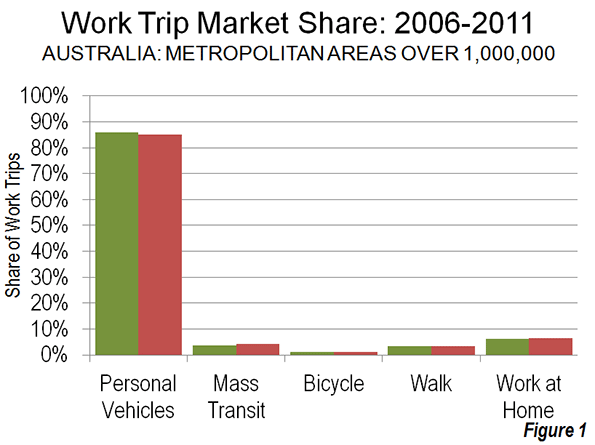
    Data from the 2011 censuses indicates that mass transit is gaining market share in all of but one of Australia’s major metropolitan areas. The greatest increase as in Perth, at 21% , aided by the new Mandurah rail line to the southern urban fringe. On average, mass transit’s market share increased by 10.8% in the five metropolitan areas with more than 1 million population. This increase seems likely to be in response to both mass transit service improvements (such as in Perth) and higher petrol (gasoline) prices. The highest mass transit market share is in Sydney, at 22%, approximately equal to that of Toronto and greater than all major US metropolitan areas except New York (31%). Adelaide has the smallest transit market share, at 9.5%, which is nonetheless 50% above that of Portland, to which Adelaide officials have often looked as a model (Figure 1).

    At the same time, there was a personal vehicle (automobiles, motorcycles, taxis and trucks) market share in all 5 metropolitan areas, averaging 2.2% (Table). However, the much larger base of personal vehicle use prevented mass transit from materially reducing the share of the automobile in any of the metropolitan areas.

    Work Trip Market Share 2006-2011
    Major Metropolitan Areas in Australia
    2000 Personal Vehicles Mass Transit Bicycle Walk (Only) Work at Home Other
    Adelaide 81.2% 9.6% 1.5% 3.1% 3.5% 1.2%
    Brisbane 76.5% 13.2% 1.1% 3.5% 4.5% 1.2%
    Melbourne 76.7% 13.3% 1.3% 3.4% 4.2% 1.1%
    Perth 80.8% 10.0% 1.1% 2.5% 4.1% 1.5%
    Sydney 69.0% 20.3% 0.6% 4.7% 4.4% 1.0%
    Average 76.8% 13.3% 1.1% 3.5% 4.1% 1.2%
    2010
    Adelaide 81.1% 9.5% 1.3% 2.8% 3.7% 1.6%
    Brisbane 75.1% 14.3% 1.2% 3.5% 4.6% 1.4%
    Melbourne 74.5% 15.4% 1.5% 3.3% 4.1% 1.2%
    Perth 78.1% 12.1% 1.2% 2.6% 3.9% 2.0%
    Sydney 66.9% 22.2% 0.8% 4.6% 4.4% 1.1%
    Average 75.2% 14.7% 1.2% 3.4% 4.1% 1.4%
    Change in Market Share
    Adelaide -0.1% -0.6% -12.2% -7.4% 4.6% 32.1%
    Brisbane -1.8% 8.3% 10.5% 0.3% 0.5% 14.4%
    Melbourne -2.9% 15.6% 17.2% -4.4% -1.0% 10.8%
    Perth -3.3% 21.0% 11.3% 4.0% -3.9% 30.2%
    Sydney -2.9% 9.4% 30.3% -3.6% -0.4% 11.1%
    Average -2.2% 10.8% 11.4% -2.2% 0.0% 19.7%
    Source: Calculated from Australian Bureau of Statistics data


    Unlike the United States, where working at home is the fastest growing method of work access (and likely to pass mass transit in this decade), Australia’s working at home share has stayed constant. Working at home is also increasing in Canada.  

    Mass Transit: About Downtown

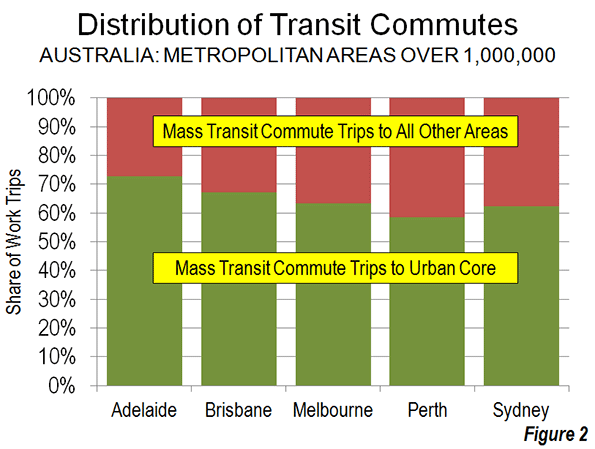
    In Australia, as in Canada and the United States, mass transit is dominated by commuting to the central business district (downtown). On average, 65% of mass transit commuters had a work trip destination in the urban core, which includes the central business district (downtown). This ranges from a low of 59% in Perth to a high of 73% in Adelaide (Figure 2). This concentration of mass transit destinations in the central business district is epitomized by Sydney, where there was a core share of all trips of nearly 60%. By contrast, in Parramatta, which includes one of the largest suburban business centers, is well served by not only the region’s rail system but also by an exclusive busway, the mass transit market share was 15%, one-fourth that of Sydney’s core.

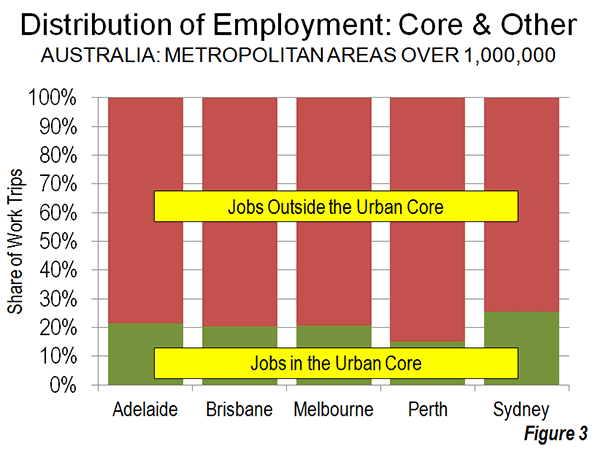
    In the five large Australian metropolitan areas, nearly 21% of jobs are located in these urban core areas that include the central business district (Figure 3). The difficulty for transit in serving the nearly 80% of work trip destinations outside the urban core lies with far lower employment densities and mass transit travel times not remotely competitive with the automobile (on the assumption that services even available). On average, mass transit carries 200 times as many commuter to each square kilometer of core land area for each commuter carried per square kilometer in the rest of the urban area (urban centre).

    It is not surprising that the central business districts dominate mass transit commuting. They are the only locations in virtually any urban area that have a sufficient employment densities and a comprehensive enough radial rapid transit system to provide no-transfer service to a large number of riders.

    Australia’s Long Work Trip Travel Times

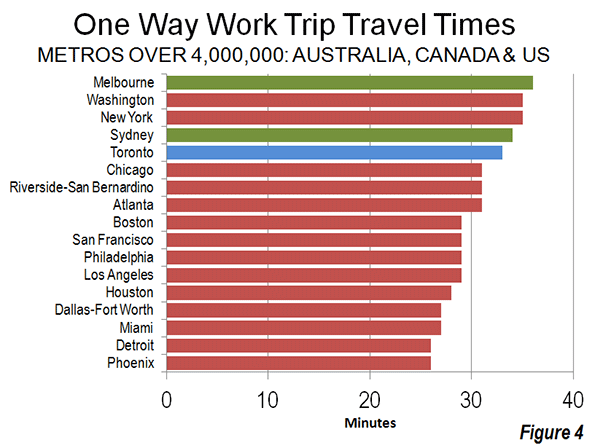
    The growth of transit has not reduced travel times but may have boosted it. In fact Australia’s workers already are traveling for longer times to work than in nearly all similar- or larger-sized metropolitan areas in Canada and the United States (Figure 4). For example, the average one-way work trip travel time in Melbourne is 36 minutes, which is longer than that of any major metropolitan area in the US or Canada.  Sydney’s one-way work trip travel time is 34 minutes. This exceeds that of all similarly sized or larger metropolitan areas in the three countries with the exceptions of New York and Washington, which are larger. In Improving the Competitiveness of Metropolitan Areas, I cited Statistics Canada data showing that mass transit work trip travel is much longer than by car and that transferring demand to transit would not improve average travel times.

    Both Melbourne and Sydney have slightly longer one-way travel times than larger Toronto, which is also larger, at 33 minutes. The Toronto Board of Trade, the Federation of Canadian Municipalities, and the Canadian Urban Transit Association have all expressed serious concern about Toronto’s long journey to work time, noting that it places is a competitive disadvantage relative to other metropolitan areas.

    Melbourne and Sydney also have longer one-way travel times than all of the other 12 US metropolitan areas with more than 4 million population. Perhaps the starkest comparison is with Los Angeles, often cited as having some of the worst traffic congestion in the high income world. Yet, despite having a urban population density higher than that of either Melbourne or Sydney and a far lower transit work trip market share, Los Angeles has a one-way work trip travel time of 28 minutes The secret in Los Angeles, is more dispersed work locations and a more comprehensive freeway system (though major parts of the planned freeway system were not built).

    Far starker is the comparison with Dallas-Fort Worth, which has a population density well below that of both Melbourne and Sydney and a much lower transit work trip market share (2%, compared to 22% in Sydney and 15% in Melbourne). Yet, in Dallas-Fort Worth, the average work trip travel time is 26 minutes, a full quarter less than in Melbourne and 8 minutes less than in Sydney.

    Where Should Planners "Put" People?

    A recent Infrastructure Australia report (The State of Australia’s Cities: 2012) cites "Marchetti’s Constant," which it characterizes as holding that "people will devote on average 90 minutes a day to travel and no more." (In fact, 90 minutes represents is a full 30 minutes greater than Marchetti indicates: See Note on Marchetti’s Constant).

    Infrastructure Australia continues "This suggests that improving the efficiency of urban transport systems by putting people in their economically optimal location within a total travel time of 90 minutes may be the key to improving the productivity of cities."

    "Putting people" where they have total travel time of 90 minutes seems a pessimistic goal; Sydney’s average daily travel time is now nearing 80 minutes. This justifies policy makers to further increase its already non-competitive work trip travel times. Economic research associates maximizing the number of jobs that can be reached by people in a metropolitan area in a specified time (such as 30 minutes) is critical to improving city productivity  (see The Need to Expand Personal Mobility.)

    The issue is not where to "put" people, but rather to facilitate more rapid access for commuters throughout the metropolitan area.

    Things are Likely to Get Worse

    In the end, there is only so much mass transit can do. Already the Australian metropolitan areas have high transit commute market shares to the cores, which leaves only modest room for improvement. At the same time there is little potential for material increases elsewhere in the metropolitan areas. Automobile competitive transit to these locations would be cost prohibitive, perhaps requiring annual expenditures rivaling the total income of the metropolitan area each year for operations, capital costs and debt service (see Megacities and Affluence: Transport and Land Use Considerations).

    Australian urban areas are generally underserved by freeways, despite their overwhelming reliance on personal vehicle travel. At the same time, urban consolidation, “smart growth” land use policies are increasing population densities without accommodating the inevitable associated additional personal vehicle demand (see Urban Travel and Urban Population Density). Things could get worse.

    Wendell Cox is a Visiting Professor, Conservatoire National des Arts et Metiers, Paris and the author of “War on the Dream: How Anti-Sprawl Policy Threatens the Quality of Life.

    —–

    Methodology: The analysis is based upon Australian Bureau of Statistics (ABS) data for capital city statistical divisions. The urban core was defined as the following local government areas: Sydney, North Sydney, Melbourne, Perth and Adelaide. In Brisbane, where the local government area is far larger, the inner Brisbane census division was used. Consistent data is limited to the central business district is not readily available. All trips which include transit as a mode are counted as transit. Workers who did not work on census day or who did not provide information were excluded from the analysis.

    Note on "Marchetti’s Constant:" Not only does Marchetti find a 60 minute, rather than a 90 minute average, but he also credits Zahavi of the World Bank with the concept, noting that with respect to travel:  "The empirical conclusion reached by Zahavi is that all over the world, the mean exposure time for man is around one hour per day.” While there are few references to Marchetti’s Constant in the academic literature, it might be more appropriately named "Zahavi’s Constant." In a further irony, Professor Peter Newman, a member of the board of Infrastructure Australia, cited 60 minutes (echoing Marchetti), rather than the 90 minute average in describing the "Zahavi/Marchetti Constant" in a Sydney Morning Herald commentary ("Why We’re in Reaching Our Limits as a One-Hour City" ).

    Photo: Downtown Brisbane (by author)

  • Modern Families: Fact from Fiction

    I sometimes struggle with our willingness to look straight through evidence to see only what we want to see, or what we believe we should be seeing. Some recent interpretations of the Australian census and conclusions about housing form and consumer choice regrettably fall into this category.

    Early results from the Australian census may have disappointed some boosters who have actively promoted the view that the typical family household is a thing of the past. The argument has had many forms but usually includes one or more of the following:

    • that single person households are the fastest growing household type; that lifestyle choices mean that more people want to live closer to city centres;
    • that the suburban housing block is an environmental calamity and is no longer even suited to what households want;
    • that high density, multi-level housing with high reliance on public transport is a preferred housing model for the ‘new’ generation of family types.

    And so it goes.

    Sadly for the promoters of rapid social change, the census reveals that the facts aren’t on their side. Indeed, in terms of housing form and family type, nothing much has really changed. There have been movements at the margin and movements in both directions, but nothing I would interpret as conclusive evidence of fundamental social change.

    Housing form

    Across Australia, 73.8% of us live in a detached house. In the last census, it was 74.3%. That’s hardly a seismic shift. In 2011, 14.6% of us lived in apartments compared to 14.7% five years earlier. Townhouses account for 9.9% of households versus 9.3%.  Don’t hold the front page, nothing much has changed.

    There are regional differences. In Sydney, detached housing is at 58.9% from 60.9% while apartments represent 27.6% of households against 26.4% five years earlier. This higher proportion in apartments comes as little surprise given the highly restrictive planning policies of NSW in that period and prior (which included a virtual prohibition on suburban expansion), combined with the long established tendency of Sydney to accommodate more people in apartments than other capitals. But for all the hype about Bob Carr’s ‘brawl against sprawl’ and subsequent planning regimes, the actual change in housing has been minimal. (Instead, what happened is that the industry stopped supplying much of either).

    In Melbourne by contrast, detached housing represents 71.1% of housing from 71.6% five years earlier. Apartments are 16.6% versus 16.4%. Melbourne, and Victoria generally, has had a less deterministic approach to planning whereby detached suburban expansion hasn’t been as vigorously opposed, so the higher dominance of the detached house is no surprise. But it also shows little change over recent times, which doesn’t support the view that a majority of consumers would prefer higher density over lower.

    In Brisbane, detached housing is at 77.6% versus 78.7% five years earlier, which is a very small change and also one of the highest proportions of households in detached housing in the country. Once again, the evidence isn’t pointing to massive social change. It isn’t even pointing to modest change.

    Family type

    Also regrettable for the promoters of widespread social change has been the fact that family types have remained largely unchanged. There are 43% of people living as a couple with children (it was 43.3% five years earlier) and there are 39.5% living as couples without children.  Remember also that ‘couples without children’ includes couples in the pre-family formation stage (young, and starting out in life in the main) and also ‘empty nesters’ (parents whose children have left the family home). A further 16% are single parent families. 

    The Census this time also went into some detail about same sex couples. But set aside the media and political hype and the facts show that the proportion of same sex couples across the country is 0.7%. There’s been a lot of media comment and public policy attention recently about that 0.7%.

    The inevitable conclusion from this evidence is simply that the overwhelming majority of people in Australia remain families who either have children, who plan to have children, or who have had children who have left home, and that this proportion hasn’t changed to anywhere near the extent promoters of social change might have wished.

    This also has implications for housing choice and style. There will be a market for higher density, inner city housing but our policy makers need to keep in mind that the detached home remains the overwhelming preference for families as a place to raise children. That also includes couples planning to raise children (not all of whom live in apartments until the first child comes along – many prefer to plan ahead) and it also includes couples with children who have left home but for whom a third or fourth bedroom is needed for grandparent child minding or children returning to the family home.

    However, the evidence hasn’t stopped some sections of the media or social commentators from reaching entirely different conclusions. “Up not out for housing” declared one writer who wrote: “Australia is increasingly favouring higher density living, according to the 2011 census.” Really? Based on the same evidence above? You’d be seriously pushed to draw that conclusion. Add to this that supply side policies have restricted the choice of detached housing in preference to the promotion of higher density, which means that increasingly housing choice has been restricted, and what there is of it, much more expensive. To conclude anything about ‘favouring’ one type of housing or another, without assessing the supply side policy constraints which limit choice, is a bit like saying more people prefer mangoes in summer than in winter. Duh.

    The Grattan Institute is another that seems committed to turning the evidence on its side to support pre-determined points of view. In this opinion piece, Grattan Institute cities program fellow Peter Mares concluded that: “that despite paying significantly more to put a roof over their head than they were five years ago, many are not ending up in the kind of housing that best matches their preferences.”  Describing the “popular view that we are wedded to the suburban block” as a mismatch, the conclusion is that ‘we’ (being, I presume, the unelected policy makers)  need to have “a serious, if difficult, conversation about what type of housing we should build and where it should be built.”

    Well, that would be difficult if it means imposing a form of housing on a population that might prefer to make its own choices about what type of housing it ‘should’ have and where they ‘should’ be living. 

    These aren’t the only examples and as more Census data becomes available, plenty more commentators will seek to extrapolate minor changes at the margin into claims this represents evidence of fundamental social change. It doesn’t and we can only hope our policy makers know the difference between evidence and a sitcom.

    Ross Elliott has more than 20 years experience in property and public policy. His past roles have included stints in urban economics, national and state roles with the Property Council, and in destination marketing. He has written extensively on a range of public policy issues centering around urban issues, and continues to maintain his recreational interest in public policy through ongoing contributions such as this or via his monthly blog The Pulse.

    Family illustration by BigStockPhoto.com.

  • From California to Canberra, the Real Class War

    Just under a year before she crawled over Kevin Rudd to claim the Prime Minister’s office, Julia Gillard visited the United States in her then capacity as Australia’s Education Minister. Her stay in Los Angeles took in the Technical and Trades College, where she brushed up on the teaching of “green skills,” a subject close to her heart. “Here in Los Angeles," she told the media that day, “under the leadership of Governor Schwarzenegger, this is a state that is looking to the future; this is a state that is leading on climate change adaption; and this is a state that’s leading on green skills and I’ve seen that on display today at this college.”

    The date was 5 October 2009. As far as dud forecasts go, these platitudes don’t match Lincoln Steffens on the Soviet Union – “I’ve seen the future and it works” – but they’re bad enough. Today Schwarzenegger has gone, his reputation in tatters, and California, reduced to issuing IOU’s to pay its bills, teeters on the brink of bankruptcy.

    Australians have long seen California as a trend-setter, given the common Anglophone culture and semi-arid climate on the Pacific Rim. There’s also the shared love of motor car mobility and suburban independence, and a voracious appetite for tech and entertainment products pouring out of Hollywood and Silicon Valley. But these days the Golden State is just as likely to fill Australians with unease. They find themselves infected with a strain of the green-welfare-utopianism that brought California to its knees.  

    Sure, this doesn’t show up in official statistics; at least not yet. Gillard and Treasurer Wayne Swan never tire of reminding Australians they are “the envy of the world”: unemployment at 4.9 per cent, GDP growth of 3 percent (or more) this financial year, government debt to GDP ratio of just 23 percent and a projected budget surplus in 2013. In April, the IMF predicted that Australia would be the best performing advanced economy over the coming two years. The government and its allies in the elite media are hyper-vigilant about containing discussion of the nation’s affairs within this bounteous frame.

    It’s hard to reconcile Australia’s position with the plight of California, which routinely attracts phrases like “basket case.” Unemployment is running at around 11per cent, significantly above the national US average of 8.2 percent, and Governor Jerry Brown is struggling with an intractable budget deficit of around $US20 billion. Thousands of teachers and other public servants are being laid off, and revenue imposts are driving businesses to other states. One commentator went so far as to say “California’s situation is in some ways more worrisome than Greece’s,” since it represents 14 per cent of the American economy, while Greece only accounts for 2 per cent of the EU.

    But if any of this is supposed to make Australians feel good about their lot, it doesn’t. However benign the headline figures look, they’re in a restive mood. The Westpac-Melbourne Institute index of consumer sentiment continues to languish in negative territory, and the latest Roy Morgan Monthly Business Confidence Survey recorded a 57 percent fall in businesses which believe “Australia will have good economic conditions in the next 12 months”. Astonishingly, the recent Boston Consulting Group consumer sentiment survey found that Australians feel less financially secure than the average European, even less secure than Spaniards, whose economy is in meltdown.

    Nor is much love flowing to Gillard and Swan. Stuck in opinion-poll hell – support for the government has been around 30 percent for over a year – they would be thrown out in a landslide if an election were held today.  

    Why are Australians so low when their economy is so high? The chattering classes are in a funk over this conundrum. People should be showering this fine progressive government with praise, they insist. In patronising tones so familiar around inner Sydney and Melbourne, one columnist scribbled “we are, as a nation, chucking a full-on, all-screaming, all-door slamming teenager temper tantrum … Maybe it’s time we grew up and realised how good we’ve got it.” Others suggest more sober explanations.

    Topping the list is Gillard’s absurd $23 a tonne carbon tax, effective from 1 July this year. Most pundits are loath to concede that, in international terms, the measure is quite radical and Gillard only embraced it to appease the Greens. From the comfort of their armchairs, they dismiss fears about the tax as irrational. After all, Treasury modelling indicates that the effect on growth will be minuscule and, under the government’s package, households will be over-compensated for cost of living increases. If only the Opposition would drop its inflammatory attacks, they maintain, the pessimism would disappear.

    Some blame the negative wealth-effect of sliding house prices and shrinking superannuation funds, battered by stock market volatility.  

    No doubt, such factors do contribute to the malaise, along with loss of faith in a parliament hit by financial and sexual scandals implicating the Speaker and a Labor MP. But opinion-makers who refuse to look beyond the headline figures are concealing the larger story. Across a range of traditional industries, workers grasp that the economy is shifting in directions that could erode the foundations of their mobility and independence. Understanding more than they are given credit for, they fear that the current Labor Government, beholden to Greens and academic elites, and hiding behind stodgy rhetoric, is driving or exploiting those shifts. The most visible manifestations of this are the carbon tax and other green agendas.

    These workers have cause to be worried, if they glance across the Pacific. In his close analysis of the California crisis, US demographer Joel Kotkin starts with the premise that “California consolidated itself as a bastion of modern progressivism.” Drawing on extensive evidence, Kotkin exposes the suffocating influence of radical environmentalists, progressive high-tech venture capitalists, Hollywood moguls, and civil rights attorneys, who have given California escalating energy costs – 50 per cent above the US average and rising – and dwindling fossil-fuel energy exploration and production, America’s sixth highest tax rates, also rising, coupled with proposals to skew the tax system in favour of the super-rich against microbusinesses, the third heaviest tax burden on business out of the 50 states, enormous subsidies and tax breaks for solar and other renewable-energy producers, and complex labour laws.

    “California’s green policies”, says Kotkin, “affect the very industries – manufacturing, home construction, warehousing, and agribusiness – that have traditionally employed middle and working class residents”. With reason, Kotkin calls these developments The New Class Warfare. There is indeed a class dimension to discontent in the United States and Australia, and it has nothing to do with the confected class-war rhetoric coming out of the Obama Administration – “we must all pay our fair share” – and the Gillard Government –“spreading the benefits of the [mining] boom”.  

    John Black, a demographic profiler and former senator, points out that since Labor came to power in 2007, “public administration, education, and health sector jobs have accounted for almost six out of ten of the 760,000 jobs created, instead of the longer term two out of ten.” The health industry alone has grown by 260,000 jobs in four years, a figure that equates to some 2.6 per cent of the whole workforce. Over those years, manufacturing, which accounts for 8.3 of total employment, lost close to 100,000 jobs.

    Last year, “health care and social assistance” replaced “retail trade” as the largest occupational category profiled by the Australian Bureau of Statistics, while “manufacturing” along with “agriculture, forestry and fishing”, traditional blue-collar hubs, were the only categories to contract. "Education and training" and "public administration and safety" ranked higher than "transport, postal and warehousing" and "wholesale trade".

    Job-shedding by a succession of manufacturing, retail and construction firms has dominated recent news bulletins. According to Black, if not for growth in the publicly-funded sector, the employment rate would be closer to 7 than 5 percent.

    If Gillard and Swan are to be believed, such shifts are beyond their control. In a major address on the economy in February, Gillard explained that “the level of the dollar – and the pace of its rise – has broken some business models and forced economic restructuring”. Displaying Marie Antoinette levels of indifference, she declared “these are powerful, economy-wide transformations, perhaps best thought of as ‘growing pains’.” If you thought this posed a complex challenge, think again. “The equation is simple,” she said, “skills brings jobs, and skills bring job security.”

    Here Gillard genuflects to the progressive dogma that education is the answer to every economic problem. It’s hardly surprising that a movement dominated by academics, researchers, educators and university administrators should claim ownership of the path to salvation. But Gillard has it back-to-front. In activities like manufacturing, economic growth brings jobs, which bring skills, not the other way around.

    It’s true that the mining boom and Australia’s safe credit rating have driven the dollar to near or above parity with the greenback. It’s also true that this has exerted pressures on the export and import-competing sector. But government action has intensified these pressures. Labor is ideologically committed to social gentrification and expansion of the white-collar professional classes, particularly in social services, even if this means transferring resources from productive industries that will slow down, stagnate, shrink or vanish.

    While Gillard and Swan would never be so candid, their allies in Australia’s bulging university system, the public sector unions and the Greens aren’t so inhibited. Nor are Labor figures like former Prime Minister Paul Keating, who criticised the Opposition’s attack on the carbon tax in these startling terms:

    … in this country, 80 per cent of people work in the tertiary economy, in services, in the industry like – as we are tonight, in the service economy. And, the new industries, the green industries, are service industries, not the old manufacturing. Manufacturing’s moved to the east [meaning East Asia]. It’s the service industries that are the new growth industries. So, to turn your back on the mechanism which allocates the capital out of the old industries and into the new ones is to turn your back on the future.

    If Gillard Labor cared about blue-collar and other routine jobs, not to mention the small business sector, they would switch to policy settings that spur growth in industries like manufacturing, retail, transportation and logistics, construction and forestry. Cutting spending, reducing company and other business taxes, junking green taxes and green tape, withdrawing from the debt market and liberalising industrial relations would hand employers more flexibility to cope with the high dollar and low cost competitors in Asia.

    Clearly, this isn’t the government’s priority. Instead they have introduced a carbon tax and a mining tax, and in last month’s budget dropped a proposed cut in company tax, they are throwing at least $2.7 billion at various green schemes, not including the “winner picking” $10 billion Clean Energy Fund, they have adopted a Renewable Energy Target of 20 per cent by 2020, they are pouring vast sums of money into higher education to the tune of $5 billion a year including an additional $5.2 billion in the budget, some of which will find its way into a maze of “sustainability institutes,” they have lifted the cap on university places and embarked on a radical plan to expand the proportion of 25 to 34 year olds with a bachelor’s degree to 40 per cent by 2025, they have re-regulated the labour market and imposed a system which, according to the chairman of BHP-Billiton, “is just not appropriate and doesn’t recognise today’s realities,” they have laid the groundwork for new multi-billion-dollar programs in aged, disability and mental health care, employing tens of thousands of new carers, and they have endorsed an industrial tribunal decision that boosts the pay of these workers by up to 65 percent.

    California here we come.

    John Muscat is a co-editor of The New City, where this piece first appeared.

    Photo of Australian Parliament House by BigStockPhoto.com.

  • Populate or Perish?

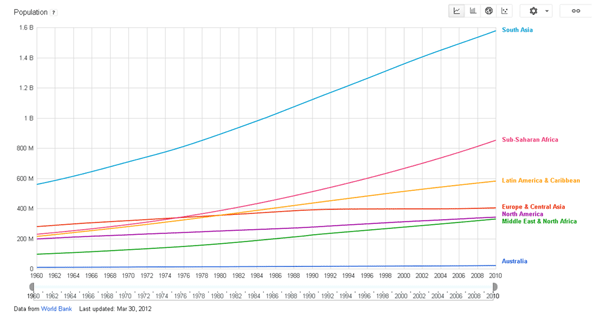
    Many global population projections point to the current world population of roughly seven billion people peaking at around nine to ten billion in 2050, after which numbers will slowly decline. In the midst of this growth, Australia’s current population of 23 million is predicted to rise to around 30 or 35 million in the same period. This low growth outlook has been called ‘big Australia.’ We are kidding ourselves, aren’t we?

    ‘Populate or perish’ was a rallying cry of post-World War II Labor Immigration Minister Arthur Calwell as he sought to overcome domestic resistance to immigration. For Calwell, immigration was the key to quickly boosting Australia’s population numbers in the interests of economic and military security. An avowed supporter of the ‘white Australia policy’ he sought immigrants from European backgrounds. Asia was, back then, regarded as the enemy.


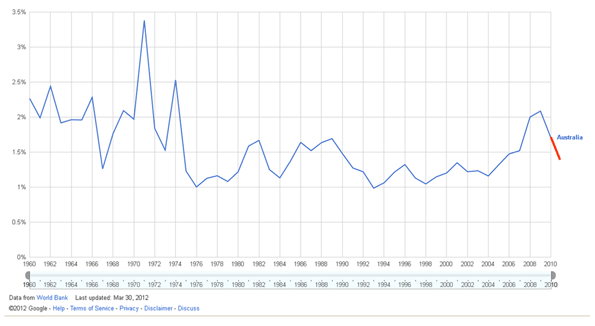
    Above: world populations since 1960. Below: Australia’s rate of population growth since 1960. Source: World Bank.

    How things change, yet stay the same. In 2012, it’s arguably just as much in Australia’s interests to boost its population numbers, in the interests of economic security and (according to some) military security also. And again, immigration – not an accelerated breeding program of naturalised Australians – is the only way this can realistically occur. As domestic industries increasingly surrender to global competition and as energy, agriculture and services industries increasingly depend on foreign markets for their long term survival, the issue of Australia’s relatively small population – despite its huge continental mass – raises little by way of public debate. A larger domestic population might provide markets for domestic industries, for local employment and for community wide infrastructure.

    In contrast the planning fraternity’s dreams of Parisian, London, or New York standards of public transport, for example, will never succeed. Our cities are simply too small to make this work.

    But talk of a ‘big Australia’ has become ‘persona non grata’ in public policy circles. We have a Federal Population Minister, but he hasn’t issued a single statement on population policy this year.  Our Prime Minister has other things on her mind, but even if her government was on more solid ground her antipathy to a ‘big Australia’ is well known and a matter of public record. And such is the apparent public hostility to the notion of a bigger population, intermixed as it is with a blend of doomsday environmentalism and references to failed Malthusian or Paul Ehlrich ‘Population Bomb’ scenarios and  myths (suggesting that Australia is running out of room and resources), that few political or public policy leaders want to take up the debate in favour of growth.

    With that in mind, I thought some very simple reality checks might prove helpful to stimulate your thinking about Australia’s population capacity relative to the rest of the world. Wendell Cox, author of the global housing affordability study ‘Demographia’ recently published his Demographia World Urban Areasreport with this summary on New Geography. I want to take just two examples and interpose them into the Australian context.

    First, let’s look at Los Angeles, California.  Often cited as a region with similarities to the Australian urban context (both in a positive and negative sense), this city popularly known for its ‘sprawl’ actually has a very high level of population density. The total population of the Greater Los Angeles area is around 15 million people. Put into context, that’s roughly two thirds of the entire population of Australia living in the Greater Los Angeles ‘sprawl.’


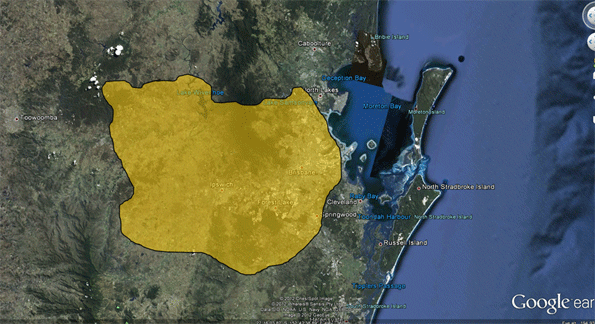
    Above: The greater Los Angeles area and below, the same area superimposed in south east Queensland.

    Put into a visual context, the contrast is even more apparent. At LA levels of population density, roughly the area we know of as south east Queensland could accommodate some 15 million people comfortably. Yet the conventional “wisdom” is that with just 3 million people it’s bursting at the seams and can’t possibly take any more

    A more extreme example, just to stretch the imagination further, is worth thinking about. Jakarta, Indonesia (our nearest large foreign neighbour) has a population of 26 million people. That’s more than the entire population of Australia, living in one (very crowded) city – at the rate of 9,400 people per square kilometre.

    Now, I’m not wishing that sort of urban density (and in large part, misery) on anyone in Australia, but the hypothetical comparison still applies, for the sake of discussion only. The footprint of greater urban Jakarta, home to 26 million people, easily fits within the boundary of south east Queensland.  In fact, it doesn’t even require the Gold or Sunshine Coasts to do it. Imagine this: the entire population of Australia, crammed as it would be into this super-compact urban footprint, and not a single soul living anywhere else on the entire continent?


    Above: Jakarta’s footprint and below, the same footprint – home to 26 million people – superimposed on south east Queensland.

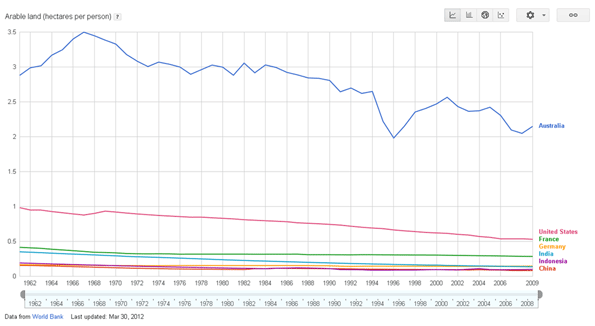
    The argument that Australia is somehow incapable of supporting substantially larger population relies on a myth that we short of room. Nor can it rely on suggestions that we would exhaust our energy stocks (we are a net exporter and would remain so at much larger population numbers), nor our food production capacity (again, we are a net exporter and would remain so even with much higher levels of population). In fact, in terms of food production, a lack of domestic market scale poses a significant problem for producers. The efficiency gains of primary production (livestock to cropping) have outpaced the growth in population.

    There is an argument regularly raised that Australia has insufficient water supply to support much larger population numbers but this argument doesn’t hold water (sorry, couldn’t help that) either. What we do lack is water storage by way of dams, but the environmental lobby has vigorously opposed almost every proposed dam in the last 30 years whether for domestic supply, agriculture or hydro energy. The lack of water storage has been a policy decision made by successive governments for varying political reasons.   

    Think also for a moment how cities like Mexico City (population nearly 20 million people) or Cairo (population 18 million) or even countries like Morocco (population 32 million in 500,000 square kilometres on the edge of the Sahara compared with Australia’s 7.6 million square kilometres) manage for water? For Australia to claim it cannot support more people due to water limitations is a bit of joke.

    Above: arable land area in hectares per person. Australia is well ahead of the field.

    Infrastructure deficits are the other vexed issue raised by by those concerned with population growth. They have pointed out that infrastructure investment has not kept pace with population, and they’re right. The problem though is largely that strategic infrastructure investment in this country is something really only talked about. Instead, what typically happens is that billions are doled out on pet projects in marginal seats or designed to win over particular interest groups that some focus group or other suggests could hold the key to winning the next election. Politically motivated rail projects (especially in NSW), home insulation schemes, TV set box boxes, green energy schemes… the list of our nation’s capacity to waste vast sums quickly is pretty impressive. Our deficient national road network, our inadequate domestic water storage (in many areas), our looming potential energy problems (not just in price thanks to a carbon tax but also in terms of power generation shortages according to some experts) – the bigger and more strategic infrastructure priorities which would support growth seem to get the least attention. Witness the latest Federal Government budget. (Read what Infrastructure Partnerships Australia, among others critical of the budget, had to say here).

    So the capacity to fund and deliver strategic infrastructure isn’t the issue. Inept public policy is.

    Instead, do we have some other more deep seated aversion to a bigger population? And is this race based? Despite being a successful nation of immigrants (  are we fearful for our culture if we had more immigration? Environmental impacts are often publicly cited as the reason to oppose more people, but if the examples of Los Angeles or Jakarta are remembered, we could in theory house a great deal more people without encroaching on vast areas of natural terrain.

    Another big reason to reconsider objections to a ‘big Australia’ is the ticking clock on Australia’s ageing population. Even the Federal Government’s own ‘Tax Reform Roadmap’ released with the May budget warned that:  “The proportion of working age people is projected to fall markedly over the coming decades. Today there are about 4.8 people of traditional working age for every person aged 65 and over. This is expected to fall to around 4 people within the next 10 years and to around 2.7 people by 2050.”

    Australia’s current rate of population growth is hovering around 1.4%. We are just shy of 23 million people. We say we’re concerned about getting to 35 million by 2050, by which time the world population will have increased by 2 billion people. We know that our ageing population will struggle to be supported by a diminished workforce  and that we lack sufficient critical mass to sustain a variety of industries in the face of global competition. Yet we consistently refuse to confront the question of a larger population and the consequences of failing to have one.

    Ultimately even if we agree collectively to prefer to remain a small nation of less than 30 million, it’s a discussion we need to be having. Pretending the issue isn’t there won’t do anyone any good.

    Ross Elliott has more than 20 years experience in property and public policy. His past roles have included stints in urban economics, national and state roles with the Property Council, and in destination marketing. He has written extensively on a range of public policy issues centering around urban issues, and continues to maintain his recreational interest in public policy through ongoing contributions such as this or via his monthly blog The Pulse.

    Australia graphic by Bigstockphoto.com.

  • Sydney’s Long and Lengthening Commute Times

    The New South Wales Department of Transport Housing and Transportation Survey reports that the average one way work trip in the Sydney metropolitan area (statistical division) reached 34.3 minutes in 2010. As a result, Sydney now has the longest reported commute time in the New World (United States, Canada, Australia and New Zealand), except for the New York City metropolitan area (34.6 minutes).

    Longer Commutes than in Dallas-Fort Worth or Los Angeles: Sydney’s average work trip travel time has increased approximately 10 percent since 2002. The 34.3 minute one way travel time is approximately 30 percent higher than that of larger Dallas-Fort Worth, which about half as dense. Part of the reason for the longer commute time in Sydney is its far greater transit dependence. Approximately 24 percent of work trip travel is on transit (which is slower for most trips). This compares to approximately 2 percent of travel in Dallas-Fort Worth.

    Even Los Angeles, with its reputation for "gridlock" has a shorter average commute time, at 28.1 minutes. This is made possible by the extensive Los Angeles freeway system, greater use of automobiles and more dispersed employment patterns (despite the higher density of Los Angeles relative to Sydney). The average Sydney commuter spends nearly an hour longer traveling to work each week than the average Los Angeles commuter.

    Even Longer Commutes Ahead? Sydney’s densification policies (urban consolidation policies) seem likely to lengthen commute times even more in the future, given the association between higher densities and greater traffic congestion.

  • Australian Elections: A Comeback for Pro-growth Policy?

    The latest local government elections in Queensland, along with the by election for former Premier Anna Bligh’s state seat of South Brisbane, may point to a fundamental shift in popular mood back in favour of growth and development. After many years of anti-growth policy paranoia, it’s a refreshing wind if it lasts.

    Was the electoral storm that swept ‘Can Do’ Campbell Newman and the conservative LNP to power only a few weeks ago something more than a direct reaction to a failed state Labor government? Subsequent local government election results state-wide may point to a more fundamental shift in community attitude. Why? Because one month after a resounding rejection of the state government, voters once again lined up to sink the knife into incumbent mayoral candidates who have presided over needless bureaucracy, excessive red tape and anti-growth policies disguised in political or media spin.

    Those who expected a bounce back to Labor from voters recognising the very large mandate of the new LNP state government were proven badly wrong. Even Labor’s stronghold state seat of South Brisbane, narrowly held by the former Premier at the last election, barely got over the line to Labor this time in a by election.

    Is this a sign that anti-growth and anti development policies, manifesting themselves in all manner of precautionary principles, red tape and green tape and which effectively ground the Queensland economy to a standstill, are on the nose? Maybe it’s not just the Labor ‘brand’ but bad public policy per se which is being rejected.

    The real economy – undisguised by the statistical support of the booming resources sector – has been suffering, with construction activity across the board falling to record lows, interstate migration and population growth slowing to record lows, and house prices and personal balance sheets under stress. Rising utility costs, partly or largely (depending on your view) driven by green-tinged policy settings, have hurt average families. New housing costs have risen and proven a barrier for a generation of young families wanting to enter the market without having to sacrifice everything in exchange for a mortgage they can’t afford. Overall, the people are clearly pissed off. And they showed it.

    In Brisbane, Lord Mayor Quirk – a prominent anointee of ‘Can Do’ Campbell Newman – was returned with an increased majority. And elsewhere, pro-growth candidates replaced incumbents whose administrations had presided over growth in regulatory process with little by way of measureable outcomes. In Redlands, a reputedly notorious local authority in terms of its hostile attitude to growth and development, Mayor Melva Hobson was turfed out in favour of pro-growth candidate and new Mayor, Karen Williams, (Williams scoring 69% of the primary vote to Hobson’s 31%).

    On the Gold Coast, pro-growth candidate and Chamber of Commerce President Tom Tait won resoundingly with 37% of the primary Mayoral vote. The next closest candidate was Eddie Saroff – a long serving Gold Coast Councillor and former Labor federal candidate, on 17.5%.

    On the Sunshine Coast – another Council which became notorious for being difficult to deal with and consumed with red tape and pointless administrative process – the pro growth and pro business candidate Mark Jamieson (33%) scored more than double his nearest two rivals, each on 17%.

    In Ipswich, popular Mayor Paul Pissale increased his majority, with almost 88% of the primary Mayoral vote. You would be hard pressed to find a more passionate, pro-growth and pro-development Mayor than Pissale, especially when it comes to his beloved Ipswich. This is a man who proudly proclaimed that he welcomed development and developers to his city.

    In Cairns, another region fast developing a reputation for an economy strangled in anti-development red and green tape and excessive planning controls, prominent local business identity and pro growth candidate Bob Manning picked up 56% of the primary vote, well ahead of his nearest rival, the incumbent Val Schier on 20%.

    The South Brisbane by-election result adds weight to the argument that this is part of a widespread and deep seated mood for change. Labor, in what is billed as a stronghold inner city seat, expected some solid bounce back as South Brisbane voters were encouraged not to give the LNP another seat in Parliament. They didn’t listen to the party line, and only one in three (33%) put the new Labor candidate Jackie Trad first. By contrast 38% of South Brisbane voters put LNP candidate Clem Grehan first. Labor had to survive on the preferences of the green vote, which drew 19.4% of the primary vote in that seat.

    Now take these most recent results and put them back to back with what happened in the state election just over a month ago. The LNP picked up a staggering 50% of the primary vote state wide, giving them 78 of the 89 seats. Labor picked up just over one in four primary votes, at 26%. The Greens only picked up 7.5% – less than their result in the previous election. The Greens in fact were outpolled by Katter’s ‘Australia Party’ which scored 11.5% of primary votes state wide. (I’m not sure whether to describe Katter’s party as pro growth but its connections to pro development rural interests suggests it is).

    That state election was a clear cut choice between a ‘Can Do’ Campbell Newman and a Labor machine which ran heavily on anti-development messages in its campaign, alleging that an LNP Government would be hostage to developers and hostile to the environment. There was no confusion in voter’s minds when they rejected the latter and firmly chose the former. You don’t get much more pro-growth than a candidate and a party which uses ‘Can Do’ as its rallying cry.

    The point of all this is that the new political mandate for growth shouldn’t be dismissed as some isolated reaction to the past government’s failings. The community seem to be making their views clear: bring back growth, bring back economic prosperity, restore the state’s balance sheet and with it, restore some health to personal balance sheets. The anti-growth movement will never be silenced by majority views but hopefully in this clear message from the people, it will take a backseat and keep a low profile, for a while at least.

    For Labor, aligning itself with anti-growth movements might prove even more damaging in the long run. Average workers on average wages left the Labor Party in Queensland in no doubt they were on the nose. It’s not just an issue of a damaged brand, and much more than a failed campaign strategy. If Labor stands in people’s minds as a party which objects to progress, which imposes punitive taxation on even humble endeavours, which is responsible for excessive intrusion of regulation into people’s lives, and which is hostage to fringe interest groups in a bid to win preference deals, it may be left in a political wilderness for a long time to come. Labor’s reconnection to working families and their values and interests is as surely the key to the revival of their fortunes, just as John Howard achieved and as Campbell Newman and a host of newly elected Mayors in Queensland have proven.

    Ross Elliott has more than 20 years experience in property and public policy. His past roles have included stints in urban economics, national and state roles with the Property Council, and in destination marketing. He has written extensively on a range of public policy issues centering around urban issues, and continues to maintain his recreational interest in public policy through ongoing contributions such as this or via his monthly blog The Pulse.

    Brisbane photo by Bigstockphoto.com.

  • Alternative Growth Paths for Sydney: A New Report and its Implications

    Population growth in Australia is double the world average and the New South Wales Department of Planning has projected that the population of the Sydney region will increase by 57,000 people annually. How will these extra people be housed?  The NSW Government follows the usual doctrines based on higher population densities. Its planning policy, known as The Metropolitan Strategy, works on locating some 70% of new dwellings within existing urban communities (in-fill) and 30% in new greenfield sites. 

    This policy is implemented by orders issued by the New South Wales Minister of Planning and imposed by ministerial fiat which are neither tabled nor debated in parliament.

    To achieve this 70/30 strategy the Department of Planning in effect has placed a restrictive growth boundary around Sydney to force higher-densities into existing residential areas. Greenfield land release has been reduced from an historic 10,000 lots per year to less than 2,000. This has caused a severe land shortage. 

    These policies are undemocratic and widely resented. What is more, the government has not justified them in terms of public good.  Indeed they might find that hard to do. For example, Australian studies show that greenhouse gas emissions per person are higher in high-density living, congestion is worse, human health is compromised, the costs of electricity, gas and water services increase, heritage conservation areas valued by the community are often lost and irreplaceable urban patchwork of greenery and wildlife within the city is decimated.

    The CIE Report

    The previous Labor Government commissioned a report on possible planning alternatives for Sydney. This report, by the Centre for International Economics (CIE) titled The Benefits and Costs of Alternative Growth Paths for Sydney: Economic, Social and Environmental Impacts was delivered back in December 2010. It has only now been released by the current government. 

    The report discusses three different scenarios for Sydney.  These portray alternatives of 90%, 70% and 50% of new housing to be built in existing urban areas (in-fill) – and correspondingly 10%, 30% and 50% in greenfield sites.

    The report compares the costs of the 90/10 and 50/50 scenarios with those of the current Metropolitan Strategy 70/30 ratio over a twenty-five-year period. It finds the cost differences between them are comparatively trivial. When compared to the Metropolitan Strategy 70/30 policy, the annual non-discounted cost saving per new dwelling for the 90/10 scenario is only A$151.  For the 50/50 scenario the additional annual cost per new dwelling is found to be A$950.

    This report contains two significant flaws. The first is an implicit assumption that the price of land will be the same for all three scenarios. It also fails to properly consider additional cost factors.

    Price of Land

    Each scenario examined changes the amount of new land that would be released for development. When compared with the current baseline 70/30 strategy, the 90/10 scenario would require even greater restrictions on the release of new housing land and hence an even greater land shortage. By contrast, the 50/50 scenario would allow for a more generous release of new land and hence more land available for construction.  The immutable laws of supply and demand ensure that the degree of land restriction would significantly affect the cost of housing in each scenario, completely swamping the relatively minor cost differences due to other factors.

    Incredibly, the report appears to fail to take the effect of relative scarcity on costs into consideration. It simply assumes that the price of land will remain the same for each scenario.

    This is significant because the report includes in its calculations factors that are highly dependent on the cost of land. If the report’s findings are to be credible, the variation of these factors caused by land price variation in each scenario examined should also be taken into account.  When land is scarce high-density developers can make greater profits as they have less competition from low-priced houses and landholders can get higher prices for their land than would be the case otherwise. 

    Other Costs

    The report alleges that electricity consumption is greater in houses than it is in apartments. This is incorrect. Studies show that consumption per capita is greater in apartments. It appears that the data the report relies on does not take into account the consumption of electricity common to the whole apartment block such as lifts and lighting common areas such as foyers and car spaces. 

    The report also does not take into account costs to existing residents arising from forcing high-density into communities originally designed for low-density. These include:

    • The impact on a single-residential property that has high-rise built next to it. This can involve theft of amenity: new in-fill residents look over gardens of existing residents while the latter have to look onto unsightly structures, and suffer lack of privacy and overshadowing.
    • Congestion. Existing residents have to suffer from increasingly congested streets and shortage of street parking.
    • Shortage of recreational facilities. As more vacant land is built upon in a community originally designed for low-density, it becomes difficult to secure new open areas to service the needs of the additional population at a reasonable standard.
    • Reduction in housing choice, particularly for families.  Most infill development consists of apartments which are not suitable for bringing up young children.  Indeed the majority of those currently living in apartments do not do so by choice. A survey indicates multi-story apartments are not even acceptable to most people wishing to downsize, if they have other choices such as smaller single residential houses or villas.
    • Reduction in biodiversity. When gardens and open space are replaced with unit blocks this has a severe effect on urban plant and animal life.
    • Heritage items valued by the community such as traditional period architect designed housing are often lost.
    • Atmospheric pollution.  There is a local effect on residents of atmospheric pollution in high-density areas.  This is due to higher traffic densities and to less volume of air being available for the dilution and dispersion of pollutants.

    If these considerations had been quantified into the report’s calculations, they would have changed its overall findings.

    Conclusions

    As is not unusual in reports by density advocates throughout the English-speaking world, the report’s findings are marred by the fact that significant factors are omitted.  If costs and benefits were fully accounted for, including the costs and benefits borne by existing residents, an already weak case for emphasising densification over fringe development would vanish.

    As we have seen, even with the flawed accounting used in the report, the magnitude of the cost differences that it finds between its three scenarios is trivial. These tiny differences make the unpopular Metropolitan Strategy 70/30 policy hard to justify, and any intensification of this strategy to 90/10 impossible to justify.   Cost differences of either A$151 or A$950 are small compared to the price that people have to pay for a house (the median price in Sydney is A$650,000). These insignificant figures need to be considered in the light of providing people with the opportunity of living in the housing style of their choice.

    If costs and benefits were to be fully accounted for, including those borne by existing residents, the case for a policy of enforced densification cannot be supported.   When asked voters want less rather than more densification.

    High land prices due to restrictive land-releases are already making housing unaffordable for the next generation.  Unwanted high-rise development represents theft from the community, reducing the amenity of existing residents and transfers that value to property developers without recompense. This theft is aided and abetted by the policies of the State Government. Moreover, it continues to result in well-publicised favours being granted to developers with connections to government.

    The Metropolitan Strategy needs to be replaced. A good start would be for the New South Wales government to adopt the suggested 50/50 strategy as the first step towards reform.  The provision of more choice will allow people to demonstrate whether they prefer to live in high-density or in lower cost, more spacious housing with a garden in the suburbs.

    (Dr) Tony Recsei has a background in chemistry and is an environmental consultant. Since retiring he has taken an interest in community affairs and is president of the Save Our Suburbs community group which opposes over-development forced onto communities by the New South Wales State Government.

    Sydney suburb photo by BigStockPhoto.com.

  • The Use and Misuse of Glaeser’s Triumph of the City

    Appeals to authority are now the stock-in-trade of progressive pundits across a range of public controversies. In the face of popular discontent bubbling up from forums on the net and elsewhere, their fall-back posture is heavy-handed ‘expertism’. Policymaking is the prerogative of those with the right qualifications and credentials. Ordinary citizens should butt-out, no matter how self-interested the experts may seem. So too in the field of urban policy, encumbered as it is with a green-compact-city orthodoxy, do appeals to authority hold sway.

    Over the course of 2011 a book title kept cropping up in some of the media coverage of urban issues – Triumph of the City by Harvard economist and New York Times blogger Edward Glaeser. Arguing that successful cities should be “urban theme parks” or “playgrounds” for the benefit of “smart inhabitants” – as progressives like to conceive themselves – while the energy-wasting populace must be brought to heel, Glaeser is, for the pundits, an authority figure from central casting.   

    The Sydney Morning Herald’s urban critic, Elizabeth Farrelly, claimed the book “instantly became flavour of the month amongst the cognoscenti”. Proceeding to deliver another full-throated hymn in praise of density, she abridged Glaeser’s argument in typically hyperbolic terms. If only we lived in “dense urban centres”, miracles would abound: cheaper housing, better transport, protected wildernesses, no climate change, decent coffee and “a choice of walk-to tapas”. 

    Her colleague Ross Gittins, the paper’s economics editor, was equally impressed. “Glaeser’s observations seem of obvious relevance to Sydney”, he wrote.  “Our sky-high house and unit prices are partly the product of … excessive government restrictions on development”, wrote Gittins, before adding, without a hint of irony, “there are limits to how far Sydney can be allowed to sprawl”. He resolves this contradiction with the phrase “Sydney needs to go up”, echoing a warning of Glaeser’s which serves as the new slogan of green urbanism: “If cities can’t build up, then they will build out”.  

    This is sweet music to the green-tinged intelligentsia, for whom there is no worse crime against the planet than a bulging ‘human footprint’. Before weighing-up the merits of Glaeser’s build-up-not-out pitch, though, it should be said that many of his Australian fans either misrepresent or misunderstand his position. Farrelly’s diatribes against developers and suburbs are commonplace. She is all in favour of rigid ‘urban growth boundaries’, prescriptive urban consolidation and other features of the anti-sprawl agenda adopted by state and local governments over recent decades. So apparently is Gittins.

    Glaeser’s views are more complex. “The government should not be in the business of enforcing lifestyles that we happen to find appealing”, writes Glaeser, “[t]he government’s job is to allow people to choose the life they want …” He takes care to explain that this perspective accords with sound economic thinking:

    “[A]t the heart of economics is the belief that businesses work best by competing furiously in a market that the government oversees as impartial umpire. The same is true for cities. Competition among local governments for people and firms is healthy … The national government does no good by propping up particular places, just as it does no good by propping up particular firms or industries.”

    Identifying this principle as ‘spatial neutrality’, Glaeser is indifferent to the type of ‘growth boundaries’ so popular with Australian town planners and their green theorists, commenting at one point that “greenbelts may serve to check urban growth – which may or may not be desirable”. Indeed, it’s hard to see how any form of coercive zoning can be consistent with his position.

    Glaeser’s core argument is that the principle of neutrality has been systematically violated in the United States. “Cities [by which he means inner-cities] can compete on a level playing field”, he says, “but over the past sixty years, America’s policies have slanted the field steeply against them”. These policies include inner-city development controls, especially height restrictions, the home mortgage interest deduction, the Interstate Highway system, inferior inner-city schools administered by local school boards and inadequate gasoline (petrol) taxes. Remove such “artificial barriers” and “everybody, not just the privileged few, can enjoy the pleasures of Manhattan or Paris or Hong Kong”.

    Lurking behind Glaeser’s sedate prose, but never quite breaking out, is some kind of ultra-centripetal theory of human settlement. Human beings maximise their satisfaction by living in the centre of the world’s leading city, measured by size, wealth and amenity. It’s just that economic and legal barriers fix most of them in various grades of less desirable places. If the whole world could, in other words, they would pack up and move to Manhattan (“New York is still a paradigm of urbanity”, says Glaeser). In the years between 1880 and 1920, when millions of people from all over Europe swarmed into the crowded tenements of New York’s lower east side, such a theory might have had some plausibility. But the world changed. Since at least the middle of the twentieth century, the statistical and historical evidence points in the opposite direction. Countries like the US and Australia saw massive population shifts to the suburbs and attracted millions of immigrants hoping for their own suburban lot and house.

    However much Glaeser’s “artificial barriers” may have contributed to suburbanisation in the United States, the key issue is how important they were relative to one of the great transformations of the twentieth century: the unremitting growth of motor vehicle ownership and motorised commercial transportation. Even Glaeser concedes that “transportation technologies shape our communities, and modern sprawl is the child of the automobile”, though he insists the convenience of car ownership can be diminished.  

    The problem is that the trend towards urban dispersion started well before Glaeser’s so-called barriers came into existence. In his book  Downtown: Its Rise and Fall 1880-1950, Robert Fogelson writes that “by the mid and late 1920s, however, some Americans had come to the conclusion that the centrifugal forces were beginning to overpower the centripetal forces – or, in other words, that the dispersal of residences might well lead in time to the decentralization of business”. And the trend shows no sign of abating. Having analysed the 2010 US census, Joel Kotkin and Wendell Cox find that during the 2000s, just 8.6 per cent of the population growth in metropolitan areas with more than a million people took place in the core cities, the rest took place in the suburbs. “America continues to suburbanize”, they say. This is despite the financial crash, which would have blunted some of Glaeser’s pro-suburban incentives. Could it be that most people just prefer space over density?

    As for Australia, Glaeser’s core argument simply doesn’t hold. Most of his “artificial barriers” have no direct equivalents here. Our advanced motorways are intra-urban rather than interstate networks, and attract significant toll charges, our schools are subject to state rather than local board control and home mortgage interest is not tax deductible. No reasonable person would claim that our governments have “slanted the field” in favour of suburbs over recent decades. The very notion of spatial neutrality has been anathema. Urban consolidation is all the rage, suppressing land releases while driving up values to the point that Australian houses are consistently ranked ‘severely unaffordable’ in the annual Demographia survey, due in no small measure to a crushing mix of developer and infrastructure contributions and utility levies.  

    Still, Australian Bureau of Statistics figures show that four of the five strongest growing Sydney Local Government Areas (LGAs) in the year to 30 June 2009 were in the outer west: Blacktown, Parramatta, The Hills Shire and Liverpool, which offer home buyers the best prospect of owning a detached house and provide many industries with the cheap land, low rents, extensive space and proximity to major road junctions they need to thrive. According to the Department of Finance, 90 per cent of the containers passing through Sydney’s Port Botany originate in or are destined for the city’s outer western region. In its recent decision to abandon some of the previous state government’s residential zoning restrictions on Sydney’s fringe, the current government is just coming to terms with reality.

    Following Glaeser’s logic, if, in conditions of “a level playing field”, or even a “field slanted” against outer suburbs, residents and businesses still “choose” to locate on the periphery, government officials have no right to interfere, and will cause economic damage if they attempt to restrain these choices. Contrary to the impressions of his green-tinged admirers, Glaeser offers, in the Australian context, a powerful argument in favour of hands-off planning, decentralisation, suburbanisation and urban growth. 

    John Muscat is a co-editor of The New City, where this piece first appeared.

    Chicago photo by Storm Crypt / Flickr

  • Will You Still House Me When I’m 64?

    In the song by the Beatles, the worry was about being fed and needed at 64. Things have changed. If the Beatles wrote those lyrics today, the worry instead might be about housing.

    Australia’s aging population is an inevitability. As our replacement rate falls (we’re having fewer children per family) and life expectancy extends, the proportion of over 65s will double in 40 years. In raw numbers, there were 2.5 million over 65s in 2002, and this will rise by 6.2 million in 2042. That’s an extra 4 million in this demographic. Have we given enough thought to where they’re going to live, and what styles of housing they might prefer?

    There have been a number of developers who have understood the looming significance of Australia’s aging population, and who have sought to supply the ‘retirement living’ market with product that suits. At one end have been the glitzy apartment style residences in inner city locations, while at the other have been the aged care ‘homes’ provided for those in need of access to nursing care or medical assistance, or at least the reassurance of it being present.

    Running parallel with the provision of retirement living or seniors living projects has been an assumption that, once ready to abandon the family home of many years, seniors will be happy to move across town and relocate to the facilities that are available. Perhaps this is hangover from the days when retirement or aged care living was provided on Stalinist lines: our oldies were forcibly shuffled off to some retirement centre well away from the rest of the community they grew up in. A sort of gulag for grumpies?

    But what if seniors simply want a change of housing style within their community? What if they don’t want to move across town to the only available accommodation because they would prefer to continue to live in the neighbourhood and community they have spent a large part of their lives living in? They may want to continue to shop with ‘their’ local butcher, visit their local supermarket, newsagent, bank branch (if it still exists) and generally remain connected to the people and places that they’re familiar with – including (quite possibly) members of their family, children and grandchildren.

    Meeting that need in the future is going to be close to impossible unless planning schemes (old fashioned zoning laws) adopt a more flexible approach. Flexibility will be needed because most of the existing suburbs of our major population centres are largely built out and will require retrofits and redevelopment of existing stock to accommodate senior’s housing preferences. Generally, the only tracts of undeveloped land capable of meeting seniors housing needs tend to be on the outskirts and while there’s nothing wrong with fringe development, it seems unfair to expect seniors to relocate across town to regions they’re unfamiliar with and to alienate themselves from their community simply because supply side mechanisms (controlled by planning schemes) don’t permit choice.

    Further, the built out status of our ‘established’ suburbs – as they now stand – is something that much planning law seems to want to preserve for time immemorial. It’s a little bit like imagining that someone has declared the existing housing mix and styles a fixture of permanency: let’s put a giant glass dome over it all and call the city a museum – because we don’t (it seems) want anything to change.

    But if we are to allow Australia’s seniors to ‘age in place’ and to ensure our markets provide choice, it’s going to mean some things will need to change, given the likely levels of future demand. The fastest growth of aging populations will be around our ‘middle ring’ suburbs and given the overwhelming preference to ‘age in place’, it is these suburbs that are going to have to change if those needs are to be met.

    What will that change look like? The psychology of seniors in years to come – even today – is going to be different to those of previous generations. They’ll likely be more active rather than sedentary. The family home that’s served them to this point may now be simply too big for their needs, or contain too many stairs (the artificial hip or knee doesn’t like too many stairs). Their future housing needs will vary widely – some will be happy with apartments in high to medium density developments (elevators to their level of living means no stairs) while others (generally the majority) will prefer smaller, detached or semi-detached, single level dwellings. Many may want a small yard or garden (or at least a large balcony or terrace if in a unit), and perhaps want to keep a small pet dog or cat. They may want a spare bedroom for visitors or for babysitting grandchildren. They will probably prefer to be close to shops and near to public transport. And the majority will want to find something of that nature generally within the same community they’ve been living in. It is unlikely they’ll be searching for the ‘retirement home’ style of assisted care living until they’re well into their later years when their choices will be more limited.

    Their problem will be that developers will struggle under current planning schemes to get approval for semi-detached housing designed with seniors in mind, if it means amalgamating some detached residential dwellings near local shops, because that land use is highly protected. They will struggle to gain approval to convert a large single site into medium or high rise in areas near local shops or transport, because the community will likely object – particularly if it’s in a neighbourhood where low density prevails (typical of most of suburban Brisbane). Advocates of Transit Oriented Development (TOD) style development might now be shouting at this article that ‘TODs are the answer.’ That might be so, if only one single TOD had been delivered during the past 15 years we’ve been talking about them.

    Plus, the majority of proposed ‘TOD’ style development areas largely surround inner city transport nodes. Not much use if you’re in Aspley and want to stay there. And of course there’s the reality that multi level apartments are much more costly to develop and construct than the cottage building industry’s approach to single level, small detached housing.

    The changes needed need not be dramatic, and subtle changes to land use surrounding existing retail or service centres in middle ring suburbs ought to be able to be achieved with minimal planning fuss. It is still possible to imagine something being done with minimal planning fuss, but very difficult to point to any actual examples. Still, hope springs eternal.

    The changes could allow (for example) for some amalgamations of larger lot, detached post war homes into higher density cottage-style dwellings on a group title, still single level and with low construction costs. A 2000 square metre amalgamation could in theory provide 10 such cottages, with private garden space and minimal likelihood of community objection. The key would be to keep regulatory costs down, so punitive development levies would be out of order. After all, the infrastructure already exists and seniors tend to be much less demanding on utilities or services than young households. (Have a think about how little garbage they generate, or how little water they use as an illustration. It would surely be unfair to tax seniors in this type of housing for infrastructure upgrades under the circumstances?).

    The traditional ‘retirement home’ or ‘aged care’ model of seniors housing is still going to be needed, especially as people require more frequent or acute care in their later years, and become less and less independent. But there will be a good 10 to 15 year period for people for whom the family home no longer suits, and who aren’t yet ready for ‘God’s waiting room.’ How we accommodate this coming bubble of seniors who want to age in place and continue to live independently, and how planning schemes will allow markets to provide choice and diversity, is something that perhaps should be a policy focus now.

    Ross Elliott has more than 20 years experience in property and public policy. His past roles have included stints in urban economics, national and state roles with the Property Council, and in destination marketing. He has written extensively on a range of public policy issues centering around urban issues, and continues to maintain his recreational interest in public policy through ongoing contributions such as this or via his monthly blog The Pulse.

    Photo by BigStockPhoto.com