Tag: Australia

  • Is Industrial Strife a Sign of Housing Stress?

    Industrial disputes – including a spate of on and off again strikes at national carrier Qantas – are becoming once again a frequent feature of the Australian media. Unions are pushing for wage rises in the face of the falling buying power of the fixed wage (as costs of living rise). Those wage push pressures are being resisted by businesses trying to stay afloat in a very ordinary domestic economy and amidst rising global competition.  

    But instead of a conflict between labor and business, perhaps we may consider   lower living costs as a solution which benefits both? Fundamentally, this boils down to addressing our biggest cost burden: housing. 

    The rapid escalation of housing costs have occurred under the aegis of Labor dominated state governments. Whether in Queensland, New South Wales or Victoria – Australia’s three largest states – their imposition of artificial growth boundaries that limited land supply, the introduction of upfront taxes on new development, and ever more complex planning and development regulation have driven housing prices to unsustainable levels.

    This is ironic since the worst impacts of those policies have been most felt by the very working class constituency which Labor traditionally sought to represent. Having presided over and championed policy mechanisms which have driven up housing costs for workers, these same governments then resist attempts to recover that standard of living through wage growth.

    Now before you think I’ve gone all Marxian militant on you all (trust me, I haven’t), here’s an example of what I’m driving at.

    Much has been said about housing affordability and what it will mean to lock an entire generation out of the housing market.   Recently this story documents yet another report attesting to falling home ownership and the rise of a renting class.   Particularly hard hit are the people who are trying to buy a first home in which to raise a family. They could typically be around their mid to late 20s, biologically in their prime for having and raising children. At this stage of life, you are probably below the average income for your career or profession so the reality of the affordability problem is most acute.

    In Queensland, this might be a teacher in their mid 20s, with two or three years of training, married to a constable who together earn after tax income around $87,500 per annum. (This combined income would be much less of course if, for example, one of our young couple was a child care or retail worker).

    Now, take a modest new family home in an outer suburb like North Lakes or Springfield. Let’s assume they’ve saved a small deposit, and with a loan of $400,000, they buy something for around $450,000. That’s hardly McMansion territory. But that loan, over 30 years at 7.8%, will cost them close to $35,000 per annum in repayments, or 40% of their combined after tax incomes.

    This, of course, is before they even think about children, and the prospect (despite generous maternity and paternity pay and leave provisions) of enduring a significant household income reduction while one of them isn’t working. Even on returning to work, there would then be child care fees, which quickly erode their pre-child household budget.

    Buying a home and starting a family have become a huge financial consideration, instead of a fairly normal and unremarkable pattern of generational and social growth. And it is now absolutely dependent on a dual income family, with both of them preferably good incomes.

    This is a profound change over the last decade. As a result, fewer people are buying homes, people are postponing children (until they can afford them) and when they do, they’re having fewer children. A countless stream of statistical and demographic reports are now underlining this change on an all too frequent basis. Although some greens may celebrate it, this is very bad news long-term for the economy, for society and the community as a whole. 

    So is it any wonder we’re seeing wage push pressures?

    Consider the cost of the $450,000 modest home they’ve bought. Within that price is roughly a $50,000 up-front ‘developer levy’ (better called a new home buyer tax). There’s probably a similar cost of in inflated land costs, brought on by artificial land supply constraints in a country of abundant land. There would also be a raft of minor additional building costs introduced under the guise of ‘green’ or ‘sustainable’ building guidelines, in order   ‘to prevent the sea from rising’. Plus there’s a hard-to-quantify compliance cost because getting the approval to develop the land for new homes now takes 10 years instead of a few months, engaging teams of town planners, lawyers, and other hangers on.

    The total cost of all of these additions to the price paid by our young couple could easily be well over $100,000. If you don’t believe me, check out this old report which I commissioned some years ago.

    A quick bit of math’s now follows. That extra $100,000 (conservatively) has been funded via our young couple’s mortgage. That’s an extra hundred large they’ve borrowed, to cover the costs of additional taxes, fees and compliance introduced under the watch of a State Labor Government. That $100,000 is worth an extra $8,640 per annum out of their pockets. If their repayments fell by that amount, their mortgage costs would be around $26,000 per annum in total, or just under 30% of their combined household income – not 40% of it.

    There you have it. At 30% of household income, not only the home becomes more affordable, but so do children. But at 40%, it’s proving to be touch and go.

    There are two ways, simply put, to improve the cost of living equation faced by younger workers on largely fixed incomes. You can increase their wages (which the unions want and which businesses and governments resist), or you can reduce their costs of living.

    This has somehow eluded people working in state treasuries and planning departments. I haven’t even commented on the insanity of the carbon tax, which is only going to exacerbate basic costs for energy further and likely weaken Australian exports.

    The simple economics of what we’re talking about was summed up beautifully over 160 years ago, in Charles Dickens’ novel David Copperfield, when Mr Micawber lectured the young Copperfield on the perils of exceeding budgets:

    "Annual income twenty pounds, annual expenditure nineteen nineteen six, result happiness. Annual income twenty pounds, annual expenditure twenty pounds ought and six, result misery."

    Mr Micawber, you’ll note, wasn’t implying the need for more income, he was highlighting the important role played by expenses.

    In the Australia (and Queensland) of 2011, the same still applies. Rather than push for more income, unions could do better to lobby their Labor Parties to reduce their living costs. Reducing the housing infrastructure levies, relaxing the rigidity and ideology of urban growth boundaries, reducing compliance costs, cutting green taxes would drive down the costs of housing.   

    In this era of globalization, fighting pitched industrial battles with employers for a few extra dollars a week in income seems futile compared to pressuring   governments over the induced inflation associated with the providing a family home you can afford and raise a new generation of Australians.

    Ross Elliott has more than 20 years experience in property and public policy. His past roles have included stints in urban economics, national and state roles with the Property Council, and in destination marketing. He has written extensively on a range of public policy issues centering around urban issues, and continues to maintain his recreational interest in public policy through ongoing contributions such as this or via his monthly blog The Pulse.
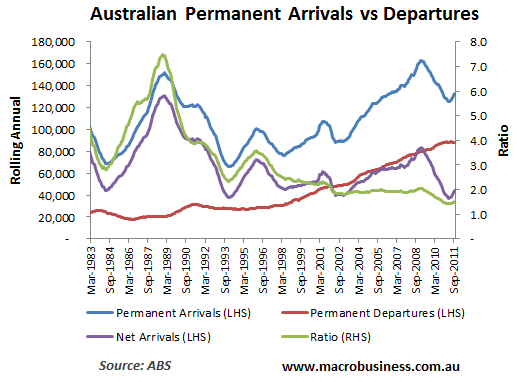
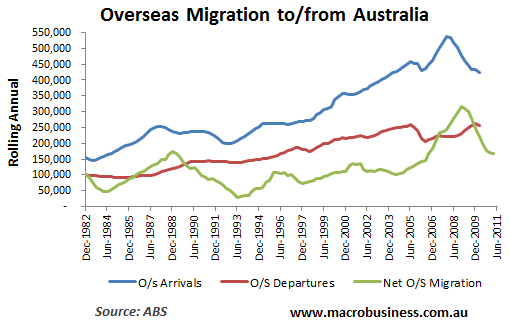
    Photo courtesy of BigStockPhoto.com.

  • Population Growth in Australia Has Normalized

    Yesterday’s Daily Telegraph contained an interesting article on the increasing number of Australians departing Australia permanently:

    OVERALL migration from Australia has soared to a record high – with 88,000 leaving in the past year, almost half from NSW.

    The stampede abroad is a 90 per cent increase 10 years ago, figures from the Department of Immigration show.

    Half the emigrants are Australian-born who have chosen to start new lives in Britain (15,119), New Zealand, (14,596), the US (8046 and Singapore (6952)…

    At the same time, the number of people emigrating to Australia has dropped, by 9 per cent to 127,458 in the past year, making the ratio of departures to arrivals a record high…

    Upon reading this article, I decided to crunch the numbers to determine how Australia’s migration numbers are tracking. The below chart shows the permanent arrivals vs permanent departures numbers alluded to in the above article. The ratio of arrivals to departures is also shown:


    As you can see, the number of net permanent arrivals into Australia – around 45,000 for the 12 months to September 2011 – is well below the long-run average (around 65,000). The ratio of arrivals to departures is also in long-term decline and currently sits at a 35-year low of 1.5 times.

    However, the broader net overseas migration (NOM) statistics published by the Australian Bureau of Statistics, which measures in/out migration of anyone residing/leaving Australia for a period of 12 months or more (rather than permanently), paints a different picture.

    According to these statistics, NOM is still above long-term trends, but has declined sharply from the peak level seen in the year to September 2008, from around 315,000 to 170,000:


    With the decline in NOM, Australia’s population growth has also fallen significantly, from a peak of just under 470,000 in the year to September 2008 to just under 320,000. The share of population growth coming from immigration has also fallen over the same period from a peak of 67% to 54%.


    Finally, in percentage terms, it appears that Australia’s population growth and immigration are returning to average levels after surging in the 3 years to 2008:


    With the ABS scheduled to release the June quarter NOM data in mid-December, it will be interesting to see whether Australia’s NOM mirrors the permanent arrivals/departures figures and registers another fall.

    This piece originally appeared at Macrobusiness.

    Leith van Onselen writes daily as the Unconventional Economist at MacroBusiness Australia. He has held positions at the Australian Treasury, Victorian Treasury and currently works at a leading financial services company. Follow him @leithVO.

  • Dense Urban Thinking Down Under

    Ku-ring-gai is a piece of suburban paradise in the inner rings of Sydney. A district of modest homes and quaint small-scale shopping districts, it sits near one of the last remaining stretches of blue-gum forest inside Australia’s largest city. You can still catch the occasional cockatoo luxuriating on a branch.

    First built around 1900, the neighborhood of 106,000 boasts all the charms of the classic “garden city,” balancing nature with modestly scaled development. Yet today the Ku-ring-gai community — including the remaining flora and fauna — is threatened with extinction by planners and developers seeking to pack the district with non-descript apartment tracks and ten-story commercial structures.

    “They’re doing everything they can to destroy this area,” says long-time community activist Kathy Cowley, a founding member of both Save Our Suburbs and Friends of Ku-ring-gai over lunch of meat pies and salad at her cottage. “They approach it as if it was a greenfield [or previously undeveloped] site for high-density housing. They are trying to destroy everything with bad planning.”

    Cowley speaks bitterly about how the state government of New South Wales, which controls development, cares little about disturbing a sensitive human as well as natural urban environment. Most of the new apartment dwellers, she notes, tend to be recently arrived residents. Many appear to be Chinese students, who ride on the surprisingly rickety trains largely to schools closer to Sydney’s center city.

    This assault on Cowley’s neighborhood reflects a peculiar density ideology that, although present in the United States, is far more powerful in New Zealand, Great Britain and Australia. Density advocates swear that everything from the necessities of economic competition to limited resources require “cramming” future populations in ever smaller spaces. It doesn’t matter that the population might object.

    In contrast, suburbs are constantly painted as on the verge of extinction. They are destined to become the dull victims of everything from demographics, “cool” migration, green ideology and the rise of “rentership” over home ownership to the ever-present, never-quite-happening “peak oil” that is destined to drive people out of their cars and into the inner cities.

    Economically, the density industry emphasizes the central city’s producer of high-end jobs tied particularly to financial services and its role as home to most universities, government institutions and media. But in the future, even elite industries seem more likely to disperse than concentrate. Look at high tech, where the vast majority of employment tends to be in suburban areas such as Silicon Valley, the counties surrounding Washington, D.C., and sprawling Durham, N.C.

    The same can be said in terms of demographics. Rather than becoming more dense, the vast majority of American cities have become more spread-out. The same has happened in many major metropolitan areas in advanced countries worldwide.

    The density obsession seems particularly ill-suited to Australia, a sparsely populated country where less than 0.2% of the land is urbanized, compared with less than 3% in the U.S. and around 6% for Great Britain.  But such thinking has taken root in this vast continent — to the detriment of many of its people.  ”The writing is on the wall for the Australian dream,” says Joe Flood, professor at the Flinders University Institute for Housing, Urban and Regional Research.

    Perhaps the biggest impact of pro-density policies has been rising land prices. State governments, which control most planning in Australia, along with their developer allies have discouraged development of new houses on greenfield sites, preferring to see the next generation of Australians living cheek to jowl close to the urban core.

    Because of this Australia, once a bastion of middle class aspiration, has suffered some of the world’s highest housing prices.  Sydney itself ranks second, behind Vancouver, in the English-speaking world’s unaffordability sweepstakes. In 1990 a Sydney household median income required five years wages; today it requires almost ten.

    Prices have been shaky recently, but current planning strictures will likely keep them artificially high. In America you can escape California or New York prices by heading south or inland. Even Australia’s second-tier, slow-growing  burgs like isolated Adelaide are more expensive than larger economically vibrant cities like Seattle and more than double as costly relative to incomes as Indianapolis, Dallas-Fort Worth or Houston.

    As a result, many younger Australians — and their parents — have reason to wonder if the next generation will ever be able to own a home. What they call the “Great Australian Dream” — with a backyard and shady streets — is being supplanted by the planner’s utopia of dense urban dwellers. Nothing wrong with having a dense option, but this is not about choice; it’s about coercion. The feisty New City Journal, edited by onetime Labour Party activists, described the process as “ruining our cities in order to save them.”

    Sadly much of the densification policy is based on faulty logic, increasingly justified by climate change. It’s ironic hearing pious greenhouse gas obsessions in a country dependent on exports of raw materials, most prominently coal, to China, the world’s biggest emitter. And a domestic reordering would have little to no impact on climate change since Australia generates barely 1% of the world’s greenhouse gases.

    But even if you agree Australia must do its part against climate change, many policy recommendations are based on a total misreading of modern urban form. Planners and media pundits assume, for example, that people can save energy by taking the train downtown; but even in Sydney, Australia’s largest and oldest big city, barely 12% of the labor force works in the central district, well below the levels decades ago.

    There’s also a presupposition that people living in downtown apartments are inherently less energy consumptive than their suburban counterpart. Yet a recent study done by researchers at the University of South Australia showed that overall urban dwellers — who travel, eat out more and consume more goods per capita — also consume more energy, once things like elevators and common areas are factored in, than the suburbanites living in townhouses or single-family homes.

    A similar finding was also made by the Australian Conservation Foundation. But in this particular battle, facts rarely intrude. Who needs to think after you have spent years in college being conditioned to believe that all density is good, the denser the better?   And for the big urban landowner, what could be better than stating a moral cause for limiting the suburban competition, thus spiking property  prices?

    What is happening to lovely Ku-ring-gai and the Great Australian Dream should stand as a warning of what happens if planners, and their big developer allies, gain total sway.  Let’s just hope America’s traditional decentralization of authority will prevent our middle class dream from following the sad trajectory of our hitherto lucky friends down under.

    This piece originally appeared at Forbes.com.

    Joel Kotkin is executive editor of NewGeography.com and is a distinguished presidential fellow in urban futures at Chapman University, and an adjunct fellow of the Legatum Institute in London. He is author of The City: A Global History. His newest book is The Next Hundred Million: America in 2050, released in February, 2010.

    Photo "Cockatoo in Sheldon Forest" by flickr user AussieGold

  • Waging a Green Jihad on Suburban Homes

    It seems rarely a month passes without some new assault on the lifestyle and housing choice preferred by the overwhelming majority of Australians: the detached suburban home. Denigrated by a careless media as ”McMansions” or attacked as some archaic form of reckless housing choice which is suddenly “no longer appropriate” (according to some planning or environmental fatwa), the detached home is under a constant assault of falsely laid allegation and intellectual derision.

    The latest of these assaults is the form of a proposed ”green star” rating scheme for ”McMansions” which critics claim cost could cost homeowners thousands of dollars in devalued prices.  While the critics’ suggestions of financial hardship might be taking the possible impacts a bit too far, it is reasonable to challenge this obsession of regulators and green crusaders which view the detached home as some form of modern environmental vandalism.

    The very first (and what should be obvious) fact that escapes our planning cabal’s attention is that houses, or home units, or even office buildings for that matter, don’t use energy. Only the occupants in them and their behaviour consume energy. The dwelling itself can be designed for more efficient energy use by the occupants, for sure, but remember always that it is people who consume power, not buildings.

    That point was brought home, embarrassingly for our rampaging environmental and social crusaders, by no less than the Australian Conservation Foundation in 2007. Their “Consumption Atlas” revealed what came as a surprise to many, but which should have been widely understood from the start: that wealthy people who can afford to live in the expensive home units and townhouses of trendy inner city areas use much more energy, and have bigger carbon footprints per capita than their suburban counterparts.  More than that, it also revealed that inner city areas are “consumption hotspots” and smaller household sizes have greater environmental impacts than larger (chiefly suburban) households.

    The significance of those findings has been studiously ignored by the advocates of environmental engineering who claim that a leading virtue of wholesale change in housing type from detached suburban to high density inner urban  will be good for the environment. The facts, however, show that it ain’t necessarily so. If a large family of five, for example, (mum, dad and three kids) living in a four bedroom house with two cars in the suburbs produce a smaller carbon footprint than the DINKs and yuppies living in their city apartment, why aren’t the media, environmental and planning advocates asking more questions?

    At the time the ACF report was released, I was running the Residential Development Council, and  can still recall hearing the ACF’s key findings mentioned in some very early radio news bulletins on the ABC.  For some reason, the story quietly petered out but the ACF kindly had a version on-line and once I sent a copy to Demographia’s Wendell Cox, it went on to infamy. Wendell prepared a report analysing its “Housing Form in Australian and its Impact on Greenhouse Gas Emissions” online findings.  

    There have been other reports too, which have either been ignored (where their evidence doesn’t suit the cause) or attacked (if the evidence is clearly getting too close to the truth). If you’re remotely interested in some of the facts (as opposed to the parade of rhetoric in the mainstream media) have a look at the evidence in this study called ”The Relationship Between Housing Density and Built Form Energy Use”’ which you can find online here.  There’s a graph on page six which shows the dwelling operational energy (blue part of the bar) for apartments is roughly three times that of detached homes.  The suggestion that occupants of high density apartments will be less likely to use private transport is yet to be borne out by evidence, with the ACF report admitting that higher incomes allowed inner city residents more opportunity to drive despite the presence of convenient public transport and also (heaven forbid) to fly to places, than households with lower incomes.

    Common sense also comes into play. Consider the basic design of apartment buildings as opposed to the detached house. Cross flow ventilation in apartments is harder to achieve (unless it’s a penthouse occupying an entire floor) than in the detached home with windows on all sides. Then there are the energy uses that the apartment more or less makes essential. There is no room for a solar powered clothes dryer (a washing line) in the backyard. Instead, energy guzzling clothes dryers are practically essential, as are air conditioners, not just for individual apartments but also for common areas throughout the building (foyers and corridors). Lighting in common areas is also almost always permanently on. Lifts to move people up and down also consume energy – taking two people from ground to level 25 in an air conditioned lift produces a lot more carbon than walking up a flight of front stairs into the detached home, after all.

    I’m not proposing that the leftist green agenda which is waging war on the detached home turn the blow torch of blame to the wealthy, nor am I suggesting that there’s anything wrong with apartment and townhouse developments. But what’s wrong with letting market forces play more of a hand without the overt moralising and environmental hand wringing that seems to accompany decisions on urban planning policy? Is it really necessary to malign the detached suburban home, in order to make the alternative more attractive?

    We are talking about middle Australia – and their counterparts in the USA, UK and elsewhere – which is under the barrage of assault for having the temerity to choose a form of dwelling that actually suits them. The fact is that people prefer, in the main, to raise children in houses rather than apartments. They often like to keep pets and have a garden around them. The children tend to like backyards to play in. The cars these families drive aren’t a ”love affair” but a necessity – getting from suburban home to suburban workplace and picking up or dropping off children on the way isn’t very practical with public transport. But you get the strong impression, reading the constant digest of anti-suburban living parading through mainstream media, that mainstream Australians are a reckless bunch of self-interested misfits whose behaviour and choices need to be controlled by people wiser than them.

    And there’s one of the great ironies in all this: those who advocate denying housing choice and enforcing apartments over detached homes, public transport over private, and inner city density over suburban expansion, invariably seem to do the opposite of what they preach.  Next time you come across one of these green jihadists waging war on the suburban home (and the people who live in them), ask them if they live in a house or a unit, how many children they have, ask how many cars (or homes) they own, and ask what their power bill is like.

    In my experience, all too frequently the answer reveals itself as a case of “do as I say, not do as I do,”  which is just plain hypocrisy.

    Ross Elliott has more than 20 years experience in property and public policy. His past roles have included stints in urban economics, national and state roles with the Property Council, and in destination marketing. He has written extensively on a range of public policy issues centering around urban issues, and continues to maintain his recreational interest in public policy through ongoing contributions such as this or via his monthly blog The Pulse.
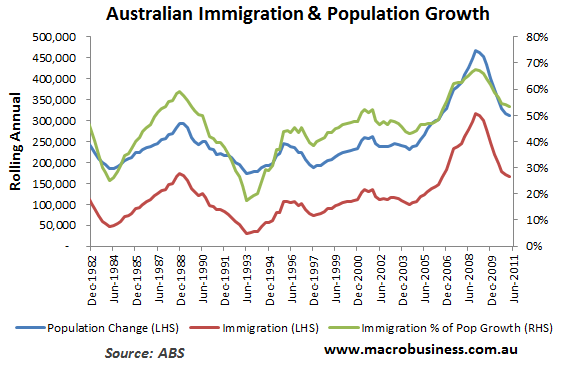
    Photo by yewenyi.

  • Applying Lessons from the UK Riots to Australia

    Many commentators correctly attribute the UK rioting to decades of misgoverning and miseducating youth. Contributing to this has been the breakdown of family discipline, the replacement of working fathers as role models and the creation of a culture of entitlement. Tony Blair has talked about a breakdown in public morality. Less convincingly, many on the left have attributed the cause to the social expenditure cuts of the Cameron Government, cuts that have actually made barely a dent in the proceeding Blair/Brown years of tumescent expenditure growth.

    Adding poison to the brew are government appointments and procedures that deflect police forces away from law enforcement into institutions that “reach out” rather than prevent wrong-doing, seek to understand miscreants rather than enforce the law, and try to contain disturbances rather than prevent them. The soft sociological and managerial ethos that has undermined policing in Britain is all too familiar here in Australia.

    But there are other factors at work. This is especially evident given the nature of those arrested. Many turn out not to be part of some jobless underclass but relatively affluent working people, some in their late twenties and early thirties.

    And the rioters are black and white – though hardly any Indians or other Asians. One reason for this is Asian family background, bringing values based on self-improvement by work rather than theft, reinforced by religious teachings, especially in the case of Muslims, the only group where a large majority are religious practitioners.

    While the complexion of the rioters will be subject to considerable analysis over future months, we can be confident about one hypothesis: few if any of the rioters own their own homes. This is because nothing engenders respect for property and others’ possessions more than people having a personal stake in property themselves. Property ownership – for most of us this means home ownership – is the key to creating a law abiding society. Where riots in England take place outside of areas other than those hosting electrical and sporting goods, they take place on council estates, in areas where people rent. If in owner-occupied housing areas, the rioters are outsiders.

    British families owning their own homes rose steadily up to the early 1980s, reaching 75 per cent. The figure has since fallen back to 70 per cent. More critically, the ability to get on the house ownership ladder has become increasingly difficult for large numbers of young people. Demographia reports that the average house in England now costs over five times the average family’s income. That’s up from three times the average family’s income 25 years ago. In London and other major cities the cost is much higher than this.

    Countless reports in England, Australia and the US demonstrate planning restraints over land use are the cause of houses becoming expensive. Governments do their level best to impose additional costs on house builders, especially through energy saving requirements, but the building industry is highly competitive and finds ways of largely offsetting these costs. However, when government regulations constrain the amount of land that can be built upon this engenders unavoidable costs.

    Ironically, after decades of acquiescing in creating shortages for new home building, the UK Government last month finally expressed a determination to do something about freeing up more land for building. That was met by the usual howls of protest from incumbent home owners wanting to avoid having “riff raff” moving close to them, barking on about preservation of villages and anxious to see a continued shortage of available properties in order to boost their own house values. But these self-centred blockages of new housing stock are contributing to an alienation of many people from mainstream values.

    British Labour Party leader, David Miliband, is arguing that a gulf between rich and poor is a cause of the rioting. He may well have home ownership in mind in offering as his solution, “we need to give people a stake in this society”. But “giving” is not a policy that will work. It morphs into an entitlement regime, which reinforces divisions within society and weakens the self-improvement ethos. Applied to housing, it is reminiscent of the US policy which required banks to make housing loans to those who were not credit-worthy, a policy still unraveling in mortgage defaults and collapsed price bubbles. Removing regulatory restraints that have driven housing prices into unaffordable ranges is the better approach.

    Not being a participant in a home owning democracy provides no excuse for trashing and thieving. But it is clear that there is a vast number of young people who have decided they are excluded and have become eager participants in hooliganism. Policies of tolerating misdemeanors and acquiescing in slack educational supervision will clearly be re-thought in the UK. But so also must be the policies creating barriers that shut people out of home ownership.

    There are lessons in the UK developments for Australia. Not the least concerns home ownership. A fundamental cause of the present economic malaise has been over-investment in US housing as a result misguided attempts to foster home ownership through forcing financial institutions to lend to people who were not creditworthy. This was motivated by the hope that the subsequent property stake would lead to an improvement in civil society on the part of those who found themselves excluded.

    These measures failed because they created a housing price bubble. However, removal of cost enhancing planning restraints would not be likely to bring the same housing inflation outcomes (indeed in states like Texas where the artificial price boosting caused by planning restraints is absent, home price inflation and busts has been modest).

    Planning restraints in Australia have created home costs that are six times family incomes (nine times family incomes in Sydney). House prices in Australia are therefore even higher than in England and urgent steps need to be taken to reform the planning policies that have caused this. If this means a society closer to the ideal of a property owning democracy, so much the better.

    Alan Moran is the Director, Deregulation at the Institute of Public Affairs.

    Photo by bobaliciouslondon.

  • High-density Housing Reflects Dense Government Thinking

    Citizens in Australia’s major cities are becoming increasingly unhappy about what they perceive as the escalating deterioration in their quality of life – traffic congestion, overloaded public transport, unaffordable housing for young people, increases in the costs of basic services and overcrowding. There is little doubt that recent election results and unfavourable opinion polls are partly an expression of this dissatisfaction.

    ‘Save Our Suburbs’ believe that these adverse trends are the result of high-density policies that have been imposed onto communities by state governments. Due to the misleading misinformation that has accompanied these policies, the public may not fully realise the connection between these policies on the one hand and deteriorating standard of living on the other. It is only when one sweeps the propaganda veil aside that one realises how shallow, trivial and sometimes downright deceptive the spin has been.

    We should start out by making it clear that we have no issue with anyone that prefers living in a high-density area or with the free market construction of buildings to fulfill this preference. The issue we have is with the enforced imposition of high density housing upon the bulk of Australians that don’t want it.

    The premise behind this government totalitarianism is that high-density living is better for the environment. They say that people will use their cars less and that greenhouse gas emissions will be greatly reduced. While these two propositions sound very much like commonsense the unfortunate fact is that the data does not bear them out. An idealised Melbourne study currently being quoted assumes that people, no matter where they live, will drive to the central business district daily. This is a completely unrealistic assumption.  Only 9.9 per cent of employment in Melbourne is in the CBD. The majority of destinations for most people in the suburbs lie close to where they live and they do not in fact make daily trips to the CBD.

    To get a better understanding we should look at the Australian Conservation Association’s Consumption Atlas, which shows greenhouse pollution per person in each postal code. The underlying research shows that the actual travel energy used by dwellers in inner Sydney suburbs is more than those in the outer suburbs, even when air travel is excluded.

    When domestic energy is added to travel energy, the energy total for people in the inner suburbs is 22 per cent more than those living in the outer suburbs.  This is because of energy needed in high-rise buildings for communal lifts, scores of individual clothes driers and ever-present security lighting in foyers and garage spaces.

    While we do concede that private transport generates somewhat higher greenhouse gas emissions than public transport, the difference is not nearly as much as people think. Greenhouse gas emissions per passenger kilometer on Sydney City Rail are 105 gm. The figure for the average car is 155 gm. It is much less for modern hybrid vehicles, being a mere 70 gm.

    Furthermore, a study of Melbourne areas shows that the people squeezed into newly converted dense areas did not use public transport to any greater extent and there was little or no change in their percentage of car use compared to living in the previous low-density.
    In fact, traffic congestion increases whenever high-density policies are imposed wherever you are in the world. Any slight increase that may occur in the proportion of people using public transport is overwhelmed by the greater number of people squeezed into that area. The resulting congestion causes higher fuel consumption and dangerous exhaust emissions. The authorities fail to admit that many people still require their cars for getting to the many workplaces, sporting facilities, and relatives and friends homes not easily reached by public transport and for transporting items that are impractical or illegal aboard public transport such as weekend recreation equipment and the family pet.

    High density advocates claim that high-density saves money. This is palpable nonsense. We are all acutely aware that high-density policies have resulted in a dramatic rise in the price of housing, due to the government enforced infill policy causing land scarcity, thereby locking out an entire generation of young people from the housing market. We are also conscious of substantial rises in the cost of services such as electricity, water and sewerage due to the incredibly inefficient modifications required to increase capacity in areas originally designed for lower densities.

    A tragic and often overlooked failure of high-density policies is the adverse effect on human health, especially mental health. There is a considerable body of peer-reviewed research proving the link between density and ill health. An article published on 23 June 2011 by eleven authors in the prestigious scientific journal, Nature, states that the incidence of schizophrenia in city dwellers is double that of people living in less crowded conditions. This article has received worldwide media attention. In view of the serious mental health situation existing in our society, those forcing high-density onto communities that do not want it, should hang their heads in shame.

    We reiterate that we have no issue with those of us that prefer living in a high-density area or with the free market construction of buildings to fulfill that limited demand. What we object to, is having draconian high density policies based on demonstrably faulty premises forced upon the 83 per cent of people that Australian research shows prefer to live in a free-standing home.

    This is especially so when the result is maddening traffic congestion, more greenhouse gases, a creaking and overloaded infrastructure, the young and disadvantaged unable to afford their own home and poorer health outcomes.

    This piece first appeared in On Line Opinion.

    (Dr) Tony Recsei has a background in chemistry and is an environmental consultant. Since retiring he has taken an interest in community affairs and is president of the Save Our Suburbs community group which opposes over-development forced onto communities by the New South Wales State Government.

    Photo by drewish.

  • Australia Central Banker: Higher House Prices a “Social Problem”

    Glenn Stevens, the Governor of the Reserve Bank of Australia expressed concern about the growing gap in housing affordability in the nation to a parliamentary committee on Friday. Stevens raised questions about the cost and supply of housing, asking:

    "How is it that we can’t add to the dwelling stock for the marginal new entrant more cheaply than we seem to be able to do," he asked.

    According to an article in the Perth Western Australian ("High price of homes ‘stealing future’") Stevens went on to say that key State and local government issues around supply, zoning, transportation and infrastructure seemed to be making a simple block of land more expensive than was necessary.

    Virtually all of Australia large urban areas have implemented urban containment policies (called "urban consolidation" in Australia and "smart growth" in the United States). The result has been to increase house prices from 2 to 3 times the historic norm relative to incomes. These price increases are consistent with the overwhelming economic evidence of a strong association between urban containment policies, especially those that ration land for development through devices such as urban growth boundaries.

    The Chairman of the Reserve Bank of New Zealand has identified a 10-times "across the urban growth boundary value" difference per acre in Auckland, which is similar to findings in Portland, Oregon.

    Stevens concluded his housing comments noting that: "There’s a very big inequality between generations building up and I think that’s a social problem as much as any economic point."

  • Queensland’s Future: Diverse and Dispersed

    I was recently asked to outline my thoughts on how the Queensland urban landscape might look 40 to 50 years from now.  Go on, you can laugh.  I did too.  It’s hard enough to forecast the next 12 months, let alone two generations away, but I’ve given it a go, of sorts, so here it is:

    First though, it might be best to outline my methodology.  In short, this forecast will be based on underlying trends, some understanding of human nature, and importantly, the Australian mindset.  My outlook is supported by evidence – what people actually do rather than say – and importantly, not by urban myths or fallacies, despite the frequency with which they have been aired of late.  Unfortunately, we don’t have the space or the time here to support every claim or go into massive detail; so this discussion is confined to broad shapes – not nitty gritty.

    Queensland’s urban future (and that of Australia) can best be summed up in two words – Diverse and Dispersed.

    Let’s deal with the second D – dispersion – first.  Our regional centres are likely to become a whole lot bigger and at the expense of the already crowded south-east corner of the state.  The move away from the world’s bigger cities is already underway, as evidenced in the recent census in the United States, but also throughout much of Europe.  Several Asian and Middle-eastern countries are now also following suite  As a Mckinsey Institute study recently found, smaller cities, particularly in the developing world, are growing considerably faster than the much discussed megacities.

    The annual ABS small-area population data suggests this trend is also very true in Australia and particularly in Queensland, which, over the past decade, been the fastest growing state on the continent, appears to be following the same trend, something likely to be borne out by 2011 Census, due later this year .

    Within our capital cities themselves, the much ballyhooed move downtown will slow – again, it already is doing so – as the cost to live within close proximity to the CBD is just too high compared to the real benefits. 

    The irrational assertions about the trend towards denser living rest on urban myths that promote inner city density over other housing forms. These include the notion that suburban growth worsens carbon emissions and traffic congestion; people are being forced to live far from jobs concentrated in our CBDs and denser development will make it cheaper for them to get to work. These notions are all largely exaggerated or incorrect. More to the point, they stand in opposition to the basic preferences of the market.  

    Instead of having a single high-density city core, with lower development density radiating outwards, the most likely urban shape in the future will be one of more even distribution of housing density throughout the city; concentrated more, no doubt, around middle-ring transport hubs and new master planned town-centres.  Our middle-ring and outer suburbs will have much more compact urban settings but will remain primarily dominated by relatively low density housing.

    Diversity relates to the housing stock itself.  The current push towards smaller dwellings has little to do with demographics and the market’s wants, but reflects basic reaction to diminished housing affordability.   There is a demand for tightly-sized product, but it is nowhere as near as high, nor is the long-term trend towards such as strong, as the urban boosters advocate.

    Taking a wider view, Australia (and America too) is still in its frontier or "barbaric" stage of its cultural evolution.  We walk with wide gaits, worship most things large from roadside bananas to women’s appendages, and don’t really like crowded spaces or queues Most of us like our space; aren’t really ready to give it up, and are not likely to do so for many decades to come.

    Rather than remaining focused on density and concentration, it could well serve the community to focus on what appeals to the vast majority of the population, particularly the middle and working class families.  A more practical approach might be to foster the development of smaller, more efficient cities, as well as expansive suburbs and revived small towns rather than engage in a manic drive towards persistent centralization. 

    Rather a forced density agenda on a largely unwilling population, it makes sense to consider how to make a more dispersed (and diverse) urban future more workable and sustainable. Innovations in work environments, notably increased use of telecommuting and dispersed workplaces, and more fuel efficient cars hold more promise than plans that force Aussies to live a way the vast majority do not prefer.

    This article originally appeared in the June/July 2011 edition of the UDIA Queensland’s Urban Developer Magazine.

    Michael Matusik is a qualified town planner and director of independent residential development advisory firm, Matusik Property Insights.

    Photo by Michael Zimmer.

  • Banana-nomics

    The price of bananas is again making headlines as it pushes up inflation and threatens rising interest rates. But what’s the price of the humble ‘nana got to do with property markets? Plenty.

    Banana prices have risen almost 500% since Cyclone Yasi wiped out much of north Queensland’s banana crop earlier this year. The immutable laws of supply and demand dictate that when supply falls relative to demand, prices will rise. Which is what they have done, and as they did a few years ago when the same thing happened after Cyclone Larry. As banana supply was restored, prices fell. As they will again.

    Banana prices are a self-evident, every day example of supply and demand at work. They’re the sort of example understood by consumers and even school children with no formal economic training. But clearly the lessons are beyond the capacity of some Australian politicians, most land regulators and many town planners. In the very same way that constraints on supply create scarcity value for every day commodities, constraints on supply and scarcity equate to rising prices for all types of real estate, not just housing.

    It starts with misguided planning schemes that aim to direct consumer behaviour and distort their purchasing decisions by limiting choice. This has become commonplace in planning to the point of representing accepted wisdom. One of the most obvious examples has been the continued efforts by some regulators and planning authorities to attack the detached house as a choice – however best suited to the needs of young families – which ‘Australia can no longer afford.’ Like a contemporary version of Stalinist central command, housing choice is distorted via planning schemes that are biased to high density apartments in central locations (that consumers are told is good for society), as opposed to detached housing on the urban boundary (that remains the majority consumer preference). Faced with little choice, more people are forced to choose the option deemed appropriate by higher authorities than themselves, and when this is later reflected in data, the regulators hail this as some sort of fundamental change in consumer preferences. You’re seeing this type of shallow analysis in the media, pushed by various interest groups, on a regular basis now.

    An equally significant consequence of using planning ideology to achieve social engineering outcomes has been the impact on prices. In the case of raw land for housing, we have succeeded in the unimaginable – needlessly elevating prices far beyond the reach of average Australians, on the basis that we may run out of land, in a country where land is plentiful. This has been achieved simply by making raw land for detached housing development scarce because permission is not allowed outside artificially drawn urban planning boundaries. (On top of creating scarcity, of course, new land supply is taxed more aggressively than existing supply, via upfront levies. This is no doubt because there are fewer votes at risk in taxing new housing lots as opposed to raising council rates or other broad based revenue measures. Plus, new supply is tied up in a regulatory tangle which now means it can take 5 or 10 years just to get permission to develop land in areas already described as intended for future housing. Go figure).

    The proof is readily available. In the Brisbane region, for example, the price of vacant land per metre is now 2.3 times (230%) what is was a decade ago. Established house prices also increased, but at a lower rate – they are 1.5 times (150%) the price a decade ago. Average weekly earnings, just to bring it back to earth, are 0.6 times (60% higher) what they were a decade earlier.

    In Melbourne, where supply constraints have been more sensibly managed, land for housing is 1.3 times the price of a decade earlier. Little wonder developers are giving up hope for south east Queensland and focussing their energies in Victoria.

    If the fundamentals of supply and demand (let’s call it banana-nomics) are so obvious in the market for new land for housing, where else are they revealing themselves?

    Recent reports have noted that Australian retail property rents (a lot like our housing prices) are amongst the highest in the world. Research by CB Richard Ellis suggests that rents in Sydney, Melbourne and Brisbane are higher than the better shopping strips in Los Angeles or Milan. How can this be? Los Angeles County has a population of around 10 million people, some of whom are noted big spenders. Retail demand there would dwarf that of Brisbane’s retail spend.

    Once again, the answer lies in supply. LA’s ‘sprawl’ is arguably more about the historically easy dispersion of retail and commercial space along high streets and back roads throughout the metro area, as it is about expanding housing. As LA developed, it was relatively easy to create new retail space, and there is plenty of redundant retail space in older strip areas where secondary traders can operate at low market rents. In Australia, by contrast, planning constraints have been much more onerous. The major retail centres, developed from the 1960s to the late 1990s throughout metropolitan areas largely remain the same major centres we have today. Finding new opportunities for retail expansion is a large hurdle which few clear – protection of the retail hierarchy and existing centres, and preventing a dispersal of retail activity beyond existing areas, is the deliberate intention of urban planning schemes.

    The result has been that those with the existing retail centres have paid for, and now own, a precious commodity: the permission to conduct retail activity, with limited threat of competition in that catchment. Our retail rents have grown because retailers – and consumers – have had limited alternative choices. New retail operators have encountered barriers to entry in the form of planning laws and no-compete clauses, once again reinforcing the value of existing permissions. Just ask Aldi or Costco what they think our planning schemes are doing for competition if you don’t believe it.

    City carparking is another example of banana-nomics at work. A study by Colliers International reveals that city parking costs in Sydney and Melbourne are more expensive than London, Tokyo or New York. Brisbane came in at 14th most expensive on a global list of 156 central business districts. How can it be? The answer is simply that the anti-car crusade has led to planning policies which deliberately seek to limit CBD parking spaces, in the futile hope that this will somehow force people to abandon the convenience (and frequently the necessity) of private transport in favour of buses or trains.

    Those ambitions have never come to much, so regulators then resort to the blunt weapon of taxes – with car parking levies now common in many cities and the prospects of congestion charging for access to CBDs frequently rearing its ugly head. This deliberate attempt to restrict (and then punitively tax) the supply of city parking spaces has the inevitable effect of raising prices.

    But there is one fundamental difference between how banana-nomics works for banana growers and property developers. Banana growers can grow more plants and create more supply. The same can’t be said for developers of property. In housing, new supply is likely to remain constrained by growth boundaries and the preference of regulators towards higher and medium density within existing areas. This will create a floor under the cost of new supply which means that prices are unable to fall (they can’t fall below the cost of production). So raw land is unlikely to get much cheaper, unless there are some radical (and many would say much needed) reforms to planning policies around Australia.

    The same applies to retail property. Retailers (most recently evidence by Solomon Lew’s Just Group comments about retail rents) may object to high rentals, but they won’t get much option. Major retail centres are where the action is, and the alternative (on-line retail) isn’t sufficiently appealing to the majority of consumers, who get more from their shopping trip than just a retail transaction. New shopping centres won’t be created within existing urban boundaries because planning schemes are unlikely to allow further retail dispersion away from existing centres. In the limited cases where approval is granted, existing centre owners will play hard ball, arguing fervently against the free market (witness Westfield’s objections to a new Aldi Store, approved by Brisbane City Council, north of Brisbane). Their actions are understandable, given they’ve outlaid very large investments that are contingent on the existing planning scheme remaining.

    And the same applies to car parking. Unless there’s a monumental shift in policy attitudes to private transport and city car parking, we aren’t going to see multiple new above or below ground public car parks being created in our cities, no matter how much the demand. That will mean prices remain high.

    In all cases, it has been the planning regulations that restrict supply and limit choice, not demand, that have been responsible for making our housing, our retail rents, our car parking and so much more, amongst the costliest in the world. And given that those constraints are unlikely to change, you’re unlikely to see that position reverse itself any time soon.

    The burning question, of course, is how long can it last? If supply costs elevate prices beyond the capacity or desire to pay, people stop buying. Economies slow down. The music stops.

    How do you like them apples?

    Ross Elliott has more than 20 years experience in property and public policy. His past roles have included stints in urban economics, national and state roles with the Property Council, and in destination marketing. He has written extensively on a range of public policy issues centering around urban issues, and continues to maintain his recreational interest in public policy through ongoing contributions such as this or via his monthly blog The Pulse.
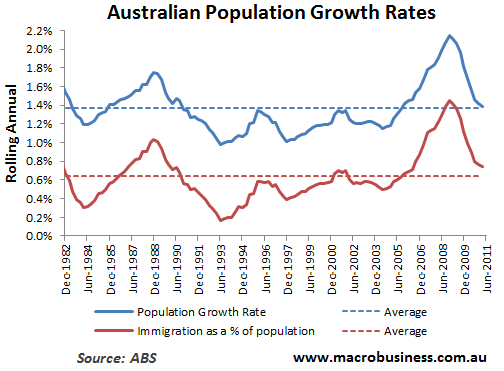
    Photo by Fernanado Stankuns.

  • Australia’s 2011 Census: Chock Full of Surprises

    There is nothing better than a good old count to check out what’s really happening.  And a lot has happened across Australia over the last five years.  But what actually has happen to the country’s demographic fabric might surprise many. 
    There are ten trends which I think will emerge out of our next national count on Tuesday 9th August.

    1.            Acceleration towards suburbia.  Despite what we are feed by the intelligentsia most Australian’s want to live in a suburban settling.  The amount of new development on the fringe and the proportion of the population living out there will have increased over the last five years.  This trend is also likely accelerate in coming decades as to will a shift to “opportunity” regions, many of which being regional towns.  And there is the real surprise, many of those that moved to suburbia are young – the 25 to 34 age group. 

    2.            Increase in household size.  Household sizes are no longer shrinking.  2006’s 2.6 people per household average will be closer to 2.8 this census and may rise even higher in the future.  Why?  The baby bonus, change in overseas migrant mix, low housing affordability and poor government decisions like, ironically, the first home owners grant and the more recent increase in owner-resident transfer duties in Queensland.

    3.            More family households.  Despite forecasts of more lone person and couple households, we are likely to see an increase in the proportion of family households this census.  In fact the proportion of lone households is likely to fall, as many are forced to live in shared arrangements or move back home with family. 

    4.            Increase in net wealth.  Despite the GFC, rising household costs and now declining house prices our net household wealth will have risen sharply between census periods; as too will our household incomes. Equity in our homes (and investment properties) will have also risen, with more people owning their home outright than ever before.  The August 2011 poll will also find that Australia’s net household wealth is also at a record high.

    5.            Working longer.  The number of hours reported as worked each week will be up, but when they were clocked will be increasingly outside of the core 9 to 5.  Yet, and whilst not a census measurement, our productivity and ability to innovate will be down.  In broader terms our economic measurements are wrong – we have suffocating, quarterly consciousness and proprietary trading rather a focus on nurturing talent and innovation.  The county is far less dynamic as a result.

    6.            Change in demographic mix.  A shift in overseas migrants from China, India, Africa and the Middle-East and less arriving here from more traditional sources such as the United Kingdom, Europe and New Zealand.  This means bigger household groups, a younger age profile and rising demand for detached housing (and burqas too).  

    7.            Larger homes.  Whilst there has been shrinkage in apartment sizes of late and only really to make them easier to sell, most other housing types across Australia over the last five years have gotten bigger.  High and rising land costs, relatively cheap building costs and increasing household sizes are the main reasons why.  Our aging demographic will also want big new homes – assuming that baby boomers move – but how cheap new housing will be to build in the future is uncertain at present.  Home owners are also moving less often and the distance, when the do move, is becoming less.  “Fewer moves, local focus” should be the catch-cry for the next decade.

    8.            Fewer marriages.  And those that are taking the plunge are getting married later.  The average age of mothers having their first child should exceed 30 years. 

    9.            Dissolution of relationships.  Not only are fewer Australians getting married, but we are breaking off relationships at an increasing rate.  Family and relationship disbanding reflects our declining resiliency and mounting acceptance of the nanny state.  We don’t seem to overcome hardships these days, just “cut and run”.  From a housing prospective if our households are fracturing so easily, then why are our prescriptions for housing increasingly rigid?

    10.          Less religion.  Last census more Australia’s nominated that they believed in the Order Of The Jedi than Christianity, so maybe the census is bunkum after all.  Yet more Australian’s are likely to nominate that they have no religion at all.  Whilst we are not America, we do live largely an American way of life and were founded on similar values – industriousness, honesty, marriage and social cohesion – but these seems to be unravelling.  This census count should show us how far lost we have become.

    To paraphrase international urban authority Joel Kotkin “Whatever your politics or economic interests, the 2011 census will show that the country is changing and in a dramatic way – if not always in the ways often predicted by pundits, planners or the media.  It usually makes more sense to study the actual numbers than largely wishful thinking of mostly urban-centric, big-city based and often quite biased analysts.”  As we wrote after the last census, it maybe time for the planning industry to take a breather and set a different course with regard to our urban land use.  Hopefully this time around the planning intelligentsia will take some notice.

    The Matusik Snapshot is opinion and not advice.  Readers should seek their own professional advice on the subject being discussedComments are welcome, contact me on michael@matusik.com.au.