Tag: Australia

  • Adelaide Land Prices Top Sydney

    The median price of serviced (improved) lots for new houses in Adelaide is reported to have risen above that of far larger Sydney by the Housing Industry Association of South Australia. Housing Industry Association of South Australian Executive Director Robert Harding attributed the high price of land to government policies that have limited the supply of land available for building. Nearly all thousands of square miles of land around Adelaide are off-limits to house building due to state government restrictions.

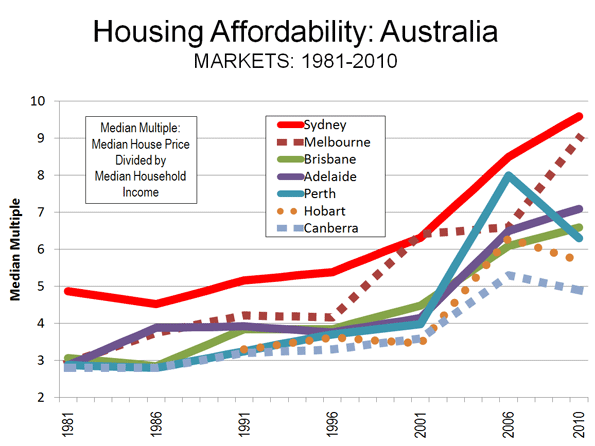
    Adelaide is the slowest growing major metropolitan area of Australia, yet has some of the worst housing affordability among larger metropolitan markets. The 7th Annual Demographia Housing Affordability Survey found median priced Adelaide housing to be 7.1 times median household incomes, ranking the metropolitan area eighth most unaffordable out of 82 with more than 1,000,000 population.

    Before the adoption of its strong smart growth (urban consolidation) land use restrictions, median house prices in Adelaide were one-half or less the present level (Figure). By comparison, new houses can be purchased in much of the United States for less than the median price of an empty lot in Adelaide ($180,000), though not in areas that have adopted smart growth restrictions.

  • Australians Are Getting A Carbon Tax They Don’t Want

    Within weeks, the Australian government is expected to announce a package of measures including a carbon tax to stimulate renewable energy sources and abate carbon emissions. Officials, activists and journalists around the world will hail Australia as a courageous and forward-looking country, ready to take its responsibilities seriously. Some will rebuke their own governments for being less bold. Yet they will ignore an inconvenient detail. According to opinion surveys, at least 60 per cent of Australians strongly oppose the tax. Since it was flagged in February, support for the ruling Labor Party has fallen to its lowest level in 40 years. Only 27 per cent of Australians now nominate Labor as their first preference. Nor did they vote for it. In the lead up to last August’s federal election, both major parties ruled out a carbon tax. Prime Minister Julia Gillard declared, just hours before polling day, that “there will be no carbon tax under the government I lead”. Her job approval rating is 31 per cent.

    So why is this happening? The current malaise can be traced to a combination of long and short term causes. Like other western countries, Australia was profoundly changed by the 1960s social movements. In the decades after World War II, as Britain lost its empire and turned to Europe for an economic future, Australia shifted its agricultural and mineral commodity trade to Asia, admitted growing numbers of immigrants from outside the British Isles, and came to rely on the United States for security. Elites in the professions, judiciary, churches, universities and bureaucracies conceiving Australia as an outpost of British civilisation, found the ground moving under them.

    Radicalised by Australia’s participation in the Vietnam war, baby boomers poured out of an expanded university system to spearhead a range of movements, over time supplanting the old elites. By the 1980s, universities, schools, many professions, the media, and most of the public sector were dominated by left-progressives. Their “long march through the institutions” was perhaps more thorough-going than in the United States, since anti-leftists had yet to find a substitute for British imperialism.

    One of the social movements was environmentalism. Australia is an isolated, sparsely populated continent with hauntingly beautiful landscapes and unique natural species. Late-coming westerners found a pristine wilderness, populated by aboriginals with close spiritual ties to the land. Since European settlement, these features have, in various forms, injected a romantic strain into the country’s transplanted British culture. That strain was mostly confined to the arts and radical fringe movements. In large part, the colonies, federated in 1901, evolved a practical outlook shaped by nineteenth-century liberalism and the blessings of trade, industry and commerce.

    The 1960s saw a fusion of the romantic strain with ideologies shaped by streams of Marxism, left-wing anarchism and revivals of Counter-Enlightenment Romanticism. Sharing a preference for ecological protection over economic growth, inner-city-based activists, including many socialists, current or former communists, Trotskyites and others from counter-culture circles, like hippies, together with aboriginal peoples, campaigned to lock up remnant bushland, native forests, wetlands and traditional aboriginal sites in “green-belts” or national parks. They targeted urban expansion and industries like logging, cattle-grazing and mining, which boomed in a mineral-rich arc across northern Queensland and Western Australia. Conflicts over mining projects were routine in the 1970s and 1980s. Uranium was particularly contentious.

    But it was in Tasmania that the new environmentalism came of age. State government plans for a hydro-electric dam on the Franklin River became a cause celebre, attracting strong opposition from environmentalists, and wide public interest. Many leading-lights of the movement, including the current Greens Party leader, made their name in that struggle. Ultimately, the activists came out on top, winning support from federal Labor just before the 1983 election, at which they returned to power.

    The Franklin tussle cast a long shadow over Australian politics. Many analysts thought it contributed to Labor’s victory. Nature conservation crept onto the mainstream agenda. In 1984, various green lobby groups, including some of the more hard line activists, came together to form Greens parties in New South Wales and Queensland, modeled on the German Greens. Other states followed, and in 1992 a national Greens Party emerged. Over time, Greens gained a presence in state and federal parliaments. Some were ideological refugees from defunct communism. Before joining the Greens, for instance, one serving Greens senator was a member of the Socialist Party of Australia, a successor organisation to the Communist Party.

    While open to compromise on environmental concerns, Labor never embraced green ideology. A moderate party in the British tradition, built on craft trade unionism rather than socialism, Australian Labor was essentially pragmatic. Its environment agenda was adapted to job security, rising living standards and the interests of mining, forestry and transportation workers. For most Australians, the environment was still a marginal issue.

    Then came the climate panic. Australia is a land of climate extremes, where severe drought alternates with devastating floods. By 2006 the continent had been in the grip of drought for virtually a decade. Water restrictions even hit the major cities, as morale began to sag under fears of interminable dryness. That year also saw some unseasonably hot days. From their posts on the “commanding heights” of academia, politics and media, green ideologues sensed a chance to ramp up their rhetoric on global warming, claiming the drought would persist until carbon emissions were cut. Now they hoped to impose their anti-growth philosophy on the whole economy, not just individual projects.

    This time their message fell on fertile ground. Surveys began to show majority support for strong action on climate change. Conservative Prime Minister John Howard, who was lukewarm on the issue, and had refused to sign the Kyoto Protocol, was caught off guard. Looking to the election due in 2007, Labor succumbed to opportunism. They took to spouting green rhetoric, promising ratification of Kyoto, an emissions trading scheme (ETS) and a renewable energy target. Come 2007, the sense of exhaustion around Howard’s eleven year government was enough to tip Labor into office. But the party’s green chickens eventually came home to roost. Having hyped global warming as a great moral cause, Prime Minister Kevin Rudd suffered the indignity of returning empty-handed from the failed Copenhagen Conference. By this time the drought had broken, and the Liberal-National opposition changed course, defeating Rudd’s ETS in the senate.

    Public support for climate action began to slide. According to the authoritative Lowy Institute Poll, it is now down to 41 per cent, from 68 per cent in 2006. Workers grew nervous about the implications for trade-exposed or energy intensive industries like mining, steel production and power generation. They shifted back to former attitudes on the environment, leaving the government stranded. Following advice from his inner-circle, including then Deputy Prime Minister Gillard, Rudd deferred the ETS until after the election scheduled for late 2010, but he suffered a crushing loss of credibility. His colleagues dumped him for Gillard.

    For city-based progressives, especially in the publicly-funded sector, climate action became a vehicle to burnish their moral authority and claim a larger share of the nation’s wealth, reversing two decades of market-oriented reform. Prompted by Labor’s turmoil, more of them defected to the Greens. At the election hastily called for 21 August 2010, neither major party won a majority in the House of Representatives. The balance of power was held by the Greens and four other independents. In the senate, the balance went exclusively to the Greens. Desperate to survive, Gillard signed up to a formal alliance with them. After weeks of negotiation, the Greens and enough independents sided with Labor to form a minority government. Their price was the carbon tax she ruled out just hours before election day.

    When the dust settled, Australians found that, by pure chance, their country was in the hands of a climate junta, euphemistically called the Multi-Party Climate Change Committee, consisting of Gillard, the Treasurer, the Minister for Climate Change, the Greens leader and his deputy, and two independents. Posing as an open-minded enquiry into Australia’s climate options, the Committee is driven by an inescapable political logic. None of them can break ranks without bringing down the government, ending the most power any of them will ever have. This logic overrides everything, even rising public anger. The opposition’s line, that “Labor may be in government but the Greens are in power”, resonates widely. Few think Gillard really believes in the tax. Moreover, it comes at a time when consumer confidence is weak, and cost-of-living pressures dominate surveys of public concerns.

    Never has such a gulf opened up between elite and popular opinion. Nothing has turned around opposition to the Committee’s tax, not Gillard’s promise of compensation for low to middle income earners, not favourable media coverage, not reports by scientific experts, not declarations signed by eminent citizens, not even an advertising campaign fronted by Oscar-winning actress Cate Blanchett. Urging Australians to “say yes”, the ad unleashed a wave of resentment towards the globe-trotting star, who owns a $10 million “eco-mansion” in one of Sydney’s exclusive suburbs. Tabloid newspapers dubbed her “Carbon Cate”.

    Most opinion-leaders will applaud Gillard’s carbon tax package. They will ignore the real story: Australians are being made to walk the climate plank, with a cutlass at their back.

    John Muscat is a co-editor of The New City.

    Photo by MystifyMe Concert Photography

  • Education as an Export

    A trade deficit is a negative balance between a nation’s imports and its exports, so a country with a trade deficit is spending more on imports than it is receiving for selling its exports. Is there any more that can be done to reduce this deficit over the course of time? One potential solution the US trade deficit would be to increase the attractiveness of its higher education institutions to international students, and to therefore increase the amount of money coming into the country. Money from abroad that is spent in the US, such as on tourism, or in this case, on education, is considered an export.

    President Obama identified a key element for future growth of the US economy as “exporting more of our goods,” and whilst this is a great way of decreasing the trade deficit, the actual ability of the country to create more manufactured goods or natural resources is fairly limited.
    But the US has a great potential for growth in the services sector, including financial services, licensing fees, entertainment, and telecommunications. Education could be a particularly high earner for the US, if it were prepared to put more money forward to attract international students.

    The US currently has around 691 thousand international students enrolled in higher education, with the tuition fees estimated to total around $13 billion during the 2009-10 academic year. Consider as well the cost of living for international students, and you can see that the economic impact of international students can be a major earner for the country.

    A University of California at Berkeley Center for Studies in Higher Education paper was released in support of the development of US higher education as an export. The Obama administration has set a goal of doubling export growth by 2015. Whilst this is an ambitious target, it is not beyond achievable.

    Increasing higher education for international students makes viable economic sense not only because the service itself is an extremely profitable one, but also because it will help meet future labour market and growth needs of the country, and fulfil “a diplomatic and cultural mission like no other form of trade”. International students can benefit from the experience of a well-organized educational system.

    There have been countries that have recognised this opportunity for growth and acted upon it. Australia, for example, has grown its educational market to attract more international students, although it has recently announced plans to prop up the educational system with a price hike for lower school years. It seems that the demand for Australian education has been on a steady rise, and there has been a corresponding increase in spending and development by higher education institutions. In the opinion of Michael Andrew, Chairman of Australia’s Skills and Innovation Task Force, after recognising the value of international students and scrutinizing the lengthy application process for higher education, Australia expects that the natural growth in interest will not be enough to keep maintain the industry’s economic boom.

    Andrew has highlighted the benefits of a strong educational policy which educates graduates to opportunities of forming strong links with Australian companies that currently operate in their home countries within Asia and India.

    Australia, the US and Canada would certainly benefit from working harder to encourage learning in industries that are suffering a skills shortage. Foreign students provide what’s been accurately called a ‘rich talent pool’ for industries that these countries have failed to utilize effectively.

    America and Canada differ from Australia in that their markets for labour are already quite saturated, so pushing education as an export and the advantages it can bring to the economy can be overlooked as an investment into future economic development.

    Exporting education can benefit the US in a way that not many other services can, by monetary gain, as well as by continual benefits should international students stay to ply their trades. And even those who don’t remain in the US will thereafter be advocates of the US educational system, and may inspire future generations to learn in the US. Finally, there will always be opportunities for the students to work in their own countries but under US corporations.

    Whether or not the Obama Administration will meet the targets they have set by positioning education as an export is another question in its own right. The US can not expect to grow this lucrative industry without further pushes to attract foreign students looking to learn at the higher education establishments of America.

    Either way, they are on the right track, and are onto how much of an advantage they have over other nations in the education system they can offer. With the right development and marketing, education, sold as an export, could grow to become one of the United States’ highest earners.

    Andy studied International Economics at University but now works as a freelance Search Engine Optimizer and travel advisor for All Inclusive Holidays provider Tropical Sky. Comment here or follow him on his twitter @andym23

    Photo by Evive: International Student Week

  • Inside Sydney’s Central Business District: the Retail Core

    World famous for its beautiful harbour setting, Sydney’s Central Business District is undergoing a resurgence. As the hub of Australia’s finance sector, it stumbled during the global crisis. Office vacancies jumped from 5.7 per cent in early 2008 to 8.8 per cent in mid 2009, despite stable supply. Ultimately, though, Sydney was spared the worst, owing to its rise as a staging post for trade and investment in the Asia-Pacific region, which averted the havoc of Europe and North America. Recovery is now underway, if slowly. White-collar employment is picking up and the vacancy rate is down to 7.3 per cent. Landlords are again celebrating the prospect of rising rents.

    But there’s a bigger story. This revival is happening amid some notable trends. Post-crisis, the CBD’s functional map is being redrawn by a wave of Asian and other visitors and investors, prominently listed property trusts and pension funds looking for a safe haven, the spatial demands of a transformed white-collar workplace, intensive residential development on the CBD fringe and officials pushing flashy “green” projects. There’s no doubting the importance of these developments, or that they will be hyped by inner-city based media.

    In fact, central Sydney has been losing economic clout, in relative terms, to the periphery or suburban hinterland for some time, a polycentric trend observed in other countries. Between the 1981 to 2001 censuses, encompassing the most active period of economic liberalisation in Australia’s history, Sydney’s general population growth was 23 per cent, while outer areas in Greater Western Sydney grew by 38 per cent. The CBD’s share of Sydney’s jobs shrunk from around 30 per cent to 9 per cent during this period. Four of the five strongest growing Local Government Areas (LGAs) in the year to 30 June 2009 were still in the outer west: Blacktown, Parramatta, The Hills Shire and Liverpool.

    The latest wave of change will prove significant and long-lasting, but the CBD isn’t destined for a return to metropolitan supremacy.

    Sydney CBD
    Sydney CBD

    The retail core

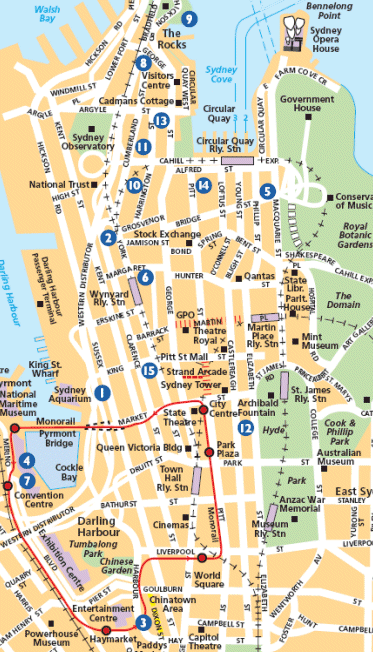
    For theorists of the CBD, peak land value intersection (PLVI) is a pivotal concept. This is the centrally-located point, usually at the intersection of two thoroughfares, where land values are highest. Without doubt, Sydney’s PLVI is the intersection of George and Market Streets. George Street is the CBD’s spine, traversing a north-south axis from Circular Quay to Central Station. Historically, Market Street was the critical entry route from the west, extending from the defunct Pyrmont Bridge (over Darling Harbour), and now from a branch of the Western Distributor. Blocks surrounding the PLVI are typically occupied by upscale department stores, absorbing peak land prices with high turnover of quality goods on multiple floors. Thus Myer and Gowings stores occupy the north-east and south-east corners respectively, and David Jones a site further east along Market Street (the Gowings site is earmarked for refurbishment as a boutique hotel). The iconic Queen Victoria Building arcade sits on the south-west corner.

    According to the “core-frame model”, another tool of CBD theory, activities competing for the highest rents, like upmarket retail and superior grade office towers, concentrate in core blocks, while marginal activities disperse to peripheral blocks. In terms of the theory, the latter are a “zone in transition”, at an intermediate stage between lower grade building stock and future redevelopment. Activities like low-end retail, fast-food, novelty shops, pawnbroking, wholesaling, storage, off-street parking, warehousing and light-manufacturing locate there.

    Traditionally, Sydney’s CBD had a retail core around the PLVI bounded by York, Park, Elizabeth and King Streets, south of an office core bounded by King, Clarence and Macquarie Streets and Circular Quay. Judging by the headlines, the retail core is Sydney’s biggest news. Long a feature of suburban life, the CBD is being transformed by the arrival of mall-style shopping, adding to the mix of department stores, arcades and stand-alone shops. In some ways, it’s catching up with the social evolution of shopping as a “complete experience” linked to identity formation.

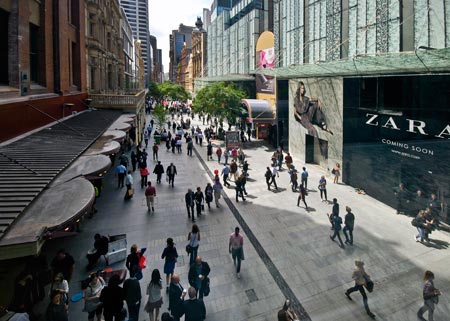
    The catalyst is Westfield’s $1.2 billion development at the corner of Pitt Street Mall and Market Street, just a block east of the PLVI. A pedestrianised section of Pitt Street between King and Market Streets (not a regular mall), Pitt Street Mall is the retail core’s epicentre. Last year, global real estate firm CB Richard Ellis (CBRE) rated it the second most expensive street for retail rents in the world. The first was New York’s Fifth Avenue.

    With rents so high, investment dollars are pouring in. Fronting the eastern side of Pitt Street Mall, Westfield’s contemporary glazed-glass structure, box-like at street level but topped by Sydney Tower, converts four properties into 93,000 square metres of retail space, distributed over a six-storey shopping mall. The first stage opened last October. On completion, it will house 330 flagship and specialty fashion outlets, and lifestyle stores, most of them international brands, including Sydney firsts Versace, Gap, Zara and Miu Miu, together with several eateries. Two skybridges link the complex to nearby Myer and David Jones department stores.

    Westfield’s opening coincided with a general revamp of Pitt Street Mall, featuring landscaping, paving and tree-planting by Sydney City Council, and reconstruction of the mall-like Mid-City Centre, 52 shops on four-levels fronting the Mall’s western side, almost opposite Westfield, penetrating west to 420 George Street. One Mid-City store, jewellery retailer Diva, is reputedly paying the highest rent in the CBD, $13,500 per square metre a year.

    Pitt Street Mall’s face-lift set off a reshuffle of fashion and luxury goods retailers around the retail core, with knock-on effects all the way up George Street. Burberry is moving to refurbished premises at 343 George Street, Louis Vuitton to a new flagship store on the corner of King and George Streets, Dior to Castlereagh Street, and Zegna and Prada to Westfield, from Martin Place. This follows the 2008 opening of the world’s largest Apple store, at glass-clad 367 George Street (roughly opposite Mid-City at 420).

    Pitt Street Mall
    Pitt Street Mall

    A sign that the retail core may be busting out of its old confines, and creeping north of King Street, major retail developments are planned in the vicinity of Wynyard railway station, at 301, 333 and 383 George Street. Some of these anticipate the most striking proposal yet: a futuristic commercial and residential precinct on the foreshore of East Darling Harbour, or Barangaroo, seeing the retail core spill into the CBD’s rising “western corridor”, which was a "zone in transition" in the days when Darling Harbour and Walsh Bay were working ports. This $6 billion plan includes 30,000 square metres of retail space and a pedestrian walkway to nearby Wynyard, the CBD’s busiest underground station.

    It’s easy to explain such hyperactivity. Sydney is one of a handful of global cities in a developed country which wasn’t flattened by the financial crisis. There’s a clear international dimension to the CBD’s resurgence. According to Cushman & Wakefield’s International Investment Atlas 2011, the Asia-Pacific is dominating global property investment. Ranked eleventh, Sydney joins 6 other Asia-Pacific cities in the top 20. In the 18 months to June 2010, reports CBRE, Sydney ranked fourth in the world in terms of cross-border investment. Foreign investors accounted for 42 per cent of Australia’s property asset acquisitions in the third quarter of 2010, way above the typical level of 10 to 15 per cent. In these conditions, Sydney shot up to ninth out of 65 cities in AT Kearney‘s 2010 Global Cities Index. And a 2010 survey by real estate agents Jones Lang La Salle rated Tokyo and Sydney the most popular Asian cities for investment. At a time when many asset classes carry outsized risks, Australian commercial property is a safe option.

    Of course, there’s nothing new about Asian investment in the retail core. Three of its most fashionable shopping arcades belong to Ipoh Pty Ltd, which is owned by a Singaporean fund manager: the Queen Victoria Building, The Strand Arcade between Pitt Street Mall and 412-414 George Street, and The Galleries, on the corner of George and Park Streets, the core’s southern edge.

    But urban planners would be wrong to overestimate the impact of all this on the wider metropolitan region. Quite clearly, Westfield’s target market embraces a small minority of Sydney’s 4.5 million residents. Commenting on the mall’s opening, the Group’s managing director hoped it would be a “destination for the people of Sydney, and the 26.8 million domestic and international visitors who come to Sydney each year”. The Australian Financial Review, citing Westfield, reported that it will “service not only 240,000 workers in the [CBD], but 1.5 million in the primary trade area across the richest suburbs and the 26 million tourists who visit the city each year”. David Jones’ CEO expressed similar sentiments, saying “my hope is that Sydney’s CBD retail precinct becomes a world-class shopping destination on a par with the world’s best such as Oxford Street, London, and Rodeo Drive in LA”.

    Much of the investment surge is predicated on large numbers of visitors, and the growth of inner-suburbs ringing the CBD. If the travelling patterns of China’s newly cashed-up middle class are any guide, for instance, these hopes won’t be disappointed. The number of Chinese visitors to Australia is forecast to grow by 7.9 per cent a year, reaching 783,000 a year by 2019. Meanwhile, Sydney LGA’s population is ballooning (the CBD and environs). Between 2001 and 2009, it grew by 38 per cent, or 49,000 new residents. Eager to meet the former state government’s target of 55,000 new residential units over the next decade, Sydney Council is presiding over a number high-density projects on derelict industrial or recreational sites. Most of the newcomers will belong to the same demographic as current residents, younger, upper-income professionals with a taste for inner-city living. They are no cross-section of Sydney’s population. Below average in age, their median weekly income is $717, compared to $518 for the whole metropolitan region.

    To an extent, Sydney CBD is exhibiting features of the global city phenomenon, when highly-developed zones “secede” from their hinterland and develop stronger ties to distinct occupational classes and overseas markets. The revitalised retail core is unlikely to lure the vast majority of shoppers — who live and work far from the CBD — away from suburban megacentres like Chatswood Chase, Miranda Fair, Warringah Mall, Castle Towers, Minto Mall, Top Ryde City, Westfield’s other centres at Bondi Junction, Parramatta, Burwood, Hurstville, Hornsby and Penrith, local retail strips, or the growing number of Australians who shop online. Just as suburban malls attract customers from their surrounding feeder population, the same applies to the retail core, but with a higher proportion of domestic and foreign visitors.

    The CBD’s revival shouldn’t be misinterpreted. It doesn’t herald a return to regional primacy. Calls by green-tinged academics and newspaper editors and columnists for billions to be spent on CBD-centric rail networks are wrongheaded. Such plans can only have a distorting and negative effect on economic vitality across the metropolitan region, especially fast growing outer LGAs. Look at the CBD’s story. For all the contemporary rhetoric linking urban success to green amenity, it owes more to plain old capitalism.

    John Muscat is a co-editor of The New City, where this piece originally appeared. 

    Photo by Christopher Schoenbohm.

  • Turn the Focus Towards Australia’s Regional Towns

    Too much property reporting and media attention is given to our capital cities, and not enough effort is spent analysing our regional towns. 

    As a result, too few investors understand Australia’s regional potential.  Right now, not only are many of our regional centres at the bottom of their cycle, but larger, long-term trends are at play.  Indeed, regional Australia is on the cusp of some big demographic changes. 

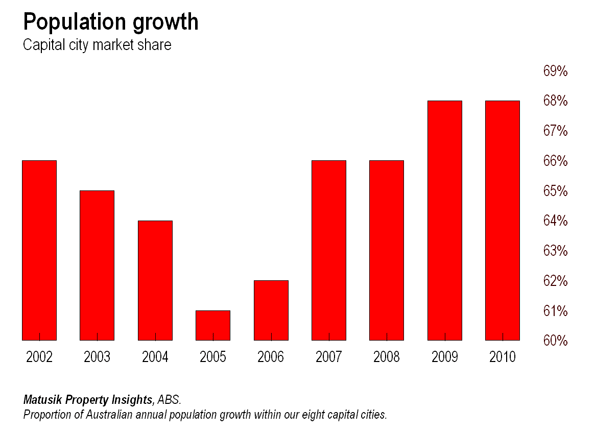
    Here’s why:  In recent years our capital cities have attracted around two-thirds of Australia’s population growth, with many of these new residents settling in the outer suburbs. Our capitals also generated the lion’s share of employment. 

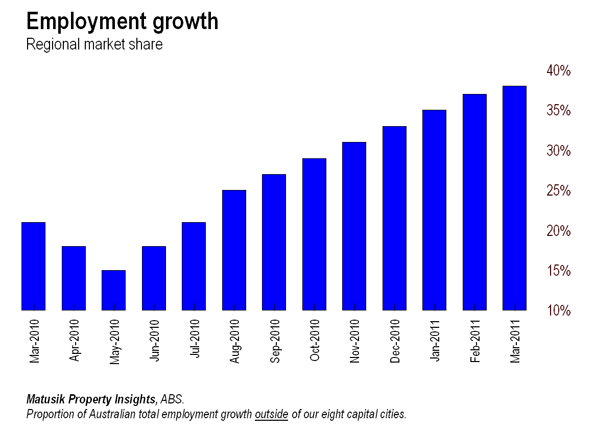
    But over the last twelve months or so, this trend has shifted, with close to two-fifths of our new jobs now being created away from our major cities and in regional towns.  Past trends suggest that population growth will follow. 

    Deteriorating lifestyle (and rising costs) – in our three major capitals, at least – is likely to add further momentum to this new regional push.

    It’s not too hard to understand why Australia’s regional areas are sometimes overlooked.  A quick look at the demographics of Australia reveals a country the same size as mainland USA, or 20 times the size of Japan, with only eight capital cities throughout its eight states and territories.  This is one of the most urbanized countries in the world, where only 15% of the population resides in rural areas and a vast interior.   

    This week, regional focus has come under the microscope with the unveiling of the 2011 Federal Budget by Australia’s Deputy Prime Minister and Treasurer, Wayne Swan.   The Government plans to flood regional areas with 16,000 skilled migrants via the introduction of new initiatives to encourage skilled migration to regional areas.

    Additionally, regional areas are set to receive critical infrastructure upgrades to hospital and health services, and funding to support strategic planning and growth. 

    Astute property buyers should start to look beyond the capitals for investment opportunities.  The big winners in this regional resurgence will most likely be the resource towns – the “muscle towns”, as Bernard Salt recently called them. 

    By this, we don’t mean the fly-in-fly out places like Moranbah, but places critical to the delivery of iron ore, gas and coal – like Wollongong, Newcastle, Gladstone, Surat Basin (Toowoomba) and Townsville.  Expect big things in these regions.  Two thirds of the new jobs created across Queensland last year were in the Gladstone region alone.

    Regional Australia is to become a whole lot more.

  • Actually, Cities are Part of the Economy

    “The prosperity of our economy and communities is dependent on the political structures and mechanisms used to manage and coordinate our economic systems.”

    No politician expecting to be taken seriously would say that today. State intervention was discredited long before it collapsed in the 1980s. Even our prime minister in Australia pays lip-service to “flexible markets with the right incentives and price signals to maximise the value of our people and capital resources.” But how does that square with her government’s quiet push for a more intrusive urban policy agenda?

    Over the last twelve months, Infrastructure Minister Anthony Albanese has been laying the ground work for a grand National Urban Policy, to be announced later in the year. To this end, he released three dense documents. Last March we got State of Australian Cities 2010 (“Cities 2010”), a compilation of statistics confirming, amongst other things, that cities account for 80 per cent of our Gross Domestic Product. Then in December came a discussion paper and a background paper, both called Our Cities.

    Their general drift can be gauged from a line in the latter’s final chapter. It’s the sentence quoted at the top of this article, with the words “cities” and “urban” replacing “economy” and “economic.”

    Embarrassed to champion intervention at the macro level, progressives resort to carving chunks out of the national economy and relabeling them “the environment”, “social capital” or “urban planning” before turning reality upside down. As he moves urban policy to the environment ledger, Mr. Albanese promises to transform the “productivity, sustainability and liveability” of our cities. Intervention is bad for the national economy, it seems, but good for the 80 per cent of GDP generated by cities.

    Urban Myths

    The authors of Mr. Albanese’s documents are anonymous, but aficionados will recognize the handiwork of Curtin University’s Sustainable Policy Institute, Griffith University’s Urban Research Program, the Faculty of the Built Environment at NSW University, and other focal-points of green orthodoxy. The reference lists are full of their output. Their technique of persuasion, recycled by Mr. Albanese’s Department, is to evoke plausible images while perpetuating three myths: suburban growth worsens carbon emissions and traffic congestion, people are being forced to live far from jobs concentrated in CBDs, and denser development will make housing cheaper.

    The discussion paper says: “Australian cities generate very high carbon emissions and air pollution from our heavy reliance on carbon fuels for energy and transport. Carbon emissions from transport are principally due to the lengths of trips necessitated by our dispersed cities and our extensive use of private motor vehicles.” Variations of this passage recur throughout the documents. It sounds plausible enough. So many vehicles cris-crossing our wide open cities must be spewing out heaps of carbon dioxide. But the documents ignore evidence painting a different picture.

    There is the Australian Conservation Foundation’s Consumption Atlas, which found that dense, affluent, inner-suburbs account for more carbon than the dispersed fringe, suggesting that, as a factor in emissions, general consumption trumps settlement patterns; there is a 2007 study by Randolph and Troy confirming earlier findings that energy consumption per capita in high-density developments, like high-rise apartments, is notably higher than in detached housing; there is a recent report by Allen Consulting for the Victorian Building Commission, noting the absence of conclusive evidence that vertical living is more ‘sustainable’ than conventional homes; and there is more.

    None of these rate a mention in the documents. Chapter 5 of the background paper does reference a couple of studies by Alford and Whteman (2009) and Trubka, Newman and Bisborough (2010), but these focus on “transport energy consumption” and “transport greenhouse gases.” They don’t investigate the impact of urban form on general consumption, the real determinant of emission levels. And a study by Perkins et al (2009), cited in Cities 2010, actually contradicts the approved message: “overall, it cannot be assumed that centralised, higher density living will deliver per capita emission reductions for residents … ”

    There is no reliable evidence that suburban growth is worse for emissions. Even Griffith’s Brendan Gleeson, a very green urbanist, had to concede that “the faith … in residential density as a simple lever that can be used to manipulate urban sustainability appears to be misplaced. New Australian scientific analysis points to the consumptive lifestyle, not the nature of one’s dwelling, as the root of environmental woes.”

    In any event, transport accounts for 14 per cent of Australia’s 1.4 per cent share of global emissions, or a minuscule 0.197 per cent of the world’s carbon. We should retain a sense of perspective, even if the documents obsess about our high per capita emissions. If the climate is being affected (a big if), it’s absolute volumes that matter.

    Allied to the myth of carbon-spewing suburbs is the myth of centrally-located jobs. We read in Cities 2010 that “the impacts of outward expansion and low density residential development have been a greater separation between residential areas and locations of employment …” The discussion paper asserts, more directly, that “the trend to inner-city living reflects changing preferences for dwellings and location – living closer to employment that is concentrated in central areas.” Again, similar statements crop up throughout the documents. People shouldn’t have to drive or commute long distances to a “centre” where the jobs are.

    Evidence to the contrary is easy to find. According to the NSW Department of Transport, only 12 per cent of Sydney’s jobs are in the CBD, and second tier centres like North Sydney, Chatswood, Parramatta, Hustville and Penrith have no more than 1.8 per cent each. The rest are distributed throughout the metropolitan region. In the case of Melbourne, McCloskey, Birrell and Yip (2009) say it’s absurd to concentrate housing near transit lines since only 19 per cent of jobs within the Melbourne Statistical Division (MSD – Greater Melbourne) were located in the Melbourne Local Government Area (the CBD), while 81 per cent “are scattered throughout the rest of the MSD”.

    In fact, the background paper points out that a majority of the employed in Sydney, Melbourne and Perth live within 10 kilometres of their workplace, while around 15 per cent live more than 20 kilometres away. This is hardly a disaster in the making. Consistently, Cities 2010 refers to “evidence that commuting distances have been stable or even declining since the 1990s in a number of capital cities.”

    For green urbanists, these myths are indispensible. Their agenda hasn’t a hope unless the public accepts that suburban growth will spoil the climate, and hike congestion and transport costs. As for housing affordability, the documents take a leave-pass (social housing is another story). They promote the term “living affordability”, adding petrol prices and mortgage rates to the equation.

    Evidence linking costly housing to supply restrictions on the fringe, like the annual Demographia survey, is too inconvenient. When the background paper does get around to the subject, it says “multiple factors [impede] the delivery of an efficient supply of suitable and affordable housing.”
    These include “land zoning and building code regulations and other standards related to building quality.” A few pages later, however, canvassing some solutions to the problem, the paper proposes “reforming planning systems to … position a variety of residential development in close proximity to centres and transport infrastructure”. Doesn’t this mean a lot more inefficient “land zoning”?

    This is just one instance of disjointed logic and economic illiteracy; many others are scattered throughout the documents.

    The Invisible Hand and Land

    Actually, cities are part of the economy, and are subject to the same principles. The operations of demand, supply and prices are equally applicable to land and structures. They can’t be erased by regulation, even if it’s called planning and zoning. The inflationary effect of coercive zoning on land values is the elephant in the room. Nowhere is it acknowledged in the documents.

    Consider two recent press items. Retail tenants in Pitt Street Mall, the heart of Sydney’s CBD, are paying rents as high as $13,000 a square meter, while industrial tenants on the north-west outskirts pay around $237. These rent differentials are, of course, a function of distance, and influence the viability, not just the location, of various types of activities.

    Restricting expansion and other forms of coercive zoning place an escalating floor under peripheral rents and values. Mr. Albanese’s authors fail to appreciate the implications of this, not least for “urban productivity.” There is little call to dwell on economic mechanisms if you believe, as the discussion paper puts it, “the private sector, through a myriad of individual decisions and investments, guided and constrained by government investments, regulations or charges, is a powerful shaper of cities [emphasis added]”.

    In the documents, lifting productivity boils down to cutting the costs of traffic congestion, estimated to reach $20 billion a year by 2020, principally by reducing “car dependency” (another loaded term, echoing drug dependency).

    Ignoring the reality of high job dispersal, the background paper says “a key challenge is to reduce dependence on motor vehicles while maintaining access between and within locations … the Australian Government recognises that it has a role … in investing in major mass transit systems, identifying and protecting new transport corridors and supporting means to shift from private vehicles to public transport”. But as McCloskey, Birrell and Yip explain, “the high level of job dispersal around Melbourne [and other cities] cannot be easily unwound.” In those conditions, Mr. Albanese’s strategy is doomed to failure.

    Alternatively, when diseconomies from congestion start to outweigh economies from centrality, firms and commuters will move to other, less congested sites, easing congestion all-round. This is the only effective, long-term solution to congestion. However by mandating concentration rather than enabling dispersion, evidenced by a dim view of road-building, green planning stymies this process. The documents want to end it altogether.

    According to the background paper, “connectivity within cities can also be achieved by placing people closer to the jobs, facilities, goods and services they desire – or putting these closer to where people live. This highlights the important role of integrated land-use and infrastructure planning in managing the need for physical travel”. But this notion, that firms and residences can be “placed” by a central authority, is logically flawed. It suffers from something akin to a “coordination problem” (a concept from game theory).

    Suppose household A has, in existing circumstances, chosen its optimal location relative to (1) affordable housing, (2) employment and (3) services. How can the government arrange things so that A ends up in a more optimal location? Moving A closer to work may push it further from affordable housing and services. Moved closer to services, A may end up further from other factors, and so on. It’s unlikely that the government can ever place A in a better location relative to all three factors.

    Then suppose household B has chosen its own optimal location relative to the three factors, some distance away from the point chosen by A. How does the government improve the outcome for both households? Action benefiting A may hurt B and vice versa.

    The same problem can be framed for businesses locating relative to (1) competitive rents, (2) transport routes, (3) suppliers, (4) suitable labour and (5) customers (market). Our cities host hundreds of thousands of households and businesses. There is no way that a planning hierarchy can engineer a more efficient outcome than the people themselves, interacting freely in the marketplace. Official meddling is more likely to induce problems than solve them.

    Instances of disjointed logic abound. One paper talks about “micro-reforms to reduce costs to businesses and consumers”, but another urges “access to a range of [more expensive and less efficient] high-quality renewable energy sources”; a paper commends “the principle of subsidiarity, ensuring that the most local level of government is used …”, but then calls for “improving alignment and integration of planning and investment across all three levels of government to support the nationally agreed … objective”; a paper demands action to “reduce red tape”, but all three documents offer heaps more instruments and regulations.

    Ultimately, Mr. Albanese’s documents are the pretext for a new wave of intrusion into economic life. As such, they represent a glaring case of bureaucratic overreach. However much he may spruik flats, smaller houses, public transport and higher utility bills as an enhancement of urban “liveability”, most Australians will disdain them as anything but liveable.

    John Muscat is a co-editor of The New City, where this piece originally appeared. 

    Photo by Joseph Younis.
  • What kind of Cities do we Want, Sustainable, Liveable or Resilient?

    A critical issue from the dreadful earthquake that has severely damaged so much of central Christchurch, taken so many lives, and terrified so many residents of the whole urban area, lies in whether the Central Area should be rebuilt. Some believe it should be abandoned for some other location; others see an opportunity to set new standards in sustainability, urban design, energy efficiency, or whatever ideal urban form takes your fancy.

    Let’s put the issue of “sustainable cities” to one side because the can words means anything, and hence mean nothing.  It has become one of the most overused phrases in the English language.

    Not surprisingly, Many of Auckand’s leaders are thrilled by the recent official ranking of Auckland as the tenth most livable city in the world, and have announced their determination to make Auckland even more “liveable” than it is now. This target of livability is also surfacing in Christchurch, normally to bolster demands for urban rail, transit-oriented gentrification, promoting cycling and walking, and making the city attractive to the “creative class”.

    However this quote from a US urban blog should give the livability boosters pause:

    Much of the highly touted livability of Portland has come at the expense of making it unlivable, that is, unaffordable, to anyone without a six figure income. The creative and professional classes thrive in Portland because they are the only ones who can afford it, and they are the ones who appreciate the development style the city has tried to mandate.

    I first raised this issue of ‘rich folk’s livability’ in How Can Cities With Unaffordable Housing Be Ranked Among The Most Livable Cities In The World? here on NewGeography. Then Wendel Cox further quantified such city’s “unlivable reality" in Unlivable Vancouver, in NewGeography.

    Cities designed to be sustainable or livable are likely to be unaffordable for all but a few.

    The Case for Resilient Cities

    Many of us watched the devastation caused by the floods in Queensland, Australia, driven by major rainstorms inland, and Pacific Typhoons devastating the West Coast and the hinterlands. The combination of a strong El Nina with the Pacific Decadal Oscillation means such events will be more common and more extreme in this part of the world than we have become used to since the similar combination of 1917/18.

    However, Phil McDermott, on his blog Cities Matter was quick to comprehend the lessons to be learned by our political leaders and urban planners.

    He opens his blog comment Cities in Search of Resilience with:

    An age of extreme events?

    Without debating whether an increase in the frequency of extreme events reflects climate warming, such events can be catastrophic when they impact on densely populated areas. Natural disturbances, whether geophysical (tsunami, earthquakes, mudslides) or climatic (flooding, hurricane strength winds, tidal surges), become disasters if they strike heavily populated centres. 

    So do human acts of aggression. The tactic of terrorising civilian populations taken to new heights in the bombing raids of the Second World War and adopted by today’s extremists is most effective – and destructive – when directed at the heart of major cities.

    Later in the post Phil sets out the following vulnerabilities generated by the current "compact city" planning paradigm:

    It relies on sophisticated, centralised interdependent systems of services. This creates greater capacity for disruption when any one part fails. Economies of scale in utilities may come with increased risk of failure under duress.  This applies to sewage treatment infrastructure, communications, water, energy distribution, and power supplies. It also applies to public transport systems.

    Poorly designed intensification reduces permeable surfaces, intensifying flood impacts.

    Converting brownfield and even greenfield sites (such as undeveloped urban space) to housing or mixed use reduces the safety valve of open space and increases vulnerability associated with the concentration of buildings and populations.

    Crowding more people into smaller spaces around constrained road capacity reduces prospects for rapid evacuation from the city or into safe structures and areas.
    Lifting the density of buildings increases the consequential impacts of severe events by such things as the collapse of structures, the spread of fire, and the transmission of disease.

    Read the whole post here. You might think Phil was setting out a list of lessons to be learned from Christchurch – but that "extreme event" was still in the future. A few days later, Phil responded to this tragedy with a second blog post, that picked up the same theme, titled "A Cruel Blow to a Beautiful City" which offers this timely warning:

    We cannot resist the power of earthquakes, hurricanes, tsunami, and the like. But we can perhaps limit the devastation that accompanies them.

    The implosion of many of Christchurch’s beautiful heritage buildings is a tragedy on its own, the wiping from the landscape of much of the City’s and nation’s history. But seeing the collapse of more modern buildings is sobering. 

    What are the lessons of architecture and engineering that might be drawn from this?

    How much resistance can we realistically build into our structures?  Or should we be thinking less rigidly, and explore designs that deflect or reduce the impacts when buildings are faced with irresistible forces? Should we think more about the survival of the people in and around buildings and less about the survival of the structures? Are there innovations in design that offer refuge, protection, and escape even if walls crumble and floors collapse?

    This event in Christchurch must surely erode planners’ resistance to the decentralisation that is the mark of a prosperous, modern city, that makes it that little bit more liveable, and so much more resilient in the face of disaster?

    Surely, Hurricane Katrina, and these events in Australia and New Zealand suggest that planners should stop worrying about sea level rises that MIGHT, or might not, happen in 100 years – with plenty of warning – and start thinking more about making our cities resilient in the face of catastrophic events which we know can happen tomorrow – hurricanes, cyclones, blizzards, volcanoes, earthquakes and tsunami.

    However, the proper debate should not be as simple-minded as "high rise vs. low rise" or "old vs. modern". In Christchurch, liquefaction contributed to the collapse of some of the modern buildings. In the Kyoto earthquake some robust high-rise blocks simply fell over, because of the total collapse of the ground under the building, but remained in one piece.

    Such problems and issues are not solved by sets of simple rules but by the application of skill, experience and wisdom. 

    Owen McShane is Director of the Centre for Resource Management Studies, New Zealand.

    Photo by Kym Rohman

  • Housing Crisis in Australia

    Even if Australia is a beautiful place to live, it is far from affordable. Results from the Demographia International Housing Affordability Survey show that some of the country’s major cities rank near the bottom of the list of areas with affordable housing. Out of the 325 cities analyzed, Perth ranks 291st, Melbourne ranks 321st, and Sydney ranks 324th. At 6.3, 9, and 9.6 respectively, each one has a median housing price to median household income ratio at least three to six points higher than the 3.0 price to income ratio demarcating affordable from unaffordable housing. Compared to these places in Australia, living in New York or London seems almost reasonable.

    Residential property prices in Australia have risen 250% in the past ten years, mainly due to the Government’s concentration on incentives for investors and speculators. A first home buyer’s program and negative gearing incentives for home and property owners have taken a toll on the housing market, creating such “inexcusable” conditions according to Australian Greens housing spokesman Senator Scott Ludlam.

    The 2008 Senate Select Committee on Housing Affordability’s investigation into this issue reveals that the Government spent about $50 billion annually on capital gains exemptions and negative gearing incentives, while only spending $512 million over the course of five years to improve the supply of affordable housing. Rental affordability is not much better, as indicated by the gap of 493,000 affordable and available rental properties in Australia.

    Ludlam and others have started to call this a “crisis,” an adequate term given migration trends all over the world. Cities with unaffordable housing, such as New York, London, and San Francisco, are losing people moving to the less expensive suburban areas. If Australia continues to have housing bubbles and affordability issues, cities like Melbourne and Sydney may experience high out-migration rates in the coming years, which would not bode well for cities on the rise.

  • Australian Local Governments Stop Forced Amalgamation

    Local government consolidations are often proposed by a wide range of interests, often out of the belief that they will produce more efficient (less costly) governments. Much of the academic literature supports this view. However, the evidence indicates that material savings routinely fail to occur from such amalgamations. The claimed $300 million annual savings in Toronto’s megacity quickly became higher costs and a larger bureaucracy.

    As in the Canadian provinces of Ontario and Quebec the Australian state governments of New South Wales (Sydney is the capital), Victoria (Melbourne is the capital) and Queensland (Brisbane is the capital) have been aggressive in forcing municipalities to merge over the last two decades. Often these attempts have met with opposition from residents. A forced amalgamation in Montreal was so unpopular that a new provincial government established mechanisms to “demerge.” Despite formidable barriers, 15 cities chose independence.

    Sometimes amalgamations are proposed for much smaller jurisdictions than 2.5 million population Toronto or even the 1990s merger that created the 90,000 population city of Melbourne, which is the core city of the Melbourne metropolitan area.

    In July, the New South Wales government announced intentions to amalgamate three jurisdictions ranging with a total population of 35,000. The city of Armidale-Dumaresque, Uralla Shire and Gyura Shire are located in the “New England” region of New South Wales, one-half way between Sydney and Brisbane. The amalgamation would have replaced the local governments with the New England Regional Council, a mega-jurisdiction of 5,000 square miles (13,000 square kilometers), a land area approximately equal in size to the area of the states of Delaware, Rhode Island and the province of Prince Edward Island (Canada) combined.

    The proposal met with determined opposition, from citizens and from the local governments. For example, the Uralla Shire Council submittal to the state Local Government Boundaries Commission, cited pitfalls of local government consolidations, relying on both Australian and international research. The Armidale Express reported that two former Guyra Shire council members mobilized that community against the amalgamation. There were substantial concerns. One was an interest in preserving historic communities, and the nearly universal aversion to moving city hall farther away. Errors were claimed in state government analyses that led to the amalgamation proposal and fiscal concerns were raised.

    In the end, the Local Government Boundaries Commission recommended against the proposed amalgamation. Minister for Local Government, Barbara Perry made the announcement on November 17. Uralla, Guyra and Armidale-Dumaresque will not be forced to amalgamate.

    The decision brought immediate positive responses from local leaders. Uralla Shire Mayor Kevin Ward said that he couldn’t be happier with the decision. Guyra Shire Mayor Hans Heitbrink said that the decision not to merge the three councils speaks volumes about the spirit of the communities who fought to save their separate local government areas. Armidale-Dumaresq Mayor, Peter Ducat, spoke of the stress that the decision will relieve for council staff and the community.

    They have reason to be pleased. Rarely, if ever, in recent decades have Australian jurisdictions retained their communities and their local democracies in the face of state amalgamation proposals.

  • The Commonwealth Bank of Australia/UBS-Demographia Data Dispute

    The Age (Melbourne) headlined a story “CBA Accused of Choosing its Facts.” CBA is the Commonwealth Bank of Australia, while UBS is the Swiss investment house. Commonwealth produced a report comparing housing affordability in Australian metropolitan areas to international metropolitan areas (Australian Housing and Mortgages: CBA Mortgage Book Secure). According to The Age:

    Investment forums and housing blogs were alive with talk yesterday that an 18-page presentation used by the bank had replaced unfavourable housing affordability figures with data showing housing costs were not out of step with other cities in the world.

    One slide compared Australian housing affordability to several cities, citing figures from a combination of the US urban planning research house Demographia and the investment bank UBS.
    The slide showed housing in Sydney and Melbourne was more affordable than cities such as San Francisco, New York and Vancouver. But it used UBS data exclusively for the Australian cities, and Demographia data for the overseas cities.

    The data were not comparable. Commonwealth relied upon Median Multiple data (median house price divided by median household income) from the 6th Annual Demographia Housing Affordability Survey for international metropolitan areas. However, Commonwealth used a median/average multiple (median house price divided by average household income) calculated by UBS, the Swiss investment house, for Australian metropolitan areas. These are very different indicators.

    There would have been nothing wrong with having used the median/average multiple, had it been shown for all metropolitan areas, Australian and international. However, comparing the median/average multiple to the Median Multiple is invalid. Average household incomes are routinely higher than median household incomes and the use of an average income figure inappropriately biases Australian housing affordability relative to international metropolitan areas.

    For example, the UBS median/average multiple for Sydney is reported by Commonwealth to be 6.2. Commonwealth finds Sydney to be more affordable than San Francisco’s, which it indicates at 7.0. However, the San Francisco figure is the Median Multiple and the comparable figure for Sydney is 9.1, making Sydney less affordable than San Francisco

    In fact, had the UBS median/average multiple been used for all metropolitan areas, including the international metropolitan areas, it is likely that the gap between Australian metropolitan areas and international metropolitan areas would be of similar magnitude to that shown in the Demographia International Housing Affordability Survey.

    From time to time, various interests have suggested alternate measures of housing affordability for Australia and then compared or suggested comparison to our Median Multiple data. Of course, that is invalid.

    The Age article by Eric Johnston was carried in other Fairfax Media outlets such asThe Sydney Morning Herald and the Brisbane Times, and the subject has been covered by financial blogs.

    Note: Author Wendell Cox of Demographia.com and Hugh Pavletich of PerformanceUrbanPlanning.com are co-authors of the Demographia International Housing Affordability Survey.