Tag: bailout

  • $12.8 Trillion Committed to Bailout

    Shortly after I told you that Bloomberg.com is reporting a running total of the money the U.S. government has pledged and spent for bailouts and economic stimulus, reporters Mark Pittman and Bob Ivry updated the totals: So far, $12.8 trillion has been pledged – an additional $1.2 trillion over the earlier report. The total disbursed through March 31, 2009 stands at $4.2 trillion. The Federal Reserve is still committed to providing the largest share at $7.8 trillion, followed by the U.S. Treasury $2.7 trillion and FDIC $2.0 trillion.

    The national debt currently stands at $11.3 trillion — versus an authorized limit of $12.1 trillion. Spending, lending and bailouts by the Federal Reserve are not counted toward the limit.

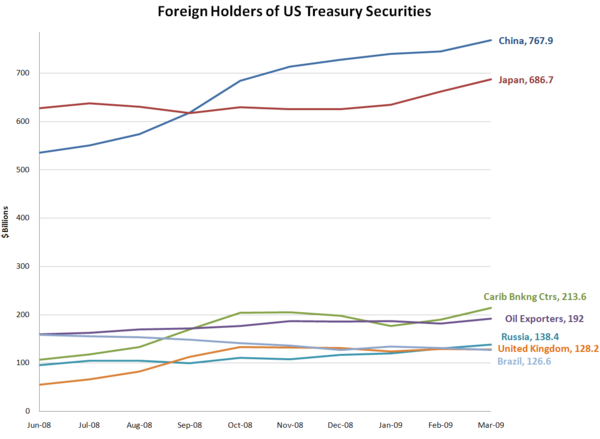
    This week, U.S. Treasury Secretary Timothy Geithner is in China. Mainland China holds $767.9 billion of Treasury securities at the end of March 2009 or about 7 percent of the total national debt. Japan, the second largest major foreign holder, has $686.7 billion.

    Notes: Data from Department of the Treasury. Caribbean Banking Centers (Carib Bnkng Ctrs) include Bahamas, Bermuda, Cayman Islands, Netherlands Antilles, Panama, and British Virgin Islands. Oil exporters include Ecuador, Venezuela, Indonesia, Bahrain, Iran, Iraq, Kuwait, Oman, Qatar, Saudi Arabia, the United Arab Emirates, Algeria, Gabon, Libya, and Nigeria.

    The U.S. bailout commitment of $11.6 trillion equals 89 percent of U.S. 2008 gross domestic product (GDP).

  • Betting against the USA — told ya’ so!

    More than once in this space, I’ve said that derivative financial products set up a perverse incentive where investors have more to gain from the failure of companies and homeowners than their success. If you haven’t seen it yet, take a look at the longer version of my description of the causes and consequences of the current crisis to understand how failed financial innovations, like credit default swaps, contributed to the meltdown of 2008. I wrote that article back in November.

    Once again, only Bloomberg.com is out front on this story. More hedge funds are catching onto the casino-like qualities of betting against America’s economic success. Reporters Salas, Harrington and Paulden could have quoted my NewGeography writings directly: “companies [have] more credit-default swaps outstanding than the bonds the contracts protected…” and, referring to Clear Channel Communications, “some of its creditors stand to profit from its failure.”

    Told ya’ so!

  • Who’s Watching AIG?

    The House Committee on Oversight and Government Reform held a hearing Wednesday – “AIG: Where is the Taxpayer Money Going?” Questions are being raised about whether the bailout better serves the interests of AIG’s customers and trading partners or the interests of U.S. taxpayers.

    The highlight of the Committee’s questioning of Chairman and CEO Edward Liddy came when Chairman Town (D-NY) asked the blunt question: “Why would you give retention bonuses to AIG employees who failed? Plus, the economy is so messed up, where would they go?” On the minds of many committee members were the facts that AIG got $70 billion in TARP money, $50 billion through the Federal Reserve Bank of New York’s Maiden Lane LLC and another $60 billion directly from the Federal Reserve Bank of New York (the FRB-NY’s AIG Credit Facility). When compared to the fact that AIG is currently worth just $5 billion, the repeated question became: “How will taxpayers be repaid?” Mr. Liddy pointed to the value of some subsidiaries and other assets that can be sold off, but he had to admit that the timing and possibility of AIG repaying taxpayers really “depends on the economy and the capital markets.”

    The Trustees of the AIG Credit Facility Trust testified in the second panel. The Trustees were named by the Federal Reserve Bank of New York, under then-President Timothy Geithner, in September 2008. The panel included one non-Trustee – Professor J.W. Verret of George Mason University School of Law. Professor Verret expressed concern over the form of the AIG trust agreement: “I am concerned by the AIG trust because of the precedent it sets. Secretary Geithner has announced his intention to create another trust to manage the Treasury’s investment in Citigroup as well as other TARP participants. If the AIG trust, crafted during the Secretary’s tenure as President of the New York Fed, is used as a model for these new entities, the risk to taxpayers will be multiplied many times over. “ Professor Verret raised three specific problems with the agreement: 1) the agreement specifically expects the Trustees to act in the best interest of the U.S. Treasury, not the U.S. taxpayers; 2) the Trustees cannot be held liable for their actions; and 3) the Trustees can invest on information they gain in the course of their duties.

    At the end of the hearing, the final question went to Representative Norton (D-D.C.). Too many of the AIG Trustees also serve or have served as directors and officers to other TARP recipients. Ms. Norton noted that all of the witnesses are connected to Wall Street and all know each other. Evidently, one of the Trustees, Jill Considine, is involved with a Bermuda company that provides services to hedge funds. Ms. Considine was uncomfortable naming the hedge funds that benefit from her advice because the Bermuda company is private – it is also foreign. Considine took Norton aside when hearing ended, engaging her in an animated conversation – off the record, of course.

    It seems evident that some of the Trustees didn’t recognize the risks AIG was taking when they were in a position to have close contact with not only AIG but their counterparties – those final recipients of the bailout money. If the Trustees missed the AIG risk then, when they were regulators in the self-regulatory industry and serving on Boards at the Federal Reserve Banks, then what can we expect from them now?

  • Buffett’s Partner Agrees with Us

    Billionaire investor, Warren Buffett, is hosting the Berkshire Hathaway shareholder meeting “Capitalist Woodstock” in Omaha this weekend. Every news truck this side of Kansas City has been moved into town to cover the event.

    While using words like “evil”, “folly” and “demented” to describe the activities that generated the global financial meltdown, Buffett’s partner, Charlie Munger, told CNBC in an interview that credit default swaps (CDS) should be outlawed completely. I have said clearly that Buffett’s strategy on CDS has gotten him in too deep. His strategy requires “new money” coming into the system regularly at a time when investors are pulling back.

    Munger also says that “the people who make a lot of money out of the system as it is have a lot of political power and they don’t want it changed.” We think he must be speaking about Buffett here, too. Berkshire Hathaway is a financial company that benefits from the bailout of financial companies. Buffett must also be aware that the government will continue to make bailout payments, that will be passed along to CDS holders, just like the approximately $50 billion Uncle Sam passed out through AIG during the fall of 2008.

    According to a report from Reuters, Berkshire Hathaway will not report their 1st quarter financial results on Friday and no new date or reason for the delay has been given. According to Bloomberg, the results will be delayed until six days after the meeting. There is some speculation at CNBC that Buffett may want to avoid some “terrifically worried” investors at the meetings this weekend. The stock price closed down $1,995 per share on Friday, May 1.

  • Geithner’s Collusive Capitalism

    Jo Becker and Gretchen Morgenson (she reported on the lack of mortgages behind mortgage-backed securities) did a long piece on Treasury Secretary Timothy F. Geithner in the New York Times. They paint a stark picture of Secretary Geithner’s brand of “Collusive Capitalism”: lunch at the Four Seasons restaurant with execs from Citigroup, Goldman Sachs and Morgan Stanley; private dinners at home with the head of JPMorgan Chase.

    Most importantly, Becker and Morgenson raise the question of why – with all that frequent contact – Geithner never sounded the alarm about these banks? Indeed, as I’ve pointed out before, Geithner took no steps to prevent $2 trillion in US Treasury bond trades go unsettled for 7 months – until it was over, when he called a meeting of the same bankers that caused the problem to have them do a study, take a survey, make some suggestions, etc. The one action that needed to be taken – to enforce finality of settlement – was never on the table.

    When the banks behaved recklessly in lending, trading, issuing derivatives and generally fueling the Bonfire of their Vanities, according to Becker and Morgenson, Geithner’s idea was to have the federal government “guarantee all the debt in the banking system.” As Martin Weiss asks in his ads for Money and Markets, “Has U.S. Treasury Chief Geithner LOST HIS MIND?”

  • How Soon We Forget: Wall Street Wages

    It also wasn’t that long ago that Congress held hearings on the bonuses paid to AIG employees after the bailout. Now, according to New York Times reporter Louise Story Wall Street compensation is rising back to where it was in 2007 – the last year that these firms made oodles of money with investment strategies that turned toxic the next year.

    And, yeah, we get it – there is a theoretic connection between compensation and performance. But we also know that there’s a difference between theory and practice. Too many of the same employees who either perpetrated the events leading to the meltdown or stood idly by while it happened are still in place.

    When AIG finally revealed what they did with the bailout money, we found out that a big chunk of it went overseas. Now, New York Post reporter John Aidan Byrne tells us that the bailout recipients are bailing out – on U.S. workers! Story found that Bank of New York Mellon, Bank of America and Citigroup, all recipients of billions of bailout dollars, are shifting more jobs overseas. The explanation, that nothing in TARP prohibits them from moving jobs out of the US, is so lame I’m surprised Story even bothered to mention it.

    The initial indicators of the current financial meltdown were visible in mid-2007. The deeper, underlying causes were recognized, talked about in Washington and then ignored as far back as 2004. The collective memory is short. Nobody wants to hear the bad news, especially when it’s this bad and it goes on for this long. The morning you wake up and wish the financial meltdown would just go away is your most dangerous moment – wishing won’t make it so.

  • TARP Criminal Charges Possible

    Of the three monitors established by the legislation that created the Troubled Asset Relief Program (TARP), only one has the authority to prosecute criminals. That is the Office of the Special Inspector General (SIGTARP) whose motto is “Advancing Economic Stability through Transparency, Coordinated Oversight and Robust Enforcement.” The Special Inspector General in charge, Neil Barofsky, told Congress before the recess that he was by-passing the Rogue Treasury to get answers directly from TARP recipients about what they are doing with the bailout money. Now, SIGTARP has set up a hotline (877-SIG2009) for citizens to report fraud or “evidence of violations of criminal and civil laws in connection with TARP.” To date, they have received 200 tips and launched 20 criminal investigations.

    What started out as a bailout costing $750 billion quickly turned into $3 trillion – an amount about equal to the U.S. government’s 2008 budget. This week, SIGTARP released a 250-page report in an attempt to place “the scope and scale [of TARP] into proper context” and to make the program understandable to “the American people.” I can’t recommend that you read a report of that length, or even that you download it (more than 10 megabytes) unless you have broadband internet access. (In fact, I don’t understand what makes them think that the American people are going to understand anything that takes 250 pages to explain… Isn’t over-complicating one of the problems they want to solve?) You can get all the high points in Barofsky’s statement to the Joint Economic Committee, which is only 7 pages and a few hundred kilobytes. If you have more time than patience, you can watch the testimony on C-SPAN.

    I applaud the hard work of the SIGTARP to provide oversight to Treasury even though they are “currently working out of the main Treasury compound.” Let’s hope they can break free of the hazards associated with the self-regulation that got us into this financial mess in the first place.

  • Catching on to Buffett

    More of the so-called “mainstream press,” like the Sacramento Bee, are catching up to what we wrote here about Warren Buffett back on March 16. He supported the bailout because his investments benefited from the handouts.

    It seems obvious that Washington takes policy advice from Buffett because he has lots of money. Newsweek reporter Mark Hirsch uncovered evidence, in fact, that Buffett may have been the one that came up with the original proposal for Treasury to buy the junk bonds off the banks’ balance sheets. Given the direction that Berkshire Hathaway’s own credit rating is going, Buffett may have even more reason to support this plan – his companies will be able to invest in the junk at discounted prices after they sell the junk to the government’s partnership funds at inflated prices!

    Some of the comments at Newsweek.com believe that the article is unfair to Buffett – after all, what company doesn’t support policies that will benefit them? But to the tune of $11.6 trillion, which is what the U.S. government has committed to this bailout? We bet even Karl Marx would find that excessive. We agree with the title of a book by William Black, an economist whose work we referred to in our own research on the Savings & Loan crisis – “The Best Way to Rob a Bank is to Own One.” Professor Black discussed the financial crisis with Bill Moyers on April 3, 2009.

    Berkshire Hathaway has significant ownership stakes in more than one bank. This brings us to an article at the Mises Institute, the libertarian think-tank. The article contains a link to an article from 1948 written by Warren’s dad when he was the U.S. Congressman from Nebraska – “Human Freedom Rests on Gold Redeemable Money.” The younger Buffett has a preference for the freshly printed stuff that Treasury is doling out.

  • Geithner’s Toxic Recycling Plan Nixed by Big Fund

    The success of Treasury Secretary Geithner’s Public-Private Investment Partnership Program depends on getting private investors interested in buying junk bonds off the banks’ balance sheets. Now it seems that at least one hedge fund is giving the plan “two thumbs-down.”

    The New York Post is reporting that Bridgewater Associates, one of the few that might qualify for Treasury’s program, decided that “the numbers just don’t add up.” Besides being a bad investment, the fund’s founder raised questions about conflicts of interest – something we find surprising. Hedge fund managers are supposed to be those free-wheeling, unregulated, we’ll-buy-anything investors – always willing to take a risk and suffer the consequences of the market outcomes.

    Bridgewater’s concern is that Geithner’s junk bond plan includes hiring asset managers – who will also be investors. There are clear conflicts of interest because these managers will “have both the government and the investors to please and because they will get their fees regardless of how these investments turn out,” wrote Bridgewater founder Ray Dalio. Imagine, a hedge fund worried about collusion among asset managers? Maybe it takes one to know one?

    The real question is why Geithner would set up a program putting US taxpayer money in the hands of unregulated hedge funds and then go to Europe a few days later and blame the global financial crisis (at least in part) on hedge funds and their lack of regulation? Dalio is right: it just doesn’t add up.

  • Junk By Any Other Name Would Smell

    The Treasury this week disclosed details of their plan to pump $1 trillion into the financial system by removing “Legacy Assets” from the balance sheets of banks. Wading through the multitude of documents and documents, I’m reminded of a remark by Michael Milken in a conversation with Charlie Rose on October 27, 2008 “Complexity is not innovation.”

    Since its inception, the plan has been sold to Congress and the media as one with potential positive payoffs for the public coffers. To support this idea, proponents point to the experience of the Resolution Trust Company (RTC) in resolving the Savings and Loan (S&L) Crisis. Back then, RTC took over failing S&Ls – some of which were bankrupted by bad real estate loans made worse when they were forced to sell off below-investment grade bond assets – the by-now-well-known Junk Bonds.

    Selling off today’s junk bonds will, I agree, clean up the balance sheets of the banks and make them more attractive to investors and depositors. But the investment in junk bonds now is not going to turn out like the investment in junk bonds then. For starters, the value of the junk bonds then declined as a result of the forced sell-off – Congress prohibited S&Ls from holding junk bonds on their balance sheets. When this supply was dumped on the market, the prices naturally dropped. Selling assets at depressed prices damaged a lot of S&Ls. RTC stepped in near the bottom of those prices to take control of the assets. When credit markets returned to normal, the prices of the junk bonds rose and the investments had positive returns.

    Then, junk bonds paid extraordinary rates of return – 10 percentage points above Treasuries at the peak. At that time, a 30-year U.S. Treasury bond could be paying more than 18% interest.

    Now, we are talking about junk bonds that we all know are junk – no matter fancy labels like “Legacy.” What rate of return could there be on a mortgage bond – no matter how you “slice-and-dice” it – created when mortgage interest rates were 5-6%? Add to that our knowledge of the problems underlying these assets and it is increasingly unlikely that there will be any positive payoff for taxpayers in this plan.

    On March 25, 2009, Mirek Topolanek, President of the European Union, called the U.S. economic plan “the way to hell.” His concern is that we’ll have to finance these trillion dollar bailouts with borrowing and that will ultimately further undermine global financial markets. He’s right, of course. The public-private partnerships will finance the purchase of the “Legacy Assets” by issuing debt. That debt will be guaranteed by the Federal Deposit Insurance Corporation (FDIC), the same agency that guarantees our savings accounts at the local bank. Our guarantee is backed by the payment of insurance premiums to FDIC. The guarantee on the debt used to purchase Legacy Assets will be secured by the Legacy Assets – which will be rated by the same credit rating agencies that gave us triple-A rated subprime mortgage bonds in the first place. How can this possibly turn out well? I’m sure Treasury, Federal Reserve and FDIC have good intentions, but as EU President Topolanek says, they may all end up as pavement on “the way to hell.” As NYTimes columnist Paul Krugman said of the new plan, “What an awful mess.”