Tag: Best Cities

  • All Cities Rankings – 2010 Best Cities for Job Growth

    Read how we pick the best cities.

    Overall
    Rank
    2010
    Area
    2010 Weighted INDEX
     2009 Nonfarm Emplymt (1000s) 
    Overall Rank 2009
    Overall Rank Change
    1 Jacksonville, NC
    99.8
            48.2
    2 Bismarck, ND
    95.1
            62.0
    18
    17
    3 College Station-Bryan, TX
    94.8
            98.2
    16
    14
    4 Killeen-Temple-Fort Hood, TX
    92.7
          125.9
    5
    2
    5 St. Joseph, MO-KS
    92.0
            59.1
    63
    59
    6 Fayetteville, NC
    91.9
          129.7
    42
    37
    7 Lawton, OK
    91.2
            43.9
    8 Fargo, ND-MN
    90.8
          121.5
    15
    9
    9 Austin-Round Rock-San Marcos, TX
    88.9
          756.8
    6
    -1
    10 Durham-Chapel Hill, NC
    86.6
          283.2
    19
    11
    11 Yakima, WA
    84.9
            77.3
    136
    127
    12 San Antonio-New Braunfels, TX
    84.9
          827.2
    20
    10
    13 Bloomington, IN
    84.9
            84.8
    201
    190
    14 Hattiesburg, MS
    83.6
            59.5
    99
    87
    15 Baton Rouge, LA
    83.2
          367.5
    27
    14
    16 Kennewick-Pasco-Richland, WA
    82.1
            95.9
    12
    -2
    17 Morgantown, WV
    81.7
            63.5
    13
    -2
    18 Anchorage, AK
    81.1
          168.0
    35
    19
    19 Huntsville, AL
    81.1
          207.9
    40
    23
    20 Hinesville-Fort Stewart, GA
    81.0
            19.5
    21 Houston-Sugar Land-Baytown, TX
    81.0
       2,513.6
    9
    -9
    22 Great Falls, MT
    80.9
            35.0
    23 Hanford-Corcoran, CA
    80.0
            36.8
    24 Ithaca, NY
    79.9
            64.7
    90
    71
    25 El Paso, TX
    79.8
          271.9
    39
    19
    26 Warner Robins, GA
    79.8
            58.8
    57
    36
    27 Iowa City, IA
    79.0
            90.2
    56
    34
    28 McAllen-Edinburg-Mission, TX
    78.7
          219.0
    7
    -16
    29 State College, PA
    78.6
            74.2
    108
    84
    30 Pascagoula, MS
    77.8
            57.3
    93
    68
    31 Brownsville-Harlingen, TX
    77.7
          124.1
    68
    42
    32 Columbia, MO
    77.5
            91.5
    51
    24
    33 Las Cruces, NM
    77.2
            67.9
    31
    3
    34 Pueblo, CO
    77.2
            56.9
    78
    49
    35 Northern Virginia, VA
    77.1
       1,291.4
    84
    54
    36 Wenatchee-East Wenatchee, WA
    76.9
            38.3
    37 Grand Forks, ND-MN
    76.4
            53.7
    70
    39
    38 Corpus Christi, TX
    76.2
          175.8
    23
    -9
    39 Lubbock, TX
    76.1
          129.3
    74
    41
    40 Kankakee-Bradley, IL
    76.1
            43.5
    41 Waco, TX
    76.0
          106.1
    103
    69
    42 Fairbanks, AK
    75.9
            36.7
    43 Jonesboro, AR
    75.8
            48.7
    44 Dallas-Plano-Irving, TX Metropolitan Division
    75.7
       2,006.9
    32
    -3
    45 Cheyenne, WY
    75.6
            43.7
    24
    -12
    46 Lafayette, LA
    75.6
          145.4
    14
    -23
    47 Washtn-Artn-Alexdria, DC-VA-MD-WV Mt Dv
    75.3
       2,380.0
    76
    38
    48 Cedar Rapids, IA
    75.3
          135.9
    77
    38
    49 Fort Worth-Arlington, TX Metropolitan Division
    75.2
          844.9
    30
    -10
    50 Glens Falls, NY
    75.2
            52.6
    141
    100
    51 Sioux Falls, SD
    75.0
          132.4
    26
    -16
    52 Greenville, NC
    74.5
            74.9
    45
    2
    53 Des Moines-West Des Moines, IA
    74.5
          313.9
    65
    21
    54 Raleigh-Cary, NC
    74.4
          496.9
    38
    -7
    55 Rapid City, SD
    73.8
            58.9
    59
    13
    56 Amarillo, TX
    73.6
          109.7
    60
    13
    57 Cape Girardeau-Jackson, MO-IL
    72.5
            44.5
    58 Lawrence, KS
    72.4
            51.9
    59 Springfield, IL
    72.2
          109.7
    122
    74
    60 Portsmouth, NH-ME NECTA
    72.2
            53.6
    146
    97
    61 Billings, MT
    72.0
            78.4
    67
    17
    62 Midland, TX
    71.7
            64.6
    47
    -4
    63 Alexandria, LA
    71.5
            64.3
    21
    -31
    64 Abilene, TX
    71.4
            65.2
    86
    33
    65 Haverhill-North Andvr-Ambry, MA-NH  NECTA Div
    71.3
            75.4
    187
    133
    66 Lincoln, NE
    71.2
          170.1
    109
    54
    67 Tyler, TX
    70.7
            92.7
    29
    -27
    68 Fort Collins-Loveland, CO
    70.3
          131.9
    46
    -11
    69 Harrisonburg, VA
    70.2
            62.0
    249
    191
    70 Olympia, WA
    69.8
            99.1
    25
    -34
    71 Trenton-Ewing, NJ
    69.7
          235.2
    130
    70
    72 Rochester, MN
    69.6
          103.0
    110
    49
    73 Shreveport-Bossier City, LA
    69.5
          174.3
    33
    -29
    74 St. Cloud, MN
    69.5
            98.6
    96
    33
    75 Fayetteville-Springdale-Rogers, AR-MO
    69.5
          199.6
    71
    7
    76 Texarkana, TX-Texarkana, AR
    69.1
            56.1
    43
    -22
    77 Madera-Chowchilla, CA
    68.8
            33.7
    78 Florence-Muscle Shoals, AL
    68.7
            54.5
    140
    74
    79 Auburn-Opelika, AL
    68.6
            52.2
    49
    -18
    80 Omaha-Council Bluffs, NE-IA
    68.5
          453.6
    72
    4
    81 Wheeling, WV-OH
    67.8
            66.6
    138
    69
    82 Utica-Rome, NY
    67.8
          131.0
    163
    93
    83 Jefferson City, MO
    67.7
            77.8
    139
    68
    84 Charlottesville, VA
    67.6
            98.0
    89
    17
    85 San Angelo, TX
    67.5
            43.8
    86 Bloomington-Normal, IL
    67.4
            88.5
    117
    44
    87 Odessa, TX
    67.2
            57.7
    1
    -73
    88 Waterloo-Cedar Falls, IA
    67.1
            88.0
    124
    49
    89 New York City, NY
    66.7
       3,655.7
    95
    19
    90 Lexington-Fayette, KY
    66.7
          247.4
    194
    117
    91 Panama City-Lynn Haven-Panama City Beach, FL
    66.7
            71.0
    150
    72
    92 Little Rock-North Little Rock-Conway, AR
    66.6
          335.0
    106
    27
    93 Dubuque, IA
    66.6
            53.7
    53
    -27
    94 Athens-Clarke County, GA
    66.6
            80.8
    11
    -70
    95 Laredo, TX
    66.6
            86.8
    8
    -74
    96 Manchester, NH NECTA
    66.5
            98.5
    128
    45
    97 Ames, IA
    66.4
            47.0
    98 Houma-Bayou Cane-Thibodaux, LA
    66.1
            91.6
    4
    -80
    99 Sioux City, IA-NE-SD
    65.8
            73.1
    80
    -5
    100 Flagstaff, AZ
    65.8
            61.8
    111
    25
    101 Wilmington, NC
    65.4
          136.6
    61
    -26
    102 Tallahassee, FL
    65.3
          171.4
    202
    114
    103 Elizabethtown, KY
    65.3
            46.1
    104 Oklahoma City, OK
    65.1
          555.3
    44
    -45
    105 Joplin, MO
    65.1
            77.7
    41
    -49
    106 Lebanon, PA
    65.0
            48.1
    107 Salt Lake City, UT
    64.9
          606.9
    36
    -55
    108 Albany-Schenectady-Troy, NY
    64.9
          438.9
    177
    85
    109 Coeur d’Alene, ID
    64.7
            53.0
    17
    -76
    110 Logan, UT-ID
    64.5
            52.5
    111 Pittsburgh, PA
    64.5
       1,112.7
    169
    75
    112 Philadelphia City, PA
    64.4
          647.2
    176
    81
    113 Barnstable Town, MA NECTA
    64.3
            92.0
    238
    142
    114 Bethesda-Rockville-Frederick, MD Metr Div
    64.3
          556.1
    145
    48
    115 Syracuse, NY
    64.2
          315.6
    129
    31
    116 Ogden-Clearfield, UT
    64.2
          191.7
    101
    2
    117 Albuquerque, NM
    64.2
          377.5
    94
    -6
    118 Altoona, PA
    64.1
            60.3
    268
    167
    119 Harrisburg-Carlisle, PA
    64.0
          318.1
    159
    57
    120 Nassau-Suffolk, NY Metropolitan Division
    63.7
       1,225.2
    180
    77
    121 Bangor, ME NECTA
    63.6
            64.9
    181
    77
    122 Rochester, NY
    63.6
          502.8
    137
    32
    123 Bremerton-Silverdale, WA
    63.4
            82.9
    246
    140
    124 Clarksville, TN-KY
    63.2
            81.0
    263
    156
    125 Augusta-Richmond County, GA-SC
    63.0
          209.2
    167
    59
    126 Tuscaloosa, AL
    62.9
            93.1
    112
    3
    127 Salem, OR
    62.8
          144.7
    100
    -10
    128 Cumberland, MD-WV
    62.7
            38.7
    129 Johnstown, PA
    62.6
            59.7
    155
    44
    130 Springfield, MO
    62.6
          190.6
    102
    -10
    131 Ocean City, NJ
    62.3
            35.8
    132 Hartford-West Hartford-East Hartford, CT NECTA
    61.9
          536.9
    199
    86
    133 Boston-Cambridge-Quincy, MA NECTA Division
    61.7
       1,644.2
    118
    4
    134 El Centro, CA
    61.6
            44.6
    135 Buffalo-Niagara Falls, NY
    61.6
          536.3
    174
    59
    136 Charleston-North Charleston-Summerville, SC
    61.6
          282.7
    58
    -58
    137 New Bedford, MA NECTA
    61.5
            63.7
    229
    112
    138 Topeka, KS
    61.2
          107.8
    104
    -14
    139 Kansas City, MO
    61.2
          544.0
    164
    45
    140 Longview, TX
    61.0
            93.3
    3
    -117
    141 Honolulu, HI
    60.9
          437.2
    132
    11
    142 Allentown-Bethlehem-Easton, PA-NJ
    60.9
          329.6
    151
    29
    143 Columbus, GA-AL
    60.4
          116.8
    224
    101
    144 Jackson, MS
    60.3
          251.4
    184
    60
    145 Oshkosh-Neenah, WI
    59.9
            90.0
    98
    -27
    146 Scranton–Wilkes-Barre, PA
    59.8
          252.5
    203
    77
    147 Poughkeepsie-Newburgh-Middletown, NY
    59.8
          247.4
    162
    35
    148 Provo-Orem, UT
    59.7
          179.8
    54
    -74
    149 Owensboro, KY
    59.5
            49.1
    150 Spokane, WA
    59.5
          207.6
    91
    -38
    151 Kansas City, KS
    59.2
          424.1
    22
    -108
    152 Madison, WI
    58.6
          335.1
    158
    27
    153 Charleston, WV
    58.6
          146.3
    114
    -18
    154 Idaho Falls, ID
    58.5
            48.3
    155 Boulder, CO
    57.8
          159.1
    79
    -54
    156 Binghamton, NY
    57.6
          109.8
    165
    31
    157 Norwich-New London, CT-RI NECTA
    57.4
          130.4
    226
    91
    158 Lynchburg, VA
    57.4
          104.5
    52
    -84
    159 Bakersfield-Delano, CA
    57.2
          225.4
    50
    -87
    160 Goldsboro, NC
    57.0
            43.2
    161 Tulsa, OK
    56.9
          406.9
    10
    -128
    162 La Crosse, WI-MN
    56.9
            71.8
    115
    -24
    163 Huntington-Ashland, WV-KY-OH
    56.7
          115.5
    157
    17
    164 Missoula, MT
    56.7
            54.1
    276
    135
    165 Sherman-Denison, TX
    56.3
            42.2
    166 Hot Springs, AR
    56.2
            36.5
    167 Blacksburg-Christiansburg-Radford, VA
    56.1
            68.8
    143
    1
    168 Beaumont-Port Arthur, TX
    55.9
          156.1
    127
    -16
    169 Crestview-Fort Walton Beach-Destin, FL
    55.8
            78.0
    282
    138
    170 Kingston, NY
    55.8
            60.5
    281
    136
    171 Dover, DE
    55.8
            62.6
    231
    85
    172 Tacoma, WA Metropolitan Division
    55.5
          265.1
    81
    -66
    173 Gainesville, FL
    55.3
          128.3
    131
    -17
    174 Virginia Beach-Norfolk-Newport News, VA-NC
    55.2
          729.7
    160
    11
    175 Palm Coast, FL
    55.2
            17.9
    176 Savannah, GA
    55.1
          150.2
    73
    -77
    177 Monroe, LA
    55.0
            75.7
    243
    92
    178 Rochester-Dover, NH-ME NECTA
    54.9
            55.5
    64
    -88
    179 Vineland-Millville-Bridgeton, NJ
    54.7
            60.0
    210
    57
    180 Portland-South Portland-Biddeford, ME NECTA
    54.5
          186.2
    221
    67
    181 Eau Claire, WI
    54.4
            78.2
    135
    -20
    182 Denver-Aurora-Broomfield, CO
    54.3
       1,178.7
    113
    -43
    183 Louisville-Jefferson County, KY-IN
    54.3
          591.5
    204
    47
    184 Columbia, SC
    54.2
          345.8
    116
    -42
    185 Champaign-Urbana, IL
    54.1
          109.0
    83
    -76
    186 Mankato-North Mankato, MN
    53.9
            51.5
    187 Knoxville, TN
    53.9
          319.9
    195
    35
    188 Anderson, IN
    53.8
            40.8
    189 Lewiston-Auburn, ME NECTA
    53.5
            47.2
    190 Lewiston, ID-WA
    53.2
            25.9
    191 Santa Fe, NM
    53.1
            60.6
    66
    -95
    192 Gulfport-Biloxi, MS
    52.9
          106.2
    270
    108
    193 Burlington-South Burlington, VT NECTA
    52.6
          109.9
    300
    137
    194 Columbus, OH
    52.6
          898.2
    178
    14
    195 Parkersburg-Marietta-Vienna, WV-OH
    52.1
            70.0
    193
    28
    196 New Haven, CT NECTA
    52.0
          266.4
    166
    0
    197 Pensacola-Ferry Pass-Brent, FL
    51.9
          158.4
    302
    135
    198 Casper, WY
    51.9
            37.9
    199 Myrtle Beach-North Myrtle Beach-Conway, SC
    51.9
          108.4
    230
    62
    200 Brockton-Bridgewater-Easton, MA  NECTA Div
    51.6
            85.7
    292
    123
    201 York-Hanover, PA
    51.6
          173.3
    92
    -78
    202 Greeley, CO
    51.4
            77.0
    28
    -143
    203 Williamsport, PA
    51.4
            51.8
    293
    121
    204 Winston-Salem, NC
    51.4
          207.5
    192
    19
    205 Calvert-Charles-Prince George’s, MD
    51.1
          375.9
    236
    62
    206 Sandusky, OH
    51.0
            34.2
    207 Lake Charles, LA
    50.9
            88.6
    119
    -56
    208 Colorado Springs, CO
    50.8
          244.4
    190
    14
    209 Ann Arbor, MI
    50.7
          192.8
    322
    145
    210 Appleton, WI
    50.7
          113.3
    232
    54
    211 St. Louis, MO-IL
    50.5
       1,286.5
    179
    0
    212 Roanoke, VA
    50.4
          154.2
    196
    16
    213 Albany, GA
    50.3
            61.5
    260
    79
    214 Seattle-Bellevue-Everett, WA Metr Div
    50.3
       1,374.6
    34
    -148
    215 Pine Bluff, AR
    49.7
            37.4
    216 Camden, NJ Metropolitan Division
    49.7
          512.1
    277
    94
    217 Nashville-Davidson–Murfreesboro–Franklin, TN
    49.7
          719.2
    153
    -31
    218 Montgomery, AL
    49.6
          167.7
    123
    -62
    219 Elmira, NY
    49.2
            39.1
    220 Duluth, MN-WI
    49.1
          125.8
    173
    -13
    221 Framingham, MA  NECTA Division
    49.1
          150.9
    62
    -125
    222 Visalia-Porterville, CA
    49.0
          106.3
    133
    -55
    223 Bellingham, WA
    48.8
            79.2
    75
    -114
    224 Charlotte-Gastonia-Rock Hill, NC-SC
    48.6
          802.5
    125
    -65
    225 Bridgeport-Stamford-Norwalk, CT NECTA
    48.5
          397.6
    240
    49
    226 Victoria, TX
    48.4
            48.1
    227 Peabody, MA  NECTA Division
    48.4
            97.4
    261
    69
    228 Reading, PA
    48.0
          164.6
    219
    26
    229 Green Bay, WI
    47.8
          160.6
    212
    18
    230 Richmond, VA
    47.8
          595.6
    218
    23
    231 Evansville, IN-KY
    47.4
          169.2
    280
    84
    232 Chico, CA
    47.3
            70.3
    265
    68
    233 Lowell-Billerica-Chelmsford, MA-NH  NECTA Div
    47.3
          112.8
    239
    41
    234 Lafayette, IN
    47.0
            91.1
    85
    -114
    235 Grand Junction, CO
    46.9
            59.6
    2
    -198
    236 Rome, GA
    46.7
            39.7
    237 Tucson, AZ
    46.2
          359.8
    222
    21
    238 Putnam-Rockland-Westchester, NY
    46.0
          548.5
    121
    -81
    239 Worcester, MA-CT NECTA
    46.0
          235.1
    228
    25
    240 Asheville, NC
    46.0
          164.5
    168
    -36
    241 Gainesville, GA
    46.0
            71.2
    48
    -157
    242 Boise City-Nampa, ID
    45.9
          250.4
    191
    -15
    243 Lancaster, PA
    45.9
          224.5
    182
    -25
    244 Valdosta, GA
    45.8
            52.8
    82
    -126
    245 Winchester, VA-WV
    45.8
            53.2
    299
    90
    246 Indianapolis-Carmel, IN
    45.6
          859.4
    197
    -13
    247 Mobile, AL
    45.3
          171.7
    37
    -174
    248 Cincinnati-Middletown, OH-KY-IN
    45.2
          984.7
    207
    -5
    249 Pocatello, ID
    45.2
            36.3
    250 Wichita, KS
    44.8
          286.0
    88
    -125
    251 Salinas, CA
    44.5
          120.5
    185
    -29
    252 Hagerstown-Martinsburg, MD-WV
    44.2
            95.9
    247
    32
    253 Nashua, NH-MA  NECTA Division
    44.0
          126.0
    171
    -45
    254 Springfield, OH
    43.9
            49.8
    250
    33
    255 Anniston-Oxford, AL
    43.8
            49.6
    215
    -3
    256 Orlando-Kissimmee-Sanford, FL
    43.8
          998.4
    154
    -65
    257 Fort Smith, AR-OK
    43.7
          115.9
    87
    -133
    258 Peoria, IL
    43.4
          174.9
    69
    -152
    259 Jacksonville, FL
    43.3
          581.8
    227
    5
    260 Bowling Green, KY
    43.2
            57.6
    97
    -126
    261 Yuba City, CA
    43.1
            37.6
    262 Johnson City, TN
    43.1
            76.8
    211
    -13
    263 Decatur, IL
    43.0
            51.9
    156
    -69
    264 Salisbury, MD
    42.7
            52.2
    251
    25
    265 Bergen-Hudson-Passaic, NJ
    42.7
          865.0
    258
    31
    266 Napa, CA
    42.7
            59.5
    189
    -39
    267 St. George, UT
    42.6
            46.4
    126
    -103
    268 Edison-New Brunswick, NJ Metropolitan Division
    42.6
          966.4
    269
    39
    269 Minneapolis-St. Paul-Bloomington, MN-WI
    42.3
       1,677.2
    242
    11
    270 Portland-Vancouver-Hillsboro, OR-WA
    42.2
          959.1
    55
    -177
    271 San Fran-San Mateo-Redwood City, CA Metr Div
    42.1
          926.1
    144
    -89
    272 Atlanta-Sandy Springs-Marietta, GA
    42.1
       2,259.3
    217
    -17
    273 Macon, GA
    41.8
            96.2
    147
    -88
    274 Corvallis, OR
    41.7
            36.7
    275 Santa Barbara-Santa Maria-Goleta, CA
    41.5
          161.8
    152
    -84
    276 San Luis Obispo-Paso Robles, CA
    41.2
            96.5
    172
    -65
    277 Fresno, CA
    41.1
          281.1
    161
    -77
    278 Lansing-East Lansing, MI
    41.0
          215.9
    273
    34
    279 Davenport-Moline-Rock Island, IA-IL
    40.5
          176.7
    105
    -135
    280 Lakeland-Winter Haven, FL
    40.3
          195.2
    200
    -41
    281 Mount Vernon-Anacortes, WA
    40.3
            43.4
    282 Pittsfield, MA NECTA
    40.1
            34.4
    283 Newark-Union, NJ-PA Metropolitan Division
    39.8
          970.5
    241
    -1
    284 Longview, WA
    39.7
            35.1
    285 Brunswick, GA
    39.5
            41.8
    286 Lake County-Kenosha County, IL-WI Metr Div
    39.4
          372.4
    148
    -95
    287 Battle Creek, MI
    39.1
            55.7
    331
    87
    288 Florence, SC
    39.0
            82.8
    175
    -70
    289 Merced, CA
    38.9
            54.3
    198
    -48
    290 Wilmington, DE-MD-NJ Metropolitan Division
    38.9
          333.3
    272
    25
    291 Cleveland, TN
    38.9
            38.9
    292 Miami-Miami Beach-Kendall, FL Metr Div
    38.8
          981.9
    216
    -32
    293 Farmington, NM
    38.5
            48.2
    294 New Orleans-Metairie-Kenner, LA
    38.3
          519.2
    234
    -15
    295 Terre Haute, IN
    38.2
            69.9
    287
    37
    296 Danville, IL
    37.9
            29.4
    297 San Jose-Sunnyvale-Santa Clara, CA
    37.6
          841.9
    134
    -117
    298 Baltimore City, MD
    37.6
          345.6
    256
    4
    299 San Diego-Carlsbad-San Marcos, CA
    37.4
       1,213.2
    208
    -45
    300 Greenville-Mauldin-Easley, SC
    36.9
          292.7
    107
    -147
    301 Punta Gorda, FL
    36.5
            39.3
    302 Erie, PA
    36.3
          125.1
    149
    -106
    303 Vallejo-Fairfield, CA
    35.9
          117.1
    295
    39
    304 Kingsport-Bristol-Bristol, TN-VA
    35.8
          115.3
    183
    -74
    305 Santa Cruz-Watsonville, CA
    35.3
            87.7
    267
    9
    306 Milwaukee-Waukesha-West Allis, WI
    35.0
          796.3
    254
    -5
    307 Palm Bay-Melbourne-Titusville, FL
    34.8
          193.9
    319
    59
    308 Bend, OR
    34.8
            60.5
    170
    -91
    309 Gary, IN Metropolitan Division
    34.7
          262.7
    186
    -76
    310 Kalamazoo-Portage, MI
    34.6
          136.8
    303
    40
    311 Saginaw-Saginaw Township North, MI
    33.8
            83.3
    334
    70
    312 Chicago-Joliet-Naperville, IL Metropolitan Division
    33.7
       3,583.0
    255
    -10
    313 Michigan City-La Porte, IN
    33.7
            43.2
    314 Springfield, MA-CT NECTA
    33.6
          280.2
    245
    -21
    315 Columbus, IN
    33.5
            41.5
    316 Stockton, CA
    33.2
          191.8
    233
    -34
    317 Redding, CA
    33.1
            57.9
    328
    60
    318 Fort Wayne, IN
    33.0
          200.4
    235
    -34
    319 Prescott, AZ
    32.7
            55.9
    252
    -18
    320 Phoenix-Mesa-Glendale, AZ
    32.6
       1,701.0
    223
    -48
    321 Memphis, TN-MS-AR
    31.7
          591.7
    237
    -35
    322 Sacramento–Arden-Arcade–Roseville, CA
    31.5
          818.2
    297
    24
    323 Oxnard-Thousand Oaks-Ventura, CA
    31.1
          271.2
    311
    37
    324 Port St. Lucie, FL
    31.0
          118.7
    290
    15
    325 Tampa-St. Petersburg-Clearwater, FL
    30.6
       1,122.8
    285
    9
    326 Wichita Falls, TX
    30.3
            57.6
    209
    -68
    327 Medford, OR
    29.9
            75.7
    248
    -30
    328 Dothan, AL
    29.8
            57.6
    271
    -8
    329 Atlantic City-Hammonton, NJ
    29.7
          136.0
    305
    25
    330 Modesto, CA
    29.6
          143.6
    274
    -7
    331 Chattanooga, TN-GA
    29.2
          225.3
    188
    -94
    332 Rocky Mount, NC
    29.0
            60.2
    307
    24
    333 Lake Havasu City-Kingman, AZ
    28.0
            46.5
    315
    31
    334 Deltona-Daytona Beach-Ormond Beach, FL
    27.8
          154.4
    313
    28
    335 Sebastian-Vero Beach, FL
    27.4
            43.5
    336 Providence-Fall River-Warwick, RI-MA NECTA
    27.2
          530.2
    318
    32
    337 Fort Lauderdale-Pomp Bch-Deerfield Bch, FL Metr Div
    26.9
          703.5
    253
    -34
    338 Decatur, AL
    26.7
            53.3
    213
    -75
    339 Las Vegas-Paradise, NV
    26.7
          806.3
    142
    -147
    340 Gadsden, AL
    26.6
            35.1
    341 Leominster-Fitchburg-Gardner, MA NECTA
    26.1
            47.1
    342 Carson City, NV
    26.0
            29.2
    343 Eugene-Springfield, OR
    26.0
          141.5
    206
    -84
    344 Bay City, MI
    25.5
            35.8
    345 Greensboro-High Point, NC
    25.5
          340.8
    296
    5
    346 Yuma, AZ
    25.4
            49.4
    266
    -26
    347 Jackson, TN
    25.4
            57.1
    214
    -79
    348 Lima, OH
    25.2
            51.7
    308
    14
    349 Cleveland-Elyria-Mentor, OH
    24.4
          983.2
    309
    14
    350 Grand Rapids-Wyoming, MI
    24.2
          360.2
    310
    14
    351 Muncie, IN
    23.4
            49.1
    289
    -8
    352 Los Angeles-Long Beach-Glendale, CA Metr Div
    22.8
       3,778.6
    279
    -19
    353 Santa Ana-Anaheim-Irvine, CA Metropolitan Division
    22.8
       1,347.1
    306
    7
    354 West Palm Bch-Boca Raton-Btn Beach, FL Metr Div
    22.4
          498.9
    301
    1
    355 Danbury, CT NECTA
    22.4
            64.6
    275
    -26
    356 Burlington, NC
    22.1
            55.6
    286
    -16
    357 Oakland-Fremont-Hayward, CA Metropolitan Division
    21.9
          948.4
    304
    1
    358 Akron, OH
    21.8
          313.2
    225
    -79
    359 Riverside-San Bernardino-Ontario, CA
    21.4
       1,108.7
    283
    -22
    360 Wausau, WI
    21.3
            65.7
    278
    -28
    361 Danville, VA
    21.3
            39.2
    362 Mansfield, OH
    21.0
            52.9
    288
    -19
    363 Niles-Benton Harbor, MI
    20.8
            58.5
    257
    -51
    364 Birmingham-Hoover, AL
    20.8
          485.1
    244
    -65
    365 Santa Rosa-Petaluma, CA
    20.7
          169.1
    312
    2
    366 Spartanburg, SC
    20.5
          116.3
    120
    -191
    367 Ocala, FL
    20.5
            90.8
    220
    -92
    368 North Port-Bradenton-Sarasota, FL
    20.4
          245.6
    325
    12
    369 Dayton, OH
    20.3
          368.4
    323
    9
    370 Sheboygan, WI
    20.0
            58.3
    205
    -110
    371 Cape Coral-Fort Myers, FL
    19.8
          195.9
    291
    -25
    372 Reno-Sparks, NV
    19.4
          190.6
    314
    -3
    373 Fond du Lac, WI
    17.7
            43.9
    374 Youngstown-Warren-Boardman, OH-PA
    17.7
          217.1
    321
    3
    375 Flint, MI
    17.4
          133.7
    333
    14
    376 Naples-Marco Island, FL
    16.8
          109.8
    298
    -22
    377 Muskegon-Norton Shores, MI
    16.2
            57.8
    326
    5
    378 Racine, WI
    15.7
            73.3
    259
    -63
    379 Steubenville-Weirton, OH-WV
    15.6
            43.9
    380 Canton-Massillon, OH
    14.6
          157.6
    284
    -39
    381 Toledo, OH
    14.4
          294.6
    332
    8
    382 Monroe, MI
    13.4
            37.0
    383 Rockford, IL
    12.8
          140.9
    262
    -63
    384 South Bend-Mishawaka, IN-MI
    12.6
          130.8
    264
    -62
    385 Sumter, SC
    11.3
            35.1
    386 Anderson, SC
    10.8
            58.0
    320
    -7
    387 Jackson, MI
    10.6
            53.2
    336
    8
    388 Waterbury, CT NECTA
    8.9
            61.2
    317
    -12
    389 Hickory-Lenoir-Morganton, NC
    8.8
          142.2
    327
    -3
    390 Dalton, GA
    7.6
            66.0
    330
    -1
    391 Janesville, WI
    7.5
            60.3
    316
    -16
    392 Kokomo, IN
    6.0
            39.4
    393 Holland-Grand Haven, MI
    4.7
          100.7
    324
    -9
    394 Detroit-Livonia-Dearborn, MI Metropolitan Division
    4.1
          689.6
    335
    1
    395 Elkhart-Goshen, IN
    2.5
            97.8
    329
    -6
    396 Morristown, TN
    1.5
            44.5
    397 Warren-Troy-Farmington Hills, MI Metropolitan Division
    1.1
       1,019.3
    294
    -42
  • New Geography Top Stories of 2009

    As we bring to a close our first full calendar year at NewGeography.com, we thought readers may be interested in which articles out of more than 350 published enjoyed the widest readership. It’s been a solid year of growth for the site; visits to the site over the past six months have more than tripled over last year and subscribers have increased by a factor of six. The list of popular articles is based both on.readership online and via RSS.

    15. Joel Kotkin’s piece, Numbers Don’t Support Migration Exodus to “Cool Cities”, makes the case that places considered “cool” by many in media and economic development circles are actually losing net migrants to other U.S. regions. In almost every case, he argues, your local resources are better spent focused on skills upgrades for your local residents or hard and soft infrastructure upgrades for industries already successful in your region. This article originally appeared on Forbes.com

    14. The British Labour Party is no example for American Progressives. Legatum Institute Senior Fellow Ryan Streeter’s piece just in time for the 4th of July, View from the UK: The Progressive’s Dilemma, dissects Britain’s high social spending, increasing debt load. Streeter contends that the UK is danger of mortgaging its future.

    13. Breaking down Obama’s first year and looking forward. In two equally popular pieces from this fall, Joel Kotkin outlines a five point plan to improve Obama’s presidency (Obama Still Can Save His Presidency which originally appeared in Forbes.com. In the second piece he takes encouragement from signs that the President may be retuning his policy back towards America – “a big, amazingly diverse country with an expanding population” – and away from the “Scandinavian Consensus” model (Is Obama Separating from His Scandinavian Muse?) . This article originally appeared on Politico.com.

    12. State of the economy June 2009. Susanne Trimbath says it may be a while before the average citizen will actually see tangible improvements in the economy. As is often the case, Susanne’s predictions have turned out so far to be all too accurate.

    11. Questioning the stimulus plan. In February’sStimulus Plan Caters to the Privileged Public Sector, Joel Kotkin calls the stimulus plan “a massive bailout and expansion of the public-sector workforce as well as quasi-government workers in fields like health and education” yet “as little as 5% of the money is going toward making the country more productive in the longer run – toward such things as new roads, bridges, improved rail and significant new electrical generation.” This article originally appeared in Forbes.com

    10. Is California’s economic malaise leaking into Oregon? After years of strong migration flows of former Californians heading to Oregon, Joel Kotkin and California Lutheran University economist Bill Watkins point out that the state’s oppressive tax policies and red tape may be leaking into Oregon as well in California Disease: Oregon at Risk of Economic Malady. The article originally appeared in The Portland Oregonian.

    9. Tracking housing decline. Wendell Cox broke down the comparative national housing market in two widely read pieces. In the first he points out that the downturn can be broken into two phases, one mirroring the explosive growth in many overvalued markets, and another second phase were markets are declining across the board: Housing Downturn Moves Into Phase II. In the second, Wendell uses his median multiple calculation for the 49 largest metropolitan regions to show that prices in many place still have much farther to fall to reach historic norms: Housing Downturn Update: We May Have Reached Bottom, But Not Everywhere.

    8. Public debt is looming. Susanne Trimbath lists public debt levels of the most highly leveraged sovereign nations and explains why this debt and the credit default swaps purchased against it could create a looming public catastrophe: The Next Global Financial Crisis: Public Debt.

    7. Washington, DC is flourishing in the recession. NYU Professor and urban commentator Mitchell Moss explains how Washington is the one city benefiting from the government stimulus. He argues this is stimulating the DC economy, from increased lobbyist activity to web designers benefiting from the government’s new interest in digital communications: Washington, DC: The Real Winner in this Recession.

    6. Californa’s Decline. Three equally widely read pieces track the drastic shift in California from economic vibrancy to stagnancy: Kotkin’s “Death of the California Dream which ran first in Newsweek and The Decline of Los Angeles from February on Forbes.com. The third piece by economist Bill Watkins examines California’s domestic migration net losses using an old coal mining metaphor: In California, the Canary is Dead.

    5. Housing Affordability Rankings. The most read housing piece this year was Wendell Cox’s release of his annual housing affordability rankings based on median multiple calculations (ratio of median housing price to median household income in a given market). “Housing Prices Will Continue to Fall, Especially in California” lists median multiple calculations for each metropolitan region in the U.S. of more than 1,000,000 population.

    4. Detroit as a model for urban renewal. In a widely linked piece across the blogosphere, Aaron Renn points out that the decline in Detroit could be a platform for residents to get creative with urban re-development. This piece is full of stunning imagery of formerly dense neighborhoods now full of greenspace that sent me on a two hour Google Earth binge exploring the area. Detroit: Urban Laboratory and the New American Frontier.

    3. ”Alternative” Geography. New Geography publisher Delore Zimmerman’s run down of odd and quirky maps that redefine borders of the U.S. proved very popular on social bookmarking sites. “Borderline Reality”: “Sometimes maps can inspire and motivate us by helping to more fully understand the geography of our economic and demographic challenges and opportunities. Perhaps most importantly thematic maps tell a story about places.”

    2. Portland isn’t a model for every community. Easily our most widely discussed, shared, and linked piece this year was Aaron Renn’s “The White City.” The piece sparked a fair amount of criticism with some looking to poke holes in the racial breakdowns and others taking the piece as an affront to liberal politics instead of an examination of urban planning policy. Many of the most vehement critics failed to address the central point of the piece: Portland is a unique place with a unique disposition and composition, yet it is held up by many community leaders in other regions as the ultimate in public policy. Instead of holding up Portland as a model, cities and regions need to do a better job of looking at themselves and defining policy based upon local community identity. Be who you are.

    1. Best Cities Rankings. Overall, our most read content at New Geography this year was the Best Cities Rankings, released in April with Forbes. Our rankings are purposefully focused just on a combination of measures of one metric, employment change. We leave out all of the more qualitative measures thinking that all contribute to the output of a shifting employment landscape.

    Where are the Best Cities for Job Growth? (Summary Piece)
    2009 How We Pick the Best Cities for Job Growth
    All Cities Rankings – 2009 New Geography Best Cities for Job Growth

    It’s been a good year at New Geography, one of steady growth and, we believe, increased influence. We welcome your comments, participation, and submissions. Thanks for reading.

  • Texas Dominates Milken’s New Best Performing Cities Index

    Texas metropolitan regions hold down four of the top five and nine of the top 16 places in Milken’s new Best Performing Cities Index, released this morning. The rankings were authored by previous New Geography Contributor Ross DeVol, director of Regional Economics at Milken.

    It’s refreshing to see a set of rankings attempting to take an objective, hard data-based look at comparative analysis. The Milken Rankings are a combination of job growth, wage and salary growth, high-tech GDP growth, and high-tech location quotients (see page 8 of the report).

    A region’s industry mix plays a big role in its ranking; you can see energy-centric regions scoring well. But remember that these rankings also explicitly factor in high tech growth and high tech concentration.

    Regions that avoided real estate inflation and those maintaining what they have or simply avoiding rapid decline tend to score better.

    “‘Best performing’ sometimes means retaining what you have,” said DeVol. “In a period of recession, the index highlights metros that have adapted to weather the storm. As we move forward in a recovery that still lacks jobs, metros will be further tested in their ability to sustain themselves.”

    The rankings include 324 regions, breaking them into two groups based on region size.

    You can view the full lists at Milken’s interactive rankings website, and the full report includes analyses of the top large and small places.

    Here’s the top and bottom 25 Large places:

    Top 25 Large Regions Bottom 25 Large Regions
    2009 rank 2008 rank Metropolitan area 2009 rank 2008 rank Metropolitan area
    1 4 Austin-Round Rock, TX MSA 176 97 Bradenton-Sarasota-Venice, FL MSA
    2 13 Killeen-Temple-Fort Hood, TX MSA 177 150 Birmingham-Hoover, AL MSA
    3 3 Salt Lake City, UT MSA 178 144 Memphis, TN-MS-AR MSA
    4 7 McAllen-Edinburg-Mission, TX MSA 179 117 Miami-Miami Beach-Kendall, FL MD
    5 16 Houston-Sugar Land-Baytown, TX MSA 180 120 Cape Coral-Fort Myers, FL MSA
    6 21 Durham, NC MSA 181 183 Spartanburg, SC MSA
    7 9 Olympia, WA MSA 182 178 Wilmington, DE-MD-NJ MD
    8 5 Huntsville, AL MSA 183 189 Dayton, OH MSA
    9 14 Lafayette, LA MSA 184 73 Merced, CA MSA
    10 2 Raleigh-Cary, NC MSA 185 191 Hickory-Lenoir-Morganton, NC MSA
    11 15 San Antonio, TX MSA 186 193 Cleveland-Elyria-Mentor, OH MSA
    12 29 Fort Worth-Arlington, TX MD 187 170 Providence-New Bed.-Fall Riv., RI-MA MSA
    13 23 Dallas-Plano-Irving, TX MD 188 186 South Bend-Mishawaka, IN-MI MSA
    14 37 El Paso, TX MSA 189 185 Kalamazoo-Portage, MI MSA
    15 45 Wichita, KS MSA 190 197 Canton-Massillon, OH MSA
    16 88 Corpus Christi, TX MSA 191 192 Ann Arbor, MI MSA
    17 17 Seattle-Bellevue-Everett, WA MD 192 187 Atlantic City, NJ MSA
    18 40 Baton Rouge, LA MSA 193 188 Youngstown-Warren-Board., OH-PA MSA
    19 72 Tulsa, OK MSA 194 190 Grand Rapids-Wyoming, MI MSA
    20 20 Greeley, CO MSA 195 196 Lansing-East Lansing, MI MSA
    21 8 Tacoma, WA MD 196 199 Holland-Grand Haven, MI MSA
    22 48 Fort Collins-Loveland, CO MSA 197 198 Warren-Troy-Farmington Hills, MI MD
    23 54 Little Rock-N. Little Rock-Conway, AR MSA 198 194 Toledo, OH MSA
    24 67 Shreveport-Bossier City, LA MSA 199 200 Detroit-Livonia-Dearborn, MI MD
    25 41 Wash.-Arl.-Alex., DC-VA-MD-WV MD 200 195 Flint, MI MSA

    And the top and bottom 25 Small regions:

    Top 25 Small Regions Bottom 25 Small Regions
    2009 rank 2008 rank Metropolitan area 2009 rank 2008 rank Metropolitan area
    1 1 Midland, TX MSA 100 110 Vineland-Millville-Bridgeton, NJ MSA
    2 7 Longview, TX MSA 101 94 Parkersburg-Marietta-Vienna, WV-OH MSA
    3 5 Grand Junction, CO MSA 102 114 Williamsport, PA MSA
    4 26 Tyler, TX MSA 103 117 Mansfield, OH MSA
    5 10 Odessa, TX MSA 104 85 Jackson, TN MSA
    6 29 Kennewick-Pasco-Richland, WA MSA 105 115 Muncie, IN MSA
    7 15 Bismarck, ND MSA 106 63 Flagstaff, AZ MSA
    8 6 Warner Robins, GA MSA 107 112 Racine, WI MSA
    9 11 Las Cruces, NM MSA 108 70 Dothan, AL MSA
    10 17 Fargo, ND-MN MSA 109 105 Sheboygan, WI MSA
    11 45 Pascagoula, MS MSA 110 97 Niles-Benton Harbor, MI MSA
    12 23 Sioux Falls, SD MSA 111 100 Altoona, PA MSA
    13 8 Bellingham, WA MSA 112 95 Terre Haute, IN MSA
    14 38 College Station-Bryan, TX MSA 113 59 Redding, CA MSA
    15 2 Coeur d’Alene, ID MSA 114 122 Lima, OH MSA
    16 12 Cheyenne, WY MSA 115 75 Janesville, WI MSA
    17 81 Texarkana, TX-Texarkana, AR MSA 116 96 Elkhart-Goshen, IN MSA
    18 27 Waco, TX MSA 117 119 Anderson, SC MSA
    19 16 Houma-Bayou Cane-Thibodaux, LA MSA 118 113 Dalton, GA MSA
    20 44 Laredo, TX MSA 119 120 Springfield, OH MSA
    21 40 Abilene, TX MSA 120 84 Lewiston-Auburn, ME MSA
    22 25 Iowa City, IA MSA 121 116 Muskegon-Norton Shores, MI MSA
    23 72 Glens Falls, NY MSA 122 121 Saginaw-Saginaw Township North, MI MSA
    24 24 Billings, MT MSA 123 123 Battle Creek, MI MSA
    25 64 Ithaca, NY MSA 124 124 Jackson, MI MSA
  • The Best Places to Avoid a Recession

    Would you like to avoid recessions altogether?

    You can come close if you live in the right place.

    This report looks at the period January 1991 through April 2009 – a period of 220 months that includes three recessions. Since employment rises and falls monthly because of seasonal trends (school year, holiday retail and more), this report uses 12-month employment growth rates as the measurement criteria – the employment in a given month compared to the employment 12 months earlier. This eliminates seasonality and allows us to compare, if you will, apples with apples.

    The metric in this analysis is the percent of months where the 12-month employment growth rate is positive.

    Using employment growth rates as the measurement criteria:
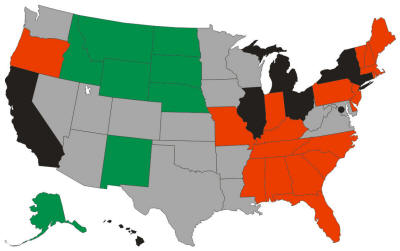
    Alaska is 99.1% recession-proof since employment was growing for 218 months out of 220.

    Michigan is 51.8% recession-proof since employment was growing for 114 months out of 220.

      All the states are shown in the graphic, color-coded as follows:

    • Green is 90% or more
    • Grey is 80% to 90%
    • Red is 70% to 80%
    • Black is less than 70%

    Some metropolitan areas are also relatively recession-proof:

    Area
    Share of months where 12-month job growth rate is positive
    Grand Junction, CO
    100.00%
    McAllen-Edinburg-Mission, TX
    99.50%
    Olympia, WA
    99.10%
    Bismarck, ND
    98.60%
    Anchorage, AK
    97.70%
    Fargo, ND-MN
    97.70%
    Tyler, TX
    97.30%
    Greeley, CO
    96.80%
    Iowa City, IA
    96.40%
    Sioux Falls, SD
    96.40%
    Cheyenne, WY
    95.90%
    Columbia, MO
    95.90%
    Coeur d’Alene, ID
    95.50%
    College Station-Bryan, TX
    95.50%
    Billings, MT
    95.00%
    Fayetteville-Springdale-Rogers, AR-MO
    94.50%
    Laredo, TX
    94.50%
    Las Cruces, NM
    94.50%
    Valdosta, GA
    94.50%
    Killeen-Temple-Fort Hood, TX
    94.10%
    Rapid City, SD
    94.10%
    Bellingham, WA
    93.60%
    Ogden-Clearfield, UT
    93.60%
    Knoxville, TN
    93.20%
    St. George, UT
    93.20%

    And, unfortunately, some metropolitan areas are not very recession proof:

    Area
    Share of months where 12-month job growth rate is positive
    Baltimore City, MD
    17.70%
    Flint, MI
    28.60%
    Detroit-Livonia-Dearborn, MI Metro
    34.10%
    Philadelphia City, PA
    35.50%
    Dayton, OH
    37.30%
    Mansfield, OH
    38.20%
    Youngstown-Warren-Boardman, OH-PA
    41.80%
    Muncie, IN
    42.70%
    Kingston, NY
    43.60%
    Waterbury, CT NECTA
    45.50%
    Binghamton, NY
    47.30%
    Lima, OH
    47.30%
    Springfield, OH
    48.20%
    Detroit-Warren-Livonia, MI
    49.10%
    Lansing-East Lansing, MI
    50.00%
    Saginaw-Saginaw Township North, MI
    50.50%
    Ann Arbor, MI
    51.40%
    Cleveland-Elyria-Mentor, OH
    52.70%
    Decatur, IL
    52.70%
    Terre Haute, IN
    53.60%
    Canton-Massillon, OH
    54.10%
    Battle Creek, MI
    54.50%
    Jackson, MI
    55.00%
    Niles-Benton Harbor, MI
    55.00%

    You can’t necessarily judge a metropolitan area by its State’s employment growth rates. For example, Georgia is only 73.6% recession-proof yet Valdosta is 94.5%. Indiana is 74.5% yet Indianapolis is 90.0%. Missouri is 72.3% yet Columbia is 95.9%.

    A complete list of states and metropolitan areas is available at http://jobbait.com/a/rpa.htm.

    The data in this report present only part of a recession-proof picture of states and metropolitan areas. Think of them as a long-term picture from 1990 through April 2009. They do not necessarily represent what’s happening today. For example, Olympia WA which is the second-most recession-proof metropolitan area long term has declines in the last two months, March and April 2009. And, this will change next month and the month after.

    This report was written by Mark Hovind, President of JobBait. Mark helps six and seven figure executives find jobs by going directly to the decision-makers most likely to hire them. Mark can be reached through www.JobBait.com or by email at Mark@JobBait.com.

  • Austin’s Secrets For Economic Success

    Few places have received more accolades in recent years than Austin, the city that ranked first on our list of the best big cities for jobs. Understanding what makes this attractive, fast-growing city tick can tell us much about what urban growth will look like in the coming decades.

    Austin’s success is not surprising since, in many ways, it starts on third base. Two of its greatest assets result from the luck of the draw; it’s both a state capital and home to a major research university.

    Our ranking of the best cities for job growth includes many college towns–from Fargo, N.D., (home to North Dakota State) to Athens, Ga., (University of Georgia), Durham-Chapel Hill, N.C., (Duke and University of North Carolina) and College Station, Texas (Texas A&M).

    Being a state capital also helps. Baton Rouge, La., home to both the state government and Louisiana State University, ranked seventh on our list of the best medium-sized cities for employment. This confluence of institutions also accounts in large part for the relatively decent rankings of two Midwestern cities, Indianapolis and Columbus, Ohio, in spite of the generally sad situation in that region.

    That’s because colleges and state governments offer stable employment–since they cannot or will not outsource jobs to India or China. These places also tend to be inhabited by reasonably well-educated people whose stable incomes makes them less vulnerable to contractions in competitive industries like finance, manufacturing, construction or information.

    “We’re pretty close to recession-proof,” suggest Chris Bradford, a local attorney and blogger in Austin. “It’s almost anti-cyclical. In bad times, the students want to stay here.”

    There is a third factor, however, that adds to Austin’s special sauce: the fact that it is located in Texas, the one fast-growing mega-state. With low taxes and low regulation at the state level, Austin–no doubt to many locals’ consternation–is a great environment not only for public sector employment but also private sector growth.

    Its success contrasts dramatically with the relatively poor employment status of capitals in business-unfriendly states (such as Sacramento, Calif., which ranked 60th among large cities) as well as other college towns like Ann Arbor, Mich., home to one of the nation’s best public universities, the University of Michigan. (Among medium-sized cities, Ann Arbor came in 93rd.)

    Austin, essentially, reaps the benefits of being a deep blue, Democratic island in a red-state sea. The university and state government employ large numbers of people who might want higher taxes and greater regulation–but they can talk the redistributionist’s game without feeling any of the pain.

    This is not to say that Austin itself–that is, its urban core area–does not try to trot out its blue, and “green,” trimmings. Like every college town, Austin likes smart growth, mass transit and high density.

    But in reality, Austin is not a dense region. In fact, its metropolitan population per acre puts it in the middle of the nation’s largest areas, well behind not only Los Angeles and New York but also Houston and Dallas.

    Even central Austin seems rather spread out and suburban compared to traditional East Coast cities. Smaller, older homes–mainly cottages–dominate neighborhoods close to downtown. Recent attempts to go high-rise have not been notably successful, as the auction signs on the sides of some new towers suggest.

    Yet the urban center increasingly represents less and less of the area’s total employment and houses fewer and fewer of its residences. Today, the city itself is home to well under half the metropolitan population of 1.5 million.

    As in many regions, notes blogger Bradford, over the past decade the strongest growth has occurred in Austin’s periphery. Even as the city itself has enjoyed strong job and population growth, the biggest increases have taken place in suburban outposts outside city limits, like Williamson, Bastrop and Hays counties, as well as parts of Travis, the county that is home to Austin. In fact, Williamson was the nation’s sixth fastest-growing county last year, while Hays ranked 10th.

    Surprisingly, these suburban areas are the places most driving Austin’s economic success. Why? Two reasons: affordability and livability. By Texas standards, the city is not cheap. It costs between $350,000 and $400,000 for a nice three- or four-bedroom house in a good school district, say, 20 minutes from downtown. However, a similar place in the ‘burbs of Silicon Valley, San Francisco, Boston or Irvine would run at least twice as much.

    Local Realtor and blogger Shannan Gonyea-Reimer adds that, a bit further away from town, home prices can drop as low as $150,000. “People come from California, and they are shocked,” she says.

    This price structure, along with the human capital attracted to the University of Texas, has in turn propelled the rapid expansion of the non-governmental economy in places like Cedar Creek and Round Rock, home to Dell. A recent Brookings study estimates that central Austin employment grew by almost 13% between 1998 and 2006. The number of jobs more than 10 miles from the central business district increased by 77,523, or 62%, according to the study.

    Austin has seen remarkable overall employment growth–almost 34%–in the last decade. With that figure, it leaves its major hip tech rivals in the dust. Over the same period, for example, San Jose/Silicon Valley has lost 6% of its jobs; San Francisco, around 1.6%. Boston, Austin’s other big high-tech competitor, enjoyed only a 1.2% gain.

    Again, this growth stems in part from the unique combination of both an appealing city center and attractive suburbs. The city’s lively urban core remains a lure for affluent professionals, young singles and, of course, students. However, unlike places like New York, Boston and San Francisco, the sprawling ‘burbs provide an affordable place for people to move to when their hardcore clubbing days are over.

    “California might work well for the apartment-dwelling, single-guy lifestyle person, but when you get married, you can’t afford Los Gatos,” says former Silicon Valley entrepreneur Mike Shultz, the CEO of Infoglide, a software firm headquartered on Austin’s outer ring. “In Austin, the same person can grow up, move into a reasonable house and have a reasonable life.”

    This does much to explain why Austin has enjoyed a migration pattern unlike that of its primary competitors. Its residents may start off hip and cool, but the city also accommodates their often inevitable evolution to Ozzie and Harriet. This allows individuals and companies to plan to stick around. One doesn’t have to have the short-term mentality so common in the Bay Area, L.A., Boston or New York.

    Ultimately, it is this combination of a “cool” downtown culture–with excellent restaurants as well as great music–and a more sedate, affordable periphery that makes Austin a home run.

    “It has a hip cool side to it,” Shultz observes, “but it’s also a great place to raise kids.”

    A caveat to all this: We also have to consider scale. With roughly 1.5 million people, Austin simply offers more convenient choices than a megalopolitan behemoth like Los Angeles, New York or the Bay Area. In Austin, nice, single-family homes within walking distance of cool urban streets are not uncommon or absurdly expensive–and even a larger, more affordable house out in the suburbs is usually less than a half an hour from downtown.

    Additionally, Texas, unlike its main rival California, is not teetering on the edge of bankruptcy and is instead a stable long-term bet in this recession. Rather than haggling with bankers or public employee unions, it is busy building its future: attracting new comers, investing in its university and building new transportation infrastructure.

    “Austin is off the charts livable, but it’s in a state that makes it viable,” says Shultz, the entrepreneur. “You can’t say that about California and many of the other places where our competitors are.”

    This article originally appeared at Forbes.

    Joel Kotkin is executive editor of NewGeography.com and is a presidential fellow in urban futures at Chapman University. He is author of The City: A Global History and is finishing a book on the American future.
  • Visualizing our 2009 Best Cities for Job Growth Rankings

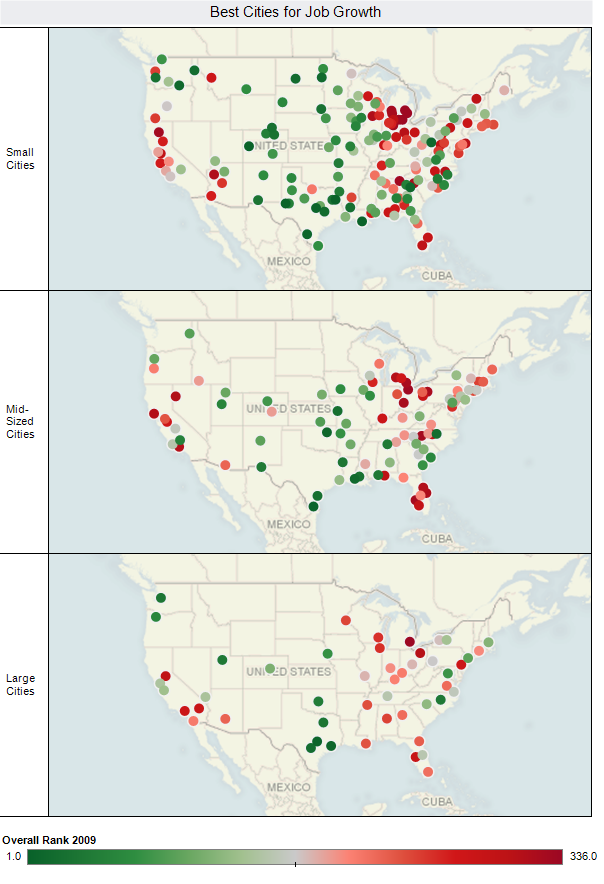
    Here’s some great maps of our annual Best Cities Rankings created by Robert Morton at Tableau Software. Robert used their software tool to plot a color coded point for each city in the rankings by size group, and immediate geographic patterns emerge:

    Check out Robert’s post for a map of the biggest gainers and losers from last year, and a rank change by size scatter plot of each place.

  • The Worst Cities for Job Growth

    One of the saddest tasks in the annual survey of the best places to do business I conduct with Pepperdine University’s Michael Shires is examining the cities at the bottom of the list. Yet even in these nether regions there exists considerable diversity: Some places are likely to come back soon, while others have little immediate hope of moving up. (Please also see “Best Cities For Job Growth” for further analysis.)

    The study is based on job growth in 336 regions – called Metropolitan Statistical Areas by the Bureau of Labor Statistics, which provided the data – across the U.S. Our analysis looked not only at job growth in the last year but also at how employment figures have changed since 1996. This is because we are wary of overemphasizing recent data and strive to give a more complete picture of the potential a region has for job-seekers. (For the complete methodology, click here.)

    First let’s deal with the perennial losers, the sad sacks of the American economy. Mostly cities in the nation’s industrial heartland, these places have ranked toward the bottom of our list for much of the past five years. Eleven of the bottom 16 regions on our list are in two states, Ohio and Michigan. In fact, the Wolverine State alone accounts for the bottom four cities: Jackson, Detroit, Saginaw and Flint.

    Unfortunately, there’s not much in the way of short-term – or perhaps even medium- or long-term – hope for a strong rebound in those places. President Obama seems determined to give the automakers, for whom Michigan is home base, far rougher treatment than what he meted out to ailing companies in the financial sector.

    In addition, new environmental regulations may not help auto production, since it necessitates some carbon-spewing and therefore perhaps unacceptable levels of greenhouse gas emission.

    However, not all of Michigan’s problems stem from Washington or the marketplace. Many of the locations at the bottom of the list remain inhospitable to business. To be sure, housing is cheap – in Detroit, property values are fast plummeting toward zero – but running a business can be surprisingly expensive in these hard-pressed places.

    In fact, according to a recent survey by the Tax Foundation, Ohio has an average tax burden roughly similar to New York, California, Massachusetts and Connecticut. But while the others are comparatively high-income states, Ohio residents no longer enjoy that level of affluence.

    Can these places come back? It is un-American to abandon hope, but there needs to be a radical shift in strategy to focus on creating new middle-class jobs. Some Midwestern cities, like Kalamazoo and Indianapolis, have made some successful efforts to diversify their economies, encouraging start-ups and trying to be business-friendly.

    But those are exceptions. Cleveland, one of our worst big cities, could spark a renaissance by revamping its port and nearby industrial hinterland. Once the world economy improves, it could re-emerge – building on the existing knowledge and skills of its production- and design-savvy population – as a hub for manufacturing and exports.

    But right now, Cleveland does not seem to be pursuing such opportunities. As Purdue’s Ed Morrison has pointed out, local leaders there seem to “confuse real estate development with economic development.”

    So Cleveland will focus on inanities such as convention business and tourism, believing we all fantasize about a week enjoying the sights along Lake Erie. Yet even high-profile buildings like the Rock and Roll Hall of Fame and Museum, completed in 1986, have not transformed a gritty old industrial town into a beacon for the hip and cool.

    Old industrial cities like Cleveland are better off focusing on their locational advantages – access to roads, train lines and water routes – while offering a safe, inexpensive and friendly venue for ambitious young families, immigrants and entrepreneurs.

    Meanwhile, cities with formerly robust economies – like Reno, Nev., Las Vegas, Orlando, Fla., Tampa, Fla., Fort Lauderdale, Fla., West Palm Beach, Fla., Jacksonville, Fla., and Phoenix – are more likely to rebound. These areas topped our list for much of the 2000s; their success was driven first by surging population and job growth and later by escalating housing prices.

    But the collapse of the housing bubble and a drop in large-scale migration from other regions has weakened, often dramatically, these perennial successes. “We could rely on 1,000 people a week moving into the area,” notes one longtime official in central Florida. “These people needed services, houses and bought stuff. Now the growth is a 10th of that.”

    Instead of waiting for the real estate bubble to return, these areas should choose to focus on boosting employment in fields like medical services, business services and light manufacturing. In much of Florida and Nevada, there’s also a need to shift away from a reliance on tourism, an industry that pays poorly on average and is always subject to changes in consumer tastes.

    We can even be cautiously optimistic about some of these former superstars. After all, observes Phoenix-based economist Elliot Pollack, the existing reasons for moving to Arizona, Nevada or Florida – warm weather, relatively low taxes and generally pro-business governments – have not disappeared. “There’s no change in the fundamentals,” he argues. “It’s a transition. It’s ugly, and there’s pain, but it’s still a cycle that will turn.”

    Once the economy stabilizes, Pollack says he expects the flow of people and companies from the Northeast and California to Phoenix and other former hot spots will resume, once again lured by inexpensive real estate, better conditions for business and a generally more up-to-date infrastructure.

    The Problem with California
    So what about California? The economic well-being of many metropolitan areas in the Golden State has been sinking precipitously since 2006. This year, three California regions – Oakland, Sacramento and San Bernardino-Riverside – have sunk down into the bottom 10 on the large cities list. That’s a phenomenon we’ve never seen before – and never expected to see.

    Like other Sun Belt communities, California suffered disproportionately from the housing bubble’s bust, which has devastated both employment in construction-related industries as well as much of the finance sector. But some, like economist Esmael Adibi, director of the Anderson Center for Economic Research at Chapman University, where I teach, think a real estate turnaround may be imminent.

    Among the first to predict the potential for a real estate bubble back in 2005, these days Adibi is more upbeat, pointing to rising sales of single-family homes, particularly at the lower end of the market. California’s inventory of unsold homes is now down to about six months’ worth, a figure well below the national average of 9.6 months.

    It seems not everyone is ready to abandon the Golden State – but still, recovery in California may prove weaker than in surrounding states. One forecaster, Bill Watkins, even predicts unemployment could reach 15% next year, up from about 11% today. California, most likely, will see only an anemic recovery in 2010 even if growth picks up elsewhere.

    Much of the problem lies with the state’s notoriously inept government. The enormous budget deficit will almost certainly lead to tax increases, which will fall mostly on the state’s vaunted high-income entrepreneurial residents. Stimulus funds won’t do much good either, Adibi notes, since “the state is grabbing all of the federal stimulus money” to keep itself afloat.

    A draconian regulatory environment also could dim California’s prospects for growth. Despite double-digit unemployment, the state seems determined not only to raise taxes but also to tighten its regulatory stranglehold.

    This is a stark contrast to what happened in the 1990s during the last deep recession. At that time, leaders from both political parties pulled together to reform the state’s regulatory and tax environment. Almost everyone recognized the need to improve the economic climate.

    But an even deeper recession, it seems, hardly troubles today’s dominant players – public employees, environmental activists and gentry liberals who largely live along the coast. The state has recently passed a draconian Assembly bill aimed to offset global warming by capping greenhouse gas emissions – a measure that seems designed to discourage productive industry.

    “This is becoming a horrible place to produce anything,” says Watkins, who is executive director of the Economic Forecast Project at the University of California, Santa Barbara.

    California’s lawyers, though, might stay busy. Attorney General Jerry Brown has threatened to sue anyone who grows their business in unapproved, environment-threatening ways. To be sure, this promise may have relatively little impact on the more affluent, aging coastal communities – but it could wreak havoc on younger, less tony areas in the state’s interior. Many of the local economies there still rely on resource-dependent industries like oil, manufacturing and agriculture.

    It’s sad because California has the capacity to recover more quickly than the rest of the country if the state moderates its spending and stops regulating itself into oblivion. This current round of legislation is so dangerous precisely because it could eviscerate the heart of the economy by slowing down entrepreneurial growth, the state’s greatest asset.

    Even in hard times, there are people with innovative ideas trying to bring them to market – and not just in Hollywood- and Silicon Valley-based industries but in a broad range of fields, from garments to agriculture, aerospace and processed foods. The desire to increase regulation reflects a peculiar narcissism and arrogance of the state’s ruling elites, who believe the genius of San Francisco’s venture capitalists and Los Angeles’ image-makers alone are enough to spark a powerful recovery.

    This is delusional. True, California still has a lead in everything from farm products to films to high-tech manufacturers. But it has been slowly losing ground – to both other states and overseas competitors. CEOs and top management might stay in the Golden State, but they increasingly send outside its borders all jobs that don’t require access to the local market, genius scientists or talented entertainers.

    “There’s a feeling in California that we will come back, no matter what, because we are California,” Watkins says. “The leadership is swallowing Panglossian Kool-aid. Some very smart people, a beautiful climate and nice beaches is not enough to guarantee a strong recovery.”

    This article originally appeared at Forbes.

    Joel Kotkin is executive editor of NewGeography.com and is a presidential fellow in urban futures at Chapman University. He is author of The City: A Global History and is finishing a book on the American future.

  • Big Movers – Up and Down the 2009 Best Cities Rankings

    In a year when modest – if not negligible – growth could nudge a city toward the top of the Best Cities for Jobs rankings you would suspect there to be little opportunity for big leaps up the scale. On the other hand, one could easily expect that there would be some places whose economic fortunes would resemble a vertigo-inducing fall.

    A look at the 2009 rankings confirms that there are many cities whose job-creating engines have sputtered.

    Among 336 cities in the rankings 46 cities fell more than 100 places compared to their position in 2008. Below are seven places that took the biggest fall and plummeted more than 200 places compared to 2008.

    Seven Falling Stars: Ranking Fell More than 200 Places 2008-2009
    City 2008 2009 Rank Change
    Port St. Lucie, FL 88 290 -202
    Pensacola-Ferry Pass-Brent, FL 98 302 -204
    Reno-Sparks, NV 104 314 -210
    Myrtle Beach-North Myrtle Beach-Conway, SC 10 230 -220
    Prescott, AZ 26 252 -226
    Winchester, VA-WV 73 299 -226
    Yuma, AZ 33 266 -233


    The Big Downstroke
    Yuma, Arizona’s precipitous decline of 233 places is partly the result of its once envious position among the top ten percent of cities in 2008. It appears they came late to the economic wake that hit some towns with the collapse of the housing bubble in Arizona, Florida and Nevada as early as 2007 . In many communities in these states 2008 reflected things getting worse as commercial and industrial construction activity also dropped off.

    The good news for Yuma, according to Paul Shedal of Yumastats.com is that the “biggest economic pillars,” agriculture and government, have remained relatively unscathed by the recession providing a fallback point that other markets don’t have. This means that our worst case scenario for recession “harm” would be returning to our pre-boom level of economic sustainability rather than some depression abyss.”

    Another falling star, Winchester, Virginia, fell 226 places in the rankings, experiencing what some in northern Virginia have described as a dramatic turnaround. Manufacturing in this part of the Northern Shenandoah Valley is linked to housing and vehicles, two industries hard hit lately. American Woodmark, the third-largest kitchen and cabinetmaker in the U.S. scaled back production as sales to homebuilders continue to fall. The services sector, once a bright spot for the region, has been shedding jobs in the midst of the recession. And major retailers like Linens N’ Things and Circuit City recently closed.

    One bright spot in the Winchester area’s economy is the increase of jobs in the federal government sector, an advantage of its 75 mile proximity to the nation’s capitol. In 2008, the federal government added 400 jobs to the local economy at the Federal Emergency Management Agency offices in Stephenson and the FBI training and recruitment center in Winchester.

    Rising Stars
    Even in a troubled economy one expects that some places will thrive simply through determination and bold leadership moves, the foresight to have done the right things, or the luck of the draw. Everyone shares a hopeful optimism that a meteoric rise can offer a glimpse of things to come and perhaps offer a roadmap to a more prosperous future.

    Rising Stars: Top Five Rankings Climbers 2008-2009
    City 2008 2009 Rank Change
    Lafayette, IN 287 85 202
    Champaign-Urbana, IL 267 83 184
    Sioux City, IA-NE.-SD 253 80 173
    Lubbock, TX 242 74 168
    Wheeling, WV-OH 305 138 167


    This year’s rising star is without doubt Lafayette, Indiana with an astounding – and surprising given its Midwestern location – 202-place charge up the rankings from 2008. Like three of the other top five rising stars Lafayette came from a slightly above average position in 2008 to a respectable position in the top 100. These are by no means this year’s best places but their economies are defying the pervasive decline in the national economy.

    A visit to the Lafayette Commerce website succinctly tells the tale. “Greater Lafayette wrapped up 2008 with a strong showing.” For Lafayette 2008 was a good year with new capital investments of $600 million, new employment in life sciences industries associated with the Purdue Research Park, and a second new hospital on the way as Greater Lafayette expands its regional healthcare base.

    Equally important, Lafayette, like many university and college towns, benefits from the stabilizing presence of Purdue University, the area’s largest employer, which also serves as a force creating new economic opportunities through research, development and access to an educated workforce.

    The annual report from Lafayette Commerce concludes by focusing on two key elements of their success. “In Greater Lafayette, we’re choosing not to participate in the national recession by using this opportunity for workforce development and innovation. That’s not to say we have been immune to the troubles of the national economy, but on the whole our community is growing, it’s thriving and improving every day.”

    The Impending Future of Boom and Gloom

    Science fiction author William Gibson’s famous quip that “the future is already here – it’s just not equally distributed” could have some credence in this year’s rankings –both up and down the scale.

    The fastest rising cities boast stable employers in government and universities. They are leveraging this edge to create new opportunities in manufacturing, production agriculture and advanced producer services serving diverse sectors. Growth in health care services to the mixture, until recently one of the few remaining generators of new jobs, has also played a role.

    Rising stars like Lafayette have made significant investments in infrastructure and advanced infrasystems, enabling them to create jobs in higher-value, innovation-generating economic activities.

    This year’s cities that fell the furthest portend a return to pre-bubble growth patterns. As in the case of Yuma many places will refocus back on their historically strong core industries, like agriculture, and the economic activities that made them viable centers in the first place.

    For all cities the ability to innovate locally and take advantage of demonstrated areas of competence represent two key ingredients of success – for building on existing momentum or hitting the reset button for a more prosperous future.

    Delore Zimmerman is president and CEO of Praxis Strategy Group and publisher of Newgeography.com

  • Where are the Best Cities for Job Growth?

    Over the past five years, Michael Shires, associate professor in public policy at Pepperdine University, and I have been compiling a list of the best places to do business. The list, based on job growth in regions across the U.S. over the long, middle and short term, has changed over the years–but the employment landscape has never looked like this.

    In past iterations, we saw many fast-growing economies–some adding jobs at annual rates of 3% to 5%. Meanwhile, some grew more slowly, and others actually lost jobs. This year, however, you can barely find a fast-growing economy anywhere in this vast, diverse country. In 2008, 2% growth made a city a veritable boom town, and anything approaching 1% growth is, oddly, better than merely respectable.

    So this year perhaps we should call the rankings not the “best” places for jobs, but the “least worst.” But the least worst economies in America today largely mirror those that topped the list last year, even if these regions have recently experienced less growth than in prior years. Our No.1-ranked big city, Austin, for example, enjoyed growth of 1% in 2008–less than a third of its average since 2003.

    The study is based on job growth in 333 regions–called Metropolitan Statistical Areas by the Bureau of Labor Statistics, which provided the data–across the U.S. Our analysis looked not only at job growth in the last year but also at how employment figures have changed since 1996. This is because we are wary of overemphasizing recent data and strive to give a more complete picture of the potential a region has for job-seekers. (For the complete methodology, click here.)

    The top of the complete ranking–which, for ease, we have broken down into the two smaller lists, of the best big and small cities for jobs–is dominated by one state: Texas. The Lone Star State may have lost a powerful advocate in Washington, but it’s home to a remarkable eight of the top 20 cities on our list–including No. 1-ranked Odessa, a small city in the state’s northwestern region. Further, the top five large metropolitan areas for job growth–Austin, Houston, San Antonio, Ft. Worth and Dallas–are all in Texas’ “urban triangle.”

    The reasons for the state’s relative success are varied. A healthy energy industry is certainly one cause. Many Texas high-fliers, including Odessa, Longview, Dallas and Houston, are home to energy companies that employ hordes of people–and usually at fairly high salaries for both blue- and white-collar workers. In some places, these spurts represent a huge reversal from the late 1990s. Take Odessa’s remarkable 5.5% job growth in 2008, which followed a period of growth well under 1% from 1998 to 2002.

    Of course, not all the nation’s energy jobs are located in Texas, even if the state does play host to most of our major oil companies. The surge in energy prices in 2007 also boosted the performance of several other top-ranked locales such as Grand Junction, Colo., Houma-Bayou Cane-Thibodoux, La., Tulsa, Okla., Lafayette, La., and Bismarck, N.D.

    Looking at the energy sector’s hotbeds, however, doesn’t tell the whole story. Another major factor behind a city’s job offerings is how severely it experienced the housing crisis. There’s a “zone of sanity” across the middle of the country, including Kansas City, Mo., that largely avoided the real estate bubble and the subsequent foreclosure crisis.

    Still other factors correlating with job growth–as evidenced by Shires‘ and my current and past studies–are lower costs and taxes. For example, the area around Kennewick, Wash., is far less expensive than coastal communities in that same state, and residents and businesses there also enjoy cheap hydroelectric power. Compared with high-tech centers in California and the Northeast, such as San José and Boston, places like Austin offer both tax and housing-cost bargains, as do Fargo, N.D. and Durham-Chapel Hill, N.C.

    College towns also did well on our list, particularly those in states that are both less expensive and outside the Great Lakes. Although universities–and their endowments–are feeling the recession’s pinch, they continue to attract students. In fact, colleges saw a bumper crop of applicants this year, as members of the huge millennial generation, encompassing those born after 1983, reach that stage of life. More recently, college towns have emerged as incubators for new companies and as attractive places for retirees.

    Specifically, the college town winners include not only well-known places like Austin and Chapel Hill, but also less-hyped places like Athens, Ga., home of the University of Georgia; College Station, Texas, where 48,000-student Texas A&M University is located; Morgantown, W.Va., site of the University of West Virginia; and Fargo, the hub of North Dakota State University.

    Democratic states are glaringly absent from the top of the list. You don’t get to a traditionally blue state–in a departure from past years, Obama won North Carolina–until you get to Olympia, Wash., and Seattle, which ranked No. 6 among the large cities.

    But political changes afoot could affect the trajectory of many of our fast-growing communities–and not always in positive ways. It’s possible that the Obama administration’s new energy policies, which may discourage domestic fossil fuel production,could put a considerable damper on the still-robust parts of Texas and elsewhere where coal, oil and natural gas industries are still cornerstones of economic success.

    By contrast, the wind- and solar-power industries seem to be, as of now, relatively small job generators, and with energy prices low, endeavors in these areas are sustainable only with massive subsidies from Washington. But still, if these sectors grow in size and profitability, other locales that have not typically been seen as energy hubs over the past few decades may benefit–notably parts of California, although Texas and the Great Plains also seem positioned to profit from these developments.

    Another critical concern for some communities is the potential for major cutbacks on big-ticket defense spending. This would be of particular interest to communities in places like Texas, Oklahoma and Georgia where new aircraft are currently assembled. Over the years, blue states like California have seen their defense industry shrivel as the once-potent Texas Congressional delegation and the two Bushes tilted toward Lone Star State contractors.

    These days it’s big-city mayors and big blue-state governors who are looking for financial support from Obama. Northeast boosters are convinced more money on mass transit, inter-city rail lines and scientific research will rev up their economies. Boston–No. 16 on the list of large cities and a leading medical and scientific research center–could be a beneficiary of the new federal spending.

    The most obvious winner from the recent power shift should be Washington, D.C. The Obama-led stimulus, including the massive Treasury bailout, has transformed the town from merely the political capital into the de facto center of regular capital as well. Watch for D.C. and its environs to move up our list over the next year or two. Already the area boasts one of the few strong apartment markets among the big metropolitan areas in the country, which will only improve as job-seekers flock to the new Rome.

    Yet Washington is an anomaly, because most of the places that stand to benefit from this unforgiving economy are ones that are affordable and therefore friendly to business, reinforcing a key trend of the last decade. It also helps regions to have ties to core industries like energy and agriculture, a sector that has remained relatively strong and will strengthen again when global demand for food increases.

    Some areas have attracted new residents readily and continue to do so, albeit at a somewhat slower pace. Over time this migration could be good news for a handful of metropolitan areas like Salt Lake City, which ranks seventh among the big cities for job growth, and Raleigh-Cary, N.C., which was No. 1 among large cities last year and No. 8 this year. Over the last few years, these places have consistently appeared at the top of our rankings and are emerging as preferred sites for cutting-edge technology and manufacturing firms.

    Below these winners are a cluster of other promising places that have already managed to withstand the current downturn in decent shape and seem certain to rebound along with the overall economy. These include the largely suburban area around Kansas City, Kan., perennial high-flyer Coeur d’Alene, Idaho, and Greeley, Colo.–in part due to their ability to attract workers and businesses from bigger metropolitan centers nearby–as well as Huntsville, Ala., which has a strong concentration of workers in the government and high-tech sectors.

    In the end, most of the cities at the top of the lists–whether they are small, medium or large–have shown they have what it takes to survive in tough times. Less-stressed local governments will be able to construct needed infrastructure and attract new investors so that job growth can rise to the levels of past years. If better days are in the offing, these areas seem best positioned to be the next drivers of the economic expansion this nation sorely needs.

    This article originally appeared at Forbes.

    Joel Kotkin is executive editor of NewGeography.com and is a presidential fellow in urban futures at Chapman University. He is author of The City: A Global History and is finishing a book on the American future.

  • All Cities Rankings – 2009 New Geography Best Cities for Job Growth

    Read how we pick the best cities.

    Overall Rank 2009
    Area
    2009
    Weighted
    INDEX
    2008 Nonfarm Emplymt (1000s)
    Size 2009
    Overall Rank
    Movement
    2009
    Size
    Rank
    1 Odessa, TX    100.0
    64.8
    S
    3
    1
    2 Grand Junction, CO      92.4
    66.5
    S
    9
    2
    3 Longview, TX      90.0
    98.4
    S
    10
    3
    4 Houma-Bayou Cane-Thibodaux, LA      88.0
    97.8
    S
    26
    4
    5 Killeen-Temple-Fort Hood, TX      87.9
    128.4
    S
    63
    5
    6 Austin-Round Rock, TX      87.7
    778.5
    L
    13
    1
    7 McAllen-Edinburg-Mission, TX      87.6
    221.1
    M
    13
    1
    8 Laredo, TX      87.1
    91.3
    S
    51
    6
    9 Houston-Sugar Land-Baytown, TX      85.4
    2,609.6
    L
    19
    2
    10 Tulsa, OK      85.1
    436.6
    M
    131
    2
    11 Athens-Clarke County, GA      85.0
    86.2
    S
    64
    7
    12 Kennewick-Pasco-Richland, WA      84.7
    93.7
    S
    11
    8
    13 Morgantown, WV      84.5
    63.4
    S
    8
    9
    14 Lafayette, LA      84.1
    151.2
    M
    28
    3
    15 Fargo, ND-MN      83.9
    122.4
    S
    31
    10
    16 College Station-Bryan, TX      83.5
    96.3
    S
    147
    11
    17 Coeur d’Alene, ID      83.0
    55.8
    S
    -14
    12
    18 Bismarck, ND      82.8
    61.0
    S
    34
    13
    19 Durham-Chapel Hill, NC      82.3
    291.0
    M
    24
    4
    20 San Antonio, TX      82.0
    849.8
    L
    28
    3
    21 Alexandria, LA      81.7
    67.0
    S
    97
    14
    22 Kansas City, KS      81.1
    446.4
    M
    47
    5
    23 Corpus Christi, TX      80.8
    182.8
    M
    105
    6
    24 Cheyenne, WY      80.8
    44.9
    S
    5
    15
    25 Olympia, WA      80.1
    103.3
    S
    2
    16
    26 Sioux Falls, SD      79.9
    135.6
    S
    25
    17
    27 Baton Rouge, LA      79.2
    377.4
    M
    44
    7
    28 Greeley, CO      78.8
    82.5
    S
    -3
    18
    29 Tyler, TX      78.7
    96.3
    S
    66
    19
    30 Fort Worth-Arlington, TX Metropolitan Division      78.3
    877.5
    L
    20
    4
    31 Las Cruces, NM      78.0
    69.4
    S
    47
    20
    32 Dallas-Plano-Irving, TX Metropolitan Division      78.0
    2,102.1
    L
    25
    5
    33 Shreveport-Bossier City, LA      77.6
    180.1
    M
    51
    8
    34 Seattle-Bellevue-Everett, WA Metropolitan Division      77.2
    1,457.8
    L
    20
    6
    35 Anchorage, AK      76.7
    169.7
    M
    149
    9
    36 Salt Lake City, UT      76.5
    640.2
    L
    -14
    7
    37 Mobile, AL      74.7
    183.3
    M
    121
    10
    38 Raleigh-Cary, NC      74.6
    513.5
    L
    -30
    8
    39 El Paso, TX      74.6
    278.8
    M
    57
    11
    40 Huntsville, AL      74.6
    211.6
    M
    -8
    12
    41 Joplin, MO      73.1
    80.9
    S
    50
    21
    42 Fayetteville, NC      73.1
    129.0
    S
    20
    22
    43 Texarkana, TX-Texarkana, AR      73.0
    58.4
    S
    118
    23
    44 Oklahoma City, OK      72.9
    576.8
    L
    111
    9
    45 Greenville, NC      72.4
    77.2
    S
    -33
    24
    46 Fort Collins-Loveland, CO      72.3
    136.6
    S
    7
    25
    47 Midland, TX      72.0
    71.3
    S
    -46
    26
    48 Gainesville, GA      71.1
    76.9
    S
    -31
    27
    49 Auburn-Opelika, AL      71.1
    54.3
    S
    -44
    28
    50 Bakersfield, CA      71.1
    237.5
    M
    -12
    13
    51 Columbia, MO      70.7
    93.4
    S
    66
    29
    52 Lynchburg, VA      70.5
    109.3
    S
    14
    30
    53 Dubuque, IA      70.4
    55.4
    S
    57
    31
    54 Provo-Orem, UT      70.1
    188.2
    M
    -47
    14
    55 Portland-Vancouver-Beaverton, OR-WA      70.0
    1,020.8
    L
    1
    10
    56 Iowa City, IA      69.8
    90.9
    S
    18
    32
    57 Warner Robins, GA      69.4
    58.0
    S
    -33
    33
    58 Charleston-North Charleston-Summerville, SC      69.4
    295.5
    M
    -23
    15
    59 Rapid City, SD      69.4
    60.3
    S
    118
    34
    60 Amarillo, TX      69.4
    113.2
    S
    59
    35
    61 Wilmington, NC      69.1
    142.7
    S
    -55
    36
    62 Framingham, MA  NECTA Division      68.7
    159.5
    M
    116
    16
    63 St. Joseph, MO-KS      68.5
    58.9
    S
    -29
    37
    64 Rochester-Dover, NH-ME NECTA      68.2
    58.5
    S
    23
    38
    65 Des Moines-West Des Moines, IA      68.2
    321.9
    M
    2
    17
    66 Santa Fe, NM      68.2
    65.0
    S
    11
    39
    67 Billings, MT      68.0
    79.3
    S
    -36
    40
    68 Brownsville-Harlingen, TX      67.8
    125.3
    S
    66
    41
    69 Peoria, IL      67.6
    189.8
    M
    14
    18
    70 Grand Forks, ND-MN      67.2
    54.8
    S
    31
    42
    71 Fayetteville-Springdale-Rogers, AR-MO      67.1
    207.0
    M
    10
    19
    72 Omaha-Council Bluffs, NE-IA      66.8
    468.2
    L
    99
    11
    73 Savannah, GA      66.8
    157.6
    M
    -58
    20
    74 Lubbock, TX      66.7
    131.1
    S
    168
    43
    75 Bellingham, WA      66.6
    84.1
    S
    -57
    44
    76 Washington-Arlington-Alexandria, DC-VA-MD-WV Metropolitan Division      66.6
    2,424.3
    L
    38
    12
    77 Cedar Rapids, IA      66.4
    138.7
    S
    76
    45
    78 Pueblo, CO      66.2
    58.4
    S
    -8
    46
    79 Boulder, CO      65.9
    166.9
    M
    42
    21
    80 Sioux City, IA-NE-SD      65.8
    76.5
    S
    173
    47
    81 Tacoma, WA Metropolitan Division      65.8
    277.6
    M
    -67
    22
    82 Valdosta, GA      65.6
    56.5
    S
    27
    48
    83 Champaign-Urbana, IL      65.6
    116.3
    S
    184
    49
    84 Northern Virginia, VA      65.0
    1,305.5
    L
    8
    13
    85 Lafayette, IN      64.9
    96.6
    S
    202
    50
    86 Abilene, TX      64.7
    68.1
    S
    19
    51
    87 Fort Smith, AR-OK      64.2
    124.3
    S
    12
    52
    88 Wichita, KS      63.8
    311.0
    M
    5
    23
    89 Charlottesville, VA      63.8
    100.5
    S
    -49
    53
    90 Ithaca, NY      63.8
    64.7
    S
    77
    54
    91 Spokane, WA      63.7
    215.9
    M
    -36
    24
    92 York-Hanover, PA      63.7
    182.9
    M
    -3
    25
    93 Pascagoula, MS      63.0
    58.6
    S
    -29
    55
    94 Albuquerque, NM      63.0
    393.5
    M
    35
    26
    95 New York City, NY      62.3
    3,760.2
    L
    35
    14
    96 St. Cloud, MN      61.8
    102.0
    S
    -10
    56
    97 Bowling Green, KY      61.8
    61.4
    S
    -81
    57
    98 Oshkosh-Neenah, WI      61.5
    93.9
    S
    161
    58
    99 Hattiesburg, MS      61.4
    60.6
    S
    -34
    59
    100 Salem, OR      61.4
    150.1
    M
    -6
    27
    101 Ogden-Clearfield, UT      61.1
    198.0
    M
    -64
    28
    102 Springfield, MO      60.9
    197.6
    M
    -55
    29
    103 Waco, TX      60.4
    107.6
    S
    -21
    60
    104 Topeka, KS      60.1
    111.7
    S
    158
    61
    105 Davenport-Moline-Rock Island, IA-IL      60.0
    189.3
    M
    128
    30
    106 Little Rock-North Little Rock-Conway, AR      59.7
    344.5
    M
    -3
    31
    107 Greenville-Mauldin-Easley, SC      59.4
    314.7
    M
    -35
    32
    108 State College, PA      59.3
    74.2
    S
    46
    62
    109 Lincoln, NE      58.9
    172.4
    M
    61
    33
    110 Rochester, MN      58.8
    106.0
    S
    52
    63
    111 Flagstaff, AZ      58.8
    63.5
    S
    9
    64
    112 Tuscaloosa, AL      58.8
    96.8
    S
    -22
    65
    113 Denver-Aurora-Broomfield, CO      58.5
    1,228.0
    L
    -5
    15
    114 Charleston, WV      57.5
    151.5
    M
    166
    34
    115 La Crosse, WI-MN      57.2
    74.7
    S
    119
    66
    116 Columbia, SC      56.6
    362.1
    M
    -37
    35
    117 Bloomington-Normal, IL      56.5
    91.8
    S
    120
    67
    118 Boston-Cambridge-Quincy, MA NECTA Division      56.1
    1,696.4
    L
    77
    16
    119 Lake Charles, LA      55.9
    92.8
    S
    54
    68
    120 Spartanburg, SC      55.8
    128.0
    S
    136
    69
    121 Putnam-Rockland-Westchester, NY      55.7
    579.9
    L
    48
    17
    122 Springfield, IL      55.6
    111.9
    S
    159
    70
    123 Montgomery, AL      55.6
    176.9
    M
    -16
    36
    124 Waterloo-Cedar Falls, IA      55.6
    90.0
    S
    83
    71
    125 Charlotte-Gastonia-Concord, NC-SC      55.5
    841.5
    L
    -84
    18
    126 St. George, UT      55.3
    50.7
    S
    -124
    72
    127 Beaumont-Port Arthur, TX      55.2
    163.1
    M
    23
    37
    128 Manchester, NH NECTA      55.1
    101.6
    S
    37
    73
    129 Syracuse, NY      54.6
    325.0
    M
    121
    38
    130 Trenton-Ewing, NJ      54.4
    238.4
    M
    78
    39
    131 Gainesville, FL      54.1
    134.9
    S
    -7
    74
    132 Honolulu, HI      54.0
    451.5
    L
    -52
    19
    133 Visalia-Porterville, CA      53.7
    112.0
    S
    -1
    75
    134 San Jose-Sunnyvale-Santa Clara, CA      53.6
    902.9
    L
    47
    20
    135 Eau Claire, WI      53.3
    82.3
    S
    -8
    76
    136 Yakima, WA      53.3
    77.5
    S
    10
    77
    137 Rochester, NY      53.2
    518.1
    L
    156
    21
    138 Wheeling, WV-OH      53.2
    68.2
    S
    167
    78
    139 Jefferson City, MO      53.1
    79.5
    S
    29
    79
    140 Florence-Muscle Shoals, AL      52.9
    56.0
    S
    -140
    80
    141 Glens Falls, NY      52.7
    52.8
    S
    -18
    81
    142 Las Vegas-Paradise, NV      52.5
    894.9
    L
    -93
    22
    143 Blacksburg-Christiansburg-Radford, VA      52.3
    71.9
    S
    163
    82
    144 San Francisco-San Mateo-Redwood City, CA Metropolitan Division      51.6
    982.3
    L
    5
    23
    145 Bethesda-Frederick-Rockville, MD Metropolitan Division      51.5
    573.0
    L
    102
    24
    146 Portsmouth, NH-ME NECTA      51.5
    54.5
    S
    -24
    83
    147 Macon, GA      51.4
    101.3
    S
    154
    84
    148 Lake County-Kenosha County, IL-WI Metropolitan Division      51.1
    394.5
    M
    84
    40
    149 Erie, PA      50.6
    132.2
    S
    99
    85
    150 Panama City-Lynn Haven-Panama City Beach, FL      50.6
    73.1
    S
    -111
    86
    151 Allentown-Bethlehem-Easton, PA-NJ      50.5
    340.8
    M
    61
    41
    152 Santa Barbara-Santa Maria-Goleta, CA      50.1
    171.9
    M
    45
    42
    153 Nashville-Davidson–Murfreesboro–Franklin, TN      50.1
    748.6
    L
    -56
    25
    154 Orlando-Kissimmee, FL      49.8
    1,056.8
    L
    -109
    26
    155 Johnstown, PA      49.7
    61.5
    S
    65
    87
    156 Decatur, IL      49.5
    54.8
    S
    58
    88
    157 Huntington-Ashland, WV-KY-OH      49.4
    119.6
    S
    18
    89
    158 Madison, WI      49.2
    343.6
    M
    70
    43
    159 Harrisburg-Carlisle, PA      48.7
    327.1
    M
    85
    44
    160 Virginia Beach-Norfolk-Newport News, VA-NC      48.5
    760.9
    L
    33
    27
    161 Fresno, CA      48.4
    297.9
    M
    -2
    45
    162 Poughkeepsie-Newburgh-Middletown, NY      48.4
    254.8
    M
    116
    46
    163 Utica-Rome, NY      48.4
    132.6
    S
    105
    90
    164 Kansas City, MO      48.3
    564.1
    L
    30
    28
    165 Binghamton, NY      48.2
    114.1
    S
    78
    91
    166 New Haven, CT NECTA      48.0
    277.2
    M
    95
    47
    167 Augusta-Richmond County, GA-SC      47.9
    214.0
    M
    49
    48
    168 Asheville, NC      47.6
    172.3
    M
    -132
    49
    169 Pittsburgh, PA      47.6
    1,138.9
    L
    91
    29
    170 Bend, OR      47.6
    66.3
    S
    -161
    92
    171 Nashua, NH-MA  NECTA Division      47.5
    132.5
    S
    39
    93
    172 San Luis Obispo-Paso Robles, CA      47.4
    102.2
    S
    -25
    94
    173 Duluth, MN-WI      47.4
    131.3
    S
    25
    95
    174 Buffalo-Niagara Falls, NY      47.1
    548.3
    L
    117
    30
    175 Florence, SC      47.0
    87.5
    S
    -117
    96
    176 Philadelphia City, PA      46.6
    661.4
    L
    132
    31
    177 Albany-Schenectady-Troy, NY      46.5
    446.9
    M
    99
    50
    178 Columbus, OH      46.4
    933.5
    L
    21
    32
    179 St. Louis, MO-IL      46.3
    1,341.9
    L
    78
    33
    180 Nassau-Suffolk, NY Metropolitan Division      46.2
    1,255.5
    L
    22
    34
    181 Bangor, ME NECTA      46.1
    66.2
    S
    89
    97
    182 Lancaster, PA      46.1
    235.2
    M
    22
    51
    183 Kingsport-Bristol-Bristol, TN-VA      45.9
    121.7
    S
    106
    98
    184 Jackson, MS      45.7
    258.9
    M
    -10
    52
    185 Salinas, CA      45.6
    126.9
    S
    34
    99
    186 Gary, IN Metropolitan Division      45.4
    279.0
    M
    53
    53
    187 Haverhill-North Andover-Amesbury, MA-NH  NECTA Division      45.3
    76.6
    S
    68
    100
    188 Chattanooga, TN-GA      45.3
    244.3
    M
    21
    54
    189 Napa, CA      45.3
    62.4
    S
    -6
    101
    190 Colorado Springs, CO      45.1
    254.2
    M
    -39
    55
    191 Boise City-Nampa, ID      44.8
    261.6
    M
    -147
    56
    192 Winston-Salem, NC      44.8
    214.7
    M
    -66
    57
    193 Parkersburg-Marietta-Vienna, WV-OH      44.8
    72.8
    S
    -4
    102
    194 Lexington-Fayette, KY      44.8
    253.6
    M
    -42
    58
    195 Knoxville, TN      44.6
    330.1
    M
    -53
    59
    196 Roanoke, VA      44.5
    160.9
    M
    73
    60
    197 Indianapolis-Carmel, IN      44.3
    898.5
    L
    -64
    35
    198 Merced, CA      44.2
    57.2
    S
    -63
    103
    199 Hartford-West Hartford-East Hartford, CT NECTA      44.2
    552.7
    L
    1
    36
    200 Lakeland-Winter Haven, FL      44.1
    205.7
    M
    -20
    61
    201 Bloomington, IN      43.4
    83.5
    S
    20
    104
    202 Tallahassee, FL      42.9
    175.3
    M
    -63
    62
    203 Scranton–Wilkes-Barre, PA      42.8
    259.2
    M
    49
    63
    204 Louisville-Jefferson County, KY-IN      42.7
    611.0
    L
    -64
    37
    205 Sheboygan, WI      42.6
    62.5
    S
    67
    105
    206 Eugene-Springfield, OR      42.6
    151.7
    M
    -75
    64
    207 Cincinnati-Middletown, OH-KY-IN      42.5
    1,028.6
    L
    38
    38
    208 San Diego-Carlsbad-San Marcos, CA      42.4
    1,283.4
    L
    16
    39
    209 Wichita Falls, TX      42.4
    61.2
    S
    -17
    106
    210 Vineland-Millville-Bridgeton, NJ      42.4
    61.7
    S
    92
    107
    211 Johnson City, TN      42.4
    80.4
    S
    6
    108
    212 Green Bay, WI      42.0
    166.8
    M
    37
    65
    213 Decatur, AL      41.7
    57.4
    S
    -113
    109
    214 Jackson, TN      41.7
    60.6
    S
    -38
    110
    215 Anniston-Oxford, AL      41.7
    52.1
    S
    -33
    111
    216 Miami-Miami Beach-Kendall, FL Metropolitan Division      41.6
    1,039.3
    L
    -71
    40
    217 Atlanta-Sandy Springs-Marietta, GA      41.6
    2,374.1
    L
    -132
    41
    218 Richmond, VA      41.6
    616.9
    L
    -81
    42
    219 Reading, PA      41.5
    171.8
    M
    21
    66
    220 Ocala, FL      41.5
    101.2
    S
    -157
    112
    221 Portland-South Portland-Biddeford, ME NECTA      41.4
    192.4
    M
    6
    67
    222 Tucson, AZ      41.4
    374.1
    M
    -62
    68
    223 Phoenix-Mesa-Scottsdale, AZ      41.4
    1,813.1
    L
    -162
    43
    224 Columbus, GA-AL      41.2
    120.0
    S
    66
    113
    225 Akron, OH      41.2
    334.0
    M
    -7
    69
    226 Norwich-New London, CT-RI NECTA      41.2
    133.6
    S
    28
    114
    227 Jacksonville, FL      40.9
    609.9
    L
    -125
    44
    228 Worcester, MA-CT NECTA      40.7
    245.4
    M
    49
    70
    229 New Bedford, MA NECTA      40.6
    65.4
    S
    78
    115
    230 Myrtle Beach-North Myrtle Beach-Conway, SC      40.6
    112.5
    S
    -220
    116
    231 Dover, DE      40.5
    64.1
    S
    -106
    117
    232 Appleton, WI      39.9
    116.1
    S
    -1
    118
    233 Stockton, CA      39.6
    204.8
    M
    -127
    71
    234 New Orleans-Metairie-Kenner, LA      39.5
    528.9
    L
    -174
    45
    235 Fort Wayne, IN      39.5
    213.4
    M
    60
    72
    236 Calvert-Charles-Prince George’s, MD      39.5
    388.1
    M
    -49
    73
    237 Memphis, TN-MS-AR      39.2
    628.4
    L
    -41
    46
    238 Barnstable Town, MA NECTA      39.1
    93.7
    S
    59
    119
    239 Lowell-Billerica-Chelmsford, MA-NH  NECTA Division      39.0
    117.3
    S
    36
    120
    240 Bridgeport-Stamford-Norwalk, CT NECTA      39.0
    412.8
    M
    -27
    74
    241 Newark-Union, NJ-PA Metropolitan Division      38.5
    1,024.2
    L
    38
    47
    242 Minneapolis-St. Paul-Bloomington, MN-WI      38.3
    1,754.4
    L
    -6
    48
    243 Monroe, LA      38.2
    78.3
    S
    70
    121
    244 Birmingham-Hoover, AL      37.9
    518.7
    L
    -38
    49
    245 Springfield, MA-CT NECTA      37.9
    293.2
    M
    58
    75
    246 Bremerton-Silverdale, WA      37.9
    83.8
    S
    -131
    122
    247 Hagerstown-Martinsburg, MD-WV      37.6
    100.1
    S
    11
    123
    248 Medford, OR      37.6
    81.4
    S
    -172
    124
    249 Harrisonburg, VA      37.5
    62.8
    S
    -136
    125
    250 Springfield, OH      37.5
    52.0
    S
    79
    126
    251 Salisbury, MD      37.5
    54.2
    S
    -103
    127
    252 Prescott, AZ      37.3
    58.7
    S
    -226
    128
    253 Fort Lauderdale-Pompano Beach-Deerfield Beach, FL Metropolitan Division      37.2
    759.8
    L
    -109
    50
    254 Milwaukee-Waukesha-West Allis, WI      37.0
    837.3
    L
    9
    51
    255 Chicago-Naperville-Joliet, IL Metropolitan Division      37.0
    3,778.8
    L
    -14
    52
    256 Baltimore City, MD      36.8
    364.0
    M
    63
    76
    257 Niles-Benton Harbor, MI      36.5
    63.0
    S
    7
    129
    258 Bergen-Hudson-Passaic, NJ      36.5
    897.2
    L
    24
    53
    259 Racine, WI      36.4
    79.0
    S
    45
    130
    260 Albany, GA      36.2
    63.4
    S
    24
    131
    261 Peabody, MA  NECTA Division      36.1
    99.8
    S
    54
    132
    262 Rockford, IL      36.1
    156.4
    M
    -98
    77
    263 Clarksville, TN-KY      36.0
    82.3
    S
    -125
    133
    264 South Bend-Mishawaka, IN-MI      35.2
    142.1
    S
    28
    134
    265 Chico, CA      34.9
    73.5
    S
    -80
    135
    266 Yuma, AZ      34.9
    52.1
    S
    -233
    136
    267 Santa Cruz-Watsonville, CA      34.8
    91.8
    S
    -156
    137
    268 Altoona, PA      34.8
    61.1
    S
    -30
    138
    269 Edison-New Brunswick, NJ Metropolitan Division      34.4
    1,010.1
    L
    -43
    54
    270 Gulfport-Biloxi, MS      34.3
    107.6
    S
    -154
    139
    271 Dothan, AL      34.3
    61.0
    S
    -159
    140
    272 Wilmington, DE-MD-NJ Metropolitan Division      34.3
    345.4
    M
    -49
    78
    273 Lansing-East Lansing, MI      34.2
    223.0
    M
    43
    79
    274 Modesto, CA      34.1
    153.6
    M
    -28
    80
    275 Danbury, CT NECTA      33.9
    68.6
    S
    -45
    141
    276 Missoula, MT      33.9
    54.7
    S
    -110
    142
    277 Camden, NJ Metropolitan Division      32.9
    526.7
    L
    -55
    55
    278 Wausau, WI      32.8
    70.9
    S
    -12
    143
    279 Los Angeles-Long Beach-Glendale, CA Metropolitan Division      32.6
    4,008.1
    L
    -5
    56
    280 Evansville, IN-KY      32.5
    174.2
    M
    3
    81
    281 Kingston, NY      32.4
    62.3
    S
    5
    144
    282 Fort Walton Beach-Crestview-Destin, FL      31.9
    80.6
    S
    -103
    145
    283 Riverside-San Bernardino-Ontario, CA      31.5
    1,189.6
    L
    -147
    57
    284 Canton-Massillon, OH      31.3
    169.8
    M
    33
    82
    285 Tampa-St. Petersburg-Clearwater, FL      31.2
    1,206.6
    L
    -80
    58
    286 Burlington, NC      30.9
    59.3
    S
    -143
    146
    287 Terre Haute, IN      30.8
    72.7
    S
    37
    147
    288 Mansfield, OH      30.5
    56.5
    S
    42
    148
    289 Muncie, IN      30.3
    52.9
    S
    34
    149
    290 Port St. Lucie, FL      30.2
    124.8
    S
    -202
    150
    291 Cape Coral-Fort Myers, FL      29.8
    208.0
    M
    -134
    83
    292 Brockton-Bridgewater-Easton, MA  NECTA Division      29.4
    87.1
    S
    -41
    151
    293 Williamsport, PA      29.4
    52.7
    S
    3
    152
    294 Warren-Troy-Farmington Hills, MI Metropolitan Division      29.4
    1,093.9
    L
    26
    59
    295 Vallejo-Fairfield, CA      29.1
    122.5
    S
    4
    153
    296 Greensboro-High Point, NC      28.9
    358.0
    M
    -105
    84
    297 Sacramento–Arden-Arcade–Roseville, CA      28.8
    863.2
    L
    -111
    60
    298 Naples-Marco Island, FL      28.5
    124.0
    S
    -83
    154
    299 Winchester, VA-WV      28.5
    54.8
    S
    -226
    155
    300 Burlington-South Burlington, VT NECTA      28.2
    111.2
    S
    -29
    156
    301 West Palm Beach-Boca Raton-Boynton Beach, FL Metropolitan Division      28.2
    539.4
    L
    -100
    61
    302 Pensacola-Ferry Pass-Brent, FL      27.3
    164.6
    M
    -204
    85
    303 Kalamazoo-Portage, MI      27.3
    141.6
    S
    -9
    157
    304 Oakland-Fremont-Hayward, CA Metropolitan Division      27.1
    1,011.6
    L
    -19
    62
    305 Atlantic City-Hammonton, NJ      26.9
    144.3
    S
    13
    158
    306 Santa Ana-Anaheim-Irvine, CA Metropolitan Division      26.2
    1,453.0
    L
    -41
    63
    307 Rocky Mount, NC      25.0
    63.4
    S
    -82
    159
    308 Lima, OH      24.4
    54.0
    S
    19
    160
    309 Cleveland-Elyria-Mentor, OH      24.4
    1,033.7
    L
    5
    64
    310 Grand Rapids-Wyoming, MI      24.3
    376.2
    M
    -12
    86
    311 Oxnard-Thousand Oaks-Ventura, CA      23.9
    283.8
    M
    -11
    87
    312 Santa Rosa-Petaluma, CA      23.9
    182.2
    M
    -101
    88
    313 Deltona-Daytona Beach-Ormond Beach, FL      23.4
    162.8
    M
    -125
    89
    314 Reno-Sparks, NV      23.4
    206.4
    M
    -210
    90
    315 Lake Havasu City-Kingman, AZ      23.3
    48.9
    S
    -159
    161
    316 Janesville, WI      22.2
    66.3
    S
    -144
    162
    317 Waterbury, CT NECTA      22.0
    66.2
    S
    -29
    163
    318 Providence-Fall River-Warwick, RI-MA NECTA      21.7
    557.5
    L
    -7
    65
    319 Palm Bay-Melbourne-Titusville, FL      21.4
    202.2
    M
    -84
    91
    320 Anderson, SC      21.2
    61.2
    S
    -47
    164
    321 Youngstown-Warren-Boardman, OH-PA      20.7
    230.5
    M
    4
    92
    322 Ann Arbor, MI      20.5
    193.1
    M
    6
    93
    323 Dayton, OH      20.1
    388.8
    M
    8
    94
    324 Holland-Grand Haven, MI      20.1
    107.8
    S
    -3
    165
    325 Bradenton-Sarasota-Venice, FL      19.6
    262.4
    M
    -96
    95
    326 Muskegon-Norton Shores, MI      18.9
    61.9
    S
    -17
    166
    327 Hickory-Lenoir-Morganton, NC      17.0
    154.6
    M
    -17
    96
    328 Redding, CA      16.9
    60.6
    S
    -125
    167
    329 Elkhart-Goshen, IN      16.3
    111.7
    S
    -139
    168
    330 Dalton, GA      14.1
    71.6
    S
    -18
    169
    331 Battle Creek, MI      12.2
    56.6
    S
    3
    170
    332 Toledo, OH      11.8
    309.5
    M
    -10
    97
    333 Flint, MI      10.4
    139.3
    S
    -1
    171
    334 Saginaw-Saginaw Township North, MI         9.5
    85.2
    S
    -1
    172
    335 Detroit-Livonia-Dearborn, MI Metropolitan Division         8.9
    739.7
    L
    0
    66
    336 Jackson, MI         4.7
    55.9
    S
    -10
    173