Tag: California

  • Protecting Cities in Fire-Prone Regions

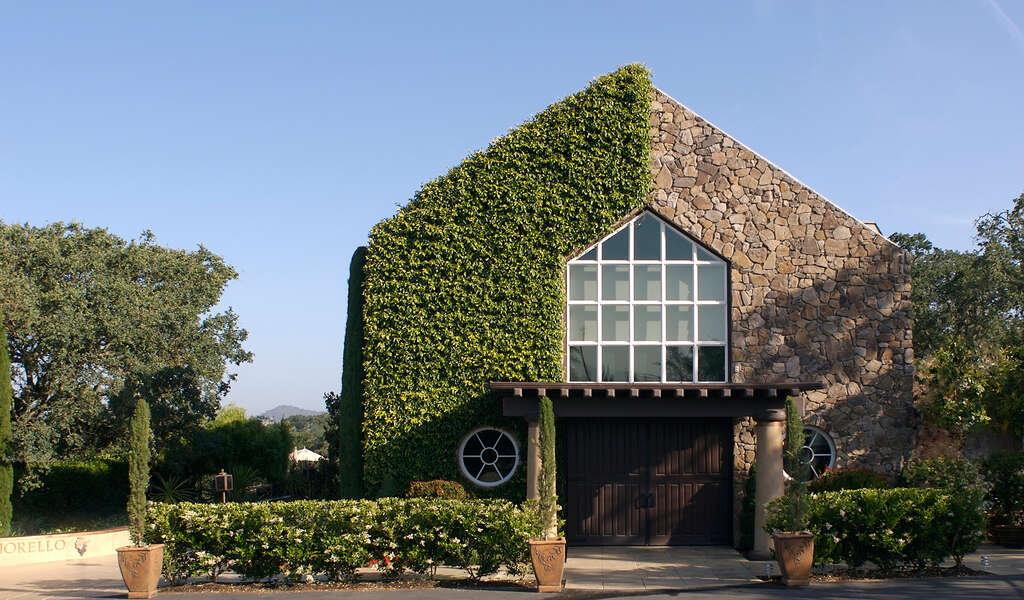
    If you live in a fire-prone area, which includes most of California, it is not a good idea to allow ivy and other plants to cover the sides of your building, as this winery and this church did near Santa Rosa. Both were lost to last week’s wildfires.

    Similarly, if you are a legislator in a fire-prone state, it is not a good idea to outlaw fire-resistant developments. As now-retired Forest Service researcher Jack Cohen relates in the above video, one requirement for making your home fire-safe is to have no large flammable structures within 100 feet of the home. That pretty much means people should build on one-acre or larger lots.

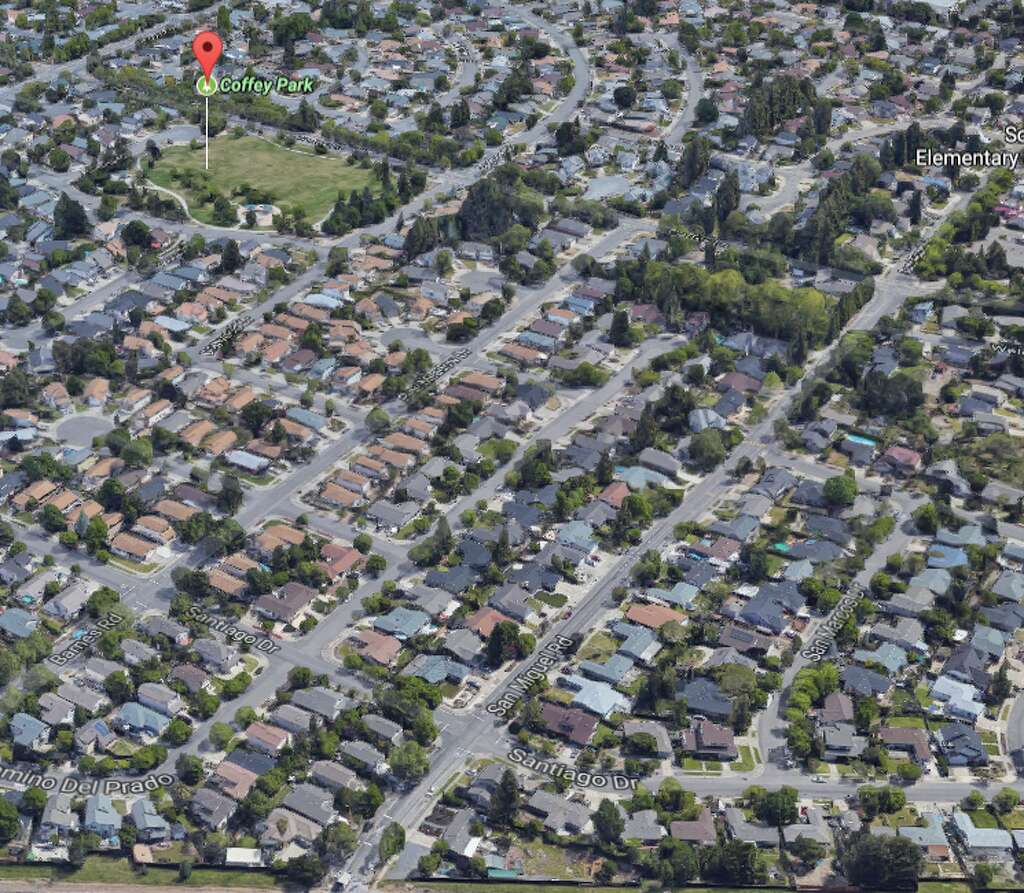
    But in California, the nation’s most fire-prone state, urban planners’ mania for density has led the legislature to effectively outlaw such low-density development. Santa Rosa’s Coffey Park neighborhood consisted of conventionally sized suburban homes on 50-by-100-foot lots–small for a modern suburb–resulting in many houses being only a few feet apart from one another. If one house caught fire during a dry spell, the intense radiant heat would be sure to set off the next home. As a result, the neighborhood is now a smoking ruin.

    As the Antiplanner noted a decade ago, California developers have built shelter-in-place neighborhoods that are so fire-resistant that it is safer for residents to stay in their homes than to evacuate. Wildfires have swept by these neighborhoods and not harmed a single home.

    Sadly, this technique has been criticized by even the California Department of Forestry, which argues that making homes fire-safe will just encourage people to live in fire-prone areas (meaning almost all of California). They suggested that people build their homes closer together to make them “easier to protect.” That didn’t work very well in Santa Rosa.

    If California had allowed urban areas to grow in the modern way, with density at the center and increasingly low densities at the edges, then a ring of low-density, shelter-in-place neighborhoods around Santa Rosa and other cities could have provided a fire break protecting the denser developments. But this is practically forbidden in California. So, we will get more disasters like the one in Santa Rosa and the 1991 Oakland Hills firestorm.

    This piece first appeared on The Antiplanner.

    Randal O’Toole is a senior fellow with the Cato Institute specializing in land use and transportation policy. He has written several books demonstrating the futility of government planning. Prior to working for Cato, he taught environmental economics at Yale, UC Berkeley, and Utah State University.

    Photo: Homes burned by a wildfire are seen, Oct. 11, 2017, in Santa Rosa, California via VOA News.

  • Garden Grove: The Other Kind of Incremental Urbanism

    This is the historic Main Street in Garden Grove, California. Back in 1874 land was platted in small twenty five foot wide lots and sold off with minimal infrastructure. Individuals built modest pragmatic structures with funds pulled largely from the household budget, extended family, and short term debt. This was long before the thirty year mortgage, government loan guaranties, mortgage interest tax deductions, zoning regulations, subsidies, economic development grants, or the codes we have today.

    Many of these simple one story shops were specifically designed to be subdivided in to two smaller shops that were each about twelve feet wide and not terribly deep. These were ideal economic incubators with a low bar to entry for tenants, yet they generated a high yield per square foot for the landlord. Businesses could expand and contract as needs changed. Some things failed. Others succeeded. Time sorted it all out.

    Families often lived above their own shops. In many cases rooms or apartments were rented to tenants. Sometimes the upper floors served as professional offices or hotel rooms. This was an additional layer of flexibility that allowed properties to adapt over time while providing affordable yet profitable accommodations. Everything expanded gradually as money and market demand permitted. This was the process that produced our Main Street towns all across the country.


    Here’s an aerial view of Main Street courtesy of Google. At one time it was the economic and cultural center of a thriving farm community. Notice the amount of private value relative to public infrastructure. Let’s pull out a bit and see what the surroundings look like today.


    Google

    Whatever may have existed around Main Street is now a vast ocean of surface parking lots. Next door and across the street are big box stores along high speed arterial roads. Times change. When transportation switched from shoe leather and horses to cars and trucks the scale of absolutely everything in society ramped up exponentially. The the old Main Street became a relic.

    Garden Grove’s civic leaders obviously thought its historic center was worth preserving, so planners did the best they could to keep it viable. Removing defunct buildings in favor of parking lots made the shops available to suburban motorists.

    Decorative paving, ye olde lamp posts, hanging flower baskets, park benches, lots and lots of American flags, potted shrubbery, and piped in music created a respectable unified atmosphere for retail. The place is clean, safe, and orderly.

    Events are programmed to keep Main Street active and attract customers. An Elvis festival, a vintage car show, the annual celebration of the strawberry… Shops that might otherwise go empty are filled with civic organizations like the Chamber of Commerce and the offices of elected representatives. Garden Grove’s remaining historic center – all one block of it – is well maintained. But it stopped functioning as a town a long time ago. It’s now an embellished strip mall. The current regulatory environment and larger economic context have halted the iterative wealth building process that might have otherwise continued. Now it’s dependent on city planning efforts to keep up appearances with grants for fresh lipstick and rouge. It’s an exercise in sentimentality and kitsch. Nothing else is legal anymore.

    Advocates for a return to the kind of development pattern that existed a century ago are up against hard limits of every kind. Reforming the current system of regulations and cultural attitudes is a waste of time. What they don’t recognize is that the small scale, fine grained, mom and pop process is alive and well in places like Garden Grove. It just doesn’t look like a Norman Rockwell village. That era is gone and isn’t coming back anytime soon. But a new version is already here. The mobile shop is the new version. I see more and more of these all across the county, because this is the new low resistance entry point for small businesses to form.

    This is only the visible stuff. Inside many suburban homes are businesses that you can’t see. These aren’t traditional retail stores. Operating a physical shop makes no sense in most cases. Who can compete with Costco or Amazon? Who wants to try to extract permission from the zoning authorities? But household ventures generate income in ways that aren’t readily apparent from the curb. I can’t publish photos of the best examples because I’d get a lot of good people in to trouble. But trust me. They’re out there in large numbers under the radar.

    When it comes to housing it’s incredibly difficult to build anything simple and cost effective anymore. A combination of endless regulations and outraged neighbors means only production home builders are left in the game. They build whole subdivisions of single family homes, or they build two hundred unit apartment complexes. The middle range of modest accommodations is no longer a reasonable option. Under the circumstance the existing stock of suburban homes are pressed in to service as de facto multi family buildings. On my way out of Orange County I asked a waitress at the airport about her living arrangements. She said she rented shared space in a five bedroom house in Costa Mesa. The overall rent was $4,200 a month. Her share was $1,100. She had three room mates. She also had three kids. That’s why so many front lawns are parking lots.

    There’s a general acceptance of the super sized suburban home. A plain vanilla ranch home can become a much larger house without breaking any rules. The neighbors don’t always love being in the shadow of such upscaled structures, but there’s the countervailing knowledge that surrounding property values go up with this kind of redevelopment. Borderline insolvent municipal authorities understand this sort of activity allows a rare opportunity for property taxes to be adjusted upwards without building more public infrastructure. And it’s difficult to create codes that forbid such additions so long as set back regulations, health and fire safety, and other concerns are addressed. It’s all still a regular house so the suburban imperatives remain inviolate.

    I have a peculiar ability to wander around and get myself invited in to people’s lives. This place in Garden Grove was once a little 1950s tract home. It was added on to in a way that perfectly conformed to all the existing rules and procedures and is still a fully detached single family home. But individual rooms are rented out and the tenants share a common kitchen and baths. It’s a small apartment building by other means. This is what we get when we forbid the Norman Rockwell Main Street model. Some people hate it. I see it as a perfectly natural response to the artificial constraints that have been placed on the old Main Street model. We can’t go back. But we can adapt and move forward under the circumstances.

    This piece first appeared on Granola Shotgun.

    John Sanphillippo lives in San Francisco and blogs about urbanism, adaptation, and resilience at granolashotgun.com. He’s a member of the Congress for New Urbanism, films videos for faircompanies.com, and is a regular contributor to Strongtowns.org. He earns his living by buying, renovating, and renting undervalued properties in places that have good long term prospects. He is a graduate of Rutgers University.

  • California Politicians Not Serious About Fixing Housing Crisis

    California’s political leaders, having ignored and even abetted our housing shortage, now pretend that they will “solve it.” Don’t bet on it.

    Their big ideas include a $4 billion housing subsidy bond and the stripping away of local control over zoning, and mandating densification of already developed areas. None of these steps addresses the fundamental causes for California’s housing crisis. Today, barely 29 percent of California households, notes the California Association of Realtors, can afford a median-priced house; in 2012, it was 56 percent.

    At the heart of the problem lie “urban containment” policies that impose “urban growth boundaries” to restrict — or even prohibit — new suburban detached housing tracts from being built on greenfield land. Given the strong demand for single-family homes, it is no surprise that prices have soared.

    Before these policies were widely adopted, housing prices in California had about the same relationship to incomes as in other parts of the country. Today, prices in places like Los Angeles, the Bay Area and Orange County are two to three times as high, adjusted for incomes, as in less-regulated states. Even in the once affordable Inland Empire, housing prices are nearing double that of most other areas, closing off one of the last remaining alternatives for middle- and working-class families.

    How did we get here?

    Largely in response to regulatory constraints, the state has been underproducing housing since the 1970s. So far this year, Los Angeles, the nation’s second-largest metropolitan region, has produced fewer homes than much smaller areas like Dallas-Fort Worth, Houston and Atlanta.

    The California Environmental Quality Act and other laws and restrictions have helped to make building the number of houses needed by California’s middle-income families unattainable. The state’s more recent draconian climate change policies are also making the building of more affordable homes, usually on the fringe of urban areas, almost impossible.

    Some developers and planners blame much of the problem on NIMBYs, or “not in my backyard” activists, who oppose high-density development in their communities. NIMBYism, often aligned with green policies, is part of the problem, but high-density housing is expensive, and there are not enough people looking for “micro-apartments” to solve the affordability crisis.

    Indeed, housing in buildings of more than five stories requires rents approximately two-and-a-half times those from the development of garden apartments, notes Gerard Mildner, academic director of the Center for Real Estate at Portland State University. In the San Francisco Bay Area, the cost of townhouse development per square foot can double that of detached houses (excluding land costs), and units in high-rise condominium buildings can cost up to seven-and-a-half times as much.

    Longtime San Francisco journalist Tim Redmond points out that luxury apartments tend to replace the often more affordable older buildings in urban neighborhoods. There’s been a gusher of high-rises built in places like San Francisco or Los Angeles, but these are generally very expensive, and have not discernibly lowered prices.

    Read the entire piece at The Orange County Register.

    Joel Kotkin is executive editor of NewGeography.com. He is the Roger Hobbs Distinguished Fellow in Urban Studies at Chapman University and executive director of the Houston-based Center for Opportunity Urbanism. His newest book is The Human City: Urbanism for the rest of us. He is also author of The New Class ConflictThe City: A Global History, and The Next Hundred Million: America in 2050. He lives in Orange County, CA.

    Wendell Cox is principal of Demographia, an international public policy and demographics firm. He is a Senior Fellow of the Center for Opportunity Urbanism (US), Senior Fellow for Housing Affordability and Municipal Policy for the Frontier Centre for Public Policy (Canada), and a member of the Board of Advisors of the Center for Demographics and Policy at Chapman University (California). He is co-author of the “Demographia International Housing Affordability Survey” and author of “Demographia World Urban Areas” and “War on the Dream: How Anti-Sprawl Policy Threatens the Quality of Life.” He was appointed to three terms on the Los Angeles County Transportation Commission, where he served with the leading city and county leadership as the only non-elected member. He served as a visiting professor at the Conservatoire National des Arts et Metiers, a national university in Paris.

    Photo credit: refundrealestate.com

  • California Population Lags Behind Projections

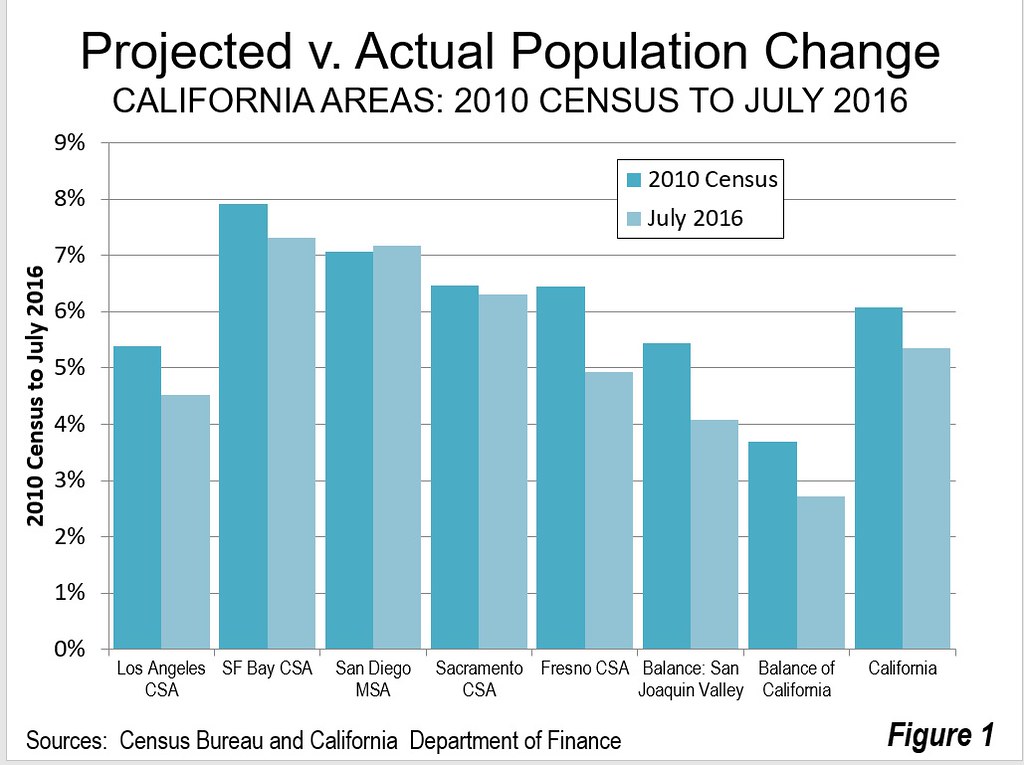
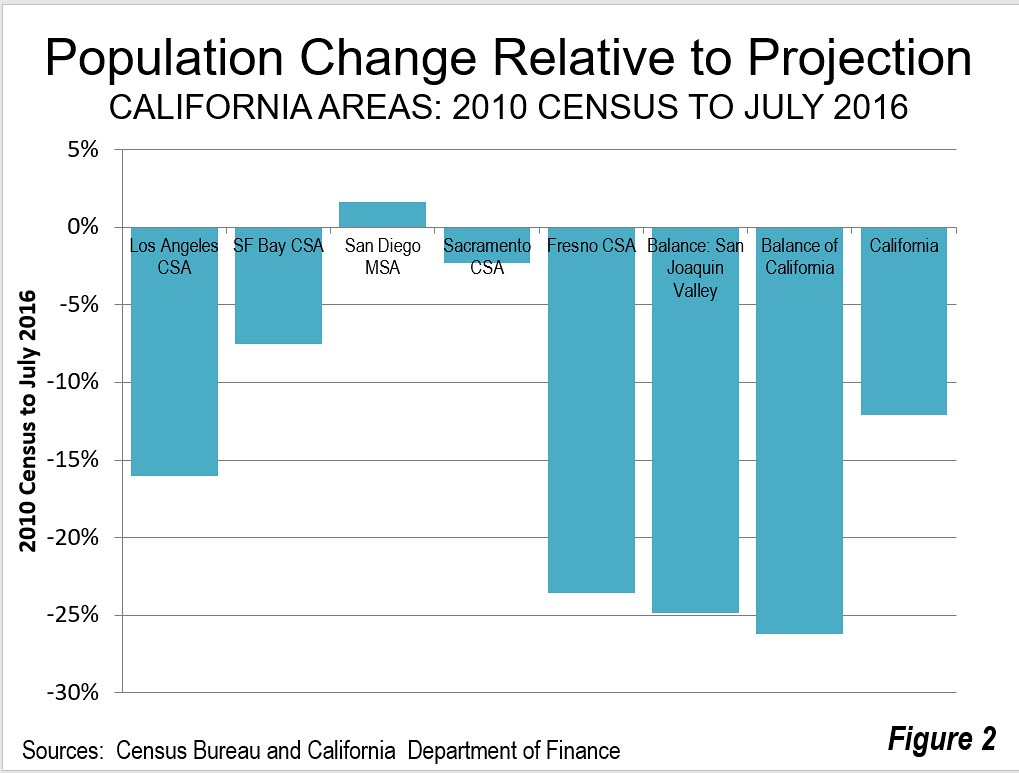
    Halfway through the new decade, California, widely seen as an irresistible force for the young and ambitious, is underperforming the state’s own demographic projections. Since 2010 the state’s population grew 5.3 percent from the 2010 census figure, 12 percent below the 6.1 percent increase projected by the California State Department of Finance. The population increased at below projected rates in all of the five metropolitan regions (combined statistical areas, or CSAs and metropolitan statistical areas MSAs, outside the CSAs) with more than 1,000,000 population, except in San Diego.

    This article compares the 2016 US Census Bureau population estimates of areas within California to the corresponding projections by the California State Department of Finance (DOF). The Census Bureau estimates are for July 1, 2016 and the Department of Finance projections are for January 1. As a result, the Census Bureau estimates are compared to the average of the California 2016 and 2017 projections. Moreover, the Census Bureau estimates are used because of their more authoritative nature. DOF calibrates its estimates to those of the Census Bureau at each 10 year national census. It is important to recognize that projections are just that — forecasts that can be significantly off even when demographers take the greatest caution to achieve accuracy.

    The Los Angeles CSA

    The population gain in the Los Angeles CSA was 4.5 percent between the 2010 census and July 1, 2016, 16.0 Percent below the projected 5.4 percent. The Los Angeles CSA includes Los Angeles, Orange, Riverside, San Bernardino and Ventura counties. Among these, only Riverside County exceeded its projection, by 5.1 percent. Los Angeles County fell 27.5 percent short of its projection and Ventura County was 20.3 percent short. San Bernardino County missed its projection by 14.7 percent, while Orange County was 10.3 percent short.

    The San Francisco Bay Area CSA

    The San Francisco Bay Area CSA also gained fewer new residents than expected, with its 7.3 percent increase following 7.5 percent short of the 7.9 percent projection. The San Francisco Bay Area CSA includes seven metropolitan areas: San Francisco, San Jose, Stockton, Santa Cruz, Vallejo, Napa and Santa Rosa. The San Francisco metropolitan area grew 4.2 percent less than its projection. This was driven by a shortfall of 27.9 percent in Marin County, 12.7 percent in San Mateo County and 6.4 percent in San Francisco County. Alameda County did slightly better than expected, while Contra Costa County did slightly worse.

    Santa Clara County, home of San Jose, grew 13.7 percent less than projected. All of the outlying metropolitan areas fell short of their projections, except for Sonoma County, which grew 15 percent more than projected, probably in part due to its having among the least severely unaffordable housing in the area and having good access to employment centers of western Contra Costa County.

    The San Francisco area’s failure to achieve its population projection is significant, given that Plan Bay Area assumed that the Bay Area would grow 54 percent more than the DOF estimates for 2010 to 2040. I raised questions about this assumption in a 2013 report for the Pacific Research Institute, that the failure to use the state projection was likely to exaggerate greenhouse gas emissions in 2040. The suspicion that Plan Bay Area was based on exaggerated population projections appears to be fully justified by the actual population trends.

    San Diego MSA

    San Diego is the only major metropolitan region in the state that is not a combined statistical area. San Diego is unique in having exceeded its population projection for 2016. The margin was small, at 1.6 percent.

    Sacramento CSA

    The Sacramento CSA (California portion), fell short by a relatively small margin, gaining 6.3 percent compared to its 6.5 percent projection (a shortfall of 2.3 percent). Sacramento County, the area’s largest, fell only 1.2 percent short of its projection. The Sacramento CSA includes three metropolitan areas: Sacramento, Yuba City and Truckee.

    Fresno CSA

    Among the larger metropolitan regions, the most dramatic shortfall relative to projections was in Fresno, where the population grew 23.6 percent less than projected, for a gain of 4.9 percent. The Fresno CSA includes Fresno and Madera counties.

    Balance of the State

    Outside the major metropolitan regions, population growth was even less compared to projections. In the San Joaquin Valley, even without Fresno and the Stockton portion of the San Francisco Bay Area CSA, population growth was 24.9 percent below projections. In the rest of the state that growth was 26.2 percent below projection (Figures 1 and 2)

    California’s Slower Growth Persists

    All of this continues the comparatively rapid turnaround of California’s population growth since 2000. Between statehood in 1850 and 1990, California’s population grew no less than 18.6 percent (1970s) and up to 300 percent (1850s). After rising back to 25.7 percent in the 1990s, growth dropped to 10.0 percent in the 2000s, an average of one percent per year. During this decade, it seems unlikely that even that rate will be achieved.

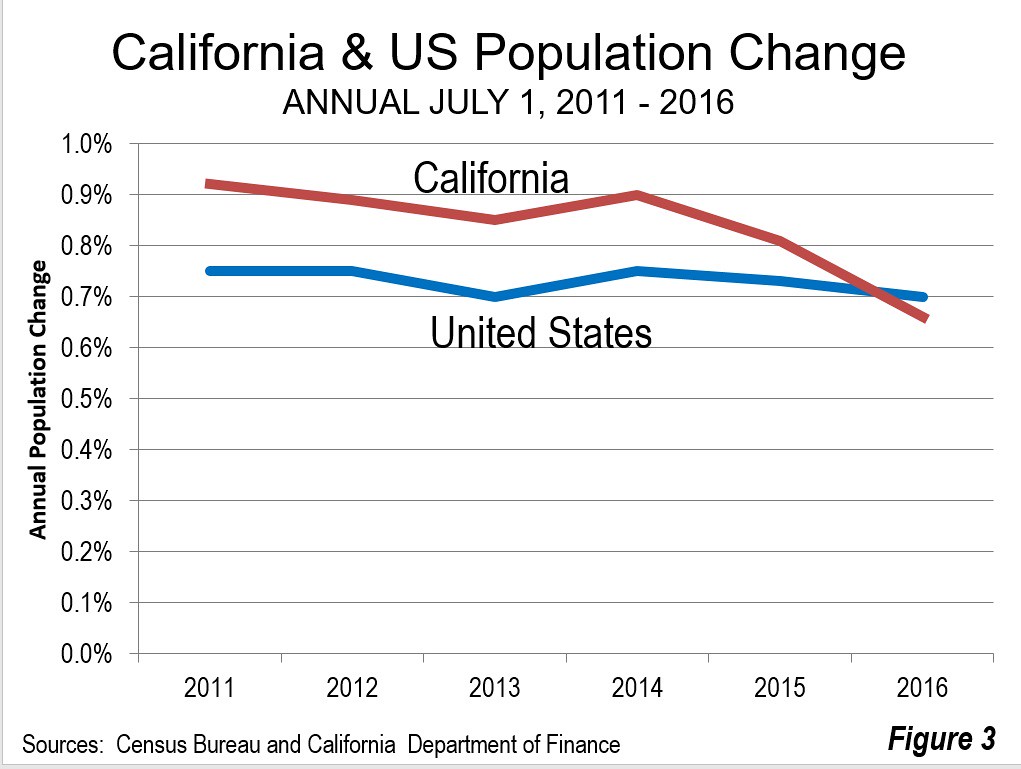
    Since the 2000 census, California’s growth rate has dropped to only 0.84 percent, only a little above the national rate of 0.73 percent. Now it may be on track to start growing slower than the nation. In 2016 California’s growth rate fell below that of the nation for the first time in the decade coming in at 0.66 percent, compared to the national rate of 0.70 percent. Between 2011 and 2016, California’s average population increase was 18 percent above the national rate (Figure 3). Once a beacon for growth, California’s growth is more stagnant than in the past.

    Wendell Cox is principal of Demographia, an international public policy and demographics firm. He is a Senior Fellow of the Center for Opportunity Urbanism (US), Senior Fellow for Housing Affordability and Municipal Policy for the Frontier Centre for Public Policy (Canada), and a member of the Board of Advisors of the Center for Demographics and Policy at Chapman University (California). He is co-author of the “Demographia International Housing Affordability Survey” and author of “Demographia World Urban Areas” and “War on the Dream: How Anti-Sprawl Policy Threatens the Quality of Life.” He was appointed to three terms on the Los Angeles County Transportation Commission, where he served with the leading city and county leadership as the only non-elected member. He served as a visiting professor at the Conservatoire National des Arts et Metiers, a national university in Paris.

    Photograph: San Diego, only major metropolitan region in California to exceed its state population projection 2010-2016 (by author).

  • California’s Coming Youth Deficit

    Images of California, particularly the southern coast, are embedded with those associated with youthfulness — surfers, actors, models, glamorous entrepreneurs. Yet, in reality, the state — and the region — are falling well behind in the growth of their youthful population, which carries significant implications for our future economic trajectory and the nature of our society.

    The numbers, provided by demographer Wendell Cox, based on U.S. Census Bureau estimates, should concern every business and community, particularly across the high-priced coastal areas. On the other hand, the stronger youthful growth in the interior, notably the Inland Empire, may become the basis for a regional resurgence, given a less draconian state regulatory regime.

    What the numbers say

    Let’s start with the millennials, the population that was aged between 20 and 34 in 2015. Since 2000, the growth of this segment of the population has been, for the most part, very slow along the coastal regions, well below the 6 percent national average. In Los Angeles and Orange County, the youth population grew by roughly 3 percent, about half the national average. San Francisco-Oakland, did a bit better, at 7 percent, but Silicon Valley-San Jose experienced a barely 1 percent increase.

    In comparison, the millennial population of Orlando, Fla., grew by 47 percent, while in Las Vegas it increased by 42 percent. The four big Texas cities — led by San Antonio, with a 43 percent increase — all registered well over 20 percent growth. Rising tech regions, like Raleigh, N.C., saw 30 percent growth — 30 times the rate in Silicon Valley.

    Yet, not all of California is losing out in the coming generation. The fastest-growing region for young people among the 53 largest metropolitan regions is right here in Southern California, the Riverside-San Bernardino area, which saw its 20-34 population expand by a remarkable 47 percent. Another inland standout in California, Sacramento, grew by over 30 percent, far ahead of any of the coastal areas.

    Read the entire piece in the Orange County Register.

    Joel Kotkin is executive editor of NewGeography.com. He is the Roger Hobbs Distinguished Fellow in Urban Studies at Chapman University and executive director of the Houston-based Center for Opportunity Urbanism. His newest book is The Human City: Urbanism for the rest of us. He is also author of The New Class ConflictThe City: A Global History, and The Next Hundred Million: America in 2050. He lives in Orange County, CA.

    Wendell Cox is principal of Demographia, an international public policy and demographics firm. He is a Senior Fellow of the Center for Opportunity Urbanism (US), Senior Fellow for Housing Affordability and Municipal Policy for the Frontier Centre for Public Policy (Canada), and a member of the Board of Advisors of the Center for Demographics and Policy at Chapman University (California). He is co-author of the “Demographia International Housing Affordability Survey” and author of “Demographia World Urban Areas” and “War on the Dream: How Anti-Sprawl Policy Threatens the Quality of Life.” He was appointed to three terms on the Los Angeles County Transportation Commission, where he served with the leading city and county leadership as the only non-elected member. He served as a visiting professor at the Conservatoire National des Arts et Metiers, a national university in Paris.

    Photo by vlasta2 [CC BY 2.0], via Wikimedia Commons

  • State Governments Are Oppressive, Too

    Historically, the battle over the size and scale of government has been focused largely on “states’ rights.” This federalist notion also has been associated with many shameful things, such as slavery, Jim Crow laws and other abuses of personal freedom.

    Yet, increasingly, the clearest threat to democracy and minority rights today comes not just from a surfeit of central power concentrated in Washington, D.C., but also from increased centralization of authority within states, and even regional agencies. Oppressive diktats from state capitals increasingly seek to limit local control over basic issues such as education, zoning, bathroom designations, guns and energy development.

    This follows a historical trend over the past century. Ever since the Great Depression, and even before, governmental power has been shifting inexorably from the local governments to regional, state and, of course, federal jurisdictions. In 1910, the federal level accounted for 30.8 percent of all government spending, with state governments comprising 7.7 percent and the local level more than 61 percent. More than 100 years later, not only had the federal share exploded to nearly 60 percent, but, far less recognized, the state share had nearly doubled, while that of local governments has fallen to barely 25 percent, a nearly 60 percent drop. Much of what is done at the local level today is at the behest, and often with funding derived from, the statehouse or Washington.

    Diversity vs. regimentation

    This trend is particularly notable in the country’s two megastates: California and Texas. Each is increasingly controlled by ideological fanatics who see in their statehouse dominion an ideal chance to impose their agenda on dissenting communities. In California, Jerry Brown’s climate jihad is the rationale for employing “the coercive power of the central state,” in his own words, to gain control over virtually every aspect of planning and development.

    In Texas, the impetus comes from the far right, which has been working to strip localities of their traditional ability to control their own affairs, which, as two Houston scholars recently pointed out, has been critical to that state’s success. These efforts cover a host of issues, from fracking and ride-sharing to transgender bathrooms, a topic which affects very few but has, absurdly, become the key issue for a legislative special session.

    Just as Californians find themselves increasingly controlled by climate warriors and anti-suburban ideologues, diverse Texans in cities like Austin now must conform to the dictates of strident demands by a “liberty caucus” that eerily resembles their authoritarian doppelgangers in Sacramento.

    In other cases, such as in North Carolina, social conservatives, like their Texan bedfellows, seek to circumscribe progressive policies in places like Raleigh or Charlotte. Businesses, in particular, are concerned that some bills, like the state’s transgender bathroom legislation, could lead to painful boycotts by corporations and event planners. Conversely, some blue-state policies, like high mandated minimum wages and policies restricting fossil fuels, hurt disproportionately poorer areas, like upstate New York and rural California, which have lost much of their political clout.

    Read the entire piece in the Los Angeles Daily News.

    Joel Kotkin is executive editor of NewGeography.com. He is the Roger Hobbs Distinguished Fellow in Urban Studies at Chapman University and executive director of the Houston-based Center for Opportunity Urbanism. His newest book is The Human City: Urbanism for the rest of us. He is also author of The New Class ConflictThe City: A Global History, and The Next Hundred Million: America in 2050. He lives in Orange County, CA.

    Photo by LoneStarMike (Own work) [CC BY 3.0], via Wikimedia Commons

  • Why the Greens Lost, and Trump Won

    When President Trump pulled out of the Paris climate accords, embraced coal, and stacked his administration from people from fossil-fuel producing states, the environmental movement reacted with near-apocalyptic fear and fury. They would have been better off beginning to understand precisely why the country has become so indifferent to their cause, as evidenced by the victory not only of Trump but of unsympathetic Republicans at every level of government.

    Yet there’s been little soul-searching among green activists and donors, or in the generally pliant media since November about how decades of exaggerated concerns—about peak oil, the “population bomb,” and even, a few decades back, global cooling—and demands for economic, social, and political sacrifices from the masses have damaged their movement.

    The New Religion and the Next Autocracy

    Not long ago, many greens still embraced pragmatic solutions—for example substituting abundant natural gas for coal—that have generated large reductions in greenhouse gas emissions. Rather than celebrate those demonstrable successes, many environmentalists began pushing for a total ban on the development of fossil fuels, including natural gas, irrespective of the costs or the impact on ordinary people.

    James Lovelock, who coined the term “Gaia,” notes that the green movement has morphed into “a religion” sometimes marginally tethered to reality. Rather than engage in vigorous debate, they insist that the “science is settled” meaning not only what the challenges are but also the only acceptable solutions to them. There’s about as much openness about goals and methods within the green lobby today as there was questioning the existence of God in Medieval Europe. With the Judeo-Christian and Asian belief systems in decline, particularly among the young, environmentalism offers “science” as the basis of a new theology.

    The believers at times seem more concerned in demonstrating their faith than in passing laws, winning elections or demonstrating results. So with Republicans controlling the federal government, greens are cheering Democratic state attorney generals’ long-shot legal cases against oil companies. The New York TimesThomas Friedman has talked about dismissing the disorder of democracy as not suited to meeting the environmental challenges we face, and replacing it with rulers like the “reasonably enlightened group of people” who run the Chinese dictatorship.

    After Trump pulled the U.S. out of the Paris climate accord, China was praised, bizarrely, as the great green hope. The Middle Kingdom, though, is the world’s biggest and fastest grower emitter, generating coal energy at record levels. It won’t, under Paris, need to cut its emissions till 2030. Largely ignored is the fact that America, due largely to natural gas replacing coal, has been leading the world in GHG reductions.

    Among many greens, and their supports, performance seems to mean less than proper genuflecting; the Paris accords, so beloved by the green establishment, will make little impact on the actual climate, as both rational skeptics like Bjorn Lomborg and true believers like NASA’s James Hanson agree. In this context, support for Paris represents the ultimate in “virtue signaling.” Ave Maria, Gaia.

    The California Model

    The cutting edge for green soft authoritarianism, and likely model after the inevitable collapse of the Trump regime, lies in California. On his recent trip with China, Brown fervently kowtowed to President Xi Jinping. Brown’s environmental obsessions also seems to have let loose his own inner authoritarian, as when he recently touted “the coercive power of the state.”

    Coercion has its consequences. California has imposed, largely in the name of climate change, severe land use controls that have helped make the state among the most unaffordable in the nation, driving homeownership rates to the lowest levels since the 1940s, and leaving the Golden State with the nation’s highest poverty rate.

    The biggest losers from Brown’s policies have been traditional blue collar, energy-intensive industries such as home building, manufacturing, and energy. Brown’s climate policies have boosted energy prices and made gas in oil-rich California about the most expensive in the nation. That doesn’t mean much to the affluent Tesla-driving living in the state’s more temperate coast, but it’s forced many poor and middle-class people in the state’s less temperate interior into “energy poverty,” according to one recent study.

    That, too, fits the climatista’s agenda, which revolves around social engineering designed to shift people from predominately suburban environments to dense, urban and transit dependent ones. The state’s crowded freeway are not be expanded due to a mandated “road diet,” while local officials repeatedly seek to reduce lanes and “calm traffic” on what are already agonizing congested streets. In this shift, market forces and consumer preferences are rarely considered, one reason these policies have stimulated much local opposition—and not only from the state’s few remaining conservatives.

    California’s greens ambitions even extend to eating habits. Brown has already assaulted the beef producers for their cattle’s flatulence. Regulators in the Bay Area and local environmental activists are proposing people shift to meatless meals. Green lobbyists have already convinced some Oakland school districts to take meat off the menu. OK with me, if I get the hamburger or taco-truck franchise next to school when the kids get out.

    Sadly, many of these often socially harmful policies may do very little to address the problem associated with climate change. California’s draconian policies fail to actually do anything for the actual climate, given the state’s already low carbon footprint and the impact of people and firms moving to places where generally they expand their carbon footprint. Much of this has taken on the character of a passion play that shows how California is leading us to the green millennium.

    Goodbye to the Family

    An even bigger ambition of the green movement—reflecting concerns from its earliest days—has been to reduce the number of children, particularly in developed countries. Grist’s Lisa Hymas has suggested that it’s better to have babies in Bangladesh than America because they don’t end up creating as many emissions as their more fortunate counterparts. Hymas’ ideal is to have people become GINKs—green inclinations, no kids.

    Many green activists argue that birth rates need to be driven down so warming will not “fry” the planet. Genial Bill Nye, science guy, has raised the idea of enforced limits on producing children in high-income countries. This seems odd since the U.S. already is experiencing record-low fertility rates, a phenomenon in almost all advanced economies, with some falling to as little as half the “replacement rate” needed to maintain the current population. In these countries, aging populations and shrinking workforces may mean government defaults over the coming decades.

    The demographic shift, hailed and promoted by greens, is also creating a kind of post-familial politics. Like Jerry Brown himself, many European leaders—in France, Germany, Sweden, the United Kingdom, and the Netherlands—are themselves childless. Their attitude, enshrined in a EU document as “no kids, no problem” represents a breathtaking shift in human affairs; it’s one thing to talk a good game about protecting the “next generation” in the collective abstract, another to experience being personally responsible for the future of another, initially helpless, human being.

    Do As We Say, Not How We Live

    The pressing need to change people’s lives seems intrinsic now to green theology. Without penance and penalties, after all, there is no redemption from original sin. In the process, it seems to matter little if we undermine the great achievements of our bourgeois economy—expanded homeownership, greater personal mobility, the ability to rise to a higher class—if it signals our commitment to achieve a more earth-friendly existence.

    The left-wing theorist Jedidiah Purdy has noted that “mainstream environmentalism overemphasizes elite advocacy” at the expense of issues of economic equity, a weakness that both Trump and the GOP have exploited successfully, particularly in the Midwest, the South, and Intermountain West. Some greens object even to the idea of GDP growth at a time when most Americans are seeing their standard of living drop. No surprise then that the green agenda has yet to emerge from the basement of public priorities, which remain focused on such mundanities as better jobs, public safety, and decent housing.

    To further alienate voters, many green scolds live far more lavishly than the people they are urging to cut back. Greens have won over a good portion of the corporate elite, many of whom see profit in the transformation as they reap subsidies for “green” energy, expensive and often ineffective transit and exorbitant high-density housing. Most notable are the tech oligarchs, clustered in ultra-green Seattle and the Bay Area, who depend on massive amounts of electricity to run their devices, but have reaped huge subsidies for green energy.

    The tech oligarchs have little interest in family friendly suburbs, preferring the model of prolonged adolescence in largely childless places like college campuses and San Francisco. Oligarchs such as Mark Zuckerberg live in spacious and numerous houses, even while pressing policies that would push everyone without such a fortune to downsize. Richard Branson, another prominent green supporter, may not like working people’s SUVs, but he’s more than willing to sponsor climate change events on a remote Caribbean island reachable only by private plane. One does not even need to plumb the hypocrisy of Al Gore’s jet-setting luxurious lifestyle.

    In the manner of Medieval indulgences these mega emissions-generators claim to pay for their carbon sins by activism, buying rain forests and other noble gestures. Hollywood, as usual, is particularly absurd, with people like Leonardo di Caprio flying in his private jet across country on a weekly basis. Living in Malibu, Avatar director James Cameron sees skeptics as “boneheads” who will have “to be answerable” for their dissidence, suggesting perhaps a shootout at high noon.

    In the end, the greens and their wealthy bankrollers may find it difficult to prevail as long as their agenda makes people poorer, more subservient, and more miserable; this disconnect is, in part, why the awful Donald Trump is now in the White House. Making progress on climate change, and other environmental concerns, remains a critical priority, but it needs to explore ways humans, through ingenuity and innovation, can meet these challenges without undermining what’s left of our middle class and faded democratic virtue.

    This piece originally appeared on the Daily Beast.

    Joel Kotkin is executive editor of NewGeography.com. He is the Roger Hobbs Distinguished Fellow in Urban Studies at Chapman University and executive director of the Houston-based Center for Opportunity Urbanism. His newest book is The Human City: Urbanism for the rest of us. He is also author of The New Class ConflictThe City: A Global History, and The Next Hundred Million: America in 2050. He lives in Orange County, CA.

    Photo by Joe Flood, via Flickr, using CC License.

  • High-Flying California Charts Its Own Path — Is A Cliff Ahead?

    As its economy bounced back from the Great Recession, California emerged as a progressive role model, with New York Times columnist Paul Krugman arguing that the state’s “success” was proof of the superiority of a high tax, high regulation economy. Some have even embraced the notion that California should secede to form its own more perfect union.

    Pumped up by all the love, California’s leaders have taken it upon themselves to act essentially as if they were running their own nation. In reaction to President Trump’s abandonment of the Paris accords, Gov. Jerry Brown trekked to Beijing to show climate solidarity with President Xi, whose country is by far the world’s largest greenhouse gas emitter and still burns coal at record rates, but mouths all the right climate rhetoric.

    At the same time California’s Attorney General is spending millions to protect undocumented workers and there’s legislation being proposed to transform the entire place into a “sanctuary state.” Sacramento also recently banned travel by government workers to Texas and seven other states that fail to follow the California line on gay and transgender rights.

    Past performance and future trajectory

    When progressive journalists, including those in Texas, speak about the California model, they usually refer to the state’s economic performance since 2010, which has been well above the national average. Yet this may have been only an aberrant phenomenon. Since 2010, Texas’ job count has grown by 20.6 percent compared to 18.6 percent for California. If you pull the curtain even further, to 2000, however, the gap is even bigger, with employment growing 32.7 percent in Texas compared to 18 percent in California.

    The main problem is that California’s once remarkably varied and vital economy has become dangerously dependent on the Bay Area tech boom. Since 2010, the Silicon Valley-San Jose economy and San Francisco have been on a tear, growing their employment base by 25 percent. Job growth in the rest of the state has been a more modest 15 percent. “It’s not a California miracle, but really should be called a Silicon Valley miracle,” notes Chapman University forecaster Jim Doti. “The rest of the state really isn’t doing well.”

    Tech starts to slow

    Such dependency poses dangers. The tech economy is very volatile, and now seems overdue for a major correction. People tend to forget the depth of the tech bust at the turn of the century. If you go back to 2000, San Jose’s job growth rate is among the lowest in the state, less than half the state average.

    Now tech is clearly slowing – job growth in the information sector has slowed over the past year from almost 10 percent to under 2 percent. Particularly hard-hit is high-tech startup formation, down almost half in the first quarter from two years ago; the National Venture Capital Association reported that the number of deals in the quarter was the lowest since the third quarter of 2010.

    The growing hegemony of a few very large firms – chiefly Apple, Google and Facebook — has created a very difficult environment for upstarts. As one recent paper demonstrates, these “super platforms” depress competition, squeeze suppliers and reduce opportunities for potential rivals, much as the monopolists of the late 19th century did.

    And as we found in our recent survey of the hot spots for high wage professional business services jobs, last year’s growth rates for this critical middle class sector in Silicon Valley and San Francisco lagged considerably behind those of boomtowns such as Nashville, Dallas, Austin, Orlando, San Antonio, Salt Lake City and Charlotte. Most other California metro areas, including Los Angeles, have languished in the bottom half of the rankings. These trends suggest that the state’s job performance will at least drop to the national average over the next two years and perhaps below, says California Lutheran University forecaster Matthew Fienup.

    Rising inequality

    California is home to a large chunk of the world’s richest people and particularly dominates the list of billionaires under 40. Yet, by one new measure introduced by the Census Bureau last year, the state also suffers the nation’s highest poverty rate; while a 2015 United Way study found that close to one in three Californians were barely able to pay their bills. No surprise then that as of 2015, the state was the most unequal in the nation, according to the Social Science Research Council.

    As of 2011, nearly half of the 16 counties with the highest percentages of people earning over $190,000 annually were located in California but denizens of the state’s interior have done far worse. A 2015 report found California was home to a remarkable 77 of the country’s 297 most “economically challenged,” cities based on levels of poverty and employment. Altogether these cities had a population of more than 12 million in 2010, roughly one third of the state at the time. Six of the ten metropolitan areas in the country with the highest percentage of jobless are located in the central and eastern parts of the state.

    What is disappearing faster than any state, according to a survey last year, is California’s middle class, a pattern also seen in a recent Pew study. One clear sign of middle class decline: California’s homeownership rates now rank among the lowest in the nation and Los Angeles-Orange County, the state’s largest metropolitan area, suffers the lowest level of homeownership of any major region.

    Jerry’s Jihad and its consequences

    State policies tied to Jerry Brown’s climate jihad have widened these divides. Inland Empire economist John Husing asserts that Brown has placed California “at war“ with blue-collar industries like home building, energy, agriculture and manufacturing. These jobs are critical for regions where almost half the workforce has a high school education or less.

    Richard Chapman, President and CEO of the economic development arm of Kern County, an area dependent on these industries, complains that most polices promulgated in Sacramento — from water and energy regulations to the embrace of sanctuary status and a $15 an hour minimum wage — give little consideration given to the needs of the interior. “We don’t have seats at the table,” he laments. “We are a flyover state within a state.”

    The recent legislation to raise the minimum wage to $15 an hour will have more severe ramifications for less affluent areas than San Francisco. As for climate policies, the state no longer even assesses the economic implications. Yet the state’s costly renewable energy mandates make a lot of difference in the less temperate interior when energy prices are 50 percent rise above neighboring states. A recent study found that the average summer electric bill in rich, liberal and temperate Marin County was $250 a month, while in the impoverished, hotter Central Valley communities, where air conditioners are a necessity, the average bill was twice as high. Some one million Californians, many in the state’s hotter interior, were driven into “energy poverty,” a 2012 Manhattan Institute study stated.

    Housing has arguably emerged as the biggest force accentuating inequality. Environmental restrictions that have cramped home production of all kinds, particularly the building of affordable single-family homes on the periphery. The ever increasing restrictions have made the state among the most unaffordable in the nation, driving homeownership rates to the lowest levels since the 1940s. New “zero emissions” housing policies alone are likely to boost the already bloated cost of new construction by tens of thousands of dollars per home.

    Demographic crisis looms

    In much of California, particularly along the south coast, the number of children has dropped sharply. Since 2000, there has been a precipitous 13.6 percent drop in the number of residents under 17 in Los Angeles, while that number has remained flat in the Bay Area. In contrast, there has been 20 percent growth or better in the under 17 population in more affordable metropolitan areas such as Dallas-Fort Worth, Atlanta, Charlotte, Raleigh, Phoenix and San Antonio.

    Housing prices, in part driven by state and regional regulation, are gradually sending the seed corn — younger workers — to more affordable places. Despite claims that people leaving California are old and poor, the two most recent year’s data from the IRS shows larger net losses of people in the 35 to 54 age group. Losses were particularly marked among those making between $100,000 and $200,000 annually.

    Young people particularly are on the way out. California boomers, as we discussed in a recent Chapman University report, have a homeownership rate around the national average but the state has the third lowest home ownership rate in the nation for people 25 to 34, behind just New York and Washington. The drop among this demographic in San Jose and the Los Angeles areas since 1990 are roughly twice the national average and a recent San Jose Mercury News poll found nearly half of all Bay Area millennials planning to move, mostly motivated by housing and costs. The one population on the upswing in the state are seniors, particularly in the coastal countries, who bought their homes when they were much less expensive.

    As long as home prices stay high, and opportunities for high-wage employment highly limited, the state will continue to suffer net domestic migration outflows, as it has for the last 22 of the past 25 years. Given that the state’s birthrate is also at a historic low and immigration from abroad has slowed, there’s a looming shortage of new workers. Between 2013 and 2025 the number of California high school graduates is expected to drop by 5 percent compared to a 19 percent increase in Texas, 10 percent growth in Florida and a 9 percent increase in North Carolina.

    And for what?

    Of course, many environmental activists generally prefer smaller families to cut greenhouse gas emissions; smaller families also serve the needs of developers of high-density housing, who might prefer that younger people remain long-term adolescents.

    Sadly, many of these climate policies, which cause so much damage, won’t have much of an impact on the actual climate unless the rest of the country adopts similar measures. This stems from the state’s already low carbon footprint and the impact of people as well as firms moving elsewhere, where they usually expand their carbon footprint. Nor does densification make sense as a climate antidote, given the rising temperatures associated with “urban heat islands.”

    The tech boom has been used to justify Sacramento’s crushing regulatory and tax regime. It has also made it possible for apologists to ignore some 10,000 businesses that have left or expanded outside the state, many of them employing middle and working class people.

    Ultimately California’s growing class bifurcation will demand solutions. Hedge fund billionaire-turned green patriarch Tom Steyer now insists that, to reverse our worsening inequality, we should double down on environmental and land use regulation but make up for it by boosting subsidies for the struggling poor and middle class. Certainly the welfare state in California — home to over 30 percent of United States’ on public assistance as of 2012 — will have to expand if the state stays on its present course.

    In the coming years the state’s business leaders fear an ever more leftist, and fiscally damaging, regime after the departure of the somewhat frugal Brown. There are increased calls in Sacramento for new subsidized housing, a single payer healthcare system as well as a big boost to the minimum wage already enacted.

    Ultimately California will pay — demographically, economically and socially — from its current surfeit of good intentions. Those who already own houses will not suffer immediately, but the new generation, immigrants and minorities will face an increasingly impossible burden. With its unparalleled natural assets, and economic legacy, California may be able to survive this toxic policy mix better than most places, but even in the Golden State reality has a way of showing its ugly face.

    This piece originally appeared on Forbes.

    Joel Kotkin is executive editor of NewGeography.com. He is the Roger Hobbs Distinguished Fellow in Urban Studies at Chapman University and executive director of the Houston-based Center for Opportunity Urbanism. His newest book is The Human City: Urbanism for the rest of us. He is also author of The New Class ConflictThe City: A Global History, and The Next Hundred Million: America in 2050. He lives in Orange County, CA.

    Photo by Neon Tommy, via Flickr, using CC License.

  • Is California Anti-Family?

    In its race against rapidly aging Europe and East Asia, America’s relatively vibrant nurseries have provided some welcome demographic dynamism. Yet, in recent years, notably since the Great Recession and the weak recovery that followed, America’s birthrate has continued to drop, and is now at a record low.

    Nowhere is this decline more marked than here in California. Once a state known for rapid population growth, and above-average fecundity, the state’s birthrate is also at a historic low. The results are particularly dismal in coastal Southern California. Los Angeles’ population of people under 17 already has dropped a precipitous 13.6 percent, with drops even among Latinos and Asians, while Orange County has fallen by 6 percent since 2000. The national growth, in contrast, was up 2.2 percent. Despite claims that people leaving California are old and poor, the two most recent years of data from the IRS show larger net losses from people in the 35 to 54 age group. Net out-migration is also larger among those making between $100,000 and $200,000 annually. This is your basic child-bearing middle class.

    Why are we eating our seed corn?

    Why is this shift to an increasingly child-free population occurring more in Southern California than elsewhere? One logical source may be housing prices, particularly near the coast, which present a particular problem for middle-class, middle-aged families. In contrast, the growth in the number of children under 17 is much higher in more affordable metropolitan areas such as Dallas-Fort Worth, Atlanta, Phoenix, San Antonio, and Charlotte and Raleigh in North Carolina.

    Housing affordability certainly drives migration. Major metropolitan areas where the cost of housing is at least four times that of annual incomes have seen a net out-migration of 900,000 since 2010. This compares to a net gain of 1.1 million in the more affordable areas.

    Hardest hit of all are the groups who will dominate our future — young people, minorities and immigrants. California boomers, as we discussed in a recent Chapman University report, have a homeownership rate around the national average, but for people aged 25 to 34 the rate is the third-lowest in the nation, behind just New York and Washington, D.C. The drops among this demographic in the San Jose and Los Angeles areas since 1990 are roughly twice the national average.

    It is no surprise, then, that places like Southern California have also seen a decline in the next demographic group: people between 35 and 49, who are generally the age of parents, and also tend to be at their peak earning years. The one population group on the upswing is seniors, particularly in Orange County, who bought their homes when they were much less expensive.

    Read the entire piece at The Orange County Register.

    Joel Kotkin is executive editor of NewGeography.com. He is the Roger Hobbs Distinguished Fellow in Urban Studies at Chapman University and executive director of the Houston-based Center for Opportunity Urbanism. His newest book is The Human City: Urbanism for the rest of us. He is also author of The New Class ConflictThe City: A Global History, and The Next Hundred Million: America in 2050. He lives in Orange County, CA.

    Photo by Kat Grigg, via Flickr, using CC License.

  • Can California Survive a Tech Bust?

    California’s economic revival has sparked widespread notions, shared by Jerry Brown and observers elsewhere, that its economy — and policy agenda — should be adopted by the rest of the country. And, to be sure, the Golden State has made a strong recovery in the last five years, but this may prove to be far more vulnerable than its boosters imagine.

    The driver of the latest California “comeback,” the Silicon Valley-San Francisco tech boom, is beginning to slow in terms of both job growth and startup activity. The most recent job numbers, notes Chapman University economist Jim Doti, show that employment growth in the information sector has slowed over the past year from almost 10 percent to under 2 percent. Particularly hard-hit is high-tech startup formation, which is down by almost half from just two years ago.

    This slowdown extends also to the professional business services sector, which has become increasingly intertwined with tech. In a recent survey of professional business service growth for Forbes magazine, economist Mike Shires and I found that last year Silicon Valley and San Francisco growth rates were considerably lower than those in boomtowns such as Nashville, Tenn.; Dallas, San Antonio and Austin, Texas; Orlando, Fla.; Salt Lake City and Charlotte, N.C. With the exception of Orange County, the rest of Southern California performed below the national average.

    The historical perspective

    Historically, California’s great strength was the diversity of its economy, stretching from high-tech and aerospace to finance, entertainment, energy, basic manufacturing and homebuilding. Yet, during the most recent boom, the growth of high-wage job growth largely took place in one region — the Bay Area — while other sectors generally stagnated or shrank.

    Silicon Valley and its urban annex, San Francisco, have brilliantly expanded the scope of the digital revolution. Google and Apple have become the world’s most valuable companies, and the Valley, along with Puget Sound in the state of Washington, account for four of the 10 wealthiest people on the planet, and virtually all of the self-made billionaires under 40.

    This success has masked greater problems in the rest of the state. Southern California, home to over half the state’s population, has seen only modest high-wage job growth, both in tech and business services, since 2000.

    Read the entire piece at The Orange County Register.

    Joel Kotkin is executive editor of NewGeography.com. He is the Roger Hobbs Distinguished Fellow in Urban Studies at Chapman University and executive director of the Houston-based Center for Opportunity Urbanism. His newest book is The Human City: Urbanism for the rest of us. He is also author of The New Class ConflictThe City: A Global History, and The Next Hundred Million: America in 2050. He lives in Orange County, CA.

    Photo by Coolcaesar at the English language Wikipedia [GFDL or CC-BY-SA-3.0], via Wikimedia Commons