Tag: California

  • The California Economy: When Vigor and Frailty Collide

    Part one of a two-part report

    California is a place of extremes. It has beaches, mountains, valleys and deserts. It has glaciers and, just a few miles away, hot, dry deserts. Some years it doesn’t rain. Some years it rains all winter. Those extremes are part of what makes California the attractive place that it is, and, west of the high mountains, California is mostly an extremely comfortable place to live.

    Today, we have some new extremes. Some of our coastal communities are as wealthy as any in the world. At the other extreme, we have some of America’s poorest communities. San Bernardino, for example, has America’s second-highest poverty rate for cities with population over 200,000.

    From the beginning, we’ve had the fabulously wealthy. For the first 140 years after gold was found, California was a place where people could find, or, more correctly, build, success. The new part is the poverty. It used to be that the poor were mostly newcomers, people who hadn’t yet had time to show that they had what it takes. Today, our poverty is dominated by families who have been here a long time. While San Bernardino certainly has some newcomers, it is mostly a city of native Californians.

    The change became visible in the early 1990s. Many analysts will tell you that the change was caused by the collapse of the Soviet Union and the resulting peace dividend, which led to a dramatic downsizing of America’s defense sector, once a major component of California’s economy.

    I believe the way to think about this is that the downsizing of the defense sector exposed the weaknesses in California’s economy, as opposed to causing them. Sure, the downsizing had an economic impact. California lost hundreds of thousands of jobs. But the defense sector eventually bounced back and again became a source of good jobs. The problem is that it bounced back someplace else. It didn’t come back in California. In fact, it continues to decline in California.

    The decline in California’s economic opportunities began way before the 1990s. As the 1960s progressed, Californians, or at the least the ones making decisions, changed their priorities. California’s spending for infrastructure had once consumed between 15 and 20 percent of the State’s budget. It precipitously fell to five percent or below.
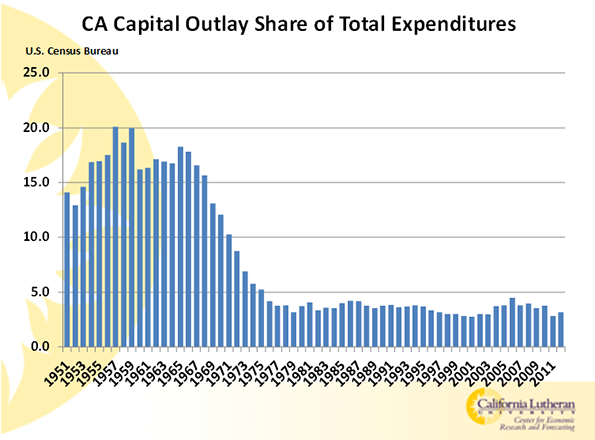
    In the ’50s and early ’60s, governors Goodwin Knight and Pat Brown presided over a fabulous investment boom in universities, highways, water projects and the like. None of their successors has even attempted anything on that scale. The profound prosperity that accompanied and followed California’s investment boom hid the impacts of subsequent policy changes for decades.

    The decline in public capital spending wasn’t the cause of our changed priorities. It was the change in priorities that caused the change in spending. It is as if we decided that we were wealthy enough, and that future spending would be on social and environmental programs. If we weren’t looking for economic growth, why invest?

    At California Lutheran University’s Center for Economic Research and Forecasting, we’ve created a vigor index. It’s composed of net in-migration, job creation, and new housing permits, each equally weighted. It is quite sensitive to changes in economic opportunity. For example, in 2000, North Dakota had the nation’s lowest score, 0.9, and Nevada led the nation with a score of 24.1. By 2013, North Dakota led the country with a score of 20.0, while Nevada had seen its index value fall to only 6.4.

    In the following chart, we show California’s index (red bars) compared to that of Texas, Oregon, and Tennessee, from 1980 through 2013.
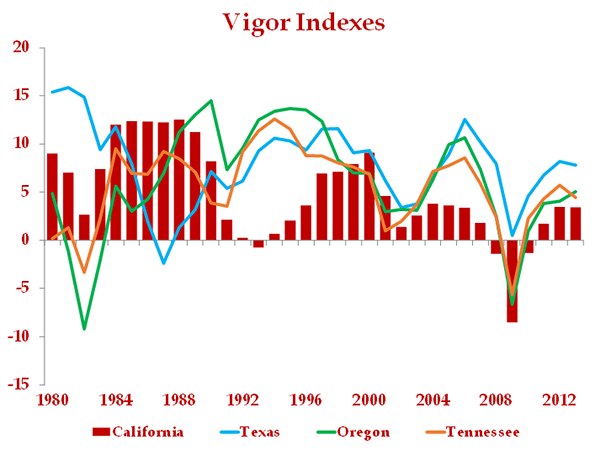
    California is apparently different than the comparison states. The Tennessee, Oregon, and Texas indexes have behaved more similarly to each other than to California since the late 1980s. Texas’ index behaved uniquely in the early 1980s, because of its dependency on oil and the long-term decline in oil prices that occurred during the 1980s.

    California appears to be different than the other states throughout the period, but the nature of the difference has changed. Prior to the late 1980s, California tended to outperform the others. For example, its score didn’t decline nearly as much as the others during the early 1980s recession. Given California’s resource endowment, we think this is natural.

    Since 1990, though, California’s vigor index has generally remained below those of Texas, Tennessee, and Oregon. Indeed, since 1990, California’s score has rarely exceeded the score of any of the comparison states, and it has never led them all.

    The index also shows that California’s investment in infrastructure during the 1950s and 1960s helped drive economic opportunity for two decades. It took two decades without any investment before we saw the consequences of the decision to not invest.

    Recently, California has seen budget surpluses and faster job growth than the average American state. The forces for the status quo now claim that this confirms the wisdom of their policies. They are wrong.

    California’s budget surpluses are a product of a temporary tax, and an incredible bull market in equities. Our dependence on a highly progressive income tax means that California’s fiscal condition swings on the fortunes of a small group of wealthy individuals.

    Equity markets have been amazing over the past few years. The Dow has increased by over 10,000 since it bottomed out on March 9, 2009, and it appears to be divorced from economic activity. It increases on good news and bad, propelled by an unprecedented monetary expansion. Right now, California’s largest taxpayers are reaping huge profits in the stock markets, and California is reaping huge windfalls in its tax revenues.
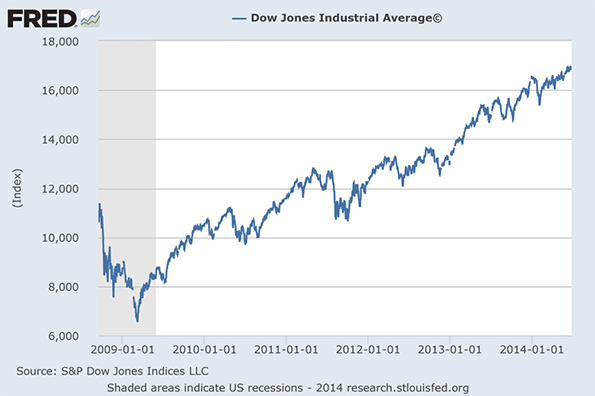
    Someday, the market gains will cease, or worse reverse. Someday, too, the temporary tax will expire. California’s surpluses will wash away like sand on a beach. The state will face a new crisis, a result of a progressive tax structure where revenues swing on paper profits and losses, not on economic activity.
    As for our job gains being better than the average state’s, California should not be average.

    Employment should be far higher than it is. Even the weak job growth we’ve seen is largely a legacy of a previous age. California has the world’s best venture capital infrastructure, partly because of the investment previous generations of Californians made in the university system. It is also, in part, a result of chance.

    An amazing period of innovation was initiated in Coastal California by a few incredibly talented individuals, who were funded by a few far-sighted capitalists. It was one of those rare coincidences that happen from time to time and change the world. The eventual result was the Silicon Valley and economic powerhouses such as Intel, HP, Apple, Yahoo, Google, Facebook, Twitter, and many more.

    Another result was the creation of a private, capitalist, vibrant infrastructure. It takes time and vast sums of money before a new idea generates profits. Product design is just the first step. An organization needs to be created to produce and sell the product. Factories need to be designed. Marketing plans need to be put in place.

    No inventor or entrepreneur can be expected to have all of the necessary skills or money to turn an idea into a profitable firm. So, an infrastructure appeared. The Silicon Valley’s world-leading venture capital markets and the support structure to enable the fabulous innovation and economic value created there was not the result of any government program or initiative. It was the spontaneous result of lots of people driven to innovate and profit from those innovations. It was capitalism at its very best.

    California’s Silicon Valley became the place for talented young people to turn great ideas into reality. It was also the place to go if you had money and wished to invest in vibrant, risky new technologies, or if you knew how to design factories, how to market products, how to build organizations, or how to finance rapid growth. The infrastructure that arose is supporting California today. This amazing capitalist engine of jobs, innovation and wealth is the source of most of California’s economic vigor. But it is a legacy that will eventually slip away, unless California changes its priorities.

    This is the first part of a two-part report. Bill Watkins is a professor at California Lutheran University and runs the Center for Economic Research and Forecasting, which can be found at clucerf.org.

    Flickr photo by mlhradio. A California extreme: Mountains on The Trona-Wildrose Road, at the edge of the Panamint Valley. One of the most remote deserts in North America, in one of the most remote corners of California; the salt flats of Panamint Valley to the west, and Death Valley to the east.
  • One-party Rule is No Party in California

    Forty years ago, Mexico was a one-party dictatorship under the Partido Revolucionario Institucional, hobbled by slow growth, soaring inequality, endemic corruption and dead politics. California, in contrast, was considered a model American state, with a highly regarded Legislature, relatively clean politics, a competitive political process and a soaring economy.

    Today these roles are somewhat reversed, and not in a good way for the Golden State. To be sure, corruption remains endemic in Mexico, where the PRI ruled for some seven decades. But now, there is a vibrant, highly competitive political culture, with three strong parties and at least some movement toward economic reform. Thirty percent of Mexicans, according to Gallup, trust their federal government, a level not all that different than in the United States.

    But if Mexico’s governance can be seen as at least gradually improving, it’s more difficult to reach that conclusion about the Golden State. California is now a one-party state, with increased corruption and little to no willingness to reform its creaky, scarily unbalanced economy. Californians, by a large margin, think things are getting worse, rather than getting better.

    We can call this trend PRI-ization, and nowhere is it more evident than in our state’s increasingly torpid politics. As there is no real competition for power or for ideas, voter turnout, at both the local and state levels, has plummeted to the lowest levels on record. June’s primaries attracted barely 25 percent of the electorate, while the Los Angeles County turnout was just over 17 percent.

    When I voted this month in my San Fernando Valley precinct, I brought my 9-year-old daughter, but she didn’t get to see democracy in action. She saw an empty church basement with a bunch of pleasant election workers sitting around with not much to do.

    This lack of voter enthusiasm could be explained, in part, by a lack of competition between the parties statewide. But it goes deeper than that; even the nominally nonpartisan recent Los Angeles mayor’s race, while highly competitive, also broke modern records for low turnout.

    Monopolistic mess

    Let’s be frank. California’s democracy is fading, the result of one-party politics, a weak media culture and a sense among many that politicians in Sacramento (or city hall) will do whatever they please once in office. As under the old PRI in Mexico, a lack of competitive politics has also bred the kind of endemic corruption with which California, in recent decades, was not widely associated.

    The case of state Sen. Leland Yee, the Bay Area crusading liberal now accused of being a wannabe gun-runner, was just the most extreme example. If Yee is convicted and sent to jail, he might be joined by two Senate colleagues, one convicted of voter fraud and the other of bribery. The scandals have damaged the Legislature’s approval ratings.

    Republicans and conservatives tend to blame such embarrassments on Democrats, just as the long out-of-power outsiders linked Mexico’s corruption to the PRI monopoly. But, in many ways, it reflects the dynamic, also seen in Republican-dominated states, such asMississippi, or in Vladimir Putin’s Russia, of those who see no threat to their monopoly taking license to steal or otherwise abuse the law.

    Arguably more disturbing than petty corruption is the inability of our politicos, as during the PRI’s heyday, to confront serious challenges facing the state. Low voter turnouts basically mean politicians don’t have to answer to middle-class or working-class voters; instead, they listen mostly to outside special interests such as public employee unions, environmentalists and social-issue lobbies. Union members have an incentive to show up at the polls to protect their pay and pensions, and issue activists will vote for those who support their line. It just seems that the rest of us have given up.

    Perhaps the biggest shift in California’s balance of power is in the diminished role of business. In the days when California produced contending political giants – like the late Govs. Edmund G. “Pat” Brown and Ronald Reagan – businesses lined up on both sides of the aisle, albeit more on the Republican side – but there also was a strong contingent of “business” Democrats.

    Today, California business operates solely for the purposes of accommodating the economic agenda of an increasingly left-oriented Democratic Party; supporting an opposing party – or even more moderate Democrats – increasingly is no longer an option to influence policy.

    Mainstream doesn’t matter

    Indeed, one of the negative products of one-party politics has been an ever greater shift away from the political mainstream. With turnouts tiny and business largely gelded, the “base” of the ruling party tends to get its way. So, California gets to try being the greenest state in the land, even as much of the state lives in a virtual permanent recession. In the process, politics becomes ever more marginal, and ever less responsive to what is happening to the citizenry.

    We see much the same on the local level. Los Angeles, even much of its establishment admits, is becoming a “city in decline,” with the highest job losses, some 3.2 percent, of any of the 32 largest U.S. metro areas since 1990. But L.A. city and county leaders have little stomach for the reforms that would be necessary to turn the region around, in large part because it might offend their public employee paymasters. Fixing the potholes mightplease neighborhood residents, but since they mostly don’t vote, who cares?

    So instead of a tough problem solver, we have a mayor who likes to take “selfies” to show how “with it” he is, and a City Council that thinks ultraexpensive solar energy projectsand subsidizing Downtown hotels will actually turn around a torpid municipal economy. But such largesse will reward the special interests who build these systems, the unionized workers at the new hotels and speculators in Downtown real estate.

    None of this will do anything to help the Valley, East L.A., Watts or even the Westside.

    Chances for rebound?

    Sadly, it’s hard to see how this trend will turn around soon. Tax and regulatory policies are making the state toxic for many businesses and middle-class families. The number of poor, state-dependent voters grows, and business, outside of a few sectors, is stagnant or in decline. In the glory days of California politics, Democrats and Republicans vied for suburban middle-class voters; now, they don’t have to bother.

    This is all made worse by the descent of the Republicans into near irrelevancy. The GOP barely escaped nominating for governor a nativist, Tim Donnelly, who accused his Hindu opponent Neel Kashkari of wanting to import Shariah law. It might have occurred to Donnelly that Hinduism is very different from – and often in serious conflict with – Islamic fundamentalism.

    Until the Republicans develop some basic sense and offer a compelling social and economic message for an increasingly diverse state, they will remain bit players.

    Oddly, unless this trajectory is reversed, we may look back at this time and wax nostalgic about the Jerry Brown years; Brown may be a bit over-the-top on some issues, such as his dodgy high-speed rail plan, but at least he’s not mindlessly ideological.

    Just wait four years, when a full-bore true believer, the glamorous Attorney General Kamala Harris, could well become governor and tries to remake this amazing, diverse state into a more impoverished version of California’s real political capital, San Francisco. If business finds getting along with the somewhat mercurial Brown to be, literally, taxing, they will find the more pure-left regime that may follow him a far more onerous task.

    Ultimately, the only hope may come when the grand delusions of our political elites – financed by the social media bubble, the stock market and high-end real estate speculation – finally come crashing down. When there is no one left to tax, and no way to borrow more, and the shift elsewhere of high-wage employment too obvious, perhaps then middle-class and working-class Californians will demand alternatives to the status quo. At that point they might even find reasons to go to the polls again.

    This article first appeared in the Orange County Register.

    Joel Kotkin is executive editor of NewGeography.com and Distinguished Presidential Fellow in Urban Futures at Chapman University, and a member of the editorial board of the Orange County Register. He is author of The City: A Global History and The Next Hundred Million: America in 2050. His most recent study, The Rise of Postfamilialism, has been widely discussed and distributed internationally. He lives in Los Angeles, CA.

    Photo: Troy Holden

  • Inland California Needs to Get in the Zone

    California’s dream is shrinking inexorably, and only radical steps can prevent the condition from becoming permanent. Compared with previous economic expansions, fewer state residents and communities are benefiting from this recovery, which has largely been restricted to the small coastal zone surrounding the Bay Area, as well as certain parts of western Los Angeles, Orange and San Diego counties.

    As the economy has strengthened, what is called a “boom” in the mainstream media is really a story of one region. Some 300,000 jobs have been created as the recovery has strengthened over the past 15 months,but three-quarters of them have been concentrated along the coast, mostly in the San Francisco-San Jose corridor.

    In contrast, much of the interior of the state, from the Inland Empire, where the poverty rate has doubled since 1990, to the Central Valley, is doing far less well. Unemployment has dropped to near 5 percent in the Bay Area, but remains above 8 percent in the Inland Empire, and above 10 percent in many interior communities, from Fresno and Modesto to Bakersfield. Viewed in the national media as some sort of permanent basket case, the inland regionbooming a decade ago, was recently compared by a UCLA economist to Appalachia.

    Get in the ‘zone

    California’s interior clearly needs a form of new deal that will allow it to participate in the state’s recovery. This plan starts with declaring the entire area an “enterprise zone” that allows communities to opt out from some of the harshest, coastally driven regulations.

    Enterprise zones typically refer to economically ailing portions of cities where policies to encourage economic growth and development are implemented for businesses in the designated area. Such policies, on a regional scale, are needed in inland California.

    Extraordinary controls on development, expensive “green energy” policies and high taxes on small enterprises may seem reasonable, or at least bearable, in a coastal economy fueled by soaring capital gains, with the prospect that the gentry rich can supply trickle-down service jobs to the hoi polloi.

    But such policies are often disastrous for the state’s interior, which lacks the resources or appeal of the coastal havens. Take the issue of electricity prices, which have soared, in large part, because of the green-energy policies favored by influential residents along the coast. Energy costs for many California businesses are roughly twice those for consumers in the Pacific Northwest, Salt Lake City or Denver. Yet here’s the rub: The climate along the coastal strip requires less air conditioning or heating, unlike that of the interior regions, where temperatures rise and fall more severely.

    Worse yet, there’s more pain to come: California’s recently enacted carbon “cap and trade” system could boost gasoline prices, already 55 cents per gallon above the national average, another dollar.

    Unaffordable Coast

    Many wealthier coastal residents can afford housing close to major job centers and, for that matter, more expensive gasoline. But the same pump prices are a dagger aimed at the finances of many middle- and working-class people who live in the interior and have to commute to employment. The gentry retort – that such people should move to the city – ignores the fact that most middle- and working-class people can’t afford to live decently in places like Los Angeles, much less San Francisco, given current prices.

    People in recent decades have moved to the interior largely to improve conditions for their families, not to lower their quality of life. Rising gas prices won’t lead them “back to the city” but, more likely, will force many to cut back further, or consider moving elsewhere. There’s no discernible movement of people to the coastal counties from the interior; if anything, the pattern, although less marked than a decade ago, remains quite the opposite.

    Despite a growing population, the long-term sustainability of the interior’s economy now is questionable. High energy costs, onerous regulatory burdens and land-use constraints imposed by Sacramento are systematically undermining industries that have traditionally driven growth in the state’s interior. These include construction, manufacturing, ranching and farming, along with logistics and business services, all of them employers of middle- and working-class Californians.

    Creating an expansive enterprise zone would allow these businesses to compete more successfully with other states. It might encourage, for example, manufacturers leaving or expanding away from the coast to head to inland California instead of to another state, or propel builders to construct affordable housing, including single-family homes, in places like the Inland Empire, as opposed to in Texas or Arizona.

    Why should the Bay Area oligarchy agree to such a step? One reason may be to avoid the soaring cost of supporting so many poor and needy people in the interior. When the tech bubble bursts, the state will face another cash crunch. Having a vast impoverished population then will mean even higher taxes and worse services, something that will affect all but the most high-end businesses.

    Dreams, green or otherwise, take money, but our bifurcated economy relies increasingly on the fortunes of the few. California’s top 1 percent of earners paid 50 percent of state income taxes in 2012, up from 40 percent the year earlier. This is not surprising since so much of the state is either impoverished or stagnating. Once aspirational regions, proud contributors to the Golden State’s economic diversity, increasingly resemble dependent countries in the Third World.

    Modern-day progressives respond to these realities by pushing for such things as raising the minimum wage, or imposing even more Draconian labor regulations. This may help some low-income workers, but it’s hard to see how it would boost the interior’s competitiveness. In contrast, the creation of an enterprise zone would give these areas at least a fighting chance.

    Ultimately, what kind of California do we want for our children? Right now, the state is evolving into something of a neofeudalist society, consisting of an affluent few, concentrated in the coastal belt, a large and expanding poverty class and a struggling, shrinking middle class. There’s the California of the oligarchs with 111 billionaires, by far the most of any state, with personally held assets worth $485 billion. Together, they own more than the GDP of all but 24 countries in the world. At the other end of the scale is a state with the nation’s highest poverty rate (adjusted for housing costs) – above 23 percent – and roughly one-third of the nation’s welfare recipients.

    This condition has been aptly labeled by one Central Valley writer as “liberal apartheid.”The well-heeled, largely white and Asian coastal denizens live in an economically inaccessible bubble – due to extremely high housing prices – while the largely poor, working class, heavily Latino communities eke out a meager existence in the state’s eastern interior.

    To be sure, many forces beyond Sacramento’s control – globalization, immigration, the asset-oriented nature of the recovery – have contributed to this growing wealth gap. But gentry-led pubic policies have exacerbated the refeudalization. Young Californians, notes one study, already are now less likely to graduate from college than were their parents.

    A Shrinking middle

    Meanwhile, the middle class, the social and economic linchpin of the state, continues to decline, with a far more dramatic drop in state households earning $35,000 to $75,000, according to research from the California Lutheran University forecast project, than the national average. As late as the 1980s, the Golden State was about as egalitarian as the rest of the country, and roughly 60 percent of its population was middle class. But now, for the first time in decades, the middle class is a minority in California.

    In fact, many Californians face a future as modern-day land serfs, renting and paying someone else’s mortgage. If they choose to start a family, they increasingly look to settle elsewhere, ironically, some to locations like Oklahoma and Texas, places that historically sent eager migrants to the Golden State, whose appeal combined economic opportunity, its milder climate and spectacular scenery.

    The prospect facing California is not unlike that seen in other Democratic-dominated regions, such as New York, where a well-organized and savvy, affluent, urban minority can impose ever-greater restrictions on the relatively unorganized, inarticulate exurban populations. Like New York’s Appalachia-like upstate regions, interior California faces a dismal future that, over time, will lead to increasing demands on the middle and upper classes. Only by allowing the interior a decent chance can California truthfully claim that its economy has, indeed, turned around.

    This article first appeared in the Orange County Register.

    Joel Kotkin is executive editor of NewGeography.com and Distinguished Presidential Fellow in Urban Futures at Chapman University, and a member of the editorial board of the Orange County Register. He is author of The City: A Global History and The Next Hundred Million: America in 2050. His most recent study, The Rise of Postfamilialism, has been widely discussed and distributed internationally. He lives in Los Angeles, CA.

    Photo by Altus via Flickr

  • Taking a Back Seat to Texas

    The most important news recently to hit Southern California did not involve the heinous Donald Sterling, but Toyota’s decision to pull its U.S. headquarters out of the Los Angeles region in favor of greater Dallas. This is part of an ongoing process of disinvestment in the L.A. region, particularly among industrially related companies, that could presage a further weakening of the state’s middle class economy.

    The Toyota decision also reflects the continued erosion of California’s historic economic diversity, which provided both stability and a wide variety of jobs to the state’s workers. We have seen this in the collapse of our once-burgeoning fossil-fuel energy industry, capped this year by the announced departure from Los Angeles of the headquarters of Occidental Petroleum. Blessed with huge fossil fuel reserves, California once stood as one of the global centers of the energy industry. Now, with the exception of Chevron, which is shifting more operations out of state, all the major oil companies are gone, converting California from a state of energy producers to energy consumers, and, in the process, sending billions of dollars to Texas, Canada and elsewhere for natural gas and oil that could have been produced here.

    As did the oil industry, the auto industry, and, particularly, its Asian contingent, came to Southern California for good reasons. Some had to do with proximity to the largest port complex in North America, as well as the cultural comfort associated with the large Asian communities here. Back in the 1980s, the expansion of firms like Honda, Toyota and Nissan seemed to epitomize the unique appeal of the L.A. region – and California – to Asian companies. Today, only Honda retains its headquarters in Los Angeles (Nissan left in 2005), while Korean carmakers Hyundai and Kia make their U.S. homes in Orange County.

    Retaining these last outposts will be critical, as Southern California struggles to retain its once-promising role as a true global city. With the exception of the entertainment industry – itself shifting more production out of town – our region is devolving toward marginality, largely as a tourist and celebrity haven.

    Still, I’m concerned less about the region’s reputation than about the economic trajectory of its middle and working classes. The Toyota relocation from Torrance will eliminate 3,000 or more generally high-wage jobs, something that usually accompanies the presence of headquarters operations. It will cost the region, most particularly, the South Bay, an important corporate citizen, as, over time, the carmaker will likely shift its philanthropic emphasis toward Texas and its various manufacturing sectors.

    Perhaps more disturbing are the fundamental reasons behind the Toyota move. According to Toyota’s U.S. chief, James Lentz, they weren’t even courted by Texas, which has fattened itself on California’s less-competitive business climate.

    Some of Toyota’s reasoning is geographical. The port link is less essential now since close to three-quarters of Toyota’s vehicles sold in the U.S. are built here, up from 58 percent in 2008. At the same time, the growth of the “Third Coast” ports – Houston, Mobile, Ala., New Orleans and Tampa, Fla. – buoyed by the widening of the Panama Canal, makes it increasingly easy to ship components or cars in and out of the central U.S.

    More troubling still is the logic, both on the part of Nissan and Toyota, linking headquarters operations – with their marketing, design and tech-oriented jobs – closer to their industrial facilities in the south and Midwest. Toyota, for example, has a large truck plant in San Antonio as well as auto assembly plants throughout the mid-South. Honda, now the last major Japanese carmaker with a Southern California headquarters, last year also moved a number of executives from Torrance to Columbus, Ohio, closer to the company’s prime Marysville, Ohio, production hub.

    This pattern contradicts the notion, popular in both the Jerry Brown and Arnold Schwarzenegger administrations, that California’s massive loss of industrial jobs over the past decade can be offset by the creative industries, notably Hollywood and Silicon Valley. Since 2010, California has managed to miss out on a considerable industrial boom that has boosted economies from the Rust Belt states to the Great Plains and the Southeast. Los Angeles and Orange counties, the epicenter of the state’s industrial economy, have actually lost jobs. Since 2000, one-third of the state’s industrial employment base, 600,000 jobs, has disappeared, a rate of loss 13 percent worse than the rest of the country.

    But, the prevailing notion in California’s ruling circles seems to be, if you have Google and Facebook, who needs dirty, energy-consuming factories or corporate operations filled with middle managers? Silicon Valley crony capitalists and urban developers who support our political class, and are willing participants in various subsidized green energyschemes, have little interest in traditional manufacturing, regardless the damage inflicted on blue-collar workers, whom progressives are happy to subsidize (and thus gain their unending support) outside the labor force or keep severely underemployed.

    The deindustrialization of California was one reason behind the withdrawal of both Nissan and Toyota. Each automaker has established strong manufacturing operations in the mid-South and wanted to integrate technology, production, sales, marketing and design as a way to keep an edge in the competitive global industry. An area that seems determined to let its industrial base wither is not likely to attract companies whose basic business is building things.

    What is too rarely understood is the link between production skills and high-end jobs. The Toyota jobs that are leaving L.A. County are largely white-collar and skilled. Toyota engineers will be headed to Texas, and many also to Michigan, where, despite the travails of the past few decades, the engineering base is already very deep – roughly twice as strong per capita as formerly engineer-rich Los Angeles.

    This link between manufacturing and higher-end technical jobs is rarely appreciated among our political class. As President Clinton’s Board of Economic Advisors Chairman Laura D’Andrea Tyson points out, manufacturing is only about 11 percent of gross domestic product, but it employs the majority of the nation’s scientists and engineers, and accounts for 68 percent of business research and development spending, which, in turn, accounts for about 70 percent of total R&D spending.

    Of course, neither Jerry Brown nor any other reigning political figure would cavalierly dismiss manufacturing jobs, or even those at a major port. Yet, as we move toward ever-higher energy prices – likely aggravated by California’s “cap and trade” regime against global warming – industrial firms seem increasingly reluctant, at least without massive subsidies, to move to or expand in California. And, contrary to arguments offered in Sacramento, and reflected in much of the media, there are never going to be enough “green” jobs to make up the difference.

    Indeed, even Elon Musk, head of electric-car maker Tesla, though a primary beneficiary of California crony capitalism, is not considering the state for a proposed $5 billion battery plant, which would employ upward of 6,500.

    In its nonresponse to the Toyota move, the Governor’s Office stressed the state’s role as the epicenter of the “new electric, zero-emission and self-driving” vehicle industry. Nevertheless, even as devout a “green” company as Tesla will likely locate its battery factory in Nevada, Arizona, New Mexico or Texas. California, reportsgreentechmedia.com “didn’t make the short list because of the potential for regulatory and environmental delays.”

    For a state that has built its future vision on “green” industry, this is both ironic and tragic. It may not bother the Legislature, whose welfare state is now being propped up by windfall tech profits, but it leaves many localities outside the Silicon Valley exposed to more job and company losses. Think of Torrance Mayor Frank Scotto, who concedes the struggle to keep companies around is becoming ever more difficult. “A company can easily see where it would benefit by relocating someplace else,” Scotto said.

    Even so, it is unlikely that Toyota’s leaving will impact the state’s leftward political trajectory. After all, if the New York Times regularly describes the California economy – fattened by stock market and real estate gains of the very rich – as “booming,” why should Gov. Brown, about to run for re-election, say otherwise, proclaiming to anyone who will listen that “California is back.”

    True, California may not be in a Depression, as some conservatives contend, but it’s hardly accurate to proclaim the Golden State as back from the brink. But, if having among the country’s highest unemployment rates, the worst poverty levels, based on living costs, and being home to one-third of all U.S. welfare recipients can’t persuade the gentry about California’s true condition, Toyota’s move certainly won’t.

    This article first appeared in the Orange County Register.

    Joel Kotkin is executive editor of NewGeography.com and Distinguished Presidential Fellow in Urban Futures at Chapman University, and a member of the editorial board of the Orange County Register. He is author of The City: A Global History and The Next Hundred Million: America in 2050. His most recent study, The Rise of Postfamilialism, has been widely discussed and distributed internationally. He lives in Los Angeles, CA.

    Photo: Toyota Corolla by Paulo Keller

  • Special Report: America’s Emerging Housing Crisis

    This is the executive summary from a new report, America’s Emerging Housing Crisis, published by National Community Renaissance, and authored by Joel Kotkin and Wendell Cox. Download the report and the supplement report below.

    From the earliest settlement of the country, Americans have looked at their homes and apartments as critical elements of their own aspirations for a better life. In good times, when construction is strong, the opportunities for better, more spacious and congenial housing—whether for buyers or renters—tends to increase. But in harsher conditions, when there has been less new construction, people have been forced to accept overcrowded, overpriced and less desirable accommodations.

    Today, more than any time, arguably, since the Great Depression, the prospects for improved housing outcomes are dimming for both the American middle and working classes. Not only is ownership dropping to twenty-year lows, there is a growing gap between the amount of new housing being built and the growth of demand.

    Our still-youthful demographics are catching up with us. After a recession generated drought, household formation is again on the rise, notes a recent study by the Harvard Joint Center for Housing Studies. In some markets, there isn’t an adequate supply of affordable housing for the working and middle classes. Overall, according to the research firm Zelman and Associates, the country is building barely one-third the number needed to meet the growth in households. Overall inventories of homes for sale are at the lowest level in eight years.

    The groups most likely to be hurt by the shortfall in housing include young families, the poor and renters. These groups include a disproportionate share of minorities, who are more likely to have lower incomes than the population in general. This situation is particularly dire in those parts of the country, such as California, that have imposed strong restrictions on home construction. California’s elaborate regulatory framework and high fees imposed on both single- and multi-family `housing have made much of the state prohibitively expensive. Not surprisingly, the state leads the nation in people who` spend above 30 percent, as well as above 50 percent, of their income on rent.

    Sadly, the nascent recovery in housing could make this situation even more dire. California housing prices are already climbing far faster than the national average, despite little in the way of income growth. This situation could also affect the market for residential housing in other parts of the country, where supply and demand are increasingly out of whack.

    Ultimately, we need to develop a sense of urgency about the growing problem of providing adequate shelter. As a people we have done this many times — with the Homestead Act, and again, after the Second World War, with the creation of affordable “start-up” middle- and working class housing in places like Levittown (Long Island), Lakewood (Los Angeles), the Woodlands (Houston) and smaller subdivisions, as well as large scale cooperative apartment development in places like New York. Government policy should look at opportunities to create housing attractive to young families, which includes some intelligent planning around open space, parks and schools. It is important to ensure that a sufficient supply of affordable housing is allowed throughout metropolitan areas, for all income groups.

    Nothing speaks to the nature of the American future more than housing. If we fail to adequately house the current and future generations, we will be shortchanging our people, and creating the basis for growing impoverishment and poor social outcomes across the country.

    Joel Kotkin is executive editor of NewGeography.com and Distinguished Presidential Fellow in Urban Futures at Chapman University, and a member of the editorial board of the Orange County Register. He is author of The City: A Global History and The Next Hundred Million: America in 2050. His most recent study, The Rise of Postfamilialism, has been widely discussed and distributed internationally. He lives in Los Angeles, CA.

    Wendell Cox is principal of Demographia, an international public policy and demographics firm. He is co-author of the “Demographia International Housing Affordability Survey” and author of “Demographia World Urban Areas” and “War on the Dream: How Anti-Sprawl Policy Threatens the Quality of Life.” He was appointed to three terms on the Los Angeles County Transportation Commission, where he served with the leading city and county leadership as the only non-elected member. He was appointed to the Amtrak Reform Council to fill the unexpired term of Governor Christine Todd Whitman and has served as a visiting professor at the Conservatoire National des Arts et Metiers, a national university in Paris.

  • Era of the Migrant Moguls

    Southern California, once the center of one of the world’s most vibrant business communities, has seen its economic leadership become largely rudderless. Business interests have been losing power for decades, as organized labor, ethnic politicians, green activists, intrusive planners, crony developers and local NIMBYs have slowly supplanted the leaders of major corporations and industries, whose postures have become, at best, defensive.

    Increasingly, a search for inspiration about the region’s future must focus, first and foremost, on immigrants. As major companies disappear, merge or shift more of their operations elsewhere, the foreign-born represent a significant asset for our grass-roots economy. With many of the region’s legacy industries – from oil and gas to aerospace and entertainment – stagnating or declining, the area desperately needs new blood to avoid ending up like the older cities of the slow-growth Northeast or Midwest, albeit with much better weather.

    Amid a graying and, increasingly, marginal generation of regional business leaders, there have emerged new foreign-born dynamic figures. Some great examples: South African native and Tesla founder Elon Musk, who lives in Los Angeles and runs SpaceX, headquartered in Hawthorne and with more than 2,000 employees, and John Tu and David Sun, owners of Fountain Valley’s Kingston Technology, a leading independent memory-chip manufacturer founded in 1987 and now employing 4,000 people worldwide.

    Our new moguls increasingly are minted abroad. Pharmaceutical entrepreneur Patrick Soon-Shiong, the son of Chinese immigrants from South Africa, is now widely considered the richest man in Los Angeles, according to the Los Angeles Business Journal. But he’s not alone; five of the 13 richest people in the City of Angels are immigrants; in 1997 there was one, Australia’s Rupert Murdoch.

    Why are these immigrants so bright when much of our business leadership is dark grey? Part of it has to do with the nature of people who risk everything to migrate to another country. Overall they account for one out of every five U.S. business owners. They are three times as likely to start a new business than non-immigrants; in 2010 they accounted for almost one-in-three new firms, twice their share in 1995. Roughly 40 percent of the engineering-based firms started in Silicon Valley, notes the Kauffman Foundation, had at least one immigrant founder.

    Whether in high-tech, pharmaceuticals or running the local coffee shop, immigrants tend both to innovate and take risks. That’s because, as Kingston’s John Tu explained to me, they don’t have a choice. “The key thing about being an immigrant makes you flexible,” he said. “IBM, Apple and Compaq were inflexible. They told the memory customers to take it or leave it. We thought about the customer and the relationship with the employees. I guess we didn’t know any better.”

    Rise of the ethnoburb

    Most of the growth being generated by Southern California’s immigrants is taking place in suburban communities – what geographer Wei Li describes as ethnoburbs. Despite the hopes that more Southlanders can be lured into high-density, high-rise rental housing, immigrants, particularly Asians, here and elsewhere, continue to move further from the city core to areas where they can live with a degree of privacy and quiet virtually impossible in their homelands.

    This can be seen in the migration numbers. As foreign-born numbers have dropped in expensive and crowded Los Angeles and Orange County, the big growth has taken place in other areas, notably in fast-growing Texas cities such as Dallas and Houston, as well as numerous low-cost, pro-business states in the Southeast. The one Southland area that has continued to see a boom in foreign-born residents – the Inland Empire – has the lowest population density and house prices in the region.

    According to demographer Wendell Cox, the Inland Empire’s immigrant population has swelled by more than 50 percent, or more than 300,000 people, since 2000, roughly three times the increase in actual numbers seen in Los Angeles and Orange counties. Much of this growth is taking place not in the older cities such as Riverside and San Bernardino, as might be expected, but in generally more affluent, newer suburbs such as Rancho Cucamonga, whose foreign-born population soared a remarkable 61.6 percent over the past decade. Even Moreno Valley, on the edge of the urbanization, has more foreign-born residents than does San Bernardino.

    Even within the coastal counties, much of the growth in the Asian population, now the largest source of immigrants to the U.S., has been outside the densest, more-urbanized parts of the region. As the immigrant share of the population has declined in traditional immigrant strongholds such as the city of Los Angeles (down 5 percent) and Santa Ana (more than 11 percent), Cox notes, the immigrant population is shifting to more upscale suburbs. In Glendale, a major destination for both Armenian and Asian immigrants, more than 56 percent of the population is foreign-born, up 4 percent since 2000.

    Other popular immigrant destinations include once-heavily white suburban communities, such as Irvine, which is now more than 38 percent foreign-born, up almost 19 percent since 2000. Fullerton, like Irvine, favored largely by Asian migrants, saw its foreign-born population increase by 21 percent since 2000, now accounting for more than one-third of the city’s total.

    Other places that seem to be attracting immigrants include Santa Clarita, Palmdale and Lancaster, all communities further out on the periphery of the region.

    Harnessing entrepreneurial energy

    If Southern California’s future lies largely in the hands of newcomers and their offspring, how can we best respond to their needs? One way is by maintaining a large supply of single-family houses or townhomes. Today’s immigrants, particularly Asians, favor settling in ethnoburbs more than the dense Chinatowns, Little Indias and barrios that may strike many other Americans as somehow more colorful. Now, the best place to encounter immigrant food and culture is frequently at the strip malls of Monterey Park, the Hispanicized shopping complexes like Plaza Mexico, Irvine’s Diamond Jamboree Center or the amazing 626 Night Market at Santa Anita Park in Arcadia.

    Of course, immigrants are less interested in providing neighbohoods with local color than in moving to places with good schools, safe streets and parks – as most middle-class families prefer. This preference runs afoul of the kind of extreme land-use regimen being imposed on the region, including the Inland Empire, planning that seeks to promote the construction of high-density housing that, to be honest, many immigrants, particularly Asians, could enjoy at home, with far more amenities.

    Planners and some developers seem keen on this shift, thinking it will appeal to young childless couples and empty-nesters. What they ignore is that, without plentiful, and at least somewhat affordable, single-family houses, immigrants will continue to shift to other parts of the country, notably, the Southeast and Texas, where they can afford them.

    Perhaps even more important may be the economy. Immigrants are the ultimate canaries in the coalmine – they tend to gravitate toward opportunity. When Southern California’s economy was burgeoning in the 1970s and 1980s, immigrants also flocked here, buying homes and starting businesses. Few immigrant entrepreneurs reached the level of a John Tu or an Elon Musk, but many have launched small manufacturing firms that supported larger firms, engaged in international trade and started small service businesses.

    Unfortunately, the business climate in Southern California increasingly makes such enterprise ever more difficult, and may lead these entrepreneurs to relocate or expand where their efforts may be more appreciated. Not helping these businesses is an L.A. political climate dominated by a crony capitalist regime – not at all friendly to plucky startups of any kind – or by a Republican Party that still seems unable to make peace with the demographic realities of our region.

    The good news is, however, that these immigrants, and their kids, are still here. They have many reasons to stay, including the presence of ethnic media, churches, schools and shops not likely to be remotely as well-developed in places like Las Vegas, Phoenix, Atlanta or Nashville. But this does not mean they can be taken for granted. We need to recognize that they are our greatest asset, and, if we can appeal to their aspirations, they could help fashion a resurgence in this region.

    This story originally appeared at The Orange County Register.

    Joel Kotkin is executive editor of NewGeography.com and Distinguished Presidential Fellow in Urban Futures at Chapman University, and a member of the editorial board of the Orange County Register. He is author of The City: A Global History and The Next Hundred Million: America in 2050. His most recent study, The Rise of Postfamilialism, has been widely discussed and distributed internationally. He lives in Los Angeles, CA.

    Photo by LHOON

  • East of Egan: Success in California is Not Evenly Distributed

    The New York Times ran a Timothy Egan editorial on California on March 6.  The essay entitled Jerry Brown’s Revenge was reverential towards our venerable Governor.  It did, however, fall short of declaring Brown a miracle worker, as the Rolling Stone did last August.  These and other articles are part of an adoring press’s celebratory spasm occasioned by the facts that California has a budget surplus and has had a run of strong job growth.

    Egan at least pauses in his panegyrical prose to mention that all is not perfect in California:

    Without doubt, California has serious structural problems, well beyond the byzantine hydraulic system that allows the state to flourish. For all the job growth, the unemployment rate is one of the highest in the nation. It has unsustainable pension obligations, a bloated public-employee sector led by the prison guard union. And it is so expensive to live here that clashes over the class divide are threatening to get nasty.

    That’s not the worst of it.  Before going there, though, let’s consider Brown’s most celebrated achievement, a budget surplus. 

    California has a budget surplus because of a temporary income tax on its highest earning citizens and because of large capital gains reaped during an amazing year for stocks.  The S&P 500 was up almost 30 percent last year, an event unlikely to be repeated.  California’s tax revenues are excessively dependent on a relatively few wealthy tax payers.  This makes revenues extremely volatile.  When these tax payers do well, Sacramento is flush with cash.  When the high end tax payers don’t do well, Sacramento has very serious problems.

    By increasing California’s reliance on a few wealthy tax payers, Brown’s tax increase made California’s revenues more volatile.  The ongoing bull stock market would have generated higher tax revenues for California without the tax increase.  It generated even more with the tax increase.  When a bear market comes, the state will again face deficits.  This is one reason that Standard and Poors ranks California’s credit as second worst in the country, only above Illinois.

    So far, to his credit and in stark contrast to what we saw in the dot-com boom under Gray Davis, Jerry Brown has, with the exception of his pet project, the high-speed train, effectively resisted the legislature’s knee-jerk impulse to increase long-term spending commitments.  What he has not done is perhaps more important: addressing California’s other financial issues, the ones that are contributing to California’s dismal credit rating.

    California has had several quarters of stronger-than-the-nation job growth, but is still 113,500 jobs below the level in 2007; in contrast Texas is 844,300 jobs above that number.  

    Nor can it be sure that growth will continue. Unfortunately, the day after Egan’s celebratory essay, California’s Economic Development Department announced that the state had lost 31,600 jobs in January.  That’s an initial estimate, and it will be changed, but it’s hard to tell which direction.  The data released with that estimate appear to be a bit of a mess and are internally inconsistent.  We’ve asked for some clarification.

    Regardless of the most recent data point, California’s job performance has been better than expected, and we should all be thankful for that.  However, comparison with the United States average is not the only metric.  Comparison with California’s potential is the correct metric, and there California is underperforming in a big way.  Given all of its advantages, California should be leading the nation in job creation and opportunity.

    California has been averaging about 27,000 new jobs a month over the most recent 12 months for which we have data.  It should be averaging at least 40,000.  This would be slightly more than Texas’ average of 33,900,.  But, it still represents only 3.2 percent job growth, well below Texas’ 3.7 percent job growth rate.

    The state is sitting over estimated oil reserves that are about four times as large as the Bakken Shield, a major contributor to North Dakota’s boom.  Any serious effort to tap that resource would generate huge numbers of jobs.  Many of those jobs would be high wage positions for less educated workers who were hurt the most by the recession.

    California has many advantages over North Dakota, or Texas for that matter, besides oil.  These are well known and include location between Pacific Rim producers and the world’s largest consumer market, ports, workforce, and climate.  Even without oil, we should be doing better.  Policy though, particularly environmental policy, is restraining the state’s job creation.

    Egan makes a big deal of migration.  Here is his first paragraph (emphasis is his):

    Let’s review. Just a few years ago California was a punching bag for conservative scolds — a failed state, profligate with its spending and promiscuous with its ambition. Ungovernable. And everybody’s leaving.

    Later, he returned to the topic:

    Third, the great exodus never happened. Since the dawn of the recession, the state has added about 1.5 million people — almost three Wyomings. And yes, 67,702 people moved from California to Texas in 2012. But 43,005 people moved from Texas to California. (Population growth is not necessarily a good thing, especially in this overstuffed state, but that’s another topic).

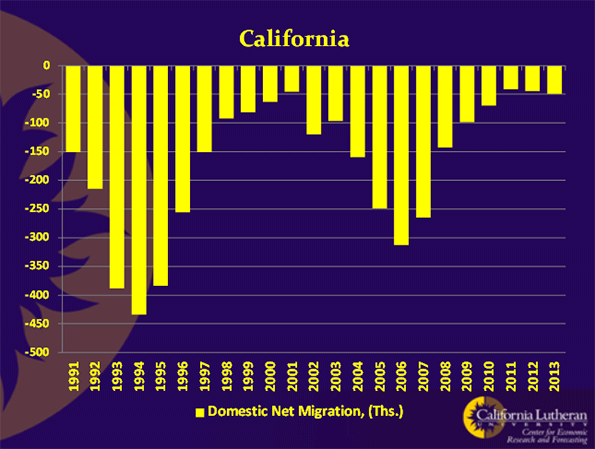
    This is really curious.  A whopping 57 percent more people moved from California to Texas than moved from Texas to California, which was the case for decades.  This is an argument that people aren’t leaving California?  California’s population is up 1.5 million?  California’s population growth is mostly a result of California’s fertile young people.  Census data show that California’s domestic migration has been negative for over 20 consecutive years.   It may not be The Great Exodus, but it’s a reversal of about a 150 year of migratory trend.

    Then there is poverty and unemployment.  Poverty, unemployment and lack of opportunity are why California’s domestic migration data is negative.  Lack of opportunity may be hard to measure, but we have lots of data on unemployment and poverty.   Some examples:

    • San Bernardino has the second highest poverty rate of any major U.S. metropolitan areas.  Only Detroit is worse.
    • California, with about 12 percent of the U.S. population, has 34 percent of U.S. welfare recipients.
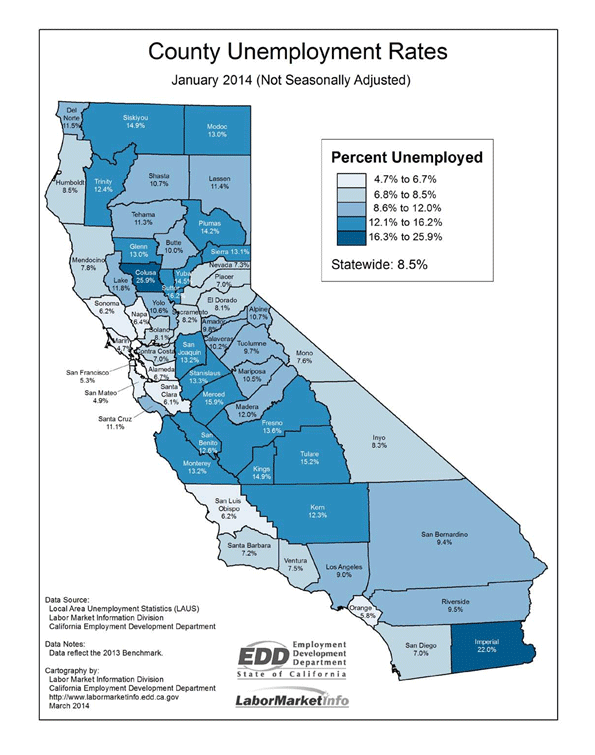
    • Two California counties, the geographically separated Colusa and Imperial, have unemployment rates over 20 percent.
    • Thirty-one of California’s 58 counties have unemployment rates in double digits.

    The geographic distribution of California’s poverty is one reason many people fail to understand California.  Most of California’s poverty is concentrated in regions where the political class —or wayfaring editorialists — seldom venture.  It’s mostly inland, not where most of California’s elite live or travel.  If you stay on the 101 corridor, or hug scenic Route 1, it’s easy to avoid.  You can find it, but you have to have eyes that are open to it, and it helps if you get off the beaten path. 

    Egan wrote his piece in Santa Barbara, where life can be as good as it gets, particularly for the affluent and boomers who bought their homes decades ago.  But, the city of Guadalupe in Santa Barbara County could give him a taste of how the other half lives. Just take a look sometime: it’s about as hardscrabble a town as the Texas town in the movie “The Last Picture Show”.

    California’s poverty is harder to ignore along the 99, but is even more evident in roads like 33 which winds along the eastern side of the coastal range.  Go there, and you will find it hard to believe that you are still in the United States, much less California.  There you will find grinding, hopeless poverty more reminiscent of the Third World than the center of the economic jobs.

    A high speed train won’t help these people.  Neither will Silicon Valley tech jobs, even if they don’t shrink in the inevitable social media shakeout.  Neither will Sacramento, apparently.  Until we start doing something for the state’s huge and struggling working and middle class, and that means creating opportunity for them, we should refrain from congratulating ourselves and each other for our good work.

    Bill Watkins is a professor at California Lutheran University and runs the Center for Economic Research and Forecasting, which can be found at clucerf.org. A slightly different version of this story appeared in CLU Center for Economic Research and Forecasting’s September, 2013 California Economic Forecast.

  • Deutschland on the Pacific?

    California and Germany may not immediately come to mind as a doppelganger, but they do share several characteristics, particularly when it comes to their attitudes toward energy production and consumption.

    Both “States” have large populations which seem to agree that the world will be a better place if renewable sources of energy are given precedence over hydrocarbon based options in powering their economies.

    For both, this translates into an emphasis on preferentially using wind and photovoltaic sources. Initiatives include 1) the use of state and federal financial support for building and operating renewable generation and 2) preferential access to the grid for exporting the net power produced.

    On the “regulation” side the two “States” differ substantially.     

    California is relatively tough on coal based generation – long a major source of power to Los Angeles through Utah – while encouraging additional load following natural gas powered generation. Despite the shutdown of the nuclear plant at San Onofre, California is also viewed as being relatively tolerant of nuclear generation which does provide copious quantities of “base load” electric power without measurable amounts of air pollution. Of course California also likes hydropower when – during wet years – they can get it.

    Germany also likes wind, solar and hydro generation, but nuclear power units? Not so much. The draconian nuclear shutdown is a reaction Japan’s Fukushima disaster. However, the unrelated shutdown of natural gas plants in favor of coal based generation is a big surprise. By comparison, Japan, which really has a nuclear generation problem, is running their gas plants hard while trying to restart at least some of their existing nuclear units.

    The German natural gas plant cutbacks stem from the relatively high price of Russian sourced natural gas under long term contract. Such gas is simply unaffordable given the mandated subsidies charged to utilities. Ironically, Germany’s political and regulatory priorities have had the unintended consequence of encouraging the use of older coal based generation. Germany does have access to affordable coal as well as to existing power infrastructure that can use it. Due to the lack of politically viable alternatives, Germany is relying on their least attractive option.

    Power supply and demand is not created equal

    Residential power consumption varies significantly over the typical 24 hour day as people wake up, take showers, eat breakfast, go to work, return home, watch TV or play with their computers, and then go to bed. This is overlaid by seasonal needs for electrically powered air conditioning or heating units as well as by demand from industrial consumers. Output needs to vary directly with consumption.

    They do this by dispatching power from two different classes of equipment, “base load” and “load following”. (Think fixed and variable output). The time of daily peaks and troughs vary for each utility, but peaks generally occur in the late afternoon with troughs are observed in the late evening or early morning hours. The difference between the peak and trough can vary by a factor of three. Because electric power can’t be stored, utilities need the capability to follow the demand load by using generators capable of changing output quickly, hence “load following generation”. Gas turbines and hydropower are both good examples of load following generators. The other category “base load” is typically provided by nuclear and coal fired units. These power plants run 24/7 and cannot alter their output in the short term. They are capital intensive but can produce power at relatively low unit costs as long as they maintain full output. Because of pollution issues, coal powered generation is least welcome in California.

    Industrial power clients tend to be major consumers of base load power as their manufacturing plants run “24/7” and their need for variable power is much lower than that of the residential sector. Adding together industrial, residential, and commercial minimum demand defines the capacity need for base load generation. Adding together the maximum needs for all categories of load following capacity provides the utility’s total capacity requirement. The difference between the maximum and the minimum defines the need for load following capacity.

    California Dreaming

    There is at least one other category of power generation. We call it “intermittent”. By that, we mean a power source whose output cannot be predicted, such as wind and solar. Adding socially desirable, but intermittent, renewable power generation to a utility’s supply mix requires that the utility also acquire more predictable supplies, as the utility now needs to react to uncertainty of supply as well as to uncertainty of demand. As a state, California has been able to add new renewable sources, albeit with the result of higher residential rates.

    Germany has also added significant amounts of intermittent power to the supply mix, with wind turbines in the North and solar panels in the South. However, the economic impact of these additions has been much more severe for residential rate payers. Germany’s “Energiewende” policy has resulted in multiyear, double digit increases in power prices as the residential sector as well as the “non-energy intensive” industrial sector bear the cost of the experiment.

    Because Germany is, uber alles an export led economy, with exports representing 24% of GDP, the planners of the renewables initiative initially exempted large, energy intensive industry from paying the higher rates. Logically enough, they concluded that high power prices would compromise Germany’s ability to compete internationally. More recently, a new coalition government has proposed that, in the interest of “political peace in the family”, these previously exempt energy intensive industrial consumers must now bear part of the high costs of the energy transition. The industrial reaction has been to vote with their feet. BASF announced a multiyear investment program that assume the majority of new capital spending will occur outside of Germany, indeed outside of Europe.

    Physician, Heal Thyself

    Some economists have argued that Germany should simply purchase additional load following power from better-endowed neighbors. In fact, to some extent, that has occurred with Germany purchasing spot power from France and other neighboring countries. However, Germany’s attempts to sell surplus renewable power back to these same neighbors has been less than successful. This is because intermittent renewables are only available when the wind blows or when sunlight is available, not when the neighbors actually need the power. Germany’s neighbors, who have not yet bought in entirely to the new religion, do not have the ability to rapidly reduce their own domestic production in order to accommodate unpredictable foreign (German) surpluses. As a result, the Germans are exporting grid instability to their neighbors.

    With no other options, German utilities have resorted to using coal in order to create power to compensate for the variability in renewable output. American hands are not exactly “clean” as we have become a major supplier of steam coal to Germany, coal we no longer need to burn in US based power plants.

    Bipolar personalities and orphan power

    “Energiewende”, a national policy intended to accelerate the use of renewables and to reduce both CO2 emissions and particulate air pollution, has instead produced the unintended consequence of multiyear increases in pollution levels. It has caused higher prices to be paid for power in order to accomplish this dubious result. At the same time the policy has irritated Germany’s partners on the European Grid by producing intermittent power when it isn’t needed. I have to believe that Germany’s engineering class foretold this result…Too bad the politicians weren’t listening.

    Power to the People

    Back in California, the state government has been figuratively wringing its hands over the potential for the development of shale gas. Californians like to use natural gas, most of it imported from other western states and Canada. Ordinarily they would love to have a new local source of supply. However, the problem for California is that much of the state is dry during the best of times and, from a water standpoint, this is not the best of times.

    Low snow and rain levels are producing a “double whammy” for the state’s economy. While the legislature passed laws that legalize fracking, the implementation of enabling regulations has run afoul of the incremental need for water, either surface or subterranean, to support the fracking process. In a state renowned for its water wars between urban and rural interests, a new incremental need for water, even with the benefit of additional gas supply, is not good news.  

    For Germany, the solution is a bit more intractable. The energy intensive manufacturers in Germany   are now being threatened by a political compromise that has them also paying for the higher costs of renewable penetration of the German power market. The government has now recognized that the residential polity can no longer bare the “unsustainable” higher costs of Energiewende without help from heavy industry.

    The result is that their export oriented manufacturing economy is about to export itself to areas with a more welcoming attitude to affordable and sustainable energy supply.  Here on the US Gulf Coast the response is “Y’all come on down!”

    German companies as diverse as BASF and Volkswagen have announced new and expanded production facilities along the US Gulf Coast (also known as “The American Ruhr”). As long as German political authorities continue to pander to their fantasies, they will have no choice. Of course we will continue to ship them all the coal they can buy. The Germans have a word for political fantasy that grounds on economic reality. They call it “Realpolitik”.

    Eric Smith is a Professor of Practice at the A.B. Freeman School of Business at Tulane University. He serves as the Associate Director of the Tulane Energy Institute. He is a Chemical Engineer and has an MBA from the A. B. Freeman School at Tulane University. 

    Renewable energy photo from BigStockPhoto.com

  • The Evolution of Red and Blue America 1988-2012

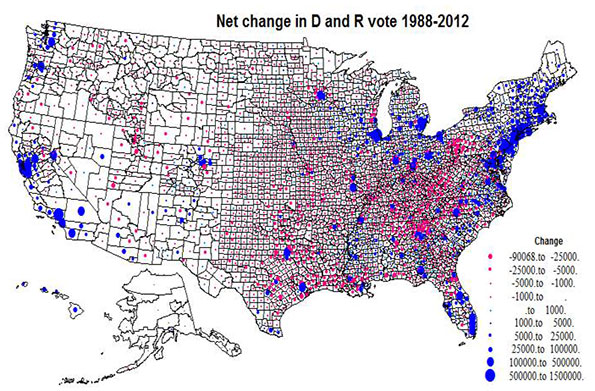
    David Jarman of Daily Kos Elections provides an excellent analysis of the absolute change in the Democratic and Republican vote for president from the 1988 through the 2012 elections, together with valuable tables and maps. The maps, tables, and narrative clearly demonstrate that, while the map looks mostly red as if Republicans were the big winners, the reality is that the Democrats were the beneficiaries of vastly more added votes, because of Democrats’ stupendous domination of the denser, bigger, metropolitan territory. For example, Los Angeles County by itself provided a Democratic gain of 1.2 MILLION, while the largest Republican gain was Utah county, Utah (Provo) with a paltry 90,000 gain. Republicans dominate the vast non-metropolitan expanses, Democrats the urban cores.

    But the title of the piece, “Democrats are from cities, Republicans from exurbs”, is not quite right. Density is only one factor in elections; Democrats did quite well in much of exurbia as well as much of suburbia, relegating Republicans to rural, small city, non-metropolitan America. But the story is as much one of social change as of city versus country. Not only the big central cities, but their suburbs and even exurbs have evolved to house the more socially liberal population, with issues of race, women’s rights, and sexuality converting many middle and upper class to the Democratic side, even while rural small town America and much of the South remain socially conservative and supportive of Republicans.

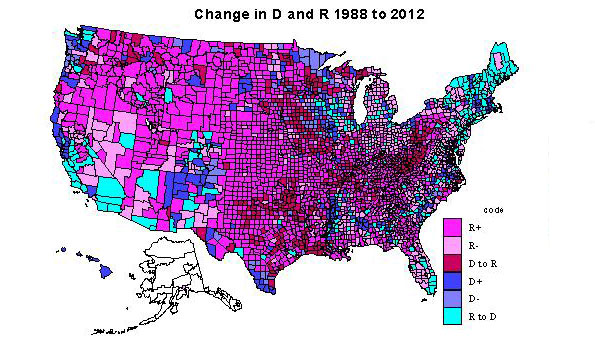
    This analysis extends Jarman’s findings by disaggregating the net change in the D and R vote by first looking at the degree of change in the Democratic share of the presidential vote from 1988 to 2012 and second by classifying by the change by such categories as:

    • increased R vote shares, 1,
    • declining R votes, 2,
    • shift to Democratic to Republican,3,
    • increased D vote shares, 4,
    • decreased D vote shares, 5,  and
    • 6, a shift from Republican to a Democratic majority

    This permits a more subtle geographic evaluation of the evolution of Red and Blue America. I want to thank the Daily Kos Elections which generously provided the necessary data files. This analysis considers only the vote for president, as the story of votes for congress is complicated by gerrymandering and other issues.

    Change in the Democratic vote by type of change (see Table 1)

    Table 1: Net Change by Type of Change
    Number of Counties 2012 %D 1988 %D Change in D% 88-12 net change County Type (Code)
    1411 30.8 39.8 -9 -4,605,125 1 Total
    448 40.3 55.1 -14.5 -1,517,300 3 Total
    108 55.8 57.2 -1.4 -62,214 5 Total
    -6,184,639 R gain
    274 71.1 58 12.8 8,835,866 4 Total
    313 59.7 42.9 16.4 8,917,699 6 Total
    572 42.4 35.3 7.1 463,743 2 Total
    18,217,308 D gain
    12,032,669 Net D Gain

    Almost half of all counties, 1411, experienced Democratic declines and net Republican gains, totaling  a  net change of 4,605,000, with the Democratic share dropping nine points from 39.8% to 30.8%.  Next in importance for Republicans was the gain of 1,517,000 votes in 448 counties taken from the Democratic column in 1988, with a decline in the Democratic share from 55.1% to 40.3%, a big drop of 14.8 points.  Finally a smaller number of counties, 108, remained Democratic but with a declining share (type 5), giving Republicans a small net gain of 62,000. These Republican gains totaled 6,184,000 and look impressive on a US map.

    But what the Democrats lose in vast America, they make up in the crowded parts. Although their increased shares took place in only 274 counties, the gains were populous enough to provide the Democrats with a massive gain of 8,836,000 total votes. The D share rose an impressive 12.5 points from 58.8% to 71.1%. (This exceeds even the R share in the R gaining counties). But even this big number was exceeded by the gain of 8,918,000 in the again fairly small number of counties which switched from Republican to Democratic, with a change in share up 16.4 points from 46.1% D to 59.3%. Finally the Democrats gained a net 464,000 votes in 572 counties carried by Republicans but by a lesser margin than in 1988, with the D share rising from 35.3% to 42.4%.  Overall the net Republican gains of 6,184,000 were surpassed by Democratic gains of 18,717,000 for a net D growth of 12,032,000, a rise in the D share of 5.9 points from 46.1% in 1988 to 52.6% in 2012.

    Change By State

    A short look at the state level is interesting (Table 2).  Sixteen states became even more Republican, with a net gain of 2,681,000.  Most important in total numbers is the southwestern set of  TX, OK, LA, and AR (1,143,000), then the northern mountain states of UT,ID, WY, and MT (477,000), followed by the Great Plains states of ND,SD, NE, KS, and MO (376,000), and the Appalachian set of TN  and KY (488,000). To the latter should be added West Virginia, 210,000, the only state which switched from Democratic to Republican and an apt example of the non-big-metropolitan and ideological shift in the US electorate.  Only one state, Iowa, experienced a small Democratic decline.

    Nine states became even more Democratic, but sixteen switched from Republican to Democratic, and thus spurring the major numeric and geographic manifestation of the 1988-2012 realignment, a total of 15,342,000.  Combining the Democratic states into subregions reveals the overwhelming importance of greater northeastern Megalopolis, yielding a net vote gain of 5,660,000 and of the “Left Coast” with 4,115,000, both dwarfing the total Republican gains. And the gains in the Great Lakes of 2,740,000, northern New England of 443,000, and the southern Mountain states of 431,000 were significant. Finally the major change in the South Atlantic region is notable, with a gain of 1,383,000 in SC, NC, GA, and FL, even though all but Florida remained Republican. At the individual state level California is dominant, 3,367,000, followed by NY-NJ. For Republicans Texas dominated with 578,000 followed by much smaller Utah with 268,000.

    County level

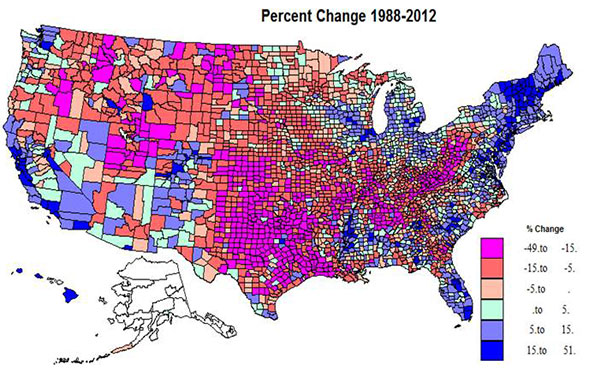
    The first two maps are the traditional red and blue (sort  of) choropleth maps, showing in Map 1 change in the share voting Democratic and in Map 2, the type of change. Map 3 depicts via graduated circles the absolute net change by counties, like the similar map in the Jarman article.

    Percent change in the Democratic and Republican shares, 1988-2012, Map 1

    Somewhat over half the territory of the US experienced Republican gains, in red shadings, but on average, the populations of the counties are smaller than for the Democratic counties in the blue shades. The dominant swath of red in the center third of the country from TX and LA north through the Dakotas and MN is impressive, but also prominent is the extension across the border south from MO and southern IL to KY, WV and into western PA, and then the northwestern extension to the mountain west, as far as the Cascade range. The most extreme Republican gains were in the two cores of southern Appalachia and eastern TX and OK into LA, plus UT. Most are non-metropolitan. A few most extreme R gains were in Knott, KY, 50%, Cameron, LA, 45, Mingo and Logan, WV, 44 and 43, and Kent, TX, 43%.

    Democratic gains were far more concentrated: in the northeast, in the urban Great Lakes, in much of FL, in the Black Belt of the south, in the metropolitan Left Coast, and in the southern mountain states. The highest gains were in central and suburban-exurban counties in the northeast, the west coast, and Great Lakes, and also in non-metropolitan northern New England. Lower Democratic gains were common beyond the big metropolitan cores or on the edges of the Black Belt in the south.  A few of the more extreme Democratic increases were in Clayton, GA, 51%, Rockdale, GA, 33, both suburban Atlanta, Osceola, FL, 31, Prince George, MD, 30, and Hinds, MS (Jackson), 28%. 

    Kind of change, 1988-2012, Map 2

    The 1411 counties becoming even more Republican (type 1) certainly dominate the interior Plains from Canada to the Gulf and the interior, mainly non-metropolitan far northwest. There are a few counties (typically university counties) in this heartland with counties still red, but less so in 2012. The dominant areas for Republican decline (type 2) are found in the Great Lakes states, in the non-metropolitan, often exurban edges of Megalopolis (NY, PA, NJ, MD, VA). Other areas of Republican decline include rural areas in the interior west, especially areas with environmental attractions and/or increasing Latino populations, and even in parts of the traditional south, such as MS, FL, SC,NC, and VA.

    Most notable are such long term Republican strongholds as Orange, CA, Duval (Jacksonville), FL, and Maricopa, (Phoenix).  Counties which switched from Democratic to Republican (type 3) are first and most impressively in Appalachia from western PA, then including most of WV, and into western VA, central TN into northern AL, second in the TX-OK-AR-LA zone, almost totally non-metropolitan.

    Areas of Democratic gains, type 4, darkest blue, require a close look at the map, as they are mainly the metropolitan cores, most notably Los Angeles, Cook, King (Seattle), much of the New York SMSA, San Francisco-Oakland, Detroit, and Philadelphia. However there are also many majority-minority counties: in the Black Belt across the south, in a few Hispanic areas along the Rio Grande, and Native American areas across the west. Highest Democratic share gains were in metropolitan CA,  FL, in exurban New York, Philadelphia, Washington, DC, and Chicago, northern New England and select amenity areas, popular with metropolitan migrants, even in WY and ID!

    Democratic voter share declined (type 5) in  some urban cores, like Allegheny (Pittsburgh), but the most prominent areas are in farming and forestry  areas in the upper Midwest (IA, WI, MN, often adjacent to counties which switched from D to R), and traditionally D forest industry counties in OR and WA. Especially interesting are the counties switching from Republican to Democratic, type 6, most critical to understanding the connection to social liberalism. The most prominent area is northern New England and NY, and extending through Megalopolis snatching a large number of very populous suburban and EXURBAN counties (MA, CT, NY, NJ, MD, VA, PA).

    A second large swath in territory and population is in CA, switching major metropolitan-suburban counties, and also increasingly Hispanic counties to the D column. This switching of suburban and exurban counties was also prevalent in CO, OR, WA, IL, and MI, as well as in parts of the south, e.g., FL and NC. Less visible is the shift of many university counties in most parts of the country. Last and increasingly important is the shift of rural environmentally attractive areas, mostly across the west, but also in the south Atlantic, upper New England and the upper Great Lakes, in part due to retirement of urban professionals. Some of the most important switches were Riverside, San Bernardino, San Diego, Sacramento in CA; Miami and Orlando, FL; Oakland, MI; Suffolk, Bergen and Westchester (all exurban New York); Mecklenburg (Charlotte); and Marion, IN (Indianapolis).

    Absolute change in the D and R vote, 1988-2012, Map 3

    Map 3 plots the absolute size variation in the Democratic versus Republican change, via a simple blue versus red, to assist the reader in properly interpreting Maps 1 and 2. The map highlights the tremendous concentration of Democratic gains in the northeastern Megalopolis, metropolitan California, the big cities of the Great Lakes, and Florida, versus the much more widespread pattern  of Republican gains, extensive in area but small in voter magnitude across the Plains, Mountain states, and most notably, Appalachia .

    Overall, what emerges is a picture far more subtle than simply cities versus exurbs. The bad news for Republicans is that most of their gains occur in rural areas with little population while the Democrats have consolidated their increases in more populous urban, suburban, and in some places exurban areas. Whether these trends spell the death knell for the GOP in the post-Obama period may turn on how they learn to appeal to the next generation of suburban and exurban voters – many of them Hispanic or Asian – as they enter their 30s, buy houses and start businesses. Economic issues could help here, but an emphasis on social issues, or simple anti-tax dogmatism could spell the GOP’s descent into permanent minority status.

    Table 2: Greatest Changes by State
    State 2012% 1988% % Change Code Net change (000)
    TX 42 43.7 -1.7 1 -578
    UT 25.4 32.6 -7.2 1 -268
    KY 36 44.7 -8.7 1 -254
    OK 33.3 41.6 -8.3 1 -253
    TN 39.5 41.8 -2.3 1 -234
    WV 36.3 52.4 -16.1 3 -210
    WY 28.6 39.5 -10.9 1 -62
    DE 59.6 43.5 16.1 4 114
    VT 68.2 48.3 19.9 6 115
    NV 53.3 39.2 14.1 6 141
    NH 52.9 37.7 15.2 6 157
    ME 57.8 44.3 13.5 6 171
    WA 58.2 50.8 7.4 4 435
    MA 61.7 54 7.7 4 516
    VA 51.9 39.7 12.2 6 598
    OH 51.5 43.9 7.6 6 643
    MI 54.8 46 8.8 6 739
    MD 62.6 48.5 14.1 6 756
    IL 58.6 49 9.6 6 979
    FL 50.4 38.8 11.6 6 1,036
    NJ 59 43.1 15.9 6 1,068
    NY 66.2 52.1 14.1 4 1,720
    CA 61.9 45.2 16.7 4 3,367

    Richard Morrill is Professor Emeritus of Geography and Environmental Studies, University of Washington. His research interests include: political geography (voting behavior, redistricting, local governance), population/demography/settlement/migration, urban geography and planning, urban transportation (i.e., old fashioned generalist).

  • Energy Running Out of California

    The recent decision by Occidental Petroleum to move its headquarters to Houston from Los Angeles, where it was founded over a half-century ago, confirms the futility and delusion embodied in California’s ultragreen energy policies. By embracing solar and wind as preferred sources of generating power, the state promotes an ever-widening gap between its declining middle- and working-class populations and a smaller, self-satisfied group of environmental campaigners and their corporate backers.

    Talk to people who work in the fossil-fuel industry, and they tell you they feel ostracized and even hated; to be an oil firm in California is like being a pork producer in an ultra-Orthodox section of Jerusalem. One top industry executive told me that many of his colleagues in California cringe at the prospect of being attacked by politicians and activists as something akin to war criminals. “I wouldn’t subject my kids to that environment,” the Gulf Coast-based oilman suggested.

    What matters here is not the hurt feelings of energy executives, but a massive lost opportunity to create loads of desperately needed jobs, particularly for blue-collar workers. The nation may be undergoing a massive “energy revolution,” based largely on new supplies of oil and, particularly, cleaner natural gas, but California so far has decided not to play.

    In all but forcing out fossil-fuel firms, California is shedding one of its historic core industries. Not long ago, California was home to a host of top 10 energy firms – ARCO, Getty Oil, Union Oil, Oxy and Chevron; in 1970, oil firms constituted the five largest industrial companies in the state. Now, only Chevron, which has been reducing its headcount in Northern California and is clearly shifting its emphasis to Texas, will remain.

    These are losses that California can not easily absorb. Despite all the hype about the ill-defined “green jobs” sector, the real growth engine remains fossil fuels, which have added a half-million jobs in the past five years. If you don’t believe it, just take a trip to Houston, where Occidental is moving. Houston now has more new office construction, some 9 million square feet, than any region in the country outside New York; Los Angeles barely has 1 million. Indeed, most of the office markets that have performed best in reducing vacancies since 2009 – Pittsburgh, Denver, Houston and Dallas – are all, to some degree, driven by energy.

    Everywhere you drive in Houston, now leading the nation in corporate expansions, one sees new office buildings. Last time I checked, I didn’t see much in the way of a Solyndra, Fisker or other green-business headquarters being constructed anywhere in our Golden State. Energy is driving Houston’s surge of some 50 new office buildings, led by ExxonMobil’s campus, the second-largest office complex under construction in the U.S. (after New York’s Freedom Tower).

    Chevron, once Standard Oil of California, has announced plans to construct a second tower for its downtown Houston campus, yet another signal of how that company is shifting emphasis from its roots in the Golden State to the Lone Star State. Relocating employees will have many people with whom to reminisce about old times; both Fluor and Calpine, major energy-related firms, have already made the Texas two-step.

    California clearly is squandering an opportunity to restart a large part of its economy. Texas energy has created some 200,000 new jobs over the past decade, while California has barely mustered 20,000. These energy jobs pay well, roughly $20,000 a year more than those in the information sector, according to EMSI. In 2011, this sector accounted for nearly 10 percent of all new jobs created in the nation. This has transformed much of the vast energy zone, from the Gulf to North Dakota. Houston, despite strong in-migration, now boasts an unemployment rate of 5.5 percent, almost four points below the jobless rate in Los Angeles.

    What about “green jobs”? Overall, California leads in green jobs, simply by dint of size; but on a per-capita basis, notes a recent Brookings study, California is about average. In wind energy, in fact, California is not even in first place; that honor goes to, of all places, Texas, which boasts twice California’s level of production.

    Ironically, one reason for this mediocre performance lies in environmental regulationsthat make California a tough place even for renewables. Even the New York Times has described Gov. Jerry Brown’s promise about creating a half-million new jobs as something of a “pipe dream.” Even though surviving solar firms are busy, in part to meet the state’s strict renewable mandates, solar firms acknowledge that they won’t be doing much of the manufacturing here, anyway.

    The would-be visionaries who manage the state are selling Californians a lot of pixie dust. Barely 700,000 Americans work in green energy, including building retrofits, compared with 9 million in fossil fuels. Nationwide employment in solar and wind, meanwhile, is well under 200,000. Overall, officials with fossil-fuel-related companies predict 1.4 million jobs in the sector by 2030.

    This predicament can’t be blamed on California running out of oil and gas; some estimates of the state’s oil and gas reserves as considerably larger than those of Texas. The Monterey Shale, located under the state’s economically struggling midsection, holds, according to federal Energy Department estimates, almost two-thirds of the nation’s total supply of shale oil. Tapping this source, notes a recent USC study, could bring as many as 500,000 new jobs to the state over the balance of this decade.

    Despite a bounty of fossil fuels, including along the coast, California’s oil production has continued to drop, and now ranks third among the states, behind No. 1 Texas, which has doubled its oil output in less than three years, and once-insignificant North Dakota. Californians have made a decision, based on green theology, that we don’t want to produce much of the stuff.

    Ordinary Californians bear the brunt of these policies, paying almost 40 percent above the national average for electricity. Rather than produce energy here, we appear set to import much of the oil and gas that, according to the state, still feeds well over 90 percent of California’s energy consumption.

    Particularly hard-hit has been California’s once-vibrant manufacturing sector, which has not mounted anything like the recovery being experienced in other parts of the country. From 2010-13, the country added 510,000 jobs, while California produced fewer than 8,000. Electricity prices are particularly uncompetitive, roughly twice as high in California, as those in prime competitors such Texas, Nevada, Arizona – as well as the hydro-powered Pacific Northwest.

    This has – discouraged manufacturers, such as Intel, from locating or expanding in the state. No surprise, then, that, just last week, it was revealed that the Lone Star State had also surpassed California in exports of high-tech goods.

    The worst impact of this deindustrialization is felt by blue-collar California. Even San Jose, the Central Valley’s traditional manufacturing hub, looks, as analyst Jim Russell suggests, more and more like a “rust-belt town.” Worse off still are the venerable agricultural and manufacturing regions, from the Central Valley to Los Angeles, where one person in five now lives in poverty. California’s green energy fixations, notes economist John Husing, are widening an ever-growing chasm based on “geography, class and race.”

    Despite these conditions, it’s hard to imagine a reversal of our current energy costs. The grip of green interests and their corporate allies in places like Silicon Valley suggests Californians will continue to endure ever-higher energy prices, lagging construction and manufacturing as a regular feature of the economy. This may make the green clerisy in the state happy, but is likely to have the opposite effect on the rest of us and on our economy as it becomes ever more narrowly based and fragile.

    This story originally appeared at The Orange County Register.

    Joel Kotkin is executive editor of NewGeography.com and Distinguished Presidential Fellow in Urban Futures at Chapman University, and a member of the editorial board of the Orange County Register. He is author of The City: A Global History and The Next Hundred Million: America in 2050. His most recent study, The Rise of Postfamilialism, has been widely discussed and distributed internationally. He lives in Los Angeles, CA.

    Oil well photo by BigStockPhoto.com.