Tag: California

  • Southern California has Aging Issues

    Back in the 1960s, and for well into the 1980s, California stood at the cutting edge of youth culture, the place where trends started and young people clustered. “The California teen, a white, middle-class version of the American dream” raised in a world of “suburbs, cars, and beaches,” notes historian Kirse Granat May, literally shaped the national image of youth, from the Beach Boys and Barbie to Gidget.

    In those times, California, particularly the Southland, was literally becoming ever younger, as more families and migrating 20-somethings moved in. The beaches of Southern California, so attractive to youth, evoked a care-free, athletic, somewhat hedonistic culture; California also was the place where young people, free from the traditional constraints of places East, felt free to innovate, in everything from music and board shorts to the earliest PCs.

    Yet today, you increasingly have to color California, particularly Orange and Los Angeles counties, a pale grey. Once evocative of youth, almost mythically so, these counties are aging far faster than the national average. From 2000-12, notes demographer Wendell Cox (www.demographia.com), the average median age of Los Angeles and Orange County residents rose by 10 percent, almost twice the national rate and well above the 6.6 percent rise for the state overall.

    This aging trend will continue, if current conditions remain in place. One recent USC study predicts that the Los Angeles area, due in large part to declining immigration, will continue aging rapidly. In the next two decades, the study projects, Los Angeles County will gain 867,000 senior citizens and have 630,000 fewer residents younger than 25.

    In contrast, the Bay Area – even rapidly aging Marin County – has been graying more gradually. In part, the Bay Area’s slower aging is less a reflection of rising birth rates, as was the case in California’s youthful heyday, than the movement of 20-somethings, particularly since 2007. Since then, the San Francisco area has led the nation in migration by the 20-34 age group. It does far worse as people get into prime child-bearing years, ranking 30th in migration among the 52 largest U.S. metropolitan areas.

    Not surprisingly, San Francisco – with 80,000 more dogs than kids – has the lowestpercentage of youngsters of any major American city. Even when more-suburban San Mateo County is added, the Bay Area ranks 40th in growth among people under age 4. San Jose-Santa Clara shows a very similar pattern, with people arriving in their 20s and leaving in their child-bearing years.

    Southern California right now is not experiencing much youth migration. Hollywood, great weather and the beaches are still all here – in a climate enhanced by a greater cultural diversity – but young people still are not moving here in droves. From 2007-12, this region ranked a mediocre 31st in migration by 20-somethings. Overall, we are losing millennials, while other regions, such as Washington, D.C., Houston, Denver and Austin, Texas, are luring them.

    Perhaps even more troubling, the region also ranks 47th for migrants in their prime child-bearing years and 32nd in terms of newborns. If not for the Inland Empire, which does markedly better with the 30- and 40-something groups, Southern California would be starting to look like a multicultural version of supergrey Japan. A recent report for theU.S. Conference of Mayors projected that, by 2042, Los Angeles will rank 58th of 70 U.S. regions for population growth, with the slowest growth of any major city in the South or West.

    This low youth migration combined with a steady erosion of the key parental cohorts, suggests that rapid aging could soon replace rambunctious youth as the region’s greatest demographic challenge. An ever-shrinking percentage of families and young workers is not good for the local economy. It deprives local companies of both new employees and an expanding customer base. Older people may be great for lower crime rates and filling hospitals, but not so much for the overall economy, as they often do not work and tend to consume less than younger people.

    Why is this occurring, and can anything be done to address this descent into regional senility? One answer lies in the region’s high housing prices. The L.A. area’s median multiple – the ratio of home price to a homeowner’s annual income – is now more thantwice that of more economically dynamic regions like Houston, Austin, Dallas, Atlanta, Nashville, Tenn., and Phoenix.

    This price pressure has sharply reduced opportunities for young couples to buy houses, while older residents, often working into their sixties, seventies or even eighties, stay in their homes, further reducing opportunities for the next generation. Mortgage applications have fallen dramatically in recent months, after some signs of resurgence. It’s now largely investors who are holding the market up.

    In Southern California, the combination of inflated house prices and weak job growth means not only that fewer young people are coming but, once here, they are having fewer babies, or will move once they take that plunge. This trend is spreading to the Inland Empire, the region’s primary nursery, where declining incomes and higher rents are making family formation an ever-more dicey proposition.

    Once a major lure for the parental age groups, the Inland area has dropped to 26th in attracting people in their 30s. This is not surprising given the toxic combination of a weak economy and rising costs; the percentage of Inland Empire households paying at least half their incomes in rent has risen from 20 percent to 30 percent since 2007, a reflection of rising rents amidst shrinking salaries. In Los Angeles, roughly a third of households see half their earnings go to rent.

    How can we address this decline? The response of many homebuilders, spurred by the planning agencies, is to reduce the size of houses, even in far-flung suburban areas. This may solve some problems in the eyes of density-obsessed planners but, is not likely to be attractive to families at a time when American house sizes, after a short period of contraction, are expanding again. Less space at higher prices in Southern California may not be so appealing to families who can get more, at lower cost, in a host of markets across the country.

    This leaves the Southland with the alternative, seen in the Bay Area, of attracting younger professionals who eventually may leave. But a torpid economy does not help in luring ambitious millennials, and building high-density housing in the absence of expanding incomes and opportunities seems something of a fool’s errand. If they can’t afford the urban-hipster enclaves of New York or San Francisco, the coveted member of the “creative class” may find themselves better off settling first in the burgeoning urban districts of less-expensive cities like Houston, Dallas or Nashville, places where they also can eventually hope to get a decent job and buy a home.

    Clearly, this region, with its still-impressive assets, should be attracting both new families as well as younger singles. But this cannot reliably be done unless we begin looking at ways to encourage older people to move out of their homes, perhaps by reforming Proposition 13 and providing other incentives. We could also start allowing builders again to construct the kind of housing families need and clearly want – detached homes where land is affordable. As for the 20-somethings, what they need most is not forced density or transit-oriented development but the whiff of opportunity, something a “smart” policy agenda seems best-suited to stifle.

    The premature aging of this region represents an existential challenge, a harbinger of further, long-term decline. Unless addressed by policies that reignite economic growth and expand opportunities, the youthfulness of this region will exist merely a cherished myth, seen in old sitcoms on Nickelodeon but increasingly not in our neighborhoods.

    This story originally appeared at The Orange County Register.

    Joel Kotkin is executive editor of NewGeography.com and Distinguished Presidential Fellow in Urban Futures at Chapman University, and a member of the editorial board of the Orange County Register. He is author of The City: A Global History and The Next Hundred Million: America in 2050. His most recent study, The Rise of Postfamilialism, has been widely discussed and distributed internationally. He lives in Los Angeles, CA.
  • The Evolving Urban Form: The San Francisco Bay Area

    Despite planning efforts to restrict it, the Bay Area  continues to disperse. For decades, nearly all population and employment growth in the San Jose-San Francisco Combined Statistical Area has been in the suburbs, rather than in the core cities of San Francisco and Oakland. The CSA (Note) is composed of seven adjacent metropolitan areas (San Francisco, San Jose, Santa Cruz, Santa Rosa, Vallejo, Napa, and Stockton). A similar expansion also occurred in the New York CSA.

    The San Francisco Bay Area is home to two of the three most dense built-up urban areas in the United States, the San Francisco urban area, (6,266 residents per square mile or 2,419 per square kilometer) with the core cities of San Francisco and Oakland and the all-suburban San Jose urban area (5,820 residents per square mile or 2,247 per square kilometer), according to US Census 2010 data. Only the Los Angeles urban area is denser (6,999 per square mile or 2.702 per square kilometer). The more spread out New York urban area trails at 5,319 per square mile (2,054 per square kilometer).

    The San Francisco Bay & Central Valley Area

    The continuing dispersion was reflected in commuting patterns that developed between 2000 and 2010, with the addition of the Stockton metropolitan area, which is composed of San Joaquin County, with more than 700,000 residents. San Joaquin County is located in the Central Valley and is so far removed from San Francisco Bay that it may be appropriate in the long run to think of the area as the "San Francisco Bay & Central Valley Area." The distance from Stockton to the closest point shore of San Francisco Bay is 60 miles, and it is nearly another 25 miles to the city of San Francisco.

    Ironically, this continued dispersion of jobs and residences is, at least in part, driven by the San Francisco Bay Area’s urban containment land use policies designed to prevent it. What the planners have ignored is the impact on house prices associated with highly restrictive land use planning. The San Francisco metropolitan area and the San Jose metropolitan area are the third and fourth most unaffordable major housing markets out of 85 rated in the recent 10th Annual Demographia International Housing Affordability Survey, trailing only Hong Kong and Vancouver.

    Historical Core Cities: San Francisco and Oakland

    The historical core municipalities (cities) of the San Francisco Bay Area, San Francisco and Oakland have held their population very well. Each essentially retains it 1950 borders. Among the 40 US cities with more than 250,000 residents in 1950, only San Francisco and Oakland managed population increases by 2000 without substantial annexations and substantial non-urban (rural) territory within their city limits. For example, New York and Los Angeles, both of which have grown, have nearly the same city limits as in 1950 and 2000, yet much of New York’s Staten Island was rural in 1950 as was much of the San Fernando Valley in Los Angeles.

    Yet both San Francisco and Oakland have had difficult times. Between 1950 and 1980, both San Francisco and Oakland suffered 12 percent population losses, which were followed by recoveries. The losses were modest compared to the emptying out of municipalities like St. Louis. Detroit, Chicago, Copenhagen, and Paris, which remain one quarter to nearly two-thirds below their 1950s figures. Further, population gains from annexations masked losses within the 1950 boundaries of many cities, such as Portland, Seattle, and Indianapolis, etc.

    San Jose: Now the Largest City

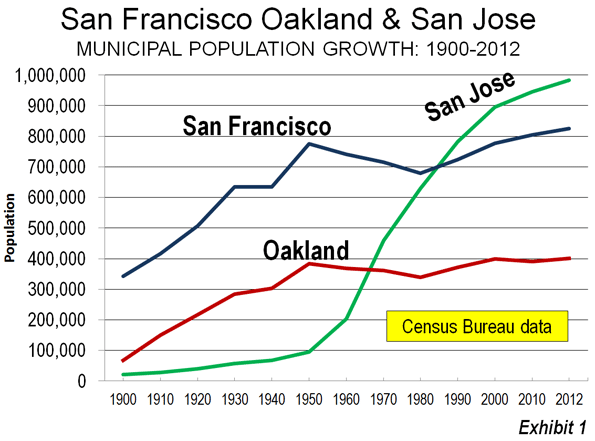
    San Jose is now the Bay Area’s largest city. San Jose has grown spectacularly, from a population of 95,000 in 1950 to nearly 1,000,000 today. San Jose passed San Francisco by the 1990 census and Oakland by the 1970 census (Figure 1). Virtually all of San Jose’s population growth has occurred during the postwar period of automobile suburbanization. The pre-automobile urban form familiar in San Francisco and central Oakland simply does not exist in San Jose. Even attempts to pretend the pre-war urban form has returned have been famously unsuccessful. Even after building an extensive light rail system, San Jose’s transit work trip market share is barely one quarter that of the adjacent San Francisco metropolitan area.

    Nonetheless, suburban San Jose has become a dominant force in the "Silicon Valley", which stretches through San Mateo County in the San Francisco metropolitan area and into Santa Clara County, which includes San Jose. The Silicon Valley has been the capital of the international information technology business for at least a half century. The highly suburbanized region has done more than its share to elevate the San Francisco Bay Area to its high standard of living (According to Brookings Institution data), a phenomenon that has spread also the urban core of San Francisco. At the same time, San Jose is the second most affluent major metropolitan in the world and San Francisco ranks seventh. The Silicon Valley, which includes much of San Mateo County (adjacent to Santa Clara County in the San Francisco metropolitan area), is clearly the economic engine of the region with twice as many jobs as San Francisco (which is both a city and a county).

    Metropolitan Growth

    Overall, the San Francisco Bay Area has grown approximately 180 percent since 1950, considerably more than the national average from 1950 to 2012 of 107 percent. The Bay Area’s growth was strong, but well behind the 280 percent growth achieved in the Los Angeles CSA (Los Angeles, Riverside-San Bernardino, and Oxnard MSAs).

    However, growth has since moderated substantially. Between 1950 and 2000, the Bay Area grew at an annual rate of 1.9 percent but since 2000, the annual growth rate has dropped to 0.7 percent annually. Even so, in recent years, the Bay Area has nearly equaled the much slowed growth of the Los Angeles CSA, adding 23.6 percent to its population since 1990, compared to 25.5 percent in Los Angeles. Both areas, however, grew at less than the national population increase rate (25.8 percent), and slowing, in the 2000s to the slowest growth rates since California became a state in 1850.

    Suburban Growth

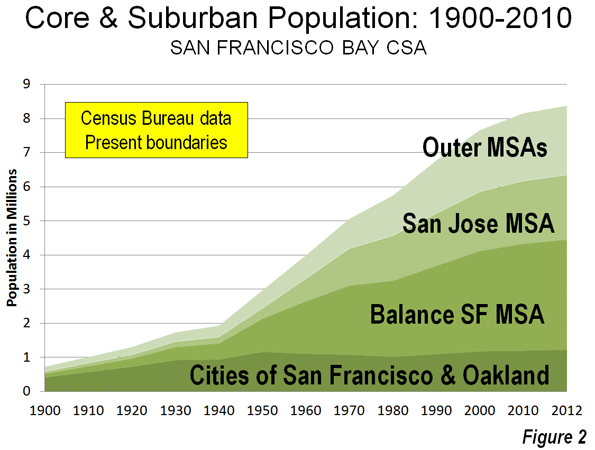
    Despite the decent demographic performance of the cities of San Francisco and Oakland since 1950, nearly all Bay Area growth occurred in the suburbs. Between 1950 and 2012, only one percent of population growth in the CSA occurred in the two historical core municipalities and 99 percent in suburban areas. Things have been somewhat better for the two cities since 2000, with seven percent of the growth in the historical core municipalities and 93 percent of the growth in suburban areas (Figure 2).

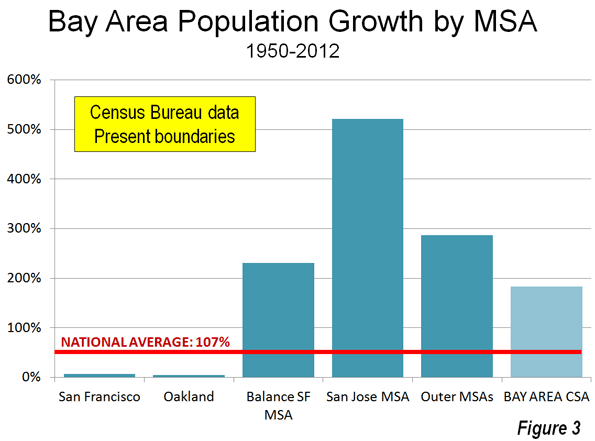
    Since 1950, the San Jose metropolitan area has grown by far the fastest in the CSA, with the more than 500 percent increase in population. The outer metropolitan areas (Santa Cruz, Santa Rosa, Vallejo, Napa, and Stockton) have grown nearly 300 percent, while the parts of the San Francisco metropolitan area outside the two core cities grew more than 200 percent. San Francisco and Oakland grew approximately 5 percent (Figure 3).

    Domestic Migration

    As house prices increased before the subprime crisis, the Bay Area lost more than 600,000 domestic migrants, a rate of more than 85,000 per year. Since 2008, however, with substantially lower house prices, and a renewed tech boom, there has been an annual gain of approximately 4,000 to the Bay Area in domestic migration. However, if the substantial house price increases since 2012 continue, the area could again become a net exporter of people.

    Future Urban Evolution

    Like much of California, San Francisco Bay CSA exhibits much slower population growth than before. How much of this is tied to the regional and state policies constricting suburban housing remains an open question, but it seems much growth that might have occurred in the original San Francisco metropolitan area or the later developing San Jose metropolitan area will instead occur in the Vallejo or Stockton metropolitan areas, where housing prices  tend to be much lower, particularly for larger homes that are increasingly unaffordable closer to the urban core. Indeed, it is not impossible that Modesto (Stanislaus County) could be added  to the San Francisco Bay CSA by 2020, which is even farther away from the historical core than the Stockton metropolitan area.

    At the same time, many potential new residents may find either the high prices near the core nor the long commutes associated with Central Valley residence unappealing. Many households may instead seek their aspirations in Utah, Colorado, Texas, and even Oklahoma, not least because the "California Dream" has been made affordable.

    Wendell Cox is a Visiting Professor, Conservatoire National des Arts et Metiers, Paris and the author of “War on the Dream: How Anti-Sprawl Policy Threatens the Quality of Life.

    —–

    Note: Metropolitan areas are labor markets. Their building blocks in the United States are complete counties. Metropolitan statistical areas are organized around built up urban areas with counties reaching a threshold of the urban area population being considered central counties and included in the metropolitan area. In addition, any county with an employment interchange of 25 percent or more with the core counties is also included in the metropolitan area. Adjacent metropolitan areas are added together to form Combined Statistical Areas if there is a 15 percent or more employment interchange. This is a simplified definition. Complete details are available from the US Office of Management and the Budget.

    Photo: Market Street, San Francisco (by author)

  • California’s Potholed Road to Recovery

    California’s economy may be on the mend, but prospects for continued growth are severely constrained by the increasing obsolescence of the state’s basic infrastructure. Once an unquestioned leader in constructing new roads, water systems, power generation and building our human capital, California is relentlessly slipping behind other states, including some with much lower tax and regulatory burdens.

    The indications of California’s incipient senility can be found in a host of reports, including a recent one from the American Society of Civil Engineers, which gave the state a “C” grade. Roads, in particular, are in bad shape, as many drivers can attest, and, according to another recent study, are getting worse. The state’s shortfall for street repair is estimated at $82 billion over the next 10 years.

    Remarkably, given how Californians spend and tax ourselves, we actually bring up the rear in terms of road conditions. Indeed, one recent survey placed California 47th among the states in road quality. In comparison, low-tax Texas notched No. 11, showing that willingness to spend money is not the only factor.

    Greater Los Angeles is particularly affected; L.A. roads have been ranked by one Washington-based nonprofit as the worst in the nation. Bad roads cost L.A. drivers an average $800 a year in vehicle repairs, and a full quarter of roadways were graded “F,” meaning barely drivable. The region that gave birth to the freeway and the dream of quick, efficient travel, now has worse roads than some much poorer, less-important, lower-tax cities, such as Houston, Dallas or Oklahoma City. Not surprisingly, Los Angeles has been ranked has having the worst traffic congestion in the nation, but San Francisco and San Jose also make it to the 10 metros with the worst traffic.

    But it’s not just the roads that are in bad shape. Other basic sinews of the state’s infrastructure – ports, water systems, electrical generation – are increasingly in disrepair. Conditions are so poor at Los Angeles International Airport, admits new L.A. Mayor Eric Garcetti, that “there’s nothing world class” about the aging facility. This is critical for a city and region with significant global pretensions. Since 2001, LAX traffic has declined by more than 5 percent, while double-digit gains in passenger traffic have been logged by such competitors as New York, Miami, Atlanta and Houston.

    Meanwhile the Los Angeles-Long Beach port system, facing greater competition from the Gulf Coast, as well as other Pacific Coast ports, has been beleaguered by regulations that, among other things, mandate moving heavy loads with zero-emission but expensive, underpowered electric trucks that further undermine port productivity. Rather than see the ports as job and wealth generators, ports also have become increasingly sources for revenue for hard-hit city budgets.

    Overall, the bills are mounting; California faces an enormous shortfall in infrastructure. One study, conducted by California Forward, puts the bill for the next 10 years at $750 billion.

    The case for addressing infrastructure needs should be compelling on its own but, given fiscal limitations, it’s critical first to set some sense of priority. California, particularly under the current governor’s father, the late Edmund G. “Pat” Brown, spent upward of a fifth of its budget on basic infrastructure; today that share is under 5 percent. Rather than build the infrastructure that might spark the economy, as the elder Brown did, we have chosen, instead, to spend on government salaries and pensions, which, however well-deserved, require a transfer of wealth from the private sector to the public sector that brings only minimal benefits.

    These shortfalls are made even worse by ideological considerations that, in this one-party-rule state, overcome even the most rational approach to infrastructure development. The ruling class in Sacramento speaks movingly about the Pat Brown legacy, but has little interest in mundane things like roads, bridges, port facilities and other economically useful infrastructure. Instead, the powerful green and planning clerisy is focused on transforming the state into a contemporary ecotopia, where people eschew cars, live in crowded apartment towers and ride transit to work. Economic considerations, upward mobility and the creation or retention of middle-class jobs are, at best, secondary concerns.

    This ideological bent leads to grossly misplaced priorities. Consider, for example, the billions of dollars being proposed for building Gov. Jerry Brown’s signature project, a $68 billion, 800-mile high-speed rail system, even as state highways erode. The bullet train, which even liberals such as Kevin Drumm at Mother Jones magazine have pointed out, has devolved into a boondoggle with costs far above recent estimates and, given the lack of interest from private investors, something unlikely to offer much of an alternative to commuters for decades to come. Unlike many liberal commentators, who tend to favor crony-capitalist projects with a “green” cast, Drumm denounced the entire project as being justified with projections, such as for ridership, that are “jaw-droppingly shameless.”

    In addition, the project’s future has been clouded by legal challenges from a host of complainants stretching from Central Valley farmers to suburbanites on the San Francisco peninsula. In December, Superior Court Judge Michael Kenny in Sacramento County accused the state high-speed rail authority of ignoring provisions in the authorizing legislation for the project designed to prevent “reckless spending.”

    Public support for this misguided venture has been fading, thankfully. Even before Judge Kenny’s decision, a USC/Los Angeles Times poll showed statewide voter opposition rising to 53 percent, while 70 percent would like to have a new vote on the legislation that authorized the project.

    At the same time, federal funding, critical to keeping this failing project afloat, grows increasingly unlikely. California Congressman Jeff Denham, also a former supporter of the project, joined with Congressman Tom Latham to ask the federal Government Accountability Office if further federal disbursements could be illegal, given the uncertainty of the state funding needed to “match” the federal dollars. With Republicans likely to retain the House after the 2014 elections, it seems all but certain that high-speed rail – at least the statewide system proposed by its advocates – is heading to a less-than-spectacular denouement.

    This tendency to allow ideological considerations to overcome logic suffuses virtually the entire planning process across the board. For example, devotion to alternative energy sources leads the state to reject the expanded use of clean, cheap and plentiful natural gas in favor of extremely expensive renewable fuels, notably wind and solar. This may have much to do with the investments by crony capitalists close to Democratic politicians – think Google or a host of venture-capital firms – as with anything else. Under the right circumstances, such as government mandates, even unsound investments can make some people rich, or, in this case, even richer.

    But the cost to the rest of society of such Ecotopian policies can be profound, and could cost as much as $2,500 a year per California family by 2020. High energy prices will severely affect the state’s already-beleaguered middle- and working-class families, particularly in the less-temperate interior of the state.

    The commitment to expensive energy also makes bringing new industry – such as manufacturing or logistics – that can provide jobs ever more problematical. Similarly, money poured into follies like high-speed rail also weaken the state’s ability to fund, directly or through bonds, more-critically needed, if less-politically correct, transport infrastructure.

    Given these clear abuses of the public purse, it is not surprising that some Californians may simply want to close their wallets. Yet this would be a disservice to future generations, who will need new roads, ports, bridges and electrical generation. California needs to rediscover its historic commitment to being an infrastructure leader, but only after acquainting ourselves once again with the virtues of common sense.

    This story originally appeared at The Orange County Register.

    Joel Kotkin is executive editor of NewGeography.com and Distinguished Presidential Fellow in Urban Futures at Chapman University, and a member of the editorial board of the Orange County Register. He is author of The City: A Global History and The Next Hundred Million: America in 2050. His most recent study, The Rise of Postfamilialism, has been widely discussed and distributed internationally. He lives in Los Angeles, CA.
  • The Story of How Marin Was Ruined

    Marin County is a a picturesque area across the Golden Gate Bridge from San Francisco of quaint walkable towns, with homes perched on rolling hills and a low rise, unspoiled feel. People typically move to Marin to escape the more urbanized South and East Bay and San Francisco. Eighty-three percent of Marin cannot be built on as the land is agricultural and protected open space. 

    This is not stopping ABAG, developers, social equity, housing and transit advocates from pushing for high density housing near transit in Marin. Plans for high density housing have sprung up the length of the county – multiple Marin communities found themselves declared Plan Bay Area "Priority Development Areas" (PDAs) making them targets for intense high density development. These designations occurred with little or no consultation by the elected officials that had volunteered them, and without any clear understanding of obligations to develop or impact.

    Residents finally came together and said they’d had enough after an unsightly 5 story, 180 unit apartment complex appeared adjacent to an existing freeway choke-point – the city that allowed it had little choice due to onerous ABAG housing quotas that if unmet left the town open to litigation by housing advocates with crippling legal bills and penalties. The last straw was the publication of a station area plan to generate transit ridership that suggested 920 more high density units be built in nearby Larkspur – another freeway bottleneck. 

    This video, put together by Citizen Marin, a coalition of neighborhood groups seeking to restore local control, was put together to drive awareness of this accelerated urbanization. For Marinites the video serves as a wake up call – most moved to Marin to live in a more rural / suburban location. Marin offers some of California’s most walkable and attractive downtowns already: Sausalito, Mill Valley and San Rafael. All offer the kind of small town charm that are a model for others to emulate and attract visitors and residents.

    The video was written and produced by Citizen Marin’s Richard Hall. The video’s narrator is from San Rafael – not San Rafael in Marin County but San Rafael, Argentina, and the animation was put together by a team from Kathmandu Nepal.

  • Srirachagate Gives a Window Into California’s Business Climate Problem

    I love Huy Fong Foods’ Sriracha sauce as much as the next guy, which is to say a lot. The red hot sauce with the rooster on the bottle has a cult following across the nation. So unsurprisingly it made national news when the city of Irwindale, CA sued to shut down production at the company’s processing plant there. The processing of the hot peppers, done during only a limited time of year because Huy Fong only uses fresh peppers, was alleged to be causing a noxious odor in the town.

    This looks like a pretty garden variety dispute between neighbors and an industrial business. Clearly industrial odors can be a problem. I don’t know how long they’ve been in Irwindale, but Sriracha has been around a long time so I’m a bit skeptical something changed just this year. Regardless, I don’t think odor complaints are necessarily evidence of a bad business climate as there could be a legitimate problem.

    Then came the state order to stop shipping the product for 30 days. The state of California decided that to reduce the risk of food borne illnesses, the sauce had to sit for 30 days before it can be shipped. Keep in mind, this is for a product that has never had a complaint against it for making someone sick.

    How many businesses can afford to halt shipments for a month and survive? Sriracha has a cult following and so they’ll likely overcome it. But many businesses wouldn’t have this luxury. When their customers can’t get product, they lose the business. Indeed, I wouldn’t be surprised if restaurants do turn to alternative suppliers. At a minimum, Huy Fong is going to lose a lot of sales.

    Who in their right mind would want to do business in a state like this? And this is far from the worst case. It just so happens that because this is such a popular consumer product, it’s visible. If even these types of companies get shut down, how much more so a firm where this wouldn’t create an avalanche of bad publicity?

    Urbanists put way too little thought into business climate, which can sound like such a shady way of saying cut services and taxes. But taxes are often the least part of it. It’s the regulatory apparatus that makes doing business in many places too painful to contemplate. This even affects city-suburb investment patterns. I’ve observed that in many places, the urban core is a flat out terrible place to do business, unless you’re very politically wired up.

    This doesn’t usually bother urbanists all that much until a trendy business they like gets affected. For example, an urban farming supply shop in Providence called Cluck got sued when they tried to open. The beautiful and the bearded were outraged and the shop was ultimately approved. But there’s no similar visibility or outrage when a Latino immigrant runs into the red-tape buzzsaw when he tries to open a muffler shop.

    If we want to promote investments in our cities and states, we need to be focused on basics like an objective, predictable regulatory framework that operates in the timely fashion and in which arbitrary denials, rule changes, and such are minimized. This is way more important to attracting capital investment than sexier items like streetcar lines.

    This piece first appeared at The Urbanophile.

  • Silicon Valley is No Model for America

    Its image further enhanced by the recent IPO of Twitter, Silicon Valley now stands in many minds as the cutting edge of the American future. Some, on both right and left, believe that the Valley’s geeks should reform the nation, and the government, in their image.

    Increasingly, the basic meme out of the Valley, and its boosters, is that, as one venture capitalist put it: “We need to run the experiment, to show what a society run by Silicon Valley looks like.” The rest of the country, that venture capitalist, Chamath Palihapitiya, recently argued, needs to recognize that “it’s becoming excruciatingly, obviously clear to everyone else, that where value is created is no longer in New York, it’s no longer in Washington, it’s no longer in L.A. It’s in San Francisco and the Bay Area.”

    But do we really want these people in control? Not if we care at all about privacy, social justice, upward mobility and the future of our democracy.

    In control

    Let’s start with the Valley’s political agenda, which is increasingly enmeshed with that of the Obama-led Democratic Party. The scary thing about the Valley’s political push is not its ideology, which is not particularly coherent, but its unparalleled potential to dominate the national political agenda.

    Joe Green, a former roommate of Facebook founder Mark Zuckerberg and head of the Valley lobbying group FWD.us, made this clear in a memo leaked to the political site Politico. Green contended that “people in tech” can become “one of the most powerful political forces” since they increasingly “control” what he labeled “the avenues of distribution.”

    Some liberals might be thrilled by the prospect of having such powerful allies, but not if they retain any concern, for example, for civil liberties. This is not merely a matter of informing people, as traditional media does, but using technology to penetrate the private lives of every individual consumer, largely for the economic gain of those “people in tech.”

    There certainly seems no desire to curtail their ongoing invasion of people’s privacy. Facebook, for example, recently disabled a key feature in its website to guarantee privacy. The Huffington Post has already constructed a long list of Google’s more-egregious violations. No surprise, then, that Silicon Valley firms have been prominent in trying the quell bills addressing Internet privacy, in both Europe and closer to home.

    Increasingly, the oligarchs see invasive technology as something of their divine right, as well as a source of unlimited profits. As Google boss Eric Schmidt put it: “We know where you are. We know where you’ve been. We can more or less know what you’re thinking about.”

    Tax avoiders

    Perhaps more shocking for many liberal friends of the Valley folks is their attitude toward paying taxes. Here, the tech firms appear to have developed at least as much skill at manipulating the political system as the financial system. The New York Times recently described Apple as “a pioneer in tactics to avoid taxes,” while Facebook paid no taxes last year, despite making a profit of over $1 billion. For its part, Google avoided paying $2 billion by putting its revenue in a shell company in Bermuda.

    OK, you can argue that the Valley tech types are a bit arrogant, dismissive of privacy rights and greedy. But is all that offset by their benefit to the economy? Tech industry boosters, such as UC Berkeley’s Enrico Moretti, extol the virtues of the “technigentsia,” claiming they constitute the key to a growing economy. This is also the conventional wisdom in both parties, among both Left and Right and throughout the media.

    Yet, over the past decade, the Valley’s record on job creation is far from superlative. From 2000-12, Valley tech companies lost well over 80,000 jobs in high-tech manufacturing. Even with the current surge in hiring, Silicon Valley’s employment in fields related to science, technology, engineering and mathematics has still not recovered all the earlier losses, according to estimates by Economic Modeling Specialists Inc.

    You hope your kid may get a good job at Facebook or Google. Well, increasingly those being sought by Valley employers are not the sons and daughters of the American middle – much less, working – class. A recent study by the left-leaning Economic Policy Institute points out that many Valley tech firms would rather hire “guest workers” – now accounting for one-third to one half of all new IT job holders. These workers are valued partly because they will work for less, and do not mind living in crowded, overpriced apartments as much as do native-born Americans.

    The Valley defends its expanding the ranks of what Indians often refer to as “technocoolies,” based on an alleged critical shortage of skilled workers in the STEM fields. But, as EPI demonstrates, this country is producing 50 percent more information-technology graduates each year than are being employed, so the preference for foreign guest workers seems more tied to finding cheaper, more-pliable workers.

    Even worse, those kinds of tech jobs being created in the Valley produce opportunities only for a narrow subset of highly skilled, or well-connected, employees. As industrial jobs – the mainstay of the Valley’s heavily minority working and middle classes – have cratered, most new jobs in the Valley, according to an analysis by the liberal Center for American Progress, earn less than $50,000 annually, far below what is needed to live a decent life in this ultrahigh-cost area.

    New Feudalism

    Rather than a beacon for upward mobility, the Valley increasingly represents a high-tech version of a feudal society, where the vast majority of the economic gains go to a very select few. The mostly white and Asian tech types in Palo Alto or San Francisco may celebrate their IPO windfalls, but wages for the region’s African American and large Latino populations, roughly on third of the total, have actually dropped, notes a recent Joint Venture Silicon Valley report, down 18 percent for blacks and 5 percent for Latinos, from 2009-11.

    Meanwhile, the poverty rate in Santa Clara County since 2001 has soared from 8 percent to 14 percent; today one of four people in the San Jose area is underemployed, up from a mere 5 percent just a decade ago. The food-stamp population in Santa Clara County, meanwhile, has mushroomed from 25,000 a decade ago to almost 125,000 last year. San Jose, the Santa Clara County seat, is also home to North America’s largest homeless encampment, known as “the Jungle.”

    What the Valley increasingly offers America is an economic model dominated by the ultrarich, and generally well-educated, with few opportunities for working-class people, women and minorities. As Russell Hancock, president of Joint Venture Silicon Valley, recently acknowledged, “Silicon Valley is two valleys. There is a valley of haves, and a valley of have-nots.”

    This is a far cry from the kind of aspirational place for middle- and working-class people that the Valley represented just a decade or so ago. Instead, the Valley, and its urban annex San Francisco, increasingly resemble a “gated” community, where those without the proper academic credentials, and without access to venture funding, live a kind of marginal existence in crowded housing, or are forced to commute to distant jobs as servants to the Valley’s upper crust.

    This exclusive future is being further enhanced by gentry liberal policies – as opposed to traditional social democratic policies – widely embraced by the Valley leadership. Instead of looking to spark growth in construction, logistics, manufacturing and other traditional sources of middle-class employment, the Valley’s leadership generally embrace “green” policies that limit suburban homebuilding, drive up energy prices and otherwise make it impossible for businesses capable of offering better paying blue-collar, or even middle-management work.

    None of this suggests that the Valley does not have a critical role to play in the recovery of the American economy. Just like Wall Street, Beverly Hills or, for that matter, Newport Beach, clusters of well-connected and well-educated people play a critical role in taking risks in investment and innovation, whether it involves technology, finance, fashion or media. Yet given their dangerous hubris, disdain for privacy rights, lower rates of tax compliance and minimal ability to create middle-class jobs, the Valley’s elite should not be held up as supreme role models, much less the hegemons, of the Republic. That is, unless we have decided that we wish to live in a high-tech, 21st century version of a highly ossified, feudal society.

    This story originally appeared at The Orange County Register.

    Joel Kotkin is executive editor of NewGeography.com and Distinguished Presidential Fellow in Urban Futures at Chapman University, and a member of the editorial board of the Orange County Register. He is author of The City: A Global History and The Next Hundred Million: America in 2050. His most recent study, The Rise of Postfamilialism, has been widely discussed and distributed internationally. He lives in Los Angeles, CA.
  • Los Angeles: Will The City Of The Future Make It There?

    When I arrived in Los Angeles almost 40 years ago, there was a palpable sense that here, for better or worse, lay the future of America, and even the world. Los Angeles dominated so many areas — film, international trade, fashion, manufacturing, aerospace — that its ascendency seemed assured. Even in terms of the urban form, L.A.’s car-dominated, multipolar configuration was being imitated almost everywhere; it was becoming, as one writer noted, “the original in the Xerox” machine.

    Yet today the nation’s second-largest city seems to have fallen off the map of ascendant urban areas. Today’s dynamic cities in terms of job and population growth are the “new Los Angeleses,” such as Houston, Dallas, Phoenix or Charlotte; at the same time L.A. lags many more traditional “legacy” cities in job creation and growth, notably New York, Boston and Seattle. Worst of all, L.A. has lost its status as the dominant city on the West Coast; that title, in terms of both economic and political power, has shifted to the tech-heavy Bay Area.

    With a weak economy and little media outside Hollywood, the city has lost much of its cachet. A Businessweek survey last year ranked San Francisco asAmerica’s best city to live in. Los Angeles was 50th, behind such unlikely competitors as Cleveland, Omaha, Tulsa, Indianapolis and Phoenix. In another survey that purported to identify the top 10 cities for millennials, Seattle ranked first, followed by Houston, Minneapolis, Dallas, Washington, Boston and New York. Neither L.A. nor Orange County made the cut.

    L.A.’s relative decline reflects a collective inability to readjust to changing economic conditions. Some of this has to do with the end of the Cold War, but also with the loss of the headquarters of many of the area’s top defense contractors, such as Lockheed and, most recently, Northrop Grumman. In 1990, the county had 130,100 aerospace workers. A decade later, that number dropped by more than half to 52,400. By 2010, the county’s aerospace jobs numbered 39,100.

    With the exception of drone technology, the region’s aerospace industry, as one analyst put it, has become “dormant,” a victim of a talent drain and a difficult business environment. This decline has weakened the metro area’s standing as an industrial center — L.A. has lost almost 20% of its manufacturing jobs since 2007. Meanwhile STEM employment in the Los Angeles-Santa Ana area is still stuck below its 2002 levels; once arguably the world’s largest agglomeration of scientists and engineers, the region has now dipped below the national average in the proportion of STEM jobs in the local economy.

    In contrast to the Bay Area, whose tech community also was largely nurtured by defense contracts and NASA, L.A.’s defense and aerospace industries never pivoted into the vast civilian market. Capital, too, has played a role. The L.A. area has lots of rich people, but a relatively weak venture capital community. For example, the Bay Area was a recipient of roughly 45% of U.S. venture capital investment in the third quarter of 2013, while far more populous Los Angeles-Orange County took in under 6.5%.

    The growth of VC-financed companies is one reason why L.A. has been less able to produce high wage jobs than its northern rival. According to a recent projection by Economic Modeling Specialists Inc., high-wage jobs will account for only 28% of L.A.’s job growth from 2013 through 2017 compared to 45% in the Bay Area.

    Far greater problems can be seen further down the economic food chain. The state’s heavy industry — traditionally the source of higher-paid blue-collar employment — entirely missed the nation’s broad manufacturing resurgence. In the first decade of the 2000s, according to an analysis by the Praxis Strategy Group, L.A. lagged all but 10 of the nation’s 51 large metro areas in creating manufacturing jobs.

    Two other once-unassailable economic niches in L.A., its port and entertainment, also are under assault. The expansion of the Panama Canal has increased the appeal of the Gulf ports, as do plans for expanded port facilities in Baja, California.  These shifts threaten many of the roughly 500,000 generally well-paid blue-collar jobs in the local logistics industry.

    Then there’s the slow but steady erosion of L.A.’s dominance in its signature industry, entertainment. Motion picture employment is down 11,000 since 2001. In the same period New York has notched modest gains alongside growth in New Orleans and Toronto. New announcements of industry expansions and an uptick in production in L.A. show that Tinseltown is far from dead, but challenges continue to mount from overseas and domestic competitors.

    Perhaps most shocking has been the tepid response to this relative decline among L.A.’s business and political leaders. Once local entrepreneurs imagined great things, like massive water and port systems, dominated the race for space and planned out the suburban dreamscapes of Lakewood, Valencia and the Irvine Ranch.

    Arguably the signature achievement of this past decade, and the one getting the most attention in the media, has been the revival of downtown as a residential and cultural hub. Having essentially abandoned the model of a multipolar city, L.A. has poured billions in infrastructure and subsidies into a half-baked attempt to turn Los Angeles into a faux New York. This is something of a fool’s errand since barely 3% of area residents work downtown, and most cultural consumers live far away on the westside or in the San Fernando Valley.

    New Mayor Eric Garcetti is also a density advocate, and is placing huge bets on the massive building of high-end high-rise housing, all this despite weak job and population growth. In his campaign he emerged as the candidate of developers who want to densify the city, including Hollywood, over sometimes fierce grassroots opposition.

    Compared to his inept and economically clueless predecessor, Antonio Villaraigosa, Garcetti represents something of an upgrade. He at least knows jobs matter at least as much as development deals for contributors. Yet he remains pretty much a creature of the failed leadership culture of L.A., which is dominated by public employee unions, subsidy-seeking developers and greens, largely from the city’s affluent westside.

    Can L.A. turn itself around? The essential ingredients that drove the city’s ascendency remain: its location on the Pacific, its near-perfect climate and spectacular topography. The key now is for the region to build an economic strategy that allows it to use its assets, and build around its increasingly immigrant-dominated grassroots economy. Innovation in music, fashion and food continue at the grassroots level, with much of the inspiration coming from the city’s increasingly racially diverse mestizo culture.

    What L.A. needs now is not a slick media campaign, but a concerted effort to tap this neighborhood-centered energy. The city of the future needs to reinvent itself quickly, before it fades further behind its competitors on the coasts and in Texas. Successful cities such as  Boston, San Francisco, Seattle  and Houston all managed to find ways to nurture new industries to supplement their traditional ones. Los Angeles should be able to do the same, but only if it seizes on its fundamental assets can it again become a city with a future.

    This story originally appeared at Forbes.com.

    Joel Kotkin is executive editor of NewGeography.com and Distinguished Presidential Fellow in Urban Futures at Chapman University, and a member of the editorial board of the Orange County Register. He is author of The City: A Global History and The Next Hundred Million: America in 2050. His most recent study, The Rise of Postfamilialism, has been widely discussed and distributed internationally. He lives in Los Angeles, CA.
  • Court Rules Against California High Speed Rail

    California Superior Court Judge Michael Kenny ruled against the California High Speed Rail Authority in two decisions announced on November 25. In the first, Judge Kenny ruled that the Business Plan failed to meet the requirements of the voter approved referendum under California Assembly Bill 3034 (2008), in not identifying sufficient capital funding for the first segment. As a result, the Business Plan needs to be redrafted. In the second decision, Judge Kenny declined to issue a conformity ruling that would have paved the way for $8 billion in bonds that had been approved by voters, which were also subject to same Assembly Bill 3034.

    Judge Kenny declined to stop construction of the project, which is scheduled to start in the Spring. However, the Authority only has federal funds for that segment, and which would require, in the longer run, matching state funds (which were to have been from the bonds).

    According to the San Francisco Chronicle , Kenny’s found that the California High Speed Rail Authority "abused its discretion by approving a funding plan that did not comply with the requirements of law."

  • The ‘Great State’ of San Francisco

    The public stock offering by Twitter reflects not only the current bubble in social media stocks, but also the continuing shift in both economic and political power away from Southern California to the San Francisco Bay Area, home to less than one in five state residents. Not since the late 19th century, when San Francisco and its environs dominated the state, has influence been so lopsidedly concentrated in just one region.

    The implications of this shift are profound not only for the ascendant northerners, but also for the increasingly powerless, rudderless regions that are home to the vast majority of Californians. With some 16 million residents by far the state’s largest region, Southern California long dominated both state politics and the economy. Today it, along with virtually all interior parts of the state, is effectively ruled by the Bay Area’s admixture of venture capitalists, tech moguls, political and environmental activists.

    This is very bad news, not just for conservatives and Republicans, a species close to extinction in the Bay Area, but for many working and middle-class Democrats. The Bay Area ideological grip – fiercely green and politically correct to a fault – has separated California from its historic commitment to economic diversity and into a one-size-fits-all approach.

    The current shift of political power has been building for the last decade, and has put to an end a Southern California ascendency that ran from the days of Richard Nixon and Ronald Reagan to Pete Wilson, Gray Davis and Arnold Schwarzenegger. Today, there is not one Southland politician with any true state-wide influence. Indeed, the only politicians of any influence from Southern California have been a steady procession of union-influenced politicians: Fabian Nunez, Herb Wesson, Karen Bass and John Perez – all who have served as State Assembly speakers. And all of them will eventually fade into well-deserved obscurity.

    In contrast, notes long-time analyst Dan Walters, the Bay Area has established a “near-hegemony in California politics.” Home to both of the state’s U.S. Senators, San Francisco’s Dianne Feinstein and Marin’s Barbara Boxer, it also domiciles the state’s most important House leader, Nancy Pelosi, again of San Francisco. But the real domination is at the state-wide level where Bay Area residents control virtually every key political office, including Lt. Gov. Gavin Newsom, former mayor of San Francisco and Attorney Gen. Kamala Harris, San Francisco’s former district attorney.

    Astute observers of state politics, such as Joe Matthews, note that the “machine” nature of Bay Area politics, most epitomized by former San Francisco Congressman Phil Burton and his brother, John, has shaped a political class with sharper elbows. Urban San Francisco, in particular, he suggests, has a rough-and-tumble aspect missing from Southern California’s more dispersed and largely indifferent variety.

    This bizarrely lopsided configuration could prove a temporary and random phenomena, but the long-term economic and demographic trends favor a growing Bay Area ascendency. The current boom in Silicon Valley is minting billions in new riches for denizens of high-tech companies and their financiers at a time when office parks across most of the state, including Los Angeles and Orange Counties, are suffering significant vacancies. In contrast, those in Palo Alto and San Francisco are filling up even at ever-rising prices.

    This reflects in large part the secular decline of Southern California, which has never fully recovered from the loss of its landmark aerospace industry as well as the Los Angeles riots. The area’s dependence on manufacturing, where it remains the nation’s largest center, has suffered huge damage – down 18 percent just since 2007. Some of this can be terraced to the very regulatory policies backed by Bay Area politicos and pundits.

    Race is a factor here, too. For its part, the Bay Area’s population is increasingly dominated by well-educated Anglos and Asians – while historically underperforming African Americans and Latinos, largely immigrants, are concentrated in southern California. San Francisco, for example, is only 22 percent black or Hispanic; in Los Angeles, this percentage approaches 60 percent.

    There is also a vast chasm which has developed in terms of both job creation and unemployment rates. Over the past six years San Francisco and Silicon Valley, after losing many jobs in the 2000-2001 tech bust, have created 44,000 new jobs and now have recovered their losses from 2007. In contrast, Los Angeles and Orange counties, even after some recent growth, are stuck almost 300,000 below their 2007 levels. Not surprisingly unemployment in Santa Clara county sits around 7 percent while San Francisco county and San Mateo county unemployment numbers are under 6 percent. In contrast Los Angeles, the state’s largest county, stays at roughly 10.8 percent.

    Even worse off are places like the Central Valley and the Inland Empire, that have large numbers of under-educated people, and have long depended on such basic industries as construction, agriculture, manufacturing and logistics. Riverside-San Bernardino counties and Sacramento county together are still almost 200,000 jobs below their 2007 levels. Some of the rural counties in the Central Valley still suffer double-digit unemployment rates and staggering levels of poverty even as mid-twenties Bay Area nerds – often heads of companies with no history of profit – engage millions, and even billions, in IPO wealth.

    The confluence of Bay Area political and economic power is not coincidental. Increasingly the Silicon Valley oligarchs are rapidly replacing Hollywood as the primary source of cash for Democratic politicians.

    Energy provides the clearest example of the Bay Area’s ability to determine policy. Many major tech firms and venture capitalists have made millions backing renewable energy ventures made profitable by state mandates and subsidies. With the high energy-consuming industrial part of the Silicon Valley increasingly eclipsed by social media and software segments, high-priced electricity matters less and less to tech oligarchs who can easily place their servers in lower-cost states. Opposition to oil and gas development, which could resuscitate some of the state’s hard-hit quarters, is predictably strongest in the Bay Area.

    Similarly, strict controls over water use, although expensive for the Bay Area, hit agricultural and industrial users mostly located in the interior the hardest. These, measures do not much impact the ultra-rich buyers in places like Palo Alto, much less in lawn-less San Francisco.

    Is this reconfiguration a permanent one? Certainly the Bay Area’s swagger will decline once the current tech bubble, as is inevitable, implodes, likely within a year or two. The “tech glitz” around concentrations of start-up companies is a movie we have seen before. Back in the early years of the decade, similar firms fell victim to flawed business models and rapid industry consolidation. In San Francisco, for example, tech employment crashed from a high of 34,000 in 2000 to barely 18,000 four years later.

    But even if the Bay Area’s economic edge recedes, its political influence is unlikely to be challenged in the near future given the dearth of talented politicians. Indeed the only possible governor candidate from south of San Jose, Antonio Villaraigosa, is lightly regarded for his less-than-successful term as mayor of Los Angeles; his only hope in a primary lies in bloc voting by his fellow Latinos.

    Instead, most likely, our next governor will be either Gavin Newsom or state Attorney General Kamala Harris, progressives from San Francisco. Until Southern California can develop new leaders to replace today’s mediocrities, and starts to push an agenda appropriate to our poorer and more diverse population, we better get used to living in what has become the Great State of San Francisco.

    This story originally appeared at The Orange County Register.

    Joel Kotkin is executive editor of NewGeography.com and Distinguished Presidential Fellow in Urban Futures at Chapman University, and a member of the editorial board of the Orange County Register. He is author of The City: A Global History and The Next Hundred Million: America in 2050. His most recent study, The Rise of Postfamilialism, has been widely discussed and distributed internationally. He lives in Los Angeles, CA.
  • Jerry Brown and California’s “Attractive” Poverty

    Jerry Brown is supposed to be a different kind of politician: well informed, smart, slick, and skilled.  While he has had some missteps, he’s always bounced back.  His savvy smarts have allowed him to have a fantastically successful career while generally avoiding the egregious dishonesty that characterizes so many political practitioners.

    So, I was shocked to read that he said that California’s poverty is a result of the State’s booming economy.  Here’s part of the Sacramento Bee report:

    Gov. Jerry Brown, whose pronouncements of California’s economic recovery have been criticized by Republicans who point out the state’s high poverty rate, said in a radio interview Wednesday that poverty and the large number of people looking for work are "really the flip side of California’s incredible attractiveness and prosperity."

    The Democratic governor’s remarks aired the same day the U.S. Census Bureau reported that 23.8 percent of Californians live in poverty under an alternative calculation that includes the cost of living. Asked on National Public Radio’s "All Things Considered" about two negative indicators — the state’s nation-high poverty rate and the large number of Californians who are unemployed or marginally employed and looking for work — Brown said, "Well, that’s true, because California is a magnet.

    "People come here from all over in the world, close by from Mexico and Central America and farther out from Asia and the Middle East. So, California beckons, and people come. And then, of course, a lot of people who arrive are not that skilled, and they take lower paying jobs. And that reflects itself in the economic distribution."

    This is so incredibly wrong that I’m worried that Brown has lost his head and ability to reason.   If he really believes what he said, he’s living in the past and he’s so ill informed as to be delusional.  If he doesn’t believe what he said, I’m worried that his political skills have slipped.  To my knowledge, he’s never said anything so clearly at odds with the truth in his career.

    Here are the facts:

    • California’s poverty is not where the jobs are, which is what we’d expect if what Brown said was true.  Most of California’s jobs are being created in the Bay Area, a region of fabulous wealth. By contrast, California’s poverty is mostly inland. San Bernardino, for example, has the second highest poverty rate for American cities over 200,000 population, and no, it’s not because it’s a magnet. Most of California’s Great Central Valley is a jobs desert, but the region is characterized by persistent grinding poverty and unemployment.  No one in recent years is moving to Kings County to look for a job.
    • States with opportunity have low poverty rates.  North Dakota may have America’s most booming economy.  According to the Census Bureau, North Dakota’s Supplemental Poverty Measure is 9.2 percent.  That is, after adjustments for cost of living, 9.2 percent of North Dakotans live in poverty.  The rate in Texas – a state with a very diverse population, and higher percentages of Latinos and African-Americans – is 16.4 percent.  California leads the nation with 23.8 percent of Californians living in poverty.
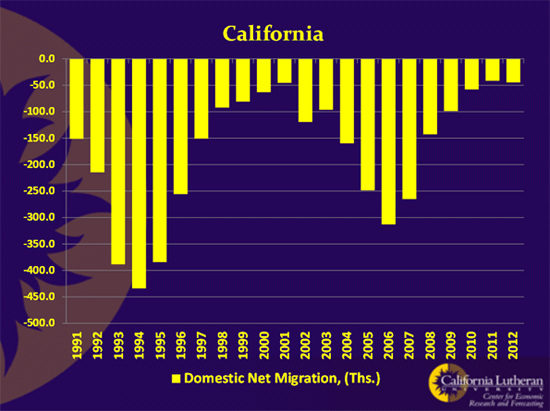
    • According to the U.S. Census, domestic migration (migration between California and other states) has been negative for 20 consecutive years. That is, for 20 years more people have left California for other states than have come to California from other states. Wake up, Jerry, this is no longer your Dad’s state – or that of his successor, Ronald Reagan. This is a big change from when Brown was elected governor the first time.  At that time, California was a magnet.  It had a vibrant economy, one with opportunity.  California was a place where you could have a career, afford a home, raise a family.  It was where the American Dream was realized.
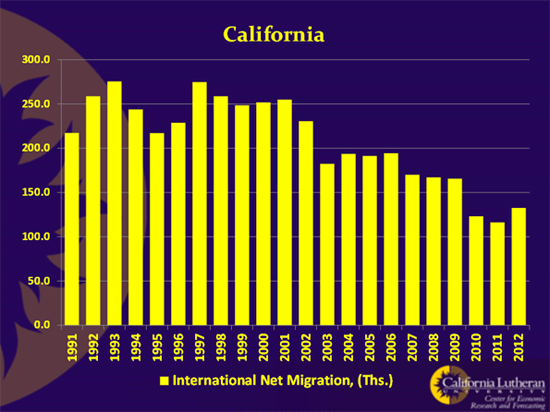
    • How about the magnetic attraction for immigrants from all over the world? According to the Census Bureau, international migration to California is way down.  The number of California international immigrants has been declining for a decade at least.  Indeed, in recent years there have been about half as many international immigrants to California than we saw in the 1990s.  Over the past decade, the number of foreign born increased more in Houston than the Bay Area and Los Angeles put together. Opportunity, not  “attractiveness”, drives people to move.
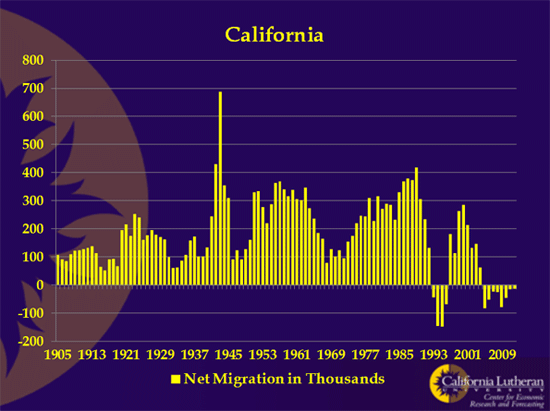
    • The result of negative domestic migration and falling international migration is the total migration to California has been negative in each of the past eight years.  More people have left California than have come to California for eight consecutive years. 
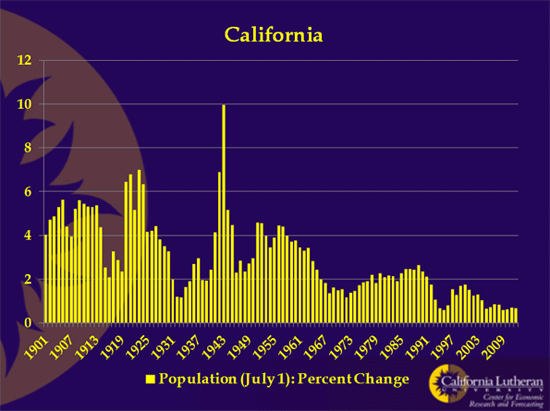
    • California’s migration trends combined with falling birth rates has resulted in the lowest sustained population growth rates that California has seen.

    The data are clear: Brown’s assertions have no basis in fact.  California – with the exception only recently of the Bay Area – is not a magnet. California is not "incredibly attractive and prosperous."  People are not coming from all over the world. California may beckon, but more are leaving, and those here are having fewer children. California’s seductive charms go only so far.

    I don’t know if I’d prefer that Brown was delusional or lying. On the one hand, policy made from a delusional analysis of the world is sure to be bad policy. Brown, for example, may convince himself that Twitter, Google, and Facebook are the future of the California economy, without recognizing how few people, particularly from the working class or historically disadvantaged minorities, they employ. On the other hand, Brown is very skilled in the political arts. If someone as skilled as he has to resort to such outright misdirection, we may be in worse shape than I think.

    Bill Watkins is a professor at California Lutheran University. and runs the Center for Economic Research and Forecasting, which can be found at clucerf.org.

    Jerry Brown photo by Bigstock.