Tag: California

  • Underemployment in America

    The nation’s lackluster economic performance continues to be a concern. This is evident in stubbornly high unemployment rates (See: Suburban and Urban Core Poverty: 2012 Special Report),which continue to be well above historic norms. There is another indicator, which may be even more important – underemployment. This figure, 80 percent above the unemployment rate, can be used as a measure of the “output gap,” which a Congressional Research Service (CRS) report refers to as “the rate of actual output (economic) growth compared with the rate of potential output growth.” CRS continues: “Potential output is a measure of the economy’s capacity to produce goods and services when resources (e.g., labor) are fully utilized” (Note 1).

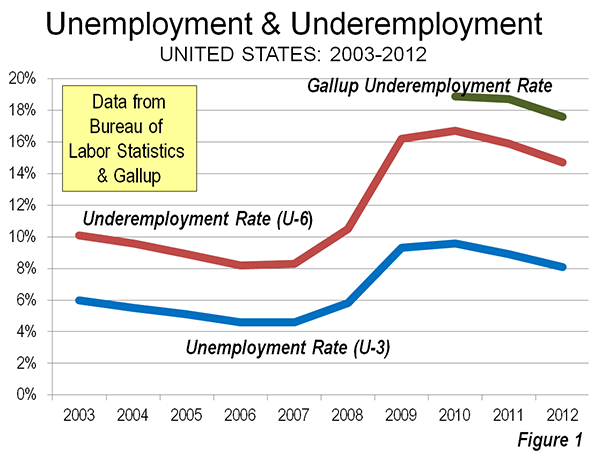
    Both rates are reported by the Department of Labor, Bureau of Labor Statistics (BLS). The national underemployment rate (BLS “U-6” labor underutilization measure) is far higher than the unemployment rate (BLS “U-3” labor underutilization measure). The 2012 underemployment rate was 14.7 percent, compared to the unemployment rate of 8.1 percent. The total unemployed population was 12.5 million in 2012, while the total underemployed population was 23.1 million.

    The difference between underemployment and unemployment comes by adding two groups: marginally attached workers and workers on part-time schedules for economic reasons. According to BLS, marginally attached workers are not counted as unemployed because they have not looked for work within the last four weeks, but they have sought work within the last year and are available for employment. Marginally attached workers include “discouraged” workers, who are not looking for work “because they believe there are no jobs available or there are none for which they would qualify.” In 2012, there were approximately 2.5 million marginally attached workers, including 900,000 “discouraged” workers.

    However, there was a much larger number of involuntary part time workers, at 8.1 million in 2012. This is nearly two-thirds of the 12.5 million workers unemployed in 2012.

    The number of underemployed may be higher. Gallup estimated the nation’s underemployment rate at 17.4 percent in August, well above the BLS August figure of 14.7 percent. The Gallup estimate would place underemployed workers at more than 27 million. This is approximately equal to all of the combined employment in the first and second largest states, California and Texas, as well as Colorado (Figure 1).
    Indeed, the number of underemployed could be higher yet. Economists Richard Vedder, Christopher Denhart, and Jonathan Robe at the Center for College Affordability and Productivity have estimated that 48 percent of employed college graduates hold jobs that do not require college degrees, using BLS data. None of these, as long as they are full time employees, would be included in the underemployment figures.

    Underemployment by State

    In addition to its monthly national estimates, BLS provides quarterly, year-on-year estimates by state, but only for Los Angeles County and New York City below the state level. Data is shown for 2006, the year of the best underemployment rate in the last decade, 2010, with the worst underemployment rate and the most recent year for which data is available, ending June 30, 2013 (Table).

    Underemployment Rates 
    by State, Los Angeles County & New York City
      2006 2010 2013q2* Rank
    United States 8.2% 16.7% 14.3%  
    Alabama 7.3% 17.3% 13.0% 22
    Alaska 11.8% 14.3% 12.4% 16
    Arizona 7.6% 18.4% 15.7% 42
    Arkansas 9.1% 14.5% 13.6% 25
    California 9.1% 22.1% 18.3% 50
    Colorado 7.9% 15.4% 13.8% 28
    Connecticut 7.8% 15.7% 14.6% 37
    Delaware 6.4% 14.3% 14.1% 30
    District of Columbia 9.8% 14.0% 14.1% 30
    Florida 6.2% 19.3% 15.1% 39
    Georgia 8.1% 17.9% 15.6% 40
    Hawaii 6.2% 16.9% 11.4% 12
    Idaho 6.9% 16.3% 13.6% 25
    Illinois 8.1% 17.5% 16.1% 47
    Indiana 8.1% 17.4% 14.5% 36
    Iowa 6.7% 11.6% 9.5% 5
    Kansas 7.4% 12.4% 10.9% 9
    Kentucky 9.3% 16.4% 14.3% 34
    Louisiana 8.1% 12.9% 12.5% 18
    Maine 8.2% 15.2% 14.2% 32
    Maryland 6.5% 13.0% 12.0% 15
    Massachusetts 8.2% 14.3% 13.3% 23
    Michigan 12.2% 21.0% 16.1% 47
    Minnesota 7.9% 13.8% 11.2% 11
    Mississippi 10.2% 17.6% 15.8% 45
    Missouri 8.0% 15.8% 12.4% 16
    Montana 6.9% 14.9% 12.7% 20
    Nebraska 6.1% 8.6% 8.7% 3
    Nevada 6.8% 23.6% 19.0% 51
    New Hampshire 6.1% 11.8% 11.1% 10
    New Jersey 7.8% 15.7% 15.7% 42
    New Mexico 7.5% 15.6% 13.7% 27
    New York 7.7% 14.8% 14.2% 32
    North Carolina 8.6% 17.4% 15.6% 40
    North Dakota 6.2% 7.4% 6.2% 1
    Ohio 9.7% 16.9% 13.5% 24
    Oklahoma 7.3% 11.4% 10.0% 6
    Oregon 10.4% 20.0% 16.9% 49
    Pennsylvania 8.0% 14.7% 13.8% 28
    Rhode Island 8.9% 19.2% 15.9% 46
    South Carolina 10.8% 18.1% 15.0% 38
    South Dakota 6.2% 9.7% 7.8% 2
    Tennessee 8.7% 16.6% 14.3% 34
    Texas 8.6% 14.4% 11.6% 13
    Utah 5.8% 15.1% 10.5% 7
    Vermont 6.4% 12.5% 10.5% 7
    Virginia 6.0% 12.9% 11.6% 13
    Washington 9.4% 18.4% 15.7% 42
    West Virginia 8.8% 14.0% 12.5% 18
    Wisconsin 8.1% 14.8% 12.9% 21
    Wyoming 5.8% 11.5% 9.0% 4
    Los Angeles County 9.1% 24.3% 20.5%
    New York City 8.7% 15.6% 15.1%
    Source: Bureau of Labor Statistics
    *2013q3: Year ended June 30, 2013


    Worst Performing States

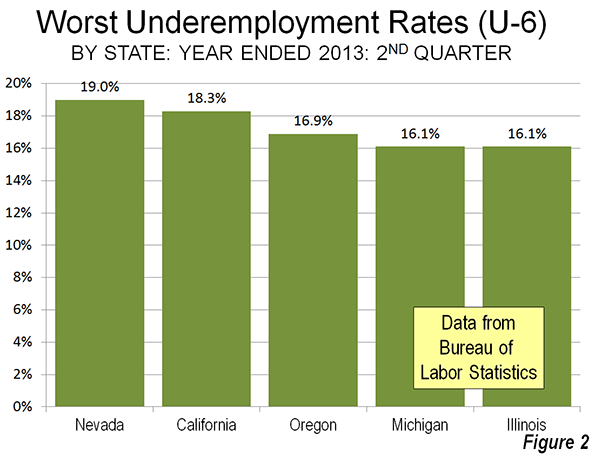
    Underemployment in the states is highest in some Western and Midwestern states. For the 12 months ended June 30, Nevada had the highest underemployment rate, at 20.3 percent. California was second, at 19.3 percent, while Oregon had the third highest underemployment rate, at 16.9 percent. Michigan and Illinois were tied for fourth highest, at 16.1 percent (Figure 2).
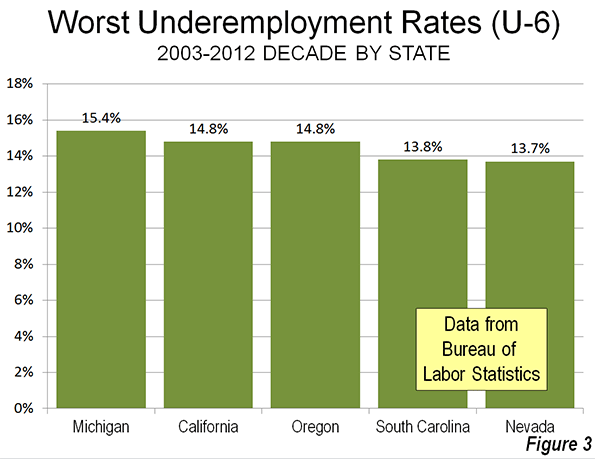
    Over the past decade (2003 through 2012), four of these states were among the five with the highest underemployment rates. Michigan, hard hit by manufacturing losses, had the highest average underemployment rate (15.6 percent), followed by California and Oregon (both at 14.8 percent), South Carolina (13.8 percent) and Nevada (13.7 percent). For the most part, underemployment has become intractable in these states. Only Nevada, with its precipitous decline from the housing crisis ranked better than 40th worst in underemployment in any year between 2003 and 2012 (Figure 3).
    Best Performing States

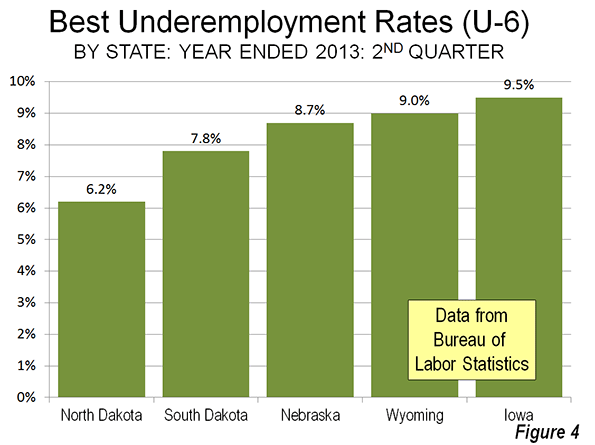
    The best underemployment rates were literally concentrated in five adjacent states with strong energy sector states, principally in the Great Plains. North Dakota led the nation for the year ended June 30, 2013, with an underemployment rate of 6.2 percent, less than one-half the national rate (14.7 percent) and less than one-third the rates of Nevada and California. North Dakota’s neighbor to the south, South Dakota had the second best rate, at 7.8 percent, while   Nebraska ranked third at 8.7 percent. On Nebraska’s western border, Wyoming, the only non-Plains state in the top five, ranked fourth with an underemployment rate of 9.0 percent. Nebraska’s eastern neighbor, Iowa, ranked fifth, at 9.5 percent (Figure 4).
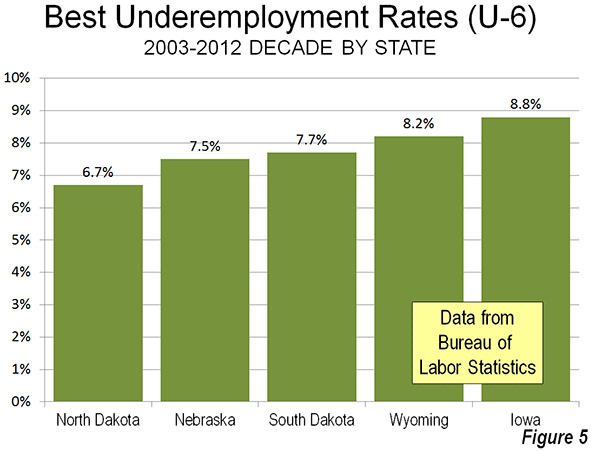
    As with the states with the worst underemployment rates over the last decade, those with the lowest  current figure also did best from 2003 and 2012. North Dakota is again number one, with an underemployment rate of 6.7 percent. Nebraska (7.5 percent), South Dakota (7.7 percent) and Wyoming (8.2 percent) follow, with New Hampshire ranking fifth best, at 8.8 percent (Figure 5).
    Underemployment in New York City and Los Angeles County

    For the year ended June 30, 2013, the city of New York had an underemployment rate of 15.1 percent, somewhat above the national rate of 14.3 percent. Over the past decade, the state of New York’s underemployment rate has been lower than that of the city in every year.  

    Los Angeles County is the largest county in the United States and if it were a state would rank eighth in population, between Ohio and Georgia. Further, it Los Angeles County were a state, it would have had the worst underemployment rate in every year from the 2008 to the present. For the year ended June 30 2013, Los Angeles County had an underemployment rate of 20.8 percent, nearly 1/2 higher than the national underemployment rate 14.7 percent and above the highest state rate of 20.3 percent in Nevada.

    Closing the Productivity Gap

    The productivity gap that results from underemployment constrains the US economy at a time of unusually severe financial challenges. College graduates face not only a grim employment market, but have student loan repayments that require good jobs. The nation continues to spend more than it collects in taxes. The inability of state and local governments to fund their government employee pension programs could lead, in the worst case, to much higher taxes or severe service cutbacks.

    Yet things could get worse. The soon to be implemented “Patient Protection and Affordable Care Act” (“Obamacare”) has a built-in incentives for employers to shift workers to part time status (weekly schedule of fewer than 30 hours of work per week). The law exempts them from providing health insurance for employees who work part time and so some establishments are shifting full time employees to part time status. Others establishments may substitute hiring part time employees instead of full time to reduce their expenses. This incentive is not just being executed by private companies seeking to maintain profitability. It extends to state and local government agencies, which unlike the federal government, must balance their books each year. According to a running of enterprises announcing shifts to part-time by Investors Business Daily, more than 75 percent are government agencies.

    All of this points to two important policy implications. The first is the necessity of focusing on the underemployment measure, the improvement of which is so crucial to maintaining and improving the standard of living and reducing poverty (by reducing the productivity gap). The second is that, with such a focus, policy makers from Washington to Sacramento, Lansing, and Carson City must pursue policies that encourage investment and employment.

    Wendell Cox is a Visiting Professor, Conservatoire National des Arts et Metiers, Paris and the author of “War on the Dream: How Anti-Sprawl Policy Threatens the Quality of Life.

    Note 1: A detailed comparison of the unemployment (U-3) and underemployment (U-6) rates is provided by economist Ed Dolan. A useful chart comparing the two indicators, with numbers from June 2012 will be found on qz.com.

    Note 2: Vedder, Denhart and Robe also suggest the possibility of “over-investment,” as more students may have been encouraged to higher education levels than there are likely to be correspondingly appropriate jobs. The extent of such over-investment is not known.

    Unemployed woman photo by BigStockPhoto.com.

  • Fixing California: The Green Gentry’s Class Warfare

    Historically, progressives were seen as partisans for the people, eager to help the working and middle classes achieve upward mobility even at expense of the ultrarich. But in California, and much of the country, progressivism has morphed into a political movement that, more often than not, effectively squelches the aspirations of the majority, in large part to serve the interests of the wealthiest.

    Primarily, this modern-day program of class warfare is carried out under the banner of green politics. The environmental movement has always been primarily dominated by the wealthy, and overwhelmingly white, donors and activists. But in the past, early progressives focused on such useful things as public parks and open space that enhance the lives of the middle and working classes. Today, green politics seem to be focused primarily on making life worse for these same people.

    In this sense, today’s green progressives, notes historian Fred Siegel, are most akin to late 19th century Tory radicals such as William Wordsworth, William Morris and John Ruskin, who objected to the ecological devastation of modern capitalism, and sought to preserve the glories of the British countryside. In the process, they also opposed the “leveling” effects of a market economy that sometimes allowed the less-educated, less well-bred to supplant the old aristocracies with their supposedly more enlightened tastes.

    The green gentry today often refer not to sentiment but science — notably climate change — to advance their agenda. But their effect on the lower orders is much the same. Particularly damaging are steps to impose mandates for renewable energy that have made electricity prices in California among the highest in the nation and others that make building the single-family housing preferred by most Californians either impossible or, anywhere remotely close to the coast, absurdly expensive.

    The gentry, of course, care little about artificially inflated housing prices in large part because they already own theirs — often the very large type they wish to curtail. But the story is less sanguine for minorities and the poor, who now must compete for space with middle-class families traditionally able to buy homes. Renters are particularly hard hit; according to one recent study, 39 percent of working households in the Los Angeles metropolitan area spend more than half their income on housing, as do 35 percent in the San Francisco metro area — well above the national rate of 24 percent.

    Similarly, high energy prices may not be much of a problem for the affluent gentry most heavily concentrated along the coast, where a temperate climate reduces the need for air-conditioning. In contrast, most working- and middle-class Californians who live further inland, where summers can often be extremely hot, and often dread their monthly energy bills.

    The gentry are also spared the consequences of policies that hit activities — manufacturing, logistics, agriculture, oil and gas — most directly impacted by higher energy prices. People with inherited money or Stanford degrees have not suffered much because since 2001 the state has created roughly half the number of mid-skilled jobs — those that generally require two years of training after high-school — as quickly as the national average and one-tenth as fast as similar jobs in archrival Texas.

    In the past, greens and industry battled over such matters, which led often to reasonable compromises preserving our valuable natural resources while allowing for broad-based economic expansion. During good economic times, the regulatory vise tended to tighten, as people worried more about the quality of their environment and less about jobs. But when things got tough — as in the early 1990s — efforts were made to loosen up in order to produce desperately needed economic growth.

    But in today’s gentry-dominated era, traditional industries are increasingly outspent and out maneuvered by the gentry and their allies. Even amid tough times in much of the state since the 2007 recession — we are still down nearly a half-million jobs — the gentry, and their allies, have been able to tighten regulations. Attempts even by Gov. Jerry Brown to reform the California Environmental Quality Act have floundered due in part to fierce gentry and green opposition.

    The green gentry’s power has been enhanced by changes in the state’s legendary tech sector. Traditional tech firms — manufacturers such as Intel and Hewlett-Packard — shared common concerns about infrastructure and energy costs with other industries. But today tech manufacturing has shrunk, and much of the action in the tech world has shifted away from building things, dependent on energy, to software-dominated social media, whose primary profits increasingly stem from selling off the private information of users. Servers critical to these operations — the one potential energy drain — can easily be placed in Utah, Oregon or Washington where energy costs are far lower.

    Even more critical, billionaires such as Google’s Eric Schmidt, hedge fund manager Thomas Steyer and venture firms like Kleiner Perkins have developed an economic stake in “green” energy policies. These interests have sought out cozy deals on renewable energy ventures dependent on regulations mandating their use and guaranteeing their prices.

    Most of these gentry no doubt think what they are doing is noble. Few concern themselves with the impact these policies have on more traditional industries, and the large numbers of working- and middle-class people dependent on them. Like their Tory predecessors, they are blithely unconcerned about the role these policies are playing in accelerating California’s devolution into an ever more feudal society, divided between the ultrarich and a rapidly shrinking middle class.

    Ironically, the biggest losers in this shift are the very ethnic minorities who also constitute a reliable voter block for Democratic greens. Even amid the current Silicon Valley boom, incomes for local Hispanics and African-Americans, who together account for one-third of the population, have actually declined — 18 percent for blacks and 5 percent for Latinos between 2009 and 2011, prompting one local booster to admit that “Silicon Valley is two valleys. There is a valley of haves, and a valley of have-nots.”

    Sadly, the opposition to these policies is very weak. The California Chamber of Commerce is a fading force and the state Republican Party has degenerated into a political rump. Business Democrats, tied to the traditional industrial and agricultural base, have become nearly extinct, as the social media oligarchs and other parts of the green gentry, along with the public employee lobby, increasingly dominate the party of the people. Some recent efforts to tighten the regulatory knot in Sacramento have been resisted, helped by the governor and assisted by the GOP, but the basic rule-making structure remains, and the government apparat remains highly committed to an ever more expansive planning regime.

    Due to the rise of the green gentry, California is becoming divided between a largely white and Asian affluent coast, and a rapidly proletarianized, heavily Hispanic and African-American interior. Palo Alto and Malibu may thrive under the current green regime, and feel good about themselves in the process, but south Los Angeles, Oakland, Fresno and the Inland Empire are threatened with becoming vast favelas.

    This may constitute an ideal green future — with lower emissions, population growth and family formation — for whose wealth and privilege allow them to place a bigger priority on nature than humanity. But it also means the effective end of the California dream that brought multitudes to our state, but who now may have to choose between permanent serfdom or leaving for less ideal, but more promising, pastures.

    Joel Kotkin is executive editor of NewGeography.com and Distinguished Presidential Fellow in Urban Futures at Chapman University, and a member of the editorial board of the Orange County Register. He is author of The City: A Global History and The Next Hundred Million: America in 2050. His most recent study, The Rise of Postfamilialism, has been widely discussed and distributed internationally. He lives in Los Angeles, CA.

    This piece originally appeared at U-T San Diego.


  • Cashing in on So Cal Culture

    Southern California has always been an invented place. Without a major river, a natural port or even remotely adequate water, the region has always thrived on reinventing itself – from cow town to agricultural hub to oil city, Tinsel Town and the “Arsenal of Democracy.”

    Today, the need for the region to reinvent itself yet again has never been greater. Due in large part to regulatory pressures, as well as competitive forces both global and national, many industries that have driven the Southland economy – notably, aerospace, garments and oil – are under assault. A high cost of living, particularly for housing, stymies potential in-migration and motivates industries to look elsewhere to locate or expand.

    As a result, virtually every key Southern California industry has been either stagnating or losing ground to competitors. More important, the area in the past decade has lost much of its appeal as a destination for both immigrants and young people, drying up a huge source of potential innovation.

    To put it in vaudeville terms, Southern California needs a new shtick. We must look to leverage our natural advantages (beyond just our climate) into a new economic paradigm that can withstand competition from the rest of the world and the rest of the country. This opportunity is best seen as the commercialization of culture. These include, as one recent Los Angeles County Economic Development Corp. report stated, “businesses and individuals involved in producing cultural, artistic and design goods and services.”

    This is not largely a matter of museums or concert venues. When it comes to the “fine” arts, Southern California is an increasingly respectable player, but cannot compete on equal footing with London, Paris, New York or Chicago, locales with far older endowments and, arguably, more people with refined artistic tastes. There is also growing competition from cash-rich wannabe cities, from Houston and Dallas to Shanghai, Beijing or Singapore. Fine art has always been for sale to the highest bidder.

    Where Southern California retains a decisive edge is in the popular arts – from casual fashion and industrial design to movies, television and commercials – which could provide the basis for a broad-based economic revival. This requires political and business leadership to shift from their obsession with downtown Los Angeles and dense building projects to a focus on nurturing long-term, sustainable employment.

    This demands that we do everything to maintain the quality of life, largely a matter of our region’s spread-out neighborhoods, that has always been our primary calling card to creative talent. Los Angeles, in particular, boasts by far the largest concentration of artists in the country. Overall, the “creative industries” account, according to a recent Otis Institute study, for roughly 337,000 direct jobs in the Los Angeles-Orange County region. Adding indirect employment, the study estimated these industries employed more than 642,000 people, more than the total employment of the Sacramento area.

    Each of these economic drivers deserves a closer look:

    Fashion

    Over the past quarter century, Los Angeles, with roughly three times as many establishments, has replaced New York as the nation’s garment capital. Most of these companies are small, but, together, the fashion industry across the five-county Southland region employs more than 100,000 people.

    In recent years, apparel manufacturing has been in decline, losing some 40,000 jobs. But there has been growth in such areas as clothing design and merchandising. The region has become the de facto capital for “fast forward” fashion, paced by firms such as Forever 21 Inc., Wet Seal and Papaya. Orange County, capital of the surfwear industry, is home to firms such as Oakley, Volcom, Hurley, Gotcha International, O’Neill, Raj Manufacturing, Mossimo and Stussy.

    These firms, and the businesses serving them, are expected to experience more growth in the coming years, according to the U.S. Bureau of Labor Statistics. Aided by the “onshoring” trend – returning jobs from overseas – and a demand for quicker product turnaround, the Southern California apparel industry seems poised to solidify its hold over the country’s fashions over the coming years.

    Entertainment

    This fashion industry derives much of its success from a link with Hollywood and the rest of the entertainment world. Accounting for more than 40 percent of all creative industry jobs, the entertainment complex is increasingly critical to the region’s resurgence. Much concern has been raised about the future of this key industry, whose growth has slowed, due in part to massive tax incentives from other states and countries.

    Despite this, the industry has been on something of an upswing recently, adding more than 4,600 jobs last year, a gain of 3.7 percent. At 129,700 jobs, employment in the industry is now at its highest level in four years but still tantalizingly below its levels in 2004 (132,200 jobs) and 1999 (146,300 jobs). Growth derives not so much from studio employment but from the ranks of independent contractors, now more than 85,000, well above the prerecession level. Nearly 80 percent of all new entertainment jobs are from the ranks of independent proprietors.

    Digital Arts

    The stabilization, and hopefully resurgence, of the entertainment sector could boost other industries, like digital media, hoping to play off the region’s extraordinary concentration of artists, specialists and story-tellers. Historically, Southern California, in large part due to a relative shortage of venture capital, has been playing catch-up with the Bay Area, and to a lesser extent, Seattle.

    The key to the future is combining other assets besides Hollywood, such as having the largest number of engineers – 70,000 – of any area in the country. Much hope has been placed on the rise of the much-ballyhooed “Silicon Beach” that follows the coastline, largely in Los Angeles, which some people claim is becoming a real competitor to Silicon Valley.

    Yet this is not the first time we have heard this story. Similar growth took place in past digital media waves, only to see reductions as the inevitable cratering takes place during market shake-outs. But employing the strong ties to the Hollywood creative community, there is the real prospect for the region to achieve a critical mass that will allow digital entrepreneurs to remain comfortably here rather than head up to Silicon Valley.

    Industrial Design

    Even as manufacturing employment has declined over time, improving recently to a level of mere stagnation recently, Southern California has maintain a leading position in industrial design. This field is expected to grow, both nationally and in the Southland.

    The area has maintained its leadership as center of automotive design, with studios such as the BMW Design Works, in Ventura, and Mercedes Advanced Design, in Carlsbad, as well as GM’s Advance Design Studio in North Hollywood. The fact that many international firms – for example, Hyundai (Fountain Valley), Kia (Irvine), Honda and Toyota – maintain their North American headquarters in the Southland provides a critical link to the expanding global auto market.

    Primacy in industrial design also extends into other product lines, such as furniture and household furnishings. If this design edge can be combined with automation and the onshoring of jobs, Southern California could enjoy a broad-based resurgence more sustainable than those of more-narrowly based economies, such as in New York or the Bay Area.

    Design of Life

    As we have seen over the past decade, local industries such as entertainment – not to mention fields like fashion, digital and industrial design – are going to be subject to enormous pressure from both home and abroad. China, for example, is building a massive $8.2 billion film studio in a concerted drive to replace Hollywood as the center of the world entertainment industry.

    If we lose our stranglehold on entertainment and other creative industries, there is very little hope for a regional resurgence. We lack the deep digital bench and funding sources of the Bay Area, or New York’s financial industry and its ability to dominate the news media. We can never be as cheap, or business friendly, as our emerging cultural rivals in the South, such as New Orleans, Nashville, Tenn., Austin, Texas, or Dallas, nor can we offer the kind of bargain-basement deals that desperate places, such as Detroit or Las Vegas, might offer to creative types.

    This means we have to focus on preserving and improving those very things – our cultural legacy and a predominately low-rise and flexible-work lifestyle – that differentiates us from far more congested, structured and often far-less pleasant locales like New York – and, even more so, China. In the past, this region has won the “design wars” by being itself, not by trying to create a faux vision that seeks to mimic Manhattan or Shanghai. Ultimately, Southern California can win only by playing the same aces that for generations have led the creative and the questioning to settle in our sun-drenched metropolis.

    Joel Kotkin is executive editor of NewGeography.com and Distinguished Presidential Fellow in Urban Futures at Chapman University, and a member of the editorial board of the Orange County Register. He is author of The City: A Global History and The Next Hundred Million: America in 2050. His most recent study, The Rise of Postfamilialism, has been widely discussed and distributed internationally. He lives in Los Angeles, CA.

    This piece originally appeared at The Orange County Register.

  • California’s New Feudalism Benefits a Few at the Expense of the Multitude

    California has been the source of much innovation, from agribusiness and oil to fashion and the digital world. Historically much richer than the rest of the country, it was also the birthplace, along with Levittown, of the mass-produced suburb, freeways, much of our modern entrepreneurial culture, and of course mass entertainment. For most of a century, for both better and worse, California has defined progress, not only for America but for the world.

    As late as the 80s, California was democratic in a fundamental sense, a place for outsiders and, increasingly, immigrants—roughly 60 percent of the population was considered middle class. Now, instead of a land of opportunity, California has become increasingly feudal. According to recent census estimates,  the state suffers some of the highest levels of inequality in the country. By some estimates, the state’s level of inequality compares with that of such global models as  the Dominican Republic, Gambia, and the Republic of the Congo.

    At the same time, the Golden State now suffers the highest level of poverty in the country—23.5 percent compared to 16 percent nationally—worse than long-term hard luck cases like Mississippi. It is also now home to roughly one-third of the nation’s welfare recipients, almost three times its proportion of the nation’s population.

    Like medieval serfs, increasing numbers of Californians are downwardly mobile, and doing worse than their parents: native born Latinos actually have shorter lifespans than their parents, according to one recent report. Nor are things expected to get better any time soon. According to a recent Hoover Institution survey, most Californians expect their incomes to stagnate in the coming six months, a sense widely shared among the young, whites, Latinos, females, and the less educated.

    Some of these trends can be found nationwide, but they have become pronounced and are metastasizing more quickly in the Golden State. As late as the 80s, the state was about as egalitarian as the rest of the country. Now, for the first time in decades, the middle class is a minority, according to the Public Policy Institute of California.

    The Role of the Tech Oligarchs.

    California produces more new billionaires than any place this side of oligarchic Russia or crony capitalist China. By some estimates the Golden State is home to one out of every nine of the world’s billionaires. In 2011 the state was home to 90 billionaires, 20 more than second place New York and more than twice as many as booming Texas.

    The state’s digital oligarchy, surely without intention, is increasingly driving the state’s lurch towards feudalism. Silicon Valley’s wealth reflects the fortunes of a handful of companies that dominate an information economy that itself is increasingly oligopolistic.  In contrast to the traditionally conservative or libertarian ethos of the entrepreneurial class, the oligarchy is increasingly allied with the nominally populist Democratic Party and its regulatory agenda. Along with the public sector, Hollywood, and their media claque, they present California as “the spiritual inspiration” for modern “progressives” across the country.

    Through their embrace of and financial support for the state’s regulatory regime, the oligarchs have made job creation in non tech-businesses—manufacturing, energy, agriculture—increasingly difficult through “green energy” initiatives that are also sure to boost already high utility costs. One critic, state Democratic Senator Roderick Wright from heavily minority Inglewood, compares the state’s regulatory regime to the “vig” or high interest charged by the Mafia, calling it a major reason for disinvestment in many industries.

    Yet even in Silicon Valley, the expansion of prosperity has been extraordinarily limited. Due to enormous losses suffered in the current tech bubble, tech job creation in Silicon Valley has barely reached its 2000 level. In contrast, previous tech booms, such as the one in the 90s, doubled the ranks of the tech community. Some, like UC Berkeley economist Enrico Moretti, advance the dubious claim that those jobs are more stable than those created in Texas. But even if we concede that point for the moment,  the Valley’s growth primarily benefits its denizens but not most Californians. Since the recession, California remains down something like 500,000 jobs, a 3.5 percent loss, while its Lone Star rival has boosted its employment by a remarkable 931,000, a gain of more than 9 percent.

    Much of this has to do with the changing nature of California’s increasingly elite-driven economy. Back in the 80s and even the 90s, the state’s tech sector produced industrial jobs that sparked prosperity not only in places like Palo Alto, but also in the more hardscrabble areas in San Jose and even inland cities such as Sacramento. The once huge California aerospace industry, centered in Los Angeles, employed hundreds of thousands, not only engineers but skilled technicians, assemblers, and administrators.

    This picture has changed over the past decade. California’s tech manufacturing sector has shrunk, and those employed in Silicon Valley are increasingly well-compensated programmers, engineers and marketers. There has been little growth in good-paying blue collar or even middle management jobs. Since 2001 state production of “middle skill” jobs—those that generally require two years of training after high-school—have grown roughly half as quickly as the national average and one-tenth as fast as similar jobs in arch-rival Texas.

    “The job creation has changed,” says Leslie Parks, a long-time San Jose economic development official. “We used to be the whole food chain and create all sorts of middle class jobs. Now, increasingly, we don’t design the future—we just think about it. That makes some people rich, but not many.”

    In the midst of the current Silicon Valley boom, incomes for local Hispanics and African-Americans, who together account for one third of the population, have actually declined—18 percent for blacks and 5 percent for Latinos between 2009 and 2011, prompting one local booster to admit that “Silicon Valley is two valleys. There is a valley of haves, and a valley of have-nots.”

    The Geography of Inequality

    Geography, caste, and land ownership increasingly distinguish California’s classes from one another. As Silicon Valley, San Francisco, and the wealthier suburbs in the Bay Area have enjoyed steady income growth during the current bubble, much of the state, notes economist Bill Watkins, endures Depression-like conditions, with stretches of poverty more reminiscent of a developing country than the epicenter of advanced capitalism.

    Once you get outside the Bay Area, unemployment in many of the state’s largest counties—Sacramento, Los Angeles, Riverside, San Bernardino, Fresno, and Oakland—soars into the double digits. Indeed, among the 20 American cities with the highest unemployment rates, a remarkable 11 are in California, led by Merced’s mind-boggling 22 percent rate.

    This amounts to what conservative commentator Victor Davis Hanson has labeled “liberal apartheid,” a sharp divide between a well-heeled, mostly white and Asian population located along the California coast, and a largely poor, heavily Latino working class in the interior. But the class divide is also evident within  the large metro areas, despite their huge concentrations of affluent individuals. Los Angeles, for example, has the third highest rate of inequality of the nation’s 51 largest metropolitan areas, and the Bay Area ranks seventh.

    The current surge of California triumphalism, trumpeted mostly by the ruling Democrats and their eastern media allies, seems to ignore the reality faced by residents in many parts of the state. The current surge of wealth among the coastal elites, boosted by rises in property, stock, and other assets, has staved off a much feared state bankruptcy. Yet the the state’s more intractible problems cannot be addressed if growth remains restricted to a handful of favored areas and industries. This will become increasingly clear when, as is inevitable, the current tech and property boom fades, depriving the state of the taxes paid by high income individuals.

    The gap between the oligarchic class and everyone else seems increasingly permanent. A critical component of assuring class mobility, California’s once widely admired public schools were recently ranked near the absolute bottom in the country. Think about this: despite the state’s huge tech sector, California eighth graders scored 47th out of the 51 states in science testing. No wonder Mark Zuckerberg and other oligarchs are so anxious to import “techno coolies” from abroad.

    As in medieval times, land ownership, particularly along the coast, has become increasingly difficult for those not in the upper class. In 2012, four California markets—San Jose, San Francisco, San Diego, and Los Angeles—ranked as the most unaffordable relative to income in the nation. The impact of these prices falls particularly on the poor. According to the Center for Housing Policy and National Housing Conference, 39 percent of working households in the Los Angeles metropolitan area spend more than half their income on housing, as do 35 percent in the San Francisco metro area—both higher than 31 percent in the New York area and well above the national rate of 24 percent. This is likely to get much worse given that California median housing prices rose 31 percent in the year ending May 2013. In the Bay Area the increase was an amazing 43 percent.

    Even skilled workers are affected by these prices. An analysis done for National Core, a major developer of low income housing, found that prices in such areas as Orange County are so high that even a biomedical engineer earning more than $100,000 a year could not afford to buy a home there. This, as well as the unbalanced economy, has weakened California’s hold on aspirational families, something that threatens the very dream that has attracted  millions to the state.

    This is a far cry from the 50s and 60s, when California abounded in new owner-occupied single family homes. Historian Sam Bass Warner suggested that this constituted “the glory of Los Angeles and an expression of its design for living.” Yet today the L.A. home ownership rate, like that of New York, stands at about half the national average of 65 percent. This is particularly true among working class and minority households. Atlanta’s African-American home ownership rate is approximately 40 percent above that of San Jose or Los Angeles, and approximately 50 percent higher than San Francisco.

    This feudalizing trend is likely to worsen due to draconian land regulations that will put the remaining stock of single family houses ever further out of reach, something that seems related to a reduction in child-bearing in the state. As the “Ozzie and Harriet” model erodes, many Californians end up as modern day land serfs, renting and paying someone else’s mortgage. If they seek to start a family, their tendency is to look elsewhere, ironically even in places such as Oklahoma and Texas, places that once sent eager migrants to the Golden State.

    Breaking Down the New Feudalism: The Emerging Class Structure

    The emerging class structure of neo-feudalism, like its European and Asian antecedents, is far more complex than simply a matter of the gilded “them” and the broad “us.” To work as a system, as we can now see in California, we need to understand the broader, more divergent class structure that is emerging.

    The Oligarchs: The swelling number of billionaires in the state, particularly in Silicon Valley, has enhanced power that is emerging into something like the old aristocratic French second estate. Through public advocacy and philanthropy, the oligarchs have tended to embrace California’s “green” agenda, with a very negative impact on traditional industries such as manufacturing, agriculture, energy, and construction. Like the aristocrats who saw all value in land, and dismissed other commerce as unworthy, they believe all value belongs to those who own the increasingly abstracted information revolution that has made them so fabulously rich.

    The  Clerisy: The Oligarchs may have the money, but by themselves they cannot control a huge state like California, much less America. Gentry domination requires allies with a broader social base and their own political power. In the Middle Ages, this role was played largely by the church; in today’s hyper-secular America, the job of shaping the masses has fallen to the government apparat, the professoriat, and the media, which together constitute our new Clerisy. The Clerisy generally defines societal priorities, defends “right-thinking” oligarchs, and chastises those, like traditional energy companies, that deviate from their theology.

    The New Serfs: If current trends continue, the fastest growing class will be the permanently property-less. This group includes welfare recipients and other government dependents but also the far more numerous working poor. In the past, the working poor had reasonable aspirations for a better life, epitomized by property ownership or better prospects for their children. Now, with increasingly little prospect of advancement, California’s serfs depend on the Clerisy to produce benefits making their permanent impoverishment less gruesome. This sad result remains inevitable as long as the state’s economy bifurcates between a small high-wage, tech-oriented sector, and an expanding number of lower wage jobs in hospitality, health services, and personal service jobs. As a result, the working class, stunted in their drive to achieve the California dream, now represents the largest portion of domestic migrants out of the state.

    The Yeomanry: In neo-feudalist California, the biggest losers tend to be the old private sector middle class. This includes largely small business owners, professionals, and skilled workers in traditional industries most targeted by regulatory shifts and higher taxes. Once catered to by both parties, the yeomanry have become increasingly irrelevant as California has evolved into a one-party state where the ruling Democrats have achieved a potentially permanent, sizable majority consisting largely of the clerisy and the serf class, and funded by the oligarchs. Unable to influence government and largely disdained by the clerisy, these middle income Californians are becoming a permanent outsider group, much like the old Third Estate in early medieval times, forced to pay ever higher taxes as well as soaring utility bills and required to follow regulations imposed by people who often have little use for their “middle class” suburban values.

    The Political Implications of Neo-Feudalism

    As Marx, among others, has suggested, class structures contain within them the seeds of their dissolution. In New York, a city that is arguably as feudal as anything in California, the  emergence of mayoral candidate Bill de Blasio reflected growing  antagonism—particularly among the remaining yeoman and serf class— towards the gentry urbanism epitomized by Mayor Michael “Luxury City” Bloomberg.

    Yet except for occasional rumbling from the left, neo-feudalism likely represents the future. Certainly in California, Gov. Jerry Brown, a former Jesuit with the intellectual and political skills needed to oversee a neo-feudal society, remains all but unassailable politically. If Brown, or his policies, are to be contested, the challenge will likely come from left-wing activists who find his policies insufficiently supportive of the spending demanded by the clerisy and the serfs or insufficiently zealous in their pursuit of environmental purity.

    The economy in California and elsewhere likely will determine the viability of neo-feudalism. If a weaker economy forces state and local government budget cutbacks, there could be a bruising conflict as the various classes fight over diminishing spoils. But it’s perhaps more likely that we will see enough slow growth so that Brown will be able to keep both the clerisy and the serfs sufficiently satisfied. If that is the case, the new feudal system could shape the evolution of the American class structure for decades to come.

    Joel Kotkin is executive editor of NewGeography.com and Distinguished Presidential Fellow in Urban Futures at Chapman University, and a member of the editorial board of the Orange County Register. He is author of The City: A Global History and The Next Hundred Million: America in 2050. His most recent study, The Rise of Postfamilialism, has been widely discussed and distributed internationally. He lives in Los Angeles, CA.

    This piece originally appeared at The Daily Beast.


  • History, Landscape, Beauty on the American Freeway

    Freeways, particularly urban freeways, have had a bad press for several decades now.  They are accused of despoiling scenery, destroying habitat and causing urban sprawl.  Many observers report with glee on the latest news of a small segment of urban freeway being dismantled.

    This blanket condemnation makes it easy to overlook the remarkable contribution that these freeways have made to the American economy and to American culture.  It is hard to imagine the growth in productivity in the country during the postwar years without these roads, which vastly increased the mobility of goods and people and connected parts of the country together in ways that were unprecedented.

    The constant criticism also makes it difficult to appreciate these roads as cultural artifacts and a wonderful way to see the country.  This is all the more surprising since Americans in recent years have been discovering the rich legacy of our nation’s highways. There has been spate of books that celebrate travel on America’s pre-freeway-era highways. Many authors wax eloquent over the remaining motels, fast food restaurants and drive in theatres along US 66 or advise motorists on finding abandoned segments of roadway by passed by later highway alignments.   There has also been a remarkable surge of interest in America’s parkways, from the earliest parkways like the Bronx River Parkway in Westchester County New York, started in 1907, to parkways at the end of the parkway era in the years immediately before and after World War II when they gradually became more like freeways, for example the Arroyo Seco Parkway in Los Angeles, or the later segments of Lake Shore Drive in Chicago, the Taconic Parkway in New York State or the George Washington Parkway outside Washington.   

    America’s postwar freeways merit a similar rediscovery.   I think that one of the biggest obstacles to appreciating them has been a question of scale.  Driving along a two-lane roadway it is possible to pull off the pavement and look at an historic courthouse or a particularly interesting agricultural landscape or early gasoline station. That is not possible on a freeway. It is also true that the engineers who designed the nation’s postwar freeways were probably less conscious of the aesthetic dimensions of the roadways than the designers of the German autobahn, who set a standard for integration of landscape and roadway  never surpassed, or American designers like landscape architect Gilmore Clarke who played important role in designing the parkways of metropolitan New York.   There is, moreover, no doubt that the push to accommodate increasing traffic loads and to make freeways safer in this country has led to a certain uniformity of standards that some people find boring.  Finally, the proliferation of sound walls over the last few decades all too often makes driving through urban areas like driving through a tunnel. 

    Still, there is no better way to get a good view of the larger features of the American landscape or cityscape than looking through the windshield of an automobile rolling along a freeway at 65 miles per hour. At that speed it is often easier than on a slower road to appreciate the changes that occur in plant species as the highway climbs a steep ridge or to appreciate the way massive cuts to lower the grades on the climb over a hill that provide a graphic illustration of the underlying geology.  It might be difficult for many people to appreciate long stretches of flat country but, if a driver can put herself into the proper frame of mind, this experience can have its own rewards because of the way it accentuates the scale of the landscape. Even the billboards, which many drivers consider simply objectionable intrusions into the natural landscape, can, by their style and content, illustrate a great many regional differences.

    And fortunately, there has been over the last two decades a growing recognition of the aesthetic dimensions of freeways.   In some ways this marks a reversion to ideas that were common in the parkway era when there was almost always a conscious attempt to integrate road and landscape into a successful composition reflecting  the landscape and culture of the region through which it passed. 

    A pioneer postwar example of this push to bring conscious aesthetic design to the freeway can be seen in I-280, the Junipero Serra freeway, which runs between San Francisco and San Jose.  Here the engineers worked with Lawrence Halprin, the landscape architect, and architect Mario Ciampi to create a road that was widely considered the “most beautiful freeway in the world” when the initial segment was opened in the 1960s.  This highway, with its careful alignment, minimizing cut and fill, and the bold, sculptural concrete overpasses does little to diminish the spectacular landscape of the San Francisco Peninsula.  In fact it affords a wonderful way to experience the golden hills on one side of the roadway and the coastal range on the other, often seen in the morning or late afternoon with fog pouring over the crest.

    In recent years the highway departments in an increasing number of American states have attempted to be more attuned to the aesthetic dimensions of freeways and of the places through which the roads run.   Wildflowers now bloom in medians and margins of a great many American freeways.   In arid landscapes engineers and landscape architects have worked to preserve native plants and use them as elements in a kind of idealized desert landscape in the median and along the berms.    In one of the most impressive achievements, a twelve mile stretch of I-70 passing through the tortuously narrow Glenwood Canyon west of Denver, opened in 1992, the designers went to great length to fit the roadway into the landscape in the least obtrusive way possible.  They accomplished this by splitting the roadway alignments, reducing the section of the roadway structure to a minimum, cantilevering both alignments from the canyon walls to reduce their bulk, pushing tunnels through the most difficult spurs of land and even treating the rocks that were scarred by excavation so they would not produce jarring juxtapositions.

    Even the urban freeway, target of the most vociferous criticism, offers interesting perspectives for those willing to look.  Unlike the case in much of Europe, where planners have often attempted to create a parkway-like driving experience by providing a wide buffer between the roadway and nearby urban areas and tightly restricting new development along the highways, American freeways have become the new main streets of many cities.  Driving along the ring roads around American’s large cities can offer some of the most compelling views of these metropolitan areas. For the motorist driving along I-80, the Ohio Turnpike, there is the view from the giant viaduct crossing the Cuyahoga River.  There, 20 miles to the north, up the heavily wooded deep gash created by the river, the gleaming tip of the Key Bank Building peaks out  above the intervening ridges in clear weather, unfortunately all too rare in Northeast Ohio.  Likewise, very few urban views can compare with the panorama that suddenly unfolds for motorists as, emerging from I-376’s Fort Pitt Tunnel under Mount Washington, they suddenly burst out onto a bridge over the Monongahela River and a view of the Golden Triangle and the entire skyline of Pittsburgh. 

    A drive along a city’s freeways is often the best way to get a good grasp of a region’s economic geography.   It would be hard to miss the contrast between the view from the Indiana Toll Road across the grimy industrial landscape of steel mills and refineries just east of Chicago, on the one hand, with the landscape of heavily planted berms and expensive new houses along the Tri-State Expressway in the north suburbs.

    Many of the earliest freeways have crossed the 50 year threshold and deserve a closer look as some of the country’s most important historical and cultural artifacts.  And they provide a wonderful way to observe America’s landscape and cityscape.


    Taconic State Parkway north of New York City.  The New York area had the first and largest set of parkways in the nation.  The Taconic, running along the Taconic Mountains from the Kensico Dam in Westchester County to Chatham near Albany, was not finished until 1960, but it maintains the earlier parkway standards rather than those of the later freeway era.   Because of its careful alignment and roadway design by landscape architect Gilmore Clarke and the beauty of the rugged countryside which it runs, it remains one of the country’s great driving experiences.


    I-280, Junipero Serra freeway, south of San Francisco.  Although a much wider highway than the prewar parkways, this road, constructed in the 1960s, maintains much of the feel of the earlier parkways though the use of alignments carefully fitted into the rolling hills, integrating the road beautifully into the spectacular landscape of the San Francisco peninsula.    


    I-20 east of Birmingham Alabama.  The undulating line that marks the edge of the pine forest and the beginning of the mowed grass in the freeway margins recalls the long curving vistas of English 18th century picturesque landscape tradition. On an overcast morning the resemblance to the British landscape tradition is particularly striking.


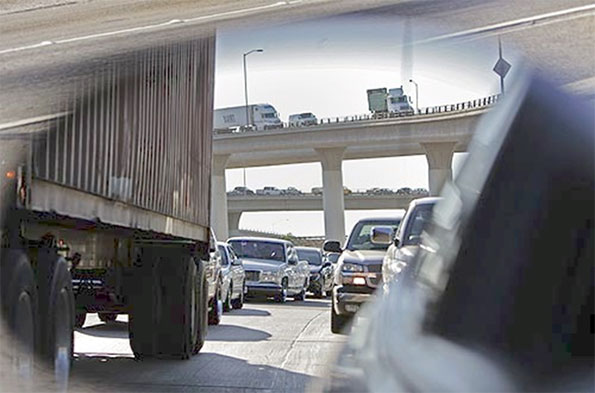
    I-10 and I-215 at Colton, California.   No place in the United States is so associated with freeways as the Los Angeles region, but actually this region has fewer lane miles of freeway than most large American metropolitan areas.  Because freeway construction pretty much stopped in the 1970s but the population continued to grow and the density rose, this region has some of the most congested roads in the country.  If there is any consolation, they offer some remarkable displays of engineering bravado and urban intensity.


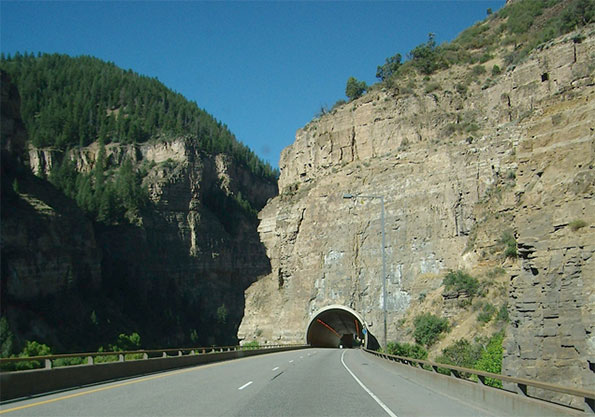
    I-70 west of Denver, Colorado.  The construction of this roadway through the Glenwood Canyon in the Rockies is both an engineering feat and an aesthetic tour de force.  By separating the alignments and cantilevering the roadway from the canyon wall, the designers were able to minimize the visual impact of the road and provide spectacular vistas for travelers.

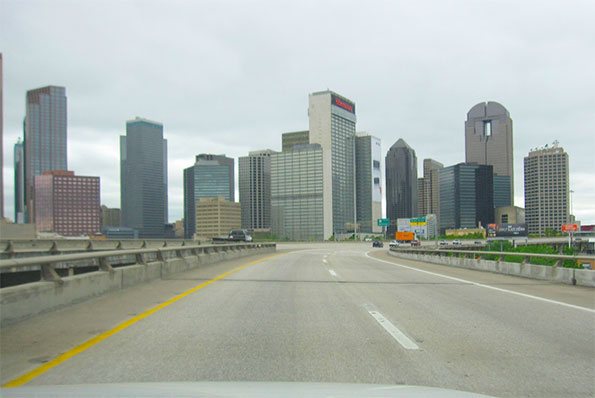
    US 75 approaching downtown Dallas.  This short piece of roadway completes a loop around downtown Dallas that allows two interstate roads to bypass downtown.  A drive around the loop provides a kaleidoscopic sequence of views of tall buildings and a highly effective orientation to downtown Dallas.


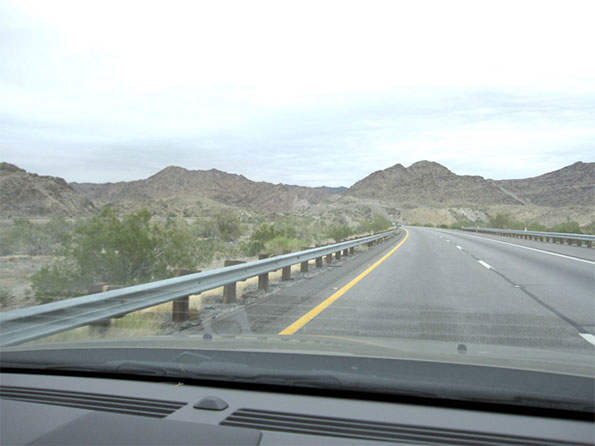
    I-10 east of Blythe Arizona.  Perhaps even more than in the East, the great distances of the American West make the freeway a lifeline for residents who live far from population centers.  The smooth roadway makes a striking contrast with the great rock outcrops and vast stretches of scrubland.


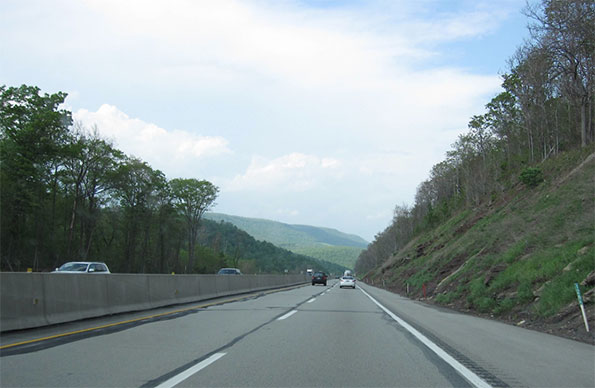
    I-80 and I-94 Pennsylvania Turnpike north of Pittsburgh.  The era of the parkway ended at about the time of the second world war as a new generation of freeways started to emerge.  One of the interesting features of the interstate system today is the way it provides testimony to the shifting ideals of roadway design.  Although large stretches of the Pennsylvania turnpike, whose initial segment opened in 1940, have been upgraded, the narrow right of ways and steep gradients of the older portions of the road as well as the streamlined design of the overpasses recall the transition from one age to the next.


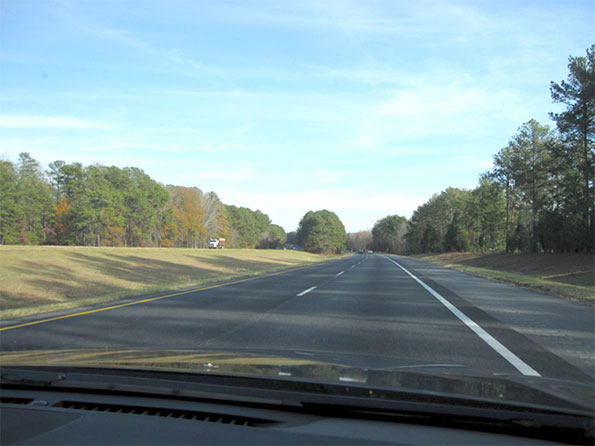
    I-20 between Covington and Augusta Georgia.  A classic piece of interstate road with the smooth ribbon of pavement gliding effortlessly through a landscape of low hills and dense forest.


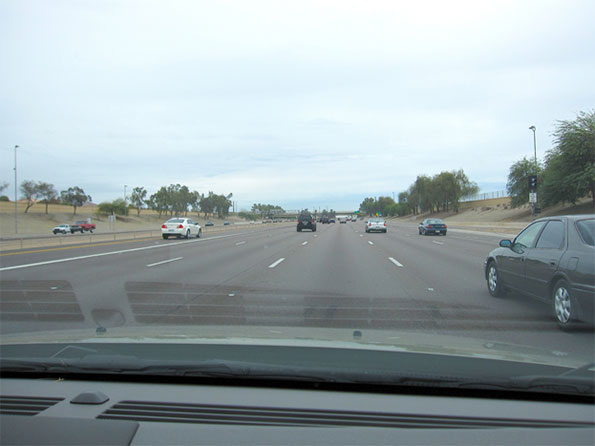
    I-10 west of downtown Phoenix.  The state of Arizona has been particularly active in trying to create an appropriate landscape for the state’s highways.   They have pioneered techniques for saving cacti and other native species in the path of the roadway and then re-installing them alongside the new roads to create an idealized desert landscape.


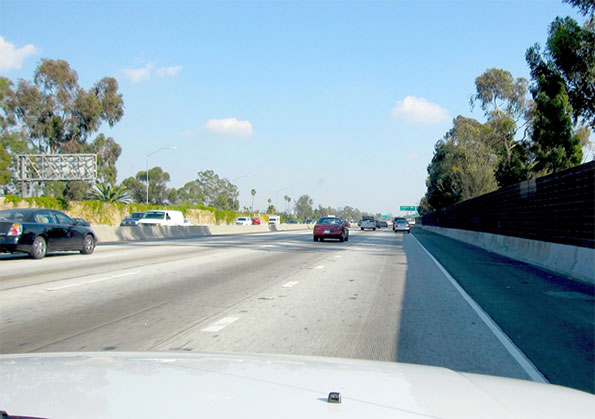
    I-10 approaching downtown Los Angeles, California.  The advent of sound walls has changed the driving experience in some profound ways.  In places it has severed the visual connection between the roadway and the city around it.  On the other hand, in some places, as here, when vines and other plants grow up over the walls and trees overtop them, the result is a curious but not entirely unpleasant sensation of floating through a city without being part of it.  Until the traffic backs up, of course.


    I-27 between Amarillo and Lubbock, Texas.  The long flat stretches of the Llano Estacado of northwest Texas produce an almost hypnotic effect.  Even highway signs and telephone poles take on a monumental character, and train elevators loom up in the distance like the skyline of a great city.


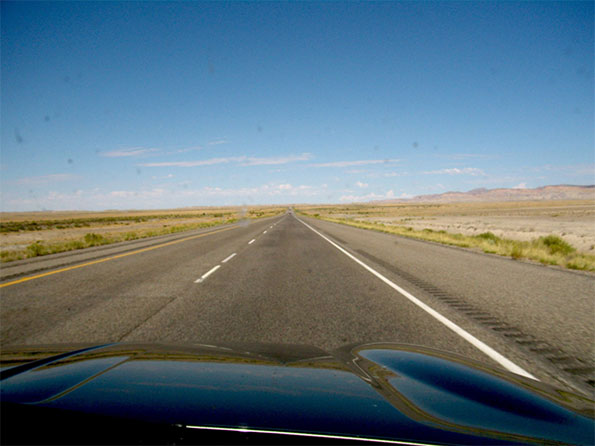
    I-70 in eastern Utah.   Although freeways can seem intrusive and over-scaled in the city, they are often dwarfed by the huge open spaces in states like Utah or Nevada.


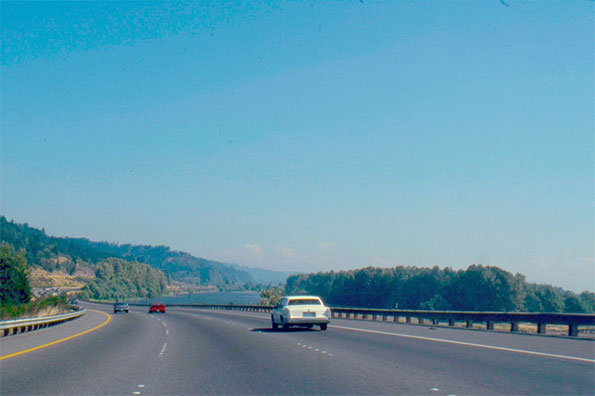
    I-5 south of Longview, Washington.   A trip across the country on the interstate roadway system allows for a panoramic view of the regional differences between, for example, the flat, semi-tropical landscape of central Florida and the deep green evergreen forests of the Pacific Northwest.


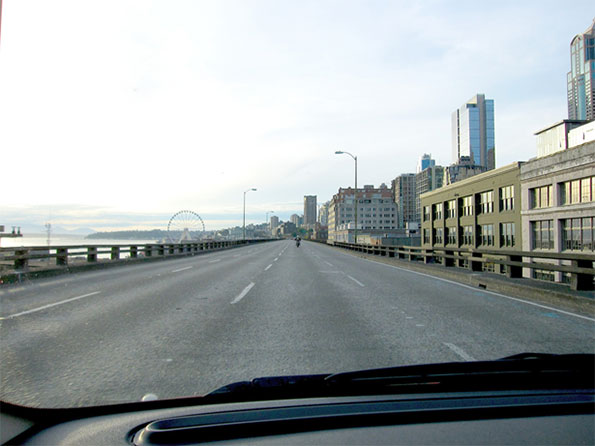
    State route 99, the Alaskan Way Viaduct, downtown Seattle.   Completed in 1953, this roadway, this roadway like a number of freeways built in the heart of American cities, created a barrier in the city.  Some of these highways, for example the Central Artery in Boston have been relocated underground. In other cases, like the Embarcadero Freeway in San Francisco the replacement was a surface boulevard.  In this case, after a considerable debate, officials made the decision to create a massive tunnel.  It is difficult to argue that a road like this should be preserved, given its structural problems and the way it cuts off Seattle from its waterfront.  Still, it is almost inevitable that some of the drivers navigating the new tunnel will keenly miss the spectacular urban spectacle that unfolds today as they sweep along the viaduct.

    Robert Bruegmann is professor emeritus of Art history, Architecture and Urban Planning at the University of Illinois at Chicago.

  • Southern California’s Road Back

    If the prospects for the United States remain relatively bright – despite two failed administrations – how about Southern California? Once a region that epitomized our country’s promise, the area still maintains enormous competitive advantages, if it ever gathers the wits to take advantage of them.

    We are going to have to play catch-up. I have been doing regional rankings on such things as jobs, opportunities and family-friendliness for publications such as Forbes and the Daily Beast. In most of the surveys, Los Angeles-Orange County does very poorly, often even worse than much-maligned Riverside and San Bernardino. For example, in a list looking at “aspirational cities” – that is places to move to for better opportunities – L.A.-Orange County ranked dead last, scoring well below average in everything from unemployment to job creation, congestion and housing costs relative to incomes.

    Yet, Southern California possesses unique advantages that include, but don’t end at, our still-formidable climatic and scenic advantages. The region is home to the country’s strongest ethnic economy, a still-potent industrial-technological complex and the largest culture industry in North America, if not the world.

    In identifying these assets, we have to understand what we are not: Silicon Valley-San Francisco, or New York, where a relative cadre of the ultrarich, fueled by tech IPOs or Wall Street can sustain the local economy. Unlike the Bay Area, in particular, our economy must accommodate a much larger proportion of poorly educated people – almost a quarter of our adult population lacks a high school degree. This means our economy has to provide opportunities for a broader range of skills.

    Nor are we a corporate center such as New York, Houston, Dallas or Chicago. We remain fundamentally a hub for small and ethnic businesses, home to a vast cadre of independent craftspeople and skilled workers, many of whom work for themselves. In fact, our region – L.A.-Orange and Riverside-San Bernardino – boasts the highest percentage of self-employed people of any major metropolitan area in the country, well ahead of the Bay Area, New York and Chicago.

    Policy from Washington has not been favorable to this grass-roots economy. The “free money for the rich” policy of the Bernanke Federal Reserve has proven a huge boom to stock-jobbers and venture firms but has not done much to increase capital for small-scale firms. Yet it is to these small firms – dispersed, highly diverse and stubbornly individualistic – that remain our key long-term asset, and they need to become the primary focus on regional policy-makers.

    Ethnic Networks

    Immigration has slowed in recent years but the decades-long surge of migration, largely from Asia and Mexico, has transformed the area into one of the most diverse in the world. More to the point, Southern California has what one can call diversity in depth, that is, huge concentrations of key immigrant populations – Korean, Chinese, Mexican, Salvadoran, Filipino, Israeli, Russian – that are as large or larger than anywhere outside the respective homelands. Foreigners also account for many of our richest people, with five of 11 of L.A.’s wealthiest being born abroad.

    These networks are critical in a place lacking a strong corporate presence. Our international connections come largely as the result of both the ethnic communities as well as our status as the largest port center in North America, which creates a market for everything from assembly of foreign-made parts to trade finance and real estate investment. Southern California may be a bit of a desert when it comes to big money-center banks, but it’s home to scores of ethnic banks, mainly Korean and Chinese, but also those serving Israeli, Armenian and other groups.

    For the immigrants, what appeals about Southern California is that we offer a diverse, and dispersed, array of single-family neighborhoods. Both national and local data finds immigrants increasingly flocking to suburbs. Places like the San Gabriel Valley’s 626 area, Cerritos, Westminster, Garden Grove, Fullerton and, more recently, Irvine, have expanded the region’s geography of ethnic enclaves.

    These enclaves drive whole economies, such as Mexicans in the wholesale produce industry or the development of electronics assembly and other trade-related industry by migrants largely from Taiwan. Global ties are critical here. Korean-Americans started largely in ethnic middleman businesses, but have been moving upscale, as their children acquire education. They, in turn, have helped attract investment from South Korea’s rising global corporations, including a new $200 million headquarters for Hyundai in Fountain Valley, as well as a $1 billion, 73-story new tower being built by Korean Air in downtown Los Angeles.

    Tech Industrial Base

    During the Cold War, Southern California sported one of the largest concentrations of scientists and engineers in the world. The end of the Cold War, at the beginning of the 1990s, severely reduced the region’s technical workforce, a process further accelerated by the movement out of the region of such large aerospace firms as Lockheed and Northrop. The region has roughly 300,000 fewer manufacturing jobs than it had a decade ago, largely due to losses in aerospace as well as in the garment industry.

    Yet, despite the decades-long erosion, Southern California still enjoys the largest engineering workforce – some 70,000 people – in the country. It also graduates the most new engineers, although the vast majority of them appear to leave for greener pastures. One looming problem: a paucity of venture capital, where the region lags behind not just the Bay Area, but also San Diego and New York. This can be seen in the relative dearth of high-profile start-ups, particularly in fields like social media, now dominated by the Bay Area.

    But the process of recovery in Southern California does not require imitating Silicon Valley. Instead we need to leverage our existing talent base – and recent graduates – and focus on the region’s traditional strength in the application of technology. A recent analysis of manufacturing by the economic modeling firm EMSI found strong growth in some very promising sectors, including the manufacturing of surgical and medical equipment, space vehicles and a wide array of food processing, an industry tied closely to the immigrant networks.

    Cultural Complex

    For most Americans, and even more so among foreigners, the image of Southern California is shaped by its cultural exports, not only in film and television but in fashion and design. This third sector epitomizes the uniqueness of the region, and provides an economic allure that can withstand both the generally poor business climate and the incentives offered by other regions.

    After a period of some stagnation, Hollywood again is increasing employment. Roughly 130,000 people work in film-related industries in Los Angeles, which is now headed back to levels last seen a decade earlier but still well below the 146,000 jobs that existed in 1999.

    At the same time, the sportswear and jeans business in Los Angeles, and the surfwear industry in Orange County, remain national leaders. Overall, the area’s fashion industry has retained a skilled production base – over twice that of rival New York’s – and has been aided, in part, by access to Hollywood, lower rents and labor costs than in New York.

    Taken together, these sectors – ethnic business, sophisticated manufacturing and culture – could provide the basis for a renaissance in the local economy. The smaller firms in these fields, in particular, need a friendlier business climate, a more evolved skills-training program from local schools and a better-maintained infrastructure. More than anything, though, they require an understanding on the part of both government and business that their success remains the best means to reverse decades of relative decline.

    Joel Kotkin is executive editor of NewGeography.com and Distinguished Presidential Fellow in Urban Futures at Chapman University, and a member of the editorial board of the Orange County Register. He is author of The City: A Global History and The Next Hundred Million: America in 2050. His most recent study, The Rise of Postfamilialism, has been widely discussed and distributed internationally. He lives in Los Angeles, CA.

    This piece originally appeared at The Orange County Register.

  • Plan Bay Area: Telling People What to Do

    The San Francisco area’s recently adopted Plan Bay Area may set a new standard for urban planning excess. Plan Bay Area, which covers nearly all of the San Francisco, San Jose, Santa Rosa, Vallejo and Napa metropolitan areas, was recently adopted by the Metropolitan Transportation Commission (MTC) and the Association of Bay Area Governments (ABAG). This article summarizes the difficulties with Plan Bay Area, which are described more fully in my policy report prepared for the Pacific Research Institute (Evaluation of Plan Bay Area).

    Plan Bay Area would produce only modest greenhouse gas emissions reductions, while imposing substantial economic costs and intruding in an unprecedented manner into the lives of residents. The Plan would require more than three quarters of new residences and one third of net additional employment to be located in confined "priority development areas." These measures have been referred to as “pack and stack” by critics. The net effect would be to virtually ban development on the urban fringe, where the organic expansion of cities has occurred since the beginning of time.

    Irrational Planning

    Violating perhaps the most fundamental requirement of a rational plan, Plan Bay Area begins with a situation that no longer exists. Further, it is based on exaggeration, systematic disregard of official federal government projections and overly optimistic planning assumptions.

    Exaggerated Population Projection: The Plan assumes that the Bay Area will grow 55 percent more rapidly between 2010 and 2040 than official California state Department of Finance population projections indicate. These state-produced estimates have tended themselves to be on the high side (Figure 1). The planners scurried about to resolve these differences, but there is no indication that the state will be revising its projections. Plan Bay Area’s population projection would require growth in the Bay Area to increase by more than one-half from the 2000-2010 annual rate. The exaggeration of population growth has its uses: it leads to a higher greenhouse gas emissions projection for 2040, providing a rationale for stronger policy interventions.

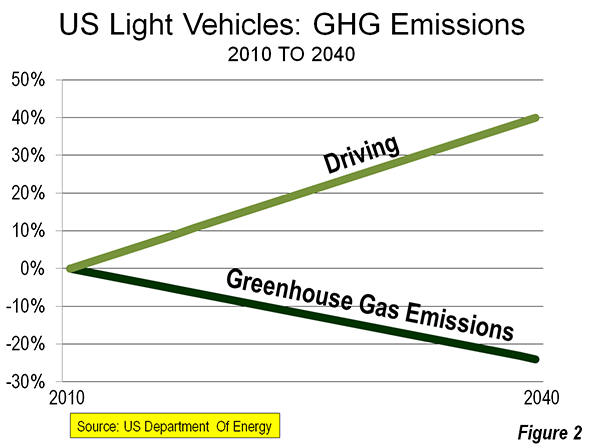
    Ignoring Current Greenhouse Gas Emissions Projections: The Plan also ignores the new, more favorable DOE fuel economy projections (Figure 2). These projections were issued in December, well before the publication of the draft plan in April and the adoption of the final plan in July. Indeed, if the new DOE projections had been published the day before, Plan Bay Area should have been placed on hold and revised. In short, Plan Bay Area was out of date when adopted.

    Overly Optimistic Planning Assumptions: The Plan assumes that travel by light vehicle (automobiles, sport utility vehicles and pickups) would be reduced by substantial increases in transit ridership. Plan Bay Area presumes that expanding transit service 27 percent over the next 30 years will lead to a near doubling of transit ridership. This is stupefying, since over the last 30 years, transit ridership remained virtually the same, while service was expanded nearly twice as much as would be planned from 2010 to 2040.

    The plan also assumes that residents forced into the priority development areas will use transit and walking much more, materially reducing their use of light vehicles. This research behind this assumption is skewed toward transit oriented developments located on rail lines with good access to downtown. But nearly nine out of 10 employees in the Bay Area work outside the downtowns of San Francisco and Oakland, and that number is increasing (according to Plan Bay Area).

    Given recent history, it seems wishful thinking to believe that small transit service expansions and downtown oriented transit development can do much to attract drivers from cars. The modest gains greenhouse gas emissions reductions projected in Plan Bay Area are likely exaggerations.

    Plan Bay Area’s “pack and stack” densification is likely to produce even less than the modest substitution of transit and walking for driving (see The Transit-Density Disconnect). Traffic congestion, in this already highly congested area, is likely to be worsened, which could nullify part or all of the greenhouse gas emission reductions expected from reduced vehicle use.

    Correcting Plan Bay Area Forecasts

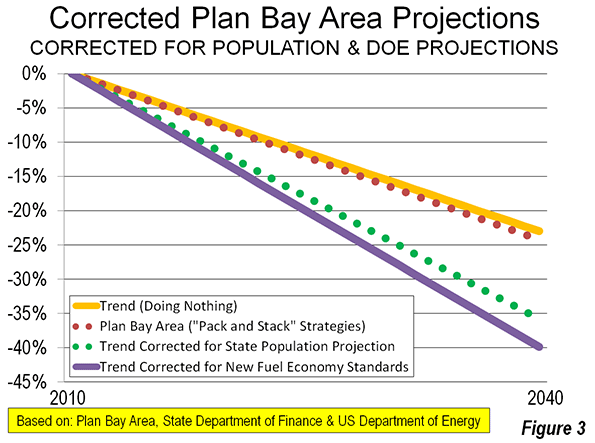
    Plan Bay Area would only modestly reduce light vehicle travel and greenhouse gas emissions. This is illustrated in Figure 3, which shows that the “pack and stack” strategies that would force most new residents and jobs into priority development areas, Plan Bay Area would reduce greenhouse gas emissions by 2 percent (“Plan Bay Area” line compared to the “Trend” or “doing nothing” line).

    By contrast, correcting the Plan Bay Area 2040 population estimates to reflect the state population projections would reduce greenhouse gas emissions more than eight times as much (17 percent), without the “pack and stack” strategies. A further correction of the Plan Bay Area 2040 estimates to reflect the latest DOE fuel economy projections, would reduce greenhouse gas emissions 22 percent, 11 times as much as the “pack and stack” strategies.

    Heavy Costs for Households and Businesses

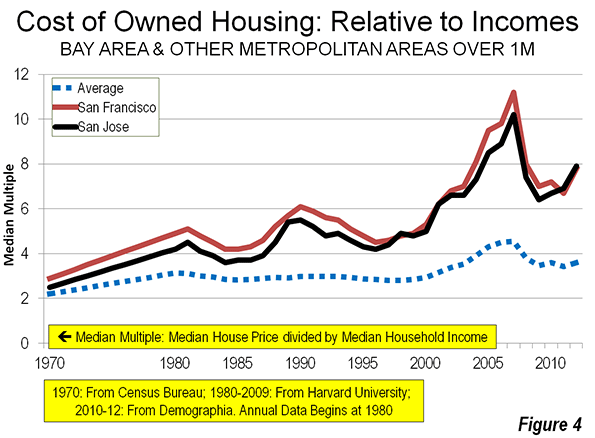
    The Plan’s “pack and stack” strategies seem likely to exacerbate the Bay Area’s already high cost of living. Currently, the San Francisco and San Jose metropolitan areas have the worst housing affordability among the nation’s 52 metropolitan areas with more than 1 million residents. San Jose’s median house price relative to its median household income was 7.9 last year, according to the Demographia International Housing Affordability Survey. San Francisco’s median multiple was 7.8. This severely unaffordable housing results from recent decades of urban containment or smart growth policies, which have severely restricted the land on which development can occur. This drives up prices (other things being equal), consistent with economic principle. This has been made worse by house and apartment impact fees imposed on developers that are far above the national average.

    By comparison, in major metropolitan areas that have not implemented strong urban containment policies, the median multiple has typically been 3.0 or less since World War II, including the Bay Area before its adoption (Figure 4). The “pack and stack” strategies would largely limit new development to small parts of the Bay Area, an even more draconian prohibition than the long standing restrictions on urban fringe development. This further rationing of land could be expected to drive land prices even higher, making it even more difficult for households and businesses to live within their means.

    The problem is already acute. The new US Census Bureau housing cost adjusted data shows California to have the highest poverty rate among the states and the District of Columbia (metropolitan area data is not available). An early 2000s Public Policy Institute of California report showed Bay Area poverty to be nearly double the official rate, adjusted for the cost of living. Ultra pricey San Francisco had among the ten highest poverty rates – over twenty percent – of any urban county in the country.

    Unaffordable housing has also fueled an exodus to the San Joaquin Valley (Central Valley). Now more than 15 percent of the workers in the Stockton metropolitan area commute to the Bay Area, which led the Federal Office of Management and Budget adding Stockton to the San Jose-San Francisco combined metropolitan area (combined statistical area). In addition, the greater traffic congestion is likely to lengthen work trip travel times. This is likely to further increase emission while also burdening job creation and economic growth (see Traffic Congestion, Time and Money).

    Ignoring the Economy and Poverty

    Plan Bay Area effectively ignores these costs (despite rhetoric to the contrary), by failing to subject its strategies to a cost per ton metric. According to the United Nation’s Intergovernment Panel on Climate Change (IPCC), sufficient greenhouse gas emissions reductions can be achieved at a cost between a range of $20 to $50 per ton. The previous regional plan (through 2035) included such estimates. Only highway strategies achieved the IPCC range. Transit and land use strategies cost from four to more than 100 times the top of the IPCC range. Even those estimates did not include the prohibitively higher housing costs that result from urban containment policies. The cost metric is crucial, because spending more than necessary to reduce greenhouse gas emissions limits job creation and economic growth, which leads to reduced household affluence and greater poverty. This is the very opposite of the economic objectives of public policy. Virtually all political jurisdictions around the world seek greater prosperity for their residents and less poverty. A legitimate regional plan requires subjecting its strategies to economic metrics.

    Opposition

    There is opposition to Plan Bay Area. A citizen movement worked for rejection and has now filed suit claiming that the Plan violates the California Environmental Quality Act. The suit also alleges that MTC and ABAG used a questionable interpretation of state law and regulation to justify the irrational Plan outcomes.

    Recorded Votes

    Opponents were also successful in obtaining a rare recorded vote at ABAG. The governing board (General Assembly) is composed of selected elected officials from cities and counties who are not elected to their ABAG positions. ABAG adopts virtually all of its actions by consensus, rather by recorded votes, as occurs in many of the nation’s regional planning boards.

    Consensus decision making seem especially odd in California, where inability to obtain sufficient votes in the legislature for the state budget required a constitutional amendment. Neither do city councils and county commissions operate on a consensus basis on controversial issues.

    There is no shortage of controversial issues, at ABAG or other regional planning agencies. A good first reform would be for recorded votes to be the rule, rather than the exception. Consensus decision making may be appropriate for clubs, but it is not for representative bodies in a democracy.

    Impeding the Quality of Life

    Plan Bay Area was outdated when approved and reflects a world that no longer exists. Drafters have insisted on extravagantly expensive and intrusive policies that produce only minimal greenhouse gas reductions, and at great cost, using, among other things, unreasonably bloated population forecasts to bolster their approach. Unless changed, the Plan will likely be more successful in driving up housing prices, limiting options for households, and further congesting traffic than meeting its stated goal of reducing   greenhouse gas emissions.

    Wendell Cox is a Visiting Professor, Conservatoire National des Arts et Metiers, Paris and the author of “War on the Dream: How Anti-Sprawl Policy Threatens the Quality of Life.

    Photo: San Francisco (by author)

  • California Homes Require Real Reach

    In the 1950s and 1960s, Southern California was ground zero for the “American Dream” of owning a house. From tony Newport Beach and Bel-Air to the more middle-class suburbs of the San Fernando Valley and Garden Grove to working-class Lakewood, our region created a vast geography of opportunity for prospective homeowners.

    Today, with house prices again skyrocketing, Southern California is morphing into something that more resembles a geography of inequality. Now, even the middle class is forced into either being “house poor” or completely shut out of homeownership, or may simply be obliged to leave the area. Even more troubling is that the working class and the poor suffer from the kind of crowded, overpriced housing conditions sadly reminiscent of those experienced during the Depression and the Second World War.

    Judged by the “median multiple” – the median income divided by the median house price – California’s prices for a generation have soared well above the national averages. Demographer Wendell Cox notes that, until the early 1970s, California’s house prices were similar to those in the rest of the United States. National Association of Realtors data indicate that the median house price in California at that time was 7 percent above the national average. By 2013, the price differential had risen to 109 percent.

    This has little to do with such things as construction costs, which have not risen as quickly in most of California as elsewhere, but are largely the result of soaring land costs and stiff fees imposed on housing. Attributable largely to regulatory factors that restrict building in many areas, the cost of finished land for comparably priced houses has increased nine times as much in California as in the rest of the nation since 1970. Portland State University economist Gerald Mildner refers to this as “Economics 101,” indicating that “as the demand for property in a region grows, the increase in demand translates into some combination of more space and high prices, depending upon the elasticity of supply.”

    Beside regulatory restraints, California housing prices are driven up by the highest impact fees in the nation. An annual survey by Duncan and Associates shows that the average impact fee in California for single-family residence in 2012 was $31,100 per unit, nearly 90 percent higher than the next most expensive state and 265 percent higher than the norm among jurisdictions that levy such fees, which typically pay for capital improvements, like water and wastewater facilities, required by a new development. Many states and localities on the other side of the Sierras do not.

    These fees also impact multifamily housing; the state’s fees on multifamily units averaged $18,800, 290 percent above the average outside the state.

    Construction penalized

    California’s emerging housing crisis, then, is not, as some suggest, a reflection of the state’s constrained geography or economic superiority. The two most-recent spikes in housing costs have occurred as the state’s median income has dropped from well above to just about the national average. Neither can we blame a huge surge of new residents, since California’s once-buoyant population growth has slowed to levels similar to those of the rest of the country.

    Instead, the roots of our state’s massive social regression lie in political choices made by the state, counties and cities. This trend likely will intensify, as regulators interpret the state’s climate-change legislation to further penalize construction of single-family houses preferred by most California families. Particularly vulnerable will be the starter-home market, once the engine of California’s egalitarian middle-class culture.

    Some “new urbanists” and greens argue that such restrictions will eliminate wasteful “McMansions” and spur construction of more “sustainable” dense housing for the working masses. Yet, in reality, the impact of highly restrictive housing polices tend to be felt most by both middle-class families and the least-affluent, who find themselves unable to buy housing or, in some cases, are forced to spend huge percentages of their income on rent.

    The growing affordability crisis seems likely to worsen as the housing market recovers. Given the paucity of new home construction, and ever-tightening regulation, California’s housing market is particularly vulnerable to wild swings in prices; the year-on-year median house price increase as of May 2013 was the greatest since 1980, even greater than in any of the past decade’s “bubble” years. Overall, price gains in the state were two to three times stronger than that in the rest of the nation.

    This process has been further accelerated by the presence of investors in the local market. Investors, many from Asia, now account for upward of one in four home purchasers in the state.

    Among the biggest losers here is California’s middle class, particularly young families without large family endowments. Some 60 percent of U.S. households can now afford to buy a house, according to the National Association of Home Builders / Wells Fargo Housing Opportunity Index, but that percentage has dropped even in the Riverside-San Bernardino (40 percent) and Sacramento (50 percent) metropolitan areas, while San Jose, Los Angeles and San Diego had affordability levels of 20 percent to 30 percent. The lowest level, 17 percent, was found in the San Francisco metropolitan area. We can expect these numbers to worsen in the immediate future.

    These numbers will impact a wide range of people, including many with skills desired by employers. According to an analysis of Orange County average salaries for National Core, a nonprofit housing developer based in Rancho Cucamonga, even a biomedical engineer or a nurse in O.C. does not earn enough to buy a house there. As economist and author Claude Gruen has suggested, more restrictive land-use regulation “is to the middle class what the economic disaster of slum clearance was to the poor.”

    Renters don’t escape

    Nor will the poor, or renters, benefit from these policies. The nation, and the state, have had programs to help lower-income residents, but these programs meet only a fraction of the need. Los Angeles County had a waiting list 17 times its potential supply of housing, according to a 2004 report by the National Low Income Housing Coalition. With relatively little new product being produced, it’s unlikely this situation can improve, as potential homeowners are shoved into the rental market, boosting rents higher.

    The net result is that more Californians are becoming house poor or “rent” poor. According to American Community Survey data analysis done for National Core by this author and demographer Wendell Cox, this state has four of the six major metropolitan areas with the largest share of renters spending more than 30 percent of their income on rent – led by Riverside-San Bernardino, Los Angeles-Orange County, Sacramento and San Diego – are located in the Golden State. This includes a majority of renter household in the cities of Los Angeles, Glendale, Anaheim and Santa Ana.

    Even more troubling is a growing percentage of working households suffering housing-expense burdens of 50 percent or more of income. California again leads the way, according the National Housing Conference, with Los Angeles and San Diego among the top five major metro areas.

    This emerging social disaster has received little attention from the so-called progressives, whose policies in part are responsible for the state’s growing housing crisis. In large part due to housing, and lack of good middle-class jobs, California now has the highest poverty rate (when adjusted for the cost of housing) of any state.

    Not only are working-class Californians poorer, they also are subject to ever-higher levels of overcrowding. On a percentage basis, four California major metropolitan areas are in the 10 regions in the country with the most families doubling up. The top two are Riverside-San Bernardino and Los Angeles, followed by San Jose and San Diego.

    Overcrowding is particularly tough on children, who suffer greater problems with health and academic performance. Another study associated psychological problems with children from overcrowded housing.

    Long drives to work

    Finally, the housing crisis also creates significant environmental problems. The unaffordability of housing has forced many Californians to seek shelter far from work. Among commuters traveling 60 minutes or more to work, Riverside-San Bernardino is third-highest, followed by Los Angeles, eighth, and San Francisco, ninth. Among major metropolitan areas with the highest share of commuters traveling 90 or more minutes one way, Riverside-San Bernardino ranks second, in a virtual tie with New York, followed by Sacramento, seventh, and Los Angeles, eighth.

    For both California’s middle- and working-class, our housing regulatory regime serves as a kind of tax – a nearly confiscatory one – that works particularly against families, the poor and those who do not possess considerable family wealth. The result is a California that is increasingly out of sync with the very dream that has brought millions from all over the country.

    Joel Kotkin is executive editor of NewGeography.com and Distinguished Presidential Fellow in Urban Futures at Chapman University, and a member of the editorial board of the Orange County Register. He is author of The City: A Global History and The Next Hundred Million: America in 2050. His most recent study, The Rise of Postfamilialism, has been widely discussed and distributed internationally. He lives in Los Angeles, CA.

    This piece originally appeared at The Orange County Register.

    Photo of Los Angeles housing by Wendell Cox.

  • California’s Blue-on-Blue Battle

    Perhaps nothing more illustrates the evolving inner class conflict within the progressive political movement than the recent embrace of California as a role model for the rest of the country. The Golden State, maintains John Judis of the New Republic, should provide the game plan for the Obama administration as it seeks a path back to relevance.

    As an old-style, and increasingly marginal, Democrat, my response is “say what?” After all, even by the standards of the tepid national recovery, California, for all the celebration, still lags. The state has consistently suffered among the highest unemployment rates in the country – now ranking around sixth at 8.5 percent – and now, according to the U.S. Census, the highest rate of poverty in the country.

    Nor is California, as is often alleged, recovering faster than nation overall. Since January 2007, California has ranked 42nd among the 50 states and the District of Columbia. Even today, it has roughly 3.5 percent – over a half-million – fewer jobs than it had five years ago. In contrast, arch-rival Texas, second after North Dakota in percentage jobs growth, has added close to 1 million positions. The recovery has been particularly slow in Southern California; in a recent analysis of U.S. metropolitan job-growth data since 2007, the Los Angeles-Orange County region ranked 39th, while the San Bernardino-Riverside area rated 37th.

    Growing split

    If anything, what’s really emerging in California is a widening demographic and geographic divide between the hard-hit largely minority inner-city areas, such as Oakland and Los Angeles, as well as much of the entire inland part of the state (with the exception of oil-rich Bakersfield) and the wealthy coastal sliver that is home to the rich, famous, predominately white (and aging). One longtime conservative California observer, Victor Davis Hanson, wryly has dubbed this a form of “liberal apartheid.”

    Whatever one calls it, under the current progressive regime, California is accomplishing the exact opposite of the putative progressive egalitarian agenda. Rather than spread the wealth in the old social democratic model of Roosevelt and Truman, and even Clinton, this recovery, such as it is, has been largely centered among the asset-owning classes. They have benefited from, first, the stock market resurgence and a hypocritically pro-Wall Street regime in Washington and, now, an emerging housing bubble, largely promoted by the Federal Reserve. Meanwhile, vast portions of the middle and working classes have continued to languish.

    This division, notes historian Fred Siegel in his upcoming history “Revolt Against the Masses,” reflects a long-standing elitist tendency within progressivism that extends to at least the beginning of the 20th century. Starting with such luminaries as Herbert Croly and H.G. Wells, there has been a thread of progressive thought that rejects the essential notion of democracy and supports the notion of a guided economic system administered by a disinterested caste of highly educated “supermen.”

    In California, this progressive trend has been given full rein, as political power in the state has flowed increasingly to its most affluent corners – notably, San Francisco and Silicon Valley – where social-media hype and environmental management dominate the political agenda. To date, this agenda has been facilitated by an alliance among the minority political warlord class and the extremely well-organized public sector unions, along with rent-seeking crony capitalists, notably those who have benefited from “green” policies.

    ‘Blue-on-blue conflict’

    Yet, there are some tentative signs that this political alliance could be endangered, as representatives of more working- and middle-class areas begin to recognize the vast chasm between their interests – largely more and better-paying jobs, and more affordable housing – and those of the reigning gentry liberals. This “blue-on-blue conflict,” as the ever-perceptive Walter Russell Mead has dubbed it, may become, given the declining relevance in California of the Republican Party, the most relevant political divide in the state today.

    Caught in the middle is the ever-unpredictable but wily Gov. Jerry Brown. In many ways Brown has epitomized the ruling progressive alliance, particularly on issues such as green energy, which has essentially served to transfer money to rich investors, such as Google, from manufacturers, middle- and working-class consumers. At a time when European model countries, such as Germany and Spain, are rethinking their expensive green-energy programs as wasteful and economically damaging, Brown seems determined to stay his course.

    Also not likely to be altered, at least for the time being, is Brown’s dream of a state high-speed rail network. If ever built, given a funding shortfall of at least $45 billion, it will benefit primarily wealthy travelers and tourists, while the roads, bridges and buses depended on by the masses continue to deteriorate. Recently, a separate proposal for a Victorville-to-Las Vegas “bullet train” failed to win a federal loan, likely dooming it.

    Brown may be basking in the temporary glow of the state’s short-term budget surplus, but he must know that the long-term pension obligations, at both the state and local levels, and the costs of a vast welfare class are, to use the overused phrase, not sustainable. Without some new engine of economic growth beyond social media, capital gains and property bubbles, the state recovery will never spread to the vast majority of Californians and could nudge the interior parts of the state more toward either penury or even the Republican Party.

    Oil and water

    In this respect, Brown has made two tentative, but potentially critical, moves toward addressing the health of an increasingly Hispanic interior. First, he has embraced the possibility of oil production using hydraulic fracking, to the alarm of Bay Area gentry liberals, as a means of sparking desperately needed high-wage blue-collar employment. He has found some allies among largely Latino and African American Democrats from working-class districts who recently blocked coastal gentry efforts to prohibit the practice.

    The second relates to the all-important issue of water. Western lore has it that, in this historically dry part of the world, whiskey may be for drinking but water is for fighting. By embracing the notion of a peripheral canal up north to assure water supplies to the central and southern parts of the state, Brown has taken on the core concerns of the Bay Area green constituencies. (The fact that San Francisco also relies almost entirely on water from the Sierras is not often acknowledged.)

    In the water wars as well, Brown will be able to build a coalition between pro-business Republicans and Democrats who represent the generally more working- and middle-class areas dependent on affordable and reliable water supplies. The imperative to back Brown’s efforts will be even greater in the Central Valley and other agricultural areas.

    Changing attitudes

    Another possible sign of change can be seen in a new effort, supported by business and labor, to begin providing some tax breaks and incentives to firms interested in expanding in the state. In the recent past, budget constraints and a largely anti-business Legislature has limited such incentives, which are used routinely by competitor states such as Texas, Utah and Louisiana. Whether such efforts will make a big difference is questionable, but they are signs of a slowly changing attitude toward enterprise in California.

    Yet, such efforts may not be enough, particularly if the current asset bubble propping up state government begins to falter. At the same time, Brown’s efforts to circumvent the green lobby on water and energy run the risk of endless lawsuits. Being an economic “Nixon in China” may hold great opportunities for Brown, but at the risk of discord with some of the very interests who have been his political bulwarks. It happened in Brown’s original second term – 1979-83 – and could emerge again this time around.

    Joel Kotkin is executive editor of NewGeography.com and Distinguished Presidential Fellow in Urban Futures at Chapman University, and a member of the editorial board of the Orange County Register. He is author of The City: A Global History and The Next Hundred Million: America in 2050. His most recent study, The Rise of Postfamilialism, has been widely discussed and distributed internationally. He lives in Los Angeles, CA.

    This piece originally appeared at The Orange County Register.

    Photo by Randy Bayne; California Governor Jerry Brown

  • Eastvale, CA: Suburban Charm Trumps Urban Convenience

    Eastvale, a new community just over the Riverside County line from Orange County, is a place that most urbanists would naturally detest. City Hall is no architectural masterpiece, occupying a small office inside the area’s largest shopping mall. The streets are wide, and the houses tend to be over 2,500 square feet. There’s nothing close to a walking district and little in the way of restaurants besides fast-food outlets and chain eateries.

    Yet Eastvale, which incorporated in 2010 , is also among the fastest-growing places within California. Located in an area once known as Dairy Valley, it was settled by Dutch farmers and for years was known as "Fly Valley" because of the insect infestations associated with herds of cattle. Houses began to go up in the early 2000s, as families leaving congested and high-cost coastal Southern California began to move into the area.

    Although hit by the housing bust, like much of Riverside County, Eastvale’s home sales have been on the upswing, and real estate agents suggest that the biggest problem is finding properties to sell. Land prices, $5 an acre in 1974, rose to $525,000 at the peak of the boom, then collapsed, but are now back to over $300,000. The median price of a single-family home, $433,000, is just around the state average. In contrast, prices in coastal Orange County average $556,000 and, along the coast, closer to $1 million for a comparatively newer home.

    With prices escalating again in Southern California, affordability is once again dropping, particularly for new buyers. Today, according to the California Board of Realtors, affordability of new housing in Orange County for first-time buyers has already dipped below 50 percent for the first time since 2008. It could be headed back to the 20 percent – or lower – rates experienced during the housing bubble.

    Los Angeles, San Diego and other coastal cities are experiencing similar upticks, but with no appreciable likelihood of new home construction, which statewide is now running at one-third of annual demand. This is particularly true for single-family detached homes, the housing preferred by most consumers but most detested by the state’s planning hierarchy.

    In the short run, this shortfall benefits what historian Bob Bruegmann calls "the incumbent’s club," current owners of single-family homes. But it also fundamentally functions as a tax on future generations. The costs of housing inflation are imposed on the offspring of the coastal cities, not to mention immigrants and new migrants, who still need someplace to live a basic middle-class lifestyle without draining all their financial resources.

    Although people on the coast tend to look down on the "909s", the fact remains that, to retain a large, growing and vibrant middle class, the coast needs an outlet, particularly for the workers to staff its industries. Roughly a third of the Inland Empire’s workforce labors in either Los Angeles or Orange County. Without the outlet represented by the area, companies in Orange and Los Angeles will increasingly be forced to relocate or expand further out of the region and the state.

    Rather than being dismissed as second-rate, the oft-maligned Inland Empire remains a critical component for the future of Southern California. The media obsesses over the disasters that accompanied the housing bust but, in places where schools and parks are strong, like Eastvale, things have improved as foreclosures have plummeted.

    In fact, after a long hiatus, local developers are beginning to put up more new houses to meet the demand. With over 50,000 residents, Eastvale already has more people than downtown Los Angeles, and the mayor, Ike Bootsma, seventh of nine children of a Dutch immigrant farming family, projects this population to swell to 76,000 by 2020.

    Eastvale largely attracts upwardly mobile (average household income is around $100,000) families, many of them minorities. These are people who, a decade or two ago, might have settled closer to the coast, but can no longer afford to do so.

    Kids are a big deal in Eastvale, at a time when coastal California, including both Orange and Los Angeles are becoming older, and dominated by childless households. One-third of Eastvale’s population is made up of children under 18, well above the one in four average for California. The number of persons per household is over four, compared to less than three for the state as a whole.

    The dream people are chasing is a traditional one, yet many of the new families are diverse. Located roughly an hour from downtown Los Angeles, almost half the city’s households speak a language other than English at home. Asians account for close to a quarter of the population, Latinos roughly 40 percent.

    "There’s no way you can live this life in Mumbai," notes Indian immigrant Nibha Kothari, who moved to Eastvale with her husband and young daughter earlier this year. "There’s a balance here between city and town here. In Mumbai, everything is so crowded and congested and there’s so much stress. It’s the little things, the quality of life for our family, that got us here."

    Residents like Kothari admit it’s not the aesthetics of the urban design that brings them to Eastvale. Instead, as in Irvine, it’s the things urban pundits barely address, like good schools, a well-developed park system , low crime rates and, perhaps most importantly, larger house footprints. After all, family is the main reason people move to Eastvale, and many locals talk about having relatives living in the same community.

    Andrea Hove, the wife of an Orange County sheriff’s deputy with whom she has four kids, has several relatives in the neighborhood and a network of friends who also have extended families. "I wanted to stay home with the kids," she explains. "In Orange County, we’d be stuck with 1,800 square feet and send the kids to private school. Here, I have great schools, 3,000 square feet for less, and my walk-in closet is bigger than most people’s bedrooms. It’s a great family community in terms of schools and parks. I can’t go anywhere without seeing someone I know."

    Finally, she says, there’s also an excitement from being in somewhere new that is still developing its sense of place and urban traditions. "This is a place where we can shape the community for our kids," she suggests. "We can make it the way we want it, not just live the way some politician says we should."

    These kind of aspirations are rarely discussed among planners, academics or even many developers but they constitute much of what people actually want and reflects their most cherished priorities. It may seem mundane to urban aesthetes, but crucial in the locational decisions of many people.

    "Everyday life," observed the great French historian Fernand Braudel, "consists of the little things one hardly notices in time and space."

    Most people live ordinary lives, start businesses, raise families, go to church, play in little leagues and local softball tournaments. Concert halls, hip restaurants and striking architecture may thrill our media and design communities, but perhaps more critical to the long-term future may be places, like Eastvale, where Southern California’s middle-class families still can comfortably thrive.

    Joel Kotkin is executive editor of NewGeography.com and R.C. Hobbs Professor of Urban Studies at Chapman University, and a member of the editorial board of the Orange County Register. He is author of The City: A Global History and The Next Hundred Million: America in 2050. His most recent study, The Rise of Postfamilialism, has been widely discussed and distributed internationally. He lives in Los Angeles, CA.

    This piece originally appeared at The Orange County Register.