Tag: California

  • New York and California: The Need for a “Great Reset”

    Despite panning Texas Governor Rick Perry’s initiative to draw businesses from New York, Slate’s business and economics correspondent, Matt Yglesias offers sobering thoughts to growth starved states along on the West Coast and in the Northeast.

    “…the Texas gestalt is growth-friendly because, quite literally, it welcomes growth while coastal cities have become exceptionally small-c conservative and change averse. But if New York and New Jersey and California and Maryland and Massachusetts don’t want to allow the construction of lots of housing units, then it won’t matter that Brooklyn, N.Y.; and Palo Alto, Calif.; and Somerville, Mass.; are great places to live—people are going to live in Texas, where there are also great places to live, great places that actually welcome new residents and new building.”

    The entire country would benefit if states like California, New York, Massachusetts and New Jersey were to enact policies to compete with Texas, as Yglesias suggests.

  • Cities Still Being Squeezed

    Recent announcements of state budget surpluses have led to the popping of corks across the deepest-blue parts of America, particularly here in California. In some cases, the purported fiscal recovery has been enshrined by an emerging hagiography about Jerry Brown’s steadfastness in the face of budget debacles. One prominent piece even argued that the “smart, bold progressive movement” actually “saved” the Golden State, in part, by forcing up income tax rates.

    Yet, as Walter Russell Mead, among others, has argued, the states’ fiscal meltdown has not been averted, but simply delayed, by the current asset-driven economic recovery. Taken together, the states owe $1 trillion in unfunded pension obligations alone. These costs are eating up much of the projected surpluses, even in prosperous and relatively frugal states such as Texas.

    But the first place where the fiscal blowout will hit the road may be at the local level. This is, in part, because one way that states try to improve their balance sheets is by cutting aid to localities while imposing new mandates dealing with everything from housing to green policies. This has occurred in such places as Pennsylvania, Massachusetts, New Jersey and New York.

    “Quietly and without fanfare, governors and state legislators approved overly generous pension packages, let stand costly, antiquated laws and continued to shift costs from Albany to our front doors,” noted one upstate New York newspaper.

    So, even as state budgets improve somewhat, municipal budgets remain very vulnerable to cutbacks. Pew reports that both state aid and property-tax collections have continued to drop, something that perhaps will be slowed by a developing bubble in real estate values.

    Similarly, according to a report by the National League of Cities, city financers at the end of 2012 projected a sixth consecutive year of year-over-year declining revenue. The ability of localities – particularly the most-distressed – to endure this pattern much longer is somewhat dubious.

    In fact, the run up to a wave of municipal bankruptcies has begun. Seven major municipalities have already filed for bankruptcy, the largest being the city of San Bernardino. To a large extent, these bankruptcies are being driven by unfunded obligations for employee pensions. A new study by the Brookings Institute “estimated that the aggregate unfunded liabilities of locally administered pension plans top $574 billion. … On average, pensions consume nearly 20 percent of municipal budgets.” But the worst is yet to come. “[I]f trends continue, over half of every dollar in tax revenue would go to pensions, and, by some estimates, in some cases, would suck up 75 percent of all tax revenue.”

    This has locked many localities across the country into a classic vicious cycle as they try to dig their way back to growth. Unless radically reformed, health care and retirement obligations to employees seem certain to outweigh the ability to fund necessary government functions, the very things – infrastructure, public safety and other economic development components – necessary to nurse a region and its governments back to health.

    By far, most vulnerable will be those cities with high unemployment, rising crime and tepid recoveries. These will include many of America’s most violent cities – Detroit, Cleveland, St. Louis, Chicago, Memphis, Tenn., – as well as those with generally dysfunctional schools and decaying infrastructure. The idea of cutting police services in such places would invite even greater deterioration of public order.

    This process of small-scale deterioration is already well advanced in California. When it comes to buck-passing to the local level, no one can outdo the Golden State. Gov. Brown’s “realignment” strategy put the responsibility for state justice programs largely on local governments (though this came with promises of increased state aid). Brown also oversaw the dissolution of the state’s 400-plus redevelopment agencies, some of which may now be forced into bankruptcy. Many cities consider these agencies, which provide tax relief to businesses, as one of their most effective economic development tools. So, while state debt is expected to decline by $1.7 billion next year, local-government debt in California is actually set to increase by $600 million.

    Many counties and localities risk also losing their health care benefits under Gov. Brown’s revised fiscal year 2013-14 budget. These changes will be hardest on those localities with the biggest problems, notably some smaller cities already tilting on the edge of bankruptcy. As many as 10 others, including Oakland and San Jose, could join them. Many others are simply cutting back; Sacramento is now asking newly recruited police officers to pay into their pension plans before joining the force.

    These problems also are deeply entrenched in the state’s largest city. Los Angeles, more than any of the top 10 cities in the country, with the possible exception of Chicago, still suffers from quasirecessionary conditions. Not surprisingly, L.A.’s budget situation, in large part due to pension and other employee-related costs, remains perilous. A former mayor, businessman Richard Riordan, has predicted that, unless pensions and compensation are reformed dramatically, the city will eventually slide, inexorably, toward bankruptcy.

    The primary culprit in this slide, notes Riordan, has been the political domination of Los Angeles, and other cities, by public employee unions and the lack of true political competition. The original poster child for this is San Bernardino, where labor costs consumed 80 percent of the city budget, in large part due to public-sector unions’ investment in local political races.

    Bigger and somewhat economically stronger, Los Angeles may not soon go the way of San Bernardino, but its fiscal problems remain severe, with a projected $800 million deficit over the next four years and pensions that are underfunded by at least $15 billion. Clearly, these shortfalls will continue to undermine the city’s ability to keep its streets safe, roads paved and parks operating – until City Hall is willing to stand up to the public-sector lobby.

    The most recent citywide election was not too comforting in this regard, since both candidates for mayor were reliable allies of city worker unions. But, at least, it should be noted that the loser, Wendy Greuel, was, in part, defeated by revelations of her massive financial backing from those unions. It almost certainly hurt her standing with what should have been her base among more conservative, quasisuburban voters from her “hood” – the San Fernando Valley.

    Yet, even if incoming mayor Eric Garcetti can right the ship, residents of Los Angeles are likely to face a combination of rising taxes and fees for years to come to address soaring pension costs. Given the financial drag of pension and other employee benefit obligations, even traditional city services, such as street repair, will likely need to be funded by additional debt or fees on property owners.

    Short of major reform, this self-defeating pattern of higher local taxes and fewer local services is likely to continue even if state economies and budgets climb out of their recent distress. Yet, at the same time, this presents an opportunity to rebalance the relationship between private- and public-sector interests.

    If good habits are learned first in the home, perhaps the road to fiscal health will have to begin at the local level. Sacramento and other state capitals have demonstrated skill at kicking the can down the road while shirking their responsibilities to local governments. Instead, it may fall upon the localities to come up with ways to overcome decades of poisonously irresponsible decision making and concoct the proper fiscal antidote.

    Joel Kotkin is executive editor of NewGeography.com and a distinguished presidential fellow in urban futures at Chapman University, and a member of the editorial board of the Orange County Register. He is author of The City: A Global History and The Next Hundred Million: America in 2050. His most recent study, The Rise of Postfamilialism, has been widely discussed and distributed internationally. He lives in Los Angeles, CA.

    This piece originally appeared in the Orange County Register.
  • Southern California Economy Not Keeping Up

    One of Orange County’s top executives asked me over lunch recently why Southern California has not seen anything like the kind of tech boom now sweeping large parts of the San Francisco Bay Area. In many ways, it is just one indication of how this region – once seen as the cutting edge of American urbanism – has lost ground not only to its historic northern rival, but also to some venerable East Coast cities, as well as the boom towns of Texas and the recovering metropolitan areas of the Southeast.

    This divergence became particularly clear to me as I put together the most recent Forbes Best Places for Jobs with Pepperdine University economist Mike Shires. Our rankings focus heavily on momentum: What areas are growing fastest now and have made the best progress over the past decade. For me, a 40-year resident of the Los Angeles Basin (Shires is a native of San Diego), the results were far from encouraging.

    To be sure, Los Angeles, Orange County and Riverside-San Bernardino are up somewhat from their dismal showings in past years, in part due to the housing recovery. But none did well enough to ascend even to mediocrity. Yet, of 66 regions with more than 450,000 jobs, Los Angeles ranked No. 49, while Riverside-San Bernardino clocked in at No. 45, and Santa Ana-Anaheim-Irvine did best, with a still-less-than-middling No. 38.

    These rankings were way below those registered in the country’s emerging economic powerhouse, Texas, which placed a remarkable four regions in the top 10 (Fort Worth, Dallas, Houston, Austin) or rising burgs such as No. 2, Nashville, No. 3, Salt Lake City, and No. 9, Denver. We also got smoked by such low-exposure places as No. 13, Columbus, Ohio, No. 15, Oklahoma City, and No. 16, Indianapolis.

    But our relative decline is not merely a reflection of the natural effects of lower costs and better business climate. We also lagged well behind such famously expensive, and hyper-regulated, places as No. 14, Seattle, No. 17, Boston, and No. 18, New York City. Worse of all, Southern California was left completely in the dust by its two great interstate rivals, the No. 1-ranked San Francisco Bay Area and No. 7-ranked San Jose/Silicon Valley. The only California cities to do worse than the Southland were No. 56, Oakland, and No. 57, Sacramento.

    Why is the Southern California economy lagging, even in this recovery? Much of the answer can be found by looking at the information sector, which is driving much of the Bay Area’s growth. As my luncheon partner, who is investing heavily in the Silicon Valley, suggested, the entire wave of new tech companies has largely bypassed Southern California.

    This is not merely a question of achieving less growth, but actually losing ground, while the Bay Area metros soar. Since 2007, for example, the information sector – which includes software, media and entertainment – surged 18 percent in the San Francisco-San Mateo area and by a remarkable 25 percent in the San Jose-Silicon Valley region. In contrast, the Los Angeles information sector declined by 7.3 percent, while in Orange County, once a tech hotbed, it dropped by 21 percent.

    These declines impact not only demonstrably tech-oriented jobs, but also professional and business services that often serve tech clients. Over the past five years, these jobs have been growing smartly in San Francisco and decently in Silicon Valley, while declining in both Orange County and Los Angeles. Only recently have these sectors showed any sign of recovery in the Southland, but at a far weaker rate than in the Bay Area.

    Why is this happening? Certainly the answers are complex. Historically, the L.A.-Orange County tech economy has been strongly tied to aerospace and defense, and these sectors have been declining under President Barack Obama. The defense sector also has tended to shift toward more politically potent places like Texas, Georgia and Alabama, where politicians actually work on behalf of industrial jobs. With the exception of drone technology, the Southern California region’s aerospace industry, as one analyst put it, has become “dormant,” a victim of a talent drain and a gradual withdrawal of aerospace giants, most recently, Northrop, from the region.

    Like Los Angeles, Silicon Valley’s tech community was largely birthed by the Defense Department and NASA, something rarely acknowledged by the region’s hagiographers. But, starting in the 1980s, the Bay Area began to apply early innovations in semiconductor design and software to other industries, such as personal computers, the Internet and, more recently, social media and mobile devices, something that has generated not only jobs, but also buzz.

    Capital, too, has played a role. The L.A. area has lots of rich people, but a relatively weak venture capital community. The Bay Area has roughly five times as much venture capital – more than $10 billion – as the far more populous L.A.-O.C. region. New York and New England also enjoy far more money in local venture investment firms than does Southern California.

    Politics and image-making also has contributed to the Southland’s eclipse. California politics are now almost totally dominated by Bay Area politicians – from Gov. Jerry Brown to Lt. Gov. Gavin Newsom and Attorney General Kamala Harris. Both our U.S. senators are from San Francisco and its environs. Their economic orientation, when they have one, tends to be to worship at the altar of allied Bay Area software giants, like Google, and social media firms such as Twitter or Facebook. Life in cyberspace makes less-direct demands on green “progressive” sensibilities than making airplanes or garments, or the work of processing trade with Asia.

    In general, the Bay Area economic mindset tends to disdain the tangible economy – manufacturing, wholesale trade, construction – critical to the more diverse and more blue-collar-oriented Los Angeles-area economy. California’s tight land-use regulation and soaring energy prices do not much impact the Bay Area giants, since they simply shift their energy-intensive operations to places like Texas or Utah. And, as for soaring housing prices, people who cannot afford Bay Area prices also can be shifted to Salt Lake City, Austin, Texas, or Raleigh, N.C.

    In contrast, Southern California, like much of the Central Valley, is far less able to slough off the green-dominated policies of the Bay Area political cliques. Los Angeles, for example, still has 360,000 manufacturing jobs, down more than 18 percent since 2007, and Orange County has an additional 160,000 such jobs, after a drop of 11 percent the past five years. In contrast, San Francisco-San Mateo has only 36,000 industrial jobs. These, too, have been declining rapidly, but have far less impact on the economy than down here.

    Then, there’s the question of image. According to a recent Bloomberg Businessweek survey, San Francisco ranked as “best city” to live in. Suburban San Jose ranked No. 33.

    Los Angeles? Try No. 50, behind such places as Cleveland, Omaha, Neb., Tulsa, Okla., Indianapolis and Phoenix.

    In another survey, identifying the top 10 cities for “millennials,” Seattle ranked first, followed by such cities as Houston, Minneapolis, Dallas, Washington, Boston and New York. Needless to say, neither Los Angeles nor Orange County made the cut.

    Is there something we can do about this decline? I think this is more than just a marketing issue. Southern California, a region that largely invented itself out of combination of real estate speculation and great climate, needs to rediscover the roots of its success. Once our entrepreneurs imagined and forced into being great things, such as massive water and port systems; they dominated the race for space and planned out the suburban dreamscapes of Lakewood, Valencia and the Irvine Ranch. With the possible exception of Elon Musk and Space X, Southern California’s entrepreneurial guile is now decidedly low-key – food trucks, ethnic shopping, reality shows, hipster-oriented lofts and shopping areas.

    This limited vision extends to politics as well. As recently as the 1980s, the region boasted an aggressive business community that bullied Sacramento and bestrode Washington like a colossus. Now, our business leaders cringe like supplicants before well-funded greens, racialist warlords and public employee unions. We need business and community leaders to match the increasing arrogance and audacity of the Silicon Valley oligarchs, to force legislators to address the needs of our economically diverse, and still tangibly oriented economy.

    This also requires that the cultural resources of the region – Hollywood, the fashion industry, universities and colleges – become more engaged in something larger than protecting their narrow interests. At some point, they should realize that, as our region loses luster, so, too, does the fundamental attractiveness of their institutions and industries.

    Until this happens, Southern California – despite its cultural richness, ideal climate and great history of economic vigor – will continue to lag, performing, at best, to its current level of underachievement, slouching toward a permanent state of mediocrity.

    Joel Kotkin is executive editor of NewGeography.com and a distinguished presidential fellow in urban futures at Chapman University, and a member of the editorial board of the Orange County Register. He is author of The City: A Global History and The Next Hundred Million: America in 2050. His most recent study, The Rise of Postfamilialism, has been widely discussed and distributed internationally. He lives in Los Angeles, CA.

    This piece originally appeared in the Orange County Register.
  • Housing Market Fringe Movement

    A year or two ago, pundits and planners, in California and elsewhere, proclaimed – and largely celebrated – the demise of suburbia. They were particularly heartened by a report, financed by portions of the real estate industry, that predicted the market for single-family homes in the state was hopelessly flooded, with a supply overhang of up to 25 years. The "new California dream" would supplant the ranch house with a high-density apartment, built along a transit or bus line.

    So much for the grand theory. As the economy has begun to recover from its nadir, single-family home sales have taken off, both in California and across the country. In 2012, prices rose by 6 percent nationwide, and pent-up demand has spurred interest among investors and buyers.

    In California, the new dream imagined by planners, pundits and their real estate backers is being supplanted by, well, a more traditional aspiration. In our state, hard hit by the most-recent housing bubble, single-family home prices surged 24 percent over the past year as inventories dropped precipitously. In some particularly desirable areas, such as Irvine, the supply constraints are at levels lower than experienced even in boom times.

    We are beginning to see a resurgence – which we were told never to expect – in new projects. The government reported recently that housing permits, still well below their peak, surged in February to their highest level since June 2008, an increase of nearly 34 percent from a year earlier.

    In Southern California, prospects for new single-family home construction are beginning to gear up. Toll Brothers, for example, recently bought into a new 2,000-home development in Lake Forest. Developers are turning over land across a vast portion of the state, particularly in places like Riverside-San Bernardino, which were at the epicenter of the housing bust but are now showing signs of recovery.

    The media’s surprise at these developments reflects the disconnect between the perceptions of planners, academics and some developers and reality on the ground. In the past decade or two, a huge industry has arisen, proclaiming the end of the single-family home and heralding the rise of densely populated urban cores. Yet, an analysis of the 2010 Census shows that growth in the suburbs, as opposed to core cities, actually rose from 85 percent to 91 percent from the previous decade.

    So, too, did the proportion of detached single-family homes, which grabbed 80 percent of the market during 2000-10, leaving 20 percent for multifamily buildings and townhouses. And now, with the market recovering, single-family homes in 2012 accounted for nearly two of three homes sold. Overall, sales of single-family homes in the past year were roughly seven times those for co-ops and condos nationwide.

    What’s behind this? It may have something to do with a little thing called consumer preference. Overall surveys tend to show that roughly 80 percent of adults prefer single-family houses, usually in either suburbs or exurbs.

    Of course, many insist that, in the aftermath of the 2007 housing bust, Americans now are finally unlearning their bad habits. In 2010, U.S. Housing and Urban Development Secretary Shaun Donovan, pointing to the flood of foreclosures in suburban reaches of Phoenix, claimed that the die, indeed, was already cast. "We’ve reached the limits of suburban development," Donovan claimed. "People are beginning to vote with their feet and come back to the central cities."

    Yet, although the Great Recession certainly slowed overall migration to suburbs, numbers for 2011, the most recent available, showed domestic migrants continued to head away from core counties and toward those in the suburbs and exurbs. Now that the economy is improving, this trend seems likely to continue, or even accelerate.

    Core cities may be reviving, but this is still a suburban nation; conservative estimates indicate than more than 70 percent of residents in major metropolitan areas live in suburbs. To be sure, areas within three miles of an urban core grew 4.7 percent in the past decade, or 206,000, a nice reversal from previous declines. Yet this represented less than one-half the metropolitan growth rate of 10.6 percent. Further, this growth was more than negated by a 272,000 loss of people living from two miles to five miles from the urban core.

    Contrast this with fringe growth. Over the past decade, for example, areas five to 10 miles further from the core expanded their populations by 1.1 million. Areas further out, 10 to 20 miles, added 6.5 million residents. Areas beyond 20 miles from the urban core saw the largest growth, 8.6 million – 40 times the growth in the urban core and nearly four times the percentage growth (18.0 percent).

    It does not appear that the Great Recession reversed these trends. An analysis of population growth in 2011-2012 by Jed Kolko, chief economist for the real estate website Trulia, found that the old patterns reinforced themselves, with strong, but numerically small, growth in the core, but the most robust expansion at the fringes. "The suburbanization of America," Kolko suggests, "marches on."

    In Southern California, this also is the pattern. From 2000-10, the Riverside-San Bernardino metropolitan area added twice as many people as did Los Angeles and three times that of San Diego. Overall growth in Los Angeles has been strongest toward its urban fringe. Although media coverage has focused on the growing residential population of Los Angeles’ downtown, which expanded from 35,884 to 51,329 over the decade, this population is actually smaller than that of the San Fernando Valley neighborhood of Sherman Oaks. It is also more than 5,000 fewer people that in the Riverside County community of Eastvale, once primarily an area of dairy farms that incorporated only in 2010 and whose population has increased eight-fold since 2000.

    The geography of the post-crash economy, despite the strong losses in suburban industries like manufacturing and construction, also has remained much as it was before the recession, and may begin to assert itself more in the future. A new report from the urban-core-oriented Brookings Institution found that the percentage of jobs within three miles of the urban core dropped in all but nine of the nation’s 100-largest metropolitan areas; only Washington, D.C., saw strong relative growth in its core.

    Overall, the periphery is now the dominant job center in metropolitan America, with more than 65 percent of all jobs in the largest metropolitan areas and with twice as many jobs 10 miles from the urban core as in the core itself. This undercuts the assertions by planners and retro-urbanists that we can cut commutes by coercing people to live closer to the core. The real trend is that many historically bedroom communities are nearing parity between jobs and resident employees. The jobs/housing balance, which measures the number of jobs per resident employee in a geographical area, has reached 0.89 (jobs per resident workers) in the suburbs of the country’s 51 major metropolitan areas, according to American Community Survey 2011 data.

    This proportion is greater in Southern California, where numerous job centers compete with downtown Los Angeles, which holds barely 3 percent of the region’s employment. Instead, many of the region’s strongest job centers – Ontario, Burbank, West Los Angeles, Valencia – are themselves suburban in nature. Overall, the strongest office markets remain in places like around John Wayne Airport and West Los Angeles, which have recovered much more than downtown Los Angeles, despite that area’s much ballyhooed "vibrancy."

    If the goal is to reduce both commute times and energy use, perhaps these dispersed centers may offer the best hope. In Irvine, for example, by 2000 there were three jobs for every resident; roughly two in five residents worked in the city. Commutes for Irvine residents are among the shortest in the Los Angeles basin, notes Ali Modarres, chairman of the Geography Department at Cal State Los Angeles.

    There’s also a danger that policies seeking to restrict construction of single-family homes could further inflate housing prices and thus also create a potential oversupply of the multifamily product that the planners and many developers want to push. This is particularly true here in sunny Southern California, where the single-family house represents, in historian Sam Bass Warner’s phrase, "the glory of Los Angeles and an expression of its design for living."

    Given these deep-seated preferences, perhaps it would make more sense if our planners, and some developers, would awake from their dogmatic slumbers. Their job should be to facilitate the quality of life that people seek, not to tell them how to live. That means admitting that the future of both America and, particularly, Southern California, is likely to remain largely suburban for years to come.

    Joel Kotkin is executive editor of NewGeography.com and a distinguished presidential fellow in urban futures at Chapman University, and a member of the editorial board of the Orange County Register. He is author of The City: A Global History and The Next Hundred Million: America in 2050. His most recent study, The Rise of Postfamilialism, has been widely discussed and distributed internationally. He lives in Los Angeles, CA.

    This piece originally appeared in the Orange County Register.
    Suburbs photo courtesy of BigStockPhoto.com.

  • The 2013 Best Cities For Job Growth

    The 2013 edition of our list shows many things, but perhaps the most important is which cities have momentum in the job creation sweepstakes. Right now the biggest winners are the metro areas that are adding higher-wage jobs thanks to America’s two big boom sectors: technology and energy.

    Our rankings are based on short, medium and long-term employment performance, and take into account both growth and momentum — whether growth is slowing or accelerating. (For a detailed description of our methodology, click here.) Consequently, areas that have made the strongest recoveries from deep setbacks often do well. Nowhere is this clearer than in the case of the San Francisco-San Mateo-Redwood City metropolitan division, our top-ranked large metro area (urban regions with more than 450,000 jobs). Over the last year, employment in the San Francisco area expanded a remarkable 4.1%, and is up 3.3% since 2008.

    A decade ago, the San Francisco area was reeling from the collapse of the last dot-com bubble; the damage was so deep that today it has only 0.6% more jobs than in 2001. Its sharp recent growth is primarily in the information sector, which has expanded a torrid 21.3% since 2009.

    Much the same can be said about San Jose-Sunnyvale-Santa Clara, better known as Silicon Valley, which is No. 7 on our large metro area list due to 3.4% job growth last year, and 2.3% growth since 2008; it is also propelled by 25% growth in information jobs since 2007. Yet looking at the longer term, the Valley, like San Francisco, is still rebounding from a deep downturn connected to the dot-com disaster of a decade ago. In fact, the Valley is still down almost 40,000 jobs from 2001.

    Is California Pulling Ahead Of Texas?

    Some East Coast boosters of the Golden State are making this claim, but we don’t see it in this year’s numbers. Besides the tech-rich Bay Area, home to two of our top 10 large metro areas, there are no other major California cities near the top. Most of the state’s big metros are in the poor to middling range over the long term; only Riverside-San Bernardino (45th place on our big cities list) has 10% more jobs than a decade ago. Los Angeles, the state’s dominant urban region, has lost some 120,000 jobs since 2001.

    In contrast, the Texas juggernaut rolls on. Growth there has not only been steady, it’s been widely spread across the state. Texas boasts a remarkable four major metros in our top 10, led by Ft. Worth-Arlington (No. 4), Houston-Sugarland-Baytown (No. 5), Dallas-Plano-Irving (No. 6 ) and Austin-Round Rock, which slips from first place last year to 10th. The state’s other big city, San Antonio, comes in at a very healthy No. 12.

    All these metro areas have more jobs than they did a decade ago — often a lot more. Since 2001, employment in Houston has expanded 20%; in Ft. Worth, it’s up roughly 16%; Dallas; 11%; Austin, a remarkable 26.5%; and San Antonio, 18.4%.

    The Energy Boomtowns

    The unconventional oil and gas boom has helped turn Texas into an economic juggernaut, particularly world energy capital Houston, but growth has also been strong in tech, manufacturing and business services. You see this same kind of blending of energy and other sectors in other strong growth economies elsewhere in the U.S., such as No. 3 Salt Lake City, No. 9 Denver and No. 15 Oklahoma City.

    But the real evidence of energy’s power can be seen in smaller metro areas. Oil-rich Midland, Texas, places first on our list of smaller metro areas (those with less than 150,000 jobs) and also first overall among the country’s 398 metropolitan areas. Nipping at its heels in second place in both categories is Odessa, Texas. On our medium-size cities list, energy towns with strong growth include No. 4 Corpus Christi, Texas; No. 5 Bakersfield, Calif.; and No. 6 Lafayette, La.

    Affordability + Quality of Life = Success

    But you don’t have to be a huge tech hub or energy capital to generate new jobs. The No. 2-ranked place in our big metro ranking, Nashville-Davidson-Murfreesboro-Franklin, Tenn., reflects the power of economic diversity coupled with ample cultural amenities, pro-business policies and a mild climate. Nashville’s 3.8% expansion in employment last year, and 7% growth since 2008, has been propelled by business services, education and health. There’s also been a recent recovery in manufacturing, up over 9% last year, as well as retail and wholesale trade. Like the Texas cities, Nashville has registered long-term growth as well, with 112,000 jobs added since 2001, a nice 16.6% increase.

    Much the same can be said about Charlotte-Gastonia-Rock Hill, N.C., No. 8 on our big city list, whose job base grew 3.3% last year. Virtually every business sector has been on the rebound since 2009, including financial services, despite Bank of America’s continuing troubles. Overall the local economy has added 100,000 jobs since 2001, up almost 13%.

    Steady, diverse growth can be seen in other low-cost and business-friendly towns such as our No. 11 big metro area, Raleigh Cary, N.C.; No. 13 Columbus, Ohio; and No. 15 Indianapolis. The shift towards stronger growth in areas away from the coasts has continued, at least in the more attractive metro areas.

    Who Doesn’t Have It?

    Of course, any list has its share of losers as well as winners. Sadly this includes long-suffering old industrial cities such as our last-placed big metro area, Newark-Union, N.J., which is followed, in order, by Saint Louis, MO-IL; Cleveland-Elyria- Mentor, Ohio; and Providence-Fall River-Warwick RI-MA. All but Providence, which stayed about even, slipped from last year’s rankings.

    But not all factory towns are headed in the wrong direction. No.  51 Detroit-Livonia-Dearborn advanced an impressive 11 places from last year’s list. The key here has not been the much talked about attempt to turn downtown Detroit into a cool place, but the resurgence of the auto industry. Manufacturing employment, concentrated in the region’s suburbs, is up over 18% since 2009 after decades of tumultuous losses.

    Also flailing a bit have been many of our largest, and most often celebrated, metros. Believe it or not, Detroit comes in one place ahead of Chicago-Joliet-Naperville ,Ill., which continues to promote itself as one of the nation’s great comeback stories, but in reality has continued to lose ground. You can tell the same tale about No. 46 Philadelphia, Pa., No. 41 Portland-Hillsboro-Vancouver OR-WA, and No. 37 Miami, which dropped a staggering 16 places despite the much celebrated recovery of its condo market. Selling to South America flight capital (legal or otherwise) and sun-deprived Europeans does not seem to be doing enough to revive the region’s overall economic vigor.

    There are also some signs that the big beneficiaries of the Bernanke-Obama-Bush economic policy may be losing some momentum. New York City, the major winner from the “too big to fail” banking bailout, fell seven places from last year to No. 18. Even Washington-Arlington-Alexandria, D.C., the nation’s prime beneficiary of crony capitalism and fiscal bloat, has lost steam, falling 10 places to No. 26 — a big decline from its No. 6 rankings in 2010 and 2011. We are usually loath to celebrate declines, but Washington’s loss, reflecting a slowdown in government growth, may be evidence that some equilibrium between the public and private sectors is slowly being restored.

    Joel Kotkin is executive editor of NewGeography.com and a distinguished presidential fellow in urban futures at Chapman University, and a member of the editorial board of the Orange County Register. He is author of The City: A Global History and The Next Hundred Million: America in 2050. His most recent study, The Rise of Postfamilialism, has been widely discussed and distributed internationally. He lives in Los Angeles, CA.

    Michael Shires, Ph.D. is a professor at Pepperdine University School of Public Policy.

    This piece originally appeared at Forbes.com.

  • Fracking Offers Jerry Brown a Watershed Moment

    The recent announcement that Jerry Brown is studying "fracking" in California, suggests that our governor may be waking up to the long-term reality facing our state. It demonstrates that, despite the almost embarrassing praise from East Coast media about his energy and green policies, Brown likely knows full well that the state’s current course, to use the most overused term, is simply not politically and economically sustainable.

    Although largely a prisoner of basic green dogma, Brown also is a former Jesuit, with that order’s sense of rationality, order and, well, philosophical flexibility. Unlike many of his progressive idolaters and legislative allies, Brown may well be intelligent enough to look past the rhetoric of the environmental movement and consider its often unexpected ill-effects.

    Brown needs to balance "California comeback" stories – including one that gushingly describes "California beaming" – with the actual realities. Good times, and the current technology bubble, may be blessing Silicon Valley, but as Walter Russell Mead points out, this comeback is being pushed "over the heads of the poor and the jobless." This, he adds, "is not how progressives used to think."

    The chasm between the effects of "noble" green politics and the interests of most Californians is becoming evident, if not widely recognized in the mainstream media. Editorial writers at the New York Times may believe we are losing our need for oil and gas, but this transition should be more difficult than they suggest and, if achieved through often-thoughtless Draconian measures, could have profound impacts on the overall economy.

    Let’s start with the supposed "up" side of the purist renewable policies hitherto embraced by Brown. The governor’s 2010 election promise about creating 500,000 "green jobs" – his economic rationale for his energy and other environmental policies – increasingly looks far-fetched. With electric car maker Fisker, backed by well-connected Democratic venture capitalists and Al Gore, now perhaps ready to follow solar-panel maker Solyndra into bankruptcy, the pitch about a green economy seems unlikely, even bizarre.

    The state-driven "green" policies have also created huge losses for the giant state-employee retirement fund CalPERS, one of whose managers at a recent conference confided that renewable–energy investments have negative returns approaching 10 percent.

    Certainly, neither green energy nor even the current Silicon Valley bubble are creating enough jobs to make up for the enormous shortfall in employment since the recession. This is particularly evident in urban areas like Los Angeles and Oakland – where Brown was mayor from 1999-2006 – as well as most of the state’s interior. Overall, the state vies for last-place honors with the likes of Rhode Island, Nevada and Mississippi for the nation’s highest unemployment rate. The damage is greatest in the state’s more blue-collar interior. Working-class Stockton just was allowed to enter bankruptcy and other municipalities seem likely to join the queue.

    Progressive journalists, eager to pronounce the state’s comeback to justify their ideology, seem utterly unaware of the seriousness of the overall situation in the state. One wonders what they would say if Pete Wilson or Meg Whitman were governor. Compare Texas, which is 550,000 jobs ahead of its 2007 number, to California, which, despite recent gains, remains down 560,000 jobs from its peak. Perhaps unemployment is not a big issue in the progressive reserve of Palo Alto, where the jobless rate is about the same as in North Dakota, but it is a constant in much of Los Angeles, San Jose and Santa Ana, as well as the Central Valley. If this suggests a "comeback" to New York Times columnist Paul Krugman, perhaps we need a new definition for that word.

    These comparisons seem particularly relevant to the discussion of fracking – oil and gas extraction using a technique called hydraulic fracturing. In the environmental scheme of things, oil and even natural gas, once widely favored by progressives, now constitute an utter evil. This is true even though gas has been the primary reason for the country’s reduced carbon emissions by replacing coal as a source for generating electricity. Some of the state’s well-heeled greens would like to ban the process entirely.

    Brown must be aware he is not just governor of the public sector or of his admirers among the coastal rich. He has to consider the unimaginable: removing mandates that force the state to rely on expensive, often-unreliable renewables, notably, solar. These have helped push California electricity prices well above the national average, and much higher than in prime economic competitors such as Washington state, Utah, Texas, Arizona and Nevada. Economist John Husing suggests this is one reason why California not only completely missed the recent national revival in manufacturing jobs – 500,000 the past two years – but actually lost 10,000 more such jobs.

    We are clearly missing the party here. California’s energy policies reflect what is already happening in Europe, where anti-fracking ideology, sometimes supported by the no-doubt-disinterested Russians, have largely won the day. But the costs of green policies have already convinced hard-pressed Spain to abandon its widely praised renewable program.

    Far more economically healthy Germany also is rethinking its renewables mandates. One reason: German companies like Bayer and BASF consider moving to cheaper locales, such as along the U.S. Gulf Coast, where electricity is one-third the price. Texas, Utah and Arizona are to California’s hard-pressed manufacturers what the Gulf Coast is to Germany’s.

    And, then, there are the effects of the budget. Unlike his East Coast admirers, Brown must know that the budget situation is hardly rosy over the longer term. The state auditor recently released a report showing the state’s net worth to be negative by some $127 billion, in large part due to often out-of-control pension costs. There are already indications that the return from last year’s hike in income taxes may not be as large as expected and that what was, during the election, promised to schools will likely end up, as widely predicted, covering rising pension obligations.

    Companies and individuals may not leave California in droves, as some have suggested, but investors certainly can put their money someplace more fiscally responsible. A longer-term problem may be that the higher-income earners, who generate the vast majority of income-tax revenue, are also those most likely to change behavior or find effective income-hiding strategies; remember, Facebook paid no income taxes last year.

    Given these prospects, reviving California’s fossil-fuel industry could prove a critical boost to the budget. A deal to raise some energy taxes while allowing more exploration and development would go a long way to filling the state’s coffers.

    Energy taxes play a big role in financing higher education in many states, including North Dakota, Louisiana and Texas. Oil money, ironically, has allowed Texas to fund universities, particularly the main University of Texas campus in Austin, as a competitor to the perennially hard-pressed University of California system. An energy boom in California, whose energy resources may exceed those of all these states, might offend most academics, but, my hunch is, they might take the money.

    Perhaps more important, a pragmatic shift on energy would also help, as columnist Tim Rutten puts it, "jump start" the state’s economy, particularly in central California. In the past decade, Texas has created almost 200,000 energy-related jobs, while California has generated barely 20,000. These jobs provide good wages to many blue-collar workers, the very people losing out the most in our progressive-minded state.

    There are other signs of pragmatism from the governor. Brown has announced support for a peripheral canal that would provide more-reliable water supplies to the state’s huge agribusiness industry. Although some state regulators threaten farmers with ever-tougher regulations, some observers, such as three-term Salinas Mayor Dennis Donahue, now a full-time farmer, say the governor is trying to "walk the line between labor, greens and agriculture."

    Many Republicans and conservatives find the notion of Brown getting on the road to reality itself fundamentally unrealistic. But the past could be prologue. Brown also started off his first term, in 1975, as something of a dreamer, proclaiming a "small is beautiful" agenda. This was, in many ways, ahead of its time, and skeptical of government spending, but Brown’s environmental views, particularly, also offended some business interests. Far worse, he signed off on legislation freeing up public-sector unions, which has turned into something of a disaster.

    But by the time he started running for a second term, Brown readjusted to a new reality. He could claim that, as someone opposed to the growth of institutionalized government, he could live with Proposition 13. Brown had opposed the measure, but, once it passed, in 1978, he chose, unlike many progressives, to embrace it.

    Brown then ran as a centrist, pro-growth governor. He particularly embraced the then-ascendant technology industry, gaining new donors and allies, although the shift toward realpolitick horrified some of his green backers. But the politics worked brilliantly.

    Today’s circumstances, of course, are different. For one thing, Brown faces little pressure from the right, as the Republican Party, at least for now, has deteriorated into near irrelevancy. The once-potent California business community also has lost much influence, with every lobby, basically, trying to make its own deal with the overweening state apparat.

    So, if Brown is to move to the center, he will have to do it largely on his own, and put up with the incessant hectoring of his allies. Yet, Brown’s occasional genius has demonstrated a Machiavellian quality, knowing when to embrace opponents in order to divide or weaken them, or to allow allies to stew. He also, at this stage of life – today, April 7, is his 75th birthday – must wonder if he wants to leave a legacy of fiscal weakness, a fading competitive edge and an ever-expanding class chasm. In the long run, whether on fracking or a host of other issues, Brown’s success will not derive from pleasing progressive writers, but by promoting a better future for the vast majority who live in, and love, this state.

    Joel Kotkin is executive editor of NewGeography.com and a distinguished presidential fellow in urban futures at Chapman University, and a member of the editorial board of the Orange County Register. He is author of The City: A Global History and The Next Hundred Million: America in 2050. His most recent study, The Rise of Postfamilialism, has been widely discussed and distributed internationally. He lives in Los Angeles, CA.

    This piece originally appeared in the Orange County Register.
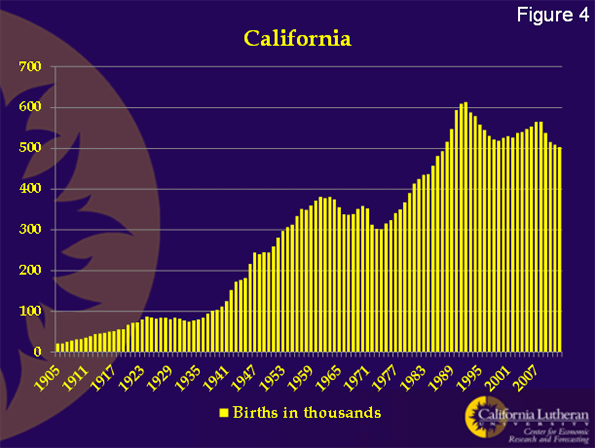
    Photo: Troy Holden

  • Chinese Cancel Treasure Island Investment as Brown Seeks High Speed Rail Funds

    California’s Governor Jerry Brown and an entourage of public officials and corporate executives has spent much of the last week traveling around China trying to drum up business for the state. One of his principal objectives is to entice Chinese investors to take a stake in the California high-speed rail project. From the Governor’s perspective, this makes all sense in the world.

    California’s high-speed rail program may be the current holder of the largest projected funding deficit of any infrastructure in the world, at approximately $50 billion. (That’s after shaving $30 billion off the project and losing the support of former California High Speed Rail Authority Chairman, former state Senator Quentin Kopp, who charges that the line is no longer "genuine high speed rail").

    As Governor Brown concludes his trip to the Orient, word comes from The San Francisco Chronicle that "A $1.7 billion deal with China Development Corp., the Chinese national railway and Lennar Corp. to construct 12,500 homes on the former Hunters Point Naval Shipyard in San Francisco and a string of high-rises on Treasure Island has collapsed." The project was to be built over up to three decades and would have housed 20,000 people. The deal is said to have fallen apart over not allowing the Chinese investors sufficient control and "unresolved tax issues."

    The now defunct deal may have been the largest serious Chinese investment proposal in California.

    There are important lessons for proponents of the high-speed rail system, who sometimes fantasize about China as the bailout investor of last resort. The Chinese, like the other investors who have found better things to do with their money are not likely to be swayed by the line’s excessively high cost or its modest ridership potential. Nor will the Chinese bear gifts to California.

    These issues are described in detail in the new Reason Foundation Updated Due Diligence report by Joseph Vranich and me.

  • California is in for a World of Hurt

    California’s political class, led by Governor Brown, has been patting itself on the back for solving California’s problems. This celebration is ludicrous.  What they’ve done amounts to a mere slowing down in a long-term political, fiscal, and demographic decline. 

    Demographic trends themselves are creating a crisis brought about by a population that is simultaneously losing its children and getting older, and to a frightening extent poorer. From 2000 to 2010, the percentage of Los Angeles’ population under 15 years old fell by 15.6 percent. This was the greatest decline of any U.S. major metropolitan area, and about double the U.S. average of 7.4 percent.

    California’s poverty statistics are just as depressing.  The state now is home to one-third of all US welfare recipients. According to a Census Bureau report, The Research SUPPLEMENTAL POVERTY REPORT: 2011 California has the nation’s highest poverty rate of any state. By its Supplemental Poverty Measure, 23.5 percent of California’s population is poor, while only 15.8 percent of the nation’s population is poor.  No other state is above 20 percent.

    Because of its aging and increasingly poor population, its dearth of young people and migratory trends, demand for government services in California will be increasing as the number of people available to pay for those services will be decreasing.  Financing concurrent expenses will be hard enough.  Paying for today’s excesses may prove impossible.

    Let’s go through the evidence:

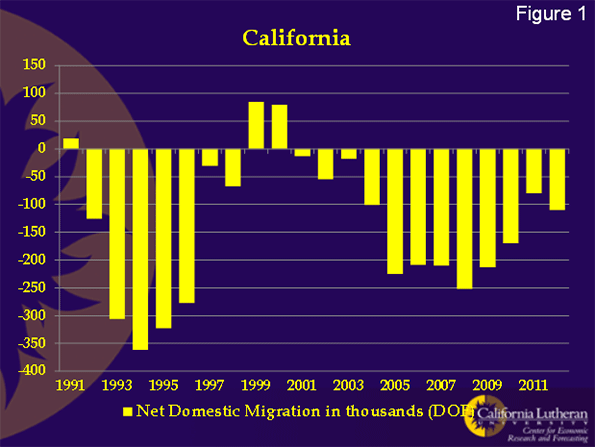
    Figure 1 shows California’s Department of Finance’s (DOF) estimate of domestic migration, migration between California and other states.  According to the DOF, California’s domestic migration has been negative in 18 of the past 20 years.  This is less dismal than the U.S. Census’ estimate that California’s domestic migration has been negative for 20 consecutive years.  This is the longest sustained period of negative domestic migration in California’s history.  We’ve seen this before, in the rust belt.  It leads to decay, poverty, increased crime, and unlivable cities.

    Domestic migration is important because it should be seen as an early warning signal of eventual decline.  Migrants are the proverbial “canaries in the coal mine”.  When domestic migration is negative, people are voting with their feet.  They are saying that California doesn’t provide enough opportunity to stay, particularly given its high cost of living.  Given how comfortable it is to live in California, I think they make that decision reluctantly.

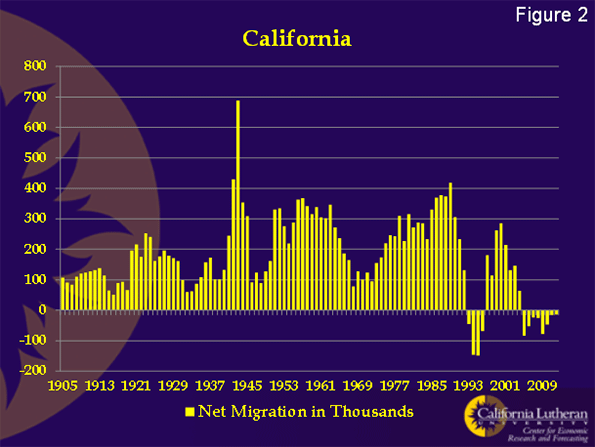
    Over most of California’s recent history, international migration has been strong enough that total migration remained positive.  That’s no longer true.

    Figure 2 shows California’s total net migration for the past 107 years.  Prior to 1993, California had never seen a year where total migration was negative.  Now, we’ve have negative migration for eight consecutive years.

    More critically, the rate of foreign migration in the state’s cities is falling behind many competitor cities. For example, over the last decade, New York had almost six times the increase in foreign born than Los Angeles. Houston, which has barely one third the population of LA-Orange County, increased its foreign born nearly four times as fast. Overall, LA-Orange had the lowest percentage increase of any major US metro. Given that the Southland has been the state’s immigration magnet for a generation, this is not good news.

    Weak, negative migration is likely to continue.  We used to characterize domestic migration as pull migration; rapidly growing economies attract migrants looking for opportunity. International migration, especially from other countries in this hemisphere, was thought to be push migration; conditions were so bad in the country of origin that migrants would come to California even in a recession.

    Apparently, that’s no longer true.  Mexico, for example, has an unemployment rate of about half of California’s today.  When you add the increased cost imposed by coyotes on illegal immigrants (a price increase from about $3,000 a few years ago to about $6,000 today plus the requirement to carry drugs), it’s no mystery why California’s growers are having a hard time finding an adequate workforce.

    Negative migration is important because migrants have been a critical part of California’s growth and creativity.  Not only is California losing the services of the migrants who choose, say, Texas instead of California, California is suffering a drain of some of its talent pool, particularly among those about to have children.

    For a long time, many people thought that California’s Hispanic population would cause its population growth rate to increase.  That turns out to not be true.

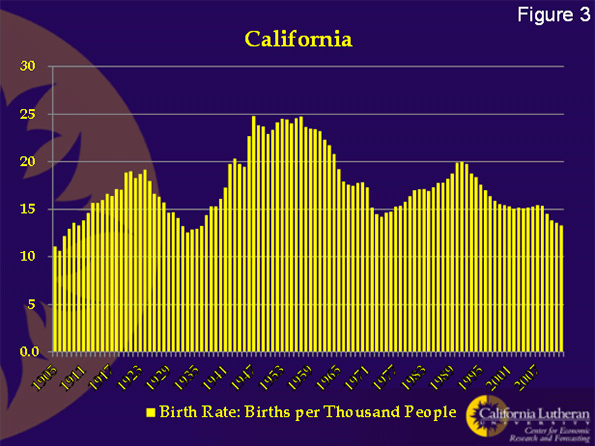
    Figure 3 shows California’s birthrate.  Our births per thousand population is the lowest it’s been since the worst part of the depression.  What’s scary though, is the rate of decline.  Births have fallen below 15 per thousand and seem destined to hit 10 per thousand.  This is a national trend and a key reason to create national policies that encourage increased international immigration.

    If a population is growing, it’s possible to have increasing births (new people) even when the birth rate is declining. Unfortunately, California isn’t there.

    Figure 4 shows the total number of births in California.  It’s fallen to 500,000 per year from 600,000 per year about 20 years ago.  If California’s birth rate falls to 10 percent, we can expect the number of births to decline to about 350,000.  At that point, the math starts to get to be a problem.  Is a decline to 10 per thousand possible?  You bet.

    According to the CIA, as of 2012, 29 out of 221 countries (13 percent) had birth rates below 10 per thousand.  Those 29 countries included Japan, Germany, Switzerland, South Korea, and Singapore.

    Unfortunately, California — as opposed to states such as Texas — could reach a 10 per thousand birth rate within 10 years if existing birth rate trends continue.  Even more disturbing, there is no reason to believe that 10 per thousand is a lower bound.  Germany, for example, has a birth rate of 8.33, while Hong Kong and Singapore have rates of only 7.54 and 7.72 respectively.

    For California’s population to continue to grow, births have to outnumber the losses to migration and deaths.  We’ve already discussed migration.  What about deaths?

    Figure 5 shows annual California deaths from 1971 through 2012.  While recently flat, the trend is up, and an aging population implies more increases. For our calculations, we’ll assume California deaths at 250,000 per year.  This is a conservative assumption. As the Baby Boomers age, California deaths will increase.

    When California’s birth rate falls to 10 per thousand, we can expect 350,000 births.  Deaths will be about 250,000. Apparently, as long as outmigration doesn’t exceed 100,000 California’s population won’t decline overall.

    The good news is that outmigration in excess of 100,000 has only happened once.  California’s net outmigration exceeded 100,000 for two consecutive years in the 1990s, when California was undergoing a dramatic economic realignment brought about by the end of the Cold War. 

    The bad news is that we’ve come very close to losing 100,000 twice in the past eight years, particularly during the housing boom. Many people believe that low home prices are restraining domestic outmigration, because people are waiting for equity to return before making the move. Higher home prices and increased tax rates could drive big increases in the numbers of people leaving California.

    Unless there is some dramatic change, it is almost inevitable that California will suffer a declining population within a generation. The way to avoid this calamity is create an economic environment that encourages job growth and economic activity. 

    At the same time, it appears prudent to begin planning now for an aging and possibly smaller population.  Increased government revenues through more robust and varied economic activity would help here, but more probably needs to be done. California needs to reform its business climate, reduce its debt and unfunded liabilities, and do so quickly.

    Bill Watkins is a professor at California Lutheran University and runs the Center for Economic Research and Forecasting, which can be found at clucerf.org.

  • California Needs More Immigrants

    Southern California, just a few decades ago the fastest-growing region in the high-income world, is hitting a demographic tipping point. With a decade or more of domestic out-migration and a sharp fall in immigration, the region is morphing from a destination that attracts dreamers and builders into a place increasingly dominated by those born or bred here.

    To some demographers, this transition from a magnet for migrants to a more native-born population represents something of a boon. As for migrants, one USC demographer wrote that California acts like "a gold pan that sifts through aspiring talent and keeps the best." Our new steady state is a good thing, the argument goes, since it offers a respite from the travails of rapid growth. All we need to focus on is spending more money on schools, and, not surprisingly, universities, and everything will turn out alright.

    There may be some truth to all these points, but, historically, a decline in new migration also suggests something else: a picture oddly reminiscent of the kind of demographic stagnation long associated with places like Cleveland, Buffalo, N.Y., Pittsburgh and Detroit. A more native-dominated region may be both more socially stable but increasingly hidebound and lacking innovation.

    For cities, demographic stagnation is not a recipe for success. Over the past decade, notes demographer Wendell Cox, the Los Angeles-Orange County area has seen the fifth-highest growth in the percentage of locally born people in its population, among nation’s 51 largest metropolitan areas. The concern is not so much that people are leaving these places in droves; the real issue is that not enough new people, with new ideas and great ambition, are coming in.

    Already, notes economist Bill Watkins, large parts of the state, particularly along the coast, are evolving into "geriatric ghettos" populated by aging, often-affluent baby boomers. And, as for keeping the "best," the steady decline in California’s relative educational ranking, particularly in the younger cohorts, should convince us that we cannot reasonably rely on native-born residents to meet the challenges of the future.

    Domestic Outmigration

    Watkins also points out that California has been losing domestic migrants for 10 of the past 15 years. It’s been worse in this region; over the past decade the Los Angeles-Orange County area suffered the third-highest rate in the country of net outmigration, slightly above New York’s. Amazingly, on a per capita basis, people are leaving our sun-drenched metropolis more rapidly than from Rust Belt disaster areas such as Cleveland and Detroit.

    In recent decades, this shortfall has been more than made up by foreign immigration. But in a stunning reversal of the trends in past decades, the number of foreign-born in our region has started to stagnate. Indeed, over the most-recent decade, the Southland has experienced the slowest rate of growth in its foreign-born population of any major region in the country. Los Angeles-Orange County gained 110,000 immigrants over the decade, one-sixth as many as New York City and only a quarter as many as Houston. Our immigrant population has grown less than that of much smaller regions such as Minneapolis-St. Paul, Austin, Texas, Atlanta and Dallas-Fort Worth.

    These patterns suggest a dangerous shift in our demographic DNA and a decline in our historic archetype as one of the world’s most culturally and economically innovative regions. Throughout history, the movement of newcomers has accented the rise of great cities at their peak, from ancient Athens, Rome and Baghdad to early 20th century London, Berlin, New York and Chicago. Similarly, the ascendency of the great cities of modern Asia – from Tokyo to Shanghai to Hong Kong and Singapore – resulted from mass migration, usually from the countryside to the urban centers.

    Pioneering Migrants

    Southern California’s evolution into one of the world’s premier urban regions has been, for the most part, propelled by outsiders, people who came to this place in search of a better life. Starting in the 1880s, these tended to be other Americans, including Los Angeles Times publisher Harrison Gray Otis (Marietta, Ohio), and railway magnate Henry Huntington (Oneonta, N.Y.), and, later, Walt Disney (Kansas City, Mo.), Howard Ahmanson Sr. (Omaha, Neb.) and Dr. Jerry Buss (Kemmerer, Wyo.).

    For such newcomers – including James Irvine, a native of Ireland – Southern California provided an opportunity to create new things of every type. Everything distinctive developed in Southern California was created largely by outsiders. The creators of the movie business were mostly Jews from Eastern Europe, while the aerospace industry was largely populated by Midwestern emigres. Even the people who built our cities came from elsewhere. Consider Ahmanson, who funded much of it. Developers like Eli Broad, a native of Detroit, or Nathan Shapell, a holocaust survivor from Poland, built many of the region’s suburban communities.

    In recent decades, L.A.’s outsiders have come increasingly from abroad. Most have come from Mexico and Asia, but also from the Middle East, the former Soviet Union and, increasingly, Africa. Their influence is everywhere, from the food trucks to the ethnic malls, at the universities and in the music scene. A large number of the smaller banks in the region are tied to immigrant communities.

    Nowhere is the influence greater than in the entrepreneurial arena. In the 1980s and 1990s, when Los Angeles-Long Beach frequently led in new immigration, newcomers from abroad fueled the rise of industries from garments to international trade and food processing. They are the primary creators of our food truck culture and often the chefs and owners of our finest restaurants.

    Business Starters

    Simply put, immigrants provided the critical oxygen for our economy, which, as a group, they are still doing. Even in the midst of the recession, newcomers continued to form businesses at a record rate, while the start-up rate for native-born entrepreneurs declined. The immigrant share of new businesses, notes a Kauffman Foundation survey, more than doubled, from 13.4 percent in 1996 to 29.5 percent, in 2010.

    Nationally, immigrants are responsible for roughly a quarter of all high-tech start-ups. Asians, who constitute more than 40 percent of newcomers, now account for roughly 20 percent of tech workers, four times their percentage of the population.

    How much is this dynamism, which once blessed the Southland, is now heading to Houston, Dallas-Fort Worth or even Charlotte, N.C.? It seems likely that, without the economic push from the immigrants and their countries, the reinvention of our economy will be far slower. Southern California natives seem far less likely to take the risks, and create the new industries, the region desperately needs.

    Regaining our allure to newcomers is now arguably our biggest challenge. We have some fine assets, such as great weather, universities and a strong entrepreneurial legacy. Critically, despite the stagnant past decade, the Los Angeles-Orange County region still remains the second-largest repository of immigrants, at 4.4 million, behind only the greater New York area’s 5.5 million. Virtually any ethnic group can find schools, shops and banks tied to their home countries; for some, like Chinese, Vietnamese, Mexicans and Iranians, Southern California remains a critical ethnic bastion and beacon.

    Shift Focus

    In this process, immigration reform could prove helpful, although most attention has been paid to legalizing undocumented immigrants already in the country. This may well be justified on moral ground but, in some ways, that debate is fighting the last war, as the flow of illegal immigration from Mexico has slowed, and may even be reversing. Legal immigration from Mexico also has declined markedly in recent years.

    A far more strategic concern would be easing the flow of Asian immigrants, who, according to a recent Pew study, are generally better educated and affluent than other newcomers. Asian immigrants are also more likely to start business; a 2012 Kauffman study notes that close to 40 percent of immigrant entrepreneurs come from India or China. We should be looking to capture all such skilled and entrepreneurial newcomers, from any country and, hopefully, also from within this country.

    To accomplish this we need to convince prospective migrants that this region, for all its faults, deserves to become, once again, a preferred destination for ambitious outsiders. It’s a task that our local leaders, both in the business world and government, need to take seriously, rather than take comfort in the prospect of a more stable, and fundamentally stagnant, demographic future.

    Joel Kotkin is executive editor of NewGeography.com and a distinguished presidential fellow in urban futures at Chapman University, and a member of the editorial board of the Orange County Register. He is author of The City: A Global History and The Next Hundred Million: America in 2050. His most recent study, The Rise of Postfamilialism, has been widely discussed and distributed internationally. He lives in Los Angeles, CA.

    This piece originally appeared in the Orange County Register.
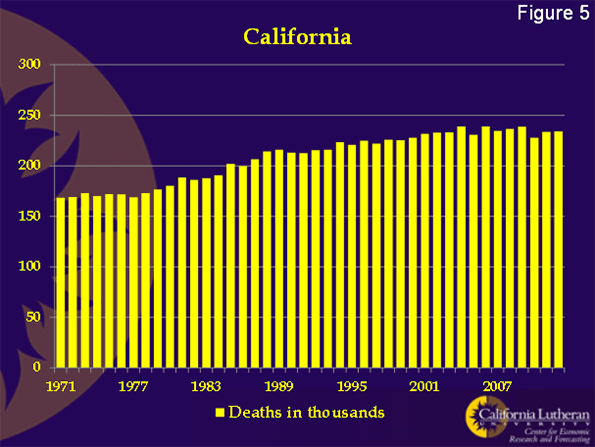
    Photo by telwink

  • Should California Governor Jerry Brown Take a Victory Lap?

    "Memento Mori" – "Remember your mortality" – was whispered into the ears of Roman generals as they celebrated their great military triumphs. Someone should be whispering something similar in the ear of Gov. Jerry Brown, who has been quick to celebrate his tax and budget "triumph" and to denounce as "declinists" those who threaten to rain on the gubernatorial parade.

    Brown speaks about California’s "rendezvous with destiny" and the state’s "special destiny… more vibrant and more stunning in its boldness." His pitch certainly has persuaded much of the mainstream media to add their horns to the triumph.

    Yet right now, despite its many blessings, our state remains more on a collision course with mediocrity – at best– than with any such manifest destiny. California may not be a "death-spiral state" as some conservatives suggest, but Brown’s triumphs – the Proposition 30 tax increases, the marginalization of the GOP as well as his Democratic rivals – have been more political than substantial and have done little to address the state’s major long-term challenges.

    Let’s check this out. Unemployment remains the third-highest among the states; we still have one-third of the nation’s welfare recipients; the highest poverty rate in the country, with one in five of California’s diminishing ranks of children living in poverty, including more than a third of children in Fresno. Our education system, with new dollars or not, continues to fail young people and our economy.

    Critically, the three key elements typically invoked to promote the comeback meme – budget relief, the genius of Silicon Valley alchemists and "green" jobs – are themselves suspect. Even Brown, who suggested that we could create 500,000 jobs from his climate change agenda, isn’t speaking much about it. In California, and across the nation, "green jobs" have failed to materialize enough to offset the higher costs imposed on the rest of the economy, the high public subsidies and parade of failed ventures associated with these policies.

    Yet, Brown is so dogmatically loyal to this agenda that he remains committed to massive regulation of the economy, which is slowing growth. And he shows – despite his occasional bouts of fiscal sanity – no signs of backing away from his financially troubled bullet-train fantasy.

    If green economics are failing, can Silicon Valley bail out the state? Reporters anxious to celebrate our deep-blue state’s comeback almost always genuflect to the tech industry. They rarely bother to look at the fact that, even with considerable growth in the tech sector over the past two years, the valley has not even recovered the job levels of a decade ago.

    More troubling still, Silicon Valley is becoming less an exemplar of capitalism than the beneficiary of an insider game that relies on access to capital and contacts more than on innovation. It is also becoming increasingly dependent on government largesse: No one bet more on subsidized "green" companies than the venture-capital elite. Prospects are also dimming for social media, the valley’s latest signature industry. User interest in Facebook is slipping, notes Pew, and the industry now sees its next great opportunity, of all socially worthless things, in online gambling.

    Even under the best of circumstances, Silicon Valley is neither robust enough nor predisposed to help solve the state’s long-term fiscal challenges. In fact, the high-tech darlings of the progressives, such as Google and Apple, are turning out to be as adept in not paying taxes as are Mitt Romney or General Electric. For its part, Facebook now appears to have paid no income taxes at all last year.

    In fact, the only thing bailing out California is not growing tech firms, but the enormous legacy of wealth, including inherited wealth, that has built up in our state over the past 30 years. California is still rich in rich people, whose stock and real estate holdings are gaining value. As long as Uncle Ben’s printing press hands out free money, California could collect enough in state income taxes to perhaps balance its annual budget for a spell.

    None of this places, to say the least, California on a firm footing. So at the risk of engendering some gubernatorial ire, here’s my memento mori suggestions for restoring California’s promise. This starts with the assumption that the elements of a true revival exist and that, if Brown would shed some of his dogma, he may end up deserving his current plaudits.

    Get real on the budget.Asset bubbles may rescue the state from annual budget woes, but the state’s long-term prospects remain cloudy, due largely to mounting government employee pension costs. Attempts to revise the game for new employees are not sufficient to scale the state’s mounting "wall of debt"; Californians per capita now owe almost five times as much to Wall Street as residents of our chief rival, Texas. Analyst Joe Matthews suggests we need more drastic fixes, such as cutting off retirees’ health benefits after they reach Medicare age.

    Redirect the climate-change jihad. California can keep leading in conservation but needs to adopt a more pragmatic people-friendly approach, such as by encouraging telecommuting and energy-saving technologies. In contrast, the current high-density housing diktats and ultra-expensive "green" energy will force up prices for housing and electricity rates way out of proportion to national norms. This damages the middle and working class even if it won’t impinge on the lifestyles of Brown’s rich and famous friends.

    Focus on basic industry. Tech and entertainment can never drive enough jobs or wealth to support this huge state. But California is blessed with the country’s richest soil and huge fossil-fuel reserves. These could bring in new revenue to the state and create new jobs for a broad number of Californians, particularly in the hard-pressed interior. Particularly critical is the state of the water system, which once again faces large cutbacks because of pressure from environmentalists. Brown has spoken in favor of a peripheral canal; solving the water problem may leave him with a greater legacy than the dodgy bullet train.

    Reform the education system. More money alone won’t save the schools, but may be used only to prop up the pensions of teachers and administrators. Some kind of radical reform – perhaps school choice, vouchers, mass use of charters – must be the price of any increase in money to education. Brown has made some reformist noises with the University of California, but he remains tethered to the teachers unions on K-12 schools.

    Invest in economically needed infrastructure. Besides the peripheral canal, Brown should look at expanding the state’s energy supply by permitting the construction of low-polluting, economically efficient gas-fired power plants. Rather than waste money on a "train to nowhere," he should be looking at fixing roads, bridges, ports – the sinews of a modern economy – and improving existing inter-city trains (and buses), particularly in high-volume corridors in the Bay Area/Sacramento and across Southern California.

    Prioritize blue-collar opportunities. California’s greatest challenges lie with a widening class divide. Bolstering manufacturing, which is in a secular decline here, and restarting construction could create new opportunities for blue-collar workers. Port expansion would create lots of jobs in everything from warehousing to assembly and business services. This can be meshed with revitalized training programs for the skilled trades. In simple terms: California needs more skilled machinists, electricians and irrigation technicians and likely fewer marginally employable ethnic-studies or humanities grads from second- and third-tier schools.

    One can understand why our governor, at age 74, wants to enjoy his triumph. But to deserve the laurel wreath, he first needs to make the major changes that can bring this greatest of states back to its historic potential.

    Joel Kotkin is executive editor of NewGeography.com and a distinguished presidential fellow in urban futures at Chapman University, and a member of the editorial board of the Orange County Register. He is author of The City: A Global History and The Next Hundred Million: America in 2050. His most recent study, The Rise of Postfamilialism, has been widely discussed and distributed internationally. He lives in Los Angeles, CA.

    This piece originally appeared in the Orange County Register.

    Jerry Brown photo by Bigstock.