Tag: California

  • From California to Canberra, the Real Class War

    Just under a year before she crawled over Kevin Rudd to claim the Prime Minister’s office, Julia Gillard visited the United States in her then capacity as Australia’s Education Minister. Her stay in Los Angeles took in the Technical and Trades College, where she brushed up on the teaching of “green skills,” a subject close to her heart. “Here in Los Angeles," she told the media that day, “under the leadership of Governor Schwarzenegger, this is a state that is looking to the future; this is a state that is leading on climate change adaption; and this is a state that’s leading on green skills and I’ve seen that on display today at this college.”

    The date was 5 October 2009. As far as dud forecasts go, these platitudes don’t match Lincoln Steffens on the Soviet Union – “I’ve seen the future and it works” – but they’re bad enough. Today Schwarzenegger has gone, his reputation in tatters, and California, reduced to issuing IOU’s to pay its bills, teeters on the brink of bankruptcy.

    Australians have long seen California as a trend-setter, given the common Anglophone culture and semi-arid climate on the Pacific Rim. There’s also the shared love of motor car mobility and suburban independence, and a voracious appetite for tech and entertainment products pouring out of Hollywood and Silicon Valley. But these days the Golden State is just as likely to fill Australians with unease. They find themselves infected with a strain of the green-welfare-utopianism that brought California to its knees.  

    Sure, this doesn’t show up in official statistics; at least not yet. Gillard and Treasurer Wayne Swan never tire of reminding Australians they are “the envy of the world”: unemployment at 4.9 per cent, GDP growth of 3 percent (or more) this financial year, government debt to GDP ratio of just 23 percent and a projected budget surplus in 2013. In April, the IMF predicted that Australia would be the best performing advanced economy over the coming two years. The government and its allies in the elite media are hyper-vigilant about containing discussion of the nation’s affairs within this bounteous frame.

    It’s hard to reconcile Australia’s position with the plight of California, which routinely attracts phrases like “basket case.” Unemployment is running at around 11per cent, significantly above the national US average of 8.2 percent, and Governor Jerry Brown is struggling with an intractable budget deficit of around $US20 billion. Thousands of teachers and other public servants are being laid off, and revenue imposts are driving businesses to other states. One commentator went so far as to say “California’s situation is in some ways more worrisome than Greece’s,” since it represents 14 per cent of the American economy, while Greece only accounts for 2 per cent of the EU.

    But if any of this is supposed to make Australians feel good about their lot, it doesn’t. However benign the headline figures look, they’re in a restive mood. The Westpac-Melbourne Institute index of consumer sentiment continues to languish in negative territory, and the latest Roy Morgan Monthly Business Confidence Survey recorded a 57 percent fall in businesses which believe “Australia will have good economic conditions in the next 12 months”. Astonishingly, the recent Boston Consulting Group consumer sentiment survey found that Australians feel less financially secure than the average European, even less secure than Spaniards, whose economy is in meltdown.

    Nor is much love flowing to Gillard and Swan. Stuck in opinion-poll hell – support for the government has been around 30 percent for over a year – they would be thrown out in a landslide if an election were held today.  

    Why are Australians so low when their economy is so high? The chattering classes are in a funk over this conundrum. People should be showering this fine progressive government with praise, they insist. In patronising tones so familiar around inner Sydney and Melbourne, one columnist scribbled “we are, as a nation, chucking a full-on, all-screaming, all-door slamming teenager temper tantrum … Maybe it’s time we grew up and realised how good we’ve got it.” Others suggest more sober explanations.

    Topping the list is Gillard’s absurd $23 a tonne carbon tax, effective from 1 July this year. Most pundits are loath to concede that, in international terms, the measure is quite radical and Gillard only embraced it to appease the Greens. From the comfort of their armchairs, they dismiss fears about the tax as irrational. After all, Treasury modelling indicates that the effect on growth will be minuscule and, under the government’s package, households will be over-compensated for cost of living increases. If only the Opposition would drop its inflammatory attacks, they maintain, the pessimism would disappear.

    Some blame the negative wealth-effect of sliding house prices and shrinking superannuation funds, battered by stock market volatility.  

    No doubt, such factors do contribute to the malaise, along with loss of faith in a parliament hit by financial and sexual scandals implicating the Speaker and a Labor MP. But opinion-makers who refuse to look beyond the headline figures are concealing the larger story. Across a range of traditional industries, workers grasp that the economy is shifting in directions that could erode the foundations of their mobility and independence. Understanding more than they are given credit for, they fear that the current Labor Government, beholden to Greens and academic elites, and hiding behind stodgy rhetoric, is driving or exploiting those shifts. The most visible manifestations of this are the carbon tax and other green agendas.

    These workers have cause to be worried, if they glance across the Pacific. In his close analysis of the California crisis, US demographer Joel Kotkin starts with the premise that “California consolidated itself as a bastion of modern progressivism.” Drawing on extensive evidence, Kotkin exposes the suffocating influence of radical environmentalists, progressive high-tech venture capitalists, Hollywood moguls, and civil rights attorneys, who have given California escalating energy costs – 50 per cent above the US average and rising – and dwindling fossil-fuel energy exploration and production, America’s sixth highest tax rates, also rising, coupled with proposals to skew the tax system in favour of the super-rich against microbusinesses, the third heaviest tax burden on business out of the 50 states, enormous subsidies and tax breaks for solar and other renewable-energy producers, and complex labour laws.

    “California’s green policies”, says Kotkin, “affect the very industries – manufacturing, home construction, warehousing, and agribusiness – that have traditionally employed middle and working class residents”. With reason, Kotkin calls these developments The New Class Warfare. There is indeed a class dimension to discontent in the United States and Australia, and it has nothing to do with the confected class-war rhetoric coming out of the Obama Administration – “we must all pay our fair share” – and the Gillard Government –“spreading the benefits of the [mining] boom”.  

    John Black, a demographic profiler and former senator, points out that since Labor came to power in 2007, “public administration, education, and health sector jobs have accounted for almost six out of ten of the 760,000 jobs created, instead of the longer term two out of ten.” The health industry alone has grown by 260,000 jobs in four years, a figure that equates to some 2.6 per cent of the whole workforce. Over those years, manufacturing, which accounts for 8.3 of total employment, lost close to 100,000 jobs.

    Last year, “health care and social assistance” replaced “retail trade” as the largest occupational category profiled by the Australian Bureau of Statistics, while “manufacturing” along with “agriculture, forestry and fishing”, traditional blue-collar hubs, were the only categories to contract. "Education and training" and "public administration and safety" ranked higher than "transport, postal and warehousing" and "wholesale trade".

    Job-shedding by a succession of manufacturing, retail and construction firms has dominated recent news bulletins. According to Black, if not for growth in the publicly-funded sector, the employment rate would be closer to 7 than 5 percent.

    If Gillard and Swan are to be believed, such shifts are beyond their control. In a major address on the economy in February, Gillard explained that “the level of the dollar – and the pace of its rise – has broken some business models and forced economic restructuring”. Displaying Marie Antoinette levels of indifference, she declared “these are powerful, economy-wide transformations, perhaps best thought of as ‘growing pains’.” If you thought this posed a complex challenge, think again. “The equation is simple,” she said, “skills brings jobs, and skills bring job security.”

    Here Gillard genuflects to the progressive dogma that education is the answer to every economic problem. It’s hardly surprising that a movement dominated by academics, researchers, educators and university administrators should claim ownership of the path to salvation. But Gillard has it back-to-front. In activities like manufacturing, economic growth brings jobs, which bring skills, not the other way around.

    It’s true that the mining boom and Australia’s safe credit rating have driven the dollar to near or above parity with the greenback. It’s also true that this has exerted pressures on the export and import-competing sector. But government action has intensified these pressures. Labor is ideologically committed to social gentrification and expansion of the white-collar professional classes, particularly in social services, even if this means transferring resources from productive industries that will slow down, stagnate, shrink or vanish.

    While Gillard and Swan would never be so candid, their allies in Australia’s bulging university system, the public sector unions and the Greens aren’t so inhibited. Nor are Labor figures like former Prime Minister Paul Keating, who criticised the Opposition’s attack on the carbon tax in these startling terms:

    … in this country, 80 per cent of people work in the tertiary economy, in services, in the industry like – as we are tonight, in the service economy. And, the new industries, the green industries, are service industries, not the old manufacturing. Manufacturing’s moved to the east [meaning East Asia]. It’s the service industries that are the new growth industries. So, to turn your back on the mechanism which allocates the capital out of the old industries and into the new ones is to turn your back on the future.

    If Gillard Labor cared about blue-collar and other routine jobs, not to mention the small business sector, they would switch to policy settings that spur growth in industries like manufacturing, retail, transportation and logistics, construction and forestry. Cutting spending, reducing company and other business taxes, junking green taxes and green tape, withdrawing from the debt market and liberalising industrial relations would hand employers more flexibility to cope with the high dollar and low cost competitors in Asia.

    Clearly, this isn’t the government’s priority. Instead they have introduced a carbon tax and a mining tax, and in last month’s budget dropped a proposed cut in company tax, they are throwing at least $2.7 billion at various green schemes, not including the “winner picking” $10 billion Clean Energy Fund, they have adopted a Renewable Energy Target of 20 per cent by 2020, they are pouring vast sums of money into higher education to the tune of $5 billion a year including an additional $5.2 billion in the budget, some of which will find its way into a maze of “sustainability institutes,” they have lifted the cap on university places and embarked on a radical plan to expand the proportion of 25 to 34 year olds with a bachelor’s degree to 40 per cent by 2025, they have re-regulated the labour market and imposed a system which, according to the chairman of BHP-Billiton, “is just not appropriate and doesn’t recognise today’s realities,” they have laid the groundwork for new multi-billion-dollar programs in aged, disability and mental health care, employing tens of thousands of new carers, and they have endorsed an industrial tribunal decision that boosts the pay of these workers by up to 65 percent.

    California here we come.

    John Muscat is a co-editor of The New City, where this piece first appeared.

    Photo of Australian Parliament House by BigStockPhoto.com.
  • Thoughts on High-speed Rail and Buses

    I’m back from a California trip – beautiful state, beautiful weather, completely dysfunctional government.  For example, even with massive fiscal problems it’s still trying to build a vastly expensive high-speed rail line from San Francisco to San Diego. On a related note, a private group is exploring building a Houston-Dallas HSR line with no subsidies of any kind. I’m totally okay with private efforts.  I’m probably even okay with a little eminent domain to get the right of way at a fair price. I hope they can make it work.

    Here’s a great alternate perspective on HSR: a TED talk on the value of perception and psychology vs. economics and technology.  Go to the 6:12 point to see a great example of the Eurostar train, where they spend a vast amount of money to reduce travel times by 40 mins, when for 90% or 99% less money they could have improved the experience instead and actually gotten higher rider satisfaction.  I believe the absolute same principle applies to bus vs. rail, whether intra- or inter-city: spend 1% or 10% of the same money improving the bus service and get higher customer satisfaction than the rail line would generate.  (hat tip to Karl)

    And Greyhound is doing just that, learning from Megabus and upgrading their service with wifi, power plugs, and nicer seats with more leg room.  With that kind of service option available at say $30 one-way within the Texas Triangle, how many people do you think would pay $150+ to go on HSR?  On second thought, maybe nobody should mention this possibility to the Texas HSR group…  😉

  • Facebook’s IPO Testifies to Silicon Valley’s Power but Does Little for Other Californians

    The  $104 billion Facebook IPO testifies to the still considerable innovative power of Silicon Valley, but the hoopla over the new wave of billionaires won’t change the basic reality of the state’s secular economic decline.

    This contradicts the accepted narrative in Sacramento. Over five years of below-par economic performance, the state’s political, media, and business leadership has counted on the Golden State’s creative genius to fund the way out of its dismal budgetary morass and an unemployment rate that’s the third highest in the nation. David Crane, Governor Schwarzenegger’s top economic adviser, for example, once told me that California could easily afford to give up blue-collar jobs in warehousing, manufacturing, or even business services because the state’s vaunted “creative economy” would find ways to replace the lost employment and income. California would always come out ahead, he said, because it represented “ground zero for creative destruction.”

    Schwarzenegger’s successor, Jerry Brown, and his economic team have been singing the same song, hoping, among other things, that the Facebook offering, and other internet IPOs, might bring in enough money to stave off the state’s massive, growing deficit, now estimated at more than $16 billion. Yet even as the new IPO wave has risen, California’s fiscal situation has worsened while state tax collections around the nation have begun to rise.

    Of course, Facebook’s public offering will help, but only so much. According to the legislative analyst’s office, the Facebook gusher should put an additional $1.5 billion into the state coffers this year, roughly one tenth of the state deficit, with perhaps another billion in the following few years. This constitutes a nice win, but barely enough to sustain the state even over the short—not to mention the long—run.

    The problem lies in large part in the nature of the economy epitomized by Facebook. Being based in cyberspace and driven entirely by software, such companies employ almost exclusively well-educated workers from the upper middle and upper classes. In the past “a booming tech economy created all kinds of jobs,” notes Russell Hancock, president and CEO of Joint Venture Silicon Valley, a key industry research group. “Now we only create these rarefied jobs.”

    As Hancock suggests, this contrasts with previous California booms. Back in the ’80s or even the ’90s, California’s tech booms were felt broadly in Orange and other Southern California counties and appeared to be moving inland to places like Sacramento. Anchored by its then dominant aerospace industry, Los Angeles remained a tech power on its own while enjoying employment from a burgeoning fashion industry, the nation’s dominant port and, of course, Hollywood. 

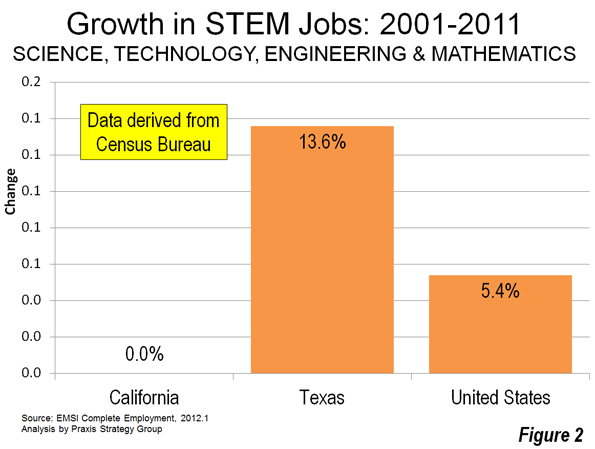
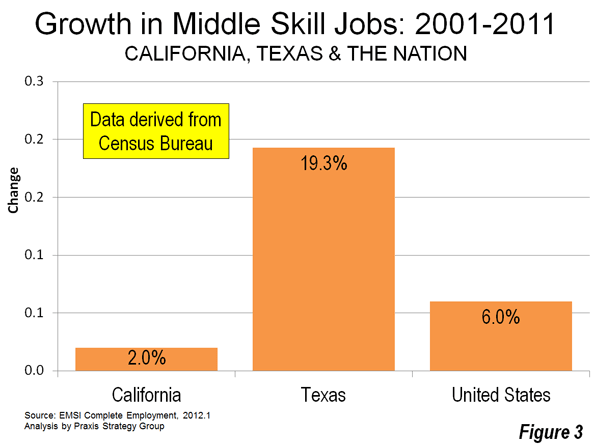
    In contrast, today’s job surge has been largely concentrated in a swath from San Francisco down to Sunnyvale. These firms create the kind of outrageous fortunes celebrated in the media, but their overall employment impact has not been enough to keep California even at parity with the rest of the country. Over the past decade, the state has created virtually no new STEM jobs (science, technology, engineering and math-related employment), while the U.S. experienced a 5.4 percent increase. Arch rival Texas enjoyed a STEM job gusher of 13.6 percent. More important still, mid-skill jobs grew only 2 percent, one third the rate nationally and roughly one fifth the expansion in the Lone Star State.

    Even the Bay Area itself has enjoyed less than stellar growth. Indeed, even now overall unemployment in the Valley remains at 9.3 percent, below the state average of more than 11 percent but higher than the national average. The Valley now boasts 12 percent fewer STEM jobs than in 2001; manufacturing, professional, and financial jobs also have shown losses. Overall, according to research by Pepperdine University economist Mike Shires, the region at the end of last year had 170,000 fewer overall than just a decade ago.

    Today’s Valley boom is also very limited geographically as well, with most of the prosperity concentrated in the Peninsula area, particularly around places like Mountain View (headquarters of Google), Menlo Park (headquarters of Facebook) and in pockets of San Francisco. Meanwhile, San Jose, which fancies itself “the capital of Silicon Valley,” faces the prospect of municipal bankruptcy, a fate increasingly common among cities across the state.

    The magnetic pull of the current tech boom is even weaker across the bay in the Oakland area, where unemployment scales to 14.7 percent. According to the recent rankings of job growth Shires and I did for Forbes, Oakland ranked 63rd out of the nation’s 65 largest metropolitan areas, placing between Cleveland and Detroit.

    Outside of San Diego, which has continued to gain jobs, the echoes of the tech “boom” are even fainter elsewhere in the state. Sacramento placed 60th in the job creation study, just behind Los Angeles, by far the largest region in the state. Former high-flier Riverside-San Bernardino ranked 50th, while the once booming “OC,” Orange County, could do no better than a mediocre 47th.

    These economies have also become technological laggards. According to a study on tech job creation by my colleague Mark Schill, greater Los Angeles, Sacramento, and Riverside-San Bernardino, three large regions, now rank  in the bottom third in tech growth. The Los Angeles area, once the global center of the aerospace industry, now has a lower percentage of jobs in tech-related fields than the national average.

    Beyond the big coastal cities, in places few reporters and fewer venture capitalists travel to, things are often worse. Fresno, Modesto, and Merced have among the weakest employment numbers in the nation. They may be partying in Palo Alto, but things are becoming increasingly Steinbeckian just 50 miles inland.

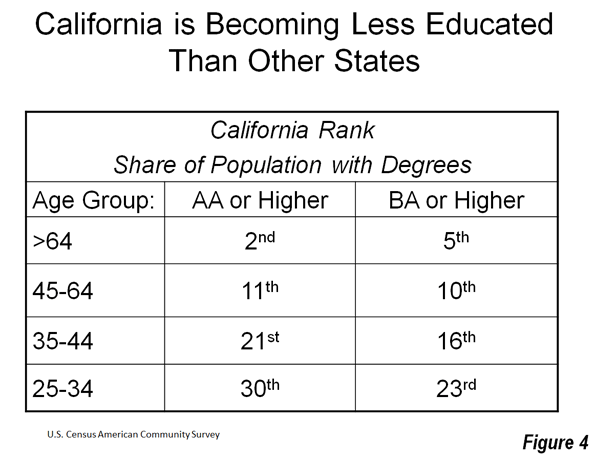
    This is happening even as there has been an ominous decline in the overall quality of California’s talent pool. For residents over age 65, the state ranks 2nd in percentage of people with an AA degree or higher, but among workers 25 to 34 it falls to 30th. Even worse, according to National Assessment of Educational Progress, California eighth graders now rank 47th in science-related skills, ahead only of Mississippi, Alabama, and the District of Columbia.

    None of this seriously affects the new wave of Valley firms. A Google, Apple or Facebook can cream the top not only of the California workforce, but the most gifted drawn from around the world. The old Valley depended on engineers and technicians cranked out in unheralded places like San Jose State and the junior colleges; the new Valley simply mines Stanford, CalTech, Harvard and MIT for its most critical raw material.

    This reflects the contradiction inherent in California’s emerging economy.  High-end, massively financed tech firms like Facebook can endure the Golden State’s weak general education, insanely tough regulations, high energy costs, and rising tax rates. Silicon Valley software firms generally tend to support, or certainly don’t oppose, the draconian energy, land use, and other state regulations widely opposed by other, less ethereal industries.

    The main reason: costs cannot be so well sustained outside the favored zones. This explains why people are not flocking in large numbers to California anymore. Last year, according to IRS data, California ranked 50th ahead of only Michigan–for rate of in-migration. So as the most gifted young nerds cluster around Palo Alto, middle-class families leave; between 2000 and 2009, 1.5 million more domestic migrants left the state than came. Even the Bay Area–the epicenter of the boom—has been losing 50,000 domestic migrants a year, due to unsustainably high housing prices and a narrower range of employment options for all but the best educated.

    Many of these people–and companies—are moving to places that are far less attractive in terms of climate or culture, such as Utah, Texas, or even Oklahoma. The migrants may miss the beach or the temperate climate but reap huge benefits from lower home prices, lower taxes, and much better business environments. 

    Of course, any state would welcome the windfall that is coming from Facebook and other dot.com phenomena. But the celebration over IPOs and rich payouts obscures the greater danger that threatens the future of the Golden State. The current boom demonstrates that Californians can no longer count on the prosperity of a few as the harbinger of better things for the rest of us. Instead Californians now inhabit, as a recent Public Policy Institute of California study    suggests, a society that is increasingly class divided, far more so than the national average.

    Ultimately, one should not expect Facebook, or any company, to solve these vast problems. To expect this tech wave to reverse California’s decline is nothing short of delusional. 

    Joel Kotkin is executive editor of NewGeography.com and is a distinguished presidential fellow in urban futures at Chapman University, and contributing editor to the City Journal in New York. He is author of The City: A Global History. His newest book is The Next Hundred Million: America in 2050, released in February, 2010.

    This piece originally appeared in The Daily Beast.

    Facebook photo by BigStockPhoto.com.

  • The Best Cities For Tech Jobs

    With Facebook poised to go public, the attention of the tech world, and Wall Street, is firmly focused on Silicon Valley. Without question, the west side of San Francisco Bay is by far the most prodigious creator of hot companies and has the highest proportion of tech jobs of any region in the country — more than four times the national average.

    Yet Silicon Valley is far from leading the way in expanding science and technology-related employment in the United States.

    To determine which metropolitan areas are adding the most tech-related jobs, my colleague Mark Schill at Praxis Strategy Group developed a ranking system for Forbes that measures employment growth in the sectors most identified with the high-tech economy (including software, data processing and Internet publishing), as well as growth in science, technology, engineering and mathematics-related (STEM) jobs across all sectors. The latter category captures tech employment growth that is increasingly taking place not just in software or electronics firms, but in any industry that needs science and technology workers, from manufacturing to business services to finance. We tallied tech sector and STEM job growth over the past two years and over the past decade for the 51 largest metropolitan statistical areas in the United States. We also factored in the concentration of STEM and tech jobs in those MSAs. (See the end of this piece for a full rundown of our methodology.)

    Anyone who has followed tech over the past 30 years or more understands the cyclical nature of this industry — overheated claims of a “tech-driven jobs boom” often are followed by a painful bust. This is particularly true for Silicon Valley. The remarkable confluence of engineering prowess, marketing savvy and, perhaps most critically, access to startup capital may have created the greatest gold rush of our epoch, but the Valley at the end of 2011 employed 170,000 fewer people than in 2000.

    Most of the job losses came in manufacturing, and business and financial services, sectors with a significant number of STEM workers. Even though the current boom has sparked an impressive 8% expansion in the number of tech jobs in the San Jose-Sunnyvale-Santa Clara metropolitan statistical area over the past two years, and 10% over the past decade, the area still has 12.6% fewer STEM jobs than in 2001. Overall, the recent growth and concentration of tech and STEM jobs remains good enough for the San Jose metro area to take seventh place in our ranking of the Best Cities For Tech Jobs. Next-door neighbor San Francisco, ranked 13th, has enjoyed similar tech and STEM growth over the past two years, but over 2001-2011, its total STEM employment inched up only a modest 0.8%.

    The Established Winners

    So which areas offer better long-term, broad-based prospects for tech growth? The most consistent performer over the period we assessed is the Seattle-Tacoma-Bellevue, Wash., metro area, which takes first place on our list. Its 12% tech job growth over the past two years and 7.6% STEM growth beat the Valley’s numbers. More important for potential job-seekers, the Puget Sound regions has grown consistently in good times and bad, boasting a remarkable 43% increase in tech employment over the decade and an 18% expansion in STEM jobs. Seattle withstood both recessions of the past decade better than most regions, particularly the Valley. The presence of such solid tech-oriented companies as Microsoft, Amazon and Boeing — and lower housing costs than the Bay Area — may have much to do with this.

    Our top five includes two government-dominated regions: the Washington-Arlington-Alexandria MSA places second with 20.6% growth in tech employment since 2001 and 20.8% growth in STEM jobs; and Baltimore-Towson, Md., places fifth with 38.8% growth in tech jobs in the same period and 17.2% growth in STEM. Over the past two years, their tech growth has been a steady, if not spectacular 4%. One key to the stability may be the broadness of the tech economy in the greater D.C. area; as the Valley has become dominated by trends in web fashion, the Washington tech complex boasts substantial employment in such fields as computer systems design, custom programming and private-sector research and development.

    Diversity in tech may also explain the success of other tech hotspots around the country. No. 3 San Diego-Carlsbad-San Marcos, Calif., has ridden growth in such fields as biotechnology and other life and physical sciences research. Over the past decade, tech employment has grown by almost 30% and STEM jobs by 13% in this idyllic Southern California region, and over the past two years, by 15.7% and 6.5%, respectively. Like San Diego, No. 11 Boston is also a well-established tech star, enjoying 11.3% tech growth over the last decade and nearly 10% over the past two years, with a diversified portfolio that includes strong concentrations in biotechnology, software publishing and Internet publishing. STEM employment, however, has remained flat over the past 10 years though.

    New Tech Hotspots

    Which areas are the likely “up and comers” in the next decade? These are generally places that have been building up their tech capacity over the past several decades, and seem to be reaching critical mass. One place following a strong trajectory is Salt Lake City, No. 4 on our list, which has enjoyed a 31% spurt in tech employment over the past 10 years. Some of this can be traced to large-scale expansion in the area by top Silicon Valley companies such as Adobe, Electronic Arts and Twitter.

    These companies have flocked to Utah for reasons such as lower taxes, a more flexible regulatory environment, a well-educated, multilingual workforce and spectacular nearby natural amenities. Perhaps most critical of all may be housing prices: Three-quarters of Salt Lake area households can afford a median-priced house, compared to 45% in Silicon Valley and about half that in San Francisco.

    Several other top players with above average shares of tech jobs are emerging as powerful alternatives to Silicon Valley. Like Salt Lake City, eighth-place Columbus, Ohio, boasts above-average proportions of tech and STEM jobs in the local economy, and benefits from being both affordable and business friendly. The Ohio state capital has enjoyed 31% growth in tech jobs over the past decade and 9.5% in the past two years. Raleigh-Cary, N.C., ranked ninth, is another relatively low-cost, low-hassle winner, expanding its tech employment a remarkable 32.3% in the past decade and STEM jobs 15%.

    Possible Upstarts

    Several places with historically negligible tech presences have broken into our top 10. One is No. 6 Jacksonville, Fla., which has enjoyed a 72.4% surge in tech employment and 17.4% STEM job growth since 2001, mostly as a result of a boom early in the decade in data centers, computer facilities management, custom programming and systems design. Another surprising hotspot: No. 10 Nashville, Tenn., where growth in data processing and systems design fueled tech industry growth of 43% along with 18.5% STEM employment growth over the past decade.

    Who’s Losing Ground

    Some mega-regions with established tech centers have been falling behind, notably No. 47 St. Louis, No. 45 Chicago, No. 41 Philadelphia and No. 39 Los Angeles. These areas still boast strong concentrations of STEM-based employment and prominent high-tech companies, but have suffered losses in fields such as aerospace and telecommunications. Remarkably despite the social media boom, the country’s two dominant media centers — L.A. and No. 33 New York — have also performed poorly enough that their STEM and tech concentrations have fallen to roughly the national average.

    Valley Uber Alles?

    Silicon Valley may be churning out millionaires like burritos at a Mexican restaurant, but looking into the future, one has to wonder if its dominance will diminish. Limited developable land, an extremely difficult planning environment, high income taxes and impossibly stratospheric housing costs may lead more companies and people to relocate elsewhere, particularly if the big paydays needed to make ends meet wind down. Mark Zuckerberg and company can bask in their big IPO this week, but the Valley may soon need to consider what it must do to compete with the many other regions that are inexorably catching up with it.

    Best Metropolitan Areas for Technology Jobs Rankings

    Region Rank Index Score
    Seattle-Tacoma-Bellevue, WA 1 76.0
    Washington-Arlington-Alexandria, DC-VA-MD-WV 2 66.4
    San Diego-Carlsbad-San Marcos, CA 3 66.0
    Salt Lake City, UT 4 58.5
    Baltimore-Towson, MD 5 57.7
    Jacksonville, FL 6 57.6
    San Jose-Sunnyvale-Santa Clara, CA 7 57.2
    Columbus, OH 8 52.9
    Raleigh-Cary, NC 9 51.9
    Nashville-Davidson–Murfreesboro–Franklin, TN 10 51.7
    Boston-Cambridge-Quincy, MA-NH 11 51.4
    San Antonio-New Braunfels, TX 12 50.7
    San Francisco-Oakland-Fremont, CA 13 48.5
    Houston-Sugar Land-Baytown, TX 14 47.6
    Cincinnati-Middletown, OH-KY-IN 15 47.4
    Austin-Round Rock-San Marcos, TX 16 46.8
    Atlanta-Sandy Springs-Marietta, GA 17 46.5
    Portland-Vancouver-Hillsboro, OR-WA 18 46.3
    Detroit-Warren-Livonia, MI 19 46.0
    Dallas-Fort Worth-Arlington, TX 20 44.2
    Denver-Aurora-Broomfield, CO 21 42.9
    Pittsburgh, PA 22 42.9
    Buffalo-Niagara Falls, NY 23 42.3
    Charlotte-Gastonia-Rock Hill, NC-SC 24 42.1
    Indianapolis-Carmel, IN 25 41.5
    Minneapolis-St. Paul-Bloomington, MN-WI 26 41.0
    Providence-New Bedford-Fall River, RI-MA 27 40.5
    Miami-Fort Lauderdale-Pompano Beach, FL 28 40.1
    Richmond, VA 29 39.1
    Phoenix-Mesa-Glendale, AZ 30 38.7
    Louisville/Jefferson County, KY-IN 31 38.6
    New Orleans-Metairie-Kenner, LA 32 38.0
    New York-Northern New Jersey-Long Island, NY-NJ-PA 33 37.8
    Hartford-West Hartford-East Hartford, CT 34 37.6
    Tampa-St. Petersburg-Clearwater, FL 35 36.0
    Oklahoma City, OK 36 35.7
    Orlando-Kissimmee-Sanford, FL 37 35.0
    Riverside-San Bernardino-Ontario, CA 38 33.8
    Los Angeles-Long Beach-Santa Ana, CA 39 33.7
    Las Vegas-Paradise, NV 40 33.4
    Philadelphia-Camden-Wilmington, PA-NJ-DE-MD 41 33.3
    Sacramento–Arden-Arcade–Roseville, CA 42 33.2
    Cleveland-Elyria-Mentor, OH 43 29.9
    Rochester, NY 44 29.5
    Chicago-Joliet-Naperville, IL-IN-WI 45 26.0
    Memphis, TN-MS-AR 46 25.8
    St. Louis, MO-IL 47 24.9
    Kansas City, MO-KS 48 24.4
    Virginia Beach-Norfolk-Newport News, VA-NC 49 24.3
    Milwaukee-Waukesha-West Allis, WI 50 24.1
    Birmingham-Hoover, AL 51 11.3


    Joel Kotkin is executive editor of NewGeography.com and is a distinguished presidential fellow in urban futures at Chapman University, and contributing editor to the City Journal in New York. He is author of The City: A Global History. His newest book is The Next Hundred Million: America in 2050, released in February, 2010.

    Mark Schill is Vice President of Research at Praxis Strategy Group, an economic development and research firm working with communities and states to improve their economies.


    Rankings Methodology

    Our Best Cities for Technology Jobs ranking is a weighted index measuring growth and concentration of technology-related employment in the nation’s 51 largest metropolitan regions. The 51 regions are scored against each other on a 1-to-100 scale. The index includes both tech industry employment data and occupation-based employment data. Our technology industry component covers 11 six-digit NAICS sectors covering information industries such as software publishing, Internet publishing, data processing, and tech-related business services such as computer systems design, custom programming, engineering services, and research and development. The technology industry data covers 4.5 million jobs nationally. The occupation-based component includes 95 science, technology, engineering, and mathematics (STEM) occupations as classified by the federal Standard Occupation Classification system. This covers 8 million STEM workers that could be employed in any industry. Employment data in our analysis is courtesy of EMSI, Inc. and is based upon over 90 federal and state data sources.

    The index comprises four weighted measures: 50% STEM occupation growth, 25% technology industry growth, 12.5% STEM occupation concentration, and 12.5% technology industry concentration. Growth measures are evenly balanced between the 2001-2011 growth rate and the 2009-2011 growth rate, while the concentration measure are job location quotients from 2011.

    Note that there is likely to be some double-counting of STEM workers working in tech industries. The tech industries are also obviously employing others, such as salespeople, managers, janitors, etc.

    Though these types of rankings typically include only industry data, we felt the STEM jobs data captured “tech” more cleanly so we weighted it higher. However we felt it still important to include the data covering the industries that most identify with the high-tech economy.  The heavier weight on STEM helps minimize the effect of a double-counted STEM worker in a tech company.

    Seattle photo courtesy of BigStockPhoto.com.

  • The Export Business in California (People and Jobs)

    California Senate President Pro-Tem Darrell Steinberg countered my Wall Street Journal commentary California Declares War on Suburbia in a letter to the editor (A Bold Plan for Sustainable California Communities) that could be interpreted as suggesting that all is well in the Golden State. The letter suggests that business are not being driven away to other states and that the state is "good at producing high-wage jobs," while pointing to the state’s 10 percent growth over the last decade. Senate President Steinberg further notes that the urban planning law he authored (Senate Bill 375) is leading greater housing choices and greater access to transit.

    This may be a description of the California past, but not present.

    Exporting People

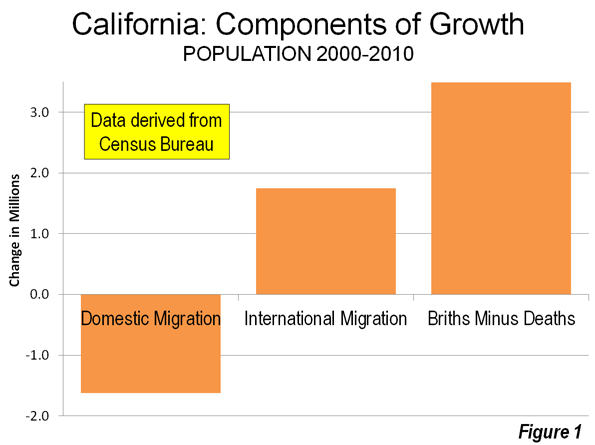
    Yes, California continues to grow. California is growing only because there are more births than deaths and the state had a net large influx of international immigration over the past decade. At the same time, the state has been hemorrhaging residents (Figure 1).

    Californians are leaving. Between 2000 and 2009 (Note), a net 1.5 million Californians left for other states. Only New York lost more of its residents (1.6 million). California’s loss was greater than the population of its second largest municipality, San Diego. More Californians moved away than lived in 12 states at the beginning of the decade. Among the net 6.3 million interstate domestic migrants in the nation, nearly one-quarter fled California for somewhere else.

    The bulk of the exodus was from the premier coastal metropolitan areas. Since World War II, Los Angeles, San Francisco, San Diego and San Jose have been among the fastest growing metropolitan areas in the United States and the high-income world. Over the last decade, this growth has slowed substantially, as residents have moved to places that, all things being considered, have become their preferences.

    More than a net 1.35 million residents left the Los Angeles metropolitan area, or approximately 11 percent of the 2000 population. The San Jose metropolitan area lost 240,000 residents, nearly 14 percent of its 2000 population. These two metropolitan areas ranked among the bottom two of the 51largest metropolitan areas (over 1,000,000 population) in the percentage of lost domestic migrants during the period. The San Francisco metropolitan area lost 340,000 residents, more than 8 percent of its 2000 population and ranked 47th worst in domestic migration (New York placed worse than San Francisco but better than Los Angeles). Each of these three metropolitan areas lost domestic migrants at a rate faster than that of Rust Belt basket cases Detroit, Cleveland and Buffalo.

    San Diego lost the fewest of the large coastal metropolitan areas (125,000). Even this was double the rate of Rust Belt Pittsburgh.

    Exporting Jobs

    California is no longer an incubator of high-wage jobs. The state lost 370,000 jobs paying 25 percent or more of the average wage between 2000 and 2008. This compares to a 770,000 increase in the previous 8 years. California is trailing Texas badly and the nation overall in creating criticial STEM jobs and middle skills jobs (Figures 2 & 3) Only two states have higher unemployment rates than California (Nevada and Rhode Island) . California has the second highest underemployment rate (20.8 percent), which includes the number of unemployed, plus those who have given up looking for work ("discouraged" workers) and those who are working only part time because they cannot find full time work. Only Nevada, with its economy that is overly-dependent on California, has a higher underemployment rate.


    Business relocation coach Joseph Vranich conducts an annual census of companies moving jobs out of California and found a quickening pace in 2012. Often these are the very kinds of companies capable of creating the high-wage jobs that used to be California’s forte. Vranich says that the actual number may be five times as high, which is not surprising, not least because there is no reliable compilation of off-shoring of jobs to places like Bangalore, Manila or Cordoba (Argentina).

    To make matters worse, California is becoming less educated. California’s share of younger people with college degrees is now about in the middle of the states, while older, now retiring Californians are among the most educated in the nation (Figure 4).

    Denying Housing Choice

    It is fantasy to believe, as Steinberg claims, that there are enough single family (detached) houses in the state to meet the demand for years to come. More than 80 percent of the new households in the state chose detached housing over the last decade. People’s actual choices define the market, not the theories or preferences of planners often contemptuous of the dominant suburban lifestyle.

    In contrast, however, the regional plans adopted or under consideration in the Bay Area, Los Angeles and San Diego would require nearly all new housing be multi-family, at five to 10 times normal California densities (20 or more units to the acre are being called for). New detached housing on the urban fringe would be virtually outlawed by these plans. And, when Sacramento does not find the regional plans dense enough, state officials (such as the last two state Attorneys General) are quick to sue. If the "enough detached housing" fantasy held any water, state officials and planners would not be seeking its legal prohibition. To call outlawing the revealed choice of the 80 percent (detached housing) would justify the equivalent of a Nobel Prize in Doublespeak.

    At the same time by limiting the amount of land on which the state preferred high density housing must be built, land and house prices can be expected to rise even further from their already elevated levels (already largely the result of California’s pre-SB 375 regulatory restrictions).

    Transit Rhetoric and Reality

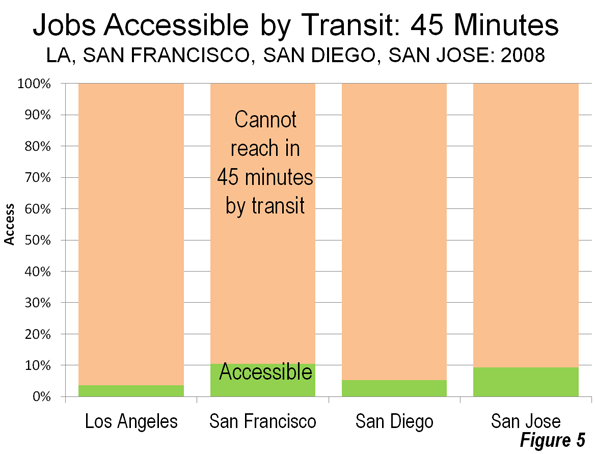
    Transit is important in some markets. About one-half of commuters to downtown San Francisco use transit. The assumptions of SB 375 might make sense if all of California looked like downtown San Francisco. It doesn’t, nor does even most of the San Francisco metropolitan area. Only about 15 percent of employment is downtown, while the 85 percent (and nearly all jobs in the rest of the state) simply cannot be reached by transit in a time that competes with the car. Even in the wealthy San Jose area (Silicon Valley), with its light rail lines and commuter rail line, having a transit stop nearby provides 45 minute transit access to less than 10 percent of jobs in the metropolitan area.

    A recent Brookings Institution report showed that the average commuter in the four large coastal metropolitan areas can reach only 6.5 percent of the jobs in a 45 minute transit commute. This is despite the fact that more than 90 percent of residents can walk to transit stops. Even when transit is close, you can’t get there from here in most cases in any practical sense (Figure 5).

    SB 375 did little to change this. For example, San Diego plans to spend more than 50 percent of its transportation money on transit over the next 40 years. This is 25 times transit’s share of travel (which is less than 2 percent). Yet, planners forecast that all of this spending will still leave 7 out of 8 work and higher education trips inaccessible by transit in 30 minutes in 2050. Already 60 to 80 percent of work trips in California are completed by car in 45 minutes and the average travel time is about 25 minutes.

    For years, planners have embraced the ideal of balancing jobs and housing, so that people would live near where they work, while minimizing travel distances. This philosophy strongly drives the new SB 375 regional plans. What these plans miss is that people choose where to work from the great array of opportunities available throughout the metropolitan area. These varied employment opportunities that are the very reason that large metropolitan areas exist, according to former World Bank principal planner Alain Bertaud.

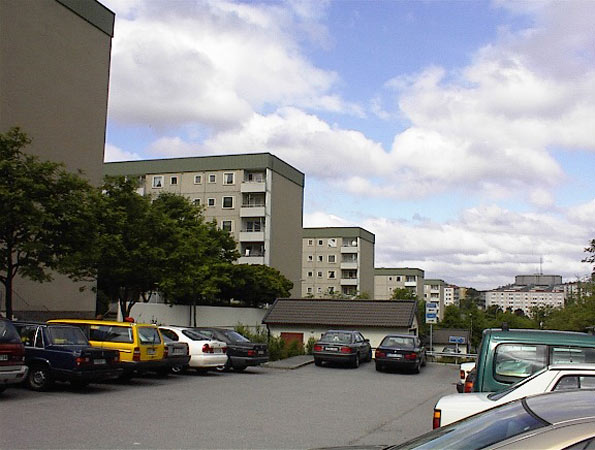
    People change jobs far more frequently than before and multiple earners in households are likely to work far apart. Similar intentions led to the development up to four decades ago of centers like Tensta in Stockholm, which ended up as concentrated low income areas (Photo). It California, such a concentration would do little to improve transit ridership, even low-income citizens are four to 10 times as likely use cars to get to work than to use transit.


    Tensta Transit Oriented Development: Stockholm

    All of this means more traffic congestion and more intense local air pollution, because higher population densities are associated with greater traffic congestion. Residents of the new denser housing would face negative health effects because there is more intense air pollution, especially along congested traffic corridors.

    Self-Inflicted Wounds

    Worst of all, California’s radical housing and transportation strategies are unnecessary. The unbalanced and one-dimensional pursuit of an idealized sustainability damages both quality of life and the economy. This is exacerbated by other issues, especially the state’s dysfunctional economic and tax policies. It is no wonder California is exporting so many people and jobs. California’s urban planning regime under SB 375 is poised to make it worse.

    Wendell Cox is a Visiting Professor, Conservatoire National des Arts et Metiers, Paris and the author of “War on the Dream: How Anti-Sprawl Policy Threatens the Quality of Life”.

    Net Domestic Migration: 2000-2009
    Rank Metropolitan Area Net Domestic Migration Compared to 2000 Population
    1 Raleigh, NC         194,361 24.2%
    2 Las Vegas, NV         311,463 22.4%
    3 Charlotte, NC-SC         248,379 18.5%
    4 Austin, TX         234,239 18.5%
    5 Phoenix, AZ         543,409 16.6%
    6 Riverside-San Bernardino, CA         469,093 14.3%
    7 Orlando, FL         225,259 13.6%
    8 Jacksonville, FL         126,766 11.3%
    9 Tampa-St. Petersburg, FL         260,333 10.8%
    10 San Antonio, TX         177,447 10.3%
    11 Atlanta, GA         428,620 10.0%
    12 Nashville, TN         123,199 9.4%
    13 Sacramento, CA         141,117 7.8%
    14 Richmond, VA           75,886 6.9%
    15 Portland, OR-WA         121,957 6.3%
    16 Dallas-Fort Worth, TX         317,062 6.1%
    17 Houston, TX         243,567 5.1%
    18 Indianapolis. IN           72,517 4.7%
    19 Oklahoma City, OK           41,082 3.7%
    20 Denver, CO           66,269 3.0%
    21 Louisville, KY-IN           34,381 3.0%
    22 Birmingham, AL           26,934 2.6%
    23 Columbus, OH           34,204 2.1%
    24 Kansas City, MO-KS           31,747 1.7%
    25 Seattle, WA           40,741 1.3%
    26 Minneapolis-St. Paul, MN-WI          (19,731) -0.7%
    27 Memphis, TN-MS-AR            (8,583) -0.7%
    28 Hartford, CT            (9,349) -0.8%
    29 Cincinnati, OH-KY-IN          (17,648) -0.9%
    30 Virginia Beach-Norfolk, VA-NC          (20,005) -1.3%
    31 Baltimore, MD          (36,407) -1.4%
    32 St. Louis, MO-IL          (43,750) -1.6%
    33 Philadelphia, PA-NJ-DE-MD        (115,890) -2.0%
    34 Pittsburgh, PA          (52,028) -2.1%
    35 Washington, DC-VA-MD-WV        (107,305) -2.2%
    36 Providence, RI-MA          (49,168) -3.1%
    37 Salt Lake City, UT          (34,428) -3.5%
    38 Rochester, NY          (40,219) -3.9%
    39 San Diego, CA        (126,860) -4.5%
    40 Buffalo, NY          (55,162) -4.7%
    41 Milwaukee,WI          (74,453) -5.0%
    42 Boston, MA-NH        (235,915) -5.4%
    43 Miami, FL        (287,135) -5.7%
    44 Chicago, IL-IN-WI        (561,670) -6.2%
    45 Cleveland, OH        (136,943) -6.4%
    46 Detroit,  MI        (366,790) -8.2%
    47 San Francisco-Oakland, CA        (347,375) -8.4%
    48 New York, NY-NJ-PA     (1,962,055) -10.7%
    49 Los Angeles, CA     (1,365,120) -11.0%
    50 San Jose, CA        (240,012) -13.8%
    51 New Orleans, LA        (301,731) -22.9%
    Data from US Census Bureau


    —–

    Note:  2000 to 2010 data not available

    Lead photo: Largely illegal to build housing under California Senate Bill 375 planning

  • The New Class Warfare

    Few states have offered the class warriors of Occupy Wall Street more enthusiastic support than California has. Before they overstayed their welcome and police began dispersing their camps, the Occupiers won official endorsements from city councils and mayors in Los Angeles, San Francisco, Oakland, Richmond, Irvine, Santa Rosa, and Santa Ana. Such is the extent to which modern-day “progressives” control the state’s politics.

    But if those progressives really wanted to find the culprits responsible for the state’s widening class divide, they should have looked in a mirror. Over the past decade, as California consolidated itself as a bastion of modern progressivism, the state’s class chasm has widened considerably. To close the gap, California needs to embrace pro-growth policies, especially in the critical energy and industrial sectors—but it’s exactly those policies that the progressives most strongly oppose.

    Even before the economic downturn, California was moving toward greater class inequality, but the Great Recession exacerbated the trend. From 2007 to 2010, according to a recent study by the liberal-leaning Public Policy Institute of California, income among families in the 10th percentile of earners plunged 21 percent. Nationwide, the figure was 14 percent. In the much wealthier 90th percentile of California earners, income fell far less sharply: 5 percent, only slightly more than the national 4 percent drop. Further, by 2010, the families in the 90th percentile had incomes 12 times higher than the incomes of families in the 10th—the highest ratio ever recorded in the state, and significantly higher than the national ratio.

    It’s also worth noting that in 2010, the California 10th-percentile families were earning less than their counterparts in the rest of the United States—$15,000 versus $16,300—even though California’s cost of living was substantially higher. A more familiar statistic signaling California’s problems is its unemployment rate, which is now the nation’s second-highest, right after Nevada’s. Of the eight American metropolitan areas where the joblessness rate exceeds 15 percent, seven are in California, and most of them have substantial minority and working-class populations.

    When California’s housing bubble popped, real-estate prices fell far more steeply than in less regulated markets, such as Texas. The drop hurt the working class in two ways: it took away a major part of their assets; and it destroyed the construction jobs important to many working-class, particularly Latino, families. The reliably left-leaning Center for the Continuing Study of the California Economy found that between 2005 and 2009, the state lost fully one-third of its construction jobs, compared with a 24 percent drop nationwide. California has also suffered disproportionate losses in its most productive blue-collar industries. Over the past ten years, more than 125,000 industrial jobs have evaporated, even as industrial growth has helped spark a recovery in many other states. The San Francisco metropolitan area lost 40 percent of its industrial positions during this period, the worst record of any large metro area in the country. In 2011, while the country was gaining 227,000 industrial jobs, California’s manufacturers were still stuck in reverse, losing 4,000.

    Yet while the working and middle classes struggle, California’s most elite entrepreneurs and venture capitalists are thriving as never before. “We live in a bubble, and I don’t mean a tech bubble or a valuation bubble. I mean a bubble as in our own little world,” Google CEO Eric Schmidt recently told the San Francisco Chronicle. “And what a world it is. Companies can’t hire people fast enough. Young people can work hard and make a fortune. Homes hold their value.” Meanwhile, in nearby Oakland, the metropolitan region ranks dead last in job growth among the nation’s largest metro areas, according to a recent Forbes survey, and one in three children lives in poverty.

    One reason for California’s widening class divide is that, for a decade or longer, the state’s progressives have fostered a tax environment that slows job creation, particularly for the middle and working classes. In 1994, California placed 35th in the Tax Foundation’s ranking of states with the lightest tax burdens on business; today, it has plummeted to 48th. Only New York and New Jersey have more onerous business-tax burdens. Local taxes and fees have made five California cities—San Francisco, Los Angeles, Beverly Hills, Santa Monica, and Culver City—among the nation’s 20 most expensive business environments, according to the Kosmont–Rose Institute Cost of Doing Business Survey.

    Still more troubling to California employers is the state’s regulatory environment. California labor laws, a recent U.S. Chamber of Commerce study revealed, are among the most complex in the nation. The state has strict rules against noncompetition agreements, as well as an overtime regime that reduces flexibility: unlike other states, where overtime kicks in after 40 hours in a given week, California requires businesses to pay overtime to employees who have clocked more than eight hours a day. Rules for record-keeping and rest breaks are likewise more stringent than in other states. The labor code contains tough provisions on everything from discrimination to employee screening, the Chamber of Commerce study notes, and has created “a cottage industry of class actions” in the state. California’s legal climate is the fifth-worst in the nation, according to the Institute for Legal Reform; firms face far higher risks of nuisance and other lawsuits from employees than in most other places. In addition to these measures, California has imposed some of the most draconian environmental laws in the country, as we will see in a moment.

    The impact of these regulations is not lost on business executives, including those considering new investments or expansions in California. A survey of 500 top CEOs by Chief Executive found that California had the worst business climate in the country, and the U.S. Chamber of Commerce calls California “a difficult environment for job creation.” Small wonder, then, that since 2001, California has accounted for just 1.9 percent of the country’s new investment in industrial facilities; in better times, between 1977 and 2000, it had grabbed 5.6 percent.

    Officials, including Governor Jerry Brown, argue that California’s economy is so huge that it can afford to lose companies to other states. But for the local economy to be hurt, firms don’t have to leave entirely. Business consultant Joe Vranich, who maintains a website that tracks businesses that leave the state, points out that when California companies decide to expand, often they do so in other parts of the U.S. and abroad, not in their home environment. Further, Brown is too cavalier about the effects of businesses’ departure. As Vranich notes, many businesses leave California “quietly in the night,” generating few headlines but real job losses. He cites the low-key departure in 2010 of Thomas Brothers Maps, a century-old California firm, which transferred dozens of employees from its Irvine headquarters to Skokie, Illinois, and outsourced the rest of its jobs to Bangalore.

    The list of companies leaving the state or shifting jobs elsewhere is extensive. It includes low-tech companies, such as Dunn Edwards Paints and fast-food operator CKE Restaurants, and high-tech ones, such as Acacia Research, Biocentric Energy Holdings, and eBay, which plans to create 1,000 new positions in Austin, Texas. Computer-security giant McAfee estimates that it saves 30 to 40 percent every time it hires outside California. Only 14 percent of the firm’s 6,500 employees remain in Silicon Valley, says CEO David DeWalt. The state’s small businesses, which account for the majority of employment, are harder to track, but a recent survey found that one in five didn’t expect to remain in business in California within the next three years.

    Apologists for the current regime also claim that the state’s venture capitalists will fund and create new companies that will boost employment. It’s certainly true that in the past, California firms funded by venture capital tended to expand largely in California. But as Jack Stewart, president of the California Manufacturing and Technology Association, points out, a different dynamic is at work today: once a company’s start-up phase is over, it tends to move its middle-class jobs elsewhere, as the state’s shrinking fraction of the nation’s industrial investment indicates. “Sure, we are getting half of all the venture capital investment, but in the end, we have relatively small research and development firms only,” Stewart argues. “Once they have a product or go to scale, the firms move [employment] elsewhere. The other states end up getting most of the middle-class jobs.”

    Radical environmentalism has been particularly responsible for driving wedges between California’s classes. Until fairly recently, as historian Kevin Starr says, California’s brand of progressivism involved spurring economic growth—particularly by building infrastructure—and encouraging broad social advancement. “What the progressives created,” Starr says, “was California as a middle-class utopia. The idea was if you wanted to be a nuclear physicist, a carpenter, or a cosmetologist, we would create the conditions to get you there.” By contrast, he says, today’s progressives regard with suspicion any growth that requires the use of land and natural resources. Where old-fashioned progressives embraced both conservation and the expansion of public parks, the new green movement advocates a reduced human “footprint” and opposes cars, “sprawl,” and even human reproduction.

    The Bay Area has served as the incubator for the new green progressivism. The militant Friends of the Earth was founded in 1969 in San Francisco. Malthusian Paul Ehrlich, author of the sensationalist 1968 jeremiad The Population Bomb and mentor of President Obama’s current science advisor, John Holdren, built his career at Stanford. Today, more than 130 environmental activist groups make their headquarters in San Francisco, Berkeley, Oakland, and surrounding cities.

    The environmentalist agenda emerged in full flower under nominally Republican governor Arnold Schwarzenegger, who initially cast himself as a Milton Friedman–loving neo-Reaganite. On his watch, California’s legislature in 2006 passed Assembly Bill 32, which, in order to cut greenhouse-gas emissions, imposes heavy fees on using carbon-based energy and severely restricts planning and development. One analysis of small-business impacts prepared by Sacramento State University economists indicates that AB 32 could strip about $181 billion per year, or nearly 10 percent, from the state’s economy. At the same time, land-use regulations connected to the climate-change legislation hinder expansion for firms.

    Another business-hobbling mandate is the law requiring that 30 percent of California’s electricity be generated by “renewable” sources by 2020. The state’s electricity costs are already 50 percent above the national average and the fifth-highest in the nation—yet state policies make the construction of new oil- or gas-fired power plants all but impossible and offer massive subsidies for expensive, often unreliable, “renewable” energy. The renewable-fuel laws will simply boost electricity costs further. The cost of electricity from the new NRG solar-energy facility in central California, for instance, will be 50 percent higher than the cost of power from a newly built gas-powered facility, according to state officials. For providing this expensive service, NRG will pay no property taxes on its facilities. By some estimates, green mandates could force electricity prices to rise 5 to 7 percent annually through 2020.

    The renewable-fuel regulations are driving even green jobs out of the state. Cereplast, a thriving El Segundo–based manufacturer of compostable plastic, last year moved its manufacturing operations to Indiana, where electricity costs are 70 percent lower. Fuel-cell firm Bing Energy cited cost and regulatory factors when announcing its move from California to Florida. “I just can’t imagine any corporation in their right mind would decide to set up in California right now,” the firm’s CFO, Dean Minardi, told the Inland Valley Daily Bulletin. Still more rules, aimed at improving water quality and protecting endangered species, could have a devastating effect on the construction and expansion of port facilities, which tend to sustain high-wage blue- and white-collar jobs.

    The political class largely ignores the economic consequences of these policies. Indeed, Governor Brown and others insist that they will create jobs—upward of 500,000 of them—while establishing California as a green-energy leader. To turn Brown’s green dreams into reality, the state has approved enormous subsidies and tax breaks for solar and other renewable-energy producers to supplement those dispensed by the Obama administration. Yet for all this, California has barely 300,000 “green jobs,” many of which are low-wage positions, such as weather-stripping installers. And the solar industry, in California and abroad, is imploding.

    Bill Watkins, head of the economic forecasting unit at California Lutheran University, notes that California’s green policies affect the very industries—manufacturing, home construction, warehousing, and agribusiness—that have traditionally employed middle- and working-class residents. “The middle-class economy is suffering since there is no real opposition to the environmental community,” says Watkins. “You see the Democrats, who should worry about blue-collar and middle-income jobs, give in every time.”

    Progressives and many Occupy protesters mourned the death of high-tech innovator and multibillionaire Steve Jobs. They also tend to view social-networking firms like Facebook more as allies than as class enemies. This embrace of Silicon Valley is nearly as strange as the Occupy movement’s decision to target the ports of Los Angeles and Oakland—large employers of well-paid blue-collar workers. Activists portrayed the attempted port shutdowns as attempts to “disrupt the profits of the 1 percent,” but union workers largely saw them as impositions on their livelihood. As former San Francisco mayor and state assembly speaker Willie Brown wrote in the San Francisco Chronicle: “If the Occupy people really want to make a point about the 1 percent, then lay off Oakland and go for the real money down in Silicon Valley. The folks who work on the docks in Oakland or drive the trucks in and out of the port are all part of the 99 percent.”

    The explanation for the progressives’ hypocritical friendliness to Silicon Valley is simple: money and politics. Venture capitalists and highly profitable, oligopolistic firms like Google (with its fleet of eight private jets) invest heavily in green companies; they were also among the primary bankrollers of the successful opposition to a 2010 ballot initiative aimed at reversing AB 32. The digital elite has become more and more involved in local politics, with executives from Facebook, Twitter, and gaming website Zynga contributing heavily to the recent campaign of San Francisco mayor Ed Lee, for example. Lee has, in turn, been extremely kind to the digerati, extending a payroll-tax break to Twitter and a stock-option break to Zynga and other firms that may soon go public.

    Hollywood manages to outdo even Silicon Valley in its class hypocrisy. Former actor Schwarzenegger doesn’t let his green zealotry stop him from owning oversize houses and driving fuel-gorging cars. Canadian-born director James Cameron, who contents himself with a six-bedroom, $3.5 million, 8,300-square-foot Malibu mansion, talks about the need to “stop industrial growth” and applauds the idea of a permanent recession. “It’s so heretical to everybody trying to recover from a recession economy—‘we have to stimulate growth!’ ” says Cameron. “Well, yeah. Except that’s what’s gonna kill this planet.”

    According to the Tax Foundation, California residents already pay the nation’s sixth-highest state tax rates, and they are likely to keep rising. Three tax-raising measures have already been proposed for the November 2012 ballot. Governor Brown’s proposal, which would boost both income and sales taxes, stands a good chance of passage. Hedge-fund manager Tom Steyer, an investor in environmental firms, has floated a measure that would raise taxes on out-of-state companies that conduct any operations in California and use some of the revenue to subsidize green-friendly building projects. And Molly Munger, a civil rights attorney and daughter of Warren Buffett’s longtime business partner, is pressing a measure to raise income taxes to fund schools. The so-called Think Long proposal, financed by nomadic French billionaire Nicolas Berggruen and overseen by a committee including Google’s Schmidt and billionaire philanthropist Eli Broad, proposes a mild cut in income-tax rates for the highest earners (like themselves) but new taxes on services provided by architects, accountants, business consultants, plumbers, gardeners, and others—the sole proprietors and microbusinesses that represent the one growing element in the state’s beleaguered private-sector middle class.

    More money for social services or education might help alleviate some of the recession’s impact, but it cannot break the vicious cycle from which California currently suffers: weak growth leading to low tax revenues, government boosting taxes to make up the shortfall, and those higher taxes driving businesses and jobs away, resulting in continued weak growth. What California’s middle and working classes need above all is broad, private-sector job growth—and that, fortunately, is a goal still well within reach. The Golden State may be run stupidly, but it retains enormous assets: its position on the Pacific Rim, large numbers of aspiring immigrants, unparalleled creative industries, fertile land, and a treasure trove of natural resources.

    The most promising opportunity is in the contentious area of fossil-fuel energy, a mainstay of the state’s economy since the turn of the twentieth century. California still ranks as the nation’s fourth-largest oil-producing state. Traditional energy has long provided good jobs; nationally, the industry pays an average annual salary of $100,000. And elsewhere, from the Great Plains to eastern Ohio, an oil and gas boom is driving growth.

    But California has thus far excluded itself from the party. Even as production surges in other parts of the country, California companies like Occidental Petroleum report diminishing oil production. The drop-off proves, some environmentalists say, that “peak oil” has been reached, but the evidence shows otherwise: the last few years have seen a fourfold increase in applications for drilling permits in California, largely because of the discovery of the massive Monterey shale deposits—containing a potential 15 billion barrels of oil—and of an estimated 10 billion barrels near Bakersfield. The real reason for the reduced production is that California has rejected most of the drilling applications since 2008. “I asked Jerry Brown about why California cannot come to grips with its huge hydrocarbon reserves,” recalls John Hofmeister, former president of Shell Oil’s U.S. operations. “After all, this could turn around the state. He answered that this is not logic, it’s California. This is simply not going to happen here.”

    The anti-fossil-fuel stance, according to the Los Angeles County Economic Development Corporation, has placed some $1 billion in investment and 6,000 jobs on hold. The sense of wasted opportunity can be palpable. If you travel to Santa Maria, a hardscrabble town near the Monterey formation, you pass empty industrial parks and small, decaying shopping centers. As economist Watkins put it at a recent conference there: “If you guys were in Texas, you’d all be rich.”

    California doesn’t even need to abandon its progressive tradition to narrow the class divide. Homebuilding, manufacturing, and warehousing could expand if regulatory burdens other than those associated with fighting climate change were merely modified—not repealed, but relaxed sufficiently to make it possible to do business, put people to work, and make a profit. New energy production could take place under strict regulatory oversight. Future industrial and middle-class suburban development could be tied to practical energy-conservation measures, such as promoting home-based businesses and better building standards. California’s agriculture industry—currently thriving, thanks to exports—could be less burdened by the constant threat of water cutbacks and new groundwater regulations.

    Even from an environmental perspective, increased industrial growth in California might be a good thing. The state’s benign climate allows it to consume fossil-fuel energy far more efficiently than most states do, to say nothing of developing countries such as China. Keeping industry and middle-class jobs here may constitute a more intelligent ecological position than the prevailing green absolutism.

    More important still is that a pro-growth strategy could help reverse California’s current feudalization. The same Public Policy Institute of California study shows that during the last broad-based economic boom, between 1993 and 2001, the 10th percentile of earners enjoyed stronger income growth than earners in the higher percentiles did. The lesson, which progressives once understood, is that upward mobility is best served by a growing economy. If they fail to remember that all-important fact, the greens and their progressive allies may soon have to place the California dream on their list of endangered species.

    This piece originally appeared in The City Journal.

    Joel Kotkin is executive editor of NewGeography.com and is a distinguished presidential fellow in urban futures at Chapman University, and contributing editor to the City Journal in New York. He is author of The City: A Global History. His newest book is The Next Hundred Million: America in 2050, released in February, 2010.

    Los Angeles aqueduct photo by BigStockPhoto.com.

  • Attack on the Suburbs: California Senate Republican Caucus Report

    Differing views on the future of California urban areas are the subject of a California Senate Republican Caucus report (Briefing Report: Attack On The Suburbs: SB 375 And Its Effects On The Housing Market).

    The report details differing views on the future of California urban areas as described by University of Utah Professor Arthur C. Nelson in a report for the Urban Land Institute with those of newgeography.com authors Joel Kotkin and Wendell Cox in recent editions of The Wall Street Journal.

    Nelson’s view is largely that the market for detached housing in California is in decline. Senate Bill 375’s planning mandates are being interpreted to virtually ban further construction of detached housing in the state’s metropolitan areas.

    However, if Nelson’s analysis were right, there would be no need for legislative intervention since people would not buy detached housing. In fact, however, the demand for detached housing remains strong. Between 2000 and 2010, detached housing accounted for 80 percent of new housing additions in California’s major metropolitan areas.

    Critics of Senate Bill 375 market interventions that would seek to steer the market toward hyper density housing (20 to 40 and more housing units to the acre) would increase traffic congestion, increase the intensity of air pollution and make California and encumber an already laggard economy.

    The report concludes: "Clearly, before the California Legislature decides to take over the community planning duties of local governments and engage in social experimentation with the housing market, it should perhaps look at both sides of the argument to see if the experiment will be successful." 

  • As California Collapses, Obama Follows Its Lead

    Barack Obama learned the rough sport of politics in Chicago, but his domestic policies have been shaped by California’s progressive creed. As the Golden State crumbles, its troubles point to those America may confront in a second Obama term.

    From his first days in office, the president has held up California as a model state. In 2009, he praised its green-tinged energy policies as a blueprint for the nation. He staffed his administration with Californians like Energy Secretary Steve Chu—an open advocate of high energy prices who’s lavished government funding on “green” dodos like solar-panel maker Solyndra, and luxury electric carmaker Fisker—and Commerce Secretary John Bryson, who thrived as CEO of a regulated utility which raised energy costs for millions of consumers, sometimes to finance “green” ideals.

    Obama regularly asserts that green jobs will play a crucial role in the future of the American economy, but California, a trend-setter in the field, has yet to reap such benefits. Green jobs, broadly defined, make up only about 2 percent of jobs in the state—about the same proportion as in Texas. In Silicon Valley, the number of green jobs actually declined between 2003 and 2010. Meanwhile, California’s unemployment rate of 10.9 percent is the nation’s third highest, behind only Nevada and Rhode Island.

    When Governor Jerry Brown predicted a half-million green jobs by the end of the decade, even The New York Times deemed it “a pipe dream.”

    Obama’s push to nationalize many of California’s economy-stifling green policies has been slowed down, first by the Republican resurgence in 2010 and then by his reelection considerations. But California’s politicians, living in what’s become essentially a one-party state, have doubled down on green orthodoxy. As the president at least tries to cover his flank by claiming to support an “all-in” energy policy, California has simply refused to exploit much of its massive oil and gas resources.

    Does this matter? Well, Texas has created 200,000 oil and gas jobs over the past decade; California has barely added 20,000. The state’s remaining energy producers have been slowing down as the regulatory environment becomes ever more hostile even as producers elsewhere, including in rustbelt states like Ohio and Pennsylvania, ramp up. The oil and gas jobs the Golden State political class shuns pay around $100,000 a year on average.

    Instead, California has forged ahead with ever-more extreme renewable energy mandates that have resulted in energy costs roughly 50 percent above the national average and expected to rise substantially from there. This tends to drive out manufacturing and other largely blue-collar energy users.

    Over the past decade the Golden State has grown its middle-skilled jobs (those that require two years or more of post-secondary education) by a mere 2 percent compared to a 5.3 percent increase nationwide, and almost 15 percent in Texas. Even in the science-technology-engineering and mathematics field, where California has long been a national leader, the state has lost its edge, growing just 1.7 percent over the past 10 years compared to 5.4 percent nationally and 14 percent in Texas.

    A recent Public Policy of California study shows that since the recession, the gap between rich and poor has widened more in California than in the rest of the nation. Lower-income workers have seen their wages drop more precipitously than those of the affluent. And the middle class is proportionately smaller and has shrunk more than elsewhere. Adjusted for cost of living, it stands at 47.9 percent in California compared to nearly 55 percent for the rest of the country.

    Meantime, many Californians have been departing for more affordable states, with a net loss of four million residents to other states over the past 20 years (while continuing, of course, to attract immigrants.) Of those who remain, nearly two-in-five Californians pay no income tax, and one in four receive Medicaid.

    There are some people are prospering in California, including many of the affluent supporters who Obama courts on his frequent fundraising forays here. Tenure-protected academics from the University of California constitute his third-largest donor base, while Google ranks fifth and Stanford twelfth, according to Open Secrets.

    Silicon Valley may emerge as the biggest source of campaign cash for Obama and the Democrats in the years ahead. After losing 18 percent of its jobs earlier in the decade, the Valley has resurged, along with Wall Street, aided by the cheap-money-for-the-rich policies of Federal Reserve Chairman Ben Bernanke. But while California’s high-tech job growth, largely in software, has been significant, the rate of increase has been less than half that of key competitors such as Utah, Washington, and Michigan.

    The IPO-lottery, Hollywood, and inherited-wealth crowds can afford the state’s sky-high costs, especially along the coast, but most California businesses can’t. Under Brown and his even less well-informed predecessor, Arnold Schwarzenegger, the official mantra has been that the state’s “creative” entrepreneurs would trigger a state revival. This is very much the hope of the administration, which trots out companies like Facebook, Apple, and Google as exemplars of the American future. “No part of America better represents America than here,”  the president told a crowd at the Computer History Museum in Mountain View last fall.

    Yet Silicon Valley represents just a relatively small part of the state’s economic base. Although the Valley—particularly the Cupertino to San Francisco strip—has recovered from the 2008 market meltdown, unemployment in the blue-collar city of San Jose hovers around 10 percent. The Oakland area, just across the Bay, ranked 63rd out of 65 major metropolitan in terms of employment trends, trailing even Detroit according to a recent analysis done by Pepperdine University economist Michael Shires. Other major California metros, including Los Angeles, Orange County, Riverside-San Bernardino, and Sacramento all ranked near the bottom.

    The newer companies that can afford the sky-high costs of coastal California, and can pay their employees adequately to do the same—places like Google, Apple, Facebook, and Twitter—employ relatively few people compared to older, manufacturing-oriented technology firms such as Hewlett-Packard and Intel. While cherry picking highly educated professionals, the new firms create few local support positions that would spread some of the wealth. What middle-income jobs they do create tend to be located in lower-cost, more business-friendly American cities like Salt Lake City or Austin, or, increasingly, overseas.

    Elite institutions like Stanford still thrive, but the state’s once-great educational system is creaking under reduced funding, massive bureaucracy, and skyrocketing pensions. Once among the best-educated Americans, Californians are rapidly becoming less so. Among people over 64, California stands second in percentage of people with an associate degree or higher; among those aged 25 to 34, it ranks 30th.

    For devoted Californians, accustomed to seeing their state as a national and global exemplar, these trends are deeply disturbing. Yet the key power groups in the state—greens, public employees, and rent-seeking developers—seem intent on imposing ever more draconian regulations on energy and land use, seeking for example, to ban construction of the single-family houses preferred by the vast majority of Californians.

    The increasingly delusional nature of the state’s politics is best captured by the urgent political push to build a fantastically expensive—potentially costing as much as $100 billion—high-speed rail line that would eventually connect the Bay Area, Los Angeles and the largely rural places in between. Obama has aggressively promoted high-speed rail nationally, but has been pushed back by mounting Republican opposition. Yet in one-party California, Jerry Brown mindlessly pushes the project despite the state’s huge structural deficits, soaring pension obligations, and decaying general infrastructure. He’s continued doing so even as the plan loses support among the beleaguered California electorate.

    It’s hard to see how these policies, coupled with a massive income tax increase on the so-called rich (families, as well as many small businesses, making over $250,000), can do anything other than widen the state’s already gaping class divide. Yet given the power of Californian ideas over Obama, one can expect more such policies from him in an electorally unencumbered second term. California’s slow-motion tragedy could end up as a national one.

    This piece originally appeared in The Daily Beast.

    Joel Kotkin is executive editor of NewGeography.com and is a distinguished presidential fellow in urban futures at Chapman University, and contributing editor to the City Journal in New York. He is author of The City: A Global History. His newest book is The Next Hundred Million: America in 2050, released in February, 2010.

    Barack Obama photo by BigStockPhoto.com.

  • Megalopolis and its Rivals

    Jean Gottman in 1961 coined the term megalopolis (Megalopolis, the Urbanized Northeastern Seaboard of the Unites States) to describe the massive concentration of population extending from the core of New York north beyond Boston and south encompassing Washington DC. It has been widely studied and mapped, including by me. (Morrill, 2006, Classic Map Revisited, Professional Geographer).  The concept has also been extended to describe and compare many other large conurbations around the world.

    Maybe it’s time to see how the original has fared?   And what has happened to other metropolitan complexes in the US, most notably Los Angeles, San Francisco, Chicago and should we say Florida?


    Table 1 summarizes the population of Megalopolis from 1950 to 2010 and Table 2 compares Megalopolis with other US mega-urban complexes.  Megalopolis grew fastest in the 1950s and 1960s, with growth rates of 20 and 18.5 percent. The  northeast has since been outpaced by the growth in other regions, but growth was still substantial in the last decade. Megalopolis added almost 3 million people, by 6.8 %, to reach an amazing 45.2 million.

    Table 1: Growth of Megalopolis 1950-2010
    Year Population Change % Change
    2010 45,357 2,983 7
    2000 42,374 5,794 15.8
    1990 36,580 2,215 6.4
    1980 34,365 360 1.2
    1970 34,005 5,436 18.5
    1960 29,441 4,910 20
    1950 24,534

    From Table 2 I note four major subregions of Megalopolis: Boston, New York, Philadelphia and Washington, DC. New York is still the biggest player, but the locus of growth over time has shifted South. This reflects the increasing world importance of Washington, DC. New York’s almost 20 million may not surprise, but the fact that greater Boston has grown to almost 9.5 million may be more surprising.  The Washington-Baltimore area grew by far the fastest at almost 15 percent (not much sign of shrinkage of government!). In contrast New York, Boston and Philadelphia’s growth was relatively paltry.

    Table 2: Megalopolis and Its Rivals
    Place
    2010 Pop
    2000 Pop
    Change
    % change
    Megalopolis
      New York 19,923 19,209 717 3.7
      Boston   9,445 8,967 478 5.3
      Philadelphia 8,415 76,781 773 9.5
      Baltimore-Washingt 7,403 7,681 960 14.9
    All 45,181 42,302 2,888 6.8
    Chicago 10,817 10,305 512 5
    Los Angeles 12,151 11,789 362 3.1
      Central 903 857 46 5.4
      North 928 634 294 46
      East 2,884 2,105 475 37
      South 3,543 3,210 337 10.4
    All Los Angeles 20,404 18,599 1,810 9.8
    San Francisco-Sacramento
      San Francisco 7,330 6,946 384 5.5
      Sacramento 3,171 2,604 572 22
    All San Francisco-Sacramento 10,501 9,550 951 10
    Florida
      Miami 6,027 5,311 716 13.5
      Tampa 4,818 3,894 974 25.3
      Orlando 2,915 2,193 722 33
      Jacksonville 1,483 1,191 2,242 24.5
    All Florida 15,243 12,544 2,699 21.5

    Greater Los Angeles is the second largest conurbation, with some 20.4 million, growing by 1.8 million, and 10 percent from 2000. In the table I distinguish between the core Los Angeles urbanized area and the satellite urbanized areas west, north, south and east. The core LA area grew by only 3 percent, while the spillover areas to the north and east had astonishing growth, at 46 and 37 percent over the decade.  These include several places with a fairly long history, such as Riverside and San Bernardino, San Diego and Santa Barbara, but many are rapidly growing large suburbs and exurbs, a spillover of growth from the Los Angeles core. Much of the fastest growth has been in  Mission Viejo, Murietta-Temecula, Indio, Lancaster, Santa Clarita and Thousand Oaks.

    For greater San Francisco, I distinguish two subregions, the Bay area of San Francisco-San Jose (west) and Sacramento (central valley).  Some might consider these totally distinct, but they have become one in a conurbation sense, as evidenced by commuting patterns. Many people live in the less costly Central Valley area but commute to the expensive Bay Area cities. Together, the conurbation is now 10.5 million, up 10 percent from 2000. The central valley (Sacramento) portion grew far more rapidly than San Francisco-San Jose (22 percent compared to 5.5 percent).  

    Compared to its rivals the Chicago conurbation has grown less rapidly but is still large, with a population of 10.8 million in 2010 , growing 512,000 (5 percent) since 2000.  Chicago and Milwaukee are the well-known core cities, but there are also less well known components with far faster growth such as Round Lake-McHenry and West Bend, WI.   

    Florida

    The more interesting and difficult conurbation to try to define is what might be called the Florida archipelago. Greater Miami has long been recognized as a conurbation, but I contend that virtually all the urbanized areas of the state are in effect a complex web of urban settlement, with little clear demarcation. This is in part a reflection of   rapid and expansive  growth.  Nevertheless it makes sense to recognize four sub-regions, centered on Miami, Tampa-St. Petersburg, Orlando and Jacksonville. 

    Together these areas have reached an astonishing 15.2 million, up 2.7 million or 21.5 percent in one decade.  Because settlement is spread across the state in such a web-like fashion with no single dominant center, they constitute a newish form of urban concentration. Besides the well-known centers such as   Miami, Tampa-St. Petersburg ), Orlando and Jacksonville,  there are many satellite cities, often quite large. These include North Port, Cape Coral  encompassing older Ft. Meyers, Bonita Springs, Kissimmee, Palm Bay-Melbourne, Palm Coast-Daytona, and Port St. Lucie.  An interesting but hard to answer question is how much of Florida’s phenomenal growth is a result of transfer of people and accumulated wealth from the North (and especially from the original Megalopolis).

    The United States is a large and diverse country, with many other giant cities and a vast countryside. But it is important to realize the importance of these megalopolitan areas, with an aggregate population of 102.6 million, one third of the nation’s population.

    What’s next? Look for the rise of now just somewhat smaller conurbations such as Houston, Dallas, Atlanta, Minneapolis, Seattle, Phoenix, and Denver. In terms of numbers and rates of growth Texas is a front runner, but its stars do not coalesce into a megalopolis, at least not yet. The belt of urban growth from Atlanta, through Greenville, SC, Charlotte to Raleigh-Durham is also a likely future conurbation candidate.

    Richard Morrill is Professor Emeritus of Geography and Environmental Studies, University of Washington. His research interests include: political geography (voting behavior, redistricting, local governance), population/demography/settlement/migration, urban geography and planning, urban transportation (i.e., old fashioned generalist).

  • Last of the Bohemians

    When I moved to Los Angeles 30 years ago, Ocean Front Walk in Venice Beach looked like a hippie parody.  It had a counter-cultural veneer, but didn’t rate as an authentic bohemian hot spot.

    Contrast, for example, with New York’s East Village with its revolutionaries, junkies, artists and various iconoclasts living side-by-side.

    The weekend spectacle at Venice – vendors, performers and “street people” showing off to crowds of tourists – struck me as self-conscious and phony. Plus, I could never call Ocean Front Walk a “board walk” because (unlike Brighton Beach and Coney Island) there was No Board.

    Since then, of course, New York has been “cleaned up.” Now Tompkins Square is family-friendly and the old walk-ups are inhabited by urban professionals worried about layoffs and declining property values.

    Times have changed.  The gulf between haves and have-nots is widening.  Living on the edge is not just a life-style choice.  “Drop-outs” need somewhere to go.

    These days I see Ocean Front Walk in Venice as more a refuge than a counter-cultural carnival.  With overnighters climbing out of their sleeping bags each morning, it’s a pretty good location for people without money.

    Where else should they live?

    I understand why local residents are advocating that something be done to make Ocean Front Walk safer and more sanitary.  With some calling for a police “crack down.”

    But now that the “tune-in, turn-on, drop-out” sub-culture is a history text book sidebar, I’m glad there is, at least, someplace warm for the dispossessed to hang out.

    Here at Venice Beach, where the continental U.S. ends, could be the last stop for these new bohemians.