Tag: California

  • California’s Bullet Train — A Fresh Start and a Change in Direction

    A new strategy is beginning to emerge toward California’s embattled high-speed rail venture. The strategy is designed to rescue the project from a possible defeat at the hands of the state legislature, gain friends and supporters among local transportation agencies, win converts among independent analysts and turn around a largely skeptical public.

    The plan combines the existing commitment to proceed with construction of the first rail segment in the Central Valley with near-term actions aimed at upgrading rail facilities at both ends of the proposed LA-to-SF high-speed line. Specifically, the so-called "bookend" strategy will involve "blending" high-speed rail service with commuter rail service in existing Bay Area and Southern California rail corridors.

    At the northern end of the line, between San Francisco and San Jose, bullet trains would share track with Caltrain commuter trains. Both would benefit from new investments in electrification, signaling systems, bridge replacements, passing tracks and grade crossings elimination. Similar type of improvements would be introduced at the Los Angeles/Orange County/San Diego ends of the line, benefitting LA’s Metrolink and other Southern California commuter rail and transit systems.

    Improving the urban "bookends" of the system will make it possible to increase the speed of local commuter trains and thus bring immediate benefits to large segments of California’s urban population. It will be a good investment whether or not the overall $98 billion high-speed rail project ever goes forward, said Will Kempton, chief executive of the Orange County Transportation Authority (OCTA) and Chairman of the independent Peer Review Group advising the High Speed Rail Authority.

    The investments will be funded with a portion of Proposition 1A funds, supplemented by matching funds from local government agencies. Up to $2.3 billion in bond money and its $950 million "interconnectivity" fund would be committed to these near term improvements according to well-informed sources. This would provide approximately $1.4 billion for Southern California and $900 million for the Bay Area, assuming a 60/40 split. Another $2.7 billion has been already set aside for the 130-mile Central Valley segment, leaving roughly $4 billion of Proposition 1A money for future HSR construction.

    The new strategy has evolved from discussions held by the High Speed Rail Authority’s new chairman, Dan Richard with the Governor and his fellow board members. In a conversation we had with Chairman Richard several weeks ago, he was frank to admit that significant changes must be made in the Authority’s way of doing business if the bullet train project is to retain the support of the state legislature, overcome the skepticism of independent critics and turn around public opinion. The Authority must find ways, in the Governor’s words, to do things "better, faster and cheaper."

    While supportive of the Governor’s vision, Richard saw a need to show signs of near-term progress and not have to wait until 2033 to demonstrate the benefits of the investment. The dollars spent on the "bookends" could have "an immediate and dramatic effect," he told us.

    Turning to the Central Valley project, Richard freely admitted the ham-handed way in which the Authority dealt with the affected property owners and local governments. He made plain his resolve to restore trust and rebuild the agency’s credibility with the Valley constituencies. We also were struck by his refreshing willingness to reach out to the program’s critics, in contrast to the Authority’s often arrogant and dismissive posture of the past.

    Richard’s new strategy is beginning to bear fruit. Six Southern California planning and transportation agencies, including the Southern California Regional Rail Authority (Metrolink) voted as a group on March 1 to support the development of high-speed rail "while providing funding for local early investment projects in

    Southern California that will improve rail service immediately." The Authority hopes to stimulate similar expressions of support in Northern California by working closely with the Bay Area’s Caltrain and San Francisco’s Municipal Transportation Agency. The Peer Review Group, which has long supported the "bookends" approach, can be expected to provide an additional boost to Richard’s strategy.

    As for the initial Central Valley segment, its construction, initially planned to begin in September, has been pushed back. The slowdown is due to the need to revisit the environmental report whose initial version has run into a storm of objections concerning the proposed route. The revised draft report will be subject to another round of public hearings before the route through the valley is finalized. Assuming the state legislature authorizes the bond funding, construction in the Central Valley is now expected to begin in early 2013, although court challenges may cause further delays. Critics are expected to continue questioning the value of that investment, fueling continued controversy and increasing the project’s vulnerability.

    A New Perception

    Regardless of what ultimately becomes of the Central Valley project, the new urban "bookends" strategy is bound to profoundly modify the public perception of the bullet train venture. While the Governor and Chairman Richard maintain that the ultimate year 2033 goal of a 2 hour 40 minute train trip from LA to San Francisco has not changed, the practical effect of the new strategy will be to shift the focus from achieving that distant vision to effecting concrete near-term improvements— investments designed to benefit millions of present-day commuters in California’s two largest metropolitan rail corridors.

    Given California’s budget deficit, given the uncertainty of further federal support for high-speed rail in general and for California’s HSR project in particular (see below), and given a lack of any evidence of private investor interest, the"bookend" program of investments may indeed end up as the key accomplishment of the Proposition 1A initiative. While bullet train visionaries will regret this shift in the focus, pragmatists will welcome it as a prudent and realistic response to the growing skepticism. From an economist standpoint, the bookend strategy will be viewed as the best use of scarce financial resources. The public will see it as a victory for common sense: a decision that wisely  places greater value on satisfying present-day needs than on the promise of distant-in-time benefits.

    Could Washington come to the rescue?

    Meanwhile, in Washington, the Administration continues pursuing its fantasy-land rhetoric. "We envision an America in which 80 percent of people have access to high-speed rail," Transportation Secretary Ray LaHood reiterated in a recent blog. "We’re committed to this program… there’s no going back… we will keep the momentum going" he stated at a February 29 high-speed rail conference sponsored by the U.S. High Speed Rail Association.

    Except that this momentum, if there ever was one, has long since vanished. No funds for high-speed rail have been provided two years in a row, including the current (FY 2012) year. Nor are any HSR funds likely to be appropriated  in the next year’s budget. Congressional reaction to the Administration’s $2.5 billion HSR request in its FY 2013 budget submission has ranged from cool to dismissive. The President’s high-speed rail program is "a vision disconnected from reality" members of the Senate Budget Committee told Sec. LaHood at a recent hearing on the Administration’s transportation budget.

    Rep. John Mica (R-FL), chairman of the House Transportation and Infrastructure Committee was even more blunt. "If the president thinks his proposal for high-speed rail is going to fly, he’s pipe-dreaming," he told participants at the February 29 rail conference. In short, all signs point to continued congressional unwillingness to support a federal high-speed rail program. This sentiment seems to cross party lines: neither the Republican-controlled House nor the Democratic-led Senate have included HSR funds in their reauthorization bills. Rep. Jeff Denham’s (R-CA) bill would specifically prohibit new federal funds from going to California’s bullet train project during the entire life of the bill.

    For California, the implications are grave. Without further federal funds, the State of California will be obliged to seek a fresh infusion of public and private funds by 2015 if it is to continue pursuing its $98 billion bullet train vision. Will a new bond initiative or a public-private partnership succeed? Time alone will tell.
  • Is Energy the Last Good Issue for Republicans?

    With gas prices beginning their summer spike to what could be record highs, President Obama in recent days has gone out of his way to sound reassuring on energy, seeming to approve an oil pipeline to Oklahoma this week after earlier approving leases for drilling in Alaska. Yet few in the energy industry trust the administration’s commitment to expanding the nation’s conventional energy supplies given his strong ties to the powerful green movement, which opposes the fossil-fuel industry in a split that’s increasingly dividing the country by region, class, and culture.

    But Republicans, other than the increasingly irrelevant Newt Gingrich, have failed to capitalize on the potent issue, instead lending the president an unwitting assist by focusing the primary fight on vague economic plans and sex-related side issues like abortion, gay marriage, and contraception. The GOP may be winning over the College of Cardinals, but it is squandering its chance of gaining a majority in the Electoral College, holding the House, and taking the Senate.

    No single sector affects more people and industries than energy, and none is more deeply affected by the disposition of government. Energy divides the nation into two camps. On one side there are the regions and industries dependent on the development and use of energy. They include the increasingly expansive energy-producing region stretching from the Gulf Coast and the Great Plains to parts of Ohio, Pennsylvania, and the Appalachian range.

    The centers of energy growth, including areas stretching from the Gulf Coast through the Great Plains to the Canadian border, have generated the highest levels of job and income growth over the past decade (along with parasitic Washington, D.C.).

    Nine of the 11 fastest-growing job categories are related to energy production, according to an analysis by Economic Modeling Systems Inc. Energy jobs pay an average of $100,000 annually, about the same as software engineers earn in Silicon Valley.

    Perhaps more important politically, this bonanza is now spreading to historical battleground states Ohio, Pennsylvania, and Michigan. Long-depressed areas like western Pennsylvania are reversing decades of decline as new finds and advances in natural-gas drilling have opened up vast new stores of domestic energy. The new energy wealth has created new jobs, enriched property owners, and provided states with potential huge new sources of revenue.

    On the other side of the energy divide stand a handful of dense, mostly coastal metropolitan areas with either little in the way of energy resources or, in the case of California’s most affluent urban pockets, little interest in exploiting them. With a shrinking industrial base and less dependence on automobiles, these areas now constitute the political base for the both the Democratic Party and the growing green-industrial complex, which boasts strong ties to Silicon Valley’s well-heeled venture-capital “community” and their less celebrated, but even wealthier, Wall Street allies.

    In these places, the current fossil-energy boom is regarded less as a boon than as an environmental disaster in the making, a view captured in the unrelenting attack on shale development in the news pages of The New York Times and other outlets in broad sympathy with the Obama administration. New production of low-cost, low-emission natural gas also threatens the viability of politically preferred renewables such as solar and wind. But unlike fossil fuels, such “green” initiatives have created very few jobs; overall, the promise of “green jobs,” as even The New York Times has noted, has failed to live up to its hype.

    Given the success in the other energy states, California—with double-digit unemployment—might reconsider its policies, but this is unlikely. “I asked [Gov.] Jerry Brown about why California cannot come to grips with its huge hydrocarbon reserves,” John Hofmeister, a former president of Shell Oil’s American operations and a member of the U.S. Department of Energy’s Hydrogen and Fuel Cell Technical Advisory Committee, told me recently. “After all, this could turn around the state."

    Brown’s answer, according to Hofmeister: “This is not logic, it’s California. This is simply not going to happen here.’”

    But elsewhere in the U.S., new technologies such as hydraulic fracking and vertical drilling have vastly increased estimates of North America’s energy resources, particularly natural gas. By 2020, the United States, according to the consultancy PFC Energy, will surpass Russia and Saudi Arabia as the world’s leading oil and gas producer.

    As President Obama has acknowledged, this surge of production boasts some great economic benefits. American imports of raw petroleum have fallen from a high of 60 percent of the total to less than 46 percent. Overall, according to Rice University’s Amy Myers Jaffe, U.S. oil reserves now stand at more than 2 trillion barrels; Canada has slightly more. She pegs North America’s combined reserves at more than three times the total estimated reserves of the Middle East and North Africa.

    At the same time, energy exploration is sparking something of an industrial revival. The demand for new rigs, pipelines, and a series of new petrochemical facilities has created a burst of industrial production across much of the country. Steel mills, makers of earth-moving equipment, and construction suppliers all have benefited. A recent study by PricewaterhouseCoopers suggests shale gas could lead to the development of 1 million industrial jobs. Not surprisingly, some of the biggest backers of shale-gas exploration are prominent CEOs from industrial firms.

    Energy policy may also be critical for the future of the Great Lakes–based American auto industry. Despite expensive PR ventures like the electric Chevy Volt, the Big Three depend for profits largely on SUVs and trucks. High oil prices will only help their competitors from Japan, South Korea, and Germany, all of which are ramping up in the emerging Southeastern auto corridor. Rising oil prices could also raise the costs of food production, which relies heavily on energy-intensive fertilizers and machinery.

    Aware of the negative consequences for a still-weak recovery, President Obama has started to mount a defense for his energy policies. Last month he launched several preemptive strikes, claiming credit for rising U.S. production while ridiculing Republicans for their “drill, baby, drill” response to rising energy prices.

    Obama is correct in asserting that increases in domestic production will not solve the energy price issue overnight, or even in the near future. But it was disingenuous for him to then take credit for the current energy boom, which resulted largely from policies adopted during the Bush years, while Obama’s policies have, if anything, slowed exploration and development.

    It’s fairly clear that the president and his team—notably Energy Secretary Steven Chu and Interior Secretary Ken Salazar—are at best ambivalent about greater fossil-fuel development. Obama, for example, recently proposed cutting tax breaks and subsidies for the oil industry, which he estimated at $4 billion annually—a new expense for the companies that would in large part be passed on to consumers at the pump.

    This is not necessarily a bad thing in its own right, but along with the effective tax hike, Obama proposed doubling down on the much larger and, to date, far less productive giveaways to the green-industrial complex, which received $80 billion in loans and subsidies in the 2009 stimulus. According to various studies, including the Energy Information Agency, solar firms enjoy rates of subsidization per kilowatt hour at least five times those gained by fossil-fuel firms.

    If all energy subsidies were removed, the fossil-fuel industry likely could shrug off the hit, while the heavily subsidized green-industrial complex would markedly diminish. Yet even if Congress refuses to continue the green subsidies, it’s probable that administration regulators would find ways to slow fossil-fuel expansion in a second Obama term. Responding largely to the Democratic environmental lobby, they have already overruled the State Department to delay the Keystone XL pipeline from Canada. Plans for new multibillion-dollar petrochemical plants on the Gulf will make easy pickings for federal regulators from agencies now controlled by environmental zealots.

    “The energy states feel they are being persecuted for their good deeds,” says Eric Smith, director of the Tulane Energy Institute in New Orleans. “There is a sense there are people in the administration who would like this whole industry to go away.”

    In the short run, Obama’s political exposure in the energy wars is somewhat limited. Most of the big-producing states—Oklahoma, Wyoming, Utah, Texas, Louisiana, Alaska, and North Dakota—are unlikely to vote for him anyway. Nor does he have to worry about too much pressure from inside his party; Democratic ranks in Congress from energy-producing states have thinned considerably in recent years, removing contrary voices inside the party.

    A more dicey issue relates to contestable states like Ohio, Pennsylvania, and Michigan, where many see the energy boom as a source of economic recovery. To make their case in these and other swing states, Republicans first have to make energy the overall revival of the American economy—the key issue for this November’s election. If they insist on campaigning primarily as stolid defenders of rigid social values and election-year promises of painless tax cuts, they will have themselves to blame for their drubbing in November.

    This piece originally appeared in TheDailyBeast.

    Joel Kotkin is executive editor of NewGeography.com and is a distinguished presidential fellow in urban futures at Chapman University, and contributing editor to the City Journal in New York. He is author of The City: A Global History. His newest book is The Next Hundred Million: America in 2050, released in February, 2010.

    Photo courtesy of BigStockPhoto.com.

  • The Moonbeam Express

    Seldom has public opinion and expert judgment been more unified than in its opposition to  the California high-speed rail project.    The project has been criticized by its own Peer Review Group, the Legislative Analyst’s Office (LAO), the California State Auditor,  the State Treasurer and a group of independent  experts  (Enthoven, Grindley, Warren et al.).  In addition, the bullet train has come under severe criticism by influential state legislators and  by members of the state’s congressional delegation. Equally damaging to the project’s future prospects have been two public opinion surveys showing  that California voters have turned solidly against the project, and the opposition of  virtually all of California’s newspapers, including The Orange County Register, whose latest editorial we reprint below.  

    Editorial: Bullet train becoming "Moonbeam Express" (OC Register, Feb 1, 2012)
    Gov. Jerry Brown wants to use anti-global-warming carbon taxes to fund California’s much-maligned high-speed rail project. 

    In a brazen denial of the obvious, Gov. Jerry Brown now insists the proposed California high-speed rail can be built for much less than its own business plan stipulates, and wants to use anti-global-warming carbon taxes to underwrite the proposal, whose price tag has nearly tripled in the three years since voters approved it.

    The governor seems intent on demonstrating how California’s state government has burdened taxpayers with mounting debt, while overspending to create consecutive years of budget deficits. The rail project has been dubbed "the train to nowhere" because the only portion close to being built would link relatively sparsely populated Central Valley towns and no metropolitan areas. Perhaps with Mr. Brown’s new foolish insistence, it should be christened the Moonbeam Express. 

    Since the rail proposal appeared on the 2008 ballot, it has been widely and legitimately criticized in detailed analyses by the rail project’s own Peer Review Group, the state auditor, treasurer, Legislative Analyst’s Office, local governments including Tulare, Madera and Kings counties and the city of Palo Alto, numerous state and federal lawmakers from both parties and studies by UC Berkeley Institute of Transportation and the Reason Foundation. These highly unfavorable critiques reflect many of the criticisms the Register Editorial Board has raised since the project was proposed.

    In only three years, the train’s estimated cost has increased from $33 billion to $98.5 billion in the latest version of its own ever-changing business plan.

    Voters approved only $9.9 billion in bonds based on the rest coming from Washington and local governments along the route, and private investors. Washington has provided about $3 billion and not another dime has materialized or been pledged. Meanwhile, the estimated completion of the original phase of the project, from San Francisco to Anaheim, has been extended 14 years beyond the original estimate of 2020.

    Ridership estimates are unrealistic, meaning trains can’t operate solely on ticket revenue as required by the initiative. Costs, even at their current highest level, are certain to increase, and the needed additional funding sources are not forthcoming. Given hostility in Congress to the project, more money from Washington, which is grappling with its own massive deficits and debts, won’t be seen in the foreseeable future.

    State Sen. Doug LaMalfa, R-Richvale, introduced a bill Monday to put the high-speed rail proposal back on the November ballot so voters can de-authorize selling the $9.9 billion in bonds.

    The Register has urged this ill-conceived and increasingly untenable project be resubmitted to voters. Thankfully, for the most part, bonds remain unsold. There is no reason taxpayers should assume billions more debt — with annual interest payments of up to $1 billion — when the likelihood is remote the train ever will be built, despite the governor’s strained assurance.

    Moreover, state Sen. Diane Harkey, R-Dana Point, notes that the governor’s proposed new revenue stream — carbon taxes created by the 2006 Global Warming Solutions Act— is another hoped-for, rather than assured, solution. "The state’s cap-and-trade program is not yet in operation, and revenue estimates of $1 billion per year are unreliable and unsubstantiated," Ms. Harkey said. "Relying on projected revenues that fall short is the key reason why our state deficit continues to explode year after year. To rush this project forward, just using up the $3.5 billion of federal funds, with the hope of an additional funding mechanism based on guesswork, is irresponsible."

  • Who Stands The Most To Win – And Lose – From A Second Obama Term

    As the probability of President Barack Obama’s reelection grows, state and local officials across the country are tallying up the potential ramifications of a second term. For the most part, the biggest concerns lie with energy-producing states, which fear stricter environmental regulations, and those places most dependent on military or space spending, which are both likely to decrease under a second Obama administration.

    On the other hand, several states, and particularly the District of Columbia, have reasons to look forward to another four years. Under Obama the federal workforce has expanded — even as state and localities have cut their government jobs. The growing concentration of power has also swelled the ranks of Washington‘s parasitical enablers, from high-end lobbyists to expense-account restaurants. While much of urban America is struggling, currently Washington is experiencing something of a golden age.

    So what states have the most to lose from a second Obama term? The most obvious is Texas, the fastest-growing of the nation’s big states. Used to owning the inside track in Washington during the long years of Bush family rule, the Lone Star state now has less clout in Congress and the White House than in recent memory. Texans are particularly worried about restrictions on fossil fuel energy development, which is largely responsible for robust growth throughout the state.

    “Obama now wants to take credit for the increased production that has happened, but [increased production] has been opposed in every corner by the administration,” says John Hofmeister, founder of the Houston-based Citizens for Affordable Energy and former CEO of Shell USA. Hofmeister fears that in a second term, with no concern for reelection, Obama could exert even greater controls on fossil fuel development. This would have dramatic, negative implications not only for Texas but for the entire national energy grid, which includes North Dakota, Wyoming, Montana, West Virginia, Oklahoma, Alaska and Louisiana. These states fear that the nation’s recent energy boom, which has generated some of the nation’s strongest job and income growth, could implode in Obama’s second term.

    Take Louisiana, which is still recovering from Hurricane Katrina in 2005 and the BP oil spill in 2010. The administration’s moratorium on offshore drilling, sparked by the spill, has had a deleterious effect on the state’s energy economy, according to a recent study, with half offshore oil and service companies  shifting their operations to other regions and laying off employees.

    Once the moratorium was lifted in 2010, companies have faced long delays for new wells, growing from 60-day delays in 2008 to more than 109 last year  .  “The energy states feel they are being persecuted for their good deeds,” says Eric Smith, director of the Tulane Energy Institute in New Orleans. “There is a sense there are people in the administration who would like this whole industry to go away.”

    Many of these same states also worry about the administration’s proposed downsizing of the military. Obama’s move to cut roughly towards $500 billion in defense spending may make sense, but it  threatens places with large military presences such as Texas, Florida, Oklahoma, Virginia, Georgia, South Carolina and New Mexico.

    The D.C. metro area might also be hit by defense cuts, but overall the it has many reasons to genuflect toward the Obama Administration. Federal wages, salaries and procurement account for 40% of the district’s economic activity, roughly four times the percentage of any state. Expanding regulation on energy, health care and financial services has sparked a steady job boom in lobbying, think tanks and other facets of the persuasion industry — including among Republicans –at a time when employment growth has been sluggish elsewhere.

    D.C. partisans hail their city as the leader of a national urban boom. The district clearly benefits from diminished job opportunities in more market-based economies, particularly for educated 20-somethings.

    No place has flourished as much as the capital, but a second term would be favorable to states such as Maryland, which depend heavily on research spending directed from Washington and where federal spending accounts for fifteen percent of the local economy, over seven times the national average. Maryland agencies such as the National Institutes for Health will likely expand under an increasingly federalized health care system — particularly if Democrats gain more seats in Congress with an Obama win.

    Other big states that may benefit from a second term include New York, California and Illinois. New York benefits largely from the administration’s Wall Street leanings, despite the president’s recent attacks on financial elite. Even for the non-conspiracy theorists, the administration’s ties to Goldman Sachs appear unusually intimate. Powerful allies like Democratic Sen. Charles Schumer, D.C.’s greatest Wall Street booster, suggest big money has little to fear from a second term.

    Overall the administration’s basic policy approach has favored the financial giants. Support for bailouts, seemingly permanent low interest rates, few prosecutions for miscreant investment bankers, the institutionalization of “too big to fail” and easy loans for renewable fuel firms all have benefited the big Wall Street players.

    Of course, a Republican victory would not be a disaster for these worthies. Companies like Goldman Sachs are hedging their bets by sending loads of cash to the likely Republican choice, former Massachusetts Gov. Mitt Romney.

    But other New York interests, such as mass transit funding, would benefit from the current administration’s  generally pro-urban, green sensibilities. Tight regulations on carbon emissions — increasing the price of fossil fuels — may help the competitive position of New York City, which has little industry left and relatively low carbon emissions per capita, in part due to a greater reliance on hydroelectric and nuclear power.

    California also has reasons to root for an Obama victory. Although among the richest states in fossil fuels, particularly oil, the Golden State has become a bastion of both climate change alarmism and renewable energy subsidization. It adamantly won’t develop traditional its energy resources — which would help boost the state’s still weak economy — and Silicon Valley venture firms have eagerly grabbed subsidies and loans for start-ups from Energy Secretary Steven Chu’s seemingly bottomless cornucopia.

    Furthermore,  more powerful EPA would make California’s current “go it alone” energy and environmental problems less disadvantageous compared to more fossil-fuel-friendly states, leveling what is now a tortuous economic playing field.

    Similarly, attempts to push the state’s troubled high-speed rail line — recently described in Mother Jones as “jaw-droppingly shameless” –  will succeed only with strong backing by the federal government. Under a Republican administration and Congress, Brown’s beloved high-speed line would depend entirely on state and private funding, likely terminating the project.

    But no state needs an Obama victory more than his adopted home state of Illinois. To be sure, having a native son in the White House has not prevented the Land of Lincoln from suffering one of the weakest economies in the nation. The state has one of the highest rates of out-migration in the country, according to recent United Van Lines data and Census results.

    Even worse, the Land of Lincoln faces a fiscal crisis so great that it makes California look well-managed.  Without a good friend in the White House, and allies in Congress, Illinois could end up replacing long-struggling, now-improving Michigan as the Great Lakes’ new leading basket case. Count Illinois 20 electoral votes in the Obama column.

    This piece originally appeared in Forbes.com.

    Joel Kotkin is executive editor of NewGeography.com and is a distinguished presidential fellow in urban futures at Chapman University, and contributing editor to the City Journal in New York. He is author of The City: A Global History. His newest book is The Next Hundred Million: America in 2050, released in February, 2010.

    Photo from BigStockPhoto.com.

  • “Jaw-Droppingly Shameless:” Mother Jones on California High Speed Rail Projection

    Kevin Drum of Mother Jones reports on the highly questionable "cost of alternatives" that has been routinely repeated by proponents of the California high speed rail project, in an article entitled "California High Speed Rail Even More Ridiculous than Before."

    The mantra goes something like, "yes high speed rail is expensive, but it would cost even more to not build it." Yes, indeed, it is expensive, starting at the low estimate of $98.5 billion the press and proponents usually cite to the nearly $118 billion that the California High Speed Rail Authority itself indicates. Advocates then cite a $171 billion figure as what Californian’s would have to pay if they didn’t build the line.

    Joseph Vranich and I detailed the flaws in this "alternatives estimate" in a Wall Street Journal commentary on January 10 ("California’s High Speed Rail Fibs"). We noted that the claim "sets a new low for planning projections in a field that has been rife with abuse." This was a reference to "strategic misrepresentation” ("lying") that has characterized rail project forecasts, according to top European academics.

    Drum goes further, calling the claim "jaw-droppingly shameless," an appropriate characterization based upon the method and documentation. He goes on to suggest that "A high school sophomore who turned in work like this would get an F."

    Regardless of the views that officials or the public may have on high speed rail, they are entitled to a standard of professional (and taxpayer financed) analysis above "jaw-droppingly shameless."

  • Mistaking an Aberration for the End of Home Ownership

    It is well known that home ownership has declined in the United States from the peak of the housing bubble. According to Current Population Survey data, the national home ownership rate fell 2.9 percentage points from the peak of the bubble (4th quarter 2004) to the third quarter of 2011.

    It is less well understood, however, that the spurt in home ownership was, like the housing bubble, an aberration. Looking over the data from the 2010 census, it seems clear that since 2000 the actual decline was a much smaller: 0.8 percentage points from the 2000 census. In fact the current home ownership rate tracks fairly well with that of the post 1960 and the entire pre-bubble period.

    The End of Home Ownership? Analysts such as Richard Florida suggest an end to the preference for home ownership, citing the losses from the bubble, which were, in fact, an aberration. Most recently, Xavier University’s Michael F. Ford wrote in the Washington Postabout home ownership having been driven to 69% by "guarantees" and "tax breaks," such as the mortgage interest deduction. He notes that this "spending spree" led to a loss of $6 trillion in US real estate value.

    Ford does not mention the fact that home ownership had hovered between 60% and 65% for more than three decades before the bubble, without suffering any such losses. Nor does he mention the roles played by Fannie, Freddie and Frank (D-Massachusetts), along with others in Washington, or the related "drunken sailor" mortgage policies concocted by lenders and Wall Street that anyone familiar with credit should have known could only lead to disaster. This was obvious to many observers, although shockingly not to the Federal Reserve Board, as recent reports indicate .

    There is no doubt that the "spending spree" led to the housing bust and triggered the Great Financial Crisis. However it was not the long-standing ownership support programs of the federal government that were primarily to blame. As late as the beginning of the decade, there was no bubble and the median multiple in major metropolitan areas averaged 2.9, within the maximum affordability rating of 3.0. The "spending spree" itself was a rational response to policies that turned housing into the equivalent of a speculative commodities market, with destructive results, in certain large markets. Critically the bubble did not appear in many others.

    Speculation and the "Bubble States:" The extent to which speculation fueled house price increases is the subject of a recent Federal Reserve Bank of New York paper by Andrew Haughwout, Donghoon Lee, Joseph Tracy and Wilbert van der Klaauw. The researchers examine investment, or speculation in real estate markets, during the housing bubble. Investors buy houses that they do not intend to live in for the purpose of making money. In normal times, this investment is principally for rental income or long term capital gains. However, in the highly charged housing markets that developed in some metropolitan areas, prices rose so rapidly, that "flipping" (short term ownership) became very profitable, at least for some.

    Pointing out that "The recent financial crisis—the worst in eighty years—had its origins in the enormous increase and subsequent collapse in housing prices during the 2000s," the New York Fed researchers show that speculative activity was much greater in California, Florida, Arizona and Nevada (which they label the "bubble states") than elsewhere. My analysis indicates that two-thirds of the house value drop in the nation before the Lehman Brothers collapse (September 15, 2008) occurred in the four "bubble states." According to the researchers, this greater speculative activity in these markets made the market more instable because unlike owner-occupiers, investors are far more likely to default on mortgage loans.

    Missing the Geography of Speculation (the Geography of "Smart Growth"): The New York Fed research, however, ignores the geography of speculation. Why was speculation was so much more rampant in the bubble states? There is no reason to believe that residents of California, Florida, Arizona or Nevada are any less interested in making money or, in general, any more greedy. Yet speculators largely stayed out of markets in high demand areas, such as Dallas-Fort Worth, Houston and Indianapolis. In fact, in large parts of the nation, there was little speculative activity. In these markets prices were not rising inordinately so speculators did not bother with them. Instead they focused on more volatile markets where prices were already rising strongly, further swelling local price increases.

    The geography of speculation corresponds largely to the geography of excessive land use restrictions, which created the shortage of land for housing that drove the prices up in the four bubble states (Note). It is a fundamental principle of economics that prices tend to rise where desired goods are in short supply.

    In California and Florida, restrictive land use policies (smart growth or growth management) created a shortage of land for new housing relative to demand. The largest metropolitan areas of Nevada (Las Vegas) and Arizona (Phoenix) are surrounded by government owned land that was auctioned for development at such a slow rate that prices rose by more than five times during the bubble.

    Astonishingly, having missed the geography of speculation, the New York Fed researchers suggest that a solution is to regulate speculation. There is a much simpler answer, which Florida has already implemented which is to repeal the restrictive land use regulations, without which inordinately speculative profits cannot occur.

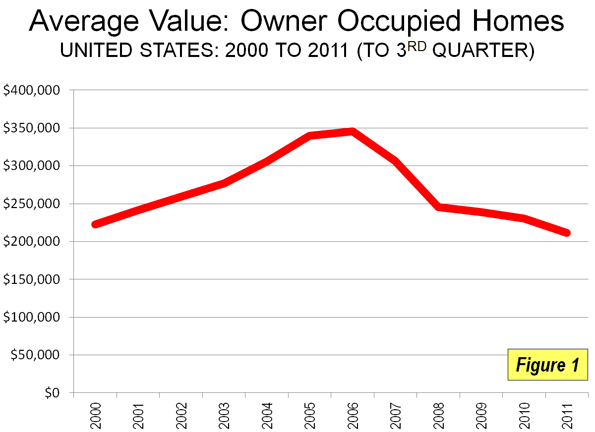
    Meanwhile, as the speculators have been driven out of the market, and despite federal government efforts to prop-up the artificially high house prices, values have fallen to below 2000 levels for the first time (Figure 1). Based upon Federal Reserve Board and Census Bureau data, it is estimated that the average owner-occupied house value in 2011 (three quarters) has fallen to $211,000, which is down from a peak of approximately $345,000 in 2006 and $222,000 in 2000 (adjusted for inflation).

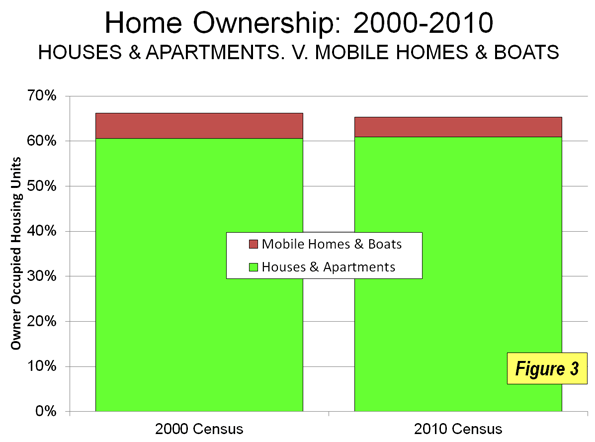
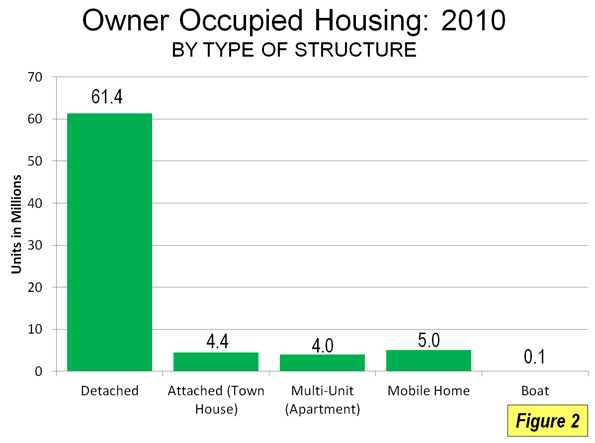
    So is Ownership now doomed? Yet the home ownership naysayers have little to cheer. Yes, home ownership dropped in the last decade. However, all of the loss was in mobile homes and boats. Even so, the number of mobile home owners remained greater than home owners living in apartments, including condominiums (Figure 2). In fact there was a slight increase in the share of households owning their own homes, if mobile homes and boats are excluded (Figure 3), with a rise from 60.6% in 2000 to 60.9% in 2010.

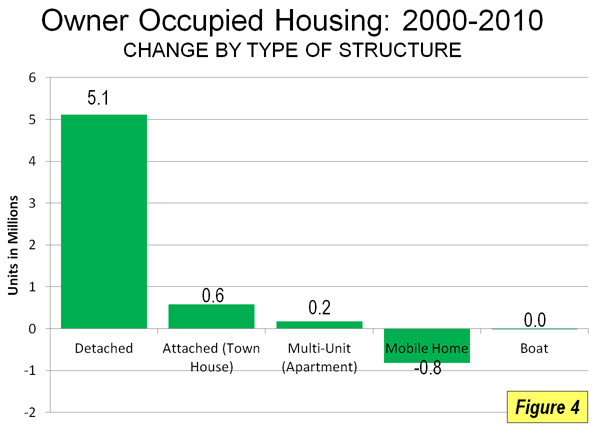
    There were 5,057,000 more home owners in 2010 than in 2000, and perhaps more surprisingly, 5,119,000 more home owners occupying detached housing. Detached, attached (town house) and apartment ownership each increased over the past decade (Figure 4). Contrary to new urbanist theoreticians, detached housing – not urban condos – overall accounted for the most housing growth, both owner-occupied and rentals.

    Xavier’s Ford calls the American Dream of home ownership a myth and even goes so far as to suggest that home ownership is "more important to special interests than it is to most Americans." In fact, Ford’s interpretation is delusional. That home ownership continued its advance, however modestly, in the face of the worst economic downturn in 80 years, reveals the durability and, indeed the reality of home ownership as an American Dream.

    Photo:  Preventing speculation (New Development, Dallas-Fort Worth suburbs)

    Note: Overall, the bubble states and other restrictively regulated metropolitan areas accounted for more than 90% of the pre-Lehman Brothers loss.

    Wendell Cox is a Visiting Professor, Conservatoire National des Arts et Metiers, Paris and the author of “War on the Dream: How Anti-Sprawl Policy Threatens the Quality of Life

  • Fresh Winds Blowing on California High Speed Rail

    For California’s beleaguered high-speed rail project, last week brought plenty of  surprises and challenges.  Dominating the headlines were the resignations of several top officials of the High-Speed Rail Authority (CHSRA). Among them were board chairman Tom Umberg, CEO Roelof van Ark, board member Matthew Toledo, Deputy Director (Environment) Dan Leavitt and press secretary Rachel Wall. Dan Richard, a respected and trusted advisor of Gov. Jerry Brown, appointed to the Board last year, is expected to assume chairmanship of the Board (Umberg remains as a member of the board).

    The past week also saw the release of a fresh critique of CHSRA’s business plan and an avalanche of criticism by influential commentators and analysts. The critique, entitled Twelve Misleading Statements on Finance and Economic Issue in the CHSRA’s Draft 2012 Business Plan, received wide distribution among state legislators and senior officials in Gov. Brown’s administration. It was authored by a group of independent experts who have closely followed the project over the past two years — Alain C. Enthoven, William C. Grindley, William H. Warren, Michael G. Brownrigg and Alan H. Bushell. The report challenges methodically one by one the credibility of the business plan’s key assumptions concerning the project’s construction costs and financing; revenues, ridership and operational costs; and societal benefits. (http://www.cc-hsr.org)

    Last week’s press commentaries added to the climate of skepticism that is increasingly engulfing the project. In close succession, there appeared a January 8 column by the well known Sacramento Bee columnist, Dan Walters (It’s Time to Kill California’s Bullet Train Boondoggle); a January 9 op-ed in The Washington Post by the newspaper’s editorial writer Charles Lane (California’s High-Speed Rail to Nowhere); and a January 10 piece in The Wall Street Journal by Wendell Cox and Joseph Vranich (California’s High-Speed Rail Fibs).

    An Orange County Register editorial on January 12 further underscored the widespread opposition to the project by the state’s newspapers. The editorial sounded alarm about legislative attempts to fast-track the HSR project by exempting it from environmental review (Rep. Feuer’s Assembly Bill 1444) Waiving environmental regulations can speed project approval and undermine legal challenges, pointed the editorial. The HSR project already faces multiple court challenges on environmental grounds, with more suits likely.

    Even the Sierra Club has turned critical."The draft business plan does not leave us feeling optimistic about the viability of the current high-speed rail program," wrote Kathryn Phillips, Director of Sierra Club California in a January 13 letter to the Authority. "We urge the HSRA to reconsider its business plan."

    Departure of key personnel could mark a new beginning

    The unexpected departure of the Authority’s top officials has added to a series of reversals experienced by the project in recent days. Most damaging has been a scathing report by the independent Peer Review Group that pronounced the Authority’s plan "not financially feasible" and warned of "immense financial risk."  Adding to it has been a growing chorus of skeptical lawmakers and further news of declining public support (a SurveyUSA news poll showing only 33% of voters in favor of the bond sale).

    The abrupt mass resignations of senior management are seen as a bid by Governor Brown to assert a tighter control over a project that is facing a critical first test later this spring when the legislature will be asked to vote the first $2.7 billion in bonds to start the initial 130-mile stretch of the line in the Central Valley. Last week, Brown also announced that he intends to fold the Authority into a new state transportation agency, thus placing the project under more direct supervision of the Governor.

    So far, Gov. Brown has maintained steadfast support of the project, but his recent actions suggest that he is sensitive to public opinion and to the political winds blowing from the state capitol. Many lawmakers, some from the Governor’s own party, counsel against rushing ahead with construction and suggest taking the time to thoroughly rethink the business plan. They include Sen. Alan Lowenthal (D), chairman of the select committee on high-speed rail; Sen. Mark DeSaulnier (D), chairman of the transportation committee; and Sen. Joe Simitian (D), chairman of the budget subcommittee overseeing transportation. The dim prospects for any further federal funds or for private money to support the project beyond the "Initial Construction Section" must also weigh heavily in the Governor’s assessment of the project’s long-term viability.  

    In the meantime, changes may be expected in the Rail Authority’s management style. Those who know the incoming chairman well look forward to an agency that will be less confrontational, more respectful of its critics and more attentive to the legislators. They hope the Authority will be more willing to reach out and build bridges to citizen groups and will assert more control over its contractors.

    Only time will tell whether last week’s events represent a true turning point for this divisive initiative. However, multiple signs coming out of Sacramento give people reasons to hope that real changes in direction are indeed underway.

    Ken Orski has worked professionally in the field of transportation for over 30 years.

    CA route map by Wikipedia user CountZ.

  • Urban Development: Playing Twister With The California Environmental Quality Act

    When it comes to environmental issues, emotions often trump reasoned argument or sensible reform, especially in California. In Sacramento at our state capitol, real world impacts are abstracted into barbed soundbites. It’s the dialogue of the deaf as environmental advocates rally around our landmark California Environmental Quality Act (CEQA) — and economic interests decry it as “a job killer.” Perhaps the polarization can be put aside to ask about a specific example in the real world. Why does an old K-Mart sit vacant on Ventura’s busiest boulevard despite initial City approval for a Walmart store? All the thunder and lightning surrounding whether a Walmart belongs in Ventura is behind us. A vigorous and contentious debate (and a failed citizen initiative) have rendered the verdict that filling an empty discount retail space with a different discount retailer is a function of the market, not government regulation.

    Nor can we directly blame the stalemate directly on the California Environmental Quality Act (CEQA). What keeps the store empty is not the controversial law itself, but the way it has been twisted like a pretzel into a tool to stop urban developments opposed by well-funded interests. Recently, the Los Angeles Times exposed the ironic way it has even been adapted by developers and big corporations to fend off their competition.

    The California Environmental Quality Act is the toughest state environmental protection statute in the nation. Passed more than 40 years ago in the wake of the first Earth Day (and signed by Governor Ronald Reagan), CEQA has spawned an industry of specialist consultants, attorneys and planners. Its original laudable goals for managing natural resources have been obscured by the hard ball tactics of litigators in our state.

    The vast majority of Californians support sensible environmental protections and are suspicious when business interests lobby to weaken them. They remember oil spills and toxic dumps and slash and burn hillside developments. Yet the case law that has grown up around CEQA is so burdensome that virtually any public or private project can be slowed or killed on bogus grounds that really have nothing whatever to do with protecting our natural environment.

    Yes, the law has protected stands of redwood trees from clear-cutting and sensitive habitat from suburban sprawl. And there are David and Goliath stories: a little band of neighbors stop a mega-developer from flooding their neighborhood with traffic (although this is a long stretch from protecting “natural resources”.) But it is now routine for special interests to hire high-powered law firms to exploit the law for their own economic interests.

    Here in Ventura, lawyers for construction unions combed over the Environmental Impact Report done for the new Community Memorial Hospital project with the goal of seizing on any technical errors or ambiguities. They fired off a thirty page “comment letter” which lays the groundwork for a lawsuit. The goal was certainly not “protecting the environment” — it was to pressure the hospital to use union labor for the construction. They were successful.

    The proposed Walmart at the old K-Mart site is stalled after initial city approval because the company knows that even something as simple as changing the facade on the building could trigger a lawsuit alleging inadequate “environmental review.” So the project sits in limbo while Walmart analyzes its legal options. What Walmart fears is exactly what happened to WinnCo grocery, which did see its proposed new signage and facade challenged by a CEQA lawsuit.

    There are lots of things not to like about development in a city. But that’s why we have planning commissions, public hearings and appeals to elected City Councils, along with detailed rules that must meet stringent legal guidelines for adoption and enforcement. But why have an elaborate land use entitlement and permit review process if it can be superseded by anyone with the resources to file a CEQA lawsuit? Democratic due process goes out the window, replaced by months or years of costly legal maneuvering.

    No sensible person advocates repealing CEQA. But after forty years, it is past time to return to its original, laudable purpose and intent: to protect our natural environment and sustainably manage our natural resources.

    Understandably, environmental advocates are skittish about tinkering with the law. There is precedent, however, for consensus reform. When the League of Conservation Voters pushed a bill to curb greenhouse gas emissions and promote sustainable regional planning, they won the support of both the League of California Cities and the Building Industry Association by incorporating a modest relaxation of onerous CEQA burdens on “infill development.” There’s lots more room for common sense consensus to separate environmental protection from a racket for special interest litigation.

    One of the worst ways to proceed is to pick out individual projects for favorable CEQA treatment. That’s what’s happened on a couple of controversial stadium projects that won legislative relief from the typical CEQA procedural hurdles. Having to lobby Sacramento to pass a special law is a brutally stark example of special interest litigation. Football stadiums are not the only or even the most important projects held hostage by CEQA abuse. Comprehensive reform is long overdue.

    In these economic times, the jobs lost to CEQA abuse aren’t offset by the ones created for CEQA experts and CEQA attorneys. California led the nation in protecting our state’s environment. If we can look past the symbolism that CEQA has assumed to both advocates and detractors, we’ll see that it’s urgent to restore the law’s original purpose and keep it from being hijacked for other agendas. That may be unlikely in today’s polarized political climate. That’s why it is crucial to bypass the soundbites and the symbolic posturing, and remember the real world fallout of failing to reform the way CEQA is administered in the Golden State.

    Rick Cole is city manager of Ventura, California, and recipient of the Municipal Management Association of Southern California’s Excellence in Government Award. He can be reached at RCole@ci.ventura.ca.us

    Photo: The vacant K-Mart in Ventura, California

  • California’s Deficit: The Jerry Brown and ‘Think Long’ Debate

    California has three major problems: persistent high unemployment, persistent deficits, and persistently volatile state revenues. Unfortunately, the only one of these that gets any attention is the persistent deficit. It is even more unfortunate that many of the proposals to reduce the deficits are likely to make all three of the problems worse over the long run.

    Two major proposals to deal with the deficit will shape the coming debate. One is from the newly formed Think Long for California Committee; the other from the governor.

    Governor Jerry Brown’s plan would increase sales taxes, and would increase the tax rate on the portion of anyone’s income that is over $250,000 (the marginal rate). It is a general rule of tax analysis that if you want there to be less of something, tax it. Indeed, this proposal would result in some wealthier people leaving California, and it would accelerate the trend of substituting internet retail purchases for local retail purchases.

    It would also increase California’s tax receipt volatility. California’s tax base is dependent on the income of a relatively small group of wealthy people. It turns out that this income is more volatile than the economy. Increasing top marginal tax rates would only increase the volatility of the state’s revenue.

    So, why would the governor make such a silly proposal? I’ve heard a few reasons.

    • The government is starving and it needs the income now.

    This is nonsense. Combined national, state, and local government spending is now over 35 percent of gross product. This is highest it has ever been, including the peak spending years of World War II.

    We can disagree on the optimal size of government, but to argue that this is a time of scarce government spending is absurd.

    • The wealthy have too much money. We must increase the progressivity of California’s tax code.

    The governor’s proposal will do that. If implemented, the plan will give California the highest marginal tax rates in the United States. The problem is that people with high incomes often have more choices than most of us. They can move. They can reallocate earnings to other states or into less-taxed activities. They can just forego earnings if the return is too low.

    Most analysts agree that California’s tax structure should be broader based. The only way to do that is to make the system less progressive, not more progressive. Increasing taxes on the wealthy may feel good when the law is implemented, but it will eventually lead to lower tax revenues, increased revenue volatility, and slower economic growth.

    • There is nothing else we can do. The political situation does not allow a better fix.

    It never will be easy to implement comprehensive tax reform in California. There are too many groups with too much at stake. However, it is senseless to argue that we should therefore increase the distortions in an already distorted tax code. California has been doing this for years, and it just keeps making things worse. California’s governance is a mess precisely because it is the result of hundreds of ad-hoc decisions.

    California desperately needs comprehensive tax reform, “if not now, when?”

    Which brings us to the proposal by the Think Long for California Committee . The Think Long committee is a subset of California’s political elite. You will recognize many of the names; for a start: Nicolas Berggruen, Eli Broad, Willie Brown, Gray Davis, Condoleeza Rice, Bob Hertzberg, Eric Schmidt, Terry Semel, Laura Tyson, and George Schultz. The proposal has three components:

    Empowering Local Governments and Regions: Here’s what it says about decentralizing decision-making: “While the committee embraces the principles of de-centralization, devolution and realignment of revenues and responsibilities, we have not endeavored to propose precisely how that should be accomplished.”

    That’s a bit like endorsing Mom and apple pie, isn’t it? The committee has not earned itself any honor or credibility by failing to have a proposal for one of the three major components of its plan, the first that it enunciates.

    Improving Accountability: “The Citizens Council For Government Accountability – an independent, impartial and non-partisan body – would be established to develop a vision encompassing long-term goals for California’s future.”

    Only, it is not a citizens group at all. It would be funded by the state, and it would have access to state agencies for support. Nine of the committee’s thirteen members would be appointed by the governor, two of whom could not be registered in either party. The Senate Rules Committee and the Speaker of the Assembly would each appoint two members, one from each major party. The committee would have four non-voting ex-officio members: the director of finance, the state treasurer, the state controller, and the attorney general.

    That sounds to me a lot like just another government agency. Not exactly; this would be a super-committee with broad powers. It would soon be involved in almost every aspect of California’s government. The committee would have subpoena power, and the ability to publish on the election ballot its comments and positions on proposed ballot initiatives and referendums, as well as to place initiatives directly on the ballot.

    Giving the committee the ability to place initiatives directly on the ballot is a nice touch in a document that elsewhere tries to make it more difficult for others to place initiatives on the ballot.

    Restructuring the Tax Code: California’s tax code needs restructuring, no doubt about that. This proposal doesn’t get us to where we need to be, though. It reduces sales tax rates, top marginal income and business tax rates, and deductions from personal income taxes, except for education and health care, and for taxing services.

    In general, these are steps in the right direction. However, exempting education and healthcare is a serious, perhaps fatal, flaw. It amounts to a huge subsidy for those industries, and places an extraordinary burden on the remaining service providers. The exempted industries are big, and exempting them means higher taxes on other service providers.

    Who would actually bear the tax burden? That depends on the elasticities of supply and demand. In general, when demand is less elastic than supply (when the consumer is relatively indifferent to price changes), the consumer bears the tax burden, which is what is desired. However, for many services, it would appear that demand is not that inelastic.

    Consumers can easily reduce the frequency of services such as haircuts, lawn maintenance, and the like. This would shift the burden of the tax from the consumer to the provider, that is, the hairdresser or landscape worker. In many cases, these are very low-income workers, making the tax extraordinarily regressive. California’s tax code needs to be less progressive, but this could be a huge regressive swing, one that would create extreme hardships for some of our least advantaged citizens.

    Economic theory is clear that there are fewer distortions in consumption taxes than in income and capital taxes. However, these models assume that the tax burden is squarely placed on the consumer. It appears that for many services this may be impossible. Perhaps that is why we don’t observe many service taxes.

    It is also the case that, in many services, taxes are avoided by the use of cash transactions. Estimates of the size of the “underground economy” vary, but most economists believe it is significant. A tax on services would likely increase its size dramatically.

    The Think Long proposal is not the solution to California’s challenges. It does, however, represent far more thought than went into the governor’s proposal. It provides a service, in that it provides a starting point for a conversation that California desperately needs.

    Photo by Randy Bayne; California Governor Jerry Brown

    Bill Watkins is a professor at California Lutheran University and runs the Center for Economic Research and Forecasting, which can be found at clucerf.org

  • A Devastating Verdict for California HSR

    Like many other observers, we have found the California High-Speed Rail Peer Review Group to have made a convincing case for a fresh look at the feasibility of the California high-speed rail project. The group’s report was issued as eleven House Democrats – eight from California – joined an earlier request from twelve Republican House members for an independent GAO investigation of the embattled project. 

    That is why we find Governor Brown’s reaction – that the peer reviewers’ report "does not appear to add any arguments that are new or compelling enough to suggest a change of course” – to be incomprehensible. Either the governor issued the statement without the benefit of having read the report, or else he is so ideologically committed to the project that he refuses to look the facts in the face.

    Precisely which conclusions of the report are not compelling enough, the governor’s spokesman has not made clear. Is it the statement that "the Funding Plan fails to identify any long term funding commitments" and therefore "the project as it is currently planned is not financially feasible"?

    Is it the reviewers’ assertion that "the [travel] forecasts have not been subject to external and public review" and, absent such an open examination, “they are simply unverifiable from our point of view"?

    Could it be their statement that "the ICS [Initial Construction Section] has no independent utility other than as a possible temporary re-routing of the Amtrak-operated San Joaquin service…before an IOS [Initial Operating Segment] is opened"?

    Or, is it the Panel’s conclusion that "…moving ahead on the HSR project without credible sources of funding, without a definitive business model, without a strategy to maximize the independent utility and value to the State, and without the appropriate management resources, represents an immense financial risk on the part of the State of California?"

    To us, the findings seem at least deserving of a respectful consideration.

    But the California High-Speed Rail Authority (CHSRA) is not ready to concede anything. Here is the opening paragraph of its response: 

    "While some of the recommendations in the Peer Review Group report merit consideration, by and large this report is deeply flawed, in some areas misleading and its conclusions are unfounded. …Although some high-speed rail experience exists among Peer Review Panel members, this report suffers from a lack of appreciation of how high-speed rail systems have been constructed throughout the world, makes unrealistic and unsubstantiated assumptions about private sector involvement in such systems and ignores or misconstrues the legal requirements that govern construction of the high speed rail program in California."

    It is not our intention to delve in detail into the Authority’s response and judge the soundness of its arguments. No doubt, the CHSRA response will come under a detailed examination by the Authority’s critics in the days ahead. Suffice it to say that, having carefully and with an open mind examined the Authority’s rambling nine-page response, we find that it did not satisfactorily rebut the peer group’s central point: that it is not prudent, nor "financially feasible," to proceed with the $6 billion dollar rail project in the Central Valley (including $2.7 billion in Proposition 1A bonds) in the absence of any identifiable source of funding with which to complete even the Initial Operating Segment. To do so, would be to expose the state to the risk of being stuck, perhaps for many years, with a rail segment unconnected to major urban areas and unable to generate sufficient ridership to operate without a significant state subsidy. 

    The Authority’s lashing out at the peer reviewers and the dismissive tone of its response suggest that it has already made up its mind to stay the course and circle the wagons. That is not a wise posture to assume in the face of an already skeptical state legislature.