Tag: California

  • What Lies Ahead for Transportation in 2012?

    As befits this time of year, our thoughts turn to the events that await us in the days ahead. Putting aside the major imponderable — the outcome of the presidential and congressional elections that inevitably will impact the federal transportation program —what can the transportation community expect in 2012? Will Congress muster the will to enact a multi-year surface transportation reauthorization? Or will the legislation fall victim to election year paralysis? What other significant transportation-related developments lie ahead in the new year? Here are our speculations as we gaze into our somewhat clouded crystal ball.

    Will Congress enact a multi-year transportation bill?

    In 2011, the Senate Environment and Public Works (EPW) Committee passed a bipartisan two-year surface transportation bill (MAP-21) and the Senate Commerce Committee approved the measure’s safety, freight and research components. But at the end of the year, the bill’s titles dealing with public transportation, intercity passenger rail and financing were still tied up in their respective committees (Banking, Commerce and Finance). What’s more, the Senate bill ended up $12 billion short of meeting the $109 billion mark set by the EPW Committee as necessary to maintain the current level of funding plus inflation.

    Finance Committee Chairman Max Baucus (D-MT) has yet to publicly identify the offsets needed to cover the final $12 billion of the bill’s cost. Repeated assurances by EPW committee chairman Sen. Barbara Boxer (D-CA) that the necessary "pay fors" have been found, has met with widespread skepticism. "I’ll believe it when I see it" has been a typical reaction among congressional watchers. With the Republicans opposed to using "gimmicks" (Sen. Orrin Hatch’s words) to come up with the needed money, it’s not entirely clear that the bill, as approved on the Senate floor, will contain the full $109 billion in funding.

    On the House side, the fate of a multi-year bill remains equally clouded. In November, Speaker Boehner announced that he would soon unveil a combined transportation and energy bill, dubbed the "American Energy & Infrastructure Jobs Act" (HR 7). The bill would authorize expanded offshore gas and oil exploration and dedicate royalties from such exploration to "infrastructure repair and improvement" focused on roads and bridges.

    However, questions have been raised about this approach. Critics, including Sen. Barbara Boxer and Sen. James Inhofe (R-OK) EPW committee’s ranking member, judge the approach as problematical. They allege, along with many other critics, that the royalties the House is counting upon would fall billions of dollars short of filling the gap in the needed revenue (the gap is estimated at approximately $75-80 billion over five years). They further contend that the revenue stream from the royalties would not be available in time to fund the multi-year transportation program. What’s more, using oil royalties to pay for transportation would essentially destroy the principle of a trust fund supported by highway user fees. In sum, the House bill, if unveiled in its currently proposed form, will meet with a highly skeptical reception in the Senate.

    Assuming that both reauthorization bills in some form will gain approval in February, will the two Houses be able to reconcile their widely different versions by March 31 when the current program extension is set to expire? Or will the negotiations bog down in an impasse reminiscent of the current payroll tax stalemate? Given the importance that both sides attach to enacting transportation legislation and given the desire of both sides to avoid the blame of causing an impasse, we think the odds are in favor of reaching an accommodation — probably more along the lines of the Senate two-year bill than the still vague and unfunded House five-year version. If this simply kicks the can down the road a couple of years, that may be OK with Senate Republicans. As one senior Senate Republican confidently told us, by the bill’s expiration date the Senate will be in Republican hands and "the true long-term bill will be ours to shape."

    Will California lawmakers pull the plug on the high-speed train?

    In 2011 Congress effectively put an end to the Administration’s high-speed rail initiative by denying any funds to the program for a second year in a row. Does the same fate await the embattled $98 billion California high-speed rail project at the hands of the state legislature in 2012?

    At a December 15 congressional oversight hearing, witnesses cited a litany of reasons why the projects is a "disaster" (Rep. John Mica’s words). Among them: unrealistic assumptions concerning future funding; quixotic choice of location for the initial line section ("in a cow patch," as several lawmakers remarked); lack of evidence of any private investor interest in the project; eroding public support (nearly two-thirds of Californians would now oppose the project if given the chance, according to a recent poll); a "devastating" impact of the proposed line on local communities and farm land; unrealistic and out-of-date ridership forecasts; and lack of proper management oversight.

    More recently, the project came under additional criticism. The job estimates claimed by the project’s advocates ("over one million good-paying jobs" according to House Minority Leader Nancy Pelosi) have been challenged— and acknowledged by project officials— as grossly inflated. Four local governments in the Central Valley, including the City of Bakersfield, have formally voted to oppose the project, fearing harmful effect on their communities. And agricultural interests are gearing up for a major legal battle, according to the Los Angeles Times.

    But most unsettling for the project’s future is the inability of its sponsors to come up with the needed funding. To complete the "Initial Operating Segment" to San Jose (or the San Fernando Valley) would require an additional $24.7 billion. To finance this construction, the California Rail Authority’s business plan calls for $4.9 billion in Proposition 1A bonds and assumes $19.8 billion in federal contributions – $7.4 billion in federal grants and $12.4 billion in the so-called Qualified Tax Credit Bonds (QTCB). But the latter assumptions came in for sharp congressional criticism as so much wishful thinking, given the bipartisan congressional refusal to appropriate funds for high-speed rail two years in a row.

    Further challenges await the project early in 2012. A group of 12 congressmen led by House Majority Whip Kevin McCarthy (R-CA) has formally requested the Government Accountability Office (GAO) to review the project’s viability and "questionable ridership and cost projections." Also expected early in January are a critique of the Authority’s business plan by the Independent Peer Review Group and a follow-up report by the State Auditor.

    Meanwhile, the governor and state legislature, are being asked by the Rail Authority to approve a $2.7 billion bond issue authorized by Proposition 1A to fund and begin construction  of the initial Central Valley section of the rail line from Fresno to Bakersfield. Will they be swayed by the findings of the three respected reviewing bodies and by the increasingly negative editorial and public opinion? Or will they continue to hold on to the seductive vision of bullet trains zooming from northern to southern California in two and a half hours — however distant and uncertain that vision may be? At this point, we believe the decision could go either way. However, sharply critical reports by the Peer Review Group and the General Accountability Office could tip the scale against funding the Central Valley project.

    Will tolling join the gas tax as a mainstream source of highway revenue?

    With the possibility of a near-term gas tax increase "less than zero," attention has turned to alternative means of raising transportation revenue. The most prominent option appears to be tolling— and 2012 may be the year when tolling becomes accepted as a mainstream source of highway revenue.

    Recent toll increases on the nation’s highways attest to their growing use (if not popularity) as revenue enhancers. In New Jersey, tolls are set to rise by 53% on the New Jersey Turnpike and by 50% on the Garden State Parkway. The Port Authority of New York and New Jersey also has approved substantial toll increases on bridges linking the two states. These moves have provoked Sen. Frank Lautenberg (D-NJ) to sponsor a "commuter protection act" that would transfer toll setting powers to the U.S. Secretary of Transportation. But the Senator’s initiative does not appear to have obtained much support in Congress. IBTTA, the toll industry association, has lodged strong objections, arguing that federalizing toll rate setting would encroach on the states’ jurisdiction and interfere with their ability to use tolls as a tool of infrastructure financing, and Congress appears to be listening.

    A recent Reason Foundation poll has found that people are more willing to pay tolls than increased fuel taxes (by a margin of 58 to 28 percent.) Moreover, the formation of a new "U.S. Tolling Coalition" suggests a growing interest in tolling on the part of the states. Under a pilot program that allows up to three Interstate highways to be reconstructed with tolls, Virginia will add tolls along the I-95 corridor and Missouri will toll its stretch of I-70. Arizona and North Carolina have applied for the remaining slot in the pilot program. Other states are embracing tolling to finance new capacity. Washington State, for example, has begun tolling the SR-520 floating bridge over Lake Washington to help pay for its replacement. Nor is the practice of tolling confined just to a few states. All told, 35 states already depend on toll revenue to some extent.  

    The Tolling Coalition wants to expand the pilot program and give the states the flexibility to toll any portions of their Interstate and other federal highways, "whether for new capacity, system preservation, or reconstruction." So far, neither the Senate nor the House have agreed to relax existing prohibitions, but they are prepared to retain the current pilot program.

    However, the need to reconstruct and modernize the existing Interstates which are reaching the end of their 50-year design life, combined with the necessity to expand capacity of the Interstate highway system to meet the needs of an expanding population, may soften congressional opposition to relaxing the current Interstate tolling restrictions. With the gas tax no longer able to meet the nation’s transportation investment needs, and with the concept of a VMT (vehicle-miles travel) fee still a distant vision, the year 2012 could mark a turning point in the acceptance of tolling as a serious highway revenue enhancer.

    ###

    Note: the NewsBriefs can also be accessed at www.infrastructureUSA.org
    A listing of all recent NewsBriefs can be found at www.innobriefs.com
  • Public Pensions: Reform, Repair, Reboot

    Ill-informed chatter continues to dominate the airwaves when it comes to California public pensions. It’s a big, complex and critical issue for government at all levels in the Golden State. What makes debate so distorted is that public pensions actually differ from agency to agency — and advocates on the issue often talk past each other. Pension critics often point to outrageous abuses as if they were typical. On the other hand, pension defenders often cite current averages that understate long-term costs. All this fuels the typical partisan gridlock that Californians lament yet seem powerless to change in our state.

    Credit Governor Jerry Brown for trying to overcome the polarization. That’s what most California voters want him to do, according to a new Field Poll, one of the leading opinion research firms in California. His 12-point pension package (unveiled in October) is successfully framing the debate — and enjoys encouraging support from voters. I agree with them. While Brown’s plan is far from perfect (as he acknowledged in presenting it as a way to build consensus) it sensibly tackles some of the most challenging areas where reform is needed. Among the key reforms he’s proposed:

    • Increasing the retirement age from 55 to 67 (with a lower age to be spelled out for public safety workers).
    • Replacing the current “defined benefit” pensions with a hybrid program that includes a defined benefit component, but also a 401(k)-like defined contribution component
    • Prohibiting retroactive pension increases.
    • Requiring all employees to contribute at least 50 percent of the cost of their pensions

    These generally follow the surprisingly strong stand taken by the League of California Cities, which was based on recommendations from a committee of City Managers that I served on. Our work was grounded in four core principles:

    1. Public retirement systems are useful in attracting and retaining high-performing public employees to design and deliver vital public services to local communities;
    2. Sustainable and dependable employer-provided defined benefits plans for career employees, supplemented with other retirement options including personal savings, have proven successful over many decades in California;
    3. Public pension costs should be shared by employees and employers (taxpayers) alike; and
    4. Such programs should be portable across all public agencies to sustain a competent cadre of California public servants.

    Our goal was to ensure the public pension system is reformed, instead of destroyed. Our reform package mirrors Brown’s calls for a hybrid system, raising retirement ages and increasing the portion of pension costs borne by employees. We also backed his bid to base retirements on the top three highest years of pay, curbing the abuses that often artificially raise final year salaries to “spike” pension pay-outs.

    Typical of California’s other challenges, the issue faces long odds in the Legislature and uncertain fate at the ballot box. Partisan Democrats are leery of crossing unions by embracing Brown’s package. Partisan Republicans are demanding more far-reaching changes. Brown hopes to bridge the differences to win majority support by drawing on moderates in both parties. “He hasn’t riled up one side or the other,” noted Field Poll director Mark DiCamillo. “He’s managed to strike the middle ground on a very polarizing issue.” Unfortunately, moderates are hard to find in Sacramento.

    That leaves the roll of the dice that comes with ballot initiatives. Since it takes millions to bankroll a successful ballot measure, few sensible measures get far without support from well-heeled interests.

    In the eternal game of chicken that goes on in Sacramento, the Legislature keeps one eye on those special interests. About the only hope for reform is if a majority is worried that failure to act might spur an expensive ballot box war and an even worse outcome.

    This issue might be the exception, however. Public outrage is real. So is the need for reform. In Ventura, we took an early lead on this issue, first with our Compensation Policies Task Force, then union contracts that established a lower benefit and later retirement age for new hires and increased contributions from all employees of at least 4.5% of their pay. But real reform to level the playing field can only come at the State level.

    Before this issue devolves into another ballot box catastrophe that radically oversimplifies the issues to a “yes” or “no” choice on an initiative bankrolled by special interests, legislators in both parties need to come together on sensible reform. The Governor has put such a program on their desks. Reasonable people can differ on the details. But only unreasonable people want all-or-nothing victories. This is an issue that both sides should be willing to compromise on. The only way that will happen is if voters push both parties toward sensible compromise in the year ahead!

    Photo by Randy Bayne

    Rick Cole is city manager of Ventura, California, and recipient of the Municipal Management Association of Southern California’s Excellence in Government Award. He can be reached at RCole@ci.ventura.ca.us

  • California in 2011: Suburbs Up, Exurbs Down?

    I had the fortune recently to stumble on the California Department of Finance’s estimates of population change in California during the period July 1, 2010 – July 1- 2011. This is distinct from the Federal census, which tried to establish the number of people in all localities as of April 1, 2010. These California statistics are for a short period of only one year; they are not as reliable, of course, as a real census.  

    Percentagewise, the county that grew fastest was a Sacramento suburban county called Placer, which grew by 1.45 per cent (or, I suppose, what financial people would call 145 basis points) during that one year. It was also only one of two California counties where more people moved to from within the United States than from outside the United States (the other being Riverside County). It was also  one of three where the number of people moving in over that moving out was greater than the excess of births over deaths, the other two being Napa County, which is suburban in its southern reaches before the grapes begin, and San Francisco County, which is known for, well, for not being big on baby-making. (Nevertheless San Francisco County did have a natural increase of 3,138 persons, whereas, as we shall see later, some rural counties had more deaths than births.)

    But what came as a surprise  was that Placer’s sister county, El Dorado, also a Sacramento suburban county running up into the mountains, gained a mere 26 basis points; and the other foothill counties of the Gold Country actually lost population during the year! This came as a surprise to me, for I have a house in Calaveras County and in the past I had spent time there; the Gold Country seemed to be a haven for the semi-retired and the part-time worker and even the long distance commuter; and Grass Valley had the beginnings of a high tech industry spilling over from Silicon Valley.

    I don’t know what the terms “suburb” and “exurb” mean to New Geography readers, but I have my own definition which seems handy enough to me. A “suburb” has subdivisions and planned communities; developers buy land, subdivide, and build homes or sell lots often with covenants of various kinds.  People still prefer suburbs – even ones quite distant from the urban cores – over the city, in part due to factors like cheaper housing, better schools, and newer amenities.

    Exurbs are different. In an exurb, people split parcels into smaller lots, sell the lots, and then people build custom houses on them with no covenants (except maybe a few easements) and any architectural style the government will allow and perhaps a few they don’t. A good place to see the contrast is in the area just north of Cajon Pass. Victorville, Adelanto, and parts of Hesperia and Apple Valley abound with subdivisions, like the Orange County of my youth. But if you go a little bit to the southwest, around Pinnon Hills and Phelan, there is not a “subdivision” to be seen, and yet houses and, on the road, commercial establishments get thicker and thicker every year. (I have, on occasion for the past 25 years, taken the road to the monastery at Valyermo from Orange County, and I have seen these changes.)

    Overall, it looks like the “suburbs” are growing – far more than the cities –  while the “exurbs” are not. Placer County is an explosion of subdivided suburbs and “planned communities” as far as Newcastle and Lincoln.

    In contrast, El Dorado has some of these in its west end, but they are not expanding much. And the other Gold Country Counties, Nevada, Amador, Calaveras, Tuolumne, and Mariposa, all of which shrank slightly in population, fit my definition of “exurban” – they have exurbs, and they are not very agricultural unless you count backyard wine and marijuana patches.  These areas had been much sought out since the inflationary “survivalist” days of the 1970s. Now, it seems, the economy and gasoline prices are not affecting the prosperity and desirability of organized suburbia, but they are making the areas beyond organized suburbia less desirable than they used to be. I wonder if this is a nationwide trend.

    Another discovery may point to the age of residents in various counties. Of the counties that actually lost population over the year the three on the Redwood Coast  – Del Norte, Humboldt, and Mendocino – did so in spite of having an excess of births over deaths. So did the two in the far northeast, Modoc and Lassen. To read that a county in California lost population is in the “this I have lived to see” category.

    Oddly, did one county in the Central Valley also declined. Kings, which is metropolitan Hanford, declined despite the fact that next door Tulare County was a big gainer; and Inyo County – home of Bishop, Lone Pine, and Death Valley – had an identical number of births and deaths. On the other hand, the Gold Country counties I mentioned – plus Sierra, Plumas, Siskiyou, Trinity, and Lake, outside the Sacramento Valley – had an excess of deaths over births. Perhaps these particular counties, more than the others, had been settled by retirees or empty nesters, who were no longer having children.

    For its part, the rain-drenched Redwood Coast and the far northeast were less attractive, apparently, to retirees. In the counties not attractive to retirees, natural increase exceeded even immigration from outside the United States, which was positive in every county except Alpine, where it was exactly zero. Also, only in the aforementioned Placer and Napa Counties, and the City of San Francisco, did inward migration of any kind – from the U.S. or outside – exceed the “natural increase.”

    The “native Californian,” once a slightly exotic phenomenon, seems to be becoming the norm. The days of what Carey McWilliams called, in his book title of 70 years ago, California: The Great Exception, seem to be at an end. We have entered a world we never knew before. California may become, at long less, less exceptional, still sprawling but in a more organized fashion.

    Howard Ahmanson of Fieldstead and Company, a private management firm, has been interested in these issues for many years.

    Photo courtesy of Bigstockphoto.com

  • The Troubled Future of the California High-Speed Rail Project

    A congressional oversight hearing, focused on the concerns surrounding the troubled California high-speed rail project, cast new doubts on the likelihood of the project’s political survival.

    The December 15 hearing was the second of two hearings called by the House Transportation and Infrastructure Committee to examine the Administration’s "missteps" in handling the high-speed rail program. Before a largely skeptical groups of committee members — Reps Mica (R-FL), Shuster (R-PA), Denham (R-CA), Miller (R-CA), Napolitano (D-CA), and Harris (R-MD)— two panels of witnesses offered a mixture of support and criticism concerning the project’s impact, financial feasibility and prospects for the future. The first panel comprised six California congressmen — three testifying against the project (Reps. Nunes (R), McCarthy (R) and Rohrabacher (R)), three in support of it (Reps. Cardoza (D), Costa (D) and Sanchez (D).) The second panel consisted of FRA Administrator Joseph Szabo, California Rail Authority CEO, Roelof Van Ark, local elected officials and representatives of citizen groups.

    A Brief Project Overview

    The proposed high-speed line, from Sacramento and San Francisco to Los Angeles and San Diego, was originally estimated to cost $43 billion in 2008 when the state’s voters approved a $9.95 billion bond measure (Proposition 1A) to help finance the project.  Since then, the total cost estimate for the project has more than doubled to $98.5 billion and the completion date has been pushed back by 13 years to 2033.

    The "initial construction section" of 140 miles is proposed to be built in the sparsely populated Central Valley from south of Merced to north of Bakersfield. The $6 billion project is to be financed with a $3.3 billion federal contribution and $2.7 billion worth of state Proposition 1A bonds. Construction is to begin in 2012. However, to qualify as an "Initial Operating Segment" as required by the authorizing bond measure and capable of running high-speed trains, the line has to be extended by another 290 miles to San Jose (or 300 miles to the San Fernando Valley), at an additional cost of $24.7 billion.

    To finance the latter construction, the California Rail Authority’s business plan calls for $4.9 billion in Proposition 1A bonds and assumes a $19.8 billion federal contribution – $7.4 billion in federal grants and $12.4 billion in the yet to be created Qualified Tax Credit Bonds (QTCB). The latter assumption came in for sharp committee criticism as wishful thinking. The bill authorizing QTCB (or TRIP) bonds, proposed by Sen. Wyden (D-OR), is not given much chance of passing in the House. Even if passed, it would only offer $1 billion for the California HSR project rather than $12.4 billion as claimed in the Authority’s business plan. Further federal high-speed rail grants are equally uncertain given the bipartisan congressional refusal to appropriate funds for high-speed rail two years in a row. In other words, the funding for the Initial Operating Segment hinges on highly questionable assumptions as to continuing federal aid.

    Even more conjectural are the Authority’s funding assumptions for the subsequent phases of the project— a line extension from San Jose to the San Fernando Valley and a southern connection, to Los Angeles and Anaheim. That phase of construction according to the Authority’s business plan, would require a further federal contribution of $42.5 billion between 2021 and 2033 (plus $11 billion in private investment).

    Left unstated in the Authority’s business plan, one informed observer speculated, is the secretly entertained hope that by 2015 (when the additional federal funding will be needed), the economic circumstances — and perhaps political circumstances as well — will have changed, allowing a resumption of generous federal support.

    A "Boondoggle" or a "Compelling Opportunity for Our State"?

    Witnesses testifying before the committee aligned along predictable fault lines. Critics of the rail project (mostly, but not all, Republicans) tended to focus on the specific weaknesses of the project: its unrealistic assumptions concerning future funding; the quixotic choice of location for the initial line section ("in a cow patch," as several lawmakers remarked); a lack of evidence of any private investor interest in the project; the eroding public support for the project (nearly two-thirds of Californians would now oppose the project if given the chance, according to a recent poll); the "devastating" impact of the proposed line on local communities and farmers; and the unrealistic and out-of-date ridership forecasts (with more passengers in 2030 predicted to board trains in Merced, a small farming community in Central Valley, than in New York’s Penn Station). Other witnesses asserted that the current project is vastly different from the one Californian voters approved in 2008; and that it is lacking proper management oversight (it is a project "of the consultants, by the consultants and for the consultants" one witness remarked).

    Defenders of the project (mostly, but not all, Democrats) resorted largely to abstract arguments about the merits of building a high-speed rail system in California. They saw the project as a compelling long-term vision, as a travel alternative to congested highways and air lanes, as a way to reduce greenhouse gas emissions, and as a means of creating thousands of jobs. They argued about the difficulty and prohibitive costs of the alternative of building more highways and airports to accommodate future population growth.

    Federal officials are fond of reminding us that construction of the interstate highway system also began "in a cow patch " — in that particular case, a wheat field in the middle of Kansas. But they ignore a fundamental difference between the two decisions: the interstate highway system was backed from the very start by a dedicated source of funds, thus ensuring that construction of the system would continue beyond the initial highway segment "in the middle of nowhere." 

    The California project has no such financial assurance. Should money for the rest of the system never materialize— as is likely to happen— the state will be stuck with a rail segment unconnected to major urban areas and unable to generate sufficient ridership to operate without a significant state subsidy. The Central Valley rail line would literally become a "Train to Nowhere" — a white elephant and a monument to wasteful government spending.
     
    ~~~~~~~~~~~~~~~~~~~~

    Note: the NewsBriefs can also be accessed at www.infrastructureUSA.org

    A listing of all recent NewsBriefs can be found at www.innobriefs.com
  • New Census Data Reaffirms Dominance of the South

    The 2011 state population estimates released earlier today by the Census Bureau show that the South has retained its dominant position in both population and growth over the last year. Southern states accounted for more than one half of the nation’s population growth between 2011 and 2000, despite having little more than one third of the population. Moreover, the South was the recipient of 95% of the inter-regional net domestic migration (people moving from one state to another), with the West accounting for the other 5%, with the losses split between the Northeast and the Midwest.

    Overall, a net 533,000 people moved from one state to another, somewhat above the low of 503,000 in 2008 and below the 573,000 at the beginning of the previous decade (2001). The figure, however, remained less than one-half that of the mid 2000s peak.

    The state data confirmed the "return to normalcy," that had been indicated by the 2010 American Community Survey data.

    The South Rises Again

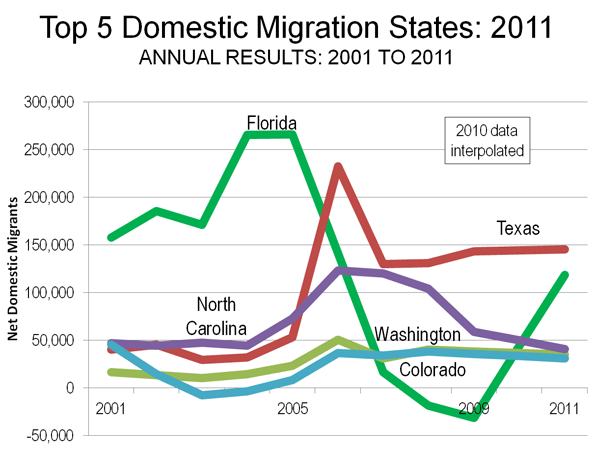
    In 2011 (July 2010 to June 2011), seven of the top domestic migration gaining states were in the South. This is a restoration of the same dominance the South achieved in 2001 to 2006. Some of the states have changed, but the overall impact is little different.

    Texas:Texas again led the nation in net domestic migration, adding 145,000 people from other states to its population. This was a slight increase from the 143,000 net domestic migrants in 2009 (Note 1) and was the highest for Texas since the artificially intense exodus from Louisiana in the year (2006) following hurricanes Katrina and Rita. Texas has led the nation in net domestic migration for six years and ranked second in the nation over the 2001 to 2009.

    Florida: Most spectacularly, however, has been the performance of Florida. Florida had been a net domestic migration leader for years, and had been number one from 2001 through 2005. However, when its highly inflated house prices collapsed (New York Federal Reserve Bank research refers to Florida as one of the "four bubble" states, along with California, Arizona and Nevada), Florida lost domestic migrants for the first time in at least six decades, in both 2008 and 2009. That has been radically turned around. In 2011, Florida added 119,000 net domestic migrants, housing prices dropped to normal levels (Note 2). While this is less than one half the gains in 2004 and 2005, it exceeds the annual Texas increase in the previous decade by 20%.

    North Carolina and South Carolina: North Carolina ranked third, adding 41,000 net domestic migrants. This is an improvement from a fourth-place ranking in the previous decade. Neighboring South Carolina added 22,000 net domestic migrants and ranked sixth. This is an improvement from the previous decade’s ranking of seventh. The domestic migrants to North Carolina and South Carolina have been called "halfbacks," as some have suggested that many who had moved to Florida from the Northeast have subsequently moved to North Carolina and South Carolina, essentially one half of the way back to where they moved from originally.

    Tennessee, Georgia and Virginia: Tennessee (7th), Georgia (8th) and Virginia (9th) rounded out the South’s seven of the top 10 states. Tennessee improved from having been 8th in 2001 to 2009, while Georgia dropped from 5th and Virginia was a new entrant, having previously ranked 12th.

    Western Runners-Up

    While the West continued to show net domestic migration gains, this formerly fastest-growing area of the nation has fallen well behind.

    Washington: Washington ranked fourth in 2011, an improvement from ninth between 2001 and 2009. Washington added 35,000 net domestic migrants.

    Colorado: Colorado also improved its position, adding a net 31,000 domestic migrants and ranking fifth in 2011, which is up from its 10th ranking in 2001 through 2009.

    Oregon:Oregon ranked 10th, adding 14,000 net domestic migrants and was a new entrant to the top 10, having placed 11th between 2001 and 2009.

    Things Never Change: The Bottom 10

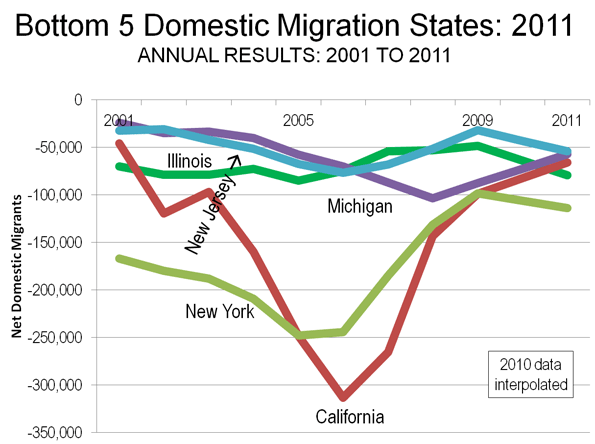
    A similar restoration of normalcy is evident in the bottom 10 states. From 2001 to 2009, all of the bottom 10 net domestic migration states were in the Northeast or the Midwest, joined by California. This changed somewhat in 2011, with formerly fast-growing Nevada, edging out one of the former bottom 10. There was some movement at the very bottom of the list.

    New York: New York recovered its last place position (51st), which it held overall between 2001 and 2009, but had yielded to California later in the decade. New York lost 114,000 net domestic migrants in 2011, which compares to the 1,650,000 loss between 2000 and 2009.

    Illinois:Illinois had the second-highest net domestic migration loss, sending 79,000 of its residents to other states. Illinois had ranked 49th in net domestic migration in the previous decade, with a 615,000 loss. Unlike the other biggest losers, New York and California, the Illinois rate in the single year of 2011 exceeded its annual rate of net domestic migration loss between 2000 and 2009.

    California:The bad news is that California continues to be among the most hemorrhaging states in net domestic migration. The 2000 to 2009 net domestic migration loss of 1,500,000 was more than the population of the cities (municipalities) of San Francisco and Sacramento combined. Perhaps it is good news that the net domestic migration loss dropped to 66,000 in 2011, less than half the annual rate in the previous decade. California ranked 49th in net domestic migration in 2011, an improvement from its 50th place position in 2001 through 2009.

    Michigan: Michigan continued its heavy losses, losing a net 57,000 domestic migrants in 2011 and ranking 48th. In the previous decade, Michigan had also ranked 48th and had a net loss of more than 535,000 domestic migrants.

    New Jersey, Ohio and Connecticut: New Jersey, Ohio and Connecticut occupied the next three higher positions in the bottom ten. The New Jersey and Ohio ranks of 47th and 46th were the same as in the previous decade. Connecticut ranked 45th in 2011 and had ranked 42nd, at the top of the bottom 10, in the previous decade. Each of these states experienced an acceleration of net domestic outmigration relative to their annual loss in the previous decade. In the previous decade, the New Jersey and Connecticut losses had been driven by the New York metropolitan area, which suffered the preponderance of the net domestic migration losses in the Northeast.

    Missouri and Indiana: The Midwestern states of Missouri and Indiana were new entrants to the bottom 10. Missouri ranked 44th in net domestic migration in 2011, losing 12,000, a substantial deterioration from its 20th ranking in the previous decade when the state added 41,000 residents from other states. Indiana ranked 43rd compared to its 32nd place ranking in the previous decade.

    Nevada: Nevada, which had ranked sixth in net domestic migration in the previous decade, occupied the top position in the bottom 10, at 42nd. Nevada lost 11,000 domestic migrants, compared to a gain of more than 360,000 in the previous decade. Like Florida, house prices had escalated sharply during the housing bubble and prices have since fallen back to normal levels. However, much of Nevada’s economy is tied to that of California, which could be a hindrance to the restoration of its previous growth.

    Other Notes

    The other "bubble state," Arizona ranked 11th in net domestic migration, adding 13,000 new residents from other states. As in Florida, house prices had escalated sharply but have since fallen back to normal levels. However, despite its healthy domestic migration, Arizona’s gain is far less than its annual rate in the previous decade.

    There are nothing but surprises in the balance of the top 15. Oklahoma, which has long exported people, especially to the West, ranked 12th in net domestic migration, an improvement from 19 in the previous decade. The District of Columbia ranked 13th, which is a strong improvement from its previous ranking of 37th. Louisiana continued its recovery, ranking 14th, which is an improvement from 45th in the previous decade. North Dakota, whose 2000 population was less than that of 1920, ranked 15th, which is an improvement from 31th in the previous decade.

    No Matter How Much Things Change They Stay the Same

    Both over the last decade and in 2011, the South accounted for 53% of the nation’s growth, the West 32%, with the Midwest rising from 8% to 9% and the Northeast falling from 7% to 6%. And, as indicated above, net domestic migration results were similar. The conclusion from the new census estimates is consistent with the old adage that "no matter how much things change, they stay the same."

    Net Domestic Migration by State:
    2001-2009 and 2011
    By 2011 Rank
    State 2011 2011 Rank 2001-2009 2001-2009 Rank
    Texas       145,315                   1        838,126                   2
    Florida       118,756                   2     1,154,213                   1
    North Carolina         41,033                   3        663,892                   4
    Washington         35,166                   4        239,037                   9
    Colorado         31,195                   5        202,735                 10
    South Carolina         22,013                   6        306,045                   7
    Tennessee         20,328                   7        259,711                   8
    Georgia         17,726                   8        550,369                   5
    Virginia         15,538                   9        164,930                 12
    Oregon         13,636                 10        177,375                 11
    Arizona         13,150                 11        696,793                   3
    Oklahoma           8,933                 12           42,284                 19
    District of Columbia           8,334                 13         (39,814)                 37
    Louisiana           7,085                 14       (311,368)                 45
    North Dakota           6,368                 15         (18,071)                 31
    Kentucky           5,761                 16           81,711                 15
    Arkansas           5,724                 17           75,163                 16
    Montana           3,888                 18           39,853                 21
    West Virginia           2,814                 19           17,727                 26
    South Dakota           2,610                 20             7,182                 27
    Delaware           2,347                 21           45,424                 18
    New Mexico           2,202                 22           26,383                 24
    Alabama           1,974                 23           87,199                 14
    Alaska               740                 24           (7,360)                 29
    Wyoming             (149)                 25           22,883                 25
    Idaho             (256)                 26        110,279                 13
    Utah             (826)                 27           53,390                 17
    Vermont             (841)                 28           (1,505)                 28
    Nebraska             (977)                 29         (39,275)                 36
    Maine          (1,000)                 30           29,260                 23
    Pennsylvania          (1,121)                 31         (33,119)                 34
    Iowa          (1,361)                 32         (49,589)                 40
    Hawaii          (2,320)                 33         (29,022)                 33
    Maryland          (2,994)                 34         (95,775)                 43
    New Hampshire          (3,645)                 35           32,588                 22
    Rhode Island          (6,273)                 36         (45,159)                 38
    Mississippi          (6,672)                 37         (36,061)                 35
    Kansas          (7,928)                 38         (67,762)                 41
    Minnesota          (8,073)                 39         (46,635)                 39
    Massachusetts       (10,886)                 40       (274,722)                 44
    Wisconsin       (10,990)                 41         (11,981)                 30
    Nevada       (11,113)                 42        361,512                   6
    Indiana       (11,412)                 43         (21,467)                 32
    Missouri       (11,831)                 44           41,278                 20
    Connecticut       (16,848)                 45         (94,376)                 42
    Ohio       (44,868)                 46       (361,038)                 46
    New Jersey       (54,098)                 47       (451,407)                 47
    Michigan       (57,234)                 48       (537,471)                 48
    California       (65,705)                 49   (1,490,105)                 50
    Illinois       (79,458)                 50       (614,616)                 49
    New York     (113,757)                 51   (1,649,644)                 51
    Data from US Bureau of the Census


    —–

    Note 1: The Census Bureau did not produce domestic migration data for 2010 (2009-2010). Any reference to 2010 in this article is based upon an interpolation of the 2010 estimate from 2009 and 2011 Census Bureau estimates.

    Note 2: By 2010, housing affordability in all of Florida’s four major metropolitan areas with the exception of Miami had been returned to a Median Multiple (median house price divided by median household income) of approximately 3.0 or less, which is the historical norm (See: 7th Annual Demographia International Housing Affordability Survey). During the housing bubble of the early to middle 2000s, the Median Multiple had risen to above 5.0 in all of the major metropolitan areas except Jacksonville.

    Wendell Cox is a Visiting Professor, Conservatoire National des Arts et Metiers, Paris and the author of “War on the Dream: How Anti-Sprawl Policy Threatens the Quality of Life

  • California: Codes, Corruption And Consensus

    We Californians like collaboration. Before we do things here, we consult all of the “stakeholders.” We have hearings, studies, reviews, conferences, charrettes, neighborhood meetings, town halls, and who knows what else. Development in some California cities has become such a maze that some people make a fine living guiding developers through the process, helping them through the minefields and identifying the rings that need kissing.

    Here’s an example. This is a (partial?) list of the groups who will have a say on any proposed project in my city, Ventura:

    • City agencies (Planning, Engineering, Flood Control, Traffic, Building & Safety, Utilities, Police, Fire)
    • Historic Preservation Committee
    • Parks and Recreation Committee
    • Design Review Committee
    • Planning Commission
    • City Council
    • School District
    • Neighborhood and Community Councils
    • No-Growth Citizen Groups
    • Chamber of Commerce
    • Ventura Citizens for Hillside Preservation
    • California Department of Fish and Game
    • United States Department of Fish and Wildlife
    • Ventura County Local Agency Formation Committee (discretionary authority regarding annexations)
    • Los Angeles Regional Water Quality Control Board (new MS4 Stormwater Permit issues)
    • Ventura County Environmental Health
    • California Coastal Commission (for some projects within the Coastal Zone)
    • California Native American Heritage Commission and Designated Most Likely Descendant of local tribe
    • United States Army Corps of Engineers
    • Natural Resources Defense Council, Surfrider Foundation, Heal the Bay, other environmental groups
    • And all parties who have requested to be on notice, as well as the general public and other agencies, will be informed of any California Environmental Quality Act (CEQA) document.

    I didn’t pick Ventura because it is the most difficult. It’s not. I think Ventura is pretty typical for a coastal California city, actually.

    The result of having all these stakeholders is that, in many California communities, particularly those in coastal and upscale locations, everyone has a veto on everything. At the beginning of a project the developer faces a huge amount of uncertainty about what the project will look like once it gets past the gauntlet and about the cost of the development process. Add to that uncertainty about who will demand what, how long the approval process will take, market conditions and the regulatory environment when the project is completed, if it is completed.

    This is where the corruption connection comes in.

    In economics, we teach that there are two types of corruption, centralized and decentralized. Decentralized corruption is the more pernicious of the two.

    Think of a city where organized crime has a successful protection racket. This would be centralized corruption. The mob is going to collect from everyone, but it has an incentive not to collect too much. It doesn’t want to draw too much attention to itself or chase the business out of town.

    By contrast, decentralized corruption consists of a bunch of independent gangs, each trying to collect all they can before the next group of thugs comes along. Each gang of thugs will demand and collect too much, and chase the business out of town.

    Of course, if you want to develop a property in California no one will hold a gun to your head and demand money, and everyone is way too polite to call it extortion. Certainly, no group thinks of itself as a mob of corrupt gangsters. Instead, the members think of themselves as stakeholders, and they hold delays, lawsuits, or project denial to your head. The results are the same.

    First, you have to meet everyone, and everyone wants something in return for support, or for refraining from opposition. Groups will demand “mitigation fees,” delays, studies and more studies, and changes in the project. You will meet their demands, or you will be sued, or the project will be denied.

    Time spent on meetings, studies, and negotiations is expensive. The cost of the local “guide,” necessary to get through the local maze, is expensive. The “mitigation fees” are expensive. Delays are expensive. Studies are expensive. Changes in the project are expensive. Lawsuits are expensive. And risk is expensive.

    Eventually, the project is no longer profitable. No wonder California’s unemployment rate is 30 percent above the United States unemployment rate.

    The current climate provides California’s local governments with their best economic development opportunity: Eliminate the legal extortion by guaranteeing a project’s prompt approval if it meets existing general plans, specific plans, zoning, building codes, and adopted design criteria. Any community that did this would see immediate increased economic activity. To steal a phrase from a famous economist, it is the closest thing to a free lunch.

    A city does outreach before it develops its zoning and community design plans. It only adds to the cost of development to require builders to go through the entire process again, fighting the same battles, every time a project is proposed.

    The best thing about this idea is that it has been tried, and it works. The City of San Diego has seen an amazing-for-California energy since its redevelopment agency implemented such a plan several years ago. In the worst economy in 50 years, San Diego has been building and providing commercial and housing projects for all economic levels in its downtown area. It is time for the rest of California to get on with it.

    Bill Watkins is a professor at California Lutheran University and runs the Center for Economic Research and Forecasting, which can be found at clucerf.org

    Photo: Two Tree Hill, Ventura California by Joseph Liao (Chowee).

  • Central Valley Noir: California’s Changing Geography of Murder

    Phillip Marlowe, Joe Friday, pack your bags. Your talents are needed elsewhere. The City of Angels is starting to live up to its namesake but the same cannot be said of the state’s agricultural communities.

    Homicide has long been associated with the inner city, the worst crime suffered disproportionately by those who fare the worst. But the annual report on homicide released this month by the California Attorney General reveals that counties traditionally dominated by agriculture have the highest rates. Monterey, Merced, San Joaquin and Kern counties top the list where the largest city to be found is Bakersfield with under 350,000 residents. In fact, the counties that hold the state’s four largest cities, Los Angeles, San Jose, San Diego and San Francisco, are not even in the top ten. Alameda, Fresno and Contra Costa are the only arguably urban-dominated counties to be in the top ten and including Fresno on this list is a stretch.

    Why is this the case? The city of Salinas in Monterey County has a horrible gang problem as does Fresno. Although most criminologists do not link murder to a poor economy, the Central Valley has suffered tremendously in recent years, causing one observer to call it “California’s Detroit .” Los Angeles, which had the state’s second highest murder rate in 2001, saw a precipitous drop in violent crime in the last decade under LAPD Chief Bill Bratton. It’s 2010 murder rate (5.9 homicides per 100,000 residents) was nearly half of the rate in 2001 (11).

    Another eye-popper in the report was the incidence of homicide in the Hispanic community: Hispanics comprised nearly 45 percent of the state’s homicide victims and nearly 49 percent of those arrested for the crime (27 percent of victims were black and 18 percent were white for comparison).

    Other interesting highlights of the report:

    • The homicide rate went down for the fifth year in the row to a rate of 4.7 homicides per 100,000 residents – the lowest rate since 1966. Monterey and Merced both had rates of 10.
    • Thirty-six percent of all homicides were gang-related. Another thirty-six percent occurred as a result of an argument.
    • Whites who murder and are murdered tend to be older than other ethnic groups: 40 percent of white arrestees were age 40 or over, and 52 percent of white murder victims were over 40.
    • For cases in which the cause of murder is known, 71 percent of homicides involve a firearm.

  • The Best Cities For Technology Jobs

    During tough economic times, technology is often seen as the one bright spot. In the U.S. this past year technology jobs outpaced the overall rate of new employment nearly four times. But if you’re looking for a tech job, you may want to consider searching outside of Silicon Valley. Though the Valley may still be the big enchilada in terms of venture capital and innovation, it hasn’t consistently generated new tech employment.

    Take, for example, Seattle. Out of the 51 largest metro areas in the U.S., the Valley’s longtime tech rival has emerged as our No. 1 region for high-tech growth, based on long- and short-term job numbers. Built on a base of such tech powerhouses as Microsoft, Amazon and Boeing, Seattle has enjoyed the steadiest and most sustained tech growth over the past decade. It is followed by Baltimore (No. 2), Columbus, Ohio (No. 3), Raleigh, N.C. (No. 4) and Salt Lake City, Utah (No. 5).

    To determine the best cities for high-tech jobs, we looked at the latest high-tech employment data collected by EMSI, an economic modeling firm. The Praxis Strategy Group‘s Mark Schill charted those areas that have gained the most high-tech manufacturing, software and services jobs over the past 10 years, equally weighting the last five years and the last two. We also included measures of concentration of tech employment in order to make sure we were not giving too much credence to relatively insignificant tech regions. Our definition of high tech industries is based on the one used by TechAmerica, the industry’s largest trade association.

    Despite the Valley’s remarkable concentration of tech jobs — roughly six times the national average — it ranked a modest No. 17 in our survey. This relatively low ranking reflects the little known fact that, even with the recent last dot-com craze sparking over 5% growth over the past two years, the Valley remains the “biggest loser” among the nation’s tech regions, surrendering roughly one quarter of its high -tech jobs — about 80,000 — in the past decade. Only New York City (No. 44) lost more tech jobs during that time.

    In contrast to this pattern of volatility, our top performers have managed to gain jobs steadily in the past decade — and have continued to add new ones in the last two years. In addition to our top five, the only other regions to claim overall tech gains in the last 10 years are Jacksonville, Fla. (No. 6), Washington, D.C. (No. 7), San Bernardino-Riverside, Calif. (No. 9), San Diego, Calif. (No. 9), Indianapolis (No. 11) and Orlando, Fla. (No. 24).

    So what accounts for high-tech success, and where will jobs most likely grow in the next decade? Certainly being home to a major research university makes a big difference. Seattle, Columbus, Raleigh and Salt Lake City all boast major educational and research assets.

    But it’s one thing to produce scientists and engineers; it’s another to generate employment for them over the long term. Clearly for the San Jose metropolitan region (which is home to Stanford) and the much-hyped No. 29 San Francisco area (home to the University of California Medical Center) academic excellence has not translated into steady growth in tech jobs. Over the past decade the Bay Area has given up 40,000 jobs, or 19% of its tech workforce, including a loss of nearly 6,000 in software publishing.

    Or look at the Boston region (ranked No. 22), which arguably boasts the most impressive concentration of research universities in the country. The region did add jobs in research and computer programming, but these were not enough to counter huge losses in telecommunications and electronic component manufacturing. Over the past decade, greater Beantown has given up 18% of its tech jobs, or more than 45,000 positions.

    One possible explanation may lie in costs, including very high housing prices, onerous taxes and a draconian regulatory environment. In tech, company headquarters may remain in the Valley, close to other headquarters and venture firms, but new jobs are often sent either out of the country or to more business friendly regions.

    Just look at the flow of jobs from Bay Area-based companies to places like the Salt Lake area. In the past two years Valley companies such as Twitter, Adobe, eBay, Electronic Arts and Oracle have all expanded into Utah. This region has many appealing assets for Bay Area companies and workers. Salt Lake City is easily accessible by air from California, possesses a well- educated workforce, has reasonable housing costs and offers world-class skiing and other outdoor activities.

    Another huge advantage appears to be closeness to the federal government, which expends hundreds of billions on tech products both hardware and software. This explains why Baltimore, primarily its suburbs, and the D.C. metro area have enjoyed steady tech growth and, under most foreseeable scenarios, likely will continue to do so in the coming years. Both regions have seen large gains in technology services industries, particularly programming, systems design, research, and engineering.

    Yet even business climate, while important, may not be enough to drive tech job growth. Texas ranks highly in most business surveys, including our own, but it did not fare so well in this one. Indeed No. 32 Austin, often thought as the most likely candidate for the next Silicon Valley, lost over 19% of its high-tech jobs over the past decade, including more than 17,000 jobs in semiconductor, computer and circuit board manufacturing. No. 18 Houston did far better, although it has also lost 6% of its tech jobs over the same period due to the cutbacks in the engineering service, a big sector there. Even more shocking: No. 46 Dallas, generally a job-creating dynamo, has seen roughly a quarter of its high-tech jobs go away, due primarily to losses in telecommunications carriers and in manufacturing of communications equipment and electronics.

    How about other potential up and comers for the coming decade? Two potentially big and somewhat surprising winners. The first: Detroit. Though the Motor City area lost 20% of its tech jobs in the past decade (ranking 40th on our list), it still boasts one of the nation’s largest concentrations of tech workers, nearly 50% above the national average. In the past two years, the region has experienced a solid 7.7% increase in technology jobs, the second highest rate of any metro area.

    The Motor City region seems to have some real high-tech mojo. According to the website Dice.com, Detroit has led the nation with the fastest growth in technology job offerings since February — at 101%. This can be traced to the rejuvenated auto industry, which is increasingly dependent on high-tech skills. Manufacturing is increasingly prodigious driver of tech jobs; games and dot-coms are not the only path to technical employment growth. This could mean good news for other Rust Belt cities, such as No. 28 Cincinatti or No. 38 Cleveland, as well as our Midwest standout, Columbus, which could benefit from growth sparked by the local natural gas boom.

    Another potential standout is No. 8 New Orleans, whose tech base remains relatively small but has expanded its tech workforce nearly 10% since 2009 — the highest rate of any of the regions studied. With low costs, a friendly business climate and world-class urban amenities, the Crescent City could emerge as a real player, aided by the growing prominence of research and development around Tulane University. There has also been a recent growing presence of the video game industry in the city.

    Looking forward, however, it makes sense to be cautious about where tech is heading. By its nature, this is a protean industry; the mix of jobs and favored locales tend to change. If the current boom in social media continues, for example, the Bay Area could recover more of its lost jobs and further extend its primacy. Similarly a surge in manufacturing and energy-related technology could be a boon to tech in Houston, Dallas as well as New Orleans. But based on both historic and recent trends, the surest best for future growth still stands with our top five winners, led by the rain-drenched, but prospering Seattle region.

    Best Places for High Tech Growth
    Ranking of 2, 5, and 10 year growth, industry concentration, and 5 and 10 year growth momentum
    Rank Metropolitan Area Rank Score
    1 Seattle  82.2
    2 Baltimore 75.7
    3 Columbus 67.9
    4 Raleigh 63.2
    5 Salt Lake City 60.0
    6 Jacksonville 59.2
    7 Washington, DC 58.9
    8 New Orleans 58.8
    9 Riverside-San Bernardino 58.2
    10 San Diego 56.1
    11 Indianapolis 55.9
    12 Buffalo 55.8
    13 San Antonio 54.0
    14 Charlotte 53.5
    15 St. Louis 51.6
    16 Pittsburgh 50.8
    17 San Jose 50.5
    18 Houston 50.2
    19 Hartford 50.0
    20 Nashville 49.6
    21 Providence 49.2
    22 Boston 48.3
    23 Minneapolis-St. Paul 48.3
    24 Orlando 48.1
    25 Portland 48.1
    26 Philadelphia 47.4
    27 Louisville 47.2
    28 Cincinnati 46.6
    29 San Francisco 46.6
    30 Denver 46.4
    31 Richmond 45.6
    32 Austin 45.1
    33 Atlanta 44.6
    34 Virginia Beach-Norfolk-Newport News 42.4
    35 Memphis 42.2
    36 Milwaukee 41.5
    37 Rochester 41.2
    38 Cleveland 40.9
    39 Phoenix 38.5
    40 Detroit 37.7
    41 Tampa 37.5
    42 Miami 33.2
    43 Sacramento 32.1
    44 New York 31.4
    45 Las Vegas 31.2
    46 Dallas-Fort Worth 31.0
    47 Chicago 30.2
    48 Los Angeles 29.5
    49 Oklahoma City 26.7
    50 Birmingham 23.5
    51 Kansas City 21.6
    Rankings measure employment in 45 high technology manufacturing, services, and software industry sectors.

    This piece first appeared at Forbes.com.

    Joel Kotkin is executive editor of NewGeography.com and is a distinguished presidential fellow in urban futures at Chapman University, and an adjunct fellow of the Legatum Institute in London. He is author of The City: A Global History. His newest book is The Next Hundred Million: America in 2050, released in February, 2010.

    Mark Schill of Praxis Strategy Group perfomed the economic analysis for this piece.

    Seattle photo courtesy of BigStockPhoto.com.

  • California’s Bullet Train in the Court of Public Opinion

    A business plan released on November 1 by the the California High-Speed Rail Authority (CHSRA), has placed the price tag for the LA-SF bullet train project at $98 billion— trippling the $33 billion estimate provided in 2008 in the voter-approved Proposition 1A. At the same time, the date of project completion has been pushed back by 13 years — from 2020 to 2033.

    California state legislators who must soon decide whether to proceed with the high-speed rail project are facing an increasingly skeptical climate of opinion.  A growing body of their colleagues who formerly supported the rail authority, including state Senators Alan Lowenthal, Joe Simitian and Mark DeSaulnier, have been shocked by the new estimate and have begun to question the wisdom of proceeding with the project. Other legislators intend to go further. State Sen. Doug LaMalfa said he will sponsor a bill to put the voter-approved rail project back on the ballot. House Majority Whip Kevin McCarthy announced that he will introduce legislation that would freeze federal funding for the project for one year so that congressional auditors can review its viability.

    At the federal level, chances of further funding for the California project are judged to be negligible, with Congress having virtually zeroed out high-speed rail funds in the FY 2012 federal budget.

    At the same time, the bullet train is rapidly losing public support. Nearly two-thirds of California’s likely voters would, if given a chance, stop the project according to a recent opinion survey. Organized opposition within the state is widespread. Public interest groups and watchdog coalitions such as  Californians Advocating Responsible Rail Design (CARRD), the Community Coalition on High-Speed Rail, the California Rail Foundation, and the Planning and Conservation League have repeatedly challenged the Authority’s cost estimates, ridership projections and rail alignments. They have testified against the project in public hearings and taken the Authority to court. Recently, they scored a legal victory when a state judge ruled that the Authority has to reopen and revise its environmental analysis of a controversial alignment.

    A team of respected independent experts, comprising Stanford economist Alain Enthoven, former World Bank analyst William Grindley and financial consultant William Warren, have reinforced the growing feeling of doubt about the project’s viability by challenging the rail authority’s assumptions and pointing out the flaws in its business  plan. 

    Finally, at both the national and state levels, the bullet train project is receiving an increasingly skeptical press scrutiny. Nearly every newspaper in the state (with the exception of the LA Times and SF Chronicle) has turned critical.  News services, notably California Watch (founded by the Center for Investigative Reporting) and investigative reporters, such as SF Examiner’s Kathy Hamilton, Mercury News’ Mike Rosenberg and OC Register’s Steve Greenhut are providing incisive critical analysis to counter the steady flow of publicity generated by the Authority and its supporters. 

    Critical commentaries in mainstream press vastly outnumber favorable stories. Here are three examples:

    The Train to Neverland
    The Wall Street Journal , November 12, 2011

    California’s high-speed rail system is going nowhere fast
    The Washington Post, November 13, 2011

    High-Speed rail depends on $55B in federal funds
    California Watch, November 12, 2011 (by Ron Campbell and Lance Williams)


    Ken Orski has worked professionally in the field of transportation for over 30 years.

    ~~~~~~~~~~~~~~~~~~~~
    Note: the NewsBriefs can also be accessed at www.infrastructureUSA.org
    A listing of all recent NewsBriefs can be found at www.innobriefs.com

  • California’s Jobs Engine Broke Down Well Before the Financial Crisis

    Everybody knows that California’s economy has struggled mightily since the 2008 financial crisis and subsequent recession. The state’s current unemployment rate, 12.1 percent, is a full 3 percentage points above the national rate. Liberal pundits and politicians tend to blame this dismal performance entirely on the Great Recession; as Jerry Brown put it while campaigning (successfully) for governor last year, “I’ve seen recessions. They come, they go. California always comes back.”

    But a study commissioned by City Journal using the National Establishment Time Series database, which has tracked job creation and migration from 1992 through 2008 (so far) in a way that government statistics can’t, reveals the disturbing truth. California’s economy during the second half of that period—2000 through 2008—was far less vibrant and diverse than it had been during the first. Well before the crisis struck, then, the Golden State was setting itself up for a big fall.

    One of the starkest signs of California’s malaise during the first decade of the twenty-first century was its changing job dynamics. Even before the downturn, California had stopped attracting new business investment, whether from within the state or from without.

    Economists usually see business start-ups as the most important long-term source of job growth, and California has long had a reputation for nurturing new companies—most famously, in Silicon Valley. As Chart 1 shows, however, this dynamism utterly vanished in the 2000s. From 1992 to 2000, California saw a net gain of 776,500 jobs from start-ups and closures; that is, the state added that many more jobs from start-ups than it lost to closures. But during the first eight years of the new millennium, California had a net loss of 262,200 jobs from start-ups and closures. The difference between the two periods is an astounding 1 million net jobs.

    Between 2000 and 2008, California also suffered net job losses of 79,600 to the migration of businesses among states—worse than the net 73,800 jobs that it lost from 1992 through 2000. The leading destination was Texas, with Oregon and North Carolina running second and third (see Chart 2). California managed to add jobs only through the expansion of existing businesses, and even that was at a considerably lower rate than before.

    Graph by Alberto Mena

    Graph by Alberto Mena

    Another dark sign, largely unnoticed at the time: California’s major cities became invalids in the 2000s. Los Angeles and the San Francisco Bay Area had been the engines of California’s economic growth for at least a century. Since World War II, the L.A. metropolitan area, which includes Orange County, has added more people than all but two states (apart from California): Florida and Texas. The Bay Area, which includes the San Francisco and the San Jose metro areas, has been the core of American job growth in information technology and financial services, with San Jose’s Silicon Valley serving as the world’s incubator of information-age technology. During the 1992–2000 period, the L.A. and San Francisco Bay areas added more than 1.1 million new jobs—about half the entire state total. But between 2000 and 2008, as Chart 3 indicates, California’s two big metro areas produced fewer than 70,000 new jobs—a nearly 95 percent drop and a mere 6 percent of job creation in the state. This was a collapse of historic proportions.

    Graph by Alberto Mena

    Not only did California in the 2000s suffer anemic job growth; the new jobs paid substantially less than before. Chart 4 reveals the sad reversal. From 2000 to 2008, California had a net job loss of more than 270,000 in industries with an average wage higher than the private-sector state average. That marked a turnaround of nearly 1.2 million net jobs from the 1992–2000 period, when 908,900 net jobs were created in above-average-wage industries. Further, during the earlier period, more than 707,000 net jobs were created in the very highest-wage industries—those paying over 150 percent of the private-sector average.

    Chart 5, which indicates job growth or decline in selected industries, again suggests that a lopsided amount of California’s economic growth in the 2000s was in below-average-wage fields. It included nearly 590,000 net jobs in “administration and support”—clerical and janitorial jobs, for example, as well as positions in temporary-help services, travel agencies, telemarketing and telephone call centers, and so on. The largest losses in the state during the 2000s were in manufacturing, which traditionally provided above-average wages. After adding a net 64,900 manufacturing jobs from 1992 to 2000, California hemorrhaged a net 403,800 from 2000 to 2008. But information jobs also went into negative territory, while professional, scientific, and technical-services employment experienced far lower growth than in the previous decade.

    The chart also shows that California’s growth in the 2000s, such as it was, took place disproportionately in sectors that rode the housing bubble. In fact, 35 percent of the net new jobs in the state were created in construction and real estate. All those jobs have vaporized since 2008, according to Bureau of Labor Statistics data. They are unlikely to come back any time soon.

    These are troubling numbers. Fewer jobs and lower wages do not a robust economy make. A continuation of this trend, even if California’s recession-battered condition improves, would result in a far more unequal economy, shrunken tax revenues, and a likely increase in state public assistance—all at a time when officials are struggling with massive deficits.

    Graph by Alberto Mena

    Graph by Alberto Mena

    A final indicator of California’s growing economic weakness during the 2000–2008 period is that the average size of firms headquartered in the state shrank dramatically. As Chart 6 shows, California had a huge increase over the 1992–2000 period in the number of jobs added by companies employing just a single person or between two and nine people, even as larger firms cut hundreds of thousands of jobs. Many of the single-employee companies may simply be struggling consultancies: if they were doing better, they’d likely have to start hiring at least a few people. While start-ups are indeed crucial to economic growth, small companies are especially vulnerable to economic downturns and often feel the brunt of taxes and regulations more acutely than larger firms do. The awful job numbers for the bigger companies—including a net loss of nearly 450,000 positions for firms with 500 or more employees—suggest the toxicity of California’s business climate. After all, bigger firms have the resources to settle and expand in other locales; in the 2000s, they clearly wanted nothing to do with the Golden State.

    Graph by Alberto Mena

    What is behind California’s shocking decline—its snuffed-out start-ups, unproductive big cities, poorer jobs, and tinier, weaker, or fleeing companies—during the 2000–2008 period? Steven Malanga’s “Cali to Business: Get Out!” identifies the major villains: suffocating regulations, inflated business taxes and fees, a lawsuit-friendly legal environment, and a political class uninterested in business concerns, if not downright hostile to them. One could add to this list the state’s extraordinarily high cost of living, with housing prices particularly onerous, having skyrocketed in the major metropolitan areas before the downturn—thanks, the research suggests, to overzealous land-use regulation.

    One thing is for sure: California will never regain its previous prosperity if it leaves these problems unaddressed. Its profound economic woes aren’t just the result of the Great Recession.

    This piece originally appeared in City Journal. City Journal thanks the Hertog/Simon Fund for Policy Analysis for its generous support of this issue’s California jobs package.

    Wendell Cox is a Visiting Professor, Conservatoire National des Arts et Metiers, Paris and the author of “War on the Dream: How Anti-Sprawl Policy Threatens the Quality of Life

    Photo by Altus via Flickr