Tag: California

  • Irvine, by Design

    Different is not necessarily better or worse. I took notice of this upon moving from the Echo Park district of Los Angeles to Irvine. Some acquaintances and casual observers viewed it as a shift from ground zero of hipster chic to the center of conformity. Neither comes close to capturing the truth about either place.

    Irvine is very different from Echo Park—not necessarily better or worse. That’s my point of view as a resident who appreciates aspects of both places.

    Here’s a viewpoint from a broader perspective: I can see why a lot of observers and even some residents of Irvine see the city as a paean to conformity. The cityscape obviously conforms to any number of standards, some of which seem to be downright capricious. Must earth tones dominate the palette of the entire city? Must opportunities for legal U-turns be so rare?

    There’s no denying that anyone who’s unfamiliar gets little help from landmarks as they find their way around Irvine. A lot of the streets have a similar look and feel. Many are bigger and busier than they seem at first glance. Cars are the boss, and it can take a while to get one’s bearings amid the slight distinctions of streetscape and zippy pace of traffic.

    It’s taking me awhile, but a few things are coming into focus. I find it helps to think of the city as a canvas and to get to know its brush strokes.

    There is a street grid, with major thoroughfares generally oriented on north to south and east to west. It helps to think of them as freeways. The housing subdivisions are like small towns. The shopping centers are downtown commercial districts.

    Get that in mind and it helps put the city in perspective. Once you put Irvine in perspective you begin to realize its design.

    Yes, the city is designed to a T—so much so that the “conformity” tag gets affixed by critics in gentrified neighborhoods filled with hipsters, including many who don’t realize that they themselves have gotten comfortable with uniformity.

    Listen closely to those same critics and you’ll realize they actually crave the sort of design that defines Irvine. Go to a community meeting in a gentrified neighborhood and you’ll likely hear all sorts of calls for strict design standards on everything from signs for mom-and-pop stores to street lights and dog parks.

    The difference between the design-obsessed enclaves of inner cities and Irvine owes to Donald Bren.

    His Irvine Company shares its name with the city. He grew it out of acreage that had been the historic Irvine Ranch. Bren’s vast landholdings have given him an unusual scope of control over how Irvine has taken shape.

    Bren is apparently obsessed with design. It’s also apparent, however, that his obsession works toward a clear purpose. He seeks a profit in the marketplace.

    The same hipsters who knock Irvine for conformity should appreciate the profit motive. Many of them look back fondly on pages of history that tell the stories of captains of industry who built company headquarters, stores and even factories as monuments and legacies.

    Ask a hipster about the Chrysler Building in New York or the Wrigley Building in Chicago. Get ready for a stream-of-conscious review of the elegance of those structures. You’ll hear about the glory days of magnates who were not beholden to quarterly profit reports and could freely direct their wealth to aesthetic pleasures for public view without questions from shareholders.

    You won’t hear Bren mentioned, but he should be.

    I know this much from my brief time in Irvine: The place is a big canvas, and much of it has been filled by Bren. The conformity that critics see actually is design. It just happens to be on such a grand scale that it requires a broader perspective than can be gained with drive through and a look around. You have to live with it awhile—or perhaps take it in from several thousand feet in the air.

    Nobody has to like Bren’s design. Fair is fair, though, and it should be understood that nothing of the scale and scope of what Bren has created can be fairly called conformity.

    Sullivan is managing editor of the Orange County Business Journal (ocbj.com), where this column originally appeared.

    Photo by maziar hooshmand
  • A Train to Nowhere: Not A Train Through Nowhere

    In expressing its opposition to the California High Speed Rail line, Washington Post editorialists noted that critics of the now approved Borden to Corcoran segment have called the line a “train to nowhere” (“Hitting the breaks on California’s high speed rail experiment“). The Post call this:

    …a bit unfair, since some of the towns along the way have expensively redeveloped downtowns that may now suffer from the frequent noise and vibration of trains roaring through them.

    What the Post missed, however, is that a “train to nowhere” is not a “train through nowhere.” There is no doubt that the high viaducts and the noisy trains have potential to do great harm to the livability of the communities through which it passes. This is one of the reasons that the French have largely avoided operating their high speed rail trains through urban areas, except at relatively low speeds. Stations, except for in the largest urban areas, are generally beyond the urban fringe and towns are bypassed. Yet, one of the decisions not yet made in California, for example, is whether the town of Corcoran will be cut in half by the intrusive, noisy line.

    There would be nothing but grief for the towns through which the California high speed rail lines would pass, but not stop (this is not to discount the disruption the line will cause even where it would stop, such as in Fresno). It may be a train to nowhere, but it is a train through places that people care about.

  • The Dispersing of Urbanism

    For more than a century, people have been moving by the millions to larger urban areas from smaller urban areas and rural areas. Within the last five years, the share of the world population living in rural areas has dropped below one-half for the first time. The migration to the larger urban areas has spread to lower income nations as the countryside seemingly empties into places like Chongqing, Jakarta and Delhi. In the United States, the rural population has declined from slightly more than 60% in 1900 to approximately 18% in 2010. In Australia, the rural population is expected to decline to below 10% later in this decade.

    Of course, the driving factor in this urban migration is the quest for opportunity. People have flocked to urban areas because opportunities are greater.

    Yet if the opportunities are in metropolitan areas, indications are that this is taking place over a wider area than in the past. A review of income growth between 2001 and 2006 in four nations shows that incomes rose more in some surrounding regions than within the metropolitan areas, at least during the first half of the decade. It will be interesting to see if these patterns have changed in the second half of the decade, something we will be able to discern once the 2010/2011 round of census data is available.

    Australia

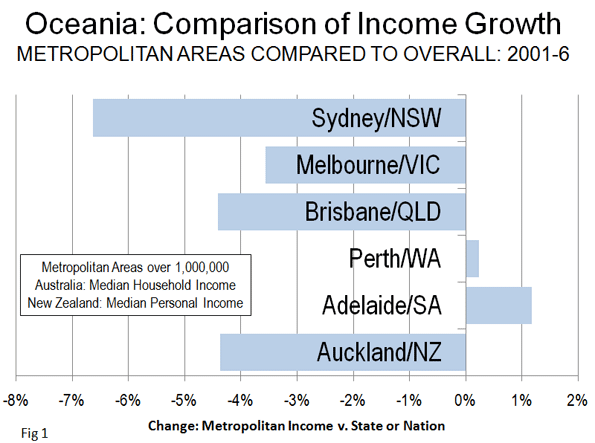
    This dispersion of opportunity is particularly evident in Australia, where data from the last two national censuses indicates that incomes overall have risen more quickly outside some major metropolitan areas. In three of five cases (the three largest) incomes rose higher outside rather than inside the major metropolitan areas (Figure 1).

    • In Sydney, the largest metropolitan area in Australia, median household incomes declined 6.6% relative to those of the state of New South Wales.
    • Melbourne median household incomes declined 3.5% relative to those of the state of Victoria.
    • Brisbane median household incomes declined 4.4% relative to those of the state of Queensland.
    • Median household incomes in Perth rose marginally more than those in the state of Western Australia (0.2%), while Adelaide incomes rose the strongest against state (South Australia) incomes at 4.4%.

    New Zealand

    Mimicking the largest metropolitan areas in Australia, Auckland, New Zealand’s largest metropolitan area, experienced a median personal income loss of 4.4% relative to that of the nation between 2001 and 2006 (Figure 1).

    Canada

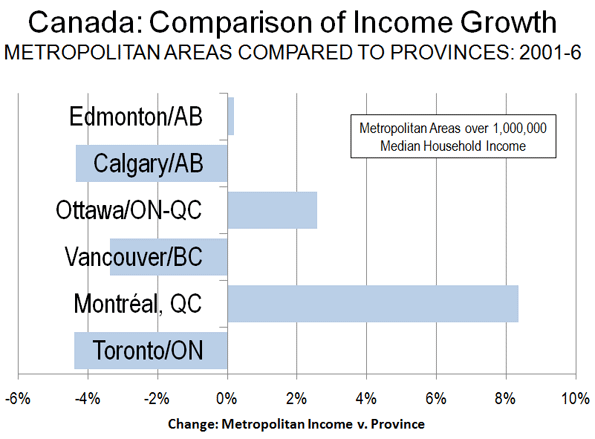
    A similar story has unfolded in Canada. Major metropolitan area median household incomes declined relative to provincial incomes in one half of the cases (Figure 2). The largest relative losses occurred in arguably two most dynamic metropolitan areas :

    • Toronto, which accounts for nearly one fifth of Canada’s population experienced a median household income decrease of 4.4% relative to that of the province of Ontario. Steve LeFluer’s recent article shows that within the Greater Toronto area, the core city, with its amalgamated inner suburbs, has the lowest median household income.
    • Calgary, Canada’s energy capital, also experienced a median household income decrease of 4.4% relative to its province, Alberta.

    Vancouver’s median household income also fell, 3.3% relative to that of British Columbia’s.

    Three metropolitan areas experienced faster economic growth:

    • By far the strongest growth income growth occurred in Montréal, where median household incomes increased 8.4% relative to incomes in Québec.
    • The nation’s capital, Ottawa (a metropolitan area that straddles the borders of Ontario and Québec) experienced a median household income increase of 2.6% relative to the weighted median of the two provinces.
    • Edmonton, Alberta’s capital, experienced income growth marginally above that of the province (0.2%).

    United States

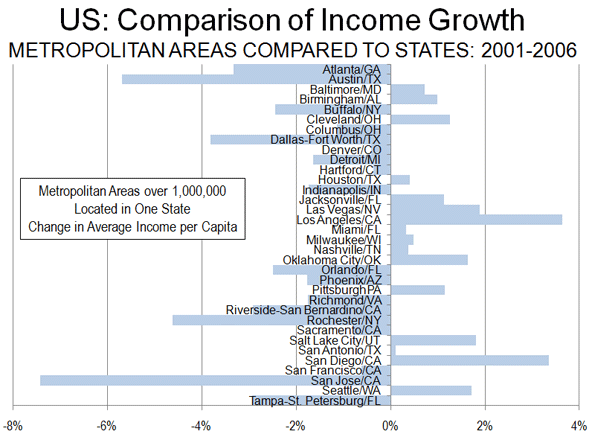
    A review of data in the United States indicates similar results. The same time span (2001 to 2006) was analyzed for the 34 metropolitan areas with more than 1 million population that are in a single state. State personal incomes per capita rose at a greater rate than the metropolitan area rates in 18 of the 34 cases (Figure 3).

    Two California metropolitan areas performed the best. In Los Angeles personal income per capita rose 3.6% relative to that of California in San Diego, per capita income rose at 6% relative to that of the state.

    Other metropolitan areas, including Las Vegas, Salt Lake City, Seattle, Oklahoma City, Cleveland, Pittsburgh and Jacksonville experienced income per capita increases of between 1% and 2% relative to those of their respective states.

    The largest loss occurred in information technology intensive San Jose, where incomes dropped 7.4% relative to those of California. Austin, capital of the nation’s second-largest state, experienced the second largest drop at 5.7% relative to incomes in the state of Texas, which as one of the leading information technology centers in the nation, generally mirrors the San Jose performance.

    Other losses between 2% and 5% relative to their states occurred in Rochester, Dallas-Fort Worth, Atlanta, Tampa-St. Petersburg, Riverside-San Bernardino, Orlando and Buffalo.

    Among the 15 multi-state metropolitan areas, eight experienced income increases relative to the states in the largest share of the population lives (this state with the historical core municipality) and seven declined. Perhaps the most surprising finding is that two metropolitan areas (New York and Washington), which have been among the most consistent in providing economic opportunities experienced only modestly greater income growth than their states.

    • New York, one of the two or three principal financial centers of the world, experienced income growth only 0.6% relative the weighted average of the states of New York and New Jersey, where nearly all of the area is located (Pike County, Pennsylvania is also in the metropolitan area).
    • Washington, where federal government and related in one can be counted upon to produce income growth, experienced only a modest rise of 0.3% relative to the weighted average of the two states (Virginia and Maryland) that comprise nearly all of the metropolitan area (Jefferson County, West Virginia is also in the metropolitan area).

    Metropolitanizing the World?

    These trends suggest a shift in metropolitan fortunes, at least in advanced countries. Historically incomes have grown much more strongly in metropolitan areas than in other areas. Now incomes are rising more quickly or at least nearly as quickly outside some major metropolitan areas as they are inside. It can no longer be blithely assumed that large metropolitan areas experience greater economic growth than their less urban hinterlands. The differences may be fading away, shaped not so much by proximity to the core but by other regional factors.

    We currently can only speculate as to the reasons for this development. The expansion of personal mobility and the ability of people to commute from outside major metropolitan areas may be one reason. Perhaps the most important factor is the rise of the information economy, which has freed some people from more intense urban living by permitting working at home part or all of the time. The proliferation of shopping opportunities, through franchised chains, the outward movement of immigrants, and online ordering may have made formerly remote areas more able to fulfill the needs and desires of people who previously would have inclined to live in more urban surroundings.

    These developments are consistent with the net migration of more than 2 million people away from metropolitan areas of more than 1 million population between 2000 and 2009 in the United States. Further, the phenomenon may be spreading beyond the high income world. As recently noted, in China, economic opportunities may be expanding in rural areas.

    ——

    Note

    This analysis compares metropolitan incomes to incomes in larger political jurisdictions (such as the metropolitan area of San Diego and California). An analysis that compared the area within the larger jurisdiction, but outside the metropolitan area, would yield a somewhat a difference (whether higher or lower), because the larger jurisdiction data available includes the metropolitan areas.

    Photo: “Outback” New South Wales: Faster Income Growth than Sydney (by author)

    Wendell Cox is a Visiting Professor, Conservatoire National des Arts et Metiers, Paris and the author of “War on the Dream: How Anti-Sprawl Policy Threatens the Quality of Life

  • Fuzzy Thinking by Famous Economists

    Edward L. Glaeser, in an end-of-year piece for the New York Times, claims that generous housing supply is the reason that Texas’s economy is performing so well. As he says in his final paragraph:

    “Housing regulations, more than those that bind standard businesses, explain the Sun Belt’s population growth. If New York and Massachusetts want to stop losing Congressional seats, then they must revisit the rules that make it so difficult to build. High prices show that the demand would be there if the supply is unleashed.”

    This can’t be true.

    If it were true, Fresno, Modesto, and other cities in California’s Central Valley would be booming. They are not. Instead, six of the ten worst U.S. Metro Areas for joblessness are in California’s Central Valley.

    It is not just California. There are lots of places where housing is abundant and inexpensive and economic activity is dismal, Michigan for example. Maybe bringing up Michigan is a little unfair, Glaeser does mention demand for housing in the essay, and there is clearly little demand for Michigan housing. Still, it brings up the question of where demand for housing comes from. It’s a question Glaeser does not address.

    We’ll get back to the question of demand for housing.

    Glaeser claims that building homes causes prosperity, but Michigan’s housing abundance is not because of recent construction. He mentioned Georgia and Arizona, but those economies have been performing worse than the national average in terms of jobs and unemployment since the crash of the housing bubble. Now Nevada leads the nation in the AP’s Economic Stress Index, the sum of unemployment, foreclosure, and bankruptcy rates.

    As it turns out, Texas is the only state among the ones that Glaeser discusses that has outperformed the national average since the recession. Something else is going on, and that something is opportunity, but Glaeser makes a fundamental mistake early in the paper:

    “If economic productivity – created by low regulations or anything else – was causing the growth of Texas, Arizona and Georgia, then these places should have high per capita productivity and wages. Yet per capita state product in Arizona in 2009 was $35,300, 16 percent less than the national average. Per capita state products was $36,700 in Georgia and $42,500 in Texas.”

    It is a mindboggling mistake for an economist to claim that business decisions are made based on productivity, without consideration of costs. If productivity was all that mattered, little manufacturing would take place in China, as United States factory workers are about five times more productive than their Chinese counterparts.

    Paul Krugman, in another New York Times piece, takes up where Glaeser leaves off and makes another amazing mistake:

    “Part of the answer is that reports of a recession-proof state were greatly exaggerated. It’s true that Texas job losses haven’t been as severe as those in the nation as a whole since the recession began in 2007. But Texas has a rapidly growing population — largely, suggests Harvard’s Edward Glaeser, because its liberal land-use and zoning policies have kept housing cheap. There’s nothing wrong with that; but given that rising population, Texas needs to create jobs more rapidly than the rest of the country just to keep up with a growing work force.”

    Krugman goes on to say that people move to cheap housing, and economic growth follows.

    People make locational decisions based on far more factors than housing costs, factors like job prospects and opportunity, climate, cultural amenities, taxes and the like. In economic terms, we say that job growth and population growth are jointly determined. There is nothing sequential going on at all. Instead, population growth (and housing demand) reflects job growth prospects, housing costs, and other factors. Job growth reflects population growth prospects (and housing supply), productivity, wage rates, and other costs and resources.

    Krugman also asserts that Texas’s economy is not exceptional among the large states, citing unemployment rates equal to New York or Massachusetts. But he ignores the fundamentals here – like higher job growth and more in-migration. During its boom period, California often suffered higher unemployment because so many people were coming there. In contrast, the workforces in both Massachusetts and New York are among the slowest growing in the country. New York, in particular, competes with California and Michigan for the highest rates of domestic outmigration. People would stay if there was opportunity.

    In his rush to denounce Texas, Krugman exaggerates or dismisses facts. Yes, Texas has a twenty billion deficit now, but that the Lone Star State budget is for two years, something he neglects to mention. These estimates may soon be downgraded, as the price of oil rises. In addition, he fails to acknowledge Texas’s stellar performance in creating both high-tech and middle skill jobs at many times the rate of such favored blue states as Massachusetts, New York and California. People are not as stupid as many Nobel Prize winners might think; they move for opportunity, not just for cheap houses or low-paid work.

    You do not have to be a free market fundamentalist to recognize that, in relative terms, we can see a band of prosperity from North Dakota to Texas. In general, economic performance declines as you move from this Heartland band to the coasts, particularly the West Coast. People who want to believe that policy doesn’t matter give oil and agriculture as the two major reasons for the Heartland’s relative prosperity. Krugman suggests that high oil prices are a key reason for Texas’s economic performance.

    No doubt, oil is important to Texas, but prices have been generally low throughout the recession, while the oil companies’ domestic capital budgets have been small. Similarly, agriculture is booming nationwide, not just in the Heartland, a result of high prices caused by growing global demand. California certainly has lots of oil and agriculture, and no one would claim that California is booming. There is more to the Heartland’s growth than agriculture and oil, and that includes states which are governed by Democrats, such as Montana.

    A region’s job growth is a result of business locational decisions. A business moves to or expands in a region based on a whole host of reasons. These include available infrastructure, resource availability, market size and location, labor supply and costs, worker productivity, facilities costs, transportation costs, and other costs. Those other costs include what I call DURT (Delay, Uncertainty, Regulation, and Taxes).

    There is no reason for every location to have the same DURT. On the contrary, a location blessed with an abundance of the other factors of business locational decisions could afford to have more expensive DURT, while locations less blessed need to have cheaper DURT to attract businesses.

    This is what we see. The coasts tend to be more intrinsically attractive than the Heartland, but they also tend to have more expensive DURT. But now many of these states – driven by such factors as public sector costs or environmental regulations – have raised the price of their DURT so high that they have driven business to expand more to less attractive locations with cheaper DURT, demonstrating once again that policy matters.

    Bill Watkins is a professor at California Lutheran University and runs the Center for Economic Research and Forecasting, which can be found at clucerf.org.

    Photo by Dean Terry

  • California’s Third Brown Era

    Jerry Brown’s no-frills inauguration today as California governor will make headlines, but the meager celebration also marks the restoration of one of the country’s most illustrious political families. Save the Kennedys of Massachusetts no clan has dominated the political life of a major state in modern times than the Browns of California. A member of this old California Irish clan has been in statewide office for most of the past half century; by the end of Jerry Brown’s new term, his third, the family will have inhabited the California chief executive office for a remarkable two full decades since 1958.

    Brown, at 72 the oldest governor in state history, may well determine the final legacy of this remarkable family. His biggest challenge will be to reverse the state’s long-term secular decline — a stark contrast to the heady days of the first Brown era, presided over by paterfamilias Edmund “Pat” Brown.

    Pat Brown was a committed progressive who actually believed in both social and economic progress. He did not focus on re-distributing wealth or expanding bureaucratic controls; his priority was to use government to help generate greater opportunities for Californians.

    Under Pat roughly 20% of the state budget was devoted to capital outlays. He expanded wealth creating infrastructure such as freeways and the State Water Project, which created vast expanses of new, highly fertile farmland. He also increased the state’s parklands so that middle-class Californians could enjoy the state’s unmatched natural beauty.

    Pat, as historian Kevin Starr notes, also transformed California into “a mecca for education.” Inexpensive and quality training — from the elite university to the extensive network of community colleges — fostered high-tech industries across the state. Under Pat Brown, California’s share of the nation’s employment rose from some 8% to 10% as its GDP swelled by a similar percent.

    Pat, not surprisingly, remains an iconic figure for many older Californians. What ended his career was not so much his embrace of big government — although its growing scope and cost concerned many voters  – but backlash against the 1964 “free speech” riots at Berkeley and the far deadlier civil unrest in Watts the following year.  Running as the candidate of law and order, as well as fiscal conservatism, Ronald Reagan in 1966 defeated Brown’s bid for a third term.

    Yet so great was the reservoir of affection for the Pat Brown that in 1974 the voters elected his 36-year-old son as Reagan’s successor. As the late Joe Cerrell, a key operative for both Browns, put it: “If he had run as Edmund G. Green, he wouldn’t have bet on his running in the top 14.”

    Jerry Brown turned out to be of a very different political hue than his father. Sometimes he sounded more anti-government even than Reagan. He disdained his father’s traditional focus on   infrastructure spending and instead preached about amore environmentally friendly “era of limits.”  Brown cut the percentage of spending on such capital improvements from roughly 10% of state spending under Reagan to barely 5%, where it remains mired today.

    Arguably Brown’s biggest mistake was signing legislation in 1978 that allowed collective bargaining for public employee unions. This opened the door for a power grab that eventually drove the state toward semi-permanent penury. Brown’s early embrace of environmentalism also set a pattern of state green engineering that, although clearly avant garde , also tipped the state’s competitive edge.

    Brown, however, also showed a pragmatic side.   Although initially opposed to Howard Jarvis’ 1978 Proposition 13 limits on property taxes, he later embraced it  so enthusiastically that the casual voter might have mistaken him for its author. In his second term Brown also evolved into an avid cheerleader for the state’s burgeoning high-tech industry.

    He also had good fortune to govern California at a time when surging Japanese investment, the high tech boom and, perhaps most important of all, the military buildup accelerated by the 1979 Soviet invasion of Afghanistan generated a remarkable economic boom. Between 1976 and 1980 aerospace and electronics-related employment jumped by a third. California’s share of the nation’s GDP, population and jobs rose steadily, while job growth surpassed the national average.

    The third Brown era, sadly, starts with far less favorable prospects. The state’s share of the nation’s economy and employment has been shrinking for at least a decade. Per capita income has fallen in comparison with the national average by nearly 20%. Once the nation’s high tech wunderkind, California’s share of new high-tech jobs has fallen to a fraction of the national average, while other states, notably Texas, Virginia, Utah and Washington have surged ahead.

    Things have been toughest on the state’s working class. Despite an ever-expanding welfare state, California’s 36 million people suffer a rate of poverty at least one-third higher than the national average when adjusted for cost of living.  Unemployment now is higher than any major state outside Michigan.

    Meanwhile, even as state social spending has surged, reminders of the heroic period — from the state system of higher education to the power, water and freeway systems — have fallen into disrepair. The state’s finances are in even worse shape. Under the feckless Arnold Schwarzenegger, state debt jumped from $34 billion to $88 billion. California now spends twice as much on servicing its interest (more than $6 billion annually) than on the University of California.

    Brown himself recently conceded that the state budget deficit may widen to $28 billion over the next 18 months while the state’s Legislative Analyst’s Office predicts that $20 billion deficits are likely to persist at least through 2016. Not surprisingly, once golden California suffers consistently near the worst debt rating of any state. And things are not likely to turn around quickly: State and local tax revenues in the third quarter of last year rose a paltry 0.6% compared with a 5.2 % gain nationwide.

    Brown’s proven taste for austerity could make him far more effective at addressing the state fiscal crisis than the clueless Terminator. His biggest problem on fiscal matters, one close advisor confided, may lie with his own Democrats in the legislature, many of whom are little more than satraps of the public employee interests.

    Brown’s support for the state’s increasingly draconian green polices may prove more problematic.  As Attorney General, Brown played the bully in enforcing radical green measures that seek to limit developments — industrial and residential — suspected of creating greenhouses gases. Brown suggested during the campaign that such policies would help create an estimated 500,000 green jobs, but few outside the environmental lobby take this seriously. Brownsupporter Tom Hayden points out that these jobs can only be created by higher energy prices and considerable tax increases — not exactly the elixir for an already weak economy.

    More troubling still, Brown, the Democratic leadership and their media supporters continue to deny that “progressive” policies have created  ”a hostile business climate.” Until they wake up to the reality of the state’s dire economic situation, little in the way of serious reform can be expected.

    To succeed, Brown must move beyond delusions and rediscover the pro-business pragmatism that characterized his second gubernatorial term. If not, we can expect the final obliteration of Pat Brown’s great  legacy of pro-growth progressivism, in no small part due to the misjudgments of his son and heir.

    Joel Kotkin is executive editor of NewGeography.com and is a distinguished presidential fellow in urban futures at Chapman University, and an adjunct fellow of the Legatum Institute in London. He is author of The City: A Global History. His newest book is The Next Hundred Million: America in 2050, released in February, 2010.

    Photo by Thomas Hawk

  • The California Cheerleaders Are at it Again

    State Treasurer Bill Lockyer and economist Stephen Levy published a piece in the Los Angeles Times that argues that California doesn’t really have any fundamental problems. In their piece, Lockyer and Levy don their rose-colored glasses and give us the same tired old excuses, twisted logic, and factual inaccuracies.

    I’ll begin with the factual inaccuracies:

    Lockyer and Levy claim that California is the state with the youngest population. That is just incorrect. The U.S. Census website has a map. California is not even the same color as that used to identify the lowest-aged states.

    The authors’ claim that California’s high unemployment rate is due to the loss of 600,000 construction jobs is also wrong. Since November 2007, the month before the recession started, California’s construction industry has lost 334.7 thousand jobs. This represents less than 25 percent of California’s 1.36 million job losses since the recession’s inception. The story is still wrong if we choose the starting date for calculating job losses as the date that most supports L&L’s argument. California’s construction jobs peaked at 948.3 thousand in February 2006. It appears to have bottomed out at 529.2 thousand in September 2010. This is a huge number of job losses, over 400,000, but it is only two-thirds of the 600,000 claimed, and it certainly does not explain all of California’s high unemployment or California’s million plus non-construction recession job losses.

    Lockyer and Levy claim that California’s budget crisis stems strictly due to revenue shortfalls, saying,

    “Our critics say we are addicted to spending. But the numbers show that isn’t true….California’s current budget woes have been caused by the devastation visited on our revenue base by the recession, not a failure to curb spending. In the three fiscal years preceding this one, general fund expenditures fell by $16 billion.”

    This is just disingenuous. Lockyer knows as well as anyone that the general fund comprises less than half of California’s spending, and while the general fund expenditures have indeed reflected a decline in taxes, total State spending has increased from $194.3 billion in fiscal year 2007/08 to $216 billion in the 2010/11 year. Furthermore, when the composition of State spending is evaluated, we see that virtually all of the cuts in the general fund have been in local assistance. State operations have been almost completely spared.

    Besides, California’s budget problems didn’t begin with the recession. Do Lockyer and Levy think that our memories are so short that we forgot that Gray Davis was thrown from office because of budget problems, and that Arnold came in office pledging to fix California’s persistent budget deficits?

    We are also again treated to Lockyer’s mantra that California has a constitutional requirement that it not default on bonds, adding,

    “During the current fiscal year, general fund revenues are expected to total $89.4 billion. Education spending under Proposition 98 will total $36 billion. That leaves $53.4 billion available to pay debt service on bonds — more than eight times the $6.6 billion the state will need.”

    That’s wonderful, but constitutional requirements and revenues don’t pay debt. Cash pays debt, and California does run out of cash. When California runs out of cash it issues vouchers. Already some banks have refused to accept California vouchers. What will the State do if all banks refuse to honor vouchers?

    I’m sure the Treasury sets aside funds for debt repayment before they issue vouchers. Whatever they set aside will probably not be enough if California finds itself in a situation where vouchers are not accepted. Do we think the unions will let their people work if they are not being paid? Would the workers want to work if they are not being paid? Would contractors work? Will there be anybody around to write a check, even if the reserves are there?

    The fact is that if vouchers are not accepted, California will be plunged into a very serious crisis, a crisis in which case California’s constitutional requirement to pay would have no more meaning than its constitutional requirement that it have a balanced budget by June.

    Lockyer and Levy ludicrously claim that California’s business environment is good. But disinterested groups that issue reports that consistently rank California as among the least attractive states are wrong, groups like the Tax Foundation and Chief Executive Magazine. Lockyer and Levy cite Public Policy Institute of California (PPIC) research that business relocations cause smaller percentage job losses in California, but the PPIC can’t measure jobs that aren’t created when businesses that could reasonably be expected to expand in or move to California don’t.

    Lockyer and Levy also repeat Brett Arends’s claim that California’s share of the World’s venture capital has increased to 50 percent, but they neglect to note that the amount is declining, a lot, as Tim Cavanaugh showed here. California is getting a larger share of a rapidly declining pie. The net result is a huge decrease in California’s venture capital.

    Finally, I’ll conclude with my favorite Lockyer and Levy quote:

    “California no doubt faces serious challenges. But our obstacles are not insurmountable.”

    That’s exactly right, but the problems are not insurmountable until you confront California’s real, fundamental, problems.

    Bill Watkins is a professor at California Lutheran University and runs the Center for Economic Research and Forecasting, which can be found at clucerf.org.

    Photo by Kevin Cole

  • 2010 Census: South and West Advance (Without California)

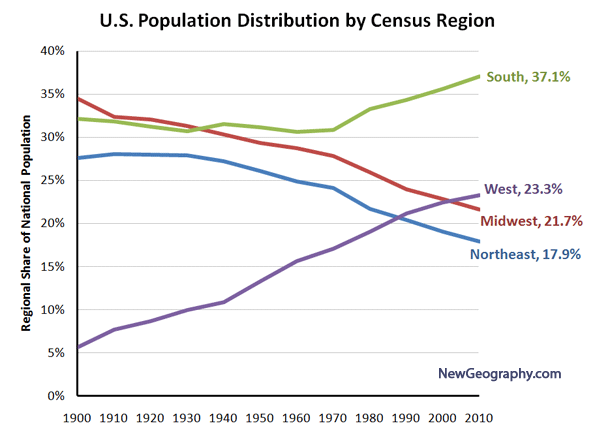
    For a hundred years, Americans have been moving south and west. This, with an occasional hiccup, has continued, according to the 2010 Census.

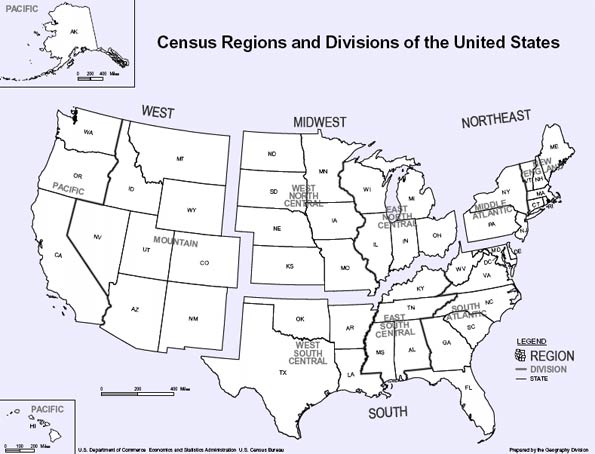
    During the 2000s, 84 percent of the nation’s population growth was in the states of the South and West (see Census region and division map below), while growth has been far slower in the Northeast and Midwest. This follows a pattern now four decades old, in which more than 75 percent of the nation’s population growth has been in the South and West. Indeed in every census period since the 1920s the South and West attracted a majority of the population growth.

    In the first census after World War II, in 1950, the East and the Midwest accounted for 58 percent of the nation’s population, with the South and West making up 42 percent. Since that time, the East and the Midwest have added less than 40 million people, while the South and West added nearly 120 million. Today, the ratios are nearly reversed, with 60 percent of the population living in the South and West and only 40 percent in the East and Midwest.

    The dominance of the South and West was overwhelming. The 24 fastest growing states were all in the South and West. The fastest growing state outside the West and South, surprisingly, was South Dakota, which added a second decade of unprecedented growth, after having gained almost no population between 1930 and 1990.

    Fastest and Slowest Growing States: The fastest growing states were the adjacent Mountain states of Nevada (35.1%), Arizona (24.6%), Utah (23.8%) and Idaho (21.1%). The only large state among the top five growing states was Texas, at 20.1%. These all greatly exceeded the national average growth rate of 9.7%

    Michigan was the only state to lose population (-0.6%) and became the first state in American history to ever exceed 10 million population (earlier in the decade) and then to fall back below that figure. Rhode Island grew only 0.4%. Louisiana grew only 1.4%, which in itself is an accomplishment given the 5 % loss that occurred between 2005 and 2006 after Hurricanes Katrina and Rita. Ohio ranked fourth lowest, gaining only 1.6%. New York continued its laggard performance, gaining only 2.1%. Since the late 1960s, New York (long the largest state) has added little more than one million people, while California added 19 million and has nearly doubled New York’s population.

    California: But all was not well in California. In every 10 year period after the 1920s, California added more people than any other state, until now. Between 2000 and 2010, Texas added 4.1 million people, nearly one million more than California.

    In no decade following the Depression (1930s) has California added so few new residents as in the 2000s. In the 1940s, California’s population rose by 3.7 million, starting from a 1940 base of 6.9 million. During the 2000s, the population increase was 3.4 million, on a 2000 base of 33.8 million.

    California still grew little faster than the national rate (10.0 percent compared to 9.7 percent). Yet this remains the lowest population growth rate for the state since its first Census, in 1850.

    Regional Analysis: The data, both state and regional, that is the basis of the regional analysis below is shown in Tables 1 and 2.

    The South: The South has had the largest share of the nation’s population since the 1940 census and it is now home to nearly 115 million people. The growth has been substantial, with 73 million new residents from 1950 to 2010, expanding 143%, more than twice the national growth rate of 104%. Overall, the South led national growth in the last decade, with a 14.3% rate and adding 14.2 million people. After Texas, the fastest growing states were North Carolina (18.5%), Georgia (18.3%) and Florida (17.6%), which had seen its growth reduced during the housing collapse. South Carolina (15.3%) also grew strongly. Outside of Louisiana, the slowest growth was in West Virginia (2.5%) and Mississippi (4.3%).

    The West: Since 1950, the West has added 58 million people, growing 256%. The West grew the second fastest among the regions, at 13.8% and added 8.7 million residents. As noted above, four of the five fastest growing states were in the Mountain West. In addition, Colorado grew 16.9%.

    The Midwest: Until the emergence of the South in 1940, the Midwest had been the nation’s largest region. Growth has been very slow. Since 1950, the Midwest has added 22.5 million people, but grown only 50 percent, or one-half the national rate of 104 percent. The Midwest had no states that grew above the national rate and had two of the states with the least growth (Michigan and Ohio). Perhaps signaling the rise of the upper Midwest, both North and South Dakota are growing faster than many Eastern or Midwestern states. After decades of population loss, South Dakota experienced unusual growth for the second decade in a row, while North Dakota, grew enough this decade to recover from decades of population loss dating to 1930.

    The Northeast: The nation’s former commercial heartland, the Northeast, has for its third census placed as the nation’s least populated region. A prediction in 1950 that the region housing New York, Philadelphia and Boston would fall so much in relative terms would have been considered absurd. Yet, from 1950 to 2010, the region added 16 million people, for the lowest regional growth rate (40%). The region added less than 2,000,000 population between 2000 and 2010, for a growth rate of 3.2%. The fastest growing state was New Hampshire, at 6.5%, reflecting the growth of its Boston suburbs and exurbs. All other states had growth rates less than one-half of the national rate.

    “Kudos” to the Bureau of the Census: Finally, congratulations are due the Bureau of the Census. In 2000, the Bureau was embarrassed by its under-estimation of the population during the previous decade. At the 1990 to 1999 estimation rate, the 2000 population would have been nearly 7,000,000 below the number of people actually counted in the census. The improvement during the decade of the 2000s was substantial. At the 2000 to 2009 estimate rate, the nation would have had 500,000 more people than were counted in 2010. Missing by less than 0.2 percent is pretty impressive.

    Table 1
    Regional Population: 1950-2010 (Census)
    Division/REGION 1950 1960 1970 1980 1990 2000 2010
    New England 9,314,453 10,509,367 11,841,663 12,348,493 13,206,943 13,922,517 14,444,865
    Middle Atlantic 30,163,533 34,168,452 37,199,040 36,786,790 37,602,286 39,671,861 40,872,375
    NORTHEAST 39,477,986 44,677,819 49,040,703 49,135,283 50,809,229 53,594,378 55,317,240
    East North Central 30,399,368 36,225,024 40,252,476 41,682,217 42,008,942 45,155,037 46,421,564
    West North Central 14,061,394 15,394,115 16,319,187 17,183,453 17,659,690 19,237,739 20,505,437
    MIDWEST 44,460,762 51,619,139 56,571,663 58,865,670 59,668,632 64,392,776 66,927,001
    NORTHEAST & MIDWEST 83,938,748 96,296,958 105,612,366 108,000,953 110,477,861 117,987,154 122,244,241
    Southeast 21,182,335 25,971,732 30,671,337 36,959,123 43,566,853 51,769,160 59,777,037
    East South Central 11,477,181 12,050,126 12,803,470 14,666,423 15,176,284 17,022,810 18,432,505
    West South Central 14,537,572 16,951,255 19,320,560 23,746,816 26,702,793 31,444,850 36,346,202
    SOUTH 47,197,088 54,973,113 62,795,367 75,372,362 85,445,930 100,236,820 114,555,744
    Mountain 5,074,998 6,855,060 8,281,562 11,372,785 13,658,776 18,172,295 22,065,451
    Pacific 15,114,964 21,198,044 26,522,631 31,799,705 39,127,306 45,025,637 49,880,102
    WEST 20,189,962 28,053,104 34,804,193 43,172,490 52,786,082 63,197,932 71,945,553
    SOUTH & WEST 67,387,050 83,026,217 97,599,560 118,544,852 138,232,012 163,434,752 186,501,297
    UNITED STATES 151,325,798 179,323,175 203,211,926 226,545,805 248,709,873 281,421,906 308,745,538


    Table 2              
    States and DC: Population 1950-2010 (Census)  
       
    State 1950 1960 1970 1980 1990 2000 2010
                   
    Alabama 3,061,743 3,266,740 3,444,165 3,893,888 4,040,587 4,447,100 4,779,736
    Alaska 128,643 226,167 300,382 401,851 550,043 626,932 710,231
    Arizona 749,587 1,302,161 1,770,900 2,718,215 3,665,228 5,130,632 6,392,017
    Arkansas 1,909,511 1,786,272 1,923,295 2,286,435 2,350,725 2,673,400 2,915,918
    California 10,586,223 15,717,204 19,953,134 23,667,902 29,760,021 33,871,648 37,253,956
    Colorado 1,325,089 1,753,947 2,207,259 2,889,964 3,294,394 4,301,261 5,029,196
    Connecticut 2,007,280 2,535,234 3,031,709 3,107,576 3,287,116 3,405,565 3,574,097
    Delaware 318,085 446,292 548,104 594,338 666,168 783,600 897,934
    District of Columbia 802,178 763,956 756,510 638,333 606,900 572,059 601,723
    Florida 2,771,305 4,951,560 6,789,443 9,746,324 12,937,926 15,982,378 18,801,310
    Georgia 3,444,578 3,943,116 4,589,575 5,463,105 6,478,216 8,186,453 9,687,653
    Hawaii 499,794 632,772 768,561 964,691 1,108,229 1,211,537 1,360,301
    Idaho 588,637 667,191 712,567 943,935 1,006,749 1,293,953 1,567,582
    Illinois 8,712,176 10,081,158 11,113,976 11,426,518 11,430,602 12,419,293 12,830,632
    Indiana 3,934,224 4,662,498 5,193,669 5,490,224 5,544,159 6,080,485 6,483,802
    Iowa 2,621,073 2,757,537 2,824,376 2,913,808 2,776,755 2,926,324 3,046,355
    Kansas 1,905,299 2,178,611 2,246,578 2,363,679 2,477,574 2,688,418 2,853,118
    Kentucky 2,944,806 3,038,156 3,218,706 3,660,777 3,685,296 4,041,769 4,339,367
    Louisiana 2,683,516 3,257,022 3,641,306 4,205,900 4,219,973 4,468,976 4,533,372
    Maine 913,774 969,265 992,048 1,124,660 1,227,928 1,274,923 1,328,361
    Maryland 2,343,001 3,100,689 3,922,399 4,216,975 4,781,468 5,296,486 5,773,552
    Massachusetts 4,690,514 5,148,578 5,689,170 5,737,037 6,016,425 6,349,097 6,547,629
    Michigan 6,371,766 7,823,194 8,875,083 9,262,078 9,295,297 9,938,444 9,883,640
    Minnesota 2,982,483 3,413,864 3,804,971 4,075,970 4,375,099 4,919,479 5,303,925
    Mississippi 2,178,914 2,178,141 2,216,912 2,520,638 2,573,216 2,844,658 2,967,297
    Missouri 3,954,653 4,319,813 4,676,501 4,916,686 5,117,073 5,595,211 5,988,927
    Montana 591,024 674,767 694,409 786,690 799,065 902,195 989,415
    Nebraska 1,325,510 1,411,330 1,483,493 1,569,825 1,578,385 1,711,263 1,826,341
    Nevada 160,083 285,278 488,738 800,493 1,201,833 1,998,257 2,700,551
    New Hampshire 533,242 606,921 737,681 920,610 1,109,252 1,235,786 1,316,470
    New Jersey 4,835,329 6,066,782 7,168,164 7,364,823 7,730,188 8,414,350 8,791,894
    New Mexico 681,187 951,023 1,016,000 1,302,894 1,515,069 1,819,046 2,059,179
    New York 14,830,192 16,782,304 18,236,967 17,558,072 17,990,455 18,976,457 19,378,102
    North Carolina 4,061,929 4,556,155 5,082,059 5,881,766 6,628,637 8,049,313 9,535,483
    North Dakota 619,636 632,446 617,761 652,717 638,800 642,200 672,591
    Ohio 7,946,627 9,706,397 10,652,017 10,797,630 10,847,115 11,353,140 11,536,504
    Oklahoma 2,233,351 2,328,284 2,559,229 3,025,290 3,145,585 3,450,654 3,751,351
    Oregon 1,521,341 1,768,687 2,091,385 2,633,105 2,842,321 3,421,399 3,831,074
    Pennsylvania 10,498,012 11,319,366 11,793,909 11,863,895 11,881,643 12,281,054 12,702,379
    Rhode Island 791,896 859,488 946,725 947,154 1,003,464 1,048,319 1,052,567
    South Carolina 2,117,027 2,382,594 2,590,516 3,121,820 3,486,703 4,012,012 4,625,364
    South Dakota 652,740 680,514 665,507 690,768 696,004 754,844 814,180
    Tennessee 3,291,718 3,567,089 3,923,687 4,591,120 4,877,185 5,689,283 6,346,105
    Texas 7,711,194 9,579,677 11,196,730 14,229,191 16,986,510 20,851,820 25,145,561
    Utah 688,862 890,627 1,059,273 1,461,037 1,722,850 2,233,169 2,763,885
    Vermont 377,747 389,881 444,330 511,456 562,758 608,827 625,741
    Virginia 3,318,680 3,966,949 4,648,494 5,346,818 6,187,358 7,078,515 8,001,024
    Washington 2,378,963 2,853,214 3,409,169 4,132,156 4,866,692 5,894,121 6,724,540
    West Virginia 2,005,552 1,860,421 1,744,237 1,949,644 1,793,477 1,808,344 1,852,994
    Wisconsin 3,434,575 3,951,777 4,417,731 4,705,767 4,891,769 5,363,675 5,686,986
    Wyoming 290,529 330,066 332,416 469,557 453,588 493,782 563,626
                   
    United States 151,325,798 179,323,175 203,211,926 226,545,805 248,709,873 281,421,906 308,745,538

    Wendell Cox is a Visiting Professor, Conservatoire National des Arts et Metiers, Paris and the author of “War on the Dream: How Anti-Sprawl Policy Threatens the Quality of Life

    Photo by Travelin’ Librarian – Michael Sauers

  • Belly-Up In The Burbs: Bank-Owned Developments

    In 2009, the number of repossessed autos increased to 1.9 million. The number of homes under foreclosure varies from month to month, but the 2009 total was about 2.8 million. For 2010, it seems that a million new foreclosed homes would be conservative, with a large percentage in California. Miss a few payments on an auto loan and you may wake up to an empty driveway. On the other hand, repossession of your home is a long drawn out process.

    What kinds of communities have been hardest hit with foreclosures? Tom Cusack, a retired federal housing manager in Portland, tracks the issue via his Oregon Housing Blog. This summer, he was quoted in the Portland Tribune, saying “The foreclosure activity that is occurring in suburban markets in Oregon is unprecedented. It’s affecting not just rural areas, not just inner-city neighborhoods, but suburban neighborhoods, probably more substantially than any time in the past.”

    Daniel Ommergluck of Georgia Tech also studied this situation. His findings, he says, contradict “…some suggestions that the crises was primarily centered in suburban or exurban communities.” It concluded, “The intrametropolitan location of a zip code appears to have been a less important factor in REO (real estate owned) growth than the fact that a large amount of development in newer communities was financed during the subprime boom.”

    Decades ago, a young couple would have had to save for many years to accumulate the considerable down-payment to buy their first home, and the prospect of losing that home to foreclosure would have been devastating. With the more recent “easy financing,” though, there has been little to risk. The low effort to move into that new housing development has meant less “emotional” investment. When home prices escalated beyond reason in the years prior to the crash, it left many home buyers over-exposed, specifically because of the easy mortgages.

    The local economy also determines which suburbs suffer the most. Certainly homes in prosperous Houston or San Antonio that did not ride the absurd price increases fared much better than Detroit, with its bleak employment picture, where homes are imploding in value.

    Historically, the U.S. suburban home buying market is somewhere between 70% and 80% higher volume than the urban market. In other words, for every ten homes sold, seven or eight of them are likely to be suburban. So, it would stand to reason that the foreclosure crisis would be focused in the suburbs. Yet suburban vs. urban data on the subject is scarce.

    It’s probably more reasonable to assume that the local employment situation would have a larger effect than whether a community is urban or suburban. For example, when the Ford Plant in urban St. Paul closes, there will be 750 employees out of work and at risk of eventual foreclosure if the job market remains depressed. The residential area abutting the Ford plant is actually very nice, suggesting that many of the workers might live in the nearby city, not in the suburbs. Several miles from the Ford Plant is the suburb of Eagan where Lockeed Martin will close down their operation and put some 400 highly paid people out of work. These newly unemployed workers also may ultimately end up with their homes in foreclosure if they cannot gain highly paid employment elsewhere. Thus suburban vs. urban foreclosures are related to a very localized economy.

    There is, however, a greater menace to the suburbs than home foreclosures. It is when an entire development is foreclosed and becomes bank owned. Since the urban foreclosure is likely on a home that has been sold many times since the development — let’s call it ‘Jones Addition’ — was first built in 1925, the developer going broke is meaningless to the urban dweller.

    However, when ‘Jones Acres’ in Pleasantville was opened just five years ago, and phase one sold out with the beginning of phase two of 12 phases just started at the time of the crash, a very different and dangerous scenario arises. You see, Jones Acres is comprised of 500 lots. Of those, perhaps 40 were purchased by new suburban home buyers trusting that the amenities would be built as planned and promised.

    When President Bush announced that we had a 700 billion dollar problem and needed to bail out the banks, those same financial institutions essentially called the loans, which closed down much (probably most) of the nation’s developers. Land was no longer secure, and the development repossessions began. Without the banks funding, developers could not afford to properly maintain the grounds, associations failed, and eventually the banks were the new owners.

    Here in Minnesota, I know of few suburban developments that have not been foreclosed on. This would seem to be a greater threat to the future of the suburbs than individual homes being lost. Yet very little attention has been paid to the volume of bank owned developments. Much of the suburban land was purchased under contracts to farmers that took the land in phases. If a major builder committed to taking down the 500 lots in Jones Acres, and placed a million dollars in initial money ($2,000 a lot for the land), and after 40 lots decided to walk away, it left the farmer holding the land now likely taxed much higher and in danger of foreclosure. It made sense in many scenarios for the major builder to walk away and lose its lot deposits. Later on, if the development failed and the bank needed to unload the property, another major builder might be able to pick up the lots at 10 cents on the dollar, and just sit on the property for years until the housing market starts to recover.

    Since the recession began, a group of us approached banks with an offer to review the approved plans and re-plan some idle developments more efficiently and sustainably. This state of limbo would have been an excellent time to redesign the land into a much more sustainable (and profitable) product with little outlay from the financial institution. We could not find a single bank that was interested in adding value.

    Often the initial developer imagines the details of a neighborhood: the amenities, the architecture, the landscaping, and the marketing. What happens when a bank takes over? The banker most likely lacks this forward vision, and sells the development later to a buyer who offered 1/10th of the initial land cost for an approved platted development. Bah humbug, this buyer says, who needs a front porch, parks are for drug dealers, and if streets were meant to have trees, then the lord would have planted them there! The result is a highly visible, low value community.

    Cities approve developments based upon relationships. The recession eradicated so many promises that may now never be realized. Foreclosed homes in the cities or in the suburbs are less of a problem than foreclosed developments… and in this case, the suburbs lose – big time!

    Photo by Sean Dreilinger: One of two adjacent bank owned homes.

    Rick Harrison is President of Rick Harrison Site Design Studio and Neighborhood Innovations, LLC. He is author of Prefurbia: Reinventing The Suburbs From Disdainable To Sustainable and creator of Performance Planning System. His websites are rhsdplanning.com and performanceplanningsystem.com.

  • Hasta La Vista, Failure

    In his headier and hunkier days, Arnold Schwarzenegger spoke boldly about how “failure is not an option.” This kind of bravado worked well in the gym–and in a remarkable career that saw an inarticulate Austrian body-builder rise to the apex of Hollywood and California politics.

    But Schwarzenegger’s soon-to-be-ended seven-year reign as California’s governor can be best described in just that one simple world: failure.  It has been so bad that one even looks forward to having a pro, the eccentric Machiavellian master, Jerry Brown, replace him.

    Schwarzenegger never grew beyond the role of a clueless political narcissist. As the state sank into an ever deeper fiscal crisis, he continued to expend his energy on the grandiose and beyond the point: establishing a Californian policy for combating climate change, boosting an unaffordable High-Speed Rail system, and even eliminating plastic bags. These may be great issues of import, but they are far less pressing than a state’s descent into insolvency.

    The Terminator came into office ostensibly to reform California politics, reduce taxation and “blow up the boxes” of the state’s bureaucracy. He failed on all three counts. The California political system–particularly after the GOP’s November Golden State wipeout–is, if anything, more dominated by public employee unions and special interests (including “green” venture capitalists) than when Gray Davis ruled. Taxes, despite efforts by members of Schwarzenegger’s own Republican Party, have steadily increased, mostly in the form of sales and other regressive taxes. The bureaucracy, with its huge pension costs,  continued to swell until this year even as state unemployment climbed well over double digits.

    Schwarzenegger’s fiscal street cred was undermined by his support for unessential new bond issues for such things as stem cell research and high-speed rail. He threw financial prudence out the window in order to appease his business cronies and faithful media claque, particularly those working for mainstream eastern media.

    Looking back, it seems difficult to remember that Schwarzenegger’s election initially thrilled the business community, who saw him as a counterweight to the dominant axis of unions and green zealots. “An army of entrepreneurs,” as I wrote around the 2003 recall, rallied around a self-made man who seemed to understand the challenges of running a business.

    In the end Schwarzennegger failed these California optimists miserably. He ignored the impending crash of the state’s real-estate-driven “boom” and instead waxed lyrical on California as “the new Athens and Sparta,” destined to lead not only the nation but the world “into the future.” Sadly, a more apt classical analogy might be Carthage–except the burning and salting of the California has been committed by its own leaders.

    Today few governors, much less foreign leaders, would regard California’s government as anything other than a cautionary tale in colossal mismanagement. Many others, particularly newly elected Republican governors, regard the state’s persistent mismanagement as a mega opportunity for poaching jobs and companies  for the benefit of their constituents.

    At the heart of the Terminator’s failure lies the politics of delusion, perhaps not surprising for someone whose greatest success was based on fantasy.  Traditionally California Republican governors focus on the hoary economic fundamentals. But Schwarzenegger’s main economic advisor, San Francisco investment banker David Crane, has clung to the notion that California’s creative skills would allow the state to flourish amid “creative destruction.”

    This delusion has failed to materialize. Silicon Valley’s venture capitalists, the much celebrated architects for a creative revival, increasingly seem a spent force, investing fewer funds with less success than a decade ago.  2009 saw fewer new venture fund financing than in any year since 2003, while actual dollars raised have been dropping since the late 1990s.

    And for all their self-importance, the venture capitalists are hardly the game-changing visionaries of the past; instead, they seek federal subsidies or back social networking start-ups that provide far less  in the way of employment prospects than legendary successes like Intel or Apple. The Google-Facebook economy has wowed the business media, but their direct  impact on jobs is largely concentrated  in a few affluent areas around Palo Alto and parts of San Francisco. Despite the celebrations of these companies, much of the more decidedly middle-class parts of the Valley remain in a deep recession, with over 15 empire state buildings worth of empty space.

    Of course, apologists point out, quite correctly, that many signature corporations are keeping their headquarters in the Golden State–after all not many CEOs are anxious  to leave the climatically blessed environs of Atherton, Palo Alto, San Diego or West Los Angeles for a new life in  Salt Lake, Shanghai or even Austin.  But these same CEOs are shifting manufacturing, tech support and. increasingly. research at a rapid clip to places with lower taxes, more accommodating business climates and a better chance for the non-filty-rich to live a good life.

    This slow but steady leakage is draining the state economy. California’s share of the nation’s jobs and national income continues to drop.  In the last seven years, California has underperformed the nation in generating both middle-income and tech-oriented jobs. Unemployment has remained two points or more higher than the national average.

    The draconian greenhouse gas reductions now proudly touted by Schwarzenegger could make this worse. If the nation was following similar regulations, something conceivable prior to the November elections, the pain may have been more equally shared and an aggressive stategy aimed at “green” industries could more likely have proved  a decent bet. Now companies in California and a handful of other similarly minded states simply will have to cope with regulatory overkill and much higher energy costs against   competitors domestically and around the world.

    The production sector, the most vulnerable target of the green machine, is already reeling. Manufacturing losses, over 32% since 2001, have remained well above the national average–with a toll of over 600,000 jobs .  Over the last three years the state ranked dead last among the nation’s 25 largest states in terms of adding new manufacturing capacity.

    This, of course, has had little impact on those who inhabit the upper echelons of Hollywood or Silicon Valley. Arnold’s failure has been toughest on California’s working and middle classes, the very people who once saw in him a savior.

    Now, in an act of what seems like desperation, Californians have brought back that quirky dinosaur, Jerry Brown, who at least one can never call either stupid or naive. Brown’s campaign scored well by linking his amateurish opponent, Meg Whitman, to Arnold’s patent lack of political savvy. Brown recognized that  Schwarzenegger had done a great job in discrediting both himself and the state GOP. The  Terminator, who once enjoyed a 65%  approval rating,  suffers the  lowest popularity rating of any California governor in the past 50 years –a dismal 22%, according to the latest Field Poll.

    Six in ten Californians now think Schwarzennger is leaving the state in worse shape than he found it, and they are right.  So what do you call a star who has lost the admiration and support of his fans? There’s just one word in this script: failure.

    This article originally appeared at Forbes.com

    Joel Kotkin is executive editor of NewGeography.com and is a distinguished presidential fellow in urban futures at Chapman University. He is author of The City: A Global History. His newest book is The Next Hundred Million: America in 2050, released in February, 2010.

    Photo by Nate Mandos

  • If California Is Doing So Great, Why Are So Many Leaving?

    Superficially at least, California’s problems are well known. Are they well understood? Apparently not.

    About a year ago Time ran an article, “Why California is Still America’s future,” touting California’s future, a future that includes gold-rush-like prosperity in an environmentally pure little piece of heaven, brought to us by “public-sector foresight.”

    More recently, Brett Arends’ piece at Market Watch, “The Truth About California,” is more of the same. California’s governor elect, Jerry Brown, liked this piece so much that he tweeted a link to it.

    The optimist’s argument about California’s future ultimately hinges on the creativity of the state’s vaunted tech sector, in large part driven by regulation promulgated by an enlightened political class and funded by a powerful venture capital sector.

    No fundamentalist evangelical speaks with more conviction or faith than a California cheerleader expounding on the economic benefits of environmental purity brought about by command and control regulation.

    The more honest cheerleaders acknowledge that California has challenges, including persistent budget problems. Arends denies even the existence of a budget problem, demanding “Er, no, actually. It’s your assertion. You do the math.” Let me help you, Brett. The non-partisan California Legislative Analyst’s Office has done the math. You can find it here. They expect budget shortfalls in excess of $20 billion a year throughout their forecast horizon. This is on annual revenues of less than $100 billion.

    Last week the numbers got even worse, as the Governor-elect, Jerry Brown, acknowledged. The deficit may now be as much as $28 billion this year, and over $20 billion for the foreseeable future. This is more than a nuisance. There’s a reason, after all, why California has among the worst credit ratings of any state.

    Most people outside of California haven’t drank from this vat of the economic equivalent of LSD-laced Kool-Aid. People know that a state is in trouble when it has persistent intractable budget deficits, chronic domestic net out-migration, and 30 percent higher unemployment than the national average. Indeed, California’s joblessness, chronic budget deficits, governors, and credit rating have made the state the butt of jokes worldwide.

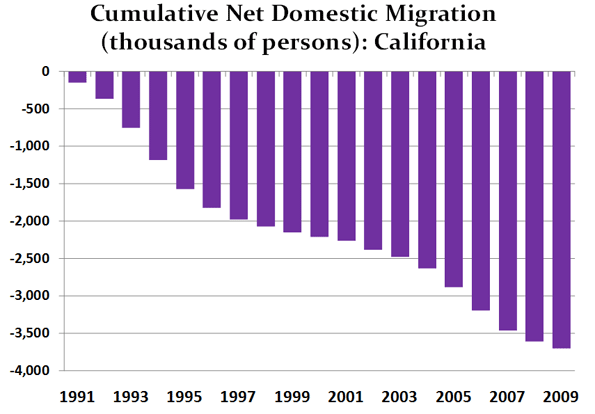
    How bad are things in California? California’s domestic migration has been negative every year since at least 1990. In fact, since 1990, according to the U.S. Census, 3,642,490 people, net, have left California. If they were in one city, it would be the third largest city in America, with a population 800,000 more than Chicago and within 200,000 of Los Angeles’ population.

    We’re seeing a reversal of the depression-era migration from the Dust Bowl to California. While California has seen 3.6 million people leave, Texas has received over 1.4 million domestic migrants. Even Oklahoma and Arkansas have had net-positive domestic migration trends from California.

    Those ultimate canaries in the coal mine, illegal immigrants, recognize California’s problems. Twenty years ago, about half of all United States illegal immigrants went to California. Today, that’s down to about one in four.

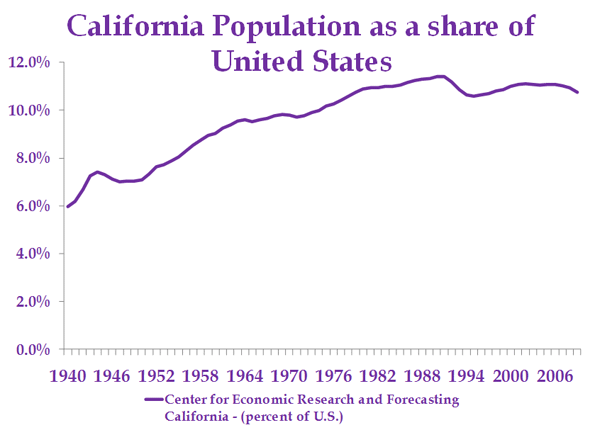
    The result of these migration trends is that California’s share of the United States population has been declining.

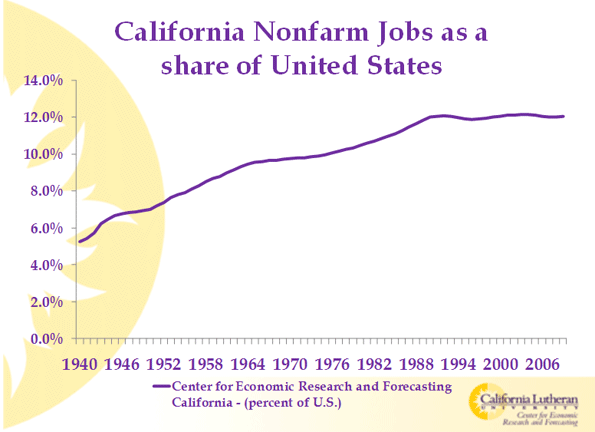
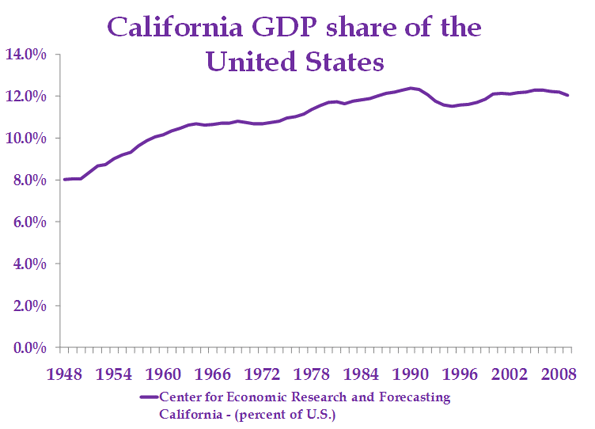
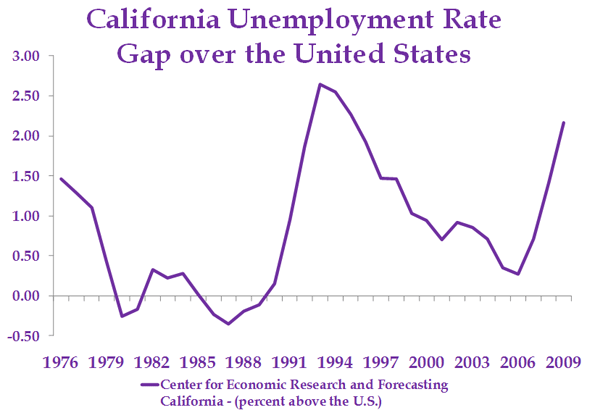
    What do these migrants see that so many of California’s political class do not see? They see a lack of opportunity. California’s share of United States jobs and output has declined since 1990, and its unemployment rate has remained persistently above the United States Average, only approaching the average during the housing boom.

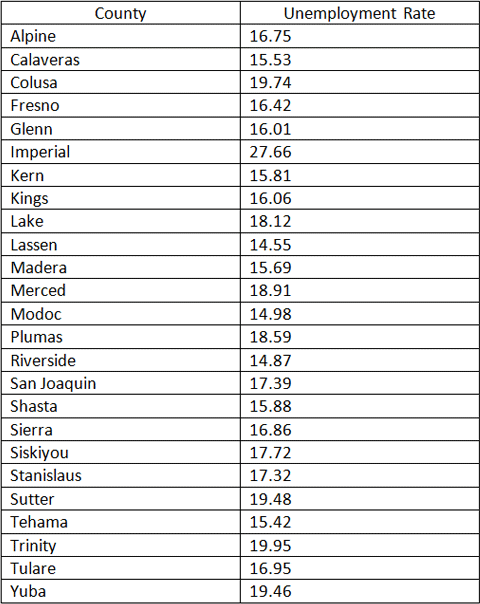
    California’s unemployment is particularly troubling. As of October 2010, only two states, Nevada at 14.2 percent and Michigan at 12.8 percent, had higher unemployment rates than California’s 12.4 percent. California’s unemployment problem is particularly severe in its more rural counties. Twenty-five of California’s 58 counties have unemployment rates higher than Nevada’s:


    These unemployment rates approach depression levels. Some will excuse many of them because they are in agricultural areas, but many assert that low Midwest unemployment rates are due to a booming agricultural sector. Which one is it?

    California’s unemployment problems are not limited to rural and agricultural areas. Most of Riverside County’s population is very urban, yet the County’s unemployment rate is 14.87 percent. On December 7th, the Wall Street Journal listed the unemployment rates for 49 of America’s largest urban regions. California had six of the 19 metro areas with double-digit unemployment. These include such major cities San Diego, San Jose, and Los Angeles.

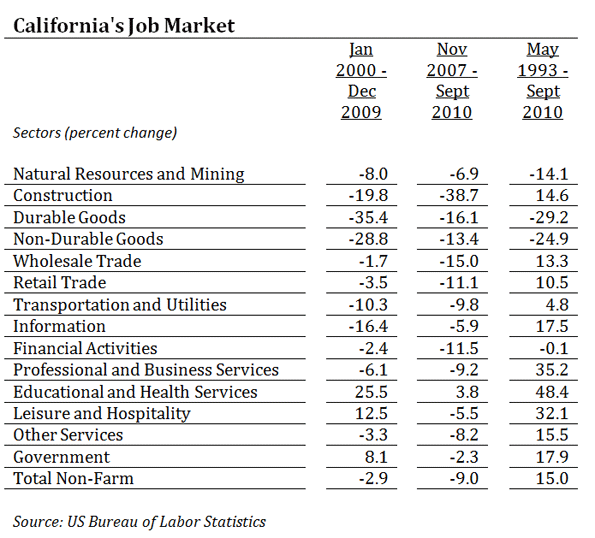
    Just as rural areas are not California’s only depressed areas, agriculture is not California’s only ailing sector. From 2000 to 2009, the only California sectors to gain jobs were government, education and health services, and leisure and hospitality.

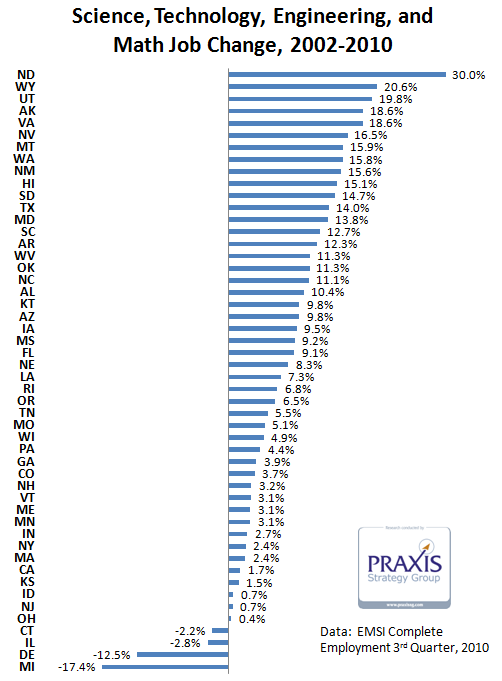
    California’s cheerleaders claim that the state’s future is assured by a vibrant tech sector, but the data do not support that assertion. North Dakota’s Praxis Strategy Group has performed analysis by job skills. They compare Scientific, Technical, Engineering, and Math (STEM) jobs across states. Their analysis shows that California is the Nation’s ninth worst state in creating STEM jobs in post dot-com-bust years. It has produced far fewer new tech jobs than Texas, and far less on average, than the country over the past decade:


    In this respect, California’s precipitous decline is really quite shocking. In just a couple of decades, California has gone from being America’s economic star, a destination for ambitious people from around the world and abundant with opportunity, to home of some of America’s most distressed communities. It has been a man-made, slow motion tragedy perpetuated by a political class that is largely deluded.

    The cheerleader’s faith in command and control regulation and environmental purity is so strong they cannot see anything that contradicts that faith.

    But that faith is misplaced. Joel Kotkin, Zina Klapper, and I performed an extensive review of the economic impacts of one of California’s most important greenhouse gas regulation, AB 32, and found that command and control regulation in general and AB 32 in particular is inefficient, cost jobs, and depress economic activity. California’s Legislative Analyst’s Office agrees, as evidenced by this report.

    More depressing still are the growing ranks of what could be called “the resigned”. They simply have given up. These include a business leadership that is more interested in survival and accommodation than pushing an agenda for growth. Easier to get along here, and expand jobs and opportunities elsewhere, whether in other states or overseas.

    Yet ultimately California’s future is what Californians make of it. No place on Earth has more natural amenities or a more benevolent climate. No place has a location more amenable to prosperity, located between thriving Pacific Rim economies and the entire North American market. No place has more economic potential.

    But unless policy is changed, California’s future is dismal, with the specter of stubbornly high unemployment, limited opportunity, and the continued exodus of the middle class. California’s political class needs first to confront reality before we can hope to avoid a dismal future.

    Bill Watkins is a professor at California Lutheran University and runs the Center for Economic Research and Forecasting, which can be found at clucerf.org.

    Photo by Stuck in Customs