Tag: California

  • Building the Train to Nowhere

    The California High Speed Rail Authority has approved building its first 54 miles in the San Joaquin Valley. A somewhat longer route, 65 miles, has been indicated in a number of press reports, but Authority documents indicate that only 54 miles of high speed rail track will be built. The route would start in Corcoran, and go through Fresno to Borden, a small, unincorporated community south of Madera. All of this would cost $4.15 billion. The route would include two stations, in Fresno and Hanford/Visalia.

    The segment was adopted under pressure by the United States Department of Transportation, which was interested in ensuring that the line would be usable (have “independent utility”) by Amtrak should the high speed rail project be cancelled due to lack of funds. The first section of the California high speed rail line would instead be a somewhat incongruously high-tech Corcoran to Borden spur, or perhaps more accurately stub to the region’s rather sparse conventional rail services.

    There are appear to have been concerns that growing opposition movements in the San Francisco and Los Angeles areas could have delayed construction, which could have put the federal money at risk. The Sacramento Bee’s Dan Walters, perhaps the leading political columnist in the state implied an ulterior motive:

    “You’d have to be terminally naive not to believe that the splashy announcement, made personally by an Obama administration official in Fresno, was to help an embattled local congressman, Democrat Jim Costa, stave off a very stiff Republican challenge.”

    Officials representing communities – many of them with high levels of unemployment – on the segment itself were elated, as any would be at the prospect of a rush of new construction jobs, regardless of what was being built. But, most everywhere else the reaction to the selection largely has been negative. Walters labeled it the “train to nowhere” in a November 29 commentary. State Senator Alan Lowenthal, who chairs the legislative committee overseeing the high speed rail project said that the Authority “could be creating an ‘orphan’ stretch of track, that will never be used by high-speed trains.”

    Richard Tolmach, president of the California Rail Foundation, an intercity rail advocacy organization, told Authority members ” It’s a crazy idea. He went on to say that “You guys are gonna be a laughingstock in Congress.”

    Already, problems are building in the now more decidedly more conservative Congress. California Republican Congressman Jerry Lewis and 27 colleagues have introduced the “American Recovery and Reinvestment Rescission Act,” which would apply unspent stimulus money to the deficit, including $2 billion that has been promised to the California high speed rail line.

    Batteries (and Trains) Not Included: Even after the $4.15 billion has been spent, the Corcoran to Borden rail stub will be incomplete. The Authority’s plan includes only the building of the rail bed and the necessary viaducts. There is no money for trains. There is no money for the electrical infrastructure necessary to power the trains. Trains and electricity infrastructure would add at least 15 percent to the bill, based upon previous California High Speed Rail reports. Thus, when and if completed, the trains and electrification would lift the cost of the Corcoran to Borden high speed rail stub to at least $4.8 billion.

    Bare Bones Stations: The plan calls for building only “basic” stations, with two tracks (one in each direction). That is fine if the line is serving Amtrak and there are only a few trains per day. But the high speed rail plan assumes frequent trains, including some that stop at all stations, some express trains that skip some stations and some express trains running non-stop from the Transbay Terminal in San Francisco to Union Station in Los Angeles. The only place that an express train can pass a slower train is at a station. That means that passing tracks must be built at virtually all stations. The passing tracks (two interior tracks in addition to the two tracks for stopped trains) required in stations are illustrated in this California High Speed Rail illustration (also above).

    The full system, or (perhaps the more likely outcome) a truncated San Jose to Palmdale line (with slower running lines over the commuter rail tracks into San Francisco and Los Angeles), would require passing tracks at the Fresno and Hanford/Visalia stations. Rebuilding these stations would increase the cost above the $4.8 billion, and that’s before the seemingly inevitable cost escalation.

    Indeed, the Corcoran to Borden stub entails a potentially large cost increase compared to previous California High Speed Rail Authority documents. After making all of the necessary adjustments to update the last available segment costs to the cost accounting method (“year of expenditure” dollars), the cost of the Corcoran to Borden stub could be at least 30 percent higher than would have been expected in the present $43 billion San Francisco to Anaheim cost.

    Applied to the entire line, a 30 percent cost escalation could take the price of the San Francisco to Anaheim line to more than $55 billion. Based upon cost ratios released by the Authority in 2008, the later extensions to Sacramento and San Diego would lift the bill to more than staggering $80 billion. Even that does not pay the entire bill, because promises have been made in state legislation for improvements across Altamont pass from Stockton to the East Bay and Oakland.

    Not that coming up with any of this money will be easy, particularly with a more deficit conscious Congress. Congressman John Mica of Florida, who will likely lead the House of Representatives Transportation and Infrastructure Committee has promised a review of all federal high speed rail grants. The Authority expects to obtain funding from local governments in California, a number of which are teetering toward financial insolvency.

    The Authority expects between $10 and $12 billion from private investors. These potential investors will all be aware of the fact that virtually every dollar of private investment in new high-speed rail lines has been lost or required a government bailout. They will not participate without subsidies, which are prohibited by California law. Finally, all these elements of the financing plan will be made even more problematic if the first phase of the project continues to rise from $43 billion to $55 billion.

    Washington analyst C. Kenneth Orski noted that the Corcoran to Borden stub could “become a huge embarrassment for the Administration” and that by its train to nowhere ”casts doubt on the soundness of the entire federal high-speed rail program and its decision-making process.”

    Then, even if California gets to keep the federal money, there are still formidable financial barriers. A likely result is high speed rail in Amtrak mode which probably won’t make much difference to passengers riding the infrequent San Joaquin service. After the Authority action, Bill Bronte, who heads the rail division of the California Department of Transportation said that “The improvements in performance might be less than one would expect.” But that might not bother contractors and consultants who can feast on what might prove to be the most expensive conventional intercity train project in history.

    Wendell Cox is a Visiting Professor, Conservatoire National des Arts et Metiers, Paris and the author of “War on the Dream: How Anti-Sprawl Policy Threatens the Quality of Life

  • Education Wars: The New Battle For Brains

    The end of stimulus — as well as the power shift in Congress — will have a profound effect on which regions and states can position themselves for the longer-term recovery. Nowhere will this be more critical than in the battle for brains.

    In the past, and the present, places have competed for smart, high-skilled newcomers by building impressive physical infrastructure and offering incentives and inducements for companies or individuals. But the battle for the brains — and for long-term growth — is increasingly tied to whether a state can maintain or expand its state-supported higher education. This is particularly critical given the growing student debt crisis, which may make public institutions even more attractive to top students.

    The great role model for higher-education-driven growth has been California. The Golden State’s master plan for education — developed under Pat Brown in 1960 — created an elaborate multi-tiered public system that offered students a low-cost and generally high-quality alternative education. Over the next half century, California became, in historian Kevin Starr’s phrase, a “utopia for higher education,” as well as a model for other states and much of the world.

    Today many of the states that copied California’s model — notably North Carolina, Texas and Virginia- — threaten to upend the Golden State’s dominance of public higher education. These states now all spend far more than traditional leader California when you look at percentage of state expenditures; Virginia, for example, spends twice as much of its state budget on higher ed than California does. New York and Illinois spend an even a smaller percentage.

    The combination of fiscal woes and misplaced priorities has engendered spending cuts in California. Tuitions for higher public education have soared: In 2009 they were raised 30%, and they have been raised over 100% over the past decade.

    To be sure, the University of California (disclaimer: I attended the Berkeley campus) retains a huge reservoir of talent, with courses taught by 111 Nobel Laureates. It still dominates lists of top public universities;  six of the top 14 schools in the US News and World Report 2010 rankings are UC schools.  But the signs of relative decline are clear. In 2004, for example, the London-based Times Higher Education ranked UC Berkeley the second leading research university in the world, just behind Harvard; in 2009, that ranking, due largely to an expanding student-to-faculty ratio, had tumbled to 39th place.

    Other states are now looking to knock California further off its perch. In 2009 alone the University of Texas lured three senior faculty members from UC. As departments shrink at places like Berkeley, those in schools such as the University of Texas at Austin, Texas A&M and Texas Tech have expanded rapidly, adding students and buildings.

    Of course, these schools also have budget problems, and they have increased tuition too–albeit at a significantly lower rate. But for the most part, these up-and-coming state systems are more focused on expansion than on retrenching and survival. While some in California question the viability of some of the newer UC campuses, Texas is busily expanding its roster of tier-one, public research universities, seeking to add the University of Houston as well as UT campuses in north Texas, Arlington, Dallas, El Paso and San Antonio to the ranks of UT Austin, Texas A&M and Rice, a private school in Houston.

    Texas Tech,  best known for its engineering and agriculture-oriented programs, for example, is thriving. Located on the windy Great Plains on the western side of the state, it is far from the state’s major metropolitan areas, and its home town of Lubbock (population: 225,000) is likely not high on anyone’s list of hip and cool college towns. Yet the school, which enjoys strong alumni and business support, is in the midst of a major building boom and a $1 billion capital campaign. When I visited there earlier this month, the campus was full of construction crews; Texas Tech has added over 3000 students in the past two years and now has over 31,000 students.

    Other unlikely upstarts include the University of North Dakota, which has boosted spending by 18.5% in 2009, a luxury afforded by the state’s booming energy, agriculture and increasingly high-tech economy. North Dakota, which historically has suffered significant loss of young talent, has set a goal to rank No. 1 in the average education of its population. Today it already ranks No. 3 in terms of college-educated residents between the ages of 25 and 34.

    These shifts could presage — and to some degree enhance — what is already a powerful trend toward states that, in the past, have been educational also-rans. Although Texas also faces budgetary constraints, its annualized $9 billion deficit is dwarfed by those of California, Illinois and New York. And those bluish states already have much higher tax rates, which leave less room for revenue increases. Texas also has the luxury of an $8.2 billion “rainy day” fund, as well as a more vibrant economy.

    More important still, states like North Carolina, Virginia and Texas continue to grow more rapidly than the older brain-center states. This is particularly true in terms of the high-tech jobs many graduates would likely seek.  Indeed since 2002 these states have all enjoyed far greater growth rates in high-tech employment than California, Illinois, Michigan or New York. They also have added more new tech jobs in actual numbers than California–despite their significantly smaller size.

    Migration patterns are also changing among college-educated workers. Between 2005 and 2007, Texas, Virginia and North Carolina already enjoy higher rates per capita of net migration of educated workers between the ages of 22 and 39 than California, New York or Massachusetts.

    This advantage could expand as the upcoming states increase their educational offerings along with employment opportunities. Students may end up tempted to attend schools closer to where there is job growth. Unlike Austin and Raleigh-Durham, which have rapidly expanded tech employment, Silicon Valley has produced virtually no new net tech jobs for the past decade.

    The second impact may  be more subtle, as declining revenues from businesses and individuals reduces the opportunity to boost education spending. As the country stumbles into this recovery, the greatest advantage will fall not only to states with the most natural resources, but those with the best-educated human resources. For a half century this is a game that states like California have played to perfection, but it is one in which other places are likely to catch up, and perhaps even pass. The long-term implications for the nation’s economic geography could prove profound.

    Joel Kotkin is executive editor of NewGeography.com and is a distinguished presidential fellow in urban futures at Chapman University. He is author of The City: A Global History. His newest book is The Next Hundred Million: America in 2050, released in February, 2010.

    Photo by Luca Zappa

  • I Opt-out of California

    Like the harried traveler who made famous the expression, “Don’t touch my junk”, I have elected my own personal protest, California style. I have decided to OPT-OUT of California to protest my overgrown state government. I am tired of California legislators sticking their hands in my pants to pay for the European style social welfare state they have created. My work, my earnings and my taxes will go elsewhere.

    I am one of those evil “high-earners” in California with income over $200,000 per year. It is unimportant to state legislators that we high-earners pay most of California’s taxes. According to the Franchise Tax Board, in 2007 more than 87 percent of California capital gains taxes came from taxpayers with adjusted incomes of more than $200,000. Residents with incomes over $200,000 pay 66 percent of its income taxes even though earn just 39 percent of the state’s income. More important to California’s future, most of us are small businesses, which account for 65 percent of new job growth in the state.

    When I moved to California in 1981, California was truly the Golden State. Its budget revenues of $22.1 billion levied just $920 per person from its population of 24 million. It had great freeways, great schools and its inexpensive college/university system was the envy of the planet. By 2009, the budget revenues had grown to $86 billion, or $2,324 per person from each of its 37 million residents. But California has a $25.4 billion deficit, which means the aging “movement” activists who govern this state are spending $114 billion or $3,081 per resident. Spending is up 520% from 1981.

    The $86 billion in revenues California collected from capital gains and income taxes is not the only tax that has increased. Despite Prop 13 that capped property taxes at 1%, property taxes expanded from $6.36 billion from 1980-1981 to $43.16 billion in 2006-2007, an increase of 579%. For point of reference the CPI index increased just 133%, from 88 in 1980-1981 to 202.4 in 2006-2007.

    The Legislative Analyst’s Office says California will have an additional $6.1 billion shortfall in the current fiscal year reaching $25.4 billion next year. Legislative Analyst Mac Taylor says the state faces deficits of $20 billion each year through 2015.

    “Unless plans are put in place to begin tackling the ongoing budget problem, it will continue to be difficult for the state to address fundamental public-sector goals — such as rebuilding aging infrastructure, addressing massive retirement liabilities, maintaining service levels of high-priority government programs and improving the state’s tax system,” the report said.

    How did California voters respond to this fiscal irresponsibility in November? They rewarded the Democratic Party with every elected office from Governor to Insurance Commissioner, and returned Barbara Boxer to the US Senate. I guess California voters did not get the Tea Party memo that resulted in a “shellacking” of 64 Democrat Congressional seats in the rest of the nation. The political tsunami that hit even parts of the Eastern seaboard in 2010 totally missed California. Perhaps it ended somewhere in Nevada with the re-election of Harry Reid.

    So, in protest to the insensitive indulgent big-spenders that run Sacramento, I say, “Don’t touch my junk!!!” My beautiful California home is now on the market for $2,000,000. My next home will be in a no state income tax state like Texas or Nevada. I will not buy that new Jaguar that I was planning to purchase for $75,000. I will keep my old Cadillac and deprive Sacramento of $6,562 from its 8.75% sales tax. My next purchase for my real estate business will be an office building in Prague in the Czech Republic, a democracy that has lower taxes and fewer regulations. My income will remain either offshore or in a state that does not confiscate like the money grubbers in Sacramento. And, I will not be investing my capital to create any new jobs in California. In the digital age, my staff will be located in states that are a little more business friendly.

    Apparently, I am not alone. Migration out of California exceeds the rate of almost every other state. Why are my fellow “high-earners” leaving the Golden State? Maybe it is because California ranks nationally in the bottom two for business friendliness while placing third in state income taxes.

    We have Jerry Brown as our Governor again, meaning that he will live his entire life without a real job. The Central Valley, once agricultural wonderland of America, has Depression era unemployment, this as a result of a green-inspired court water shut-off designed to protect an Anchovy sized piece of bait called the Delta Smelt. And, our brilliant voters – including those working class voters most impacted – rejected Prop 23. That means that on January 1, 2011, California must begin to reduce our greenhouse gases by 40%. To achieve this noble goal, we seem certain to make ourselves even more uncompetitive with other countries and other states.

    If that was not enough, voters also approved Prop 25 which allows the public union dominated Democrats to pass its budget with a simple majority. They did such a good job ($20 billion shortfalls) when they were forced to obtain a 2/3rds vote for approval. They no longer will need a single Republican vote to pass their budgets.

    Margaret Thatcher remarked to Parliament on February 22, 1990, “The trouble with socialism is that you eventually run out of other people’s money.” Such will be the fate of the failed state of California and its free spending legislators, when high-earners like myself vote with their feet, and their wallets, and take their earnings elsewhere.

    **************************

    Robert J Cristiano PhD is the Real Estate Professional in Residence at Chapman University in Orange, CA and Head of Real Estate for the international investment firm, L88 Investments LLC. He has been a successful real estate developer in Newport Beach California for twenty-nine years.

    Photo by ASurroca

  • Looking Down Under for a California Turnaround

    At a time when government in California faces an existential crisis, it’s telling to observe a starkly different picture in Australia. Forty years ago, local officials in fast-growing suburban communities in Queensland, Australia looked to their colleagues in fast-growing suburban communities in California as kindred spirits. They began a tradition of trading annual exchange visits to compare notes. Last month I had the opportunity to participate in that exchange. This year’s gathering took place on the “Sunshine Coast” north of Brisbane. While California government seems paralyzed by the strains of the economic crisis, local government Down Under is leading constructive change.

    Fiscal crisis is so pervasive in California that some have questioned whether the nation’s largest state and the world’s eighth largest economy remains “governable.” Every year our state budget is held hostage to interminable partisan bickering. This year, a patently bogus deal was cut that left an estimated $25 billion gap over the next 19 months.

    Until recently, non-partisan local government maintained greater credibility. But with the City of Vallejo declaring bankruptcy, Maywood firing its entire workforce and Bell embroiled in a grotesque corruption scandal, most Californians fear the eclipse of the “California Dream.” Widespread unemployment, home foreclosures, budget meltdowns and severe cuts in government services are the most obvious symptoms. But there’s a growing disconnect between angry voters and their government.

    Yet in Australia, the unofficial national motto is “no worries, mate.” It’s not an excuse for complacency. Australians seem to recognize that innovation is key to continued success. Where California politics has become gridlocked, local government in Queensland plows forward with reorganization and strategic visioning.

    At the annual conference of the Local Government Managers Association in Queensland, the most glaring distinction I viewed was the Australian embrace of “amalgamation.” Beginning a decade ago, state governments in Australia have pushed consolidation of smaller towns into larger and more efficient regional groupings. In Queensland, that process has reduced the number of local governments from 157 to 72. While local officials may have questioned the mandate, they approached the challenge with brisk efficiency. Three years on, Queensland local government officials look forward confidently instead of backward nostalgically.

    After the conference I spent five days with the Central Highlands Regional Council, gaining direct experience with current Australian local government. I was particularly impressed by the Central Highlands motto of “one region, one council”, to underscore their commitment to regional unity and equity.

    In contrast, local officials in California have an almost pathological hostility to State government (not without justification.) California’s 488 cities are part of a confusing jumble of 5,000 overlapping government entities in our state. Californians elect separate boards for schools, colleges, and innumerable water, library, sanitation, transportation and other “special district” agencies. It’s been forty years since the state has done anything to rationalize this fragmented and multilayered governance, despite the glaring meltdown of dysfunctional cities like Bell, Vernon and Maywood.

    Queensland’s appetite for challenges is by no means confined to amalgamation. The conference was dominated by talk of innovation in everything from library services to “reinventing government.”

    Before the housing meltdown, many California cities built new library buildings without rethinking the role of public libraries in the digital age. In contrast, I was captivated by vision I heard from Ross Duncan, Director of Learning Communities on the Sunshine Coast. Infusing their 10 branch library system with a focus on “changing the world,” he’s created a family university offering more than 4500 activities, workshops and events that bring together their 120,000 members in a shared journey toward a “learning community.”

    The vision of the City Council and community in the Sunshine Coast is to create “Australia’s most sustainable region, one that is vibrant, green and diverse.” The library’s role is to promote that through learning. That means that every library is a wireless hotspot which offers a kaleidoscope of classes and seminars on everything from worm farming to support groups for parents of autistic children. The libraries offer a “book a brain” service that allows you to reserve time with a retired business executive or professor to offer advice for your business or community group. Duncan is constantly pushing to “think outside the square,” seeking partners to underwrite new efforts to make learning accessible and attractive, and to make libraries “the key community hub to bring the community together, breaking down barriers of age, income and geography.”

    That pioneering spirit is evident on the larger challenge of “reinventing government.” Professor Ken Wiltshire, head of public administration at the University of Queensland Business School, posed two key questions as challenges for each manager:
    • “If your organization were to be abolished, would it be missed?”
    • “If your organization was privatized, would anyone invest in it?”
    Despite California’s dire crisis, few public organizations are facing those challenges. We are mainly engaged in trimming or chopping existing functions and services, instead of re-organizing for success in the “new normal.”

    At a time of deep distrust and discontent with public institutions, I return to the Golden State buoyed by the professional pride I saw in Queensland local government. Professor Wiltshire illustrated the value of local leaders in shaping and leading change. “Today . . . our work focuses on the ‘transformational’ aspect of leadership, the role of empowering, challenging, inspiring, celebrating and encouraging others to make powerful and enduring changes.”

    That audacious spirit is sorely needed – and missing – in the Golden State. At a time when our crisis calls out for making powerful and enduring changes, we lack the transformational leadership to shape and lead those changes. We might look Down Under for both the hope and example we need to turn California around.

    Photo by mi..chael: Wheel along the Brisbane river in South Bank, Brisbane, Queensland, Australia.

    Rick Cole is city manager of Ventura, California, and 2009 recipient of the Municipal Management Association of Southern California’s Excellence in Government Award. He can be reached at RCole@ci.ventura.ca.us

  • Beyond Grassroots and Into Congress: California High-Speed Rail

    While most of the substantial opposition to high-speed rail in California previously came from local government leaders and citizens, primarily in the Bay Area, Congressmen are now taking the issue to the entire country for debate. House Representative Jerry Lewis, R-Redlands, introduced H.R. 6403, also entitled the “American Recovery and Reinvestment Rescission Act,” which would allot the remaining $12 billion in uncommitted stimulus money to the US Treasury to help relieve the national deficit of $1.3 trillion. At least half of that $12 billion is set to go to various high-speed rail projects across the country.

    Although the divergence of money to the US Treasury would not have a significant impact on the national deficit, it would greatly affect California’s high-speed rail plans. The project, now estimated to cost $43 billion, relies heavily on federal money because it will only receive voter-approved state bonds on a matching basis. No federal money, no bond money. So far, it has gotten $2.25 billion from Washington, $200 million of which has already been spent on planning. The American Recovery and Reinvestment Rescission Act would halt the development of the largest high-speed rail project in the country.

    Lewis and 27 other Republicans in the House are pushing for this bill, not necessarily because they think the Democratic Senate or President Obama will let it pass, but because they want to start a movement to stop wasteful government spending. Whether or not anything comes of Lewis’ efforts, he is forcing his fellow members in Congress to consider how high-speed rail fits into national economic priorities.

    President Obama will not abandon high-speed rail anytime soon- he has invested too much into it at this point. Therefore, if the federal government is going to put any kind of controls on funding poorly planned projects like California’s high-speed rail, it will have to come from Congress.

  • California Suggests Suicide; Texas Asks: Can I Lend You a Knife?

    In the future, historians may likely mark the 2010 midterm elections as the end of the California era and the beginning of the Texas one. In one stunning stroke, amid a national conservative tide, California voters essentially ratified a political and regulatory regime that has left much of the state unemployed and many others looking for the exits.

    California has drifted far away from the place that John Gunther described in 1946 as “the most spectacular and most diversified American state … so ripe, golden.”  Instead of a role model, California  has become a cautionary tale of mismanagement of what by all rights should be the country’s most prosperous big state. Its poverty rate is at least two points above the national average; its unemployment rate nearly three points above the national average.  On Friday Gov. Arnold Schwarzenegger was forced yet again to call an emergency session in order to deal with the state’s enormous budget problems.

    This state of crisis is likely to become the norm for the Golden State. In contrast to other hard-hit states like Pennsylvania, Ohio and Nevada, which all opted for pro-business, fiscally responsible candidates, California voters decisively handed virtually total power to a motley coalition of Democratic-machine politicians, public employee unions, green activists and rent-seeking special interests.

    In the new year, the once and again Gov. Jerry Brown, who has some conservative fiscal instincts, will be hard-pressed to convince Democratic legislators who get much of their funding from public-sector unions to trim spending. Perhaps more troubling, Brown’s own extremism on climate change policy–backed by rent-seeking Silicon Valley investors with big bets on renewable fuels–virtually assures a further tightening of a regulatory regime that will slow an economic recovery in every industry from manufacturing and agriculture to home-building.

    Texas’ trajectory, however, looks quite the opposite. California was recently ranked by Chief Executive magazine as having the worst business climate in the nation, while Texas’ was considered the best. Both Democrats and Republicans in the Lone State State generally embrace the gospel of economic growth and limited public sector expenditure. The defeated Democratic candidate for governor, the brainy former Houston Mayor Bill White, enjoyed robust business support and was widely considered more competent than the easily re-elected incumbent Rick Perry, who sometimes sounds more like a neo-Confederate crank than a serious leader.

    To be sure, Texas has its problems: a growing budget deficit, the need to expand infrastructure to service its rapid population growth and the presence of a large contingent of undereducated and uninsured poor people. But even conceding these problems, the growing chasm between the two megastates is evident in the economic and demographic numbers. Over the past decade nearly 1.5 million more people left California than stayed; only New York State lost more. In contrast, Texas gained over 800,000 new migrants. In California, foreign immigration–the one bright spot in its demography–has slowed, while that to Texas has increased markedly over the decade.

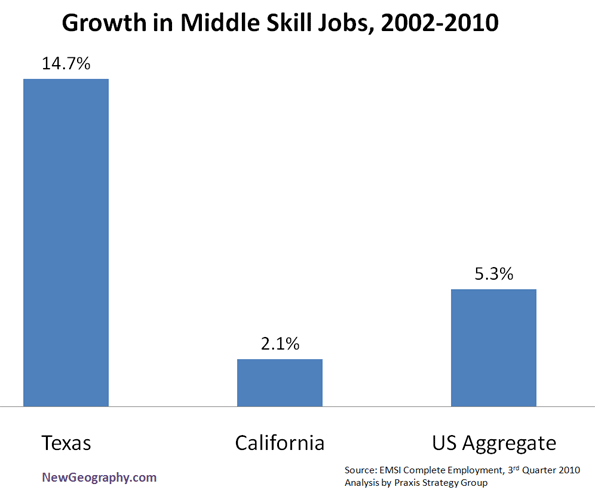
    A vast difference in economic performance is driving the demographic shifts. Since 1998, California’s economy has not produced a single new net job, notes economist John Husing. Public employment has swelled, but private jobs have declined.  Critically, as Texas grew its middle-income jobs by 16%, one of the highest rates in the nation, California, at 2.1% growth, ranked near the bottom. In the year ending September, Texas accounted for roughly half of all the new jobs created in the country.

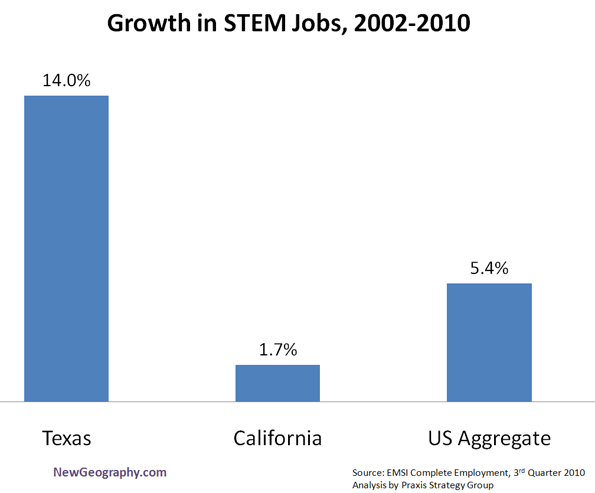
    Even more revealing is California’s diminishing preeminence in high-tech and science-based (or STEM–Science, Technology, Engineering and Mathematics) jobs. Over the past decade California’s supposed bulwark grew a mere 2%–less than half the national rate. In contrast, Texas’ tech-related employment surged 14%. Since 2002 the Lone Star state added 80,000 STEM jobs; California, a mere 17,000.

    Of course, California still possesses the nation’s largest concentrations of tech (Silicon Valley), entertainment (Hollywood) and trade (Port of Los Angeles-Long Beach). But these are all now declining. Silicon Valley’s Google era has produced lots of opportunities for investors and software mavens concentrated in affluent areas around Palo Alto, but virtually no new net jobs overall. Empty buildings and abandoned factories dot the Valley’s onetime industrial heartland around San Jose. Many of the Valley’s tech companies are expanding outside the state, largely to more business-friendly and affordable places like Salt Lake City, the Research Triangle region of North Carolina and Austin.

    Hollywood too is shifting frames, with more and more film production going to Michigan, New Mexico, New York and other states. In 2002, 82% of all film production took place in California–now it’s down to roughly 30%. And plans by Los Angeles County, the epicenter of the film industry, to double permit fees for film, television and commercial productions certainly won’t help.

    International trade, the third linchpin of the California economy, is also under assault. Tough environmental regulations and the anticipated widening in 2014 of the Panama Canal are emboldening competitors, particularly across the entire southern tier of the country, most notably in Houston. Mobile, Ala., Charleston, S.C., and Savannah, Ga., also have big plans to lure high-paid blue collar jobs away from California’s ports.

    Most worrisome of all, these telltale signs  palpable economic decline seem to escape most of the state’s top leaders. The newly minted Lieutenant Governor, San Francisco Mayor Gavin Newsom, insists “there’s nothing wrong with California” and claims other states “would love to have the problems of California.”

    But it’s not only the flaky Newsom who is out of sync with reality. Jerry Brown, a far savvier politician, maintains “green jobs,” up to 500,000 of them, will turn the state around. Theoretically, these jobs might make up for losses created by ever stronger controls on traditional productive businesses like agriculture, warehousing and manufacturing. But its highly unlikely.

    Construction will be particularly hard hit, since Brown also aims to force Californians, four-fifths of whom prefer single-family houses, into dense urban apartment districts. Over time, this approach will send home prices soaring and drive even more middle-class Californians to the exits.

    Ultimately the “green jobs” strategy, effective as a campaign plank, represents a cruel delusion. Given the likely direction of the new GOP-dominated House of Representatives in Washington, massive federal subsidies for the solar and wind industries, as well as such boondoggles as high-speed rail, are likely to be scaled back significantly.  Without subsidies, federal loans or draconian national regulations, many green-related ventures will cut as oppose to add jobs, as is already beginning to occur. The survivors, increasingly forced to compete on a market basis, will likely move to China, Arizona or even Texas, already the nation’s leader in wind energy production.

    Tom Hayden, a ’60s radical turned environmental zealot, admits that given the current national climate the only way California can maintain Brown’s “green vision” will be to impose “some combination of rate heights and tax revenues.”  Such an approach may help bail out green investors, but seems likely to drive even more businesses out of the state.

    California’s decline is particularly tragic, as it is unnecessary and largely unforced. The state still possesses the basic assets–energy, fertile land, remarkable entrepreneurial talent–to restore its luster. But given its current political trajectory, you can count on Texans, and others, to keep picking up both the state’s jobs and skilled workers. If California wishes to commit economic suicide, Texas and other competitors will gladly lend them a knife.


    This article originally appeared at Forbes.com.

    Joel Kotkin is executive editor of NewGeography.com and is a distinguished presidential fellow in urban futures at Chapman University. He is author of The City: A Global History. His newest book is The Next Hundred Million: America in 2050, released in February, 2010.

    Employment data from EMSI.

    Photo by {Guerrilla Futures | Jason Tester}

  • Geography of the Election: A New Era of Racial Politics

    Laura Jean Berger worked on the Congressional Campaign of Assemblyman Van Tran. This is her account of the results.

    Energy and free beer flowed through Assemblyman Van Tran’s campaign headquarters, the crowd anxiously building with anticipation each time Fox News reported another House seat for the Republicans. Every major network’s live trucks crowded the parking lot of the converted Blockbuster video store, their cameras trained on a stage set for a victory speech.

    But the crowd would be disappointed tonight. Results had Tran and incumbent Democratic Congresswoman Loretta Sanchez tied early in the evening, but she pulled ahead to a nine-point lead by midnight. And now, almost a week later, the wait is not yet over. While national press has declared Sanchez the winner yet again in central Orange County, California, neither candidate has yet conceded or declared victory.

    So why in California’s 47th district — where most have declared Sanchez the winner–will neither candidate make a declaration? Just ask the Orange County Registrar of Voters: the surprise in the ballot box is that there are still approximately 30,000 votes yet to be tallied, as reported by the Orange County Register. In a race where approximately 66,000 ballots cast have been counted thus far, one third of the vote share remains outstanding.

    The race could go either way at this point because those ballots yet to be counted are record numbers of both vote by mail and provisional ballots. If you’re Loretta Sanchez, you know that provisionals will likely break in your favor due to alleged polling place confusion in heavily Democratic Santa Ana. But if you’re Van Tran, you are hoping that the largest Vietnamese community outside Vietnam all decided to vote absentee this year.

    The Voice of OC asserts that “history has shown that absentee and provisional votes often make big differences in municipal elections involving large numbers of Vietnamese voters.” In this district, it seems that race is playing a substantial role in the election results just as it did during the campaign.

    National media attention descended when Sanchez declared on the Spanish television station Univision that the “Vietnamese and the Republicans” were trying to “take this seat…” and also remarked that Tran was very “anti-immigrant.” Her comments ignited a firestorm because Tran is, in fact, a Vietnamese immigrant himself. Sanchez was accused of bringing racial divisiveness into the campaign and later offered an apology for her comments once prompted.

    While the Vietnamese community in Orange County is certainly cohesive, they are not single-issue voters, as opposed to many Hispanics. OC Weekly columnist Gustavo Arellano stated in an interview with Southern California Public Radio, “All really that matters to the Spanish-language media right now is the question of immigration because that is the biggest question that its readership has…Everything else is secondary.” Since Tran has not defined his views on immigration precisely, he is “largely ignored” by Spanish-language media.

    Vietnamese voters, on the other hand, share the country’s priority on jobs yet also consider how either candidate–Vietnamese or not–would handle policy positions toward Vietnam. Sanchez’s work on House Resolution 334 calling for an end to Vietnam’s political imprisonment of those who supported Saigon and the South greatly helped her relationship with the Vietnamese community, approximately fifteen percent of the district’s residents.

    While that number might not seem like much, it’s important to note that the Vietnamese turn out at much higher percentages than Hispanics. Hao-Nhien Vu, managing editor of the largest Vietnamese newspaper in the US, ascribes civic involvement with the fact that “they went through so much to get here.”

    Yet the racial disparity in Orange County plays into a larger statewide picture. Voters in California supported Proposition 20 on Election Day, which gives the power of redistricting state and federal districts to a citizens’ committee as opposed to state legislators. California’s districts have been compared to “Swiss cheese,” but the district bordering the 47th to the north, the 40th, makes some rather interesting jabs around the edges.

    The Republican (and Vietnamese) stronghold of Garden Grove has been seemingly attacked by a cookie cutter, while one could argue that isolating predominantly Hispanic Anaheim and Santa Ana in the same district lumps too many Democratic votes together. Both parties are to blame for drawing illogical districts to maintain the status quo. But there’s an even greater national issue growing in this Petri dish.

    President Barack Obama’s election was seen by many as an advance in the fight against racial politics in the United States. But in light of Sanchez’s and Tran’s campaigns and supporters, when does cohesiveness cross the line? This district is a prime example of a place where there are more minority residents than whites. Therefore, it’s logical that a minority representative would be easily elected.

    But which minority?

    The answer is different for each voter. Identifying with the electorate has always worked well in politics. Sanchez identifies with the Hispanics while Tran pulls in the Vietnamese. Each has their supporters among Anglos and African-Americans. But even so, the inevitable is that one ethnic group is pitted against the other in a sense, and everyone knows it (and now admits it after Sanchez’ aforementioned Univision comments).

    The good news? The issue of race is now forced onto the table. Now that it’s no longer completely taboo, there’s a hope that different ethnic groups can come together and realize the diverse issues they all face. If this can be done, the voters will undoubtedly select the candidate that can best represent them, and that may not be a candidate with whom they identify based on race.

    However, this can only happen once an interracial dialogue is established. It won’t happen overnight. Members of minority voting blocs will and do integrate into the larger political discussion with time. Only after this is achieved will race become the non-issue that it should be in politics.

    As for California’s 47th Congressional district, the jury is still out for this year. And in 2012, who knows what the Citizens’ Redistricting Committee will change? Hopefully this year is one of the last in which race will play such a deciding role in elections. But that depends on the opening of communication channels between groups. As our country gets more diverse, and complex, we could be witnessing the beginning of a new era of racial politics in America.

    Laura Jean Berger is a senior at Chapman University studying Political Science and Communication Studies. A lifelong resident of Glendale, she is an avid classical pianist and a self-diagnosed political junkie.

    Photo by Neon Tommy

  • The Real OC: Diverse, Dynamic and — Dare I Say — Progressive

    I recently returned to Orange County after a decade’s absence, fully aware that a stereotype of all-white, card-carrying-John Birchers still exists among many who remain unfamiliar with facts on the ground here.

    I never bought that old saw in the first place.

    And now, on a second venture into OC, I’m amazed by how deeply those old stereotypes have been buried under the accumulated accomplishments of everyday folks.

    The truth is that OC can rightfully claim ground as a leader when it comes to all sorts of popular buzzwords that are falsely applied to a lot of so-called cosmopolitan places.

    Start with “diversity,” a sop for all seasons in Los Angeles and other urban centers, where ethnic communities often are treated like so many pawns.

    Then there’s “dynamic,” another adjective that many metropolitan areas seem to think is theirs simply for the taking.

    Dare I add the presumptuous “progressive” to the list of over-used and seldom-earned buzzwords?

    I shall.

    In many ways OC, with its suburban reputation and libertarian leanings, comes closer to living up to the actual meaning of those words compared to many of the so-called cosmopolitan centers that cling to old stereotypes about this place.

    How do I figure?

    Take the campaign between Democratic incumbent Loretta Sanchez and Republican challenger Van Tran for the 47th District seat in the U.S. House of Representatives, an area that includes much of Central County.

    Tran has made Sanchez work hard in her re-election bid, no small feat considering her long incumbency.

    Neither candidate can count on ethnic appeal alone to propel them to the top. Latinos account for about 68% of the population in the district, which helps Sanchez. But voter registration is a different matter. Asians make up a smaller-but-still-significant base for Tran, with about 15% of the district—slightly more than whites. The winner will have to pick up a good chunk of voters outside their respective ethnic bases.

    That makes for a competitive race in a general election.

    And that’s a rarity in too many metropolitan areas.

    Consider Los Angeles, where ethnic communities too readily are factored like so many widgets into the calculus of ethnic politics. Electoral districts are carved up to turn this or that ethnic community into a lock for one political party or another.

    Candidates in these tailored districts typically get in line with power brokers before launching campaigns. There are occasional primary contests. But the differences between candidates in those intraparty affairs are usually so small that any debate is dominated by minute matters rather than any real difference in philosophies or policies.

    That’s stagnation.

    Some so-called cosmopolitan types might look at OC and say that the Sanchez-Tran race is an anomaly because of the challenger’s heritage. The local Vietnamese community ended up in OC after its founders fled a communist government, making it a natural for conservative, Republican politics here. That makes the community an outlier in terms of politics, ethnic or otherwise.

    That might hold up if it weren’t for Phu Nguyen, the Democratic nominee for the 68th District seat in the California Assembly, a territory that stretches from Anaheim to Newport Beach.

    Nguyen and Tran—Democrat and Republican— together belie any notion that the Vietnamese community is an outlier because of over-riding Republican loyalties in the local Vietnamese community.

    Nguyen’s opponent for the Assembly seat, Costa Mesa Mayor Allan Mansoor, points in the same direction as he engages in their high-spirited debate.

    Mansoor is a Republican who springs from Arabic and Finnish stock. The district that he and Nguyen vie to represent takes in parts of Little Saigon and Little Arabia, but does not feature a majority of voters of Vietnamese or Arabic heritage. There’s no big Finnish contingent, either.

    So you have a couple of candidates who can be readily identified by their ethnicities locked in an electoral battle that goes well beyond ethnic politics. They must reach beyond ethnic politics because the district in the heart of OC is too diverse for such narrow appeals.

    I don’t see any saints in the local political lineup. I’m willing to bet that both parties have tried to slice and dice the map to come up with districts that would make cynical use of ethnic communities.

    The point here is that OC attracts the sort of residents who reach beyond the familiar, pushing out here and bumping into one another there. Sure, Little Saigon is the major center of Vietnamese-American life, Santa Ana has an undeniably Latino core, and there is a Little Arabia in Anaheim. Yet those centers function more as cultural touchstones and less as assigned areas for members of those respective ethnic communities.

    The truth is that OC’s population mix is pretty well spread geographically and socioeconomically, with plenty of ambition—political and otherwise—throughout.

    That’s a different sort of diversity compared to what we hear so much about in a lot of so-called cosmopolitan centers.

    Sounds pretty dynamic.

    You might even call it progressive.

    Sullivan is managing editor of the Orange County Business Journal (ocbj.com)

    Photo by vansassa

  • Help Mexico: Legalize Pot

    Mexico is disintegrating. Bombings, kidnappings, assassinations, and shootings are now common. Recently, the mayor of Tancitaro Mexico was stoned to death. Mexican corruption is so rampant that United States law enforcement officials are reluctant to work with their Mexican counterparts out, fearing perverse results.

    The crimes are perpetuated by ruthless criminals whose depravity cannot be overstated. These are after all, people for whom torture, rape, and beheadings are normal parts of their business, and they show little reluctance to commit these atrocities against children. This link needs a strong-stomach warning.

    Most of Mexico’s violence and corruption has as much to do with our war on drugs than anything indigenous. It is thus preventable with a change of U.S. policy. This is not only in Mexico’s interest but ours as well: the drug-related violence has already begun to spill over into the United States.

    This cannot be avoided. The United States provides the customer base and the distribution network for Mexican drugs necessarily permeates the country. Increasingly, the product is produced in the United States. Travel in less-frequented California and Arizona wildernesses and parks is already dangerous. The problem is so pervasive that a fishing magazine, California Flyfisher, had an article in its October 2010 issue on how to avoid violent encounters with marijuana growers while fishing. The article documents how widespread and serious the problem is in California.

    The most immediate impact of Mexico’s violence’s will be felt along our common border. It’s already a violent place. It will become even more violent. However, the impacts will eventually be felt throughout the United States, challenging prison officials and law enforcement everywhere. Eventually, the corruption will infect our government and police, and the violence will impact everyone. For those who doubt that it can happen here, I recommend reviewing the history of prohibition in the United States.

    There will be other less direct implications of continued drug violence in Mexico. Immigration from Mexico will increase, but the composition of the immigrants will likely change. To date, our Mexican immigrants have mostly been relatively young, low-human-capital workers. As Mexican property rights—and what property rights can exist if your life is not reasonably secure?—decline, the middle and upper-middle class will be looking for alternatives. Many of them will see the United States as an attractive option.

    This can only be good for America. We should welcome these people, the wealth, the human capital, and the physical capital they will bring. They will provide a vigorous stimulus to our economy and our communities. These benefits, however, will not outweigh the costs of the crime and corruption.

    If we want to avoid the crime and corruption, we really need to abandon prohibition. We have a precedent.

    America’s 13-year nightmare of alcohol prohibition was initially popular. The eighteenth constitutional amendment creating prohibition passed both houses of congress with votes of 65 to 20 in the Senate and 282 to 128 in the House. It was ratified by 36 of the then 48 states in only 13 months. Eventually, 46 states ratified the amendment with only Connecticut and Rhode Island rejecting it.

    Ironically, the 21st amendment repealing prohibition was at least as popular as the 18th amendment that created prohibition. It passed the Senate with a vote 63 to 21 and the House by a vote of 289 to 121. Ratification by the necessary 36 states was achieved in only ten months, through State Ratifying Conventions. To date, the repeal of prohibition is the only constitutional amendment ratified by state conventions rather than by state legislatures.

    In only 13 years, prohibition went from being popular to being so unpopular that the amendment repealing it was ratified in 10 months. Something had changed. Prohibition had sparked an upsurge in crime and expanded the Mafia into a national powerhouse. Enforcement costs had soared. Government revenues had declined, and many officials corrupted. John D. Rockefeller summarized America’s change of heart:

    When Prohibition was introduced, I hoped that it would be widely supported by public opinion and the day would soon come when the evil effects of alcohol would be recognized. I have slowly and reluctantly come to believe that this has not been the result. Instead, drinking has generally increased; the speakeasy has replaced the saloon; a vast army of lawbreakers has appeared; many of our best citizens have openly ignored Prohibition; respect for the law has been greatly lessened; and crime has increased to a level never seen before.

    Today, alcohol still imposes huge personal and social costs, but we know that those costs are less than what we paid for prohibition. Drugs also impose huge personal and social costs, and the costs could increase in the event of legalization. The impacts of alcohol and drugs abuse on the abuser and those around him are terrible. The impacts of prohibition are worse.

    Continuation of drug prohibition will result in increased crime, increased corruption, and ever more of our public lands being diverted to illegal production. Thousands of people will continue die in the United States, Mexico, and other countries. The numbers of bombings, kidnappings, assassinations, and shooting will continue to increase. Thousand more will survive with diminished lives, a result of wounds, the loss of property, the loss of loved ones, or a life dominated by fear.

    Californians, by voting for Proposition 19, have to opportunity to take the first step in reducing the costs of prohibition. Despite the heartache and loss that drug abuse brings, voting for Proposition 19 is the humane thing to do, and it is one way that California can restore its now beleaguered reputation as a national thought leader.

    Bill Watkins is a professor at California Lutheran University and runs the Center for Economic Research and Forecasting, which can be found at clucerf.org.

    Photo by Troy Holden

  • The Urban Bike Tribes of Los Angeles

    A recent Los Angeles Times article chronicled a showdown between drivers and bicyclists, inspired by the installation of bike lanes and — more significantly — the reduction of auto traffic lanes on a San Fernando Valley boulevard. The change was clearly intended to encourage cyclists, but I had to wonder: Which ones? In a city as diverse as Los Angeles, even the bike riders are divided, loosely, into different tribes.

    On a San Andreas Fault tour, on the San Francisco Peninsula skirting Silicon Valley, my friends and I passed large numbers of people riding back and forth on bicycles. They had brought their bicycles up into the Santa Cruz Mountains in the backs of their SUVs, and were riding back and forth, exercising their legs. Most of them were dressed in bicycle helmets, and costumes that looked like a cross between a surfer’s short wetsuit and a ballet tutu. It did not seem to me that this sort of activity was really going to replace the automobile for any serious purpose, and anyway, they were not commuting..

    In my own Orange County “paleo-urbanist” community we have the people of the helmets and ballet tutus, who use the streets. But we also have regular folks, who dress in shorts and often T-shirts. These ordinary adults and children use the sidewalk, not the street. I hear that many parents forbid their kids to ride in the street, especially when the street is Pacific Coast Highway. It is actually, as I understand it, illegal to ride a bicycle on most sidewalks. It is also against the law to drive more than 65 miles per hour on the freeway, to drink alcohol if you’re under 21, or (at least till November) to possess or smoke marijuana. As the young folks like to say, Bwahaha.

    I’ve heard about (I think there was an LA Times story some years ago) what I would like to call Los Midnight Riders – those who ride bicycles to work for economic reasons, not ecological ones, because they A) have jobs that don’t pay enough to support owning a car and B) have jobs with hours or locations that preclude using public transit; it either doesn’t run to where they’re going, or it shuts down long before they can go home. These people are the real bike commuters. They often cannot, alas, afford proper front and rear night lights, which makes them a hazard. And they live in parts of town that may not be the best equipped with bike lanes, bike lanes being a rather bourgeois-bohemian interest.

    I taught myself to ride a bicycle at college when I was 21, not having had much opportunity or daring to learn earlier. There was a campus fad for bike riding at the time, but there were no ballet tutus or anything resembling them – ordinary shorts and the like were the costume for our rides. I felt incredibly self-righteous. For some time afterward I used the bicycle once in a while for local trips. But I did so less and less as time wore on. I still have a bicycle, and still use it occasionally, but bikes need to be kept in working order, and being of a certain age I fear I must confess that yes, yes, I do walk my bike up long or steep hills. I don’t wear a tutu, though when I get off a bike I often understand why other people do: My “privates” have gone to sleep, and when I dismount they begin to wake up with a tingling that is about as different as can be from titillation.

    Will bicycles ever become a transit option for masses of commuters? Office dress and decorum has not yet deteriorated to the point where bicycle commuting will be practical without a locker room. One would arrive at the office a sweaty mess and need to shower and change, I’d think, which could be as much of a hassle as going to a health club, and just as time-consuming.

    About a month from now I will be in Copenhagen. There, bike paths run between the street and the sidewalk, including right in front of hotels. Anyone getting out of a car must keep this in mind, for bicyclists are moving past at very high speeds! They seem to be dressed, for the most part, in long pants, and even in business suits. Not having spent a lot of time meeting with Danish bankers and lawyers, I don’t know whether or not they reek of sweat, or if their offices include huge locker rooms.

    But three factors should be noted: A) Copenhagen is a very flat city, so a cyclist might not work up that much of a sweat, B) The weather is not very warm most of the time, so there’s less opportunity to work up a sweat anyway, and C) They’re Danish. I don’t know if they have different tribes of bicyclists, but they may have a different metabolism.

    Photo by Buz Carter of bicyclists crossing the Seventh Street Bridge in Los Angeles.

    Howard Ahmanson of Fieldstead and Company, a private management firm, has been interested in these issues for many years.