Tag: California

  • In the Hunt for a Red October

    California’s precarious budget situation appears to be driving the state closer to potential fiscal ruin. The state is now 28 days into a new fiscal year, operating without a budget, and the deadlocked legislature in Sacramento appears unable and/or unwilling to strike a deal on a new budget able to cover the state’s massive $19 billion deficit.

    With no fix on the immediate horizon, California faces a cash shortage. State Controller John Chiang claims that at current burn rates, the state will find itself out of cash by October if the budget impasse continues. In order to sustain the state’s remaining reserves for as long as possible, Chiang plans to start issuing IOUs to contractors “in August or September to preserve cash”.

    Today, in another effort to defer the date the state will run out of funds, Gov. Schwarzenegger issued an executive order requiring state employees to “take three unpaid days off per month.” This move comes in the wake of the Governor’s proposal to impose minimum wage pay on state workers to save money, currently stuck in the courts.

    If the state legislature is unable to find a solution to the deficit, and creditors prove unwilling to accept more IOU’s, California may be forced to effectively default on its debts. According to Newgeography contributor Bill Watkins, under such a scenario bond issues could fail, state operations grind to a halt, and the “mother of all financial crises” might be unleashed. Even if California is able to find ways to juggle debt load and convince creditors to accept IOU’s while the budget impasse drags on, such stop-gap actions may place its already shaky credit rating at risk of being slashed further towards junk status. The state, legally unable to declare bankruptcy, must find some solution to its budget dilemma or it will become the first state to default since the Great Depression.

  • CA State Treasurer Skeptical of High-Speed Rail

    California High Speed Rail officials and the Governor’s office seem to be suffering from selective hearing. Lawmakers and experts at the University of California’s Institute of Transportation continue to challenge the high-speed rail project’s viability due to precarious statistical projections on ridership and cost. One wonders if developers will reconsider upon hearing California treasurer Bill Lockyer’s recent criticisms.

    Lockyer’s first major issue lies with the basics: the ability to raise enough capital from private sources needed to complete the project. The Rail Authority claims it would need $10 to $12 billion from private investment alone, although some analysts think that, like most of the monetary figures associated with the rail line, this number will ultimately grow. Investors are reluctant to fund such a risky venture, as nothing proposed in this project has proven stable or certain. If investors do indeed close their checkbooks, there is no way the Rail Authority will complete the project.

    Lockyer doesn’t think selling the idea in smaller chunks would work either. He questions the willingness of anyone to buy state bonds for the HSR, even though voters approved $9.95 billion worth in November 2008.

    Despite these reservations, Governor Schwarzenegger is protecting the funding promises made in the 2008 ballot measure. The Rail Authority is also ignoring the warnings of Lockyer and others. They are also trying to start building in the Bay Area in order to meet deadlines for federal funding. But the way things are going, it looks as if federal funding is all they will get. As more and more powerful people add their names to the list of skeptics, the high-speed rail line seems that much closer to complete failure.

    Rather than overriding their critics and spending money they may not get, the Rail Authority should invest in consumer confidence. They need more concrete plans and more promising statistics to create a market for this line because right now, most think the project will turn out to be nothing more than a huge budgetary debacle.

  • California: Bad for Business

    Looking for a business-friendly state? You had better skip California. Extensive regulations, high taxes, and high worker’s compensation rates have made California unappealing for resident and out-of-state businesses alike in the past two years. However, according to the business relocation coach, 2010 marks an economic “emergency” as there have already been 84 instances in California of companies either closing their factories, moving their headquarters out of state, or investing heavily in another out-of-state location. This nearly doubles the 2009 total of 44 instances, and more than doubles the 2006-2008 total of 35. California is losing its economic luster at an alarming rate, which does not bode well for job seekers.

    Some of the companies moving or hedging their bets by shifting operations elsewhere include Google, Apple, Genentech, Facebook, and Hilton. Orange County, Los Angeles, and Santa Clara counties have suffered the most in 2010 with 25, 19, and 16 company moves respectively. Santa Clara in particular houses some of the big tech names like Google, Hewlett Packard, and Apple. In 2009, Los Angeles had the largest number (and the only county in double digits) of company moves with 12. California is not only losing out economically, but it is also losing some of its character as the technology-hub of the US.

    This exodus follows recent trends emerging during the recession. The states benefitting most from California’s high taxes and strict regulations include Texas (with 18 events), Colorado (17 events), Arizona (11 events), Nevada (10 events), and North Carolina (10 events). Increasingly, these states have established themselves as promising havens for job seekers and have fared better during these tough times.

    The state that once drew thousands of hopeful migrants during the Great Depression is now stifling growth opportunities. This is a bleak and unfortunate reversal, particularly for a place struggling to stay afloat in the recession.

  • University of California Report Calls Cambridge Systematics High-Speed Rail Ridership Forecast Unreliable

    A just-released report by the Institute of Transportation Studies at the University of California-Berkeley finds that the ridership projections prepared by Cambridge Systematics (CS) for the California high speed rail system are “not reliable.”

    Authors Samer Madanat (director of ITS-Berkeley and a professor of civil and environmental engineering), Mark Hanson (UC-Berkeley professor of civil and environmental engineering) and David Brownstown (chair of the Economics Department at UC-Irvine) essentially reported that the projections had such large error margins that the system could either lose a lot of money or make a lot of money:

    … the combination of problems in the development phase and subsequent changes made to model parameters in the validation phase implies that the forecasts of high speed rail demand-and hence of the profitability of the proposed high speed rail system-have very large error bounds. These bounds, which were not quantified by CS, may be large enough to include the possibility that the California HSR may achieve healthy profits and the possibility that it may incur significant revenue shortfalls.

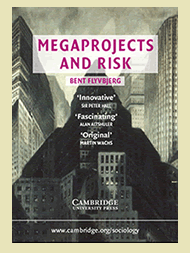
    Biased High Speed Rail Projections: Given the overwhelming history of upwardly biased ridership and revenue projections in major transport projects, it seems far more likely that reducing the margins of error would produce projections with much smaller ridership numbers and major financial losses. Major research by Oxford University professor Bent Flyvbjerg, Nils Bruzelius (a Swedish transport consultant) and Werner Rottenberg (University of Karlsruhe and former president of the World Conference on Transport Research) covering 80 years of infrastructure projects found routine over-estimation of ridership and revenue (Megaprojects and Risk: An Anatomy of Ambition). The evidence is so condemning that Dr. Flyvbjerg has referred to the planning processes for such projects as consisting of “strategic misrepresentation” and “lying” (his words) to advance projects that might not otherwise be implemented.

    Broad Concern about the Reliability of California High Speed Rail Projections: The University of California report joins other reports that have questioning the veracity of the Cambridge Systematics projections. During the run-up to the 2008 statewide bond issue, the California Senate Transportation and Housing Committee, chaired by Senator Alan Lowenthal (D-Long Beach) indicated concerns. Illustrating continuing concerns, the committee commissioned the University of California study.

    Doubts have been expressed by the California Legislative Analyst and the California State Auditor. The Reason Foundation Due Diligence Report, authored by Joseph Vranich and me in 2008 estimated the ridership projections to be at least 100% high (see High Speed Rail: Untimely Extravagance presented at the Heritage Foundation last week in Washington).

    Investment Grade Projections Far Lower: The Cambridge Systematics ridership projections publicized that were used in the statewide bond election were more than 150% above the “investment grade” projections that had been produced by Charles Rivers Associates for the California High Speed Rail Authority a decade ago. Even “investment grade” projections can be high, as the recent bond default and bankruptcy of the Las Vegas Monorail indicates. In that case the “investment grade” ridership projections were 150% above the actual achieved average, nonetheless bond holders lost their investments. (Our 2000 report accurately projected the Monorail ridership).

    Undermining GHG Emissions Reduction Claims: Meanwhile, the California high speed rail proposal has come under criticism with respect to its environmental claims. The high speed rail line has been promoted as a means for reducing greenhouse gas (GHG) emissions in the state. Yet another recently released University of California report indicates that it could take as long as 71 years to save enough GHG emissions by attracting airline passengers and drivers to cancel out the emissions produced in constructing the project. More defensible ridership projections could lengthen this period considerably.

    Response to Criticism: The body of the University of California high speed rail study is 10 pages, followed by approximately 40 pages of comments and response by Cambridge Systematics and a letter from the California High Speed Rail Authority requesting that the University of California authors to consider the comments. This review is performed by the University of California authors, as they reject virtually all Cambridge Systematics criticisms in the final four pages of the report.

    Photograph: Cover of Megaprojects and Risk: An Anatomy of Ambition

  • L.A.’s Economy Is Not Dead Yet

    “This is the city,” ran the famous introduction to the popular crime drama Dragnet. “Los Angeles, Calif. I work here.” Of course, unlike Det. Sgt. Joe Friday, who spoke those words every episode, I am not a cop, but Los Angeles has been my home for over 35 years.

    To Sgt. Friday, L.A. was a place full of opportunities to solve crimes, but for me Los Angeles has been an ideal barometer for the city of the future. For the better part of the last century, Los Angeles has been, as one architect once put it, “the original in the Xerox machine.” It largely invented the blueprint of the modern American city: the car-oriented suburban way of life, the multi-polar metropolis around a largely unremarkable downtown, the sprawling jumble of ethnic and cultural enclaves of a Latin- and Asian-flavored mestizo society.

    Yet right now even the most passionate Angeleno struggles to feel optimistic. A once powerful business culture is sputtering. The recent announcement of Northrop Corp.’s departure to suburban Washington was just the latest blow to the region’s aerospace industry, long our technological crown jewel. The area now has one-fourth as many Fortune 500 companies as Houston, and fewer than much-smaller Minneapolis or Charlotte, N.C.

    Other traditional linchpins are unraveling. The once thriving garment industry continues to shift jobs overseas and has lost much of its downtown base to real estate speculators. The port, perhaps the region’s largest economic engine, has been mismanaged and now faces severe threats from competitors from the Pacific Northwest, Baja, Calif., and Houston. Although television and advertising shoots remain strong, the core motion picture shooting has been declining for years, with production being dispersed to such locations as Toronto, Louisiana, New Mexico, Michigan, New York and various locales overseas.

    Once a reliable generator of new employment, over the past decade L.A. has fared worse than any of the major Sun Belt metros–including hard-hit Phoenix–losing over 167,000 jobs between 2000 and 2009. Historic rival New York notched modest gains, while the rising big metro competitors, Dallas and Houston, enjoyed strong and steady growth. L.A. may not be Detroit, and probably never will be, but its once proud and highly diversified industrial base is eroding rapidly, losing one-fifth of all its employment since 2004. In contrast to the rest of the country, unemployment still continues to rise.

    To give you an idea how much L.A. has sunk, look to this year’s Forbes best city rankings, which measures both short- and mid-term job growth. Once perched in the upper tier of major cities, Los Angeles now ranks a pathetic 59th out of 66 large metro areas, far below not only third-place Houston and fourth-place Dallas but also New York and even similar job-losing giants like San Francisco and Philadelphia.

    It takes a kind of talent to sink this low given L.A.’s vast advantages: the best weather of any major global city, the largest port on this side of the Pacific, not to mention the glamour of Hollywood, the Lakers and one of the world’s largest and most diverse populations of creative, entrepreneurial people.

    Jose de Jesus Legaspi, a prominent local developer, pins much of the blame for this on what he describes as “a parochial political kingdom”–with Antonio Villaraigosa, mayor since 2005, wearing the tinsel crown. A sometimes charming pol utterly bereft of economic acumen, Villaraigosa is a poor manager who is also highly skilled at self-promotion. His idea of building an economy revolves around subsidizing downtown developers and pouring ever more funds into the pockets of public sector workers. No surprise then that L.A. suffers just about the highest unemployment rate of any of the nation’s 10 largest cities outside Detroit. One in five county residents receive some form of public aid.

    But the real power in L.A. today is not so much Villaraigosa but what the Los Angeles Weekly describes as a “labor-Latino political machine,” whose influence extends all the way to Sacramento. These politicians represent, to a large extent, virtual extensions of the unions, particularly the public employees.

    The rise of the Latino-labor coalition does stir some pride among Hispanics, but it has proved an economic disaster for almost everyone who doesn’t collect a government paycheck–L.A.’s city council is the nation’s highest paid–or subsidy. Although perhaps not as outrageously corrupt as the Chicago machine, it is also not as effective. L.A.’s version manages to be both thuggish and incompetent.

    According to an analysis by former Mayor Richard Riordan, the city’s soaring pension liabilities will grow by an additional $2.5 billion by 2014, by which date the city will probably be forced to declare bankruptcy.

    So is the city of the future doomed for the long term? Not necessarily. Although Latino politicians and “progressive” allies strive to derail entrepreneurialism, our grassroots remains stubbornly entrepreneurial. This is particularly true of Latino and other immigrant businesspeople in Los Angeles. In 2006, for example, roughly 10% of the foreign born population was self-employed, almost twice the percentage of the native born.

    To be sure, much of this activity takes place in smaller area municipalities–Burbank, Glendale, Lynwood, Monterey Park–that are mercifully outside the reach of the City of Los Angeles, which accounts for somewhat less than half of L.A. County’s 10 million people. But as Legaspi, who came to L.A. from Zacatecas, Mexico, in 1965, points out, ethnic enterprises–Armenian, Iranian, Israeli, Korean, Chinese as well as Mexican and Salvadoran–continue to thrive even within the city limits. You rarely find in L.A. the kind of desolation found in dying cities like Detroit or Cleveland or even large swaths of New York or Chicago.

    All this suggests there’s still hope for Los Angeles to blossom further as a hub for international trade, global culture and fashion. But to achieve that goal the city needs a government that will nurture its grassroots rather than stomp or extort them. “Los Angeles is a potential great world city, but it needs to be ruled like a world city,” Legaspi points out. Until that happens, our putative city of the future will exist more as dreamscape than reality.

    This article originally appeared in Forbes.com.

    Joel Kotkin is executive editor of NewGeography.com and is a distinguished presidential fellow in urban futures at Chapman University. He is author of The City: A Global History. His newest book is The Next Hundred Million: America in 2050, released in Febuary, 2010.

    Photo by k.landerholm

  • The Vote: Democracy or Disease?

    When the California polls closed on Tuesday, the most costly primary race in the state’s history—thus far—came to an end. Like many high profile races for Senator and Governor nationwide, the spending attracted national attention.

    Of course, this isn’t the first time that California politics and political trends have captured the national imagination and spread like a virus. Given the particularly brutal economic meltdown in California, one would not expect the state’s notoriously dysfunctional governance system to be a role model for others to follow. Alas, it unfortunately seems that it is. Three examples below from the Midwest show that California-style governance definitely has its fans. Indeed, the rise of using constitutional amendments to make policy, and of big money/ special interest- backed referendum petitions shows that the California governance disease is starting to metastasize, even in the Heartland.

    The first example is Missouri, where billionaire Rex Sinquefield launched launched a successful drive to get an initiative on the ballot to eliminate the city earnings tax in Kansas City and St. Louis. Sinquefield is a self-made man who became rich after, among other things, creating the first S&P 500 index fund. Known for his ardent support of free market views, Sinquefield has followed in the footsteps of George Soros and other wealthy financiers in pushing his ideas politically, albeit in a smaller arena. Like Soros, Sinquefield channels plenty of money to candidates, and even has his own think tank, the free market Show Me Institute.

    Sinquefield’s latest crusade is to change state law to prohibit new cities from having local earnings taxes, and to require those cities where they are already in place to put them to a vote every five years and phase them out if ever voted down, with no mechanism for ever reinstating such a tax, even if the city’s voters approve it. While this is a state law change, it targets two specific cities, Kansas City and St. Louis; the latter gets a third of its revenue from the earnings tax. Sinquefield says he wants to replace the earnings tax with a land value tax – an excellent idea – though his actual initiative text doesn’t replace it with anything.

    Whatever one thinks of the actual policy, the idea of billionaire-backed petition drives is right out of the California special interest playbook. Also, while Sinquefield might reasonably want to eliminate the earnings tax in St. Louis, where he lives and pays taxes, it isn’t clear what skin he has in Kansas City’s tax. In effect, Kansas City residents are will have their city’s fiscal future determined by voters who largely live outside the city limits, in a campaign financed by an out-of-town billionaire who lives 250 miles away on the far side of the state.

    And there will be more than 20 other referendum votes on the Missouri ballot this fall. In this governance environment, it shouldn’t be surprising that a significant number of Kansas City businesses are migrating across the state line to Overland Park and other Kansas suburbs where they don’t have to deal with this type of politically induced uncertainty. The political risk in Missouri is commercially toxic.

    The second example is Indiana. Prodded by court rulings, Indiana switched from a property assessment system that undervalued older buildings to one more reflective of market values. This, in combination with the elimination of an inventory tax, led to a spike in property taxes across the state. The spike, along with an income tax increase, led to the mayor of Indianapolis losing his reelection bid to a total political neophyte without any significant financial or establishment backing.

    This stunning upset jolted the legislature into action. Indiana sales taxes were raised by one percentage point, the state took over several key municipal expenses, including educational operations costs and juvenile justice, and it bailed out underfunded local pensions. In return, property taxes were capped to prevent a repeat of the tax crisis.

    So far, so good. By most accounts the financial restructuring and the tax caps are working reasonably well. But state politicians aren’t satisfied. They are in the process of amending the state constitution to write the tax caps into law.

    This is a mistake on two levels. First, it assumes a constitutional tax cap is a substitute for political will on fiscal policy. The notion that if property taxes are limited, then legislative spending won’t increase has been disproven; the example of Prop 13 in California immediately comes to mind. In fact, writing the tax caps into the constitution might actually cause future legislatures to breathe easy and take their eye off the fiscal ball.

    The second is that constitutions should deal with the structure and general powers of government, not with setting tax rates. Writing specified property tax rates into the constitution is simply an attempt by the current legislature to take advantage of high current popularity for a particular policy, and to prevent future legislatures from changing that policy, even if conditions or public opinion change. As a general rule, one legislature or governor should not be able to bind the terms of policy of their successors. If that is established as a valid exercise of legislative power, it seems likely to be used again and again in the future, perhaps for more dubious policies.

    The last and most incredible example is Ohio, where a group of developers wanted to open casinos. Led by Rock Ventures, the investment vehicle of Quicken Loans owner Dan Gilbert of Detroit, the group spent $47 million to draft, put on the ballot, and pass a constitutional amendment permitting casino gambling in Ohio. But this initiative did much, much more than that. It only permitted casinos on four specific properties — properties controlled by the referendum backers — and thus granted them exclusive rights to open casinos. It exempted their casinos from zoning or most other types of local control, authorized them to operate 24 hours a day, and specified a very low license fee of only $50 million per casino to the state. It also permitted them not only to run any game currently allowed by any surrounding state, but also any game those states might approve in the future. It’s undoubtedly one of the most incredible constitutional amendments in the history of the United States.

    Casino companies are far from the only special interest groups to use Ohio’s liberal initiative process to their own ends. Other users include the conservative Cincinnati anti-tax group COAST – Citizens Opposed to Additional Spending and Taxes. COAST does endorse candidates, but in general has a poor track record of getting politicians elected. It has, however, used initiatives to defeat or delay a slew of projects locally. On another front, animal rights advocates at the Humane Society are trying to amend the Ohio constitution to implement their preferred standards for treatment of animals in agriculture.

    The takeaway on Ohio referendums for any special interest group is very clear: “Why not us, too?”

    The legislature is starting to get fed up. Rep. John Domenick wants to amend the constitution to require future changes to obtain a two-thirds supermajority vote, not just a simple majority. He cites the growing ability of deep pocketed, out-of-state interest groups like the Michigan-based casino developers to effectively take over policy making from elected officials.

    Domenick is on the right track. Direct democracy can play an important role in many cases. For example, there’s nothing wrong with requiring voter approval for large tax increases or bond issues for major civic programs after they are approved by elected officials. This gives the matters in question extra legitimacy. But referendum petitions that are too easy to submit and approve only lead to political gridlock and a special interest takeover of the levers of power. The lessons of California suggest that going too far down the road of reliance on constitutional restrictions can become a substitute for political will.

    Flckr photo by SanFranAnnie

    Aaron M. Renn is an independent writer on urban affairs based in the Midwest. His writings appear at The Urbanophile.

  • Arizona’s Short-Sighted Immigration Bill

    Arizona’s recent passage of what is widely perceived as a harsh anti-immigrant bill reflects a growing tendency–in both political parties–to focus on the here and now, as opposed to the future. The effort to largely target Latino illegal aliens during a sharp recession may well gain votes among an angry, alienated majority population, but it could have unforeseen negative consequences over time.

    In terms of the Arizona law, this is not simply a case of one wacko state. The most recent Gallup survey shows that more Americans favor the law than oppose it, with independents and Republicans showing strong support. Despite the negative coverage in the media, the Arizona gambit could somewhat pay off in November. A weak economy tends to exacerbate nativist sentiments, something that has been constant throughout much of American history.

    But there is a distinct danger for the GOP here, not only in Arizona but in the rest of the country as well. As Bill Frey of the Brookings Institute points out, there is a growing gap between the electorate, which is still largely white and older, and the much younger, far more rapidly growing Latino population. In Arizona Frey says the “cultural generation gap” between the ethnicity of seniors and children is some 40%, meaning that while 83% of senior are white, only 43% of children are. Nationwide, Frey estimates the gap in the ethnic composition of seniors and youths stands at a still sizable 25 points.

    Arizona’s large disequilibrium in the ethnicity of its generations is a product, in part, of the state’s historic pull to white retirees. Yet its formerly booming economy, based largely around construction and tourism, required a massive importation of largely Latino, low-wage labor, much of it illegal. As a result over the past two decades, Arizona’s Latino population has grown by 180%, turning what had been a 72% Anglo state to one that is merely 58% white.

    You don’t have to go very far–in fact just across the California border–to see what awaits Arizona’s nativist Republicans. The Grand Canyon state’s future has already emerged there. In the 1970s and 1980s California’s generally robust economy made it a primary destination for immigrants from both Asia and Latin America. Comfortable in their Anglo-ness, papers like the Arizona Republic were dismissing California as a “third world state,” particularly in the wake of the 1992 LA riots.

    Like their Arizona counterparts today, many white Californians then were sickened by pictures of mass Latino participation in looting during the riots. Many were also concerned with soaring costs of providing social services to a largely poor immigrant population. Sensing an opportunity, in 1994 Gov. Pete Wilson–locked in tough re-election battle amid a deep recession–endorsed Proposition 187, a measure designed to prevent illegal aliens from accessing public services. The measure passed easily, with support from both whites and African-Americans. The strong backing among Independents and even some Democrats helped Wilson win re-election with surprising ease.

    But the long-term consequences of 187 reveal the longer-term consequences for the GOP. During the Reagan era and even the first Wilson term, Latino voters split their votes fairly evenly between the parties. But after 1994 there was a distinct turn toward the Democrats, with the GOP share at the gubernatorial level falling from nearly half in 1990 to less than a third in subsequent election. In some cases, right-wing Republicans garnered even smaller portions of Latino voters.

    This is a classic case of the past waging war on the future. Since 1990 Latino and immigrant population has continued to grow. Overall, the percentage of foreign-born residents, according to USC demographer Dowell Myers, has grown from roughly 22% to 27%. One-third of Californians in 2000 were Latino; Myers projects Latinos will constitute almost 47% of the state’s population in 2030.

    The political consequences will only get worse for Republicans. Latino population voting power already has doubled from roughly 10% of the total in 1990 to 20% in 2006.

    This Latino population will become increasingly active and engaged. It is, for one thing, ever more English-fluent, and increasingly dominated by the second and third generations. This group could become permanently estranged, like African-Americans, from the GOP. If that happens, notes longtime Sacramento columnist Dan Weintraub, Republicans could “all but become a permanent minority party in California.”

    And the rest of the country will feel these trends; between 2000 and 2050, the vast majority of America ‘s net population growth will come from racial minorities, particularly Asians and Hispanics. Already one out of every five American children–tomorrow’s voters–is Hispanic.

    Of course, as Latinos integrate and intermarry, they may become less particular in their world view and share more in common with other middle-class Americans. Yet memories of slights against a particular group can overcome even economic self-interest. Blood often proves thicker than bank accounts. The tendency of Jews, a largely affluent and entrepreneurial tribe, to back often harshly anti-business Democrats has its roots in old world scars left from the pogroms in czarist Russia as well as the right-wing genocide in Nazi Germany. Some older voters recall the rabid anti-Semites once prominent in the American far-right as well as the more genteel exclusionism practiced by more refined upper-class Republicans.

    In the future, today’s images of shrill, anti-immigrant right-wing activists could resound for coming generations of Latinos as well as Asians and other newcomer groups. It could essentially deprive the Republican Party of voters who might otherwise consider the GOP option, handing the Democrats a permanently expanded base, not only in southwest but in much of the country.

    None of this is necessary or good for the country. Political competition for ethnic groups is a healthy thing for national interests and for the individual groups. Lock-step support by African-Americans may make them powerful within the Democratic Party, but it also means they can also be taken for granted when push comes to shove. And, of course, when they are in power, Republicans have little real political stake in confronting the serious issues facing black America.

    All this is particularly disturbing since competition for Latino voters should be intense. Heavily employed in construction and manufacturing industries, they have been badly hurt in the recession and their interests were not particularly addressed in the Obama stimulus plan. Many are also socially conservative, supporting, for example, California’s Proposition 8 ban on gay marriage.

    In coming months other proposed steps by the administration and its congressional allies, such as the proposed cap-and-trade legislation, could prove very tough on industries that tend to employ Latinos. Climate change-inspired moves against single-family homes–already in place in California–conflict directly with the aspirations of many Latinos as well as other immigrants who, unlike the usually affluent, homeowning white population, are still seeking the chance to buy their own home.

    But instead of fighting for their economic interests, the Arizona law has handed the Democrats a golden opportunity for to engage their own demagogy on race issues. Instead of having to defend their plans to restart the economy and reorient them to middle and working class needs, Democrats now can play to narrow racial concerns among Latinos while further bolstering the self-righteousness of their affluent, white, left-wing base.

    The reversion to racial politics prompted by the Arizona law ultimately does no good for anyone except “base-oriented” partisan campaign consultants, nativists and ethnic warlords. With all the long-term economic and social challenges that face this growing country, Phoenix’s folly marks an unfortunate step backward to our more shameful past and away from a potentially promising future.

    This article originally appeared in Forbes.com.

    Joel Kotkin is executive editor of NewGeography.com and is a distinguished presidential fellow in urban futures at Chapman University. He is author of The City: A Global History. His newest book is The Next Hundred Million: America in 2050, released in Febuary, 2010.

    Photo by Caleb Alvarado

  • State Auditor Says Only Part of California High Speed Rail Line May be Built

    The California State Auditor’s report title says it all: High-Speed Rail Authority: It Risks Delays or an Incomplete System Because of Inadequate Planning, Weak Oversight, and Lax Contract Management.

    The report, which can fairly be characterized as “damning,” criticizes the California High Speed Rail Authority on a wide range of issues, some of which go to the very heart of the project itself.

    For example, the State Auditor says that without additional bond funding from the taxpayers, the state “may have to settle for a plan covering less than a complete corridor.” Given the financial and administrative disarray of the California High Speed Rail Authority, this is a distinct possibility, which was raised by the Reason Foundation California High Speed Rail Due Diligence Report, released in September of 2008 (co-authored by Joseph Vranich and me).

    This could produce a system that spectacularly fails to meet the promises of its promoters, while enriching the income statements mostly offshore firms that build trains and of firms that failed so spectacularly in managing the Big Dig in Boston. Martin Engel, who leads an organization of concerned citizens on the San Francisco peninsula frequently notes that the real driving force behind high speed rail is spending the money. In this regard, the California High Speed Rail Authority will deliver the goods. The vendors and consultants will get their money.

    The State Auditor also raises questions about the potential to attract the substantial private investment necessary to completing the project. This is a legitimate concern, since the California High Speed Rail Authority has raised the possibility of government revenue guarantees for private investors. This could lead to “back door” taxpayer payment of the “private” investment.

    The Authority continues to skirt legal requirements. The State Auditor notes that the “peer review” committee, ordered by state law in 2008, is still not fully constituted. This is not surprising for an agency that delayed its publication of a legally mandated business plan from two months before the 2008 bond election to days after it.

    In its response, the California High Speed Rail Authority was relegated to taking issue with the report’s title, characterizing it as “inflammatory” and “overly aggressive.” It hardly seems inflammatory and overly aggressive to point out that an ill-conceived plan is rushing headlong to failure. The State Auditor rightly dismissed the criticism saying: “We disagree. The title accurately characterizes the risks the Authority faces, given our findings.”

    This potential financial debacle could not have come at a worse time for California. California’s fiscal crisis is of Greek proportions. Economist Bill Watkins has raised the possibility of a default on debt. Former Mayor Richard Riordan has suggested bankruptcy for Los Angeles, the nation’s second largest municipality.

    Unlike many in California, Riverside’s Press-Enterprise in high-speed rail in the context of California’s bleak financial situation: The dearth of answers to basic fiscal questions suggests that taxpayers might end up paying for big financial deficiencies in the rail plans. Deficit-ridden California has better uses for public money; no list of state priorities includes dumping countless billions into faster trains.

  • California is Too Big To Fail; Therefore, It Will Fail

    Back in December I wrote a piece where I stated that California was likely to default on its obligations. Let’s say the state’s leaders were less than pleased. California Treasurer Bill Lockyer’s office asserted that I knew “nothing about California bonds, or the risk the State will default on its payments.” My assessment, they asserted, “is nothing more than irresponsible fear-mongering with no basis in reality, only roots in ignorance. Since it issued its first bond, California has never, not once, defaulted on a bond payment.”

    For good measure they labeled as “ludicrous” my comment that the Governor and Legislature may not be able to solve the budget problem next year because “debt service is subject to continuous appropriation. That means we don’t even need a budget to make debt service payments.”

    The Department of Finance was also not amused. They resented my prediction that California is on the verge of a default of its bond debt. They insisted that the state has

    “multiple times more cash coverage than we need to make our debt service payments.“

    “There are three fail-safe mechanisms in place to ensure that debt service payments are made in full and on schedule.”

    “Going back as far as the Great Depression, California has never — ever — missed a scheduled payment to a bondholder or a noteholder. Not during the recession of the early 1980s. Not during the collapse of the defense industry in the early 1990s. Not during the dot-com collapse of the early 2000s. And not now. And we, along with the Treasurer and the Controller, will continue to ensure that this streak will never be broken.”

    I am not alone in being taken to the state woodshed. More recently, Lloyd C. Blankfein, Chairman of the Board and CEO of Goldman, Sachs & Co. received this letter from Lockyer’s office, a letter that was ridiculed by The Financial Times’ Spencer Jacob here.

    Once you get past the name calling, California has two arguments. One argument is that California has never defaulted; therefore it will never default. This is, of course, absolutely absurd, insulting our intelligence. Every person, corporation or other entity that has ever defaulted on a loan has been able to say, at least once, that they have never defaulted. As they say in finance: Past performance is not a guarantee of future performance.

    California’s second argument is that it has both a constitutional requirement to meet certain debt payments and the cash to do so.

    That’s nice.

    I have no idea what a constitutional requirement to meet debt payment means, but it doesn’t mean that California will always pay its bills. California has a constitutional requirement to have a balanced budget every June. That constitutional requirement is ignored almost every year. It was ignored last year. It will be ignored this year. It will be ignored next year, unless the Feds have bailed out California, relegating the state’s legislature to rubber-stamp status.

    California’s constitutional requirement to meet debt payments will mean nothing when the state’s financial crisis comes. It won’t mean anything if a debt issue or rollover can’t be sold. It won’t mean anything if the state has no cash, and banks refuse to honor California’s vouchers.

    The relevant analysis begins with the recognition that California is too big to fail, which means it will fail.

    Since there is no procedure for a state to file bankruptcy, the solution to California’s financial crisis will be chaotic. What does it look like when the government of the world’s eighth largest economy can’t pay its employees, or pay its suppliers, or meet its obligations to school districts, counties, cities or other local government agencies?

    It looks ugly, ugly enough to have huge economic ramifications far beyond California’s borders. It looks ugly enough to mean that California is too big to fail, and that’s why we will have a financial crisis.

    Once something (a bank, a car manufacturer, a state) is too big to fail it has perverse incentives. A moral hazard is created because of the free insurance. In California’s case, the moral hazard is exacerbated by a system that assigns responsibility to no one. The super-majority requirement means that both parties will escape blame, and the required cooperation of the legislature will absolve the governor. The governor will blame the legislature. The Republicans will blame the Democrats. The Democrats will blame the Republicans. The citizens will blame the political class. Talking heads will blame an allegedly fickle electorate. Everyone will point fingers, but the blame will not settle on anyone.

    In the end, blame will not matter. No one in a position of power in California has the incentive to make the tough decisions needed to avoid a crisis. So, no one will. Indeed, at this point everyone has an incentive to not make any hard decisions. A bailout from the Feds will be a wealth transfer from the citizens of other states to California’s citizens. The incentive is to drag things out, to appear to be working on the problem, to maximize the eventual windfall.

    I’d love to see California’s political class show some leadership, step up, and effectively deal with the state’s financial problems, but that really is unlikely, requiring as it will, tough decisions on spending priorities and taxes and foregoing a windfall. Ultimately, money usually trumps character.

    Bill Watkins is a professor at California Lutheran University and runs the Center for Economic Research and Forecasting, which can be found at clucerf.org.

    Photo by pirate_renee

  • Finding the Good in This Bad Time

    This year’s best places rankings held few great surprises. In a nation that shed nearly 6.7 million jobs since 2007, the winners were places that maintained or had limited employment declines. These places typically had high levels of government spending (including major military installation or large blocs of federal jobs) or major educational institutions. Nor was the continued importance of the energy economy surprising in a nation where a gallon of gas is still about $3 a gallon.

    Even including part of 2010, only 13 cities (out of 397) showed growth, reflecting the breadth and depth of the downturn. In an economy where the most promising statistic is a “limited” decline in the number of new job losses from month to month, where is the proverbial silver lining?

    It is found in two places: (1) areas that show some resilience in this dour economy; and (2) a newly retooled American economy positioned to compete more strongly in the future.

    Regions of Current Hope
    With disaster as a backdrop, the early signs of buoyancy in the economies of the Intermountain West, the Great Plains, and even parts of the Midwest are quite impressive. Many predicted these areas would mirror the collapse of their larger, high-growth counterparts in California, Florida, Arizona and Nevada. To the contrary, these relatively rural locations are emerging as beacons of hope.

    In the big cities, there have been across-the-board declines in most sectors led by the collapse of construction and financial services. Thousands of small businesses have disappeared in addition to huge layoffs by large employers. You see many “For lease” signs now at what were once your favorite shops and watering holes.

    In a business climate like this, a lot can be said for slow and steady. Comparatively, slower-growing cities across the middle parts of the country are recovering more easily and more quickly.

    Perhaps the most important lesson is that the economies of the future are not all about the “knowledge class” and that “too-good-to-be-true” high wage jobs may be just that. As seen in the dot-com bubble and in this real estate bubble, those fancy, high-wage finance and tech jobs are highly vulnerable to swings in the economy and high-paying construction jobs are only as good as the housing market.

    This is simply because markets eventually adjust. In the case of overheated stock and real estate markets, the losses are felt by the knowledge class, financiers and construction workers. In the case of manufacturing, as the price is bid up through labor costs, other places become more competitive.

    During volatile times, places with the broad-based growth strategies — like Texas and Utah — do best. Cities that are heavily dependent on a narrow set of industries leave themselves vulnerable, paying back the gains of good years in poor years.

    Part of the success of Texas is not just energy (as the modest performance of Midland and Odessa shows), but rather to the state’s adjustments to a past crisis, the savings and loan crisis of the 1980s. The state instituted new laws that imposed a range of disciplines on financial markets — such as limiting home equity lines — thereby minimizing the damage to the state’s economy as those markets went topsy-turvy.

    Regions of Future Hope
    There remains hope for the future in the story of this recession. One of the defining aspects of this recession was not just that certain sectors were hit hard, but that it was also broadly distributed across the economy. This pervasiveness extended deeply enough to cause every enterprise in America to seriously reconsider their business model and re-engineer how they served their customers.

    Consequently, the American economy is leaner and cleaner than it was three years ago. Businesses are more in touch with what makes them successful. While growth will be slower, it will be focused on areas that will bring about quick increases in productivity across the economy and bring new, real wealth to the local economies.

    Where will this happen most quickly? In those places where businesses survived best. Expect the Intermountain West and smaller manufacturing hubs across the United States to lead the charge (because of their lower costs), but large metros like Los Angeles, Chicago, Houston, Minneapolis, and Dallas, with their deep inventories of manufacturers and large labor pools, should see these returns before too long.

    Similar stories can be told for nearly every sector although the beneficiaries will be different. Much of the growth in information sector, for example, will continue to take place outside Silicon Valley. Business services will grow most rapidly where there is growth in business overall, initially outside the core hubs. Midsized and small communities will lead this recovery, and the big cities will eventually follow.

    Economies open to a wide array of occupations will do better than those that are less diversified. Places like Portland and Atlanta, so deeply focused on attracting high-wage, knowledge-based jobs are likely to miss out on the “basic” job growth that will fuel the first stage of the American recovery. Venture capital is still tight across the nation and capital markets are uncertain, especially with new government regulations up in the air. Consequently, high-end, white collar, and high tech jobs, with their insatiable need for investment capital, will develop more slowly. Even among the high-tech superstars, high profits will not lead to huge surges in hiring.

    Why Government Holds the Key
    Government’s actions over the next six to 12 months will define potential and the pace of this recovery. With an election looming, all sides will be jockeying for electoral advantages in November. They will cater legislation to many competing constituencies, fostering tremendous uncertainty in the private sector.

    One thing is certain, however. The current pace of government spending is unsustainable. Not even the US economy can support ongoing deficits in excess of $1.5 trillion per year. Either government spending must slow or someone must pay a lot more. The only alternative — high inflation — will have its own negative effect. One way or another some combination of the three MUST happen.

    Additionally, current regulatory initiatives will change the dynamics and employment patterns within some important sectors. Whether it is the complete restructuring of the health care industry (part of one of the only bright spots in the current economy), or the prospective new regulation in the financial services sector, potentially destabilizing change is coming.

    And the feds are not the only destabilizing government actors. California’s aggressive climate legislation, for example, and the mixed signals it is sending businesses across the state’s 28 MSAs will certainly shape their near and midterm economic futures.

    So what should the federal and state governments be doing at this time? Most importantly, they need to ensure stability: stable capital and lending markets, a consistent and stable tax code, focusing interventions on broad-based, low-shock actions, and developing a plan for moderating and containing the national deficits and mounting national debt. The key to continued prosperity in these times is a growing private job base, not a growing government sector.

    Moreover, government needs to learn the lessons of the private sector. Even as private firms retrench, governments at all levels need to reduce their cost structures. This is happening in many localities, at least on a temporary basis, as even unionized local employees are accepting wage and benefit reductions to retain jobs. Localities and states must recognize the true cost of the services they provide. They must either find consistent ways of providing funding for them, or eliminate them to preserve more critical services.

    Finally, public and private sectors alike must learn that this has been a transformational recession. Unlike downturns in the past, business and government cannot expect things will return to the way they were. Markets and banks will not be printing imaginary value increases in real property for consumers to spend any time soon and capital markets are cautious about financial good news,,preferring the old tried and true winners to novelties.

    Government and government employees are behind the curve understanding this transformation. Wage and benefit concessions given up during this recession are not likely to reappear. The concepts of furlough and unpaid time off are here to stay. Even as the private sector has been forced to reconsider its baseline practices, so, too, the political pressure now will be on government to retain savings obtained during the recession.

    Michael Shires, Ph.D. is a professor at Pepperdine University School of Public Policy.