Tag: California

  • I Heart Des Moines

    Forbes Magazine just released its “Best Places for Business and Careers” list and it’s no surprise to me that Des Moines, Iowa just landed in the top spot. Nearly 5 years ago, I’d have said the same thing you may have just muttered. “Des Moines…that’s fly over country…who’d want to live and work THERE?” I fully appreciate your logic with our cold winters, humid summers, and ag-centric heritage. But weather and corn fields aside, the Des Moines metro, a circle consisting of about half a million people, has captured my heart and I’ve become its most passionate evangelist.

    After a lifetime of Southern California bustle, my wife wasn’t exactly thrilled about my desire to abandon our friends and family infrastructure. But ultimately she wanted me to have more than a view from the windshield of a Honda Civic and to be a stay-at-home mom for our kids. We began to see clearly that reaching goals for entrepreneurship, more family time, and more civic engagement were unattainable in our current location. We were ready to reclaim our time, live with less hassle, and stretch a bit.

    So in 2005, we executed geographic arbitrage landing in Clive, Iowa, a beautiful community on the West side of the Des Moines metro. Soon the memory of my 2.5 hour daily plunge into freeway hell was fading. Views of the beaches and mountains from the window of the 6:20AM flight to DFW became real life experiences on urban bike trails and fishing at the lake blocks from my house. A 20-minute drive from end-to-end, the Des Moines metro area defines easy living and 70 miles equals 60 minutes. (I’m still chronically early to my appointments.)

    During those first months here a local business blogger who’d been reading my copious posts on “Why Des Moines?” reached out to me. After coffee and a few introductions, my personal and business network began to flourish. It was hard to comprehend how quickly anyone who’s willing could reach top level contacts in business, associations, and in government. Before long I was shopping a business plan to investors and prominent business owners in town. I was even introduced to State House representatives who cared about my thoughts on what’s happening in their districts. (I went 33 years never meeting a Congressman in CA.) I realized that within a few phone calls I could reach top decision makers, corporate leaders, and legislators and they were willing to listen to me. My business createWOWmedia is growing rapidly now and I’m reaping the benefits of 2.5 years of head down execution and statewide relationship building. I had the time, the energy, and the start up capital through my CA home sale to stop dreaming and start doing. The Des Moines metro gave me that opportunity and I’m thankful for it.

    I’ve figured out that if you’re willing to endure a couple months spent largely indoors or bundled up that the trade-offs are magical and worth their weight in gold. I wouldn’t trade what I’ve found here for anything. The Des Moines metro and the state of Iowa as a whole offer so much…and ask so little in return. Des Moines is easy living defined.

    Am I worried about a massive influx of new Iowans pouring in from Western states based on this piece and Forbes’s recommendations? No chance. But if you do decide to take the plunge and reclaim your life from the concrete jungle, shoot me an email and I’d be happy to guide you. That’s what good neighbors and Iowans do.

    Doug Mitchell is a Southern California refugee who moved his family to Des Moines, Iowa to build a better life. Doug can be reached at doug@createWOWmedia.com or on twitter @doug_mitchell

  • The War For Jobs, Part II: Teamwork On The Frontlines

    So if we are in a new war — this one for business and job growth — what role does local government play?

    It would be a mistake to over-emphasize the role of government, especially at the local level. Despite the claims of politicians from both parties about how many jobs their policies “created,” governments don’t create jobs, at least not in the private sector. Ventura, for example, is estimated to generate about seven to eight billion dollars in annual economic activity. The sales and profitability of thousands of individual businesses are only marginally impacted by what goes on at City Hall, no matter what cheerleaders or critics might claim.

    Still, local government can obviously contribute to a healthier economic climate — and it can certainly get in the way of one.

    There are four broad areas where our impact (good and bad) is greatest: services and infrastructure; taxation; regulation; and encouragement.

    When local Chambers of Commerce advocate for “business-friendly” policies, they usually underplay the most important function of local government: providing vital services (from policing to clean water) and key infrastructure (from roads to sewer pipes). That’s the core function of government, and the more cost-effectively local government does that, the better it is for local business.

    Yet it’s taxation, regulation and “encouragement” that advocates and critics focus on, and argue over endlessly. Important questions. But there is a catalytic spark when encouraging business starts with two simple words: teamwork and focus.

    That’s where we in Ventura are putting our energy to grow business and high value, high wage jobs.

    We’ve put together a team to focus on the business sectors that will drive economic recovery. Alex Schneider directs our successful Ventura Ventures Technology Center. With thirteen start-up high tech businesses, it’s the tangible outcome of our intense focus on new economy business development. On the first of May, Joey Briglio returns to work on green business development. We are transferring Eric Wallner from the Community Services Department to capitalize on his expertise in growing our visitor and creative business sector.

    These new assignments complete the team that also includes Economic Development Manager Sid White and Ventura Business Ombudsman Alex Herrera. White concentrates on Downtown Redevelopment, real estate, Auto Center redevelopment, general business assistance/loan programs, and ongoing work with County Economic Development organizations. Herrera provides personal access and follow-through for local businesses of all sizes. All are assigned to the Community Development Department under Director Jeff Lambert. As City Manager, I’m taking a hands-on approach to working directly with all of them on our new business strategy.

    This is our team. This is our focus.

    Past battles over land use gave Ventura a reputation for being “anti-business.” We can argue ‘til the cows come home whether this was fair or not. But why re-fight those battles? We’re in a new war and our goal is to change our reputation by winning the battles ahead.

    Almost nobody in Ventura wants to pave the city with oversized real estate overdevelopment. Almost everybody wants robust business growth to generate local jobs, enhance the range of private goods and services available to local residents, and to augment revenue to support public services. When 200 Ventura business and community leaders assembled last May for our Economic Summit, what emerged was a community consensus that is as wide as it is deep: focus on growing our own businesses, especially green ones — and increasingly, every business is turning greener.

    In all the buzz about ‘green jobs’ in the energy sector, it’s important to focus on ‘clean tech’ innovation in every field. Our own Patagonia is a blue-chip model for the green future. In recent years, top executives from Walmart, GE and other global giants have visited Patagonia’s downtown Ventura headquarters to study their rigorous focus on reducing waste and shifting to more sustainable supply chains. Is Patagonia a pioneer in renewable forms of energy? No, they make outdoor clothes. Their local workforce exemplifies the opportunity America – and even high-cost coastal California – still has to lead the world in producing globally-competitive quality products and services.

    It was a theme hammered home by Mayor Bill Fulton in his State of the City speech this year:

    “We are fortunate to be located close to two major economic engines… that constantly spin off startup businesses in the high-tech and biotech centers: UC Santa Barbara to our north and Amgen to our south.

    In the past two years, Ventura has made a major effort — unlike any other city in this region — to connect with these institutions, with startup entrepreneurs, and with venture capitalists, to encourage spin-off businesses to locate and grow here in Ventura. And it’s working. Today — for the first time — we are part of the high-tech/biotech business ecosystem.

    “This is a time of great change and uncertainty in our society. Old ways of doing things are falling by the wayside quickly, and new ways are emerging rapidly. Such times can be frightening, but they are also pregnant with great possibilities. We in Ventura are very determined and well positioned to take advantage of those opportunities in order to reinforce Ventura as a great place to live and work.”

    For a city committed to living within our means, we are focusing our team on earning a reputation that Ventura is serious about winning the new war for jobs. We hope to be a pioneer in forging strategy and tactics that will set the standard for other cities in California tackling the urgent task of reinventing the California dream. Reinvigorating the seventh largest economy on the planet will be based on victory in the war on jobs.

    This article is part two of a two-part series by Rick Cole on the war for jobs.

    Flckr photo of Ventura at night by Wink

    Rick Cole is city manager of Ventura, California, and 2009 recipient of the Municipal Management Association of Southern California’s Excellence in Government Award. He can be reached at RCole@ci.ventura.ca.us

  • The War For Jobs Trumps The War For Sales Tax Dollars: Part I

    At the beginning of every war, generals always try to fight the last one. Experienced professionals are often the last to realize the times and terrain have changed.

    Since the passage of Proposition 13 — the 1978 ‘taxpayer revolt’ against California property taxes — most California cities have focused on generating sales tax. Property tax, which had been the traditional backbone of local revenue, was slashed by 60%, sparking an intense Darwinian struggle between cities for sales tax market share. During the nineties, the cities along the 101 Corridor in Ventura County competed intensely in the “mall wars” over which cities would get auto dealers and major retailers. The City of Ventura won some and lost some, but during the last consumer boom we were still number two in the County in sales tax per capita, after Thousand Oaks.

    This intercity competition spawned redevelopment megadeals, tax sharing agreements and fawning over chain stores and “big boxes.” “Public-private partnerships” was the name given to deals cut with favored developers and retailers. Some cities won the lottery (Camarillo declared its strawberry fields next to the freeway “blighted” in order to grab redevelopment funding to build its successful outlet center), and some lost (Oxnard’s planned 600,000 square foot “Riverpark Collection” sits vacant and forlorn, and the city’s downtown theater and restaurant development scrapes along with continuing city subsidies).

    With the steep drop in sales tax revenue across California, cities are tempted to try that much harder to grab a bigger slice of a shrinking pie. That’s why a major retailer that pays low wages to mainly part-time employees stills gets more attention and help from cities than a similar size manufacturer or company headquarters paying top salaries. That’s why cities review detailed reports on their top 100 retailers every quarter and don’t even keep lists of their top 100 employers.

    But that is fighting the last war. In the debt-fueled boom that crashed in 2007, 70% of every dollar was going to consumer spending, as consumers tapped their credit cards and home equity loans. To cash in on that spending spree, developers could continue to build new shopping centers and auto malls.

    Now all that has changed. Consumers not only have less income and credit, they are saddled with more debt. Even a recovery in consumer buying power might not translate into needing more stores, as the Internet changes the way people live, shop and entertain themselves. Retail square footage will be slashed as inventory is digitized (think e-books) or as consumers take advantage of an electronic market that offers infinitely more variety than any store (think Zappos Shoes and More.)

    Today’s sharp drop in sales tax is an economic Pearl Harbor. The next war has already begun. Cities will need to fight, not for more stores, but for high wage private sector jobs that can directly compete in the brutal global economy. There are two basic ways to do that: provide value through local advantage, or provide world-class quality.

    Local advantage is not easy. Local retailers and service businesses still compete with corporate giants by adapting to serve a local clientele. Our downtown is primarily made up of these niche companies, serving local customers and clients. But economies of scale continue to favor bigger players.

    World-class quality is even harder. “Buy American” is a nice slogan, but most Americans pay no attention to labels on their underwear or their autos. To sustain high wage jobs, companies located here must overcome the cost disadvantage of operating in coastal California by providing products or services that are worth the premium.

    Patagonia, the outdoor specialty clothing powerhouse, is a high profile success story for competing in the world economy. Although they do nearly $400 million in annual sales, most of the company’s actual work (manufacturing, shipping, back office functions and retailing) takes place elsewhere. But its highest-value headquarters function remains in Ventura, providing 200 high quality, high wage jobs. Their unique passion for a green supply chain landed them on the cover of Fortune as “The Coolest Company on the Planet.”

    Can cities be as effective at growing these kinds of companies as they have been at luring Walmarts and Lexus dealers?

    Ventura is a test case. Our Ventura Ventures Technology Center and quest for Google Fiber are innovative experiments. We are “incubating” thirteen tiny start-ups – and fostering what Lottay CEO Harry Lin, an experienced high tech entrepreneur, calls a “technology ecosystem” of connected players in the new company game.

    If we succeed in our efforts to promote new and expanded “world class quality” companies and the high wage, high value jobs they produce, will that help pay the bills for city services? Isn’t a new Walmart still a better bet?

    The answer is not clear-cut. A new Walmart will provide some tangible real revenue, particularly if it diverts Ventura residents from driving to Oxnard to shop at their Walmart. But if Walmart primarily takes customers away from our two Targets and our other retail outlets, there’s little actual gain in revenue. And the point is, in a shrinking retail market (lower incomes, lower spending, more diversion to the Internet), there isn’t much opportunity to keep adding new stores, especially in a competitive market where Oxnard is trying to fill up the brand new center they have sitting vacant. To refill our recent sales tax declines, we’d need the net sales tax of about ten new Walmarts, or their equivalent. For obvious reasons, that can’t happen and won’t. It still makes sense to “buy local” where a penny on every dollar stays home to fund city services. But we can’t build enough stores to restore a prosperous economy or the community services we’ve had to slash.

    So while Ventura’s entrepreneurial emphasis on high wage jobs may be experimental, at least we are fighting the right war. It will be a while before we know whether we are winning. But fighting the last war is a sure loser. Even if the economy “recovers,” it will be years before the region’s retail space is filled — if ever. The best thing we can do to create a healthy retail environment is to generate new wealth in our region through robust business and job growth.

    In the early years following Proposition 13, some cities led the way toward retail development in the war for sales tax dollars. Today, Ventura is adopting new tactics and weapons in the war for jobs. That may seem like a new and untested strategy. It is. Yet in a changing world, there is great opportunity to rebuild local prosperity on a new and stronger foundation.

    This article is part one of a two-part series by Rick Cole on the new war for jobs.

    Flckr photo of Ventura by ah zut

    Rick Cole is city manager of Ventura, California, and 2009 recipient of the Municipal Management Association of Southern California’s Excellence in Government Award. He can be reached at RCole@ci.ventura.ca.us

  • Denver Relocation: The Search for Higher Ground

    In 2003 our family relocated to Folsom, California from Carson City, Nevada, after my father-in-law was diagnosed with Parkinson’s disease, to help with his care. In many ways the transition felt like an immersion into what Joel Kotkin calls the “city of aspiration.” Folsom, a Sacramento region suburb of 50,000, was notable for its robust economy, impressive K-12 schools, world-class bike paths, and low crime. It offered a favorable environment for families and upwardly mobile professionals.

    Seven years later, the landscape has certainly changed. My father-in-law has passed on, and California’s high cost of living continues to have a profound impact on our personal finances. This scenario, coupled with the currently dire economic picture, gave my wife and I pause to again rethink our future path. After many long nights of thoughtful dialogue, we came to the realization that it was time to break ties with the Golden State. In early summer, Denver will become our next home.

    This pending relocation offers our family an opportunity to embrace what I call “the geography of place”— the merging of what one wants to do with where one wants to live. As a process, it embodies a deep exploration into our values and upbringing, hopes and fears, past and future. And while a move of any distance can be daunting, it’s this deeper journey of self that makes the experience rich and meaningful.

    Our plans come at a time of decline in nationwide domestic relocation. Prominent demographer William Frey, in conjunction with the Brookings Institution, led a recent study on migration trends. He found that in 2007-08, the overall U.S. migration rate reached its lowest point since World War II, particularly for long-distance moves and renters. His study also indicated that migrations to exurban and newer suburban counties dropped substantially, simultaneously bringing unanticipated population “windfalls” to many large urban centers. The overall rate of decline is largely attributed to the economic slowdown crippling many parts of the nation, leading to job and income loss as well as upside down mortgages.

    Deciding where to settle down during these uncertain times required a well-thought-out process grounded in a clear set of criteria. After much discussion, we developed the five-C approach to classify our optimum home locale:

    1. Culture: Our ideal environment should have a rich, culturally diverse set of demographics. As a biracial family, social acceptance in our community is paramount.

    2. Charm: Our perfect residential picture is a neighborhood that represents a hybrid of walkable urbanism, housing affordability, safety, and community, which are often found in more suburban environs.

    3. Community: We both enjoy opportunities for civic connection. Proximity to hubs of social connection – such as coffee houses and universities – is a must.

    4. Convenience: By choice we are a one-car household, which makes bicycle, light-rail and walkable accessibility to centers of city activity and conveniences key.

    5. Climate: As a native Midwesterner married to a Southern Californian, we found common ground in a locale offering a change of seasons with generally moderate temperature.

    The upshot of our vetting process had some correspondence with a recent Best Cities for a Fresh Start list compiled by relocation.com. Topping that list is Austin, Texas, an impressive city that I recently visited as a part of my urban research study tour. The Dallas/Ft. Worth area came in second, followed by Charlotte, North Carolina. Denver was fourth, with Columbus, Ohio (my hometown) and Indianapolis tying for fifth on the list.

    Our personal list yielded five locations:

    Portland, Oregon: This Pacific Northwest jewel has received much media attention for its progressive urban practices. And for good reason. It boasts strong community and civic vibes, great neighborhoods, a transportation system ranked among the best in the nation, and a hip, urbane population base. In the end, though, the overcast, rainy climate was too much to overcome in a transition from ever-sunny California.

    Ft. Worth, Texas: For economic vibrancy Ft. Worth, with its sister-city, Dallas, tops the list. It also has good reputation for housing options, schools, civic pride, and decent weather. On the downside, property taxes are a bit high (we estimate 6 to 10 times higher than Denver). And as a bi-racial couple we had some reservations since, as one area resident put it, “Texas is still the South.”

    Boise, Idaho: Despite concerns about Boise’s diversity, the area has extremely low housing costs. Its strong university presence (Boise State) and vibrant downtown were also appealing. On the downside, the airport would have posed some travel limitations. Moreover, the area lacks the depth of social and cultural options common in more urbanized settings.

    Indianapolis, Indiana: Having lived in the Indianapolis area in the early ‘90s, this state capital has always held a special place in my heart, with its strong African-American communities, myriad array of spectator sports, and low cost of living. While I’ll always be a Hoosier at heart, the advantages of this Midwestern city were outweighed by its bleak winter climate. My wife’s need for sunshine booted it out of contention.

    And then there was Denver.

    Denver, our city of choice, impressed us with its myriad quality-of-life intangibles. While not on the order of California, it is culturally diverse with a strong sense of civic vibrancy. The area offers a wealth of housing options that fit our parameters: semi-urban, walkable, affordable, and safe.

    Culturally, the city has a young, active vibe to it. People are involved in varied outdoor activities and events, which underscore the recognition of Denver as one of the most physically fit cities in the U.S. Many have also described it as unpretentious. It has a progressive political structure, as well as a strong economic development platform for the future.

    With a population of nearly 600,000, Denver is the 24th most populous city in the U.S. and the 16th most populous metropolitan area in the nation. Geographically, it’s located in the center of the U.S., nestled in a mountain range that makes harsh cold weather and winds a rarity. While the city gets its fair share of snow, the winter months are rarely bleak. In fact, a draw for many residents is the 300-plus days of sunshine the city receives each year.

    We stand to gain immeasurably moving from über-expensive California. And in terms of intangibles, several are prominent. We’re looking to capitalize on Denver’s new urbanist-influenced walkability. The city has lots of options, from the hip and trendy Lo Do District to the established community of Capitol Hill. A key requirement of our ultimate housing choice will be a quality school district, along with proximity to transportation, coffee houses, grocery stores, fine dining venues, and even co-working sites. In our current residence in Folsom, California, it’s a challenge to stroll by foot to area amenities.

    As intellectually inclined individuals, it was also exciting to find that Denver holds the distinction of being the most educated city in the U.S. with the highest percentage of high school and college graduates of any U.S. metropolitan area. According to census estimates, 92% of the metro area population has a high school diploma, and 35% has at least a bachelor’s degree, compared to the national average of 81.7% for high school diplomas and 23% with a college degree.

    And finally, as a former resident of Indianapolis, a city that fed my obsession for spectator sports, Denver’s robust athletics scene certainly raised my heart rate. The hub of professional franchises in football, basketball, baseball, and hockey, it is one of the nation’s top sports meccas. It has certainly sparked a picture in my mind of hanging out at sporting events, beer in hand, enjoying the scene.

    In the end, relocating to a new geographical locale is never smooth. It requires a great deal of thoughtfulness, conversation and patience. My family views it as the ultimate “Mile High” climb for higher ground amid the economic unsettledness currently affecting California. If well-orchestrated, the payoff will be significant: a better quality of life and a rich existence. That’s our hope; that’s our goal for 2010.

    Photo of Denver’s Lo Do district by Michael Scott

    Michael P. Scott is a Northern California urban journalist, demographic researcher and technical writer. He can be reached at michael@vdowntownamerica.com.

  • The Great Deconstruction – First in a New Series

    History imparts labels on moments of great significance; The Civil War, The Great Depression, World War II. We are entering such an epoch. The coming transformation of America and the world may be known as The Great Deconstruction. Credit restrictions will force spending cuts and a re-prioritization of interests. Our world will be dramatically changed. There will be winners and losers. This series will explore the winners and losers of The Great Deconstruction.

    ***

    The phrase, The Great Depression, was coined by British economist Lionel Robbins in a 1934 book of the same name. Its unexpected onset followed years of speculative growth during which economist Irving Fisher famously proclaimed, “Stock prices have reached what looks like a permanently high plateau.” The depression can be traced to the stock market crash of Black Tuesday, October 29, 1929, when stocks lost $14 billion in a single day. During the Great Depression that, followed, unemployment soared to 25%, a drought turned the farm belt into a dust bowl and international trade plummeted by two-thirds. The worldwide slump did not end until the advent of World War II.

    A similar, albeit less catastrophic, stock market collapse occurred in 2008. Following the speculative rise of a housing bubble, trillions of dollars in home equity and stock value were wiped out and 15 million Americans were left looking for work. Paul Krugman, columnist for the New York Times, labeled the worst downturn in nearly a century, The Great Recession. The Dow fell from a peak of 14,093 in October of 2007 to 6,626 in March of 2009. While Wall Street recovered half of its losses thanks to TARP, an $800 billion financial rescue package for the banks, Main Street has lagged behind. Home equity fell by $5.9 trillion. Housing starts plummeted from 2,075,000 in 2005 to 306,000 in 2009 decimating the construction industry. Foreclosure notices went out to 2.8 million homeowners in 2009 and 4,000,000 are projected for 2010. Eight million jobs have been lost and despite an $800 billion stimulus package, unemployment remains at 9.7%. Under-employment, the real jobless number, has reached 17%. Diversion of agricultural water to protect an endangered species in California and a severe drought has brought bread lines to the famously fertile Imperial Valley.

    Like the Great Depression before it, this recession will leave permanent scars on the people. The depression experience made our parents forever frugal. The Greatest Generation became savers, amassing trillions in home equity, stocks and savings accounts. In contrast, their spoiled and coddled children, the Baby Boomers, became the generation of instant gratification. Easy credit and home equity credit lines meant flat screen TVs, vacations, jewelry and jet-skis could be acquired instantly and paid for later. The Baby Boomers entered Congress, the state house and local government with the same attitude: buy now and pay later. Their largesse was fueled by a bubble mentality. Even though the Dot-Com Bubble burst in the late 90s, it was followed by the Housing Bubble of the 00s and a seemingly endless stream of revenue. A spending frenzy ensued with equity rich homeowners offered home equity lines of credit and credit cards with $100,000 limits.

    It wasn’t just consumers who went wild. In many states, such as California, so did the Legislature. In 1999, California rewarded its public employees with generous pensions (SB 400) that allowed retirement at age 50 with 90% of salary – for life. The California Legislative Analyst’s Office estimated the cost of SB 400 at $400 million per year. In 2009, the actual cost was $3 billion. The pension drain contributed to the $20 billion state deficit that California now faces. A Stanford Institute for Economic Policy Research report estimates California’s unfunded pension obligation at $500 billion.

    Cities in California matched SB 400, as did counties and municipal agencies, and it led to similar economic results. On April 6th, the City of Los Angeles announced furloughs for public employees, a 40% pay cut, effective immediately to help plug a $500 million deficit. Vallejo, a small city of 120,000 that generously paid its City Manager $600,000 per year and its firemen, $175,000, was forced to file for Chapter 9 Municipal Bankruptcy once the Great Recession dried up their honey pot.

    The problem has consumed municipal government across the nation. The Center on Budget and Policy Priorities recently estimated budget deficits for cities and counties would reach $200 billion this year. Detroit, with a $300 million deficit, has proposed leveling and returning huge sections of the decaying city to farmland.

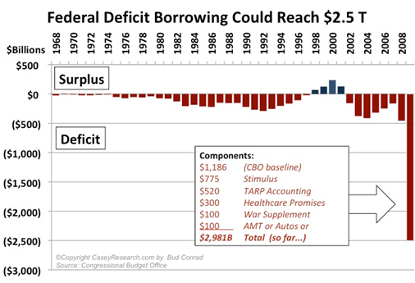
    At the Federal level, the Obama Administration projects deficits of $1 trillion per year as far as the eye can see. The unfunded obligations for Social Security and Medicare are a staggering $107 trillion. Congressional Budget Office Director Douglas Elmendorf said, “U.S. fiscal policy is unsustainable, and unsustainable to an extent that it can’t be solved through minor changes. It’s a matter of arithmetic.”

    Elmendorf said fixing the problem will require fundamental changes and government would need to make changes in the large programs, Medicare, Medicaid and Social Security and the tax code, to get the deficit under control.

    When the Credit Card is Denied …

    Such deficits simply cannot be ignored. There will be an intervention. It may come from outside if China, Japan and the Saudis stop buying our debt. It could come from our children who may object to being forced to repay debt they did not spend. It will more likely come from our parents, The Greatest Generation, in the form of a credit intervention. Our parents may intervene, like they did back in the 60s when the Boomers experimented with sex, drugs and rock n roll. When some of us lost control, it was our parents who intervened and straightened us out. They may be forced to intervene once again. this time at the ballot box in November 2010. The Greatest Generation may send the politicians packing, impose order where chaos has reigned, and cut up the credit cards used by their spoiled and coddled Baby Boomer children. Have you noticed who attends the Tea Party rallies? They are retired, educated, tax paying middle class Americans – they look a lot like our parents.

    Deconstruction will take many forms and will encompass all that we know. Private industry has already shed 8 million jobs. The firing of private employees was low hanging fruit. Once untouchable social programs will be forced to disappear. Sacred cows will be slaughtered. Pet programs will be defunded. Even the military may have to learn to live with less. Further changes imposed will cut deep, reaching the union protected public employees and their constitutionally protected pensions. Just as General Motors was forced to abandon its venerable Pontiac brand along with Saturn, Saab and Hummer, unions will lose many of the benefits they obtained the last ten years. There will have to be changes to Medicare, Medicaid and even Social Security.

    We learned something from the health care fiasco. If we treat seniors, our parents, fairly and honestly, they will make the sacrifice. They were upset with the unfairness of the Cornhusker Kickback and the Louisiana Purchase. They became furious when Cadillac health care plans of union members received different treatment than theirs. Treated fairly, our parents will be part of the solution.

    Fifteen million Americans are looking for work. The jobs will not return soon. Thirty-three states have deficits that must be resolved by law. It will not happen without major sacrifice and draconian job lay-offs of public employees at the national, state, and local levels. The furloughs in Los Angeles only portend things to come. The Great Deconstruction has already begun.

    ***************************************

    The Great Deconstruction is a series written exclusively for New Geography. Future articles will address the impact of The Great Deconstruction at the national, state, county and local levels.

    Robert J Cristiano PhD is the Real Estate Professional in Residence at Chapman University and Director of Special Projects at the Hoag Center for Real Estate & Finance. He has been a successful real estate developer in Newport Beach California for twenty-nine years.

  • Another Caution on California: Golden State’s Grassroots Are Dying

    The subject line on the recent e-mail got my attention: “The Speaker wants to talk with you.”

    The message referred to California State Assembly Speaker John Perez, a Democrat who represents the 46th District, which includes Downtown and nearby districts that are part of the Garment & Citizen’s circulation area.

    Perez has been in the Assembly for more than two years, and he’s gotten plenty of publicity for being the first openly gay person to become Speaker. Some folks are vaguely aware that he’s a cousin to Los Angeles Mayor Antonio Villaraigosa, and a former city commissioner.

    Perez hasn’t been what you’d call a man about the district, though. Ask beyond tight circles of political operatives and special interests—inquire among regular folks who live or work or own small businesses in the 46th District—and you’ll likely find little familiarity with him or his staff.

    Not many can point out much good Perez has done as a public servant, either. A number of observers and constituents believe that his most significant piece of legislation amounts to a favor for the Anschutz Entertainment Group (AEG), owner of the LA Live development near the Staples Center—and also a big political contributor. Perez championed a law that granted AEG an exception on selling alcohol advertising at the Nokia Theatre at LA Live, a potentially lucrative concession.

    I still held out hope when I saw the subject line of the recent e-mail—but that evaporated when I read the message. It came from a group called Courage Campaign, and it aimed to orchestrate some sort of mass teleconference with Perez as the star attraction.

    Courage Campaign has been active in the push to make marriage legal for gay couples in California, and I’ve got no problem with those efforts. My problems arrive when leaders of the group claim to be a “multi-issue advocacy organization” that deploys “an online organizing network that empowers more than 700,000 grassroots and netroots activists to push for progressive change and equality in California and across the country.”

    I grow wary when I see that Courage Campaign’s website on the Internet tosses tired chunks of red meat to the partisan political class, touting the organization’s efforts to help “kill” some proposal by Republicans. I get more concerned about a list of “partners” that includes assumed allies of the Democratic Party.

    The members of Courage Campaign are certainly free to engage in whatever politics they like—and so are all of their partners. So is Perez, for that matter. I just wish that all involved would be honest about “grassroots” and “netroots.” It’s obvious that Courage Campaign is part of the political power structure and the bickering that passes for government in California these days. That’s not a grassroots or netroots approach. Grassroots political movements challenge existing power structures. Courage Campaign is a cog in a political machine.

    Consider the appeal in the recent e-mail from the organization: “Hosting these special statewide calls can be very expensive. Can you help us cover the cost of this Courage Campaign Conversation with Speaker Perez? If you can contribute $10, $25 or $50, it will allow us to open this call to as many participants as possible.”

    I won’t begin to question the actual costs of hosting such conference calls. I’ll simply offer my suggestion on what Courage Campaign officials really meant:

    The Speaker wants to talk with you so he can convince you to give money to a political organization that will, in turn, provide him and his allies support in the future.

    Now here’s what I mean to say to members of the Courage Campaign and all of the other political operatives—liberal and conservative, Democratic and Republican—who dilute and devalue the meaning of grassroots and netroots:

    You are all special interests, creatures of twisted system. Getting the Speaker of the California State Assembly to shill for your fundraising makes it obvious that you are part and parcel of a political culture that has failed. You might soon be just about the only ones left who don’t realize what you have become.

    We need a new approach, fresh ideas, and bold challenges to the old politics that have done so much damage to California.

    A pay-to-play teleconference with a politician who has yet to solve one problem amounts to nothing more than the same old problems.

    Jerry Sullivan is the Editor & Publisher of the Los Angeles Garment & Citizen, a weekly community newspaper that covers Downtown Los Angeles and surrounding districts (www.garmentandcitizen.com)

    Photo by ZSasaki

  • Forced March To The Cities

    California is in trouble: Unemployment is over 13%, the state is broke and hundreds of thousands of people, many of them middle-class families, are streaming for the exits. But to some politicians, like Sen. Alan Lowenthal, the real challenge for California “progressives” is not to fix the economy but to reengineer the way people live.

    In Lowenthal’s case the clarion call is to take steps to ban free parking. This way, the Long Beach Democrat reasons, Californians would have to give up their cars and either take the bus or walk to their local shops. “Free parking has significant social, economic and environmental costs,” Lowenthal told the Los Angeles Times. “It increases congestion and greenhouse gas emissions.”

    Scarily, his proposal actually passed the State Senate.

    One would hope that the mania for changing how people live and work could be dismissed as just local Californian lunacy. Yet across the country, and within the Obama Administration, there is a growing predilection to endorse policies that steer the bulk of new development into our already most-crowded urban areas.

    One influential document called “Moving Cooler”, cooked up by the Environmental Protection Agency, the Urban Land Institute, the Environmental Defense Fund, Natural Resources Defense Council, the Environmental Protection Agency and others, lays out a strategy that would essentially force the vast majority of new development into dense city cores.

    Over the next 40 years this could result in something like 60 million to 80 million people being crammed into existing central cities. These policies work hard to make suburban life as miserable as possible by shifting infrastructure spending to dense areas. One proposal, “Moving Cooler,” outdoes even Lowenthal by calling for charges of upwards of $400 for people to park in front of their own houses.

    The ostensible justification for this policy lies in the dynamics of slowing climate change. Forcing people to live in dense cities, the reasoning goes, would make people give up all those free parking opportunities and and even their private vehicles, which would reduce their dreaded “carbon imprint.”

    Yet there are a few little problems with this “cramming” policy. Its environmental implications are far from assured. According to some recent studies in Australia, the carbon footprint of high-rise urban residents is higher than that of medium- and low-density suburban homes, due to such things as the cost of heating common areas, including parking garages, and the highly consumptive lifestyles of more affluent urbanites.

    Moreover, it appears that even those who live in dense places may be loath to give up their cars. Over 90% of all jobs in American metropolitan regions are located outside the central business districts, which tend to be the only places well suited for mass transit.

    Indeed, despite the massive expansion of transit systems in the past 30 years, the percentage of people taking public transportation in major metropolitan regions has dropped from roughly 8% to closer to 5%. Even in Portland, Ore.–the mecca for new wave transit consciousness–the share of people using transit to get to work is now considerably less than it was in 1980. In recent months overall transit ridership nationwide has actually dropped.

    These realities suggest that densification of most cities–with the exceptions of New York, Washington and perhaps a few others–cannot be supported by transit. Furthermore, drivers in dense cities will be confronted with not less congestion, but more, which will likely also boost pollution. The most congested cities in the country tend to be the densest, such as Los Angeles, Sen. Lowenthal’s bailiwick, which is in an unenviable first place.

    Then there is the little issue of people’s preferences. Urban boosters have been correct in saying that until recently there have been too few opportunities for middle-class residents to live in and around city cores. But over the past decade many cities have gone for broke with dense condo and rental housing and have produced far more product, often at very high cost, than the market can reasonably bear.

    Initially, when the mortgage crisis broke, the density advocates built much of their case on the fact that the biggest hits took place in suburban areas, particularly on the fringe. Yet as suburban construction ended, cities continued building high-density urban housing–sometimes encouraged by city subsidies. As a result, in the last two years massive foreclosures have plagued many cities, and many condominiums have been converted to rentals. This is true in bubble towns like Las Vegas and Miami; “smart-growth” bastions like Portland and Seattle; and even relatively sane places such as Kansas City, Mo. All these places have a massive amount of high-density condos that are either vacant or converted into lower-cost rentals.

    Take Portland. The city’s condo prices are down 30% from their original list price. The 177-unit Encore, one of the fanciest new towers, has closed sales on 12 of its units as of March, while another goes to auction. Meanwhile in New York half-completed structures dot Brooklyn’s once-thriving Williamsburg neighborhood, while the massive Stuyvesant Town apartment complex in Manhattan teeters at the edge of bankruptcy.

    Finally, it is unlikely that cities would be able to accommodate the massive growth promoted by urban boosters, land speculators and policy mavens. Aaron Renn, who writes the influential Urbanophile blog, says that most American cities today struggle to maintain their current infrastructure. They also have limited options to zone land for high-density construction, due in part to grassroots opposition to existing residential neighborhoods. Overall they would be hard-pressed to accommodate much more than 10% of their region’s growth, much less 50% or 60%.

    Given these realities, and the depth of the current recession, one might think that governments would focus more on basics like jobs and fixing the infrastructure–in suburbs as well as cities–than reengineering how people live. Yet it is increasingly clear that for many “progressives” the real agenda is not enabling people to achieve their dreams–especially in the form of a suburban single-family house. It is, instead, forcing them to live in what is viewed as more ecologically and socially preferable density.

    In the next few months we may see more of the kind of hyperregulation proposed by the likes of Sen. Lowenthal. It is entirely possible that a hoary coalition of HUD, Department of Transportation and EPA bureaucrats could start trying to restrict future housing development along the lines suggested in “Moving Cooler.”

    Yet over time one has to wonder about the political efficacy of this approach. Right now Americans are focused primarily on simply economic growth–and perhaps a touch less on the intellectual niceties of the “smart” form. In addition they are increasingly skeptical about climate change, which serves as the primary raison d’etre behind the new regulatory schema.

    Given the zealousness of the density advocates, perhaps the only thing that will slow, and even reverse, this process will be the political equivalent of a sharp slap across the face. Unless the ruling party begins to reacquaint itself with the preferences and aspirations of the vast majority of Americans, they may find themselves experiencing repeats of their recent humiliating defeat–manufactured largely in the Boston suburbs–in true-blue Massachusetts.

    Americans–suburban or urban–may resist a return to unbridled and extreme Republicanism, whether on social issues or in economic policy. But forced to choose between Neanderthals, who at least might leave them alone in their daily lives, and higher-order intellects determined to reengineer their lives, they might end up supporting bipeds lower down the evolutionary chain, at least until the progressive vanguard regains a grip on common sense.

    This article originally appeared at Forbes.com.

    Joel Kotkin is executive editor of NewGeography.com and is a distinguished presidential fellow in urban futures at Chapman University. He is author of The City: A Global History. His newest book is The Next Hundred Million: America in 2050, released in Febuary, 2010.

    Photo: Creativity+ Timothy K Hamilton

  • Deconstruction: The Fate of America? – The Changing Landscape of America

    America is at a crossroads. Its current path is unsustainable. The deficit for fiscal year ending Sept. 30, 2009 was $1.42 trillion. The National Debt is $12.5 trillion with the debt ceiling just raised to $14.9 trillion. The National Debt has increased $4 billion per day since September 28, 2007. The Obama Administration projects trillion dollar deficits for years to come. It has bailed out GM and Chysler, the banks “too big to fail” , and state governments that cannot manage their budgets. They have given away billions for clunkers and caulkers, and rewarded homeowners who bit off more than they can chew. We owe China $894 billion, Japan $764 billion and the Oil Exporters another $207 billion. It is uncertain how long foreigners will continue to finance our debt.

    There comes a breaking point at which the financial model is unsustainable and can no longer continue. For you and I, it is called bankruptcy. If we screw up financially, we are forced to declare bankruptcy. The courts offer protection until we can get our house in order but we are forced to stop spending. We solve our problems under Chapter 7 (liquidation) or Chapter 11 (reorganization).

    DECONSTRUCTION

    Cities can also be forced into Chapter 9 municipal bankruptcy. The City of Vallejo, California, population 120,000, filed for bankruptcy in 2008 after its politicians went fiscally berserk, paying the city manager $400,000 per year and its fireman an average annual wage of $175,000. Cleveland, Ohio declared bankruptcy in 1979 after defaulting on $15 million of bonds. (Seems trivial in this era of trillion dollar deficts). New York City avoided bankruptcy in 1975 when the teachers union forked over $150 million at the eleventh hour. These cities were forced to remedy their reckless spending.

    States cannot declare bankruptcy. Nor can they print money like the federal government. The Legislative Analyst’s Office estimates California has unfunded pension obligations of $237 billion. California is flirting with junk bond status. If it loses its credit rating, it will no longer be able to fund its bloated operations. The Golden State then will become the first failed state. They will be forced to dismantle their regulatory bureacracy. California has over 500 agencies and many are overlapping. They have 250,000 state employees. Thousands will lose their jobs as the financial community imposes cuts the legislature will not make. Such down-sizing will become known as deconstruction. California may be the first state to deconstruct its government services but it will not be the last. The Pew Center for the States reported that state governments have more than a trillion dollars in unfunded pension obligations.


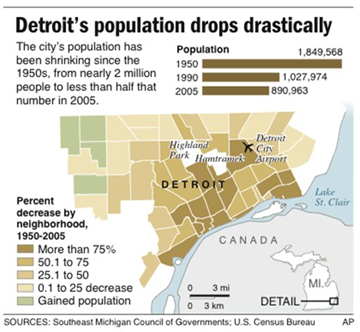
    There is no better example than the City of Detroit. Once the home of Henry Ford and the American automobile industry, Detroit has fallen on hard times. Its population has fallen from nearly 2 million residents to less than 900,000 today. With a budget deficit of $300 million per year, Detroit can no longer provide basic services to its own residents. There are 33,500 empty homes and 91,000 vacant residential lots. More than 300,000 buildings are vacant or in shambles. It is estimated that 40 square miles of Detroit lies abandoned.

    Twelve years ago, British urban historian Sir Peter Hall wrote in “Cities in Civilization” that Detroit “has become an astonishing case of industrial dereliction; perhaps, before long, the first major industrial city in history to revert to farmland.” Hall may have been prescient. This week, Mayor David Bing released the “Neighborhood Revitalization Strategic Framework,” a landmark document that suggests that vast sections of Detroit be razed and returned to farmland, open space and nature. The report suggests the first organized and orderly deconstruction of a major American city.

    The report envisons replacing entire neighborhoods with “Naturescapes” (meadows), “Green Thoroughfares” and “Village Hubs” that require fewer city services. But, it will require hundreds of millions of federal aid to finance such a major transformation, money the federal government no longer has to give.

    In an era of trillion dollar federal deficits, there are no longer easy solutions. The shift of tectonic plates caused by the Great Recession have exposed hopelessly unsustainable city and state budgets. Swollen payrolls, duplicative agencies and inefficient municipal services can no longer be afforded. The deconstruction of government services seems inevitable.

    In five years, will Detroit remain a cratered landscape of vacant buildings, broken promises, and smashed dreams? Or will a smaller, safer, more efficient city evolve out of its ruins? If deconstruction is successful in Detroit, it could serve as a model for many other governments as well, from City Hall to state capitols and all the way to the most bloated disaster of all, Washington, DC.

    ***********************************

    During the first ten days of October 2008, the Dow Jones dropped 2,399.47 points, losing 22.11% of its value and trillions of investor equity. The Federal Government pushed a $700 billion bail-out through Congress to rescue the beleaguered financial institutions. The collapse of the financial system in the fall of 2008 was likened to an earthquake. In reality, what happened was more like a shift of tectonic plates.

    ************************************

    This is the eighth ninth in a series on The Changing Landscape of America written exclusively for New Geography

    Robert J. Cristiano PhD is a successful real estate developer and the Real Estate Professional in Residence at Chapman University in Orange, CA.

    PART ONE – THE AUTOMOBILE INDUSTRY (May 2009)
    PART TWO – THE HOME BUILDING INDUSTRY (June 2009)
    PART THREE – THE ENERGY INDUSTRY (July 2009)
    PART FOUR – THE ROLLER COASTER RECESSION (September 2009)
    PART FIVE – THE STATE OF COMMERCIAL REAL ESTATE (October 2009)
    PART SIX – WHEN GRANNY COMES MARCHING HOME – MULTI-GENERATIONAL HOUSING (November 2009)
    PART SEVEN – THE FATE OF DETROIT: GREEN SHOOTS? (February 2010)
    PART EIGHT – THE FAILED STATE OF CALIFORNIA (March 2010)

  • Jerry Brown: Machiavelli Or Torquemada?

    For more than one-third of a century Jerry Brown has proved one of the most interesting and original figures in American politics–and the 71-year-old former wunderkind might be back in office in 2010. If he indeed wins California’s gubernatorial election, the results could range from somewhat positive to positively disastrous.

    Brown is a multi-faceted man, but in political terms he has a dual personality, split between two very different Catholic figures from the 15th century: Machiavelli and Tomas de Torquemada. For the sake of California, we better hope that he follows the pragmatism espoused by the Italian author more than the stern visage of the Grand Inquisitor.

    Like a good Jesuit, Brown certainly can be flexible. Back in 1978, for example, he worked against Howard Jarvis’ Proposition 13, which capped real estate taxes. But once the measure was passed, Brown embraced it as his own. Indeed, he was so enthusiastic about the tax-cutting measure that Jarvis actually voted for Brown’s re-election late that same year. A month after the vote a Los Angeles Times poll revealed most Californians thought Brown actually supported 13.

    Brown also has shown his flexibility by throwing even loyal allies under the bus. Elected largely due to the electoral coalition constructed by his father, Edmund G. “Pat” Brown, Brown made a point of tweaking and restraining the expanding bureaucracy largely created by his father. He also took on the University of California and the welfare bureaucracy as well as agriculture, residential real estate and manufacturing giants.

    This Oedipal battle reflected Brown’s personal crankiness. He came into office, recalled top aide Tom Quinn, “questioning the values of the Democratic Party.”

    Ascetic and even monk-like, he rejected his father’s “build, build, build” philosophy and embraced E. F. Schumacher’s “small is beautiful” ideology. Like the 15th-century Florentine Catholic monk Girolamo Savanarola, he came to rid Sacramento of suberbia and luxuria.

    Brown was also ahead of his time. His early embrace of green politics–particularly energy conservation and renewable fuels–foreshadowed that of later Democrats, particularly Barack Obama. His strong outreach to Latinos and other minorities expanded his political base among California’s fastest-growing populations.

    Yet Brown understood that economic prosperity–not civil rights or environmental zealotry–was key to political ascendancy. Eastern journalists dismissed him as “Governor Moonbeam,” but they ignored his Machiavellian skill in recognizing and reaching out to rising economic forces, notably the high-tech entrepreneurs in the Silicon Valley and across Southern California. The growth of this sector, along with rising trade with Asia and the military boom after the Soviet invasion of Afghanistan, set the pace for the state’s strong rebound from its early 1970s doldrums.

    But Brown’s inquisitorial side surfaced again as he prepared a second run–he had made a charmingly eccentric assault in 1976–for the White House. Perhaps the prospect of facing a man of infinite flexibility, Bill Clinton, pushed him over the top, but Brown re-invented himself as a high-octane and, at times, shrill populist.

    After some years in the political wilderness, he reemerged in 1998 as Mayor of Oakland, a tough job even in good times. Although he remained predictably arrogant and aloof, the job of managing a working-class city seemed to have brought him to his senses. Like the ideal politician in The Prince, Brown governed with something approaching strategic precision, pushing economic development, embracing the police and supporting new infrastructure spending.

    Brown’s newfound reputation as a canny realist helped him win the election as attorney general in 2006. Yet once back in statewide politics, the inquisitorial side found expression. Convinced about the impending threat of global warming, Brown used his new powers to push the Gorite agenda with the passion of a Torquemada.

    Although Brown was not quite torturing heretics, he certainly applied the legal equivalent of thumbscrews to anyone–developers, cities, counties–who did not follow his prescriptions about “carbon neutrality.” Even proposals for sensible, relatively dense “in fill” development were turned aside in favor of utopian, economically unsustainable ideas about forced density and transit friendliness.

    Today, with California’s economy is in tatters–its unemployment well over 12%–and Brown’s crusade seems likely to make it worse. Onerous regulation threatens everything from the construction of new single-family homes to new employment tied to anything that releases demon carbon–including manufacturing, oil drilling and large-scale agriculture.

    All this has made Brown widely feared in much of California’s fractured, traumatized business community. Even worse, he has emerged as the standard-bearer of the public employee unions, the very force whose political power and pensions are bringing the state to the verge of economic ruin. The fact that Brown’s campaign is funded largely by these unions makes it, at least on the surface, unlikely to challenge the hegemony of our putative “civil servants.” They are said to be ready to spend up to $40 million on “independent” campaigns to help beat back any chance of a GOP victory.

    This is worrisome given Brown’s role in fostering the expansion of public-sector unions during his term, a group whose ascendancy has become arguably the single biggest factor in the state’s precipitous decline during his last gubernatorial reign. As author Steven Greenhut has pointed out, unfunded pension liabilities in excess of $50 billion are one key element driving the state toward ever more depressed bond ratings and possible bankruptcy.

    Under normal circumstances, Brown’s ties to the public sector, his fickle nature and his dubious accomplishments would spell political doom. But amazingly, Brown’s long, if mixed, record might actually prove an advantage against his most likely opponent, former eBay executive Meg Whitman, who is running as an outsider.

    The problem for Whitman or any GOP candidate lies with the miserable legacy of another nominally Republican outsider, Arnold Schwarzenegger. The Terminator’s record of ineptitude and empty blather stands as a mega-advertisement against inexperience. Compared to the former body builder’s amateurish blundering, Brown’s wealth of knowledge of government looks appealing.

    Whitman, or her main challenger Insurance Commissioner Steve Poizner, also must struggle with a Republican Party out of sync with an increasingly multi-racial and socially liberal state. As long-time political analyst Allan Hoffenblum notes, for the first time there is not one congressional, state senate or assembly district with a GOP majority.

    So in the end, California’s fate may end up resting on which Jerry Brown emerges after the election. If he continues on his inquisitorial assault on carbon-creators, you can pretty much expect California’s middle class to continue diminishing while the state’s aspirational appeal ebbs ever further. The state could end up resembling Kevin Starr’s description of his native San Francisco– “a cross between Carmel and Calcutta.”

    But given his history, Brown could still surprise us. Stuck with responsibility for a decaying economy and fiscally burdened by the voracious public unions, Brown could do a “Nixon in China,” imposing controls on pensions and salaries. He could recognize that “green jobs” can not save California from the abyss and that a new “era of limits” must apply to the public sector as well as the rest of us. With the passionate climate-change constituency shrinking, he might even decide to accept a modicum of carbon heresy as a necessary evil.

    Brown should heed Machiavelli’s advice for rulers to be “merciful and not cruel” and “proceed in a temperate manner with prudence and humanity.” If in his old age Brown adopts the Italian writer’s credo of tactical flexibility, reason and tolerance, the Golden State may yet revive itself, and with it restore the legacy of its most storied political family.

    This article originally appeared at Forbes.com.

    Joel Kotkin is executive editor of NewGeography.com and is a distinguished presidential fellow in urban futures at Chapman University. He is author of The City: A Global History. His newest book is The Next Hundred Million: America in 2050, released in Febuary, 2010.

    Photo: Troy Holden

  • The Forty-Fifth Parallel

    When I was a kid growing up in Oregon, we’d occasionally drive north on I-5 to Portland. Just north of Salem we’d pass a sign that read (if memory serves) “The 45th Parallel: Halfway between the equator and the north pole.”

    I wish I’d stopped and taken a picture of myself straddling the parallel. It would go with a collection of similar straddles: across the equator in Uganda, across the Arctic Circle in Finland, and across the 42nd parallel.

    Yes, for if you go south on I-5 (or almost any other road) the 42nd parallel, 7/15ths of the way from the equator to the north pole, is very well marked. It says “Welcome to California.” For 42 is the southern boundary of Oregon and Idaho, against California, Nevada and Utah. Likewise, heading south from Syracuse on I-81, just past Binghamton, it’s marked as “Welcome to Pennsylvania.”

    Other latitudes form important state lines: the four corners is at the 37th parallel and the 109th meridian. Colorado’s northern boundary follows the 41st parallel. And famously, the 49th parallel comprises the largest part of the US-Canada border.

    The special 45th parallel, however, is explicitly reflected in political geography in only two places: it forms Montana’s southern boundary with Wyoming. And more significantly, it forms the northern boundary of New York and Vermont against Quebec.

    Only four states lie entirely north of the 45th parallel: Alaska, Washington, Montana (almost), and North Dakota. The biggest cities are Seattle and Portland. The parallel divides the Minneapolis-St. Paul area. So counting six million from Washington, 2 million each from Oregon and Minnesota, and about 3 million from everywhere else, approximately 13 million Americans live north of the 45th parallel – or 4% of our population.

    Now consider Canada. That country’s southernmost reach is Middle Island in Lake Erie, just south of the 42nd parallel. (My mother often told me that Canada was south of California.) The 45th parallel passes north of Barrie, Ontario, which means the Toronto Metro area and Western Ontario are to the south. Further east, St. John, NB lies just to the north, but Halifax, NS is just to the south. Montreal, Ottawa, and all western cities are north of 45. I’ll guess that about 25 million of Canada’s 34 million people live north of the 45th – about 74% of the population.

    So while almost all Americans live to the south, a large majority of Canadians live to the north. So if one wants to distinguish the US from Canada by a single straight line, the 45th is as good as any. It is much better than the iconic 49th, since the largest Canadian cities are well south of that latitude.

    Heading east, the 45th passes through the southern tip of Crimea, and splits Kazakhstan and Mongolia in half. The only parts of Russia lying south are Vladivostok and the northern Caucasus. Japan, China and the Central Asian republics are almost all to the south.

    In Europe, the parallel runs through Southern France and Northern Italy. To a very rough approximation, it follows the Pyrenees-Alps mountains. In the continental EU, only Bulgaria, Greece, Spain and Portugal lie entirely to the south.

    The parallel wouldn’t have been the worst way to split up the former Yugoslavia: Zagreb is to the north, and Belgrade in the south. Further, the Serbian region of Vojvodina and the Romanian region of Transylvania are north. These areas both have large Hungarian minorities, formerly part of the Austro-Hungarian empire. Irredentist movements in Hungary might happily settle for a boundary at the 45.

    A reasonable population estimate for north of the 45th counts 200 million in the former USSR, 370 million in Europe, and 30 million in Canada, for a total of 600 million, or 10% of the world’s population.

    If the earth were a perfect sphere, then 29.3% of the surface area of the northern hemisphere would lie north of the parallel (this is a reasonably straightforward calculus problem; try it if you’re so inclined). As the earth is actually an ellipsoid, the number is somewhat smaller. Since about 5 billion people live in the Northern Hemisphere, only about 12% of them live north of 45. (Only about one million people live south of 45 S.)

    Is this surprising? Not really – one wouldn’t expect many people to be living at the north pole. But come to think of it, you’ll be surprised by how surprising this number really is.

    A reasonable rule of thumb is that cities at the same latitude will have the same average annual temperature, as they get the same amount of sunshine at the same times. Thus while Minneapolis certainly has colder winters and hotter summers than Portland, on average it should come out right. I learned this again on my last visit to Portland – summer nights in Portland are cold!

    But the rule of thumb doesn’t apply when something truly bizarre affects the climate. And that bizarre thing is the Gulf Stream, which heats Europe 5+ degrees latitude more than it should. Thus Milan (at 45) has a San Francisco climate; London, Paris and Berlin feel like Portland; Oslo, Helsinki and St. Petersburg are similar to Vancouver; and even Murmansk can’t be worse off than Anchorage.

    Thus the surprise is not how few people live north of 45, but rather how many. For of the 600 million northerly souls, only 5% of them live in North America. That means that subarctic Eurasia has nearly 20 times the population, but probably only 3 times the land area. Thus there is a seven-fold higher population density in northern Eurasia than there is in North America. I’m surprised.

    To quantify the surprise, the appropriate Gulf Stream comparison line through Europe might be at the 52nd parallel rather than 45. I chose that latitude as it roughly corresponds to the Baltic coast. Thus France, Germany, Benelux, Ukraine, Poland, and major parts of European Russia lie between 45 and 52, along with smaller countries. Estimating that combined population at about 400 million, and subtracting that from the 600 million, we get a more reasonable sub-arctic population estimate of about 200 million.

    So 200 million live in the northerly Eastern hemisphere, and 35 million live in Canada – a ratio of nearly six to one. I’m still surprised, but can no longer account for the discrepancy. Is life really that much easier in Finland?

    There is another half-way latitude worth mentioning. What latitude splits the earth’s surface in half? If you did the above calculus assignment, you will immediately know the answer: the 30th parallel. Half the earth’s surface lies within 30 degrees of the equator, and half beyond. The 30th parallel does not correspond to any political geography – it goes through Jacksonville, Baton Rouge, Beaumont, and Austin, before entering Mexico southeast of El Paso.

    So the United States mostly lies between the 30th and 45th parallels. Now isn’t that just the very best of temperate climes?

    Daniel Jelski is Dean of Science & Engineering State University of New York at New Paltz.