Tag: California

  • The Failed State of California – The Changing Landscape of America

    The Golden State is not so golden anymore. California is broke. With a $20 billion dollar deficit and tax revenues down 27% from last year, Governor Schwarzenegger looks to Washington D.C. for a bail-out to rescue the state from financial ruin. Like the executive passing a beggar on a street corner, Washington looks the other way. Unemployment is statistically 12.3%, but functionally, it runs closer to 20% of the work force. Nowhere is unemployment more tragic than in the Central Valley, the fruit and vegetable producer of the world. The unemployment rate in arguably the most fertile land on the planet is near 30% as residents line up in bread lines to feed their families. How did this happen? What happened to the Golden State?

    California is a victim of its own success.

    For decades following WWII, people flooded into the golden state in search of weather, opportunity and the good life. California delivered. Under Governor Pat Brown in the 1960s, California had wonderful weather, plentiful water, new highways, and the best public school systems in America. Every student had access to a strong community college system and top students were guaranteed admission to the University of California. Agriculture, Hollywood, aerospace and construction provided more jobs than workers.

    The 1970s brought harbingers of California’s future. The environmental movement muzzled a robust real estate industry with alphabet agencies like AQMD, CEQA, EIR and CCC. Building moratoriums raised home prices along the coast. Aggressive land use controls pushed development inland creating urban sprawl and long commutes as residents sought affordable housing inland. Governor Jerry Brown quipped, “If we do not build it, they will not come” and shut down highway construction, public school construction and added layers of new regulations. The people came anyway.

    The collapse of the Soviet Union in 1989 dealt California a cruel blow. The peace dividend meant the end for many high paying aerospace jobs and defense contracts. The recession that followed was felt far deeper than in the rest of the country. California climbed out of its recession led by wave after wave of new millionaire software developers during the dot com revolution.

    In 2001, the dot come bubble burst. The politicians in Sacramento, emboldened by an endless supply of money from the dotcommers to state coffers, spent over $100 billion while revenues fell to just $70 billion. They ran up a $38.2 billion deficit in 2002 under Governor Gray Davis – more than the other 49 states combined. The people recalled Davis in 2003 and replaced him with the Terminator, Arnold Schwarzenegger.

    The politicians learned nothing.

    California survived the bursting dot com bubble with yet another round of real estate escalation (the housing bubble) that lifted home prices by 20% per year. Spending escalated in line with home prices. More regulations were added to burden industry. Taxes were raised. Tuition increased. California added “The Global Warming Solutions Act of 2006” as if California alone could stem global warming. In response to 9-11, politicians passed SB 400, a feel good law that allowed cops and fireman to retire at 50. It was budgeted to cost “just $400 million” per year. Last year it cost $3 billion. Then, they passed SB183 the next year, applying the same benefits to non-safety state employees like billboard inspectors. When the housing bubble burst in 2007, California found itself with a $20 billion deficit – again.

    This time, California will not climb out so easily. Federal regulators, implementing the Endangered Species Act that was invented in California, diverted water from the farms of the Imperial Valley to the ocean to protect the engendered Delta Smelt. This tiny fish, with no commercial value, threatens the well being of tens of thousands of agricultural workers and contributes to unemployment figures worse than the Great Depression. California’s schools now rank 49th in the nation. They no longer generate the brilliant minds that fueled past economies. California’s 11.6% income tax has forced many high income earners to no income tax states like Florida or Nevada. The housing industry that created 212,960 units in 2006 was only able to build 36,000 units in 2009.

    Former state librarian and California historian Kevin Starr talks about the potential of California being the nation’s first failed state. John Moorlach, Orange County Supervisor says, “We better start talking about this. What are we going to do when the entity (state government) above us crumbles? I think we are already technically bankrupt.” He should know: Orange County went bankrupt in 1994. The City of Vallejo, population 120,000, was forced into bankruptcy in 2008 by commitments by its politicians to pay its City Manager $400,000 per year and its fireman an average of $175,000 annually.

    The biggest obstacle facing California’s recovery is a dysfunctional pension system created by politicians indebted to the public employee unions. The pension obligation is now $17 billion per year. California has 260,000 state employees and 38,000 are paid more than $100,000 per year. The University of California employs another 250,000 and 19,000 are paid over 100,000 annually. These generous salaries have been converted into lifetime annuities. The Legislative Analyst’s Office estimates the unfunded pension obligations of California to total $237 billion. In an era of retiring baby-boomers, this trajectory is clearly unsustainable. With tax receipts down, huge pension obligations and a state budget deficit of $20 billion, the vast majority of municipalities in California are suffering deficits and facing the prospect of Chapter 9 municipal bankruptcy.

    A train wreck is coming.

    Schwarzenegger, once the Terminator but now a Termed-Out lame duck, told the Sacramento Press Club, “No single issue threatens the fiscal health of this state more than our exploding pension obligations. Over the last 10 years, our pension costs have gone up by 2,000 percent from $150 million per year to $3 billion a year (for state government workers). That means hundreds of billions in unfunded liabilities and it means the $3 billion we are spending now will go up to $10 or $12 billion.”

    In October, state Treasurer Bill Locker told lawmakers they needed to reform the pension system or “it will bankrupt the state.” The California Public Employees’ Pension System chief actuary has described the current pension system as “unsustainable.” Adam B. Summers, a policy analyst at the Reason Foundation and author of “California Spending By The Numbers: A Historic Look At State Spending From Gov. Pete Wilson to Gov. Arnold Schwarzenegger” warns, “I think we are starting to approach a tipping point.”

    Do the politicians in Sacramento want to do something about the train wreck that is coming? The answer as of now is clearly no. There is no evidence that they are willing to curtail spending and reform the pension laws that cover 500,000 state employees. They know the State of California cannot go bankrupt under existing laws. However, if they will not act, the people may act for them. Just as they did in 2003 with the recall of Gray Davis, the people are taking the initiative. They are sponsoring the Citizens Power Initiative to curtail the ability of unions to use payroll deductions for campaign purposes. Another initiative would make California’s full-time legislature part-time. In the meantime, the California economy continues to grind to a halt. Will the people of California shock the nation like the people of Massachusetts did with the election of Scott Brown? Or will the unions buy another election and drive the Golden State over the edge, making it the First Failed State?

    ***********************************

    During the first ten days of October 2008, the Dow Jones dropped 2,399.47 points, losing 22.11% of its value and trillions of investor equity. The Federal Government pushed a $700 billion bail-out through Congress to rescue the beleaguered financial institutions. The collapse of the financial system in the fall of 2008 was likened to an earthquake. In reality, what happened was more like a shift of tectonic plates.

    ************************************

    This is the eighth in a series on The Changing Landscape of America written exclusively for New Geography

    Robert J. Cristiano PhD is a successful real estate developer and the Real Estate Professional in Residence at Chapman University in Orange, CA.

    PART ONE – THE AUTOMOBILE INDUSTRY (May 2009)
    PART TWO – THE HOME BUILDING INDUSTRY (June 2009)
    PART THREE – THE ENERGY INDUSTRY (July 2009)
    PART FOUR – THE ROLLER COASTER RECESSION (September 2009)
    PART FIVE – THE STATE OF COMMERCIAL REAL ESTATE (October 2009)
    PART SIX – WHEN GRANNY COMES MARCHING HOME – MULTI-GENERATIONAL HOUSING (November 2009)
    PART SEVEN – THE FATE OF DETROIT: GREEN SHOOTS? (February 2010)

  • Obama Throws Life-Line to Smart Growth Areas

    President Obama has announced a special program of assistance for home owners in the five states that have been hit hardest by the housing crisis. The proposed program is targeted at California, Florida, Arizona, Nevada and Michigan, where house price declines are more than 20% from the peak of the bubble.

    The greatest losses occurred in California, Florida, Arizona and Nevada (see note), where peak to trough house price loses exceeded 40% in all 12 metropolitan areas over 1,000,000 population except Jacksonville. These markets accounted for 70% of the gross housing value loss in the nation before the Lehman Brothers collapse. House prices were driven to unprecedented levels of up to four times historic norms by overly prescriptive land use regulations (“growth management” or “smart growth”) that makes land unaffordable.

    Average losses were more than $175,000 in the markets of these states, more than 10 times those in traditionally regulated markets such as Atlanta, Dallas-Fort Worth, Houston, Indianapolis, Kansas City and Cincinnati. These intense losses were beyond the ability of the mortgage industry to sustain and it is generally acknowledged that this precipitated the Great Recession.

    Smart growth had nothing to do with the Michigan price collapse. There, the strong economic downturn pushed prices down even as the state escaped without a housing bubble.

    The President’s program means that the nation is now paying twice for smart growth policies. The first payment was, of course larger, which cascaded into the huge household wealth losses in the Great Recession.


    Note: While Las Vegas and Phoenix are sometimes perceived as not having prescriptive land use policies, the Brookings Institution ranks both metropolitan areas as toward the more restrictive end of the regulatory spectrum. These overly prescriptive regulatory environments are exacerbated by the fact that in both metropolitan areas much of the developable suburban land is owned by government, and is being auctioned, though at a rate less than demand. These factors combined to drive auction prices per acre up nearly 500% in Phoenix and nearly 400% in Las Vegas during the housing bubble.

  • Who’s Dependent on Cars? Try Mass Transit

    The Smart Growth movement has long demonstrated a keen understanding of the importance of rhetoric. Terms like livability, transportation choice, and even “smart growth” enable advocates to argue by assertion rather than by evidence. Smart Growth rhetoric thrives in a political culture that rewards the clever catchphrase over drab data analysis, but often fails to identify the risks for cities inherent in their war against “auto-dependency” and promotion of large-scale mass transit to boost the “sustainability” of communities.

    Yet in pursuing this transit-friendly future political leaders rarely confront this inescapable reality: public transportation is fiscally unsustainable and utterly dependent on the very car-drivers transit boosters so often excoriate. For example, a major source of funding for transit comes from taxes paid by motorists, which include principally fuel taxes but also sales taxes, registration fees and transportation grants. The amount of tax diversion varies from place to place, but whether the metro region is small or large the subsidies are significant. In Gainesville, Florida – a college town of 120,000 – the regional transit system received 80 percent of the city’s local option gas tax in 2008. In New York City, the Triborough Bridge and Tunnel Authority diverts 68 percent of its toll revenues to subways and buses.

    In addition to local subsidies, state and federal agencies fund transit operations with revenue from gas taxes and other motorist user fees. In 2007 transit agencies received $10.7 billion from the federal Highway Trust Fund, and that is a conservative figure since another $11.7 billion was diverted for vaguely phrased “non-highway purposes.”

    In contrast, fare box recovery doesn’t come close to covering operating expenses. Nor can transit pay for its own capital outlay. Last year the Metropolitan Washington Airports Authority moved to dedicate toll revenue and toll bonds to cover half the cost of the $5.26 billion Dulles Metrorail project.

    The implications of transit’s auto-dependency are serious. Americans drove 11 billion fewer miles between 2008 and 2009, and for each mile not traveled local, state, and federal taxes were not collected. Without these anticipated revenues, transit systems across the country have suffered and, ironically, those hit hardest are the people who are dependent on public transportation ,that is in most cities, the poor and the young.

    In D.C., transit riders are being warned by Metro officials to expect half-hour waits for buses and trains and more crowded rides as they cut services and lay off positions to close a $40 million budget shortfall. Santa Clara County’s Valley Transit Authority has announced plans to reduce bus service by 8 percent and light rail service by 6.5 percent. In Arizona, both Tempe and Phoenix face major cuts that will lengthen wait times and eliminate routes. Even as demand for transit increases in states like Minnesota, the decline in funding is leading to major readjustments in service.

    The situation is so dire in New York City – with by far the most extensive transit system in the country – that advocates used students as props to protest service cuts caused by a $400 million budget shortfall. Though transit receives funding from other sources, there can be no mistaking the key role played by motorists.

    The decline in driving can be attributed largely to the economic downturn and increased unemployment, but even when the recession ends transit agencies will face an uncertain funding future. New technologies are making automobiles cleaner and more fuel efficient, which will allow people to drive more while paying and polluting less. If auto makers meet new federal standards, cars will soon be achieving 35.5 miles per gallon instead of today’s 27.5 mpg average. Economic growth continues to disperse and there has been a strong uptick in telecommuting.

    But perhaps the biggest threat to the future of auto-dependent transit is the very “cause” that seeks to establish it as the preferred travel mode. The planning doctrine called Smart Growth with its rationale of sustainable development is growing in popularity in urban areas across the country. Local officials are enamored with visions of auto-light cities where the buses are full, sidewalks are crowded and there are more bicycles on the road than cars.

    Beneath the appealing rhetoric of Smart Growth rests the assumption that automobiles are intrinsically bad and that public policy should be directed at restricting their use. Rarely do policymakers weigh the automobile’s many benefits and the improving technologies that are mitigating its negative environmental impact. Even rarer is discussion of whether transit can realistically match the convenience and flexibility of the automobile for both individuals and families.

    Distracted perhaps by pictures of ornate transit hubs and shiny rail cars, many policy makers fail to focus on developing a fiscally sustainable plan for public transportation. They miss the fundamental problem that anything heavily subsidized –particularly in a budget constrained atmosphere – is, by definition, unsustainable. (To the extent roads are subsidized, it breaks down to about a half-penny per passenger mile; transit subsidies are 100 times more than driving subsidies.) Ideally, user fees would cover all expenses of all transportation modes, including driving.

    A responsible policy goal should be for transit users to put their fair share in the fare box. However, given the current tax diversion imbalance, local officials should at least target a near-term goal for fare box recovery of 85 percent of costs instead of its current one-third average. This will reduce both their fatal auto-dependency and the instability that comes when external revenue sources are impacted by external factors like an economic downturn.

    Transit agencies should also right-size their bus fleets. Despite visions of large 55-passenger vehicles filled to capacity with contented commuters, only a small portion of routes in any urban area can fill these big box buses even during certain peak times. A smaller sized fleet would be not only less expensive but also more flexible, allowing cities to adjust routes and increase headways for greater service. It would also have a smaller carbon footprint.

    Finally, responsible policymakers should suspend most of their plans to build rail transit. In addition to routinely running over-budget, rail transit- outside of a few cities such as Washington DC and New York- simply does not carry many passengers relative to automobiles to justify its enormous operating expenses . The Santa Clara Valley Transportation Authority, for example, spent $55.5 million in operating expenses in 2008, recovering just $8.6 million from passenger fares and costing taxpayers an average of $5.88 per trip.

    Rubber tire transit is more efficient compared to rail as a service to those needing public transportation. Santa Clara’s operating expenses per vehicle revenue mile were 25 percent less for bus than for light rail. Additionally, bus transit is far more flexible, easier to expand and less disruptive in the construction phase.

    Essentially, policymakers need to see transit as a service with an important but limited role to play in most urban regions. With jobs and more activities spreading to the suburbs and exurbs – a process often accelerated by economically disruptive urban policies, cities should focus transit on a limited number of central core commuters as well as those people who cannot drive. Unfortunately, such goals are too modest for planners who envision transit as the catalyst for large scale social engineering and who have little concern for their regions’ economic bottom line.

    The dirty little secret remains that public transportation would collapse without the automobile. It will remain unsustainable as long as it remains dependent on that which public policy is trying to discourage. Smart Growth rhetoric makes for great campaign literature but not for smart decision-making. Responsible officials should question the underlying assumptions about automobiles and begin reconsidering the fiscal calculus that underlies transit policy.

    Ed Braddy is the executive director of the American Dream Coalition, a non-profit public policy organization that examines transportation and land-use policies at the local level. The ADC’s annual conference will be held this year on June 10-12 in Orlando, Florida.

    Photo: ahockley

  • MILLENNIAL PERSPECTIVE: Vintage Fashion & The Twice-Around Economy

    One impact of the recession has been a fundamental change in consumer clothing purchase patterns. Luxury retailers’ losses have been second-hand retailers’ gains. Internet marketers have also been uniquely positioned to benefit.

    Instead of buying new goods, more shoppers are turning to second-hand bargains. Thrift stores, with their low prices, are rising in popularity. As an added bonus, shoppers can walk away with vintage goods that might be worth more than their price tags indicate, because most thrift stores do not check the labels on goods and price them accordingly. (I cannot resist mentioning that I personally recently found a Free People skirt for $5.95 at Goodwill. Still attached was the original store tag: $144.00. )

    Even small vintage boutiques that cater to a higher-end shopper — in Los Angeles, for example, Decades, Resurrection, and The Way We Wore — are actually faring quite well during these difficult economic times. More clothing is available for purchase by vintage store owners as people scramble to come up with extra cash. This allows the stores to choose from a larger selection, and consequently, have greater control over the quality and quantity of their stock. More clothing also equals a faster turnover of goods, keeping the racks refreshed. This means the stock of the store is more appealing to frequent customers who are most likely to make purchases.

    According to an employee at a San Francisco location of Buffalo Exchange, a nationwide, youth-oriented second-hand chain, “More people have definitely been trying to sell [to us], but the number of customers has surprisingly increased as well.” This is partially due to the quicker rotation of stock, but also because customers are searching for high quality clothing at lower prices. Vintage fashion items are usually made out of sturdier fabrics and have superior construction to today’s clothing. For consumers who want affordable clothing that will last, vintage presents a great alternative.

    Consumers are not the only ones with their eyes turned toward vintage fashion. Designers have recently been evoking the 1930s and 1940s in their newest lines, drawing parallels between the current economic recession and the Great Depression. Although reminding consumers of the Great Depression might seem like a poor marketing strategy, it also carries the message that the times will improve and the economic crisis will resolve just as the Great Depression did. The association of vintage items and longevity is also a boon, in that it makes their designs appear more like investments.

    As this designer interest suggests, the trend is fueled by more than pure economics. Vintage items contain elements of nostalgia. To those people who actually lived during the period in which the goods were manufactured, they often call back positive memories. More significant from a marketing viewpoint, for those who are not old enough to have experienced the actual decade in which their vintage product was created, vintage still recalls what they perceive as more prosperous times in our nation’s history.

    The notion that items can last despite the events of the time is part of a movement against the current cynicism towards the “disposable” culture. Vintage clothing is recognized as sturdy in an age of “planned obsolescence” with products made cheaply to intentionally break down and need replacement. Anything that has survived this long is viewed as a good investment over the inferior merchandise of today.

    Along with a rejection of the throw-away culture is a rejection of the mass-produced, seen-everywhere culture. The older a piece of clothing is, the less likely it is that other similar pieces have survived. It’s one of the few inexpensive ways to find unique, possibly even designer, clothing. There’ s also a counter-cultural element in not following the corporate legacies of stores like Macy’s, but instead creating new looks that differ from what current designers decide is in fashion.
    The search for vintage clothing is about finding something completely original and rare that no longer exists, or does so only in small amounts. And what better tool speaks to finding unusual niches than the internet?

    The internet has become an option where pricing has leveled out between the extremes of bargain hunting and pricey boutiques. This equilibrium of price has been achieved in part by the abundance of information available on the internet, not just about vintage fashion, but about how to price it correctly. The search features on sites such as eBay allow users to easily compare similar pieces of vintage fashion and determine if it is overpriced or not as unique as it might be perceived in a vintage store window.

    Perhaps the most important innovation in the online realm of vintage fashion is the website etsy.com, which allows individuals to set up their own shops and sell handmade and vintage goods. What differentiates Etsy from competitors such as Amazon and eBay is the interface: consumers feel as if they are breezing through individual shops as they enjoy aesthetically appealing layouts and large high quality photographs. This ability to create personalized shops aimed at an audience searching for handmade and vintage items is the perfect resource for those searching for a venue in which to resell their thrift store finds and make them appeal as affordable and unique clothing.

    The downside is the difficulty to determine authenticity in a virtual world. Unlike porcelain and glass, there is no simple black-light test to figure out the age of a fabric. On the other hand, online information abounds in relation to authenticating vintage fashion in general.

    As the economy spins, fashion does as well: past to present, cast-off to coveted, retail to thrift shop. With the addition of the internet, yesterday’s twice-arounds may become tomorrow’s thrice-arounds.

    Photos of Elsewhere Vintage in Orange, California by Elizabeth Iverson.

    Elizabeth Iverson is a freshman at Chapman University in Orange, California. She is currently studying Film Production and wishes to pursue a career in the entertainment industry.

  • Oregon Tries to Catch California – On the way down!

    Oregon’s voters will soon give their judgment on Measures 66 and 67, measures that will raise income and corporate taxes in the recession-ravaged state – with unemployment at 11.1 percent, the eighth highest in the nation. Besides leaving the state with the highest marginal rate in the country, tied with Hawaii, more insidiously measure 67 will impose a minimum tax based on sales, not profits, implying an infinite marginal tax rate for low-profit companies.

    This is not good news for businesses and citizens of Oregon. In a report titled Tax Policy and the Oregon Economy: The Effects of Measures 66 and 67, Two Cascade Policy Institute economists, Eric Fruits and Randall Pozdena, thoroughly review the literature on the impacts of tax increases on jobs and domestic migration, and they rigorously analyze the measures’ impact on Oregon jobs and migration.

    They estimate the new measures through 2018, will cost Oregon employment losses of “approximately 47,000.”

    Finally, Fruits and Pozdena examine the impacts of measures 66 and 67 on migration. They find that adoption of measures 66 and 67 will result in the loss of approximately 80,000 Oregon tax filers with a loss of $5.6 billion in adjusted gross income.

    These results have to be taken as the minimum impacts. Fruits and Pozdena are careful researchers. They do nothing that is not completely defensible. Consequently, because of statistical issues, some of the potential impacts, particularly those of measure 67’s minimum tax based on sales are almost surely under measured.

    Clearly Oregon , where many residents look down on the increasingly bedraggled Golden State seems anxious to follow California’s decline trajectory. We all know how that story ends: high unemployment, domestic out-migration, declining jobs, declining opportunity, and a vanishing middleclass.

    I am not alone in seeing the warning signs.

    The PEW Center on the States issued a report in November 2009 titled Beyond California: States in Fiscal Peril. PEW created an index using foreclosure rates, job losses, state revenues, budget gaps supermajority requirements, and money-management practices. The index resulted in values ranging from 6, Wyoming, to 30 California. Higher values are bad here, and the closer to California’s 30, the more a state is at risk of California-style fiscal problems. Oregon, with a value of 26 is listed as one of nine states that the PEW researchers consider at high risk.

    Then there’s Small Business & Entrepreneurship Council’s recently released Small Business Survival Index. They use a much larger set of variables to create their index of public policy climates for entrepreneurship, a total of 39 indicators covering tax policy, regulation, crime rates, costs, and more. This index results in values ranging from 25.7 for South Dakota to 84 for the District of Columbia. As with the previous index, high numbers are bad. California, with a score of 77.7 is the second worst state, behind only New Jersey. Oregon’s score is 65.2, the 38th among states, and dangerously close to California’s score.

  • Now You Should be Really Fiscally Afraid in California

    After reading a recent article I wrote about growing unfunded liabilities for public employee pensions and health care, a reader told me that it made him want to “burn his eyes out with red hot pokers.” Yes, the current situation – expanding debt, growing government, excessive pay and special privileges for government workers, thanks to union power – is not fun to read about. It can be downright scary, when one considers the financial mess that already is looming.

    If you really want to be scared, you need to listen to the types of people who are now sounding the alarm bells. I’m a libertarian, and it’s not a surprise to hear me warn about the ill effects of government spending.

    But listen to what former California Assembly Speaker Willie Brown, one of the state’s best-known liberal politicians, recently wrote in a San Francisco Chronicle op-ed:

    “The deal used to be that civil servants were paid less than private sector workers in exchange for an understanding that they had job security for life. But politicians–pushed by our friends in labor–gradually expanded pay and benefits…while keeping the job protections and layering on incredibly generous retirement packages…This is politically unpopular and potentially even career suicide…but at some point, someone is going to have to get honest about the fact.”

    Democratic state Treasurer Bill Lockyer said at a legislative hearing: “It’s impossible for this Legislature to reform the pension system, and if we don’t it will bankrupt the state,”

    The chief actuary for the California Public Employees Pension System called the current pension situation “unsustainable.”

    This is from a recent Economic Policy Journal article: “According to the chairman of New Jersey’s pension fund, the US public pension system faces a higher-than-expected shortfall of more than $2 trillion.”

    The only hope to rein in the current problem is for wider agreement that the days of enriching public employees must end. That means making inroads with liberal Democratic politicians, many of whom must realize that the future of other programs they support are imperiled by shaky finances and pension obligations that suck the life out of government budgets.

    Steven Greenhut is director of the Pacific Research Institute’s calwatchdog.com journalism center and author of “Plunder! How Public Employee Unions Are Raiding Treasuries, Controlling Our Lives and Bankrupting The Nation.”

  • High-Speed Rail: Toward Least Worst Projections

    It comes as welcome news that the United States Department of Transportation Inspector General is concerned about the integrity of high-speed rail projections, “including ridership, costs, revenues and associated public benefits.” The issue has become ripe as a result of the $8 billion for high speed rail that the Obama Administration slipped into the economic stimulus bill early in 2009.

    The response was more than 250 applications from 30 states totaling $57 billion. It is easy to understand the Inspector General’s concern, though no-one should be surprised that the demand for free money outstrips the supply. Applicants range from the huge California High Speed Rail proposal, to a greenhouse gas belching magnetic levitation (maglev) line in population-losing Pittsburgh, to comparatively modest railroad grade crossings that could improve both railroad and highway safety.

    In a January 4 letter to the Federal Railroad Administrator, Inspector General Mitchel Behm announced an evaluation of “best practices” with respect to high-speed rail forecasts, noting that “it is of critical importance that the Federal investments are directed to the most worthy projects.” For starters, the Inspector General needs to understand that there are is no such thing as “best practices” in high-speed rail forecasts. Best practices and high speed rail in the same sentence sounds like a line from a comedy routine. The record of ridership, revenue and cost projections in high speed rail projects is abysmal.

    An Object Lesson: The Las Vegas Monorail Default: This was brought home earlier this week, when the privately financed Las Vegas Monorail defaulted on its bonds, principally because its ridership was absurdly over-projected. Even before the economic implosion (2007), the Las Vegas Monorail was carrying only 21,000 riders per day, far below the 53,500 riders that had been predicted for 2004 by the world-class planning firm retained by the promoters. In 2000 we produced a report predicting that the Monorail would carry between 16,900 and 25,400 daily riders. The reality was in the middle of that range. Of course, no venture could survive with consumer demand 60 percent below projections and default was inevitable, as we predicted. People who purchased the bonds may have overlooked the shaky foundations of the project, assuming that the state required bond insurance would make them whole. It did for the first defaulted payment, however the bond insurer, Ambac, itself is also in financial difficulty. Abmac has been characterized as “a borderline insolvent bond insurer.” Following Ambac’s debt payment, the Las Vegas Monorail filed for bankruptcy improbably claiming that it was necessary to permit expansion to the airport.

    High Speed Rail Follies: Of course, the Las Vegas Monorail is not a high-speed rail line, but high-speed rail projects are subject to the same risk of absurdly inaccurate projections of ridership, revenue and costs.

    High speed rail has often been touted by proponents as being profitable. However, they usually exclude such basic costs building the system and buying the trains. This is like a household that claims to be saving, but does not pay the mortgage. Proponents routinely repeat claims of profitability for one line or the other, without the slightest concept of reality. Indeed no less than Iñaki Barrón de Angoiti, director of high-speed rail at the International Union of Railways in Paris, said that high speed rail is not a profitable business and said that short Paris-Lyon and Tokyo-Osaka routes are the only ones in the world that have “broken even.”

    The California proposal, in particular, anticipates substantial private investment. Anyone courageous enough to invest will want due diligence performed by consultants other than those who produced the numbers to support the Las Vegas Monorail bond issue.

    Within the past few days, the non-partisan California Legislative Analyst’s office issued a critical report of the new California High Speed Rail business plan. The most damning criticism was that the plan “appears to violate law, because it assumed operating subsidies, which were prohibited by the bond issue passed by the voters of the state. This is particularly relevant to the USDOT Inspector General’s inquiry, since the California High Speed Rail Authority has been claiming for years that the project would not require operating subsidies. California, needless to say, is not in a position to be offering subsidies of any kind.

    Cheerleader Projections: There is plenty of reason for concern:

    Taiwan’s high-speed rail line, the only fully privately financed line in the world, has attracted approximately one-half of its projected ridership and has suffered considerable construction cost overruns. During its first few years of operations, its debt has been restructured, its bonds downgraded, expansion plans have been suspended and the Taiwan government has now taken majority control of the board. It should not be long before Taiwan taxpayers will be footing the bill.

    The new high-speed rail line in Korea is attracting approximately one-half of its projected ridership, while its costs were three to four times the projected level.

    This problem is all documented in Megaprojects and Risks: An Anatomy of Ambition, by Bent Flyvbjerg of Oxford University, Nils Bruzelius of and Werner Rothenberger of the University of Karlsruhe and former chairman of the World Conference on Transport Research. The authors examined decades of major transportation projects in Europe and North America and identified a general pattern of projection inaccuracy. With respect to the systematic cost projection errors, Professor Flyvbjerg says: “Underestimation cannot be explained by error and is best explained by strategic misrepresentation, that is, lying.” He further notes that “The policy implications are clear: legislators, administrators, investors, media representatives, and members of the public who value honest numbers should not trust cost estimates and cost-benefit analyses produced by project promoters and their analysts.”

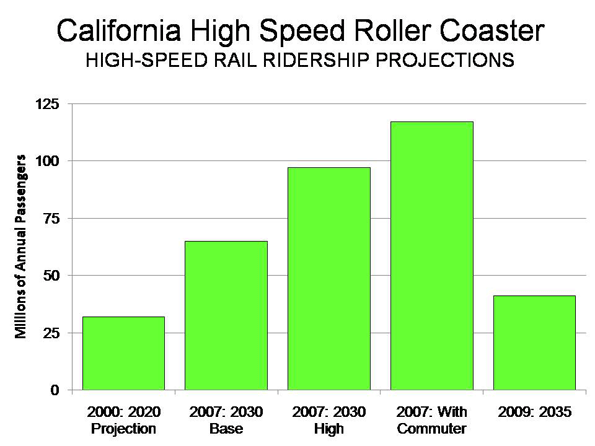
    The California High Speed Roller Coaster: The proposed California High Speed Rail system seems poised to break “lower the bar” even further with respect to performance relative to projections. The ridership projections have been like a roller coaster. In 2000, the California High Speed Rail Authority’s modelers predicted, in an “investment grade projection” that the system would carry 32 million riders a year by 2020. Then, in 2007, the projection gurus raised the “base” number to 69 million by 2030 and added a “high” number of 97 million. By the time the high speed rail bond election was underway, some Authority board members went around the state citing a number of 117 million riders that included commuter ridership.

    Within the last month, the Authority has released a new plan indicating that ridership will be 41 million in 2035 (See Figure). If the 2000 ridership projections were “investment grade” then the subsequent projections have been “junk bond grade.”

    Joseph Vranich and I projected annual ridership of 23 million to 31 million for 2030 in a report published by the Reason Foundation (The California High Speed Rail Proposal: A Due Diligence Report). We also predicted, based upon our analysis of high speed rail systems worldwide, that the costs will rise by as much as another 70 percent to cover the usual cost overruns and to build portions of the system not included in the projections.

    The erratic ridership projections are just the beginning. We also found the proposed fare structure to be far too optimistic (fares far too low). Apparently the California High Speed Rail Authority agrees, because it has doubled its proposed fare levels. Meanwhile, its costs continue to rise, despite having risen by half from 2000 to 2008 (inflation adjusted), at the same time that the size of the proposed system was shrinking.

    Perverse Incentives: Part of the problem here lies with incentives. The “world class“ consulting firms have no incentive to produce reasonable numbers. Indeed, some actually participate in later stages of the projects and as a result have exactly the opposite incentive – an interest in projections being optimistic enough that the project gets approved.

    Solutions: The Inspector General might look at removing the incentive for misrepresentations and exaggeration, by prohibiting the participation of planning consultants in the implementation phase of high speed rail projects. Another modest proposal could revolutionize major project projections. Perhaps the world class consulting firms should be required to guarantee their projections financially.

    We certainly wish the Inspector General the best, though he has certainly set a standard (“best practices”) not likely to be achieved. But perhaps he can move the industry from absurdity to least worst projections.

    Wendell Cox is a Visiting Professor, Conservatoire National des Arts et Metiers, Paris. He was born in Los Angeles and was appointed to three terms on the Los Angeles County Transportation Commission by Mayor Tom Bradley. He is the author of “War on the Dream: How Anti-Sprawl Policy Threatens the Quality of Life.

  • A Milestone on the Road to Becoming a Third-World Economy

    Northrop Grumman Corp started California’s New Year by announcing it is moving its headquarters to the Washington D.C. area. Unfortunately, they are neither the first nor the last major corporation to leave Southern California. It is a trend, one that may not last much longer, though since aren’t that many major corporations still headquartered in greater Los Angeles.

    For decades, Southern California was the center of the aerospace world, a basic part of the Southern California’s DNA. Now, once Northrop leaves, there will be no major aerospace companies still headquartered in Southern California.

    Aerospace is not the only industry abandoning Southern California. The region was once host to financial giants, like Bank of America, Security Pacific Bank, Countrywide, and First Interstate. Today, there are none. California was once a major automobile manufacturing state, with a dozen plants. Even the entertainment industry is slowly shifting away from its Hollywood roots.

    When you lose corporate headquarters, you lose more than jobs. You lose the tax base, the leadership, the philanthropic giving, and the intangibles. Corporate headquarters are usually very good citizens.

    Many local political leaders ignore this business’ exodus, or make excuses. The decline of the U.S. defense spending, aerospace spending in particular, is often given as a reason for the decline. But the last decade was not a bad one for defense; the industry thrived, just not in Southern California.

    The reasons for this exodus are both simpler and less flattering than those usually given. One big reason is selfishness. California’s decline chose to consume, and not to produce. Wealthy, aging, Baby Boomers control the state. In the cause of “quality of life,” or “the environment,” they have succeeded in limiting opportunity for everyone else.

    The other big reason for decline lies with governments, state and local, that now exist to serve themselves and not their citizens. The level of government goods and services, even infrastructure and basics, has declined, but state spending, adjusted for inflation and population, has continued to soar. The difference has been going into public employee’s pockets, through higher salaries, benefits, and generous retirement programs.

    Remarkably, no Southern California economic sector is in ascendancy. Unemployment remains well above the national average, particularly in the middle class Inland Empire. The growth in bankruptcies has been about twice that of the United States. The state is becoming less equitable, the divide between those who have and those who do not have constantly growing, the middle class declining.

    Southern California is starting to look a lot like a third-world economy, service based, inequitable, serving a wealthy, mostly aging few, with little opportunity for younger workers and a large underclass. Changing the region’s prospects will be very difficult. Nothing short of a major generational change in leadership is likely to change the current sad trajectory.

  • New Geography Top Stories of 2009

    As we bring to a close our first full calendar year at NewGeography.com, we thought readers may be interested in which articles out of more than 350 published enjoyed the widest readership. It’s been a solid year of growth for the site; visits to the site over the past six months have more than tripled over last year and subscribers have increased by a factor of six. The list of popular articles is based both on.readership online and via RSS.

    15. Joel Kotkin’s piece, Numbers Don’t Support Migration Exodus to “Cool Cities”, makes the case that places considered “cool” by many in media and economic development circles are actually losing net migrants to other U.S. regions. In almost every case, he argues, your local resources are better spent focused on skills upgrades for your local residents or hard and soft infrastructure upgrades for industries already successful in your region. This article originally appeared on Forbes.com

    14. The British Labour Party is no example for American Progressives. Legatum Institute Senior Fellow Ryan Streeter’s piece just in time for the 4th of July, View from the UK: The Progressive’s Dilemma, dissects Britain’s high social spending, increasing debt load. Streeter contends that the UK is danger of mortgaging its future.

    13. Breaking down Obama’s first year and looking forward. In two equally popular pieces from this fall, Joel Kotkin outlines a five point plan to improve Obama’s presidency (Obama Still Can Save His Presidency which originally appeared in Forbes.com. In the second piece he takes encouragement from signs that the President may be retuning his policy back towards America – “a big, amazingly diverse country with an expanding population” – and away from the “Scandinavian Consensus” model (Is Obama Separating from His Scandinavian Muse?) . This article originally appeared on Politico.com.

    12. State of the economy June 2009. Susanne Trimbath says it may be a while before the average citizen will actually see tangible improvements in the economy. As is often the case, Susanne’s predictions have turned out so far to be all too accurate.

    11. Questioning the stimulus plan. In February’sStimulus Plan Caters to the Privileged Public Sector, Joel Kotkin calls the stimulus plan “a massive bailout and expansion of the public-sector workforce as well as quasi-government workers in fields like health and education” yet “as little as 5% of the money is going toward making the country more productive in the longer run – toward such things as new roads, bridges, improved rail and significant new electrical generation.” This article originally appeared in Forbes.com

    10. Is California’s economic malaise leaking into Oregon? After years of strong migration flows of former Californians heading to Oregon, Joel Kotkin and California Lutheran University economist Bill Watkins point out that the state’s oppressive tax policies and red tape may be leaking into Oregon as well in California Disease: Oregon at Risk of Economic Malady. The article originally appeared in The Portland Oregonian.

    9. Tracking housing decline. Wendell Cox broke down the comparative national housing market in two widely read pieces. In the first he points out that the downturn can be broken into two phases, one mirroring the explosive growth in many overvalued markets, and another second phase were markets are declining across the board: Housing Downturn Moves Into Phase II. In the second, Wendell uses his median multiple calculation for the 49 largest metropolitan regions to show that prices in many place still have much farther to fall to reach historic norms: Housing Downturn Update: We May Have Reached Bottom, But Not Everywhere.

    8. Public debt is looming. Susanne Trimbath lists public debt levels of the most highly leveraged sovereign nations and explains why this debt and the credit default swaps purchased against it could create a looming public catastrophe: The Next Global Financial Crisis: Public Debt.

    7. Washington, DC is flourishing in the recession. NYU Professor and urban commentator Mitchell Moss explains how Washington is the one city benefiting from the government stimulus. He argues this is stimulating the DC economy, from increased lobbyist activity to web designers benefiting from the government’s new interest in digital communications: Washington, DC: The Real Winner in this Recession.

    6. Californa’s Decline. Three equally widely read pieces track the drastic shift in California from economic vibrancy to stagnancy: Kotkin’s “Death of the California Dream which ran first in Newsweek and The Decline of Los Angeles from February on Forbes.com. The third piece by economist Bill Watkins examines California’s domestic migration net losses using an old coal mining metaphor: In California, the Canary is Dead.

    5. Housing Affordability Rankings. The most read housing piece this year was Wendell Cox’s release of his annual housing affordability rankings based on median multiple calculations (ratio of median housing price to median household income in a given market). “Housing Prices Will Continue to Fall, Especially in California” lists median multiple calculations for each metropolitan region in the U.S. of more than 1,000,000 population.

    4. Detroit as a model for urban renewal. In a widely linked piece across the blogosphere, Aaron Renn points out that the decline in Detroit could be a platform for residents to get creative with urban re-development. This piece is full of stunning imagery of formerly dense neighborhoods now full of greenspace that sent me on a two hour Google Earth binge exploring the area. Detroit: Urban Laboratory and the New American Frontier.

    3. ”Alternative” Geography. New Geography publisher Delore Zimmerman’s run down of odd and quirky maps that redefine borders of the U.S. proved very popular on social bookmarking sites. “Borderline Reality”: “Sometimes maps can inspire and motivate us by helping to more fully understand the geography of our economic and demographic challenges and opportunities. Perhaps most importantly thematic maps tell a story about places.”

    2. Portland isn’t a model for every community. Easily our most widely discussed, shared, and linked piece this year was Aaron Renn’s “The White City.” The piece sparked a fair amount of criticism with some looking to poke holes in the racial breakdowns and others taking the piece as an affront to liberal politics instead of an examination of urban planning policy. Many of the most vehement critics failed to address the central point of the piece: Portland is a unique place with a unique disposition and composition, yet it is held up by many community leaders in other regions as the ultimate in public policy. Instead of holding up Portland as a model, cities and regions need to do a better job of looking at themselves and defining policy based upon local community identity. Be who you are.

    1. Best Cities Rankings. Overall, our most read content at New Geography this year was the Best Cities Rankings, released in April with Forbes. Our rankings are purposefully focused just on a combination of measures of one metric, employment change. We leave out all of the more qualitative measures thinking that all contribute to the output of a shifting employment landscape.

    Where are the Best Cities for Job Growth? (Summary Piece)
    2009 How We Pick the Best Cities for Job Growth
    All Cities Rankings – 2009 New Geography Best Cities for Job Growth

    It’s been a good year at New Geography, one of steady growth and, we believe, increased influence. We welcome your comments, participation, and submissions. Thanks for reading.

  • How California Went From Top of the Class to the Bottom

    California was once the world’s leading economy. People came here even during the depression and in the recession after World War II. In bad times, California’s economy provided a safe haven, hope, more opportunity than anywhere else. In good times, California was spectacular. Its economy was vibrant and growing. Opportunity was abundant. Housing was affordable. The state’s schools, K through Ph.D., were the envy of the world. A family could thrive for generations.

    Californians did big things back then. The Golden State built the world’s most productive agricultural sector. It built unprecedented highway systems. It built universities that nurtured technologies that have changed the way people interact and created entire new industries. It built a water system on a scale never before attempted. It built magnificent cities. California had the audacity to build a subway under San Francisco Bay, one of the world’s most active earthquake zones. The Golden State was a fount of opportunities.

    Things are different today.

    Today, California’s economy is not vibrant and growing. Housing is not affordable. There is little opportunity. Inequality is increasing. The state’s schools, including the once-mighty University of California, are declining. The agricultural sector is threatened by water shortages and regulation. Its aging, cracking, highways are unable to handle today’s demands. California’s power system is archaic and expensive. The entire state infrastructure is out of date, in decline, and unable to meet the demands of a 21st century economy.

    Indications of California’s decline are everywhere. California’s share of United States jobs peaked at 11.4 percent in 1990. Today, it is down to 10.9 percent. In this recession, California has been losing jobs at a faster pace than most of the United States. Domestic migration has been negative in 10 of the past 15 years. People are leaving California for places like Texas, places with opportunity and affordable family housing.

    California’s economy is declining. Those of us who live here can all see it. Yet, Californians don’t have the will to make the necessary changes. Like a punch-drunk fighter, sitting helpless in the corner, California is unable to answer the bell for a new round.

    Pat Brown’s California – between 1958 and 1966 – crafted the Master Plan for Higher Education, guaranteeing every Californian the right to a college education, a plan that has served the state very well. That system is threatened by today’s budget crisis and may be on the verge of a long-term secular decline. California was a state where people said yes, a state where businesses could be created, grow, and prosper. Some of these businesses were run by Democrats, others Republicans but all celebrated a culture of growth and achievement.

    Today’s California is a state where building a home requires charrettes with the neighbors, years in the planning department, architects, engineers, and environmental impact studies – we built the transcontinental railroad in three years, faster than a builder can get a building permit in many California communities. People here dream of a green future but plan and build nothing. There’s big talk about the future, but California now turns more and more of our children away from college, and too many of our least advantaged children don’t even make it through high school.

    Once, California was a political model of enlightened government. Now it’s a chaotic place where everyone has a veto on everything; a state where people say no; a state where business is wrapped up in bureaucracy and red tape; a state our children leave, searching for opportunity; a state with more of a past than a future.

    Some things have not changed. California’s physical endowment is still wonderful. The state is blessed with broad oak-studded valleys, incredible deserts, magnificent mountains, hundreds of miles of seashore, and an optimal climate. California’s location on the Pacific Rim situates the state to profit from growing international trade with the dynamic Asian economies. California didn’t change, Californians changed. Californians have forgotten basics that Pat Brown knew instinctively.

    How did California get to this point? How did it move from Pat Brown’s aspirational California to today’s sad-sack version? What did Pat Brown know in 1960 that Californians now forget?

    First thing: Pat Brown knew that quality of life begins with a job, opportunity, and an affordable home. Other Californians in Pat Brown’s time knew that too. His achievements weren’t his alone. They were California’s achievements.

    It seems that California has forgotten the fundamentals of quality of life. Instead, the state has embraced a cynical philosophy of consumption and denial. The state’s affluent citizens celebrate their enjoyment of California’s pleasures while denying access to those less fortunate, denying not only the ticket, but the opportunity to earn the ticket. At best California offers elaborate social services in place of opportunity.

    Today, too many Californians don’t rely on the local economy for their income. For them, quality of life has nothing to do with jobs, opportunity, or affordable homes. Many see the creation of new jobs as bad, something to be avoided. They see no virtue in opportunity. They have theirs, after all. It is their attitude that if someone else needs a job, let them go to Texas; if people are leaving California, so much the better.

    They see someone else’s opportunity as a threat to them. Perhaps the upstarts will want a house, which might obstruct their view. They see economic growth as a zero sum game. Someone wins. Someone loses.

    This type of thinking is unsustainable. Opportunity is not a zero sum game. It may be a cliché, but it is true, that if something is not growing it is dying. Many of the things that make California the place it is are not part of our natural endowment. The Yosemite Valley is part of the state’s natural endowment, but the Ahwahnee Hotel is not. Monterey, Santa Barbara, San Francisco, the wine countries, and California’s many other destinations were made possible and built because of economic growth. Will California add to this impressive list in the 21st century?

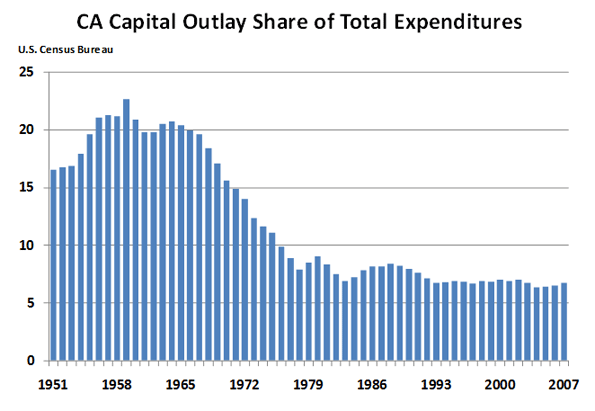
    Not likely. Today, we are not even maintaining our infrastructure. Infrastructure investment’s share of California’s budget has declined for decades. In Pat Brown’s day California often spent over 20 percent of its budget on capital items. Today, that number is less than seven percent. It shows.

    Pat Brown also knew that with California’s natural endowment, all he had to do was build the public infrastructure and welcome business, business will come. Too many today act as if they believe that business will come, even without the infrastructure or a welcoming business climate. Indeed, many Californians – particularly in the leadership in Sacramento – seem to think that business will come no matter how difficult or expensive the state makes doing business in California. This is just not true.

    California needs to embrace opportunity and economic growth. It is necessary if California is to achieve its potential. It is necessary if California is to avoid a stagnant future characterized by a bi-modal population of consuming haves and an underclass with little hope or opportunity and few choices, except to leave.

    Bill Watkins is a professor at California Lutheran University and runs the Center for Economic Research and Forecasting, which can be found at clucerf.org.