Tag: California

  • The Decade of the South: The New State Population Estimates

    Much has been made – particularly in the Northeastern press – of the slowing down of migration to the South and West as a result of the recession. But in many ways this has obfuscated the longer term realities that will continue to drive American demographics for the coming decade.

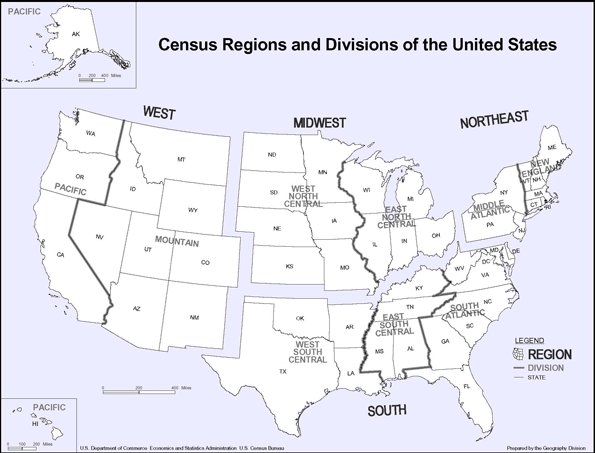
    Americans have been moving from the Northeast and Midwest to the West and South for decades (see US region map). In the first four decades after the Second World War, the warm, dry climates of coastal California were a significant factor. As the nation became more mobile – aided by such things as inexpensive air travel and the interstate highway system and the spread of air conditioning – the larger migration pattern went towards the South. There were, of course, other factors. Business costs, particularly the costs of labor, were often lower in the West and especially the South. Personal taxes in some states were lower than in the Northeast and Midwest. Surely the period from the end of World War II to 2000 could be called the demographic “half-century” of the West and South.

    The New State Census Estimates: The latest (July 1, 2009) Bureau of the Census release of state population estimates indicates a fundamental shift in migration patterns. Yes, even at recession-depressed rates, the Northeast and Midwest continue to export domestic migrants, but they are almost exclusively going to the South now, and not the West (See Table).

    Net Domestic Migration by State
    2009 Rank Net Domestic Migration Rank 2000-2009
    State 2009 2000-2009
    1 Texas    143,423       838,126 2
    2 North Carolina      59,108       663,892 4
    3 Washington      38,201       239,037 9
    4 Colorado      35,591       202,735 10
    5 South Carolina      31,480       306,045 7
    6 Georgia      26,604       550,369 5
    7 Tennessee      20,605       259,711 8
    8 Oklahoma      18,345         42,284 19
    9 Virginia      18,238       164,930 12
    10 Oregon      16,173       177,375 11
    11 Arizona      15,111       696,793 3
    12 Louisiana      14,647      (311,368) 45
    13 Alabama      11,044         87,199 14
    14 Utah        8,623         53,390 17
    15 Wyoming        7,192         22,883 25
    16 Kentucky        6,268         81,711 15
    17 Arkansas        5,298         75,163 16
    18 West Virginia        4,510         17,727 26
    19 District of Columbia        4,454        (39,814) 37
    20 Massachusetts        3,614      (274,722) 44
    21 New Mexico        3,366         26,383 24
    22 Delaware        2,580         45,424 18
    23 Montana        2,410         39,853 21
    24 South Dakota        1,619            7,182 27
    25 Idaho        1,555       110,279 13
    26 North Dakota        1,375        (18,071) 31
    27 Pennsylvania        1,346        (33,119) 34
    28 Alaska           979          (7,360) 29
    29 Missouri          (124)         41,278 20
    30 Nebraska          (956)        (39,275) 36
    31 Vermont          (975)          (1,505) 28
    32 Kansas       (1,242)        (67,762) 41
    33 Iowa       (2,135)        (49,589) 40
    34 New Hampshire       (2,602)         32,588 22
    35 Maine       (2,937)         29,260 23
    36 Nevada       (3,801)       361,512 6
    37 Hawaii       (5,298)        (29,022) 33
    38 Mississippi       (5,529)        (36,061) 35
    39 Wisconsin       (5,672)        (11,981) 30
    40 Rhode Island       (6,172)        (45,159) 38
    41 Indiana       (6,805)        (21,467) 32
    42 Connecticut       (7,824)        (94,376) 42
    43 Minnesota       (8,813)        (46,635) 39
    44 Maryland    (11,163)        (95,775) 43
    45 Florida    (31,179)    1,154,213 1
    46 New Jersey    (31,690)      (451,407) 47
    47 Ohio    (36,278)      (361,038) 46
    48 Illinois    (48,249)      (614,616) 49
    49 Michigan    (87,339)      (537,471) 48
    50 New York    (98,178)  (1,649,644) 51
    51 California    (98,798)  (1,490,105) 50
    Derived from US Bureau of the Census data.

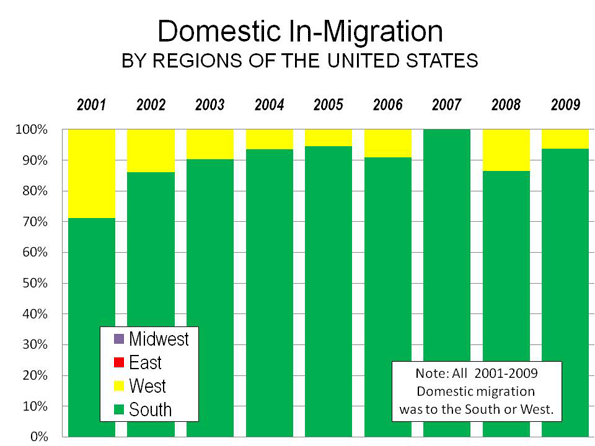
    Moving to the South: Between 2000 and 2009, the South attracted 90% of domestic migrants from other states, with the West accounting for only 10% (see chart below). In 2001, the South attracted 71% of domestic migration but its share rose to 86% in 2002 and accounted for virtually all net migration by 2007. In that year, not only did the Northeast and Midwest lose domestic migrants, but also the West. By 2009, the South’s share of inbound domestic migration fell back to 94%.
    Throughout the decade, the small share of domestic migration that did not go to the South went to the West, while the Northeast and Midwest continued to lose residents. The 2000s are best characterized as the demographic “decade of the South” because the vast majority of Americans moving between states moved South.

    Nearly all states in the South gained domestic migrants during the decade. Only Mississippi, Maryland and Louisiana, along with the District of Columbia, lost domestic migrants. Even before Hurricanes Katrina and Rita, Louisiana was losing domestic migrants. Perhaps the big surprise is Florida, which has led the nation in domestic in-migration for years and has attracted 1.1 million from other states during the 2000s.

    Florida’s peak came in 2004 and 2005, when more than a net 260,000 domestic migrants moved to Florida from other states. Things have changed markedly, however, with Florida rapidly losing domestic migrants in 2008 and 2009, very likely due to the impact of the housing bubble and an overreliance on inbound retirees to drive its economy.

    However, Florida’s recent decline does not weaken the near-monopoly position of the South as the dominant destination of movers. Florida’s rapidly declining domestic migration has been largely replaced by a new domestic migration champion: Texas. In the early 2000s, Texas generally attracted from 30,000 to 50,000 net domestic migrants. Migration from Louisiana from Rita and Katrina propelled Texas to the top in 2006 and the state appears to have consolidated its position as the leader in domestic migration. In 2009, with domestic migration at more modest levels nationally, the Texas gain was more than any year except for 2006 with Hurricanes Katrina and Rita. But it’s not just a Lone Star story. Seven of the top ten states in domestic migration remained in the South in 2009. Throughout the entire decade, 6 of the top 10 states were from the South and 4 from the West. However, most of the gains in the West were simply from moving around (and from California); there was relatively little inter-regional domestic migration.
    Moving Around the West (and Away from California): Most states in the West have also gained domestic migrants in the 2000s, with the exceptions of Alaska, Hawaii and California. California is the real story in the West, having lost nearly 1.5 million domestic migrants, a population greater than that of the city of San Diego. In 2000, California lost nearly 100,000 domestic migrants and for the fourth year in a row led the nation in net domestic out-migration. This includes 2006, when not even Louisiana’s catastrophic hurricanes could drive as many people away as California. During the first year of the decade, California lost only 45,000 net domestic migrants. By 2007, as the center of the worldwide housing bubble, California’s losses were 7 times that amount. In 2009, even with depressed migration rates associated with the recession, out migration more than doubled between 2001 and 2009.

    California is simply not the draw that it used to be. There was a time, in the late 1930s, that the state tried to bar “Okies” from moving to the state, legislation wisely declared unconstitutional by the Supreme Court. Things have certainly changed. The latest Internal Revenue Service data indicates that every year during the 2000s, Oklahoma gained net domestic migrants from California.

    Outside California, there has been healthy domestic in-migration in the West. However, California’s losses cancelled out more than 80% of the West’s gains during the decade. Much of the movement within the region was internal, with Californians shifting to markets where housing was less expensive (but still expensive), such as Arizona, Nevada, Washington and Oregon. More recently the movement to the housing bubble ground zero states of Arizona and Nevada, have all but disappeared, with far smaller gains in Arizona and a small net loss in Nevada in 2009.

    In one year (2007), California lost more domestic migrants than all of the other states of the West gained. Domestic migration in the West remains largely about households moving around within the region: from California to other states, with a far smaller number arriving from elsewhere in the nation.

    Escape from New York (and the Northeast): Domestic migrants continue to leave the Northeast, just as they have for decades. In the Northeast, only New Hampshire and Maine gained domestic migrants in the 2000s. However, it was a bit different in 2009. Both New Hampshire and Maine lost, while Massachusetts and Pennsylvania gained.

    Pennsylvania has been the subject of more than one “what’s wrong with Pennsylvania” report as analysts inside and out decry its competitive position. In fact, by the ultimate measure of competitiveness, where people choose to move to or from, Pennsylvania has done relatively well in the 2000s. Pennsylvania’s modest loss of 33,000 domestic migrants pales by comparison to the net 2.5 million people who have moved away from neighboring New York, New Jersey, Maryland and Ohio. Like Texas, Georgia and many other states, Pennsylvania largely missed the housing bubble, which probably accounts for some of this surprising phenomenon.

    But the relative success of Pennsylvania should not be touted, as the mainstream media would tend to, as a sign of general Northeastern resurgence. New York alone lost 1.65 million over the 2000-2009 period. This is, in absolute numbers, more than California and a larger percentage loss than Louisiana with Katrina and Rita. Critically, data through 2008 shows that most of the domestic migration losses came from New York City and to a lesser extent its suburbs. Upstate New York, which also missed the housing bubble, experienced comparatively modest domestic migration losses, as Ed McMahon and I showed in an Empire Center policy report earlier this year.

    Hollowing out the Heartland: Domestic migrants are also deserting the Midwest, though in somewhat smaller numbers than in the Northeast. Only Missouri and South Dakota gained domestic migrants in the 2000s, although in 2009, Missouri experienced a small loss and was replaced by North Dakota as a gainer. But it is not a region-wide phenomena. Nearly 90% of the loss in the Midwest was in Illinois and the economic basket case states of Michigan and Ohio.

    Slowing Migration: One of the principal stories out of this year’s Census release is that interstate domestic migration declined markedly in 2009. Indeed, domestic migration was lower than in any other year in the decade, but not by that much. In 2009, 500,000 people migrated between the states, compared to between 570,000 and 620,000 annually from 2001 to 2003. Then, from 2003 to 2007, interstate domestic migration was up to 1.25 million and averaged more than 900,000. The anomaly is not so much that domestic migration is down, but rather that domestic migration got so high in the middle part of the decade, at the very same time that house price differences reached unprecedented heights. It’s no wonder people were moving.

    The Future? What comes next after the chaotic decade of the 2000s? As is suggested above, much of the variation in domestic migration is explained by differences housing prices and trends. Indeed, the price of housing may be a surrogate for the cost of living, which varies principally between areas based upon housing cost differences. This is likely to continue. In coastal California, house prices remained above historic norms, even at the largest “bubble burst” losses,” and there are recent indications that unhealthy price escalation has resumed. Much of the West and most of the country is far more affordable. This would suggest that coastal California’s domestic migration losses will continue and rise in the future.

    By contrast, in much of the rest of California and the other “ground zero” states of Florida, Arizona and Nevada house prices have returned to historic norms, which suggests that after the recession, strong domestic in-migration could resume.

    The future looks very bright for Texas and other states in the South that have done so well (such as North Carolina, South Carolina, Georgia, Tennessee, Oklahoma and even Arkansas). Their biggest challenge will be to resist the siren songs to become more like California, with its disastrous policies appreciated only by proponents and a fawning media.

    Wendell Cox is a Visiting Professor, Conservatoire National des Arts et Metiers, Paris. He was born in Los Angeles and was appointed to three terms on the Los Angeles County Transportation Commission by Mayor Tom Bradley. He is the author of “War on the Dream: How Anti-Sprawl Policy Threatens the Quality of Life.

  • What Happens When California Defaults?

    The California Legislative Analyst’s Office recently reported that the State faces a $21 billion shortfall in the current as well as the next fiscal year. That’s a problem, a really big problem. My young son would say it was a ginormous problem. In fact, it may be an insurmountable problem.

    Our governor and legislature used every trick in their books when they created the most recent budget. They even resorted to mandatory interest-free loans from the taxpayers. Now, they have no idea where to go. The Democrats have declared that they will not allow budget cuts. The Republicans will not allow tax increases. They have probably run out of smoke and mirrors, although their ability to engage in budget gimmickry is enough to make an Enron accountant blush. No one is considering raising revenues by increasing economic activity.

    In my opinion, California is now more likely to default than it is to not default. It is not a certainty, but it is a possibility that is increasingly likely.

    Then what?

    Ideally, we’d see a court-supervised, orderly bankruptcy similar to what we see when a company defaults. All creditors, including direct lenders, vendors, employees, pensioners, and more would share in the losses based on established precedent and law. Perhaps salaries would be reduced. Some programs could see significant changes. This is distressing, but it is better than other options.

    Unfortunately, a formal bankruptcy is not the likely scenario. There is no provision for it in the law. Consequently, absent framework and rules of bankruptcy, the eventual default is likely to be very messy, contentious and political.

    Other states have defaulted. Nine states defaulted on credit obligations in the 1840s. Most of those states eventually repaid all of their creditors (see William E. English “Understanding the Costs of Sovereign Default: U.S. State Debts in the 1840s,” American Economic Review, vol. 86 (March 1996), pp. 259-75.) Unfortunately, the examples in the 1840s are not much help in anticipating the impacts of a modern default. Circumstances are different, and things have changed, a lot.

    We’re left with the question: what happens when California defaults?

    The worst case would be the mother of all financial crises. According to the California State Treasurer’s office, California has over $68 billion in public debt, but the Sacramento Bee’s Dan Walters has tried to count total California public debt, including that of local municipalities, and his total reaches $500 billion. Whatever the amount, the impact of default could be larger than the debt amount would imply. Other states – New York, Illinois, New Jersey, for example – are in almost as bad shape as California, and they could follow California’s example. The realization that a state could default would shock markets every bit as much as when Lehman Brothers failed. Given the precarious state of our economy and the financial sector, another fiscal crisis would be disastrous, with impacts far beyond California’s borders.

    What would a California default look like? In a sense, we’ve already seen California default, when that state issued vouchers. If any company tried that, they would be in bankruptcy court in days. Issuing vouchers didn’t trigger a California crisis because banks were willing to honor the vouchers. If banks refuse to honor the vouchers next time, employees and vendors won’t be paid, and state operations will come to a halt. This could happen if our legislature locks up and is unable to act on the current $21 billion problem.

    Another possible California scenario is that the State will try to sell or roll over some debt, and no one buys it. Already, we’ve seen California officials surprised with the interest rates they have had to pay. What happens if no one buys California’s debt? We saw last September what happens when lenders refuse to lend to large creditors.

    If we continue on the current path, the worst case is also the more likely case. Bad news keeps dribbling out. One day we find we are paying 30-percent-higher-than-anticipated interest on a bond issue. A few days later, we find the budget shortfall is billions of dollars higher than projected just a short time ago. Every month brings new bad news. The risk that one of those news events triggers a crisis grows with every news event.

    Given California’s recent history, it is difficult to believe that the people with the authority and responsibility for California’s finances can act responsibly, but that is what we need. Responsible action would be creating a gimmick-free budget that places California finances on a sustainable path, and provides an environment that allows for opportunity and job creation. But, sadly, Sacramento probably cannot draft an honest balanced budget, and will thus need to plan for California’s eventual default. They need to work with Federal Government and Federal Reserve Bank officials to insure a coordinated plan to limit damage to financial markets. That plan needs to be ready to release when markets go crazy, which is exactly what could happen when participants realize that default is possible. It could be needed sooner than they think.

    Bill Watkins is a professor at California Lutheran University and runs the Center for Economic Research and Forecasting, which can be found at clucerf.org.

  • Capping Emissions, Trading On The Future

    Whatever the results of the Copenhagen conference on climate change, one thing is for sure: Draconian reductions on carbon emissions will be tacitly accepted by the most developed economies and sloughed off by many developing ones. In essence, emerging economies get to cut their “carbon” intensity–a natural product of their economic evolution–while we get to cut our throats.

    The logic behind this prediction goes something like this. Since the West created the industrial revolution and the greenhouse gases that supposedly caused this “crisis,” it’s our obligation to take much of the burden for cleaning them up.

    Plagued by self-doubt and even self-loathing, many in the West will no doubt consider this an appropriate mea culpa. Our leaders will dutifully accept cuts in our carbon emissions–up to 80% by 2050–while developing countries increase theirs, albeit at a lower rate. Oh, we also pledge to send billions in aid to help them achieve this goal.

    The media shills, scientists, bureaucrats and corporate rent-seekers gathered at Copenhagen won’t give much thought to what this means to the industrialized world’s middle and working class. For many of them the new carbon regime means a gradual decline in living standards. Huge increases in energy costs, taxes and a spate of regulatory mandates will restrict their access to everything from single-family housing and personal mobility to employment in carbon-intensive industries like construction, manufacturing, warehousing and agriculture.

    You can get a glimpse of this future in high-unemployment California. Here a burgeoning regulatory regime tied to global warming threatens to turn the state into a total “no go” economic development zone. Not only do companies have to deal with high taxes, cascading energy prices and regulations, they now face audits of their impact on global warming. Far easier to move your project to Texas–or if necessary, China.

    The notion that the hoi polloi must be sacrificed to save the earth is not a new one. Paul Ehrlich, who was the mentor of President Obama’s science advisor, John Holdren, laid out the defining logic in his 1968 best-seller, The Population Bomb. In this influential work, Ehrlich predicted mass starvation by the 1970s and “an age of scarcity” in key metals by the mid-1980s. Similar views were echoed by a 1972 “Limits to Growth” report issued by the Club of Rome, a global confab that enjoyed a cache similar to that of the United Nations’ Intergovernmental Panel on Climate Change.

    To deal with this looming crisis, Holdren in the 1977 book Ecoscience (co-authored with Anne and Paul Ehrlich) developed the notion of “de-development.” According to Holdren, poorer countries like India and China could not be expected to work their way out of poverty since they were “foredoomed by enormous if not insurmountable economic and environmental obstacles.” The only way to close “the prosperity gap” was to lower the living standards of what he labeled “over-developed” nations.

    These predictions were less than accurate. World-wide systemic mass starvation did not take place as population escalated. Rather those many millions wallowing in poverty in the developing world, particularly in Asia, lifted themselves into the global middle class. Far more efficient ways to use energy have been developed, and unexpected caches of new resources continue to be discovered all over the planet.

    Yet however wrong-headed, Holdren’s world view now has jumped from the dustbin of history into the craniums of presidents and prime ministers. President Obama’s pledge to “restore science to its rightful place” has morphed into state-sponsored scientific ideology.

    The blind acceptance of this agenda threatens the credibility of Obama and other Western leaders. For one, if the crisis is by its nature global why should we allow massive increases in carbon emissions in developing countries–China will soon surpass us in greenhouse gas emissions, if it hasn’t already–while we draconically cut ours? Does the planet really care if it’s turned to toast by American- vs. Chinese-made gas?

    Then there’s the specious historical narrative that insists we pay for creating the industrial revolution since it brought on global warming. Should the West pay for the sins of the British who brought electricity and railroads to India? Does America owe carbon penance for making the technology transfers critical to East Asia’s remarkable rise? Maybe we should start by making Wal-Mart cancel its China orders. That might help de-carbonize the planet a bit.

    There’s also growing skepticism about the whole warmist narrative. Climate change now ranks last among 20 top issues in a recent Pew report. There’s been a similar rise in skepticism in the U.K., once a hot bed of warmist sentiment.

    The reasons for the shift may vary. First, there’s a controversy over the temperatures of the past decade, with even some concerned about climate change admitting that there has not been the expected warming. Or perhaps a deep recession has made many “rich” countries feel a trifle less “overdeveloped.”

    And now we have Climate-gate–where leading warmist pedagogues are trying to suppress unsuitably conformist scientists and perhaps even cook the numbers a bit. Although you won’t see too much tough coverage in the mainstream press, the tawdry details have poured out over the Internet and diminished the aura of scientific objectivity of some leading global warming researchers. One recent poll shows that a large majority of Americans believe scientists may have indeed falsified their research data. By well over 4 to 1, they also believe stimulating the economy is a bigger priority than stopping global warming.

    Clearly the political risks of giving first priority to the carbon agenda are on the rise. Australia’s Senate just voted down that country’s proposed cap and trade scheme. The Western center-right, once intimidated by the well-financed greens and their media claque, has become bolder in challenging climate change alarmism.

    There’s also something of a rebellion brewing, at least toward emissions trading schemes, among some liberals from the South and Midwest, notably Wisconsin’s Russ Feingold and North Dakota’s Byron Dorgan. As analyst Aaron Renn has pointed out, these areas are most likely to be negatively affected by the current climate change legislation. Feingold recently stated that he was “not signing onto any bill that rips off Wisconsin.”

    So why do leaders like Barack Obama and British Prime Minister Gordon Brown continue identifying themselves with the climate change agenda and policies like cap and trade? Perhaps it’s best to see this as a clash of classes. Today’s environmental movement reflects the values of a large portion of the post-industrial upper class. The big money behind the warming industry includes many powerful corporate interests that would benefit from a super-regulated environment that would all but eliminate potential upstarts.

    These people generally also do not fear the loss of millions of factory, truck, construction and agriculture-related jobs slated to be “de-developed.” These tasks can shift to China, India or Vietnam–where the net emissions would no doubt be higher–at little immediate cost to tenured professors, nonprofit executives or investment bankers. The endowments and the investment funds can just as happily mint their profits in Chongqing as in Chicago.

    Global warming-driven land-use legislation possesses a similarly pro-gentry slant. Suburban single family homes need to be sacrificed in the name of climate change, but this will not threaten the large Park Avenue apartments and private retreats of media superstars, financial tycoons and the scions of former carbon-spewing fortunes. After all, you can always pay for your pleasure with “carbon offsets.”

    So who benefits from this collective ritual seppuku? Hegemony-seeking communist capitalists in China might fancy seeing America and the West decline to the point that they can no longer compete or fund their militaries. A weakened European Union or U.S. also won’t be able provide a model of a more democratic version of capitalism to counter China’s ultra-authoritarian version.

    The Chinese may win a victory in Copenhagen greater than anything accomplished so far in the marketplace–and our leaders will likely thank them for it. Forget bowing to the emperor in Tokyo; like vassal states at the height of the old Middle Kingdom, the new requisite diplomatic skill for Westerners will be kow-towing to Beijing.

    Yet most people in the developing world will not benefit from the suicide of the West. The warmists’ vision is not one of growing prosperity, but of capping wealth at a comparatively low level. De-industrialization means the West falls back while emerging economies grow a bit. The “prosperity gap” may close, but ultimately everyone is left with less prosperity.

    In the long run developing countries gain less from harvesting guilt than enjoying a bounty of customers, capital and expertise. The West’s experience and technology can assist developing nations in improving their far more greatly threatened environment. Turning the West into a spent force will leave the world poorer, dirtier and ultimately less hopeful.

    This article originally appeared at Forbes.com.

    Joel Kotkin is executive editor of NewGeography.com and is a distinguished presidential fellow in urban futures at Chapman University. He is author of The City: A Global History. His next book, The Next Hundred Million: America in 2050, will be published by Penguin Press early next year.
  • Think Globally, Regulate Locally

    It was during a recent tour of a sun-baked Los Angeles schoolyard that theories on state regulations developed by the latest Nobel Prize-winning economist came into focus. The Da Vinci Design Charter School is an oasis in an asphalt desert. Opened this year by the appropriately named Matt Wunder, the school draws 9th and 10th graders from some of the most difficult and dangerous learning environments in the country, and introduces them to a demanding, creative atmosphere.

    The school is located just south of Los Angeles Airport. Wunder is taking advantage of the area’s proliferation of aerospace companies, and is building relationships with the likes of Boeing and Northrop Grumman, which offer financial and educational assistance. This is not the standard thinking one finds in the mammoth Los Angeles Unified School District.

    As we walked the playground we came upon two dirt-spewing holes in the blacktop, spaced about 50-feet apart. We discovered an actual human being with a shovel digging what looked like the beginnings of a mine shaft. The reason?

    California State regulations, as established by the California Architects Board, require all basketball hoops on public school campuses to be cemented into 50-inch deep holes. That’s four-feet-two inches for a basketball hoop!

    Now I am sure some scientifically sound earthquake testing at a California university found that such precautions are necessary if we are ever struck with a 9.9-Richter scale disaster. Of course, if such a thing happened we would have bigger problems than basketball rims keeling over. But a larger point became clear: In a school where creative leadership is making life-long impacts on the lives of children, the “long arm” of Sacramento has reached into the very soil, regulating how deep to dig ditches for recreational equipment. In so doing the State not only increases “construction” costs, but also incurs our disenchantment, as we consider a government that “trusts” local decision-making on curriculum, but not on hole digging.

    The theories of Elinor Ostrom, one of this year’s two Nobel Prize-winners in economics, tie in here with stunning irony. Ostrom, a political scientist at Indiana University, won the prize for her historical and economic analysis concerning the “tragedy of the commons”: the theory that, without some form of regulation, when people fish or farm “common” (non-private) property they will tend to abuse the privilege and hurt all interests in the end.

    A major underpinning of this theory is how these rule sets are most effectively developed. Ostrom found, in studies dating back centuries, that local parties –- sometimes non-governmental ones — almost always determine the best regulations, based on deliberated self-interest as opposed to centralized (and, often, distant) institutions.

    As Vernon Smith, a past economics Nobel laureate himself, recently commented on Ostrom’s work, “A fatal source of disintegration is the inappropriate application of uninformed external authority, including intervention to prevent application of efficacious rules to political favorites.” As rule-making becomes more removed from the actual location of execution, there’s a loss of “local knowledge” regarding conditions. And “interests” that tend to gather around centralized institutions have a disproportionate influence on legislation.

    At a recent conference on sustainable planning at Pepperdine University, I sat in on a discussion of “natural resource management” and heard a relevant story of competing, predominantly left-leaning interests. In one corner were the “green” energy folks who had attempted to build a massive solar “farm” in the Mojave Desert. In the same, uh, other corner, were the defenders of the desert tortoise. Not wanting to get anyone in trouble, I will just say that officials from several State and Federal departments were present to talk about how, once again, centralized decision-making had sunk an impressive project.

    Apparently, when alerted to the possibility of frying turtles under the heat of these huge solar mirrors, local park authorities provided a proposal to mitigate the loss of these reptiles through a variety of measures from fencing along the highways to moving the turtles to non-developed areas. This was not good enough for State decision-makers who, from the exalted heights of Sacramento, determined that the only legitimate course of conservation would be to land-swap the entire 8,000+-acre land parcel for another similar and suitable section for these animals. As one local official recounted, “If the goal of the policy is to save tortoises, we had that plan, which also kept the solar project alive. But the goal of the policy was to do a land exchange, which is stopping the project, and not doing all that much better for the tortoises.”

    My point in raising these two of what could be thousands of examples of overreach by the administrative state is not to dismiss government’s central and important role in advising, and, at points, regulating the actions of citizens in areas ranging from public safety to sustainable planning. Rather, it’s to demonstrate what happens when policy goals are subsumed by prescriptive policy created at levels (such as Sacramento in a state the size of California) which cannot possibly allow for unique local conditions. The goal is not just child safety, or saving tortoises, but to accomplish these in a certain way that may, in fact, prevent these greater benefits to the public good.

    This style of governance exasperates the well-intentioned in both the private and public sector, as it prevents the liberty necessary for creative and customized policy-making. This common sense approach to policy-making is, apparently, what they give out Nobel Prizes for these days.

    It was Alexis De Tocqueville who most famously realized that the genius in American governance was decentralized administration , an aspect directly contrary to the European bureaucratic experience. In words that could have appeared in Professor Ostrom’s classic, Governing the Commons, De Tocqueville wrote over 150 years ago, “When the central administration claims to replace completely the free cooperation of those primarily interested, it deceives itself or wants to deceive you. A central power, however enlightened… cannot gather to itself alone all the details of the life of a great people.”

    Let us not be so deceived.

    Pete Peterson is Executive Director of Common Sense California, a multi-partisan non-profit organization that supports civic engagement in local/regional decision-making. His views here are not meant to represent CSC. Pete also teaches a course on civic participation at Pepperdine University’s School of Public Policy.

  • California: The Housing Bubble Returns?

    To read the periodic house price reports out of California, it would be easy to form the impression that house prices are continuing to decline. Most press reports highlight the fact that house prices are lower this year than they were at the same time last year. This masks the reality of robust house price increases that have been underway for nearly half a year. The state may have forfeited seven years of artificially induced house price escalation in just two years but has recovered about one-fifth of it since March.

    California Housing Market Since 2000: In 2000, the average median house price among California markets with more than 1,000,000 population was $291,000. The Median Multiple (median house price divided by median household income) was 4.5, making houses in California approximately 50% more costly relative to incomes than in the rest of the nation.

    According to the California Association of Realtors, the average median price peaked at $644,000 between 2005 and 2007, depending upon the particular market. This nearly 140% price increase translated into a more than doubling of the Median Multiple, to 9.2.

    Median prices fell rapidly from the peak, dropping at their low point to an average of $315,000. The average Median Multiple fell to 4.4, slightly below the 2000 level, but still well above the national level. All markets reached their low points in the first part of 2009.

    It is at this point that the business press lost track of what was going on. Of course, year on year price declines continued, but only because the price declines had been so severe early 2008. Since the bottoming out of house prices, there have been strong gains. As of September, the average median house price among the major metropolitan areas was $383,000, a nearly 20% increase from the low point. Moreover, in dollar terms, median house prices recovered nearly 20% of their loss from the peak to the low point.

    Major California Markets: Median House Prices: 2000 to Present
    Metropolitan Area (MSA) 2000 Peak Low Point 2009/09 Loss: Peak to Low Pt Change from Low-Pt
    Los Angeles: Los Ang. County  $ 215,900  $ 605,300  $  295,100  $  351,700 -51.2% 19.2%
    Los Angeles: Orange County  $ 316,200  $ 747,300  $  423,100  $  496,800 -43.4% 17.4%
    Riverside-San Bernardino  $ 144,000  $ 415,200  $  156,800  $  172,400 -62.2% 9.9%
    Sacramento  $ 172,000  $ 394,500  $  167,300  $  184,200 -57.6% 10.1%
    San Diego  $ 231,000  $ 622,400  $  321,000  $  386,100 -48.4% 20.3%
    San Francisco  $ 508,000  $ 853,900  $  399,000  $  536,100 -53.3% 34.3%
    San Jose  $ 448,000  $ 868,400  $  445,000  $  553,000 -48.8% 24.3%
    Average  $ 290,700  $ 643,800  $  315,300  $  382,900 -52.1% 19.4%
    Exhibit: Median Multiple            4.5            9.2            4.4            5.2
    Above Historic Norm (3.0) 50% 208% 46% 73%
    Derived from California Association of Realtors and National Association of Realtors data
    Note: California Association of Realtors divides the Los Angeles MSA into Los Angeles and Orange counties

    Profligate Lending: It is critical to note that the inflated house prices that existed two to three years ago were wholly artificial. Prices had been driven up by the special and hopefully never to be repeated conditions of profligate lending, which increased demand.

    California: Regulating Away Housing Affordability: But the increase in demand alone would not have been enough to produce the unprecedented house price increases had public officials and voters not established a veritable mish-mash of housing supply regulations. The house price increases were driven ever higher by these severe land use restrictions, which prevented housing markets state from meeting demand.

    Supply restrictions, which go under various names, such as compact development, urban containment and “smart growth,” have been a feature of California housing for some time. Examples of such policies are urban growth boundaries, building moratoria and expensive development impact fees which disproportionately tax new homes for the expanded community infrastructure a rising population requires.

    As more loose lending practices increased the demand for home ownership, the inability (and unwillingness) of the state’s land use regulations prevented the housing supply from increasing in a corresponding manner. With demand for housing far outstripping supply, prices had nowhere to go but up. The result was short term house price escalation that may have never occurred before in a first-world nation.

    Contrast with Healthy Housing Supply Markets: There was a stark contrast with house price increases in the liberally regulated markets around the nation. For example, in Atlanta, Dallas-Fort Worth and Houston, house prices remained near or below the historic Median Multiple norm of 3.0, as the supply vent was allowed to operate. This is despite the fact that there was a strong underlying increase in demand for home ownership (measured by domestic migration) in these and other liberally regulated markets. In the California markets, on the other hand, there was overall negative underlying demand, with significant domestic out-migration. Of course, speculation ran rampant in California, as could be expected in any market where asset values are responding to a severe shortage of supply relative to demand.

    By the 1990s, Dartmouth’s William Fischel had associated California’s high house prices relative to the nation with the intensity of its land use regulation. In 1970, as the more severe regulations were beginning, house prices in California were at approximately the same level relative to incomes as in metropolitan areas in the rest of the nation.

    California’s disproportionate losses are illustrated by the fact that its major metropolitan areas have less than twice as many total owned houses as those in Texas (Dallas-Fort Worth, Houston, San Antonio and Austin), yet experienced gross value losses 85 times as great as the Texas metropolitan areas by Meltdown Monday (September 15, 2008, when Lehman Brothers failed).

    Recent Price Increase Rate Exceeds the Bubble: While widely unnoticed, the post-bottom median house price has increased 20%. In six months or less, the average median price increase among California metropolitan areas exceeded the annual price increase for all of the bubble years except one, which was 22% in 2004. The 2009 price increase rate, annualized, is nearly double that. As a result, despite the widely reported bubble collapse, California’s housing affordability now is worsening relative to the rest of the nation. The prospect could be for further inflation of the bubble, with the passage of Senate Bill 375, which is likely to lead to even more intensive land use restrictions, on the false premise that higher densities will materially reduce greenhouse emissions. As governments increasingly force development to occur only where it prefers, the property owning winners can extract much higher prices than would occur if there were more competition.

    This of course will mean that the more dense housing units built will be even more expensive, even as the market is prohibited from supplying the larger detached homes that households overwhelmingly prefer. All this will make California less competitive, something the increasingly uncompetitive Golden State could do without.

    Another View: The recent price escalation, however, may be illusory. The widely read California real estate blog, Dr. Housing Bubble suggests that the first wave of “sub-prime” loan failures that constituted the bubble burst could be followed by a second wave over the next few years, driven by “option arm” mortgage resets. The Doctor notes that these loans are concentrated in California and other ground zero states (Florida, Arizona and Nevada), unlike the previous wave, which was more evenly spread around the nation.

    In the End: Regulation Will Lose the Day: Thus, the “jury is still out.” The bubble may be re-inflating in California, or another bust could be on the horizon. However, in a state that has given new meaning to regulatory excess, the longer run prospects call for artificially higher housing prices, unaffordable to much of the state’s middle class. This means that California will continue to become an ever-more bifurcated state, between an aging, largely affluent coastal homeowning population and, well, just about everyone else.

    Photograph: Los Angeles (Porter Ranch in the San Fernando Valley)

    Wendell Cox is a Visiting Professor, Conservatoire National des Arts et Metiers, Paris. He was born in Los Angeles and was appointed to three terms on the Los Angeles County Transportation Commission by Mayor Tom Bradley. He is the author of “War on the Dream: How Anti-Sprawl Policy Threatens the Quality of Life.

  • Boomer Economy Stunting Growth in Northern California

    The road north across the Golden Gate leads to some of the prettiest counties in North America. Yet behind the lovely rolling hills, wineries, ranches and picturesque once-rural towns lies a demographic time bomb that neither political party is ready to address.

    Paradise is having a problem with the evolving economy. A generational conflict is brewing, pitting the interests and predilections of well-heeled boomers against a growing, predominately Latino working class. And neither the emerging “progressive” politics nor laissez-faire conservatism is offering much in the way of a solution.

    These northern California counties–which include Sonoma, Napa, Solano and Marin–have become beacons for middle- and upper-class residents from the Bay Area. These generally liberal people came in part to enjoy the lifestyle of this mild, bucolic region, and many have little interest in changing it.

    “The yuppies have insulated themselves here for the long term,” notes Robert Eyler, a director at the Center for Regional Economic Analysis at Sonoma State University. “The boomers have blocked everyone else different in age and skill from rising up and making their place.”

    Nowhere is this more evident than in the “green,” anti-growth movement so prevalent in these places. Strong restrictions of business growth, bolstered by California’s draconian land-use regulations, have turned these areas into business no-go zones. This has become increasingly clear after the collapse of the real estate boom, which created thousands of jobs for agents, mortgage brokers and construction workers.

    Hard times have come to paradise. Unemployment in Sonoma now tops 10%, up from barely 3% two years ago, notes Eyler. The rate is slightly higher in neighboring Solano County but a bit lower in wealthy Marin and Napa. Across the region, vacancy rates for offices and other commercial buildings have reached as high as 30%. Overall, by some estimates, the vacancy rate is higher in Sonoma than in Detroit.

    These conditions, local business leaders suggest, seem to have no effect on the region’s well-organized and well-financed greenies, who often see any growth as a threat to their quality of life

    Of course, economic reversal can sometimes hurt the balance sheets of wealthy yuppies and early retirees, but Eyler suggests the change could prove most devastating to the next generation of residents. In 2000 these counties were almost 70% white; Eyler projects that by 2030 they will be majority minority, with the Latino percentage more than doubling to almost one-third the population.

    At the same time, the predominant white population will be getting older and even less supportive of economic growth. The boomers who moved to paradise may not have “put up a parking lot” as much as rooted themselves firmly into the ground. Already Marin, the wealthiest county, is among the oldest in California, vying with other high-end places like San Francisco and Orange and Ventura Counties.

    Today in Marin, there are still more people aged 40 to 55 than over 65. But by 2025 the over-65 crowd will be as large as the prime working-age population (which comprises those in their 30s and 40s) and should be larger than the under-25 population. The old and young also will diverge greatly in their ethnicities. In virtually all North Bay areas, the bulk of the codgers will be white, while most young people will be Hispanic or other minorities.

    In the past, besides construction, these young workers might have found employment in the area’s once-burgeoning electronics and telecommunications industry. But many of these companies have moved operations to more business-friendly regions or overseas. “When these kids who are in school now grow up, we are going to have a huge job crisis here,” Eyler warns. “But when the boomers are gone, what happens when all the jobs have moved to Des Moines?”

    Of course, the widely accepted solution to this dilemma comes in the color green–that environment jobs will provide the new employment. Indeed by some accounts, most embarrassingly in a recent Time magazine cover, the shift to green technologies has already created a “thriving” economy.

    This would be news to a state that suffers 12% unemployment, massive outmigration and among the worst business climates in the country. Time extols Google, Apple, Facebook, Twitter and the other Silicon Valley companies as exemplars leading to a glorious prosperity; somehow the article missed the empty factories, vacant offices and abandoned farms across the state.

    Not surprisingly, California’s middle class is getting hammered, and has for years. Since 1999, according to research at the California Lutheran University forecast project, the state has experienced a far more dramatic drop in households earning between $35,000 and $75,000, than the national average. At the same time California’s poverty rate has grown at a more rapid pace than the national average, with a huge spike since 2006.

    This reflects a strange disjunction between the optimism of the top-tier boomers–venture capitalists, academics and the self-described progressives–and the realities facing most Californians. For Apple’s Steve Jobs, Google’s Eric Schmidt and venture capitalists connected to Al Gore, these could well be the best of times. Fed policy prints money for investment bankers to speculate; stock prices rise as people have nowhere else to invest. And for the much celebrated venture community, there’s also an Energy Department that pours hundreds of millions into “green” start-ups that build things like expensive electric cars.

    California’s high-tech greens may talk a liberal streak in terms of diversity and social justice, but their prescriptions offer little for those who would like to build a career and raise a family in 21st century California. Their policies in terms of land use regulation and greenhouse gas emissions will make it even harder for existing factories, warehouses, homebuilders and other traditional employers of the middle- or working class. “In effect,” Eyler notes, “the progressives have become regressives.”

    In the real world hype and enthusiasm are not sufficient to create a sustainable economic model. In order to grow a “green” economy, you first have to have an economy. To be sure, there are potential opportunities in the development and implementation of energy-saving technologies in the next decade, including wind and solar energy, but it’s doubtful that many jobs can be generated without a major shift in the economic climate here.

    One key problem, as suggested in a recent analysis by Rob Sentz at Economic Modeling Specialists, is that green is not really about “what” you make but about “how” you make it. Green jobs, for the most part, will come from growth in construction, manufacturing and warehousing industries.

    Yet the “greenest” parts of the country–places like the northern end of the Bay Area–are among the toughest places to build or manufacture anything, without huge public-sector subsidies. Indeed, California’s new green requirements, compared with places like Texas or China where manufacturing has other advantages, would further undermine an already struggling sector. Few businesspeople see much growth in the near future in office or residential construction.

    This leaves “green” industries reduced to largely improving the energy footprint of existing structures, an effort that will no doubt be further undermined by the deteriorating picture for many commercial mortgages. At best, Eyler notes, this may create a small temporary surge in jobs, but the long-term effects will likely be limited.

    Ultimately, the only way out of this looming crisis lies with the boomer gentry doing something totally out of character: getting past their self-interest and self-love for the good of the next generation. In the process, they do not have to give up preserving paradise, but focus as well on creating economic opportunity for the emerging working and middle class majority. If not, their Eden will end up as a green version of a gated community.

    This article originally appeared at Forbes.com.

    Joel Kotkin is executive editor of NewGeography.com and is a distinguished presidential fellow in urban futures at Chapman University. He is author of The City: A Global History. His next book, The Next Hundred Million: America in 2050, will be published by Penguin Press early next year.

  • Reducing Carbon Should Not Distort Regional Economies

    A pending bill in Congress to reduce carbon emissions via a “cap and trade” regime would have significant distorting effects on America’s regional economies. This is because the cost of compliance varies widely from region to region and metro to metro. This is all the more important since such legislation may do very little to reduce overall carbon emission according to two of the EPA’s own San Francisco lawyers.

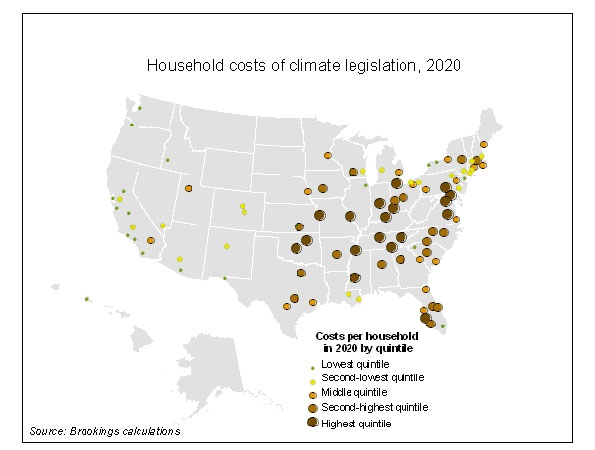
    The Brookings Institution recently calculated the projected cost of compliance under the cap and trade plan on a metro by metro basis and produced the map below for The New Republic:

    The costs of compliance are highest in the lower Midwest through to the Mid-Atlantic and in the South. New England, the Upper Midwest, and the West are the winners from a cost standpoint.

    The actual costs vary from a high of $277 per household per year in 2020 in Lexington, KY to a low of $96 in Los Angeles among the 100 largest metros. Other hard hit metros include Washington, DC ($250), Indianapolis ($246) and Kansas City ($228). Among the winners are Portland ($107), San Francisco-Oakland-Fremont ($119) and Chicago ($135).

    In aggregate, this adds up to a significant amount of money. The Cincinnati metro had 815,000 households in 2008. Brookings did not include their household estimates for 2020, but even with no population growth at all, at $244 per household that still adds up to about $200 million per year in compliance costs. To put that in perspective, Cincinnati is proposing to construct a new downtown streetcar system for that same amount of money. It could conceivably build a new streetcar line every single year in perpetuity for the cost of compliance. Portland has 835,000 households, for an annual compliance cost of $90 million. Though they are about the same size regions, Cincinnati will be paying over $100 million more per year compliance costs. This creates a $100 million disincentive to live or locate a business in Cincinnati vs. Portland.

    In short, cap and trade creates disparities between metros. As the New Republic put it, “place matters” on cap and trade. And because the effects are geographically clustered, these disparities aren’t just local, they are regional. This is enough to immediately prompt the question as to whether or not this was an implicit design goal of the system.

    Among the biggest beneficiaries of cap and trade is California. Its large metros are clustered together at the bottom of the list. I noted previously how California is placing a huge bet on the green economy as its engine of economy renewal. In fact, beyond legacy industries such as high tech, agriculture, and entertainment, California’s political leaders are betting their entire future on green. With so much on the line for California, it should come as no surprise that the state would seek to federalize its policies and institutionalize the advantages it has in this arena through its state level climate regulations. One might even better name this bill “The California Economic Recovery and Competitor Hobbling Act of 2009”.

    This reality isn’t lost on Indiana Governor Mitch Daniels. With Indianapolis the fifth hardest hit metro in the country, it is no surprise he denounced the plan in a Wall Street Journal editorial, saying, “Quite simply, it looks like imperialism. This bill would impose enormous taxes and restrictions on free commerce by wealthy but faltering powers – California, Massachusetts and New York – seeking to exploit politically weaker colonies in order to prop up their own decaying economies.”

    It is clear that getting a bill out of Washington is not just a matter of cost, but of states and regions jockeying for position. The significant regional disparities in impact grind the legislative gears and might ultimately imperil getting legislation passed. Reducing regional disparities could help improve the chances of action on carbon.

    But shouldn’t places that implemented what is considered good policy be rewarded? To some extent, yes. Many places actually voted to cause economic pain for themselves for the sake of a better environment. Other places have fought environmental regulation every step of the way. Clearly, we do want to provide incentives for good behavior, and certainly not reward bad.

    On the other hand, not all the differences in current carbon emissions or abilities to reduce them are the result of good policy. Quite a bit of them are the result of simple good luck. Some places have climates that reduce the need for heating and air conditioning. Other places face more extreme weather.

    Plentiful clean energy sources are unequally spread throughout the country. Not every place has access to large amounts of solar, wind, or hydro power sources. Much of the Midwest and South built coal fired power plants due to plentiful coal supplies in the region. Technology and transportation costs made other sources cost prohibitive. Carbon emissions were not on anyone’s radar then. Some places like Chicago were fortunate to build nuclear plants, which were bitterly opposed by environmentalists at the time, but now are praised by some as a source of low carbon power.

    In short, much of the inequality in carbon emissions results from accidents of geography or history, not deliberate bad choices. People shouldn’t be punished for practices that were rational at the times. As Saul Alinksy put it, “Judgment must be made in the context of the times in which the action occurred and not from any other chronological vantage point.” And while one could say perhaps regions whose climates require excessive heating and cooling shouldn’t be favored places to live, one could say the same about much of the West, including California, whose existence depends on a vast edifice of what many consider environmentally destructive water works.

    To actually get action on carbon – the true imperative – we should adopt the following policy guiding principles:

    1. The goal is carbon reduction, full stop. Encumbering it with additional regional economic gamesmanship, or becoming overly enamored with particular means to that end should be avoided.
    2. Reducing carbon emissions will come with an economic cost. It isn’t realistic to expect that we will get away with pain free reductions. Obviously we should seek to get the best blend of costs and benefits, but let’s not pretend we can have our cake and eat it too, holding carbon action hostage to a standard that can never be met.
    3. The carbon reduction regime should not create significant regional cost disparities. As a purely practical matter, this helps ease passage and should be embraced. Complete equality is never realistic, but when some regions will pay twice as much as others, that by itself creates oppositional voting blocs. If a cap and trade scheme is the preferred approach, then perhaps assistance to high compliance cost areas should partially fund the transition away from coal and towards less polluting sources.
    4. The carbon reduction regime should not encourage business to migrate offshore. We should also not take action that reduces the attractiveness of America as a place to do business and especially to manufacture. Regulatory arbitrage already provides an incentive to move to China, where you can largely escape environmental rules, health and safety regulations, and avoid the presence of independent, vigorous unions. An ill chosen carbon regime could simply enhance China’s allure as a “carbon haven”. Again, this skews manufacturing regions and labor interests against action on carbon, while shifting production to areas with only minimal regulatory restraints.

    In short, action on carbon reduction may well be a good policy goal. But we shouldn’t embrace any means to that end uncritically if it creates huge distortions in regional economic advantage or further damages America’s industrial competitiveness.

    Aaron M. Renn is an independent writer on urban affairs based in the Midwest. His writings appear at The Urbanophile.

  • A Slow Job Recovery in Silicon Valley

    Although job growth is gradually returning to Silicon Valley, don’t break out the champagne quite yet.

    Lucia Mokres moved to the area five years ago. Last year, when she was working at a contract engineering and manufacturing firm, she saw several clients lose their jobs, as well as both large and small companies go under in the economic crunch. She remembers one conference vividly. While manning the event booth, instead of seeing people pitch work they had for her firm, they instead passed out resumes, asking her team for work.

    Soon after, her job was cut back from 5 days per week to 4 days, which included a 20% pay cut. Mokres said, “That was really hard, as my rent and student loans did not also get cut 20%.”

    She persisted over “many months” to find a better position, which ultimately resulted in a higher salary and better benefits as a clinical scientist in a medical device company based in Menlo Park, Calif. Looking ahead now, Mokres feels optimistic about her future in Silicon Valley and said, “I am in the medical industry, and there will always be a demand for medical technology and healthcare.”

    “There are worse places to be,” she added. “I’m in one of the top two biotech hotspots in the country. Silicon Valley breeds innovation, and therefore will survive.”

    Harold Lee* feels less cheerful. He was the class president at a tier one university several years ago, and since graduating in 2004, he has worked at several of the top companies in Silicon Valley. He is now a product manager at a social networking startup based in Mountain View, Calif. While he couldn’t imagine leaving the area, he summarized his long-term prospects in one word: “limited.”

    Lee counts himself lucky to have a job at a popular startup, when the signs around him are still troubling. “There’s definitely a palpable feeling of companies scaling back,” he said. “Free lunches are no longer free, snacks are rationed out a bit more, and there’s a lot more focus on measured productivity.”

    Reports from friends and peers, particularly those who have been laid off in the last year, have not lifted the gloom. Said Lee, “Things have settled down to the point where people aren’t frightened, but I doubt anyone would be surprised if they got a pink slip tomorrow.” He added, “Trying to get a job is immensely difficult. I have friends who returned to get their graduate degrees in business, who now can’t land anything.”

    The lagging indicator in economics is jobs, which, for the average worker, has the biggest personal impact. Over the last year, California lost 732,700 jobs, the worst hit of all U.S. states, according to the U.S. Bureau of Labor Statistics.

    The job situation in Silicon Valley has not rebounded as quickly as hoped. The area’s jobless rate is nearly double what it was a year ago, according to the state’s Employment Development Department. Nearly three times as many people are actively looking for work, versus during the dot-com bust, when the jobless rate peaked at 9.2 percent in early 2003. The recent number of unemployed is 110,900, representing an 87 percent increase from the prior year, according to the EDD.

    The technology industry has continued to take a beating in the past six months. Cisco cut 700 local jobs in July, and Lockheed Martin slashed nearly 500 local jobs in August, based on state filings. Most recently in October, Sun Microsystems Inc. announced that it would eliminate up to 3,000 jobs across all sites, or 10 percent of its worldwide work force through the new year, due to the takeover by Oracle Corp.

    The larger question is if the recovery in Silicon Valley will be technology-led. Many believe that the tech industry, which dominates local economics, will lead other companies out of the recession. Does a rising tide lift all boats? Due to the slower return of jobs, it will likely take more time for tech companies to generate the tax revenue needed to support the service sector and other programs again.

    However, local leaders and economists feel that the worst has passed. The usual suspects are optimistic. Stanford University recently hosted its fourth annual roundtable, and the panel discussion dove immediately into the economic crisis. Moderated by television host Charlie Rose, the panel included Eric Schmidt, chairman of the board and chief executive officer of Google; Penny Pritzker, who serves on President Barack Obama’s Economic Recovery Advisory Board; Guillermo Ortiz, governor of the Bank of Mexico; Stanford Economics Professor Caroline Hoxby; Garth Saloner, dean of the Stanford Graduate School of Business; and Stanford President John Hennessy.

    Google’s CEO Schmidt told the audience: “We know that things are improving. We’re seeing everyone come up at the same time, which is a good sign.”

    Other experts, who track economic growth, echo similar sentiments. The perennially optimist Stephen Levy of the Center for Continuing Study of the California Economy has told press that, while Silicon Valley will continue to lose some jobs, revival signs are encouraging. He said, “We’re on the road to recovery.”

    Not everyone has the same rosy forecast. Job growth in the Valley has not been creating net jobs for over a decade. Some individuals have done well, but the path to upward mobility may not be as cheery as the professional boosters and Valley insiders suggest. While the information sector for the three major Valley cities – specifically the cluster of San Jose, Sunnyvale, and Santa Clara – grew the fastest of all nonfarm sectors at nearly 31 percent since 2003, overall employment has actually dropped by 6 percent over the last 12 years, according to data from the U.S. Bureau of Labor Statistics.

    Judy Huang has learned this lesson the hard way. After working nine years with local technology companies, she has returned to job hunting and found that the road to recovery is much rockier up close. After witnessing several friends struggle similarly, she set up a community group called “Yes We All Can” to support other job seekers with emotional support and job tips. Huang explained, “We have more fun doing it with a little help from our friends.” Since she started the group in May, roughly a quarter of group members have found job positions.

    Hiring specialists have also seen slow growth. Andrew Adelman has not seen any particular sector bounce back yet in Silicon Valley, although he thinks that the recovery will likely start with companies that focus on efficiencies in operations. Adelman directs CoreTechs, Inc., a temporary contract staffing firm that specializes in technical and accounting positions. He noted, “Most companies we speak to are on freezes until they feel confident in either maintaining their current revenue or some pick up. Until they have that confidence, nothing is going to change.”

    He felt that the last economic crash was focused mainly on Internet companies and supporting services. In his view, the current downturn is much more widespread. Many companies outside the tech industry have had to face staff cutbacks and shrinking revenue, and their paranoia feeds a deeper dread. He said, “The fear this time around is much more pervasive and thus much more damaging in the stagnation it causes. Once the fear starts to wane will be when a true recovery starts to take hold.”

    Lei Han agrees. Based in San Francisco, she started a blog, “Career Coach – I am in your corner,” in February, which allows her to mentor and encourage individuals on a broader scale. From the worker’s perspective, she said, “They are all worrying more about their careers and jobs. Almost everyone I know knows someone who has been laid off.”

    She added, “Ironically, people who have a job are also worried. There is a bit of survivor guilt, as well as survivor nonchalance.”

    Despite recent challenges, there are several reasons for workers to be optimistic. At the top of the list, Silicon Valley still remains the world’s hotbed of innovation.

    John Lekashman, an engineering executive who has lived in Silicon Valley since 1983, has seen the region survive many downturns. He laughed, “We have been iron oxide valley, and silicon valley, and software valley, and social media valley and biotech valley, and solar valley, and nanotech valley, and any of a bunch of other random new ideas that fly.”

    From his experience, workers in Silicon Valley persevere. The region fosters a culture of renewal and failure, which will provide an economic buffer until the jobs become plentiful again.

    * Not his real name

    Tamara Carleton is a doctoral student at Stanford University, studying innovation culture and technology visions. She is also a Fellow of the Foundation for Enterprise Development and the Bay Area Science and Innovation Consortium.

  • Police Pensions and Voodoo Actuarials

    A key argument that public-safety officials use to justify their absurdly high pension benefits –- i.e., “3 percent at 50” retirements that allow them to retire with 90 percent or more of their final year’s pay as early as age 50 — is this: We die soon after retirement because of all the stresses and difficulties of our jobs. This is such a common urban legend that virtually every officer who contacts me mentions this “fact.” They never provide back-up evidence.

    Here is one article I’ve been sent by police to make their point. It was written in 1999 by Thomas Aveni of the Police Policy Council, a police advocacy organization. Here is the key segment: “Turning our attention back towards the forgotten police shift worker, sleep deprivation must be considered a serious component of another potential killer: job stress. The cumulative effect of sleep deprivation upon the shift-working policeman appears to aggravate job stress, and/or his ability to cope with it.

    “Even more troubling is the prospect that the synergy of job stress and chronic sleep indebtedness contributes mightily to a diminished life expectancy. In the U.S., non-police males have a life-expectancy of 73 years. Policemen in the U.S. have a life expectancy of 53-66 years, depending on which research one decides to embrace. In addition, police submit workman’s compensation claims six times higher than the rate of other employees …”

    I don’t doubt that police work can be very stressful, but many jobs are stressful, many have long hours, many are more dangerous, many involve sleep deprivation. As intelligent adults, we all need to weigh the risk and benefits of any career choice. Aveni uses the high amount of workers compensation claims as evidence of the dangers of the job, but given the tendency of police and firefighters to abuse the disability system – miraculously discovering a disabling injury exactly a year from retirement, thus getting an extra year off and protecting half the pension from taxes – I’m not convinced this proves anything. Given the number of officers who are retired based on knee injuries, back aches, irritable bowel syndrome, acid reflux, etc., this suggests that police game the system and know their fellows on the retirement board will approve virtually any disability claim.

    There are so many legal presumptions (if an officer develops various conditions or diseases it is legally presumed to be work related, whether or not it actually is work related) that bolster the scam. “Disabled” officers often go right out and get similar law enforcement jobs, which calls into question how disabling the injury really is. Regarding sleep deprivation, police and firefighters have secured schedules that minimize the long hours; then the officers often choose to work overtime for double salary, which perhaps is the real cause of sleep problems.

    The big whopper in the Aveni article, however, is the claim that officers live to be 53-66. If that were so, there would be no unfunded liability problem because of pension benefits. Police officers would retire at 50-55, then live a few years at best.

    But, for example, according to the state of California pubic employees’ retirement system (CalPERS) actuary, police actually live longer than average these days, which isn’t surprising given that the earlier people retire and the wealthier they are, the longer they tend to live. And according to a 2006 report to the Oregon Public Employees Retirement System, these are the age-60 life expectancies for the system’s workers (meaning how many years after 60 they will live):

    — Police and fire males: 22.6
    — General service males: 23.4
    — Police and fire females: 25.7
    — General service females: 25.7

    So we see that police and firefighters who retire at age 60 live, on average, well into their 80s. That’s real data and not the hearsay used by apologists for enormous police pensions.

    CalPERS actuary David Lamoureux sent me a CalPERS presentation called “Preparing for Tomorrow,” from the retirement fund’s 2008 educational forum. The presentation features various “pension myth busters.”

    Here is Myth #4 (presented as part of a Power Point presentation): “Safety members do not live as long as miscellaneous members.” CalPERS officials explain that “rumor has it that safety members only live a few years after retirement.” Actuarial data answers the question: “Do they actually live for a shorter time?” The presentation considers the competing facts: “Safety members tend to have a more physically demanding job, this could lead to a shorter life expectancy. However, miscellaneous members sit at their desk and might be more at risk to accumulating table muscle!” Fire officials, by the way, make identical claims about dying as early as police officials.

    For answers, CalPERS looked at an experience study conducted by its actuarial office in 2004. It looked at post-retirement mortality data for public safety officials and compared it to mortality rates for miscellaneous government workers covered by the CalPERS system.

    Here are the CalPERS life expectancy data for miscellaneous members:

    — If the current age is 55, the retiree is expected to live to be 81.4 if male, and 85 if female.
    — If the current age is 60, the retiree is expected to live to be age 82 if male, and 85.5 if female.
    — If the current age is 65, the retiree is expected to live to be age 82.9 if male, and 86.1 if female.

    Here is the CalPERS life expectancy data for public safety members (police and fire, which are grouped together by the pension fund):

    — If the current age is 55, the retiree is expected to live to be 81.4 if male, and 85 if female.
    — If the current age is 60, the retiree is expected to live to be age 82 if male, and 85.5 if female.
    — If the current age is 65, the retiree is expected to live to be age 82.9 if male, and 86.1 if female.

    That’s no mistake. The numbers for public safety retirees are identical to those of other government workers. As CalPERS notes, average public safety officials retiree earlier than average miscellaneous members, so they receive their higher level of benefits for a much longer time.

    Here is CalPERS again: “Verdict: Myth #4 Busted! Safety members do live as long as miscellaneous members.”

    The next time you hear this “we die early” misinformation from a cop, firefighter or other public-safety union member (most of them probably believe it to be true, given how often they have read this in their union newsletters), send them to CalPERS for the truth!

    I expected these numbers for the recently retired, given the pension enhancements and earlier retirement ages, but it seemed plausible that police in particular might have had a point about mortality rates in earlier days. But even that’s not true. A 1987 federal report from the National Criminal Justice Reference Center, “Police Officers Retirement: The Beginning of a Long Life,” makes the following point:

    “’The average police officer dies within five years after retirement and reportedly has a life expectancy of twelve years less than that of other people.’ Still another author states, ‘police officers do not retire well.’ This fact is widely known within police departments. These statements (which are without supporting evidence) reflect a commonly held assumption among police officers.

    “Yet, a search of the literature does not provide published studies in support. Two suggested sources, the Los Angeles City Police and Massachusetts State Police, have provided data which also appears to contradict these assumptions. Reported in this paper are results from a mortality study of retired Illinois State Police (ISP) officers. It suggests that ISP officers have as long, if not longer, life expectancy than the population as a whole. Similar results also arise when examining retirees from the Ohio Highway Patrol, Arizona Highway Patrol, and Kentucky State Police.”

    The report also casts doubt on the commonly repeated statistic that police have higher rates of suicide and divorce than other people. The federal report found the divorce rates to be average and suicide rates to be below average. This is important information because it debunks a key rationale for the retirement expansions, although more recent data need to be examined on divorce/suicide rates.

    Police have an oftentimes tough job, but many Americans have oftentimes tough and sometimes dangerous jobs. This needs to be kept in perspective. Public officials need to deal in reality rather than in emotionally laden fantasy when considering the public policy ramifications of pensions.

    This article was excerpted from Greenhut’s forthcoming book, “Plunder! How Public Employee Unions Are Raiding Treasuries, Controlling Our Lives And Bankrupting The Nation” to be published by The Forum Press in November.

  • Wikigovernment: Crowd Sourcing Comes To City Hall

    Understanding the potential role of social media such as blogs, twitter, Facebook, You Tube, and all the rest in local government begins with better understanding the democratic source of our mission of community service. The council-manager form of local government arose a century ago in response to the “shame of the cities” — the crisis of local government corruption and gross inefficiency.

    Understanding what business we are in today is vital. It drives the choices we make and the tools we use. Railroads squandered their dominance in transportation because they defined their business as railroading. They shunned expansion into trucking, airlines, and airfreight. While they were loyal to one mode of transportation, their customers were not. Similarly, newspapers are in crisis because they defined their trade as the newspaper industry. Today’s readers don’t wait for timely news to arrive in their driveways. They have digital access on their computers and hand-held phones. Guess where advertisers are going?

    Most local governments suffer similar myopia. Many managers define our core mission as delivering services. But that overlooks the history of why local governments deliver those services. We deliver police services in the way that we do because Sir Robert Peel invented that model in response to the public safety challenges of industrializing London.

    We deliver library services because Ben Franklin invented that model in response to the need for working people in Philadelphia to pursue education and self-improvement. Governments didn’t arise to provide services; services arose from “government of the people, by the people, and for the people.”

    Our core mission is not to provide traditional services, but to meet today’s community needs. To do this, we can learn more from the entrepreneurial risk-taking of Peel and Franklin than from public management textbooks.

    We face these new dangers and opportunities:
    • Transitioning from unsustainable consumption to living in sustainable balance with planetary resources.
    • Overcoming an economic crisis that is slashing our capacity to maintain traditional services and meet growing community needs.
    • Embracing growing diversity while dealing with increasing fragmentation marked by divergent expectations about the role of local government.

    During a similar period of historic upheaval, the young Karl Marx wrote that “all that is solid melts into air.”

    Of course, it’s possible to underestimate the emerging crisis from the perspective of local government in many American towns and suburbs. The local voting population seems stable, though declining in numbers. The “usual suspects” still populate the sparse audiences at council and commission meetings. The budget is horrendous, but we’ve seen these cycles before.

    In reality, this overhang is typical of the lag between action and reaction, the inertia Thomas Jefferson identified when he wrote, “Mankind are more inclined to suffer, while evils are sufferable, than to right themselves by abolishing the forms to which they are accustomed.”

    In California, we’re confounded by the seemingly endless crisis in political leadership that is squandering our state’s credit rating and capacity to deliver vital services. Members of our political class resemble cartoon characters who dash off a cliff, then momentarily hang in the air before abruptly plunging. As the economist Herb Stein wryly observed, “If something cannot go on forever, it will stop.”

    Global Communication Tools
    In the current tough times, we all pay lip service to civic engagement and we all pursue it, with varying degrees of enthusiasm and success. But if we want to avoid plunging into the vortex like the state of California (and Vallejo, California, its bankrupt local counterpart), we will need to reassert and reinvent government of the people, by the people, and for the people in our communities.

    The textbook model puts the elected governing board squarely between us and the public. Elected officials interpret the will of the people. They’re accountable to the public. We report to those who have been elected. But in the modern world, professional staff cannot hide behind that insulation. We cling to the old paradigm because we lack a better one.

    That’s where the real significance of social media comes into focus. These aren’t just toys, gizmos, or youthful fads. Social media are powerful global communication tools we can deploy to help rejuvenate civic engagement.

    The Obama presidential campaign lifted the curtain on this potential. “Nothing can stand in the way of millions of people calling for change,” he asserted at a time when conventional political wisdom doubted his path to the White House. MyBarackObama.com wasn’t his only advantage, but he deployed it with stunning effectiveness to raise colossal sums from small donors, pinpoint volunteer efforts in 50 states to the exact places of maximum leverage, and carry his campaign through storms that would have capsized a conventional campaign.

    It remains to be seen how this translates into governance at the federal level. But it has direct application to local democracy. Crowd sourcing is a new buzzword spawned by social media. It recognizes that useful ideas aren’t confined to positional leaders or experts. Wikipedia is a powerful success story, showing how millions of contributors can build a world-class institution, crushing every hierarchical rival. “Wikigovernment” is not going to suddenly usher in rankless democratic nirvana, but it’s closer to the ideal of government of the people, by the people, and for the people than a typical local government organization chart.

    “To govern is to choose,” John Kennedy famously said. Choices must be made, and citizens will increasingly insist on participating in those decisions. As citizens everywhere balk at the cost of government, we can’t hunker down and wait for a recovery to rescue us. Like carmakers suddenly confronted by acres of unsold cars, we are arriving at the limits of the “we design ‘em, you buy ‘em” mentality.

    A crowd-sourcing approach to local government resembles a barn raising more than a vending machine as a model for serving the community. Instead of elected leaders exclusively deciding the services to be offered and setting the (tax) price of the government vending machine, a barn raising tackles shared challenges through what former Indianapolis mayor Stephen Goldsmith calls “government by network.”

    Citizen groups, individual volunteers, activists, nonprofits, other public agencies, businesses, and ad hoc coalitions contribute to the designing, delivering, and funding of public services. The media compatible with this model are not the newspapers such as — for example — the local newspaper that reports yesterday’s council meeting. The new media are the instant Facebook postings, tweets, and YouTube clips that keep our shifting body politic in touch.

    The Dark Side
    It’s not hard to conjure up the dark side of all this. Web presence is often cloaked in anonymity. This isn’t new in political discourse; the Founders engaged in anonymous pamphleteering. But the Web can harbor vitriol that wasn’t tolerated in the traditional press (at least until recently).

    The Web also tends to segregate people. One study concluded that 96 percent of cyber readers follow only the blogs they agree with. This self-selection of information bypasses editors trained in assessing the credibility of information. Opinion is routinely passed off as fact.

    But it isn’t surprising that the cutting edge of digital communication is full of both danger and promise, nor should it keep us from using these new media in our 2,500-year quest for self-government. The atomization generated by a zillion websites also breeds a hunger for the community of shared experience. Both the election of Barack Obama and the death of Michael Jackson tapped into that yearning.

    We can foster that yearning by deploying these exciting new tools in the service of building community. Yes, it’s risky to be a pioneer, but in a rapidly changing world, it’s even riskier to be left behind.

    This is part two of a two-part series. A slightly different version of this article appeared in Public Management, the magazine of the International City/County Management Association; icma.org/pm.

    Rick Cole is city manager of Ventura, California, and this year’s recipient of the Municipal Management Association of Southern California’s Excellence in Government Award. He can be reached at RCole@ci.ventura.ca.us