Tag: California

  • E-Government: City Management Faces Facebook

    Does a City Manager belong on Facebook?

    Erasmus, the Dutch theologian and scholar, in 1500 wrote, “In the country of the blind the one-eyed man is king.” I feel this way in the land of social media — at least among city and county managers. Inspired by the first city manager blog in the nation, started by Wally Bobkiewicz in Santa Paula, California, I began posting back in 2006. Although most bloggers strive for frequent, short blurbs, I’ve employed blogging to provide a place to get beyond the sound bites (and out of context quotes) in the local press. I seek to provide background, explanation, and context for the stories in the news, along with the trends that don’t make the news.

    I tried MySpace and Facebook initially out of curiosity. For my first six months, I had only six friends on Facebook. Now I have more than 400, and few days go by when I don’t review requests for more. I post at least once a day, usually links to intriguing articles on public policy and photos of my three kids.

    While I was finding my way as a boomer in cyberspace, I resisted Twitter…until an invitation arrived from a friend 30 years older than I. If someone in his 80s was interested in tweets from me, I figured the time had come to join the crowd. And although I’ve never made a YouTube video, several videos of me are floating in cyberspace.

    For local managers, all of these social media offer new tools to work on one of democracy’s oldest challenges: promoting the common good. What local governments can’t do is fall hopelessly behind. The fate of railroads, automakers, and newspapers shows what happens to the complacent. It’s time to get online — and reach far beyond the initial step of a city website with links — to lead the effort to build stronger communities and a healthier democracy for the 21st century.

    Civic Engagement and Social Media: The Ventura Case Study

    Ventura has a civic engagement manager position, but civic engagement is considered a citywide core competency, like tech savvy and customer service. It’s not something we do periodically; it’s how we strive to do everything.

    One of our key citywide performance measures is the level of volunteerism in the community. We look not just at the 40,000 volunteer hours logged by city government last year, but at the percentage of the population that volunteer for any cause or organization: 50 percent versus 26 percent nationally. We strive to raise awareness, commitment, and participation by citizens in local government and their community.

    Reports by Council staff not only list fiscal impacts and alternatives, but document citizen outreach and involvement in each recommendation. There are obviously different levels; they recently ranged from a stakeholder committee that held four facilitated sessions to produce rules governing vacation rentals, to a citywide economic summit cosponsored with the chamber of commerce that drew 300 businesspeople and residents to develop 54 action steps unanimously endorsed by the city council at the conclusion.

    Effective engagement requires aggressive, fine-tuned, and immediate communication. We address traditional media with a weekly interdepartmental round table that reviews what stories are likely to surface and identifies other stories we’d like to see covered. We encourage city staff to quickly post comments to online newspaper postings to set the record straight, respond to legitimate queries, and direct citizens to additional information on our website.

    We have two public access channels — one for government, one for the community — and actively provide both with programming. Our most direct access comes from a biweekly e-newsletter that goes out to 5,000 addresses, linking directly to website resources, including the city manager’s latest blog post.

    Slow at first to embrace Facebook, Twitter, and YouTube, we’re closing the gap. One councilmember is a prolific blogger, and another uses Facebook for interactive community dialogue. We make judicious use of reverse 911 to get public safety information out quickly to residents. We’ve also pioneered “My Ventura Access”, a one-stop portal for all citizen questions, complaints, compliments, and opinions, whether they come by phone, Internet, mail, or in person.

    Not Your Grandfather’s Democracy

    Twitter, which allows just 140 characters – including spaces and punctuation – per “tweet”, gets a disproportionate share of the social media chatter. After a Republican member of Congress was ridiculed for tweeting during the State of the Union address this past February, Twitter usage exploded 3,700 percent in less than a year. By the time you read this, U.S. Twitter users will outnumber the population of Texas, or possibly California. In just five years, techcrunch.com reports, Facebook users have zoomed past 250 million. A Nielsen study estimates that usage has increased by seven times in the past year alone.

    Yet as blogs, tweets, Facebook, YouTube, and text blasts reshape how America communicates, few local governments — and even fewer city and county managers — are keeping pace. E-government remains largely focused on websites and online services. This communication gap leaves local government vulnerable in a changing world. “Business as usual” is not a comforting crutch; it’s foolish complacency. Just look at the sudden implosion of General Motors, the Boston Globe, and the state of California.

    It would be equally shortsighted to thoughtlessly embrace these new communication media as virtual substitutes for thoroughgoing civic engagement. We’re part of a 2,500-year-old experiment in local democracy, launched in Athens long before Twitter and YouTube. Local democracy operated long before the newspapers, broadcast media, public hearings, and community workshops familiar to today’s local government managers.

    We may live in a hi-tech world, but the basis of what we do remains “high touch,” involving what some of the most thoughtful International City/County Management practitioners call “building community.” Social media offer new tools to build community, although they aren’t a magic shortcut.

    This is part one of a two-part series. A slightly different version of this article appeared in Public Management, the magazine of the International City/County Management Association; icma.org/pm.

    Rick Cole is city manager of Ventura, California, and this year’s recipient of the Municipal Management Association of Southern California’s Excellence in Government Award. He can be reached at RCole@ci.ventura.ca.us

  • Can Silicon Valley Attract the Right Workforce for its Next Turnaround?

    In less than 30 years, Silicon Valley has rocketed to celebrity status. The region serves as the top magnet for innovation, often occupying the coveted #1 position of global hot spot rankings. More of an informal shared experience than a physical place, Silicon Valley capitalizes on being centrally located in the San Francisco Bay Area, a broader regional zone that is an economic powerhouse.

    Keeping this leadership position requires constant transformation. The region has weathered and reinvented itself through previous downturns. These next few years, in the wake of what some have termed the Great Recession, will provide another test of economic recovery and relevance.

    Based on a recent in-depth research study of global innovation networks, several elements will be essential to the future success of the Bay Area. Two critical but often overlooked factors are specifically community colleges and local demographics. Both are tied directly to people.

    Almost any conversation of innovation assumes that the top research institutions are prerequisites. Boston has MIT and Harvard; the Bay Area has Stanford University and the University of California at Berkeley. One university professor said frankly, “Stanford is part of what the outside world sees as part of the Silicon Valley secret.”

    These tier-one universities do play a critical role within the local economy, receiving the greatest doses of federal research dollars and enjoying their pick of top young talent. They also soak up the spotlight, so much so that the tiers below them are often ignored by local policymakers.

    This elitist mentality dominates the top of the Bay Area food chain. An eminent faculty leader of a biotech institute was astounded when asked about the role of the other local schools for regional growth. He remarked, “We are more focused on the entrepreneurs than the foot soldiers. We kind of believe that [latter] part will take care of itself.”

    This kind of thinking is delusional. In truth, community colleges provide the bedrock for the region’s university ecosystem. They channel bright students up the local educational chain, helping train and transfer them to the upper tiers. Within the Bay Area, the Foothill-De Anza Community College has served a diverse student body, which includes a combination of younger, older, and re-entry students, for over 50 years.

    In particular, community colleges serve as a gateway to ambitious foreign-born talent. Foothill-De Anza admits more international students than any other community college in the U.S., notes Peter Murray, Foothill’s Dean of Physical Sciences, Mathematics and Engineering. Many of these students from outside the U.S. seek a natural entry to Silicon Valley. Once on a student visa, they aggressively pursue their career interests, often transferring to another state school, such as Stanford or the University of California system, to finish their degrees and join the local workforce. Others gain critical technical skills – such as in database management or bioinformatics – critical to operating sophisticated, technology-based companies.

    The community colleges also learn to do more with less. Although state-assisted, Foothill-De Anza funds students at a relatively low rate of $4019 per student, even compared to other national community colleges that average $8041 per student, according to Community College League of California statistics. This is far below what it costs to send students to Berkeley or Stanford.

    Most recently, the school’s administration has faced painfully deep state budget cuts, re-juggling curriculum priorities and teaching staff loads. They adjust by being flexible. The community college system recently announced a partnership with the University of California at Santa Cruz with ambitious plans to build a new billion-dollar multi-university campus at the NASA Ames Research Center. Carnegie-Mellon University in Pittsburgh and San Jose State University in San Jose, Calif., have joined the unique venture that mixes private, public, and industry spheres.

    The new campus will include a new School of Management, major science laboratories, engineering facilities, classrooms, and homes for 3,000 people on 75 acres. The backers are hopeful that this will lead to a “sustainable community for education and research.” If all goes accordingly to plan, this university will offer a new model of education that combines the best of a local community college, local metropolitan school, two universities at a distance, and a strong industry partner.

    Education constitutes only one part of the region’s human capital outlook. Local population trends can reflect the overall strength of the workforce and its ability for continued growth. On a more fundamental level, innovation efforts rest on people who start and grow new ventures. By understanding current demographics, you garner strong hints for future gaps and issues.

    Looking just at Silicon Valley, the area’s population grew modestly by 1.6% to a total of 2.6 million residents for 2008, according to the latest Silicon Valley Index. Compared to California and the U.S., Silicon Valley’s population consists of fewer children and more people between working ages (25–64). This combination bodes well for work productivity, but also indicates that many who start families soon drift to other states to raise the next set of young workers.

    Silicon Valley does better attracting and retaining foreign talent, who seek new opportunity and prosperity. AnnaLee Saxenian, a dean at the University of California at Berkeley, considers this global migration and circulation to be critical in maintaining regional advantage. Foreign immigration has driven Silicon Valley’s population growth. Looking solely at U.S. Census data estimates for the period of 2000 and 2003, foreign migration to the metropolitan cluster of San Francisco, Oakland, and Fremont rose by 10 percent each year, while domestic migration dropped by nearly 14 percent on average.

    Another good sign is that foreign students, particularly those receiving degrees in science and engineering, continue to stay higher in Silicon Valley than other U.S. regions. Unfortunately, when the student visas end, many of these bright workers, who would otherwise stay in the area, take their skills and dreams back home.

    More worrying, college graduates – both foreign and domestic – are leaving the region on their own volition. No city in the greater Bay Area sits in the top 20 list of places to work after college. If American youth are relocating to other areas, then the region may be destined to simply age in place. Local parents in my recent research study simply did not make the connection that nearly all their grown children lived elsewhere – and what that implication entailed for long-term regional vitality.

    Part of this difference in understanding can be explained by generational biases. Each generation brings a dominant set of traits that shape the tone and direction for local innovation. Baby Boomers (born 1943–1960) are focused on their own pursuits. Even when retired, Boomers stay active as consultants and independent contractors, partly to offset decreased life savings as well as enjoy a self-sufficient lifestyle. Often criticized for being narcissistic, they can help to influence innovation activities for others through policy and funding decisions. A senior research policymaker said emphatically, “What are we going to do for the generations out ahead of us? That’s what I care more about than anything.”

    Generation X (born 1961–1981) is the most entrepreneurial generation in U.S. history, but the smallest in size, so policymakers easily overlook them. Certain tensions exist with the prior generation. Research from Neil Howe and William Strauss show that the Boomers are increasingly resisting the decisions made by Gen X to the point of overlooking their contributions in favor of the next generation.

    This is a drastic mistake for two reasons. First, the average age for a U.S.-born technology entrepreneur to start a company is 39, which sits squarely in Gen X. This generation has already become the primary engine for Silicon Valley. Second, this generation has the best academic training and international experience in American history. They may be small in their weight class, but Gen X packs a hefty punch overall. The challenge will be for the Bay Area to retain this population group, as their family and career needs shift.

    In contrast, the Millennials (born 1982–2005) are generally focused on social bonding, authority approval, and civic duty – attributes that may make parents happy, but do not usually drive new economic growth. As the largest generation in American history, they are proving to be massive consumers of technology and social advocates. By and large, Millennials steer away from high-risk ventures, preferring community-oriented activities, and they bring a different set of demands to the Bay Area.

    In the innovation lifecycle, if Boomers serve as advisors and Gen Xers as the entrepreneurs, then the Millennials could provide potent networkers. Each plays an essential role in regional growth, and all frequently vote with their feet. The critical question is whether the Bay Area is positioned to retain the right workforce mix to harness its next turnaround, or whether the dynamism will shift to other regions both in America and abroad.

    Tamara Carleton is a doctoral student at Stanford University, studying innovation culture and technology visions. She is also a Fellow of the Foundation for Enterprise Development and the Bay Area Science and Innovation Consortium.

  • Crash in High-end Real Estate or a Roller Coaster Recession? :

    During the first ten days of October 2008, the Dow Jones dropped 2,399.47 points, losing trillions of investor equity. The Federal Government pushed TARP, a $700 billion bail-out, through Congress to rescue the beleaguered financial institutions. The collapse of the financial system was likened to an earthquake. In reality, what happened was more like a shift of tectonic plates.

    *******************************************

    In September 2009 the Fed proclaimed “The Recession is Over.” President Obama said his Stimulus Package saved the US economy and his international actions have “brought the global economy back from the brink.” Vice-President Biden declared, “The Stimulus Package worked beyond my wildest dreams.” I feel so much better. Living in California, I must have missed these events.

    If the recession is over, why is unemployment in California 12.2%? (Functional unemployment, the real number, is closer to 16%). In decimated areas like the Central Valley, unemployment is at Great Depression levels of 26%. If the economy was saved, why do our homes continue to lose value? And it is not just “our homes” that are impacted. Treasury Secretary Timothy Geithner was forced to rent out his Larchmont, N.Y., home after it failed to sell. President Obama’s Chicago home, purchased for $1.65 million with a $1.3 million jumbo mortgage at the height of the real-estate bubble is now worth less than $1.2 million according to an estimate by Zillow.

    The recession may be over but Americans are now experiencing The Roller Coaster Recession. Like a roller coaster chugging its way up to the top, home values climbed between 2002 and 2007. Beginning in the fall of 2007, home values declined, first slowly but inexorably until they bottom out and began to climb again. Have we bottomed out? The Atlantic screamed, “Home sales soared 11% in June”.

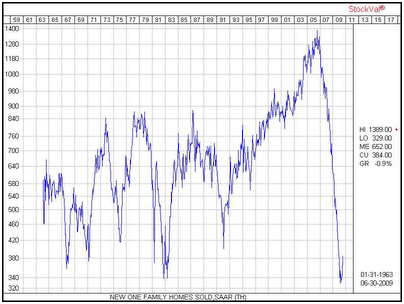
    Not so fast. Like the cars in a roller coaster, the first cars will begin to climb out while the last cars are still screaming downward at top speed. The Commerce Department reported sales in August rose a tepid .07% in August. What they did not highlight is that new home sales of 429,000 are at historical off the chart low compared to the last 50 years (see chart below).

    Such is the case with the Roller Coaster Recession. In California’s roller coaster ride the first car, The Inland Empire, crested the top in 2007. When pink slips were issued, these homeowners did not have deep pockets to sweat it out. All of their savings had been plowed into their down payment. When values declined, they had no staying power. They were gone in the first wave of foreclosures.

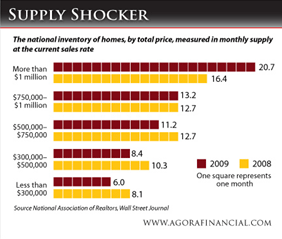
    Meanwhile, the rear car, Coastal California, continued to climb in value seemingly immune to the problems inland. The reason was staying power. The residents of tony Corona Del Mar were able to dump their third car, the Range Rover to keep solvent. When that ran out, Coastal California tapped their savings and finally used their equity lines to maintain their high mortgage payments while they waited for a buyer. But it is 2009 and the buyers have not materialized. More Jumbo Loans are falling behind in their payments. Watch the 60-day delinquency rate on prime Jumbo Loans. According to First American Core Logic, Jumbos in default jumped to 7.4% in May versus 4.9% for conforming loans

    Like our proverbial roller coaster, now it’s the turn for the first cars to rise. As the Inland Empire seems to have bottomed, Coastal California is still racing downward. There are 200 homes for sale between $1.5 and $3 million in ritzy Corona Del Mar. Even with a hefty 25% down payment, a $2 million property will require a $1,500,000 mortgage. Today’s lenders will require proof that the borrower can afford the $7,500 per month mortgage payment. They will demand a W-2 or 2008 tax return showing at least $22,500 per month in income to support a 30% housing expense ratio.

    The reality is there simply are not enough buyers earning $250,000 per year to buy up the 200 homes in Corona Del Mar. The current inventory will take 17 months to sell out but, as the recession continues, more homes are posting For Sale signs each month. Coastal California has not yet seen their bottom and they are still heading down at a rapid pace.

    Our national leaders may proclaim the end of the recession, but Californians have no reason to party. The Stimulus Package that shipped $50 billion to California was a one-time windfall that delayed but did not end California’s structural $26 billion budget deficit.

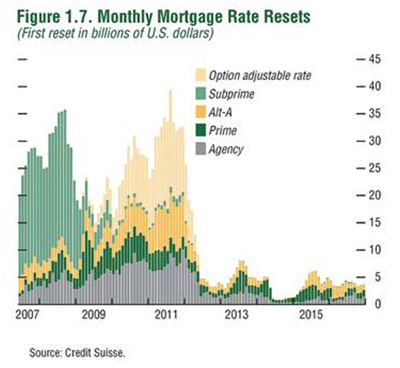
    Add to that the “Mortgage Armageddon” that is scheduled to hit next February. As the sub-prime mortgage defaults subside, the Option ARMS (adjustable rate mortgages) and Prime ARMs will begin to reset in early 2010 (see chart). This is not a working class but primarily a middle and upper-class problem. It is more a coastal than inland crisis; in New York terms, more Larchmont and less exurbia.

    There is a problem, however, with dinging the rich. They are the very folks expected to spend in our consumer-driven economy and invest in new ventures. If they have to re-route more dollars to mortgage payments, they not going to be able to help the economy.

    The Roller Coaster Recession will see more rises and dips before a sustainable recovery comes to California and other high-priced marekts. Those in the first car, like The Inland Empire, have nearly completed their ride. Any remaining dips will be minor in drop and brief in duration. But the genteel folks in the last car, in places like Coastal California, have another precipitous drop in front of them. This may come as a surprise to those believing the headlines that the recession was over. The wild ride for many is hardly over yet.

    ***********************************

    This is the fourth in a series on The Changing Landscape of America. Future articles will discuss real estate, politics, healthcare and other aspects of our economy and our society.

    Robert J. Cristiano PhD is a successful real estate developer and the Real Estate Professional in Residence at Chapman University in Orange, CA.

    PART ONE – THE AUTOMOBILE INDUSTRY (May 2009)
    PART TWO – THE HOME BUILDING INDUSTRY (June 2009)
    PART THREE – THE ENERGY INDUSTRY (July 2009)

  • Purple Politics: Is California Moving to the Center?

    You don’t have to be a genius, or a conservative, to recognize that California’s experiment with ultra-progressive politics has gone terribly wrong. Although much of the country has suffered during the recession, California’s decline has been particularly precipitous–and may have important political consequences.

    Outside Michigan, California now suffers the highest rate of unemployment of all the major states, with a post-World War II record of 12.2%. This statistic does not really touch the depth of the pain being felt, particularly among the middle and working classes, many of whom have become discouraged and are no longer counted in the job market.

    Even worse, there seems little prospect of an immediate recovery. The most recent projections by California Lutheran University suggest that next year the state’s economy will lag well behind the nation’s. Unemployment may peak at close to 14% by late 2010. Retail sales, housing and commercial building permits are not expected to rise until the following year.

    This decline seems likely to slow–or even reverse–the state’s decade-long leftward lurch. Let’s be clear: This is not a red resurgence, just a shift toward a more purplish stance, a hue that is all the more appropriate given the economy’s profound lack of oxygen.

    There is growing disenchantment with the status quo. The percentage of Californians who consider the state “one of the best places” to live, according to a recent Field poll, has plummeted to 40%, from 76% two decades ago. Pessimism about the state’s economy has risen to the highest levels since Field started polling back in 1961.

    Inevitably, this angst has affected political attitudes. Though still lionized by the national media, Gov. Schwarzenegger’s approval ratings have fallen from the mid-50s two years ago into the low 30s. The 12% approval rate for the state legislature, according to a Public Policy Institute of California survey in May, stands at half the pathetic levels recorded by Congress.

    Moreover, voters now favor lower taxes and fewer services by a 49-to-42 margin–as opposed to higher taxes and more services. Support for ultra-green policies aimed to combat global warming has also begun to ebb. For the first time in years, a majority of Californians favors drilling off the coast. Californians might largely support aggressive environmental protections, but not to the extreme of losing their jobs in the process.

    Remarkably, state government seems largely oblivious to these growing grassroots concerns. The legislature continues to pile on ever more intrusive regulations and higher taxes on a beleaguered business sector. Agriculture, industry and small business–the traditional linchpins of the economy–continue to be hammered from Sacramento.

    Agriculture now suffers from massive cutbacks in water supplies, brought about in part by drought, but seriously worsened by the yammerings of powerful environmental interests. Large swaths of the fertile central valley are turning into a set for a 21st-century version of Steinbeck’s Grapes of Wrath.

    At the same time, the state’s industrial base is rapidly losing its foundation. Toyota recently announced it was closing its joint venture plant in Fremont, the last auto assembly operation in the state, shifting production to Canada and Texas. Even the film business has been experiencing a secular decline; feature film production days have fallen by half over the decade, as movie-making exits for other states and Canada.

    Most important, California may be undermining its greatest asset: its diverse, highly creative and adaptive small-business sector. A recent survey by the Small Business and Entrepreneurship Council ranked California’s small-business climate 49th in the nation, behind even New York. Only New Jersey performed worse.

    Regulation plays a critical role in discouraging small-business expansion, a new report from the Governor’s Office of Small Business Advocate suggests. Prepared by researchers from California State University at Sacramento, the report estimates that regulations may be costing the state upward of 3.8 million jobs. California currently has about 14 million jobs, down 1 million since July 2007.

    Ironically, the regulatory noose is now slated to tighten even further as a result of radical measures–from energy to land use–tied to reducing greenhouse gases. Another study, authored by California State University researchers, estimates these new laws could cost an additional million jobs.

    Many in the state’s top policy circles, as well as academics and much of the media, dismiss the notion that regulations could be deepening the recessionary pain. Some of this stems from the delusion–always an important factor in this amazing state–that ultra-green policies will actually solidify California’s 21st-century leadership. Few seem to realize that other states, witnessing the Golden State’s economic meltdown, might not rush to emulate California’s policy agenda.

    Internally, discontent with the current agenda seems particularly strong in the blue-collar, interior regions of the state. Brookings demographer Bill Frey and I have described this area as the “Third California.” In the first part of the decade, this region expanded roughly three times as rapidly as Southern California, while the Bay Area’s population remained stagnant.

    Today the Third California represents roughly 30% of the state’s population, compared with barely 18% for the ultra-blue Bay Area. The most conservative part of the state has skewed somewhat more Democratic in recent elections, largely due to migration from coastal California and an expanding Latino population.

    But the intense economic distress now afflicting the interior counties–where unemployment rates are approaching 20%–may now reverse this process. The ultra-green politics embraced by the Democrats’ two prospective gubernatorial nominees-Attorney General Jerry Brown and San Francisco Mayor Gavin Newsom–may not appeal much to a workforce heavily dependent on greenhouse-gas-emitting industries like farming, manufacturing and construction.

    Eventually, the Democrats may rue their failure to run a pro-business, pro-growth candidate, particularly one with roots in the interior region. This oversight could cost them votes among, say, Latinos, who have been far harder hit by the recession than the more affluent (and overwhelmingly white) coastal progressives epitomized by Brown and Newsom. Along with independents, roughly one-fifth of the electorate, Latinos could prove the critical element in the state’s purplization.

    This, of course, depends on the Republicans developing an attractive pro-growth alternative. In recent years, the party’s emphasis on conservative cultural issues and xenophobic anti-immigrant agitation has hurt the GOP in the increasingly socially liberal and ethnically diverse California.

    Although he has proved a poor chief executive, Gov. Schwarzenegger did at least show such a political approach could work. The recent emergence of three attractive Silicon Valley-based candidates, including former eBay CEO Meg Whitman and State Insurance Commissioner Steve Poizner, as well as the likable libertarian-leaning former congressman Tom Campbell, could score well at the polls.

    This political course-correction should be welcomed not only by Republicans but by California’s moderate Democrats and Independents. However blessed by nature and its entrepreneurial legacy, California needs to move back to the pro-growth center if it hopes to revive both its economy and the aspirations of its people.

    This article originally appeared at Forbes.

    Joel Kotkin is executive editor of NewGeography.com and is a distinguished presidential fellow in urban futures at Chapman University. He is author of The City: A Global History. His next book, The Next Hundred Million: America in 2050, will be published by Penguin Press early next year.

  • California Golden Dreams

    California may yet be a civilization that is too young to have produced its Thucydides or Edward Gibbon, but if it has, the leading candidate would be Kevin Starr. His eight-part “Dream” series on the evolution of the Golden State stands alone as the basic comprehensive work on California. Nothing else comes remotely close.

    His most recent volume, “Golden Dreams: California in an Age of Abundance, 1950-1963,” covers what might be seen as the state’s true Golden Age. To be sure, there is some intriguing history before—the evolution of Hollywood in the 1920s, the reaction to the Depression and the fevered buildup during the Second World War—but this was California’s great moment, its Periclean peak or Augustan age.

    “It was a time of growth and abundance,” Starr writes in his preface, and provides the numbers to prove it. In 1950, California was home to 10.7 million, making it a large state to be sure, but hardly a dominant one. By the early 1960s, the population passed 16 million, slipping by New York state in population.

    Yet it was not a mere matter of numbers that made California so appealing or important. It was the idea of California as not only a part of America, but also something more. To millions in America and around the world, California grew to mean opportunity, sunshine and innovation.

    The state’s business elite, for example, did not identify with the button-down hierarchy that sat atop teeming New York, and its second-tier competitors like Chicago. The leaders of Los Angeles would never consider it a second city, but simply a different, and generally, better one. There was no need for the excessive Manhattan penis envy that led Chicago to keep trying to build higher buildings than Gotham.

    In a different way, San Francisco’s top executives also did not crave that their city be New York—it was always more beautiful, nuttier, freer and more creative than Gotham. What they shared with their downstate rivals was a sense of superiority over the old part of the country. If anything, they felt a mixture of contempt—particularly the conservatives—and condescension about an older, decaying society that fixated on tradition, order and breeding.

    “California,” Cyril Magnin, scion of one of San Francisco’s great families, told me back in the late 1970s, “has recaptured what America once had—the spirit of pioneering. People in business out here are creative; they’re willing to take risks.”

    Geography also plays a role here. Leaders in California, starting at least by the turn of the last century, looked out across the Pacific and saw themselves as part of an emerging shift from Europe to Asia, a process that continues and will dominate the rest of this century. This connection, suggested Pete Hannaford, a public relations executive and partner of Ronald Reagan’s Svengali, Michael Deaver, took on an almost Spenglerian inevitability. “Out here there’s a sense of being where the action is,” Hannaford believed, “with Japan and the Pacific.”

    Starr captures these attitudes, which already had become deeply entrenched by the late 1950s and early 1960s. There was, as he writes, “a conviction that California was the best place to seek and attain a better American life.” However, it was more than money or power. It was about the quality of life. Success in California was not a matter of living by the rules, sheltered in a dark Manhattan apartment, but about the seduction of the physical world. In California, Starr writes, “Eros vanquished Thanatos.”

    Yet Starr’s book is not merely about the rich, the powerful, and even the culturally influential. He finds his primary muse not in the Bohemian realms of San Francisco or the mansions of Beverly Hills, but in that most democratic of everyman’s places, the San Fernando Valley, the place author Kevin Roderick aptly dubbed “America’s Suburb.”

    To see long excerpts from “Golden Dreams,” click here.

    “The Valley” lies over the Santa Monica Mountains from the Los Angeles Basin. As late as the 1930s, it was largely an arid district of ranches, citrus orchards and chicken farms. The area’s postwar expansion was rapid, even by California standards. Between 1945 and 1950 alone, the Valley’s population more than doubled to nearly 500,000. By 1960, it had doubled again.

    This growth was far more than the mindless bedroom sprawl often depicted by aesthetes and urban intellectuals. People in the Valley did not depend largely on the old part of Los Angeles the way, for example, Long Island lived off Manhattan. Most of the Valley’s growth was homegrown—driven by local industry such as aerospace, entertainment, electronics and until the 1960s automobiles.

    Even today, the Valley has very much its own economy and sense of separation from Los Angeles. However, more important, the Valley was, first, a middle-class phenomenon. A cosmopolitan of the first order, Starr manages to chronicle California’s artistic and literary elites, but does not see in them the essence of the state’s appeal. Instead, he explores the everyday wonders of the Valley’s families, single-family homes and swimming pools—6,000 permitted in one year, between 1959 and 1960!

    As a Valley resident myself, I can still see the basic imprint of that culture, what Starr calls its “way of life.” Compared to the tony Westside and hardscrabble east and southside of Los Angeles, the Valley has remained a relatively safe “child-oriented” society, with a big emphasis on restaurants, malls, ball fields, churches and synagogues.

    The single-family tracts, of course, have changed hands, and the majority of the owners have changed. The primarily WASP and second-generation Eastern European Jews are still there, but they have steadily been augmented, and sometimes outnumbered, by others—Armenians, Orthodox Jews, Israelis, Persians, Thais, Chinese, Mexicans, Salvadorans, African-Americans and at least 10 groups I somehow will neglect and no doubt offend.

    Yet the essential way of life forged in the 1950s and 1960s has remained a constant, and that remains the source of California’s attraction. Of course, it is no longer just a “Valley” phenomenon. As California has grown, there are many such places, outside San Diego, in Orange County, the Inland Empire, outside Sacramento, Fresno and scores of other towns. Almost all have the same imprint—an auto-dominated culture, dispersed workplaces, pools and a culture of aspiration.

    In the ensuing decades, perhaps to be covered in Starr’s next book, this archetype evolved mightily. The San Gabriel Valley, once a plain vanilla suburban appendage, has morphed into the country’s largest Asian suburbia, complete with a shopping center jokingly referred to as “the Great Mall of China.” The often-monotonous housing tracts between San Jose and Palo Alto, on the San Francisco Peninsula, also attracted hundreds of thousands of Asians but also produced something equally astounding—the Silicon Valley, the world’s leading center for technology.

    These suburban developments long ago surpassed in importance the urban roots of California metropolises. A serious corporate center during the time covered by Starr’s volume, San Francisco has devolved in a ultra-politically correct, hip and cool urban Disneyland for Silicon Valley, providing good restaurants and housing for those still too young to crave a house on the Peninsula. The San Gabriel Chinatown long ago replaced the older one in downtown Los Angeles as the center of Asian culture and cuisine.

    These places grew before the current malaise infected the state. As Starr points out, California based its ascendancy on two seemingly contradictory principles: entrepreneurship and activist government. Under Gov. Earl Warren, but also Goodwin Knight and finally Pat Brown, the state made a commitment both to basic infrastructure—energy, water, roads, schools, parks—and expanding its economy.

    By the early 1960s, this system was hitting on all cylinders. New roads, power plants and water systems opened lands for development for farms, subdivisions, factories. Ever expanding and improving schools produced a work force capable of performing higher-end tasks, and capable of earning higher wages. New parks preserved at least some of the landscape, and gave families a place to recreate.

    For Pat Brown, arguably the greatest governor in American history, this was all part of California’s “destiny.” Starr describes Brown’s California as “a modernist commonwealth, a triumph of engineering, a megastate committed to growth as its first premise.” Yet within this great modernist project was also stirring opposition, on both left and right, that would soon place this Golden Age at its end.

    Many of the objections were legitimate. The Sierra Club and its many spinoffs rightfully saw the Brown development machine as threatening California’s landscape, wildlife and, in important ways, the appeal of its way of life. More careful controls on growth clearly were needed. The battle over the nature of those controls continues to this day.

    Some more angry voices, then as now, targeted the very existence of suburbia, the dominant form of the state’s growth, and eventually sought its eradication. This struggle goes on to this day with a religious fervor, led, ironically, by the former and perhaps future governor, Jerry Brown, currently attorney general and leading Torquemada of the greens.

    Minorities also began to stir amid the celebrations of the 1950s and early 1960s. Woefully underrepresented in the halls of power and the corridors of business, Asians and Latinos remained largely passive politically. However, by the early 1960s acceptance of exclusion was giving way to more assertive attitudes. Ultimately the massive immigration that swelled both their numbers in the 1970s and beyond would ensure these groups far more influence both on the politics and in the economy of the state.

    Yet it was the African-American who would really upset the balance of the golden era. Never discriminated against as in the South, black Californians felt the lash of a thousand, often-informal exclusions. As the civil rights movement grew, with it less deferential attitudes, particularly toward the police, a powder keg was building. In 1964, the first year after the era chronicled in “Golden Dreams,” Watts blew up, shattering the comfortable assumptions of a progressive, post-racial state.

    Finally, as Starr reports, there was mounting thunder on the right. The business elite and the middle class were financing the ever-expanding California state. They saw their money go to the poor, to minorities and state employees. Particularly annoying were the university students, many of whom were in open revolt against the state, in the mind of much of the public that had nurtured them.

    By the early 1960s many of these latter Californians also were angry, but their rage would express itself not in riots, but at the ballot box, ushering in the age of Ronald Reagan. The period that follows “Golden Dreams” emerges as one of conflicting visions, between greens, students and minorities, on the one hand, and largely suburban middle-class workers and business owners on the other.

    These two groups would battle over the next generation, with the advantage oscillating over time. Today the heirs of the protesters—greens, minority activists and former ’60s radicals—hold the political advantage, although the state they dominate has fallen on parlous times.

    In retrospect, the golden era before these conflicts does indeed seem like a high point. The question now is whether California, down on its luck, will find a way to rebound, much as imperial Rome did after the demise of the Julian dynasty, or fall, like Athens, into ever more squalid decline. Does the state have a bright “destiny” ahead or only more ruin?

    This, of course, will be the basis for another historical epoch. Let us hope Kevin Starr be around to chronicle it for the rest of us.

    This piece originally appeared at Truthdig.com

    Golden Dreams: California in an Age of Abundance, 1950-1963 at Amazon.com.

    Joel Kotkin is executive editor of NewGeography.com and is a distinguished presidential fellow in urban futures at Chapman University. He is author of The City: A Global History. His next book, The Next Hundred Million: America in 2050, will be published by Penguin Press early next year.

  • Hard Times In The High Desert

    The High Desert region north and east of Los Angeles sits 3,000 feet above sea level. A rough, often starkly beautiful region of scrubby trees, wide vistas and brooding brown mountains, the region seems like a perfect setting for an old Western shoot ’em up.

    Today, it’s the stage for a different kind of battle, one that involves a struggle over preserving the American dream. For years, the towns of the High Desert–places like Victorville, Adelanto, Hesperia, Barstow and Apple Valley–have lured thousands of working- and middle-class Californians looking for affordable homes.

    Now, like other exurbs in the U.S., the area suffers from sky-high foreclosure and unemployment rates. Rather than elicit sympathy, however, these hardships have delighted a growing chorus of planners, environmentalists and urbanists who believe that such far outer-ring communities are doomed to becoming America’s “next slums.”

    Such dismal future prospects have gained an air of plausibility with devastating speed. For much of the past century, the High Desert was a rough-hewn region of small farms and mines, its economy largely dependent on military bases.

    But since the 1980s, the area has flourished, adding over 120,000 people in the first seven years of the decade. Most people came because of housing costs–as much as a third less than those closer to the coast. Today the largely middle and working class population stands at over 350,000.

    You don’t hear much good about people in places like the High Desert. Like many exurbanites, they do not fit the hip categories of “knowledge workers” or “creative class.” They work with their hands–in construction, driving trucks, in factories and mines–or run small retail businesses. In the High Desert, 60% of residents have never attended college. Many commute over the 4,100-foot Cajon Pass to blue- and pink-collar jobs as far as Los Angeles, more than an hour and a half away.

    “This is one of those places where the women have more tattoos than the men,” joked one long-time resident over drinks at Chateau Chang, a well-appointed local hangout owned by Chinese immigrants.

    For many, the rapid decline of housing prices since 2007 has been devastating. Newcomers bought homes at the top of the market, when median prices scaled over $300,000. Some did so with adjustable-rate mortgages. Today, the median price is closer to $100,000, leaving a large percentage of homes underwater.

    The real estate collapse has also hurt employment. Construction, warehousing and manufacturing–linchpins of the local economy–all have been pummeled by the recession. Unemployment now stands over 16%.

    Similarly bleak conditions plague exurbs throughout the country–from central Florida to the outskirts of Phoenix, Las Vegas, Sacramento and scores of other onetime boomtowns. Shuttered factories, empty stores and abandoned lots contribute to an often depressing landscape.

    These reverses have led some pundits to assert it’s time to let such places die–and the sooner the better. Greensheet Grist recently held a competition about what to do with dying suburbs that included ideas such as turning them into farms, bio-fuel generators and water treatment plants.

    Such post-apocalyptic views are popular with architects, planners and environmentalists, as well as in the mainstream media. But these people never liked conventional suburbs much; many considered exurbs atrocities whose residents indulged in unspeakable acts of overconsumption.

    Yet what about the residents of these places–and the many who likely would care to join them? The fact is exurbs are popular: Between 2000 and 2007, 3 million Americans moved to exurbs, and while the recession has slowed this growth, it has not stopped it. Indeed, now that housing prices have fallen, home sales have skyrocketed in some areas. In the High Desert, for example, existing-home sales more than tripled in the past year, to the highest level ever.

    Most demographic estimates suggest this exurban population growth will continue; the High Desert is expected to receive another 200,000 residents by 2025. The key driving force, notes Redlands, Calif.-based economist John Husing, remains the deep-seated desire to own a small piece of ground and enjoy some privacy and a middle-class way of life that is no longer affordable closer to the urban center.

    For most exurbanites, moving back to the city–the preferred option of planners and urban boosters–is not an attractive option. These people could never afford a charming townhouse in Portland’s Pearl District or a loft in New York’s SoHo. For them, the “urban option” means the prospect of a dreary blocky apartment complex in a noisy, crowded, less-than-genteel section of Los Angeles or another large city.

    This preference should not be confused with racism, as is sometimes alleged. Like many exurbs, the High Desert has become increasingly multi-racial. Over half of the 23,000 students at the sprawling Victor Valley College, for example, are minorities–nearly 30% are Hispanic. Cruise the shopping center, and you are as likely to find a family-owned Mexican, Vietnamese or Korean restaurant as you would a hamburger chain or pizza shop.

    To my mind, harboring ill will toward the aspirations of exurbanites is hardly “progressive,” at least from a social democratic point of view. Yet many on the so-called left feel that what is generally considered upward mobility needs to be curbed so that the hoi polloi can better live according to the prescriptions of their more enlightened, usually higher-educated and more affluent “betters.”

    In contrast, a more humane, and fundamentally democratic, approach would be to find ways to help these communities thrive. The first step: local job creation. Even without the excessive prices associated with “peak oil” theories, gas prices and car expenses do place a considerable burden on many exurbanites. Developing more economic opportunities closer to these communities would relieve this financial burden, while also cutting energy consumption.

    Experience shows that suburbs that develop their own economies have suffered far less from the recession than those that depend on long-distance commuters. Ontario, a suburb 40 miles east of Los Angeles where I have worked as a consultant, for example, has developed a strong airport, industrial and office economy and a thriving locally based retail sector. Average commutes there are roughly parallel to those in neighborhoods close to downtown Los Angeles.

    Although hit hard by the recession, Ontario suffers a foreclosure rate that is one-third of the High Desert’s. It continues to attract businesses from Los Angeles and the rest of the world by offering a more enterprise-friendly environment and a well-maintained infrastructure.

    Places like Ontario could provide something of a role model for places like the High Desert, notes local real estate investor Joe Brady. Like many other local leaders, he recognizes that basic job creation–not real estate speculation–holds the key to the region’s future.

    But it’s not all doom and gloom for the High Desert. Some prospective new industrial investment has come to the area. And Husing believes the High Desert will play an expanding role as a warehouse area for products shipped from the massive Los Angeles port complex. The converted former George Air Force Base, now the Southern California Logistics Airport, has created 2,500 jobs and could generate another 35,000 within the decade.

    Yet creating many more jobs in the High Desert will not be easy. Though most local cities are pro-business, business consultant Larry Kosmont notes they are still saddled with regulations imposed by the state of California. These could discourage business attraction and development.

    There’s a bit of an irony here. Local job growth would save energy and cut emissions by reducing commutes and making these communities more environmentally sustainable. But some coastal “progressives” may discourage new industrial or warehouse facilities for emitting too much greenhouse-gas.

    In the end, only fostering a strong locally based economy can make these places economically viable. Whatever their aesthetic and design problems, exurbs will continue to appeal to millions of Americans searching for what they define as a better way of life. That alone should make them intrinsically valuable, and definitively worth saving.

    This article originally appeared at Forbes.

    Joel Kotkin is executive editor of NewGeography.com and is a distinguished presidential fellow in urban futures at Chapman University. He is author of The City: A Global History. His next book, The Next Hundred Million: America in 2050, will be published by Penguin Press early next year.

  • Don’t Go Looking for Work in California

    The current economic recession has tarnished the Golden State’s employment opportunities in a major way.

    A report released on Sunday by the California Budget Project says that two of five working-age Californians do not have a job.

    The level of unemployment has not been this high since February 1977. In fact, the study found that “California now has the same amount of jobs as it did nine years ago.” The only difference? In 2000, the state was home to 3.3 million fewer working age people than today.

    The nation is not faring much better, as the U.S. Labor Department reported last Friday that the nation’s jobless rate had climbed to 9.7 percent, the highest since 1983. California’s unemployment stands at over 11 percent.

  • High Cost of Living Leaves Some States Uncompetitive

    Late this spring, when voters in California emphatically rejected tax increases to close the state budget gap, they sent a clear message to state policymakers. They were tired of California’s high taxes, which according to the non-partisan Tax Foundation, consumed 10.5 percent of state per capita income last year. This compared with a national average of 9.7 percent, making California the sixth most heavily taxed state in the nation.

    But if Californians were tired of paying an additional 0.8 percent of their income in state and local taxes, what would they make of research by economists at the federal Bureau of Economic Analysis that estimated that the cost of living in California, based on 2006 data, was a whopping 29.1 percent above the national average? Obviously, from an economic point of view, the state’s high cost of living has a much greater impact on the average person’s standard of living than taxes do.

    Cost of living is not an issue that we typically think about, when it comes to voting and politics. That needs to change. Cost of living estimates provide a valuable tool for making accurate comparisons of economic performance. Moreover, they provide the best available, if indirect, measure of the costs imposed by regulation. And with Congress debating potentially dramatic changes in how we regulate energy and health care, costs of this kind clearly deserve close scrutiny.

    Let’s begin with economic performance, starting with California. According to 2006 census estimates from the American Community Survey, the median household income in California was $56,645. In terms of ranking, that made California the sixth most prosperous state in the nation. But how did California fare, once the cost of living was taken into account? The answer is not very well. The economists who published the 2006 data, Bettina Aten and Roger D’Souza, did not deflate income data by the full 29.1 percent when calculating the real effect of cost of living. Rather, they exempted certain components of income, such as government transfer payments. Using this attenuated calculation, real median household income in California in 2006 was $47,988. In terms of ranking, that dropped California down to 31st place. (Were the data deflated by the full 29.1 percent, the state would have fallen all the way to 48th place.)

    California is not the only state afflicted with an exorbitant cost of living. Bluer than blue New York State, according to the Aten and D’Souza data, had an even higher cost of living, estimated at 31.8 percent above the national average. And not surprisingly, it fared particularly badly, once the cost of living was taken into account. Again using an attenuated calculation, the median household income in New York dropped from $51,384 in nominal dollars down to $42,744 in cost of living adjusted dollars. In terms of rankings, this dropped New York from 17th place down to 49th place. (Were the data deflated by the full 31.8 percent, the state would have fallen to last place, almost 10 percent lower than the next poorest state, Mississippi.)

    What cost of living estimates taketh away from some, however, they also giveth to others. Consider, for example, Utah and Minnesota. In the case of Utah, median household income in 2006 stood at $51,309 in nominal terms. But according to the Aten and D’Souza estimates, the cost of living in Utah was 13.5 percent below the national average. Using the attenuated calculation, cost of living adjusted income in Utah was $57,147, the second highest in the nation.

    In the case of Minnesota, median household income in 2006 stood at $54,023 in nominal terms. But according to the Aten and D’Souza estimates, the cost of living was 7.4 percent below the national average. The attenuated calculation put the Minnesota a cost of living adjusted income at $57,140, third highest in the nation.

    As a general rule, the states with the lowest cost of living are states in the South and to a lesser degree the Mountain West. Among the states of the Old South, only Virginia had a cost of living above the national average. Dynamic states like North Carolina had a cost of living 13.1 percent below the national average. In Georgia, the figure was 12.1 percent. In the Mountain West, Idaho had a cost of living 17.3 percent below the national average. In New Mexico, the figure was 16.5 percent.


    Besides affecting the true measure of economic performance, cost of living differentials have other, important implications as well. Federal taxes are one example. Consider New York. For years, it has been recognized that New York State sends more in taxes to Washington, D.C. than it receives back in the form of federal outlays. Recently, there has been some disagreement about the size of this deficit, but in the past it was generally agreed that it amounted to approximately two percent of Gross State Product. If New Yorkers were truly rich, this would not be a great burden. But as shown already, that is not the case. By failing to control its cost of living, New York ends up subsidizing other states that in real terms are doing much better.

    Another implication of cost of living differentials has to do with population. All things being equal, people will live where they can maximize their standard of living. Not surprisingly, states that have seen the largest population growth in recent decades tend to be those with a low cost of living, notably in the South and in the Mountain West. On the other hand, states with a high cost of living have typically seen population growth lag. This is particularly true among certain Northeastern states that should have boomed, if nominal income were the best guide of how well a state is doing. Examples include Massachusetts, Connecticut and to a lesser degree, New Jersey, which has the second highest median household income in the nation.

    In sum, the cost of living says a great deal about a state, its politics and its future.

    Eamon Moynihan is the Director of the Cost of Living Project in New York. The purpose of the project is make New York City and State more competitive, with a particular focus on the costs imposed by regulation. A former government official at both the City and State level, he most recently served as Deputy Secretary of State for Public Affairs and Policy Development. An interactive website for the project can be accessed at thecostoflivingproject.org.

  • Local Agriculture: How To Feed The Hungry

    The search for ways to feed the hungry is as old as recorded history. Can an issue this long-standing and complex be adequately addressed on small, local level? A unique California program is trying, with surprising success.

    Ag Against Hunger unites farmers, food processors and nonprofit food banks in the effort to reduce hunger and promote food security as it simultaneously benefits agriculture producers. This one-of-a-kind program is changing the way fresh fruits and vegetables move through the California food system. The goal is, of course, a secure source of healthful nutrition for all, and an improvement in the health of the more than 20% of our local population that is in need throughout our community.

    How We Operate – Ag Against Hunger works with large and small farmers, food processors, and distributors on behalf of food banks, to help the non-profits fully benefit from bountiful harvests. Currently up and running in Monterey, Santa Cruz and San Benito counties, the program has become an efficient model of ways to distribute perishable surplus produce.

    When an influx of fresh fruits and vegetables exceeds a grower’s or processor’s capacity, Ag Against Hunger picks up, refrigerates, stores and re-distributes the large quantities of newly available, highly perishable fruits and vegetables to rural and urban food banks. Being organized for a quick response is key.

    The large-scale and perishable nature of the produce we collect far exceeds what a single food bank could store and distribute. Everyone involved benefits. Food bank clients receive fresh fruits and vegetables that would otherwise be destroyed. Food processors are able to donate their products, knowing that the goods will be handled quickly for optimal freshness and nutrition, and they do not incur the expense of disposing of perfectly good and healthful food into a landfill.

    What We’ve Accomplished – Each year Ag Against Hunger swiftly moves an average of 10 million pounds of highly perishable food into food banks from fields or processing plants, using a coordinated system of refrigerated tractor-trailers and a 5,000 square foot storage cooler.

    Since its inception in 1990, the organization has distributed over 154 million pounds of produce to people in need. Locally, Food Bank for Monterey County, Second Harvest of Santa Cruz and San Benito Counties, Grey Bears of Santa Cruz and Community Pantry of San Benito County make our fresh produce available to more than 260 nonprofit human service agencies, and feed over 75,000 low-income people each month.

    Food and Health – Adequate and appropriate nutrition is a linchpin of well-being and health that’s especially challenging with limited financial resources. The connection between chronic illnesses — diabetes is just one example — and diets poor in fruits and vegetables is well-established. The correlation is strong: The Department of Agriculture states that improved nutrition and lifestyle could reduce illness and death due to cancer by 30-40%, death from cardiovascular disease by 22-30%, and cases of diabetes by 50%.

    Among children (who make up more than 1/4 of Ag Against Hunger recipients), diet patterns establish the foundation of adult eating habits. For seniors (27% of our recipients), and pregnant women, healthful eating is also critical.

    The affluent enjoy the option of choosing among a range of nutritious foods and healthy lifestyles. For the poor, the only option is whatever is available and possible at the moment. This lack of healthful food choices contributes to the health disparities we see between the affluent and others, and the increasing number of low-income individuals with chronic health conditions that spring from poor nutrition.

    Localism Can Stretch – Last year Ag Against Hunger was able to provide over 8.7 million pounds of high-quality fresh fruits and vegetables to over 50 rural and urban food banks throughout California and beyond. Once nearby local food banks were satisfied, it worked with California Emergency Foodlink, a statewide food distribution program, which dispersed produce to over 50 food banks and community pantries in other parts of the state. After state organizations received all the produce they needed, it worked with food organizations in Arizona, Washington, Oregon, Colorado, Utah and New Mexico to feed about three million people throughout the US West Coast states.

    Ag Against Hunger also coordinates a thriving gleaning program. In 2008 volunteers harvested more than 120,000 pounds of produce that would have otherwise been disked underground. On a few weekends each month, 25 to 100 volunteers from diverse organizations — Cub Scouts to church groups — come together to harvest these crops, learn about their local agricultural community, and directly contribute to the amount of produce we pass along to our food bank partners.

    If you are interested in becoming a gleaning volunteer or learning more, please give us a call at 831.755.1480, or visit Ag Against Hunger at www.agagainsthunger.org

    Abby Taylor-Silva is the Executive Director of Ag Against Hunger, a Salinas-based non-profit. She is a native of Monterey and San Benito counties; her family farmed in south Monterey County for over 50 years. She lives in Salinas with her husband Paul and daughter Olivia.

  • California Disease: Oregon at Risk of Economic Malady

    California has been exporting people to Oregon for many years, even amid the recession in both states.

    Indeed, the 2005 American Community Survey report shows that California-to-Oregon migration was 56,379 in 2005, the sixth-largest interstate flow in the United States. The 2000 census showed a five-year flow of 138,836 people, the eighth-largest over that time period. Until two years ago, Oregon was managing to absorb this population with mixed results, but generally as part of an expanding and diversifying economy. But that pattern has ended, at least for now.

    So now what will Oregon do with a suddenly excess population? California, at least, can say its emigres over time will reduce unemployment and reduce out-of-whack property prices. The immediate net benefits for Oregon are harder to discern.

    California’s massive economic collapse — which has resulted in 926,700 jobs lost from July 2007 through June 2009 and an unemployment rate of 11.6 percent — is now becoming Oregon’s problem. As Californians, largely for lifestyle and cost reasons, head north across the border, they have helped swell Oregon’s ranks of both unemployed and, perhaps equally important, underemployed.

    Our analysis of California migrants has shown a gradual reduction in their earnings over what they were earning in the Golden State. There also are less quantifiable impacts. Portland, a city attractive to many unemployed and underemployed younger Californians, could well be becoming the “slacker” capital of the world.

    There’s another major problem with the continuing California migration. Along with young people, newcomers to the state also include large numbers of the retired and semi-retired. These people generally have little interest in economic growth, whether for longtime state residents or their fellow, often younger emigres. Instead what they bring with them are political attitudes that could slow down the state’s economic recovery.

    Some might call this California disease. This refers to a chronic inability to make hard decisions as well as a general disregard for business and economic activity.

    California’s inability to plan or create new public infrastructure affects every part of the state’s economy. California was once a leader in building infrastructure, but that was in Pat Brown’s gubernatorial administration in the 1960s when California last planned a major infrastructure project.

    There are consequences to California’s inability to deal with infrastructure. Its freeways are parking lots. Its water problems are threatening the viability of Central Valley agriculture, one of the key drivers of the state’s economy. Its electrical system is so bad that every summer brings the fear of interruptions in the supply of electricity. Its universities are in decline. Its prisons are overcrowded.

    Another symptom of California disease is regulation and red tape that increases the uncertainty for any project and raises the cost.

    California projects can be in planning for years, and at the end of that planning process they may still be denied. The long delays are expensive. And as many would-be California developers will tell you, the uncertainty is a strong detriment to economic activity and development.

    We also see symptoms of California disease in tax policy. California no longer has the United States’ highest income tax rate. Big deal. With a top income tax rate of 10.3 percent, sales taxes that can reach 10.25 percent and a 33.9 cents-per-gallon gas tax, its total taxes are among the highest in the country.

    California’s regulatory climate also reflects the disease. Even as the state endures its most brutal recession in decades, it persists in unilaterally imposing new regulation, making the state less competitive with other states.

    In short, California is whistling past the graveyard, hoping that its economy will rebound, “because it always has.”

    Key symptoms of California disease are forgetting that quality of life begins with a job and negative domestic migration.

    With all the influx of Californians, it’s not surprising that Oregon shows some signs of California disease. It recently increased its tax rates so that Oregon’s highest-income taxpayers face marginal tax rates that match Hawaii’s for the highest in the nation. Oregon’s land-use planning had been extremely centralized for some time. Indeed, Oregon’s land-use planning may be the most centralized in the United States. This makes it harder for communities to control their own destinies, whether they want to grow or not.

    If Oregon does have California disease, the malady is surely not as advanced as it is in California. Oregon has lower gasoline taxes and lower property taxes than California. Oregon, in contrast with California, enjoys net positive domestic migration. It is also a good sign that a significant percentage of the people moving to Oregon from California are young folks. While it seems to many that the typical California immigrant is a wealthy aging baby boomer, the data show that he (or she) is still most likely a young person in his 20s or 30s, and often married with children. They are people who, if the economy grew, could have something to contribute to the economy as well as the cultural development of the state.

    But Oregon’s relationship with California remains a double-edged sword. On the one hand, Oregon has benefited from the inflow of cash and skilled workers. On the other hand, Oregon’s relationship with California has led to the current situation where at 12.2 percent for the month of June, Oregon has one of the highest unemployment rates in the United States.

    Oregon may be at a crossroads. The state is richly endowed with many of the components of a high quality of life. People want to live in Oregon, and they are moving to Oregon even in hard times. Yet as the population swells, there’s no concurrent growth in businesses and employment. Over time, this could pose serious problems. Remember, quality of life begins with a job, preferably a rewarding, well-paying job.

    However, Oregon must avoid making many decisions that led to California’s current situation. The costs of California disease are more than those reflected in the economic statistics. Devastated communities and families, and wasted opportunities, could infect this fair state for years to come.

    Joel Kotkin is author of “The City: A Global History.” Bill Watkins is director of the Center for Economic Research and Forecasting at California Lutheran University.