Tag: California

  • Housing Downturn Update: We May Have Reached Bottom, But Not Everywhere

    It is well known that the largest percentage losses in house prices occurred early in the housing bubble in inland California, Sacramento and Riverside-San Bernardino, Las Vegas and Phoenix. These were the very southwestern areas that housing refugees fled to in search of less unaffordable housing in California’s coastal metropolitan areas (Los Angeles, San Francisco, San Diego and San Jose).

    Yet now the prices in these hyper-expensive markets are beginning to fall. Once considered widely immune from the severe housing slump, the San Francisco area now has muscled its way into the list of biggest losers. The newly published first quarter 2009 house price data from the National Association of Realtors indicates that prices are down 52.5 percent from the peak. Only Riverside-San Bernardino and Sacramento have experienced greater losses out of the 49 metropolitan areas with a population of more than 1,000,000 for which there is data (see table below). Other metropolitan areas that have seen prices drop more than 50 percent include Phoenix, Las Vegas and, for very different reasons, that rustbelt sad sack, Cleveland.

    Table 1
    Median House Price Loss: Metropolitan Areas Over 1,000,000 Population
    Rank Metropolitan Area
    Median House Price % Loss from 2000-2008 Peak
    Median House Price Loss from 2000-2008 Peak
          1 Riverside-San Bernardino, CA -57.7% $235,600
          2 Sacramento, CA -56.5% $219,600
          3 San Francisco, CA -52.5% $444,800
          4 Phoenix, AZ -51.9% $139,200
          5 Cleveland, OH -51.5% $74,300
          6 Las Vegas, NV -51.3% $163,800
          7 Los Angeles, CA -48.8% $289,400
          8 San Jose, CA -48.0% $415,000
          9 San Diego, CA -47.5% $291,900
        10 Miami-West Palm Beach, FL -47.3% $185,200
        11 Orlando, FL -43.1% $117,200
        12 Tampa-St. Petersburg, FL -42.2% $98,800
        13 Washington, DC-VA-MD-WV -37.3% $165,900
        14 St. Louis, MO-IL -35.8% $56,300
        15 Chicago, IL -35.2% $100,900
        16 Atlanta, GA -34.4% $60,600
        17 Memphis, TN-MS-AR -34.0% $49,400
        18 Providence, RI-MA -33.6% $102,600
        19 Boston, MA-NH -32.5% $140,200
        20 Cincinnati, OH-KY-IN -28.6% $42,600
        21 Richmond, VA -27.9% $66,800
        22 Indianapolis, IN -26.6% $34,300
        23 Minneapolis-St. Paul, MN-WI -25.9% $60,800
        24 Columbus, OH -24.5% $38,400
        25 Denver, CO -24.1% $61,200
        26 Birmingham, AL -23.2% $39,300
        27 Jacksonville, FL -22.4% $44,600
        28 Charlotte, NC-SC -22.1% $48,700
        29 New York, NY-NJ-PA -21.9% $104,700
        30 Virginia Beach-Norfolk, VA -21.2% $54,000
        31 Kansas City, MO-KS -20.4% $32,400
        32 Seattle, WA -20.1% $79,500
        33 Pittsburgh, PA -19.0% $24,300
        34 Hartford, CT -17.7% $47,800
        35 Portland, OR-WA -17.0% $51,100
        36 Baltimore, MD -16.3% $47,900
        37 New Orleans, LA -15.6% $27,800
        38 Philadelphia, PA-NJ-DE-MD -15.2% $37,000
        39 Louisville, KY-IN -15.1% $21,500
        40 Rochester, NY -14.5% $18,000
        41 Houston, TX -13.6% $21,800
        42 Dallas-Fort Worth, TX -13.5% $21,100
        43 Buffalo, NY -13.1% $15,000
        44 Milwaukee, WI -12.1% $27,800
        45 Salt Lake City, UT -6.7% $16,500
        46 San Antonio, TX -6.2% $9,800
        47 Austin, TX -6.1% $11,900
        48 Raleigh, NC -5.3% $12,600
        49 Oklahoma City, OK -3.3% $4,500

    Cleveland, the newest entrant to the “over 50” club, fell largely because of the collapse of its industrial economy. It remains the only one of the thirteen mega-losers without prescriptive land use policies (sometimes called “smart growth”), which raise house prices by rationing land for development and imposing more stringent regulatory requirements. Cleveland illustrates a point made in a previous commentary: that the huge house price losses in the housing downturn have spread broadly from the original metropolitan areas that precipitated Meltdown Monday, the Lehman Brothers bankruptcy on September 15, and the Panic of 2008.

    During Phase I of the housing downturn (through September 2008), the largest losses were concentrated in the “Ground Zero” markets of California, Florida, Las Vegas, Phoenix and Washington, DC. In each of these 11 markets, median house prices dropped at least 25 percent, with per house over $100,000 except in Tampa-St. Petersburg during Phase I. These markets, all with more prescriptive planning, accounted for nearly 75 percent of the gross house value loss in the nation, with other more prescriptive markets accounting for another 20 percent. The more responsive markets, where land use regulation follows more traditional market-driven lines, accounted for slightly more than 5 percent of the loss.

    The Chart below and Table 1 in The Housing Downturn in the United States: 2009 First Quarter Update financial collapse, however, now has spread the losses much more generally. In Phase II, the Ground Zero markets represented 44 percent of the loss, the other more prescriptive markets 38 percent and the more responsive markets 18 percent.
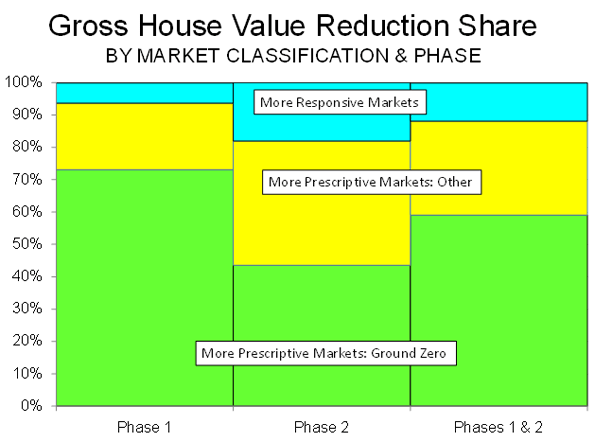
    As of the first quarter of 2009, prices had dropped in all major metropolitan areas. The average per house loss in the Ground Zero markets was still the highest, at 48 percent, though the overall all loss had increased to 34 percent.

    There are indications that the housing downturn may be slowing. The latest data indicates that the median house price increased in March, though not enough to forestall a loss in the first quarter. Another indicator is the fact that the Median Multiple (median house price divided by median household income) has fallen to a national level of 3.1, which is slightly more than the 2.9 historic rate and well below the 4.6 peak.

    The best news of all is that the Median Multiple has dropped to 3.8 in the Ground Zero markets, which is equal to the historic level and well below the peak of 7.3. In the other more prescriptive markets, the Median Multiple is at 3.5, above the 2.9 historic average but well below the peak of 4.8. In the more responsive markets, the Median Multiple has dropped to 2.6, just above the historic average of 2.5 and below the peak figure of 3.2.

    Prices have fallen so much that they now stand at historic 1980 to 2000 Median Multiple levels in 18 of the 49 metropolitan areas. Critically, this includes the Ground Zero markets of Riverside-San Bernardino, Sacramento, Phoenix and Las Vegas.

    Other Ground Zero markets have seen much of their price inflation whittled away, but still have a way to go. Prices need to decline $33,500 to reach the historic Median Multiple level in Los Angeles, $32,300 in Miami, $31,200 in Washington, $18,500 in San Francisco, $11,100 in San Diego and only $1,700 in Tampa-St. Petersburg.

    In other markets, however, prices still have some distance to go before the historic Median Multiple is reached. The largest decrease would have to occur in New York, at $122,000, followed by Portland ($95,000), Seattle ($94,000), Baltimore ($75,000) and Salt Lake City ($74,000). Other markets, including Philadelphia, Virginia Beach, Milwaukee and Ground Zero San Jose would need to have price declines of more than $50,000 to restore their historic Median Multiples. See Table 2.

    Table 2
    Median House Price Reduction Required to Reach Historic Price/Income Ratio (Median Multiple)
    Median House Price Reduction Required to Reach 1980-2000 Median Multiple
    Median Multiple
    Rank Metropolitan Area
    1980-2000 Average
    2000-2008 Peak
    Current (2009: 1st Quarter)
          1 New York, NY-NJ-PA $122,200             3.9            7.7           5.8
          2 Portland, OR-WA $94,700             2.7            5.4           4.4
          3 Seattle, WA $94,400             3.3            6.2           4.7
          4 Baltimore, MD $74,700             2.6            4.6           3.7
          5 Salt Lake City, UT $73,800             2.6            4.3           3.8
          6 Philadelphia, PA-NJ-DE-MD $61,500             2.4            4.2           3.4
          7 San Jose, CA $55,400             4.5          10.2           5.1
          8 Virginia Beach-Norfolk, VA $53,600             2.6            4.7           3.5
          9 Milwaukee, WI $51,400             2.8            4.4           3.8
        10 Boston, MA-NH $41,900             3.5            6.1           4.1
        11 Los Angeles, CA $33,500             4.5          10.1           5.1
        12 Miami-West Palm Beach, FL $32,300             3.4            7.0           4.0
        13 Jacksonville, FL $32,000             2.3            3.6           2.9
        14 Washington, DC-VA-MD-WV $31,200             2.9            5.3           3.3
        15 Providence, RI-MA $29,400             3.1            5.4           3.6
        16 Raleigh, NC $26,700             3.3            3.9           3.7
        17 Austin, TX $20,500             2.8            3.3           3.2
        18 San Francisco, CA $18,500             5.0          11.2           5.2
        19 Denver, CO $18,000             2.9            4.3           3.2
        20 Minneapolis-St. Paul, MN-WI $15,700             2.4            3.6           2.6
        21 Hartford, CT $14,300             3.1            4.2           3.3
        22 San Diego, CA $11,100             4.9            9.5           5.1
        23 Buffalo, NY $10,900             1.9            2.5           2.1
        24 Charlotte, NC-SC $10,100             3.0            4.1           3.2
        25 Richmond, VA $9,500             2.8            4.1           3.0
        26 Louisville, KY-IN $8,100             2.4            3.1           2.6
        27 Chicago, IL $7,800             2.9            4.8           3.0
        28 San Antonio, TX $5,200             3.0            3.3           3.1
        29 Orlando, FL $4,000             2.9            5.2           3.0
        30 Pittsburgh, PA $3,400             2.1            2.8           2.2
        31 Tampa-St. Petersburg, FL $1,700             2.8            4.7           2.8
    Las Vegas, NV  At or Below              3.4            5.3           2.7
    Riverside-San Bernardino, CA  At or Below              3.7            6.6           3.0
    Sacramento, CA  At or Below              3.6            5.6           2.8
    Memphis, TN-MS-AR  At or Below              3.0            3.1           2.0
    New Orleans, LA  At or Below              3.1            3.3           2.8
    Phoenix, AZ  At or Below              2.8            4.7           2.4
    Atlanta, GA  At or Below              2.4            3.1           2.0
    Birmingham, AL  At or Below              3.0            3.5           2.7
    Cincinnati, OH-KY-IN  At or Below              2.3            2.8           2.0
    Cleveland, OH  At or Below              2.2            2.8           1.4
    Columbus, OH  At or Below              2.4            2.9           2.2
    Dallas-Fort Worth, TX  At or Below              2.7            2.7           2.4
    Houston, TX  At or Below              2.5            2.9           2.5
    Indianapolis, IN  At or Below              2.1            2.3           1.7
    Kansas City, MO-KS  At or Below              2.5            2.9           2.3
    Oklahoma City, OK  At or Below              2.8            2.9           2.8
    Rochester, NY  At or Below              2.2            2.4           2.0
    St. Louis, MO-IL  At or Below              2.2            2.9           1.9
    Median Multiple: Median house price divided by median household income.

    These price reductions may or may not occur in over-valued metropolitan areas like New York, Portland and Seattle, all of which are also experiencing serious increases in unemployment. However, given the pervasive evidence that the market is returning to the vicinity of historic price ratios, it would not be surprising if significant price reductions happen in these metropolitan areas, which were previously seen and saw themselves as immune to the fallout that hit the less well-regarded ground zero markets.

    Additional information is available in:
    The Housing Downturn in the United States: 2009 First Quarter Update

    Wendell Cox is a Visiting Professor, Conservatoire National des Arts et Metiers, Paris. He was born in Los Angeles and was appointed to three terms on the Los Angeles County Transportation Commission by Mayor Tom Bradley. He is the author of “War on the Dream: How Anti-Sprawl Policy Threatens the Quality of Life.
  • California Meltdown: When in doubt, Blame the Voters!

    By rejecting the complex Sacramento budget settlement, Californians have brought about an earthquake of national significance as has not been seen since the passage of Proposition 13 over thirty years ago. Once again, California voters handed politicians something they fear more than anything else, constraints on the ability to raise taxes and raid revenues for their pet interests.

    Some, like long time Los Angeles Times statehouse reporter George Skelton thinks it’s the voters’ fault, as he suggested in his recent op-ed. The problem, we are told, lies with voters. The state’s massive fiscal crisis, which I and others warned was coming, was apparently unforecastable to California politicians and their enablers, like Skelton.

    Blame the voters will become a large part of the national and local media spin. It is not the first time. Consider Proposition 13. The problems that led up to Prop 13 were years in the making, and they were well understood. Inflation and rising home prices were increasing taxes beyond what citizens were prepared to pay. Sacramento tried several times to address the problem, but then as now, politicians couldn’t make hard decisions. The entrenched interests, notably the public employee unions, would not hear of anything that might shrink state revenues.

    Contrary to some versions of history, Proposition 13 was not backed by oil companies, land developers and other business interests. In fact, most opposed it.

    Proposition 13 backers were outmanned, outspent and certainly without much media support. The measure was passed because after years of incompetence in Sacramento, California voters, like Medieval peasants, grabbed their pitchforks and torches and stormed the castle. They passed Prop 13.

    Some interpret this story as showing voter ignorance and fickleness. I interpret it as showing that California voters are patient, but only to a point. Once they have reached a certain point, California voters take matters into their own hands. The results are invariably far more onerous for the state than if the political class had effectively faced the issue. Part of the reason for this is because the voters have fewer tools available to them. Legislatures and governors may have scalpels, voters have only axes.

    Gray Davis was the victim of a similar uprising. He took the fall for a government that had failed. Arnold was going to be different. He would be the Governator. He won election promising mortal combat with special interests. In 2005, he tried to change things but was outmaneuvered by his union-backed opponents. After losing round one, he became Gray Davis but without his predecessor’s grasp of the essentials of government. As the Sacramento Bee’s Dan Walters has pointed out, hubris and ignorance make a deadly combination.

    Now, we have a budget crisis, and California voters are unwilling to give Sacramento a pass. Why?

    Maybe they don’t think they are getting value for their increased investment in government. California spent about $2,173 per resident (2000 dollars) in the 1997-1988 budget. The 2007-2008 budget spends about $2,738 (2000 dollars) per resident. That represents a 26 percent increase in real (inflation adjusted) per-capita spending in ten years.

    What have California voters purchased with their 26 percent increase in government spending? Are the roads 26 percent better? Are schools 26 percent better? What is 26 percent better?

    That is Sacramento’s problem. It is very hard to identify what good that this increase in spending has purchased. If it has been a good investment, why haven’t California’s leaders convinced the voters?

    Maybe you can make a case that we are 26 percent better off; maybe not. I don’t know, but then I haven’t seen a strong effort to make the case. Instead, we get predictions of doom. We’ll cut back on teachers. We’ll let prisoners out of jail. Skelton says “And, oh yes, the elderly poor, blind and disabled – welfare moms and children’s healthcare? They’ll take the biggest hits, as usual.”

    The problem with predictions of doom is that they don’t ring true, or they sound as if the political leaders will punish voters for forcing the leaders to face a budget constraint. Voters can remember 1997-1998. California had teachers. Prisoners were in jail. Healthcare was provided for those with the least resources. If California had these essential services then, and the State is spending 26 percent more now, why cut those essential services now?

    That is the question the California’s leaders have to answer soon. Today Sacramento faces a crisis. The governor and the legislature will have to deal with a real binding budget constraint, and how they choose to deal with that constraint will make a huge difference. They could show leadership. They could make difficult choices. They could stand up to the special interests that will spare no effort to punish them.

    They may not. They may try to punish voters by cutting essential services. They may try even more Enron-style accounting tricks. They may sell assets or use federal money to push the problem to future legislators and governors. They may make poor choices. They may avoid cutting entitlements and public employee pensions, the real source of the state’s fiscal distress.

    We are heading towards a convulsion, not only here in California but in a host of high-tax, high-regulation states now controlled by their own employees. This includes New York, Illinois, and New Jersey for starters. In the age of Obama, with its celebration of bigger government, this suggests perhaps a whiff of a counter-revolution.

    Bill Watkins, Ph.D. is the Executive Director of the Economic Forecast Project at the University of California, Santa Barbara. He is also a former economist at the Board of Governors of the Federal Reserve System in Washington D.C. in the Monetary Affairs Division.

  • The Twilight of Special Interest Politics

    Special interest groups are the scourge of the common interest, are they not? The Founding Fathers, in The Federalist Papers, recognized the danger posed by “factions,” but assumed that competing groups would keep the balance. They could not have foreseen our current Special Interest State, wherein tens of thousands of special interest groups exert such profound influence on politics, policies and life in the United States.

    Nowhere is this more evident than in California, my adopted home state. In California, as in much of the country, government is forever and hopelessly trapped in interest group politics and therefore, forever large and growing. Interest groups are intractable, in this view, because they are always able to devote more resources to their specific causes and concerns than are any conceivable guardians of the common interest.

    California’s predicament is a perfect illustration of public choice theory, which shows that government will always act in its own interest, interest group politics seem to be the logical and inevitable end-point of democracy. Multiply this process by the tens of thousands of special interests that lobby, petition and influence politicians and the public sector and it becomes clear why government will tend only to grow, never to shrink, crowding out the private sector. Over the decades the number of special interests has expanded exponentially, whether Democrats or Republicans control Sacramento or Washington.

    But eventually this system must overwhelm carrying capacity. Maybe in California we are approaching that limit even faster than the rest of the country.

    Debts, deficits, waste, inefficiency and voter/taxpayer fatigue must at some point render the special interest state untenable. Readers of this web site are familiar with the dire situation in California: a budget deficit of gargantuan proportions, driven by increases in public sector spending that have outpaced population growth plus inflation, now combined with a drastic drop in state revenues. Attempting to deal with the situation, the Governor and legislators have placed six measures on the May 19th special statewide election ballot. Proponents claim the measures will stabilize the budget process, save billions, modernize the lottery, preserve needed services, and cap elected officials’ salaries. Opponents claim the measures will raise taxes, not put a meaningful cap on spending, and not solve the state’s basic problems.

    A new poll by the Public Policy Institute of California asks voters, “Would you say the state government is pretty much run by a few big interests looking out for themselves, or is it run for the benefit of all the people?” Among likely voters, 76% say special interests dominate the state government which, only a few decades ago, was once touted as having one of the best, most forward-thinking governments on the planet!

    According to Shane Goldmacher, writing in the Sacramento Bee, they’re right. The six ballot propositions, agreed upon in February’s budget deal between Governor Schwarzenegger and the Legislature, are designed to please or neutralize the state’s most powerful political players: labor unions, public service workers, the teachers union, casino-operating Indian tribes, the liquor, beer and wine industry, and the oil industry, to name a few.

    Some of these very interest groups protected in the budget deal are bankrolling the campaign to ratify it. But, writes Goldmacher, the influence of such groups is, more often than not, simply unspoken.

    According to Jerry Roberts and Phil Trounstine (www.calbuzz.com) voters hate the propositions for the following reasons:

    • They were carefully crafted to avoid causing any pain or requiring any sacrifice by Sacramento’s heavyweight special interests.
    • They were written with stultifying complexity, the better to sell them to voters with simple-minded sound bites.
    • Their political perspective has far more to do with inside-Sacramento tactics and strategy than with the real lives of real people.

    The Third American Republic
    Clearly, in California and on the federal level, the special interest state is untenable in the long run, and what cannot continue will stop. How and when it will stop, and what will replace it, is the subject of an essay in The American by James DeLong, “The Coming of the Fourth American Republic.”

    The special interest state is the third iteration of American politics and policy, in DeLong’s analysis. The first was the Civil War and its aftermath, which established that sovereignty belongs to the nation first and the states second. The second great institutional upheaval was the New Deal, which radically revised the role of government to include responsibility for the functioning of the economy.

    As governmental power expanded, it needed to delegate management and implementation of tasks to those with administrative abilities or specific expertise. This stimulated the rise of agencies, legislative committees and subcommittees, and yes, interest groups. Eventually, perhaps inevitably, power came to rest with those with the greatest interest or the most money at stake. Thus was the Special Interest State created, with various interest groups seizing control over particular power centers of government and using them for their own ends.

    This Special Interest State must expand, explains DeLong: the larger and more complex the government becomes, the higher the costs of monitoring it. No one without a strong interest in a particular area can be expected to possess the time and energy to keep track. As a result policy turf is left to the beneficiaries of government action.

    Special interests wield their power through laws, regulations and the tax code. Voters may object, and politicians may pronounce and promise, but nothing ever gets done to diminish special interest power. In fact, special interests have become their own special interest: the millions of lobbyists, governmental officials and compliance officers that make a living from the system and resist all reform.

    But the special interest Third American Republic, writes DeLong, is falling of its own weight. American progress cannot proceed without reforming it.

    The End of the Third Republic
    This Third Republic has had a good run, and could continue, writes the author, but it is more likely that the Special Interest State has reached a limit. This may seem a dubious statement, at a time when the ideology of total government is at an acme, but DeLong offers a catalogue of the current regime’s insoluble problems:

    Sheer size. Government in the US consumes about 36% of GNP (federal and state combined). This does not reflect the impact of tax provisions, regulations, or laws, however, so an accurate estimate of how much of the national economy is actually disposed of by the government is impossible. Whatever it is, it is growing apace, and the current administration is determined to increase it considerably.
    Responsibility. As the government has grown in size and reach, it has justified its claims to power by accepting ever more responsibility for the economy and society. Failure will result in rapid loss of legitimacy and great anger.
    Lack of any limiting principles. There is no limit on the areas in which special interests will now press for action, nothing that is regarded as beyond the scope of governmental responsibility and power. Furthermore, special interests try to convert themselves into moral entitlements to convince others to agree to their claims. Compromise is regarded as immoral.
    Conflicts. The combination of moral entitlement, multiplication of claimants, and lack of limits on each and every claim throws them into conflict, and rendering unsustainable the ethic of the logrolling alliances that control it.
    U.S. politicians do not grasp the situation. None of the leaders of any branch are demonstrating an appreciation of the problems and limits of the Special Interest State.
    Past Governors and Presidents have understood the importance of keeping special interests at some distance. They may have given up the agencies, but most ensured at some level, the executive, at very least, acted in the overall public interest. This is no longer the case.

    Over the past few years, political winners have become increasingly aggressive. Losers have become increasingly restive, ready to attack the legitimacy of the winners’ victory. This was true for George Bush and now Barack Obama. Politics has become more like a contest between equally fierce warring gangs than a civilized contest for ideas. Each party is regarded by the other as a principle-free alliance of special interests, eager to loot the government.

    What Comes Next?
    Given these trajectories and the lack of any mechanisms for altering them, writes the author, it is hard to see how the polity of the Third Republic can continue. Nor is there any easy self-correcting mechanisms in the Special Interest State. Quite the reverse; the incentives all seem to be pushing the accelerator rather than the brake.

    Thus the need for a new break: what DeLong calls the Fourth American Republic.

    What will this look like, and how will it come about? Two possibilities for change seem most promising, he believes. The first is a third political party that explicitly repudiates the present course and requires that its members reject the legitimacy of the Special Interest State. This would require a certain almost religious fervor, but the great tides of history and politics are always religious in nature, so that is no bar. In California at least this comes up often in meetings between interested, but frustrated, citizens.

    This second would be more bottom-up. In California, there is a growing movement to change the Constitution. This could also occur on the national level as well. There could also be a groundswell to force responsible change within the current constitutional framework.

    This may seem a bit pie in the sky but, as the California crisis worsens, that of the country may not be far behind. Something, quite clearly, needs to change.

    Dr. Roger Selbert is a trend analyst, researcher, writer and speaker. Growth Strategies is his newsletter on economic, social and demographic trends; IntegratedRetailing.com is his web site on retail trends. Roger is US economic analyst for the Institute for Business Cycle Analysis in Copenhagen, and North American agent for its US Consumer Demand Index, a monthly survey of American households’ buying intentions.

  • In California, the Canary is Dead

    Canaries were used in early coal mines to detect deadly gases, such as methane and carbon monoxide. If the bird was happy and singing, the miners were safe. If the bird died, the air was not safe, and the miners left. The bird served as an early warning system.

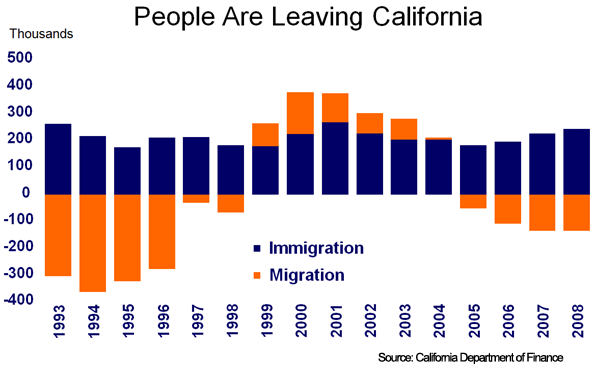
    Domestic migration trends play a similar early warning system for states. California’s dynamism was always reflected by its ability to attract newcomers to the state. But today California’s canary is dead.

    Here’s the logic. If net domestic migration is positive, the state’s economy is reasonably sound. Economic growth, taxes, housing, and amenities are strong enough to keep people where they are and attract others. If net domestic migration is negative, it usually means that lack of economic growth, taxes, quality of life, and housing have deteriorated sufficiently to drive people away. This happens despite the inevitable pain of leaving the security and comfort of family, friends, and familiar surroundings.

    California has been a destination for migrating workers and families since 1849. They came form every state and from around the world. Often the migrants faced tremendous challenges and hardship. Illegal immigrants from Mexico and other developing countries still must leap over such barriers. Often, California’s migrants came in waves. The 1850s, 1930s, and 1950s all saw huge surges tied to huge events – the Gold Rush, the Depression and the post-war boom. But even between these waves, California consistently experienced a steady inflow of new immigrants.

    Immigration has been good for California. The new residents brought ambition, skills, and a willingness to take risks. They found a state with abundant natural resources, from oil to rich soil and ample, if sometimes distant water resources. Together with the people already there, they created an economic powerhouse. They built cities with amenities that rival any other. They fed much of the nation and large numbers overseas. They did this while persevering much of California’s unique endowment: the vast coastline, the Sierra Nevada, and the deserts.

    California, with 12 percent of the United States population, became the world’s sixth largest economy while managing to maintain the aura of paradise at the same time. Opportunity and housing were abundant. California was a great place to have a career and raise a family.

    Most recently, though, this has begun to change. California is no longer a preferred destination, at least for domestic migrants. The state’s economy is limping along considerably worse than that of the nation. Opportunity is limited. Housing is relatively expensive, even after the dramatic deflation of the past two years, except for some very hard-hit and generally less attractive inland areas. Taxes are high and increasing. Regulation is onerous and becoming more so. Many California communities are outright hostile to business.

    Consequently, net domestic migration has been negative for 10 of the past fifteen years. International migration to California remains positive, but that reflects more on the weakness of the economies and the attraction of existing ethnic networks than the intrinsic superiority of California. This represents a sea change: anyone predicting it fifteen years ago would have been laughed out of the room.

    What happened?

    California’s economy was badly hit by the 1990s recession. The State’s aerospace and defense sectors were especially decimated. Middle-class families moved out by the hundreds of thousands.

    The 1990s out migration caused some soul searching in California. There was lots of talk, and a little action on making the State more competitive. Then came the technology and real estate booms. Domestic migration turned positive. The half-hearted efforts to make California more competitive faded as policy makers were lulled into complacency by the strength of California’s resurgence.

    But the problems that bedeviled the state in the 1990s – high housing prices and taxes, cascading regulations and a deteriorated infrastructure – had only been obscured by the boom. By 2005 migration began to turn negative, largely as soaring housing prices discouraged newcomers and encourage many residents to cash out and move to less expensive places. California had priced itself, and the dream, out of competitiveness. Since then, California has seen four consecutive years of increasingly negative domestic migration. The recent net outflow numbers have been smaller than in the 1990s, but it may be because other tradidional California migrant destination economies – like Oregon, Washington, Nevada and Arizona – have become less competitive as well.

    Today, many argue that California will bounce back, but they can’t identify the reason. What sector will lead the resurgence? They seem to think economic growth will come with the sunshine, beaches, and mountains. There was plenty of sunshine in the 80 years between the founding of the first mission and the gold rush, and not much happened. Similarly, the differences between California cities and neighboring Mexican cities show clearly that successful economies need more than good looks and nice climate.

    It’s hard right now to assume California’s future will include the same predominance in technological innovation. Agriculture is running out of water, in large part due to environmental lawsuits, and the state no longer seems willing to invest in new water projects. Even the entertainment industry is increasingly looking outside of California for growth. You have to ask: what does California offer that will overcome the State’s high costs, regulatory environment, and antipathy to business?

    That is the short term. The long term doesn’t look very good either. The public universities, a major source of innovation over the past two decades, are facing increasingly severe budget challenges. It is unlikely that they will be able to maintain their status even as other states – Texas, Colorado, New Mexico – eye further expansion. Even more ominous are gains in countries, such as China and India, who have long sent their best and brightest to the Golden State.

    All this suggests a relative decline in California’s long-term prospects. What should we do? Part of California’s problem is its political process. The state’s chronic inability to do much of anything reinforces stasis. As Dan Walters says, “everyone has a veto on everything.”

    But even improving the political process may not be enough. Much of Coastal California is dominated by rich, aging, baby boomers. The residents of this increasingly geriatric ghetto often don’t worry much about economic opportunity. They may have the money and votes to guarantee that growth does not impinge on their lifestyles. Unless these conditions change, it will be unlikely to see a renewal of strong domestic migration to California in the coming years.

    Bill Watkins, Ph.D. is the Executive Director of the Economic Forecast Project at the University of California, Santa Barbara. He is also a former economist at the Board of Governors of the Federal Reserve System in Washington D.C. in the Monetary Affairs Division.

  • U-Haul Prices as Migration Indicator

    Austin fared very well on this year’s Best Cities Rankings, and here’s another interesting indicator of the difference in migration between Austin and San Francisco:

    “When comparing California with Texas, U-Haul says it all. To rent a 26-foot truck oneway from San Francisco to Austin, the charge is $3,236, and yet the one-way charge for that same truck from Austin to San Francisco is just $399. Clearly what is happening is that far more people want to move from San Francisco to Austin than vice versa, so U-Haul has to pay its own employees to drive the empty trucks back from Texas.”

    This anecdote comes from a report comparing business environments in Texas to California.

    Here’s a table of the latest domestic migration numbers from US Census for all metropolitan areas of more than 1.5 million total population (rate numbers are per 1,000 population):

    NAME
    Population, 2008
    Net Domesitc Migration Rate, 2008
    Ave. Net Domesic Mig Rate, 2001-2008
    New York-Northern New Jersey-Long Island, NY-NJ-PA 19,006,798 -7.6 -12.0
    Los Angeles-Long Beach-Santa Ana, CA 12,872,808 -9.0 -12.2
    Chicago-Naperville-Joliet, IL-IN-WI 9,569,624 -4.4 -6.8
    Dallas-Fort Worth-Arlington, TX 6,300,006 7.0 5.7
    Philadelphia-Camden-Wilmington, PA-NJ-DE-MD 5,838,471 -3.8 -2.3
    Houston-Sugar Land-Baytown, TX 5,728,143 6.6 4.5
    Miami-Fort Lauderdale-Pompano Beach, FL 5,414,772 -8.7 -5.1
    Atlanta-Sandy Springs-Marietta, GA 5,376,285 8.2 10.2
    Washington-Arlington-Alexandria, DC-VA-MD-WV 5,358,130 -3.4 -2.9
    Boston-Cambridge-Quincy, MA-NH 4,522,858 -1.8 -7.1
    Detroit-Warren-Livonia, MI 4,425,110 -13.9 -9.1
    Phoenix-Mesa-Scottsdale, AZ 4,281,899 12.3 17.9
    San Francisco-Oakland-Fremont, CA 4,274,531 1.3 -10.5
    Riverside-San Bernardino-Ontario, CA 4,115,871 -1.9 16.1
    Seattle-Tacoma-Bellevue, WA 3,344,813 3.6 0.9
    Minneapolis-St. Paul-Bloomington, MN-WI 3,229,878 -1.1 -1.0
    San Diego-Carlsbad-San Marcos, CA 3,001,072 0.1 -4.8
    St. Louis, MO-IL 2,816,710 -2.0 -1.8
    Tampa-St. Petersburg-Clearwater, FL 2,733,761 2.4 12.9
    Baltimore-Towson, MD 2,667,117 -4.6 -1.6
    Denver-Aurora, CO /1 2,506,626 7.3 1.8
    Pittsburgh, PA 2,351,192 -1.0 -2.9
    Portland-Vancouver-Beaverton, OR-WA 2,207,462 8.3 6.2
    Cincinnati-Middletown, OH-KY-IN 2,155,137 -1.7 -1.2
    Sacramento–Arden-Arcade–Roseville, CA 2,109,832 2.2 8.7
    Cleveland-Elyria-Mentor, OH 2,088,291 -7.1 -7.5
    Orlando-Kissimmee, FL 2,054,574 1.6 15.9
    San Antonio, TX 2,031,445 11.5 10.4
    Kansas City, MO-KS 2,002,047 0.7 1.5
    Las Vegas-Paradise, NV 1,865,746 7.9 23.7
    San Jose-Sunnyvale-Santa Clara, CA 1,819,198 -1.5 -16.4
    Columbus, OH 1,773,120 1.4 1.8
    Indianapolis-Carmel, IN 1,715,459 4.0 4.8
    Charlotte-Gastonia-Concord, NC-SC 1,701,799 20.9 18.2
    Virginia Beach-Norfolk-Newport News, VA-NC 1,658,292 -9.4 -0.6
    Austin-Round Rock, TX 1,652,602 22.0 17.2
    Providence-New Bedford-Fall River, RI-MA 1,596,611 -6.6 -3.7
    Nashville-Davidson–Murfreesboro–Franklin, TN 1,550,733 10.9 9.6
    Milwaukee-Waukesha-West Allis, WI 1,549,308 -4.2 -5.9
  • California Natives

    If you are going to San Francisco, be sure to say hello to mom, dad, and maybe your best friend from third grade.

    California has traditionally been a land of migrants from around the country and around the world, but for the first time in the state’s history, the majority of California residents are native-born.

    A study done by researchers at the University of Southern California has determined that more than 70% of those between the ages of 15 and 24 were born in the Golden State. Native-born Californians were also found to be less likely to move out of the state.

    This increase in locally born residents comes with profound implications about the state’s future. For example, more workers will be educated in California, “putting a greater burden on the state’s taxpayers to pay for quality schools.” At the same time, with a greater number of residents staying in-state, a wealth of workers, taxpayers, and home buyers could keep more business from moving.

    Additionally, as more people continue to put down roots, the potential support for investments in such public goods such as transportation networks and public universities could grow as more residents become committed to investing in California’s future.

  • A California Wedding

    My wife and I attended a wedding on a recent past weekend. It was a beautiful event in a beautiful setting: city of Atascadero, county of San Luis Obispo, on California’s central coast. We drove through spectacularly beautiful wine country to get there. The weather was beautiful. A beautiful young couple exchanged vows in the backyard of the groom’s childhood home, where his mom still lives.

    Beautiful setting, wonderful people
    Two beautiful families became one big extended family. It was a beautiful atmosphere: loving, warm and generous of spirit. Every single person I encountered during the weekend impressed me as a beautiful, wonderful individual, and that’s not just the champagne talking. Even the exes got along beautifully, and that was a good thing, because my god, there were a lot of them.

    Demographics rears its head
    As a demographer I was cognizant of several overlapping trends that were manifesting themselves. The bride is an only child. The bride’s mom (let’s call her “Betty”) is an only child. Two of Betty’s exes were present, including the bride’s father (an only child), as was her current husband (a childless only child). Everyone is seemingly on wonderful terms with ex-spouses, ex-spouses’ intervening and current partners, and everyone else.

    The bride’s father (let’s call him “Jack,” because this is going to get complicated), after his marriage to Betty, was then married for a while to a woman (let’s call her “Jane”), who was also present. One of Jane’s previous husbands was a guy (oh hell, let’s call him “Peter”) who is here by dint of multiple connections, having grown close with the bride as a counselor, and as a former business partner of the bride’s father, Jack.

    Jack and Jane not only married with Peter’s blessing, they got married in Peter’s house, the same house in which he (Peter) and Jane had gotten married ten years previously. They all get along wonderfully as well. Jack is here, by the way, with current partner “Louise,” a lovely person who, for my demographically analytical purposes, is divorced and childless (forgive me Louise, that sounds worse than it should). Betty’s other ex in attendance is, we’ll say, “Randy,” who is here with, oh, “Melody,” also previously divorced. They make a really sweet couple, and are both childless.

    Peter and Jane have an only child we’ll call “Helen.” She was the maid of honor. Also in attendance are the bride’s (married and as yet childless) good friends “Mary” and “Andrew” (an only child).

    Peter is a relationship counselor; this must come in handy. We are all staying at Peter’s serene and beautiful vineyard compound, the grounds of the Center for Reuniting Families, a retreat where he offers individuals, couples and families a place to heal themselves and their relationships. This is coastal California, after all.

    So let’s see:
    “Betty” has two exes here (Jack and Randy);
    “Jack” has two exes here (Betty and Jane);
    “Jane” has two exes here (Jack and Peter);
    “Peter” has two exes here (Jane and “Linda”).

    Who is Linda? Linda lives at the compound, as do a few of her exes and current partner. Linda and her only child run a bakery together and made the spectacular, beautiful wedding cake.

    The groom’s divorced parents are also on wonderful terms, and it showed on the day when it all came together.

    I guess my wife and I are the outliers. We are still in a long-lasted first marriage and have four siblings between us who can say the same. We do have an only child, though; each of our four siblings has two each.

    I am not a native Californian, but my wife is, and her mother and grandmother can claim nine marriages between them.

    We do have an only child, but during the 1970s we did belong to the National Organization for Non-Parents, which promoted the notion it was okay to be childless. The founder also eventually had a child and formed a new organization to promote the notion that single children were okay too. God, we baby boomers.

    Implications, Reflections
    What does it all mean? Well, the first thing that occurs to me is that statistics on marriage, divorce and remarriage don’t really capture the whole picture. Many people believe the divorce rate is 50%, but the divorce rate is not even measured or expressed as a percentage figure; it’s the number of divorces per 1,000 of population in any given year. In 2005, the most recent year for which data are available, the US divorce rate was 3.6, the lowest level since 1970. (The peak was 5.3 in 1981.) And California was not the state with the highest divorce rate; that distinction went to Nevada, at 6.4, followed by Arkansas at 6.3 and Wyoming at 5.3.

    The reason so many people think the divorce rate is 50% is because for any given year of the past many decades, the number of divorces (and hence, the divorce rate) has been about half the number of marriages (and thus half the marriage rate). For example, in 2005 there were about 2.2 million marriages in the US (resulting in a marriage rate of 7.5), and about 1 million divorces (and a divorce rate of 3.6).

    It’s hard to state the percentage of marriages that end in divorce, because there are few longitudinal studies done tracking the same married couples over time, and the percentage which divorce will increase the longer the time frame. But I have read a figure of approximately 33%, which if true would mean that two-thirds of first marriages do not end in divorce. On the other hand, the divorce rate is down because the marriage rate is down, and for the first time in our history, the percentage of households comprised of married couples has fallen below 50% (and thus, no longer a majority of households).

    [The exact 2005 numbers: of the nation’s 111.1 million households, 55.2 million, or 49.7%, were made up of married couples, those with or without children. The rest were single households, unrelated cohabitating households, or other non-traditional households.]

    What about the kids?
    The second thing I can tell you is that the statistics reveal nothing about the level of happiness out there. The people I saw this weekend were about as happy, content and well-adjusted a group as I’ve ever seen. Not that they haven’t gone through their share of heartbreak, difficulty, sorrow, challenge and crisis (no small amount of which relating to children!). Our daughter, in her 20s, tells us she does not know of a single contemporary who is not dealing with one or more “issues” (therapy, medication, psychoanalysis, depression, bipolar disorder, drug use, eating disorders, cutting, to name a few). And if you’re going to say these problems are most prevalent in the populations that can afford them, I’ll agree.

    Still, the incidence of single children and childlessness might be a concern. Demographers Ben Wattenberg and Nicholas Eberstadt have written of a future world of declining fertility and birth rates, leading to eventual declines in population. They’re concerned because population growth is the foundation of modern economies and welfare states, and if populations of the rich, advanced, educated, industrialized, developed countries are not growing (and they are not, except for the notable exception of the US), then who will reproduce and replenish? Increasingly, they fear, people at odds with the modern world.

    And what will be the effect on families in a world where the only biological relatives for many people will be their ancestors?

    Demographer Phillip Longman puts it more bluntly in his book The Empty Cradle. Childbearing has become a sucker’s game, he writes: parents are supposed to provide society with a steady new supply of well-bred individuals (educated, moral, balanced, sober, disciplined, productive citizens), in exchange only for the psychic rewards. No wonder the birthrate is falling. Or was, until 2007. In that recent year there were a record 4.3 million births in the US, the most since 1957 (the middle of the Baby Boom). The fertility rate (the average number of children born to each woman over her lifetime) rose to 2.1 (the level needed to maintain current population size), the highest since 1971.

    Of course by 2050 half of the 400 million Americans projected to be alive will be what are now considered ethnic and racial minorities. That doesn’t bother you, does it?

    But none of it was a concern this particular weekend. Everything, and everyone, was beautiful. Even the traffic on the 101 returning to Los Angeles was not that bad. This doesn’t have the look or feel of decline, but if it is, it’s been a beautiful ride.

    Dr. Roger Selbert is a trend analyst, researcher, writer and speaker. Growth Strategies is his newsletter on economic, social and demographic trends; IntegratedRetailing.com is his web site on retail trends. Roger is US economic analyst for the Institute for Business Cycle Analysis in Copenhagen, and North American agent for its US Consumer Demand Index, a monthly survey of American households’ buying intentions.

  • Cash, Not Pretense: An Entrepreneur’s Guide to the Credit Crisis.

    Compared with most businessmen, 41-year-old Charlie Wilson has some reason to like the economic downturn. President of Salvex, a Houston-based salvage firm he founded in 2002, Wilson has seen huge growth in the bankruptcy business over the past year. It is keeping his 10-person staff, and his 55 agents around the world, busy.

    But the credit crunch still creates headaches for Wilson. With loans hard to secure, many would-be customers cannot bid on the merchandise in his inventory. “We are booming with more deals because people are defaulting,” Wilson notes, “but the buyers are gun-shy because they can’t get the money to pay.”

    So what do you do in these circumstances? Charlie Wilson is taking a back-to-basics approach. Rule No. 1: Stay away from people who rely on credit, not cash. This means private companies – including many outside the U.S. – are often better customers than larger, but now cash-strapped, public ones. “The further away I get from Wall Street, the better I feel,” Wilson says.

    Cheap is the new hip. Focus on cutting costs and streamlining operations. Don’t spend money on unnecessary employees or hard infrastructure; use the Internet wherever possible. It helps, Wilson says, to be located in an affordable building and in a place, like Houston, where taxes, regulatory costs and rents are generally cheap. “I work out of a Class C building,” he says, “and now everyone thinks it’s sexy.”

    Expand your range of customers. Look for new customers who have cash resources and access to markets that are still growing. This has led Wilson to look outside the U.S, to places like India or China, where many companies still have cash and see the current crisis as a great opportunity for bargain hunting.

    These three trends – the growing importance of cash, cost cutting and expanding one’s customer base – are defining entrepreneurial response to the credit crash. All three trends can be seen in the strategies of entrepreneurs who are focusing on burgeoning, often cash-oriented immigrant markets.

    Consider the success of La Gran Plaza, a massive Latino-themed shopping center on the outskirts of Ft. Worth, Texas. Not so long ago, La Gran Plaza was a failing suburban shopping center. Now it’s thriving, but only after being regeared to service the cash economy of the local Latino community. Similar success can be seen elsewhere in the country, even in Southern California, which has been hard-hit by the recession but where ethnic malls and supermarkets continue to thrive.

    Some urbanists, like scholar Richard Florida, maintain that the post-crash environment favors densely populated (and very expensive) cities like New York. But in fact, it may make more sense for entrepreneurs concerned with costs to work out of places like Houston, or even the Great Plains states, where local governments are more business-friendly. And everything, from housing to energy, tends to be less expensive.

    Indeed, over the past few recessions, the basic pattern has been that cities come into the downturns late and stay in them longer. In the last decade, many big cities have become very dependent on Wall Street and asset inflation. In 2006, for instance, financial services accounted for a remarkable 35% of all of New York City’s wages and salaries, compared with less than 20% 30 years earlier.

    So it seems likely that the credit crisis will hit pretty hard in those places most addicted to credit – places like New York, San Francisco and Chicago. This occurred early 1980s, the early 1990s and will occur again now. It might even be worse this time around. The federal takeover of the banks will mean lower salaries and bonuses, which will make such places less attractive to ambitious young people. If you are limited to $250,000 a year, it’s much easier to “get by” in Charlotte or Des Moines than it is in Manhattan.

    The biggest hope for New York, Los Angeles and other big cities lies with immigrants and the fact that lower property prices could keep some talented individuals from migrating elsewhere. But the one expensive big city really well-positioned for the credit crunch may be Washington, D.C., since it “creates” its own credit. As key financial decision making shifts to the capital, we can expect to see some financial-industry titans (and their retainers) spending more time in, or even moving to, the capitol. Washington, it’s time for your close-up.

    Beyond the beltway, the credit crunch will eventually benefit places with lower costs of living – including Houston. High rents, strong regulatory restraints and prestige spending make little sense in a cash-short environment. Now, fancy high-rise offices in elite areas are an albatross for even the strongest business.

    The remade economy may hold some much-needed good news for hard-hit sun-belt markets. Some places, like Phoenix, may be poised for a comeback. “Phoenix is paying for being overbuilt, but [lower] prices will attract people back,” explains local economist Elliot Pollack. “The fundamentals that drove the growth are still here with the return of lower costs – the ease of doing business, lower taxes and the attractiveness of the area.”

    But the real winners may be the people now leaving big companies to start new firms. Unburdened by bad habits developed in the bubble, they will be able to fit their business models in lean times. Many won’t mind being in an un-fancy building or neighborhood. Whether they are forming new banks, energy companies or design firms, they will need to do it more efficiently – with less overhead, smarter use of the Web and less pretension.

    “People are watching their companies go under. You get three vice-presidents who get laid off but know their business,” Wilson says. “They start a new company somewhere cheap that is more efficient and streamlined. These are the companies that will survive and grow the next economy.”

    This article originally appeared at Forbes.

    Joel Kotkin is executive editor of NewGeography.com and is a presidential fellow in urban futures at Chapman University. He is author of The City: A Global History and is finishing a book on the American future.

  • How Elite Environmentalists Impoverish Blue-Collar Americans

    The great Central Valley of California has never been an easy place. Dry and almost uninhabitable by nature, the state’s engineering marvels brought water down from the north and the high Sierra, turning semi-desert into some of the richest farmland in the world.

    Yet today, amid drought conditions, large parcels of the valley – particularly on its west side – are returning to desert; and in the process, an entire economy based on large-scale, high-tech agriculture is being brought to its knees. You can see this reality in the increasingly impoverished rural towns scattered along this region, places like Mendota and Avenal, Coalinga and Lost Hills.

    In some towns, unemployment is now running close to 40%. Overall, the water-related farming cutbacks could affect up to 300,000 acres and could cost up to 80,000 jobs.

    However, the depression conditions in the great valley reflect more than a mere water shortage. They are the direct result of conscious actions by environmental activists to usher in a new era of scarcity.

    To some extent, such efforts reflect some real limits imposed by the growth of population. Constructive long-term changes in the conservation and utilization of all basic resources – energy, water and land – are not only necessary, but also inevitable.

    Yet the new scarcity does not simply advocate humane ways to deal with shortages, but seeks to exacerbate them intentionally. This reflects a doomsday streak in the contemporary environmental ethos – greatly enhanced by the concern over climate change – that believes greater scarcity of all basic commodities, from land and water to energy, might help reduce the much detested “footprint” of our species.

    One key element of this agenda has to do with reducing access to critical resources like water beyond those required to support existing uses. To be sure, two years of below-average precipitation helped create central California’s current water shortage. Planting crops such as cotton, which needs lots of water, may also have contributed to the problem.

    However, this only explains part of the problem, which increasingly has to do not with vicissitudes of nature but conscious political action. In prior dry periods, the state has managed its water resources to supply farmers and other users as effectively as possible. Today, in response to seemingly endless litigation to protect certain fish in the Delta region west of Sacramento or to “revitalize” valley streams, enormous amounts of water have been allowed to flow untapped into San Francisco Bay.

    This distinction was entirely missing in national coverage of the drought. A recent New York Times article, for example, barely acknowledged the role played by environmentalists whose move to block additional water supplies from the Delta have turned a below-average year – moisture content in the Sierra is about 90% of normal – into something of an epochal agricultural and human disaster.

    “This is still a pretty decent drought but nothing unusual,” suggests Tim Quinn, executive director of the Association of California Water Agencies, which represents both urban and agricultural interests. “We were prepared, as usual, for the drought, but they have taken all the tools away from us.”

    Many environmentalists justify their efforts to curtail water availability for California’s farmers and towns by citing various doomsday global warming projections. Energy Secretary Steven Chu, for example, recently opined that as the state’s climate inevitably shifts to a hot-weather, low-precipitation pattern, water scarcity will create “a scenario where there is no more agriculture in California.” If agriculture is doomed anyway, why not kill the industry now and use the water for fish or other pet “green” projects?

    This represents a remarkable reversal in the spirit that only a few decades ago drove the development of California. Anyone who has lived for any period in the state knows that aridity represents our greatest natural challenge. California seems always either at the edge of drought, coming out of one, or about to enter a dry spell. Since 1920, the state has experienced crippling six-year droughts during 1929 to 1934 and 1987 to 1994, as well as severe shortfalls of a lesser span on several occasions.

    Recognizing the need for a reliable water supply despite the certainty of significant dry years, Californians responded by building one of the most highly advanced water delivery systems in the world. The result was a network of federal and state dams, pumps and aqueducts emblematic of the “can-do” spirit motivating old Progressives, like Edmund Brown in Sacramento and New Dealers in the nation’s capitol.

    The state’s water conveyance facilities opened vast new tracts of land to agriculture. Some of the world’s largest expanses of almonds, pistachios, pomegranates, grapes and cotton covered once-arid land. This expansion created steady demand for advanced farming technologies as well as low-paid labor, much of it undocumented. Reflecting this dichotomy, wealth and poverty grew hand in hand throughout the Central Valley.

    Today, environmentalists cite – as yet another reason to dehydrate California farmlands – the prevalence of immigrant labor in the Central Valley. Lloyd Carter, a major state environmental activist, recently suggested that cutting farm production would actually be beneficial since most farm workers are “not even American citizens for starters” and raise children that “turn to lives of crime,” “go on welfare” and “get into drug trafficking and … join gangs.” These comments cost Carter his association with certain environmental groups, but not his day job – deputy attorney general under former governor and supreme green jihadi Jerry Brown.

    Unfortunately, Carter’s comments reflect what many environmentalists will tell you in private. As a Valley resident himself, Carter may have great empathy for his region’s poor and working class, but it’s hardly a priority among the core of the green movement, which is based in places like San Francisco or Santa Monica. This reflects not so much racism as a disconnect with the productive industries – agriculture, energy and manufacturing – that tend to cluster on the other side of the coastal range.

    The growing economic problems in Central Valley cities like Fresno, where unemployment is near 15%, represents little more than an abstraction to a new cadre of wealthy “progressives” who merely pass through the area on their way to Yosemite and other Sierra resorts.

    “We are getting the sense some people want us to die,” notes native son Tim Stearns, a professor of entrepreneurship at California State University at Fresno. “It’s kind of like they like the status quo and what happens in the Central Valley doesn’t matter. These are just a bunch of crummy towns to them.”

    This split has engendered what is likely a quixotic secession campaign led by farmers in the interior counties, but such drives to divide the Golden State have risen and failed many times before. Yet clearly, there exists a growing divide between producer and consumer economies, and this is coming to the fore not only in California, and on issues well beyond water.

    It is critical to understand that anti-growth politics diverges from the old conservationist ethos in radical ways. No longer is it enough to talk about growing intelligently or using technology to meet long-term problems. Instead, scarcity politics seeks to slow and even reverse material progress through what President Obama’s science adviser, John Holdren, calls “de-development.”

    “De-development” – that is, the retreat from economic growth – includes some sensible notions about conservation but takes them to unreasonable, socially devastating and politically unpalatable extremes. The agenda, for example, includes an opposition to population growth, limits on material consumption and a radical redistribution of wealth both nationally and to the developing world.

    In much the same way as seen in California’s water crisis, many of the administration’s “green” energy policies pose a direct threat to blue-collar workers employed in extracting and processing fossil fuels. The resultant high energy prices caused by the proposed “cap and trade” system – essentially a system for creating scarcity – also will cost middle-class consumers, blue-collar workers, truckers and manufacturers. These constituencies could well face the kind of water policy-related decline that is destroying farming communities throughout central California.

    Yet at the same time, such policies make the well-to-do and trustafarians in San Francisco and Malibu – for whom higher energy prices are barely a concern – feel better about themselves. In what passes for progressive politics today, narcissism usually takes priority over reality.

    In the new scarcity politics, access to land also may be sharply limited. New land regulation, ostensibly for climate-change reasons – already in place in California and being discussed as well in Washington state – could force almost all new development to follow a high-density, multi-family pattern. Over time, single-family homes – the preference of a vast majority of Americans – will become once again, as they were in the past, the privilege only of the upper classes in some metropolitan regions.

    By embracing the politics of scarcity, the Obama administration seems committed to imposing a regime that could slow any sustained recovery from the current recession. Although these ideas might appear plausible at a Harvard Law Review bull session, their real consequences for millions of Americans could prove very ugly indeed.

    This article originally appeared at Forbes.

    Joel Kotkin is executive editor of NewGeography.com and is a presidential fellow in urban futures at Chapman University. He is author of The City: A Global History and is finishing a book on the American future.

  • I’ll have a $14,000 vacation with my lobbyists, please.

    Democratic lawmakers from California recently took a break in the midst of “intense state budget negotiations” to travel up to a wine-country lodge complete with gourmet food, rooms, and cocktails with a trio of interests footing the $14,000 bill.

    At the time of the retreat, the Consumer Attorneys of California (who, along with labor unions, had been pushing to roll back some labor rules) the California Professional Firefighters (seeking to protect funding for fire safety programs) and the Northern California Carpenters Regional Council (lobbying for greater roles for private contractors in state construction) all had strong interest in the proceedings.

    The getaway came a day after Gov. Schwarzenegger declared a state of fiscal emergency and ordered the Legislature to discuss a series of proposals to plug a projected $42-bilion budget gap.

    For the most part, each group had its interests protected in the budget package passed in February – though each group denied the retreat had anything to do with the budget.

    Such extravagance gifted to lawmakers is not uncommon; groups with business before the state commonly bankroll such outings. Dinner at Morton’s Steakhouse with a $144 price tag, tickets to Disneyland, and $13,211 trip to Egypt, Jordan, and Israel, among many others, were revealed last week in documents filed by lawmakers.

    Indecent lobbying goes down best with a vintage cabernet.