Tag: California

  • The Aging of Paradise in Ventura County California

    You could say that Ventura County, just north of Los Angeles, represents what is best about California. Some people believe that its amenities – beaches, gorgeous interior valleys and parks – assure perpetual economic growth for Ventura County and California. They are wrong. There is trouble in paradise.

    Ventura County has changed, and not for the better. It is aging, losing its demographic as well as economic vitality. This represents a relatively new phenomenon, the slow decline of even formerly healthy suburban areas.

    The current recession illustrates the change. In the past Ventura County suffered mild recessions even as the country and the region suffered mightily. The County saw no annual net job losses in the 2001 recession. The early 1990s recession was more painful, but Ventura County did far better than California as a whole.

    All of that has changed with the current recession. Ventura County has recently been losing jobs at a faster pace than California. In 2007, the County lost jobs while California gained jobs.

    The picture is even worse when Ventura County’s economy is compared to the Los Angeles County economy. In 2008, Ventura County’s economy shrank at a rate about five times faster than did Los Angeles’s economy.

    What is going on here? In the past, Ventura County has been buffered by its twin giants, Amgen and Countrywide. Amgen’s Ventura County growth has slowed. Countrywide has done much worse than Amgen, and its demise has been well documented.

    But you can’t blame all of Ventura County’s weakness on Countrywide. It has contributed, but it is not Ventura County’s sole source of economic weakness. The weakness is quite general, spanning the construction sector, non-durable manufacturing, retail trade and other services. Each lost over 1,000 jobs in 2008. By contrast, the finance, insurance, and real estate sectors, where Countrywide resides, lost just fewer than 900 jobs, accounting for about 4 percent of the job losses.

    My sense is the real underlying problem is demographic, and this may not go away even if the economy recovers. One clue is that more people have been leaving Ventura County than moving in from all sources, and this has been happening long enough to be a trend. It reflects still-high housing costs and limited opportunity. It implies a weak future.
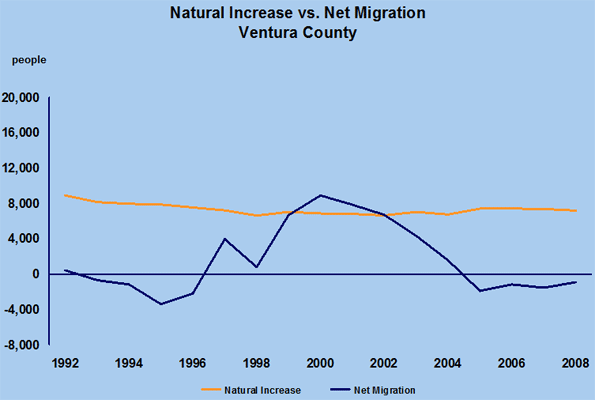
    This chart shows that in exactly half of the past 16 years, migration has been negative. That is total migration, not just domestic migration.

    Think about this for a moment. More people are leaving Ventura County than are moving in. That is certainly counter to what has happened in most of the past 150 years.

    Ventura County’s net out migration has impacts beyond its effect on the size of the population. The composition of the county is also changing, away from working age people and families and towards people either close to retirement or already there.
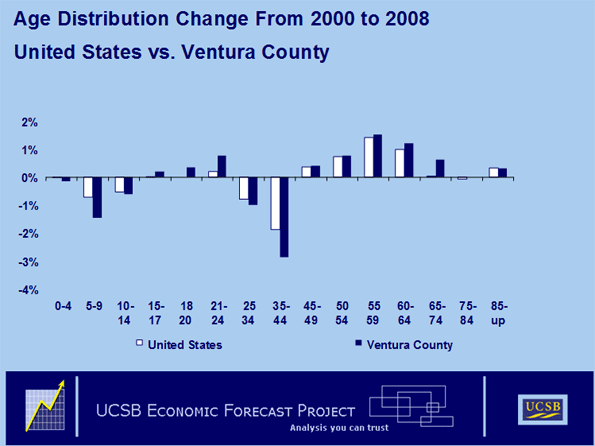
    The above chart compares relative changes, by age cohort, in Ventura County’s population since the 2000 census with changes in the United States population since the 2000 census. The County’s population between 25 and 44 years of age and their children has been collapsing. At the same time, the County’s populations of both young adults and people over 45 have been growing as a percentage of the total population. The bulk of that growth has occurred in the over 55 cohort.

    The migration out of Ventura County has also resulted in changes to the County’s income distribution. The following chart compares changes in the County’s income distribution to changes in the United States income distribution since the 2000 census:
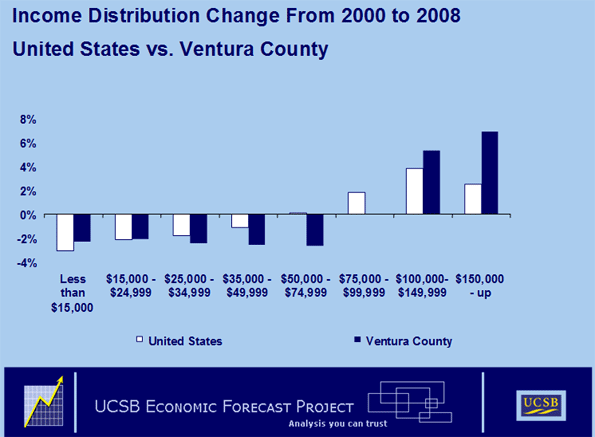
    The comparisons are telling. The County has been losing very-low-income people at a slower pace than has the United States. At the same time, the growth in population with incomes over $100,000 has been spectacular. The local population with incomes between $25,000 and $75,000 has fallen far more rapidly than that of the United States. The County’s population with incomes between $75,000 and $100,000 is relatively unchanged, while that of the United States has shown significant growth.

    People – particularly in the late 20s and early 30s – aren’t leaving Ventura County because amenities have suddenly disappeared. They are leaving because of a deficit in opportunity. Their leaving has consequences. Ventura County’s population is aging more rapidly than it otherwise would. The net result of these demographic changes is that Ventura County’s median real per-capita income is declining, while the County’s median age is rising. Real per-capita personal income has fallen almost $1,000 in only eight years, to $32,718 (Constant 2000 dollars) from $33,797 in 2000.

    Ventura County’s demographic changes can be easily summarized. It is losing its middle class and becoming bi-modal. The young families that provide a community’s vigor and future have been leaving. There is no reason to believe that the trend will reverse itself. Ventura County home prices are still relatively high, while opportunity is declining.

    The County is left with an aging and increasingly wealthy population along with the lower-income people that service the wealthy aged and the very-low-income farm workers. In a sense, it now resembles what we see in many expensive city cores – even if it is on the periphery!

    This creates enormous risks. Most amenities are luxury goods. Poor people don’t invest in luxury goods. Generally, the lower-income population does not have the resources to provide leadership or invest in a community’s future. They have their hands full just taking care of their families, particularly in an expensive place like Ventura County. Their children will likely join the middle class, but in someplace more affordable like Texas, Arizona, or Nevada.

    High concentrations of older people and declining incomes are often associated with deteriorating schools, amenities and increasing crime. The aged wealthy are not in Ventura County to invest in its future. They are there to consume it. They will not invest in the future – particularly if their children and relatives have gone elsewhere.

    Ventura County is not unique. It is fairly representative of Coastal California. Communities like Ventura, Goleta, and San Luis Obispo used to be middle-class communities that valued opportunity. Things are even more extreme in California’s elite playgrounds: Monterey, Malibu, and Santa Barbara. Populations in Monterey and Santa Barbara have actually declined over the past several years. Similar phenomena may be noticeable in other formerly elite suburbs within our most favored metropolitan areas.

    These changes present serious challenges to California’s workers, businesses, and those policy makers who still care about something other than greenhouse gases and public employee pensions. Something needs to be done, and quickly. But the immediate prognosis is less than encouraging. Like Ventura County, California is suffering its worst recession in decades, and policy makers don’t seem to be focusing on policies that may help the area return to its previous status as a region of opportunity.

    Portions of this essay have previously appeared in a UCSB-EFP Ventura County Forecast.

    Bill Watkins, Ph.D. is the Executive Director of the Economic Forecast Project at the University of California, Santa Barbara. He is also a former economist at the Board of Governors of the Federal Reserve System in Washington D.C. in the Monetary Affairs Division.

  • Death of the California Dream

    For decades, California has epitomized America’s economic strengths: technological excellence, artistic creativity, agricultural fecundity and an intrepid entrepreneurial spirit. Yet lately California has projected a grimmer vision of a politically divided, economically stagnant state. Last week its legislature cut a deal to close its $42 billion budget deficit, but its larger problems remain.

    California has returned from the dead before, most recently in the mid-1990s. But the odds that the Golden State can reinvent itself again seem long. The buffoonish current governor and a legislature divided between hysterical greens, public-employee lackeys and Neanderthal Republicans have turned the state into a fiscal laughingstock. Meanwhile, more of its middle class migrates out while a large and undereducated underclass (much of it Latino) faces dim prospects. It sometimes seems the people running the state have little feel for the very things that constitute its essence — and could allow California to reinvent itself, and the American future, once again.

    The facts at hand are pretty dreary. California entered the recession early last year, according to the Forecast Project at the University of California, Santa Barbara, and is expected to lag behind the nation well into 2011. Unemployment stands at roughly 10 percent, ahead only of Rust Belt basket cases like Michigan and East Coast calamity Rhode Island. Not surprisingly, people are fleeing this mounting disaster. Net outmigration has been growing every year since about 2003 and should reach well over 200,000 by 2011. This outflow would be far greater, notes demographer Wendell Cox, if not for the fact that many residents can’t sell their homes and are essentially held prisoner by their mortgages.

    For Californians, this recession has been driven by different elements than the early-1990s downturn, which was largely caused by external forces. The end of the Cold War stripped away hundreds of thousands of well-paid defense-related jobs. Meanwhile, the Japanese economy went into a tailspin, leading to a massive disinvestment here. In South L.A., the huge employment losses helped create the conditions conducive to social unrest. The 1992 Rodney King verdict may have provided the match, but the kindling was dry and plentiful.

    This time around, the recession feels like a self-inflicted wound, the result of “bubble dependency.” First came the dotcom bubble, centered largely in the Bay Area. The fortunes made there created an enormous surge in wealth, but by 2001 that bust had punched a huge hole in the California budget. Voters, disgusted by the legislature’s inability to cope with the crisis, recalled the governor, Gray Davis, and replaced him with a megastar B-grade actor from Austria.

    Yet almost as soon as the Internet bubble had evaporated, a new one emerged in housing. As prices soared in coastal enclaves, people fled to the periphery, often buying homes far from traditional suburban job centers. At first, it seemed like a miraculous development: people cheered as their home’s “value” increased 20 percent annually. But even against the backdrop of the national housing bubble, California soon became home to gargantuan imbalances between incomes and property prices. The state was also home to such mortgage hawkers as New Century Financial Corp., Countrywide and IndyMac. For a time the whole California economy seemed to revolve around real-estate speculation, with upwards of 50 percent of all new jobs coming from growth in fields like real estate, construction and mortgage brokering.

    As a result, when the housing bubble burst, the state’s huge real-estate economy evaporated almost overnight. Both parties in the legislature and the governor failed miserably to anticipate the impending fiscal deluge they should have known was all but inevitable.

    To many longtime California observers, the inability of the political, business and academic elites to adequately anticipate and address the state’s persistent problems has been a source of consternation and wonderment. In my view, the key to understanding California’s precipitous decline transcends terms like liberal or conservative, Democratic and Republican. The real culprit lies in the politics of narcissism.

    California, like any gorgeously endowed person, has a natural inclination toward self-absorption. It has always been a place of unsurpassed splendor; it has inspired and attracted writers, artists, dreamers, savants and philosophers. That’s especially true of the Bay Area—ground zero for California narcissism and arguably the most attractive urban expanse on the continent; Neil Morgan in 1960 described San Francisco as “the narcissus of the West,” a place whose fundamental asset was first its own beauty, followed by its own culture of self-regard.

    At first this high self-regard inspired some remarkable public achievements. California rebuilt San Francisco from the ashes of the great 1906 fire, and constructed in Los Angeles the world’s most far-reaching transit system. These achievements reached a pinnacle under Gov. Pat Brown, who in the 1960s oversaw the expansion of the freeways, the construction of new university, state- and community-college campuses, and the creation of water projects that allowed farming in dry but fertile landscapes.

    Yet success also spoiled the state, incubating an ever more inward-looking form of narcissism. Even as the middle class enjoyed “the good life” — high-paying jobs, single-family homes (often with pools), vacations at the beach — there was a growing, palpable sense of threats from rising taxes, a restless youth population and a growing nonwhite demographic. One early expression of this was the late-1970s antitax movement led by Howard Jarvis. The rising cost of government was placing too much of a burden on middle-class homeowners, and the legislature refused to address the problem with reasonable reforms. The result, however, was unreasonable reform, with new and inflexible limits on property and income taxes that made holding the budget together far more difficult.

    Middle-class Californians also began to feel inundated by a racial tide. This was not totally based on prejudice; Californians seemed to accept legal immigration. But millions of undocumented newcomers provoked fear that there were no limits on how many people would move into the state, filling emergency rooms with the uninsured and crowding schools with children whose parents neither spoke English nor had the time to prepare their children for school. By 1994, under Gov. Pete Wilson, the anti-immigrant narcissism fueled Proposition 187. It was now OK to deny school and medical services to people because, at the end, they looked different.

    Today the politics of narcissism is most evident among “progressives.” Although the Republicans can still block massive tax increases, the predominant force in California politics lies with two groups — the gentry liberals and the public sector. The public-sector unions, once relatively poorly paid, now enjoy wages and benefits unavailable to most middle-class Californians, and do so with little regard to the fiscal and overall economic impact. Currently barely 3 percent of the state budget goes to building roads or water systems, compared with nearly 20 percent in the Pat Brown era; instead we’re funding gilt-edged pensions and lifetime guaranteed health care. It’s often a case of I’m all right, Jack — and the hell with everyone else.

    The most recent ascendant group are the gentry liberals, whose base lies in the priciest precincts of San Francisco, the Silicon Valley and the west side of Los Angeles. Gentry liberalism reflects the narcissistic values of successful boomers and their offspring; their politics are all about them. In the past this was tied as much to cultural issues, like gay rights (itself a noble cause) and public support for the arts. More recently, the dominant issue revolves around environmentalism.

    Green politics came early to California and for understandable reasons: protecting the resources and beauty of the nation’s loveliest landscapes. Yet in recent years, the green agenda has expanded well beyond that of the old conservationists like Theodore Roosevelt, who battled to preserve wilderness but also cared deeply about boosting productivity and living standards for the working classes. In contrast, the modern environmental movement often adopts a largely misanthropic view of humans as a “cancer” that needs to be contained. By their very nature, the greens tend to regard growth as an unalloyed evil, gobbling up resources and spewing planet-heating greenhouse gases.

    You can see the effects of the gentry’s green politics up close in places like the Salinas Valley, a lovely agricultural region south of San Jose. As community leaders there have tried to construct policies to create new higher-wage jobs in the area (a project on which I’ve worked as a consultant), local progressives — largely wealthy people living on the Monterey coast — have opposed, for example, the expansion of wineries that might bring new jobs to a predominantly Latino area with persistent double-digit unemployment. As one winegrower told me last year: “They don’t want a facility that interferes with their viewshed.” For such people, the crusade against global warming makes a convenient foil in arguing against anything that might bring industrial or any other kind of middle-wage growth to the state. Greens here often speak movingly about the earth — but also about their personal redemption. They have engaged a legal and regulatory process that provides the wealthy and their progeny an opportunity to act out their desire to “make a difference” — often without real concern for the outcome. Environmentalism becomes a theater in which the privileged act out their narcissism.

    It’s even more disturbing that many of the primary apostles of this kind of politics are themselves wealthy high-livers like Hollywood magnates, Silicon Valley billionaires and well-heeled politicians like Arnold Schwarzenegger and Jerry Brown. They might imagine that driving a Prius or blocking a new water system or new suburban housing development serves the planet, but this usually comes at no cost to themselves or their lifestyles.

    The best great hope for California’s future does not lie with the narcissists of left or right but with the newcomers, largely from abroad. These groups still appreciate the nation of opportunity and aspire to make the California — and American — Dream their own.

    Of course, companies like Google and industries like Hollywood remain critical components, but both Silicon Valley and the entertainment complex are now mature, and increasingly dominated by people with access to money or the most elite educations. Neither is likely to produce large numbers of new jobs, particularly for working- and middle-class Californians.

    In contrast, the newcomers, who often lack both money and education, continue in the hierarchy-breaking tradition that made California great in the first place. Many of them live and build their businesses not in places like San Francisco or West L.A., but in the increasingly multicultural suburbs on the periphery, places like the San Gabriel Valley, Riverside and Cupertino. Immigrants played a similar role in the recovery from the early-1990s doldrums. In the ’90s, for example, the number of Latino-owned businesses already was expanding at four times the rate of Anglo ones, growing from 177,000 to 440,000. Today we see signs of much the same thing, though it often involves immigrants from the Middle East, the former Soviet Union, Mexico or South Korea. One developer, Alethea Hsu, just opened a new shopping center in the San Gabriel Valley this January — and it’s fully leased. “We have a great trust in the future,” says the Cornell-trained physician.

    You see some of the same thing among other California immigrants. More than three decades ago the Cardenas family started slaughtering and selling pigs grown on their two-acre farm near Corona. From there, Jesús Sr. and his wife, Luz, expanded. “We would shoot the hogs through the head and sell them off the truck,” says José, their son. “We’d sell the meat to people who liked it fresh: Filipinos, Chinese, Koreans and Hispanics…We would sell to anyone.” Their first store, predominantly a carnicería, or meat shop, took advantage of the soaring Latino population. By 2008, they had 20 stores with more than $400 million in sales. In 2005 they started to produce Mexican food, including some inspired by Luz’s recipes to distribute through such chains as Costco. Mexican food, notes Jesús Jr., is no longer a niche. “It’s a crossover product now.”

    Despite the current mess in Sacramento, this suggests some hope for the future. Perhaps the gubernatorial candidacy of Silicon Valley folks like former eBay CEO Meg Whitman (a Republican), or her former eBay employee Steve Wesley (a Democrat), could bring some degree of competence and common sense to the farce now taking place in Sacramento. Sen. Dianne Feinstein, who’s said to be considering the race, would also be preferable to a green zealot like Jerry Brown or empty suits like Los Angeles Mayor Antonio Villaraigosa or San Francisco’s Gavin Newsom.

    But if I am looking for hope and inspiration, for California or the country, I would look first and foremost at people like the Cardenas family. They create jobs for people who didn’t go to Stanford or whose parents lack a trust fund. They constitute what any place needs to survive: risk takers who are self-confident but rarely selfish. These are people who look at the future, not in the mirror.

    This article originally appeared at Newsweek.

    Joel Kotkin is executive editor of NewGeography.com and is a presidential fellow in urban futures at Chapman University. He is author of The City: A Global History and is finishing a book on the American future.

  • Obama: Only Implement Green Policies that Make Sense in a Time of Crisis

    With the exception of African-Americans, the group perhaps most energized by the Barack Obama presidency has been the environmentalists. Yet if most Americans can celebrate along with their black fellow citizens the tremendous achievement of Obama’s accession, the rise of green power may have consequences less widely appreciated.

    The new power of the green lobby — including a growing number of investment and venture capital firms — introduces something new to national politics, although already familiar in places such as California and Oregon. Even if you welcome the departure of the Bush team, with its slavish fealty to Big Oil and the Saudis, the new power waged by environmental ideologues could impede the president’s primary goal of restarting our battered economy.

    This danger grows out of the environmental agenda widening beyond such things as conservation and preserving public health into a far more obtrusive program that could affect every aspect of economic life. As Teddy Roosevelt, our first great environmentalist president, once remarked, “Every reform movement has a lunatic fringe.”

    Today, the “green” fringe sometimes seems to have become the mainstream, as well. While conservationists such as Roosevelt battled to preserve wilderness and clean up the environment, they also cared deeply about boosting productivity as well as living standards for the middle and working classes.

    In contrast, the modern environmental movement often seems to take on a different cast, adopting a largely misanthropic view of humans as a “cancer” that needs to be contained. Our “addiction” to economic growth, noted Friends of the Earth founder David Brower, “will destroy us.” Other activists regard population growth as an unalloyed evil, gobbling up resources and increasing planet-heating greenhouse gases.

    For such people, the crusade against global warming trumps such things as saving the nation’s industrial heartland, which is largely fueled by coal, oil and natural gas, even if it means the inevitable transfer of additional goods making it to far dirtier places such as India and China. Of course, the current concern over global warming could still prove to be as exaggerated as vintage 1970s predictions of impending global starvation or imminent resource depletion.

    Certainly experience suggests we should not be afraid to question policies advocated by the true believers — particularly amid what threatens to be the worst economic downturn in generations. Actions taken now in the name of climate change could have powerful long-term economic implications.

    We don’t have to imagine this in the abstract; just look at the economies of two of the greenest states — Oregon and California — whose land use, energy and other environmental policies have helped contribute to higher housing and business costs as well as an exodus of entrepreneurs.

    Bill Watkins, head of the forecasting project at the University of California, Santa Barbara, notes that these two environmentally oriented states now have among the nation’s highest unemployment rates, pushing toward 10 percent — ahead of only the Rust Belt disaster areas farther east. In some places, such as central Oregon, it could hit close to 15 percent next year.

    Many green activists, along with “smart growth” advocates and new urbanists, laud Oregon’s long-standing strict land use controls as a national role model. Recently imposed land use legislation in California, concocted largely to meet the state’s restrictions on greenhouse gas, has been greeted by them with almost universal hosannas.

    Of course, there is nothing wrong at all with trying to curb excessive sprawl or energy use. Promoting a dense urban lifestyle is also commendable, but it is an option that appeals to no more than 10 percent to 20 percent of the population. This is even truer of middle-class people with children, few of whom can hope to live the urban lifestyles of the Kennedys, Gores and other elites — much less also afford one or two country homes to boot.

    Tough land use policies are not only hard on middle-class aspirations, but they appear to have played a role in inflating the extreme bubble that affected the California and Oregon real estate markets. Limiting options for where people and business can locate, notes UCSB’s Watkins, tends to drive up the prices of desirable real estate beyond what it would otherwise cost.

    Perhaps worst of all, it is not at all certain that a forced march back to the cities would necessarily produce a better, more energy-efficient country. Sprawling and multipolar, with jobs scattered largely on the periphery, most American cities do not lend themselves easily to traditional mass transit; in many cases, this proves no more energy efficient than driving a low-mileage car, using flexible jitney services or, especially, working at home. Big cities also have a potential for generating a “heat island” effect that can result in higher temperatures.

    Energy policy represents another field where hewing too close to the green party line could prove problematic. Obama already has endorsed California’s approach as exemplary. And indeed, some things — like imposing tougher mileage standards, stronger conservation measures and more research into cleaner forms of energy — could indeed bring about both short-term and long-term economic benefits.

    However, there are also downsides to adopting a California-style single-minded focus on renewable fuels such as solar and wind. Right now, these sources account for far less than 1 percent of our nation’s energy production. Even if doubled or tripled in the next few years, they seem unlikely to reduce our future dependence on foreign oil or boost our overall energy supplies in the short, or even medium, term.

    Looking at the experience of these two states, bold claims about vast numbers of green jobs created by legislative fiat seem more about offloading costs to consumers, business and taxpayers than anything else, particularly at today’s current low energy prices. In contrast, new environmentally friendly investments in natural gas, hydro, biomass and nuclear are more likely to find private financing and may work sooner both to reduce dependence on foreign fuels and to keep energy prices down.

    The Obama administration certainly should listen to the arguments of environmentalists. But given the clear priority among voters to deal first with the economy, the president should implement only those green policies that make sense at this time of crisis. A sharp break from the Bush approach is certainly welcome, but not in ways that promise more pain to ordinary Americans and our faltering economy.

    This article originally appeared at Politico.

    Joel Kotkin is executive editor of NewGeography.com and is a presidential fellow in urban futures at Chapman University. He is author of The City: A Global History and is finishing a book on the American future.

  • Housing Prices Will Continue to Fall, Especially in California

    The latest house price data indicates no respite in the continuing price declines, especially where the declines have been the most severe. But no place has seen the devastation that has occurred in California. As median house prices climbed to an unheard-of level – 10 or more times median household incomes – a sense of euphoria developed among many purchasers, analysts and business reporters who deluded themselves into believing that metaphysics or some such cause would propel prices into a more remote orbit.

    Yet gravity still held. A long-term supply of owned housing for a large population cannot be sustained at prices people cannot afford. Since World War II, median house prices in the United States have tended to be 3.0 times or less median household incomes. This fact should have been kept in mind before – and now as well.

    By abandoning this standard, California’s coastal markets skidded towards disaster. Just over the past year, house prices in the Los Angeles, San Francisco, San Diego and San Jose metropolitan areas have declined at more than three times the greatest national annual loss rate during the Great Depression as reported by economist Robert Schiller.

    But the re-entry into earthly prices is just beginning. In the four coastal markets, the Median Multiple has plummeted since our third quarter 2008 data just reported in our 5th Annual Demographia International Housing Affordability Survey. The most recent data from the California Association of Realtors would suggest that the Median Multiple has fallen from 8.0 to 6.7 in San Francisco, in just three months. In San Jose, the drop has been from 7.4 to 6.3. Los Angeles has fallen from 7.2 to 6.2 and San Diego has slipped from 5.9 to 5.2.

    Yet history suggests that there is a good distance yet to go. California’s prices will have to fall much further, particularly along the coast. Due largely to restrictive land use policies, California house prices had risen to well above the national Median Multiple by the early 1990s, an association identified by Dartmouth’s William Fischel. During the last trough, after the early 1990s bubble and before the 2000s bubble, the Median Multiple in the four coastal California markets fell to between 4.0 and 4.5. It would not be surprising for those levels to be seen again before there is price stability.

    Using this standard, I expect median house prices could fall another $150,000 to $200,000 in the San Francisco and San Jose metropolitan areas. The Los Angeles area could see another $100,000 to $125,000 drop, while the San Diego area could be in store for a further decline of $50,000 to $75,000.

    Is there anything that can stop this? Yes there is – the government. This is the same force that caused much of the problem at the onset. Now with the passage of Senate Bill 375 and an over-zealous state Attorney General more intent on engaging in a misconceived anti-greenhouse gas jihad, it may become all but impossible to build the single-family homes that, according to a Public Policy Institute of California survey, are preferred by more than 80% of California. Instead we may see ever more dense housing adjacent to new transit stops – exactly the kind of housing that has flooded the market in recent years. Many of these units, once meant for sale, have been turned into rentals. Many others lay empty.

    In the short run, however, even Jerry Brown’s lunacy will have limited impact. The continuing recession will continue to reduce prices even though the supply remains steady. The surplus of dense condominium units will expand the swelling inventory of rentals, as prices continue to drop towards a 4.0 to 4.5 Median Multiple or below.

    The one place which may benefit from this will be some of the less glamorous inland markets, that are suddenly becoming far more affordable. Sacramento earns the honor of being the first major metropolitan area to reach a Median Multiple of 3.0, as a result of continuing declines. Riverside-San Bernardino is close behind, and should be in this territory within the next year.

    But many other overpriced markets have yet to experience this kind of pain. Prime candidates for big reductions include New York, Miami, Portland (Oregon), Boston and Seattle. These areas may not have suffered the extreme disequilibrium seen in California, but their prices have soared. As the economies of these regions – New York and Portland in particular – begin to unravel, prices will certainly fall, perhaps precipitously.

    This may not make Manhattan or Portland’s Pearl District affordable for the middle class but could drive prices to reasonable levels in the outer boroughs, Long Island or the Portland suburbs. This may be a disaster for the speculators, architects, developers and some local governments, but for many middle class families it may seem like the dawning of a new age of reason.

    HOUSING AFFORDABILITY RATINGS UNITED STATES METROPOLITAN MARKETS OVER 1,000,000
    Rank Metropolitan Area Median Multiple
    AFFORDABLE  
    1 Indianapolis 2.2
    2 Cleveland 2.3
    2 Detroit 2.3
    4 Rochester 2.4
    5 Buffalo 2.5
    5 Cincinnati 2.5
    7 Atlanta 2.6
    7 Pittsburgh 2.6
    7 St. Louis 2.6
    10 Columbus 2.7
    10 Dallas-Fort Worth 2.7
    10 Kansas City 2.7
    10 Mem[hios 2.7
    14 Oklahoma City 2.8
    15 Houston 2.9
    15 Louisville 2.9
    15 Nashville 2.9
    MODERATELY UNAFFORDABLE  
    18 Minneapolis-St. Paul 3.1
    18 New Orleans 3.1
    20 Birmingham 3.2
    20 San Antonio 3.2
    22 Austin 3.3
    22 Jacksonville 3.3
    24 Phoenix 3.4
    25 Sacramento 3.5
    26 Tampa-St. Petersburg 3.6
    27 Denver 3.7
    27 Hartford 3.7
    27 Las Vegas 3.7
    27 Raleigh 3.7
    27 Richmond 3.7
    32 Salt Lake City 3.8
    33 Charlotte 3.9
    33 Riverside-San Bernardino 3.9
    33 Washington (DC) 3.9
    36 Milwaukee 4.0
    36 Philadelphia 4.0
    SERIOUSLY UNAFFORDABLE  
    38 Chicago 4.1
    38 Orlando 4.1
    40 Baltimore 4.2
    41 Virginia Beach-Norfolk 4.3
    42 Providence 4.4
    43 Portland (OR) 4.9
    SEVERELY UNAFFORDABLE  
    44 Seattle 5.2
    45 Boston 5.3
    46 Miami-West Palm Beach 5.6
    47 San Diego 5.9
    48 New York 7.0
    49 Los Angeles 7.2
    50 San Jose 7.4
    51 San Francisco 8.0
    2008: 3rd Quarter  
    Median Multiple: Median House Price divided by Median Household Income
    Source: http://www.demographia.com/dhi.pdf

    Note: The Demographia International Housing Affordability Survey is a joint effort of Wendell Cox of Demographia (United States) and Hugh Pavletich of Performance Urban Planning (New Zealand).

    Wendell Cox is a Visiting Professor, Conservatoire National des Arts et Metiers, Paris. He was born in Los Angeles and was appointed to three terms on the Los Angeles County Transportation Commission by Mayor Tom Bradley. He is the author of “War on the Dream: How Anti-Sprawl Policy Threatens the Quality of Life.

  • Report: Ontario, CA – A Geography for Unsettling Times

    These are unsettling times for almost all geographies. As the global recession deepens, there are signs of economic contraction that extend from the great financial centers of New York and London to the emerging market capitals of China, India and the Middle East. Within the United States as well, pain has been spreading from exurbs and suburbs to the heart of major cities, some of which just months ago saw themselves as immune to the economic contagion.

    Without question, the damage to the economies of suburban regions such as the Inland Empire has been severe. Foreclosures in San Bernardino and Riverside Counties have been among the highest in the country, while drops in real-estate related employment have resulted in the first net job losses in four decades. This has led some critics to suggest that the entire area is itself doomed, destined to devolve along with other suburban regions to “the new slums”.

    Yet our close examination of both short and longer-term trends suggests these perspectives are wildly off-base. For one, it is critical to separate different parts of the Inland region from one another. A place like Ontario retains many characteristics that make it far more able than other locales in the region to resist the negative trends. These advantages include a diversified economy, a powerful local job center, an excellent business climate and, most of all, a location perfectly positioned along the historic growth corridors of Southern California.

    These assets have already allowed Ontario to weather the current storm far better than many other Inland Empire areas. Foreclosure rates, for example, although far too high, have remained considerably below the average for the region, and far below those in communities that lack the same strong diversified economic base and close access to employment.

    More importantly, Ontario remains well-positioned to take advantage of both the eventual recovery of the Inland region and the greater expanse of Southern California. Housing prices – particularly the availability of single family homes – has been a driver of growth for the inland region for decades. As prices fall, the rates of affordability for the region – which had been dropping dangerously – will once again rise.

    Despite the claims of some theorists, the preference of most Californians for single family housing seems likely to be unabated, particularly as immigrants seek a better quality of life and the first generation of millennials enters the home-buying market. These are populations that have been heading east to Ontario, the surrounding “Mt. Baldy region,” and to the Inland Empire as a whole for decades, and there is no reason to suppose the flow will stop.

    As the Inland Empire restarts its growth cycle, Ontario will remain uniquely suited to take advantage. Significantly, despite the current downturn in energy prices, worldwide supply shortages as well as growing political demands for regulation on carbon emissions will lead businesses to look increasingly at procuring goods and services nearby. As the Inland Empire’s premier business and transportation hub, Ontario will be well-positioned to emerge as the epicenter of the entire Inland Region.

    At the same time, Ontario residents generally have short commutes, and the city sits astride the primary transportation routes of the region. Over time, well-planned developments such as the New Model Colony will offer a wide range of residents an opportunity to live, work and spend their spare time within a relatively compact, energy-efficient place.

    Business friendliness is also a key asset. Ontario enjoys a close working relationship with expanding companies in business services, manufacturing, logistics, medical services, and other industries not directly dependent on the housing sector.

    But more than anything, Ontario’s position rests on the city’s fundamental commitment to a balance of jobs and housing, and to a long-standing focus on economic growth. Unlike many communities in the region, Ontario has grown on a solid economic basis. As the fourth largest per capita beneficiary of retail sales in Southern California, the city has a considerable surplus to meet hard times .

    Although the immediate prospects for virtually all communities will be difficult, few places in Southern California can hope to ride out the current tsunami better than Ontario. And even fewer seem as well-endowed to ride the next wave of growth that will sweep through the region – as has occurred throughout the last century – when the economy once again regains its footing and customary vitality.

    See attached .pdf file for full report.

    Primary Authors: Joel Kotkin, Delore Zimmerman
    Research Team: Mark Schill, Ali Modarres, Steve PonTell, Andy Sywak
    Editor: Zina Klapper

    Photo courtesy of Valerita

  • Hollywood Tax Credits? The Shows Are On The Road

    If you were paralyzed with shock at the October $700 billion dollar Congressional bailout, you may have missed the inclusion of a $478 million-fine-print allotment to Hollywood for tax incentives. A month later, in the midst of California’s on-going fiscal crisis, Governor Arnold Schwarzenegger proposed something called ‘the runaway production provision’, to utilize the bailout incentives to keep entertainment production in California and stimulate investment in motion pictures here. The proposal allows production companies to claim a $15 million deduction per California movie during the first year of filming. The credit increases to $20 million if the company films in an economically depressed area.

    Whatever your thoughts may be on the bailout in general, Hollywood is hurting, and tax incentives — especially if they don’t end up exclusively in the coffers of the major players — are long overdue. If California doesn’t protect its long-standing identity as the center of the entertainment industry, the Hollywood Sign may soon be strung across a mesa overlooking Albuquerque, or facing post-Katrina trailers. Forty states offer financial incentives to feature film and television companies; currently, California does not.

    Los Angeles and the state of California have been victims of runaway production for 25 years, but with California’s shrinking economy and growing anti-business reputation, the fight to keep any of the state’s industries in place has gained importance. Roughly a quarter of a million Californians work directly in the entertainment industry, with a substantial additional segment of the state economy fueled by retail, professional services, health care, and education related to the industry workforce. Entertainment is the fifth largest industry in Southern California.

    ‘Runaway production’ — the popular term for motion picture and television production which moves outside the United States — and ‘production flight’ — production re-located outside of LA — mean job and economic loss for California and greater Los Angeles. Feature film production in the region has dropped by about half since its 1996 peak. By 2007, entertainment production in the region had dropped to 31%. In 2008, television production marginally increased, but the migration continued to states such as New York, New Mexico, and Louisiana, which promised better tax climates.

    Here’s a rundown on who’s eating LA’s power lunches:

    Big Apple’s Big Win: Last May Variety announced “Ugly Betty Bites the Big Apple”; the filming of ABC’s hit would possibly move to New York. By summer, persuaded by Governor David Paterson’s expansion of tax breaks, the move took place. It makes sense that “Ugly Betty,” a series about the New York fashion industry, is now actually shot in New York. But production designers are famously skillful at locale substitutions. The dealmaker was undoubtedly New York’s new laws that tripled the eligibility for a tax credit to 30%, with an expiration date pushed to 2013. New York City “tips” an additional 5% tax break.

    New Mexico’s State Motto, Crescit Eundo: Crescit Eundo translates to “it grows as it goes,” and the New Mexico film and television industry has been growing. The program was initiated by Republican governor Gary Johnson, and was then enthusiastically supported by Democratic Governor Bill Richardson. The state recently celebrated the 100th film to collect its 25% rebate through state tax incentives.

    “No Country for Old Men,” the 2007 Best Picture Oscar-winner, was based on a Cormac McCarthy novel set in Texas that used Texas as a metaphor for a changing America. But it was shot in New Mexico. The AMC series “Breaking Bad,” the feature “Terminator Salvation,” the sequel to “Transformers”, and, perhaps most appropriately, a biography of Georgia O’Keefe, were all recently filmed in New Mexico.

    New Mexico claims that its 25% production cost rebate has contributed to building a stable film industry: $600 million in direct spending since 2003, and an estimated $1.8 billion in financial impact as of 2007. In 2008, productions in the state generated about 142,000 days of employment, up from 25,000 in 2004. The state continues to invest in the future of its film industry by building additional studios, and Sony Pictures Imageworks will open a large post-production facility in Mesa del Sol west of Albuquerque in mid-2009.

    The latest California loss to New Mexico: ReelzChannel, after laying off more than 40 employees in Los Angeles, just announced its relocation to Albuquerque.

    Les Bon Temps De Roulez Rolls Over A Grand Bump: Louisiana has a history of aggressive pursuit of film and television production through tax incentives. It offers 25% (plus 10%) transferable tax credits. Jefferson parish, outside New Orleans, offers an additional 3% rebate for production with a cap of $100,000. The cap rises to $110,000 if the production office and stage are in Jefferson Parish.

    The Louisiana Film Commission boasts that more than $2 billion in productions have been filmed in the state, with a direct impact of $1.48 billion for their economy. Film production almost doubled between 2005 and 2007, and film-related jobs have grown 23% per year. An estimated 65 projects were completed in 2008.

    Louisiana’s figures look good, but are they real? In an accounting finesse as creative as a film plot, former Film Commissioner Mark S. Smith inflated budgets and broadly interpreted “film projects” to include the filming of music festivals, thereby bankrolling with taxpayer money almost 30% of some music festivals, handing out $10 million to festival producers. Smith pleaded guilty in 2007 to taking bribes of $65,000, and after numerous postponements is still awaiting sentencing.

    Louisiana quietly closed some of the loopholes related to the actual amount of filming in the state, but the system still poses questions for Louisiana taxpayers. “The Curious Case of Benjamin Button” is as big a Hollywood-picture-not-primarily-shot-in-Hollywood as they come. Most of the filming was done in New Orleans and Montreal, with some sound stage work in Los Angeles. It stars Brad Pitt (and the city of New Orleans), and is up for 13 Oscars, inclduing Best Picture. The film’s $167 million budget was so big and laden with special effects that it required the backing of two studios, Paramount Pictures and Warner Bros. Louisiana taxpayers will provide roughly $27 million of the film’s costs, as the producers who qualified for the incentives (pre-loophole-closing) ultimately cash or sell the value of their tax incentives.

    Production Flight Or Production Fleece?: While Louisiana appears resolute in its determination to be the Tinseltown of the Gulf Coast, other states in the midst of budget slashing are questioning the value of tax incentives for film production in the current economy. With Detroit in a tailspin, fiscal watchdogs in the Michigan congress are looking to cap film credits, enacted in April of 2008, at $50 million. Rhode Island, smarting from paying more in incentives than was returned to the economy on a straight-to-video movie, has also tightened its production incentive laws.

    The confusion and intricacy of exploring the possible tax credits, incentives, and rebates has created its own set of entrepreneurs. Producers who visit The Incentives Office can shop for film incentives in the way that a buyer or broker shops for favorable interest rates. The Incentives Office promises to help producers “maximize their production incentives,” to help states with their film incentive programs, and to assist lenders in verifying estimated rebates and tax credits. “Most effectively, we take care of the entire incentive process for producers, from choosing the right state to filing the final documents and collecting the money.” The Incentives Office is located in Santa Monica, so the incentive consulting business — if not the actual incentives — remain part of the California economy.

    California is struggling with more economic fault lines than a seismic map of the state. Its flagship business, entertainment, is hoping to be re-powered by tax incentives. If the industry does succeed at closing the deal with government, the last words on the script may be “I’ll be back,” and not “Hasta la vista, baby.”

    Nancy Meyer is a broadcast and cable television executive and producer. She also works in university education with the Academy of Television Arts & Sciences Foundation, and is co-author of Television, Film, and Digital Media Programs published by Princeton Review/Random House.

  • Not Even Gerrymandering Will Save Some Candidates from Ethnic Shifts

    California’s 32nd congressional district, stretching from East Los Angeles to the eastern San Gabriel Valley, would seem like friendly territory for a Hispanic candidate. Labor Secretary-designate Hilda Solis’s district is more than 60 percent Latino, and there is no shortage of Hispanic local and state lawmakers eager to replace her in Congress.

    But rapidly shifting demographics suggest an Asian-American candidate – State Board of Equalization Chairwoman Judy Chu – has a shot at winning the urban-suburban district. Asians make up nearly 20 percent of the district, whom statistics suggest are better-organized politically, wealthier and have generally attained a higher level of citizenship (voting power) than Latino residents.

    The 32nd is one of several congressional districts that could soon trigger new leadership in ways that would have seemed unimaginable just a few years ago. The city where Chu long served as mayor, Monterey Park, is one of the only majority Asian-American municipalities in the nation.

    The increasingly mobile nature of American society means that no district – no matter how carefully gerrymandered – can be considered permanently safe. So while Solis’s district could slip away, Latinos can look west down the I-10 freeway to a swath of potential pick-up opportunities among seats held by African-American lawmakers.

    Consider the South Los Angeles-based 35th Congressional District, long represented by firebrand liberal Maxine Waters. The area won national attention – and infamy – as the epicenter of L.A.’s two postwar riots: in Watts in 1965 and at the corner of Florence and Normandie in 1992.

    But the district is no longer majority black. Inglewood – once all white, later mostly black – is now about 46 percent Hispanic, though city statistics suggest African Americans still vote in higher numbers. Hawthorne now has more Hispanics than blacks. And South Los Angeles, an almost entirely black neighborhood at the time of the Watts riots, now is home to more Hispanics. A small shift in district boundaries in the post-2010 Census redistricting process could provide a Hispanic lawmaker a decent shot at beating Waters in a Democratic primary.

    Rep. Diane Watson faces a similar political predicament in the neighboring 33rd District. Watson was a pioneering African-American lawmaker in her long state Senate career before serving as ambassador to Micronesia in the Clinton administration. She won a 2001 special election to Congress in the demographically diverse district, which begins about one mile inland from Venice Beach, runs through Culver City and ends up in South Los Angeles. The district also includes Koreatown, the Miracle Mile district, and Hollywood – all areas with both an influx of immigrants from various countries and a growing cadre of young professionals.

    Though once solidly African-American, the district is now 35 percent Hispanic, 30 percent black and 12 percent Asian. Lower citizenship rates among Latinos have deflated their political clout. But small shifts in new redistricting could have a considerable impact on Watson, altering the district’s racial and ethnic balance of power and possibly generating serious primary competition from a Latino challenger.

    This drama was already played out in the Long Beach area 37th Congressional District during a 2007 special election. The seat takes in Compton and Carson, which went from predominately black through the 1980s to heavily Latino. When Rep. Juanita Millender-McDonald passed away in early 2007 the open seat special election quickly came down to another African-American Assemblywoman – Laura Richardson – and Hispanic state senator Jenny Oropeza. Richardson edged out Oropeza in the special election primary, a temporary setback for Hispanic political ambitions. But the district could change considerably in redistricting within two years, providing another Hispanic pickup opportunity.

    The story is similar in other demographically shifting districts around the nation. In 2008 once-Republican Virginia, Democrats took over three U.S. House seats. The suburban district of long-time Republican Rep. Tom Davis fell to Democrat Gerry Connolly in an area filled with professional transplants from across the Potomac in Washington, D.C. Though technically part of the South, Northern Virginia votes more like affluent parts of New Jersey.

    Michigan, Pennsylvania and other large states with relatively static populations are projected to lose seats in the post-2010 redistricting process. Meanwhile rapidly growing Sunbelt states like Arizona, Florida and Texas will make big gains. All these states are seeing rapid demographic shifts, particularly from Latinos.

    Members of Congress have grown expert in tailoring district lines to their own political advantage. But given the rapidly shifting demography of the nation, the redistricting process of 2011 could result in even the craftiest lawmakers and political consultants losing control of their electorate.

    David Mark is a senior editor at Politico.com and author of Going Dirty: The Art of Negative Campaigning.

  • Corporate Sponsorship of the Golden Gate, the Ultimate Sign of Failed Infrastructure

    The most anticipated tourist attraction in the city where I live, The Golden Gate Bridge, is a testament to the lasting utility of a well executed infrastructure project. The world’s most famous suspension bridge still serves as the critical artery connecting San Francisco to the bedroom communities of Marin County to the north, where much of the city’s workforce resides. Remarkably, this marvel of engineering was completed in the late 1930s – a time when the U.S. was coming out of the Great Depression.

    The New Deal brought about an expansion of infrastructure that should inspire us. Yet nearly 70 years after its completion, the sobering reality remains: it’s difficult to imagine a project of that moxie being constructed today.

    One indicator of the distance between then and now can be seen in the story of Doyle Drive – the one-and-half mile southern approach to the Bridge. In 1993, USA Today reported that the elevated portion of Doyle Drive is the 5th most dangerous bridge in America. After years of EIR studies and bickering amongst a myriad of stakeholders and governmental agencies, San Francisco voters in 2003 finally passed Proposition K, a sales tax increase ensuring the city’s funding for an upgrade of Doyle Drive.

    Sales tax revenue generated from Proposition K is slated to cover only $67.9 million of the $1.045 billion estimated cost of the project. State and Federal funding has also been committed for the project, yet there is still $414 million of cost yet to be accounted for. Along with hopes of securing additional funding from the Fed, The Golden Gate Bridge District is responsible for providing $75 million for the Doyle Drive retrofit. To meet the cost of this and other projects, such as the addition of a suicide-prevention net, the Bridge District is seriously considering soliciting corporate sponsorship of the world-famous span.

    The appalling fact that corporate sponsorship is on the table for one of the most iconic pieces of infrastructure in the modern world confirms the failure of the public sector in regards to maintaining an aging infrastructure. For the past few years, politicians at all levels of the government seeking office have beaten the drum of tax reductions in order to secure votes, only to find themselves with budget crises on their hands once elected. With city and state budgets strapped, local politicians often look to the federal government in order to help pay for repairing roads and other basic services, not to mention the huge pensions of public employees.

    The other place local governments look for money to balance the budget is from the private sector. In many cities across America, elected officials have responded to these kinds of crises by partnering up with private enterprise to generate jobs and sales tax revenue by developing ‘convention and retail districts’. Oftentimes these developments will also include hotels, luxury condominiums and even sporting or arts venues. Even before the recent economic downturn, many of these developments were representing white elephants, sitting empty while the issues of sustained job creation and infrastructure repair remain unresolved.

    Examples of infrastructure from the past, such as the ruins of Roman Aqueducts on the Iberian Peninsula and the dams of the ancient city of Petra in Jordan, remind us of the great lengths societies will go through in order to function more efficiently. Although today the concept of infrastructure is primarily associated with industrial economies and modernization in the developing world, the truth is that ever since the earliest agrarian communities humans have been building physical systems that harness the powerful forces of nature and make life more convenient.

    Years from now, the built environment of America will provide one of the primary measurements for historians seeking to quantify 20th Century achievements. Today the vast networks of roads, bridges, ports, airports, power plants and water lines built in the U.S. over the past 150 years remains the standard for nations undergoing industrialization. Yet while other countries are busy catching up to the American paradigm, the U.S. system is falling behind. Entropy is setting in, and repeated policy failures prevent retrofitting and repair to take place at a mass scale.

    With all the current hubris surrounding the “New New Deal” proposed by the incoming Obama administration, discussion about the fundamental role of infrastructure seems to be missing from the conversation. Primary focus about the infrastructure package remains on rapid job creation rather than long term economic health. New Orleans remains a grim reminder of how infrastructural failure can destroy an economy for good, and misplaced investments in convention centers and other ephemera have limited impact.

    There has also been much press about a ‘green revolution’. While looking for cleaner alternatives to powering our society is an important issue, there is almost no acknowledgment that the most sustainable approach lies in fixing and updating what is already in place. Already, speculators are foaming at the mouth at what will end up probably being the next bubble – clean tech.

    In the coming days, it will be critical that careful attention be paid to a basic approach to ensure that stimulus money is not squandered on pork. As state and local governments – as well as big business and special interests – vie for handouts from Papa Fed, the United States government must seek ways to allocate funds for maximum investment in future generations.

    This is not to say such investments should not be bold and even beautiful. I know it’s possible every time I look at, or cross, the Golden Gate.

    Adam Nathaniel Mayer is a native of the San Francisco Bay Area. Raised in the town of Los Gatos, on the edge of Silicon Valley, Adam developed a keen interest in the importance of place within the framework of a highly globalized economy. He currently lives in San Francisco where he works in the architecture profession.

  • Daschle And State-by-State Healthcare Mistakes

    Tom Daschle appears before the Senate this week for confirmation as Secretary of Health and Human Services. While Daschle knows his stuff on health care (see his book, Critical: What We Can Do About the Health-Care Crisis), the discussion is likely to be sidetracked by those who champion a reliance on insurance companies, or on piecemeal reform starting with children. Or, as I’ll discuss here, on a wrong-headed impulse to depend on the states to create new health care models.

    Justice Louis Brandeis famously said, “It is one of the happy incidents of the federal system that a single courageous state may, if its citizens choose, serve as a laboratory; and try novel social and economic experiments without risk to the rest of the country.”

    Brandeis’ elegant language has been distilled to the phrase, “laboratories of democracy,” and used as if that’s a good thing. However, the converse also holds: bad ideas can be legislated at the state level and spread nationwide. One idea that continues to threaten to boil over the boundaries of a single state is “universal health insurance” achieved one state at a time. Oregon, Tennessee, California, and most famously Massachusetts have all experimented with versions, and other states have tried variations, particularly with children.

    I’ll get to the more general notion of why I think states can’t go it alone. But for now, I’ll give a quick rundown on how states have tried and failed.

    Critical Mass: Despite recent claims of a 97-percent coverage rate, Commonwealth Care, the Massachusetts plan, is struggling. You remember the Massachusetts plan: Mitt Romney was for it as governor before he was against it as a presidential candidate.

    The plan is a patchwork of good intentions, political and practical exceptions, and as-yet deferred but heavy-handed enforcement. There’s an appeals system, waivers, and “creditability” (this has to do with the comprehensiveness of the policy and the out-of-network charges).

    The crux of the Massachusetts law is a model of administrative clarity. The goal of insuring the uninsured was to be achieved in a couple of ways. One was that if health insurance was “offered by” an employer, the employee had to take it.

    The problem is that “offered by” the employer isn’t a clean standard. Employers might have an insurance plan that’s technically available to employees, but it might be too expensive for them, or for their families. To square this circle, Massachusetts subsidized employment-based coverage if it cost more than a certain percent of the person’s income, and raised the eligibility limits for public insurance. Those without employers were required to buy private insurance, and insurers were regulated to make the policies “affordable.”

    And then there are the penalties: “To enforce the mandate, [Massachusetts will] establish state income tax penalties for adults who do not purchase affordable health insurance….”

    These stipulations raise obvious questions. What is “affordable”? Will residents be penalized for buying a policy too expensive for their family budget? Will insurance companies be punished for selling them such policies (do I hear the words “sub-prime mortgage”?). Will premium arrearages be counted as medical debt in bankruptcy court?

    Alan Sager and Deborah Socolar, directors of the Health Reform Program at the Boston University School of Public Health, damned the Massachusetts legislation with faint praise in the Boston Globe last July: “the best law that could be passed.”

    Calling it “a blessing to 350,000 newly insured people,” they pointed out that a similar number remained uninsured, and that the law often “can’t work” largely for reasons of cost. The mandates, they said, required huge subsidies, boosted payments to providers without controls, and redistributed funds committed to the most vulnerable.

    Not surprisingly, by summer 2008, the lousy economy had begun to take its toll. To shore up the “coverage” rate, Massachusetts has reduced funding to safety-net hospitals, and has even cut millions of dollars from subsidized immunization programs. Patients wait six months for a physical.

    With no plan for reducing medical costs, the state is effectively obligated to bankrupt itself.

    The Oregon Lucky Number:

    Oregon in March – for the first time in more than three years – will begin accepting new beneficiaries in its Oregon Health Plan […] The state will use a lottery system to enroll 2,000 eligible applicants per month for 11 months. Kaisernetwork.org, Jan. 10, 2008

    The Oregon plan had lost two-thirds of its participants since freezing enrollment in 2004 and a lottery was deemed to be the fairest way to apportion openings.

    Government lotteries have been used for everything from real estate in tax foreclosure to placement in magnet schools or, showing my age, the chance to serve in Vietnam.

    Still, why should anyone have to depend on a lucky number to be treated for diabetes or cancer without going broke? If the plan is funded for 32,000 participants out of a total of 100,000 eligible residents, why didn’t they keep topping up as the numbers diminished? Or was there a theoretical break-even point somewhere?

    California Pipe Dream: In early 2007, Governor Arnold Schwarzenegger announced a $14 billion program that supposedly mirrored the Massachusetts plan. The plan would have extended Medi-Cal, the state’s Medicaid program, to adults earning up to twice the federal poverty line, and to children, regardless of immigration status, who lived in homes with family incomes up to 300 percent above – about $60,000 a year for a family of four.

    One controversial element called for employers without health plans to contribute to a fund to help cover the working uninsured. Doctors were to pay two percent and hospitals four percent of their revenues to help cover higher reimbursements for those who treat patients enrolled in Medi-Cal.

    The ambitious program died in committee a year later, with legislators from both parties agreeing that it was unaffordable.

    Florida No Frills: A 2008 Florida package would allow insurers to offer “no-frills coverage to the state’s 3.8 million uninsured” residents. Residents ages 19 to 64 could purchase limited health coverage for as little as $150 per month; the policies would cover preventive care and office visits, but not care from specialists or long-term hospitalizations.

    “No frills” works better in airline travel than in health care. You can do without hot meals and pay extra for a headset or a Bloody Mary, but what Floridians will ultimately get for their $1800 a year and up are office visits and preventive care. It would probably be cheaper served à la carte and paid for in cash.

    Hawaii’s Keiki Care In October, 2008, Hawaii dissolved the only state universal child health care program in the nation after only seven months. Dr. Kenny Fink, the administrator at the Department of Human Services, told a reporter, “People who were already able to afford health care began to stop paying for it so they could get it for free. I don’t believe that was the intent of the program.”

    I should say not, but this disconnect between the intent of the program and its result makes perfect sense. Consumer behavior is supposed to be based on rational choices, and those parents who switched seem pretty rational. Hawaii’s solution seems simple and elegant, until you apply some basic laws of economics and behavior. Aloha, Keiki Care.

    Why States Can’t Do It Alone

    Why haven’t any of these state “universal health care” plans succeeded? Probably for the same reason that states can’t be self-sufficient in fossil fuels, or in banking. Most don’t produce their own fuels, and those that do can’t require their use within the state. They don’t print their own currencies. They have to compete with the rest of the world, public sector and private, for energy and capital.

    These are not minor issues with localized consequences. The decision-making alone requires resources that might not be available at the state level. We need national bodies to determine standards, to evaluate technology, and – remembering that Medicaid, Medicare, the VA, and the government employee system amount to around half of health care spending – to decide on the appropriate use of federal dollars.

    A final thought: Each additional set of rules, level of supervision, and geographic boundary may make sense initially. But when the lines drawn become indelible, and the bureaucracies created to enforce them calcify, we move further from the goal of providing health care. Jobs, and their budgets, become ends in themselves. We have to return to our original purpose and ask, “How can we get there?” One thing you can be sure of: it won’t be one state at a time. When it comes to health care, we need more unum and less e pluribus.

    Georganne Chapin is President and CEO of Hudson Health Plan, a not-for-profit Medicaid managed care organization, and the Hudson Center for Health Equity & Quality, an independent not-for-profit that promotes universal access and quality in health care through streamlining. Both organizations are based in Tarrytown, New York.

    Tom Daschle photo by: aaronmentele

  • Moving to Flyover Country

    As the international financial crisis and the US economy have worsened, there have been various reports about more people “staying put,” not moving from one part of the country to another. There is some truth in this, but the latest US Bureau of the Census estimates indicate the people are still moving, and in big numbers.

    In the year ended June 30, 2008, 670,000 people moved between states. This is down substantially from the peak years of 2005 to 2007, when housing prices in California and its suburbs of Nevada and Arizona, Florida, the Northeast and the Northwest reached record heights never seen before. In those years, people could elicit considerable and unprecedented financial gain by moving to parts of the country where the housing bubble had not visited or had done less damage. A household could buy in Indianapolis, Dallas-Fort Worth or Atlanta and save more than $1,000,000 in purchase price and mortgage payments compared to a comparable house in San Diego, Los Angeles or the San Francisco Bay area. In 2006, net domestic migration between states peaked at 1,200,000.

    Still, despite the reduction from the most extreme bubble years, last year’s interstate migration numbers still exceeded those of 2001, 2002 and 2003 and nearly equaled 2004. Lost in the discussions of the decline has been the continuation of a seemingly inexorable secular trend: the continued migration to the “Flyover County” that many of the coastal urban elites tend to dismiss as insignificant and even unlivable. What residents of Elitia reject, millions are embracing.

    Can 3,500,000 Movers be Wrong? The new data shows a strong trend of domestic migration to Flyover Country. Between 2000 and 2008, 3,500,000 residents moved to Flyover Country. This is roughly equal to the movement of the entire population of the City of Los Angeles. Moreover, the trend has been accelerating. In the last four years, the number of people relative to the population leaving Elitia’s promised lands has increased by 60 percent.

    The Lost Empire: New York has lost residents at a rate exceeding that of any other state or the District of Columbia. Not even the destructive winds of Katrina and Rita, the malfeasance of the Army Corps of Engineers or even mis-governance – from Washington to Baton Rouge and New Orleans itself – could drive people out as effectively as the Empire State. New York has lost 1,575,000 domestic migrants since 2000, nearly equal to the population of Manhattan.

    New York’s net domestic migration loss is equal to 8.1 percent of its 2000 population, compared to Louisiana’s 7.1 percent loss. New York has even outdone that perpetual exporter of residents, the District of Columbia, which lost a mere 7.6 percent through domestic migration.

    From Golden State to Fool’s Gold State: Then there is California, which has added more people over the past 50 years than live in Australia. How things have changed. Early in the decade, the Golden State was suffering somewhat modest domestic migration losses. But by 2005, with house prices escalating wildly relative to incomes, California won the race to the bottom. Each year since then, California has driven away more people than any other state.

    What’s Right with Pennsylvania: There are anomalies, however. One of the leading parlor games is “what’s wrong with Pennsylvania” stories. From the Philadelphia Inquirer to Washington’s Brookings Institution, there has probably been more hand wringing about Pennsylvania than about all other states combined. Yet things have changed materially, and largely for the better. Although Pennsylvania continues to lose domestic migrants, the rate has been far less than elsewhere in the Northeast. Between 2000 and 2008, Pennsylvania lost less than 50,000 domestic migrants. Its neighboring states – New York, New Jersey, Maryland and Ohio (Delaware and West Virginia have had small gains) – have lost more than 2,300,000 domestic migrants or nearly 50 domestic migrants for every one leaving Pennsylvania. Among states with more than 10,000,000 population, only Florida and Texas have done better in domestic migration than Pennsylvania.

    That’s pretty good company for a state so many have declared to be on life support. Indeed, it is time to ask “what’s right about Pennsylvania?” One answer might be that Pennsylvania home prices did not explode relative to incomes (a distortion avoided because of Pennsylvania’s generally more liberal land use regulations). The American Dream – at least for those who are aspiring to achieve it – has shifted from New York, New Jersey and Maryland to Pennsylvania. This is evident from the housing construction on the west bank of the Delaware River and just over the Maryland line in York, Adams and Franklin counties.

    Florida: A Changing Story: Flyover Country’s gains are impressive. Florida has attracted the largest number of residents from other states, at 1,250,000 since 2000. This amounts to a 7.6 percent increase compared to the state’s 2000 population. However, things are changing. As the state’s housing became unaffordable, domestic migration dropped and then stopped. By 2007, domestic migration fell more than 80 percent from average of earlier years. Then, Florida slipped into a loss of 9,000 domestic migrants in 2008.

    Southern Gains: The rest of the South generally avoided the worst of the housing bubble. Texas has added 700,000 domestic migrants since 2000. The state displaced Florida as the leading destination for domestic migrants and has held that position since 2006. North Carolina has added 580,000 domestic migrants; Georgia added 525,000, South Carolina 270,000 and Tennessee 240,000. Even Arkansas and Alabama, although held in low esteem on the coasts, gained more domestic migrants than any state in the Northeast.

    Escaping from California: Nevada has been a big draw for domestic migration, adding 365,000 new residents. This is 18.3 percent of its 2000 population, the highest rate in the nation. Arizona added 700,000, or 13.7 percent of its population. Much of this growth has been driven by Californians fleeing out of control housing prices, though their own more recently developing bubbles have probably contributed to somewhat reduced domestic migration gains In recent years.

    Basket Cases in Flyover Country: However, not all is well in Flyover Country. Michigan lost 109,000 residents to other states in 2008 alone, for the deepest percentage loss in the nation (1.1 percent). Since 2000, Michigan experienced a 4.7 percent domestic migration loss, equal to the decline in Massachusetts. Further, based upon current rates, Michigan next year will probably be the first state to ever drop from above to below 10,000,000 residents. Illinois and Ohio have also suffered substantial domestic migration losses, at 4.6 percent and 3.0 percent respectively.

    Where from Here? It is, of course, impossible to tell whether these trends will continue. Domestic migration could fall even more precipitously if economic times continue to worsen.

    We cannot predict whether seemingly unlikely trends, such as net in-migration to South Dakota and West Virginia, will continue in the longer run. Will Florida’s losses continue or intensify, or will it resume its position as a magnet for residents of other states? Has the magnet of California truly lost its attraction? Will the improving trends in the Midwest begin to make up for half a century of migration losses? Only time will tell.

    Resource: State Population & Migration: 2000-2008 (http://www.demographia.com/db-statemigra2008.pdf)

    Wendell Cox is a Visiting Professor, Conservatoire National des Arts et Metiers, Paris. He was born in Los Angeles and was appointed to three terms on the Los Angeles County Transportation Commission by Mayor Tom Bradley. He is the author of “War on the Dream: How Anti-Sprawl Policy Threatens the Quality of Life.