Tag: California

  • Uber! Regulations Mean San Francisco Loses While Phoenix and Pittsburgh Win

    Any business person who has dealt with California’s frustrating laws, regulations and bureaucrats was nonetheless surprised to see the story headlined, "Uber Ships Self-Driving Cars to Arizona After California Ban."

    Really? A state ban on Uber? The poster child of the billion-dollar-plus startup, tech-guru, market-disruptor club? Why would Sacramento give Uber, of all people, a bad time?

    Reuters said Uber Technologies Inc. pulled its fleet of self-driving cars from the streets of San Francisco and sent them to Arizona’s friendlier territory:

    The California Department of Motor Vehicles banned Uber’s self-driving cars from San Francisco just days after they first deployed. In response, Uber picked up and moved out. "Our cars departed for Arizona this morning by truck, Uber said… . We’ll be expanding our self-driving pilot there in the next few weeks, and we’re excited to have the support of Governor Ducey."

    Gov. Doug Ducey wooed Uber on social media the evening when the ride-hailing company pulled its self-driving test from San Francisco. “California may not want you; but AZ does!” he wrote on Twitter. The next morning, Uber’s fleet was headed his way.

    California moved to revoke registrations for Uber’s automobiles, but Uber said its vehicles require oversight by a human driver and shouldn’t qualify under California’s autonomous-driving rules. Nonetheless, the state Attorney General and soon-to-be Senator, Kamala Harris (loyal to unions and hostile to business interests), threatened legal action if the company continued operating automobiles without a permit.

    Uber in Arizona

    Anthony Levandowski, the head of Uber’s Advanced Technologies Group, argued that because the company’s self-driving system is an early prototype and requires test drivers to keep their hands on the steering wheel at all times. It’s no different from driver-assist systems already on the market — and those are exempt from the requirement for a California permit.

    Levandowski said that it isn’t clear why the DMV is requiring a permit now when they’ve known that Ubers have been on the streets of San Francisco over a month and have been operating safely for months in Pittsburgh, "where policymakers and regulators are supportive of our efforts."

    Last year, Uber opened its Center for Excellence in Phoenix, where it serves U.S. customers and Uber users worldwide. Now, it seems that more development work will occur in Phoenix. That’s what happens when a state is friendly to business interests.

    Uber in Pittsburgh

    Uber has been successfully testing autonomous-driving vehicles in Pittsburgh for some time. An extensive Wall Street Journal story in September — Uber’s Self-Driving Cars Debut in Pittsburgh — described how Uber is turning the city into an "experimental lab" where it will have as many as 100 specially equipped Volvo XC90s operating. Also, reported the WSJ, the city has its quirks – like the "Pittsburgh left turn" – which makes it a great location for testing autonomous vehicles:

    It is customary for the first driver at a stoplight who is signaling a left turn to have priority over oncoming traffic when the light turns green. People in the oncoming lanes generally allow that leftward dash and are puzzled or even angry if it doesn’t occur. Uber has programmed its cars to allow other cars to make the ‘Pittsburgh left’ but not to make it themselves. The city is also notoriously difficult to drive through with steep hills and three rivers that make streets twist and turn unpredictably… . “If you can drive successfully in Pittsburgh, you’re pretty much done,” said Ragunathan Rajkumar, a professor at [Carnegie Mellon University] who specializes in autonomous vehicles.

    Last year Uber opened an Advanced Technologies Center in Pittsburgh and this year is developing its second research facility there, which will be part of a massive brownfield redevelopment site. Uber says it likes Pittsburgh’s “world-class research universities and engineers and a thriving technology community.”

    Uber entered into a strategic partnership with Carnegie Mellon University to help create its new technology center and also to rely on the university’s National Robotics Engineering Center to do R&D in mapping, vehicle safety and autonomy technology. Safety is one of Uber’s major concerns.

    Uber also selected Pittsburgh because of the clustering of robotics companies such as Carnegie Robotics and RedZone Robotics.

    Although California prides itself on the pool of technical talent found in San Francisco and Silicon Valley, Uber has found justification to praise Phoenix and Pittsburgh for the talent available from local universities and the community support of technology and innovation.

    Uber’s experience in San Francisco shows that venture capitalists, Ph.Ds in robotics and software engineers are no match for an all-knowing California bureaucracy.

    Joseph Vranich is the Principal of Spectrum Location Solutions, an Irvine-based Site Selection firm that helps companies identify optimum locations to accommodate growth or to improve competitiveness. On such projects he conducts an in-depth analysis of business taxes, the regulatory climate, labor rates, logistics options and lifestyle factors.

  • Trump and California’s Economy

    Defenders of California’s status-quo claim to be proud of California’s economic growth and worry about what Trump will do to that growth. If you are so impolite as to mention that this has been California’s slowest recovery in 70 years, as the following chart shows, you will be told that slow growth is good. It avoids the excesses of previous business cycles.

    That’s nonsense. Slow growth is anti-poor and anti-minority. Here’s a simple way to analyze economic policy: Ask how the policy changes the probability of a young person finding a job. If the policy increases their chances, it’s good policy. If it decreases the probability, it’s bad policy.

    I go farther than that. To me, deliberately enacting a policy that reduces a young person’s prospects is immoral.

    California, and the nation, have lots of policies that reduce young people’s job prospects. So, there are lots of opportunities to increase economic growth. Certainly, it’s possible to present a set of policy proposals that would increase California’s economic growth.

    Evaluating Trump’s economic plan is difficult, though. So far, it’s a mixed bag. It has policies that would increase economic growth. It also has some that would decrease economic growth. I think the best way to evaluate the impact is to look at his major proposals for their growth impact and probability of becoming law.

    Trump has promised to reduce American business’s regulatory burden. That would reduce costs, encourage domestic production and jobs, and provide a strong economic boost. Some of that overhead was created by executive action and can be reversed by executive action. The probability of reversing those regulations is high, as are the economic benefits.

    He’s also promised to eliminate or “fix” Dodd-Frank and the Affordable Healthcare Act. Exactly what he intends to do, fix or eliminate, depends on the tweet of the day. It’s also not clear what fix means. Still, any real change will face significant hurdles, even with a Republican controlled Congress. To be conservative, we need to assume that he will be unsuccessful in his attempts to significantly change these laws. If he does, and it’s done in a way that reduces costs, it will be a happy plus.

    Then there is his immigration policy, if you can figure out what it is. He’s been all over the map, from shipping out all undocumented residents to only shipping out the criminals. Of course, if he is able, as some fear, to move millions of our workers, the economic impact would be seriously negative.

    Realistically, the most he is likely to accomplish is exporting criminals and slowing immigration. The numbers of undocumented criminals is small enough to have no measurable impact on the economy. Decreasing immigration tends to slow economic growth, but it may reduce inequality a bit by reducing competition faced by our low-productivity workers. Overall, Trump’s immigration policies will likely have modest negative economic impacts.

    As in all things Trump, his trade proposals are inconsistent and vague. One thing has been consistent. Trump wants to reduce trade. We can only hope that he’s unsuccessful. The economic impacts of reducing trade would be large and negative. Presumably, Congress will effectively resist his most egregious proposals.

    Reducing trade would particularly hurt California’s economy, as a large percentage of what the United States exports and imports goes through California’s ports, which are a significant portion of the state’s limited remaining industrial assets.

    Taxes are one area of Trump policy clarity. He wants to reduce corporate taxes and reduce the tax impediments to repatriating foreign corporate earnings. By themselves, these would provide an economic stimulus. Repatriating foreign earnings has no obvious downside. By contrast, without some action somewhere else, reducing corporate taxes could increase the severity of our already severe budget challenges. Eliminating deductions, as proposed, would lessen the budget impacts, as would taxing repatriated earnings at the suggested 10 percent rate. These, combined with increased economic activity, potentially brings the long-run budget impact to near zero. Supply-siders would argue that the package would reduce deficits. That’s probably a stretch, although the combination of regulatory reform and tax reform could very well reduce the deficit.

    Trump proposes a stimulus package that appears to be another public capital spending spree. This would add to our budget challenge, but it’s far worse than cutting taxes to businesses. Cutting taxes at least has the benefit of generating new economic activity to offset some of the budget impact. Public capital spending at the national level is non-stimulative and inefficient. Given the budget impacts, zero economic impact is the best we can hope for.

    Some California leaders worry that Trump will retaliate economically for California giving Hillary Clinton a popular-vote victory. I don’t believe that the presidency has enough power for a vindictive new president to exact revenge by economically punishing states that voted for his opponent. If he does, the presidency is way too powerful.

    Overall, it’s likely that Trump’s economic impacts will be a small positive, but with an increase in an already too-large budget deficit. California’s impact could be smaller, or even negative, depending on Trump’s success reducing trade.

    Whatever Trump’s impacts on the national economy, they are likely to be far less for California, as his program will be swamped by California’s own unilateral deindustrialization. While the rest of the nation will be enacting a program intended to be pro-business and pro-job, California is firmly embarked on an agenda that promises to be anti-business and anti-job, with increased regulation and costs for businesses and consumers.

    Examples of California’s anti-business agenda are easy to come by. Governor Brown has recently asked the Federal Government to ban all offshore oil and gas drilling off of California. In the most recent election, Californians renewed their commitment to environmental purity, embracing carbon emissions targets 40 percent below 1990 levels by 2030. Nothing is beyond the reach of California’s environmentally devout. They’ve already regulated cow flatulence, which could lead to backpacks and plumbing to collect cow gas. More likely, it will lead to fewer cows in California, but more in other places and no change in global bovine emissions.

    While it’s entertaining to speculate what California regulates after cow flatulence, there are serious consequences to the state’s regulatory enthusiasm. Unless the rest of the country embraces California’s agenda, very unlikely under a Trump administration, its economy and the nation’s will eventually diverge, even with California’s location, climate, and tech advantages. This will lead to slower economic growth and increased migration out of the Golden State.

    Bill Watkins is a professor at California Lutheran University and runs the Center for Economic Research and Forecasting, which can be found at clucerf.org.

    Photo: Wendell, Flickr

  • How Silicon Valley’s Oligarchs Are Learning to Stop Worrying and Love Trump

    The oligarchs’ ball at Trump Tower revealed one not-so-well-kept secret about the tech moguls: They are more like the new president than they are like you or me.

    In what devolved into something of a love fest, Trump embraced the tech elite for their “incredible innovation” and pledged to help them achieve their goals—one of which, of course, is to become even richer. And for all their proud talk about “disruption,” they also know that they will have to accommodate, to some extent, our newly elected disrupter in chief for at least the next four years.

    Few tech executives—Peter Thiel being the main exception—backed Trump’s White House bid. But now many who were adamantly against the real-estate mogul, such as Clinton fundraiser Elon Musk, who has built his company on subsidies from progressive politicians, have joined the president-elect’s Strategic and Policy Forum. Joining Musk will be Uber’s Travis Kalanick, who half-jokingly threatened to “move to China” if Trump was elected.

    These are companies, of course, with experience making huge promises, and then changing those promises to match new circumstances. Uber, for instance, touted itself as a better deal than a cab for both riders and drivers before it prepared to tout a better deal for riders by replacing its own soon-to-be obsolete drivers with self-driving cars.

    Silicon Valley and its leading mini-me, the Seattle area, did very well under Barack Obama, and expected the good times to continue under Hillary Clinton. Tech leaders were able to emerge as progressive icons even as they built vast fortunes, largely by adopting predictably politically correct issues such as gay rights and climate change, which doubled as a perfect opportunity to cash in on Obama’s renewable-energy subsidies. Increasingly tied to the ephemeral economy of software and media, they felt little impact from policies that might boost energy costs or force long environmental reviews for new projects.

    No wonder Silicon Valley gave heavily to Obama and then Clinton. In 2016, Google was the No. 1 private-sector source of donations to Clinton, while Stanford was fifth. Overall the electronics and communications sector gave Democrats more than $100 million in 2016, twice what they offered the GOP. In terms of the presidential race, they handed $23 million to Hillary, compared to barely $1 million to Trump.

    Yet, there is one issue on which the Valley has not been “left,” and that is, predictably, wealth. It may have liked Obama’s creased pants and intellectually poised manner, but it did not want to see the Democrats become, God forbid, a real populist party. That is one reason why virtually all the oligarchs favored Clinton over Sanders, who had little use for their precious “gig economy,” the H-1B high-tech indentured-servants program, or their vast and little-taxed wealth.

    Jeff Bezos, the Amazon founder with a net worth close to $70 billion, used his outlet, The Washington Post, to help bring down Bernie, before being unable, despite all efforts, to stop Trump. So now Bezos sits by Trump’s side, hoping perhaps that the president-elect’s threats to unleash antitrust actions against Amazon will be conveniently forgotten as an artful “deal” is struck.

    For these and other reasons, there’s little doubt that the tech elite would have been better off under Clinton, who likely would have, like Obama, disdained antitrust actions and let them keep hiding untaxed fortunes offshore. Now, they will have to share the head table with the energy executives they’d hoped to replace with their own climate-change-oriented activities.

    The tech oligarchs have long had a problem with what many would consider social justice. Although the tech economy itself has expanded in the current period, its overall impact on the economy has been less than stellar. For all of its revolutionary hype, it’s done little to create a wide range of employment gains or boost worker productivity.

    To be sure, there have been large surges of employment in the Bay Area, Seattle, and a handful of other places. California alone has more billionaires than any country in the world except China, and nearly half of America’s richest counties.

    But for much of the country, notably those areas that embraced Trump, the tech “disruption” has been anything but welcome news. This includes heavily Latino interior sections, home to many of America’s highest employment rates. Overall, the “booming” high-wage California economy celebrated by progressive ideologues like Robert Reich does not extend much beyond the Valley. In most of California, job gains have been concentrated in low-wage professions.

    Despite its vast wealth, California has the highest cost-adjusted poverty rate in the country, with a huge percentage of the state’s Latinos and African Americans barely able to make ends meet. California metropolitan areas, including the largest, Los Angeles, account for six of the 15 metro areas with the worst living standards, according to a recent report from demographer Wendell Cox. Meanwhile, the middle and working class, particularly young families, continue to leave, with more people exiting the state for other ones than arriving to it from the, in 22 of the past 25 years.

    Even in Silicon Valley itself the boom has done little for working-class people, or for Latinos and African Americans—who continue to be badly underrepresented at the top tech firms as many of those same firms aggressively promote diversity. A study out of the California Budget and Policy Center (PDF) concluded that with housing costs factored in, the poverty rate in Santa Clara County soars to 18 percent, covering nearly one in every five residents, and almost one-and-a half times the national poverty rate. Since 2007, amidst an enormous boon, adjusted incomes for Latinos and African Americans in the area actually dropped (PDF).

    Much of this has to do with change in the Valley’s industrial structure, which has shifted from manufacturing to software and media. The result has been a kind of tech alt-dystopia, with massive levels of homelessness, and housing costs that are prohibitive to all but a small sliver of the local population.

    With a president whose base is outside the Bay Area, and dependent on support in areas where jobs are the biggest issue, the tech moguls will need to find ways to fit into the new agenda. The old order of relentless globalization, offshoring, and keeping profits abroad may prove unsustainable under a Trump regime that has promised to reverse these trends. In some senses the Trump constituency is made up of people who are the target of Silicon Valley’s “war on stupid people.” Inside the Valley, such people are seen as an obstacle to progress, who should be shut up with income supports and subsidies.

    So can Silicon Valley make peace with Donald Trump, the self-appointed tribune of the “poorly educated”? There are two key areas where there could be a meeting of minds. One is around regulation. One of the great ironies of the tech revolution is that the very places that are home to many techies—notably blue cities such as San Francisco, Austin, and New York—also tend to be the very places most concerned with the economic impacts of the industry.

    Opposition to disruptive market makers in the so-called sharing economy like Uber, Lyft, and Airbnb is greatest in these dense, heavily Democratic cities. What’s left of the private-sector union movement and much of the progressive intelligentsia is ambivalent if not downright hostile to the “gig” economy. Ultimately, resistance to regulations relating to this tsunami of part-time employment could be something that Trump’s big business advisers might share in common with the techies.

    More important will be the issue of jobs. It may not work anymore for firms to lower tech wages by offshoring jobs or importing lots of foreign workers under the H-1B visa program, since Trump has denounced it. IBM’s Ginni Rometty, who had been busily replacing U.S. workers with ones in India, Brazil, and Costa Rica, has now agreed to create 25,000 domestic jobs. Other tech companies—including Apple—have also been making noises shifting employment to the United States from other countries. Trump may well feel what “worked” with Carrier can now be expanded to the most dynamic part of the U.S. economy.

    If the tech industry adjusts to the new reality, they may find the Trump regime, however crude, to be more to their liking than they might expect. Companies like Google may never again have the influence they had under Obama, but many techies may be able to adjust. As long as the new president “deals” them in, the techies may be able to stop worrying about Trump and begin to embrace, if not love, him.

    This article first appeared on The Daily Beast.

    Joel Kotkin is executive editor of NewGeography.com. He is the Roger Hobbs Distinguished Fellow in Urban Studies at Chapman University and executive director of the Houston-based Center for Opportunity Urbanism. His newest book, The Human City: Urbanism for the rest of us, was published in April by Agate. He is also author of The New Class ConflictThe City: A Global History, and The Next Hundred Million: America in 2050. He lives in Orange County, CA.

    Photo by Gage Skidmore from Peoria, AZ, United States of America (Donald Trump) [CC BY-SA 2.0], via Wikimedia Commons

    Photo: MCR World

  • The Future of Racial Politics

    From its inception, the American experiment has been dogged by racial issues. Sadly, this was even truer this year. Eight years after electing the first African-American president, not only are race relations getting worse, according to surveys, but the electorate remains as ethnically divided as in any time of recent history.   

    Donald Trump has emerged in most media accounts as the candidate of Anglo voters, with a margin of 21 percentage points over Hillary Clinton among that segment of the electorate. Clinton’s embrace of “identity” politics may have played a role in turning off many of these white non-Hispanic voters, who might otherwise had voted Democratic.

    Many Democrats maintain still, with some justification, that as demographics evolve over the next decade, the increasingly diverse electorate will reward their identification with racial minorities. The country, and the electorate, seem destined to become ever less white in the coming decades.  Between 2000 and 2015, the nation’s population makeup became increasingly minority, from 31 percent to 38 percent. This trend will continue, with the country conceivably becoming 45 percent non-white by 2030 and 53 percent by 2050.

    White Men Can’t Jump, But They Can Still Vote

    It may well be that Democrats this year jumped the demographic gun. Even as the white population diminishes, it retains a dominant influence in elections. One reason: Whites tend to vote more. Most critical, the African-American share of the electorate, which reached record highs with Barack Obama atop the ticket,  actually dropped by a percentage point in 2016. Latino turnout, widely seen as a surge that would elect Clinton, represented  about the same percentage –11 percent — in 2016 as in 2012.  

     Thesedynamics keyed the Trump victory, particularly in heavily white working-class precincts in the Midwest, Pennsylvania and Florida, where he secured his electoral victory. Many of the pivotal states electorates remain very white indeed. In Wisconsin, for example, more than 80 percent of voters are white, and most of them are not residents of liberal college towns like Madison. This is also the case for Pennsylvania, where more than 75 percent of voters are Caucasian. Even Florida – itself a very diverse state — still has a heavily white electorate, accounting for more than 55 percent of voters.  

     These patterns will remain critical past what might be seen as their sell-by date for two critical reasons. One has to do with the concentration of minority voters. Nearly 60 percent of African-Americans live in Southern states where Trump won by dominating a very conservative white electorate. Other minority voters are clustered in big cities in the Northeast, which are not remotely contestable for Republicans.

     Latino voters, and also Asians, are likewise heavily concentrated, particularly in California,   now essentially a non-GOP zone, as well as the similarly politically homogeneous Northeastern cities and Chicago. To be sure, Latinos are also critical in Texas, and Asians too (increasingly so), but for now the Texas white population still outvotes them by a considerable margin.

     Another problem for the much-ballyhooed “emerging Democratic majority” lies in one stubborn fact: The elderly, most of whom are white, are not dying out quickly enough for Democrats to win. Although the extension of life spans may have slowed, or even slightly reversed in some demographic segments, seniors are clearly living longer than before.  

    The Limits of Identity Politics    

    Ignoring the reality of economic decline in the states that swung to Trump, some observers maintain that the increased conservatism among white working-class voters reflects deep-seated racial antagonisms. But this does not explain the considerable movement  of these voters, particularly in the Rust Belt, from support for Obama to support for Trump, as seen in such places as Youngstown, Ohio, Wheeling, W.Va., Macomb County, Mich., and Erie, Pa.

    The Democratic Party made things easier for Trump by adopting identity politics as its mantra. This is particularly maddening when charges of racism are leveled by affluent professionals, academics and bureaucrats, many from elite universities, who are themselves privileged.

    To their credit, some  progressives suggest shifting away — at least in the short run — from identity politics. But racial determinism may now be too central to their ideological core. Bernie Sanders’ campaign spokesperson Symone Sanders, for example, said that when it comes to picking a new leader for the  Democratic National Committee, whites need not apply.    

     Matthew Yglesias, always an excellent window on progressive dogma, insists that “there’s no other kind of politics” but identity politics; Democrats, he asserts, simply need “to do it better.” Progressives seem about as ready to ditch racialist politics  as Southern segregationists were willing to abandon Jim Crow in 1948.

    The Coming GOP Crisis

    For Republicans, identity politics is the gift that keeps giving, but the question is for how long. If you want a nightmare racial scenario for the GOP, just look at California. Since 1994, when the state passed Proposition 187, a measure widely perceived as anti-Hispanic, the Anglo population has dropped by more than 2 million as the state has added 9 million people, including more than 7 million Hispanics. Minorities now account for 62 percent of the population, compared to 43 percent in 1990. The shift in the electorate has been slower but still significant. In 1994, 49 percent of the electorate was Democratic and 37 percent Republican. Due in large part to ethnic change, by 2016 the Democratic margin was 45 percent-26 percent.

    In California this surge in minority voters has accompanied a gradual erosion of the white population, a large portion of which has left for other states. The Golden State  also has gone out of its way to encourage immigration of undocumented aliens by offering them driver’s licenses, subsidized health care and  financial aid for college; 74 percent of all California children under 15 are  now minorities, compared to 66 percent in 2000, and  25 percent of them live below the poverty line. This is 2.5 times the white non-Hispanic rate in California.  

    Despite largely positive results outside the blue coastal states, potentially the biggest long-term problem facing Republicans is in a dominant aspect of geography:  suburbia. Trump lost   some largely affluent suburban areas like Orange County, where 55 percent the population is Latino or Asian, up from 45 percent in 2000.  Perhaps most emblematic of potential GOP problems was Trump’s — and the GOP’s —  loss of Irvine, a prosperous Orange County municipality that is roughly 40 percent Asian.

    Republicans should be even more worried about trends in Texas, where Latinos are already close to a plurality and the Asian population is surging. There are still enough conservative whites to win elections in Texas — Trump won by 10 percentage points — but the margins will continue to shrink. This trend can already be seen in Houston’s sprawling, increasingly multiracial suburbs. Trump, for example, lost solidly middle-class Fort Bend County, by some estimates among the most diverse in the country, which voted Republican in every presidential elections since 1968.

    If this pattern continues, the die may indeed be cast for the GOP. As most minorities now live in the suburbs — a trend that continues to increase — a loss of suburban voters, given the total Democratic lock on inner city electors, would be too much for rural and small-town whites to overcome.  Simply put, by 2030, losses in the multicultural suburbs could make dreams of progressive long-term dominance all but inevitable.

    How Republicans Can Withstand the Racial Shift

    Republicans must reverse these trends if they don’t want to go the way of the dinosaur. They can take some limited satisfaction in knowing that Trump did somewhat  better than Mitt Romney or John McCain among Hispanics and blacks  as well as improving slightly among Asians.

    To expand on these modest gains, Republicans need to focus not on race but economics.  Our recent study for the Center for Opportunity Urbanism demonstrates clearly that minorities generally do far better in red states than in blue ones, based on such factors as income, homeownership, entrepreneurship and migration. Minorities all continue to move in ever larger numbers to red states because their economic climate and regulatory regime work better for them.

    Conservatives can make a case that Barack Obama’s progressive agenda actually favored the highly affluent, who tend to be disproportionately white.  According to a 2016 Urban League study,  African-American levels of economic equality are lower now than in 2009, surely a disappointment for a black middle class so understandably proud of Obama’s elevation.

    The best role model for the GOP could be in Texas. Latinos in the Lone Star State generally do better than their counterparts in California — as measured by homeownership, marriage rates, incomes — and also tend to vote more conservatively. In 2014, for example, Republican Gov. Greg Abbott won 44 percent of Texas Latinos. In contrast, that same year Democratic Gov. Jerry Brown won 73 percent of the Latino vote in California.  

    Other factors, notably upward mobility among  Latinos, African-Americans and Asians, could play a transformative role. As they continue to move to the suburbs, buy houses and start businesses, they may become less likely to support a high-regulation, high-tax and redistributionist agenda. Since 2000, more than 95 percent of the minority growth (black, Asian and Hispanic) in the 52 largest metropolitan areas has been in suburban and exurban areas. Trump did much better among college-educated black males, for example,  than those with no college education — 16 percent vs. 11 percent.

    If more minorities enter the middle class, particularly under Trump, this  could provide an opening for Republicans, just as occurred after the World War II when Italian, Irish, Polish and other eastern European voters moved to the suburbs and assimilated, even intermarried, after years of living apart. A message that targets the middle class aspirations of minorities could be more effective in the long run than appealing merely to xenophobic sentiments shared by an inexorably diminishing population.

    Critically, in the coming  decades, the vast majority of Latinos and Asians will be native-born. They will have spread out increasingly not only within regions but to more conservative parts of the country, notably Texas and the Southeast. At the same time, the population of undocumented workers, the least assimilated and generally the poorest demographic, is already declining, down by 300,000 since 2008. If it continues to decline, which may be likely under Trump, immigration may soon fade away as a primary issue for Latinos.

    Perhaps even more critical, however, may be the growing trend toward intermarriage among minorities. Among second-generation Latinos and Asians, interracial marriage is creating what could become an increasingly fluid racial identity. Intermarriage involving African-Americans is also on the upswing. The new generation of ethnic hybrids, most with one Anglo parent, will no longer be easily pigeon-holed ethnically. Overall, 15 percent of marriages were between partners of different ethnic groups in 2012.

    These are all opportunities to succeed, but the GOP can only prolong itself if it finds a way to reach minority voters based on an appeal of economic mobility. Whether they take this tack, or simply play for time until white voters lose their primacy, may determine whether it is the stupid party that some suggest, and one that, even at its great moment of opportunity, is destined to remain permanently so.

    Ultimately, Republicans could build on Trump’s economic message by demonstrating its efficacy for minority voters. This may be the party’s only hope in the future, given the demographic trends. The competition could also encourage Democrats to focus more on “bread and butter” issues. If future presidential campaigns are waged over key economic issues, rather than pitting ethnicities against one another, the nation will be both unified and stronger.

    This article first appeared on Real Clear Politics.

    Joel Kotkin is executive editor of NewGeography.com. He is the Roger Hobbs Distinguished Fellow in Urban Studies at Chapman University and executive director of the Houston-based Center for Opportunity Urbanism. His newest book, The Human City: Urbanism for the rest of us, was published in April by Agate. He is also author of The New Class ConflictThe City: A Global History, and The Next Hundred Million: America in 2050. He lives in Orange County, CA.

    Wendell Cox is principal of Demographia, an international public policy and demographics firm. He is a Senior Fellow of the Center for Opportunity Urbanism (US), Senior Fellow for Housing Affordability and Municipal Policy for the Frontier Centre for Public Policy (Canada), and a member of the Board of Advisors of the Center for Demographics and Policy at Chapman University (California). He is co-author of the “Demographia International Housing Affordability Survey” and author of “Demographia World Urban Areas” and “War on the Dream: How Anti-Sprawl Policy Threatens the Quality of Life.” He was appointed to three terms on the Los Angeles County Transportation Commission, where he served with the leading city and county leadership as the only non-elected member. He served as a visiting professor at the Conservatoire National des Arts et Metiers, a national university in Paris.

    Photo: Steve White, Creative Commons

  • Caltrain and Blended High Speed Rail Promise Peninsula Traffic Paralysis

    The following notice was issued by the Community Coalition on High Speed Rail in the San Francisco Bay Area.

    A TRANSPORTATION EXPERT CONFIRMS OUR WARNINGS:
    THE SO-CALLED "BLENDED" PROJECT WILL
    PARALYZE TRAFFIC ON THE PENINSULA

    Paul Jones, a mechanical and industrial engineer who was an Associate Professor of Industrial and Systems Engineering at the Georgia Institute of Technology, and who was the principal engineer in charge of the high-speed rail design study for the high-speed train from Madrid to Barcelona, Spain, has analyzed the traffic impacts that can be expected if the High-Speed Rail Authority (partnering with Caltrain) actually constructs its proposed "Blended System" project on the Peninsula.

    What is Mr. Jones’ bottom line conclusion? The following quotation is from the "Abstract" of his November 7, 2016 report, "Potential Traffic Paralysis Throughout the Peninsula: Blended Caltrain/High Speed Rail Impact on Street Traffic."

    (End of notice)

    The report is available at: http://www.cc-hsr.org/news-pdf/Paul-Jones-traffic-delays.pdf.

    Note: The California High Speed Rail project, of which this work is a part, has been evaluated in reports by Joseph Vranich and Wendell Cox, who predicted substantial cost escalation (http://www.reason.org/files/1b544eba6f1d5f9e8012a8c36676ea7e.pdf). This prediction turned out to be low. This was shown in a subsequent report, with an analysis indicating that the system is likely to require substantial subsidies to operate (http://reason.org/studies/show/california-high-speed-rail-report). A later report by Wendell Cox and Adrian Moore found that the high speed rail line that the reductions in greenhouse gas emissions (CO2) from passengers transferring from planes and cars would cost up to nearly $19,000 per metric tonne (http://demographia.com/CalHSRGHGAnalysis.pdf). This is more than 1,000 times the market price.

  • The Texas Urban Model

    This essay is part of a new report from the Center for Opportunity Urbanism titled "The Texas Way of Urbanism". Download the entire report here.

    The future of American cities can be summed up in five letters: Texas. The metropolitan areas of the Lone Star state are developing rapidly. These cities are offering residents a broad array of choices — from high density communities to those where the population is spread out — and a wealth of opportunities.

    Historically, Texas was heavily dependent on commodities such as oil, cotton, and cattle, with its cities largely disdained by observers. John Gunther, writing in 1946, described Houston as having “…a residential section mostly ugly and barren, without a single good restaurant and hotels with cockroaches.” The only reasons to live in Houston, he claimed, were economic ones; it was a city “…where few people think about anything but money.” He also predicted that the area would have a million people by now. Actually, the metropolitan area today is well on the way to seven million.

    It would no doubt shock Gunther to learn that Texas now boasts some of the most dynamic urban areas in the high income world. Approximately 80 percent of all population growth since 2000 in the Lone Star state has been in the four largest metropolitan areas. People may wear cowboy boots, drive pickups and attend the big rodeo in Houston, but they are first and foremost part of a great urban experiment.

    The notion of Texas as an urban model still rankles many of those who think of themselves as urbanists. Most urbanists, when thinking of cities of the future, keep an eye on the past, identifying with the already great cities that follow the traditional transit dependent and dense urban form: New York, London, Chicago, Paris, Tokyo. And yet, within these five urban areas, there are large, evolving, dynamic sections that are automobile oriented and have lower density.

    Measuring Employment Success

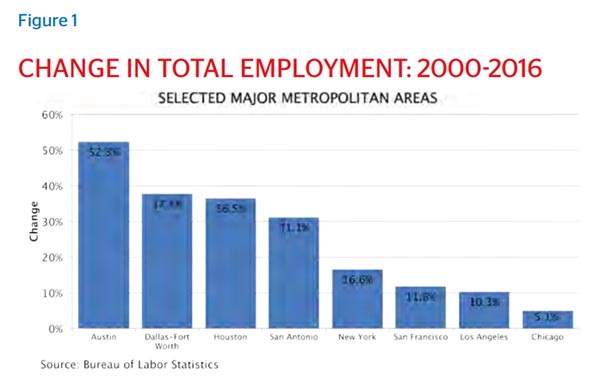
    Since 2000, Dallas and Houston have increased jobs by 31 percent, growing at three times the rate of increase in New York and five times as rapidly as Los Angeles. Texas’ smaller but up-and-coming metropolitan regions are also thriving, with San Antonio and Austin, for example, boasting some of the most rapid job growth in the country.
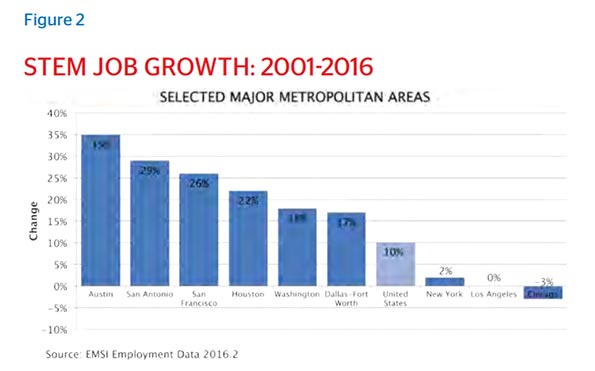
    This growth is not all at the low end of the job market, as some suggest. Over the past fifteen years Texas cities have generally experienced faster STEM (Science, Technology, Engineering and Math-related) job growth than their more celebrated rivals. Austin and San Antonio have grown their STEM related jobs even more quickly than the San Francisco Bay Area has grown theirs, while both Houston and Dallas-Fort Worth have increased STEM employment far more rapidly than New York, Los Angeles or Chicago.
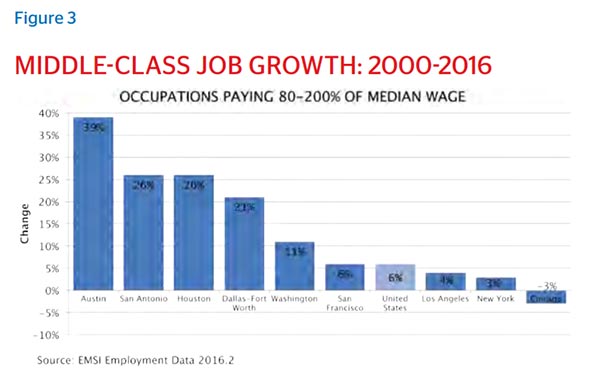
    The Texas cities also have enjoyed faster growth in middle class jobs, those paying between 80 percent and 200 percent of the median wage at the national level. Since 2001, these jobs have grown 39 percent in Austin, 26 percent in Houston, and 21 percent in Dallas-Fort Worth, a much more rapid clip than experienced in San Francisco, New York or Los Angeles, while Chicago has actually seen these kinds of job decrease.
    Recent Pew Research Center data illustrates that between 2000 and 2014, out of the 53 metropolitan areas with populations of more than 1,000,000, San Antonio had the second largest gain in percentage of combined middle-income and upper-income households; the percentage of households in the lower-income segment dropped. Houston ranked 6th and Austin ranked 13th, while Dallas-Fort Worth placed 25th, still in the top half.

    Much of the credit for this growth in jobs goes to the state’s reputation for business friendliness. Texas is consistently ranked by business executives as the first or second leading state. Needless to say, New York, California and Illinois do not fare nearly as well. The Texas tax burden ranks 41st in the country. Compare this to New York, which has the highest total state tax burden, Texas rates are also far lower than those in New York, neighbors Connecticut and New Jersey, or in California.

    The Demographic Equation

    No surprise, then, that people are flocking to the Texas cities. Over the last ten years, Dallas-Ft. Worth and Houston have emerged as the fastest growing big cities of more than five million people in the high-income world, growing more than three times faster in population than New York, Chicago, Los Angeles or Boston. Among the 53 US major metropolitan areas, four of the top seven fastest growing from 2010 to 2015 were in Texas.

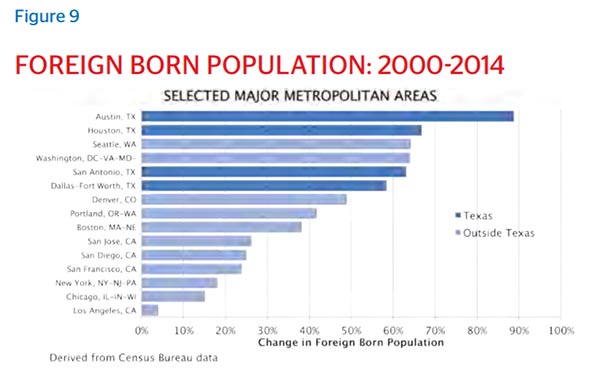
    Foreign immigration, a key indicator of economic opportunity, is now growing much faster in Texas’ cities than in those of its more established rivals. Between 2000 and 2014 alone, Texas absorbed more than 1.6 million foreign born citizens. In numbers, that’s slightly less than California took in, but in proportion to Texas’ population it is 60 percent more.

    During that same time period the Latino population of Austin grew by 90 percent; Dallas-Fort Worth and Houston each grew by about 75 percent. In contrast, the Latino population in Los Angeles grew only 17 percent.

    Houston now has a far higher percentage of foreign born residents than Chicago does. Dallas-Ft. Worth draws even with Chicago in that measurement, with an immigrant population that has grown three times as fast as that of the Windy City since 2000.

    Economic opportunity explains much of the difference. Texas’ vibrant industrial and construction culture has provided many opportunities for Latino business owners. In a recent measurement of best cities for Latino entrepreneurs, Texas accounted for more than one third of the top 50 cities out of 150. In another measurement, San Antonio and Houston boasted far larger shares of Latino-owned businesses than Los Angeles, which also has a strong Latino presence.

    Texas is not a totally successful environment for minorities. Poverty levels for blacks and Hispanics remain high, and education levels lag in Houston, Dallas-Fort Worth and San Antonio. But the key factor is that Texas cities present superior prospects for upward mobility.

    Domestic Migration Trends

    Since 2000, Dallas-Ft. Worth has gained 570,000 net domestic migrants, and Houston has netted 500,000. In contrast, the New York area has had a net loss of over 2.6 million people, while Los Angeles hemorrhaged a net 1.6 million, and Chicago nearly 900,000. Dallas-Fort Worth, Houston, Austin and San Antonio were all among the top eleven in total net domestic migration gains. The smaller Texas cities have also experienced large gains in migrants.

    Many newcomers come from places — notably, California — where many Texans once migrated. Between 2001 and 2013, more than 145,000 people (net) have moved from greater Los Angeles to the Texas cities, while about 80,000 have come from Chicago and 90,000 from New York.
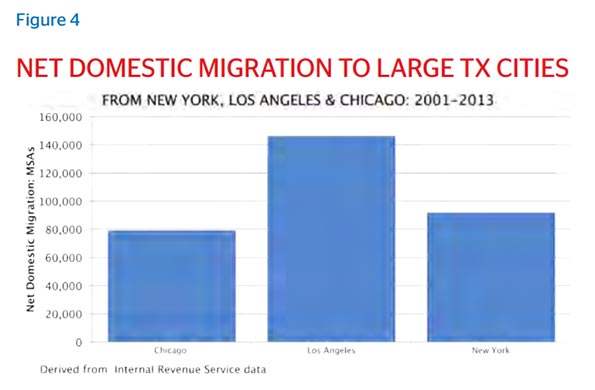
    As Dallas Morning News columnist Mitchell Schnurman says, “If oil prices don’t go up, Texas can always count on California — and New York, Florida, Illinois and New Jersey.”

    Creating the Next Generation of Urbanites

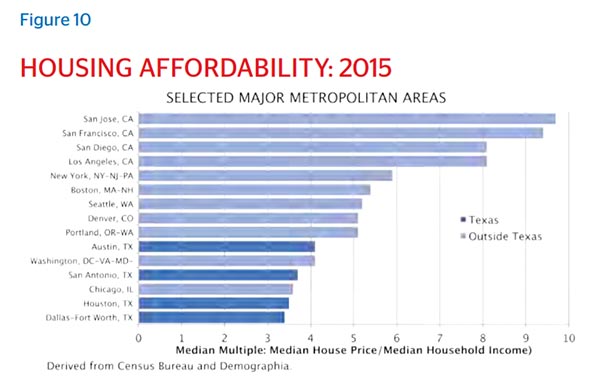
    Texas urban growth has occurred more or less in conjunction with market demand, without the strict controls and grandiose ‘visions’ that dominate planning in New York and California. Overall housing prices in Texas cities remain, on average, one-half or less than those in coastal California cities such as San Francisco, San Jose, San Diego and Los Angeles. They are a third below those in New York, and have not experienced the huge spikes in housing inflation seen elsewhere in the Northeast Corridor, such as in Boston.
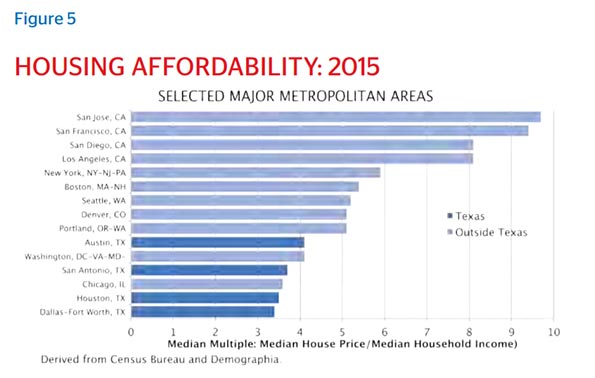
    The lower house prices in Texas facilitate greater aspirations to home ownership, particularly among young people. The financial leap from renting to owning is far less daunting in Texas than it is the Northeast, or in some western US cities.
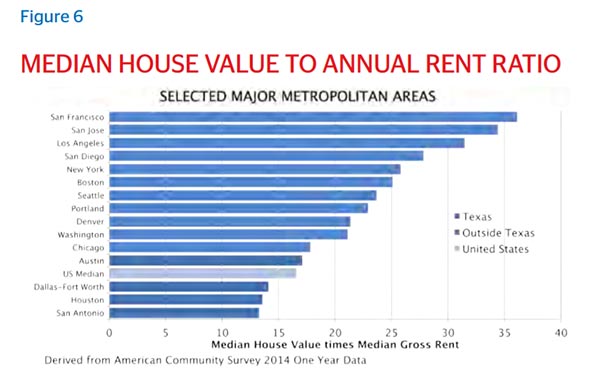
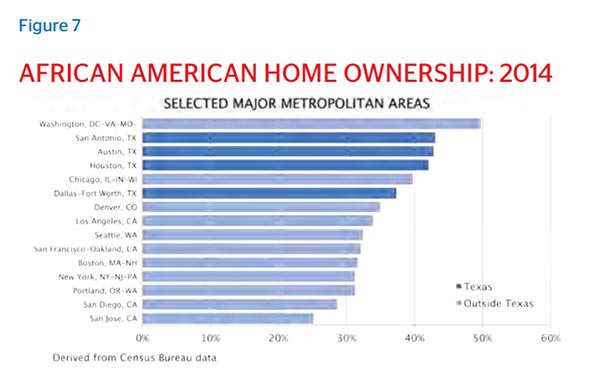
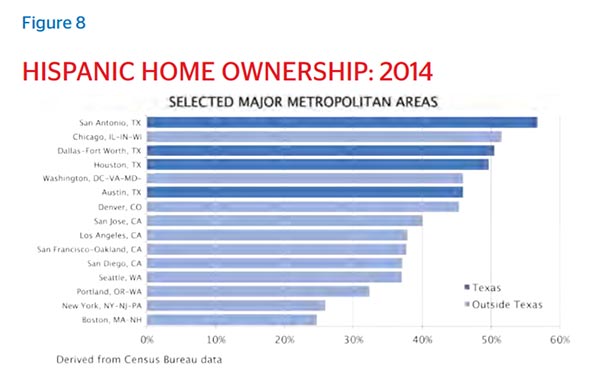
    These lower prices have been a boon to ethnic minorities, who make up an ever-growing percentage of the population in cities nationwide. Latinos and African-Americans are far more likely to be home owners in Texas cities than in New York, Los Angeles, Boston or San Francisco.
    A review of US Department of Commerce Bureau of Economic Analysis data indicates that housing costs are responsible for virtually all of the cost-of-living differences between the nation’s approximately 380 metropolitan areas. Consequently, it is far cheaper to live in Texas cities — even Austin — than in Boston, New York, Los Angeles, San Diego, Chicago and, most of all, the San Francisco and San Jose metropolitan areas.
    Some observers lament that, due to market forces, the vast majority of Texas metropolitan growth — nearly 100 percent — has taken place in the suburbs and exurbs. Yet the Texas cities mirror nationwide experiences: there is essentially no difference between the share of metropolitan development in the Texas suburbs and the share in most other areas. The average share for all major metropolitan areas is 99.8 percent, including in Portland, Oregon, the much ballyhooed model for densification.

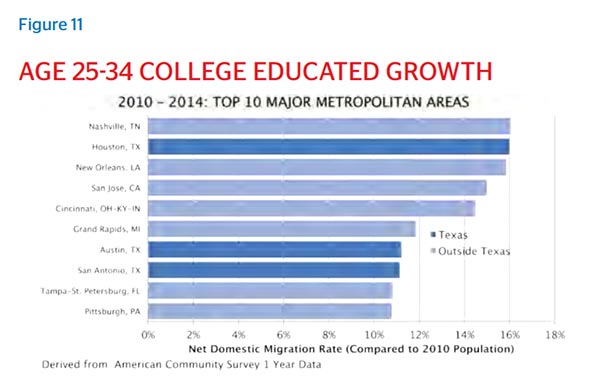
    Ironically, dense housing development has grown more rapidly in Texas cities than it has in California, where the state has tried to mandate dense development. Building permit rates indicate that Texas cities have led the nation in both low density single family housing and in high density multifamily development. Between 2010 and 2015, Texas’ largest cities held three of the top five positions among the 53 major metropolitan areas in the issuance of multifamily building permits. Austin led the nation in these permits, while Houston and Dallas-Fort Worth had higher multifamily building permit rates than San Jose, Denver, Portland, Washington, or Los Angeles. At the same time, these three Texas cities also were in the top 10 in single-family building permits. Who occupies these new residences? Between 2010 and 2014 Texas cities, led by Austin and San Antonio, experienced higher rates of growth among college educated 25 to 34 year olds than did traditional ‘brain centers’ like New York, Boston, Chicago and even San Francisco. During the tech boom of the late 1990s, more people moved from Texas to the Bay Area than vice versa; in the current one, the pattern is reversed. A recent San Jose Mercury poll found that one-third of all Bay Area residents hope to leave the area, primarily citing high housing costs and overall cost of living.
    As young people mature, Texas’ major urban areas provide them with an array of choices. Texas city-dwellers, unlike many New Yorkers or San Franciscans, do not need to choose between living a middle class family lifestyle or staying in a city they love. Texas housing policies that allow organic growth driven by the market are attractive to young people seeking to establish careers or families, and to those who are already newly-established.

    These trends will have a long-term demographic impact, and suggest a continuing Texan ascendency. According to the American Community Survey’s ranking of elementary-age school children per family, Austin, Dallas-Fort Worth, Houston and San Antonio rank in the top six among the 53 major metropolitan areas. By comparison, Chicago ranks twenty-second, Los Angeles twenty-seventh, New York thirty-sixth, and San Francisco 45th.
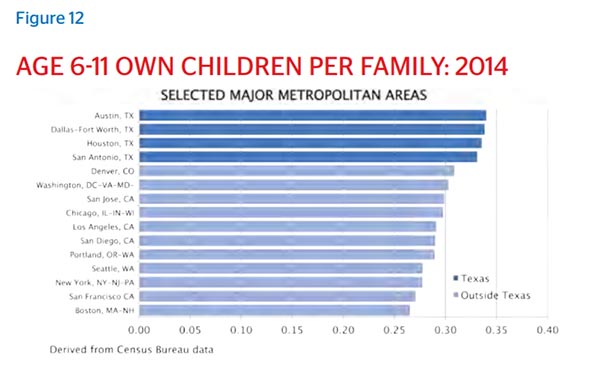
    The Lone Star State is already home to two of the nation’s five largest metropolitan areas, the first time in history that any state has so dominated the nation’s large urban centers. At its current rate of growth, Dallas-Ft.Worth, could surpass Chicago in the 2040s, as would Houston a decade later. By 2050 the Lone Star state could dominate America’s big urban centers even more than it does now.

    Joel Kotkin is executive editor of NewGeography.com. He is the Roger Hobbs Distinguished Fellow in Urban Studies at Chapman University and executive director of the Houston-based Center for Opportunity Urbanism. His newest book, The Human City: Urbanism for the rest of us, will be published in April by Agate. He is also author of The New Class ConflictThe City: A Global History, and The Next Hundred Million: America in 2050. He lives in Orange County, CA.

    Wendell Cox is principal of Demographia, an international public policy and demographics firm. He is a Senior Fellow of the Center for Opportunity Urbanism (US), Senior Fellow for Housing Affordability and Municipal Policy for the Frontier Centre for Public Policy (Canada), and a member of the Board of Advisors of the Center for Demographics and Policy at Chapman University (California). He is co-author of the “Demographia International Housing Affordability Survey” and author of “Demographia World Urban Areas” and “War on the Dream: How Anti-Sprawl Policy Threatens the Quality of Life.” He was appointed to three terms on the Los Angeles County Transportation Commission, where he served with the leading city and county leadership as the only non-elected member. He served as a visiting professor at the Conservatoire National des Arts et Metiers, a national university in Paris.

    Welcome To Texas” flickr photo by David Herrera is licensed under CC BY 2.0

  • Five Ideas to Make America Greater

    Donald Trump’s presidential campaign was based on the notion that he could “Make America Great Again.” But beyond the rhetoric — sometimes lurching into demagoguery — the newly elected president comes to office, as one commentator suggests, “the least policy-savvy president in history.”

    To succeed, Trump must adopt innovative policies that transcend traditional right-left divides. He needs to find ways to help his heavily white, working-class base while expanding his appeal to minorities, millennials and educated people who are now largely horrified by his ascendency.

    In the short run, his biggest problem may lie with his own Republican Party establishment, which, rather than “drain the swamp,” would simply like to create one of its own. The looming presence of corporate lobbyists, swarming around the administration like hungry flies, is not encouraging at all, nor are GOP congressional plans to re-establish “earmarks.”

    The key lies not in empowering a different set of K Street parasites, but rather in reversing income stagnation. If he cannot, his triumph may prove to be no more consequential than an absurdist, Latin American-style telenovela.

    A flatter, fairer tax

    The basic instinct among many Republicans tends toward reducing taxes on their richest donors and making life easier for the ultrarich, including some on Trump’s economic team. Trump’s imperative should, instead, be to make the tax system fairer for the middle and working classes. One way would be to make a graduated flat tax that would mean that the rich, who make most of their money from investments, pay the same rate for capital gains as the rest of us do for income.

    Democrats will, no doubt, still charge Trump with being “unfair,” but, as Ronald Reagan proved 20 years ago, Americans support incentives for work if they don’t unfairly tilt conditions to the ultrarich. Main Street business owners, the most hostile constituency to the Obama administration’s policies, pay taxes based on their income and can’t manipulate the system like Apple, Google, Wall Streeters or, for that matter, real estate developers like Trump himself.

    A middle ground for immigration

    Opposition to illegal immigration helped drive the Trump campaign early on, but, outside of the GOP base, there is little support for a mass roundup of the undocumented. The vast majority of Americans, over 70 percent, also oppose “open borders.” After all, even President Obama evicted 2 million people during his two terms in office.

    Trump also can begin reordering our immigration policies toward skilled workers who are interested in becoming citizens. At the same time, Trump could score points by undermining the H1-B visa program, which allows Silicon Valley firms, along with corporations like Disney and Southern California Edison, to lay off American workers and replace them with temporary indentured servants.

    Read the entire piece at The Orange County Register.

    Joel Kotkin is executive editor of NewGeography.com. He is the Roger Hobbs Distinguished Fellow in Urban Studies at Chapman University and executive director of the Houston-based Center for Opportunity Urbanism. His newest book, The Human City: Urbanism for the rest of us, will be published in April by Agate. He is also author of The New Class ConflictThe City: A Global History, and The Next Hundred Million: America in 2050. He lives in Orange County, CA.

    Photo: Gage Skidmore from Peoria, AZ, United States of America (Make America Great Again hat) [CC BY-SA 2.0], via Wikimedia Commons

  • San Francisco Observations

    I made quite a few trips to San Francisco during the late 90s into the early 2000s, but hadn’t been back in a very long time – probably close to 15 years.

    Recently I was there for a conference and a long weekend and got to spend some time exploring the city. I won’t claim a comprehensive review, but I did have a few takeaways to share.

    1. Fewer homeless than expected. Based on the rhetoric you read in the papers, I expected SF to be overrun with aggressive homeless people. This wasn’t the case. There were visible homeless to be sure, but no more than I remember from 15 years ago and no more than I see in New York. And they were not particularly aggressive in any way.

    2. A curiously low energy city. It’s tough to judge any American city’s street energy after living in New York, but San Francisco felt basically dead. Tourist areas around Union Square and the Embarcadero were crowded, and the Mission on a Friday night was hopping, but otherwise the city was very quiet. Haight-Ashbury was nearly deserted and many neighborhoods had the feel of a ghost town. It’s very strange to be walking around a city with such a dense built fabric but so few people.

    3. San Francisco is too small to support a centralized economy. The Financial District has a number of skyscrapers, and SOMA is awash in construction – the biggest changes I observed were in this district – but central San Francisco is too small to serve as a global city business center. And the city as a whole is not big enough to support that kind of a resident base. The bottom line is that San Francisco’s constrained geography renders the construction of a CBD in the style of a Chicago or New York very difficult. Also, at only around 856,000 people – an all time record high – the absorption capacity of the city is limited. Contrast with NYC at 8.5 million, LA with 4 million and Chicago with around 2.7 million in much bigger geographies. Also, the transport geography of San Francisco does not include the type of massive commuter rail system that NYC, London, Chicago, etc. have. In short, I don’t see SF having the capacity for a much greater degree of employment centralization.

    4. Major construction is undesirable in San Francisco. As I’ve written before, San Francisco is one of America’s most achingly beautiful cities with a very unique building stock. It’s also, like Manhattan, mostly fully developed. So new construction in most places would involve demolition of the existing building stock. No surprise SOMA is where the construction is, because there’s room to do it and/or lower quality buildings to replace. To make a serious increase in the quantity of residential or office space would involve significant damage to the character of the city and would not in my view be desirable. Nor, given the point above about its small size, is it likely to make much of a difference anyway. It’s hard to see how the city of San Francisco itself changes its trends without an economic pullback.

    5. San Francisco doesn’t feel like it has the services of a high tax city. Taxes are high in San Francisco, but it many ways it doesn’t feel like it. In New York, our taxes are high, but the level of services is highly visible, at least in Manhattan. Just as one small example, SF’s storm drains were often partially blocked with leaves, and there were pools of standing water even on Market St. In NYC, BID employees or building supers regularly clear storm drains and sweep water into sewers. Our parks are in better shape. I was surprised to see that SF still has curbs with no ADA ramps. In short, while the city is beautiful and such, it doesn’t radiate the feel of high services.

    6. Barrier and POP transit system. I ran into a curious situation while riding transit. Muni, the city’s transit agency, has a light rail system called Muni Metro. It runs as a subway under Market St. Because it runs on street elsewhere, the trainsets are pretty short. I rode the subway portion, which has a barrier system. But then on the train my ticket was checked again by a conductor. Why have barriers if you are running a POP system on top of it? I’m glad I saved my ticket.

    7. San Francisco Opera. I attended my first opera in San Francisco. The San Francisco Opera is a very globally respected company. The opera, Janacek’s The Makropulous Case, was very good. It was well-patronized but there were plenty of empty seats too. It has the feel of the Lyric Opera of Chicago, where the majority of attendees are subscribers. The average age was very high – much higher than the Met Opera, which although suffering a serious attendance problem draws quite a few young people. The SF Opera’s patron base is getting up there. I also took a look through the program. I did not see a single tech company on their list of corporate sponsor, nor did I see any tech names I recognized on their major donor list. Opera in San Francisco appears to be an old money affair, with the emphasis on old. This doesn’t bode well for the future of this flagship cultural organization if it can’t find a way to tap into younger attendees and donors. I’d have to caveat this somewhat given that my investigation is very limited. But this is a trend affecting many similar organizations.

    Aaron M. Renn is a senior fellow at the Manhattan Institute, a contributing editor of City Journal, and an economic development columnist for Governing magazine. He focuses on ways to help America’s cities thrive in an ever more complex, competitive, globalized, and diverse twenty-first century. During Renn’s 15-year career in management and technology consulting, he was a partner at Accenture and held several technology strategy roles and directed multimillion-dollar global technology implementations. He has contributed to The Guardian, Forbes.com, and numerous other publications. Renn holds a B.S. from Indiana University, where he coauthored an early social-networking platform in 1991.

  • Overcrowded California

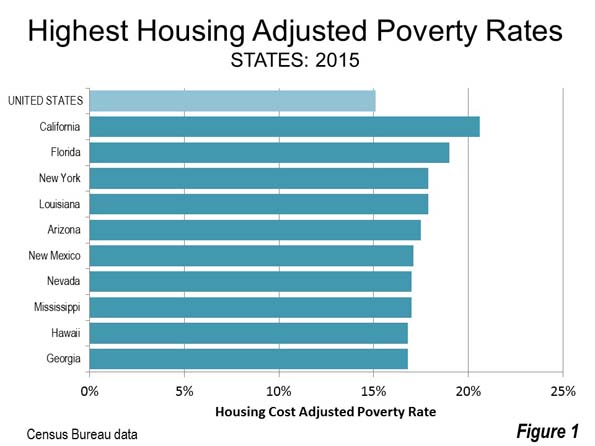
    In its decades of unprecedented population growth, California was a land of superlatives. Regrettably, the superlatives have changed from mostly positive to largely negative. For example, the latest Census Bureau Supplemental Poverty Estimates, indicated that California continues to have the highest poverty rate of any state, after adjustment for housing costs (Figure 1). Not even Mississippi can compete with that, sitting 3.6 percentage points lower. California metropolitan areas undoubtedly resemble this shameful performance, though the Census Bureau does not provide data below the state level.

    It should not be surprising that this backdrop is accompanied by some of the highest rates of housing overcrowding in the nation, according to the latest American Community Survey data (2015). Overcrowding is estimated by the number of people living in a dwelling unit per room. That raises the critical question of what is a room? The American Community Survey gives the following instruction on how to count rooms:

    "When counting the number of rooms in a home for the American Community Survey (ACS), please count rooms separated by built-in archways or walls that extend out at least 6 inches and go from floor to ceiling. Include only whole rooms used for living purposes, such as living rooms, dining rooms, kitchens, bedrooms, finished recreation rooms, family rooms, enclosed porches suitable for year-round use, etc.

    DO NOT count bathrooms, kitchenettes, strip or pullman kitchens, utility rooms, foyers, halls, open porches, balconies, unfinished attics, unfinished basements, or other unfinished space used for storage."

    Overcrowding is generally defined as a household having more than one person (of any age) per room in a dwelling unit. Severe overcrowding is more than 1.5 persons per room. A household is the people living in a housing unit, whether a detached house, an apartment, a mobile home or other.

    Degrees of Overcrowding

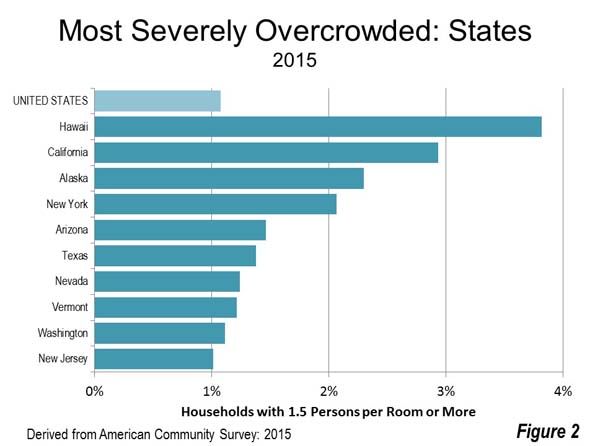
    California generally leads in both overcrowding and severe overcrowding. The state’s share of overcrowded households in the nation is 27 percent, while the state has 30 percent of severely overcrowded households, almost 3 times its 11 percent share of households.

    Only Hawaii has a higher severe overcrowding rate than California, at 3.8 percent of households California’s severe overcrowding rate is 2.9 percent. By contrast, average for the United States is a much lower 1.1 percent. Alaska has the third most severe overcrowding rate, at 2.3 percent, while New York has the fourth most severe overcrowding, at 2.1 percent. Arizona ranks fifth at 1.5 percent (Figure 2).

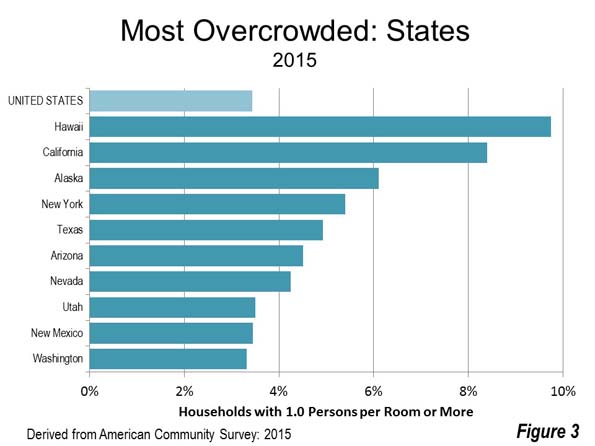
    The situation is similar with respect to basic overcrowding, more than one person per room. Hawaii also leads in this category at 9.7 percent, followed by California at 8.4 percent. The national overcrowding rate is 3.4 percent. Again, Alaska ranks third at 6.1 percent, followed by New York and 5.4 percent and Texas at 4.9 percent (Figure 3).

    Metropolitan Areas

    California metropolitan areas dominate in terms n both of the highest severe overcrowding rates and the highest overcrowding rates, to a far greater extent than one would expect from a highly developed, still affluent state.

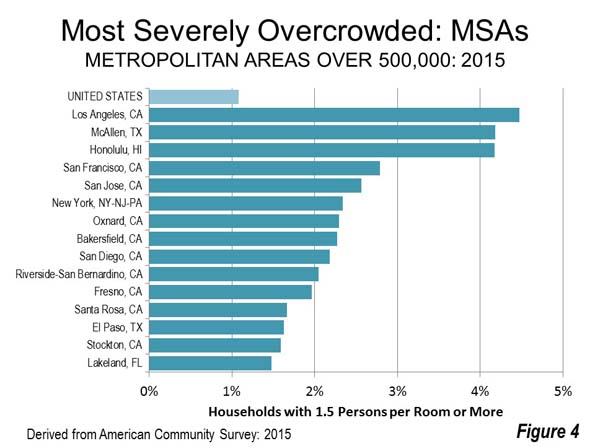
    California is home to 12 of the 106 metropolitan areas with more than 500,000 population (as of 2015). 10 of the 15 most severely overcrowded metropolitan areas are in California. My birthplace of Los Angeles has the worst rate in the United States, with 4.5 percent of its households in living in severely overcrowded conditions. This is more than four times the national rate of 1.1 percent. McAllen, Texas, in the Rio Grande Valley, is the second most severely overcrowded (4.2 percent), leading the third ranked Honolulu (4.2 percent) in the second digit.

    Two of California’s and the nation’s most wealthy metropolitan areas are among the most severely overcrowded (more than 1.5 persons per room), both in the San Francisco Bay Area. These include San Francisco itself (#4) and San Jose (#5). New York is the sixth most severely overcrowded.

    Other California metropolitan areas among the most severely overcrowded are Oxnard (#7), in the Los Angeles area, Bakersfield (#8) and Fresno (#11) in the San Joaquin Valley, San Diego (#9), Riverside San Bernardino (#10) in the Los Angeles area as well as Santa Rosa (#12) and Stockton (#14) in the San Francisco Bay Area (Figure 4).

    Only two of California’s metropolitan areas with more than 500,000 residents do not rank in the most severely overcrowded metropolitan areas, Sacramento and Modesto.

    California’s dominance in basic overcrowding (over one person per room) is more complete, with 11 of its 12 largest metropolitan areas represented in the most overcrowded 15. Only Sacramento was exempted.

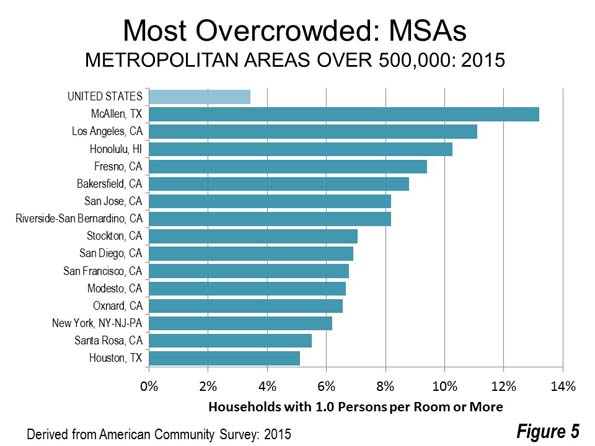
    The same three metropolitan areas lead the pack, though in a somewhat different order. McAllen has an overcrowding rate of 13.2 percent, nearly 4 times the national rate of 3.4 percent. Los Angeles is the second most overcrowded, at 11.1 percent, while Honolulu repeats its third ranking at 10.3 percent.

    The next at nine most overcrowded metropolitan areas are all in California, including Fresno (#4), Bakersfield (#5), San Jose (#6), Riverside-San Bernardino (#7), Stockton (#8), San Diego (#9),
    San Francisco (#10), Modesto (#11), in the San Joaquin Valley and Oxnard (#12). Santa Rosa has the 14th largest overcrowding rate (Figure 5).

    Contributing Factors

    Two characteristics stand out with respect to the states and metropolitan areas most overcrowded, high international immigration rates and high housing costs. High housing costs were cited as a factor in California’s high overcrowding rates by the state Legislative Analyst. High housing costs are also a problem in Hawaii and New York, which are among the 10 most crowded states in both categories as are there largest metropolitan areas. In addition, states that are magnets for international immigration are also represented among the most overcrowded, such as California, New York, Arizona, New Mexico and Nevada.

    Overcrowding has important social consequences, especially for children. For example, Claudia D. Solari at the University of North Carolina, Chapel Hill and Robert D. Mare of UCLA found in research focused on the city of Los Angeles that overcrowded housing significantly harms children, regardless of socioeconomic characteristics, negatively impacting school achievement, behavior and physical health. They conclude that these factors can persist throughout life, affecting their future socioeconomic status and adult well-being.”

    California, with its progressive ideals, needs to match its performance with its rhetoric. The state’s working class is clearly being hemmed in, and face a future that is hardly that promised by its political class.

    Wendell Cox is principal of Demographia, an international public policy and demographics firm. He is a Senior Fellow of the Center for Opportunity Urbanism (US), Senior Fellow for Housing Affordability and Municipal Policy for the Frontier Centre for Public Policy (Canada), and a member of the Board of Advisors of the Center for Demographics and Policy at Chapman University (California). He is co-author of the “Demographia International Housing Affordability Survey” and author of “Demographia World Urban Areas” and “War on the Dream: How Anti-Sprawl Policy Threatens the Quality of Life.” He was appointed to three terms on the Los Angeles County Transportation Commission, where he served with the leading city and county leadership as the only non-elected member. He served as a visiting professor at the Conservatoire National des Arts et Metiers, a national university in Paris.

    Photo: Downtown Los Angeles toward the Hollywood Hills and the San Fernando Valley (by author)

  • California Jumps the Shark

    America may have trended toward the GOP, but California seems determined to find its own direction. The only question is, simply, how much more progressive the Golden State will become, even in the face of a far more conservative country beyond the Sierras.

    This election confirmed, if it was needed, the death spiral of the state’s Republican Party. Thanks, in part, to Donald Trump — and his magnetic anti-appeal among Latinos, women and the educated — the GOP did even worse here in the presidential race than in 2012, when it couldn’t muster 40 percent support, and has lost several legislative seats, allowing the Democrats to re-establish their coveted two-thirds supermajority in the Assembly — and possibly in the Senate as well.

    The progressives also won most of the major propositions — most critically, the extension of a high income tax rate on the state’s affluent population through 2030. We may have more freedom to smoke pot, but it won’t be so easy to start a business, buy a house or build a personal nest egg, if you are anything other than a trustifarian or a Silicon Valley mogul, or are related to one.

    Go any direction you want, as long as it’s to the left

    Since the late 1990s, California has been moving leftward, with a bit of a bump from the Schwarzenegger recall election. By morphing into a liberal Democrat, the Terminator helped terminate the GOP as a serious force. Add to that the damage done by the residue of Pete Wilson’s Proposition 187, which permanently alienated the rising Latino electorate, and the GOP seems destined to further decline.

    The only hope for sanity has been an alliance of the Republican rump with moderate Democrats, many of them backed by what’s left of traditional California business. But, increasingly, inside the party, it’s been the furthest Left candidates that win. In the Democrat-only Sanchez vs. Harris race for the U.S. Senate, the more progressive candidate triumphed easily, with a more moderate Latina from Southern California decimated by the better funded lock-step, glamorous tool of the San Francisco gentry Left.

    Gradually, the key swing group — the “business Democrats” — are being decimated, hounded by ultra-green San Francisco billionaire Tom Steyer and his minions. No restraint is being imposed on Gov. Brown’s increasingly obsessive climate change agenda, or on the public employee unions, whose pensions could sink the state’s finances, particularly in a downturn.

    Read the entire piece at The Orange County Register.

    Joel Kotkin is executive editor of NewGeography.com. He is the Roger Hobbs Distinguished Fellow in Urban Studies at Chapman University and executive director of the Houston-based Center for Opportunity Urbanism. His newest book, The Human City: Urbanism for the rest of us, will be published in April by Agate. He is also author of The New Class ConflictThe City: A Global History, and The Next Hundred Million: America in 2050. He lives in Orange County, CA.