Tag: California

  • California Leaders Double Down on Dry

    “What do we do with this worthless area, the region of savages and wild beasts, of shifting sands and whirlwinds of dust, of cactus and prairie dogs? To what use could we ever hope to put these great deserts and these endless mountain ranges?”

    – U.S. Secretary of State Daniel Webster, on the American West, 1852

    The drought, if somewhat ameliorated by a passably wet winter in Northern California, reminds us that aridity defines the West. Our vulnerability is particularly marked here in Southern California, where the local rivers and springs could barely support a few hundred thousand residents, as opposed to the 20 million or so who live here. Bay Area, we’re talking about you, too, since about two-thirds of your drinking water is imported.

    The prospect of continued water shortfalls – perhaps made worse by climate change – poses something of an existential question for this state. In the past, California met the challenge of persistent dryness much as the Romans did in their heyday, by constructing massive waterworks that connected mountain runoff with the thirsty urban masses. Everything that made California the harbinger of the future, from rich farmland to semiconductors and our great cities, was predicated on water transfer.

    Now there is a sense that California’s expansion, its ability to create new communities and industries – outside of a few fields, like media and software – faces insurmountable constraints on water and other resources. This perspective has been favored by greens, anti-development NIMBYs and those who seek to corral all California growth into ever-denser, family-unfriendly environments.

    This mindset has been predominant over the past decade, as the state has invested little in new water storage or delivery systems, essentially doing nothing since the late 1970s, when the population was 16 million less. Like the Roman Empire in its dotage, we seem to have decided to live off the blessings of the past, a sure way, it seems, to guarantee a diminished future.

    Read the entire piece at The Orange County Register.

    Joel Kotkin is executive editor of NewGeography.com. He is the Roger Hobbs Distinguished Fellow in Urban Studies at Chapman University and executive director of the Houston-based Center for Opportunity Urbanism. His newest book, The Human City: Urbanism for the rest of us, will be published in April by Agate. He is also author of The New Class ConflictThe City: A Global History, and The Next Hundred Million: America in 2050. He lives in Orange County, CA.

    Photo of Lake Palmdale California Water Project by Kfasimpaur (Own work) [Public domain],via Wikimedia Commons

  • California Valued for Cash, Not Candidates

    California may be the country’s most important and influential state for technology, culture and lifestyle, but has become something of a cipher in terms of providing national political leaders. Not one California politician entered the 2016 presidential race in either party and, looking over the landscape, it’s difficult to see even a potential contender emerging over the coming decade.

    We are a long way from the California dreamin’ days of Richard Nixon, Ronald Reagan and even the early Jerry Brown era. Today we approach national politics largely as spectators – and our rich residents as donors – to storms brewing in other regions.

    In contrast, New Yorkers clearly have the moxie to rise. Ted Cruz even lambasted “New York values” in his to-date failed attempt to derail Donald Trump. Just watch Trump and his new consigliere, New Jersey Gov. Chris Christie, in action, they’re quintessential New York egomaniacal tough guys.

    The Democrats also have a big New York imprint, with the front-runner, Hillary Clinton, a former New York U.S. senator and current resident. Her diminishing challenger, Bernie Sanders, is an aged Jewish boy from Brooklyn.

    And, waiting in the wings, with his billions and his ego ready to propel him, sits former New York City Mayor Michael Bloomberg. Some East Coast observers see him as a potential running mate for Clinton, which certainly would make fundraising less important.

    But it’s not just New York’s political culture that has shaped this election. The biggest non-Trump drama of the race has been the bitter conflict between two Florida politicians, the departed Jeb Bush and Marco Rubio, now the rapidly fading hope of establishmentarian Republicans. Texas, too, has expressed at least the more doctrinaire aspect of its political culture in inflicting Ted Cruz on the electorate. Even the Rust Belt has had its moment, in the quixotic, but at least fundamentally decent, campaign of John Kasich.

    Read the entire piece at The Orange County Register.

    Joel Kotkin is executive editor of NewGeography.com. He is the Roger Hobbs Distinguished Fellow in Urban Studies at Chapman University and executive director of the Houston-based Center for Opportunity Urbanism. His newest book, The Human City: Urbanism for the rest of us, will be published in April by Agate. He is also author of The New Class ConflictThe City: A Global History, and The Next Hundred Million: America in 2050. He lives in Orange County, CA.

    Photo by Steve Jurvetson from Menlo Park, USA (Hillary Clinton Looking Forward) [CC BY 2.0], via Wikimedia Commons

  • Serfs Up with California’s New Feudalism

    Is California the most conservative state?

    Now that I have your attention, just how would California qualify as a beacon of conservatism? It depends how you define the term.

    Since the rise of Ronald Reagan, most conservatives have defined themselves by pledging loyalty to market capitalism, supporting national defense and defending sometimes vague “traditional” social values. Yet in the Middle Ages, and throughout much of Europe, conservatism meant something very different: a focus primarily on maintaining comfortable places for the gentry, built around a strong commitment to hierarchy, authority and a singular moral order.

    Until recently, modern California has not embraced this static form of conservatism. The biggest difference between a Pat Brown or a Reagan was not their goals – greater upward mobility and technical progress – but how they might be best advanced, whether through the state, the private sector or something in-between. Under both leaders, California evolved into a remarkable geography of opportunity.

    In contrast, California’s new conservatism, often misleadingly called progressivism, seeks to prevent change by discouraging everything – from the construction of new job-generating infrastructure to virtually any kind of family-friendly housing. The resulting ill-effects on the state’s enormous population of poor and near-poor – roughly-one third of households – have been profound, although widely celebrated by the state’s gentry class.

    Read the entire piece at The Orange County Register.

    Joel Kotkin is executive editor of NewGeography.com and Roger Hobbs Distinguished Fellow in Urban Studies at Chapman University, and a member of the editorial board of the Orange County Register. He is also executive director of the Houston-based Center for Opportunity Urbanism. His newest book, The New Class Conflict is now available at Amazon and Telos Press. He is also author of The City: A Global History and The Next Hundred Million: America in 2050. He lives in Orange County, CA.

    Photograph: Great Seal of the State of California by Zscout370 at en.wikipedia [CC BY-SA 3.0],from Wikimedia Commons

  • In Southern California, It Takes an Assortment of Villages

    Among urban historians, Southern California has often had a poor reputation, perennially seen as “anti-cities” or “19 suburbs in search of a metropolis.” The great urban thinker Jane Jacobs wrote off our region as “a vast blind-eyed reservation.”

    The Pavlovian response from many local planners, developers and politicians is to respond to this criticism by trying to repeal our own geography. Los Angeles’ leaders, for example, see themselves as creating the new sunbelt role model, built around huge investments Downtown and in an expensive, albeit underused, subway and light-rail network.

    Yet the notion of turning Southern California into a dense, New York hybrid makes very little sense. Nor has it done much for the regional economy, certainly in Los Angeles. The City of Angels thrived during its period of development into a multipolar region; in the 21st century, as Downtown has gained a few thousand hipsters, the rest of the city has lagged economically while population and job growth – including in tech – has been more robust in the surrounding counties of Orange, Riverside and San Bernardino.

    Building off Strength

    Southern California, even before the advent of the freeways, developed along the lines of an “archipelago of villages.” Even Downtown Los Angeles, the one legitimate urban core in the region, lost its central relevance by the 1930s and, despite all its self-promotion, employs close to the smallest share – well short of 3 percent – of the regional workforce of any large region in the country.

    In contrast, the two fastest-growing areas in Southern California – the Inland Empire and Orange County – are arguably the largest regions in the country without a real downtown. Rather than a negation of urbanity, as some suggest, these areas are nurturing an expansive archipelago of smaller hubs, each serving distinct geographies, populations, tastes and purposes, and constitute the building blocks for Southern California’s urban future.

    Read the entire piece at The Orange County Register.

    Joel Kotkin is executive editor of NewGeography.com and Roger Hobbs Distinguished Fellow in Urban Studies at Chapman University, and a member of the editorial board of the Orange County Register. He is also executive director of the Houston-based Center for Opportunity Urbanism. His newest book, The New Class Conflict is now available at Amazon and Telos Press. He is also author of The City: A Global History and The Next Hundred Million: America in 2050. He lives in Orange County, CA.

  • Is California’s Economy Swell?

    Every now and then, something happens to cause California’s comfortable establishment to celebrate the state’s economy.  Recent budget surpluses and jobs data have provided several opportunities, never mind that these are hardly summary statistics.  They don’t tell the complete story.

    The celebrants conveniently ignore California’s nation-leading poverty, huge inequality, persistent negative domestic migration, and the fact that with about 12 percent of the nation’s population, California is home to about 30 percent of the nation’s welfare recipients.

    A recent Next 10 report, prepared by Beacon Economics, has provided another opportunity for celebration.  The Los Angeles Times’ coverage of the report is here.  Their reporter, Chris Kirkham, provides a straight-forward summary, including charts not in the original report and quotes from people who might not be expected to be mindless cheerleaders.  Full disclosure: He tried to interview me, but I was unavailable.

    My favorite coverage was a celebratory piece at The National Memo, by one Froma Harrop, titled High Taxes, Regulations, and a Swell Economy.  Try telling the children of one of the several families living in a single-family home, children with little prospect of ever living a middle-class lifestyle, that California’s economy is swell.  Try telling that to the huge numbers of long-term unemployed in California’s Central Valley, or one of the many people who, like Martin Saldana, have been poorly served by California’s swell economy.  California’s economy might be swell, but only for a portion of the population.

    Harrop, and apparently large numbers of California’s comfortable establishment, don’t appear to care much about their less-fortunate fellow citizens.  She’s channeling Marie Antoinette when she says “OK.  Those who can’t pay the price—or who want bigger spaces—can and often do consider other parts of the country.”

    Right.  What about all the people who provide services to California’s wealthy coastal residents in places like Monterey and Santa Barbara?  What about counties like Napa and Ventura that insist, by law, that land be set aside for agriculture, an industry that employs thousands, but can’t survive and pay wages that would allow a respectable standard of living in these high-cost counties?

    This time the celebration turns out to be about nothing.  The Next 10 report is seriously flawed.  The first hint of weakness is on the first page of the actual report, page 4 of the document, where they say “This analysis is trying to show….”  Serious analysis attempts to answer questions, not support a pre-conceived opinion.

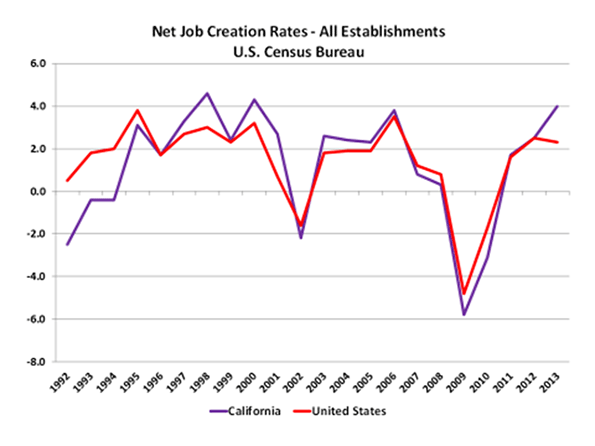
    The next clue is Table 1.  In a report filled with time series, the authors present data on one point in time, say that California has the fourth highest net job growth rate, and conclude all is good.  Why would they do that?  Could it be that the time series doesn’t support the narrative?

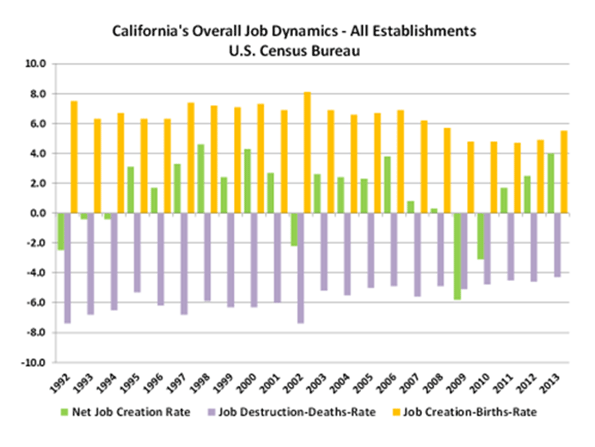
    Actually, they used the only recent year where California performed significantly better than the United States.  Here’s the data in time series.  It’s similar to a chart in the Los Angeles Times’ piece.  We compare California’s net job creation rate with that of the United States:

    Doesn’t look so spectacular, does it? 

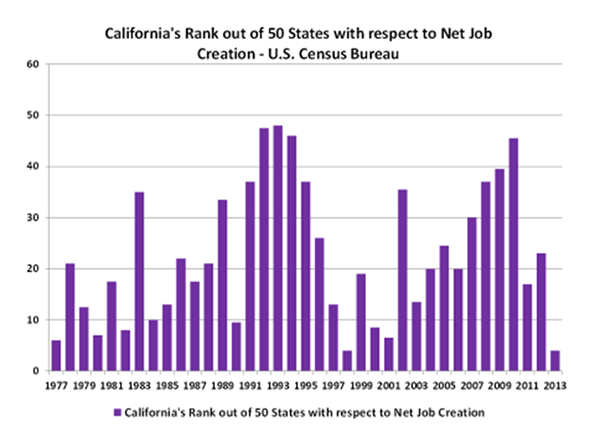
    Maybe the rankings would look better?  Below is a chart of California’s ranking going back to 1977.  Remember, one is good, 50 is bad:

    The narrative isn’t supported here either.  California has only ranked in the top 20 twice since 2006, and over that time it’s been in the bottom 20 three times.  Indeed, California has been in the top ten only once since 2001.  That was the data point they used in their analysis.

    The report has other weaknesses.

    Consider the charts 4a through 4f.  Combined, they purport to show that for California, firms of all ages were net job creators every year.  There is no year where they show firms of any age group having net job losses.  Given the well-documented massive California job losses in the past few recessions, this is simply unbelievable. 

    Indeed, a close look at the charts yields apparent internal inconsistencies.  Chart 4e is an example.  In 2002, 2009, and 2010 job destruction rates were far greater than job creation rates, but somehow they report that net job creation rates managed to remain positive in each of these years?  For the record, we built a chart using aggregate data that show net job loss rates for all California establishments of -2.2, -5.8, and -3.1 for the years 2002, 2009 and 2010, respectively:

    California’s apologists don’t do themselves any favors by resorting to such shoddy and misleading work.  California has had some good job years recently.  It also has some huge strengths.  These include a world-leading venture capital infrastructure, a world-leading climate, and a fantastic location between Asia and the massive American consumer market.

    California has some huge challenges too, including the poverty, inequality, and limited opportunity for minorities.  Ignoring these challenges and exaggerating the state’s strengths is a guarantee that California will never be the land of opportunity that it was — or could be.

    Bill Watkins is a professor at California Lutheran University and runs the Center for Economic Research and Forecasting, which can be found at clucerf.org.

  • Los Angeles: City Of Losers?

    When I arrived in Los Angeles four decades ago, it was clearly a city on the rise, practicing its lines on the way to becoming the dominant metropolis in North America. Today, the City of Angels and much of Southern California lag behind not only a resurgent New York City, but also L.A.’s longtime regional rival, San Francisco, both demographically and economically.

    Forty years ago, San Francisco was a quirky, backward-looking town, a haven for the gilded rich and hippies, a quaint but increasingly insignificant town. The Dodgers and the Lakers ruled the California sporting world.

    Today things couldn’t be more different. San Francisco and its much bigger southerly neighbor, Silicon Valley, have morphed into the global epicenter of the technology industry, with 25 tech companies on the Fortune 500. In contrast, Los Angeles County, which has almost twice as many people, is home to only 15 Fortune 500 firms total.

    Meanwhile, the Giants and the Golden State Warriors have become consistent winners while the Dodgers, Angels and Clippers disappoint and the Lakers are painfully unwatchable.

    Although there is a desire to repeat L.A.’s success with the 1984 Olympics and bring football back to town, that would only put a happy veneer over the city’s core problem: the long-term decline of its business sector. In 1984, the city had a strong and highly motivated business elite highlighted by 12 Fortune 500 companies, who could help sponsor the games and provide management expertise. Now there are only three within city limits, with the departure of major corporations such as Lockheed, Northrop Grumman, Occidental Petroleum and Toyota, and the loss of hundreds of thousands of manufacturing jobs.

    In contrast, the Bay Area is full of thriving companies and successful entrepreneurs, many of them astoundingly young. Of the 30 richest people in the country, five live in the Bay Area; Southern California has only one, the Irvine Company visionary Chairman Donald Bren, and he’s in his eighties. The Bay Area accounts for the vast majority of American billionaires under 40; if not for Snapchat’s founders, Evan Spiegel and Bobby Murphy, as well Elon Musk, who lives in L.A. but spends much of his time working in Northern California, where Tesla and Solar City are located, L.A. would be off the list.

    This unfavorable contrast with the Bay Area, sadly, is not just a recent development. Since 1990 Los Angeles County has added a paltry 34,000 jobs while its population has grown 1.2 million. In contrast, the Bay Area, which added roughly the same number of people during the same time, gained a net 500,000 jobs, mostly in the suburbs. In 1990 Los Angeles had around the same number of private-sector jobs per person as the Bay Area, roughly 410 per 1,000; today Los Angeles’ private-sector jobs to population ratio has dropped to 364 per 1,000 while the Bay Area’s has grown to 415. Worse yet, while the Bay Area has increased its share of high-wage jobs to 33 percent since 1990, Los Angeles percentage fell to 27.7 percent.

    How L.A. Blew It In Technology

    As recently as the 1970s, as UCLA’s Michael Storper has pointed out, L.A. stood on the cutting edge not only in hardware, but also software. Computer Sciences Corp. was the first software company to be listed on a national stock exchange. In 1969, UCLA’s Leonard Kleinrock invented the digital packet switch, one of the keys to the Internet.

    In 1970, IT’s share of the economy in greater Los Angeles and in the Bay Area was about the same (in absolute terms it was bigger in L.A.). By 2010, IT’s share was four times bigger in the north than in the south.

    Storper links the decline in large part to the strategies of the biggest high-tech companies in the L.A. area: Lockheed Martin, Rockwell and TRW focused on defense and space, essentially becoming dependent on government spending. In contrast, the Bay Area technology community, although also initially tied to Washington, began to move into more commercial applications. In the process they also developed a huge network of venture capitalists who would continue to help found and finance fledgling firms.

    Today the San Jose area enjoys the highest percentage of workers in STEM (science technology engineering and mathematics-related jobs) in the country, over three times the national average. San Francisco and its immediate environs, largely as a result of the social media boom, now has a location quotient for STEM jobs of 1.75, meaning it has 75% more tech jobs per capita than the national average. In contrast, the Los Angeles area barely makes it to the national average.

    Southern California remains an attractive to place to live, but it’s hard to imagine it as the next Silicon Valley. L.A. had its chance, and, sadly, it blew it.

    The Growing Demographic Crisis

    Storper and other critics suggest that Los Angeles failed in part because it tried to maintain high-wage blue collar industries while the Bay Area focused on information and biotechnology. The problem now, however, are the factors in L.A. that drive industry away, such as ultra-high electricity prices and a high level of regulation. Even amidst the recent industrial boom in many other parts of the country, Los Angeles has continued to lose manufacturing jobs; Los Angeles’ industrial job count stands at 363,900, still the largest number in the nation, but down sharply from 900,000 just a decade ago.

    This decline places L.A in a demographic dilemma. Like the Midwestern states that lured African-American to fill industrial jobs during the Great Migration, L.A. attracted a large number of largely poorly educated immigrants, mostly from Mexico and Central America. These people came for jobs in factories, logistics and home-building, but now find themselves stranded in an economy with little place for them outside low-end services.

    Although inequality and racial disparities also exist in the Bay Area, the issue is far more relevant in Southern California. The Bay Area’s population is increasingly dominated by well-educated Anglos and Asians. San Francisco’s population is 22 percent black or Hispanic; in Los Angeles, this percentage approaches 60 percent.

    Poverty and lack of upward mobility are the biggest threats to the region. In Los Angeles, a recent United Way study found 35 percent of households were “struggling,” essentially living check to check, compared to 24 percent for the Bay Area.

    recent study by the Public Policy Institute of California and the Stanford Center on Poverty and Inequality found that, once adjusted for cost of living, Los Angeles has the highest level of poverty in the state, 26.1 percent. Rents are out of control for many people who are struggling in an increasingly low-wage dominated economy. In fact, Los Angeles now is the least affordable city for renters, based on income, according to a recent UCLA paper.

    Is There A Way Out?

    Despite these myriad challenges, Los Angeles, and indeed all of Southern California, is far from a hopeless case. It is unlikely to become the next Detroit and is better positioned by natural and human resources than it’s similarly troubled big city competitor Chicago. It still enjoys arguably the best climate of any major city in the world, remains the home of Hollywood, the nation’s dominant ports and a still impressive array of hospitals and universities.

    At least some of the city’s leadership has begun to recognize the challenges facing the region. “The city where the future once came to happen,” a devastating blue ribbon report recently intoned, “is living the past and leaving tomorrow to sort itself out.”

    This recognition might be the first step toward a turnaround, but the area really has increasingly little control over its own fate. Today San Francisco and its immediate environs, despite its much smaller population, is home to virtually every powerful politician in the state: both its U.S. Senators, the Governor, the Lieutenant Governor and the Attorney General. Not surprisingly, state policies on everything from greenhouse gases, urban density and transit to social issues follows lines that originate in, and largely benefit, San Francisco.

    Most troubling of all, the local leadership seems clueless about how to resuscitate the economy, or even how this vast region actually operates. Neither another Olympics nor getting a football team or two will make a difference. Even worse is the effort by Mayor Eric Garcetti to densify the city to resemble a sun-baked version of New York.

    This has been part of the agenda for developers, greens and most local academics for the better part of 30 years. But the problem remains: Los Angeles, and even more so its surrounding region, is notNew York, nor can it ever be. It is, and will remain, a car-dominated, multi-polar city for the foreseeable future. After all the vast majority of Southern California’s population growth — roughly 75 percent — came after the Second World War and the demise of the Red Cars, L.A.’s  much lamented pre-war transit system.

    Some outside observers such as progressive blogger Matt Yglesias now envision L.A. as “the next great transit city.” Yet in reality, despite spending $10 billion on new transit projects, the share of transit commuters has actually dropped since 1990; today nearly 31 percent of New York area commuters take public transportation, while 6.9 percent do so in Los Angeles-Orange County.

    People take cars because, for most, it’s the quickest way to work. Few transit trips take less time, door to door than traveling by car, not to mention the convenience of working at home. The average transit rider in Los Angeles spends 48 minutes getting to work, compared to people driving alone, at 27 minutes.

    This reflects L.A.’s great dispersion of employment, which is not compatible with a transit-driven culture. In greater New York, 20 percent of the workforce labors in the central core; in San Francisco, the percentage is roughly 10 percent. But barely 2 percent do so in Los Angeles. The current, much ballyhooed revival of downtown Los Angeles then is less a reflection of economic forces, than the preferences of a relatively small portion of population for a more urban lifestyle and as market for Asian flight capital. Its population of 50,000 is about the same as Sherman Oaks or the recently minted city of Eastvale in the Inland Empire.

    Rather than seek to become someplace else, Los Angeles has to confront its key problems, like its woeful infrastructure, particularly roads, among the worst in the country, and a miserable education system. These are among the likely reasons why people with children are leaving Los Angeles faster than any major region of the country.

    Yet Los Angeles is not without allure. Overall Los Angeles-Orange has grown its ranks of new educated workers between 25 and 34 since 2011 as much as New York and San Francisco and much more than Portland.

    Perhaps most promising is the region’s status as the number one producer of engineers in the country, almost 3,000 annually. This raw material is now being somewhat wasted, with as many as 70 percent leaving town to find work.

    What Los Angeles needs to do is to provide the entrepreneurial opportunities to keep its young at home, particularly the tech oriented. As the Bay Area has shown, it is possible to reshape an economy based on pre-existing strength. For L.A. the best regional strategy would be based on a remarkably diverse economy dominated by smaller firms, a population that, for the most part, seeks out quiet residential neighborhoods and often prefers working closer to home than battling their way to what remains a still unexceptional downtown.

    One place where Los Angeles could shine is in melding the arts and technology. Unlike New York, which has relatively few engineers, Los Angeles still has the largest supply in the country. The Bay Area may be more appealing to nerddom, but is unexceptional in the arts. This revival will not come from the remaining suits in L.A.; roughly half of workers in the arts are self-employed, according to the economic forecasting firm EMSI.

    This entrepreneurial trend will continue since, with the studio system clearly in decline, as large productions go elsewhere, digital players such as Netflix, Amazon, Apple as well as Los Angeles based Hulu have become more important. Los Angeles could expand its arts-related niche by supplying the content that these expanding digital pipelines require.

    Given the corporate exodus, and the difficult California business climate, overall L.A.’s recovery must come from the bottom up, and be dispersed throughout the region. According to Kauffman Foundation research, the L.A. area already has the second highest number of entrepreneurs per 100 people in the country, just slightly behind the Bay Area.

    The next L.A. can succeed, but not by trying to duplicate New York or San Francisco. Instead there’s a need for greater appreciation why so many millions migrated here in the first place: great weather, beaches, suburban-like living and entrepreneurial opportunities. Only when the local leadership rediscovers the uniqueness of L.A.’s DNA can the region undergo the renaissance of this most naturally blessed of places.

    This article first appeared at Forbes.

    Joel Kotkin is executive editor of NewGeography.com and Roger Hobbs Distinguished Fellow in Urban Studies at Chapman University, and a member of the editorial board of the Orange County Register. He is also executive director of the Houston-based Center for Opportunity Urbanism. His newest book, The New Class Conflict is now available at Amazon and Telos Press. He is also author of The City: A Global History and The Next Hundred Million: America in 2050. He lives in Orange County, CA.

    Photo: Downtown Los Angeles toward the Hollywood Hills and the San Fernando Valley (by Wendell Cox)
  • California Companies Head for Greatness – Outside of California

    Why would companies located in one of the most beautiful states in the country – California – undertake the costly proposition of relocating to places with less scenic appeal and less-than-ideal weather?

    There are three answers and they relate to California’s business environment: Regulations, taxes and anxiety.

    Let’s take anxiety first. Corporate leaders and business owners fear what will happen in the future regarding proposals to raise taxes on business property, extend the Proposition 30 taxes that were supposed to be “temporary,” raise cap-and-trade fees to curb carbon emissions, and impose new workplace regulations regarding family leave and health care. We’re talking about billions of dollars in new operating and ownership costs.

    Some of those proposals were defeated this year. But the energy level of the zealotry in California’s legislature means they are certain to rise again in 2016 and 2017. Projecting the resulting cost and complexity in future operations causes leaders in corporations and small businesses to worry – then they worry some more over the unpredictability of it all.

    About taxes: This could be discussed for hours, but suffice to say that the Tax Foundation’s 2015 State Business Tax Climate Index lists California at No. 48.

    The regulatory environment can be brutal. Examples include fines for trivial errors such as a typo on a paycheck stub – not on the check, just the stub – and putting into law costly overtime provisions that in most states aren’t codified in a statute.

    Last year, when Gov. Jerry Brown was asked about business challenges, he revealed his aloofness by saying, “We’ve got a few problems, we have lots of little burdens and regulations and taxes, but smart people figure out how to make it.” The Wall Street Journal responded: “California’s problem is that smart people have figured out they can make it better elsewhere.”

    In short, California is so difficult that companies relocate entirely or, if they keep their headquarters here, find other places to expand.

    In an effort to offset Sacramento’s head-in-the-sand approach to business concerns, my firm completed a new study that provides details of business disinvestments in the state. Over the seven-year period that includes last year, the study estimates that 9,000 businesses disinvested in California in favor of other locations.

    The study shows that 1,510 California disinvestment events have become public knowledge and provides details on each and every event. Site selection experts I’ve been in touch with conservatively estimate that a minimum of five events fail to become known for every one that does. One reason is that when companies with fewer than 100 employees relocate it almost never becomes public knowledge. Hence, it is reasonable to conclude that about 9,000 California disinvestment events have occurred in the last seven years.

    Los Angeles County #1 in Losses

    The study found that the Top Fifteen California counties with the highest number of disinvestment events put Los Angeles with the most losses at No. 1, followed by (2) Orange, (3) Santa Clara, (4) San Francisco, (5) San Diego, (6) Alameda, (7) San Mateo, (8) Ventura, (9) Sacramento, (10) Riverside, (11) San Bernardino, (12) Contra Costa tied with Santa Barbara, (13) San Joaquin, (14) Stanislaus and (15) Sonoma.

    The report excluded instances of companies opening new out-of-state facilities to tap a growing market, acts unrelated to California’s business environment. It also points to shortcomings in Federal and state reporting systems that result in underreporting of business migrations. Those factors reduced the number of California losses.

    It is easy to verify circumstances described in the report since every disinvestment event is public information, is outlined in detail and sources are identified in endnotes.

    When a company launches a site search, it always wants to examine potential costs. I’ve seen many business people smile upon learning that operating cost savings are between 20 and 35 percent in other states. By the way, the appeal isn’t necessarily to the lowest-cost states, but to lower-cost states with the proper workforce.

    Winning Locations

    The Top Ten States to which businesses migrated puts Texas in the No. 1 spot, followed by (2) Nevada, (3) Arizona, (4) Colorado, (5) Washington, (6) Oregon, (7) North Carolina, (8) Florida, (9) Georgia and (10) Virginia. Texas was the top destination for California companies each year during the study period.

    Metropolitan Statistical Areas (MSAs) benefiting from California disinvestment events, in the order starting with those that gained the most, are: (1) Austin-Round Rock-San Marcos, (2) Dallas-Fort Worth-Arlington, (3) Phoenix-Mesa-Scottsdale, (4) Reno-Sparks, (5) Las Vegas-Paradise, (6) Portland-Vancouver (WA)-Hillsboro, (7) Denver-Aurora-Lakewood, (8) Seattle-Tacoma-Bellevue, (9) Atlanta-Sandy Springs-Marietta and (10) Salt Lake City tied with San Antonio.

    Offshoring still occurs, and the Top Ten Foreign Nations that gained the most put Mexico at No. 1, followed by (2) India, (3) China, (4) Canada, (5) Malaysia, (6) Philippines, (7) Costa Rica, (8) Singapore, (9) Japan and (10) United Kingdom.

    Capital diverted to out-of-state locations totaled $68 billion, a small fraction of actual experience because only 16 percent of public source materials provided capital costs for the 1,510 events. Moreover, the top industry to disinvest in California is manufacturing, a capital-intensive sector, and more detailed knowledge of this industry alone would likely increase the capital diversion.

    As California companies relocated or expanded facilities elsewhere they transferred more than capital – they also shifted jobs, machinery, taxable income, intellectual capital, training facilities and philanthropic investments.

    Indicators are that California’s business climate will worsen, enhancing prospects that more companies will seek places that are friendlier to business interests.

    The report is based exclusively on news stories and company reports to the U.S. Department of Labor, the Securities and Exchange Commission and the California Employment Development Dept. Although all entries are based on public information, it’s rare for so much data to be gathered into one report.

    Read the full study: “Businesses Continue to Leave California – A Seven-Year Review” available as a PDF here.

    Joseph Vranich is the Principal of Spectrum Location Solutions, a Site Selection firm that helps companies identify optimum locations to accommodate growth or to improve competitiveness. In doing so, he conducts an in-depth analysis of business taxes, the regulatory climate, labor rates and lifestyle factors.

  • Is California’s Bubble Bursting?

    California has a long history of boom and bust cycles, but over the past 25 years or so, California’s cycles appear to be becoming more volatile, with increasing frequency, higher highs, and lower lows.  The fast-moving business cycle may not provide the time necessary for many people to recover from previous busts, and may be too limited in its impact. Even now, 22 of California’s 58 counties have unemployment rates of 7.5 percent or higher. Eleven California counties have unemployment rates of at least nine percent.  And these, we are told, are the best of times.

    Policy behavior is predictable throughout the business cycle. 

    Sacramento is awash in cash during a boom, because California’s revenues are more closely related to asset prices than economic activity.  As the economy grows, particularly in an era of ultra-low interest rates, asset prices climb faster than the economy grows, and California is flush.  Sacramento acts as if the boom will continue forever.  Spending commitments are increased, or taxes are decreased.  Politicians congratulate themselves on “fixing” the budget problem.

    For Sacramento, economic busts and the resulting fiscal crisis are acts of God, completely independent of policy.  State revenues fall more rapidly than economic activity falls, because asset prices fall faster than overall economic activity. Sacramento tries to transfer the fiscal pain to local governments.  Mostly, they are successful. As of July, Local government employment was still down almost five percent from its pre-recession high, while state government employment is up about 4.5 percent over the same period.

    Sacramento is currently enjoying a boom, but this boom, like all booms, will ultimately lead to a bust.  There are signs that California’s confrontation with its next bust could come soon.

    Asset prices are cause for concern.  After a five-year Bull Market that saw cumulative gains of over 70 percent, the S&P is little changed this year.  Over the past 60 days, it’s been very volatile.  California’s median home price is up over 70 percent from its recession low.  It too has recently shown volatility, reflecting the huge differences between regional markets.

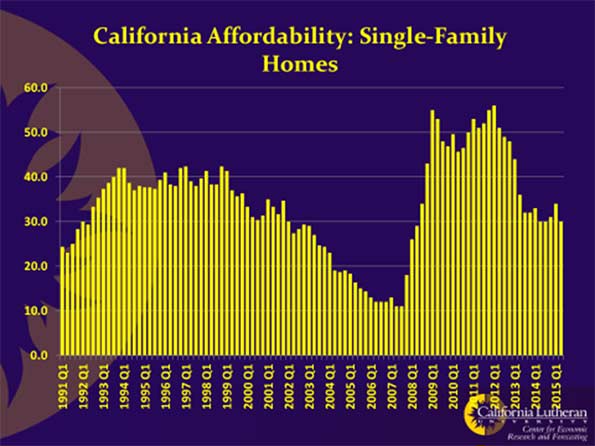
    Housing affordability (percentage of population that could afford the median home) is down too.  It’s fallen from over 50 percent to about 30 percent.  We can’t be sure, but it’s probably below a sustainable level.  That is, below a level that can sustain a middle-class population.  Several California communities have lower levels home ownership rates, but places like Marin County have minimal middle classes.

    California’s tech sector has served the state well over the past business cycle.  In quarter after quarter the Bay Area has led the state in job creation.  In many quarters, the Bay Area was the only California region to gain jobs.

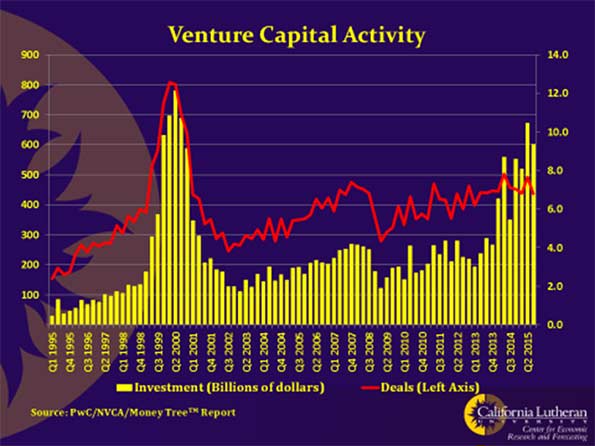
    But California’s tech sector can be very volatile, as the last dot.com bust in 2000 showed.  Today, venture capital investment is near the levels we saw just before tech’s big bust.  The number of deals is lower though.  It’s not clear that it is again a bubble about to bust, the possibility should be seriously considered.  Ideally, we would have a plan to deal with the subsequent fiscal challenges.

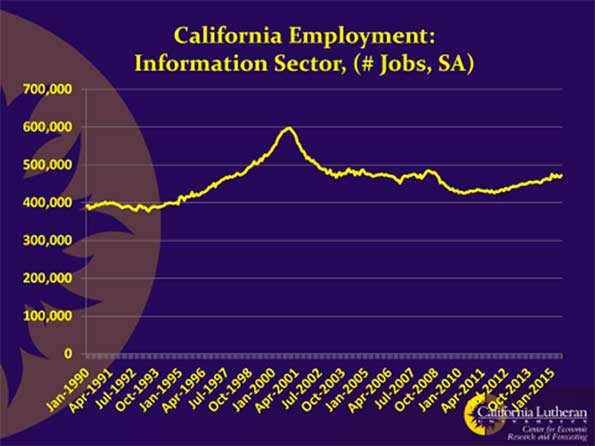
    If tech does decline, the impacts will be more than fiscal.  California’s Information sector, down more than 100,000 jobs from its previous high, still has not recovered from the dot.com bust:

    Recent data imply that continued economic growth, even the slow growth we’ve become accustomed to, is threatened.  California’s most recent jobs report was a big disappointment.  National data was disappointing too.  Only 20 states saw employment increases in September.

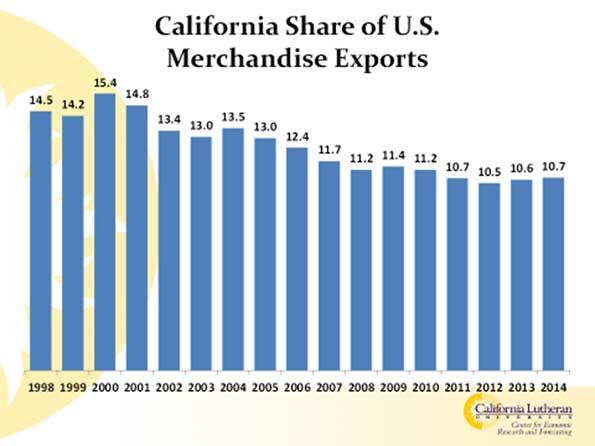
    California’s position on the Pacific Rim between Asia’s manufacturing sector and the world’s largest consumer market guarantees that trade is an important sector for California.  Increasingly, however, that sector is at risk.  China’s economic growth is weakening.  Competing ports in Mexico and Canada threaten California’s trade sector, as does the Panama Canal expansion.  California’s response has been to ignore the challenges and to refuse to expand ports to accept today’s largest ships.  California’s share of North American trade will surely continue to decline:

    An economic downturn would have a huge impact on California and its citizens.  California’s budget surplus is precarious, and the state has failed to make any real changes in California’s fiscal structure.  Instead of using California’s period of good fortune to reduce the budget’s vulnerability to volatile asset prices, by broadening the tax base, Sacramento has amazingly elected to increase revenue volatility by augmenting the status quo with a temporary tax.

    The games that partisan politicians play leads me to the conclusion that they either don’t believe that their policies adversely affect real lives, or they don’t care.  Certainly, economic outcomes   affect real lives.  There is abundant evidence that unemployment and poverty cause drug abuse, domestic violence, broken families, poor health outcomes, and many other social pathologies.

    The question, then, is do policies affect economic outcomes?  In their book Why Nations Fail, Acemoglu and Robinson compare side-by-side communities that appear identical but have different economic outcomes, cities like Nogales Arizona and Nogales Mexico.  These two cities, and the other pairs in the book, are identical, except for being in different countries.  They are adjacent to other.  They have the same resources.  They are demographically very similar.  They only differ by political regimes.   Acemoglu and Robinson find that policy decisions and the inclusiveness of the decision process have dramatic impacts on economic outcomes, and thus people’s lives.

    California policy is dominated by a rich coastal elite who control most of the media, finance campaigns, rule over the universities and generally dominate all discussion.  The result is extreme inequality, persistent nation-leading poverty, high housing costs, and limited opportunity for California’s most disadvantaged populations.  And, California’s most disadvantaged will pay the most for California’s next downturn.  They won’t write checks, because they can’t.  Their net worth won’t decline, because it’s already at or below zero.  They’ll pay a far higher cost in broken homes, broken families, and broken lives.

    Bill Watkins is a professor at California Lutheran University and runs the Center for Economic Research and Forecasting, which can be found at clucerf.org.

  • Conferences and Progress

    Californians attend innumerable conferences on housing and economic growth.  Year after year, in counties across California, the same people show up to say and hear the same things.  Mostly what they say and hear is naive, and nothing ever changes.

    I was reminded of this when I saw a report on what appears to have been a typical conference at the Harris Ranch on Growing the Central Valley Economy.

    There is no doubt that the Central Valley economy could use some economic growth.  After years of paying a disproportionate share of the costs of California’s coastal-driven energy, environmental and water regulations, the Valley’s economy is suffering.  Poverty is rampant, as California leads the nation with a three-year average poverty rate of 23.4 percent according the Census Bureau’s most recent comprehensive poverty measure.

    The Valley and some other inland areas are the primary reason California leads the nation in poverty and inequality.  Throughout the Valley, economic growth is anemic.  It’s negative in some areas.  Some counties are seeing declining populations.

    Conferences, at least the typical California conference, won’t help.  They only serve to provide a low-cost means to salve the participants’ consciences, allowing them to feel that they are doing something.

    Consider the recommendations that came through the report:

    Creative thinking from the public policy sector

    You can bet your net worth that you will hear about creative thinking or thinking outside the box at every California housing or economic development conference. At best, it doesn’t mean anything. If it does mean anything, creative thinking from the public policy sector is the worst thing that could happen.

    Public policy sector creative thinking is what has created the San Joaquin Valley’s stagnant economy and California’s poverty and inequality in the first place. California’s ruling elite are proud of California’s regulatory quagmire. No one could have imagined 20 years ago how successful they would be in putting it in place. Today, it remains unduplicated by any state, but Oregon is trying.

    The public sector does not create jobs or wealth, although it can provide preconditions through infrastructure development or contracts. But government is not the source of innovation or wealth creation. That comes from entrepreneurs, whether in the once-dominant aerospace industry or the early days Silicon Valley’s world-leading tech sector.  It won’t create any in the future.

    The best that government can do is to get out of the way of innovators—that means stream-lining the regulatory process and protecting property rights, in order to provide a predictable business environment.

    Let’s hope we don’t see more creative thinking from the public policy folks.

    Putting a “face” on the Valley and individual lives affected, emphasizing the continuing drought, pending fracking legislation, and burgeoning trade and logistic sectors in the seven-county region known as the San Joaquin Valley

    I think the idea is that if the coastal elite could just see the impacts of their policies, they would change those policies to allow more economic vigor in the Valley. The naivety is touching, and shockingly naive.

    Let’s face it, California’s coastal elite likely care more about some Minnesota dentist’s shooting a lion than they care about the lives of Valley residents. Their policies are there to save the world. If they cause some inconvenience for people in the Valley, well that’s just the cost of progress.

    It might be different if they thought their policies would impact their own incomes. Their policies don’t. Tech sector people know their incomes come from all over the world, and they just relocate plants, call centers, tech support and even development outside of California if costs become too high. There is a reason that the Silicon Valley no longer is building more of the chip factories for which it was named.

    The retired coastal elite’s income is mostly independent of California’s economy. Once again, the checks come from someplace else.

    Accessing and employing the most effective tools from science, engineering and technology to responsibly advance technological applications

    Yep, and motherhood is a wonderful thing. Technology and applications will advance, regardless of what happens in the San Joaquin Valley. How is this supposed to help the Valley? California has priced itself out of competitive tradable goods production. That’s why Intel, Apple, Facebook and others are spending billions expanding outside of California.

    Technology will benefit Valley residents, but it won’t be a source of economic growth until the Valley has a competitive cost structure. And that cannot happen until the state takes its foot off the valley’s neck.

    Building coalitions to ensure adequate resources and investment in the Central Valley during what is likely to be a dramatic transition period

    Coalitions are another topic that comes up in every California conference. We’ve heard this for decades, and nothing has happened.

    All that coalitions, at least as they materialize in California, can do is advocate. Most often, they advocate to the government. Since governments are the source of the problem and not the source of economic growth and wealth, this not an effective strategy. The coalitions might extract some wealth from someone else, but they are not going to create economic vigor.

    Focusing locally on training and retaining that will help boost opportunities for employment and contribute to an improved quality of life as the region continues its transformation to a progressively more sustainable future

    This is another thing you hear constantly California conferences. Education and training are something that we have chosen to do for our young people. It can be an economic development tool. In California today, though, education is not an economic development tool.

    San Joaquin Valley graduates of high school or college can’t get jobs in the Valley. The Valley’s unemployment rates are way above the State’s even in good years. More individuals with degrees won’t change this. All it means is that Texas, Arizona, Utah, and other states will have a better pool of California workers to supply their economies. We may feel a moral obligation to educate, but it’s not a local economic development tool.

    What Could Work?

    The California Environmental Quality Act (CEQA) was originally enacted to protect California’s pristine natural environments. Since then it’s evolved into a tool which allows almost anyone to stop or delay just about any project. In fact, the threat of a CEQA case is often wielded by project opponents in order to extort concessions from companies.

    CEQA dramatically increases the uncertainty and costs associated with California projects. It needs to be rewritten to achieve its original purpose while limiting its use as a tool for maintaining the status quo.

    California’s other regulations that most hurt economic growth are either environmental or are designed to bring in “stakeholders .” All need to be evaluated on a cost-benefit basis.

    Chapman University researchers have presented compelling evidence that California’s greenhouse gas regulations have almost no impact on global carbon levels, but we know they have considerable costs.

    Regulations designed to bring in “stakeholders” effectively grant almost everyone veto power over most projects. You could hardly design a more effective method to slow or stop growth.

    Politically, there is no chance of making necessary regulatory revisions anytime soon. There is hope, though. California’s minority caucus recently stopped proposed regulation mandating a 50 percent decrease in California’s use of gasoline. The minority caucus’ constituents are California’s primary regulatory victims. It was good to see them stand up for their constituents. I hope to see more of it in coming years. That will be far more effective than another conference.

    Bill Watkins is a professor at California Lutheran University and runs the Center for Economic Research and Forecasting, which can be found at clucerf.org.

  • Eco-Modernism, Meet Opportunity Urbanism

    California has always been friendly ground for new ideas and bold proposals. That was a good thing when California’s economic and social policies encouraged middle-class opportunity, entrepreneurship, and social mobility, way back in the 1960s. But the contemporary California political elite tends to pioneer policies that endanger the spirit of opportunity that once made California great.

    Fortunately, some alternative ways of thinking are emerging. An environmental policy think-tank in Oakland called The Breakthrough Institute has been pioneering a new, pro-growth environmentalism called Eco-Modernism, premised on the idea of technological decoupling. That is, it is based on the principle that by intensifying the use of resources, human needs could be met with far less material. If technologies that do more with less were to be developed, more of the environment would be allowed to flourish independent of human exploitation.

    The Eco-Modernist’s answer to a problem as vast as climate change would not be to reduce emissions through cap-and-trade schemes or to put limits on the use of fossil fuels. Instead, Eco-Modernists would encourage investments in next-generation technologies capable of replacing fossil fuels. Hydroelectric and nuclear facilities have been providing such clean, carbon-free energy for decades. Eco-Modernists support government-funded construction of nuclear plants and hydroelectric systems to reduce carbon emissions and fight climate change while providing affordable energy. Technological advancement and government investment can both promote prosperity and save the environment, if used properly.

    Meanwhile, a Houston-based think-tank, the Center for Opportunity Urbanism, (directed by New Geography’s Southern California-based Executive Editor, Joel Kotkin, where I am a research associate) has been suggesting that urban planning and macroeconomic policy ought to be conducted with the goal of expanding opportunities for social mobility and a middle-class lifestyle. The center favors policies that maximize the availability of work and minimize the cost of living. In practice, this means promoting business and development-friendly tax, regulatory, and zoning codes, and investments in effective public infrastructure and education. The goals include removing unreasonable land and energy regulations that drive up the cost of housing and utilities, and investment in quality public education and in infrastructure.

    These two philosophies offer compelling, positive alternatives to the reigning green-and-blue consensus. Their shared goal: a wealthy, high-tech society, replete with opportunities for upward mobility, leaving little environmental impact. A meld of Eco-Modernism and Opportunity Urbanism could provide a thoughtful, compelling alternative to the California’s current orthodoxy; a path that would neither stifle economic growth, nor be uncaring towards the environment or the working class.
    There are at least two policy areas where the philosophies conflict, however, and if such a synthesis were to become viable, these differences would need to be addressed.

    Eco-Modernism doesn’t particularly support suburban sprawl, because it takes up more land than dense urban cores, while Opportunity Urbanism strongly encourages suburb formation. And Opportunity Urbanists support fossil fuel use for the indefinite future to provide cheap energy, while Eco-Modernists seek a gradual phasing-out of fossil fuels, and their replacement with nuclear energy.

    There’s a fairly straightforward policy compromise evident here. Eco-Modernists ought to accept suburban sprawl as important to economic growth and opportunity, and recognize that human housing needs take up comparatively little land. Opportunity Urbanists, for their part, should accept that nuclear energy can provide more sustainable and lasting energy than fossil fuels, and that a more nuclearized power system would be healthier, provide cheaper energy, and would generally provide a better quality of life for more people than fossil fuels ever could.

    If Eco-Modernists gave up their hostility to suburbia they would gain a zero-carbon nuclear platform, while Opportunity Urbanists that gave up on fossil fuels would retain an opportunity society with more advanced energy technology.

    Aside from this great compromise, Eco-Modernism and Opportunity Urbanism could complement each other very well. Intensive government investments in infrastructure, technology, and education drive the economy; market principles and expanded economic opportunity distribute its fruits. This strong-government/ market-based synthesis begins to resemble the economic philosophy of Henry Clay and Abraham Lincoln, that old Whig tradition that has unfortunately left us for the time being. Perhaps these new ideas will resurrect it.

    What better state to articulate new philosophies and a new synthesis based on innovation and opportunity, and put it into practice? California has always been about creating something new, and giving individuals the chance to create themselves anew. The state’s policy should reflect the state’s character. But two recent stories illustrate the lunacy that our political class substitutes for good policy.

    In September, a whole raft of Governor Jerry Brown’s anti-climate change legislation was soundly defeated. The boldest of these proposals called for a 50 percent cut in petroleum usage statewide by 2030 (amended later to 2050). The agenda was clear: bring California’s carbon emissions down to lead the fight against climate change through the force of example. An earlier drama occurred in June, when the Los Angeles City Council passed, nearly unanimously, a resolution to raise L.A.’s minimum wage to $15 an hour by the year 2020. Almost immediately, the move was condemned by business leaders and policy wonks across the state and nation on the grounds that it would raise the cost of doing business and drive industries out.

    This heavy-handed regulatory mode of problem-solving — a crucial component of what commentator Walter Russell Mead calls the “Blue Model” — dominates areas of California policy from water quality to food prices to pensions.

    The Republican alternative isn’t much better. Out of power and lost in the wilderness since the follies of the Pete Wilson administration, California Republicans typically unload pseudo-Reaganite market-based ideas when asked significant policy questions. In the above two cases, their solutions would be don’t put restrictions on carbon emissions, and don’t raise the minimum wage. But the problems still would not be fixed.

    New ideas need to be out there in response. Perhaps it’s time for Eco-Modernists and Opportunity Urbanists to enter into a dialogue and establish a common policy agenda for the Golden State. The dominant Democratic Party and the floundering Republicans don’t have these ideas. Someone needs to show them the way.

    Luke Phillips is a student studying International Relations at the University of Southern California. He has written for the magazine The American Interest and is a research associate at the Center for Opportunity Urbanism.

    Flickr photo by Jim Bowen: Sacramento, the California Statehouse.