Tag: Canada

  • Canada’s Middle-Income Housing Affordability Crisis

    The Canadian Mortgage and Housing Corporation (CMHC) has issued a “red warning” for the entire housing market in Canada.” According to CMHC the red warnings are due to “strong evidence of problematic conditions for Canada overall. Home prices have risen ahead of economic fundamentals such as personal disposable income and population growth. This has resulted in overvaluation in many Canadian housing markets.”

    This pattern has been present  in Canada for at least a decade. This was the subject of a policy report authored by Ailin He, a PhD candidate in economics at McGill University (Montréal) and me (Canada’s Middle-Income Housing Affordability Crisis), which was published by the Frontier Centre for Public Policy in Winnipeg. The report covered all census 33 metropolitan areas and two smaller census agglomerations.

    The Executive Summary (adapted) and selected charts from Canada’s Middle-Income Housing Affordability Crisis are reproduced below.

    Canada has a serious middle-income housing affordability crisis. Canada’s house prices have grown nearly three times that of household income since 2000. This contrasts with the stability between growth in house prices and household income during the previous three decades. These house-price increases have raised serious concerns at the Bank of Canada and at international financial organizations such as the Organisation for Economic Co-operation and Development (OECD) and the International Monetary Fund (IMF).

    This public policy report examines overall housing affordability in 35 housing markets, including all 33 CMAs and two census agglomerations (Section 1).

    Higher house prices reduce the standard of living and constrain economic growth. Housing affordability is analyzed using indicators with comparisons between housing markets and within individual housing markets over time. Price-to-income multiples are used. Higher house prices mean less home buyer discretionary income (the amount left over after paying for necessities such as housing, food, clothing and transportation). Households have less income available for purchasing other goods and services, which can constrain economic growth and job creation. Moreover, less discretionary income translates into lower standards of living (Sections 1.1 and 1.2).

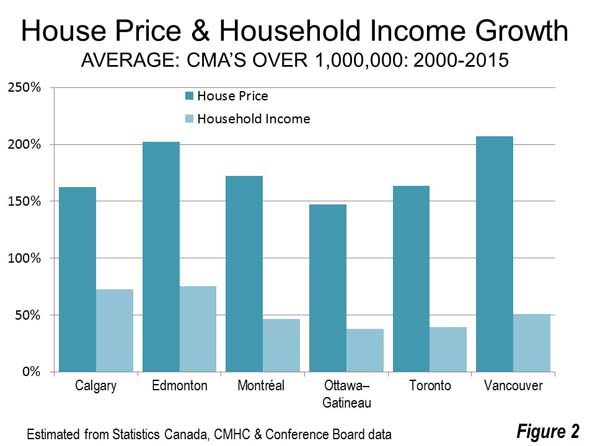
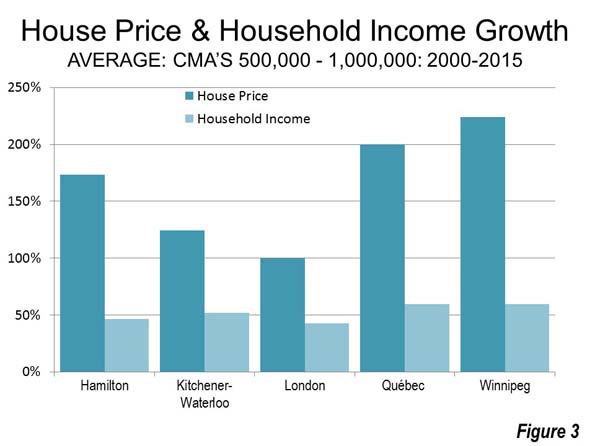
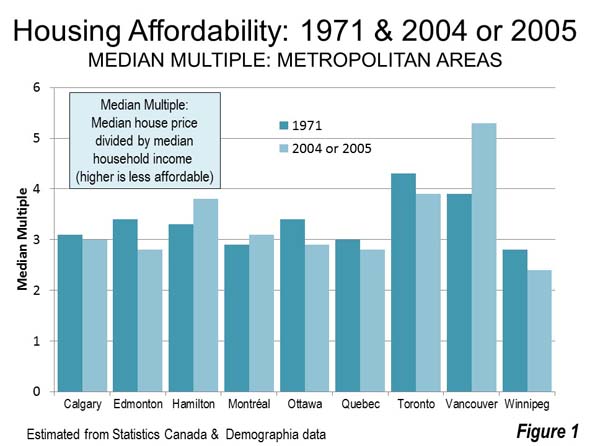
    There was serious deterioration in middle-income housing between 2000 and 2015. This analysis shows that house prices rose faster than income in each of the 35 markets. The largest losses in housing affordability occurred in the six markets with a population of more than one million (Calgary, Edmonton, Montréal, Ottawa-Gatineau, Toronto and Vancouver), where house prices rose on average 3.3 times that of household income. More alarmingly, house prices rose more than four times household income in Vancouver and Toronto. In the five metropolitan areas with between 500,000 and one million residents (Hamilton, Kitchener-Waterloo, London, Québec and Winnipeg), house prices rose 3.2 times that of household income. Even in the smaller markets, house prices rose on average by at least double that of household income (Section 2).

    Substantial mortgage affordability losses could occur with the expected interest increases. Should mortgage interest rates rise by 2020 as projected by The Conference Board of Canada, approximately 800,000 fewer households will be able to qualify for a mortgage on an average-priced house, all else being equal. This could have an impact sooner than expected, since many Canadian mortgages require renewing every five years (Section 3).

    Higher house prices have made it more difficult for middle-income households to afford the housing that Canadians have preferred for decades. Higher house prices appear to have been a principal factor in a trend toward smaller houses and condominiums across Canada between 2001 and 2011. This shift is most evident in Vancouver and Toronto, where housing markets also have the most-restrictive land-use regulation (Section 4).

    Restrictive land-use policy is associated with housing affordability losses. International economic literature associates more-restrictive land-use regulation with diminished housing affordability. The largest housing affordability losses have occurred in metropolitan areas (markets) that have adopted urban containment land-use strategies, which severely limit the land that can be used for building houses on and beyond the urban fringe. Consistent with basic economics, this reduction of land supply is associated with rising land prices, which lead to higher house prices. Without the substantial reform of restrictive land-use policies, housing affordability is likely to continue deteriorating (Section 5).

    Higher house prices impose adverse social and economic consequences. Higher house prices are associated with increased rates of internal migration out of higher-cost markets, increased inequality, overcrowding, the greater public expenditure that is required to support low-income housing and losses to the economy (Section 6).

    Solving the middle-income housing affordability crisis will require policy reforms. There is considerable evidence that restrictive land-use policies are associated with significant losses in housing affordability in Canada as is the case elsewhere. Metropolitan areas with restrictive land-use policy should undertake reforms aimed at improving housing affordability. There should be a moratorium on the adoption of urban containment policy where it is not yet in place. Concerns have been expressed about the potential for high house prices and high household debt to complicate the ability of central banks (such as the Bank of Canada) to perform their monetary policy responsibilities.  Conclusion:  that middle-income housing affordability in Canada is a profound social and economic crisis that warrants serious and concentrated public policy attention (Section 7).

    Wendell Cox is principal of Demographia, an international public policy and demographics firm. He is a Senior Fellow of the Center for Opportunity Urbanism (US), Senior Fellow for Housing Affordability and Municipal Policy for the Frontier Centre for Public Policy (Canada), and a member of the Board of Advisors of the Center for Demographics and Policy at Chapman University (California). He is co-author of the “Demographia International Housing Affordability Survey” and author of “Demographia World Urban Areas” and “War on the Dream: How Anti-Sprawl Policy Threatens the Quality of Life.” He was appointed to three terms on the Los Angeles County Transportation Commission, where he served with the leading city and county leadership as the only non-elected member. He served as a visiting professor at the Conservatoire National des Arts et Metiers, a national university in Paris.

    Photograph: Calgary (by author)

  • Fastest Metropolitan Area Growth Continues in Prairie Provinces

    The latest Statistics Canada population estimates indicate that much of the nation’s growth continues to be in the census metropolitan areas (CMAs) of the Greater Golden Horseshoe, centered on Toronto, and in the Prairie Provinces of Alberta, Saskatchewan and Manitoba.

    In addition to Toronto, the Greater Golden Horseshoe includes Hamilton, Kitchener-Waterloo, Oshawa, Brantford, Barrie, Peterborough St. Catherine’s-Niagara and Guelph census metropolitan areas. The Prairie Provinces metropolitan areas are Calgary, Edmonton, Winnipeg, Saskatoon and Regina.

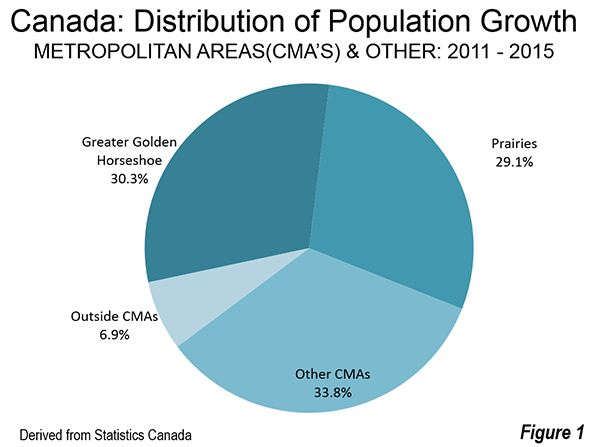
    Between the 2011 census and 2015, the Greater Golden Horseshoe accounted for 30.3 percent of the national population increase (Figure 1). The five Prairie Province metropolitan areas had 29.1 percent of the growth.

    Growth in the Greater Golden Horseshoe was above its national share of the population of 25 percent. The Prairie Province CMA growth was more than 2.5 times its population share, which was less than 11 percent in 2011.

    The CMAs outside the Greater Golden Horseshoe and the Prairie Provinces accounted for approximately 34 percent of the growth, somewhat more than their 30 percent share of the population. Areas outside the CMA’s accounted for only seven percent of the growth, a fraction of their 34 percent population share. This is a continuing indication that the metropolitan areas continue to draw more of the population growth.

    Changing Distribution of Growth

    The last decade and a half has seen substantial changes in the distribution of CMA growth. Between 2001 and 2006, the Golden Horseshoe metropolitan areas welcomed 40 percent of Canada’s population growth, well above the 30 percent over 2011 to 2015. At the same time, the Greater Golden Horseshoe reduction in the share of growth has been compensated by the gain in the Prairie Province metropolitan areas. Between 2001 and 2006, the share of national growth was 19 percent, which rose to 29 percent over 2011 to 2015.

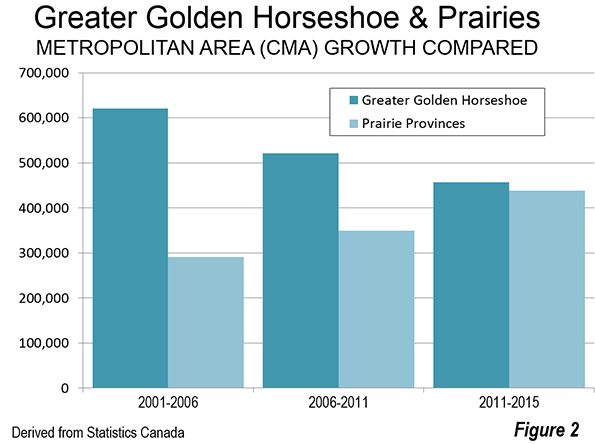
    The population growth rate has slowed considerably in the Greater Golden Horseshoe metropolitan areas, from 1.7 percent annually between 2001 and 2006 to 1.1 percent between 2011 and 2015. Growth has risen considerably in the Prairie Province metropolitan areas, from 1.2 percent annually between 2001 and 2006 to 2.8 percent between 2011 and 2015. Numerically, the Prairie Province metropolitan area growth is now challenging that of the Greater Golden Horseshoe, despite the latter’s more than twice as many residents (Figure 2).

    Winnipeg’s would pass Québec in population by the 2021 census, if the growth rates of the last four years continue and would become the 7th largest metropolitan area.

    Fastest Growing Metropolitan Areas

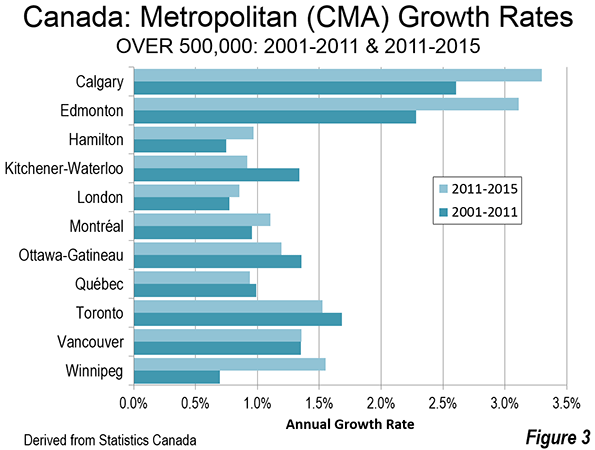
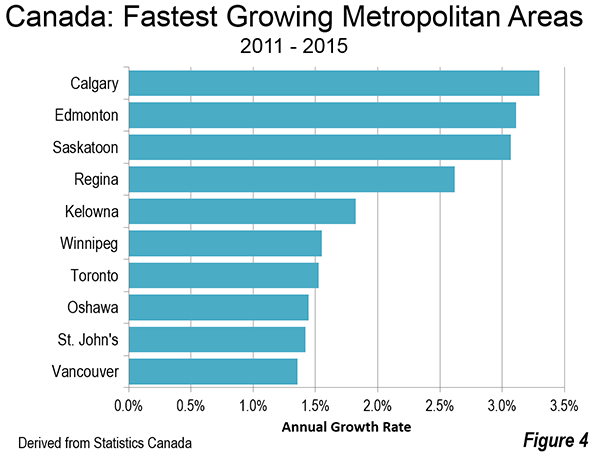
    Five of the six fastest growing metropolitan areas between 2011 and 2015 were in the Prairie Provinces. Calgary, Edmonton and Saskatoon topped the list, growing more than three percent annually (Figure 3). This is an extraordinary rate, better than three times the national growth rate. Regina grew 2.5 percent annually. Over this period, Calgary and Edmonton have both grown larger than Ottawa-Gatineau, which had been the fourth largest CMA for at least 40 years. One can expect growth in the two Alberta cities to slow with the decline in energy prices,  while the other prairie metropolitan areas, less oil dependent, though resource dependent, should do better.  

    Winnipeg, which was the nation’s fourth largest metropolitan area until 1961 and nearly as large as Vancouver as late as 1931, has begun once again  to grow more quickly, after decades of lackluster growth. Having slipped to 8th largest by 2001, Winnipeg ranked sixth in growth since 2011, trailing only the four other Prairie Province metropolitan areas and fast growing Kelowna, BC (1.8 percent annual growth). Unusually, Winnipeg’s growth rate exceeded that of Toronto between 2011 and 2015. Winnipeg’s annual growth rate was 1.6 percent, more than double its 2001-2011 growth (0.7 percent). Should Winnipeg’s growth continue at the most recent rate through the 2021 census, it could exceed the population of the Québec CMA and would trail only the six metropolitan areas with more than 1,000,000 population.

    The changing growth rates of the largest CMAs is indicated in Figure 4, which indicates the rising growth rates in the Prairie province metropolitan areas, with more mixed performance among the other larger CMAs.

    Largest Metropolitan Areas

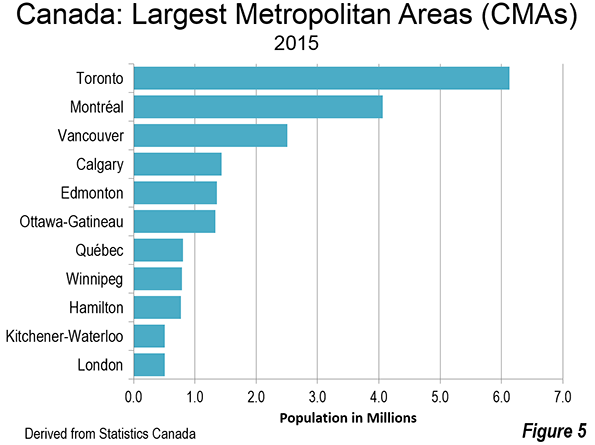
    Canada has eleven metropolitan areas with more than 500,000 residents. Toronto remains by far the largest, at more than 6 million and seems unlikely to be challenged in the foreseeable future. Montréal is closing in on 4.1 million, while Vancouver has just passed 2.5 million (Figure 5).

    The Future

    Canada’s fastest growing metropolitan areas also face the greatest growth challenges. The energy downturn has been particularly rough on Calgary and Edmonton, exacerbated by the disastrous Fort McMurray fire. There was a noticeable downturn in growth between 2014 and 2015 in both CMAs, yet only Kelowna grew faster in the last year. Other Prairie province metropolitan areas, less impacted by the energy decline, have seen their population growth rates fall. The growth rate was one third less than the 2011 to 2015 rate in Saskatoon and about 30 percent less in Regina between 2014 and 2015. Winnipeg fared best, maintaining 90 percent of its 2011-2015 growth rate.

    Other metropolitan areas face challenges every bit as complex. The economic dynamo of Toronto should continue to grow, though has faced strong domestic out-migration between 2004 and  2014, as the population disperses to outer metropolitan areas in the Greater Golden Horseshoe and outside Ontario altogether (See: "Moving from Canada’s Biggest Cities"). Montréal also experienced strong domestic migration losses, with half moving to other parts of Québec and half to other provinces. Vancouver, despite its incomparable attractiveness is also losing net domestic migrants. In all three metropolitan areas, the rising cost of living seems likely to be a major factor in the losses, with "tanking" housing affordability the apparent cause. Vancouver now ranks as the third least affordable major metropolitan area among 87 in the nine nations covered by the Demographia International Housing Affordability Survey, while Toronto’s house prices have risen at more than four times average household incomes since 2001 (see the Frontier Centre policy report: "Canada’s Middle-Income Housing Affordability Crisis"). House prices escalated almost as much in Montréal.

    With the outcomes of these conflicting influences unclear, Canada’s metropolitan area growth could go in different directions. This could range from growth patterns that are similar in the coming years, to the continued discovery by households of smaller metropolitan areas, a higher quality of life is possible because of the lower cost of living. This, has already been evident in the smaller metropolitan areas of Ontario and Québec, as households have been exiting Toronto and Montréal. Meanwhile, Canada is in the midst of its every five year census for 2016, the results of which should be available in seven months (February 2017).

    Photo: North Saskatchewan River from Edmonton central business district (by author).

    Wendell Cox is principal of Demographia, an international pubilc policy and demographics firm. He is a Senior Fellow of the Center for Opportunity Urbanism (US), Senior Fellow for Housing Affordability and Municipal Policy for the Frontier Centre for Public Policy (Canada), and a member of the Board of Advisors of the Center for Demographics and Policy at Chapman University (California). He is co-author of the "Demographia International Housing Affordability Survey" and author of "Demographia World Urban Areas" and "War on the Dream: How Anti-Sprawl Policy Threatens the Quality of Life." He was appointed to three terms on the Los Angeles County Transportation Commission, where he served with the leading city and county leadership as the only non-elected member. He served as a visiting professor at the Conservatoire National des Arts et Metiers, a national university in Paris.

  • Are Compact Cities More Affordable?

    Housing affordability has been a tenacious and intractable urban problem for as long as stats have been kept. Several cities recently declared it a crisis. But what kind of problem is it? Opinions vary widely. An economic problem, or a social one? A land resource issue? Or, as traded wisdom would have it, the result of reliance on the wrong urban form? Proposed solutions vary accordingly. Now, new evidence rules out one potential source of unaffordable housing: clearly, it is not an urban form problem. The widely-believed theory that a city’s lack of affordable housing can be fixed with increased compactness — when combined with public transit — is apparently wrong.

    In a recent article we questioned a publicized correlation between a compactness index level (i.e., urban form) and housing affordability. The argument supporting compactness is that it enables the use of public transit and active mobility modes, which reduce transport expenses sufficiently to eclipse the higher cost of housing prevalent in compact districts. We challenged that assumption, and found that data from eighteen US regional metro regions showed no such effect. Even if it were at all present, it would not be sufficiently pronounced to be an effective solution. Those conclusions were based on a regional look at the problem.

    While the aggregate regional data undermined the urban form theory of affordability, what do sub-regional level data show? At this finer level, could the housing-plus-transportation burden work to the advantage of households? To answer this question, we used data from 18 districts of the Metro Vancouver (BC) region. In this case, the official data exclude certain types of households — a critical limitation. But, given that such disaggregated data are rare, an effort at deciphering their meaning is warranted.

    The two subject groups were Working Homeowners and Working Renters. First, we looked at whether or not the working homeowners could find accommodation that suited their income without stretching themselves thin.

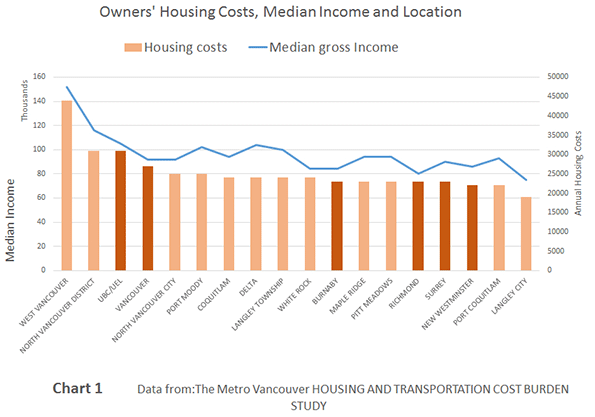
    Chart #1 shows the progression of housing costs in each sub-regional district, and the corresponding household median income. The in-step slopes of the two data sets suggest that working home-owning households have housing costs in tune with their earnings. This implication is further confirmed by the strong correlation (R2= 0.8598) between their income and their housing expenses.

    Housing costs that are proportional with income are a positive sign, but can these homeowners actually make their mortgage payments without financial stress? The data says yes, they can. This group’s average ratio of housing payments to income is 26%. It never exceeds 30%, the accepted threshold of financial strain.

    Instructively, from an urban form perspective, the highest ratios occur in the central, compact district; a confirmatory finding. Equally expected are that the lowest cost-to-income ratios occur in districts furthest from the center; these districts are either suburban or exurban.

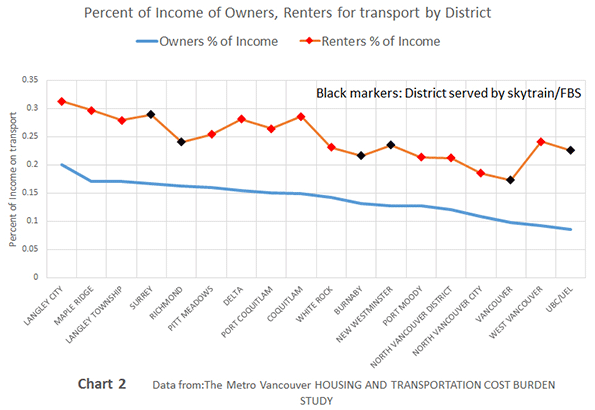
    But are any of these home-owning households disadvantaged by excessive transportation costs due to their location? The data show a normal, average transportation expense of 14% of income and a range from about 8% to 20%. The ratios do increase with distance, but bear no significant correlation with income (R2= 0.0178).

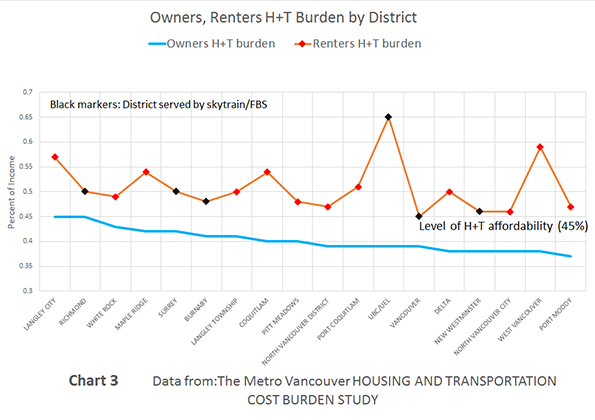
    When choosing the place of residence, do homeowners consider housing costs, but disregard transportation costs? If so, could this lead to an affordability problem as measured by the combined costs? Apparently not. Chart #3 graphs (blue line) this group’s cost burden for combined housing and transportation (H+T) expenses, which never exceed the recognized affordability threshold: 45% of income.

    Conclusion? Metro Vancouver’s 305,000 households of working homeowners with mortgages aren’t experiencing financial strain due to their housing costs, no matter what their preferred housing form, location or transportation arrangements. The urban and suburban locations of the city structure fully satisfy their housing and transport needs. Neither compactness nor its absence has a negative impact on their finances.

    The data paints an entirely different picture for the 224,000 working households that rent their accommodations. Their average H+T burden (Chart #3; orange line) is 51% of their median income, and it ranges from the 45% threshold of affordability to an extreme of 65%.

    This picture, however, is not the result of high housing costs; rents register in the affordable range in all locations but two. The average working renter’s housing cost is 26%, which mimics that of a homeowner, and the range is below the stress level of 30%, with only two outliers (out of 18 districts) at 35% and 45% of income. For renters, as is the case for homeowners, the highest housing costs occur in the more compact districts. The outliers are found in elite social cluster districts — highly desirable neighborhoods — entirely unrelated to urban form.

    Given that rent costs are within the affordable range in all but two locations, we may infer that the Metro Region provides a sufficient range of housing costs for this group in its current urban/suburban structure.

    These findings are reinforced by the proportionality of incomes and housing expenses for both homeowners and renters. The incomes of renter households range from 45% to 63% of homeowners by location, and their rent costs are from 45% to 65%, an almost identical range.

    It would seem, then, that the excessive H+T burden renters face can be attributed partially to the transportation costs of this group. However, contrary to expectations, of the six districts that have rapid rail service (sky-train; black markers on Chart #3), not one manages to have a total burden below the affordability threshold. That even goes for the two suburban districts that offer the lowest rents.

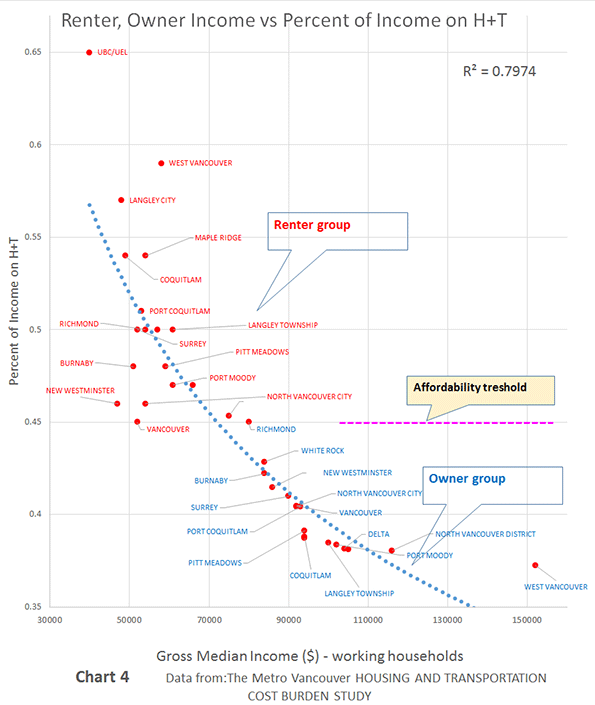
    Chart #4 clearly shows the division between the earnings of owners and renters, and the affordability threshold that separates them. The belief that a compact urban form provides a path to solving housing affordability problems appears untenable.

    Overall, the data shows that for working homeowners there are no locations in the Metro Vancouver Region, whether urban, suburban or exurban, that push housing costs or the combined costs of housing and transportation above the affordability threshold. Urban form is not affecting budgets in these households.

    For working renters, rents are affordable in 16 of the 18 districts, whether urban, suburban or exurban. However, when transportation costs are added to their housing costs, the new sum puts them in financial stress, even in districts served by rapid rail transit.

    This sub-regional, limited analysis confirms the findings of our earlier regional look: compactness and access to transit do not produce the affordability benefits that have been claimed. The compact urban form does not equal more affordable living, particularly for the less affluent.

    Fanis Grammenos heads Urban Pattern Associates (UPA), a planning consultancy. UPA researches and promotes sustainable planning practices including the implementation of the Fused Grid, a new urban network model. He is a regular columnist for the Canadian Home Builder magazine, and author of Remaking the City Street Grid: A model for urban and suburban development. Reach him at fanis.grammenos at gmail.com.

    Flickr photo by Nick Kenrick: The Neighbourhood of East Van

  • A Question of Values: Middle-Income Housing Affordability

    This is the Executive Summary from a new report “A Question of Values: Middle-Income Housing Affordability and Urban Containment Policy" authored by Wendell Cox and published by the Frontier Centre for Public Policy. Ailin He, a PhD doctoral candidate in economics at McGill University served as research assistant.

    The "report is a public policy narrative on the relationships between urban containment policy, housing affordability and national economies. It is a synthesis of economic and urban planning analysis that is offered as a policy evaluation of urban containment. The analysis is presented in the context of higher-order objectives of domestic policy: improving the standard of living and eradicating poverty" (Page 9). The research focuses on the international experience, especially in Canada, Australia, New Zealand, the United Kingdom and the United States. Download the full report (pdf) here.

    Middle-income housing affordability is important to people and the economy: Canada’s house prices have risen more than house prices in most other high-income nations. This is of concern, because higher house prices reduce discretionary incomes, which defines the standard of living and poverty. If discretionary incomes are reduced, households will have less to spend on other goods and services, which can retard job creation and economic growth. Improving the standard of living and eradicating poverty are among the highest-order domestic priorities.

    Urban containment policy can lead to higher house prices: Urban land-use regulation has become stronger in many metropolitan areas and often includes urban containment policy. Urban containment severely restricts or bans development in urban fringe areas. Consistent with basic economics, this increases land values and house prices (all else equal). The planning intention and expectation is that higher housing densities will offset the land-price increases and that housing affordability will be maintained.

    Severe losses in housing affordability have been experienced in urban containment markets: Top housing and economic experts attribute much of the loss in housing affordability to stronger land-use policy.

    Housing affordability losses have been sustained in the five nations this report focuses upon: Across the United Kingdom, Australia, New Zealand and some markets in Canada and the United States, house prices have nearly doubled or tripled compared with household incomes as measured by price to income ratios. Much of this has been associated with urban containment policy.

    Demand and supply: Some research suggests that the huge house-price increases have occurred due to higher demand and the greater attractiveness of metropolitan areas that have urban containment policy. However, the interaction of supply and demand sets house prices. Claims that metropolitan areas with urban containment policy are more attractive are countered by their net internal out-migration and diminished amenities for some households.

    An intrinsic urban containment amenity seems doubtful: Some urban containment advocates claim that urban containment policy intrinsically improves amenities (such as a dense urban lifestyle). However, whether a feature is an amenity depends on individual preferences. Moreover, the strong net internal migration away from many metropolitan areas with urban containment policy is an indication that there is no urban containment amenity for most households.

    Higher densities have not prevented huge losses in housing affordability: In contrast with planning expectations, the land-value increases expected from urban containment have not been nullified by higher densities within urban containment boundaries.

    Intervening urban containment boundaries are more influential than topographic barriers: It has been suggested that topographic barriers such as mountains and the ocean cause higher house prices. However, in urban containment metropolitan areas, urban containment boundaries are usually placed between the built-up urban areas and the topographic barriers. As a result, house-price increase associated with the land shortage will be principally associated with the urban containment boundary, not the topographic barrier.

    A competitive land supply is required for housing affordability: A risk with urban containment policy is that by limiting the land for sale, large landholders will seek to buy up virtually all of the land for future gain. Without urban containment, there will not be a land shortage, and there will not be an incentive to monopolize the land supply. A sufficient land supply can be judged to exist only if prices relative to incomes are not higher than before the urban containment policy came into effect.

    Urban containment policy has been associated with reduced economic growth: Evidence suggests that urban containment policy reduces job creation and economic growth. The increased inequality noted by French economist Thomas Piketty is largely attributed to the housing sector and is likely related to strong regulation. Other research estimated a US$2-trillion loss to the U.S. economy, much of it related to strong land-use regulation, and called this “a large negative externality.”

    Urban containment policy has important social consequences: There are also important social consequences such as wealth transfers from younger to older generations and from the less-affluent to the more-affluent households.

    Urban containment policy has failed to preserve housing affordability: Some have expressed concern that urban containment policy might not have been implemented if there had been the expectation of losses in housing affordability. In fact, the administration of urban containment policy has been deficient, with corrective actions largely not taken despite the considerable evidence of losses in housing affordability. In urban containment markets, programs should be undertaken to stop the further loss of housing affordability and transition toward restoring housing affordability. Further, urban containment should not be implemented where it has not already been adopted.

    Canada could be at risk: Canada could be at greater risk in the future. Already, huge losses in housing affordability have been sustained in Vancouver and Toronto. Other metropolitan areas are strengthening land-use regulations. This could lead to severe consequences such as lowering middle-income standards of living and greater poverty with less job creation and less economic growth.

    The urban containment debate is fundamentally a question of values: Ultimately, the choice is between the planning values of urban design or urban form and the domestic policy values of improving the standard of living and reducing poverty. Urban containment policy appears to be irreconcilable with housing affordability. Proper prioritization requires that the higher-order values of a better standard of living and less poverty take precedence.

    Download the full report (pdf) here.

    Wendell Cox is Chair, Housing Affordability and Municipal Policy for the Frontier Centre for Public Policy (Canada), is a Senior Fellow of the Center for Opportunity Urbanism (US), a member of the Board of Advisors of the Center for Demographics and Policy at Chapman University (California) and principal of Demographia, an international public policy and demographics firm.He is co-author of the “Demographia International Housing Affordability Survey” and author of “Demographia World Urban Areas” and “War on the Dream: How Anti-Sprawl Policy Threatens the Quality of Life.” He was appointed to three terms on the Los Angeles County Transportation Commission, where he served with the leading city and county leadership as the only non-elected member. He served as a visiting professor at the Conservatoire National des Arts et Metiers, a national university in Paris.

  • Is Suburbia Crashing? Suburban Traffic Myths Refuted

    Traffic crashes are a cause of ill health, impaired living or curtailed lifespan. Does city growth, in its sprawl-type outward expansion, increase the incidence of fatal and injurious crashes? This factor is the latest addition to numerous attempts to pin a correlation or causality linking traffic accidents with any number of causes.

    The twentieth century is not the only time in city evolution at which traffic accidents became a concern. Around the end of nineteenth century, when all in-city transportation was hoof and foot-dependent, accidents in cities were common.

    In New York, for example, 200 persons died in accidents in the year 1900, which, when transposed, means a 75 percent higher per capita rate than today. In Chicago the rate per horse-drawn vehicle in 1916 would be almost seven times the per auto rate in 1997.

    These are surprising, counter-intuitive statistics: the two cities, as all others at the time, were not just walkable, they were predominantly foot-based cities; exemplars of urbanism. No person had to cross six-lane arterials or dodge high-speed vehicles. Distances were short, city blocks small, densities high, and personal daily routine took place mostly on foot. It seems paradoxical that a walkable, dense, mixed-use city would generate high fatality rates; and more so because the speed of traffic ranged between 3 and 9 m/hr : half or less the 20 m/hr threshold beyond which fatalities increase. Without sidetracking for explanations, we can draw at least one simple idea from this past: a dense, foot-based city can generate high rates of fatalities.

    Soon after motorized transport entered city streets, fatal crashes rose. In the face of appalling and rising death figures, many adjustments occurred over a 30-year period. None of these changes involved urban form; they were inevitably operational and regulatory (e.g. lane markers, stop signs, driving rules, etc).

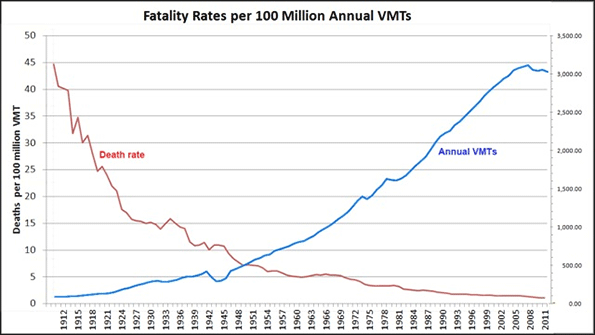
    In the U.S. during the first decades of the automobile’s presence on city streets, car accident rates fell rapidly even though car travel tripled between 1920 and 1955.

    During the same period the urban form characteristics remained fairly stable. The modest suburban expansion of cities at that time was light-rail dependent; “motopia” had yet to emerge . Most urban form of the ’30s and ’40s was generally similar to the early twentieth century prototypes: medium to high density compact development around a rail line or station with a core of amenities and services. It is nearly impossible to determine whether or not this form played a role in the drop in fatalities, due to the absence of concurrent alternative forms. When new “motopia” forms emerged, trends in fatalities did not bear out their influence.

    When automobile dominance was firmly established and new highways opened vast tracts of land for city growth, urban form at the city periphery changed decisively from compact, mixed use, walkable and transit-centered to typical “motopia” or “sprawl.”

    Despite a Smart Growth America recent claim of a correlation between sprawl and an increase in fatal accidents and a small decrease in injuries, the traffic fatality rate actually decreased as U.S. cities sprawled and total VMTs increased.

    The current level of traffic fatalities stands at about one third of the 1955 level and less than 1/20 of the 1925 rate. Intriguingly, sprawl at the national scale did not produce an increase in fatal or total crashes as analysts predicted. If the sprawl paradigm did play its negative role, then other countervailing factors must have had a greater influence that overshadowed its effect.

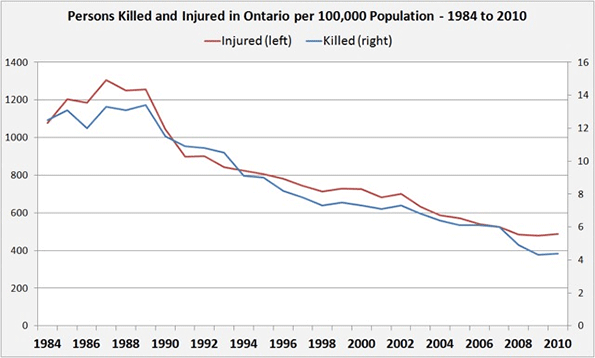
    The national trends in Canada mirror those of the U.S. Notably, fatal crashes fell at a faster rate than injuries, increasing the uncertainty about the correlation that links a substantial rise in fatalities with a rise in “sprawl-ness”. Provincial statistics show similar trends. The chart below shows the trends in Ontario, the most populous Canadian province:

    During a quarter century of more suburban expansion, fatalities and injuries followed a similar decline for a respective drop of around 70 percent in fatalities and about 60 percent in injuries; a substantial change. Like the national level statistics, provincial ones reinforce the uncertainty about a correlation between urban form and traffic fatality rates; instead of upward climb, we see an unmistakable decline.

    But what do statistics show at the finer, city scale?

    We turn to two – Toronto and Calgary – of six Canadian cities whose sprawl has been documented in detail. In spite of their anti-sprawl policies, in most the movement was retrograde, toward more sprawl.

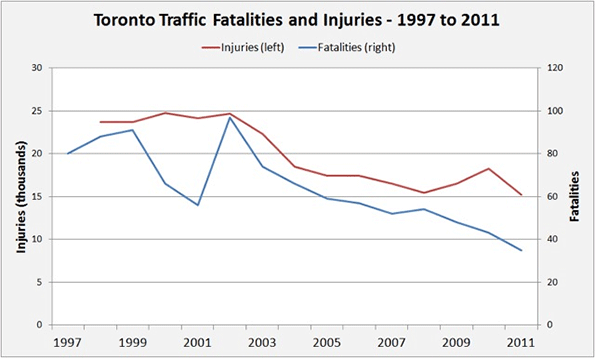
    The graph above shows Toronto’s trend in fatal crashes and injuries for the period of 1997 to 2011. Toronto during these 15 years can be characterized as a suburbanized region (with a few exurban appendices) that continues to expand using the conventional development model.

    In addition, Calgary, Alberta, the “car capital of Canada”, according to a Smart Growth report, has Canada’s lowest overall density; it remains a sprawled city. As with the national and provincial trends, the two cities’ traffic safety trends show a persistent overall drop in fatal and injurious accidents. Once more, the city-level fatalities and injuries trends contradict the correlation that links sprawl-type urban form with an increase in fatal accidents and a decrease in injuries. Whatever the countervailing factors are, they mask and overwhelm an expected rise in fatalities. As for the decrease in injuries, the actual drop is far greater than what the postulated correlation would predict and cannot be explained by it alone.

    If at the national, provincial and city levels the trends are positive in spite of the negative direction of urban form, the health concerns that would justify planning interventions appear to have been alleviated on this front, at least for the first century of automobility and for the half century of uninterrupted sprawl.

    One might speculate that had growth been in a compact, walkable, diverse use, transit-centered form, fatalities could have declined even faster. This could well be true but cannot be deduced from the above statistics. Regardless, the current trends could not be seen as a cause for concern and urgent action on the urban form front. On strictly health grounds, cities and provinces are progressing in the right direction. There is no apparent imminent or growing threat.

    So far we have seen the difficulty of explaining the persistent drop in traffic fatalities via a correlation with “sprawl-ness” and we hypothesized that other factors may be at work. Indeed they are. We find several in overlapping lists of international, national, provincial and city documents: some linked to the causes of fatal crashes, others as government directives. Here is a collection in no particular order of importance:

    Speed limit range/control
    Drinking and driving laws
    Young driver restrictions
    Intersection geometry
    Car crash-worthiness rating
    Car fitness regulations
    Road condition care
    Driving fitness/age
    Speeding penalties
    Vulnerable user protection
    Motorcycle helmets
    Seat belt use/air-bags
    Child restraints usage
    Pre-hospital, on-spot care
    Distraction prohibitions

    As one example of the potential effect of safety measures, NHTSA in 2005 estimated that 5,839 lives would have been saved in 2004 (or 14 percent of total car-related fatalities) if all passengers wore seat belts.

    Planning interventions can have multiple beneficial effects. On at least one front there is no cause for alarm or a rationale for a call to arms; the battle against traffic fatalities is being won, without urban form change. This does not suggest that a correlation between sprawl and the reduction in fatal and injurious crashes exists, or imply that sprawl is a desirable urban form. It simply means that the effect of urban form on crashes cannot be established unequivocally and therefore cannot be a lead driver for action.

    Fanis Grammenos heads Urban Pattern Associates (UPA), a planning consultancy. UPA researches and promotes sustainable planning practices including the implementation of the Fused Grid, a new urban network model. He is a regular columnist for the Canadian Home Builder magazine, and author of Remaking the City Street Grid: A model for urban and suburban development. Reach him at fanis.grammenos@gmail.com.

    After twenty-four years at Canada Mortgage and Housing Corporation, Tom Kerwin now leads an active volunteer life, including being the Science and Environment Coordinator for the Calgary Association of Lifelong Learners. He holds a Master’s degree in Environmental Studies from York University.

    A different version of this article appeared at SustainableCitiesCollective.

    Flickr photo by 7mary3: a car accident due to an unsafe lane change.

  • Prairie Metropolitan Areas Drive Canada’s Growth

    In Canada, growth is moving west, but not all the way. The big growth now is in the Prairies between central Canada and British Columbia, the Canadian part of the Great Plains.

    Yet you can’t talk about metropolitan Canada without first mentioning the Toronto region.

    The Greater Golden Horseshoe continues to dominate Canada’s population, according to the latest census metropolitan area estimates from Statistics Canada. Anchored by Toronto, the metropolitan areas of the Greater Golden Horseshoe (Hamilton, Kitchener, Oshawa, Brantford, Barrie, Peterborough St. Catherine’s – Niagara and Guelph) now have a population of 8.7 million residents, 23.4% of the national total of 35.5 million.

    The Major Metropolitan Areas

    Canada has six major metropolitan areas (populations over 1 million) and a total of 33 (Table 1).

    Table 1
    Canada: Census Metropolitan Areas
    Population: 2001-2011-2014
            Annual Change
    Metropolitan Area 2001 2011 2014 2001-2011 2011-2014
    Toronto                       4,883     5,770     6,056 1.68% 1.63%
    Montréal                      3,533     3,886     4,027 0.96% 1.20%
    Vancouver                     2,075     2,373     2,470 1.35% 1.35%
    Calgary                          978     1,264     1,407 2.60% 3.62%
    Edmonton                         962     1,206     1,328 2.28% 3.27%
    Ottawa           1,110     1,270     1,318 1.35% 1.24%
    Québec                           704        777        800 0.99% 0.97%
    Winnipeg                         696        746        783 0.70% 1.61%
    Hamilton                         689        742        765 0.75% 1.01%
    Kitchener-Waterloo        432        493        507 1.34% 0.93%
    London                           453        489        502 0.78% 0.87%
    Halifax                          369        402        414 0.86% 0.98%
    St. Catharines-Niagara        392        403        406 0.27% 0.28%
    Oshawa                           309        367        384 1.76% 1.51%
    Victoria                         326        352        359 0.78% 0.62%
    Windsor                          321        328        334 0.23% 0.57%
    Saskatoon                        231        270        301 1.58% 3.62%
    Regina                           197        218        238 1.00% 2.98%
    Sherbrooke                       184        205        212 1.07% 1.18%
    St. John’s                       176        203        212 1.39% 1.49%
    Barrie                           155        193        200 2.18% 1.30%
    Kelowna                          154        184        191 1.76% 1.38%
    Abbotsford        154        174        179 1.25% 0.88%
    Kingston                         153        164        168 0.74% 0.78%
    Sudbury                  161        165        166 0.23% 0.09%
    Saguenay                         162        159        160 -0.18% 0.16%
    Trois-Rivières                   143        153        156 0.67% 0.56%
    Guelph                           129        146        151 1.20% 1.20%
    Moncton                          122        140        146 1.38% 1.37%
    Brantford                        129        139        143 0.82% 0.87%
    Saint John                       126        129        127 0.20% -0.34%
    Thunder Bay                      127        125        125 -0.14% 0.04%
    Peterborough                     115        122        123 0.58% 0.29%
    Metropolitan Areas   20,851   23,759   24,859 1.31% 1.52%
    Outside Metropolitan Areas   10,172   10,586   10,684 0.40% 0.31%
    Canada   31,023   34,345   35,542 1.02% 1.15%
    In thousands
    Source: Statistics Canada


    Toronto remains the largest metropolitan area in the nation, at 6.1 million residents. The population has increased nearly 1.2 million since 2001, 300,000 of it in since the census year of 2011. In the past half-century, Toronto has steadily increased its share of Canada’s population. In 1961, 11 percent of the nation’s residents were in the Toronto metropolitan area. By 2014, 17 percent of the population was in Toronto. Toronto’s has built a margin of 2.0 million over second-ranked Montréal, an expansion of more than one half just since 2001. Montréal had been the largest metropolitan area in Canada until 1976.

    Montréal continues to be Canada’s second largest metropolitan area, at 4.1 million. Montréal’s annual growth rate was higher between 2011 and 2014 than in the previous 10 years, though is still growing at less than the national average. 

    Vancouver is Canada’s third largest metropolitan area. In the second half of the 20th century, Vancouver grew at a rate considerably greater than that of the nation as a whole. However over the last three years, Vancouver’s has grown at a rate less than that of Canada as a whole. Vancouver is nearing a population of 2.5 million, which it should achieve in 2015.

    Among Canada’s major metropolitan areas (over 1 million residents), Calgary is the fastest-growing. Calgary has reached a population of 1.4 million and is growing at 2.5 times the national rate (3.62 percent annually).Since 2001, Calgary has added more than 400,000 residents. Calgary’s growth rate has been spectacular. In 1951, Calgary had fewer than 150,000 residents, but has since grown into a major center specializing in energy. Calgary has the distinction of having built by far the largest post-World War II downtown area in either Canada or the United States (see photograph at the top of the article).

    Edmonton has grown almost as quickly. From a population of under 200,000 in 1951, Edmonton has grown to more than 1.3 million. Edmonton’s annual growth rate since 2011 has been 3.27% and has added more than 360,000 residents since 2001.

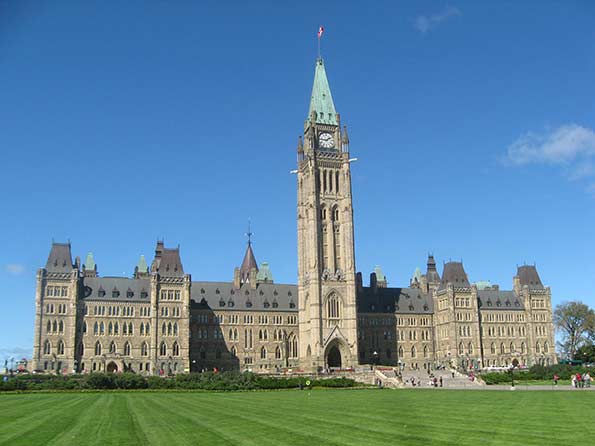
    Ottawa, the national capital (see photo below), stretches across the Ontario-Québec border, with Gatineau the largest municipality on the Quebec side. In 2011, Ottawa had been the fourth largest metropolitan area since 1941, but has been passed by both Calgary and Edmonton since 2011.


    Photo: Centre Block, Parliament Hill, Ottawa

    Moving to the Prairies?

    The population estimates of the last three years indicate considerable growth in the Prairie metropolitan areas relative to the rest of the nation. The Prairies provinces are include Alberta, Manitoba and Saskatchewan (Table 2).

    Table 2
    Canada: Census Metropolitan Areas by Region
    Population: 2001-2011-2014
            Annual Change
    Region 2001 2011 2014 2001-2011 2011-2014
    Atlantic Provinces        794        874        900 0.96% 0.97%
    Québec                        4,997     5,498     5,683 0.96% 1.11%
    Ontario     8,587     9,830   10,231 1.36% 1.34%
    Prairie Provinces     3,765     4,474     4,846 1.74% 2.70%
    British Columbia     2,708     3,083     3,199 1.30% 1.24%
    Metropolitan Areas   20,851   23,759   24,859 1.31% 1.52%
    In thousands
    Source: Statistics Canada


    Calgary and Edmonton have experienced strong growth for decades. The same was not true of Saskatchewan’s two largest cities, Saskatoon and Regina. After years of near population stagnation, both metropolitan areas, and the province added population at an accelerated rate. Saskatchewan’s growth pattern has paralleled that of North Dakota, which has shared the energy boom and experienced unprecedented growth after decades of stagnation.

    Saskatoon’s annual growth rate tied with that of Calgary, at 3.62%. This is more than double the 2001 to 2011 growth rate. Regina nearly tripled its annual growth rate from 1.00% between 2001 and 2011 to 2.98% between 2011 and 2014.

    But perhaps the biggest surprise was Winnipeg. Winnipeg was for many years Canada’s fourth largest metropolitan area, a title it relinquished to Ottawa in the 1960s. By 2001, Winnipeg had fallen to eighth place, its population exceeded by not only Calgary and Edmonton, but also Quebec City. However, in a major turnaround, Winnipeg’s annual growth rate has more than doubled since 2011.

    The strength of the Prairies is evident in the regional data (Table 2). The metropolitan areas in the Prairie Provinces grew at more than double the rate achieved by the metropolitan areas in the other regions of Canada between 2011 and 2014.

    The metropolitan areas in all of the four other regions of Canada grew at rates below that of the nation as a whole between 2011 and 2014. The slowest growth was in the Atlantic Provinces (New Brunswick, Newfoundland, Nova Scotia and Prince Edward Island). The annual growth rate of Québec’s metropolitan areas was the second lowest. However growth edged up in Québec’s metropolitan areas. Ontario and British Columbia had grown an approximately the national metropolitan area rate between 2001 and 2011. However, both provinces saw their metropolitan growth fall below the national rate in the last three years.

    The Prairies are likely to experience a reduction in their population growth rate as a result of lower oil and commodity prices. It is an open question how long the lower prices will prevail. The proximate cause of the lower prices is OPEC’s relaxed rationing of its supply to the world. That could change by political whim at virtually any time, or due to disruptions in the Middle East or West Africa, sending prices higher.

    Meanwhile, non-metropolitan Canada continues its very slow growth, which now stands at one-third that of the nation and one-fifth that of the metropolitan areas.

    Wendell Cox is principal of Demographia, an international public policy and demographics firm. He is co-author of the "Demographia International Housing Affordability Survey" and author of "Demographia World Urban Areas" and "War on the Dream: How Anti-Sprawl Policy Threatens the Quality of Life." He was appointed to three terms on the Los Angeles County Transportation Commission, where he served with the leading city and county leadership as the only non-elected member. He was appointed to the Amtrak Reform Council to fill the unexpired term of Governor Christine Todd Whitman and has served as a visiting professor at the Conservatoire National des Arts et Metiers, a national university in Paris.

    Top Photo: Downtown Calgary (by author)

  • Canada’s Prairie Cities Step Up

    Traditionally, the discussion of Canadian urban issues focussed almost exclusively on the Big Three cities: Toronto, Vancouver, and Montreal, with the occasional nod to Ottawa. Calgary, Winnipeg, and Regina were generally only mentioned as punchlines, and, until recently, no one in urban Canada really knew what was going on in Edmonton other than that they had a winning hockey team in the ’80s and a really big mall. Saskatoon, which Joni Mitchell famously escaped as soon as she could, hasn’t historically been on anyone’s radar, and Regina is scarcely mentioned outside the context of football. It’s not surprising that many Prairie residents are defensive or bashful about their cities, given the PR they’ve gotten over the years. But from an outsider perspective, now is a very good time to live on the Prairies.

    With Calgary, Edmonton, Regina, and Saskatoon perennially vying for the title of fastest growing Canadian city, and with Winnipeg in the early stages of an urban renaissance, it’s getting harder to ignore Canada’s Prairie cities. The narrative is shifting. The election of young, urbane, and pragmatic mayors in Calgary, Edmonton, and Winnipeg has put the spotlight on these once ignored cities.

    Naheed Nenshi, a Harvard-educated McKinsey consultant turned university instructor, was improbably elected Mayor of Calgary in a 2010 landslide victory. His quick wit and social media savvy have made him a darling of Canadian urbanists. He was recently short-listed for the World Mayor Prize. Regardless of what one thinks of his policy agenda, he is a good ambassador for the city.

    Not to be outdone, Edmonton elected 34-year-old city councillor and self-proclaimed nerd Don Iveson as mayor in 2013. Iveson recently made headlines for showing up at a comic expo in full Star Trek attire. His nerd-chic appeal has resonated with a cohort of young Edmontonians who feel that the city’s creative community gets short shrift. He, like Nenshi, is thought of as a smart, moderate mayor, an image that flies in the face of the redneck Albertan stereotype that hasn’t been an accurate representation of either of these Alberta cities for quite some time.

    Winnipeg has followed suit, electing privacy lawyer Brian Bowman as mayor. The 43-year-old has chaired both the Winnipeg Art Gallery and the Winnipeg Chamber of Commerce. Like Nenshi and Iveson, Bowman was elected with a diverse support base, including the business and arts communities. Being of Metis descent, he is also considered to be in a strong position to address some of the challenges facing the city’s large, indigenous population.

    The three mayors have more in common than belonging to roughly the same age cohort. All three are seen as moderates, and all have had some minor political experience but aren’t identified strongly with any political party. Each grew up in his respective city. Their biographies underscore an often overlooked advantage of Prairie cities: opportunities for economic mobility.

    As Canada’s Big Three cities get more expensive, Prairie cities are becoming increasingly attractive to recent graduates and early career professionals. Relatively affordable rents and tighter labour markets make them bargains, relative to Toronto or Vancouver. Tighter labour markets combined with the general default instinct among young professionals and graduates to move to Toronto or Vancouver mean that Prairie cities are a good place to get from the bottom to the middle in one’s industry. While there is a ceiling – the best paid financial sector employees will be in Toronto for the foreseeable future – there is less competition. Being able to live in the most attractive urban neighbourhoods for less than the cost of living in generally undesirable Toronto neighbourhoods, or being able to buy a house for a fraction of the sale price in Vancouver, sweetens the deal.

    Prairie cities are also a great place to take a chance. Lower rents mean that someone who wants to open a business needs to accumulate less capital and borrow less money than he or she would in a bigger city. That makes opening a restaurant or founding a start-up a less risky proposition. The same goes for aspiring artists. Relatively cheap gallery space makes it much easier to display one’s work. Whereas it might take family connections or years of networking to get on the board of a non-profit in Toronto or Vancouver, opportunities abound on the Prairies.

    In the world of politics, contrast Nenshi, Iveson, and Bowman, all from fairly ordinary families, with the winner of the last Toronto election.

    Toronto’s new mayor, John Tory, was born to the founder of the prestigious law firm Torys LLP. Tory was given his start in business at telecom giant Rogers by family friend Ted Rogers, the son of Rogers founder Edward Rogers, and went on to later run Rogers. His career also included running the Canadian Football League, making partner at the family firm, serving as principle secretary to former Premier of Ontario Bill Davis, chairing the campaign of former Prime Minister Brian Mulroney, and leading the official opposition in the Ontario legislature. In short, John Tory is the epitome of the Canadian establishment. His chief opponents weren’t exactly political novices either.

    Could Nenshi, Iveson, or Bowman have plausibly become the Mayor of Toronto? The answer is likely no. While some might argue that the level of political competition is necessarily higher in Toronto, the bigger reason is that the entrenched political and business elites in the three major cities have more clout than their Prairie counterparts.

    Calgary, Edmonton, Regina, and Saskatoon are dominated by new money. While Winnipeg has some influential legacy families, the political barriers to entry are generally much lower than they are in Toronto. A person of Bowman’s upbringing would have had an exceedingly difficult time becoming chair of the Chamber of Commerce in Toronto. An academic City Hall gadfly like Nenshi wouldn’t have a chance, even if he considered making a run for Mayor of Toronto. And someone as young as Iveson would have a hard time getting elected as a city councillor in Toronto, let alone as mayor. That isn’t meant to take away from them in the least. It is merely a recognition that the political system in Toronto is much more elite-driven.

    The combination of affordability, opportunity, and economic mobility presents a major opportunity for Canadian Prairies cities. Lower political barriers to entry can facilitate more responsive local governments. Relative isolation can help to spawn innovation of necessity. And upward mobility can help lure young talent from across the county.

    Cynically – or optimistically, depending on one’s view – none of these young mayors has a great deal of power to bend the trajectory of their cities. Mayors are merely single votes on councils, and even city councils are only one of many actors that shape these respective cities. Arguably the most important thing that mayors can do is serve as good ambassadors for their cities. The first step is to convince residents of the reality that things are going pretty well, and even better times lay ahead. The rest of the world won’t believe in Prairie cities until their own residents do. Civic pride is contagious.

    So far Nenshi has been an exceptional civic booster, and Iveson appears to be on that trajectory, too. Bowman seems keen on following in their footsteps. Hopefully, mayors and councillors in the rest of the Prairie cities can do the same. Prairie cities are having a moment, and that moment could potentially be a very long and a very good one.

    Steve Lafleur is the Assistant Director of Research for the Frontier Centre for Public Policy. He currently lives in Winnipeg, Manitoba, and has lived in every major Prairie city with the exception of Saskatoon.

    Flickr Photo by Elsie, Calgary Reviews: A chai latte at Caffe Rosso, Calgary

  • From Jurisdictional to Functional Analysis of Urban Cores & Suburbs

    The 52 major metropolitan areas of the United States are, in aggregate, approximately 86 percent suburban or exurban in function. This is the conclusion from our new City Sector Model, which divides all major metropolitan zip codes into four functional categories, based on urban form, population density and urban travel behavior. The categories are (1) Pre-Auto Urban Core, (2) Auto Suburban: Earlier, (3) Auto Suburban: Later and (4) Auto Exurban. It is recognized that automobile-oriented suburbanization was underway before World War II, but it was interrupted by the Great Depression during the 1930s and was small compared to the democratization of personal mobility and home ownership that has occurred since that time.

    For decades there has been considerable analysis of urban core versus suburban trends. However, for the most part, analysts have been jurisdictional, comparing historical core municipalities to the expanse that constitutes the rest of the metropolitan area. Most core municipalities are themselves substantially suburban, which can mask (and exaggerate) the size of urban cores.

    The Queen’s University Research

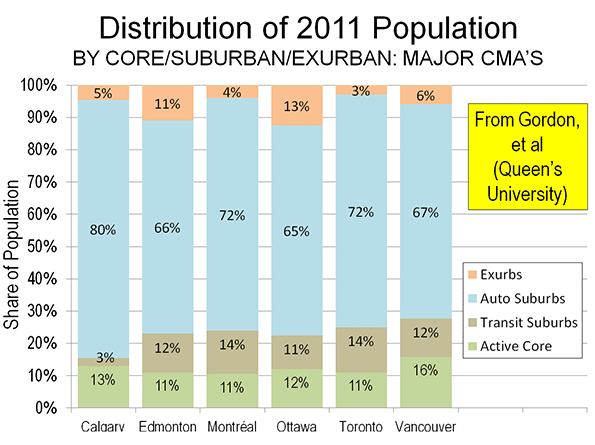
    The City Sector Model is generally similar to the groundbreaking research published by David L. A. Gordon and Mark Janzen at Queen’s University in Kingston Ontario (Suburban Nation: Estimating the Size of Canada’s Suburban Population) with regard to the metropolitan areas of Canada. Researchers used travel behavior (journey to work data from the 2006 census) and density for classifying metropolitan areas into four sectors, (1) Active Core, (2) Transit Suburbs, (3) Auto Suburbs, and (4) Exurbs. The active core was that portion of metropolitan areas with a high share of work trip travel by walking and cycling. I covered the research in a newgeography.com article last autumn.

    Gordon and Janzen concluded that the metropolitan areas of Canada are largely suburban. Among the major metropolitan areas of Canada, the Auto Suburbs and Exurbs combined contain 76 percent of the population, somewhat less than the 86 percent we found in the United States.

    The City Sector Model follows the same general approach as the Queens University research, although there are important differences. For example, the City Sector Model is principally aimed at identifying the Pre-Auto Urban Core component of the modern metropolitan area and does not identify an active core.

    All US Major Metropolitan Area Growth Has Been Suburban and Exurban

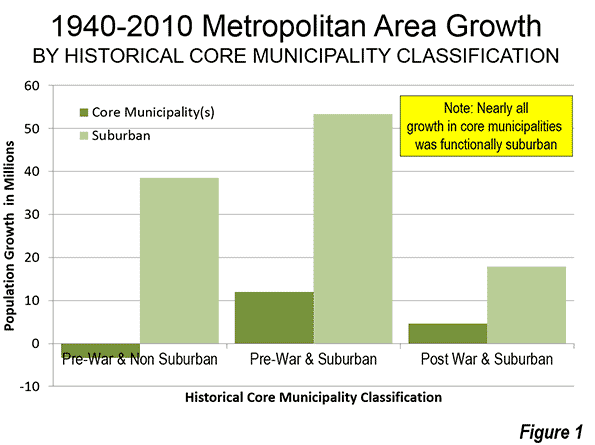
    Virtually all population growth in US metropolitan areas (as currently defined) has been suburban or exurban since before World War II (the 1940 census). The historical core municipalities that have not annexed materially and were largely developed by 1940 have lost population. As a result, approximately 110 percent of their metropolitan area growth has occurred in suburbs and exurbs. Further, among the other core municipalities, virtually all of the population growth that has occurred in annexed areas or greenfield areas that were undeveloped in 1940 (Figure 1).
    Identifying the Pre-Auto Urban Core

    The City Sector Model is not dependent upon municipal boundaries (the term "city" is generic, and refers to cities in their functional sense, metropolitan areas, or in their physical sense, urban areas). Not being constrained by municipal boundaries is important because core municipalities vary substantially. For example, the core municipality represents less than 10 percent of the population of Atlanta, while the core municipality represents more than 60 percent of the population of San Antonio. The City Sector Model applies data available from the US Census Bureau to estimate the population and distribution of Pre-Auto Urban Cores in a consistent manner.

    At the same time, the approach is materially different from the Office of Management and Budget (OMB) classification of "principal cities." It also differs from the Brookings Institution "primary cities," which is based on the OMB approach. The OMB-based classifications classify municipalities using employment data, without regard to urban form, density or other variables that are associated with the urban core. These classifications are useful and acknowledge that the monocentric nature of US metropolitan areas has evolved to polycentricity. However, non-urban-core principal cities and primary cities are themselves, with few exceptions, functionally suburban.

    The City Sector Model Criteria

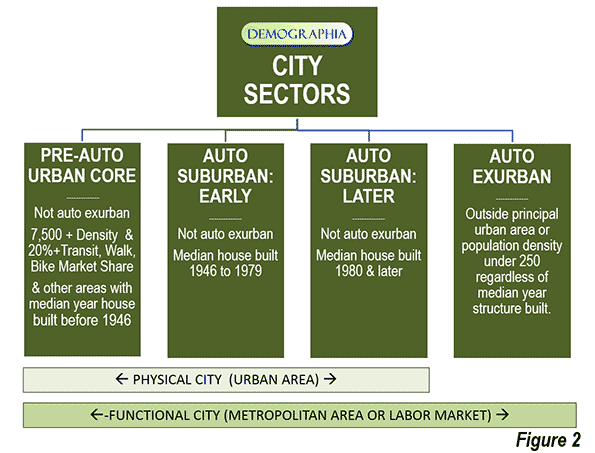
    Due to media and academic interest in the Pre-Auto Urban Core, a number of data combinations were used to best fit the modeled population to that of the core municipalities that have virtually the same boundaries as in 1940 and that were virtually fully developed by that time (the Pre-War & Non-Suburban classification in historical core municipalities). A number of potential criteria were examined, and the following were accepted (Figure 2).

    The Auto Exurban category includes any area outside a principal urban area.

    The Pre-Auto Urban Core category includes any non-exurban with a median house construction date of 1945 or before and also included areas with a population density of 7,500 per square mile (2,900 per square kilometer) or more and with a transit, walk and cycling journey to work market share of 20 percent or more.

    The Auto Suburban Earlier category included the balance of areas with a median house construction date of 1979 or before.

    The Auto Suburban Later category later included the balance of areas with a median house construction date of 1980 or later.

    Additional details on the criteria are in Note 1
    Results: 2010 Census

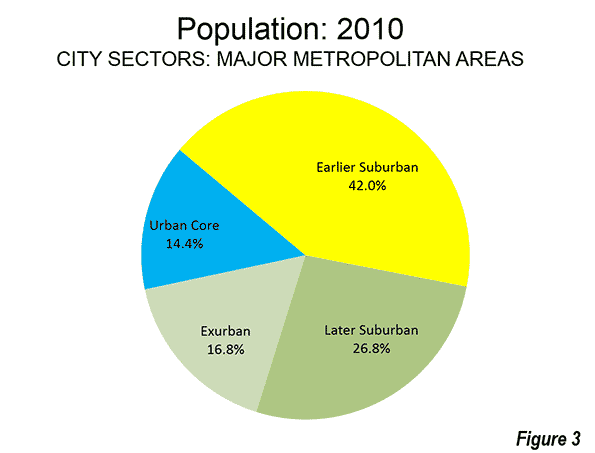
    The combined Pre-Auto Urban Core areas represented 14.4 percent of the population of the major metropolitan areas in 2010 (2013 geographical definition). This compares to the 26.4 percent that the core municipalities themselves represented of the metropolitan areas, indicating nearly half of their population was essentially suburban.

    The Auto Suburban: Earlier areas accounted for 42.0 percent of the population, while the Auto Suburban: Later areas had 26.8 percent of the population. The Auto Exurban areas had 16.8 percent of the population (Figure 3).
    The substantial difference between US and Canadian urbanization is illustrated by applying an approximation of the Gordon-Janzen criteria, which yielded an 8.4 percent Pre-Auto Urban Core population. The corresponding figure for the six major metropolitan areas of Canada was 24.0 percent. This difference is not surprising, since major Canadian urban areas have generally higher densities and much more robust transit, walking and cycling market shares. Yet, the Gordon-Janzen research shows Canada still to be overwhelmingly suburban (Note 2).

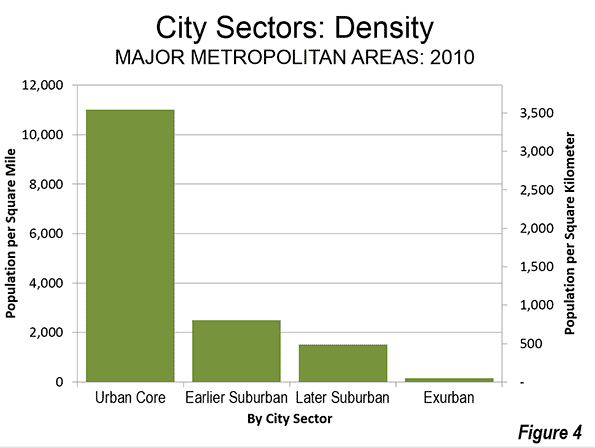
    Population Density: As would be expected, the Pre-Auto Urban Core areas had the highest densities (Figure 4), at 11,000 per square mile (4,250 per square kilometer). The Auto Suburban: Earlier areas had a density of 2,500 per square mile (1,000 per square kilometer), while the Auto Suburban: Later had a population density of 1,300 per square mile (500 per square kilometer), while the Auto Exurban areas had a population density of 150 per square mile (60 per square kilometer)).
    Individual Metropolitan Areas (Cities)

    The metropolitan areas with the highest proportion of Pre-Auto Urban Core population are New York (more than 50 percent), and Boston (nearly 35 percent), followed by Buffalo, Chicago, San Francisco-Oakland, and Providence, all with more than 25 percent (Table).

    Table
    City Sectors: 2010
    Major Metropolitan Areas
    City (Metropolitan Area) Pre-Auto Urban Core Auto Suburban: Earlier Auto Suburban: Later Auto Exurban
    Atlanta, GA 0.5% 14.9% 70.7% 13.8%
    Austin, TX 1.8% 15.7% 62.5% 20.0%
    Baltimore, MD 16.2% 41.8% 19.9% 22.0%
    Birmingham, AL 0.0% 42.1% 24.6% 33.3%
    Boston, MA-NH 34.2% 49.7% 3.2% 12.9%
    Buffalo, NY 28.8% 51.6% 3.1% 16.5%
    Charlotte, NC-SC 0.0% 10.0% 38.4% 51.6%
    Chicago, IL-IN-WI 25.8% 45.0% 18.3% 10.9%
    Cincinnati, OH-KY-IN 10.1% 38.8% 24.3% 26.8%
    Cleveland, OH 22.2% 46.8% 10.5% 20.6%
    Columbus, OH 5.0% 28.7% 37.5% 28.9%
    Dallas-Fort Worth, TX 0.3% 34.4% 43.0% 22.4%
    Denver, CO 3.1% 42.9% 42.4% 11.6%
    Detroit,  MI 6.3% 60.6% 16.1% 16.9%
    Grand Rapids 3.8% 32.9% 15.3% 48.1%
    Hartford, CT 11.1% 58.6% 1.1% 29.2%
    Houston, TX 0.3% 34.2% 48.9% 16.6%
    Indianapolis. IN 4.6% 28.0% 41.8% 25.6%
    Jacksonville, FL 0.0% 26.4% 48.2% 25.4%
    Kansas City, MO-KS 5.4% 37.6% 26.3% 30.6%
    Las Vegas, NV 2.4% 17.5% 76.7% 3.5%
    Los Angeles, CA 10.4% 76.4% 5.2% 8.0%
    Louisville, KY-IN 8.1% 45.4% 25.6% 20.8%
    Memphis, TN-MS-AR 1.8% 40.6% 34.3% 23.3%
    Miami, FL 1.4% 51.4% 44.8% 2.4%
    Milwaukee,WI 22.1% 52.0% 10.4% 15.5%
    Minneapolis-St. Paul, MN-WI 12.7% 31.6% 33.8% 22.0%
    Nashville, TN 0.0% 25.0% 36.1% 38.9%
    New Orleans. LA 10.6% 49.9% 7.0% 32.4%
    New York, NY-NJ-PA 52.4% 35.3% 5.6% 6.7%
    Oklahoma City, OK 2.5% 35.1% 31.6% 30.8%
    Orlando, FL 0.0% 16.1% 50.5% 33.4%
    Philadelphia, PA-NJ-DE-MD 24.6% 51.1% 15.1% 9.2%
    Phoenix, AZ 0.0% 29.4% 51.7% 18.8%
    Pittsburgh, PA 15.7% 56.1% 4.8% 23.4%
    Portland, OR-WA 9.3% 36.7% 39.5% 14.6%
    Providence, RI-MA 25.5% 47.7% 2.8% 24.0%
    Raleigh, NC 0.0% 7.5% 54.4% 38.1%
    Richmond, VA 4.5% 38.8% 38.0% 18.8%
    Riverside-San Bernardino, CA 0.0% 29.1% 29.4% 41.4%
    Rochester, NY 11.1% 46.9% 7.7% 34.3%
    Sacramento, CA 1.6% 38.0% 40.2% 20.1%
    St. Louis,, MO-IL 11.7% 39.9% 25.7% 22.8%
    Salt Lake City, UT 4.6% 47.9% 38.4% 9.1%
    San Antonio, TX 0.1% 39.7% 42.6% 17.6%
    San Diego, CA 1.2% 61.6% 30.3% 6.9%
    San Francisco-Oakland, CA 25.7% 55.5% 7.6% 11.2%
    San Jose, CA 0.1% 77.7% 9.1% 13.1%
    Seattle, WA 7.8% 38.9% 40.2% 13.0%
    Tampa-St. Petersburg, FL 0.0% 44.8% 39.7% 15.5%
    Virginia Beach-Norfolk, VA-NC 1.5% 44.4% 37.7% 16.4%
    Washington, DC-VA-MD-WV 15.9% 29.2% 36.2% 18.7%
    Overall 14.4% 42.0% 26.8% 16.8%


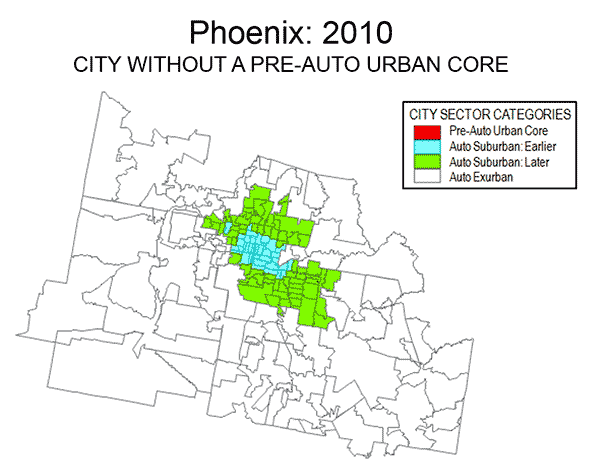
    It may be surprising that many of the major metropolitan areas are shown with little or no Pre-Auto Urban Core population. For example, five metropolitan areas have virtually no Pre-Auto Urban Core population, including Phoenix, Riverside-San Bernardino, Tampa-St. Petersburg, Orlando, Jacksonville, and Birmingham. By the Census Bureau criteria of 1940, two of these areas were not yet metropolitan and only Birmingham (400,000) had more than 250,000 residents.  Many of the newer and fastest growing metropolitan areas were too small, too sparsely settled or insufficiently dense to have strong urban cores before the great automobile suburbanization that followed World War II. Further, many of the Pre-Auto Urban Cores have experienced significant population loss and some of their neighborhoods have become more suburban (automobile oriented). Virtually no urban cores have been developed since World War II meeting the criteria.

    Thus, no part of Phoenix, San Jose, Charlotte and a host of other newer metropolitan areas functionally resembles the Pre-Auto Urban Core areas of metropolitan areas like Chicago, Cincinnati, or Milwaukee. However, new or expanded urban cores are possible, if built at high enough population density and with high enough transit, walking, and cycling use. 

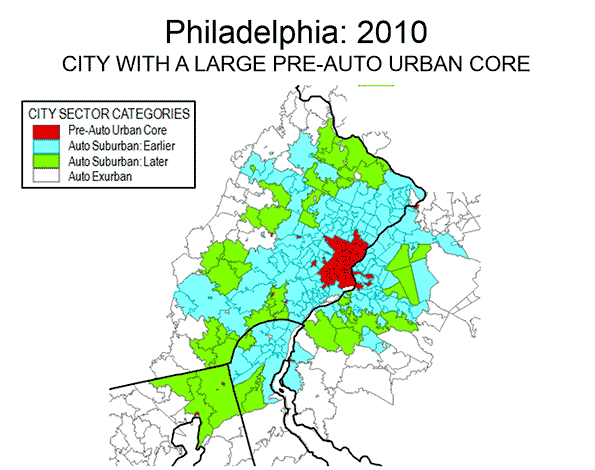
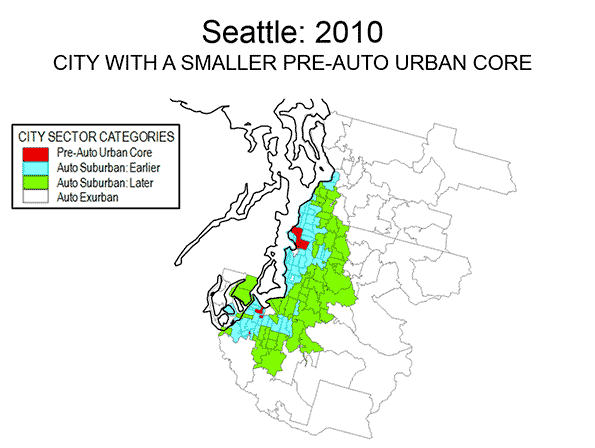
    Examples of three differing metropolitan areas are provided. Philadelphia (Figure 5) is a metropolitan area with a strong Pre-Auto Urban Core, which is indicative of an older metropolitan area that has been among the largest in the nation since its inception, Seattle (Figure 6) is a much newer metropolitan area, yet exhibits a larger Pre-Auto Urban Core than most. Phoenix (Figure 7) may be the best example of a post-War metropolitan area, with virtually no Pre-Auto Urban Core. In 1940, the Phoenix metropolitan area had only 120,000 residents and could be 40 times that large by 2020. Virtually all of Phoenix is automobile-oriented. Even three years after opening its light rail line, 88 percent of Phoenix commuters go to work by car and only two percent by transit, virtually the same as in 2000.
    Despite the comparatively small share of the modern metropolitan area represented by the Pre-Auto Urban Core in the City Core Model, the definition is broad and, if anything over-estimates the size of urban core city sectors. The population density of Pre-Auto Urban Core areas is below that of the historical core municipalities before the great auto oriented urbanization (11,000 compared to 12,100 in 1940) and well above their 2010 density (8,400), even when New York is excluded. The minimum density requirement of 7,500 per square mile (not applied to analysis zones with a median house construction data of 1945 or earlier) is slightly less than the density of Paris suburbs (7,800 per square mile or 3,000 per square kilometer) and only 20 percent more dense than the jurisdictional suburbs (suburbs outside the historical core municipality) of Los Angeles (6,400 per square mile or 2,500 per square kilometer). Some urban containment plans require higher minimum densities, not only in urban cores but also in the suburbs.

    In describing the Canadian results, Professor Gordon noted that there is a tendency to “overestimate the importance of the highly visible downtown cores and underestimate the vast growth happening in the suburban edges.” That is true to an even greater degree in the United States. 

    —–

    Note 1:

    The City Sector Model is applied to the 52 major metropolitan areas in the United States (over 1 million population). The metropolitan areas are broken into principal urban areas, with all other areas considered to be exurban. The principal urban areas also include the Concord urban area and the Mission Viejo urban area, which are adjacent to and included in the San Francisco and Los Angeles urban areas respectively. As a result, some smaller urban areas, such as Palm Springs (Riverside-San Bernardino metropolitan area), Lancaster (Los Angeles metropolitan area) and Poughkeepsie (New York metropolitan area) are considered exurban. Areas with less than 250 residents per square mile (100 per square kilometer) are also considered exurban, principally for classification of large areas on the urban fringe that have a substantial rural element.

    The Pre-Auto Urban Core includes all non-– exurban areas in which is the median house (single-family or multi-family) was built is 1945 or before. Three density levels were considered, 10,000, 7,500 and 5,000 per square mile (4,000, 2,900 and 2,000 per square kilometer). The lower 5,000 per square mile was examined to test the extent to which such a low density would increase the urban core population. This density, less than the entire urban area (urban core and suburban) of the Los Angeles, San Francisco, San Jose and New York urban areas would have, at the most raised the urban core population to 21.5 percent of the metropolitan population, even with a modest 10 percent transit, walking and cycling market share (Figure 8)
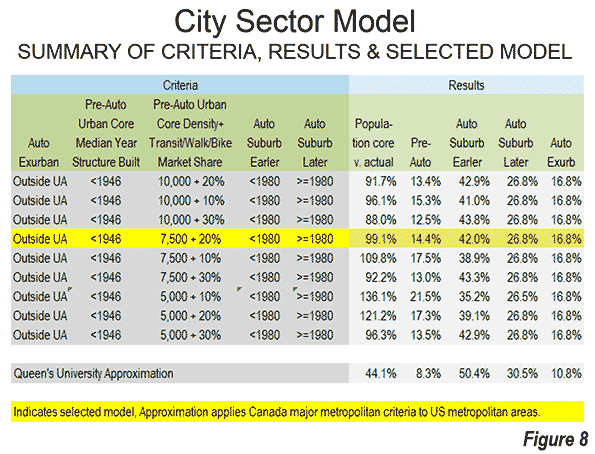
    The pre-auto urban core specification results in a 2010 population for the metropolitan areas with Pre-war and non-suburban historical core municipalities within one percentage point of the actual total, excluding the far higher density case of New York.

    The analysis showed that a lower transit, walking and cycling market share at a 7,500 per square mile floor (2,900 per square kilometer) would substantially increase the Pre-Auto Urban Core category population, while diluting its urban core nature. More than one-half of the increase would be in Los Angeles which has added literally millions of residents in high density suburban areas that are as automobile oriented as suburbs elsewhere.

    The analysis zones (zip codes) have an average population of 19,000, with from as many as 1,000 zones in New York to 50 in Raleigh.

    Note 2:

    An approximation based on the Gordon and Janzen approach would indicate an urban core population of only 8 percent in the major metropolitan areas of the United States. This approximation results in a modeled population for the metropolitan areas with pre-war and non-suburban historical core municipalities of less than one-half the actual 2010 population.

    This Queen’s University research comparison in Figure 8 is referred to as an approximation, since it applies an overall transit, walking, and cycling market share for the six major metropolitan areas, instead of a factor corresponding to each metropolitan area (the Gordon and Janzen approach).

    The differences in transit market share relative to the US are substantial. This may be best shown by considering Calgary, which with a population of 1.2 million in 2011 would have ranked as the 47th largest metropolitan area if it were in the United States. Yet, Calgary would rank second only to the New York metropolitan area in transit market share if it were in the United States. Even so, Calgary is found to be the most suburban of Canada’s major metropolitan areas in the Queen’s University research and Statistics Canada data from 2011 indicates strong domination of urban travel by the automobile.

    Wendell Cox is principal of Demographia, an international public policy and demographics firm. He is co-author of the “Demographia International Housing Affordability Survey” and author of “Demographia World Urban Areas” and “War on the Dream: How Anti-Sprawl Policy Threatens the Quality of Life.” He was appointed to three terms on the Los Angeles County Transportation Commission, where he served with the leading city and county leadership as the only non-elected member. He was appointed to the Amtrak Reform Council to fill the unexpired term of Governor Christine Todd Whitman and has served as a visiting professor at the Conservatoire National des Arts et Metiers, a national university in Paris.

    Photo: Los Angeles
  • Canada: Suburban, Automobile Oriented Nation

    Canada is even more a suburban nation than generally thought, according to new research that digs deeper than the usual core city versus suburbs distinctions. Researchers at Queen’s University in Kingston, Ontario have announced groundbreaking research that disaggregates 33 census metropolitan areas into four classifications: (1) urban core, (2) transit oriented suburban, (3) automobile oriented suburban and (4) exurban lifestyles, which are also automobile oriented. The findings were made available to canada.com and will be published during the autumn in an academic journal.

    Suburbs and Urban Cores: The Complexities

    Professor David Gordon, director of the School of Urban and Regional Planning at Queen’s University summarized the research as indicating that “Canada is a suburban nation.” This may be surprising, the core cities of Canada represent a larger share of their metropolitan area population than is common in the United States. However, the core city versus suburban (outside the core city) classification substantially understates the suburban and automobile oriented nature of Canada’s metropolitan areas. This definition has long since become obsolete with the substantial annexations of suburban areas by Calgary and Edmonton and the forced consolidations of Toronto, Montréal (parts of which were reversed) and Ottawa.

    Even the core city of Vancouver, which has had essentially the same boundaries for at least 60 years, contains considerable expanses of suburbanization beyond its urban core. The core city of Toronto contains large areas of suburban development, such as in Scarborough, North York and Etobikote. The same is true of the core cities of Calgary, Edmonton and Ottawa and the ville de Montréal.

    To get around this difficulty, we used federal electoral district data to do an early analysis of urban core versus suburban growth when the 2011 census data was released. Our findings were that the greatest share of growth had been in suburban areas (See: Special Report: Census 2011: Urban Dispersion in Canada). The Queens University researchers went considerably deeper, and showed that 95 percent of metropolitan area growth had been in suburban areas between 2006 and 2011, a somewhat higher figure than the 93 percent suburban growth derived from the federal electoral district data (federal electoral districts are smaller than the large core cities).

    The Queen’s University Approach

    Gordon and the research team divided metropolitan areas into the four classifications at the census tract level. The census tract level is ideal for this type of analysis, because it is the closest approximation to the neighborhood. The Gordon et al analysis is thus finely grained, and may be virtually unprecedented in the world.

    The research uses criteria developed from journey to work mode data (such as transit, walking, cycling and automobile) and residential densities. Gordon et al called their urban core classification "active core," to note the greater dependence of residents on walking and cycling for commuting to work. They divided suburban areas into transit and auto suburban areas, and designated the rural areas of metropolitan areas as exurban (Note).

    The findings may be surprising to those retro-urbanists who hold Canada up as a planning model. When urbanization is examined at the neighborhood level, little of the metropolitan population actually follows    the urban core model. Overall, the average urban core constitutes approximately 12% of the metropolitan area. This varies little by population category.

    In describing the results, Gordon noted that there is a tendency to “overestimate the importance of the highly visible downtown cores and underestimate the vast growth happening in the suburban edges.” This is especially evident in the largest metropolitan areas.

    Major Metropolitan Areas

    Among the six major metropolitan areas (those with more than 1 million population), the urban cores also average 12 percent of the population (Figure).


    In relative terms, Vancouver has the largest urban core, at 16% of its population, followed by Calgary with 13% of its population. Toronto, Montréal and Edmonton all have urban cores with approximately 11% of their population, while Ottawa, which is both in Ontario and Quebec, stands at 12%. This means that the major metropolitan areas are, on average, 88% suburban or exurban.

    There is also relative consistency with respect to the populations of the transit oriented suburban areas. The largest are in Toronto and Montréal, at 14%. Vancouver and Edmonton have 12% of their populations in transit oriented suburban areas and Ottawa 11%. However, transit’s reach is much less in Calgary, where the transit suburbs have only 3% of the population.

    Calgary was the most automobile oriented of the major metropolitan areas, with 85 percent of residents living in automobile suburbs and exurbs. But other major metropolitan areas were not far behind, ranging from 73 percent in Vancouver to 78 percent in Ottawa, with Toronto Montréal and Edmonton in between.

    Smaller Metropolitan Areas

    Generally, the level of suburbanization was similar even in the smaller metropolitan areas. Interestingly, Gordon’s method did not require an urban core. This is illustrated by the Abbotsford (BC), where there no urban core is reported. Abbotsford is located in the Fraser River Valley, east of the Vancouver metropolitan area. Abbotsford developed in recent decades and, as a result, is so automobile oriented that the Queen’s University researchers do not even find a transit oriented suburb.

    Further, there were two instances of transit suburban areas being oriented toward urban cores outside their own metropolitan areas. In Oshawa, to the east of Toronto, a transit suburban area is west of Oshawa’s core, along the GO Transit commuter rail line to Toronto’s Union Station. Similarly, in Hamilton, a transit suburban area is located east of Hamilton’s core, on the GO Transit commuter rail line to Toronto.

    Maps

    The media site canada.com has also published A Country of Suburbs  with detailed census tract level maps for each of the metropolitan areas. There are also articles on each of the major metropolitan areas.

    Professor Gordon and his associates have pioneered a new, far more detailed method of analyzing the lifestyle components of the modern metropolitan area. They deserve credit for their objectiveness and attention to detail. Similar analysis is needed in other high income world nations.

    ——

    Note: Metropolitan areas always include rural areas – areas that are not urban. This is because metropolitan areas are employment market areas and people invariably commute from outside the population center (formerly called the urban area by Statistics Canada). The rural areas of metropolitan areas are far larger in geography than population centers or urban areas.

    Photograph: Centre Block, Parliament Hill: Ottawa (by author)

    This has been adapted from an article published at Frontier Centre for Public Policy Notes.

  • America’s True Power In The NAFTA Century

    OK, I get it. Between George W. Bush and Barack Obama we have made complete fools of ourselves on the international stage, outmaneuvered by petty lunatics and crafty kleptocrats like Russia’sVladimir Putin. Some even claim we are witnessing “an erosion of world influence” equal to such failed states as the Soviet Union and the French Third Republic. “Has anyone noticed how diminished, how very Lilliputian, America has become?” my friend Tunku Varadajaran recently asked.

    In reality, it’s our politicians who have gotten small, not America. In our embarrassment, we tend not to notice that our rivals are also shrinking. Take the Middle East — please. Increasingly, we don’t need it because of North America’s unparalleled resources and economic vitality.

    Welcome then to the NAFTA century, in which our power is fundamentally based on developing a common economic region with our two large neighbors. Since its origins in 1994, NAFTA has emerged as the world’s largest trading bloc, linking 450 million people that produce $17 trillion in output. Foreign policy elites in both parties may focus on Europe, Asia and the Middle East, but our long-term fate lies more with Canada, Mexico and the rest of the Americas.

    Nowhere is this shift in power more obvious than in the critical energy arena, the wellspring of our deep involvement in the lunatic Middle East. Massive finds have given us a new energy lifeline in places like the Gulf coast, the Alberta tar sands, the Great Plains, the Inland West, Ohio, Pennsylvania and potentially California.

    And if Mexico successfully reforms its state-owned energy monopoly, PEMEX, the world energy — and economic — balance of power will likely shift more decisively to North America. Mexican President Pena Nieto’s plan, which would allow increased foreign investment in the energy sector, is projected by at least one analyst to boost Mexico’s oil output by 20% to 50% in the coming decades.

    Taken together, the NAFTA countries now boast larger reserves of oil, gas (and if we want it, coal) than any other part of the world. More important, given our concerns with greenhouse gases, NAFTA countries now possess, by some estimates, more clean-burning natural gas than Russia, Iran and Qatar put together. All this at a time when U.S. energy use is declining, further eroding the leverage of these troublesome countries.

    This particularly undermines the position of Putin, who has had his way with Obama but faces long-term political decline. Russia, which relies on hydrocarbons for two-thirds of its export revenues and half its budget, is being forced to cut gas prices in Europe due to a forthcoming gusher of LNG exports from the U.S. and other countries. In the end, Russia is an economic one-horse show with declining demography and a discredited political system.

    In terms of the Middle East, the NAFTA century means we can disengage, when it threatens our actual strategic interests. Afraid of a shut off of oil from the Persian Gulf? Our response should be: Make my day. Energy prices will rise, but this will hurt Europe and China more than us, and also will stimulate more jobs and economic growth in much of the country, particularly the energy belts of the Gulf Coast and the Great Plains.

    China and India have boosted energy imports as we decrease ours; China is expected to surpass the United States as the world’s largest oil importer this year. At the same time, in the EU, bans on fracking and over-reliance on unreliable, expensive “green” energy has driven up prices for both gas  and electricity.

    These high prices have not only eroded depleted consumer spending but is leading some manufacturers, including in Germany, to look at relocating production , notably to energy-rich regions of the United States. This shift in industrial production is still nascent, but is evidenced by growing U.S. manufacturing at a time when Europe and Asia, particularly China, are facing stagnation or even declines. Europe’s industry minister recently warned of “anindustrial massacre” brought on in large part by unsustainably high energy prices.

    The key beneficiaries of NAFTA’s energy surge will be energy-intensive industries such as petrochemicals — major new investments are being made in this sector along the Gulf Coast by both foreign and domestic companies. But it also can be seen in the resurgence in North American manufacturing in automobiles, steel and other key sectors. Particularly critical is Mexico’s recharged industrial boom. In 2011 roughly half of the nearly $20 billion invested in the country was for manufacturing. Increasingly companies from around the world see our southern neighbor as an ideal locale for new manufacturing plants; General Motors GM -0.96%Audi , Honda, Perelli, Alcoa and the Swedish appliance giant Electrolux have all announced major investments.

    Critically this is not so much Ross Perot’s old “sucking sound” of American jobs draining away, but about the shift in the economic balance of power away from China and East Asia. Rather than rivals, the U.S., Mexican and Canadian economies are becoming increasingly integrated, with raw materials, manufacturing goods and services traded across the borders. This integration has proceeded rapidly since NAFTA, with U.S. merchandise exports to Mexico growing from $41.6 billion in 1993 to $216.3 billion in 2012, an increase of 420%,while service exports doubled. MeanwhileU.S. imports from Mexico increased from $39.9 billion in 1993 to $277.7 billion in 2012, an increase of 596%.

    At the same time, U.S. exports to Canada increased from $100.2 billion in 1993 to $291.8 billion in 2012.

    Investment flows mirror this integration. As of 2011, the United States accounted for 44% of all foreign investment in Mexico, more than twice that of second-place Spain; Canada, ranking fourth, accounts for another 10%. Canada, which, according to a recent AT Kearney report, now ranks as the No. 4 destination for foreign direct investment, with the U.S. accounting for more than half the total in the country. Over 70% of Canada’s outbound investment goes to the U.S.

    Our human ties to these neighbors may be even more important. (Disclaimer: my wife is a native of Quebec). Mexico, for example, accounts for nearly 30% of our foreign-born population, by far the largest group. Canada, surprisingly, is the largest source of foreign-born Americans of any country outside Asia or Latin America.

    We also visit each other on a regular basis, with Canada by far the biggest sender of tourists to the U.S., more than the next nine countries combined; Mexico ranks second. The U.S., for its part, accounts for two-thirds of all visitors to Canada and the U.S. remains by far largest source of travelers to Mexico.

    These interactions reflect an intimacy Americans simply do not share with such places as the Middle East (outside Israel), Russia, and China. There’s the little matter of democracy, as well as a common sharing of a continent, with rivers, lakes and mountain ranges that often don’t respect national borders. Policy-maker may prefer to look further afield but North America is our home, Mexico and Canada our natural allies for the future. Adios, Middle East and Europe; bonjour, North America.

    This story originally appeared at Forbes.

    Joel Kotkin is executive editor of NewGeography.com and Distinguished Presidential Fellow in Urban Futures at Chapman University, and a member of the editorial board of the Orange County Register. He is author of The City: A Global History and The Next Hundred Million: America in 2050. His most recent study, The Rise of Postfamilialism, has been widely discussed and distributed internationally. He lives in Los Angeles, CA.

    NAFTA logo by AlexCovarrubias.