Tag: Canada

  • The Poverty Of Ambition: Why The West Is Losing To China And India – The New World Order

    The last 10 years have been the worst for Western civilization since the 1930s. At the onset of the new millennium North America, Europe and Oceania stood at the cutting edge of the future, with new technologies and a lion’s share of the world’s GDP.  At its end, most of these economies limped, while economic power – and all the influence it can buy politically – had shifted to China, India and other developing countries.

    This past decade China’s economic growth rate, at 10% per annum, grew to five times that U.S.; the gap was even more disparate between China and the slower-growing  E.U.,  Yet periods of slow economic growth occur throughout history — recall the 1970s — and economies recover. The bigger problem facing Western countries, then, is a metaphysical one — a malady that the British writer Austin Williams has dubbed “the poverty of ambition.”

    This lack of ambition plagues virtually every Western country. The ability to act has become shackled by a profound pessimism that according to a recent Gallup survey contrasts with the optimism found not only in rising states like China, India and Brazil, but also deeply impoverished places like Bangladesh.

    Attitudes have consequences. The rising stars of the non-Western world — from the United Arab Emirates to Singapore and China — are building cities with startling new architecture and bold infrastructure. Their entrepreneurs are expanding their operations across the planet.

    Of course, you can chortle at the outrageous overbuilding in places like Dubai, but the Western world might do better to appreciate the scope of their ambition. Indeed, for years New York’s Empire State building, erected  during the Depression, was derided as  ”the empty state building.” Today it’s visionary developers like Iraqi-born Istabraq Janabi who are planning unlikely  new structures even  in  troubled places like Ramadi, Iraq.

    The difference in ambition can be seen clearly at airports, which now serve as the entry halls of the global economy. A traveler to John F. Kennedy Airport, Heathrow, Charles De Gualle LAX or Dulles passes through decayed remnants of fading late 20th century buildings and technology. In contrast, airports in Dubai, Hong Kong and Singapore offer clean, ultra-modern facilities with often impressive design.

    The West’s retreat from space exploration further underscores its metaphysical poverty. Today, Europe and the U.S., the world’s historic leader in the field, are cutting back on plans to explore the cosmos, which has included a manned operation to the moon. President Obama wants NASA to focus more on issues regarding climate change instead. In contrast, the rising countries of Asia, notably China and India, have begun plans for manned flights to the moon and beyond.

    This divergence is not about resources; it is about the growing conviction in the West that moving forward is an illusion or, as the British academic John Gray’s puts it, “progress is a myth.”  Victorian empire-makers and intellectuals, like their republican American successors, believed perhaps naively in the potential of humanity, economic and technological progress. Today our intellectual and political classes have gone to the other extreme.

    The West’s politics are in the grips of two profoundly retrograde mentalities. One, a small-minded conservatism, harks back to the “golden” age of the 1950s when Western power faced only a flawed Soviet challenge. The idealistic but flawed commitment to imposing democracy by force of the Bush years has faded; it has been replaced by an obsession with taming a bloated public sector. While this focus may be justified, it is fundamentally more reactive than proscriptive.

    The Left, which once portrayed itself as the bastion of scientific rationalism, increasingly embraces neo-druidism, a secular form of nature worship. This tendency’s roots can be traced back to the “Limits to Growth” ideology of the early 1970s which projected, mostly mistakenly, that the planet was about to run out of everything from food to oil. Concerns over climate change have transformed this dismal sentiment into a theology, with carbon emissions treated as a form of original sin.

    The anti-progress nature of the new Left is unmistakable. Rather than seek ways to control climate change, suggests The Guardian’s George Monbiot, environmentalism is engaged in “a battle to redefine humanity.” Monbiot believes the era of economic growth needs to come to an inevitable denouement; that “the age of heroism” will be followed by the decline of the “expanders” and the rise of the “restrainers.”

    Europe, particularly the U.K., suffers acutely from metaphysical angst.  Once touted as the new great power by its leaders and their American claque, the E.U. is quickly dissolving along cultural and historical lines; this is especially evident in the division between the  resilient countries of the north (something like the Hansa trading states of the late Middle Ages) and the weaker countries along the periphery. For the most part, Europe no longer seems capable of doing much more than finding ways to control an unaffordable welfare state without tearing about its social net. The once cherished notion of a multi-racial “new” Europe largely has dissolved as immigration has devolved from a source of demographic and cultural salvation to a widely perceived threat to the E.U.’s economic and social health as well as security.

    Such defeatism usually has less success in the United States. But America’s “progressive” left increasingly resembles its European cousins.  Obama’s science advisor, John Holdren, has been a long-time advocate of the idea of “de-development,” the purposeful slowing of growth in advanced countries in order to protect the environment. The critical infrastructure needed to accommodate upward of another  100 million Americans — new dams in the west, intelligent development of our vast natural gas reserves and building new cities, airports and ports  – are not at the center of either party’s platforms. These could be financed largely with private sources, given the right incentives.

    Fortunately the West’s decline is not at inevitable. China, India, Vietnam, Brazil, South Africa all deserve their day in the sun, but this does not mean that Americans or Europeans should cower in the shadows. Western countries still possess much of the world’s cutting-edge technology and leading companies; the combined GDP for the E.U., North America and Oceania stands at over $33 trillion, almost five times that of India and China together.

    More important still, the political and cultural institutions of the West — with their liberal values — represent the best hope for a stable world of self-governing peoples. Does anyone in the West, particularly the progressives in the media and academia, really want a world run by Chinese despotism?

    The current financial crisis should serve as both a warning and a spur for a new focus on economic expansion. But this can only occur if the West can restore its belief in its future. This does not necessitate a return to the colonial attitudes of the past, but rather a keener appreciation of our unique human, physical and political advantages.

    Only the United States – by far the richest, largest and most populous Western nation — can lead such a revival. For one thing, the U.S. remains the world’s leading immigrant magnet and most diverse large country, all of which makes it the natural center of an evolving global society. Although immigrants pose some serious issues, University of Chicago scholar Tito Sananji notes that the U.S., along with Canada and Australia, seems to be doing a better job educating their newcomers than the continental European states.

    The U.S., Canada and Australia also possess resources, most critically food, that could benefit from growing demand in developing countries. Both North America and some European nations — notably the new Hansa of the Netherlands, Germany and Scandinavia – remain world leaders in scores of industrial endeavors, as well as technology- and culture-based industries.

    Together these Western countries can do much more to shape the global future than is commonly understood. But to do so this century they will need how to recover the animal spirits that drove their remarkable rise in the last.

    Joel Kotkin is executive editor of NewGeography.com and is a distinguished presidential fellow in urban futures at Chapman University, and an adjunct fellow of the Legatum Institute in London. He is author of The City: A Global History. His newest book is The Next Hundred Million: America in 2050, released in February, 2010.

    Photo by Wally Gobetz

  • Toronto: Three Cities in More than One Way

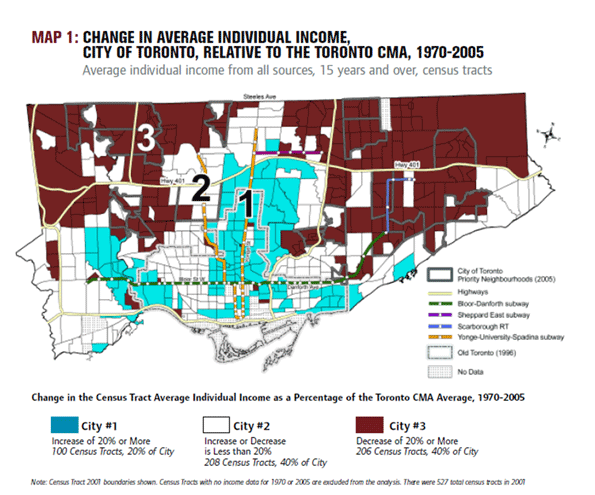
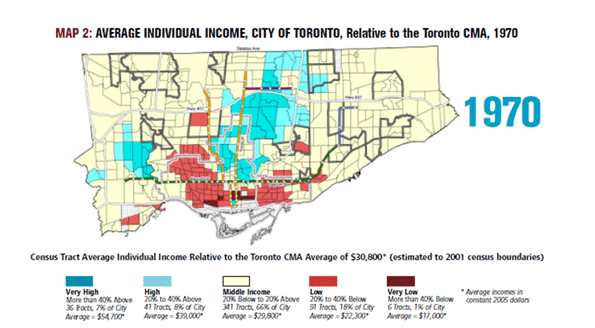
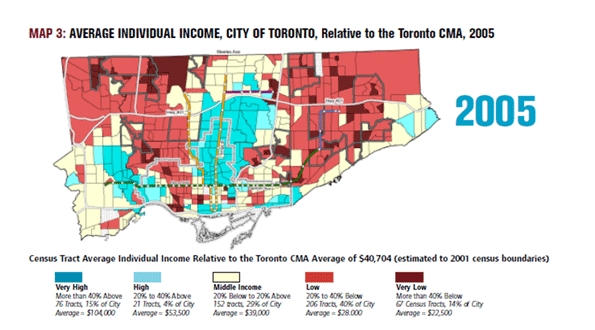
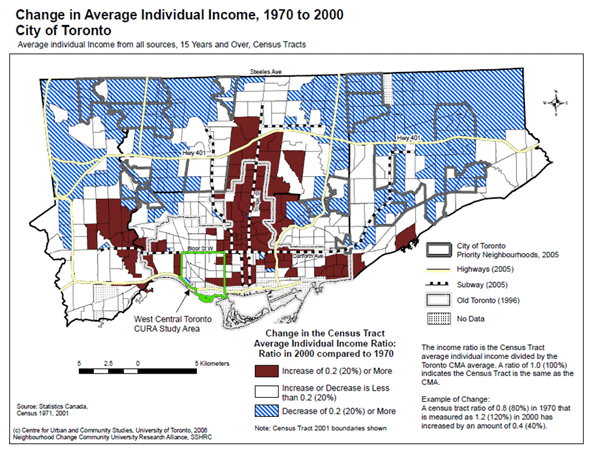
    The issue of income disparity in Toronto has once again been brought into the public eye by a December 15th report by University of Toronto Professor David Hulchanski. The report, “The Three Cities Within Toronto,” points to a growing disparity in incomes between Downtown Toronto, the inner suburbs, and the outer suburbs of the city. The report demonstrates that between 1970 and 2005 the residents of the once prosperous outer suburbs have been losing ground compared to the now wealthy downtown core. The results for the inner suburbs have been mixed.

    In 1970, 66% of city neighbourhoods were considered middle income. Only 15% were considered high or very high, and 19% were low or very low. In 2005, only 29% of neighbourhoods were considered middle income. The number of high or very high income neighbourhoods rose to 19%, while low and very low income neighbourhoods made up a staggering 54% of neighbourhoods.


    The news isn’t all bad. After all, the downtown core is now one of the most desirable places to live in North America, and many of the formerly low income neighbourhoods have gentrified, or are in the process of doing so. However, many of the city’s traditional suburbs have been decimated. The former cities of Etobicoke and Scarborough used to be middle class. Not so much anymore.

    In real dollar terms, even the majority of the very low income areas have become wealthier. The trouble with poverty statistics is that they focus on relative poverty, rather than absolute poverty. This means that if Etobicoke’s average income doubled tomorrow, the downtown core would all of a sudden be considered poor. This is a major limitation. Toronto isn’t exactly turning into a Canadian Detroit.

    The report rightly points to the need for greater mobility in the outer suburbs. Given that the most lucrative jobs are typically downtown, many young professionals and recent graduates living outside of the core need to be able to get downtown cheaply and quickly in order to build their careers. Where the report goes wrong is that it recommends stricter land use regulations, stronger rent controls, and the revival of the flawed Transit City plan that Mayor Ford vigorously campaigned against in the recent election.

    It is easy for academics to blame a lack of social welfare spending, or suburbanization for the problem. The real problem is the loss of local policy making power resulting from amalgamation. For the most part, the areas losing ground the fastest are the formerly middle class suburbs amalgamated into the city. In contrast the “exurbs” just outside of city boundaries have thrived. This is no coincidence. The real takeaway from this study is that the suburbs have different needs than the central core. By attempting to accommodate the needs of both, the megacity has benefitted neither. Short of de-amalgamation, the only hope for the city is to substantially decentralize policy making. No amount of spending can make up for the loss of local autonomy.

    Policies have different effects in different types of cities. Take the treatment of automobiles. It might make sense to discourage automobile usage in downtown Toronto, but the benefits of doing so in Vaughan or Pickering would be questionable at best. Similarly, mandating that every commercial establishment have a public washroom probably makes sense as a public health measure in downtown, where public urination is an issue, but not so much in suburban Markham, or Richmond Hill.

    Making sensible regulations for a small, relatively homogenous area isn’t all that difficult. Applying these regulations to a large, demographically diverse area can help some areas and hurt others. It’s not that regulations need to be a zero sum game. People in Etobicoke wouldn’t be affected if, say, maximum parking allotments were tightened in the downtown core. They would be affected if they were tightened throughout the entire megacity. Similarly, increasing maximum parking allotments might hurt the core and help the suburbs. The current one size fits all approach sometimes benefits the core and sometimes benefits the suburbs, but ever both.

    Perhaps more important than city wide regulations is the centralization of taxing power. Since the merger, the city now sets tax rates across the entire megacity. This also allows the city to control the ratio of residential to non-residential taxes. The city of Toronto has the highest ratio of non-residential to residential taxes in Ontario. This means that businesses carry a higher share of the tax load in the city than anywhere else in the province. The combination of tax and regulatory policies in the city have lead the Canadian Federation of Independent Businesses to rank Toronto as the second least business friendly city in Canada. On a scale of 1-100, Toronto came in at 33, slightly ahead of Vancouver’s 31. Meanwhile, the rest of the (Greater Toronto Area) GTA is near the top, at 61. Neighbouring Oshawa took the top spot in Ontario with 69.

    GTA Area Cities by CFIB Entrepreneurial Cities Policy Score

    Rank (Ontario)

    City

    Score

    Driving Distance to Yonge and Bloor

    1

    Oshawa

    69

    0:45

    6

    GTA (Excluding Toronto)

    61


        Mississauga

    61

    0:27


        Brampton

    61

    0:41


        Richmond Hill

    61

    0:32


        Markham

    61

    0:32


        Vaughan

    61

    0:32

    16

    Hamilton

    55

    0:58

    19

    Guelph

    54

    1:15

    24

    Barrie

    52

    1:16

    27

    Brantford

    51

    1:20

    30

    Kitchener

    48

    1:23

    33

    Toronto

    33


        Etobicoke

    33

    0:20


        Scarborough

    33

    0:21

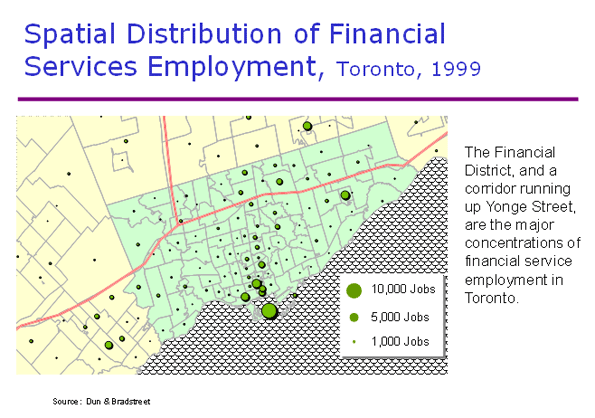
    Now the share of non-residential to residential taxes in Toronto may actually make sense downtown. The core is home to the third biggest financial sector in North America. These jobs are heavily concentrated in the downtown core.

    Downtown Toronto isn’t competing with low tax Vaughan or Barrie for these jobs. They are competing with high tax cities like New York and Chicago. This means that employment in the core is not as easily chased off by taxes and regulations than in the suburbs. But in industries like wholesale and manufacturing, which are far more important outside of the core, employment can easily relocate to Barrie, Mississauga, Oshawa, and so forth. Indeed, jobs have been leaving the city since before the recession hit.

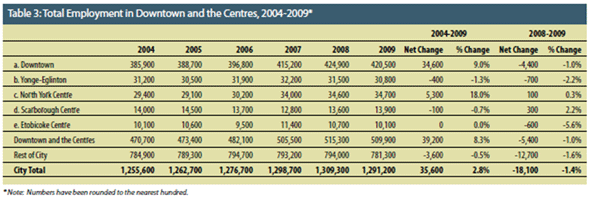
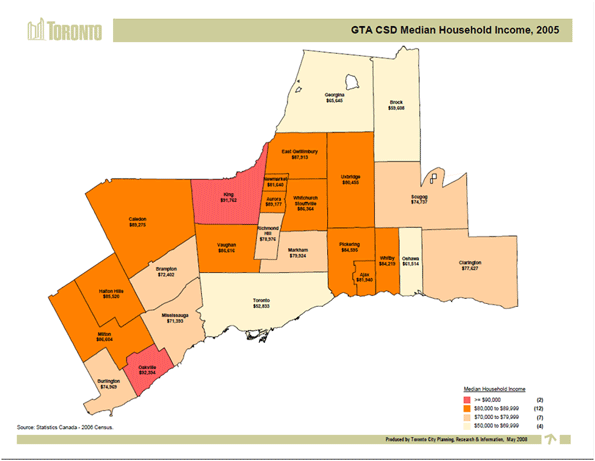
    Since 2004 Downtown and North York have prospered but the rest of the city has lost jobs. This should make the results of the Professor Hulchanski’s report unsurprising. The financial sector isn’t enough to keep the entire city employed or lift wages in the city-controlled suburban rings. As a a result despite the thriving financial sector, Toronto was dead last in the GTA in terms of median incomes.

    To turn this around, the city must decentralize decision making power so the suburban communities can come up with their own economic development strategies. No matter how much the city improves transit to the outer suburbs, they will not be able to significantly increase median incomes without creating more jobs. The financial sector will continue to grow, but many of jobs created in this sector require specialized training, and thus go to people from outside of the city. This doesn’t do much for former manufacturing workers in Scarborough and Etobicoke. Growth of the financial sector combined with the dispearance of blue collar jobs together guarantee continuing income disparities in the city.

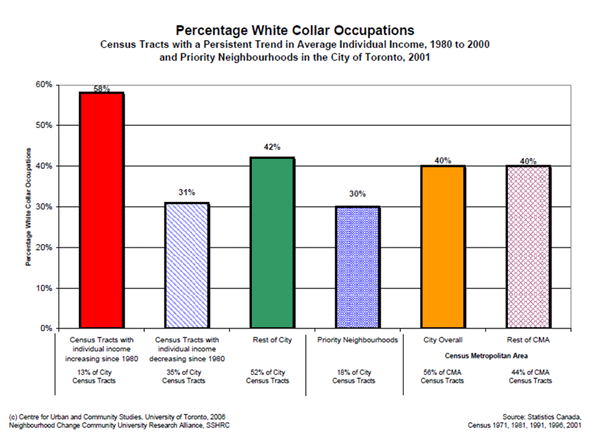
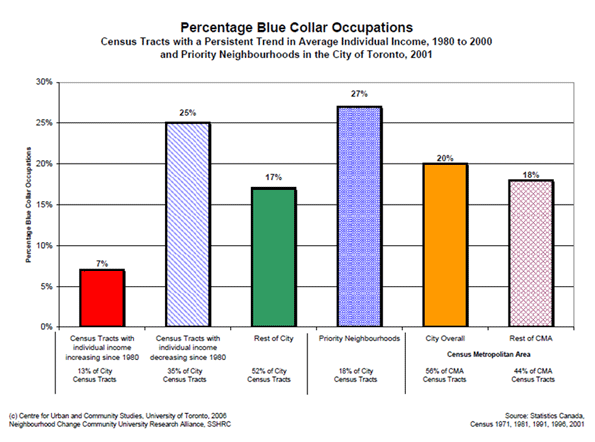
    Below is previously published data from Professor Hulchanski that highlights how badly blue collar sections of the city have been hit.


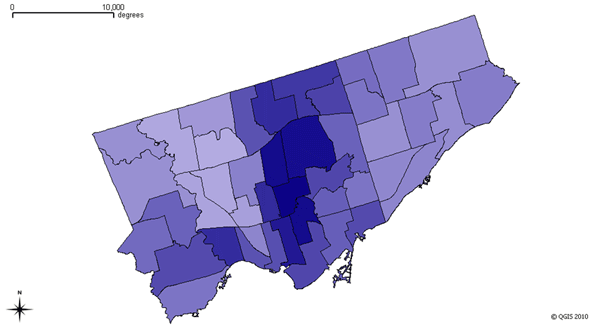
    Fundamentally, a strong focus on financial and other so-called “creative class” jobs will do little for these areas. The above map was created by Richard Florida’s Martin Prosperity Institute. It shows that most creative class jobs are clustered around the subway, but this doesn’t mean that expanding rail transit will expand creative class employment. Building a light rail line through a neighbourhood doesn’t suddenly transform the residents into artists and physicians. It may attract more artists and physicians, but this could actually hurt local residents by driving up rent and property values without creating jobs for them. Below is a map of educational attainment by ward. The darker the colour, the higher the number of residents with a bachelor’s degree or higher.

    The real problem is that a focus on elite jobs creates exactly the kind of bifurcation that progressive complain about. Given that city wide business policies are tailored towards creative class type occupations, it is unlikely that price sensitive manufacturers will find any reason to locate within city boundaries, rather than setting up shop in Mississauga or Barrie.

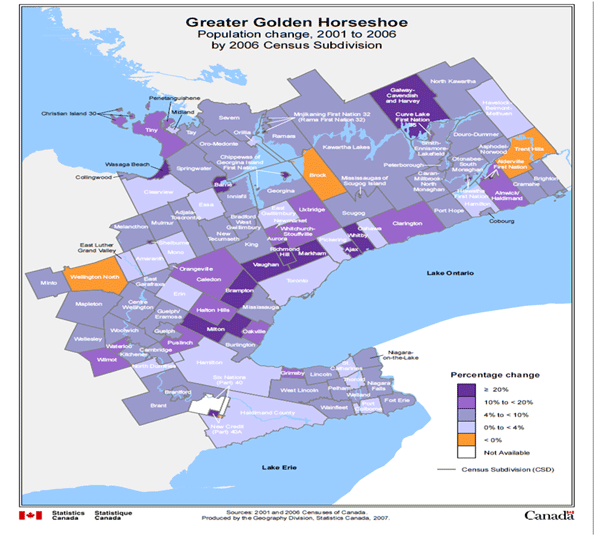
    Indeed, for all the temptation by urbanists to point to Toronto’s suburban ring as an example of the decline of suburbia, the peripheral suburban areas outside of city limits have been booming. Here is a map of growth in the GTA between 2001-2006. While Toronto grew modestly, suburban cities Milton, Brampton, Vaughan, Richmond Hill, Markham, Ajax, and Whitby all grew by at least 20%. Even Oshawa, which was hit hard by the decline of the auto sector, has managed to survive, and indeed maintained a higher median income than Toronto during this period. Regional rival Mississauga eclipsed Toronto’s growth rate, and emerging regional player Barrie grew by over 20%.

    In short, despite its strong financial core, Toronto is losing its standing as the go-to destination in the GTA. And it could get worse. Mississauga is working hard to lure financial services and advanced manufacturing jobs from Toronto. Several other cities, such as Guelph and Waterloo are actually competing for the very creative types that Toronto’s policies are tailored to attract. Other cities, such as Barrie are working hard to cannibalize what is left of Toronto’s manufacturing and distribution sectors. Were it not for amalgamation, Etobicoke or Scarborough could just as easily have undertaken a similar strategy to attract blue collar jobs.

    The Three Cities report identifies serious regional disparities in Toronto. Unfortunately, it doesn’t provide much insight into how to fix the problem. Expanding transit options will only go so far towards this. Building more light rail may raise median incomes by attracting wealthier people to these neighbourhoods. Ironically, this will only widen the income gap. The real challenge is finding out how to create opportunities for blue collar jobs in suburban Toronto. Unfortunately, amalgamation has imposed one size fits all policies that may work downtown, but utterly fail in the suburbs and continue to drive people to the periphery outside the city limits. Ironically, the very policies that seek to halt “sprawl” may well end up exacerbating it.

    Toronto Skyline photo by Smaku

    Steve Lafleur is a public policy analyst and political consultant based out of Calgary, Alberta. For more detail, see his blog.

  • Toward a Continental Growth Strategy

    North America remains easily the most favored continent both by demography and resources. The political party that harnesses this reality will own the political future.

    America cannot afford a prolonged period of slow economic growth. But neither Democrats nor Republicans are prepared to offer a robust growth agenda. Regardless of what happened in the November midterm elections, the party that can outline an economic expansion strategy suitable to this enormous continental nation will own the political future.

    Economic expansion that barely exceeds the current 2 percent or less is woefully insufficient for the United States. Such meager growth could perhaps work in countries with very low birthrates and limited immigration, such as in much of Europe and Japan, but not in the demographically vibrant United States.

    In the years between 2000 and 2050, Europe’s workforce will decline by 25 percent; Japan’s by 44 percent; China’s by 10 percent. In contrast, America’s workforce is expected to expand by more than 40 percent, adding millions of new entrants from an increasingly diverse population.

    Given the growth in workforce, it is impossible to see how the country succeeds without rapid expansion not only of employment but also a broad-based wealth creation. Despite conservative attempts to dress up the numbers, the vast bulk of all the gains in wealth since 2000 have been achieved by the relatively small number of Americans with incomes significantly above the poverty level. Meantime many middle-tier educated and skilled workers have lost ground while the rate of upward mobility has stagnated.

    The collapse of the housing bubble has eliminated the one way that middle class families took advantage of economic growth during the Bush years. Under Obama, virtually all the gains have been to the stock market (up 30 percent) and corporate profits (42 percent). Meanwhile, weekly earnings, jobs, and home sales price all stagnated or declined. But the biggest price may be paid by young people; even those with degrees have lagged behind in wage growth as they crowd into a labor market potentially far tougher than the one their boomer parents faced.

    All this suggests an emerging “aspiration gap” that could define our politics for much of the next few decades. Today, belief in the achievability of the “American dream,” according to a recent survey by Strategy One, has dropped to the low 40s. Americans may still overwhelmingly believe in the ideal of upward mobility but, as individuals, now only a minority feel they can achieve it themselves.

    The “aspiration gap” fundamentally does not advantage either party at the moment. Democrats are set for large losses in the 2010 election. But party identification and approval for the GOP remain low, particularly among the rising minority and millennial constituencies. Even in suburbia, amid rapidly rising middle class angst, the Republicans, according to a recent Hofstra University poll, have lost more support than the Democrats since 2008. Independents have been the big winner and constitute the largest faction of suburbanites—more than 36 percent, compared to just 30 percent two years ago.

    Our Failing Parties: The Democrats

    Let’s start with the Obamacized Democratic Party. Up through the 1990s, the Democrats still maintained strong links to small businesses, private sector unions, and the old Midwest industrial economy. This gave them reasons to favor growth-inducing policies that could close the “aspiration gap.”

    But today the party has become captured largely by the coastally oriented alliance of public employees, their charges, greens, and the professiorate—what Fred Siegel calls an alliance of the “overeducated and the undereducated.” For the most part, these constituencies are largely detached from the private sector, and thus only tangentially interested in economic growth. Even high unemployment, unsurprisingly, was not the primary concern for an administration dominated by longtime public servants and tenured professors—people who rarely lose their jobs.

    This indifference stems not so much from a traditional socialist agenda, as imagined by some conservatives, but by the nature of the party’s constituencies. It is more a dictatorship of the professoriate than that of the proletariat.

    Further obscuring the growth agenda is the fact that some key advisors consider growth itself inherently evil. Take for instance the president’s science advisor John Holdren. A protégé of the Malthusian Paul Ehrlich, Holdren long has favored the planned “de-development” of Western economies in order to reduce consumption.

    The “de-development” agenda has been bolstered by the growth of the climate change industry. Proposals for “cap and trade” rules or Environmental Protection Agency regulations on greenhouse gases represent profound threats to basic industries like manufacturing, housing, and agriculture. In contrast, they have proven boffo for university research grant-seekers and Silicon Valley venture capitalists, who increasingly focus on “clean” technologies subsidized by government grants and edicts favoring their technologies.

    The climate change agenda also distorts the administration’s approach to infrastructure. Instead of focusing on transportation bottlenecks effecting companies and commuters on a daily basis, the administration has favored massive boondoggles such as high-speed rail or sometimes poorly conceived light-rail systems. These are often too expensive compared to alternatives, and not well-suited to the needs of most American communities or companies.

    Our Failing Parties: The Republicans

    Today, with as many as 25 million Americans unemployed or underemployed, the Democratic Party still seems to be missing a coherent program to put them back to work. Sadly, much the same can be said of the Republicans, who benefit from populist outrage about the stimulus, but also lack an answer to the deepening aspirational gap.

    The fundamental problem is obvious at the level of the Tea Party, the grassroots driving force behind today’s GOP. Tea partiers know what they are against—higher taxes and government spending—but have not developed much in the way of approaches to spur growth.

    This is epitomized by the career of the movement’s patron saint, Sarah Palin. Celebrated by many in the “lower 48,” Palin is widely seen among Alaska’s predominately Republican business community as indifferent to economic growth. As governor, they maintain, she proved more interested in redistribution to the middle class—through larger checks from the state’s energy fund—than in investing in things like new infrastructure.

    “She epitomizes the whole idea of we get a piece and no sense of planning for the future, about thinking about what we need to do,” notes Jim Egan executive director of Commonwealth North, a local think tank.

    Long-term growth, in Alaska and elsewhere, Egan suggests, needs government to play a critical supporting role. The fact that the Obama administration missed its opportunity to focus on basic infrastructure in its bungled, politically driven stimulus does not mean that investing in the future is an inherently bad idea.

    The Republican embrace of austerity represents good policy when it comes to reducing wasteful spending, notably on public employee pensions. But knee-jerk resistance to any government spending could prove detrimental in an increasingly competitive world.

    Needed: A Continental Strategy

    To promote economic growth, the country needs to develop a new national consensus around which I call “a continental strategy.” This would focus on taking advantage of the unique demographic and resource assets of this country as well as its North American neighbors, Mexico and Canada.

    Today the United States faces formidable competitors, notably from China, India, and Brazil. These are proud, vast countries with considerable resources and an expanding middle class population. At least in the short run, they suffer neither the ruinous demography of Japan nor the elaborate welfare burdens of Western Europe.

    Already these countries are investing in their basic infrastructure so that they can tie their vast landmass together and profit from it.

    Hard as it is to imagine amid the wreckage of the stimulus, American history is replete with examples of how government can actually do good things. The public support for canals, railway lines, the New Deal engineering and construction projects, the Interstate Highway, and space programs all greatly benefited the country’s economy. They underpinned first American leadership in the industrial age, and then in the information economy. In recent decades, public investment in basic infrastructure construction and maintenance has declined, even in the face of considerable population growth.

    “One looks back at that map ‘Landscape by Moses,’” writes the sociologist Nathan Glazer, about the legacy of New York City’s “master builder” Robert Moses, “and if one asks what has been added in the 50 years since Moses lost power, one has to say astonishingly: almost nothing.”

    Restoring our priority towards binding together and improving our continental infrastructure remains critical to achieving greater economic growth. Rather than a policy of retrenchment, it would represent a return to an approach that sparked our original ascendency and could gain broad bipartisan support.

    Even today, what makes a continental strategy so compelling lies with this often overlooked reality: North America remains easily the most favored continent both by demography and resources. It possesses the world’s second-largest oil reserves and massive, still largely untapped natural gas supplies.

    North America also constitutes by far the world’s richest agricultural area, with the most arable land. This is a huge advantage as global food demands grow over the next few decades. Critically, the continent also boasts more than four times as much water per capita as either Asia or Europe.

    Most important still, North America retains a unique demographic vitality among all advanced countries. It continues to lure upwardly mobile people from around the world: roughly half of the world’s educated migrants come to America, and a considerable number also head for Canada.

    Ultimately a continental strategy meets the needs of large segments of the country—ranging from immigrants and their children to millennials—who will dominate our emerging job market. These same groups in the coming decades will also shape our political future.

    The party that offers these new voters the greatest opportunities for work, raising a family, and buying a house will be the one that dominates the political future. As generational chroniclers Mike Hais and Morley Winograd, both committed Democrats, have pointed out, millennials are essentially nonideological; they will be attracted to those policies that work, both for society and for their young families.

    Although this year’s political results may please conservative ideologues, they should recognize that this represents only the defeat of poorly executed Obamian statism. The future belongs to whichever party emerges as the true party of growth.

    This article originally appeared at The American.

    Joel Kotkin is executive editor of NewGeography.com and is a distinguished presidential fellow in urban futures at Chapman University. He is author of The City: A Global History. His newest book is The Next Hundred Million: America in 2050, released in February, 2010.

    Photo by IronRodArt – Royce Bair

  • Love and the City

    It has been said that the modern city is soulless, that it is heartless, and that it is brutal. The modern city represents in its scale and complexity one of the most extraordinary of human inventions, but there is also no doubt that everywhere in the world it is also one of our biggest failures.

    The dysfunction of a city in the past was an inconvenience. The dysfunction of a city in the future will be a profound disaster for that city and, ironically, a profound opportunity for another city, of a smarter city. It will be an opportunity for a city that has found out how to position itself better in the world of cities, but more importantly in the eyes and hearts of its citizens.

    All over the world, there is a growing recognition that this brutality must stop; we have to imagine a different kind of city which addresses human needs and that puts the soul back into the city. This is essential to the survival of the city. Put another way, there is a growing understanding that it is actually “love” that will be the prime force in the future economy of successful 21st century cities.

    Who would have thought in the last generation that “love” might become a meaningful topic in a discussion about urban economies, much less a prime force of those economies?

    One important reason for creating a love-based city grows from the struggle today among cities for hegemony. We read all the time about “alpha-cities” and “delta-cities”: the “alphas” enjoy the fruits of labour and the “deltas” just do the labour – they just exist. And why is this?

    Well, it’s because the dynamics of urban growth and competition have fundamentally changed in the last quarter century. The world has become footloose, with people and capital moving at will: business can be done anywhere. Other aspects of life are more important than one’s livelihood and where people choose to settle is not tied down the way it used to be. We can do and be almost anything anywhere.

    The result is a new kind of economic base for our cities, augmenting the traditional economic activities holding our cities together. This is the ideas and service economy and it opens up the imperative to create a city of beauty and quality liveability and style. This is an economy driven by people, their direct needs, their preferences and their day-to-day experiences.

    This ideas and service economy quickly becomes an economy involving almost everyone. If you live in a core city, have you ever tried to get a gardener or a plumber? But, even beyond that, you have to think about all of the professions and vocations that can now demand an enjoyable as well as functioning city.

    We’re not just talking about the service sector or the ‘creatives’, we’re talking about almost everybody. We have to focus the discussion on a city that is liveable for a broad array of its population.

    I worry that in all our creative thinking about sustainable technologies and sustainable urban forms, there may be some strong denial going on about people and their inclinations, denial that will block the way towards sustainability.

    Take the fashion that insists on the primacy of density and mixed use and diversity and sustainable transportation. Sadly, most consumers in the English speaking world, except in a very few of our older gracious places, have shown very little interest in being a part of that kind of city. In my country, two-thirds of Canadians live in auto-dominated suburbs that boast none of these qualities – and that proportion is even higher in America.

    Let’s be blunt: most people hate density because most of it has been so bad; they think of mixed use as probably hitting them negatively and transit is not even in most people’s vocabulary. The ideal of most people is some sort of rural “garden of Eden” that they want to escape to from the city – even if that ends up being an illusory goal.

    I sympathize. The cities we have been building since the War have very seldom offered anything very appealing at almost any density. Who can really fall in love with brutal concrete canyons or anonymous strip malls or wind-swept roads?

    If cities want to offer an alternative, they must change and bring back the human touch – we have to bring placemaking to the very heart of the civic agenda. We have to stop trading away the urban qualities we care about for the urgencies of the moment of modern life.

    We must start to build places that truly appeal to people – yes, places that are sustainable, but also places that are so good that people will choose them. These cities have to have all the human services and they have to have beauty and they have to be gentle. Only then will they become attractive to a wide range of people.

    I call this “Experiential Planning” – learning about and then carefully making the city deliver the experiences people tell us they want in their lives for their families and children.

    Experiential planning looks beyond land-use and transportation patterns to things like character and comfort and health and convenience and the visceral response of the senses and caprice: things that simply make people happy. Happiness is the applied side of love.

    People want all of the efficiencies and choices but they also want more. They want to feel the unique, special spirit of a place as a real thing, not a marketing gimmick. They want their habitat to have a “buzz” that makes them feel good. They want their day-to-day living environment to foster social engagement and neighbourliness not isolation. That is what the contemporary city has often been missing.

    For as long as anyone can remember, modern cities, with very few exceptions, have been shaped by economic activity and politics and the shifting of social groups: the city exploited as a commodity. But that doesn’t have to be the case. We can actually design our cities as an explicit act of creation – grand civic design with the whole city as a canvas. And every city has to find its own way: they should not accept cookie-cutter replications of what’s being done everywhere else.

    To start, every city needs to perform a ritual burning of these outdated and single-purpose rules. Now I am not talking about de-regulation. The city of the future will have to have strong regulations because the possibilities out there for development are just too diverse and the private interests in development too strong. There must be a clear expression of the public interest and public needs to match that of the private sector.

    Also, I want to be clear that this is not a “top-down” agenda. Experiential planning requires an aggressive and diverse engagement of the public at every step along the way to articulate the public perspective and to insure public buy-in and ownership. The general public needs to discuss and debate an overall civic vision and all aspects of urban design.

    In this experiential-based city there will be an alignment of profitability and community building. We will also see people coming back to live in the core city and to suburbs transformed through natural choice and preference. There will be an alignment of consumer selection and sustainable practice. This will include all kinds of people but especially families with children.

    But none of this will happen by accident. We have to make it happen and bring along individual values through a careful process of reconciliation.

    Tomorrow’s city must meet the environmental test and the economic test but it must also meet the experiential test; and that is the test of love; that is the test of soul. It must be beautiful and joyful and sociable and humane and offer a complete rich community life – with all the subtleties of human occupation. That is the real power of an urban love affair.

    Larry Beasley is the retired Director of Planning for the City of Vancouver in Canada. He is now the “Distinguished Practice Professor of Planning” at the University of British Columbia and the founding principal of Beasley and Associates, an international planning consultancy. He chairs the ‘National Advisory Committee on Planning, Design and Realty’ of Ottawa’s National Capital Commission; he is the Chief Advisor on Urban Design for the City of Dallas, Texas; he is on the International Economic Development Advisory Board of Rotterdam in The Netherlands; and he is the Special Advisor on City Planning to the Government of Abu Dhabi in the United Arab Emirates.

    Photo by ecstaticist

  • Toronto Election Highlights Failure of Amalgamation

    In my pre-election piece on the Toronto election, I discussed the city’s lingering malaise. It developed slowly but its roots can be traced to the 1998 amalgamation that swallowed up five suburban municipalities. This led to a six folds expansion of city boundaries and a tripling the population base. This amalgamation was initiated by the province of Ontario as a cost saving measure and faced major local opposition. Citizens and politicians were concerned that the benefits of the alleged efficiency saving would be outweighed by the negative impact of losing local decision making powers. The recent Toronto municipal election bore out this concern.

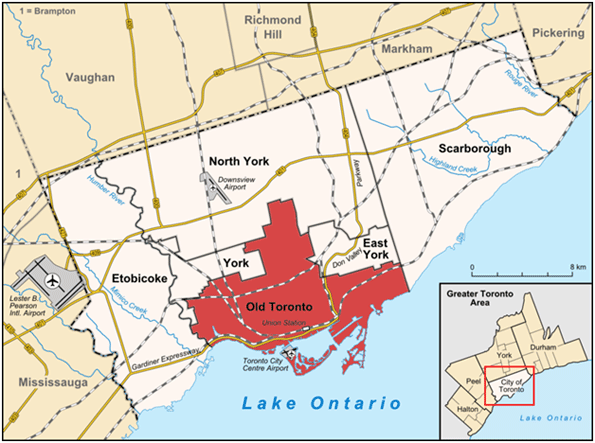
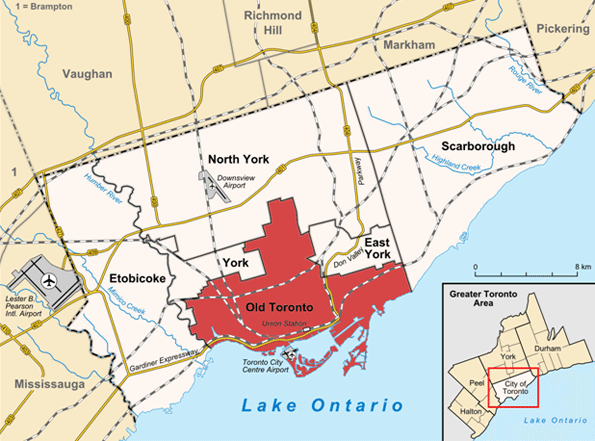
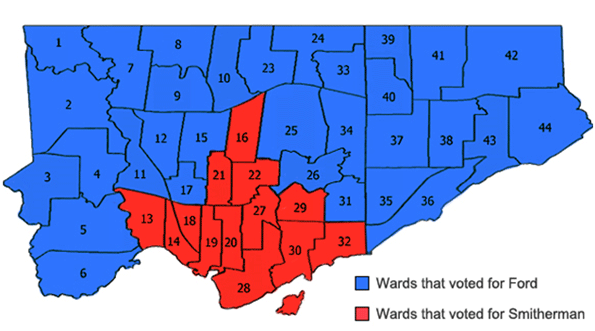
    In the October 25th election, Torontonians were presented with two dramatically different visions. The first vision was presented by former Liberal Ontario cabinet minister George Smitherman. A self-described progressive, Smitherman appealed mainly to voters in the downtown core of Old Toronto. He stood for issues such as improved bicycle lanes, renewal of the downtown waterfront, and improving social housing conditions. The second version was presented by maverick councilor Rob Ford, who represented a ward in the former City of Etobicoke. Ford’s message was simple: it’s time to stop the “gravy train” at City Hall. While he had elaborate platforms on many issues, cutting waste at City Hall was his ubiquitous message.

    Despite Toronto’s social democratic image, Rob Ford won a crushing victory. Ford earned 47% of the vote, while Smitherman ended up with 35%. Far left candidate Joe Pantalone (known primarily for attempting to stop businesses from opening in his own ward) managed to capture 12% of the vote.

    Aside from the shock that a partisan conservative won in Toronto, there are two other significant developments. Both front runners were significantly more fiscally conservative than the current administration. Ford and Smitherman represented constituencies desperately seeking change. Smitherman’s base was frustrated with the inability of the city to provide the services that they want efficiently. Ford’s base was angry that the city is providing many of these services in the first place.

    Not surprisingly the results broke down along specific geographic lines. Ford won an outright majority of votes in every single ward outside of Old Toronto. Within the old boundaries, Smitherman won 13 of the 16 wards. The three Old Toronto wards Ford won are all on the fringes of the Old City.

    In 1997, the newly amalgamated city went to the polls for the first time. Conservative former North York Mayor Mel Lastman narrowly defeated social democratic former Old Toronto Mayor Barbara Hall. Since then, downtown oriented social democrats have controlled the city ever since.

    Clearly this result shows that the concerns expressed by the opponents of amalgamation were largely valid. Amalgamation failed to create cost savings, and has created a dysfunctional megacity. Rather than having six municipalities where voters are focusing on solving local problems, we have one gigantic city with the core and the suburbs fighting for their share of the public purse. This leads to the schizophrenic policy decisions we see today.

    Before amalgamation, there were six different versions of Toronto life that one could choose from. If you didn’t like living in high tax Toronto, you could live in Etobicoke. If Etobicoke’s bylaws and business taxes were hurting your business, you could move to North York. Now all people in the Toronto area can do is vote the bums out on election day, or get out of the area altogether. This isn’t a viable long-term solution.

    The problems are systemic, and cannot be solved so long as the megacity exists. This extends beyond the fact of the impossibility of satisfying the core and the suburbs at the same time. The megacity allows public sector unions to literally hold 2.5 million people hostage whenever they feel like it. A notorious strike last summer lead to a month without garbage collection in the entire city. The 24,000 strikers also shut down parks and recreation services, daycare, provision of municipal licenses, health inspections, animal services, and forced a 25% reduction in ambulance services. In 2008, the transit union called a last minute strike at midnight on a Friday night, grinding the city to a halt. These are just two examples of how powerful Toronto public sector unions have become. The only reason strikes aren’t more frequent is that the city typically gives them whatever they want in order to avoid chaotic strikes. De-amalgamation would not only allow more local control over policy, but would help fray the noose that the unions have tied around the city’s neck.

    Downtown progressives gripe over how Rob Ford is going to destroy their city, but they should take a minute to think about what some of their policies have been doing to suburbanites for years. They have imposed high taxes, and burdensome regulations on the amalgamated cities, as well as a myriad of new bylaws. Some of these policies make sense in Old Toronto. For instance, dissuading automobile usage in the congested core makes sense. Doing so in the suburbs does not. It might make sense to regulate trees on private property in a crowded downtown neighborhood. Not so much in a new subdivision. One-size-fits-all policies don’t work across a city as large and diverse as Metropolitan Toronto.

    Now that the suburbs have wrought their revenge on the old city, progressives need to recognize that de-amalgamation is not just a fantasy of libertarians and angry suburbanites. It is a prerequisite to restoring sound public policy reflecting the preferences of individual communities. Railing against Rob Ford won’t fix the problem. Rob Ford is what the suburbs want. As long as the megacity lives, Toronto will elect a Rob Ford type every now and then.

    The only way to stop this pattern of alternating, divergent visions is by de-amalgamation. Critics will use metaphors such as ‘unscrambling an egg’ to illustrate the difficulties of de-amalgamation. No one should believe that de-amalgamation would be easy. But there will never be a better time than now to take the necessary step of de-amalgamation. A few years of chaotic governance would be worth the long run benefit of restoring local control.

    Downtown Toronto photo by Astro Guy

    Steve Lafleur is a public policy analyst and political consultant based out of Calgary, Alberta. For more detail, see his blog.

  • “Redneck” Calgary Elects Liberal Muslim Academic Mayor: World Doesn’t End

    Calgary municipal politics rarely makes news outside of the city. Going into this year’s municipal election, I had reason to believe this would change. I came to Calgary to manage the campaign of the runner up from the last election. He is a Muslim (specifically Ishmaili), and an outsider to the political establishment. People told me there’s no way someone like that could be elected in Calgary. I’m happy to say that they were proven wrong. Unfortunately, I had nothing to do with this.

    My former candidate is a colorful guy. He had lived in Calgary for less than five years before running for mayor the first time around. His odds were pretty steep. Mayor Dave Bronconnier had garnered over 80% of the vote in the previous election. His closest rival had just over 5%. My candidate spent over a million dollars of his own money to run a viable campaign against the two term incumbent. He finished that election with a quarter of the votes. Internal polling suggested he had a serious chance, until false allegations concerning his past business dealings in Kenya derailed his candidacy.

    He is also a strong believer that Calgary’s redneck image is outdated. Calgarian values are old fashioned in many ways, many of them good. There is no major Canadian city where people are as supportive of free-enterprise as Calgary. Think of it as Houston North. The economy is largely driven by the oil and gas money, and it is perceived as being a very socially conservative, predominately white city. This perception is out of date. Nearly a quarter of Calgarians are members of visible minority groups, and the city elected Canada’s first Muslim Member of Parliament. My candidate mocked this perception. One of his ice breakers with skeptics of his candidacy was to tell them that “redneck Calgary is ready to elect a brown, bald guy from Kenya” as Mayor. It turns out he was right about the “brown” part.

    I ended up leaving that campaign early. We had different visions for the campaign, and the candidate always wins that argument. He wound up pulling out of the race the day before the election officially got underway. I harbored suspicions that the only reason he came in second the last time was that he happened to be the only guy willing to spend a million bucks to run against a popular incumbent. Had he not run, the two term incumbent would have walked to another landslide victory. Some people were angry with the incumbent, and he was the other name on the ballot they recognized.

    My faith that a member of a visible minority group could be elected Mayor of Calgary dwindled. But in the last few weeks of the campaign, something odd began happening in the polls. A man by the name of Naheed Nenshi started to poll at 20%. Few people took his candidacy seriously before this. His numbers began to climb into the 30% range in the final week. I started making long shot bets with friends that Nenshi would win, but I didn’t really expect it to happen. Surely the polling was wrong. Redneck Calgary couldn’t possibly elect a Liberal Muslim academic as Mayor.

    The polling actually was wrong. Since many young people only have cell phones, they are underrepresented in polls. It turns out that the polls massively underestimated Nenshi’s support. He didn’t just sneak by. Turnout was an astonishing 53%–shattering records for the last 3 decades—and he grabbed 40% of the votes. This was supposed to be a two way race between fiscal hawk alderman Ric McIver, and popular news anchor Barb Higgins. Elections don’t always turn out as they’re scripted by the pundits.

    The fact that we’ve actually elected a Muslim Mayor has lead to a serious rethink of Calgary’s redneck reputation. Pundits claim that this represents a shift in the city’s attitude towards immigrants. I disagree. Like its American energy town counterpart Houston, it’s an open, opportunity-oriented city. People don’t care if you’re white, brown, or from Saskatchewan. Calgary is a magnet for entrepreneurial people. It is a city that was built on people from all over the world seeking opportunities. One fifth of Calgarians are immigrants.

    “Go west, young man” is not a mantra that was exclusively adopted by white Protestant men. Nenshi was born and raised in Calgary, but his mayoralty would not have been possible if it weren’t for the hospitable Calgarian attitude.

    Frankly, he’ll probably do an alright job. Nenshi has an impressive business background, and his knowledge of urban public policy and municipal government is extensive. He’s more of a market liberal, than the dogmatic leftist that his critics painted him as. He wants more public amenities, but understands fiscal prudence and the need for efficient regulations.

    No matter how much his critics called him a socialist, Nenshi was the candidate who was able to convince voters that he knew how to provide the necessary services without breaking the bank. Voters wanted a clear vision of the city’s future, and that’s what Nenshi provided. People knew what they were voting for. Frontrunner Ric McIver offered slightly lower tax increases, combined with major spending initiatives. We’ve all seen what happens when politicians promise tax cuts without a plan to reduce spending. This isn’t a vision, so much as a recipe for disappointment.

    Calgarians wanted to elect a Mayor who would clean up City Hall. Nenshi offered that, and people didn’t care what God he worships (or doesn’t). Calgarians didn’t vote for a Muslim mayor any more than they voted for a Protestant Mayor the last election. They voted for the guy they thought would get things done. That’s the Calgarian attitude.

    Photo by 5of7

    Steve Lafleur is a public policy analyst and political consultant based out of Calgary, Alberta. For more detail, see his blog.

  • The New World Order

    Tribal ties—race, ethnicity, and religion—are becoming more important than borders.

    For centuries we have used maps to delineate borders that have been defined by politics. But it may be time to chuck many of our notions about how humanity organizes itself. Across the world a resurgence of tribal ties is creating more complex global alliances. Where once diplomacy defined borders, now history, race, ethnicity, religion, and culture are dividing humanity into dynamic new groupings.

    Broad concepts—green, socialist, or market-capitalist ideology—may animate cosmopolitan elites, but they generally do not motivate most people. Instead, the “tribe” is valued far more than any universal ideology. As the great Arab historian Ibn Khaldun observed: “Only Tribes held together by a group feeling can survive in a desert.”

    Although tribal connections are as old as history, political upheaval and globalization are magnifying their impact. The world’s new contours began to emerge with the end of the Cold War. Maps designating separate blocs aligned to the United States or the Soviet Union were suddenly irrelevant. More recently, the notion of a united Third World has been supplanted by the rise of China and India. And newer concepts like the BRIC nations (Brazil, Russia, India, and China) are undermined by the fact that these countries have vastly different histories and cultures.

    The borders of this new world will remain protean, subject to change over time. Some places do not fit easily into wide categories—take that peculiar place called France—so we’ve defined them as Stand-Alones. And there are the successors to the great city-states of the Renaissance—places like London and Singapore. What unites them all are ties defined by affinity, not geography.

    1. New Hansa

    Denmark, Finland, Germany, Netherlands, Norway, Sweden

    In the 13th century, an alliance of Northern European towns called the Hanseatic League created what historian Fernand Braudel called a “common civilization created by trading.” Today’s expanded list of Hansa states share Germanic cultural roots, and they have found their niche by selling high-value goods to developed nations, as well as to burgeoning markets in Russia, China, and India. Widely admired for their generous welfare systems, most of these countries have liberalized their economies in recent years. They account for six of the top eight countries on the Legatum Prosperity Index and boast some of the world’s highest savings rates (25 percent or more), as well as impressive levels of employment, education, and technological innovation.

    2. The Border Areas

    Belgium, Czech Republic, Estonia, Hungary, Iceland, Ireland, Latvia, Lithuania, Poland, Romania, Slovakia, U.K.

    These countries are seeking to find their place in the new tribal world. Many of them, including Romania and Belgium, are a cultural mishmash. They can be volatile; Ireland has gone from being a “Celtic tiger” to a financial basket case. In the past, these states were often overrun by the armies of powerful neighbors; in the future, they may be fighting for their autonomy against competing zones of influence.

    3. Olive Republics

    Bulgaria, Croatia, Greece, Italy, Kosovo, Macedonia, Montenegro, Portugal, Slovenia, Spain

    With roots in Greek and Roman antiquity, these lands of olives and wine lag behind their Nordic counterparts in virtually every category: poverty rates are almost twice as high, labor participation is 10 to 20 percent lower. Almost all the Olive Republics—led by Greece, Spain, and Portugal—have huge government debt compared with most Hansa countries. They also have among the lowest birthrates: Italy is vying with Japan to be the country with the world’s oldest population.

    4. City-States

    London

    It’s a center for finance and media, but London may be best understood as a world-class city in a second-rate country.

    Paris

    Accounts for nearly 25 percent of France’s GDP and is home to many of its global companies. It’s not as important as London, but there will always be a market for this most beautiful of cities.

    Singapore

    In a world increasingly shaped by Asia, its location between the Pacific and Indian oceans may be the best on the planet. With one of the world’s great ports, and high levels of income and education, it is a great urban success story.

    Tel Aviv

    While much of nationalist-religious Israel is a heavily guarded borderland, Tel Aviv is a secular city with a burgeoning economy. It accounts for the majority of Israel’s high-tech exports; its per capita income is estimated to be 50 percent above the national average, and four of Israel’s nine billionaires live in the city or its suburbs.

    5. North American Alliance

    Canada, United States

    These two countries are joined at the hip in terms of their economies, demographics, and culture, with each easily being the other’s largest trade partner. Many pundits see this vast region in the grip of inexorable decline. They’re wrong, at least for now. North America boasts many world-class cities, led by New York; the world’s largest high-tech economy; the most agricultural production; and four times as much fresh water per capita as either Europe or Asia.

    6. Liberalistas

    Chile, Colombia, Costa Rica, Mexico, Peru

    These countries are the standard–bearers of democracy and capitalism in Latin America. Still suffering low household income and high poverty rates, they are trying to join the ranks of the fast-growing economies, such as China’s. But the notion of breaking with the U.S.—the traditionally dominant economic force in the region—would seem improbable for some of them, notably Mexico, with its close geographic and ethnic ties. Yet the future of these economies is uncertain; will they become more state–oriented or pursue economic liberalism?

    7. Bolivarian Republics

    Argentina, Bolivia, Cuba, Ecuador, Nicaragua, Venezuela

    Led by Venezuela’s Hugo Chávez, large parts of Latin America are swinging back toward dictatorship and following the pattern of Peronism, with its historical antipathy toward America and capitalism. The Chávez-influenced states are largely poor; the percentage of people living in poverty is more than 60 percent in Bolivia. With their anti-gringo mindset, mineral wealth, and energy reserves, they are tempting targets for rising powers like China and Russia.

    8. Stand-Alones

    Brazil

    South America’s largest economy, Brazil straddles the ground between the Bolivarians and the liberal republics of the region. Its resources, including offshore oil, and industrial prowess make it a second-tier superpower (after North America, Greater India, and the Middle Kingdom). But huge social problems, notably crime and poverty, fester. Brazil recently has edged away from its embrace of North America and sought out new allies, notably China and Iran.

    France

    France remains an advanced, cultured place that tries to resist Anglo-American culture and the shrinking relevance of the EU. No longer a great power, it is more consequential than an Olive Republic but not as strong as the Hansa.

    Greater India

    India has one of the world’s fastest-growing economies, but its household income remains roughly a third less than that of China. At least a quarter of its 1.3 billion people live in poverty, and its growing megacities, notably Mumbai and Kolkata, are home to some of the world’s largest slums. But it’s also forging ahead in everything from auto manufacturing to software production.

    Japan

    With its financial resources and engineering savvy, Japan remains a world power. But it has been replaced by China as the world’s No. 2 economy. In part because of its resistance to immigration, by 2050 upwards of 35 percent of the population could be over 60. At the same time, its technological edge is being eroded by South Korea, China, India, and the U.S.

    South Korea

    South Korea has become a true technological power. Forty years ago its per capita income was roughly comparable to that of Ghana; today it is 15 times larger, and Korean median household income is roughly the same as Japan’s. It has bounced back brilliantly from the global recession but must be careful to avoid being sucked into the engines of an expanding China.

    Switzerland

    It’s essentially a city-state connected to the world not by sea lanes but by wire transfers and airplanes. It enjoys prosperity, ample water supplies, and an excellent business climate.

    9. Russian Empire

    Armenia, Belarus, Moldova, Russian Federation, Ukraine

    Russia has enormous natural resources, considerable scientific-technological capacity, and a powerful military. As China waxes, Russia is trying to assert itself in Ukraine, Georgia, and Central Asia. Like the old tsarist version, the new Russian empire relies on the strong ties of the Russian Slavic identity, an ethnic group that accounts for roughly four fifths of its 140 million people. It is a middling country in terms of household income—roughly half of Italy’s—and also faces a rapidly aging population.

    10. The Wild East

    Afghanistan, Azerbaijan, Kazakhstan, Kyrgyzstan, Pakistan, Tajikistan

    This part of the world will remain a center of contention between competing regions, including China, India, Turkey, Russia, and North America.

    11. Iranistan

    Bahrain, Gaza Strip, Iran, Iraq, Lebanon, Syria

    With oil reserves, relatively high levels of education, and an economy roughly the size of Turkey’s, Iran should be a rising superpower. But its full influence has been curbed by its extremist ideology, which conflicts not only with Western countries but also with Greater Arabia. A poorly managed economy has turned the region into a net importer of consumer goods, high-tech equipment, food, and even refined petroleum.

    12. Greater Arabia

    Egypt, Jordan, Kuwait, Palestinian Territories, Saudi Arabia, United Arab Emirates, Yemen

    This region’s oil resources make it a key political and financial player. But there’s a huge gap between the Persian Gulf states like Saudi Arabia and the United Arab Emirates and the more impoverished states. Abu Dhabi has a per capita income of roughly $40,000, while Yemen suffers along with as little as 5 percent of that number. A powerful cultural bond—religion and race—ties this area together but makes relations with the rest of the world problematic.

    13. The New Ottomans

    Turkey, Turkmenistan, Uzbekistan

    Turkey epitomizes the current reversion to tribe, focusing less on Europe than on its eastern front. Although ties to the EU remain its economic linchpin, the country has shifted economic and foreign policy toward its old Ottoman holdings in the Mideast and ethnic brethren in Central Asia. Trade with both Russia and China is also on the rise.

    14. South African Empire

    Botswana, Lesotho, Namibia, South Africa, Swaziland, Zimbabwe

    South Africa’s economy is by far the largest and most diversified in Africa. It has good infrastructure, mineral resources, fertile land, and a strong industrial base. Per capita income of $10,000 makes it relatively wealthy by African standards. It has strong cultural ties with its neighbors, Lesotho, Botswana, and Namibia, which are also primarily Christian.

    15. Sub-Saharan Africa

    Angola, Cameroon, Central African Republic, Congo-Kinshasa, Ethiopia, Ghana, Kenya, Liberia, Malawi, Mali, Mozambique, Nigeria, Senegal, Sierra Leone, Sudan, Tanzania, Togo, Uganda, Zambia

    Mostly former British or French colonies, these countries are divided between Muslim and Christian, French and English speakers, and lack cultural cohesion. A combination of natural resources and poverty rates of 70 or 80 percent all but assure that cash-rich players like China, India, and North America will seek to exploit the region.

    16. Maghrebian Belt

    Algeria, Libya, Mauritania, Morocco, Tunisia

    In this region, spanning the African coast of the Mediterranean, there are glimmers of progress in relatively affluent countries like Libya and Tunisia. But they sit amid great concentrations of poverty.

    17. Middle Kingdom

    China, Hong Kong, Taiwan

    China may not, as the IMF recently predicted, pass the U.S. in GDP within a decade or so, but it’s undoubtedly the world’s emerging superpower. Its ethnic solidarity and sense of historical superiority remain remarkable. Han Chinese account for more than 90 percent of the population and constitute the world’s single largest racial-cultural group. This national cultural cohesion, many foreign companies are learning, makes penetrating this huge market even more difficult. China’s growing need for resources can be seen in its economic expansion in Africa, the Bolivarian Republics, and the Wild East. Its problems, however, are legion: a deeply authoritarian regime, a growing gulf between rich and poor, and environmental degradation. Its population is rapidly aging, which looms as a major problem over the next 30 years.

    18. The Rubber Belt

    Cambodia, Indonesia, Laos, Malaysia, Philippines, Thailand, Vietnam

    These countries are rich in minerals, fresh water, rubber, and a variety of foodstuffs but suffer varying degrees of political instability. All are trying to industrialize and diversify their economies. Apart from Malaysia, household incomes remain relatively low, but these states could emerge as the next high-growth region.

    19. Lucky Countries

    Australia, New Zealand

    Household incomes are similar to those in North America, although these economies are far less diversified. Immigration and a common Anglo-Saxon heritage tie them culturally to North America and the United Kingdom. But location and commodity-based economies mean China and perhaps India are likely to be dominant trading partners in the future.

    This article originally appeared in Newsweek.

    Legatum Institute provided research for this article.

    Joel Kotkin is executive editor of NewGeography.com and is a distinguished presidential fellow in urban futures at Chapman University and an adjunct fellow with the Legatum Institute in London. He is author of The City: A Global History. His newest book is The Next Hundred Million: America in 2050, released in February, 2010.

    Illustration by Bryan Christie, Newsweek

  • Vancouver: Planner’s Dream, Middle Class Nightmare

    Vancouver is consistently rated among the most desirable places to live in the Economist’s annual ranking of cities. In fact, this year it topped the list. Of course, it also topped another list. Vancouver was ranked as the city with the most unaffordable housing in the English speaking world by Demographia’s annual survey. According to the survey criteria, housing prices in an affordable market should have an “median multiple” of no higher than 3.0 (meaning that median housing price should cost no more than 3 times the median annual gross household income). Vancouver came in at a staggering 9.3. The second most expensive major Canadian city, Toronto, has an index of only 5.2. Even legendarily unaffordable London and New York were significantly lower, coming in at 7.1 and 7.0 respectively. While there are many factors that make Vancouver a naturally expensive market, there are a number of land use regulations that contribute to the high housing costs.

    Vancouver is a unique real estate market: it’s the only major Canadian city that doesn’t experience frigid winters. This makes it a major draw for high skilled, high salary employees. It is also a major destination for wealthy Canadian retirees, who choose to actually spend their winters in Canada. There is little doubt that it is a naturally expensive real estate market. As with coastal California cities, people pay a premium for (in this case relatively) hospitable weather. The proximity to world class skiing, fishing, and hiking are no doubt another factor in the city’s high real estate costs. There is certainly a premium to be paid for living less than two hours away from the world’s best ski resort.

    Moreover, Vancouver has become an appealing real estate market for overseas investors, particularly Chinese nationals. There has been a good deal of news recently about how many of the nouveau riche in China are now looking to Vancouver, rather than Los Angeles or New York as an immigration destination. In absolute dollar terms, Vancouver is still cheaper than either city. This, combined with the more hospitable Canadian immigration system, has made Vancouver so attractive to overseas investors that real estate agents are now organizing house hunting tours for potential Chinese buyers.

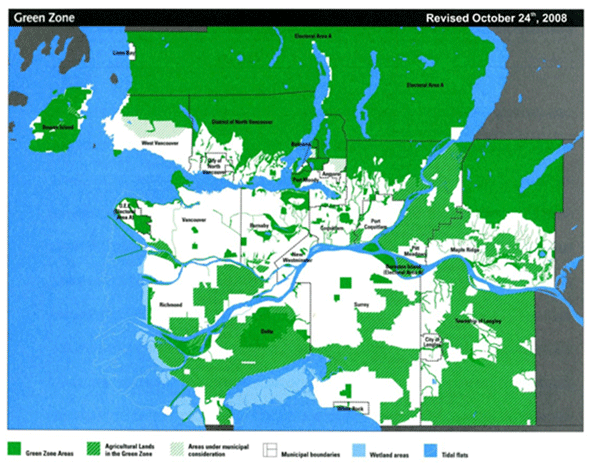
    To be sure, geography deserves much of the blame for Vancouver’s high housing costs. But a large chunk of the blame lies with restrictive municipal and provincial land use policies. Since the introduction of the city’s first comprehensive plan in 1929, Vancouver has used various land use regulations to create dense mixed use development in order to protect green space surrounding the city. In 1972, the provincial government passed legislation aimed at protecting BC farmland. This left less than half of the already scarce land in Greater Vancouver off limits to developers. As a result, the city is circled by undeveloped land, referred to as the Green Zone. The Green Zone acts as a de facto urban growth boundary, largely designed to prevent sprawl.

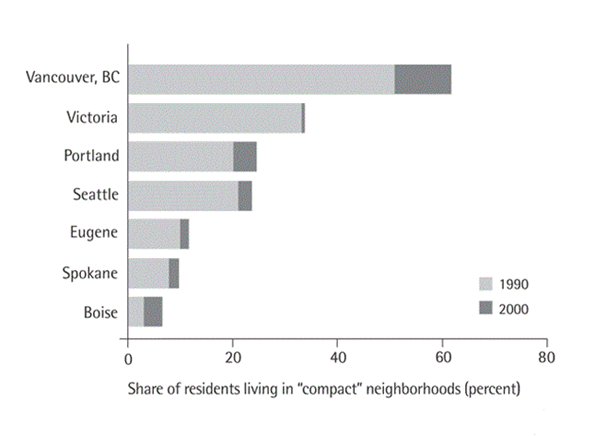
    As a result, Vancouver is one of the few North American cities that have been growing almost exclusively upwards, rather than outwards for the last century. Its narrow streets and lack of a major highway running through the city make it one of the least automobile friendly cities on the continent. Unsurprisingly, Vancouver was ranked the most smart growth oriented city in the Pacific Northwest by the Sightline Institute. Roughly three times more Vancouver residents live in compact neighborhoods as a percentage of the population compared than Portland or Seattle. This arguably makes Vancouver the most smart growth oriented city in North America.

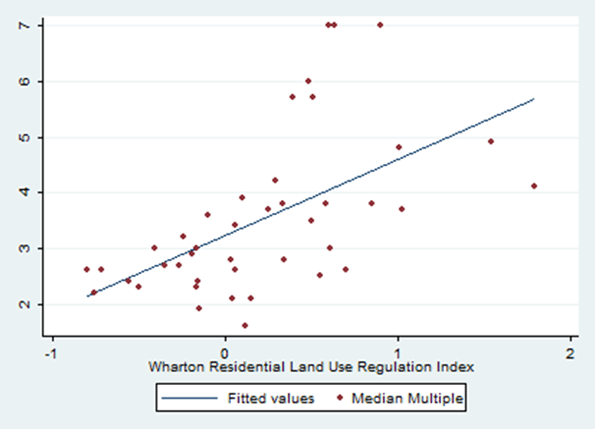
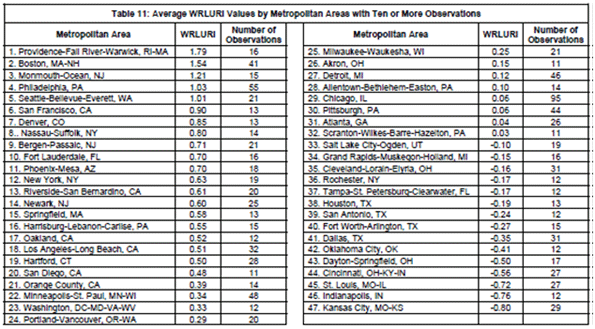
    Smart growth has become a truism for urban planners. Walkable communities with a mix of commercial and residential units combined with strict zoning regulations to encourage transit usage is a formula increasingly prescribed for North American cities. Though many smart growth principles are attractive, there is an strong correlation between heavy land use regulations and housing costs. Using data from the Wharton Residential Land Use Regulation Index (WRLURI), and Demographia’s International Housing Affordability Survey, a simple scatter plot diagram has been included to illustrate this correlation.

    The WRLURI measures the stringency of land use controls imposed on various US jurisdictions by state and local governments. There is a clear correlation between high regulations, and low housing affordability. Though the index does not include Canadian cities, it does include neighboring Seattle. Seattle ranks fifth of 47 cities on the Wharton Index. According to a recent study in Boston College International & Comparative Law Review by David Fox, Vancouver is decades ahead of Seattle in terms of smart growth policies. This means that Vancouver would rank at least fifth in North America on the index, though it is more realistic to assume it would most certainly top the index.

    In addition to smart growth policies, Vancouver also has very stringent inclusionary zoning laws. Inclusionary zoning requires developers to provide a certain number of affordable housing units in any given development. This policy might seem to make the city more affordable, but it functions exactly like rent control. Those fortunate enough to find spaces in the affordable housing units pay less, but the subsidized rent is made up for by higher rent in adjacent units. In a study of inclusionary zoning in California cities, Benjamin Powell and Edward Stringham from the Department of Economics at San Jose State University found that inclusionary zoning imposes an additional $33,000-$66,000 cost on adjacent market rate units.

    There have been some recent policy initiatives that may reduce the cost of housing marginally. In 2004, the city amended its zoning code to permit secondary suites throughout the city. Secondary suites are subdivided units of owner occupied homes that are used as rental units. This zoning change brought tens of thousands of relatively low cost units into the market. There are currently 120,000 secondary suites in the province. The city recently went one step further to allow homeowners to convert laneway garages into rental units. These units have a maximum of 500 square feet. There are 70,000 homes in Vancouver that are eligible for conversion, though it is unclear how many will take up the offer. This will add to the stock of relatively affordable rental housing in the city, but may not significantly reduce housing costs. In fact, by increasing the revenue generating potential of houses, it may actually increase the cost of purchasing a single dwelling home. After all, if the potential rental income of a single dwelling unit increases, the market price of the unit is likely to do the same. This isn’t necessarily an argument against the policy, though it does underscore the fact that housing costs in Vancouver will never decrease without liberalizing municipal and provincial land use policies.

    In short, the City of Vancouver and Province of British Columbia have chosen to favor compact growth over affordable housing costs. This likely makes the city more attractive to affluents from both the rest of Canada and abroad, but increasingly makes it unaffordable for middle class families. There is certainly some substance to the Economist’s claim that Vancouver is the most livable city on earth. It is a very attractive place for those who can afford it. Nevertheless, creating a city fit only for the wealthiest segments of society and non-families is hardly something to be proud of.

    Downtown Vancouver photo by runningclouds

    Steve Lafleur is a public policy analyst and political consultant based out of Calgary, Alberta. For more detail, see his blog.

  • The Forty-Fifth Parallel

    When I was a kid growing up in Oregon, we’d occasionally drive north on I-5 to Portland. Just north of Salem we’d pass a sign that read (if memory serves) “The 45th Parallel: Halfway between the equator and the north pole.”

    I wish I’d stopped and taken a picture of myself straddling the parallel. It would go with a collection of similar straddles: across the equator in Uganda, across the Arctic Circle in Finland, and across the 42nd parallel.

    Yes, for if you go south on I-5 (or almost any other road) the 42nd parallel, 7/15ths of the way from the equator to the north pole, is very well marked. It says “Welcome to California.” For 42 is the southern boundary of Oregon and Idaho, against California, Nevada and Utah. Likewise, heading south from Syracuse on I-81, just past Binghamton, it’s marked as “Welcome to Pennsylvania.”

    Other latitudes form important state lines: the four corners is at the 37th parallel and the 109th meridian. Colorado’s northern boundary follows the 41st parallel. And famously, the 49th parallel comprises the largest part of the US-Canada border.

    The special 45th parallel, however, is explicitly reflected in political geography in only two places: it forms Montana’s southern boundary with Wyoming. And more significantly, it forms the northern boundary of New York and Vermont against Quebec.

    Only four states lie entirely north of the 45th parallel: Alaska, Washington, Montana (almost), and North Dakota. The biggest cities are Seattle and Portland. The parallel divides the Minneapolis-St. Paul area. So counting six million from Washington, 2 million each from Oregon and Minnesota, and about 3 million from everywhere else, approximately 13 million Americans live north of the 45th parallel – or 4% of our population.

    Now consider Canada. That country’s southernmost reach is Middle Island in Lake Erie, just south of the 42nd parallel. (My mother often told me that Canada was south of California.) The 45th parallel passes north of Barrie, Ontario, which means the Toronto Metro area and Western Ontario are to the south. Further east, St. John, NB lies just to the north, but Halifax, NS is just to the south. Montreal, Ottawa, and all western cities are north of 45. I’ll guess that about 25 million of Canada’s 34 million people live north of the 45th – about 74% of the population.

    So while almost all Americans live to the south, a large majority of Canadians live to the north. So if one wants to distinguish the US from Canada by a single straight line, the 45th is as good as any. It is much better than the iconic 49th, since the largest Canadian cities are well south of that latitude.

    Heading east, the 45th passes through the southern tip of Crimea, and splits Kazakhstan and Mongolia in half. The only parts of Russia lying south are Vladivostok and the northern Caucasus. Japan, China and the Central Asian republics are almost all to the south.

    In Europe, the parallel runs through Southern France and Northern Italy. To a very rough approximation, it follows the Pyrenees-Alps mountains. In the continental EU, only Bulgaria, Greece, Spain and Portugal lie entirely to the south.

    The parallel wouldn’t have been the worst way to split up the former Yugoslavia: Zagreb is to the north, and Belgrade in the south. Further, the Serbian region of Vojvodina and the Romanian region of Transylvania are north. These areas both have large Hungarian minorities, formerly part of the Austro-Hungarian empire. Irredentist movements in Hungary might happily settle for a boundary at the 45.

    A reasonable population estimate for north of the 45th counts 200 million in the former USSR, 370 million in Europe, and 30 million in Canada, for a total of 600 million, or 10% of the world’s population.

    If the earth were a perfect sphere, then 29.3% of the surface area of the northern hemisphere would lie north of the parallel (this is a reasonably straightforward calculus problem; try it if you’re so inclined). As the earth is actually an ellipsoid, the number is somewhat smaller. Since about 5 billion people live in the Northern Hemisphere, only about 12% of them live north of 45. (Only about one million people live south of 45 S.)

    Is this surprising? Not really – one wouldn’t expect many people to be living at the north pole. But come to think of it, you’ll be surprised by how surprising this number really is.

    A reasonable rule of thumb is that cities at the same latitude will have the same average annual temperature, as they get the same amount of sunshine at the same times. Thus while Minneapolis certainly has colder winters and hotter summers than Portland, on average it should come out right. I learned this again on my last visit to Portland – summer nights in Portland are cold!

    But the rule of thumb doesn’t apply when something truly bizarre affects the climate. And that bizarre thing is the Gulf Stream, which heats Europe 5+ degrees latitude more than it should. Thus Milan (at 45) has a San Francisco climate; London, Paris and Berlin feel like Portland; Oslo, Helsinki and St. Petersburg are similar to Vancouver; and even Murmansk can’t be worse off than Anchorage.

    Thus the surprise is not how few people live north of 45, but rather how many. For of the 600 million northerly souls, only 5% of them live in North America. That means that subarctic Eurasia has nearly 20 times the population, but probably only 3 times the land area. Thus there is a seven-fold higher population density in northern Eurasia than there is in North America. I’m surprised.

    To quantify the surprise, the appropriate Gulf Stream comparison line through Europe might be at the 52nd parallel rather than 45. I chose that latitude as it roughly corresponds to the Baltic coast. Thus France, Germany, Benelux, Ukraine, Poland, and major parts of European Russia lie between 45 and 52, along with smaller countries. Estimating that combined population at about 400 million, and subtracting that from the 600 million, we get a more reasonable sub-arctic population estimate of about 200 million.

    So 200 million live in the northerly Eastern hemisphere, and 35 million live in Canada – a ratio of nearly six to one. I’m still surprised, but can no longer account for the discrepancy. Is life really that much easier in Finland?

    There is another half-way latitude worth mentioning. What latitude splits the earth’s surface in half? If you did the above calculus assignment, you will immediately know the answer: the 30th parallel. Half the earth’s surface lies within 30 degrees of the equator, and half beyond. The 30th parallel does not correspond to any political geography – it goes through Jacksonville, Baton Rouge, Beaumont, and Austin, before entering Mexico southeast of El Paso.

    So the United States mostly lies between the 30th and 45th parallels. Now isn’t that just the very best of temperate climes?

    Daniel Jelski is Dean of Science & Engineering State University of New York at New Paltz.

  • Fighting Spirit Lives On In Northern Montana

    On a hot July day in 1923 northern Montana served as the unlikely backdrop for a boxing extravaganza on the international stage. There on the plains right outside the City of Shelby, Jack Dempsey defended his World Heavyweight Boxing Championship against the hard-hitting Tommy Gibbons – the only world championship fight that Jack Dempsey ever fought that went the full fifteen rounds.

    The fight began as a real-estate stunt and a chance to get the recently oil-rich town’s name into the national media. As recounted in a 2004 Chicago Tribune story “The prestige and attention brought by a world-class sporting event could bring more money — perhaps even new residents and investment — into the community, or so thought town leaders at the time. Boomtown mentality had taken over.”

    Local boosters lauded the bustling town near the Canadian border as the Tulsa of the West and built a 40,208-seat stadium to host the match – the biggest outdoor arena in America at the time.

    But there on Champions Field the “gladiatorial battle” between Dempsey and Gibbons was fought amidst ticketing problems reminiscent of the modern day Woodstock Festival.

    Reports throughout the last days leading up to the fight cast doubt on the event. And even though Jack Dempsey stepped in to assure organizers that a bout would take place, the damage had been done. Rail services had been cancelled for special trains, advance reservations cancelled and fight fans stayed home. In the end, only 7,702 paying fans showed up. An estimated 13,000 people got to see the fight free.

    Today a local group of dedicated citizens are working hard to build a park on the original fight sight with a full size ring holding life size bronzes of Jack Dempsey, Tommy Gibbons and the referee. Kiosks throughout the park will depict pictures and audio highlights recounting fight events as well as feature the history of northern Montana homesteading, the oil and gas industry and the railroad.

    The fighting spirit lives on in other ways in Northern Montana as four-term Mayor Larry Bonderud (Shelby, Montana) and other civic leaders step into the ring of economic development on a daily basis.

    Shelby, the County seat of Toole County, is a small community that thinks and acts big. Led by Mayor Bonderud and supported by a strong cast of local and regional civic and business leaders, the city has set in play a diverse, aggressive and successful approach to economic development focusing on attracting young families by bringing new businesses, industries and family wage jobs to the community. This approach is paying off, with the city realizing a 6.31 percent population increase since 2000.

    Capitalizing on long-term vision and an entrepreneurial approach to economic development, Shelby has been successful in attracting and growing business and employment opportunities within the city and county. Going back ten years, in an effort to grow job opportunities in the region, the city worked to attract a private adult correctional center near the city. Fast forward to today, the Crossroads Correctional Facility is the top private employer within the county with over 150 employees.

    Always the promoter, Bonderud suggests that “We’re one of the safest counties anywhere,” noting some 230 correction officers, Border Patrol agents, local police and regional FBI and Montana Highway Patrol officers who work in the county with 5,100 residents.

    The community continues to work on growing its industrial base by expanding its industrial park, capitalizing on its growing wind energy developments and a concerted development effort to put together an innovative 25 million dollar intermodal facility and energy park that capitalizes on existing rail capacity, access to energy and a location adjacent to the Canadian border. The city, county and regional port authority are working and investing together to make this opportunity a reality.

    Working together seems to come naturally in these parts. Shelby and Toole County are part of the 5-county Sweetgrass Development region (Cascade, Glacier, Pondera, Teton and Toole counties) that is working collaboratively to diversify and grow the regional economy and capitalize on its competitive advantages. Nestled together adjacent to the I-15 corridor and along the Rocky Mountain front, the five county region is well positioned to meet growing needs for domestic energy consumption in the western United States. The region’s renewable energy sources including wind and hydro-electric based power, and its significant agricultural capacity (the backbone of the regional economy) have served as a buffer in the recent economic downturn.

    The Sweetgrass Development organization is spearheaded by Cascade County Commissioner Joe Briggs, an affable and effective leader who along with regional partners Corlene Martin, Cynthia Johnson, Cheryl Currie, Bill McCauley, Brett Doney and Mayor Bonderud are working to set aside parochial power plays and find economic development solutions that work for the region. A common refrain is “what is good for one is good for all”. This team spirit is exemplified by regional efforts to retain and expand value-added agriculture opportunities including milling operations and packing plants and assistance in growing the regional capacity for wind energy development and transmission.

    The region is not driven by wind and wheat alone. The area’s numerous high-tech, knowledge-based industries such as D.A. Davidson (financial consultants), Centene (healthcare services), AvMax (aviation support and management services), Intercontinental Truck Body (truck body manufacturing) exemplify the knowledge base and work ethic inherent in the region and speak of the natural appeal of the Sweetgrass region as one component in the race to attract and retain a quality work force.

    A combination of “can do” spirit and strategic investments to support growing local companies and new infrastructure to feed new industries fitting with the region’s strengths place the Shelby, MT region in a strong position to beat the recession.

    Doug McDonald is a Senior Associate with , a development firm specializing in economic development strategies and initiatives for small to medium-sized metropolitan areas and urbanizing rural regions. Delore Zimmerman is president and CEO of Praxis Strategy Group and publisher of Newgeography.com

    Photo by jimmywayne