Tag: cars

  • Higher Gas Tax Unlikely to Gain Support in Congress

    Although some infrastructure advocates are hoping to use the current budget negotiations to win support for an increase in the federal gasoline tax, the idea is unlikely to gain support in Congress or the Administration.  While  the 2010 Simpson-Bowles deficit-reduction commission proposed raising the federal gas tax by 15 cents/gallon as part of a broad deficit-reduction plan, neither House Speaker John Boehner (R-OH) nor Senate Majority Leader Harry Reid (D-NV) have endorsed the idea.  Nor is an increase in the federal gasoline tax popular among  the rank-and-file.  Most lawmakers see the pressure to raise it as coming only from a narow coalition of liberal advocacy groups and transportation stakeholders that stand to benefit from increased federal transportation spending.

    Nor is the Obama administration eager to advocate a gas tax increase whose burden would fall most severely on the middle class —precisely the constituency it  wishes to protect from the pain of any further tax increases.  Given this perception, it is almost certain that a federal gas tax increase will remain off the table in the current fiscal cliff negotiations  and probably throughout the next session of Congress as well.

    Look instead for the states to assume a larger share of responsibility for funding their transportation needs. An early harbinger may be the state of Arkansas whose voters recently approved a half-cent statewide sales tax increase to back a $1.3 billion bond issue to fund highway construction over the next ten years. The measure has been called "the largest infusion of new tax dollars into a state transportation system in recent history." Local  referenda supporting public transportation also have appeared on the ballot in numerous states.  According to the Center for Transportation Excellence,  last November voters approved 70 percent of such initiatives.

    In addition to greater local financial participation, look for a shift in emphasis from federal funding to public and private financing of large infrastructure projects. The shift will be fueled by a vastly expanded TIFIA lending authority —by more than 600 percent, from $122 million in FY 2012 to $750 million in FY 2013—and by a large reservoir of equity in pension funds and private infrastructure investment funds looking for attractive investment opportunities. (TIFIA stands for the Transportation Infrastructure Financing and Innovation Act).

    This means an expanded role for tolling, for TIFIA and private sources of capital can only be used to finance facilities that are backed by a dedicated stream of revenue to cover interest payments on the loan and the loan repayment itself.   Tolls are viewed by many as a fairer way to pay for new and reconstructed highways and bridges because, unlike the gas tax,  they are paid only by the users of the particular tolled facility. In other words, drivers in Montana will not be required to pay for a road or bridge built for and benefiting mainly  the residents of say, Texas.  

    The likely prospect that  financing will replace stagnant or dwindling federal funding, dominated discussion among financial practitioners at ARTBA’s Public-Private Partnership Conference in Washington on October 10-11. Participants were encouraged to hear that 19 projects worth $27.5 billion have already submitted letters of interest for TIFIA loans in the past three months. Four more projects totaling $1.9 billion have been announced since October.  More applications are certain to follow as it becomes clear that the Highway Trust Fund no longer can continue to serve as a source of investment capital for transportation infrastructure.


    In sum, rather than hoping for an increase in the gas tax, the transportation community should look forward to three new trends as the most likely response to the perceived inadequacy of current  transportation revenue:  greater financial participation by state and local taxpayers,  a shift in emphasis from federal funding to private and public financing, and an expanded use of tolling.
  • BBC Monster Traffic Jam List Includes Lexington, Kentucky? Really?

    The British Broadcasting Corporation (BBC) has just published a list of 10 "monster commutes" around the world. Some are to be expected, and are usually found on any list of extreme traffic congestion, such as Jakarta, Bangkok, Manila, Mumbai, Seoul, Nairobi and Dhaka.

    Lexington? However, reading further it becomes clearer that the BBC story deserves its own exhibit in the "Ripley’s Don’t Believe It" Room at the British Museum. BBC lists Lexington, Kentucky as one of 10 with "monster traffic jams." At first I thought BBC might have listed the wrong "L" place, having intended to cite Lagos or Lima instead. Not so, however since BBC quotes a Lexington commuter who claims to have spent an hour commuting to work one morning.

    That, surely is not the experience of the average Lexington resident. According to the United States Census Bureau, the average work trip travel time, one way, in the Lexington metropolitan area is 21 minutes. This compares to the US national average of approximately 25 minutes. Researchers David Hartgen and M. Gregory Fields estimated the excess travel time during peak hour in Lexington at five percent in 2003 (traffic congestion has not become serious enough to warrant the attention of the long-standing Texas Transportation Institute’s congestion reporting system). A quick review of data supplied by INRIX suggests that about 150 out of more than 180 rated US, European and Canadian metropolitan areas have worse traffic congestion than Lexington.

    Austin? Perhaps a stronger case can be made for the inclusion of Austin, Texas on the list. But even so, Austin barely makes the most congested quarter of the INRIX international list. Austin’s worse than average traffic congestion is the result of its late development an express roadway system, as this metropolitan area of the nearly 2,000,000 population was the last in the nation to connect two freeways together.

    BBC’s Austin commuter is quoted as indicating that he commutes by car, for which "I castigate myself daily." He continues: “I see two things that make me feel both guilty and shocked. A vacant city bus inching along my route and an empty tram cutting across traffic at 5pm." He misses the point. If the city bus is a vacant and the tram is empty, it is because they do not meet the needs of a sufficient number of customers (needs, which by the way can only be defined by consumers, not planners).

    The proof is the crowded buses and trains that converge on six large downtown areas in the United States, where 40 percent to 75 percent of commuters use transit. This is not because the people who work south of 59th Street in Manhattan, in Chicago’s Loop, or the downtown areas of Philadelphia, Washington, Boston or San Francisco have more effectively managed their guilt than the Austin commuter. It is rather because transit meets their needs. Commuters are rational. They take the mode of transport that best suits their needs. Transit’s market shares around the country (many of them miniscule) speak volumes about how well transit meets the needs of potential customers.

    Finally, BBC’s Austin commuter claims that it takes 45 minutes to drive three kilometers (2 miles) to work (walking would be as fast for most people). It is hard to imagine a more unrepresentative commute in Austin. According to the United States Census Bureau, the average one way commute in Austin in 2011 was 26 minutes. Somehow 85 percent of Austin commuters get to work in less time than the Austin commuter, and they travel a lot farther.

  • China Personal Vehicles Now More than US

    China Web quotes the nation’s Ministry of Public Security to the effect that China’s personal vehicle fleet (automobiles and motorcycles) reached 217 million at the end of June. This would place China ahead of the United States, which had approximately 200 million personal vehicles in 2010 and led the world for perhaps for most, if not all of the last century.

    China has 114 million automobiles and 103 million motorcycles, a substantially different mix than in the more affluent United States. The US has 192 million automobiles and 8 million motorcycles.

    Motorcycles are particularly useful in China’s growing and congested cities and are the logical stepping stone for buyers who are likely to eventually own cars. Many of the motorcycles are "E-Bikes," which use a plug-in battery operated technology. These motorcycles are so fuel efficient that their greenhouse gas (GHG) emissions per passenger kilometer approximate those of a full bus.

    In 2011, China also took the lead in freeway mileage, displacing the US. The United States, with its interstate highway system had led the world in freeway mileage for at least one-half century.

  • Transportation for Tomorrow: Driverless Cars

    Economist Clifford Winston of the Brookings Institution outlines the surface transportation system of the future in a Wall Street Journal commentary, "Paving the Way for Diverless Cars." Winston notes "a much better technological solution is on the horizon" than high speed rail "as an effective way to reduce highway congestion" as the Obama administration in Washington and the Brown administration in Sacramento contend. Indeed, not even the voluminous planning documentation used to justify high speed rail provides evidence that the 21st century edition of an early 19th century technology can materially reduce traffic congestion.

    Already Google has conducted experiments with the automated car that have been so successful that they are now permitted in Nevada. Winston suggests that by automating cars, it will be necessary to separate automobile traffic from truck traffic, which will make it possible to provide additional traffic lanes within the existing road footprint. Non-automated cars and trucks would continue to operate in conventional, wider lanes on the same right-of-way. Another advantage would be that with the automated control, more cars could be accommodated in each lane. The need for highway expansion would be largely displaced by substantially improving capacity by upgrading highways with 21st century technology.

    Winston has been a critic of overly expensive urban rail systems and transit subsidies. Driverless cars were also the subject of a Wall Street Journal commentary by Randal O’Toole in 2010.

  • Learning the right lessons from LA’s “Carmageddon”

    Carmageddon has come and gone, and the world didn’t end. The catalyst for the predicted disaster was the closure of Interstate 405 in Los Angeles for construction for the weekend of the 16th and 17th of July. Freeway closures aren’t all that unusual, but the 405 is not a regular freeway. It is both the busiest, and most congested road in America. The 405 carries an estimated half million vehicles per weekday. Had traffic been even close to normal volumes—even weekend volumes—the event would have earned the nickname. However, less people drove. Way less people. In fact, the roads were unusually empty.

    There are two lessons that one might be tempted to take home from this:

    1. Persuasion can cause people to drive less.
    2. America could do with less freeways.

    These are the wrong lessons to take away. Using moral suasion or fear to alter people’s behavior can work under certain circumstances, but it hasn’t helped alter people’s day to day commuting patterns. People drive more now than ever, even though the glamorization of automobiles has diminished, and the appeal of urban living has increased. There are plenty of people who choose urban, auto-free living, but that’s a choice that isn’t made by public interest campaigns. It may be the case that there are compelling arguments for stalling the growth of urban freeways, but using Carmageddon to make that point would be disingenuous.

    The two real lessons of Carmageddon are:

    1. Persuasion can convince people to drive less under unusual circumstances–temporarily.
    2. When faced with the right incentives, people will drive less.

    The fear stirred up about the closure for months obviously worked. Billboards went up; the media counted down; celebrities Tweeted warnings at the behest of the city; Mayor Villaraigosa advised people to “go on vacation,” and councilor Paul Koretz told people to “stay the Hell away.” But this only works in acute situations, where there is a credible threat. The fact that the apocalyptic term Carmageddon caught on certainly helped permeate the public consciousness. But everyone knows LA traffic is usually incredibly bad, yet they endure it on a daily basis. People in LA are grudgingly willing to tolerate the country’s worst traffic, but they’re not willing to venture into the city with Interstate 405 closed unless they have to. Since it was on a weekend, most of them didn’t. Many radio shows even pre-taped segments to keep their guests from getting stuck in traffic. Several film and television productions were shut down for the weekend. These types of deferrals can be arranged, but rarely, and with sufficient notice. Citing Carmageddon as an example of how we can do with less automobile traffic is like pointing to a blackout as an example of how we can reduce electricity consumption.

    The most important lesson, though, is that people respond to incentives. Since the city obviously doesn’t want people to “stay the Hell away” forever, they’re going to have to come up with another way to use incentives if they want to tackle gridlock. LA drivers spend over half a billion hours per year stuck in excess traffic delays, which costs the economy roughly $12 billion dollars. Adding more freeway lanes seems like an obvious solution, except for the fact that it doesn’t work. Studies have shown that every percentage increase in roads leads to an equal percentage increase in driving. In other words, more roads mean more driving. There are certainly exceptions to this, since the optimal level of roads isn’t zero, but it does illustrate the fact that we can’t just build our way out of traffic congestion. Instead, we need to introduce strong incentives other than fear to reduce congestion. That incentive is congestion pricing.

    While road tolls aren’t the most appealing thing to drivers, electronic tolls can reduce the amount of discretionary driving, and convince some number of people to take transit rather than driving. Some would describe this approach as a “War on Drivers,” but the reality is that the intention is precisely the opposite. It is an attempt to make sure that drivers can actually get where they need without soul crushing traffic. If that means they’ll have to pay $2 to drive to the store to get bread, maybe they’ll walk to the corner store instead. Incentives are important, and even small incentives can radically shift people’s behavior. Goading people into changing their behavior rarely works. Otherwise no one would drink cola, or eat trans-fats.  On ordinary days, people need to get places, and for most people, driving is more convenient. The number of people for which driving is the most convenient choice will decline if the urban renaissance being predicted does materialize, but we can’t count on the majority of existing drivers to abandon their cars and move to city cores. Acknowledging that cars will be the dominant mode of transportation for the foreseeable future, and that people drive more than they need to when it is free are key to addressing traffic congestion. Otherwise, everybody will continue to sit in traffic.

    This piece originally appeared at the Frontier Centre for Public Policy Blog.

    Steve Lafleur is a public policy analyst with the Frontier Center for Public Policy.

  • Exaggerating in Orlando: Sunrail

    For decades taxpayers have paid billions to finance major transportation project cost overruns far exceeding the routinely low-ball forecasts available at approval time. This has been documented in a wide body of academic literature, the most important of which was conducted by Bent Flyvbjerg of Oxford University, Nils Bruzelius University of Stockholm and Werner Rothengatter of the University of Karlsruhe in Germany (Megaprojects and Risk: An Anatomy of Ambition).

    Major project advocacy, however, has descended to a new low of unprecedented and absurd exaggeration. This is evident in the current public policy debate about the Sunrail commuter rail project in Orlando. Two examples make the point

    Exaggeration #1: Job Creation: The Central Florida Partnership claims that Sunrail will create 10,000  jobs. "almost immediately." This would be quite an accomplishment. The Sunrail project is currently projected to cost approximately $850 million for just the first segment. Every cent of the likely cost overruns will be on a blank check drawn the account of Florida taxpayers.

    At Sunrail’s claimed rate of job creation,  the Obama Administration’s $800 million "shovel ready" stimulus program (enacted in 2009), would have "almost immediately" produced more than nine million jobs. By now, the unemployment rate would have been reduced to little above 2 percent, lower than at any point in the more than 60 years of available data. Of course, and predictably, the stimulus program did no such thing, not least because a job created by public spending is likely to destroy more than one sustainable job in the private sector.

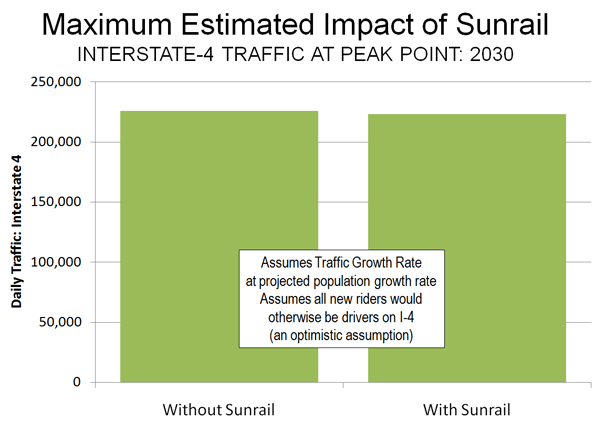
    Exaggeration #2: Sunrail Will Make a Difference: The proponents imply that Sunrail will carry a significant number of trips in the Orlando area, claiming that the line will carry one lane of freeway traffic and that it will give central Florida residents an alternative to high gasoline prices. In fact, even if Sun Rail reaches its ridership projections, it would take a full day of train travel to remove less than an hour’s peak hour freeway volume. Needless to say, no one will notice any fewer cars on the freeway (Figure).

    Further, Sunrail will not provide an alternative to the overwhelming majority of central Floridians, since it will attract only 1,850 new round-trip riders per day by 2030 (Sunrail’s number). Spending $850 million on Sunrail is the same as the taxpayers giving each new rider a gift of $450,000.

    The Need to Set Rational Priorities: All of this is occurring in the face of an national fiscal crisis so severe that even the AARP has expressed its willingness to consider cuts to Social Security. As an AARP spokesperson put it "You have to look at all the tradeoffs." Indeed.

  • The Transportation Politics of Envy: The United States & Europe

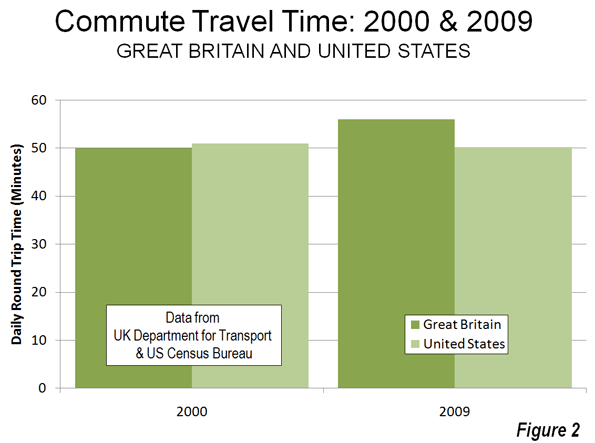
    The Department for Transport of the United Kingdom may be surprised to learn that the average round-trip commute in the nation is up to a quarter hour less than reflected in its reports. This revelation comes from an article in The Economist, ("Life in the Slow Lane") citing a survey indicating that the average commuter in the United Kingdom spends less than 40 minutes daily traveling to and from work in 2000. According to Regional Transport Statistics, published by the Department for Transport, the average commuter spent 50 minutes traveling to and from work in 2000. The UK government further indicates that the average commute time had risen to 56 minutes by 2009. The Economist relies on the much lower figure (and other similarly low estimates from other European nations) in fashioning an article criticizing transportation policy in the United States.

    Shorter US Commute Times: The Economist begins with the contention that the average work trip travel time in the United States is substantially greater than that of the number of European nations. The most reliable data says otherwise.

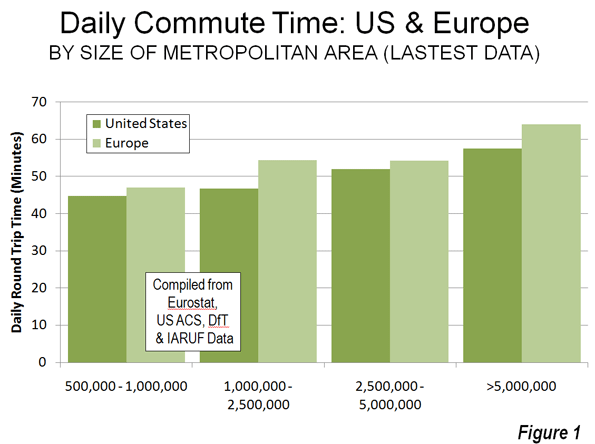
    The most comprehensive work trip data in Europe is maintained by Eurostat, the statistical agency of the European Commission. The Eurostat data indicates that average commute times in Europe are somewhat more than in the United States in metropolitan areas of similar size (Figure 1), when compared to the comprehensive data from the US Census Bureau. For example, among metropolitan areas of more than 5 million population, the daily round-trip average commute is under 58 minutes in the United States, less than the 64 minutes in Europe. European commute times are longer in all population categories (Note).

    Overall, the average round-trip travel time in the US metropolitan areas over 500,000 population is 23.6 minutes and 25.3 minutes in the European metropolitan areas.

    Moreover, there are indications that the US trend is favorable, at least in comparison to the United Kingdom. Between 2000 and 2009, UK government data shows average round trip commute times to have increased six minutes, while US government data indicates a decline of nearly one minute (Figure 2).

    The US: Less Traffic Congestion:  The Economist then asserts that traffic congestion is worse in US metropolitan areas than in Europe. According to The Economist:

    …with few exceptions (London among them) American traffic congestion is worse than western Europe’s. Average delays in America’s largest cities exceed those in cities like Berlin and Copenhagen.

    The reality is the opposite, according to the INRIX Traffic Scorecard and a more correct rendering of the point above would have been:

    … with few exceptions (Los Angeles among them) western Europe’s traffic congestion is worse than America’s. Average delays in some of western Europe’s smallest cities exceed those in cities like Atlanta, Houston and Dallas-Fort Worth.

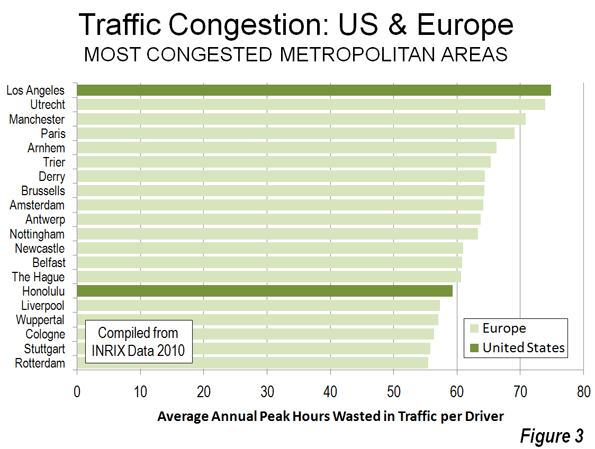
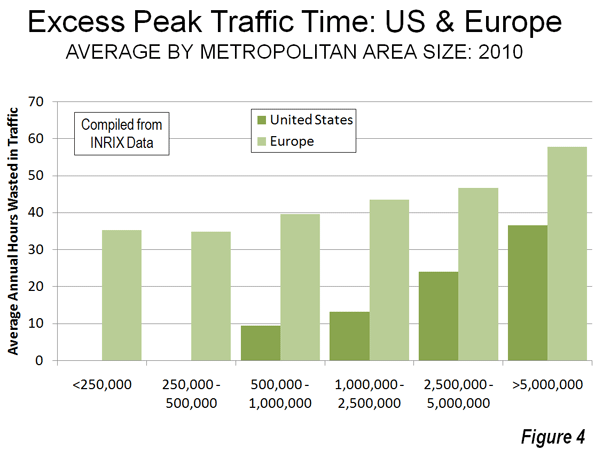
    INRIX compared 2010 peak period traffic delays in metropolitan areas of the United States and Europe. As with commuting time, the average travel delay per driver was greater in Europe than in the United States in every population classification. While Los Angeles has the worst congestion the approximately 200 metropolitan areas (one-half in the US and one-half in Europe), the next 13 worst were in Europe (Honolulu ranks 15th) and 18 of the worst 20 were in Europe (Figure 3). The third worst ranking US metropolitan area was San Francisco, at 28th, while Washington was 29th. Only seven of the 50 most congested metropolitan areas were in the United States. Of course, anyone who has driven extensively in the metropolitan areas of the US and western Europe knows that congestion is generally far worse in Europe, a fact confirmed by the INRIX data.

    Indeed, traffic congestion in the smallest European metropolitan areas (under 500,000) was worse than in the largest US metropolitan areas, those with over 5 million (There were no US metropolitan areas with less than 500,000 population in the INRIX data, see Figure 4). Those automobile-oriented, highly suburbanized banes of urban planning, Atlanta, Dallas-Fort Worth and Houston all ranked in the middle, between 90th and 110th. At least 75 European metropolitan areas had worse traffic congestion than all three.

    High-Speed Rail Envy: Finally, The Economist decries the lack of high-speed rail in the United States, noting that:

    The absence of true high-speed rail is a continuing embarrassment to the nation’s rail enthusiasts.

    It is hard to imagine a more pathetic standard for evaluating public policy than "satisfying rail enthusiasts."  It is well known that that governments from Washington to London, Athens and Lisbon are in serious financial difficulty. It is a time for limiting public expenditures to matters of genuine priority. That does not include high speed rail.

    The intercity road and airport systems are principally financed by users, in contrast to the operating subsidies and intense (100 percent) capital subsidies required by high-speed rail. This is evident in California with its now $65 billion first line that has more than doubled in real cost in a decade. It is also evident, closer to home for The Economist, where the controversial HS-2 high-speed rail proposal from London to Manchester and Leeds could easily double in cost (to £65 billion), based upon the best international research. Astoundingly, a doubling of cost would be a bargain for Britain’s taxpayers compared to two previous high-speed rail failures in the same corridor (See: The High Speed Rail Battle of Britain). The recurring environmental justifications ring hallow due to the high costs and the three generations or more it would require in California and the United Kingdom to eliminate the first gram of greenhouse gas.

    Transport policy could be improved in the United States, as well as in Europe. However, the starting point must be facts, not fancy, and certainly not envy.

    ——-

    Note: this analysis includes all data available for metropolitan areas in the United States (metropolitan statistical areas) and Europe (larger urban zones, the closest equivalent to US metropolitan areas). US data is complete, covering all 100 metropolitan areas with more than 500,000 population and is from the United States Census Bureau. European data is principally from Eurostat (94 larger urban zones and three from other sources). Paris data is from IAURIF (Institut d’aménagement et d’urbanisme de la région Île-de-France). Newcastle-upon-Tyne and Leeds data is from the UK Department for Transport.  Data is not available for a number of metropolitan areas with more than 500,000 population in Europe.

  • United States: Less Congestion than Europe per INRIX

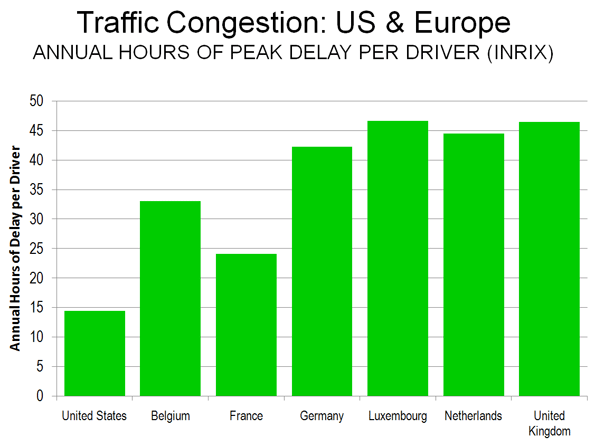
    A new international report indicates that traffic congestion in the United States is far better than in Europe. The report was released by INRIX, an international provider of traffic information in 208 metropolitan areas in the United States and six European nations.

    The report shows that the added annual peak hour congestion delay in the United States is roughly one-third that of Europe. The rate of France was somewhat less than twice the rate of the US and rates in Luxembourg, the United Kingdom, Germany and the Netherlands were three times as high.

    In the United States, peak period traffic congestion adds 14.4 hours annually per driver. This compares to an average delay per year of 39.5 hours for the European nations. Luxembourg, the United Kingdom, the Netherlands and Germany had the greatest lost time, at from 42 to 47 hours. Again, France scored the best in Europe, at 24.1 hours of lost time in traffic per year (Figure).

    Among individual metropolitan areas. Los Angeles had the greatest peak hour delay, at 74.9 hours annually. Utrecht (Netherlands), Manchester (United Kingdom), Paris, Arhem (Netherlands) and Trier (Germany) second through sixth in the intensity of traffic congestion, all with 65 or more hours of delay per driver per year.

    These findings are consistent with international data indicating that traffic congestion tends to be more intense where there are higher urban population densities.

  • Petrol a Green Fuel? The Volkswagen 261 Mile per Gallon Car

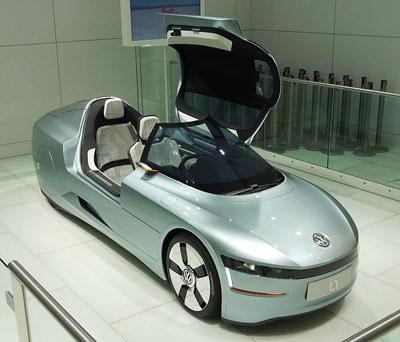
    There have been reports for some years about the Volkswagen 1-litre car, so called because it would travel 100 kilometers on one litre of fuel. That is the equivalent of 235 miles per gallon. Earlier reports were that the car would be marketed by now.

    Now Volkswagen indicates that the car will be produced "within the next few years." The car will be called the XL1. However, rather than being a 1 L car it will be a 0.9 L car, achieving 261 miles per gallon. The improvement is the result of adding an electric motor that will make the car a plug-in hybrid.

    This is just further indication of reality that technological improvements can materially reduce greenhouse gas emissions. Indeed, if the entire automobile fleet could obtain this fuel efficiency by 2050, greenhouse gas emissions from cars would be reduced more than 80 percent, despite substantial increases in driving. This development may mean that petroleum itself could emerge as a "green fuel."

    Moreover, this advance is consistent with finding by McKinsey & Company and the Conference Board, in a report sponsored by the Environmental Defense Fund, the Natural Resources Defense Council (NRDC), Shell, National Grid, DTE Energy and Honeywell that "….no change in thermostat settings or appliance use, no downsizing of vehicles, home or commercial space and traveling the same mileage” and no “shift to denser urban housing" would be necessary to achieve substantial greenhouse gas emission reductions in the United States.

    Volkswagen L1 (2009) photo by RudolfSimon

  • Cars, People & Carbon Neutrality: A Symbiosis

    The potential for a symbiotic relationship between the environment, cars and people may be about to take a giant leap forward. London’s Daily Telegraph reports that a group of engineers from Genco have developed a bio-bug (Volkswagen bug) that runs on human waste. The car is powered for 10,000 miles from the excrement from 70 households (annually). The human waste bio-bug would be carbon neutral because it would not add any greenhouse gas to that already produced. The fuel would be produced at sewage plants, which already produce the necessary methane fuel from waste. While the technology, fully implemented, would not produce sufficient methane to power the entire fleet of cars, it would be a significant step forward and is further indication of the potential for technology to make substantial greenhouse gas emission reductions.

    Bio-Bug Photo