Tag: Census 2010

  • Bay Area Growth Slowing

    New 2010 Census data indicates that the two major metropolitan areas in the San Francisco Bay Area, San Francisco and San Jose, have settled into a pattern of slow growth.

    San Francisco: The San Francisco metropolitan area grew 5.1 percent between 2000 and 2010, a more than one-half drop from the 1990 to 2000 rate of 11.9 percent, from 4,124,000 to 4,335,000, for a gain of 211,000. Only in one decade (1970 to 1980) have the five counties of the metropolitan area gained at such a slow percentage rate.

    The historical core municipalities of San Francisco and Oakland gained 20,000 residents, from 1,176,000 to 1,196,000. San Francisco reached a population of 805,000, up from 777,000 in 2000. As in the case of both the city of Los Angeles and Los Angeles County, the State Department of Finance estimate (857,000) was well above the Census Bureau population count (We had previously questioned the aggressive population projections released by the State Department of Finance in an Orange County Register op-ed,  60 Million Californians: Don’t Bet on It). Even with this increase, however, the city of San Francisco remains below its population peak of 827,000, recorded in a 1945 special census, according to the Census Bureau.

    The city of Oakland declined in population from 399,000 to 391,000. The historical core municipalities grew 1.7 percent, compared to the 6.5 percent growth rate of the suburbs. The historical core municipalities captured nine percent of the metropolitan area growth, with 91 percent of the growth going to the suburbs. The State Department of Finance estimate, at 430,000, was more than 10 percent above the actual Census Bureau count. The city of Oakland also reached its population peak of 401,000 in a 1945 special census.

    While San Francisco remains the second largest metropolitan area in the state (after Los Angeles), this distinction could soon be lost. Riverside-San Bernardino registered a population of 4,225,000 and at growth rates of the last decade, would pass San Francisco by 2012.

    San Jose: The San Jose metropolitan area grew 5.8 percent between 2000 and 2010, from 1,736,000 to 1,837,000. The historical core municipality of San Jose rose 5.0 percent, from 901,000 in 2000 to 946,000 in 2010. San Jose captured 44 percent of the metropolitan area growth, the highest figure among the reporting metropolitan areas except for the largely suburban historic municipality of Oklahoma City (47 percent). The State Department of Finance had estimated the city of San Jose population at 1,023,000 in 2010, indicating that its growth estimate for the decade was more than 2.5 times the increase indicated in the census count.

    The suburbs of the San Jose metropolitan area grew 6.7 percent and accounted for 56 percent of the population growth.

  • New Jersey: Still Suburbanizing

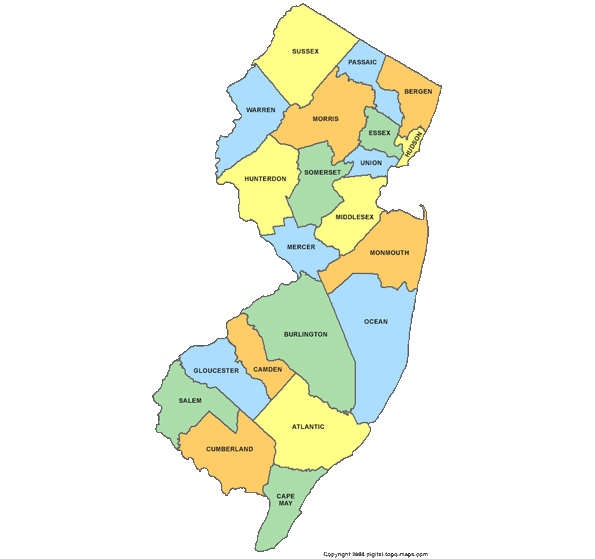
    The state of New Jersey virtually defines suburbanization in the United States.  New Jersey is not home to the core of any major metropolitan area but, major portions of the nation’s largest metropolitan area (New York) and the fifth largest metropolitan area (Philadelphia) are in the state (See map). These two metropolitan areas comprise 17 of the state’s 21 counties. Another county (Warren) is in the Allentown, Pennsylvania metropolitan area, while Atlantic (Atlantic City), Cumberland and Cape May are single-county metropolitan areas. No one, however, should make the mistake of imagining that New Jersey is wall to wall suburbanization. In the 2000 census, more than 60 percent of the state’s land area was rural, with urban areas (areas of continuous urban development) making up less than 40 percent of the state’s land area, while 94 percent of the 2000 population was urban (which includes suburban).

    Map courtesy of Passaic Public Library

    The recently released 2010 census data indicates that the dispersion of New Jersey population, which was underway by 1900 and continued apace in the last decade.

    New Jersey’s Larger Municipalities: This is not to suggest that it was a bad decade for the larger municipalities in the state. However, the 20th century was not kind to New Jersey’s largest municipalities. At some point during the century, six municipalities reached a population of 100,000 or more. Four of these municipalities were near the city of New York and were eventually engulfed by its suburbanization (Newark, Jersey City, Paterson and Elizabeth). Another, Camden, was engulfed by Philadelphia’s expansion and the last, the state capital Trenton, is midway between the cores of the two metropolitan areas and has more recently become a part of the New York metropolitan area.

    The new decade started out better for these municipalities. Newark, Jersey City, Elizabeth and Camden gained population between 2000 and 2010. However, even after the population gains, Newark’s population remains 165,000 (37 percent) below its 1930 peak. Jersey City remains 70,000 (22 percent) below its 1930 peak, despite the growth of a new financial district just across the Hudson River from lower Manhattan. Camden remains approximately 35,000 (37 percent) below its 1950 peak. Of the four municipalities gaining population, Camden did the best, adding 6.9 percent to its population, a full 50 percent above the statewide increase of 4.5 percent.

    Paterson and Trenton posted small population losses. Trenton remains nearly 45,000 (33 percent) below its 1950 peak (Table 1).

    Table 1
    New Jersey Municipalities Achieving 100,000 Population
    Census Population Peak
    Municipality 2000 2010 Change % Change Population Year
    Newark      273,946    277,140       3,194 1.2%     442,337 1930
    Jersey City      240,055    247,597       7,542 3.1%     316,715 1930
    Paterson      149,222    146,199      (3,023) -2.0%     149,227 2000
    Elizabeth      120,568    124,969       4,401 3.7%     124,969 2010
    Trenton        85,403      84,913         (490) -0.6%     128,009 1950
    Camden        78,672      84,136       5,464 6.9%     124,555 1950
    Total      947,866    964,954     17,088 1.8%   1,285,812
    Balance of State   7,466,484  7,826,940    360,456 4.8%
    New Jersey   8,414,350  8,791,894    377,544 4.5%   8,791,894 2010


    Elizabeth and Paterson however have been far more successful in retaining their population than other older municipalities, both in New Jersey and around the nation. Both Elizabeth and Paterson have become majority Hispanic and have a sizeable African American community. They also have a large immigrant community.  In Elizabeth, 45 percent of the population is foreign born, almost four times the national rate. Paterson has an immigrant population of 25 percent.  

    The Older Suburban Counties: Nonetheless, even with the modest population reversals in four of the five municipalities in the Philadelphia and New York metropolitan areas, their corresponding older suburban counties grew slower than the rest of the state in the 2000s. Combined, Camden, Essex, Hudson, Passaic and Union counties – fast growing suburbs of the early 1900s – grew at a rate of 1.6 percent, compared to the statewide growth rate of 4.5 percent, capturing 12 percent of the statewide growth.  (Table 2).

    Table 2
    New Jersey County Population Growth by Area
    Area 2000 2010 Change % Change Share of Growth
    5 Older Suburban Counties  2,923,130  2,969,617    46,487 1.6% 12.3%
    Balance of NY & Phila Metropolitan Counties  4,887,467  5,184,873  297,406 6.1% 78.8%
    Outside NY & Phila Metropolitan Area     603,753     637,404    33,651 5.6% 8.9%
    Total  8,414,350  8,791,894  377,544 4.5% 100.0%
    Note: 5 Older Suburban Counties Include Camden, Essex, Hudson, Passaic and Union


    The Newer Suburban Counties: The bulk of New Jersey’s growth has taken place, as in the rest of the country, in more newly suburbanizing counties of the Philadelphia and New York metropolitan areas (Note 1). The growth rate in these counties was 6.0 percent, well above the statewide growth rate of 4.5 percent. Overall, the outer suburban counties accounted for 73 percent of the state’s population growth during the 2000s. The strongest growth was in Ocean County, which is at the furthest distance (fifty to one hundred miles) from New York City.  Ocean County grew 13 percent, adding 66,000 people to its population, nearly one-fifth of the state population gain. Gloucester County, in the Philadelphia area also grew 13 percent, adding 33,000 to its population. Ocean and Gloucester accounted for more than one-quarter of New Jersey’s population growth. Only one other county added more than 50,000 people, Middlesex, which is adjacent to the New York City borough of Staten Island in New York, much of which is made up of postwar suburbanization.

    Counties Outside the Large Metropolitan Areas: The counties outside the New York and Philadelphia metropolitan area, Atlantic, Cape May, Cumberland and Warren added 5.6 percent to their population and nine percent of the state’s population gain. The largest growth was in Atlantic County (8.7 percent) and Cumberland County (6.1 percent), both adjacent to counties of the Philadelphia metropolitan area. Cape May County had the largest population loss in the state, at 4.9 percent (Essex County, where Newark is located, lost 1.2 percent, the only other county to lose population).

    Small Area Analysis: The dispersion of the population is also illustrated by "place" data, which includes incorporated municipalities (Note 2) and "census designated places."

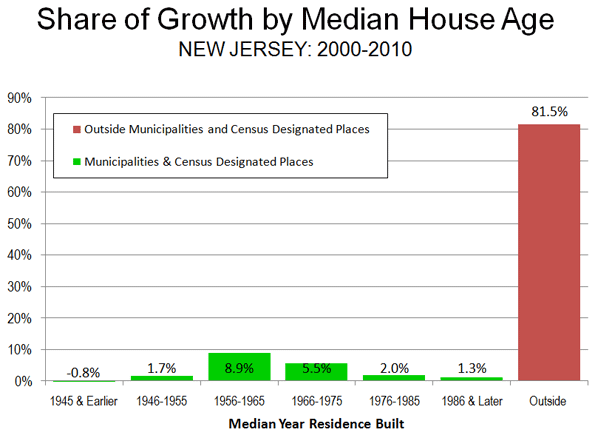
    Generally, newer housing reflects the distance of suburbs from the urban core. Gaining a larger share of population growth, this demonstrates a primarily  suburban, rather than urban core oriented, expansion.  An analysis of the more than 500 places (municipalities and "census designated places") indicates that the greatest share of New Jersey’s growth is in new suburban areas.

    Among places in which housing has a median construction date of 1945 or earlier, there was a 0.8 percent reduction in population. The growth rate then rises with each 10 year increment, reaching 4.0 percent in places with a median construction date of 1976 to 1985 and 11.1 percent for places with a median construction date of later (though this is the smallest category).

    However, the growth in these places accounts for only 18.5 percent of the state’s population gain. The other 81.5 percent was outside the incorporated municipalities and the census designated places. This population is generally in the state’s townships, some of which are older (such as North Bergen or Woodbridge), but most of which are much newer.  However, much of the growth in the townships was in newer areas, with 84 percent in areas with median construction dates of 1966 or later (Note 3)

    Thus, all-metropolitan New Jersey is becoming more suburban, while older, major municipalities such as Newark, Jersey City and Camden are enjoying a welcome respite from their generally steep declines.

    Note 1: These counties include Bergen, Burlington, Cumberland, Hunterdon, Mercer, Middlesex, Monmouth, Morris, Ocean, Salem, Somerset and Sussex.

    Note 2: New Jersey township officials have been engaged with the Census Bureau in a dispute over whether New Jersey townships should be considered incorporated. This analysis uses the "non-incorporated" status as defined by the Census Bureau, without taking a position on the nature of the disagreement.

    Note 3: The Census Bureau routinely makes changes to "census designated places" between censuses. As a result it is not possible to reconcile the township and place totals to the state total. There is a discrepancy of approximately 1.5 percent. This discrepancy is small enough to make the township figures generally reflective of the median construction dates.

    Wendell Cox is a Visiting Professor, Conservatoire National des Arts et Metiers, Paris and the author of “War on the Dream: How Anti-Sprawl Policy Threatens the Quality of Life

  • The Protean Future Of American Cities

    The ongoing Census reveals the continuing evolution of America’s cities from small urban cores to dispersed, multi-polar regions that includes the city’s surrounding areas and suburbs. This is not exactly what most urban pundits, and journalists covering cities, would like to see, but the reality is there for anyone who reads the numbers.

    To date the Census shows that  growth in America’s large core cities has slowed, and in some cases even reversed. This has happened both in great urban centers such as Chicago and in the long-distressed inner cities of St. Louis, Baltimore, Wilmington, Del., and Birmingham, Ala.

    This would surely come as a surprise to many reporters infatuated with growth in downtown districts, notably in Chicago, Los Angeles, Denver and elsewhere. For them, good restaurants, bars and clubs trump everything. A recent Newsweek article, for example, recently acknowledged Chicago’s demographic and fiscal decline but then lavishly praised the city, and its inner city for becoming “finally hip.”

    Sure, being cool is nice, but the obsession with hipness often means missing a bigger story: the gradual diminution of the urban core as engines for job creation. For example, while Chicago’s Loop has doubled its population to 20,000, it has also experienced a large drop in private-sector employment, which now constitutes a considerably smaller share of regional employment than a decade ago. The same goes for the new urbanist mecca of Portland as well as the heavily hyped Los Angeles downtown area.

    None of this suggests, however, that the American urban core is in a state of permanent decline. The urban option will continue to appeal to small but growing segment of the population, and certain highly paid professionals, notably in finance, will continue to cluster there.

    But the bigger story — all but ignored by the mainstream media — is the continued evolution of urban regions toward a more dispersed, multi-centered form. Brookings’ Robert Lang has gone even further, using the term “edgeless cities” to describe what he calls an increasingly “elusive metropolis” with highly dispersed employment.

    Rather than a cause for alarm, this form of  development  simply reflects  the protean vitality of American urban forms.  Two regions, whose results were released last week, reveal these changing patterns. One is the Raleigh region, which has experienced a growth rate of 42%, likely the highest of the nation’s regions with a population over 1 million. This metropolitan area, anchored by universities and technology-oriented industries, is among the lowest-density regions in the country, with under 1,700 persons per square mile, slightly less than Charlotte, Nashville and Atlanta.

    Unlike the geographically constrained older urban areas, Raleigh’s historical core municipality experienced strong growth, from 288,000 to 404,000, a gain of 40%. This gain was aided by annexations that added nearly 30% to the area of the municipality (from 113 to 143 square miles). The annexations of recent decades have left the city of Raleigh with an overwhelmingly suburban urban form. In 1950, at the beginning of the post-World War II suburban boom, the city of Raleigh had a population of 66,000, living in a land area of only 11 square miles.

    Even here, however, the suburbs (the area outside the city of Raleigh) gained nearly two-thirds of the metropolitan area growth (65%) and now have 64% of the region’s population. Over the last ten years, the suburbs have grown 43%. It is here that much of the economic growth of the Research Triangle has taken place, as companies concentrate in predominately suburban communities such as Cary.

    Yet in most demographically healthy urban regions, the growth continues to be primarily in the suburban centers. One particularly relevant example is the Kansas City area, a dynamic region anchoring what we have identified as “the zone of sanity.” Like most American regions, the Kansas City area is growing, but in ways that often do not resemble the fantasies of urban density boosters.

    KC’s growth pattern is important and could be a harbinger of what’s to come in this decade. Along with Indianapolis, this resurgent Heartland region is expanding faster than the national average. It is also attracting many talented people, ranking in our top ten list of the country’s “brain magnets,” a performance better than such long-standing talent attractors as Seattle, Portland, San Francisco, and Boston. Between 2007 and 2009, the Kansas City region’s growth in college-educated residents was more than twice the rate of our putative intellectual meccas of New York, Chicago or Los Angeles.

    But despite the wishes of some  in Kansas City’s traditional establishment, this cannot be interpreted as meaning that  the “hip and cool” are being lured en masse to the city’s inner core. Over the past decade, as in most American regions, Kansas City has expanded far more outward than inward. Despite a modest increase in the city’s population of some 18,000 — much of it in the city’s furthest urban boundaries — the city’s population remains below its 1950 high. On the other hand, some 91% of its 200,000 population increase occurred in the suburban periphery.

    Critically, it is important to note that this expansion reflects not so much the growth of “bedroom” communities, but a dramatic shift of employment to the periphery. By far the most important center for this new suburban growth in jobs and people lies across the river in Johnson County, Kan.. Over the past decade, Johnson County has accounted for roughly half of the region’s total growth.

    Johnson County  – which boasts among the highest levels of educated people in the country — also has become the primary locale for many technology and business service firms, with more people commuting into the area than out. This reflects an increasingly suburbanized economic base. Over the past decade the urban core of Jackson County has lost 42,000 jobs, while the surrounding suburbs have grown by 20,000, with the biggest growth in largely exurban Platte County.

    So what does this tell us about the future of the American urban region?  Certainly the expansion of relatively low-density peripheral areas negates the notion of a  ”triumphant” urban core. Dispersion is continuing virtually everywhere, and with it, a movement of the economic center of gravity away from the city centers in most regions.

    But in another way these patterns augur a bright future for an expansive American metropolis that, while not hostile to the urban center, recognizes that most businesses and families continue to prefer lower-density, decentralized settings.  The sooner urbanists and planners can accommodate themselves to this fact, the sooner we can work on making these new dynamic patterns of residence and employment more sustainable and livable for the people and companies who will continue to gravitate there.

    This piece originally appeared at Forbes.com

    Joel Kotkin is executive editor of NewGeography.com and is a distinguished presidential fellow in urban futures at Chapman University, and an adjunct fellow of the Legatum Institute in London. He is author of The City: A Global History. His newest book is The Next Hundred Million: America in 2050, released in February, 2010.

    Kansas City skyline photo by Tim Samoff

  • Major Metropolitan Areas: Summary of the First 20

    Data is now available for 20 of the nation’s 52 metropolitan areas with more than 1,000,000 population. The early results indicate a pattern of accelerating dispersion of the population to the suburbs as is indicated in the table below. Thus far, historic core municipality growth has been approximately one-half the 1990s rate. During the 2000s, the historic cores have accounted for 8.8 percent of metropolitan growth, down nearly one-half from the 1990s rate.

    Summary of 2010 Census Results
    Major Metropolitan Areas (Over 1,000,000 Population)
    Historical Core Municipalities
    Suburbs
    Metropolitan Areas
    2000-2010
    Population Gain 682,000 7,047,000 7,729,000
    Percentage Increase 6.7% 23.7% 17.7%
    Share of Growth 8.8% 91.2% 100.0%
    1990-2000
    Population Gain 1,229,000 6,718,000 7,948,000
    Percentage Increase 10.8% 30.5% 23.7%
    Share of Growth 15.5% 84.5% 100.0%
    Includes 20 of 52 metropolitan areas released by 3-3-2010

  • Kansas City MO-KS: Moving Toward Kansas?

    Results just announced for the 2010 Census show that the Kansas City metropolitan area grew 10.8 percent from 2010, from 1,836,000 to 2,035,000 persons. As in all of the major metropolitan areas (over 1,000,000 population) for which data has been reported, the bulk of the growth was in the suburbs, rather than in the historical core municipality (Kansas City).

    The suburbs captured 91 percent of the metropolitan area growth, with a growth rate of 13.0 percent. Nearly one-half of the metropolitan area growth was in Johnson County, Kansas. The Kansas City metropolitan area is unusual among bi-state metropolitan areas, because the population is relatively evenly split between Missouri (location of the historical core municipality) and Kansas, with 58 percent in Missouri and 42 percent in Kansas.

    The historical core municipality of Kansas City gained 4.1 percent, from 442,000 to 460,000. Based upon the 2009 Census estimates, this population was approximately 24,000 lower than expected. The 2010 population remains below the 1970 peak of 507,000 and is only marginally above the 1950 figure (457,000). However, in 1950, the density of the city was substantially higher, contained in a land area of 81 square miles. Kansas City now covers nearly four times as much land area, at 314 square miles. A large portion of Kansas City is actually rural and thus outside the urban area (See 2000 urban area map). This open land provides the city of Kansas City with greenfield land for new suburban development. The suburban development within Kansas City, however, has been substantially less than in other suburban areas of the metropolitan area.

    Kansas City, Kansas, which was also developed around a pre-World War II core, had a population decline from 147,000 to 146,000.

    The continuing dispersion of the Kansas City metropolitan area is indicated by the employment trends from 2001 to 2010 (June). Employment was down 22,000 in the metropolitan area. However, employment was down 42,000 in Jackson County, which includes the urban core of the region (the non-suburban portion of Kansas City). All employment growth has been in the suburbs (20,000).

  • Virginia Metropolitan Areas Dispersing

    Population data from the 2010 Census has been made available for Richmond and Virginia Beach- Norfolk. In both cases, the bulk of the population growth is in the suburbs.

    Virginia Beach-Norfolk: The Virginia Beach-Norfolk metropolitan area grew from 1,576,000 in 2000 to 1,672,000 in 2010, a gain of 6.0 percent, which is a decline from 8.8 percent in the 1990s. The municipal core municipality of Norfolk gained from 234,000 to 243,000, an increase of 3.6 percent.

    Suburban growth was 6.5 percent and the suburbs accounted for 91 percent of the population growth. The suburbs include Virginia Beach, which is largely a post-World War II suburban municipality. The metropolitan area is principally named for Virginia Beach because it is the largest municipality.

    Richmond: The Richmond metropolitan area grew from 1,097,000 in 2000 to 1,258,000 in 2010, a gain of 14.7 percent. The historical core municipality of Richmond grew from 198,000 to 204,000, for an increase of 3.2 percent. Richmond remains below its population peak of 249,000, reached in 1970. In both the 2010 and 1970 censuses, Richmond’s land area was 60 square miles. In 1950, the population (237,000) was higher than in 2010, despite a land area of only 37 square miles.

    The suburbs added 17.2 percent to their population and accounted for 96 percent of the metropolitan area growth.

  • Dispersion in Delaware

    The 2010 census data, just released, shows a strong trend toward dispersal in Delaware. The state’s largest county, New Castle, added eight percent to its population, rising from 500,000 to 538,000. All of that gain in the county was outside the city of Wilmington, which lost three percent of its population (from 73,000 to 71,000). Wilmington and New Castle County is a former metropolitan area that has been engulfed by the growth of the larger Philadelphia metropolitan area. Philadelphia has spread from its Pennsylvania base, with a large share of the metropolitan area now in New Jersey, along with New Castle County in Delaware and Cecil County in Maryland.

    Delaware’s other two counties, both to the south of New Castle County, are growing rapidly as the population moves outside metropolitan areas. Kent County, with the state capital in Dover, gained 28 percent from 127,000 to 162,000. Southern most Sussex County added 26 percent to its population, rising from 157,000 to 197,000. Thus, much smaller Sussex County added more people than New Castle County, which began the decade of the 2000s with three times the population.

  • Raleigh: Suburbanizing the City and Suburbs

    New 2010 Census results indicate that the Raleigh metropolitan area (Raleigh-Cary) grew 42 percent from 2000 to 2010. This growth rate is projected to be the highest of any metropolitan area in the nation for the 2000 to 2010 period.

    The historical core municipality of Raleigh grew strongly, from 288,000 to 404,000, a gain of 40 percent. This gain was aided by annexations that added nearly 30 percent to the area of the municipality (from 113 to 143 square miles). The annexations of recent decades have left the city of Raleigh with an overwhelmingly suburban urban form. In 1950, at the beginning of the post-World War II suburban boom, the city of Raleigh had a population of 66,000, living in a land area of only 11 square miles.

    The suburbs (area outside the city of Raleigh) gained nearly two-thirds of the metropolitan area growth (65 percent) and now have 64 percent of the population. Over the last ten years, the suburbs have grown 43 percent.

    The core urban area of Raleigh was one of the least densely populated in a major metropolitan areas in 2000, with under 1,700 persons per square mile, at slightly less than Charlotte, Nashville and Atlanta.

  • Las Vegas, Birmingham & Salt Lake City Show Continuing Dispersion to Suburbs

    Census data released in the last week indicates confirms the continuing dispersion of population away from the historical core municipalities (central cities) to the suburbs in the 2000 to 2010 decade. The new figures, for Las Vegas, Birmingham and Salt Lake City indicate that a majority of growth occurred in the suburbs in each metropolitan area and that the dispersion of population to the suburbs was greater in the 2000s in each case than in the 1990s.

    Las Vegas: The Las Vegas metropolitan area continued to grow strongly, adding 41 percent to its population between 2000 and 2010. This, however, represents a more than halving of the growth rate from the 1990s (86 percent). The metropolitan area population in 2010 was 1,951,000, up from 1,376,000 in 2000.

    The core municipality of Las Vegas of grew 22 percent between 2000 and 2010 (from 478,000 to 584,000). The core city of Las Vegas has an overwhelming suburban urban form, having experienced virtually all of its growth in the modern, car oriented era of suburbanization. During the 2000s, the land area of Las Vegas was expanded from 113 square miles to 131.

    The suburbs grew 52 percent between 2000 and 2010. The suburbs attracted 82 percent of the metropolitan population growth, up from 65 percent in the 1990s. The suburbs now account for 70 percent of the Las Vegas metropolitan area population.

    Birmingham: The Birmingham metropolitan area experienced a decline in growth rate from 10 percent in the 1990s to seven percent in the 2000s. The population increased from 1,052,000 to 1,128,000.

    The historical core municipality of Birmingham declined eight percent, from 243,000 to 212,000. This loss of 13 percent is the largest yet recorded for a historical core municipality in a major metropolitan area. Birmingham’s population peaked at 341,000 in 1960. This loss of more than one-third in population between 1960 and 2010 is despite annexations that doubled the size of the city (from 75 to 150 square miles).

    The suburbs gained 13 percent between 2000 and 2010 and captured 140 percent of the metropolitan area’s growth (up from 124 percent in the 1990s). The suburbs now account for 81 percent of the metropolitan population.

    Salt Lake City: In the Salt Lake City metropolitan area growth declined to 16 percent in the 2000s from 26 percent in the 1990s. The population rose from 969,000 to 1,124,000.

    The historical core municipality of Salt Lake City grew three percent (from 182,000 to 186,000). Salt Lake City reached its population peak at 189,000 in 1960. This modest loss occurred while the land area of the city nearly doubled (from 56 square miles to 109).

    The suburbs gained 19 percent between 2000 and 2010. The suburbs attracted 97 percent of the metropolitan population growth, which is up from 89 percent in the 1990s.

  • What The Census Tells Us About America’s Future

    With the release of results for over 20 states, the 2010 Census has provided some strong indicators as to the real evolution of the country’s demography. In short, they reveal that Americans are continuing to disperse, becoming more ethnically diverse and leaning toward to what might be called “opportunity” regions.

    Below is a summary of the most significant findings to date, followed by an assessment of what this all might mean for the coming decade.

    Point One: America is becoming more suburban.

    For much of the past decade, there has been a constant media drumbeat about the “return to the cities.” Urban real estate interests, environmentalists and planners have widely promoted this idea, and it has been central to the ideology of the Obama administration, the most big-city dominated in at least a half century. “We’ve reached the limits of suburban development,” Housing Secretary Shaun Donovan opined last February, “People are beginning to vote with their feet and come back to the central cities.”

    Donavan and others cite such things as the energy price spike in the mid-aughts as well as the mortgage crisis as contributing to the “back to the city” trend. Yet in reality the actual numbers suggest that Donavan and his cronies may need a serious reality check. The Census reveals that, contrary to the “back to the city” rhetoric, suburban growth continues to dominate in most regions of the country, constituting between 80% and 100% of all growth in all but three of the 16 metropolitan areas reporting.

    This includes sprawling regions like Houston, “smart growth areas like Seattle and Portland  (where suburbs accounted for more than 80% of all growth over the decade) and Midwestern regions like St. Louis, which like Chicago saw a sharp decline in the urban population. The only exceptions have been Oklahoma City, Austin or San Antonio, with vast expanses still allowing for much of new development to take place within the city limits.

    To be sure, no one should pretend that urban fortunes have sunk to their 1970s nadir. Yet overall, central cities, which accounted for a 11% of metropolitan growth in the 1990s, constituted barely 4% of the growth in the last decade.  Some core cities, notably Chicago, have shrunk after making gains in the ’90s. Indeed Chicago — the president’s adopted hometown and the poster child of the urban “comeback” — took what analyst Aaron Renn humorously dubbed “a Census shellacking,” losing some 200,000 people, while the outer suburban ring continued to grow and diversify their populations. The Windy City’s population is now down to the lowest level since the 1910 Census.

    Point Two: America is becoming more diverse, and the diversity is spreading.

    The racial reordering of America is proceeding apace. Nowhere is this more clear than in Texas, where Hispanic and Asian populations have driven much of the state’s demographic growth. Latinos alone now account for roughly 38% of all Texans. Immigration rates in Dallas and Houston  are now higher than for Chicago, Washington, Seattle and Atlanta. Texas, notes long-time observer Candace Evans, is becoming the country’s premier laboratory for promoting a successful diversity.

    There are other major shifts in ethnic demographics. For one thing, minorities continue to head to the suburban rings around most major cities. African-Americans and even Latinos may be fleeing places like Chicago, but they continue to move in large numbers to suburban locales in surrounding Illinois counties. , especially south of the city.  Others appear to  have headed to places like the traditional black-opportunity magnet of Atlanta and or other southern hubs, such as Nashville.

    Another trend appears to be the migration of ethnic minorities to areas that, in the past, have been primarily white. This is clear in the thriving Indianapolis area, where the African-American population grew by 28% and the Hispanic population by 161%, or some 56,000 souls.   Look for more minority growth in such areas which have the advantage of affordable housing, robust economies and better than average job growth.

    3. The Shift to “Opportunity Regions”

    As the economy slid in the last years of the decade, population growth slowed, particularly in some Sun Belt states, such as Florida and Nevada, that thrived during the bubble. In contrast newcomers flocked to places, notably in the Texas cities, that offered better prospects. Austin, San Antonio, Houston and Dallas-Ft. Worth regions all grew by 20% or more over the decade.

    The key here seems to be affordability and jobs. As economist Mark Sharpe has illustrated, Texas private sector job growth last year was 2.7%, compared with 1% nationally. Unfortunately, unemployment remains over 8%, since of this growth was absorbed by newcomers. In contrast, places with the slowest, or negative growth, tend also to be losing jobs. For example, although the residential population of Chicago’s loop tripled in the past decade to 20,000,the famed business district lost almost 65,000 jobs.

    But it’s not just Sun Belt cities that are gaining on places like Chicago.  Indianapolis has emerged as a different kind of “opportunity region.” It lacks the dynamism and diversity of the Texas cities, but it has continued to attract people from all over the country, including the surrounding rural or old Rust Belt parts of the state. Overall the Indianapolis region grew nearly 15% over the decade, roughly 50% higher than the national average, as much as Portland and more than Seattle.

    In contrast, growth seems to be slowing in some formerly hot areas. Population increases for Seattle, Portland and Denver were around 14%,  about half the rate of the previous decade. Part of this may have to do with high unemployment, particularly in Oregon, and high housing prices. Still, these three areas continue to grow much faster than regions such as Chicago, St. Louis or Baltimore where growth struggled in the single digits

    Possible Long-term Implications

    These shifts suggest that the Obama administration might want to rethink its high-density and urban-oriented strategy. Despite all the media focus on an imagined “back to the city” movement, Americans continue to disperse to “opportunity regions” and toward the suburbs. As a result, expect generally conservative-leaning suburbs and exurbs to gain more power after reapportionment and core city influence to decline further.

    Yet the Census numbers also have some unsettling aspects for Republicans. The increasing minority population even in heartland states such as Indiana, not to mention Texas, could undermine GOP gains, particularly if the party listens to its strong nativist wing. Diversification in the suburbs could ultimately turn some of these areas to the center or even left.

    The new American generation arising in the census will be increasingly diverse. A growing portion will consist of the children of immigrants, and they will be predominately English-speaking.  This suggests a more active and engaged minority population, perhaps susceptible to a pro-growth GOP message and the economy of “opportunity regions” but likely hostile to overtly anti-immigrants posturing.

    Whatever your politics or economic interests, the Census suggests that the country is changing in dramatic way– if not always in the ways often predicted by pundits, planners or the media. It usually makes more sense  to study  the actual numbers, than follow the wishful thinking of largely urban-centric, big-city-based and often quite biased analysts.

    This piece originally appeared at Forbes.com

    Joel Kotkin is executive editor of NewGeography.com and is a distinguished presidential fellow in urban futures at Chapman University, and an adjunct fellow of the Legatum Institute in London. He is author of The City: A Global History. His newest book is The Next Hundred Million: America in 2050, released in February, 2010.

    Indianapolis Photo by IndySawmill