Tag: Chicago

  • Obama’s Home Town

    Hyde Park, in Chicago, is where President Obama called home before moving to Pennsylvania Avenue.

    I once called 5118 S. Dorchester home.

    Hyde Park is a college town surrounded by – but not really part of – a big city. The University of Chicago, founded in 1890, is the heart of the community. The campus was built of Indiana limestone, fake Gothic, and made to look old from its very inception. Some people like it.

    In 1893, Hyde Park hosted the World’s Columbian Exhibition (a year late). This showcased the new campus, and also what is now the Museum of Science & Industry, at the northern edge of Jackson Park. The Midway Plaisance – as in carnival midway – then a canal traversed by Venetian gondolas, now marks the southern boundary of Hyde Park.

    The tradition continued with Robert Maynard Hutchins and Mortimer Adler – the latter founder of Encyclopedia Britannica, and both authors of the Great Books model of liberal arts education. Subsequent residents have included Muhammad Ali, William Ayers, Saul Bellow, and Barack Obama.

    The community is bordered on the east by Lake Michigan, on the west by Washington Park (as in green grass – where few white residents dare to picnic), on the south by the ghetto community of Woodlawn, and to the north by Kenwood – also mostly a ghetto. The formal northern boundary is Hyde Park Blvd (51st St.), but really the neighborhood extends a couple of blocks north into Kenwood. Including this (say to 49th St.), Hyde Park is less than two square miles, and has about 30,000 people.

    To preserve its integrity as a college town, the area is separated as much as possible from the surrounding ghetto. As a result, public transportation to and from Hyde Park is poor to anyplace besides the Loop. It is difficult to get to Hyde Park from nearby communities. This is what gives it the feel of a separate village. It takes half an hour to get to the rest of Chicago.

    The Illinois Central tracks bisect Hyde Park along Lake Park Ave. East of the tracks is a lakeshore community, traditionally Jewish. Here are high-rise condos such as one would find on the North Side. The famous and impressive Shoreland Hotel has become a college dormitory. Hyde Park Blvd. turns south, east of the tracks, and is a very impressive avenue leading to the Museum of Science & Industry. A pedestrian tunnel leads under Lakeshore Drive to the marvelous Hyde Park Point – a peninsula jutting out into the lake. This offers the very best view of the Chicago skyline from anywhere in the city. Drive to the very end of 55th St. and you’re there.

    The town-gown divide runs right along 55th Street: south is gown (and mostly white), north is town (and majority Black). The entire community is racially integrated – one of the defining features of Hyde Park. Nevertheless, east of Woodlawn and south of 55th Street is mostly faculty and graduate student housing. Conversely, the northwest part of town is predominantly Black.

    55th Street itself is very boring – the victim of urban renewal in the 60’s and 70’s. The only interesting place is the Lutheran School of Theology at Chicago, a modern but very satisfying building. (On my last visit the building looked to be in disrepair).

    The commercial main street is 53rd Street from Woodlawn to Lake Park. I am pleased to say that while individual businesses have come and gone, the character of this street is mostly unchanged over the past 30 years. Half white and half Black, half university and half blue-collar, the street is a great place for people-watching. The center is a small shopping area known as Harper Court. When I last visited, the Valois Cafeteria (53rd and Blackstone) was still there – great place!

    Four blocks south is 57th Street, the main street of the campus neighborhood. This used to be justly famous for fantastic bookstores, and probably still is. Please visit the Seminary Co-op Bookstore at the corner of 58th and Woodlawn. (It’s inside the Chicago Theological Seminary building, in the basement; there are small signs.) A less interesting branch is along 57th Street. A small used bookstore on 57th Street just before the tracks is still there (called Powell’s, but probably unrelated to the Portland store). I’m certain all the other independent bookstores are gone.

    The university proper starts at Woodlawn and extends west. The impressive Rockefeller Chapel is on Woodlawn south of 58th Street. Frank Lloyd Wright’s justly famous Robie House is at 58th and Woodlawn. The main quad of the university extends from 57th and University all the way to 59th and Ellis. It is well worth exploring. If you can, go into the Harper Library. And walk past the Divinity School. The unforgivably ugly Regenstein Library is across 57th Street – classic brutalism.

    West of Ellis is a huge medical complex: the University of Chicago hospitals. This neighborhood is very different still, as neither nurses nor patients live in Hyde Park. The academic core of the university extends west of Ellis as well, and now includes a Science Quad.

    By the time one gets to Cottage Grove – the western boundary of Hyde Park and the eastern limit of Washington Park – one is actually in the ghetto. I never felt safe walking along Cottage Grove. Indeed, except for the university campus, I rarely ventured west of Ellis. Otherwise I walked around town at all hours of the day or night.

    The campus has crossed the Midway Plaisance, and now includes a row of large buildings along 60th Street – notably the law school. This is a wall against impoverished (and increasingly uninhabited) Woodlawn.

    I understand that one additional building needs to be built in Hyde Park: the Obama Presidential Library. Please let the White House know where you think they should put it. The matter is of some urgency.

    I’m hoping they can start construction no later than 2013.

    Daniel Jelski is Dean of Science & Engineering State University of New York at New Paltz.

  • The IOC rejects Chicago in the First Round

    The International Olympic Committee has rejected Chicago in the first round. A delegation of President Obama, Michelle Obama, Oprah, Mayor Daley and others failed to convince the IOC. President Obama made an impassioned plea to the IOC:

    “Chicago is a city where the practical and the inspirational exist in harmony; where visionaries who made no small plans rebuilt after a great fire and taught the world to reach new heights,” Obama told the IOC’s members. “I urge you to choose Chicago.”

    This fell on deaf ears representing a major defeat for President Obama, Mayor Daley, and powerful Alderman Ed Burke (who was the point man to hand out the money).

    Veteran Chicago journalist Ben Joravsky summarized the negative concerning Chicago:

    the city hasn’t completed a major construction project on time or on budget in recent memory. Pick a project, any project: the reconstruction of Soldier Field, the creation of Millennium Park, the redevelopment of the prime downtown land at Block 37, the expansion of O’Hare airport—they were all finished way over budget if they were finished at all. In Chicago, people know that the question isn’t whether city projects will go over budget, but by how much.

    Even though Chicago’s City Council voted 49-0 in a guarantee to support the 2016, public support has been on the decline all year. A recent Chicago Tribune poll suggested half the public didn’t want the Olympics. The IOC, undoubtedly, had to be concerned the lack of public support in Chicago when making the final decision.

    The grass roots organization No Games Chicago deserves much credit for taking on the Chicago Machine with meager funds. Thomas Tesser of No Games ran an effective campaign in the media against the powerful Chicago interests. The Chicago Sun Times ran this Tesser attack which was quite effective:

    The City Council voted to give oversight of the City’s Olympic commitments to Ald. Ed Burke, chairman of the Finance Committee. This is the final cruel joke played by the Council on the taxpayers. Burke has become a millionaire doing deals with firms that have business with the city and has collected millions in campaign contributions from firms doing business with the city. Pat Ryan, the chairman of the 2016 effort, contributed $3,000 to Burke. Burke didn’t mention that he has ten clients who are major donors to the

    Will Chicago come back for another try in 2020? Only time will tell.

  • Olympics the Chicago Way

    Most American cities chose not to bid on the 2016 summer Olympics and with good reason. With the exception of the 1984 Los Angeles games, the Olympics has proved a big time money loser in city after city. More often than not, it has been staged more for the prestige – think of Berlin in 1936 or China in 2008 – it brings to regimes, particularly autocratic ones.

    In Chicago, prestige is important, but graft is the real king. In Chicago, one of the most corrupt big cities, the Olympics represents, more than anything, a grand chance for a giant heist.

    Economists have a technical term for profiting from the political process: it’s called rent-seeking. Chicago’s politically favored businesses, unions, and insiders with ties to Mayor Daley and Alderman Burke have perfected this activity. The Olympics just provide another opportunity to clean up at the public expense.

    This is how it works. On Chicago public works projects, those on the inside hope to get overpaid at the expense of Illinois and federal taxpayers. Now throw in the Olympics where opportunities for such activities have long been rife with corruption and you can understand the glee in the Chicago machine’s eyes.

    Right now there isn’t any financial guarantee from the federal government. But Chicago’s power elite hopes Rahm Emanuel, Valerie Jarrett, David Axelrod, and others can convince the Congress at some point to help with Chicago’s Olympic sized costs if they get the 2016 games. They can always call it a “stimulus”!

    Yet is the average Chicagoan thrilled at this prospect to get reamed? A recent Chicago Tribune/WGN poll shows a slide in public support:

    Nearly as many city residents oppose Mayor Richard Daley’s Olympic plans, 45 percent, as support them, 47 percent. And residents increasingly and overwhelmingly oppose using tax dollars to cover any financial shortfalls for the Games, with 84 percent disapproving of the use of public money.

    The poll comes a month before the International Olympic Committee selects the host city for the 2016 Olympics. Chicago is competing against Tokyo, Madrid and Rio de Janeiro.

    The new results show slippage from the 2-to-1 support found in a Tribune poll in February, and experts said the findings could hurt Chicago’s chances.

    But fading public support in Chicago could be overwhelmed by political factors. With 107 votes on the International Olympic Committee(IOC), the African votes are considered the swing votes. President Obama made a special appeal to the African IOC voters. WLS TV reported:

    European IOC members may be inclined to support Madrid. Asian members may back Tokyo. There is one continent whose members are not aligned: Africa. Chicago’s bid team traveled to Abuja, Nigeria, to meet with Africa’s 16 IOC members, who may hold the swing votes.

    The fear of cost overruns, a history of bloated union contracts, and fraud has tempered enthusiasm for the Olympics. Mayor Daley has had to promise tighter oversight on the whole Olympics process. Yet this has not prevented an effective grass roots opposition organization from springing up. No Games Chicago has been instrumental at raising questions of money and accountability, dampening public support for the games. No Games Chicago spokesman Thomas Tesser explains:

    The City Council voted to give oversight of the City’s Olympic commitments to Ald. Ed Burke, chairman of the Finance Committee. This is the final cruel joke played by the Council on the taxpayers. Burke has become a millionaire doing deals with firms that have business with the city and has collected millions in campaign contributions from firms doing business with the city. Pat Ryan, the chairman of the 2016 effort, contributed $3,000 to Burke. Burke didn’t mention that he has ten clients who are major donors to the 2016 Committee, giving a total of at least $1 million in cash and services, and likely much, much more.

    But, Alderman Burke isn’t the only insider benefiting from the Olympics. Real Estate developer Michael Scott also stands to gain. The Chicago Tribune reports of Scott: “A member of Mayor Richard Daley’s team working to bring the Olympics to Chicago has quietly arranged to develop city-owned land near a park that would be transformed for the 2016 Summer Games, potentially positioning himself to cash in if the Games come here.”

    Michael Scott is also President of the Chicago Public School board. The Chicago Sun-Times reported that Scott

    has been subpoenaed to testify before a federal grand jury investigating how students are chosen for admission to some of the city’s most elite public schools.

    This new scandal might put in to question Secretary of Education Arne Duncan’s leadership as CEO of the Chicago Public School system.

    All the recent skepticism of the cost of the games couldn’t stop Chicago insiders from getting the stunning vote of support from Chicago’s City Council. This is still a one-party, all-machine, all-the-time town. In a vote of 49-0, the City Council showed that there is not a single vote to back the nearly fifty percent who oppose Mayor Daley’s plans.

    Michelle Obama will lead a Chicago delegation for the last pitch for the games in Copenhagen next month. Some speculate that President Obama will make a dramatic last minute appearance to make Chicago’s case in front of the International Olympic Committee. No one knows for sure whether Chicago will get the 2016 games but if it does, it will be a grand feeding time at the trough for the insiders and ever bigger burdens on the less well-connected businesses and individuals who inhabit Chicago.

    Steve Bartin is a resident of Cook County and native who blogs regularly about urban affairs at http://nalert.blogspot.com. He works in Internet sales.

  • Origins and Growth of Al Capone’s Outfit: Chicago’s First Ward Democratic Organization and its Aftermath

    Barack Obama ran for President with his headquarters in downtown Chicago. Obama’s election night victory speech was just blocks away in Chicago’s Grant Park. To historians of organized crime both locations are located in a significant place: Chicago’s old First Ward. This valuable plot of land is where Chicago’s Democratic Machine and Al Capone’s criminal organization both began. The connection between the two is of great historical significance. Why? Because the Chicago Mob is nothing but an outgrowth of Chicago’s old First Ward Democratic Organization.

    The First Ward contained not only the big office buildings of downtown Chicago but also the near south side which contained the Levee (which was America’s premier vice district for prostitution and gambling) in the early part of the twentieth century. Crime researcher Ovid Demaris explains the origins of the First Ward in the first decade of the Twentieth Century:

    The chain of command on the levee started at the top with committeeman Michael “Hinky Dink” Kenna and Alderman Bathouse John Coughlin, bosses of the First Ward, the wealthiest plot of real estate (it contains the Loop) in the Midwest. Their bagman was Ike Bloom, a ward heeler and proprietor of a busy dance hall. The next in command was Big Jim Colosimo, an Italian pimp and restaurateur, who started out as a street cleaner. When he married a madam with a pair of dollar houses, Hinky Dink made him a precinct captain in charge of getting out the Italian vote.

    By 1912, Jim Colosimo owned 200 brothels, many located in the First Ward. Colosimo is considered by the FBI to be the first head of the Chicago Mob. His base – organizing street sweepers – presaged the powerful role of public unions in Chicago nearly a century later.

    Another important First Ward Democratic precinct captain with connections to Kenna and Coughlin was Harry Guzik. Guzik, like Colosimo, was a pimp who passed his political connections on to his son, Jake. Jake Guzik, also a pimp, became the Chicago Mob’s accountant until his death in 1956. Guzik (note 1) was considered the number two man in the Chicago Mob and the financial brains behind the operation until his death in 1956.

    In 1909, Colosimo reached out for help in running his expanding empire. New York street gang leader John Torrio came to Chicago to help manage Colosimo’s empire from Colosimo’s Cafe at 2126 South Wabash Avenue at the south end of the First Ward.

    In 1919, on the eve of Prohibition, Torrio wanted the operation to expand into bootlegging. Colosimo was content with the money he was making from the existing rackets. So, Torrio had Colosimo executed. Before Colosimo was executed, Torrio had brought to Chicago a street thug he mentored in New York: Al Capone. With Colosimo, out of the way, Torrio moved the operation headquarters a few blocks away to the 2222 S. Wabash. Capone acted as the underboss of the operation.

    Torrio and Capone no longer needed to take orders from Kenna and Coughlin of the First Ward. Over time, as the Chicago Mob became wealthy, they began to tell Kenna and Coughlin how to operate. Jake Guzik became the de facto political boss of the First Ward issuing orders to Kenna and Coughlin.

    By 1925, Torrio stepped down as boss after an assassination attempt and left Chicago. Al Capone took over. The mob extended its political influence into other Chicago wards, to the surrounding suburbs of Chicago and even downstate.

    Capone’s reign only lasted until 1932, but his legacy and organization were just beginning. Robert Cooley and Hillel Levin in their monumental book When Corruption Was King explain:

    Oddly enough, far less is known about his successors and their grip on the city during the last half of the twentieth century. But that is when Chicago’s Mafia became the single most powerful organized crime family in American history. While Mob bosses knocked each other off on the East Coast, in Chicago they united into a monolithic force called the Outfit…By the Seventies, the FBI reported that Chicago’s Mob controlled all organized criminal activity west of the Mississippi – including and especially Las Vegas. Millions were skimmed from casinos like the Tropicana and the Stardust, and bundles of cash, stuffed in green army duffel bags, found their way back to the Outfit’s bosses.

    By the 1950s, the Chicago Mob realized it would be more efficient to send one of their own “made members” to City Council (Note 2). John D’Arco was a high ranking made member elected to City Council in 1951. D’Arco also became the First Ward Democratic Committeman, the boss of the precinct captains. He got caught by the FBI meeting with Sam Gianciana near Chicago’s O’Hare Airport, in 1962, and stepped down from City Council but kept his ward committeemanship until the 1990s. He was a regular visitor to Mayor Jane Byrne’s office in the late 1970s and early 1980s.

    In 1968, the Chicago Mob sent Fred Roti, one of their most effective high ranking made members, to the City Council. Roti grew up in the First Ward just blocks away from Capone headquarters. He was a precinct captain for John D’ Arco. Roti’s success on City Council surpassed John D’Arco. By 1982, the Chicago Tribune reported that Roti was Chicago’s most powerful City Council member:

    Roti’s name is always called first during council roll calls, and he revels in that privilege. His initial response gives other administration aldermen their cue as to what Roti – and, therefore, the mayor – wants. It’s often said that roll calls could stop after Roti votes – the outcome is already known. Roti, an affable fellow, controls the Chicago City Council with an iron fist.

    According to the Justice Department, Roti was an important co-conspirator in turning a large segment of Chicago’s organized labor movement into a racketeering enterprise.

    In the 1980s, criminal defense lawyer Robert Cooley wore a wire on Alderman Roti and his boss Pat Marcy. Cooley became the star witness in a series of sensational trials from an investigation titled Operation Gambat. Roti was indicted in 1990 and “was convicted of RICO conspiracy, bribery and extortion regarding the fixing of criminal cases in the Circuit Court of Cook County, including murder cases involving organized crime members or associates, and was sentenced to 48 months’ imprisonment.” John D’Arco’s son was also indicted and convicted of taking bribes. John D’Arco Jr. was the Chicago Mob’s man in Springfield, rising to the position of Assistant Majority Leader of the Illinois Senate.

    The Chicago Mob was never the same. Without Roti and Marcy, the judges could no longer be bribed into allowing the mob hitmen back on the street. The regular killings, to get people in line, stopped. The First Ward got mapped out of existence in the early 1990s. Senior FBI agent William Roemer explained the devastation to the Chicago Mob by Robert Cooley’s “Operation Gambat”:

    As a result of Gambat, Tony Accardo’s people were deeply wounded. For decades Pat Marcy and John D’Arco, Sr., has been to Accardo what Hinky Dink and Bathhouse John were to Colosimo, Capone, and Nitti. Since 1950 – some forty years – John D’ Arco had been there. They were themselves a great one-two punch for Accardo and for Greasy Thumb…

    So, the Chicago Mob has been in retreat. But, it still exists and has great access to power.

    In 1999, at Fred Roti’s funeral, his best friend on City Council Alderman Bernard Stone spoke. Alderman Stone, set the record straight in case there was any illusion of how important Fred Roti was in the history of Chicago:

    “Our skyline should say ‘Roti’ on it,” Stone said at the funeral. “If not for Fred Roti, half the buildings in the Loop would never have been built.”

    At the time of his indictment in 1990, Roti was Chairman of the City Council Buildings Committee. This is the key committee in Chicago that determines the height of buildings.

    After Fred Roti’s funeral, his body was laid to rest at the Mount Carmel Cemetery in the Chicago suburb of Hillside. Roti was buried in Section 34 of the Cemetery. Just a short walk from Roti’s casket in Section 35 of the Cemetery is Al Capone’s grave.

    The man who brought down the First Ward, FBI informant Robert Cooley, is back in the news. Days after Governor Rod Blagojevich was arrested, WLS TV reported that according to Cooley, Blagojevich was bookmaker for the Chicago Mob. WLS TV did a follow up report in which a former senior FBI agent confirmed that Cooley made bookmaking allegations about Blagovich in the 1980s. This isn’t the only mob tie concerning Blagojevich. His wife is related to the recently deceased Chicago Mob Consiglerie Alphonse Tornabene.

    Lurking in the background of the Blagojevich criminal case is a casino license that was to be auctioned off. The license was by far the most valuable asset Blagojevich had control over. Blagojevich wanted the casino built in the Chicago Mob dominated suburb of Rosemont. The Chicago Mob also wanted the casino built there. In November of 2005, Blagojevich brought in Eric Holder to give Rosemont a clean bill of health. Holder and Blagojevich had a news conference outside the Thompson Building, which is in the old First Ward.

    The mob connection extends beyond the Blagojevich case. In their drive to retain President Obama’s U.S. Senate seat, the frontrunner is Obama’s friend, Alexi Giannoulis. He is so tainted by Chicago Mob allegations that Illinois Democratic Party Chairman Mike Madigan refused to endorse him in a past race for State Treasurer.

    As the Senate race heats up, these connections between the Chicago machine and the mob could prove embarrassing at least for the man the machine has helped elevate to the White House.


    Note 1: Jake “Greasy Thumb” Guzik earned his nickname from counting stacks of money and bribing public officials.

    Note 2: In preparation for this article, a former FBI agent identified John D’ Arco Sr. as a high ranking made member of the Chicago Mob. His status was at the level of a capo in which he was allowed to run a political crew.

    Steve Bartin is a resident of Cook County and native who blogs regularly about urban affairs at http://nalert.blogspot.com. He works in Internet sales.

  • Downtown Central-Cities as Hubs of Civic Connection

    There’s been a torrent of spirited banter lately about the reemergence of downtown central-cities. Much of this raucous debate is between advocates of urban revitalization, who offer an assortment of anti-sprawl messages as justification for this movement, and those who see suburban growth options as essential to quality of life in America. Adding to the fray are environmentalists who see housing density and alternative forms of transportation as the panacea for confronting our carbon-choked world. Downtown central-cities, they say, will incentivize citizens to relinquish their cars in favor of bikes and walking paths.

    These discussions largely ignore a greater significance to the reemergence of central-cities; namely, the recognition of downtowns as the epicenter of civic and cultural activity. This represents a shift away from the traditional concept – barely a century old and now antiquated – of downtown as predominately an economic and job center hub.

    This primary role for downtowns has been declining since the 1950s. According to Robert Fogelson, professor of urban studies and history at MIT and author of Downtown: Its Rise and Fall, 1880-1950, after World War II, downtowns lost their prominence as places where people “work, shop, do business, and amuse themselves.” As he states in the book, “Downtowns were once thought to be as vital to the well-being of a city as a strong heart was to the well-being of a person.”

    Increasingly the word “downtown” has become associated exclusively with large urban centers, fostering images of traffic, crime, homelessness and other forms of unsavoriness. A closer look, however, reveals a wide range of downtown genres – small and large, central-city and suburban, safe and sketchy, chaotic and peaceful, established and emergent. Some downtowns are situated in major urban regions while others are nestled in small-town communities. The senior demographic is prominent in some, college crowd in others.

    This new assessment of downtown as primarily a center for civic opportunities makes sense and revives the ancient role of the plaza “forum” or “agora” concept–places that H.G. Wells affectionately referred to as ideal for “concourse and rendezvous.” This redefinition may bother some who wish to return to the downtown apex of the 1950s, yet the idea is both viable and sustainable.

    With the traditional town-center model serving as the hub of civic activities, residents and visitors alike are frequenting dining establishments, arts and music venues, and coffeehouses in the spirit of civic connection and community. No longer a phenomenon exclusively associated with young artists, bohemians, and intellectuals, the downtown experience is also drawing unprecedented numbers of older folks who appreciate the history, cultural significance, ambiance and architecture of the old core.

    Downtown planning efforts in many locales are responding to this surge of interest by creating a brand identity for their cities – Austin, Texas, has developed a vibrant music scene, with a number of entertainment venues tucked along its 6th street corridor; Indianapolis promotes itself as a spectator-sports mecca, with its downtown activity infused by a robust fan base frequenting college basketball tournaments, pro and minor league baseball games, and the nation’s largest sporting event: the Indianapolis 500; Chicago touts itself as a tourist destination replete with world-class museums, city and architectural tours, and fine dining in its vast downtown core. Smaller downtowns in cities like Davis, California, Evanston, Illinois, and Iowa City, Iowa, tap into a bustling college crowd from area universities.

    Traverse City, Michigan, with a population of over 15,000 (142,075 in the surrounding metro area) offers another model: the quintessential small-city downtown. Quaintly situated along the Grand Traverse Bay on Lake Michigan, the area is primarily known for boating, kayaking, and sailing, except in July, when the city hosts its annual, week-long Cherry Festival that attracts swarms of people to its historic downtown area.

    According to Rob Bacigalupi, Acting Executive Director of the Traverse City Downtown Development Association, downtown traffic is driven by the office population and events. “Downtown Traverse City has somewhere in the neighborhood of 3,500 office workers. Certainly that’s a small number by any measure, but for a town of 15,000, these workers provide a good base for retailers who otherwise have to rely exclusively on seasonal visitor traffic,” he says.

    In terms of a niche identity for downtown Traverse City, tourism seems to be front and center. The calendar is jammed with events, many of which are designed specifically to attract locals downtown. Other cultural activities, such as the Cherry Festival, Traverse City Film Festival and Horses by the Bay, draw visitors by the tens of thousands. Bacigalupi cites a recent convention and visitor’s bureau survey indicating downtown shopping as one of the main regional attractions. “There’s no doubt,” he says, “that regional tourist traffic is perhaps the largest driver of foot traffic downtown. This says a lot for a region that has a number of other attractions and activities to offer.”

    For many city leaders the potential impact of downtown on regional economics and culture is what’s creating the most buzz. Kansas City (Missouri), Roanoke (Virginia), and Asheville (North Carolina) are among a growing number of cities seeking to capitalize on their unique brand of cultural connection to generate badly needed tax revenues for their downtown areas. Some experts say this is a sound move amid tepid economic times as city and local governments look to draw customers from closer to home.

    This message rings true for economically ravaged Rust Belt cities like Cleveland, Ohio. For years, downtown Cleveland has struggled to survive – beginning in 1960 when manufacturing and heavy industries began their decline and the flight to the suburbs gained momentum. In 1978, Cleveland had the dubious distinction of becoming the first American city to enter into default since the Great Depression. Despite small glimmers of promise, downtown Cleveland has been stuck in neutral, unable to build a cohesive identity and direction.

    There are some successes though: Redevelopment efforts have transformed a downtown corridor along E. Fourth Street into a bustling fine dining and nightlife mecca, demonstrating the appeal that well-constituted areas have on the local populaces and tourists. And the area’s rich ethnic and cultural heritage shows promise as a catalyst for change in the central core. While all of this points to some progress for downtown Cleveland, it still must overcome a heavy stigma associated with crime, poverty, and a declining population base to truly achieve civic vibrancy.

    Many of our nation’s suburban communities are setting the pace for downtown civic connection. Naperville, a Chicago suburb and the fifth largest city in Illinois, has established itself as a model for suburban downtowns. This city of 142,000 residents features a cornucopia of sophisticated shops, restaurants and entertainment venues that attract foot traffic to the town center-oriented central district. Open space has been integrated into the cityscape through well-maintained walking paths along the DuPage River, which flows through downtown. Thoughtful planning for the provision of abundant, free parking, train accessibility, and bike lockups enables convenient accessibility to the area both day and night.

    Folsom, California, is indicative of a suburban community that fosters civic ties and activities through its historic downtown district. With a population of 70,000 this city located in the eastern portion of rapidly growing Sacramento County draws an eclectic crowd to its old town boardwalk setting replete with saloons, outdoor restaurants, and antique stores. The downtown core also serves as a gathering post for legions of bicyclists who have helped shape Folsom into one of the top bicycling communities in the nation.

    During summer, downtown Folsom hums with activity generated by two weekly events: Thursday Night Market, featuring live music, food and shopping, and the Sunday Farmers Market, where frequenters can purchase fresh, locally grown food from area farmers. Plans are afoot for a street-scape improvement and a storefront restoration – projects that are designed to preserve historic elements while enhancing the city’s tourism desirability. Also in the works are mixed-use housing units and a restaurant that incorporates a railroad roundabout. All of this comes on the heels of a new parking structure and ice-skating rink, which debuted last year.

    In the end, downtown central-cities seem poised to reclaim some of their prominence as magnets of culture and social connection. We may not be witnessing the rebirth of the great economic centers of the 1950s, but a revival of our central space represents a positive development for communities both large and small.

    Michael Scott is a researcher and writer focusing on the growth and sustainability of downtown central-cities. He can be reached at michael@vdowntownamerica.com.

  • Tracking Business Services: Best And Worst Cities For High-Paying Jobs

    Media coverage of America’s best jobs usually focuses on blue-collar sectors, like manufacturing, or elite ones, such as finance or technology. But if you’re seeking high-wage employment, your best bet lies in the massive “business and professional services” sector.

    This unsung division of the economy is basically a mirror of any and all productive industry. It includes everything from human resources and administration to technical and scientific positions, as well as accounting, legal and architectural firms.

    Overall there are roughly 17 million professional and business services jobs, 4 million more than manufacturing. This makes it twice as big as the finance sector and five times the size of the much-ballyhooed tech sector. While its average salary – roughly $55,000 a year – is somewhat lower than in those other elite sectors, its wages are still higher than those in all the other large sectors, like health. The sector’s $1 trillion in total pay per year accounts for nearly 20% of all wages paid in the nation; finance and tech together only account for $812 billion.

    More than that, the business and professional services sector has encompassed the fastest-growing part of the high-wage economy. Employment in lower-wage sectors like education has also grown quickly. But employment in other sectors that pay their employees well, such as technology, has remained stagnant; jobs in some, such as manufacturing, have fallen sharply. Critically, the business services sector – particularly at the better-paying end – seems to have weathered the current recession better than these other high-wage sectors.

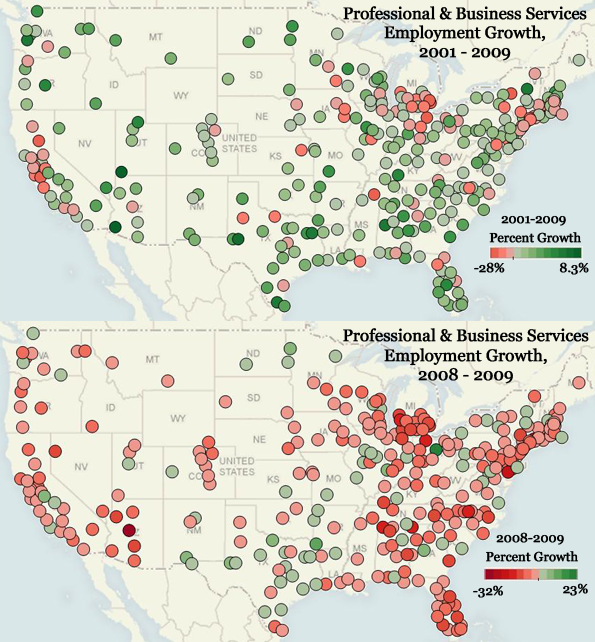
    The crucial question remains: In what regions is this critical economic cog booming? In a new analysis with my colleagues at the Praxis Strategy Group, we examined Bureau of Labor Statistics employment data for this sector, keeping an eye on trends over both the last year and the last decade. Some of the metropolitan areas that boasted short-term growth in this sector also maintained steady employment success over the long-term, which suggests that these particular cities have sturdy economies that aren’t as prone to intense boom-bust cycles.

    At the top of our list of best places is greater Washington, D.C., and its surrounding suburbs in Virginia and Maryland. Government jobs may drive that economy, but it is the lawyers, consultants and technical services firms who harvest the richest benefits. As New York University public policy professor Mitchell Moss observes, Washington has emerged as the “real winner” in the recession – not just for public-sector workers but private-sector ones too.

    Fastest Growing Professional and Business Services Sectors
    Area Name Jobs in Sector 2009
    (thousands)
    Sector Share of Jobs 2009
    (percent of total)
    Growth 2008 – 2009
    (percent growth)
    Cumulative Growth 2001 – 2009
    (percent growth)
    2001-2009 Job Change (thousands) 2008-2009 Job Change (thousands)
    Northern Virginia, VA 355.2 27.2% 1.5% 22.4% 65.0 5.2
    Washington-Arlington-Alexandria, DC-VA-MD-WV 558.7 23.0% 0.9% 22.8% 103.6 5.1
    Austin-Round Rock, TX 112.4 14.4% 3.3% 18.7% 17.7 3.6
    Houston-Sugar Land-Baytown, TX 382.3 14.7% 0.9% 19.2% 61.5 3.2
    Virginia Beach-Norfolk-Newport News, VA-NC 106.6 14.0% 2.8% 8.0% 7.9 2.9
    Bethesda-Frederick-Rockville, MD 125.7 21.9% 2.1% 9.0% 10.4 2.6
    Wichita, KS 31.5 10.1% 3.5% 16.4% 4.4 1.1
    Chattanooga, TN-GA 25.9 10.6% 4.3% 11.8% 2.7 1.1
    Peoria, IL 23.0 12.1% 4.5% 43.2% 6.9 1.0
    Rochester, NY 61.8 11.9% 1.5% 1.9% 1.1 0.9
    Augusta-Richmond County, GA-SC 31.0 14.5% 3.0% 7.5% 2.2 0.9
    Mansfield, OH 5.1 9.1% 19.4% 4.1% 0.2 0.8
    Kennewick-Pasco-Richland, WA 20.8 22.2% 4.2% 20.2% 3.5 0.8
    St. Louis, MO-IL 195.4 14.6% 0.4% 3.9% 7.4 0.8
    Fayetteville-Springdale-Rogers, AR-MO 33.5 16.2% 2.2% 34.2% 8.5 0.7
    Macon, GA 12.1 11.9% 5.5% 31.2% 2.9 0.6
    Pittsburgh, PA 158.9 13.9% 0.4% 14.5% 20.1 0.6
    Fresno, CA 30.7 10.3% 1.9% 23.3% 5.8 0.6
    Provo-Orem, UT 23.3 12.4% 2.5% 16.7% 3.3 0.6
    Charleston-North Charleston-Summerville, SC 42.2 14.3% 1.3% 31.1% 10.0 0.5

    Over the past year, parts of northern Virginia – ground zero for the so-called “beltway bandits” who work in industries the government depends on to do its job – have enjoyed the fastest growth in business and professional services, adding over 5,200 jobs despite the current downturn.

    Other areas around the nation’s capital have also seen strong growth. The Washington D.C.-Arlington-Alexandria area, for example, came in second on our list, gaining nearly 5,100 positions, while No. 6 the Bethesda-Frederick-Rockville, Md., metro area added 2,600. In addition, yet another Virginia area – No. 5-ranked Virginia Beach-Norfolk-Newport News, a center for military-related industries – gained nearly 2,900 jobs in this sector.

    It’s far too early to thank the free-spending ways of Barack Obama’s administration for all this growth. As anyone can tell you, the Bush White House and its Republican Congress were not exactly models of fiscal restraint. Plus, Washington and Northern Virginia have seen growth in their business services sectors over the last several years, in the period stretching from 2001 to 2009. Together those two metros added over 165,000 new jobs in this critical, high-wage sector.

    Of course, you don’t have to head to Washington to find a high-paying job – although you might not be able to escape unpleasant summer weather. The other major group of business-services hot spots includes Austin, Texas, at No. 3, and Houston, at No. 4. These Lone Star local economies have continued to thrive not only during the current recession but also over the last decade.

    The others winners include farther-afield locales in Kansas, Tennessee, Illinois and New York. These areas could be gaining both from companies seeking to lower costs and from the new capabilities for remote work due to the Internet. Even though they didn’t make our list, a host of smaller communities – like Mansfield, Ohio; Provo, Utah; and Charleston, S.C. – also enjoyed significant growth in the business services sector over the past year.

    So if these are the places where this segment of the economy is growing and high-paying jobs are easier to come by, where is the opposite true? The worst cities on our list span three archetypes: Rust Belt basket cases, Sunbelt flame-outs and expensive big cities. Perhaps the toughest losses were in Michigan: Detroit and the Warren-Troy metro area suffered big setbacks both in the last year and over the last decade.

    Fastest Declining Professional and Business Services Sectors
    Area Name Jobs in Sector 2009
    (thousands)
    Sector Share of Jobs 2009
    (percent of total)
    Growth 2008 – 2009
    (percent growth)
    Cumulative Growth 2001 – 2009
    (percent growth)
    2001-2009 Job Change (thousands) 2008-2009 Job Change (thousands)
    Phoenix-Mesa-Scottsdale, AZ 289.2 16.0% -10.8% 7.9% 21.2 -35.1
    Warren-Troy-Farmington Hills, MI 202.5 18.5% -12.0% -21.2% -54.4 -27.7
    Chicago-Naperville-Joliet, IL 633.6 16.8% -4.1% -2.9% -19.0 -27.0
    Los Angeles-Long Beach-Glendale, CA 574.7 14.3% -4.2% -3.4% -20.4 -25.2
    Atlanta-Sandy Springs-Marietta, GA 390.3 16.4% -5.9% -1.3% -5.1 -24.4
    Orlando-Kissimmee, FL 170.9 16.2% -8.5% 7.7% 12.3 -16.0
    Santa Ana-Anaheim-Irvine, CA 261.9 18.0% -4.7% 4.0% 10.2 -12.8
    Minneapolis-St. Paul-Bloomington, MN-WI 253.4 14.4% -4.6% -4.6% -12.2 -12.3
    Edison-New Brunswick, NJ 164.5 16.3% -6.7% -2.6% -4.4 -11.9
    Detroit-Livonia-Dearborn, MI 108.9 14.7% -9.5% -20.9% -28.8 -11.4
    Indianapolis-Carmel, IN 120.3 13.4% -8.3% 13.6% 14.4 -10.8
    Riverside-San Bernardino-Ontario, CA 133.7 11.2% -6.5% 36.0% 35.4 -9.2
    Tampa-St. Petersburg-Clearwater, FL 223.2 18.5% -3.7% 12.3% 24.5 -8.6
    New York City, NY 595.7 15.8% -1.4% -0.8% -5.1 -8.4
    Newark-Union, NJ-PA 163.5 16.0% -4.7% -0.5% -0.8 -8.0
    Bergen-Hudson-Passaic, NJ 130.6 14.6% -5.8% -9.1% -13.0 -8.0
    Milwaukee-Waukesha-West Allis, WI 107.6 12.9% -6.6% -1.7% -1.8 -7.6
    Miami-Miami Beach-Kendall, FL 139.1 13.4% -4.7% 2.2% 3.0 -6.8
    Oakland-Fremont-Hayward, CA 158.0 15.6% -4.0% -7.1% -12.2 -6.7
    Las Vegas-Paradise, NV 108.2 12.1% -5.8% 38.1% 29.9 -6.6
    Boston-Cambridge-Quincy, MA 308.8 18.2% -2.0% -6.8% -22.5 -6.4
    Sacramento–Arden-Arcade–Roseville, CA 106.1 12.3% -5.6% -1.8% -1.9 -6.3
    Cleveland-Elyria-Mentor, OH 137.8 13.3% -4.3% -5.2% -7.6 -6.1
    Denver-Aurora-Broomfield, CO 207.0 16.9% -2.9% 4.0% 8.0 -6.1

    Consistent job losses in business services in these areas – some 54,000 in the Troy area since 2001 – reveal the clear connection between employment in business services and in the region’s fundamental auto industry. It turns out that elite services often prove dependent on basic industry. When industrial plants shut down, it’s not just blue-collar workers and company executives that suffer; as a result, these firms will use fewer lawyers, accountants, architects and technical consultants.

    A similar picture emerges in cities like Phoenix, which lost about 35,000 business-services jobs in just one year. This loss stems from the collapse of the housing bubble, which powered the rest of the regional economy. The same meltdown caused smaller but still significant reversals in one-time boomtowns like Orlando, Fla., Atlanta and Southern California’s Santa Ana region, which encompasses Orange County, where business service employment dropped by double-digit rates over the past year.

    Yet these same areas should see some recovery, perhaps more so than the traditional auto manufacturing-focused towns. Phoenix, Orlando and other Sun Belt locations – including a host of other areas in Florida – all saw increasing employment in business services over the past decade. If the economy comes back, along with a stabilization of the residential real estate market, business-services job growth will likely begin to take off again. After all, the fundamental reasons for the success of these areas, such as warm weather, lower costs and the need to serve a growing population, have not fundamentally changed.

    Perhaps most perplexing is the fate of some of the other places on our worst cities list, particularly the biggest metropolitan areas. The professional and business services sector is widely considered ideal for large, cosmopolitan centers, since lots of industries require support. But Chicago experienced a huge chunk of job losses – almost 25% – in this sector during the last year. Other big cities, including Los Angeles, Minneapolis and New York, also suffered.

    This is not a new phenomenon. These and other big cities, like Boston and San Jose, San Francisco and Oakland in California, have been shedding these types of jobs since 2001. These losses, however, have been concentrated at the lower-wage end of the business service pyramid, in areas like human resources and administration. These are the positions that companies can fill more easily and cheaply using the Internet or by hiring in less expensive outposts.

    That’s why Washington and its environs, which has seen across-the-board business growth, remain the great exception. Many business-services jobs outside the beltway appear to be becoming more nomadic, based in places where firms face lower costs and where workers can afford to live well on middle-income salaries. Even the long-term resiliency of higher-wage employment like law and accounting in traditional business hubs like New York could be at risk over time, with some jobs shifting to less expensive locales or even overseas.

    The changing nature of business services presents a boon to some communities and a challenge to others as they seek to survive and thrive in spite of the current recession. How some cities manage to grow this segment of their economies may well presage which parts of the country will thrive best during the years of recovery – and beyond.
    This article originally appeared at Forbes.

    Joel Kotkin is executive editor of NewGeography.com and is a presidential fellow in urban futures at Chapman University. He is author of The City: A Global History. His next book, The Next Hundred Million: America in 2050, will be published by Penguin early next year.

  • Chicago: Preventing the Self-Destruction of Diversity

    Chicago’s urban core has boomed in a way that makes most other cities jealous. Every time you turn around, it seems, another gem is added to it. The Renzo Piano designed Modern Wing at the Art Institute recently opened its doors to general, if not universal, acclaim, for example.

    But while this boom is to be celebrated, and clearly it has been necessary to sustain the animating life force of the city as a whole, there are long term threats that need to be considered.

    The first is that all booms tend to contain within themselves the seeds of their own collapse. We’ve seen that with the dot.com bubble, the real estate bubble, and the finance bubble, the last two of which are really weighing on Chicago. Growth feeds on itself in a type of positive reinforcement loop. If it hits a certain point, it can really take off, as in a typically “hockey stick” diagram. The problem is that some point the trend reaches the point of exhaustion, and the hangover can be a bear. Most stable systems employ negative feedback controls or stabilizers to “take away the punch bowl just as the party is getting started”.

    The real challenge, however, is what Jane Jacobs called the “self destruction of diversity”. Thriving urban districts require a mixtures of users and uses acting to mutually sustain and energize a neighborhood. But what has a tendency to happen is that, as an area becomes popular, land values go up and rents go up. There is greater demand for and competition for the space. Because of this, the most economically successful use of the moment tends to become increasingly dominant. This is particularly the case if that use benefits from face to face interactions among multiple players in the space and clustering economics.

    Jacobs also talked about the requirement that neighborhoods contain buildings of a mixture of ages, such that they require differing levels of economic rent. New enterprises, particularly in wholly new fields, often require space that is available at low cost. So if there are no low cost buildings in an area, tomorrow’s new industries can’t often get started in a place at all. While she didn’t quite put it this way, this notion is often paraphrased as “new ideas require old buildings”.

    The boom in Chicago causes concern on both of these fronts. Firstly, the great Loop area is increasingly dominated by two uses: financial and business services for the global city function of Chicago, and entertainment/tourism. To some extent, the Loop has always had these characteristics as a typical CBD. And in many respects, the streets are far more active today than they were in an era not that long ago when the streets in the Loop really did roll up at 6pm.

    The real problem is that the boom in the Loop has generated enormous opportunity for profit in the redevelopment of older buildings. Many older buildings have been demolished completely, or preserved only the form of the “facadectomy”. A number of vintage office skyscrapers have been converted to residential use. The high rent district, which used to apply mostly to the core of Loop, now extends far to the West and South instead of just the traditional north. The number of places where one can obtain low-rent space in the greater Loop area would appear to have declined significantly.

    The same forces are operating in residential areas, which are increasingly taking on the cast of New Urbanist suburbs. Housing prices keep out all but the already affluent in many places. Rents have followed suit, leading to a predominance of swanky establishements catering primarily to consumption by the upscale: restaurants, clubs, boutiques, spas, etc. A number of formerly industrial districts have been reborn as more or less single use large format retail strips.

    What will the long term affect of this be? I don’t know. I do think it is something worth of consideration. Affordable housing is obviously something that is on the radar of many groups. But the idea of affordable office or industrial space less so. We want the Loop to be successful, but also I think there should be policies developed that are designed to actively sustain its diversity over time.

    The danger is that the Loop becomes increasingly concentrated in ever most high value specialized services. (I’ve even suggested how we might encourage this through cross-regional collaboration). This can be good in that it keeps Chicago a player at the pinnacle of the global economy. But it also exposes Chicago to the risk of niche exhaustion. And with the global city functions an artifact of globalization as we know it today, any disruption or further evolution of that model could seriously hit Chicago.

    As I’ve long argued, in an ever more rapidly changing, uncertain world, it is critical for cities to have a diversity of strategies and future options for success, and not put all their eggs in one basket. Chicago needs to continue reinforcing its success, but it also needs to look at how to diversify that success so that when, as it inevitably will, economic needs change, Chicago is right there with the next new thing. While picking winners and losers is a problematic concept, at a minimum the city should be looking at how to preserve the conditions necessary for success.

    Interestingly, the city has already taken some steps here. It created the concept of a “Planned Manufacturing District” to prevent residential encroachment into surviving manufacturing zones like the Kinzie Corridor. A good move. While mono-use isn’t always a good thing, for a traditionally manufacturing area, I think this is a decent strategy. We should be looking at similar means of preserving the favorable economics for new ideas in the urban core as well.

    More Chicago:

    Chicago: A Declaration of Independence

    Reconnecting the Hinterland Series
    Part 1A: Metropolitan Connections
    Part 1B: High Speed Rail
    Part 2A: Onshore Outsourcing
    Part 2B: On Innovation

    On the Chicago Economy
    Chicago: Corporate Headquarters and the Global City
    The Financial Crisis: Good for Chicago?

  • The Gambler King of Clark Street, the Origin of Chicago’s Political Machine

    Long before Chicago sold off its assets, made plastic cows parade and outlawed goose guts, there was Michael Cassius McDonald, Big Mike. Where the Chicago Machine now grinds the citizen with Progressive idiocies, Mike McDonald and other Machine Mavericks like the Lords of the Levee appeared to actually help people. Vice and Government have gone hand-in-hand since Solon tried to reason with Croesus – Hesiod tells us that political corruption sparks political thought. The life of Michael Cassius McDonald was active and thought-provoking. Big Mike sleeps with counselors and kings a few hundred yards from my raised ranch along the tracks on Rockwell Street in the Morgan Park neighborhood of Chicago.

    Big Mike’s massive mausoleum dominates the entrance to Mount Olivet Catholic Cemetery on 111th street, situated between the railroad tracks that once served the Chicago Stockyards and the ones that connected to the steel mills of Indiana. Chicago workingmen had their pockets looted by Big Mike during the 19th Century, particularly those who were given to vice gambling, booze and broads. More importantly Michael Cassius McDonald was the architect of the Chicago Democratic Machine.

    Chicago journalist, lecturer, author and frequent guest contributor on the History Channel, Richard C. Lindberg has written a wonderful parallel to our current political situation. The Gambler King of Clark Street: Michael C. McDonald and the Rise of Chicago’s Democratic Machine – Southern Illinois University Press studies the life of this remarkable, energetic, romantic and larcenous Chicagoan.

    The flabby accolades and acclimations directed at Jane Addams by the PC crowd are all too tiresomely trumpeted. Socialist Sapphist has her own expressway, but most of Addams’ storied good works are more flatulence than wholesome air. In reality, her arch-nemesis 19th Ward Alderman John Powers did more for starving Greek, Italian, and Jewish families (while taking more than few spondulix for himself) than crop-haired Addams, whom Powers appointed to public office only to have Addams scream for his indictment. It is amazing, that, once one takes the time to read contemporary accounts from the archives, that iconic Harpies like Jane Addams emerge in the flesh. Likewise, traditional villains seem to have the scales of their sins drop like cotton-wood puffs. While doing some research on 1904 Stockyard Strike, I learned that Addams and her crowd seemed to sell out the strikers. Historians can deal with that, I guess. In the mean time Richard Lindberg casts a cold eye on history.

    Richard Lindberg studies Big Mike McDonald in the cold light of historical reality. This from the Amazon Product description:

    “Twenty-five years before Al Capone’s birth, Michael McDonald was building the foundations of the modern Chicago Democratic machine. By marshaling control of and suborning a complex web of precinct workers, ward and county bosses, justices of the peace, police captains, contractors, suppliers, and spoils-men, the undisputed master of the gambling syndicates could elect mayoral candidates, finagle key appointments for political operatives willing to carry out his mandates, and coerce law enforcement and the judiciary. The resulting machine was dedicated to the supremacy of the city’s gambling, vice, and liquor rackets during the waning years of the Gilded Age.

    McDonald was warmly welcomed into the White House by two sitting presidents who recognized him for what he was: the reigning “boss” of Chicago. In a colorful and often riotous life, McDonald seemed to control everything around him—everything that is, except events in his personal life. His first wife, the fiery Mary Noonan McDonald, ran off with a Catholic priest. The second, Dora Feldman, twenty-five years his junior, murdered her teenaged lover in a sensational 1907 scandal that broke Mike’s heart and drove him to an early grave.”

    I had the pleasure of chatting with Mr. Lindberg about his book that traces Illinois political corruption to the Chicago King of Vice in the 19th Century. Richard Lindberg traces the lineage of the modern machine and “boss rule” back to the 1870s – Big Mike was the uncrowned “boss” of the Democratic Party, controlling patronage, the gambling action, the Cook County Board, the neighborhood saloon bosses he anointed to aldermen and a bewildering array of contractors and spoilsmen not unlike the same kind of folks who cut the inside deals today. Rich moves the story forward to the 1890s and early 1900s when Mike relinquished his rule to younger up-and-comers. As the 19th Century rolled over and we move forward into the Cermak-Kelly-Daley years, the names become more familiar to us. After Mike settled in for a bitter and unhappy retirement having to contend with an unfaithful wife who ultimately drove him into the grave, the “impresarios of Democratic graft, clout and patronage” take over – James “Hot Stove” Quinn and Robert Emmet “Bobby” Burke (indicted); Roger C. Sullivan (who tried to ramrod through the Council the Ogden Gas Monopoly in the 1890s); George “Boss” Brennan, who mentored “Pushcart” Tony Cermak; the Pat Nash-Jake Arvey-Ed Kelly triumvirate through Depression and War; continuing on through the Daley Dynasty, the final destruction of Chicago’s Republican Party and the modern day notions of political correctness foisted on us that disguise a mountain of political malfeasance in good ole’ Crook County.

    There’s never been a book-length biography of McDonald written before – and Rich, the author of 14 books about his ‘ole home town, is contemplating making this Volume One of a three-volume history of Machine graft. The story is an eye-opener, but as Rich reminded me, the lakefront liberals who castigated John McCain and the GOP so savagely last Fall, turn a blind eye and say nothing about the 130 years of non-stop corruption in the City of Chicago – most of it perpetrated by the Lords of the Machine, of which Mike McDonald was its founding father. The shady history of the “Copperhead” Democrats of the Civil War, the 27 aldermen indicted since 1970 – none of that counts in this one-party, one-rule town championed by the Chicago Sun-Times (the Obama Times) when you get down to it, and that is the sad and sordid legacy of our past.

    This article is courtesy of the Chicago Daily Observer.

    Pat Hickey is an author, blogger, and regular columnist for the Chicago Daily Observer.

    You can buy Rich Lindberg’s book The Gambler King of Clark Street: Michael C. McDonald and the Rise of Chicago’s Democratic Machine here.

  • The Real Mayor of Chicago

    Most Americans living outside the Chicago area identify the city with Oprah, Obama, or Michael Jordan. When the subject of who really runs Chicago comes up, most people would say Mayor Daley. Chicago’s lack of term limits and persistent political machine have kept Mayor Daley in office for over 20 years.

    Those who know Chicago politics know there’s one man who’s more powerful than Mayor Daley, Alderman Ed Burke. Mayor Daley may be the identifiable public face of Chicago’s political system and act as a lightning rod for criticism, but the lower profile Alderman Burke wields the real power.

    Chicago’s City Council recently celebrated Alderman Burke’s record-breaking 40 years in office. No Chicago Alderman has served so long or accumulated so much power. No man represents Chicago’s political system better and all that is wrong with it. Only in a city that is hostile to checks and balances could a politician achieve what Alderman Burke has done. Since joining City Council in 1969, Alderman Burke has amassed a portfolio of positions to be the Machine’s top boss. Alderman Burke not only represents the 14th Ward but also serves as Chairman of the Finance Committee. The city of Chicago’s own website is quite honest about exactly who’s in charge:

    As Chairman of the City Council’s powerful Committee on Finance, Alderman Burke holds the city’s purse strings and is responsible for all legislative matters pertaining to the city’s finances, including municipal bonds, taxes and revenue matters. Alderman Burke became Chairman for the second time in 1989. He previously served from 1983 to 1987. He also serves as a member of the Chicago Plan Commission.

    One of the Finance Committee’s responsibilities is dealing with workers compensation claims. A few years ago, the Chicago Sun-Times explained Chicago’s system: “When city workers get hurt on the job, they usually turn to a handful of lawyers tied to City Hall. And the city often fights back by hiring lawyers with ties to Ald. Edward M. Burke, chairman of the City Council Finance Committee, which has sole authority to settle workers compensation claims against the city.”

    But, Alderman Burke’s control of Chicago’s financial purse strings isn’t his only lever of power. Cook County has the largest unified court system in America. In heavily Democratic Cook County, 100% of all of the judges are Democrats. The Chairman of the Democratic Party Judicial Slating Committee is none other than Alderman Burke.The Chicago Reader astutely observed Burke’s “Seat on the Democratic Party judicial slate-making committee ensures that Cook County judges owe him their jobs.” Alderman Burke’s influence goes beyond the Cook County level: his wife Anne is a justice on the Illinois Supreme Court.

    Along with all of Alderman Burke’s power to control Chicago’s tax code and Cook County’s judicial system comes campaign contributions. Alderman Burke doesn’t represent a wealthy ward, nor has he ever faced a serious political opponent, but he still has amassed an eye popping campaign fund. The Chicago Tribune explains:

    But the state’s richest political family was Ald. Edward Burke (14th) and his wife, Illinois Supreme Court Justice Anne Burke. Together, their political committees held $8.3 million in cash. The Tribune reported Monday that Anne Burke’s campaign was returning a large portion of her cash to donors because she is running unopposed in the Democratic primary.

    Mayor Richard M. Daley, who traditionally ceases fundraising after elections, raised just $43,000 in the last six months, but had $3.1 million in cash on hand.

    In terms of cash at the very least, Burke is already more potent not only than Daley but has more in his coffers than Daley and all 49 Aldermen combined. But, the ever active Alderman Burke is also a businessman, not surprisingly a rather successful one.

    The state of Illinois has rather lax ethics laws, and since being an Alderman is a “part time” job, Alderman Burke has outside employment. Burke runs a successful property tax appeals business. Burke’s latest ethics form filed with the city of Chicago shows his impressive list of clients. Such big corporations as AT&T, American Airlines, Bank of America, Northern Trust, Harris Bank, T Mobile and many others have done at least $5000 in legal business with Alderman Burke’s law firm in the last year. They also – I am sure readers will be shocked – do business with the city of Chicago. WBBM, the local CBS affiliate, even has Alderman Burke handle some of its legal business.

    Occasionally, Alderman Burke’s conflicts get reported on. When Obama ally and Blagojevich influence peddler Tony Rezko was looking to get his taxes cut on a big land deal the Chicago Sun-Times explained:

    Why did Ald. Edward M. Burke vote to approve Tony Rezko’s plans to develop the South Loop’s biggest piece of vacant land even as he was working for Rezko on that same deal?

    Burke says: I forgot to abstain.

    When Rod Blagojevich first decided to run for Governor in 2001, he got important backing from Burke. Blago’s father in law, by the way, is Alderman Dick Mell, a colleague of Alderman Burke’s who got the ball rolling.The Daily Herald unearthed this revealing statement from Alderman Burke in 2001 concerning Blago:

    “I am with Rod 100% because he has what it takes to win – money, message and an army of supporters,” said Burke, referring to a rousing announcement speech given by Blagojevich to a reported throng of 10,000 people on August 12. Burke also mentioned filings with election officials that show Blagojevich with over $3 million in his campaign fund, double the amount of cash on hand of all of his potential Democratic opponents combined.

    In the coming years, as Chicago style politics seeps into America’s mainstream, remember Alderman Burke. Thirty of Burke’s colleagues on Chicago’s City Council went on to become convicted felons since 1970. But Alderman Burke is still standing, and still dominating in the shadows, atop much of what happens in the Windy City.

    Steve Bartin is a resident of Cook County and native who blogs regularly about urban affairs at http://nalert.blogspot.com. He works in Internet sales.

  • The Successful, the Stable, and the Struggling Midwest Cities

    The Midwest has a deserved reputation as a place that has largely failed to adapt to the globalized world. For example, no Midwestern city would qualify as a boomtown but still there remain a diversity of outcomes in how the region’s cities have dealt with their shared heritage and challenges. Some places are faring surprisingly well, outpacing even the national average in many measures, while others bring up the bottom of the league tables in multiple civics measures.

    Let us examine the health of various cities, using population growth as a heuristic proxy for overall civic health. Looking at population change from 2000 to 2008, we will classify a city as “successful” if its metro area population growth exceeded the national average growth rate of 8% during that period, as “stable” if it had a population growth rate between 3% and 8%, and as “struggling” if its growth was less than 3%. Let us also put Chicago into its own category of “global city”. It is simply one of a kind in the Midwest, a colossus of nearly 10 million people, and not easily measured against the other cities. Indeed, it is really three cities in one, a prosperous urban core, an archipelago of successful upscale suburbs and edge based growth to the west and north, with a sea of deteriorating city neighborhoods and stagnant to declining suburbs surrounding them. On our scale, Chicago would be “stable” – its inner core has grown but the city overall has lost population, while the outer ring has grown strongly. As a region, it has grown somewhat below the national average.

    Here are the results of our tiering, including all cities in the Midwest* with metro areas exceeding 500,000 in population:

    Global City
    Chicago (5.2%)

    Successful Cities
    Des Moines (15.6%)
    Indianapolis (12.5%)
    Madison (11.9%)
    Columbus (9.9%)
    Kansas City (9.0%)
    Minneapolis-St. Paul (8.8%)

    Stable Cities
    Cincinnati (7.2%)
    Grand Rapids (4.9%)
    St. Louis (4.4%)
    Milwaukee (3.2%)

    Struggling Cities
    Akron (0.5%)
    Detroit (-0.6%)
    Dayton (-1.4%)
    Toledo (-1.5%)
    Cleveland (-2.8%)
    Youngstown (-6.1%)

    These tiers, based only on a single criterion and arbitrary boundaries, nevertheless basically conform to how these cities are performing both economically and in terms of perceptions.

    A few interesting things emerge:

    1. There are a surprisingly large number of Midwestern cities that are growing faster than the US average population. This indicates pockets of strength, in its larger metros at least, seldom associated with the Midwest.
    2. The clear dominance of the successful list by state capitals. This is so pronounced that I have put forth what I call the “Urbanophile Conjecture”, which is that if you want to be a successful Midwestern city, it helps to be a state capital with a metro area population of over 500,000. The only successful city on the list that is not a state capital is Kansas City.
    3. The 500,000 barrier seems to be important as well. The state capitals below that threshold – Lansing, Springfield, and Jefferson City – would not qualify as successful on this list. Note too that the presence or absence of the major state university does not appear to be a decisive factor. Des Moines and Indianapolis are not home to their states’ flagship universities. The home of the academic powerhouse that is the University of Michigan is the Ann Arbor metro area, which was not included in this list because its population is only about 350,000. Notwithstanding, its growth rate would have put it into the stable category.
    4. In a region in which there is such divergence between the performance of cities, a diversity of city specific policies are required. There is no one size fits all for the Midwest. There may indeed be a base of pan-Midwest policies worth pursuing – improvements in education, attractiveness to migrants, better conditions for innovative entrepreneurship, etc – but successful approaches will be those most tailored to uniquely local conditions. For example, a state capital or University town may have different needs than a place that has neither.

    Some suggested areas to investigate by city tier are:

    • Chicago. How can it ease the gap between the thriving global city of Chicago – largely located around the Loop as well as the northern and western suburbs – and the parts of the region that are falling behind, largely the western city neighborhoods and southern edge of metropolis? How do you do this without sacrificing its overall competitiveness? Can the policies appropriate to each be reconciled?
    • Successful Cities. Their policy focus should be on maintaining favorable demographic and economic conditions, and dealing with decaying areas of their urban cores and the potential for decay in some inner ring suburbs. Should the civic aspiration be desirous of it, tuning the engine to attempt to shift the growth rate into high gear to target a profile closer to the Sunbelt boomtowns would be a further focus area. Each city would need to examine which specific policy levers it could pull to attempt to do this. Clearly modernizing and expanding infrastructure to keep up with growth in these places and maintain their high quality of life is a clear imperative.
    • Stable Cities. Their challenge is to bring growth rates up to average or above average levels. It would be worthwhile for them to study the successful areas, and ask what policies and approaches might be adopted. Kansas City offers the best encouragement here. It has managed to maintain a strong growth rate despite not being a state capital and being part of a bi-state metro region. Kansas City features lows costs, high quality of life, a relatively stable housing marketing, and a pro-business culture. It is clearly a standout and worthy of further study for that reason. It may hold the key for moving the stable cities up into the successful tier. Geographically, it is notable that Kansas City is a border state on the far edge of the Midwest, and could arguably be called a Great Plains city. Is that a factor? Some type of peer city comparison with the successful cities, and especially Kansas City, might be warranted here.
    • Struggling Cities. Unfortunately, there isn’t a magic bullet to solve the long festering problems in these places. All of them were heavily industrialized and have borne the brunt of globalization, particularly in manufacturing. This is especially the case in cities linked to the domestic automobile industry, which is clearly in a state of crisis. Until the automobile industry completes its restructuring, and out migration right sizes some of these areas, there does not seem to be a clear path to restart growth. Youngstown, which brings up the bottom of our league table, perhaps offers the best road forward. It is trying to right-size itself to a permanently smaller, but more sustainable, future population based on an aggressive controlled shrinkage plan that has received extensive national notice. This type of plan is likely something all of these cities need to be actively considering as the large fixed costs support a population base that no longer exists will become increasingly unaffordable as the population further shrinks. These cities likely also will need special state and federal help to back this shrinkage plan.

    * The Midwest is defined as Illinois, Indiana, Iowa, Michigan, Minnesota, Missouri, Ohio, and Wisconsin.

    Aaron M. Renn is an independent writer on urban affairs based in the Midwest. His writings appear at The Urbanophile.