Tag: Chicago

  • Battle of the Upstarts: Houston vs. San Francisco Bay

    “Human happiness,” the Greek historian Herodotus once observed, “does not abide long in one place.” In its 240 years or so of existence, the United States has experienced similar ebbs and flows, with Boston replaced as the nation’s commercial capital first by Philadelphia and then by New York. The 19th century saw the rise of frontier settlements—Cincinnati, Pittsburgh, Cleveland, and finally Chicago—that also sought out the post position. In the mid 20th century, formerly obscure Los Angeles emerged as New York’s most potent rival.

    Today we are seeing yet another shuffling of the deck among American regions. New York remains the country’s preeminent city, but its most powerful rivals are likely to be neither Chicago nor Los Angeles, but rather two regions rarely listed in the hierarchy of influential regions: the San Francisco Bay Area and Houston.

    Making of a new pecking order

    The Bay Area does not rank among the 20 top global cities in most studies, such as the 2014 A.T. Kearney listings. In the respected rankings of the London-based Globalization and World Cities Network, the Bay Area stood below not only Chicago, which is considered an “alpha” global city, but also such places as Toronto and Mexico City.

    Yet such rankings vastly underestimate the power now being wielded by the San Francisco region. As the headquarters for the largest concentration of cutting edge tech firms in the world, the Bay Area increasingly shapes the operations of companies from manufacturing and marketing to retail and media. And given that roughly half the nation’s venture capital is still being lavished on area start-ups, it is not surprising that Silicon Valley ranks number one in the world as a place to launch tech ventures, according to the Startup Genome.

    Tech dominance, according to a recent study on global cities conducted by my firm NewGeography, explains why the San Francisco Bay Area nudges out much larger Los Angeles for bragging rights on America’s Pacific Rim. Technology leaders, including Intel, Apple, Oracle, Google, and Facebook, are based in Silicon Valley, while Asian global tech firms such as Samsung also have North American headquarters there. Top technology firms from other cities often have their key R&D functions in the Bay Area. Even a frugal firm like Wal-Mart is enlarging its Silicon Valley presence.

    The current social media bubble will surely pop, but as Michael S. Malone and others have noted, the Bay Area’s preeminence will likely continue, fueled by its unique concentration of engineers, entrepreneurs, and risk capital. As a lure for the ambitious, Silicon Valley and San Francisco are replacing Wall Street. Google alone has 1,200 employees who formerly worked for large U.S. investment banks, and migration from the Big Apple to California is now at its highest level since 2006.

    Much of the appeal of the Bay Area is a result of happy coincidence of history and geography. The Bay Area—where I went to school and got my start in journalism, and where parts of my family have resided since the ’50s—has been blessed with excellent higher education and is centered around what is arguably America’s most beautiful city. Good weather, beautiful vistas, and access to nature have made the Bay Area a natural lure for people who can afford to live wherever they want.

    The Energy Capital

    Houston, where I have been working as a consultant, hardly qualifies as one of the most physically attractive or temperate cities. San Francisco may well have been, as Neil Morgan suggested a half century ago, “the Narcissus of the West,” but Houston, in most accounts, has been widely disparaged as hot, steamy, ugly and featureless. Yet despite this, its ascendency is no less compelling than that of the Bay Area.

    Houston’s trump card, like the Bay Area’s, resides in its control of one strategic industry, in this case energy. The majority of traded foreign oil majors, such as London-based Shell and British Petroleum, have their U.S. headquarters in Houston, and even companies based elsewhere boast a significant Houston presence. For example, Exxon, although it has its headquarters in Dallas-Fort Worth, is opening a massive Houston campus that will be home to 10,000 employees. Additionally, a majority of the world’s largest oil services companies, such as Baker Hughes, Schlumberger, and FMC Technologies, are based in Houston.

    Altogether, more than 5,000 energy-related companies call Houston home. The city employs three times more people in energy than its second place rival, Dallas-Ft. Worth, and more than the next five cities combined. This growth is likely to accelerate because foreign companies, notably from Germany, have begun buying up energy firms in the area, including Siemens’s recent $7.6 billion dollar purchase of the Dresser Rand Group, an energy equipment firm.

     Houston has added more than 10 percent more jobs since 2008, almost twice the increase in the Bay Area. Since 2000 Houston’s employment figures have shot up 32 percent, while the Bay Area has grown by barely 4 percent. And it’s not just energy that’s driving things—Houston is now the nation’s largest export port and boasts the world’s largest medical center. It has also become, by some measurements, the most ethnically diverse (PDF) region in the country. In the last decade, for example, Houston increased its foreign-born population by 400,000, second only to New York and well ahead of much larger Los Angeles.

    The big losers: LA and Chicago—but also New York

    In the past century New York and Los Angeles have dominated American media. This is being severely undermined by the Bay Area’s digital economy. Since 2001, notes Mark Schill at Praxis Strategy (where I am a senior fellow), book, periodical, and newspaper publishing—all traditionally concentrated in the New York area—have lost some 250,000 jobs, while Internet publishing and portals generated some 70,000 new positions, many of them in the Bay Area or Seattle.

    Google and Yahoo are already among the largest media companies in the world. (Yahoo now refers to itself as a digital media company rather than a technology company). With the ubiquity of its iTunes platform, Apple exercises ever greater control over consumer distribution of entertainment products such as music and video; Netflix, Hulu, and YouTube could become the studios of the future. This could shift global media decision-making from its familiar New York-Los Angeles axis to the Bay Area.

    This is particularly bad news for Los Angeles, whose grip on the entertainment industry was weakening even before Silicon Valley’s rise. Since 2004, LA’sentertainment industry lost roughly 11 percent of its jobs, as production shifted to Canada, Louisiana, and other locales.

    The decline in media employment comes on the heels of a rapid industrial decline—the area has lost more than 90,000 aerospace jobs since the end of the Cold War. The situation is so dismal that a report issued by many of the region’s top business and political leaders concluded that the city “is barely treading water while the rest of the world is moving forward.”

    Chicago’s situation is arguably even worse, but it is more threatened by Houston, which has already passed the Windy City in numbers of corporate headquarters. Since 2010, when U.S. industry began recovering, Houston manufacturing employment expanded by more than 17 percent, compared to flat growth in Chicago.

    “Houston is the Chicago of this era—like the old Chicago,” remarks David Peebles, who runs the Texas office of Odebrecht, a $45 billion engineering firm based in Brazil. “In the ’60s you had to go to Chicago, Cleveland, and Detroit. Now Houston is the place for new industry.”

    With its industrial base eroding, Chicago is no longer a strategic hub for any key industry. Outside of trading commodities, it also no longer serves as a major global financial center. Regional population growth has been meager over the past decade, and the city’s own pension issues may be worse than Detroit’s.

    Chicago retains its brilliant skyline, great cultural institutions, powerful political influence, and a strong business community. But its days of America’s number two city are long gone, and, as we enter the mid-2000s, it is falling behind not only Los Angeles and New York but the two rising Texas cities, Houston and Dallas, both expected to pass the “city of big shoulders” in population by mid-century, or earlier.

    Engineering the Future

    In the coming decades, New York will remain the nation’s top global city, due to its remarkable urban legacy, the power of Wall Street, and the entrenched traditional media. But its Achilles heel is a lack of the engineering power necessary to address key challenges such as the digitization of industry, energy efficiency or climate change. New York is profoundly weak in engineering talent (PDF)—ranking 78th out of 85 metropolitan areas in engineers per capita.

    In contrast, the Bay Area represents the epitome of engineering power, with the San Jose area boasting the largest per capita concentration of engineers of any major metropolitan area. The Bay Area’s power to develop new technologies and its almost unfathomable wealth will continue to undermine traditional institutions, from Hollywood and Wall Street to business services, tourism, automotive, and even aerospace industries.

    Far less appreciated, Houston, rather than being a southern city of duller wits, actually ranks second in engineers per capita. If the Bay Area is master of the digital economy, Houston ranks as the technological leader of the material one; it is the capital for the energy-driven revival of U.S. industry, not only in Texas but throughout the old industrial heartland. Revealingly, Houston actually has seen far more rapid growth in both college educated and millennial population since 2000 than the Bay Area, as well as New York, Chicago, and Los Angeles.

    Rival Approaches to Urbanism

    The Bay Area, for all its vaunted progressivism, increasingly resembles a “gated community” whose high prices repel most potential newcomers, particularly families. Already by far the nation’s least affordable city—only 14 percent of current residents can possibly afford to buy a home—it represents a growth model that is by definition exclusive, almost a throwback to medieval forms where the rich clustered inside the city gates.

    High housing prices, notes economist Jed Kolko, account for the fact that, despite the boom, population growth in the Bay Area remains well below national averages. From 2000 to 2013, the region lost approximately 550,000 domestic migrants. Despite sizable immigration, the regional population growth rate has fallen below the national average.

    In contrast, Houston is among the fastest growing regions in the country, with rapid increases both in domestic migrants and newcomers from abroad. This stems from both lower housing prices and a growth model that is far more amenable to higher paid blue collar and middle management positions. Since 2000, Houston’s population has grown by 30 percent compared, three times that of the Bay Area.

    Ironically, Houston’s growth has been more egalitarian than that of the notionally super-progressive San Francisco region. A recent Brookings report found that income inequality has increased most rapidly in what is probably the most left-leaning big city in America, where the wages of the poorest 20 percent of all households have actually declined amid the dot com billions.

    This inequality has a distinct racial element. The Bay Area gap between white residents (who dominate the tech economy) and minorities is among the highest in the nation while, during the boom, income has fallen for Hispanics and African-Americans, according to Joint Venture Silicon Valley.

    This racial divergence is far less pronounced in Houston, while the growth of poverty since 2000 has been slower, increasing at one third the rate of New York and San Francisco, and half that of Los Angeles. The Texas city may lack the great views of San Francisco, but Houston has turned out to be a better city for middle class minorities. Homeownership among African Americans stands at 42 percent and for Latinos at more than 53 percent; this compares to 32 and 37 percent in the Bay Area.

    Perhaps the biggest differences can be seen in families. Of the nation’s 52 largest metropolitan areas, the Bay Area has the lowest percentage, 11.5 percent, of people ages 5 to 14. In Houston, 23 percent of the population fits this age category. In particular San Francisco is notoriously inhospitable to families, with the lowest percentage of kids of any major city.

    The two regions also reflect very different urban forms. The Bay Area’s leadership has opted to favor dense “in fill” growth and sought to restrict suburbandevelopment. Houston has taken a different tack. As its population has expanded, so too has the metropolitan area. This includes the development of many planned communities that appeal to middle class families and many immigrants. In 2013, Houston alone had more housing starts than the entire state of California.

    But it would be wrong to dismiss Houston’s model as merely “sprawl.” Instead it is better seen as simply expansive. In fact, arguably no inner ring in the country has seen more rapid growth, with high-rise, mid-rise and townhouse development in many long neglected districts. The increase in high-density housing tracts (more than 5,000 per square mile) since 2000 has been almost ten times higher than the Bay Area.

    The Political Battle for the Future

    Increasingly America’s future will be determined by these two cities, with the issue of addressing climate change at the fore. Much of the Bay Area’s leadership—led by the likes of Google Chairman Eric Schmidt and investor Tom Steyer—have all but declared war on the oil and gas industry. Several colleges and universities in the region, including Stanford, have shed their energy holdings, and Silicon Valley has nurtured movements such as Bill McKibben’s 350.org that seek to revoke the “social license” of big oil, a tactic used previously against the tobacco companies and firms that did business in apartheid South Africa.

    The elites of Silicon Valley and San Francisco are not just interested in saving the earth; they wish to profit from a change in the nation’s energy economy. Google, Sun Microsystems founder Vinod Khosla, and top venture capitalists such as John Doerr have bolstered their already ultra-thick wallets by capitalizing on “green energy” subsidies and outright grants from various levels of government. Given these investments, it’s easier to understand the Valley’s support for draconian climate change legislation, complete with attempts to demonize “Texas oil.” (One won’t see such populist zeal on , say, increasing capital gains rates.)

    The Valley’s hostility to fossil fuel energy, and its jihad to destroy an entire industry, is only barely recognized in Houston. I also have never heard anyone there suggest that Silicon Valley should be closed down as a danger to the planet (or at least a threat to the attention span of younger Americans). Houstonians, particularly in the energy industry, generally lack media savvy, which is one reason why energy is widely rated as the country’s least popular industry. Also missing, thankfully, is the sense of entitlement and self-congratulation one finds in the Bay Area. But once the intention to devastate the oil and gas industry is better understood, expect the energy capital to square off against the tech center, generating what may be the regional battle royal of our era.

    This piece originally appeared at The Daily Beast.

    Joel Kotkin is executive editor of NewGeography.com and Roger Hobbs Distinguished Fellow in Urban Studies at Chapman University, and a member of the editorial board of the Orange County Register. His newest book, The New Class Conflict is now available at Amazon and Telos Press. He is author of The City: A Global History and The Next Hundred Million: America in 2050. His most recent study, The Rise of Postfamilialism, has been widely discussed and distributed internationally. He lives in Los Angeles, CA.

    Photos courtesy of University of Texas Health Science Center at Houston Office of Communications and Vincent Bloch.
  • The Rise of Urban Riverfronts

    I recently moved from Cincinnati to Providence, Rhode Island, although I still think of the Detroit area as my hometown. All of these cities are based on their access to water. Providence, despite its location at the mouth of an Atlantic bay, is still a river-town at heart. Chicago mayor Rahm Emanuel has plans for a new and improved riverwalk, too. What can these cities learn from each other?

    In the ’80s, downtown Providence was a much less vibrant and destination-worthy place than it is now. Its urban rivers were buried beneath cement, rail-lines, and acres of concrete until a public-private revitalization effort gained enough traction. Today, in its place, the 11-acre Waterplace Park hosts numerous attractions, including the well-loved Waterfire events, and is a long, winding string of paths and bridges that sprawls through Providence’s downtown.

    What’s best about its place-making design is its versatility. The riverfront offers commutable routes between destinations, areas to picnic or socialize during lunch breaks, and event space throughout the seasons. Gondola rides, kayaking, and even viral pop-up installations all thrive here, making it multi-functional and inviting to a range of citizens.

    Chicago, much like Providence, has revealed renderings of parks that show multi-functional, inviting public spaces for rest, socializing, jogging, and enjoying attractive outdoor landscapes. Chicago is also poised to offer kayak rentals, which would allow visitors to interact with the water’s surface, rather than simply admire it. Mayor Emanuel has plans for the riverwalk to stretch “from Lake Michigan to the confluence of the three branches,” or about 1.3 miles.

    That would add a key element: in addition to being multi-functional and inviting, the riverwalk, at least within its blueprints, will be interconnected and able to serve as a pathway between all types of destinations within the city, much like Boston’s incredible Emerald Necklace. The Mayor also recognizes the huge potential for retail expansion along this stretch, something that Providence can certainly attest to.

    Detroit, too, has been actively improving its waterfront. The shores of the Detroit River now include a long, inviting path for walking, jogging, or biking, with parks and features along the way. The transformation from its earlier state is reminiscent of Providence’s overhaul efforts of the ’80s, pushing the space from neglected and utilitarian to a pedestrian-focused destination for anyone in the downtown area. A Great Lakes-themed waterpark has recently been put into place, making the riverfront even more attractive to families and young people. In addition to being a long-time hub for local fishermen, the riverfront is now a destination for joggers, dog-walkers, families, and those on their lunch break in a newly recovering downtown business district.

    What Chicago should strive to institute is a core of riverfront events and attractions. Like Providence’s Waterfire, Detroit hosts events on its riverfront during the summer — even given that it only uses one side of a river it shares with Windsor, Ontario — including the hugely popular River Days concert series and festival.

    Many cities have access to only one side of a major river, including Cincinnati. But Chicago, like Providence, has the full body of its rivers. This asset is huge, considering how big a draw water-based or focused events can clearly be for visitors, and how great a reason for locals to meet up and enjoy their city together. This is part of what Chicago can learn from Detroit and Providence.

    Still, Providence has a great deal of room for improvement. What Chicago and Detroit have realized is that a river’s waterfront isn’t exactly a connector for separate parks. It can be one space where different areas bloom larger than the others. That is, that the entire riverfront can be a destination, even between established attractions.

    Currently, Providence is preparing for the development of what’s being called The Link, an area of open land where I-195 used to cut through the downtown, Jewelry District, and Fox Point neighborhoods. Part of the grassy scar has been designated to become a riverfront park with a pedestrian bridge, and is expected to connect by bike/walk path to the nearby Roger Williams Park and Zoo. This is a big step toward a holistic riverfront that can be accessed from a several neighborhoods.

    Providence also offers the vaguely inviting Promenade, with a bike lanes on each side and a pedestrian bridge/plaza. But the Promenade is cut off from Waterplace Park by the mall and the interstate rumbling overhead. From there, looking west, the river is largely ignored before reemerging as the Woonasquatucket River Greenway, which offers a newly installed boat launch and a winding bike path. Utilizing the riverfront along this entire span, not just at certain hotspots, is a key task and goal for Providence and cities like it.

    During the blossoming years of metropolises, a river waterfront meant shipping and transportation opportunities. Today, with competition for dynamic downtown areas, the riverfront offers something else, too. Locals gain opportunities and reasons to come together as a community, and visitors, find places to enter and connect with a place… as long as riverfront cities use what they’ve got.

    Flickr photo by yuan2003: WaterFire Panorama1; Waterplace Park, Providence, Rhode Island, June, 2014.

    C.J. Opperthauser is a poet and urban thinker who blogs here.

  • Chicago’s Planning Strategy: Hot or Not?

    The City of Broad Shoulders may have two faces, but how will it age?

    This was the essence of the question that the Chicago Tribune was asking in October of 2013 when it urged readers to re-envision the city’s original 1909 plan in a modern context. In the 115 years since, and especially recently, Chicago has become a glitzy glass and steel mecca for Midwest yuppies. It’s also become an unfortunate poster child for corruption, financial struggles, urban violence, and poor schools. It’s a city whose two reputations could hardly be more different.

    To many in the Windy City, the opportunity was a chance to envision a bold new future for the region. In their eyes, the future of Chicago today depends on it becoming a vibrant bastion of international excitement, with a growing population and tourism as key ingredients of new fiscal health.

    Their hopes are based on optimism garnered from a real estate scene in which Chicago’s north side has become one of the hottest locations in the country, and formerly blighted neighborhoods have turned into battlegrounds for gentrification.

    Along with that, through a variety of initiatives, the fiscally strapped city has invested in many white-collar neighborhoods and international attractions, which some have argued come at the expense of the city’s lower-income areas, as well as the city’s older industrial, manufacturing, and infrastructural assets. Arguably the most visible investment – Millennium Park – has been a story of success that is inspiring the subsequent transformation of the Chicago River from a primarily industrial channel into a tourist experience unto itself. It’s part of an approach by Mayor Rahm Emmanuel to up tourism and generate tourist industry jobs.

    The strategy of investing deeply in white-collar cultural successes with the hope that the resulting momentum will offset the city’s grimmer challenges is a daring game. There are some reasons to think that parts of it may be working. Over the last decade, for instance, Chicago attracted a rapid in-migration of new residents – by some estimates Cook county gained over 100,000 in-migrants per year.

    But the bigger demographic picture doesn’t inspire optimism. While Chicago gained a substantial numbers of Millennials in their 20s and folks in their 50s and 60s between 2000 and 2010, it was also the only one of the nation’s ten largest cities that lost population overall during the same time period.

    And between 2005 and 2010, despite substantial in-migration, Cook County lost as many as 185,000 residents a year to out-migration according to IRS data, including negative net-migration among nearly every age group, including 20-somethings, a statistic that is particularly eye-popping given the city’s perceived success at attracting people in exactly that age bracket.

    At the same time that Chicago’s Loop experienced a sudden burst as the hottest urban center in the US, the city as a whole still lost considerable ground to the nation’s growing cities. It’s been predicted that in another 30 years the Chicago region will be surpassed in size by at least two different metropolitan areas in the Texas triangle, and, nationally, possibly by more. That’s assuming that Chicago doesn’t lose ground faster than it already has. Moving forward, it may have a tougher time attracting large numbers of Midwestern Millennials, as Rust Belt cities like Cleveland work to keep their talent at home.

    There are additional reasons to doubt Chicago’s long-term ambitions to become a global mecca. For one, the city is a lonely snowman in the age of air conditioning. Between 2000 and 2012 nearly every city in the southern US grew its metropolitan region by at least 30 percent. Even hot growth cities in the North like Columbus and Indianapolis couldn’t match that pace. Since air conditioning became a norm rather than an exception, growth has overwhelmingly trended toward warmer climates. In the last 50 years, half of the population growth in the US went to the eight states with the warmest climates, while the eight coolest states attracted just 3% of that total.

    A second area of concern is that the exponential power of a centralized city has diminished. The city of Chicago is now home to just seven of the region’s 28 Fortune 500 companies. The city of a dominant core and residential periphery is being squashed by the realities of preferences.

    Rather than settle on being the bland and livable capital of the Midwest, Chicago has instead opted to try to wage battle with the likes of London and Rome, and it may have a tough time winning. It’s clear that such worldly ambitions are contingent on growing both residents and tourists.

    The city might do well to begin with a humbler approach that focuses on serving its current residents. The primary things Chicago has going for it are its comparative affordability to other large cities, and the perception that it’s composed of friendly people. These traits are largely antithetical to most megacities. Rather than pursue a path on which it could lose these unique assets, Chicago should capitalize on them.
    In addition to remaining affordable, the city should take easy steps to be more family friendly, a quality it currently lacks because of horrifically high crime and subpar schools.

    Of the city’s out-migration in the last decade, an overwhelming amount was by families, especially from its African American community. If Chicago invested in creating average schools out of its failing ones, rather than closing the bad ones while expanding the great ones, it might retain some of the people who are fleeing the city. Generating even passable middle and high schools alone might be enough to convince companies that adequate talent exists to launch the kinds of job training and manufacturing centers that could start to revitalize neighborhoods in the city’s job-depleted areas.

    It could also zone parts of the city with declining populations more in the way that suburbs do. High density development need not be the only considered path forward. Chicago’s geographic constraints already make it difficult to find spacious low-density housing within a reasonable distance of the center city, so it might help revitalize neighborhoods if low density development were permitted on the city’s struggling south and west sides.

    The city should also consider decentralizing its public transportation infrastructure. Chicago’s core transit system is designed around an outdated jobs model that focuses all lines toward the center of the city. The result is that while overall commute times are fairly low, just 6.3% of jobs can be reached within 45 minutes on public transit.

    Finally, the city shouldn’t lose sight of its manufacturing legacy just because yuppies are moving in. Chicago’s greatest assets include its positioning as an infrastructural crossroads, and this is of great value to industry.

    If it did these few things better, the city might find itself losing far fewer residents, and not relying so heavily on narrow groups of in-migrants. If not, existing preoccupations with international fame may cause Chicago to lose its appeal, while other American cities accelerate faster.

    Roger Weber is a city planner specializing in global urban and industrial strategy, urban design, zoning, and real estate. He holds a Master’s degree from the Harvard Graduate School of Design. Research interests include fiscal policy, demographics, architecture, housing, and land use.

    Flickr photo by Chris Smith: Pritzker Pavilion, Millennium Park

  • New York, Legacy Cities Dominate Transit Urban Core Gains

    Much attention has been given the increase in transit use in America. In context, the gains have been small, and very concentrated (see: No Fundamental Shift to Transit, Not Even a Shift). Much of the gain has been in the urban cores, which house only 14 percent of metropolitan area population. Virtually all of the urban core gain (99 percent) has been in the six metropolitan areas with transit legacy cities (New York, Chicago, Philadelphia, San Francisco, Boston, and Washington).

    In recent articles, I have detailed a finer grained, more representative picture of urban cores, suburbs and exurbs than is possible with conventional jurisdictional (core city versus suburban) analysis. The articles published so far are indicated in the "City Sector Articles Note," below.

    Transit Commuting in the Urban Core

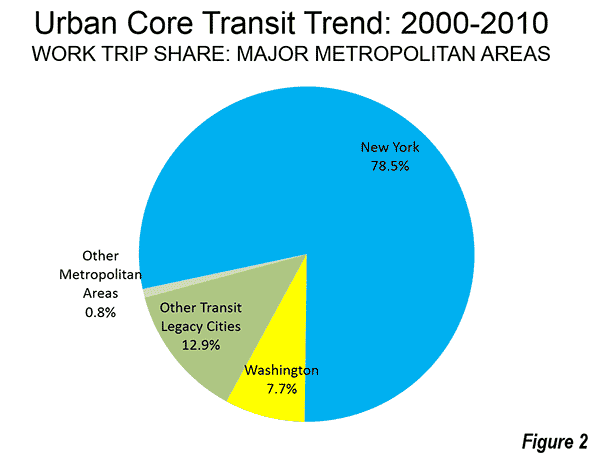
    As is so often the case with transit statistics, recent urban cores trends are largely a New York story. New York accounted for nearly 80 percent of the increase in urban core transit commuting. New York and the other five metropolitan areas with "transit legacy cities" represented more than 99 percent of the increase in urban core transit commuting (Figure 1). This is not surprising, because the urban cores of these metropolitan areas developed during the heyday of transit dominance, and before broad automobile availability. Indeed, urban core transit commuting became even more concentrated over the past decade. The 99 percent of new commuting (600,000 one-way trips) by transit in the legacy city metropolitan areas was as well above their 88 percent of urban core transit commuting in 2000.

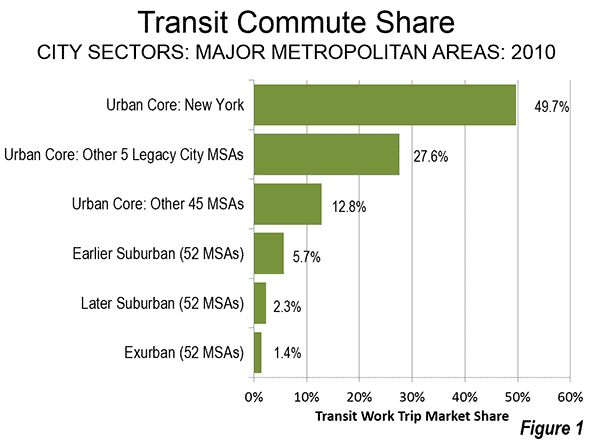
    New York’s transit commute share was 49.7 percent in 2010, well above the 27.6 percent posted by the other five metropolitan areas with transit legacy cities. The urban cores of the remaining 45 major metropolitan areas (those over 1,000,000 population) had a much lower combined transit work trip market share, at 12.8 percent.

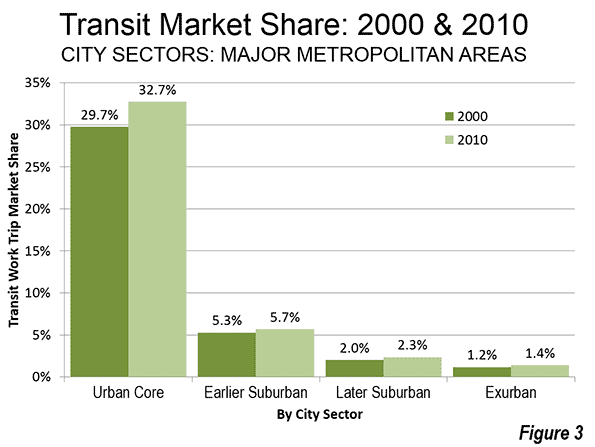
    The suburban and exurban areas, with 86 percent of the major metropolitan area population, had much lower transit commute shares. The Earlier Suburban areas (generally median house construction dates of 1946 to 1979, with significant automobile orientation) had a transit market share of 5.7 percent, the Later Suburban areas 2.3 percent and the Exurban areas 1.4 percent (Figure 2).

    The 2000s were indeed a relatively good decade for transit, after nearly 50 years that saw its ridership (passenger miles) drop by nearly three-quarters to its 1992 nadir. Since that time, transit has recovered 20 percent of its loss. Transit commuting has always been the strongest in urban cores, because the intense concentration of destinations in the larger downtown areas (central business districts) that can be effectively served by transit, unlike the dispersed patterns that exist in the much larger parts of metropolitan areas that are suburban or exurban. Transit’s share of work trips by urban core residents rose a full 10 percent, from 29.7 percent to 32.7 percent (Figure 3).

    There were also transit commuting gains in the suburbs and exurbs. However, similar gains over the next quarter century would leave transit’s share at below 5 percent in the suburbs and exurbs, because of its small base or ridership in these areas.

    Walking and Cycling

    The share of commuters walking and cycling (referred to as "active transportation" in the Queen’s University research on Canada’s metropolitan areas) rose 12 percent in the urban core (from 9.2 percent to 10.3 percent), even more than transit. This is considerably higher than in suburban and exurban areas, where walking and cycling remained at a 1.9 percent market share from 2000 to 2010.

    Working at Home

    Working at home (including telecommuting) continues to grow faster than any work access mode, though like transit, from a small base. Working at home experienced strong increases in each of the four metropolitan sectors, rising a full percentage point or more in each. At the beginning of the decade, working at home accounted for less work commutes than walking and cycling, and by 2010 was nearly 30 percent larger.

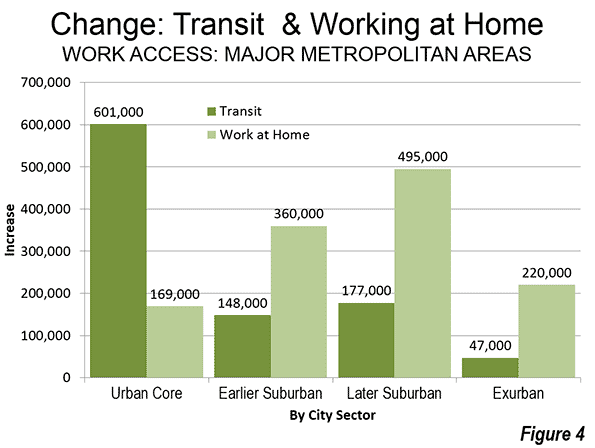
    The working at home largest gain was in the Earlier Suburban Areas, with a nearly 500,000 person increase. Unlike transit, working at home does not require concentrated destinations, effectively accessing employment throughout the metropolitan area, the nation and the world. As a result, working at home’s growth is fairly constant across the urban core, suburbs and exurbs (Figure 4). Working at home has a number of advantages. For example, working at home (1) eliminates the work trip, freeing additional leisure or work time for the employee, (2) eliminates greenhouse gas emissions from the work trip, (3) expands the geographical area and the efficiency of the labor market (important because larger labor markets tend to have greater economic growth and job creation, and it does all this without (4) requiring government expenditure.

    Driving Alone

    Despite empty premises about transit’s potential, driving remains the only mode of transport capable of comprehensively serving the modern metropolitan area. Driving alone has continued its domination, rising from 73.4 percent to 73.5 percent of major metropolitan area commuting and accounting for three quarters of new work trips. In the past decade, driving alone added 6.1 million commuters, nearly equal to the total of 6.3 million major metropolitan area transit commuters and more than the working at home figure of 3.5 million. To be sure, driving alone added commuters in the urban core, but lost share to transit, dropping from 45.2 percent to 43.4 percent. In suburban and exurban areas, driving alone continued to increase, from 78.2 percent to 78.5 percent of all commuting.).

    Density of Cars

    The urban cores have by far the highest car densities, despite their strong transit market shares. With a 4,200 household vehicles available per square mile (1,600 per square kilometer), the concentration of cars in urban cores was nearly three times that of the Earlier Suburban areas (1,550 per square mile or  600 per square kilometer) and five times that of the Later Suburban areas (950 per square kilometer). Exurban areas, with their largely rural densities had a car density of 100 per square mile (40 per square kilometer).

    Work Trip Travel Times

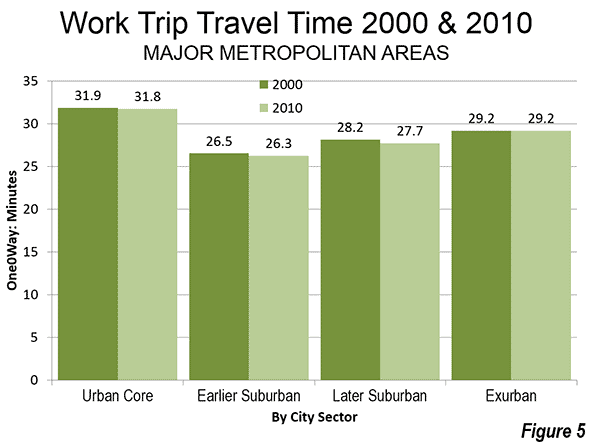
    Despite largely anecdotal stories about the super-long commutes of those living in suburbs and exurbs, the longest work trip travel times were in the urban cores, at 31.8 minutes one-way. The shortest travel times were in the Earlier Suburbs (26.3 minutes) and slightly longer in the Later Suburbs (27.7 minutes). Exurban travel times were 29.2 minutes. Work trip travel times declined slightly between 2000 and 2010, except in exurban areas, where they stayed the same. The shorter travel times are to be expected with the continuing evolution from monocentric to polycentric and even "non-centric" employment patterns and a stagnant job market (Figure 5).

    Contrasting Transportation in the City Sectors

    The examination of metropolitan transportation data by city sector highlights the huge differences that exist between urban cores and the much more extensive suburbs and exurbs. Overall the transit market share in the urban core approaches nine times the share in the suburbs and exurbs. The walking and cycling commute share in the urban core is more than five times that of the suburbs and exurbs. Moreover, the trends of the past 10 years indicate virtually no retrenchment in automobile orientation, as major metropolitan areas rose from 84 percent suburban and exurban in 2000 to 86 percent in 2010. This is despite unprecedented increases is gasoline prices and the disruption of the housing market during worst economic downturn since the Great Depression.

    —————————-

    Wendell Cox is principal of Demographia, an international public policy and demographics firm. He is co-author of the "Demographia International Housing Affordability Survey" and author of "Demographia World Urban Areas" and "War on the Dream: How Anti-Sprawl Policy Threatens the Quality of Life." He was appointed to three terms on the Los Angeles County Transportation Commission, where he served with the leading city and county leadership as the only non-elected member. He was appointed to the Amtrak Reform Council to fill the unexpired term of Governor Christine Todd Whitman and has served as a visiting professor at the Conservatoire National des Arts et Metiers, a national university in Paris.

    Photograph: DART light rail train in downtown Dallas (by author)

    —————————-

    City Sector Note: Previous articles in this series are listed below:
    From Jurisdictional to Functional Analyses of Urban Cores & Suburbs
    The Long Term: Metro American Goes from 82 percent to 86 percent Suburban Since 1990
    Functional v. Jurisdictional Analysis of Metropolitan Areas
    City Sector Model Small Area Criteria

  • Is Something Wrong With Chicago’s Suburbs?

    I previously talked about Connecticut becoming a suburban corporate wasteland as well as the rise of the executive headquarters in major global city downtowns. What we see is that high end functions have shown anecdotal signs of re-centralizing, while the more bread and butter – though still often well-paying – jobs are heading to less expensive suburban locales in places like Austin, Charlotte, and Salt Lake City. These leaves expensive and business hostile suburbs around global cities, like most of those in Connecticut, in a tough spot.

    Suburban Chicago isn’t as expensive or business hostile as say Connecticut or New Jersey, but there are so many stories about businesses leaving it that I can’t help but wonder if something is seriously wrong there.

    First, downtown Chicago has attracted a number of marquee executive headquarters locations like Boeing, MillerCoors, and now ADM. The suburbs have only picked up a handful of smaller operations, like Mead Johnson Nutritionals.

    Second, a number of suburban companies have relocated (or announced relocations of) headquarters to downtown. This includes a Sara Lee spinoff, the old Motorola cell phone division, United Airlines, and Gogo Internet. What distinguishes this from the executive headquarters relocations is that some of these involved big numbers of jobs. I believe there were about 3,000 United Airlines employees and about 2,500 Motorola ones.

    Third, even companies that haven’t moved their headquarters have opened downtown offices or relocated operations there. Walgreens moved its e-Commerce operations to the Loop and BP relocated some employees, for example.

    Fourth, some suburban based companies have simply abandoned the Chicagoland area outright. Office Max comes to mind, which is moving 1,600 jobs to Boca Raton. Sears is having a slow-motion going out of business sale.

    Two recent news articles this week reinforce to me the lack of competitiveness of Chicago’s suburbs. First, when Toyota announced it was relocating its headquarters from Los Angeles and Cincinnati to suburban Dallas, Greg Hinz at Crain’s Chicago Business asked why Chicago wasn’t even on the list of candidate cities for this operation.

    I believe Toyota wanted to be in the South. But if you look at where they located, namely the suburb of Plano, you’ll see that this is why Chicago is off the list. Chicago’s suburbs have been losing these types of corporations, not gaining them. If you’re going to choose a suburban location, why would you pick Schaumburg over Plano? You probably wouldn’t unless you had a major reason to be in Chicagoland, such as having a primarily Midwest presence or if your company was founded in the area.

    What this shows is that while Chicago’s stellar Loop environment is great for executive headquarters type operations, the suburbs lack appeal to people looking to build a greenfield operation from out of town. This hurts the region’s ability to attract large scale employers like Toyota.

    Then yesterday Crain’s reported that Walgreens is looking at relocating its entire headquarters downtown in the old Main Post Office building. This isn’t a done deal by any means, but the fact that a company I’d always considered dyed-in-the-wool suburban would consider this is incredible. (Investors have been pressuring Walgreens to move its HQ overseas, but like Aon’s re-domicle to London, even if it happened it might not involve many jobs, especially since the pharmacy business in the United States is so radically different from that in the rest of the world).

    So unlike in even other global cities, Chicago’s suburbs can’t even seem to hang on to large scale employers within the region. I don’t want to overstate a trend here, but this would be at least the third company moving thousands of jobs downtown. That’s huge and I don’t see it happening anywhere else at this scale.

    Which raises the question of what might be wrong with Chicago’s suburbs. They can’t seem to be competitive for greenfield operations like Toyota, and they are losing some marquee established employers. I took a quick peek at suburban vacancy rates, and it looks like at first glance every major sub-market is over 20% and there was net negative absorption last year (do some further research before quoting me on that). Is there a big problem going on out there?

    I’ve long observed that while Chicago has some great residential suburbs, its business suburbs are weak. Places like Schaumburg and Oak Brook are just generic, unattractive edge cities of a typology that, like the enclosed mall, appears falling out of favor. Chicago seems to lack the kind of suburb that combines residential appeal with a strong business presence and a significant regional amenity draw. Only Naperville would seem to fit the bill here.

    So while Chicago’s suburbs are not super-high cost by global city standards, and Illinois isn’t the worst when it comes to taxes and a poor business climate by any means, those suburbs appear to have a serious competitiveness issue. It’s a major concern that regional suburban business centers should look to address. As other edge city environments around the country like Stamford (one part of Connecticut I would say has significant strengths) and Tyson’s Corner upgrade themselves, Chicago’s suburbs are only going to fall further behind.

    Aaron M. Renn is an independent writer on urban affairs and the founder of Telestrian, a data analysis and mapping tool. He writes at The Urbanophile, where this piece originally appeared.

    Photograph: Outer suburbs of Chicago (by Wendell Cox)

  • May the (Insidious) Force Be With You

    Google Earth pic to the left of the boundary between Detroit and suburban Grosse Pointe Park, MI. Alter Road (cutting from upper left to lower right) is the boundary between the two. Take note of the differences in vacant land between Detroit (on the left) and Grosse Pointe Park (on the right).

    Too many people think today’s “de facto” segregation in metro areas is the result of personal preferences expressed by individuals, when the fact is that public policy has created the conditions we live with today.  In fact, I see the demise of Jim Crow through the Civil Rights Act and the Voting Rights Act corresponding with the immediate rise of an insidious, “non-racist” racism that shapes our metros today.  Our metro areas have never dealt with this.

    In the aftermath of the Donald Sterling controversy (which, if you aren’t aware of, you truly are under a rock), the Atlantic’s Ta-Nehisi Coates posted an on-spot critique of how racism is viewed and how racism is really working in today’s society.  It is a truly beautiful piece on the perception of racism versus its realities — the perception being that racism is the purview of dunces like Sterling (and Cliven Bundy before him) who get caught making inelegant statements that shed light on their true feelings, and a reality that is far more insidious and receives far less attention.  Coates describes how “elegant racism”, that insidious force, shapes where we live, what jobs are available to us, how we’re educated, and who is incarcerated and who isn’t:

    “Elegant racism is invisible, supple, and enduring. It disguises itself in the national vocabulary, avoids epithets and didacticism. Grace is the singular marker of elegant racism. One should never underestimate the touch needed to, say, injure the voting rights of black people without ever saying their names. Elegant racism lives at the border of white shame. Elegant racism was the poll tax. Elegant racism is voter-ID laws.”

    And to better describe how “elegant racism” works, he cites Chicago as its key implementer:

    “Throughout the 20th century—and perhaps even in the 21st—there was no more practiced advocate of housing segregation than the city of Chicago. Its mayors and aldermen razed neighborhoods and segregated public housing. Its businessmen lobbied for racial zoning. Its realtors block-busted whole neighborhoods, flipping them from black to white and then pocketing the profit. Its white citizens embraced racial covenants—in the ’50s, no city had more covenants in place than Chicago.

    If you sought to advantage one group of Americans and disadvantage another, you could scarcely choose a more graceful method than housing discrimination. Housing determines access to transportation, green spaces, decent schools, decent food, decent jobs, and decent services. Housing affects your chances of being robbed and shot as well as your chances of being stopped and frisked. And housing discrimination is as quiet as it is deadly. It can be pursued through violence and terrorism, but it doesn’t need it. Housing discrimination is hard to detect, hard to prove, and hard to prosecute. Even today most people believe that Chicago is the work of organic sorting, as opposed segregationist social engineering. Housing segregation is the weapon that mortally injures, but does not bruise.”

    (Let’s parenthetically stop here for a second; the symbolism in that last sentence is incredible.  The implication is that victims of elegant racism “die” from internal injuries, which are often believed to be sustained from a lifetime of poor personal choices.  But elegant racism made those choices for them.  Absolutely incredible).

    I don’t know if Chicago was the innovator of this type of racism, but I do believe it was something created in Northern industrial cities — i.e., the Rust Belt.  I suspect it has its seeds in the antebellum North, whose cities had small African-American populations prior to the Civil War and immediately afterwards.  I imagine at that time, when blacks comprised maybe less than five percent of, say, Buffalo’s population, it was relatively easy to isolate blacks without necessarily singling them out, as in the Jim Crow South.

    But the Great Migration changed everything.  The need for industrial labor in the North, and rapidly declining conditions in the Jim Crow South, pushed African-Americans into Northern cities.  Once there they encountered competition for jobs and housing from both longtime “nativists” and more recent European immigrants.  The ten years from 1910-1920 were fraught with racial conflicts in Northern cities, culminating with the Red Summer of 1919.

    But Northern cities did something that Southern ones did not.  They sought to limit and stigmatize the places where blacks lived, instead of limiting or stigmatizing the people themselves.  Out of this a whole set of policies emerged.  Racial covenants.  Redlining emerges during the New Deal.  Blockbusting came about as a tool to clear room for a growing black population, accelerate suburban expansion, and enrich real estate speculators.  Public housing was concentrated where blacks lived, and infrastructure investments ground to a halt.  Investments in education fell behind that of suburban schools, or couldn’t keep up with growing social challenges.  “Tough-on-crime” measures like mandatory sentencing and the “War on Drugs” were effective in removing potential workers from the workforce, reducing competition.  Taken together, these “non-racist” racist policies, often grounded in sound, rational economic thinking, created deeply ingrained patterns within metros that shape them today.

    This position is further buffeted by research done by Nancy DiTomaso, a business professor at Rutgers University in New Jersey.  In her book, The American Non-Dilemma: Racial Inequality Without Racism, she says this:

    “Because whites disproportionately hold jobs with more authority, higher pay, more opportunities for skill development and training, and more links to other jobs, they can benefit from racial inequality without being racists and without discriminating against blacks and other nonwhites. In fact, I argue that the ultimate white privilege is the privilege not to be racist and still benefit from racial inequality.”

    There are other strong claims made by DiTomaso in that interview; it (and the book, which I loved) is worth your attention.

    In my opinion the practice was perfected in the Rust Belt but has spread everywhere.  Milwaukee Journal-Sentinel is doing a series on political segregation in southeastern Wisconsin, and found that its roots are in the state’s residential segregation legacy.  Lee Atwater’s famous quote about the abstraction of racial policies, uttered in 1981, possibly signaled to Southern metros that there was a way to accomplish the separation that Jim Crow had earlier provided.  I see a correlation between the number of blacks within a metro area, and the impact of insidious policies on residential and job patterns.  In some metros, the impact, while there, is not as strong (New York, Boston), because of lower relative numbers of blacks.  In some Sun Belt metros, Jim Crow likely enforced similar patterns but subsequent post-War growth and the new policies altered things a little (Atlanta, Charlotte, Nashville).  In other Sun Belt metros with more recent growth the numbers of blacks has hardly been enough for full-on “elegant racism” implementation (Phoenix, Las Vegas).  But insidious racism is a critical feature of today’s Rust Belt cities.

    This is in part why I’m skeptical of new calls from urbanists to increase affordable housing in cities, when I see vast neighborhoods that have suffered from policies that simply removed them from the consciousness of the majority of the housing market.  I’d prefer to address yesterday’s mistakes before creating new ones.

    Plus, I keep thinking about that saying that the only thing necessary for evil to prosper is for good people to do nothing…

    This post originally appeared in Corner Side Yard on May 9, 2014.

    Pete Saunders is a Detroit native who has worked as a public and private sector urban planner in the Chicago area for more than twenty years.  He is also the author of “The Corner Side Yard,” an urban planning blog that focuses on the redevelopment and revitalization of Rust Belt cities.

  • The Monuments of Gentry Liberals in Chicago: White Students Dominate the Test-Admittance Public Schools

    According to the U.S. Census Bureau, Chicago’s population peaked a long time ago.  In 1950, Chicago had 3. 6 million people. Recent estimates put Chicago’s population at 2.7 million. With the growth of American suburbs, many Chicago families have fled to public schools in the suburbs. Chicago’s horrible public schools have been an embarrassment for Chicago’s elite. A recent Chicago Tribune editorial estimated that only “only 8 of 100 freshmen who enter Chicago public high schools manage to get a college diploma.”  

    In an attempt to keep white families from fleeing Chicago, the second Mayor Daley came up with a plan:  test-admittance-only public high schools. This was a reasonable solution for gentry liberals who pay high property taxes but didn’t want to leave the city or couldn’t afford to send their children to private schools. These select public high schools produce college bound students while “limiting” gentry liberal’s children from being exposed to children from “troubled backgrounds”. This is a sensitive subject because Chicago’s Public School System is only 9.2% white, while being 39.7% African-American.

    Being admitted to these select magnet schools can often determine whether a family stays in Chicago or moves elsewhere. Recently, Daniel Hertz made news by graphically showing how Chicago’s middle class has being largely eliminated since 1970. The new Chicago is still a one-party town, but is now a coalition of rich and poor with a residual government worker middle class. White children have left Chicago’s Public School system leaving minorities as the majority. But, who gets into the selective public high schools?  The Chicago Sun-Times reports:

    More white students are walking the halls at Chicago’s top four public high schools.

    At Walter Payton College Prep on the Near North Side, more than 41 percent of freshmen admitted the past four years have been white, compared to 29 percent in 2009, a Chicago Sun-Times analysis of Chicago Public Schools data has found.

    At Jones College Prep in the South Loop, 38 percent of this year’s freshman class is white, compared to 29 percent four years ago.

    In 2010 — the first year race was no longer used to determine the makeup of Chicago schools — the percentage of white freshmen at Northside College Prep in North Park rose from 37 percent to 48 percent.
    And at Whitney Young College Prep on the Near West Side, the percentage of black freshmen has steadily declined in the past three years, while the percentage of whites has risen.

    As these schools attract white students, Mayor Rahm Emanuel had to shut down 50 public schools which according to Democracy Now affected” 30,000 students, around 90 percent of them African American.” While Chicago is closing public schools, it is getting ready to build a new school. Not just any public school, but an expensive test only admittance high school named after Chicago’s glorious leader who went far. The new high school will be named Barack Obama College Preparatory High School.

    Gentry liberals leaders have told us with enormous conviction that public education is an “investment”. Yet, President Barack Obama and Mayor Rahm Emanuel send their children to elite private schools. What’s interesting in Rahm Emanuel’s case is he couldn’t find one public school in all of Chicago good enough to send his children. Mayor Rahm Emanuel is so committed to public education that he sends his children to a private school 15 miles away from where his children live.

  • Watch Chicago’s Middle Class Vanish Before Your Very Eyes

    Note: I owe both the concept for this measurement of income segregation and much of the actual data – all of it, except for 2012 – to Sean Reardon andKendra Bischoff, who wrote a series of wonderful papers on the subject and then were kind enough to send me a spreadsheet of their data from Chicago a while ago. The maps, however, are mine, as is all the data from 2012, and any mistakes in them or in the interpretation of the data is entirely my responsibility.

    I think one reason I’ve felt less than compelled by Chicagoland, CNN’s reasonably well-made documentary series, is that its tale-of-two-cities narrative is so worn, so often repeated, that it’s become a little dull. Not the actual fact of inequality – which only seems to cut deeper over time – but its retelling.

    In fact, I think the point has long passed at which simply repeating the story of Chicago’s stratification is equivalent to fighting it. For a lot of people, in my experience, it’s the opposite: an opportunity for distancing, for washing of hands. It’s a ritual in which we tell each other that this is the way it’s always been – The Gold Coast and the Slum was written about already well-entrenched institutions, after all, over three-quarters of a century ago – that these facts somehow seep out of the ground here, as much a part of the city as the lake, and that as a result there’s really nothing we can do about it.

    But this obscures much more than it clarifies. Inequality has always been a part of Chicago – as it has always been a part of the United States, and a part of humanity – but the forms it has taken, and the severity of those many forms, have changed in truly dramatic ways. Take, for example, today’s monolithic segregation of African Americans: at the turn of the last century, black Chicagoans were less segregated than Italians, and not because Italians were then hyper-segregated.

    Moreover, decisions made by people in the city have played, and continue to play, a huge role in determining what those changes look like. Had Elizabeth Wood received any serious support from white residents or their elected representatives – instead of meeting Klan-like violent resistance – the history of racial integration, economic integration, and public housing in this city would be very, very different. This isn’t to say that national and global factors aren’t important, since they obviously are. But neither do we lack responsibility.

    Anyway, this is all by way of introducing the following maps: their goal is not merely to depress you (you’re welcome!), but to suggest just how dramatically the reality of Chicago’s “two cities” has changed over the last few generations, how non-eternal its present state is, and that a happier alternate reality isn’t just possible, but actually existed relatively recently.

    I feel relatively comfortable telling the story of how Chicago came to be so segregated by race; I’m much humbler about my ability to explain this, except inasmuch as the ever-widening ghetto of the affluent could not exist without, yes, radically exclusionary housing laws, and I will take that up separately in another post. In the meanwhile, I’ll take a page from Ta-Nehisi Coates and ask you all, if you have some background in this, to talk to me like I’m stupid: what does the literature say about growing economic segregation? Who and what should I be reading?

    One last piece: the obvious and immediate reaction to these maps is to see them as a direct consequence of rising income inequality. There is some truth to that, but the researchers from which much of this data came have already discovered that income segregation has actually risen faster than inequality. So that’s not the end of the story.

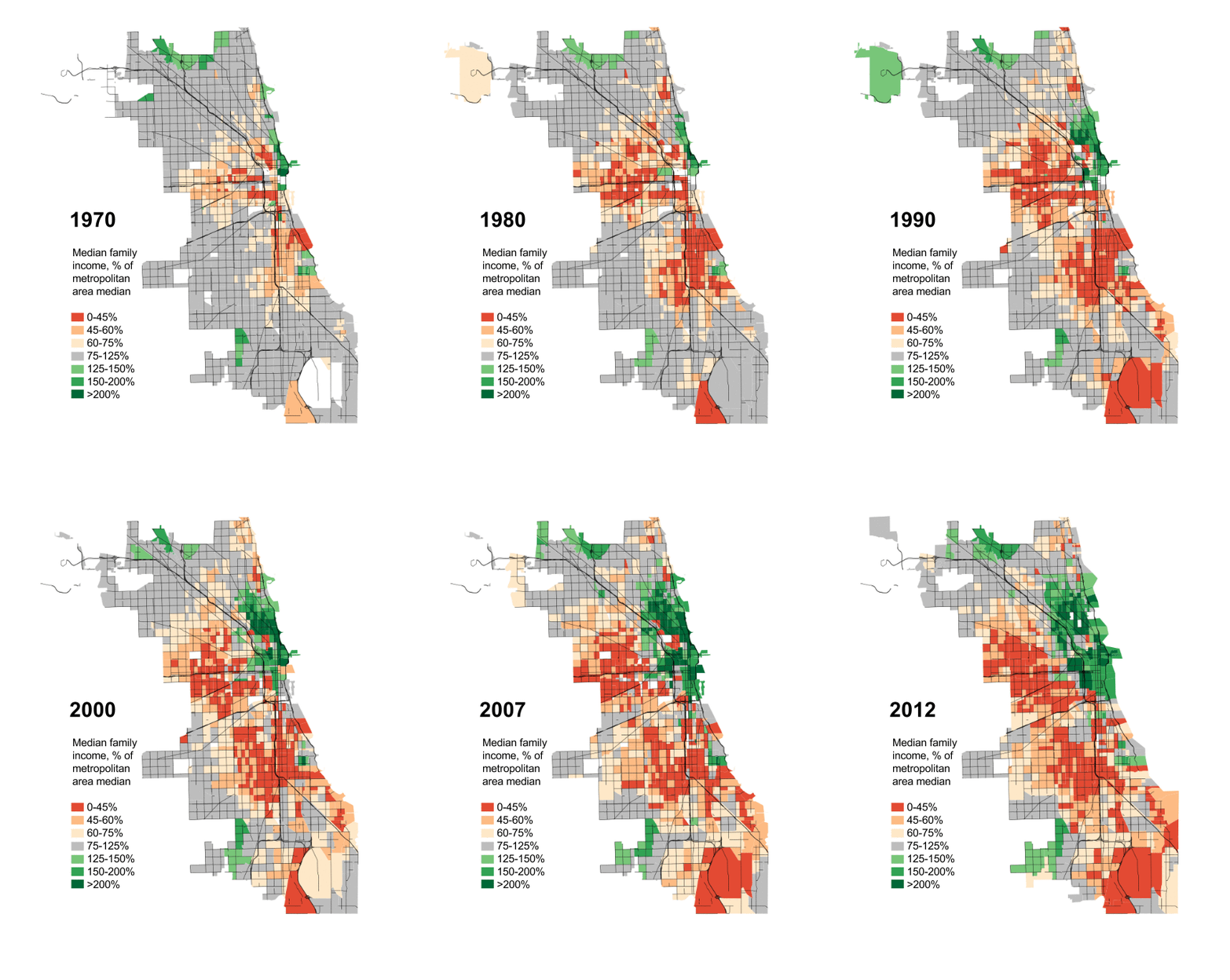
    Anyway, here you go: the disappearance of Chicago’s middle-class and mixed-income neighborhoods since 1970, measured by each Census tract’s median family income as a percentage of the median family income for the Chicago metropolitan region as a whole.

    Seg70aSeg80a


    Seg90aSeg00aSeg07aSeg12a


    IncSegGIF


    This piece first appeared at Daniel’s blog City Notes.

  • New Central Business District Employment and Transit Commuting Data

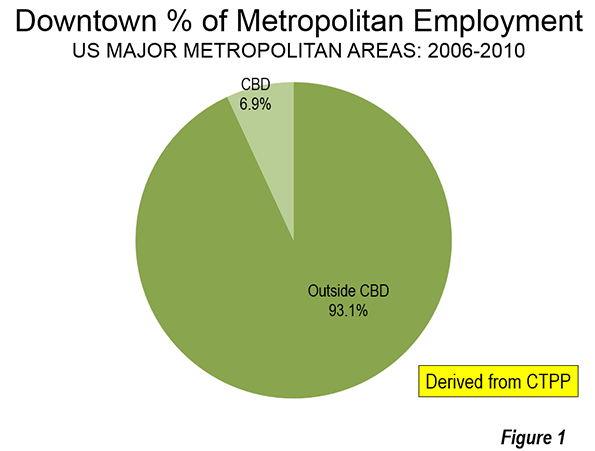
    Photographs of downtown skylines are often the "signature" of major metropolitan areas, as my former Amtrak Reform Council colleague and then Mayor of Milwaukee (later President and CEO of the Congress of New Urbanism) John Norquist has rightly said. The cluster of high rise office towers in the central business district (CBD) is often so spectacular – certainly compared with an edge city development or suburban strip center – as to give the impression of virtual dominance. I have often asked audiences to guess how much of a metropolitan area’s employment is in the CBD. Answers of 50 percent to 80 percent are not unusual. In fact, the average is 7 percent in the major metropolitan areas (over 1,000,000) and reaches its peak at only 22 percent in New York (Figure 1), which sports the second largest business district in the world (after Tokyo).

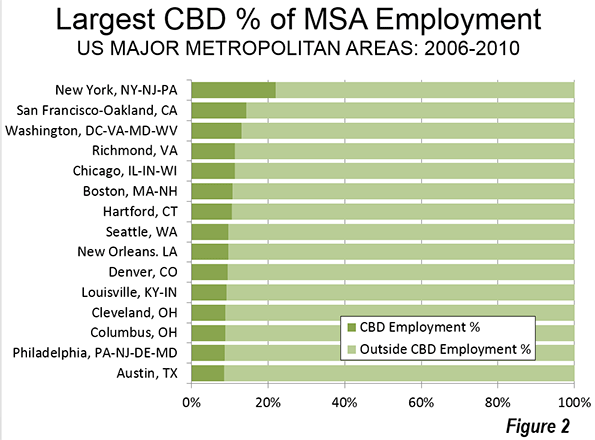
    Only seven of the 52 major metropolitan areas have CBDs with 10 percent or more of employment. Some are much lower. For example, Los Angeles and Dallas have had some of the nation’s tallest skyscrapers outside New York or Chicago for decades, yet these downtowns have only 2.4 percent and 2.3 percent of their metropolitan area employment respectively (Figure 2).

    This and similar information has been summarized in the third edition of Demographia Central Business Districts, which is based on the 2006-2010 Census Transportation Planning Package, a joint venture of the Census Bureau and the American Association of State Highway and Transportation Officials (AASHTO). The two previous editions of the report summarized data from the 1990 and 2000 censuses.

    The Declining Role of Downtown

    Downtowns have become far less important than before World War II, when a large share of American households did not have access to automobiles and when employment was far more concentrated than today. Indeed, the highly concentrated American downtown area is "unique," as Robert Fogelson indicates in Downtown: Its Rise and Fall: 1880-1950, and could be easily located as the destination of the "street railways." Downtown was a product of transit and remains transit’s principal destination today. The concentrated US style CBD form is really quite rare outside other new world nations, such as Canada, Australia, South Africa and New Zealand. Some, but only a few Asian cities have also followed the example, most notably Shanghai, Hong Kong, Nanjing, Chongqing, Singapore, and Seoul.

    The US, however, for all its role as originator of the downtown paradigm has also led the world in employment dispersion. This reflects the dominance in the US of automobiles. Dispersion is more amenable to mobility by the car, which dominates motorized mobility in virtually all major metropolitan areas of North America and Western Europe. This has led in the US to generally shorter work trip travel times and less traffic congestion, according to Tom Tom and Inrix. The continuing expansion of working at home could improve the situation even more.

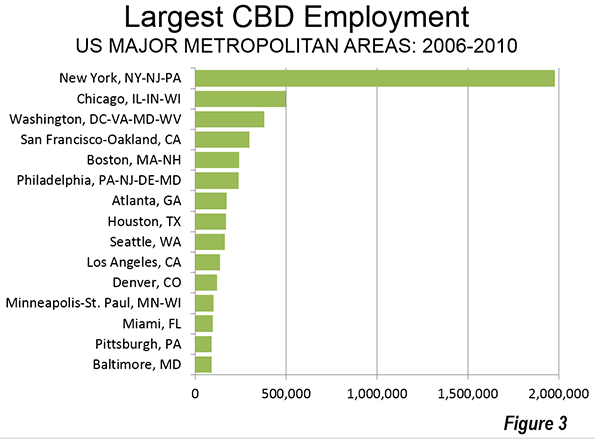
    New York has the largest CBD in the nation by far, with nearly 2,000,000 jobs. Chicago’s CBD (the Loop and North Michigan Avenue) has about one-quarter as many jobs (500,000) and Washington approximately 375,000. San Francisco, Boston and Philadelphia, also ranked among the nation’s transit "legacy cities," have between 200,000 and 300,000 jobs. Automobile oriented Houston and Atlanta are the largest otherwise, with Houston’s downtown being much more compact than Atlanta’s. Atlanta’s downtown has expanded strongly (and less densely) to the north and includes "Midtown" (Figure 3)

    Transit is About Downtown

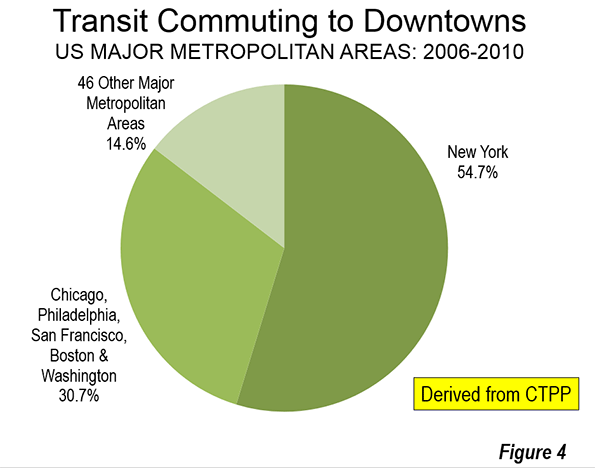
    Transit is about downtown. Approximately 55 percent of transit commuting in the United States is to jobs in just six municipalities (not to be confused with metropolitan areas), which I have called transit’s "legacy cities." Most of that commuting is to the six downtown areas. Of course, the city of New York is dominant, which alone accounts for 55 percent of the country’s CBD transit commuting (Figure 4), with much of the balance in the other five legacy cities (Figure 4). Only 14 percent of the CBD commuting is to the other 46 smaller downtowns.

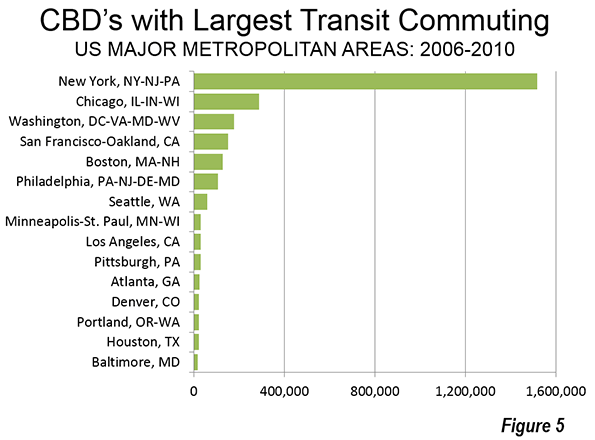
    More than 1.5 million transit commuters converge on jobs in Manhattan every day. In the other five legacy cities, the figure ranges from 100,000 to 300,000 daily. All of the other central business districts draw fewer than 100,000 daily commuters. Seattle ranks 7th, at 60,000, and has double or more the CBD transit commuters of any of the other 44 CBDs (Figure 5). 

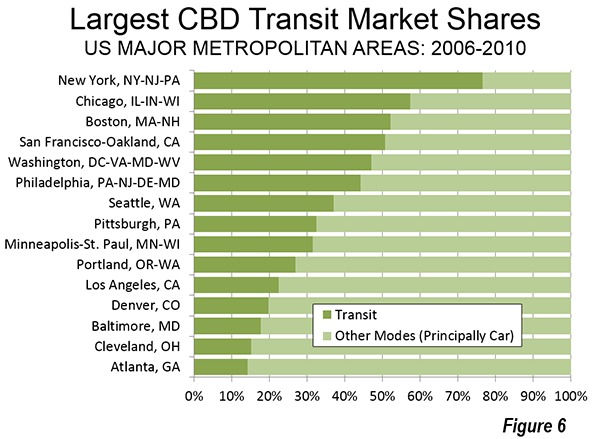
    New York has by far the highest transit commuting share of any downtown in the nation. Approximately 77 percent of people who work in the New York central business district commute by transit. The other legacy cities post impressive market shares as well, though well below those of New York. The CBDs in Chicago, Boston, and San Francisco draw between 50 percent and 60 percent of their commuters by transit. Downtown Philadelphia and Washington attract more than 40 percent of their commuters by transit (Figure 6).

    Transit is About Downtown II

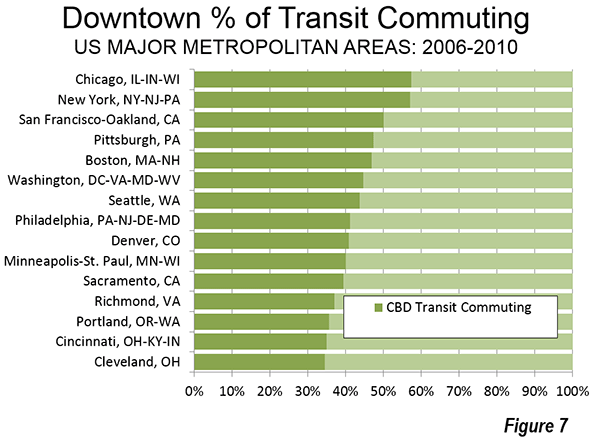
    The importance of downtown to transit is also indicated by its predominance in transit commuting destinations. In the New York metropolitan area, with a transit market share of approximately 30 percent, 57 percent of all transit commuting is to downtown jobs. Chicago’s transit commuting is concentrated in downtown to a slightly greater degree than in New York. One half of all the transit commuting in the San Francisco metropolitan area is to downtown. The CBDs of Boston, Philadelphia, and Washington account for between 40 percent and 50 percent of all transit commuting in their downtown areas. Seattle and Pittsburgh also are in this range (Figure 7). Seven of the eight metropolitan areas with the largest transit market shares have a CBD commuting dominance of 40 percent or more (Pittsburgh is the exception).

    The 52 major metropolitan area CBDs combined have less than five percent of the nation’s jobs. Elsewhere, downtowns and otherwise, the other 95 percent of American commuters use transit at only a three percent rate.

    Other Employment Centers

    In a new feature, Demographia Central Business Districts also provides data for selected employment centers other than the principal central business districts. These also include some surprises. For example, downtown Brooklyn, long since engulfed by the expansion of New York, has the second highest transit market share of any employment center identified other than New York, at 60 percent. Across the river, the Jersey City Waterfront area achieves a transit market share of more than 50 percent, greater than the downtowns of legacy cities Philadelphia and Washington.

    Data on supplemental employment center and corridor data is selected and therefore not representative. It is notable that some employment corridors and centers have employment totals that dwarf those of the principal downtown areas in their respective metropolitan areas, such as Los Angeles, Portland, Dallas, and Kansas City.

    With a few exceptions, the transit commuting shares for most of these selected centers and corridors is modest. Many are served by new rail systems, which are simply not up to the task of providing mobility to these dispersed centers. Nor can they provide the radial, high quality service that makes transit such a success in the six legacy city downtowns. For example, the Dallas light rail system provides service along virtually the entire US-75 corridor from north of downtown to Plano. Transit’s share of commutes in this corridor is only 2 percent, far below the downtown Dallas share of 14 percent and the legacy city downtown average of 65 percent.

    Wendell Cox is principal of Demographia, an international public policy and demographics firm. He is co-author of the "Demographia International Housing Affordability Survey" and author of "Demographia World Urban Areas" and "War on the Dream: How Anti-Sprawl Policy Threatens the Quality of Life." He was appointed to three terms on the Los Angeles County Transportation Commission, where he served with the leading city and county leadership as the only non-elected member. He was appointed to the Amtrak Reform Council to fill the unexpired term of Governor Christine Todd Whitman and has served as a visiting professor at the Conservatoire National des Arts et Metiers, a national university in Paris.

  • No Fundamental Shift to Transit: Not Even a Shift

    The American Public Transportation Association (APTA) is out with news of higher transit ridership. APTA President and CEO Michael Melaniphy characterizes the new figures as indicating "a fundamental shift going on in the way we move about our communities.” Others even characterized the results as indicating "shifting consumer preferences." The data shows either view to be an exaggeration.

    1935 and 2013

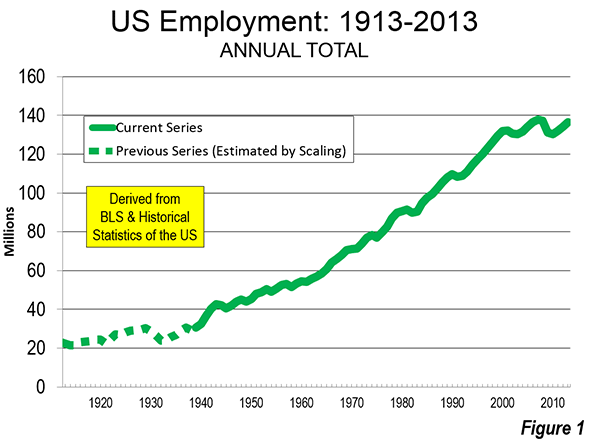
    This is hardly a reliable time for making judgments about fundamental shifts or shifts in consumer preferences. Economic performance has been more abysmally abnormal only once in the last century –during the Great Depression – than at present.

    The last year, 2013, is the sixth year in a row that total employment, as reported by the Bureau of Labor Statistics was below the peak year of 2007 (Figure 1). This run of dismal job creation was exceeded only between the Great Depression years of 1929 and 1936 in the last 100 years (Note 1). From World War II until the Great Recession, the maximum number of years that employment fell below a previous peak was two, following the 9/11 terrorist attacks (2001 to 2003). The Great Recession may have ended, according to the National Bureau of Economic Research, but the Great Malaise continues as the economy is performing well below historic levels. Judgments about fundamental shifts and consumer choice today are not more reliable than they would have been in the Great Depression year of 1935.

    Transit’s Market Share: Stuck in Neutral

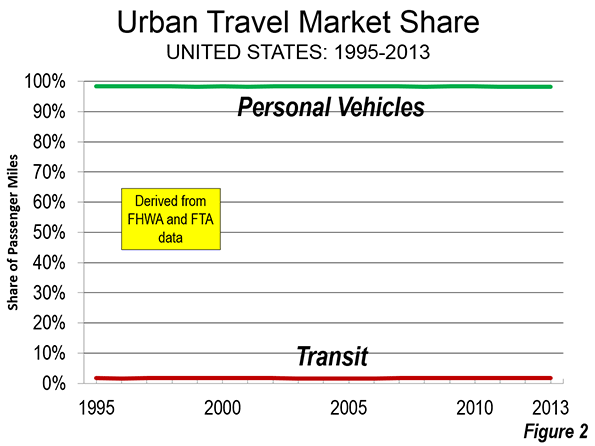
    But more importantly, there is no shift to transit.  APTA is right to point out that transit ridership has grown faster than vehicle travel in the United States since 1995. Nonetheless, transit’s share of urban travel has barely budged, because its 1995 share of travel was so small. This is indicated by Figure 2, which compares the overall market share of transit to that of cars and light trucks from 1995 to 2013. Indeed, the top of Figure 2 (the 100 percent line) is virtually indistinguishable from the personal vehicle share over the entire period. The bottom of the chart (the zero percent line) is virtually indistinguishable from the transit share. This is not the stuff of fundamental shift.

    Commuting: The Story is Not Transit

    A similar pattern of little or no change is indicated by the commuting (work access) data from the Census Bureau’s American Community Survey.

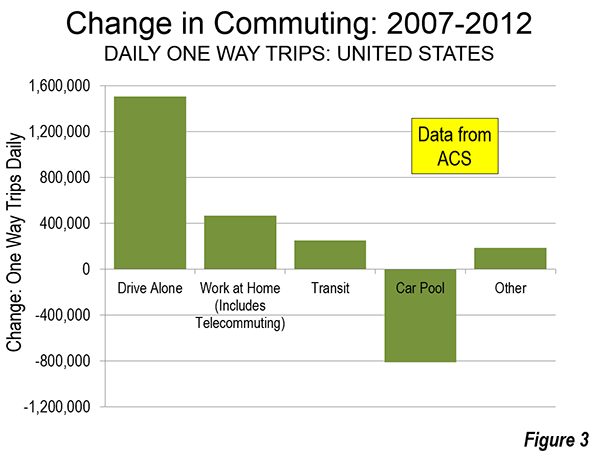
    Over the past five years, as with virtually all the years since such data has been collected, the overwhelming majority of new commuters have driven alone (Figure 3). Indeed, transit has not taken a single net automobile off the road since 1960, and not in the last five years. Between 2007 and 2012, 93 percent of the additional commuters drove alone (Note 2). The drive alone market, which might have been thought to be saturated, actually rose from 76.1 percent to a 76.3 percent market between 2007 and 2012.

    The biggest change has been the continuing loss in carpool use, which dropped from 10.4 percent to 9.7 percent from 2007 to 2012. It is estimated that nearly 450,000 passengers left carpools (excluding drivers), approximately 1.8 passengers for each additional commuter using transit (250,000).

    The largest gain from 2007 to 2012 was in working at home, including telecommuting. Working at home increased from 4.1 percent to 4.4 percent. In actual numbers, working at home added 1.9 times the increase in transit commuting. Its change in market share was greater than that of transit in 42 of the 52 major metropolitan areas. Surprisingly, this includes New York, with its incomparable transit system (by US standards).

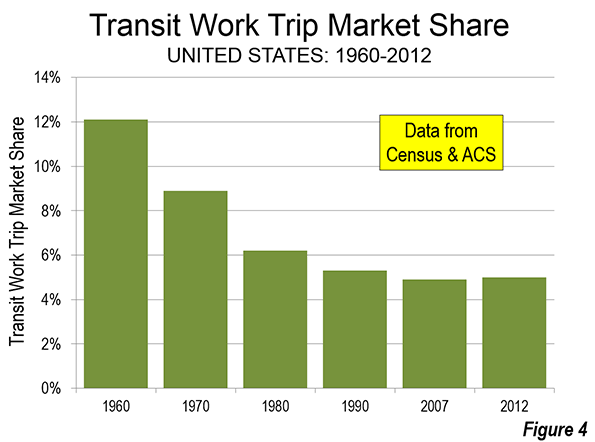
    Transit’s share of commuting inched up only 0.1 percentage points between 2007 and 2012. This is so small that if this rate of annual increase were sustained for 50 years, transit’s commute market share would  edge up to only 6 percent (Figure 4), approximately transit’s 1980 market share (doubling to 10 percent would require 130 years). The latest data indicates both gains and losses for transit, with market shares up in 28 major metropolitan areas and down in 24.

    Transit Losses

    In Atlanta, with the nation’s second largest Metro (subway) system built since 1975, a declining overall employment base was accompanied by a loss of 13,000 transit commuters, at the same time that there was an increase in working at home of 19,000.

    In Portland, considered by many around the world to be an urban planning Utopia, the data is hardly favorable. Since 1980, the last year with data before the first of five light rail lines and one commuter rail line opened, transit’s market share has dropped from 8.4 percent to 6.0 percent. While spending billions of dollars on rail, working at home – which involves little or no public expenditure – increased by triple the number of people drawn to transit. And things have not changed materially, even during the claimed "fundamental shift." In the last five years, the working at home increase is more than double that of transit.

    In Los Angeles, ridership at the largest transit agency continues to languish below its 1985 peak, despite having opened 9 light rail, Metro, and rapid busway lines and adding more than 1.5 million residents. Even this decline may be under-stated because of how transit counts passengers. Each time someone steps on a transit vehicle, they are counted (as a boarding). A person who transfers between two or three buses to make a trip counts as two or three boardings, which is what the APTA data reports.

    When rail is added to a transit system, bus services are reconfigured to serve the rail system. This can mean many more boardings from transfers without more passenger trips. This potential inflation of ridership is likely to have occurred not only in Los Angeles, but in all metropolitan areas that added rail systems.

    Transit Gains

    At the same time, gains are being made in some metropolitan areas. Ridership has risen more strongly in transit’s six "legacy cities," the municipalities (not metropolitan areas) of New York, Chicago, Philadelphia, San Francisco, Boston, and Washington. Between 2007 and 2012, 68 percent of the additional transit commuting occurred to employment locations in these six municipalities. This is higher than the 55 percent of national transit commuting that these areas represented in 2012. The much larger share being attracted by these areas in the last 5 years is an indication that transit ridership, already highly concentrated in just a few places, is becoming even more concentrated.  Further, 50 percent to 75 percent of commuters to the corresponding six downtowns reach work by transit.

    Rational Consumer Behavior

    Even when the nation finally emerges from the Great Malaise, only vain hope will be able to conceive of a large scale consumer preference driven shift toward transit. The rational consumer will not choose transit that is slower or less convenient than the car. Where transit access is impractical or impossible, people will use cars. This is the case for most trips in all US metropolitan area, as the Brookings Institution research cited below indicates

    The Brookings Institution research indicated that the average employee in the nation’s major metropolitan areas are able to access fewer than 10 percent of jobs in 45 minutes. This is not only a small number of jobs, but it is a travel time that is approximately twice that of the average employee in the United States (most of whom travel by car).

    More funding for transit cannot solve this problem. The kind of automobile competitive transit system needed to provide rational consumer choice between cars and transit would require annual expenditures rivaling the total personal income in the metropolitan area, as Jean-Claude Ziv and I showed in our 2007 11th World Conference on Transport Research paper (2007). It is no wonder that not a single comprehensive automobile competitive transit system exists or has been seriously proposed in any major US or Western European metropolitan area (Note 3).  Transit is about the largest downtowns and the largest urban cores.

    Unbalanced Coverage

    All of this appears to have escaped many media outlets, which largely parroted the APTA press release. For example, The New York Times, CBS News, the Washington Post, and the Chicago Tribune were as parish newsletters commenting on a homily by the priest, for their failure to report both sides. A notable exception was USA Today, whose reporter consulted outsider Alan Pisarski (who has written for newgeography.com). Pisarski placed the APTA figures in historical context and expressed reservations about restoration of the transit commuting share numbers of 1980 or before. 

    Wendell Cox is principal of Demographia, an international public policy and demographics firm. He is co-author of the "Demographia International Housing Affordability Survey" and author of "Demographia World Urban Areas" and "War on the Dream: How Anti-Sprawl Policy Threatens the Quality of Life." He was appointed to three terms on the Los Angeles County Transportation Commission, where he served with the leading city and county leadership as the only non-elected member. He was appointed to the Amtrak Reform Council to fill the unexpired term of Governor Christine Todd Whitman and has served as a visiting professor at the Conservatoire National des Arts et Metiers, a national university in Paris.

    Photograph: DART light rail train in downtown Dallas (by author)

    ———————

    Note 1: Current Employment Statistics Survey data, 1939 to 2013. 1913 to 1938 estimated from data in Historical Statistics of the United States: Bicentennial Edition.

    Note 2: The source for the commuting data is the American Community Survey of the Census Bureau, which indicates an employment level in 2012 that is higher than in 2007. The Current Employment Statistics Survey of the Bureau of Labor Statistics indicates a decline.

    Note 3: I would be pleased to be corrected on this. In 2004, we issued a challenge on this subject, and while there were some responses, none met the required criteria (see http://demographia.com/db-challenge-choice.htm). The criteria are repeated below:

    To identify an actual system or propose a system that provides the following in an urban area of more than 1,000,000 population:

    · Transit choice (automobile competitive public transport service) for at least 90 percent of trips and passenger kilometers in the particular urban area.

    · Automobile competitiveness is defined as door to door trip times no more than 1.5 times automobile travel time.

    The description of any system not already in operation should also include an estimate of its cost, capital and annual operating.