Tag: Chicago

  • The Sound and the Fury In Chicago

    The Second City syndrome is alive and well. An anti-Chicago essay masquerading as a book review in the New York Times provides the latest example of the truth of that.  Rachel Shteir, a former New Yorker now living in Chicago, notes the various ills in the Windy City that should come as a surprise to no one, least of all residents:

    “Poor Chicago,” a friend of mine recently said. Given the number of urban apocalypses here, I couldn’t tell which problem she was referring to. Was it the Cubs never winning? The abominable weather? Meter parking costing more than anywhere else in America — up to $6.50 an hour — with the money flowing to a private company, thanks to the ex-mayor Richard M. Daley’s shortsighted 2008 deal? Or was it the fact that in 2012, of the largest American cities, Chicago had the second-highest murder rate and the ­second-highest combined sales tax, as well as the ninth-highest metro foreclosure rate in the country? That it’s the third-most racially segregated city and is located in the state with the most underfunded public-employee pension debt? Was my friend talking about how a real estate investor bought The Chicago Tribune and drove it into bankruptcy? Or how 15-year-old Hadiya Pendleton, who performed at Barack Obama’s inauguration, was shot dead near the president’s Kenwood home?"

    Illustrating the rule that criticizing Chicago is something that is Simply Not Done, this piece sent locals into collective apoplexy. Huffington Post Chicago provides a roundup of the “epic backlash.”  The Atlantic Cities chimes in with its own roundup of “Everything You Need to Know About Why Chicago Is Furious With Rachel Shteir and The New York Times,” noting that “We don’t have to wait for the angry letters to be printed in the next Book Review. The counter-manifestos are already here! In the past few days, it seems, everyone from Gary to Milwaukee has read Shteir’s ‘Chicago Manuals’ piece, resulting in a groundswell of angry rebuttals.” An army of angry tweeters spoke out.  And even the mayor addressed the issue. Not a bad day’s work for a theater professor at Depaul (Shteir’s day job).

    In a sense Shteir is right. I’ve long noticed that Chicago is basically an echo chamber of boosterism in which everyone is terrorized about deviating from the party line lest they be excommunicated from polite company, a fate that may well indeed await Shteir. And Chicago clearly has manifest problems as a city, many of which she notes, though many of her list such as the perennial disappointment of Cubs fans are clearly more snark than substance.

    However, what Shteir and Chicago both miss is the real value proposition of the city. Taken on its own terms, Chicago is a simply fantastic place to live. It has a magnificent lakefront setting, a stunning skyline, fantastic cultural institutions, incredible opportunities to consume (from designer clothing to world class dining), and much more. It may be true that these great things largely benefit those from more affluent precincts with vast tracts of the city left behind in segregated, entrenched poverty, but it’s tough to name a place where that isn’t likewise true. Much of Brooklyn, for example, remains mired in poverty, but no one in New York seems to care and criticisms of it as such are simply shrugged off.

    Chicago also has perhaps – at least in my view – the best blend of the best of the elite urban center with much of the best of cities further down the food chain. You can have genuinely walkable neighborhoods, take transit to work, and eat food that would be impressive in any city in the world while simultaneously having a spacious and affordable condo with parking that allows you to drive to a conveniently located Target or Costco to stock up when you need to. It’s car oriented when you need it and walkable when you need it, all at a reasonable price. Now that’s certainly something that many cities lower down in the hierarchy will also claim – big city amenities with a high quality of life. But Chicago is the most elite city in America that can plausibly make that claim.

    What Chicago is not, despite its pretensions, a truly global tier one city like New York, London, or Paris. That is what the booster culture can’t abide. It is an article of faith that every Chicagoan must believe, or at least pretend to believe, that Chicago is worthy of being spoken of in the same breath as any city in the world. Even a critic like Shteir seems to evaluate it on that basis.

    But the reality is that Chicago is a “1B” city like Frankfurt or Toronto not a “1A” city. There’s nothing wrong with that. In fact, I happen to believe Chicago’s value proposition is arguably better than most of the 1A cities for everyone who isn’t in the 0.1%. But both local boosters and critics can’t look at Chicago for what it is, but rather what it isn’t and never will be. Chicago will never be New York. But neither will New York ever match the best of Chicago on the Windy City’s own terms with a comparable quality/price/ease mix.

    In this sense, Chicago might be seen as the leader of a wave of other emerging would be 1A cities – Houston, Dallas, San Diego – that are making the cut from a second tier city. Being the leader and something of a role model for a wave of rising cities may not be bad positioning at all.

    Aaron M. Renn is an independent writer on urban affairs and the founder of Telestrian, a data analysis and mapping tool. He writes at The Urbanophile.

    Photo by Doug Siefken.

  • Chicago: Outer Suburban and Exurban Growth Leader

    Greg Hinz at Crain’s Chicago Business congratulates Chicago for its nation-leading population growth. Heinz also notes that the far suburbs also gained population strongly, but there had been losses in the areas between the two. He asks: "the question now is whether the area can prosper with a thriving core but sinking neighborhoods and inner-ring suburbs around it."

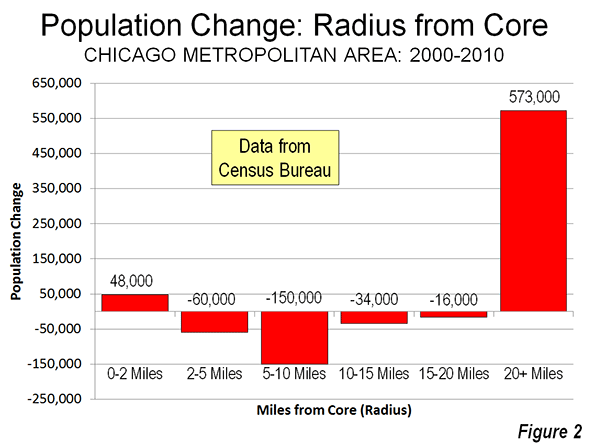
    The area within 2 miles of downtown gained nearly 50,000 people between 2000 and 2010. No other US metropolitan area equaled this urban core population increase.

    The article cites a number of factors beyond population growth to indicate that the city of Chicago is outperforming the suburbs. Retail sales tax collections have increased faster in the city. However, Hinz also notes that there has also been a sizable proliferation of big-box stores (Target and Wal-Mart), which is made it possible for residents to shop in the city instead of the suburbs.

    Empty Nesters Not Flocking to Downtown

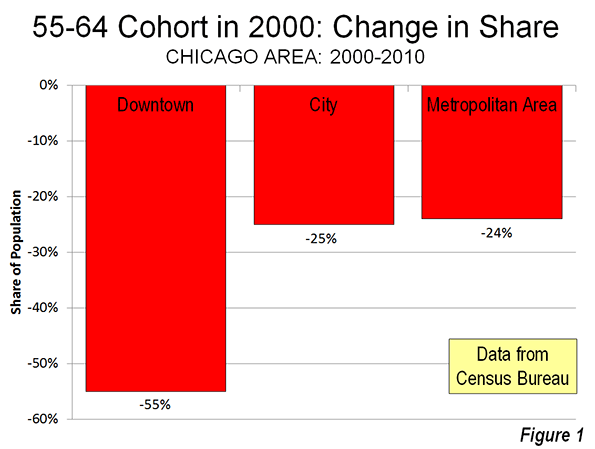
    Hinz notes that "empty nesters" are moving to the urban core. Yet this is not confirmed by the data. Between 2000 and 2010, the age cohort that was from 55 to 64 years old in 2000 dropped by 55 percent as a share of the population in the fast growing core census tracts of central Chicago. In contrast, in the city of Chicago overall, the loss was 25%, and the reduction was 24% in the entire metropolitan area (Figure 1). Our previous national research showed that the population losses in this cohort were the greatest in the core cities among the 51 major metropolitan areas.

    The article goes on to quote Alan Ehrenhalt to the effect that an "inversion" of the city to suburban movement pattern is occurring, and "it’s happening more in metropolitan Chicago than just about any other city in the country."

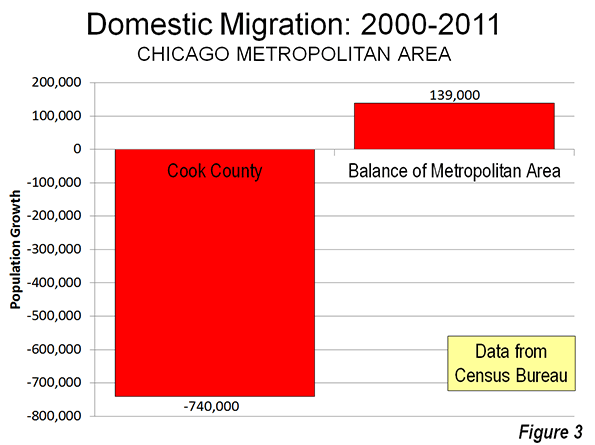
    "Inversion" implies "turning upside down." For an inversion to have occurred, there would need to have been a reversal of the trend in movement from the core cities to the suburbs. The most important indicator of any such inversion would be that domestic migration would show a flow from a suburbs to cities. It does not. Domestic migration from Cook County, in which Chicago is located, was minus 740,000 between 2000 and 2011 (Note). Domestic migration in the suburban counties was a plus 139,000. Thus, there was no net migration from the suburbs to Cook County (Figure 2).  

    The City of Chicago Outside Downtown

    The story was much different outside the core area. The balance of the city, where 93 percent of the people live, lost 250,000 residents – a loss greater than that of any municipality in the nation over the period – including Detroit. The losses were pervasive. More than 80 percent of the city’s 77 community areas located outside the core lost population.

    Thus, the core area boom is far more than negated by the losses in the balance of the city. The losses that were sustained in the area between the urban core and the outer suburbs and exurbs were virtually all in the city itself.

    Inner Suburbs

    At the same time, the inner ring suburbs (between the city and 20 miles from the core for this analysis) grew only modestly, gaining less than 20,000 between 2000 and 2010. This is not unexpected, especially in a metropolitan area with slow growth, like Chicago. Urban areas tend to grow organically, with the greatest growth on the urban fringe. As the urban fringe moves further from the core, growth will be less in the established developed areas. 

    An important exception is the small pockets of growth developing and occupying previously disused warehouse and commercial and even railroad yard areas. The core of Chicago is among these, along with Portland’s Pearl District, the Washington Avenue corridor in St. Louis, the Third Ward in Milwaukee, and others. The exit of commercial activities permitted conversion to residential uses, often decades after the abandonment of previous uses.

    Outer Suburban and Exurban Growth

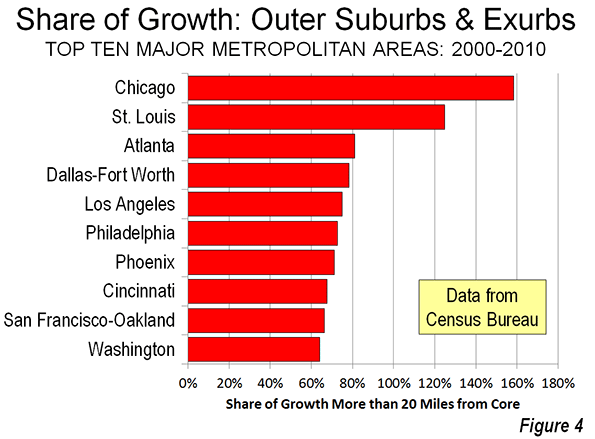
    The overwhelming reality of metropolitan growth in Chicago, however, is that the outer suburbs and exurbs continue to capture virtually all growth. Overall, areas outside 20 miles from the core of Chicago gained 573,000 residents between 2000 and 2010. By contrast, the entire metropolitan area gained only 362,000 residents. As a result, these outer suburbs and exurbs accounted for 158% of the Chicago metropolitan area’s population growth between 2000 and 2010. The core gains, city and inner suburban losses are illustrated in Figure 3.

    Approximately 52 percent of the metropolitan area population is now in the outer suburbs and exurbs. If Chicago’s outer suburbs and exurbs were a separate metropolitan area, they would rank as the 10th largest in the nation, with a population of nearly 5 million, between Atlanta and Boston.

    Chicago: Outer Suburban and Exurban Growth Leader

    As significant as Chicago’s core population growth has been over the last decade, it has been substantially overshadowed by outer suburban and exurban growth. Approximately 12 residents were added in the outer suburbs and exurbs for each new resident in the urban core. Like its urban core growth, Chicago’s growth in the urban core led the nation. Only one other metropolitan area, St. Louis, exceeded 100 percent in its population growth outside a 20 mile radius from downtown (Figure 4).

    Wendell Cox is a Visiting Professor, Conservatoire National des Arts et Metiers, Paris and the author of “War on the Dream: How Anti-Sprawl Policy Threatens the Quality of Life.

    Photograph: Outer suburbs of Chicago (by author)

    Note: Domestic migration data is not available below the county level.

  • Transit Legacy Cities

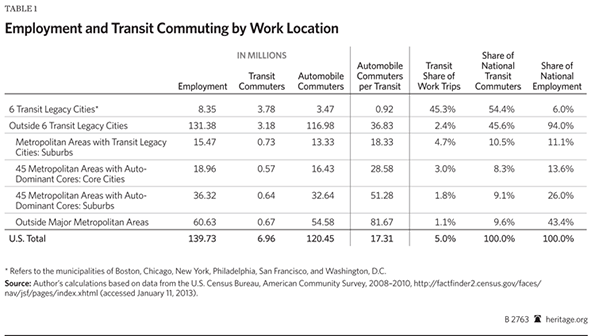
    Transit’s greatest potential to attract drivers from cars is the work trip. But an analysis of US transit work trip destinations indicates that this applies in large part to   just a few destinations around the nation. This is much more obvious in looking at destinations than the more typical method of analysis, which looks at the residential locations of commuters. This column is adapted from my new Heritage Foundation Backgrounder "Transit Policy in an Era of the Shrinking Federal Dollar."

    Transit Legacy Cities

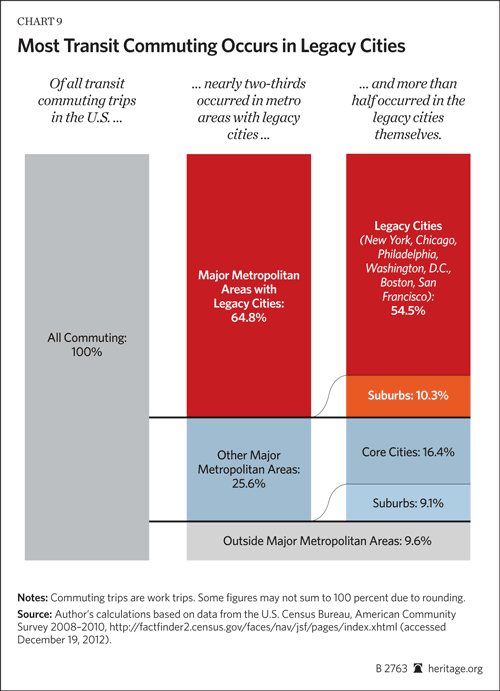
    Transit commuting is heavily concentrated to destinations in just the six core cities (historical core municipalities) of New York, Chicago, Philadelphia, San Francisco, Boston and Washington (Backgrounder Chart 9). I call them the "transit legacy cities," because their high transit market shares relate to their development before the automobile became dominant. Because there is such a lack of clarity in the use of terms that apply to cities, it is important to emphasize that the transit legacy cities are municipalities, not the surrounding metropolitan areas or urban areas, where the majority of residents live (Note 1). 


    The transit legacy cities account for nearly 55 percent of the nation’s transit commuters, by work trip destinations, according to the American Community Survey (2008-2010). By contrast, the transit legacy cities have an overall national employment market share barely one-tenth their national transit share (6 percent). Moreover, combined, the transit legacy cities cover a land area little larger than the core city (municipality) of Jacksonville, Florida.

    At the same time, the "other side of the coin" is that commuting to other destinations is dominated by the automobile, from the suburbs in metropolitan areas with transit legacy cities, and even more so in the other 45 major metropolitan areas (with more than 1,000,000 population) and the balance of the nation.

    Legacy Cities: Transit’s Strength

    The extent of the concentration in the six transit legacy cities is illustrated in Backgrounder Table 1. In some ways, transit is, first and foremost,  really a New York story. More than one-third of all transit work-trip commuting is to destinations in the core city of New York. The dominance is even greater for high-capacity subways/elevated services, a mode in which where New York represents two-thirds of national commuting.

    The Key: Large, Concentrated, Well Served Downtowns: The concentration of transit commuting in the six transit legacy cities reflects the factor that is probably more responsible than any other for attracting people from cars to transit. This is a highly concentrated downtown area (central business district, or "CBD") from which a dense network of rapid transit services radiates.

    The six transit legacy cities are also home to the six largest CBDs in the nation, where transit’s share of commuting is far higher than compared to the rest of the nation. Approximately three quarters of commuters to the sprawling Manhattan CBD in New York (south of 59th Street) commuted by transit in 2000. Less well known is that New York also contains the CBD with the second largest transit work trip destination, downtown Brooklyn (58 percent), which is followed by downtown Chicago (55 percent).

    In addition, between nearly 40 percent and more than 50 percent of commuters used transit to the CBDs of Boston, San Francisco, Philadelphia and Washington. While covering a land area less than one-half the size of Orlando’s Walt Disney World, these downtowns accounted for 35 percent of national transit commuting.

    Outside the Transit Legacy Cities: Automobile and Work at Home Country

    So what about the 94 percent of US commuters who work outside the transit legacy cities? The answer is that the automobile dominates, and transit has been overtaken by working at home. In the suburban areas of metropolitan areas with transit legacy cities, the car carries 18 times as many people to work locations as transit. In the core municipalities of the 45 major metropolitan areas without legacy cities, cars carry 29 times as many commuters as transit, and 51 times as many in the suburbs. Outside the nation’s major metropolitan areas, cars carry 82 times as many commuters as transit (Backgrounder Table 1)

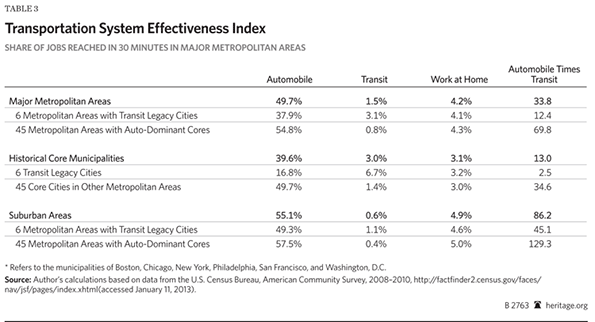
    Further, outside the transit legacy cities, working at home (including telecommuting) provides access to twenty percent more jobs than transit (Backgrounder Table 3).

    An American Love Affair with the Automobile?

    The enduring myth of the American love affair with automobile is countered by the huge transit market shares to city downtowns . For example, commuters to Manhattan are five times as likely to use transit as cars. On the other hand, commuters to the edge city of Parsippany, on the I-287 corridor in suburban New Jersey are 50 times as likely to use their cars as transit. Yet both employment centers serve the same labor market. The issue is not preferences, it is rather rational choice. It would be irrational for most people to commute to Manhattan by car, principally because of the traffic congestion and cost, particularly for parking. It would similarly be irrational for most people to commute to Parsippany by transit, because it either could not be done at all, or it would take too long.

    Transit’s work trip destination market share is an effective measure of its relevance to the market.

    And lest anyone should counter that the answer is more money, consider this.

    A Cost Not A Revenue Problem

    Portland (with a core city that is not a legacy city) has long been held out as a model for improving transit. Yet, after billions of dollars in federal and local tax subsidies, more than 50 times as many people travel to work to suburban locations by car as by transit. More than five times as many work at home as use transit, and working at home costs taxpayers virtually nothing. Yet, despite all these billions, Portland’s transit system is in crisis. Tri-Met’s  Executive Director Neil McFarlane has warned of 70 percent service cuts over 12 years without substantial changes to union contracts.

    Transit’s fundamental problem is not insufficient revenue but insufficient cost control. Since 1983, national transit expenditures have risen at an inflation-adjusted rate nine times that of its increase in commuters (Note 2). Even if costs were under control, it would be financially impossible to provide automobile-competitive transit throughout the modern urban area, as Professor Jean-Claude Ziv and I showed in our WCTRS paper (Megacities and Affluence: Transport and Land Use Considerations).

    Celebrating Transit

    Yet, beyond its inability to convert generous taxpayer subsidies into corresponding ridership increases, transit deserves credit for the large number of people it moves to jobs in the legacy cities. This success should be celebrated although it remains an impossible, prohibitively expensive, dream elsewhere.

    Wendell Cox is a Visiting Professor, Conservatoire National des Arts et Metiers, Paris and the author of “War on the Dream: How Anti-Sprawl Policy Threatens the Quality of Life.”

    —-

    Note 1: Each of the transit legacy cities has a lower population than the surrounding suburbs. This ranges from nearly 45 percent of the population in the suburbs of the New York metropolitan area to little more than 10 percent in Washington.

    Note 2: Within the first 30 days of my time on the Los Angeles County Transportation Commission, I became convinced that transit’s principal problem was cost control (see Toward More Prosperous Cities). This was then and today remains clear from the above-inflationary escalation of unit costs. Regrettably that trend continues today and has seriously impeded transit’s ability to increase ridership.

    —–

    Photo: Downtown Philadelphia (by author)

  • Why Are There So Many Murders in Chicago?

    After over 500 murders in Chicago in 2012, the Windy City’s violence epidemic continues – 2013 saw the deadliest January in over a decade – and continues to make national news.  The New York Times, for example, ran a recent piece noting how Chicago’s strict gun laws can’t stem the tide of violence.

    The NYT piece predictably spurred much debate over gun policy, but that distracts from the real question: why exactly does Chicago have so many murders?  Chicago had 512 murders in 2012. New York City – with three times Chicago’s population – had only 418 murders, the lowest since record keeping began in the 1960s.  Los Angeles, with over a million more people than Chicago, had only 298 murders.  These other cities can’t be accused of lax gun laws or somehow being immune to guns being brought in illegally from more lenient jurisdictions. So what’s different about Chicago?

    It’s impossible to say for certain what is causing Chicago’s unique murder problem, but a few possibilities suggest themselves.

    1. The number of police officers.  Depending on the report, Chicago’s police department is about 1,000 officers short of authorized strength and is facing a large number of looming retirements while few new recruits are brought in due to budget constraints. This clearly has had an impact. However, NYPD has also seen a decline in the number of officers without this effect.
    1. Police tactics. New York has made headlines with controversial, but apparently effective, tactics like the so-called “stop and frisk” policy.  The city hasn’t hesitated to defend these, even in the face of enormous negative press and lawsuits. Los Angeles has made huge strides in moving past its Detective Mark Furhman era reputation to build bridges to minority communities while Chicago has spent years and millions of dollars ignoring and defending officers who used torture to extract confessions. New York and Los Angeles also have more experience with statistically driven policing than Chicago.
    1. Politically controlled policing.  Mayor Daley hired Jody Weis from the FBI as police superintendent, but neutered his ability to run the department by assigning a political operative as Weis’ chief of staff.  Similarly, Rahm Emanuel, a fan of centralized control, has been heavily involved in driving major decisions like disbanding the anti-gang strike forces. It’s not clear whether police decisions have been driven by purely professional crime fighting concerns or, as in likely given the city’s culture, political considerations.
    1. William Bratton. Both New York and Los Angeles saw the start of their major successes against crime under the leadership of William Bratton. Los Angeles in particular was extremely smart to go hire him after his success in New York. While other cities have experienced murder declines, often with similar strategies, they are not places of the same scale, demographic diversity and political complexity of New York and LA. Perhaps Chicago should have spent whatever it took to get Bratton as police superintendent, though whether Bratton would have been willing to come into a place with such a history of political meddling with the police is uncertain.
    1. Gang fragmentation. Local and federal officials had great success taking out the leadership of many of the city’s gangs. The result has been significant gang fragmentation and a lack of hierarchical control over the rank and file that some have blamed for contributing to the violence epidemic.
    1. Depopulation. Few analyses of Chicago’s murder problem focus on the city’s very poor demographic performance.  New York City and Los Angeles are at all time population highs. Other urban areas like Boston and Washington, DC have started rebounding from population losses. However, Chicago lost a stunning 200,000 people in the 2000s and now has a population rolled back to levels not seen since 1910.  Loss of population in many neighborhoods has had many pernicious effects, including a loss of social capital (notably middle class families), loss of businesses due to loss of customers, and a diminished tax base.  It’s hard to maintain social cohesion in the face of both extreme poverty and population decline.  Similarly, the Chicago region had the worst jobs performance of any large metro in the US during the 2000s, which couldn’t have helped.
    1. Public housing demolitions. Chicago’s high rise projects like Cabrini-Green and the Robert Taylor Homes were yesterday’s national shame as hotbeds of crime and the killing of youths. Chicago was one of the most aggressive demolishers of these, with all of the high rises effectively destroyed. While this perhaps reduced localized crime, it destroyed the only homes many people had ever known, and, like depopulation, destroyed significant social capital and possibly simply redistributed and dispersed crime, as some research in other cities has suggested.  New York’s public housing is hardly problem free, but NYC  took a very different approach, investing in the high-rises rather than destroying them.  It’s hard not to speculate on what this has meant to the trajectory of crime in those two cities.

    Whatever the actual answer may be, Chicago’s murder epidemic continues to ravage families and neighborhoods. Given the results in January, it would appear the city is no nearer to getting a handle on it than it was a year ago. A reconsideration of the differences between Chicago and other large cities, and a resulting adjustment in strategy, would seem to be long overdue.

    Aaron M. Renn is an independent writer on urban affairs and the founder of Telestrian, a data analysis and mapping tool. He writes at The Urbanophile.

    Chicago photo by Bigstock.

  • The New Places Where America’s Tech Future Is Taking Shape

    Technology is reshaping our economic geography, but there’s disagreement as to how. Much of the media and pundits like Richard Florida assert that the tech revolution is bound to be centralized in the dense, often “hip” places where  “smart” people cluster. Some, like Slate’s David Talbot, even fear the new tech wave may erode whatever soul is left to increasingly family free, neo-gilded age San Francisco.

    Such claims have been bolstered by the tech boom of the past few years — especially the explosion of social media firms in places like Manhattan and San Francisco. Yet longer-term trends in tech employment suggest such favored media memes will ultimately prove well off the mark. Indeed, according to an analysis by the Praxis Strategy Group, the fastest growth over the past decade in STEM (science, technology, engineering and mathematics-related) employment has taken place not in the most fashionable cities but smaller, less dense metropolitan areas.

    From 2001 to 2012, STEM employment actually was essentially flat in the San Francisco and Boston regions and  declined 12.6% in San Jose. The country’s three largest mega regions — Chicago, New York and Los Angeles — all lost tech jobs over the past decade. In contrast, double-digit rate expansions of tech employment have occurred in lower-density metro areas such as Austin, Texas; Raleigh, N.C.; Columbus, Ohio; Houston and Salt Lake City. Indeed, among the larger established tech regions, the only real winners have been Seattle, with its diversified and heavily suburbanized economy, and greater Washington, D.C., the parasitical beneficiary of an ever-expanding federal power, where the number of STEM jobs grew 21% from 2001 to 2012, better than any other of the 51 largest U.S. metropolitan statistical areas over that period.

    The question is whether the last two to three years, during which places like San Francisco, New York and Boston have enjoyed stronger STEM growth than their peripheries, represents a paradigm shift or is just a cyclical phenomenon. As with tech in general, the long-term trends are not so city-centric; over the past decade,  the core counties nationwide overall have lost about 1.1% of their tech jobs while more peripheral areas have experienced a gain of 3.5%.

    Today’s urban tech boom looks a lot like a rerun of the dot-com boom of the late 1990s. In that period media-savvy dot-com startups proliferated in such places as South of Market in San Francisco and the Silicon Alley in lower Manhattan. At their height, these firms and their founders were as likely to be covered in the fashion and lifestyle sections as on the business pages.

    Yet by the early 2000s, many of these dot-com darlings had merged, been acquired or simply gone out of business. Anchored largely on hype, they fell victim to flawed business models, and rapid industry consolidation.  In San Francisco, for example, tech employment crashed from a high of 34,000 in 2000 to barely 18,000 four years later. Silicon Alley suffered a similar downward trajectory, losing 15,000 of its 50,000 information jobs in the first five years of the decade.

    The peaking social media boom, marked by the weak performance of Facebook’s IPO last year, suggest another bust at the end of the “hype cycle.” Urban darlings such as  San Francisco’s Zynga and Chicago’s Groupon have floundered in spectacular fashion. More are likely to join them.

    These firms may have generated buzz, but they have done not so well at the mundane task of making money. One problem may be that  the most avid users of social media are largely young people from the “screwed” generation who lack much in the way of spending power — a clear turnoff to advertisers. Now , with venture capital flows declining overall,  cooler heads in the Valley are shifting bets to more business-oriented engineering and research-intensive fields more grounded in marketplace realities.

    And what about the future of the Valley — still home to virtually all the Bay Area’s top tech firms? Its glory days as a job generator and economic exemplar seem to have passed. Between 1970 and 1990 the number of people employed in tech in the Valley more than doubled to 268,000, and then burgeoned to over 540,000 in the 1990s. At the peak of the last tech boom in 2001, the unemployment rate in Santa Clara County was a tiny 3%; the Silicon Valley Manufacturing Group confidently predicted there would be another 200,000 jobs by 2010.

    However, at what may be the peak of the current boom, the number of tech jobs in the Valley remains down from a decade ago and unemployment is over 7.7%, just around the national average. In reality, social media was never going to reverse the downward trajectory in the rate of job growth. Old-line companies like  Hewlett-Packard or Intel, with over 50,000 employees in the U.S. alone, were capable of creating a broad range of opportunities for workers; in contrast, the social media big three of Facebook, LinkedIn and Twitter together have less than 6,500 employees.

    As the social media industry matures and consolidates,   employment is likely to continue shifting to less expensive, business-friendly areas. The Bay Area, where the overall cost of living is 68% higher than the national average and housing is the most expensive in the nation, may continue to attract and retain only the highest-end, best-paid workers. But for the most part they will follow the path of established tech firms such as  Apple, Intel, Adobe, eBay and IBM  to lower-cost places like Austin, Columbus and Salt Lake City. A similar phenomena also can be seen in other urban-centered industries, such as entertainment and finance where  virtually all employment growth is in places like St. Louis, Des Moines and Phoenix, even as the largest centers, New York, Chicago, Boston, Los Angeles and San Francisco have suffered significant job losses.

    Demographic forces may further accelerate these trends. The critical fuel for tech growth, educated labor, is now expanding faster in places like Columbus, Austin, Raleigh, Dallas and Houston than in Boston, San Jose and San Francisco. The old centers may still enjoy a lead in brains, but other places are catching up rapidly.

    Companies may also discover that with many millennials starting to hit their 30s, some may seek to leave their apartments to buy houses and start families. In California new local regulations essentially ban the construction of new single-family homes in some of the state’s biggest metro areas, pricing this option out of reach for all but a few, and forcing a key demographic group to seek residence elsewhere.

    Under these conditions, Silicon Valley will be forced to rely increasingly on inertia and mustering of financial resources than innovation. As a result, the nation’s tech map will continue to expand from the Bay Area, Boston, Seattle and Southern California to emerging metropolitan areas in North Carolina, Texas, Utah, Colorado and the Pacific Northwest. In the future parts of Florida, Phoenix, and even Great Plains cities like Sioux Falls and Fargo could also achieve some critical mass.

    Ultimately, one of the main dynamics of the information age — that even sophisticated tasks  can be done from anywhere — works against the dominion of single hegemonic industry centers like Wall Street, Hollywood and Silicon Valley. The tech sector is particularly vulnerable to declustering, due in large part thanks to the freedom from geography created by technologies of its own making.   Silicon Valley may continue to reap riches from the periodic technology  gold rush , but in the longer term, tech growth will continue its long-term dispersion to ever more parts of the country.

    STEM Occupations in the Nation’s 51 Largest Metropolitan Areas
    MSA Name 2001 – 2012 Growth 2005 – 2012 Growth 2010 – 2012 Growth 2012 Location Quotient LQ Change, 2001 – 2012
    Washington-Arlington-Alexandria, DC-VA-MD-WV 21.1% 12.7% 3.7% 2.19 10.6%
    Riverside-San Bernardino-Ontario, CA 18.6% -1.4% 2.2% 0.57 1.8%
    San Antonio-New Braunfels, TX 18.3% 17.2% 4.5% 0.83 1.2%
    Baltimore-Towson, MD 17.9% 11.4% 3.9% 1.37 15.1%
    Raleigh-Cary, NC 17.9% 14.6% 6.2% 1.53 0.0%
    Las Vegas-Paradise, NV 17.2% -2.6% 0.8% 0.52 4.0%
    Salt Lake City, UT 16.3% 18.1% 7.4% 1.16 4.5%
    Houston-Sugar Land-Baytown, TX 15.7% 17.2% 6.6% 1.20 -2.4%
    Seattle-Tacoma-Bellevue, WA 15.4% 22.2% 6.7% 1.86 8.1%
    Jacksonville, FL 13.0% 6.5% 2.4% 0.87 8.7%
    Austin-Round Rock-San Marcos, TX 12.2% 17.2% 9.1% 1.82 -8.5%
    San Diego-Carlsbad-San Marcos, CA 11.3% 8.0% 2.1% 1.38 6.2%
    Columbus, OH 10.4% 12.8% 4.7% 1.27 7.6%
    Orlando-Kissimmee-Sanford, FL 9.4% -1.1% 0.8% 0.84 -3.4%
    Indianapolis-Carmel, IN 6.9% 6.5% 2.7% 1.04 2.0%
    Nashville-Davidson–Murfreesboro–Franklin, TN 6.7% 3.5% 2.4% 0.77 -1.3%
    Sacramento–Arden-Arcade–Roseville, CA 6.4% 3.5% 0.4% 1.33 2.3%
    Oklahoma City, OK 5.5% 9.6% 6.4% 0.89 -1.1%
    Pittsburgh, PA 5.3% 10.3% 4.9% 1.07 5.9%
    Virginia Beach-Norfolk-Newport News, VA-NC 4.8% 2.3% 0.5% 1.10 3.8%
    Charlotte-Gastonia-Rock Hill, NC-SC 4.3% 8.2% 5.7% 0.99 -3.9%
    Kansas City, MO-KS 4.0% 5.8% 4.6% 1.12 4.7%
    Richmond, VA 3.8% 4.4% 3.4% 0.99 0.0%
    Cincinnati-Middletown, OH-KY-IN 3.7% 5.5% 6.8% 1.02 4.1%
    Buffalo-Niagara Falls, NY 3.2% 6.4% 3.6% 0.90 4.7%
    Dallas-Fort Worth-Arlington, TX 3.1% 11.4% 5.5% 1.19 -5.6%
    San Francisco-Oakland-Fremont, CA 2.5% 15.0% 9.9% 1.63 5.8%
    Phoenix-Mesa-Glendale, AZ 2.3% 3.5% 3.9% 1.05 -6.3%
    Minneapolis-St. Paul-Bloomington, MN-WI 2.2% 6.7% 5.9% 1.31 1.6%
    Portland-Vancouver-Hillsboro, OR-WA 1.6% 6.4% 5.4% 1.19 -3.3%
    Louisville/Jefferson County, KY-IN 0.9% 9.6% 6.9% 0.76 0.0%
    Denver-Aurora-Broomfield, CO 0.5% 10.8% 3.7% 1.43 -2.1%
    Atlanta-Sandy Springs-Marietta, GA -1.0% 5.5% 6.5% 1.07 -2.7%
    Boston-Cambridge-Quincy, MA-NH -1.3% 11.2% 6.0% 1.64 -1.2%
    Providence-New Bedford-Fall River, RI-MA -1.5% -1.6% 1.9% 0.88 2.3%
    Philadelphia-Camden-Wilmington, PA-NJ-DE-MD -2.8% -1.4% 1.4% 1.06 -1.9%
    Hartford-West Hartford-East Hartford, CT -4.5% 1.5% 0.3% 1.10 -3.5%
    New York-Northern New Jersey-Long Island, NY-NJ-PA -4.6% 2.8% 3.2% 0.90 -6.2%
    St. Louis, MO-IL -4.8% -1.7% 1.4% 1.05 -0.9%
    Milwaukee-Waukesha-West Allis, WI -6.1% -0.8% 4.0% 1.00 0.0%
    Tampa-St. Petersburg-Clearwater, FL -6.3% -4.3% 2.5% 0.89 -3.3%
    Miami-Fort Lauderdale-Pompano Beach, FL -6.4% -8.3% 0.6% 0.67 -8.2%
    Los Angeles-Long Beach-Santa Ana, CA -7.1% -3.5% 3.1% 0.98 -5.8%
    Memphis, TN-MS-AR -7.3% -4.0% 0.7% 0.62 -4.6%
    Cleveland-Elyria-Mentor, OH -8.8% -2.1% 4.3% 0.89 1.1%
    Chicago-Joliet-Naperville, IL-IN-WI -10.8% -1.4% 3.5% 0.87 -7.4%
    Birmingham-Hoover, AL -11.4% -8.0% -2.0% 0.76 -8.4%
    Rochester, NY -12.0% -2.1% 4.1% 1.14 -10.2%
    San Jose-Sunnyvale-Santa Clara, CA -12.6% 12.4% 8.3% 3.18 -4.8%
    New Orleans-Metairie-Kenner, LA -16.0% -7.4% -2.4% 0.74 0.0%
    Detroit-Warren-Livonia, MI -17.7% -10.3% 10.5% 1.42 -3.4%
    Analysis by Mark Schill, Praxis Strategy Group
    Data Source: EMSI 2012.4 Class of Worker – QCEW Employees, Non-QCEW Employees & Self-Employed 

    The LQ (location quotient) figure in the table above is the local share of jobs that are STEM occupations divided by the national share of jobs that are STEM occupations. A concentration of 1.0 indicates that a region has the same concentration of STEM occupations as the nation. The analysis covers 80 STEM occupations in all industries.

    Joel Kotkin is executive editor of NewGeography.com and a distinguished presidential fellow in urban futures at Chapman University, and a member of the editorial board of the Orange County Register . He is author of The City: A Global History and The Next Hundred Million: America in 2050. His most recent study, The Rise of Postfamilialism, has been widely discussed and distributed internationally. He lives in Los Angeles, CA.

    This piece originally appeared at Forbes.com.

    Computer engineer photo by BigStockPhoto.com.

  • The Dispersion of Financial Sector Jobs

    When you think of financial services, one usually looks at iconic downtowns such as New York’s Wall Street, Montgomery Street San Francisco’s or Chicago’s LaSalle Street. But since the great financial crisis of 2007-8 the banking business is on the move elsewhere. Over the last five years (2007 to 2012), even as the total number of financial jobs has declined modestly, they have been growing elsewhere.

    This is the conclusion of an analysis of data supplied by Moody’s Analytics for an article in The Wall Street Journal ("Meet Them in St. Louis: Bankers Move). This analysis adjusts the data provided by Moody’s Analytics, combining portions of metropolitan areas (called "metropolitan divisions")into their complete metropolitan areas (See Note 1).

    The financial sector tends to be comparatively concentrated. In 2007, approximately one-third of the financial sector jobs reported by Moody’s were located in the New York metropolitan area. New York is the home of one of world’s largest financial sector hubs, Manhattan.

    New York: Financial Sector Employment Losses and Dispersion

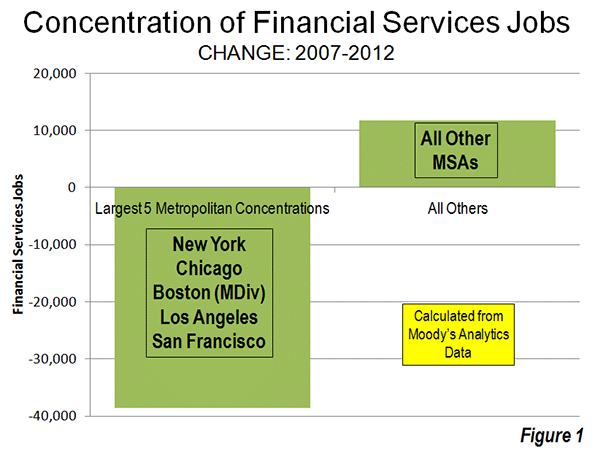
    However, the New York metropolitan area and the other four largest concentrations of financial sector jobs – New York, Chicago, Boston, Los Angeles and San Francisco – accounted all of the net job losses over the period. Between 2007 and 2012, the five largest financial sector markets, lost 39,000 jobs. Outside these five metropolitan areas, the number of financial sector jobs increased by 12,000 (Figure 1).

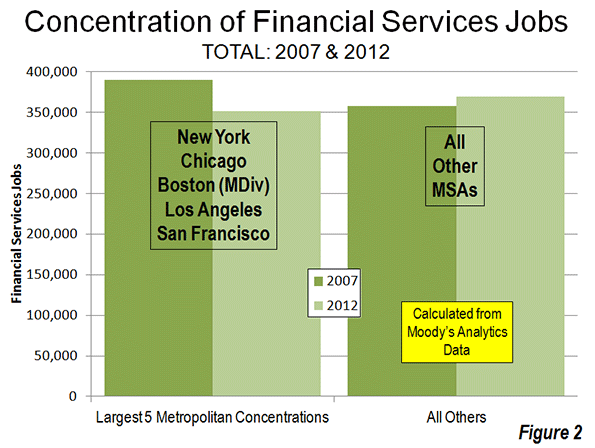
    The extent of this dispersal away from the five most concentrated markets is illustrated by the decline in their financial sector jobs compared to the other metropolitan areas. In 2007, the five most concentrated markets had 32,000 more financial sector jobs than the other metropolitan areas. By 2012, the other metropolitan areas achieved a total number of 19,000 more financial sector jobs than the five most concentrated markets (Figure 2).

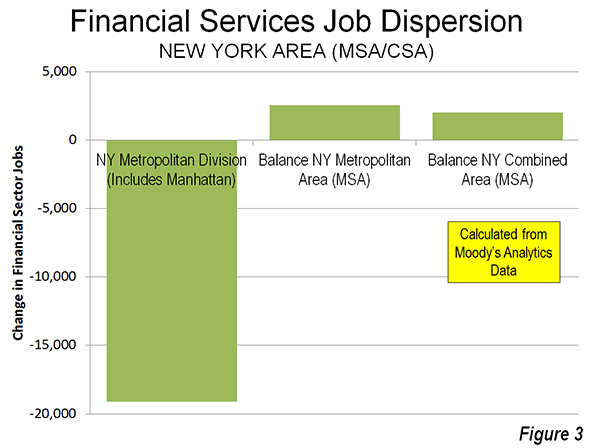
    The dispersion of financial sector jobs is evident even within the New York area itself. The central metropolitan division of the New York metropolitan area (New York-White Plains-Wayne), which includes Manhattan, lost 19,000. However, the balance of the New York metropolitan area experienced a 2500 increase in financial sector jobs, resulting in a overall loss of 16,500 jobs in the metropolitan area

    Not all of the New York metropolitan area jobs were lost to places like Dallas-Fort Worth and Des Moines. The balance of the New York combined statistical area (formerly called consolidated metropolitan statistical areas) added 2000 jobs, principally in the Bridgeport (Fairfield County, Connecticut) metropolitan area (Figure 3). Thus, while the core of the New York metropolitan area was losing 9 percent of its financial sector jobs, the more suburban balance of the combined area gained 11 percent, even as the total region lost employment.

    California: Substantial Financial Sector Employment Losses

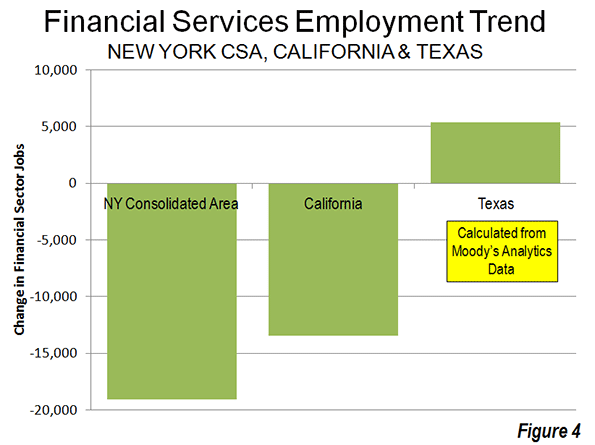
    However, New York’s percentage losses paled by comparison to those in the Los Angeles (Los Angeles and Riverside-San Bernardino) and San Francisco combined (San Francisco and San Jose) statistical areas. The losses in the Los Angeles area were 21 percent, while in the San Francisco area the losses reached 17 percent. The losses in Los Angeles and San Francisco regions exceeded that of the New York combined statistical area, which had three times as many financial sector jobs in 2007. San Diego also experienced a 5percent job loss, while Sacramento’s loss was miniscule. Overall, California lost 17 percent of its financial sector jobs between 2007 and 2012.

    Texas: Gaining Financial Sector Employment

    The large metropolitan areas of Texas and did better. Dallas-Fort Worth, Houston, San Antonio and Austin added 5400 financial sector jobs, an increase of 14 percent (Figure 4).

    Metropolitan Area Performance

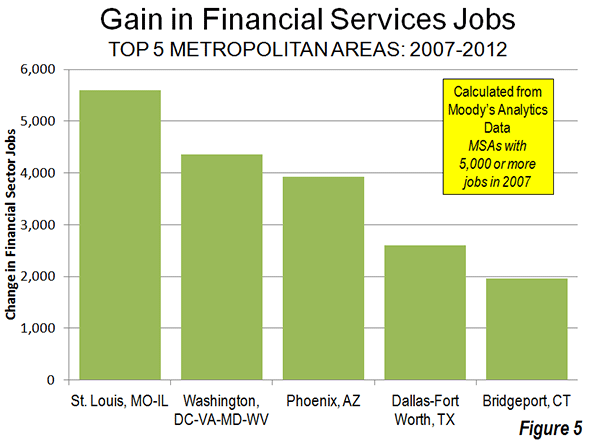
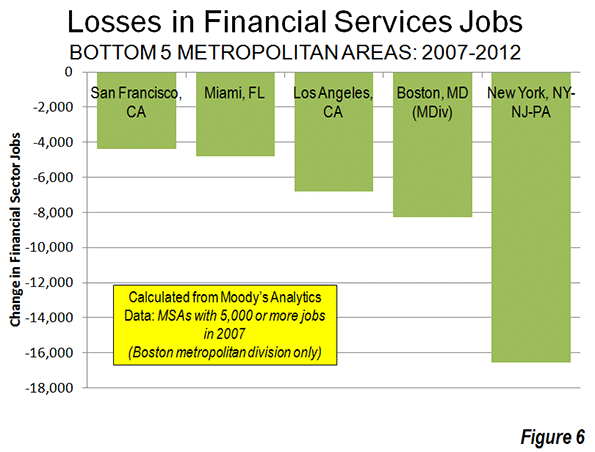
    St. Louis added 5,600 financial sector jobs, the most of any single metropolitan area (Figure 5). The Washington area added 4,400, followed by Phoenix (3,900), Dallas-Fort Worth (2,600) and Bridgeport (2,000). New York, as mentioned above, lost 16,500 financial sector jobs, the most of any individual metropolitan area (Figure 6). Boston had the second largest loss (8,300), followed by Los Angeles (6,800), Miami (4,800) and San Francisco (4,400).

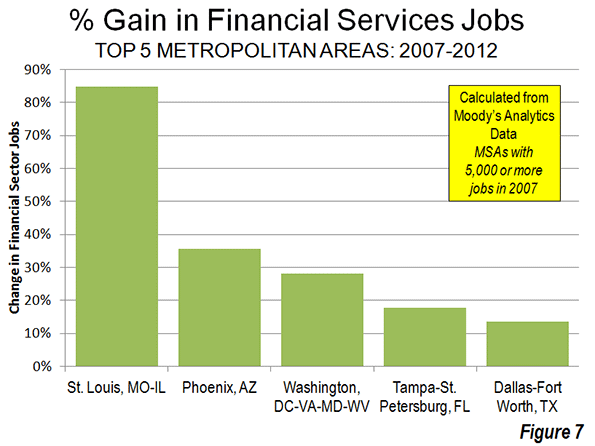
    The metropolitan areas with the largest percentage gains include net job leader St. Louis which grew 85 percent (Figure 7). Phoenix gained 36 percent, Washington 28 percent, Tampa-St. Petersburg 18 percent and Dallas-Fort Worth 14 percent. Des Moines, which had only 1,400 financial sector jobs in 2007 had the largest percentage gain, at 96 percent.

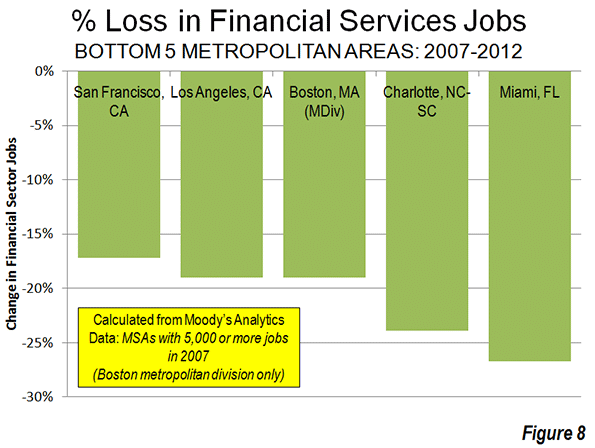
    Miami had the largest loss, at 27 percent (Figure 8). Charlotte, having risen to prominence with its large banks may have been in the wrong place at the wrong time, losing 24 percent of its financial sector jobs, followed by Boston and Los Angeles (19 percent) and San Francisco (17 percent).

    Dispersing to Lower Density Areas

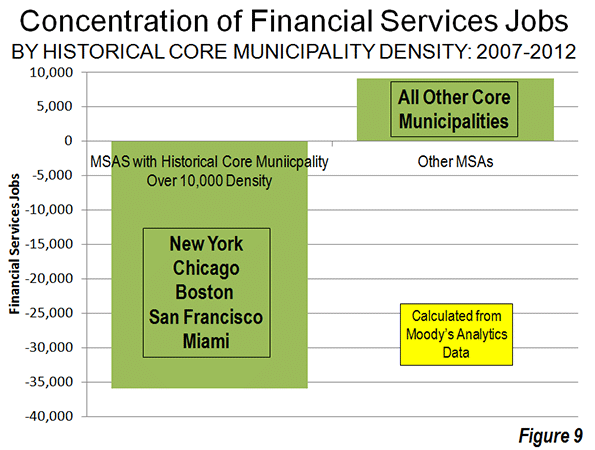
    The data is not sufficiently precise to distinguish between central business district, urban core and suburban trends. However, the metropolitan areas with high density historical core municipalities (above 10,000 persons per square mile or 4,000 per square kilometer in 2010), suffered a loss of 35,000 financial sector jobs between 2007 and 2012, more than the total national metropolitan loss of 27,000. The six high density historical core municipalities (Note 2) include New York, Chicago, Philadelphia Boston, San Francisco and Miami all suffered significant losses while the metropolitan areas with less dense cores gained 9,000 financial sector jobs (Figure 9).

    Further, the losses were concentrated in the metropolitan areas with the four most dense major urban areas, Los Angeles, San Francisco, San Jose and New York and the losses in these areas exceeded the overall industry loss. This movement away from density reinforces the often misconstrued conclusions of the Santa Fe Institute Urban Scaling research to the effect that metropolitan area size was a principal determinant of productivity, however not urban density (see: Density is Not the Issue: The Urban Scaling Research). Larger, less dense regions did far better — for example Houston, Dallas and St. Louis — than their more dense rivals.

    Dispersion to Housing Affordability

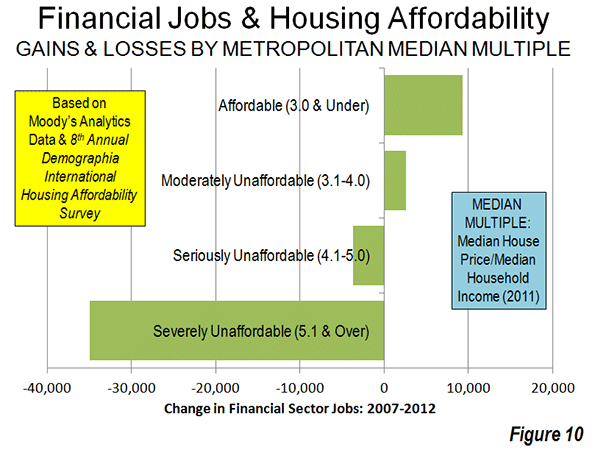
    There is also a strong trend of financial sector job gains where housing is more affordable and job losses where housing is less affordable. This is indicated by the median multiple (median house price divided by gross median household income) data from the 8th Annual Demographia International Housing Affordability Survey (Table below).


    Demographia International Housing Affordability Survey

    Housing Affordability Rating Categories

    Rating

    Median Multiple

    Severely Unaffordable

    5.1 & Over

    Seriously Unaffordable

    4.1 to 5.0

    Moderately Unaffordable

    3.1 to 4.0

    Affordable

    3.0 & Under


    Metropolitan areas rated as affordable (median multiple 3.0 or lower) gained 9,300 financial sector jobs between 2007 and 2012. Metropolitan areas rated moderately unaffordable (median multiple 3.1 to 4.0) gained 2,600 jobs. The metropolitan areas with the most unaffordable housing suffered a net loss in financial sector jobs. Seriously unaffordable (median multiple 4.1 to 5.0) metropolitan areas lost 3,700 jobs. Metropolitan areas rated seriously unaffordable (median multiple 5.1 or higher) lost 35,000 jobs. This is more than the overall loss reported in the data of 27,000 (Figure 10).

    Financial Sector Jobs: Reflecting Urban Dispersion

    The dispersion of financial sector jobs away from concentrated areas may come as a surprise, given the close association that the industry has with the largest central business districts. Yet, the trend mirrors the more general, but overwhelming trends of dispersion indicated over the last decade in both population and domestic migration.

    Wendell Cox is a Visiting Professor, Conservatoire National des Arts et Metiers, Paris and the author of “War on the Dream: How Anti-Sprawl Policy Threatens the Quality of Life.”

    ——

    Note 1: The data used in this analysis is limited to that provided in The Wall Street Journal article. Data was provided for only is only for a part of the Boston metropolitan area (the Boston-Quincy metropolitan division).

    Note 2: In 1940, at least 15 of the historical core municipalities had population densities exceeding 10,000 per square mile (4,000 per square kilometer)

    Photo by Flickr user IABoomerFlickr

  • Cities Flying Too Close to the Sun

    I was honored to speak at a conference in Milwaukee over the summer called Milwaukee’s Future in the Chicago Mega-City. Chicago and Milwaukee are about 90 miles apart on I-94. There’s an Amtrak link that makes the journey in about 90 minutes. The two cities have been sprawling such that there’s now more or less continuous development along the lakefront between the two cities. Milwaukee has been a challenged city economically and demographically. Chicago has had its own serious problems, but has seen its already muscular core boom in terms of residents and investment. High end business seems to be doing well in Chicago, and the city gets pretty good press nationally.

    If you are Milwaukee, the idea of somehow tapping into Chicago naturally presents itself. Local leaders clearly see Milwaukee’s future as, if not a giant suburb of Chicago, at least a city for which Chicago’s cachet and prosperous zone somehow provides them with a leg up. As Richard Longworth put it, “Once an independent economic power of its own, Milwaukee now belongs to Greater Chicago.”

    The notion that proximity to Chicago or another mega-city* represents an unambiguous good seems nearly universal. While the mechanics and value basis of greater collaboration are often illusive, it’s assumed that such value must be present and such collaboration desirable. Not just Milwaukee, but places like South Bend, Indiana and Grand Rapids, Michigan look towards Chicago as an economic engine for them.

    But what if it this is actually backwards? What if proximity to Chicago or another mega-city is actually a curse, not a blessing?

    My friend Drew down in Indy has a model of this, clearly targeted as his own city but relevant to the discussion. He says that the Midwest is like a solar system with Chicago as the sun. As he see is it, Indianapolis is Earth – it’s the perfect distance from Chicago. A place like Cleveland is too far away – it doesn’t get enough heat and light. But Milwaukee is like Mercury – it’s too close to the sun and gets burned up.

    I suggested at the conference that one reason Milwaukee should want to active engage in shaping the interaction between the two regions is that the natural development could actually be negative. I had in mind here Providence, which is in a similar situation. Providence is 50 miles from Boston – that’s closer than Milwaukee is to Chicago, but Boston is also smaller than Chicago. Like Milwaukee, there’s a rail connection between the cities, with commuter service taking a bit over an hour.

    Providence, like Milwaukee, has struggled. In fact, it’s struggled far worse. Sticking with solar system thinking, my immediate gut take here has been that Providence is a brown dwarf of a city. Maybe at one time it generated real economic life force, but today is a shell of a metro region in many ways.

    Another similar example is New Haven, Connecticut, which is about 80 miles from NYC, and is a notoriously troubled city. And even being in the same state hasn’t helped Springfield, Mass at 90 miles from Boston. It too has struggled.

    Is this actually the pattern? Is proximity a negative indicator not a positive one? Does proximity drain vitality instead of creating it? Let’s consider further.

    I believe a lot of the thinking that being close is positive comes from the example of two very successful twin cities: Dallas-Ft. Worth and Minneapolis-St. Paul. Two things jump out at me about these, however. One, in both cases the cities are significantly closer than Milwaukee and Providence are to Chicago and Boston. Dallas is about 35 miles from Ft. Worth. Minneapolis and St. Paul actually abut each other, and the downtown-downtown trip by freeway is 14 miles. These actually are part of the same metro area by any standard.

    Two, the cities in these cases are reasonably balanced in size. Dallas is bigger than Ft. Worth and Minneapolis bigger than St. Paul, but it doesn’t have the feel of the vast disparity of say a Chicago vs. Milwaukee. Indeed, the difference is clear in how we compare the cities. With a Chicago and Milwaukee, metro area seems the way to go, but with the others municipal population seems a reasonable proxy.

    Another positive example might be Washington-Baltimore. The distance here is about 40 miles. These are separate metros, but overlap considerably and could potentially be combined. Also, Washington is only about twice as big as Baltimore, which is pretty hefty in its own right at 2.7 million people. Contrast Chicago at over six times as big as Milwaukee and Boston at almost three times as big as Providence, a number I think is understated since part of Southern Massachusetts that’s in Providence metro arguably has a strong Boston orientation as well. In any case, while the city of Baltimore remains infamous in many ways, the overall metro area has done well.

    So the idea that proximity is a positive could have originated in models that aren’t applicable. Being close works: but only if you are really, really close – say about 40 miles or better – and your size ratio is no more than about 2:1.

    Or maybe the latter might not even be necessary. There are a few examples of old industrial cities turned into suburbs in Chicago – Aurora (41 miles), Elgin (42 miles), and Joliet (44 miles) being the prime examples. These were once independent cities of sorts, and now are clearly suburbs. They aren’t nirvana yet, but proximity to Chicago has clearly invigorated them to a certain extent. The size ratio vs. the overall Chicago region or even just the city would obviously be huge. So perhaps the only question is whether you could plausibly be a true suburb.

    Interestingly, Detroit and Ann Arbor fit this and are only a bit over 40 miles apart, so also follows this rule. It may seem ludicrous to credit Detroit with injecting life into Ann Arbor, but I don’t think it would be as successful if it were isolated in the middle of the state. (Madison, Wisconsin succeeded on its own, but is a bit bigger and also the state capital).

    But it may even be worse than this. Back to my provocation a few paragraphs back, is it possible that not only does anything other than true suburban style proximity not help you, it might even hurt you? The examples of Milwaukee, Providence, New Haven, and Springfield suggest it’s at least possible. Now all of these are post-industrial cities that have clearly struggled for reasons other than proximity to a mega-city. Many similarly situated places (or even more badly troubled ones) are not near a much bigger city. But it’s worth considering the point.

    I hypothesize about it in terms of attempting to reboot a high value economy. If you are a high value business – say a biotech startup or some such – looking to locate in New England, why would you ever pick Providence over Boston? You wouldn’t – not unless they paid you a ton of money a la 38 Studios (a Curt Schilling backed video game company that went bankrupt after receiving $100 million in loan guarantees from Rhode Island). Not only is Providence itself an expensive place to live and do business, it’s talent and ecosystem disadvantaged. Why subject yourself to that when you can move 50 miles up the road to one of the world’s premier innovation areas? The kicker is that this applies to business ideas in Providence as well. You can launch your business in Boston and still basically stay where you live.

    I’m not a believer in the oft-repeated claim that these tier one cities are sucking all the talent out of smaller places. The numbers don’t back it up. Chicago has the second highest college degree attainment among large Midwest cities, but at 34.2% hardly towers over other regional cities, most of which are at least in the 30s, including Milwaukee. And Chicago’s growth in population with degrees is actually in the bottom half of large Midwest metros.

    However, perhaps there is a “dead zone” of sorts around mega-cities. This zone extends from the edge of their suburbs to some unknown outer radius. In that zone, perhaps black hole like, high value functions really are sucked into the mega-city. Or perhaps negative aspects of the mega-city like traffic and pollution act like kryptonite on the economy of cities in this zone. I don’t know for sure. It’s just a hypothesis to consider based on a few observations. I would love to see some research done into this. In the meantime, small cities near a very large one shouldn’t be too quick to celebrate their location as boon.

    Aaron M. Renn is an independent writer on urban affairs and the founder of Telestrian, a data analysis and mapping tool. He writes at The Urbanophile, where this piece first appeared.

    Milwaukee photo by Bigstock.

  • Thoughts on Chicago’s Tech Scene

    I’ve said before that I don’t think Chicago is well positioned to become some type of dominant tech hub, but should only seek to get its “fair share” of tech. However, as the third largest city in America, Chicago’s fair share on tech is still pretty darn big. If you look at what’s been happening in the city the last couple of years, I think you’d have to have to say it’s something real. Built in Chicago lists 1145 companies in its inventory, and that’s definitely something. I’ll give a bit of a mea culpa by admitting that the tech community has done better than I probably thought it would a couple years ago, though I still stand behind the statement I made at the beginning of the paragraph.

    Part of what has happened in Chicago is the general decentralization of technology in America. It used to be that tech in America was heavily concentrated in the Bay Area and Boston. In an era when pretty much literally anybody can start a company, you simply don’t need to be in any particular place to be successful these days.

    Mark Suster made this point in his Tech Crunch post, 12 Tips To Building A Successful Startup Community Where You Live:

    I would point out that these days there are really talented tech developers and teams everywhere. And I really mean everywhere. Ever play Zynga’s “Words with Friends” or any of their “with Friends” games? Didn’t come out of the SF facility. It came from an amazing small startup in McKinney, Texas (30 miles North of Dallas) called NewToy, which they acquired.

    Think the next big startup can’t come from Dallas? Think again. Angry Birds? From startup Rovio in Finland.

    Think USV is only invested around Union Square in NYC? How about in the last 12 months deals were announced with Dwolla (Iowa) and Pollenware (Kansas City). I met the Pollenware team myself – they were KILLER.

    In this environment, it’s possible for lots of cities to find success. This is why places like New York and Chicago have been table to reboot their tech ambitions, and why some of those hot startups Suster mentioned are in smaller Midwest cities. Strong tech/startup scenes have been emerging all over the country. Being a startup hub isn’t what it used to be in terms of joining a highly exclusive club.

    This is a case where there aren’t of necessity winners and losers. It isn’t like the Midwest can have just one tech center, for example, and thus the battle for Chicago is to be the winner, while everyone else gets to be a loser. The good news here is that Chicago can win and other places can win too. This might be one economic change that really can start rebranding a region.

    Not only has there been legitimate strength in the Chicago tech community of late, it is also starting to get some good press. For example, just this week the New York Times ran a story on tech businesses moving into the Merchandise Mart. (An unfortunate subtext of this piece appears to be a serious decline in Chicago’s vaunted design community, however). This is one of a number of positive pieces that have appeared recently.

    The city has really put on the full court press for tech, with Mayor Rahm Emanuel in effect making it the signature economic development cluster of his administration. I cannot think of any other sector of the economy in which Emanuel has so put his personal imprimatur. He has repeatedly stood up to endorse Chicago tech and its ambitions, and I think it’s fair to say he’s got a lot riding on it being successful – and not just successful, but an outsized success compared to peer cities.

    Rahm has also put city action behind the marketing. For example, making an open data push, and also the recent broadband deployment initiative to underserved areas.

    The trendlines certainly appear positive for Chicago at this point, but I want to highlight a few areas I find lacking and/or risky to the future.

    The Booster Club Society

    I’ll lead off a video from last year’s Chicago Ideas Week. This is JB Pritzker’s keynote at the Midwest Entrepreneur’s Summit. (If the video doesn’t display for you, click here).

    This is a pretty good talk, but thinking about it a bit, a few things jumped out at me.

    First, this is a talk in the finest tradition of “the sun is always shining on Chicago.” I’ve noted many times that under the Daley administration there was in effect a gag rule against saying anything that could be construed as even slightly negative about the city. I’ve noticed a change in that under Emanuel, but there’s one big exception, and that’s the tech sector. In Chicago tech pretty much everybody is pretty much 100% on the rails of the marketing message all of the time.

    Listening to this, you’d think Chicago basically is tech nirvana, with the exception of a central gathering place for techies, something that Pritzker conveniently has a plan to create. Strong as Chicago may be, I can’t believe everything could possibly be this rosy. Similar sentiments from various members of the tech community are prominently on display in pretty much every article out there.

    There’s nothing wrong with being a champion for your city, but when you become too much the booster club society, it’s not healthy. A little more paranoia and a little less spin would probably do the city good. Chicagoans would clearly recognize the excess earnestness that characterizes such rhetoric if they saw it in another city – I see it all over the place, as all kinds of cities make the case for why they too are one of the next great tech hubs by closing ranks and presenting a unified, totally positive marketing front to the outside world – so I’d suggest they think about how they’d evaluate the statements they make if those same statements were being made by boosters of another place like say Kansas City.

    Here’s another example. Announcing some additional protected bike lanes, Rahm Emanuel had this to say:

    It’s part of a planned bike lane network that Mayor Rahm Emanuel on Sunday said will help Chicago to attract and keep high tech companies and their workers who favor bicycles.

    “By next year I believe the city of Chicago will lead the country in protected bike lanes and dedicated bike lanes, and it will be the bike friendliest city in the country,” Emanuel said Sunday at Malcolm X College.

    “It will help us recruit the type of people that have been leaving for the coast. They will now come to the city of Chicago. The type of companies that have been leaving for the coast will stay in the city of Chicago.”

    I like protected bike lanes. I applaud Chicago’s protected bike lane program. But this is a bit over the top. I got unsolicited email from as far away as the West Coast mocking this.

    I think Emanuel’s media savvy and willingness to sell Chicago is a big plus for the city. But he has had a tendency to sometimes step over the line and make extravagant statements that just don’t pass the sniff test. I think this comes from his days in Washington where that sort of thing is expected, understood, and discounted by everyone. It’s just the way the game is played there. But for mayors there’s a different standard of judgement. Yes, everyone expects you to make the aggressive case for your city. But mayoral statements that seem un-moored from reality – like the various claims that have been made about crime and shootings, for example – end up calling into question the truth of everything else you say. This in my view is a danger for Rahm or anyone else who has been overly steeped in Beltway style communications.

    So I would suggest that Chicago continue to be aggressive on marketing, but tone down some of the orgasmic rhetoric and take care that they don’t end up believing too much of their own press. This can be a fine line to walk. I hope that in private at least the city’s tech community has a huge punch list of things that need to be better they are actively working on.

    Better Tech Media

    Another aspect of Pritzker’s talk that jumped out at me immediately at the time he gave it (I attended the event), was his failure to mention that Chicago already had a very successful version of his own 1871 incubator called Tech Nexus. Tech Nexus is a self-described “clubhouse” for Chicago’s tech community, a co-working space, and an incubator (ranked one of the top ten in the United States by Forbes) that has served over 100 companies. Tech Nexus also hosts tons of meetups and other events, and through the affiliated Illinois Technology Association has been an instrumental booster of the Chicago tech scene the last few years.

    Now Pritzker did mention them in passing in a long list of institutions he gave in the talk. But to claim Chicago lacked the central gathering place for tech until he, JB, rode to the rescue with 1871 is a) not true and b) pretty obviously a deliberate snub of Tech Nexus.

    I certainly don’t think everybody needs to be on the same page in a city’s tech community. I actually think that would be a weakness. I think it’s healthy to have different groups of people with different visions each pushing them. Building a space like 1871 is a positive. The more the merrier I say. But this type of talk smells to me like pretty much just a political power play in the Chicago tech community.

    Speaking of which, Pritzker may be a venture capitalist, but he’s also an heir to the Pritzker family fortune and one of the richest men in America. (Oh, the irony of having as the keynote speaker for your entrepreneurship conference a guy who inherited over a billion dollars – that tells you a lot about how Chicago works). The Pritzkers have long been power players in Chicago and a key part of what I’ve called the Nexus. So being on the executive committee of World Business Chicago is not so far a leap as he may have us believe. (I also wonder if perhaps Pritzker is the guy who convinced Emanuel to make the very risky move of piling all those chips on the tech square, as he’d appear to be one of the few guys with an interest who would have the clout to do it).

    My point here isn’t to bash JB Pritzker, but rather to wonder why no one is asking questions or talking about stuff like this in the press. There are lots of very rich guys with no doubt big egos involved Chicago tech. There’s bound to be lots of interesting politics and personality clashes and maneuverings going on behind the scenes. I want to be able to pop some popcorn and follow the drama. But it doesn’t get covered. I think the local media is basically out of their depth when it comes to covering Chicago tech.

    My believe is that Chicago needs a new, independent media source covering the local tech market. This would not be part of the marketing machine of Chicago tech, though like TechCrunch would of course be institutionally favorable to the industry, but instead would provide real, credible coverage of the what’s what and who’s who of the community. As Mark Suster said in the post I linked to earlier, “Local press matters.”

    In my review of Enrico Moretti’s book, I noted how he took a face value some mainstream media reports on how tech giants like Facebook were acquiring startups just to get their talent while shutting down the actual companies. He apparently didn’t read Gawker, which gave a fuller story. New York tech community also benefits from other sites, such as the irreverent Betabeat from the New York Observer. Suster mentions sites like GeekWire in Seattle and SoCalTech as well but I don’t know them personally so can’t say they’d be the models to replicate.

    In any event, I believe Chicago needs a first class tech media site. A site like Technori does a good job, but it strikes me more as a “how to” site than a media property. Chicago needs a someone asking tough questions, and looking at the people and politics around tech, not just the bits and the bytes. Because IMO the traditional Chicago media hasn’t really shown any interest in pursuing this.

    Why Digital?

    I’m also a bit puzzled as to why Chicago is leading its marketing with the digital/social media/consumer space. Obviously Groupon (which seems to be in the process of getting airbrushed out of the Chicago tech politburo photo) played a role in this. But this seems like a shaky place to stake a claim. I don’t see consumer type brands as Chicago’s strong suit, and the digital market seems weak in any case. Even juggernaut type companies like Facebook and Groupon have struggled financially. There’s a big question mark over the whole space. What’s more, it seems like lots of places, ranging from San Francisco to New York, are rushing to tell basically the same story in digital and are frankly ahead in the space.

    By contrast, Chicago has a long and successful history of business to business and information technology. Flip Filipowski’s Platinum Technology was a great example of this. These types of companies might not have the sexiest brands, but they deliver value and make money. What’s more, because of the support demands of corporate clients, these businesses often employ a material amount of highly skill, highly paid people, unlike most digital startups.

    Also, Chicago has been a major center of corporate IT for a long time. This is often not valued by the pure tech crowd, but is a huge source of value and good paying jobs. Terry Howerton (who runs TechNexus) said of State Farm:

    “State Farm has 12,000 employees in IT in Bloomington,” Howerton said. “I’m sure many of those employees are really smart people, but how innovative can you be with 12,000 IT workers in your bureaucratic corporate environment in an industry as historic as insurance?”

    Well, to start with, 12,000 IT employees is likely more than the total local employee count of every digital startup in Chicago combined. And that’s just one company. Howerton is the best advocate out there for a B2B vision for Chicago tech, but I would also add the IT part to the equation as well.

    Chicago’s IT shops have a long track record of innovation going back to before a lot today’s digital folks were even born. Walgreen’s Intercom system, for example, linked all their pharmacies nationwide together back in the 1980s so that you could get your prescription refilled anywhere you needed it. And they didn’t have today’s open systems and frameworks to make life easy. They had to use a proprietary satellite system and a specialized high volume, 24×7 uptime mainframe operating system called TPF (originally developed for airline reservations). I’m not sure most of today’s digital coders could figure out how to build and support a TPF application if their lives depended on it.

    Given Chicago’s heritage as a center for professional and business services, and corporate headquarters, I believe its natural strengths in technology are in B2B tech companies, technology consulting, and corporate IT. If you can get digital/consumer startups that’s great, but I wouldn’t make that the public face of the city. Instead, take all that corporate services mojo and embed it in tech.

    The Big Risk

    If you look at what I’ve written about changes so far, most of them are tweaks around the margins. They don’t indicate core weaknesses. Frankly they are sort of nit-picky. That should tell you something. As I said, I think the Chicago market has been doing well – better than I thought it would. I’m not even concerned about the so-called “developer drought” of which I’m extremely skeptical (see more here).

    But there’s one thing that is a clear risk to Chicago, one that could undo all its effors – and it’s one that the city can’t do anything about. That’s the risk of another tech crash.

    Technology is very cyclical. Every so often, Silicon Valley has had a major crash. I believe it is these crashes that have actually helped to keep the tech industry concentrated in its major hubs. That’s because when crashes come, industries retrench and reconsolidate. For example, Joel Kotkin has said that it was actually the 1980’s energy crash, the one that devastated Houston, that actually helped trigger the industry consolidation there. We’re seeing something similar in media, where financial pressure is consolidating it into NYC and to a somewhat lesser extent DC while secondary markets get wiped out.

    So too in tech. Think about the dot com era. Lots of cities had their startup dreams back then too, and it seemed like parts of the country outside the major hubs would be able to get their bite at the apple. Chicago had its “Silicon Prairie” and New York its “Silicon Alley.” All of them got blown up by the dot com crash. But Silicon Valley and Boston survived. Chicago and New York tech eventually came back, but it was on a totally new basis.

    There’s a tendency locally in Chicago to now talk about the flaws of the city’s tech ambitions in the Silicon Prairie days in contrast to how it now has its act together. The idea is that Silicon Prairie collapsed because people didn’t get along, or because they chased away their entrepreneurs, etc. But the reality is that it most likely collapsed simply because the market did, not because of flaws or mistakes. I’m not convinced there’s anything the city could have done to survive that shakeout. And if another crash hit, the same thing might easily happen all over again.

    We’re seeing the early part of the cycle repeat again today. We’ve had a frothy investment climate with a spread of tech around the country to a whole slew of me-too places. But as I said, the whole digital startup thing has questions marks. It’s not clear that there’s a lot of sustainable, cash generating businesses out there. Many of them (e.g. Groupon) are not even really tech companies. A lot of them are basically media type entities, and like much media in the world have more eyeballs than profits.

    Regardless of whether the digital wave crashes soon, another tech crash would appear to be inevitable at some point. If it happens at a time when Chicago hasn’t built some sort of a sustainable franchise, that would be bad. Right now, I don’t believe the Chicago tech scene as currently conceived would survive a major crash. I’m somewhat skeptical New York’s would either. That’s not because the city is doing anything wrong, but because of where it is in the maturity cycle.

    That is really the key weakness in the Chicago story. It’s not the fortress hub that Silicon Valley is. I believe it is benefiting from a general decentralization of tech along with a boom cycle investment climate. That can be very good for Chicago, but unless and until it can turn the corner into something that can survive the next big crash, there will continue to be a major question mark over its viability.

    This is what I find most interesting about Rahm’s all-in bet on tech. The last go round ended badly. There’s lots of reasons to believe Chicago can be a strong player in the current market, but the city doesn’t have intuitive structural advantages that would make it a slam dunk candidate to become a fortress hub in tech. The digital market is looking somewhat questionable, as the stock charts on Groupon and Facebook show. This was a risky bet. Not to say a bad one, but a risky one. That’s why I think it would be a very intriguing story to find out how it came to be.

    In the meantime, while we wait for the judgement of history, Chicago should enjoy where it’s at, build on the present success, and look to shore up those addressable areas of weakness around an excessive booster club mentality, the need for stronger media, and getting away from an overly digital based marketing approach to Chicago tech.

    Aaron M. Renn is an independent writer on urban affairs and the founder of Telestrian, a data analysis and mapping tool. He writes at The Urbanophile, where this piece originally appeared.

    Photo by Doug Siefken
  • Chicago Tribune Joins the Ranks of High-speed Rail Critics

    Last year, in congressional testimony before the House Transportation and Infrastructure Committee hearing on high speed rail, we cited the Chicago-to-St.Louis "high-speed rail" project as an example of the Administration’s wasteful use of its economic stimulus money. We pointed out that the $1.4 billion program of track upgrades will allow top speed of 110 mph but will raise average speeds of Amtrak trains between Chicago and St. Louis by only 10 miles per hour, from 53 to 63 mph. The four-and-a-half hour trip time will be cut by a mere 48 minutes, to three hours and fourty minutes. In France, TGV trains between Paris and Lyon cover approximately the same ditance (290 miles) in a little under two hours, at an average speed of 150 mph. Yet, federal officials did not hesitate proclaiming the Chicago-St. Louis project as "historic" and hailing it as "one giant step closer to achieving high-speed rail passenger service."

    Now, a Chicago Tribune story, linked here and excerpted below, confirms just how "ridiculously expensive" and "uneconomical"  this project is turning out to be.  As the editorial points out, the project stands to "drain funding from mundane projects that could make a much bigger difference." Something that the California High Speed Rail Authority has belatedly recognized in diverting almost half of the initial $10 billion stage of its bullet train project to upgrading "mundane" commuter rail services in Los Angeles and the Bay Area. 

    In recent years, under the banner of economic stimulus, the federal government has spent a ton of money getting the tracks ready for those speedy locomotives. In the Chicago-St. Louis corridor, for instance, Uncle Sam has poured at least $1.4 billion into crossing improvements and other upgrades. Between Chicago and Detroit, more than $400 million has been spent.

    How would you feel, taxpayer, if we told you that some of the work might need to be torn up and redone?

    Angry? You bet.

    A debate over just how fast high-speed trains should operate could turn very costly very soon.

    The issue comes down to 15 miles per hour.

  • Rethinking Brand Chicago

    So many Midwest places flail around looking for a brand image or identity. Not Chicago. In fact, the identity and stories of Chicago overflow the page. They are too numerous to be written in a mere blog posting.

    Yet Chicago has in effect decided to jettison that powerful, historic brand identity in favor of a type of global city genericism. This, I believe, is a mistake.

    One trend you can’t help but notice if you travel is the increasing homogenization of the urban culture and standard of urban development. Global markets demand standardized commodities that can be graded and traded. This includes cities. This forces cities increasingly into a standard model of what one expects.

    I’ve written in the past about the example of the Wallpaper guides to world cities. These travel guides, ostensibly a guide for the modern, sophisticated urban traveler to the best of each globally elite locale, often seem identical except for the name on the spine. One modern boutique hotel, one swank restaurant or bar, one fashion outlet, one bike share program, one piece of starchitecture is much the same as another in any city you visit around the world. The frosting might be different, but the cake is the same. And once you’re commoditized, you’re done.

    So it is too with Chicago. I noted in my review of the city’s street lighting what appears to be a deliberate downplaying of the city’s rough-edged, masculine past in favor of a feminized, generic, even suburban motif. You see this repeated throughout.

    It’s truly incredible. Travel anywhere in the world in mention that you’re from Chicago, and immediately the other person will mime a couple of pistols with their fingers and say, “Bang! Bang!” This is a sore spot with many local leaders, who hate the notion that it is still known more for gangsters than glitter. The city over the years has so tried to suppress its Al Capone heritage that it has obliterated many historic sites related to the mob. It’s like the city that wants to pretend it doesn’t exist.

    This sadly makes Chicago like all too many smaller cities that suppress their strongest brand assets out of embarrassment and a desire to be taken seriously by members of the cool kids club. Go talk to urban boosters in Indianapolis, and you probably won’t hear much about the Indy 500, for example. So too it is with Chicago. It’s as if to prove it’s a member of the club – i.e., is exactly like every other cool city – Chicago has to ignore its gritty past and essential culture.

    A friend of mine likes to say that “Chicago is a city that runs on testosterone.” It’s a rugged, manly city, a place where it was said high culture was just the ransom rich men paid to their waves. A place where people wore their shoe leather out trying to make a buck. The land of the hustler. A place of bellowing blast furnaces and brawny immigrants. A place where pedigree didn’t matter and crazy newcomers, dreamers, schemers, and gamblers could win or lose big. A place with audacious ambition and a relentless determination to demolish rivals, whether that be Cincinnati, St. Louis, or Milwaukee. A place that once dreamed to dethroning New York. A place of limitless imagination and inventiveness that brought us everything from the skyscraper to the futures market. A place with music like the blues made for and by the hard luck working man. And yes, a place of gangsters and crooked politicians.

    None of that is part of new Chicago, at least not the image the city wants to portray. The iconic architecture remains, but it has been drained of its cultural content. Listen to what the city tries to project of itself and see what it says. It says that Chicago has become just another way-station along the global city parade. Starchitecture (no longer architecture made in Chicago for the most part), microbrews and microroasts, culinary delights, high culture, boutique hotels, great shopping, bike infrastructure, digital startups (the exact same type every other “hub” is bragging about), music festivals by and for the high end educated hipster, global conferences, etc. Almost every box is checked, with a few exceptions like fashion and media as I highlighted earlier.

    All of this is good in a way and proof of a transformation in Chicago that is in many ways for the better. But something has been lost along the way. These items are all disconnected from the city in which they happen to reside. It’s as if they descended on the place out of the heavens like that flying saucer on top of Soldier Field. Drawing Room mixologist Charles Joly may have a Chicago flag tattooed on his arm, but his bar could be located anywhere.

    Saskia Sassen has written that the economies of global cities are not generic but are inherently linked to their histories. Chicago in the past was a great center of manufacturing, for example, and today is expert at providing global services to manufacturers. But where in underlying economic reality there may be distinctiveness, on the surface there is more homogenization. This may explain why people tend to assume all global cities are alike. To a visitor staying in the central core, the experience may well be quite similar in many ways.

    What’s more, the aspiration seems to be generic. The idea, again, is to demonstrate that you are part of the club by focusing on replicating all the same stuff everybody else is already doing and talking about yourself in much the same way. I’ve seen little in Chicago’s branding or global city rhetoric that is much different from anywhere else.

    Yet the differences remain, especially outside the rarefied precincts of the global elite. And much of that continues to inspire embarrassment to this day. Corruption and cronyism seem to continue unabated, for example.

    Yet there is good as well. Ask yourself what more than anything epitomizes Chicago. To me, it is none other than former Mayor Richard M. Daley. Listen to him speak. Barack Obama he is not. But character he had, lots of it, and what’s more, a fanatical dedication to making Chicago the best city it could possibly be. Was there a lot of corruption in Daley’s Chicago? No doubt. Did he desire to have maximum power over politics in his city? Of course. But nevertheless I get the impression of, as I said in my last piece, a guy who every morning wakes up and asked himself, “What can we do today to make Chicago a greater city?” This is a quality of leadership all too lacking in most Midwestern cities. The character of Chicago and the character of Mayor Daley himself seem to me to have so much in common.

    Ironically, under Mayor Daley, the city pursued that policy I mentioned of abandoning its past, of abandoning the image of the city as evidenced by the mayor himself. You walk down Michigan Ave., through Millennium Park, around the newly thriving neighborhoods, and you expect that city to be led by a Dr. Smooth type character, not a blunt, plainspoken man like the Mayor. But if only he had seen the value in a city that presented a face like his own. A city not ashamed but proud of its rough and tumble edge, of the fact that it was where generations of ne’er-do-wells and hustlers came to wear out their shoe leather trying to make it big, a city that both Al Capone and Paddy Bauler thought not ready for reform, a city that drew generations of farm boys off to its earthly delights, a city from Bridgeport not the Gold Coast. That’s Chicago. Not a genteel, refined metropolis, not a swank, sophisticated type of town, not a city on a hill. No, but a city of dreams nevertheless, where people came to get rich, to reinvent themselves, to change the course of world history. That’s Chicago.

    No, Chicago will never be the Chicago of Cyrus McCormick and Philip Amour and Aaron Montgomery Ward and all the rest. You can’t live off the past. That’s nostalgia and there’s no more corrosive force known to mankind. But you can know who you are, what you stand for, what your heritage is, and how it fits into the future. Not a clinging to the past, but letting your essential character be a guidepost to the future.

    The fifth Frank Gehry titanium Bilbao clone, the n-th swank restaurant or shop, the latest in Italian furniture – ultimately none of them will make Chicago Chicago. It’s going to take the real city, an expression of its own terroir and primal identity to do that.

    I happen to think Chicago can do it. If it changes course and gets way from following the trends to creating its own future. If it steps up and makes sure the world knows that Chicago, and not just yet another generic world city, is here, and determined to claim its rightful place.

    Chicago will only realize its potential for greatness if it is willing to let go of its insecurity and desire to be a member of the club, and dares once again to think of itself as it did back in the days of the Burnham Plan as a city destined to be the greatest in the world, a city proud of itself and not afraid to boldly chart its own course into the great unknown of the future.

    Is Rahm Emanuel is the person who can pull this off? He’s from the North Shore. He was a ballet dancer. He’s a man clearly most comfortable dealing with the elite. Yet he’s also got a rougher side. He’s supposedly Captain F-Bomb. He hates to lose. He mailed some dead fish to a someone once to show his displeasure with some polling. I’d say there’s more than a streak of authentic Chicago in there.

    Maybe the bigger question is whether he wants any change of course. The NATO Summit play suggests not. But it’s still early.

    I would strongly urge the city to rethink its brand and what it wants to be in the marketplace. Bottle up some that classic Chicago heritage and apply it liberally. This is a huge opportunity in the marketplace. With the vast bulk of cities trying to convince you they are all the same, this is in opportunity for Chicago to seize the advantage and stride forth with classic boldness and braggadocio, making other cities take real notice for a change. Want to actually put Chicago on the brand consciousness map? That’s the way to do it.

    In short, it’s time to stop aspiring to global city goo and instead give the world a punch in the face with a little old school Chicago.

    This is the fourth installment in my “State of Chicago” series. Read part one here, part two here, and part three here.

    Aaron M. Renn is an independent writer on urban affairs and the founder of Telestrian, a data analysis and mapping tool. He writes at The Urbanophile, where this piece originally appeared.