Tag: Chicago

  • 5000 Public School Teachers Could Lose Their Jobs in Chicago

    The Democratic Party in Chicago is at war. The one party town is seeing an important element of the coalition on strike. Rahm Emanuel is at war with a real adversary:  teacher’s union boss Karen Lewis. Last year Lewis began laying the groundwork for a strike as witnessed in this Chicago Magazine interview with reporter Carol Felsenthal:

    CF: So you have an issue with [Secretary of  Education, former CPS CEO] Arne Duncan?

    KL:Yeah, because he has a bachelor’s in sociology from Harvard and played basketball [he’s an education expert]? I think he’s completely and totally unqualified to do this job. And to me, it’s sort of indicative of how education is such a political tool now, as opposed to [his] having a real bent toward education. I think this is a way for Obama to try to make an olive branch with Republicans. There’s this mentality that outsiders and people with no education background are the… experts…. They want to privatize public education…. Arne’s policies here were a disaster.

    Karen Lewis, like Rahm Emanuel, isn’t shy about expressing her opinions. Conflict is in the air. For 25,000 teachers to be on strike weeks before a Presidential election is a major problem for Barack Obama and Rahm Emanuel. Karen Lewis has even organized children to chant slogans against Rahm Emanuel.  As veteran Chicago reporter Greg Hinz has said:

    Mr. Emanuel has loudly declared what he wants, issued his demands in what I hear was an f-bomb-filled meeting with Ms. Lewis, and moved to impose some items by fiat — i.e., enacting a longer school day and directing the board to rescind a negotiated 4 percent pay hike.

    Chicago is running out of money. There’s much blame to go around. The financial math is a threat to the status quo. The public school system has been a lucrative racket for some. Chicago Tribune columnist John Kass explains:

    Unfortunately, the system works just fine. It works for the teachers union that wins the big raises (the current offer: a 16 percent bump over the next four years) and for the bureaucrats who are creatures of patronage, and for the vendors who feed from the almost $6 billion budget.

    It works for Democratic politicians. They increase property taxes to pay for union raises and, in exchange, receive union support and political donations in election years. It’s been going on that way for years.

    But does it work for the kids? Not when nearly half don’t graduate.

    As New Geography readers remember, we warned that Chicago was on the downswing. The 2010 Census confirmed this decline. The difficult part of decline is the hardship that comes with layoffs. University of Chicago Professor Tim Knowles says 5000 Chicago Public School teachers could lose their jobs because of 100 schools may shut. When you lose 6.9% of your population in 10 years, closures are inevitable.

    In conclusion, Karen Lewis has picked a perfect time to strike: right before a Presidential election. The Democratic party needs all the help it can get from unions to get out the vote in nearby battleground states. What if they don’t get out the vote in Ohio and other unions strongholds in November?

  • New Chicago Machine Scam In the Works: Eminent Domain Seizure of ‘Underwater’ Mortgages

    With property values down 40% since 2006 in Chicago, the Chicago Democrat Machine has a new scam brewing. The Chicago Sun-Times reports:

    Should Chicago use its sweeping condemnation powers to help stem the foreclosure epidemic — paving the way for underwater mortgages to be written down and repackaged under terms more affordable to struggling homeowners?

    The City Council’s most powerful aldermen believes it’s a concept worth considering, which is why the Finance Committee chaired by Ald. Edward M. Burke (14th) will hold a joint committee hearing on the controversial idea on Tuesday.

    If this passes, the potential for corruption will be unlimited in Chicago. Alderman Burke controls Chicago’s tax code. But, the conflicts are even more pronounced. Alderman Burke slates all the judges in Cook County which means a Burke-slated judge will hear the property seizure case. Even that’s not all; Alderman Burke’s day job is running a property tax appeals tax firm. Being a client of Alderman Burke’s probably will be a good way to avoid a ‘takings’. Expecting a fair appeal, in court, on the seizure? Alderman Burke’s wife, Anne, is a justice on the Illinois Supreme Court. Expecting help from the Illinois state legislature to clamp down on Alderman Burke’s conflicted lifestyle? Alderman Burke’s brother, Daniel, is Assistant Majority Leader of the Illinois General Assembly.

    In conclusion, you can be assured that seizing ‘underwater’ mortgages in Chicago will become a money maker for Alderman Burke. Nothing has left Alderman Burke’s attention in terms of making money off the taxpayers of Chicago. The Chicago Sun-Times has reported that Chicago Public Schools have a history of paying milk money to Alderman Burke. In Chicago, even if you have a checkered past you can still work with Alderman Burke as long as you pay tribute.

  • State of Chicago: Explaining the 1990s Versus the 2000s

    In my article “The Second-Rate City?” I noted Chicago’s very strong economic and demographic performance in the 1990s and contrasted it with the very poor performance in the 2000s. Then I outlined several problems with Chicago I thought helped drive the struggles. A few people asked a very fair question, saying, “All the negative factors you cite about Chicago (e.g., clout, business climate) were equally as true in the 1990s as in the 2000s, so what really made the difference?” I want to try to respond to that today.

    First, let’s ask ourselves, why did Chicago decline into its Rust Belt malaise? Was it some unique to Chicago factor? No, clearly not, as a broad swath of the industrial United States experienced a similar collapse. Likewise, lots of big cities (I mentioned New York before) seemed to be on the fast track to oblivion in the 1970s. In a sense, the city was a victim of outside macro-economic forces and secular trends.

    Next, why did Chicago come back? Saskia Sassen helps us understand why. Globalization, which enabled the global distribution of many functions of production, also simultaneously created the demand for new types of functions to help control and manage these far flung networks, especially new types of financial and producer services. These require very specialized, high skill workers operating in dense knowledge networks, which led to agglomeration effects and the emergence of so-called “global cities.”

    So, in a sense, the rise of global cities is simply an emergent property of the new global economy. The global transformation that renewed Chicago, New York, London, etc. had little to do with good leadership or great mayors, and everything to do with a historical context that was ripe for repositioning in a new world economy that demanded it. In other words: outside forces again. This includes other secular changes like the start of a new wave of people who prefer urban to suburban living. These forces laid the cities low and they brought them back.

    So as I’ve said before, when it comes to Chicago’s transformation, the city was the artifact, not the architect.

    The 1990s were a great decade nationally. Combine that with these forces I mentioned, and Chicago really had the wind at its back. It’s easy to do well in that environment. However, when the national economy took at turn for the worse in the 2000s and we experienced a “lost decade,” things were very different. It’s when the tide goes out that, as Warren Buffett likes to put it, you get to see who’s been swimming naked.

    In a sense, the 2000s tough times exposed the weaknesses of Chicago in the same way that the financial meltdown blew up so many Ponzi schemes.

    Also, I believe there were some particular characteristics about the way the markets changed in the 1990s and 2000s that particularly benefited Chicago in the 1990s and hurt it in the 2000s. I can’t claim to have done a rigorous study on it (though I think there is some good research to be done), but working in the industries affected and living it myself – and having some personal knowledge of various firm employee counts during the period – I feel somewhat qualified to state this as a hypothesis.

    I’ve outlined this before, particularly in a very extensive post called “A Better Tomorrow” but I’ll restate it in part here.

    There were two main forces that converged on Chicago in the 1990s: the tech revolution and the nationalization of industry. Note that I consider the 1990s really the prelude to globalization, which was the dominant force of the 2000s.

    Consider the technology world of 1990. It was an era dominated by staid mainframe shops. By the end of the decade, the world was completely transformed. Just think of some of what we went through: the client/server revolution, the emergence of the web and the dot com boom, the ERP revolution, the Y2K retrofit problem, and the emergence of mobile telephony and laptops as ubiquitous. These were all huge, gut wrenching changes that required not just incredibly large numbers of people skilled in new technologies themselves, but also with tremendous business, functional, and people skills so they could be deployed effectively.

    At the same time, the 1990s was the Great Rollup era. Back in the 1980s most cities had their three big local banks, their local electric and gas companies, their local retailers, even their local manufacturers. Only AT&T seemed to be a true national player of the type we know today. Fast forward through the 1990s and industry after industry was subject to national rollups. First was the emergence of “super-regional” banks, which led to today’s huge giants. (It was also when Glass-Steagall fell, arguably to our chagrin). Utilities merged, department stores merged, and major big boxes and category killers like Wal-Mart, Target, Walgreens, Best Buy, and Home Depot developed national footprints. Integrating these businesses, and building scalable processes and technology to manage these huge enterprises, was another gigantic effort.

    Both of these worked enormously to Chicago’s benefit. Chicago had always been the dominant location in the interior for professional services, with core sub-industries including: management consulting (e.g., McKinsey), technology consulting (e.g., Accenture), IT/business process outsourcing (e.g., TCS), accounting (e.g., KPMG), and law (e.g., Mayer Brown).

    Both the technology and nationalization trends generated huge amounts of demand for new people to manage them, which drove a huge increased demand generally for consultants and other service providers. What’s more, unlike the old back office “data processing” mainframes, the new technology was directly embedded into the fabric of the business. This meant that people working with it needed industry knowledge like never before. Clearly, to help executives merge and manage large national firms, consultants and such needed a lot of industry expertise as well, and needed to be able to serve their clients on a national, not just local basis.

    This led to a sea change in the organization of professional services firms. Historically they had been organized by local office practice. But in the 1990s they reorganized along industry lines, with national practices. Instead of a Chicago consultant serving Chicago clients primarily, you’d have, for example, a retail consultant serving retailers where ever they might be nationally.

    If you need to fly consultants all over the country to work with clients, where do you want to do it from? The two best options are Chicago and Dallas. So Chicago, with its huge labor market, its urban environment hitting at the emerging youth trend, its status as a major air hub, its central location, and its head start through its already robust professional services sector, became the best location in America for professional services overstaffing. That is, hiring people into a city with the idea that they’ll fly around the country servicing clients coast to coast. I believe this explains why Chicago boomed like nobody’s business during the 1990s. I suspect most major professional services companies doubled or tripled employment in Chicago in this period.

    The 2000s were very different. First, the dotcom bust deflated demand for tech generally and Chicago as a hub got blasted. Second, the 2000s really didn’t see the same sorts of technology revolutions that we saw in the 1990s. I believe that things like Web 2.0 were mostly evolutionary. (Smart devices and such may be leading us through another fundamental revolution, but that wasn’t mostly a 2000s phenomenon). Third, the rise of the global age led to the emergence of offshore software development and business process delivery. Thus, much of the new demand, and existing demand, could be satisfied offshore, and didn’t require an army of expensive onshore consultants anymore. This new competition caused traditional firms to have to revamp themselves to become much more efficient internal business operators. (Law seems to be the last holdout, and is in the early stages today of a major shakeup in how legal business gets done).

    This hurt Chicago badly. You didn’t need to overstaff in Chicago because you could do it in India. When there was recovery from the dotcom bust, much of it was offshore. I suspect that even 12 years later, there isn’t a single technology consultancy that employs as many people in Chicago as it did in 2000, new companies excepted. Consider that major firms like Arthur Andersen and Whitman-Hart don’t even exist anymore. Many smaller sized internet era firms also experienced the same fate, and Chicago’s “Silicon Prairie” ambitions more or less got wiped out, which cost a huge number of telecom jobs. Also, industries like finance have been subject to increasing centralization in global hubs. Chicago went from being #2 nationally as a financial hub to something further down the chart in a global hierarchy. Chicago retains great strengths in derivatives and risk management generally, but second tier financial hubs like Chicago and Boston have been feeling the pinch.

    This, in a nutshell, is what I think explains the difference in performance. The general “wind at the back” of Chicago and big cities in a boomtime economy papered over a multitude of civic sins in the 1990s that the lean years of the 2000 exposed. And the tech/nationalization era of the 1990s particularly benefited Chicago, helping to explain why it rated so highly in that decade.

    I’ve got one more piece in my “current conditions” segment of State of Chicago. Then I’ll turn to articulating my rationale for some of the structural weakness factors I outline in the article, then move on to a series of proposed fix-its.

    This is the third installment in my “State of Chicago” series. Read part one here and part two here.

    Aaron M. Renn is an independent writer on urban affairs and the founder of Telestrian, a data analysis and mapping tool. He writes at The Urbanophile, where this piece originally appeared.
  • State of Chicago: The New Century Struggle

    This is the second installment in my “State of Chicago” series. Read part one here.

    Last time I looked at Chicago’s 70s and early 80s horrible struggles followed by rebirth and robust out-performance during the 1990s. Today we turn our attention to the first decade of the 21st century. During the 2000s, Chicago experienced a bit of a two-track performance. Parts of the urban core continued to grow robustly, fueled by the real estate bubble and perhaps the greatest urban condo building boom in America. The culinary, cultural, and other scenes in Chicago only improved. Yet while there was a solid core of health at the center, the overall city and region stumbled badly with aggregate statistics that were, bluntly, awful in most respects. I’ve detailed these elsewhere already so won’t go in depth, but let’s review. These are metro area statistics unless otherwise noted.

    Population

    I already discussed how Chicago got shellacked in the 2010 Census. It was the only one of the 15 largest municipalities in the United States as of 2010 to lose population. The cities of New York, Los Angeles, and San Francisco hit all time record high populations. Philadelphia and DC grew for the first time since 1950, and Boston continued growing. But Chicago has now rolled back its population clock a hundred years and stands at its lowest population since 1910.

    Chicago’s metro population growth of 4% was less than half the national average, and virtually all of that came at the exurban fringe. Chicagoland ranked 40 out of 51 large metros for population growth, though it did beat New York, LA, and Boston on a regional basis, which is positive.

    International Population

    This previous data was all from previous writings. I want to highlight a couple of other areas of demographic weakness though. First is international population. Chicago’s percentage of foreign born residents is 17.6%, which beats the national average, but trails New York and LA by over ten percentage points. It ranked 5 out of the 10 largest US metros. On a growth basis in foreign born population, Chicago did beat New York and LA. Those three were at the bottom in the percentage growth category, most likely because they all started from relatively high bases of total foreign born population. On a total change basis Chicago ranked 7th, with New York #1, but sick man LA brought up the bottom, a stunning change of fortunes for them.

    The city of Chicago itself seems to have lost its allure to immigrants. The foreign born population of the city actually declined during the 2000s. Even during a decade of huge Hispanic population growth nationally, Chicago barely grew its Hispanic population. The city of Indianapolis, about a third of Chicago’s size, added nearly twice as many total Hispanic residents. To the extent that immigrants now see Chicago as an opportunity zone, it appears to be suburban Chicago.

    Education

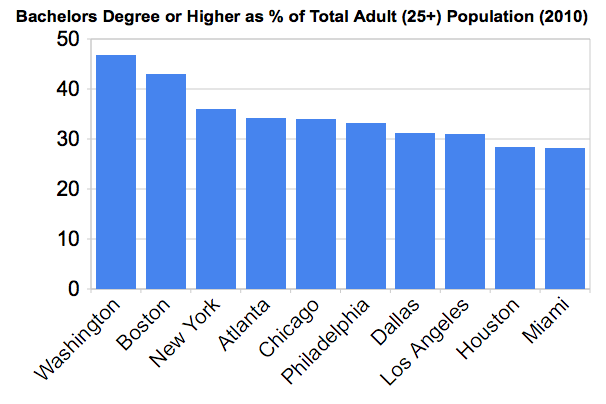
    Chicago’s college degree attainment is in the middle of the pack for the top 10, ranking #5. Considering it came from an industrial heritage, I think this is pretty good.


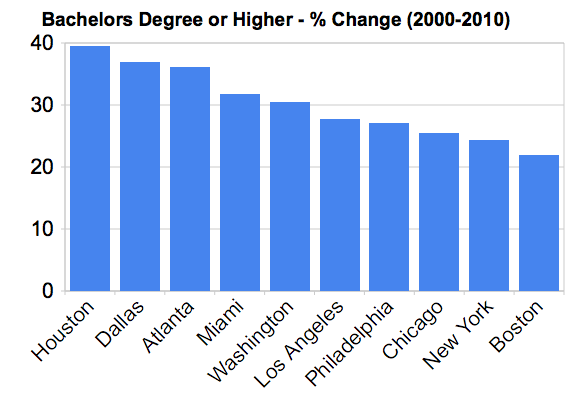
    However, Chicago only ranked 8th out of the top 10 in the growth in population with bachelor’s degrees.


    This hardly suggests that metro Chicago is a talent magnet. If you look at the numbers vs. other large Midwest metros, Chicago is healthy, but not looking like it is pulling away from the pack. I don’t see anything to suggest that Chicago is hoovering up all the college grads in the Midwest.

    Economy

    Chicago lost 323,000 jobs during the 2000s, or 7.1%. The was the worst performance on a percentage basis of any of the 10 largest US metros:


    One of the stats that took some flak from my City Journal piece was that private sector employment in the Loop had dropped by 18.6% during the 2000s. This seems at odds with the massive skyscraper boom and other improvements. This wasn’t my stat. It came from a Chicago Loop Alliance report, and they commissioned a credible analytics firm to do the work, and the data was also reported by the Chicago Sun-Times, so I believe it is solid. A few things to consider:

    – This figure is for the Loop, not the Central Area (a bigger construct). The Loop does have the majority of the Central Area jobs, however.
    – Much of the construction was residential, not commercial. Also, things like the booming Loop U probably brought in more students than jobs.
    – Keep in mind that 2000 was the peak of the dotcom bubble. For reasons I’ll explore later, I believe this hurt Chicago badly. So there’s a tough comp (also why the Bay Area and to a lesser extent Boston look bad on comps vs 2000).
    – Consider major Chicago companies that totally went out of business: Arthur Andersen and Whitman-Hart come to mind.
    – Also consider that pledges of added jobs generally are trumpeted to the sky, while jobs are often cut silently as much as possible.

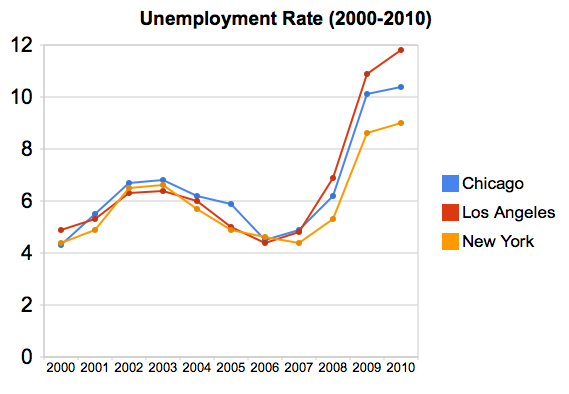
    Looking at unemployment rate in our Chicago vs. NYC/LA chart from before, we now see that Chicago is no longer winning, though is beating LA:


    Chicago is a large economy, but not a particularly high value added one. Out of the ten largest metros, Chicago ranks 8th in per capita GDP. (Chicago is 3rd among large Midwest metros on this figure)


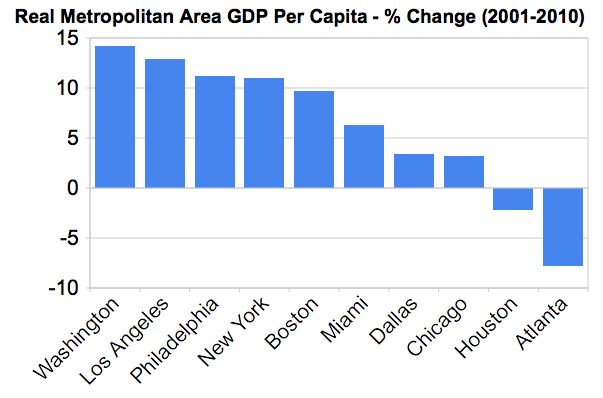
    Chicago also ranked eighth in real per capita GDP growth over the decade.


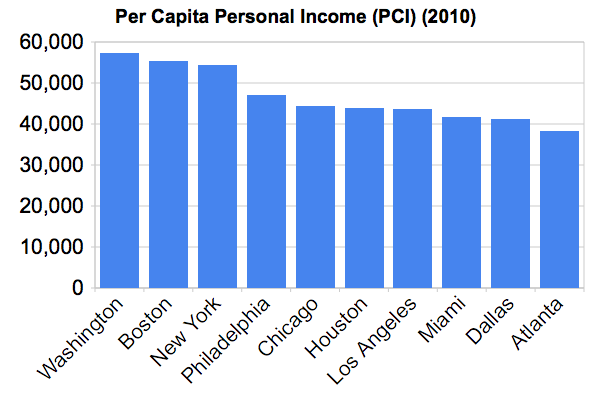
    Chicago ranked 5th out of 10 in per capita personal income, beating LA:


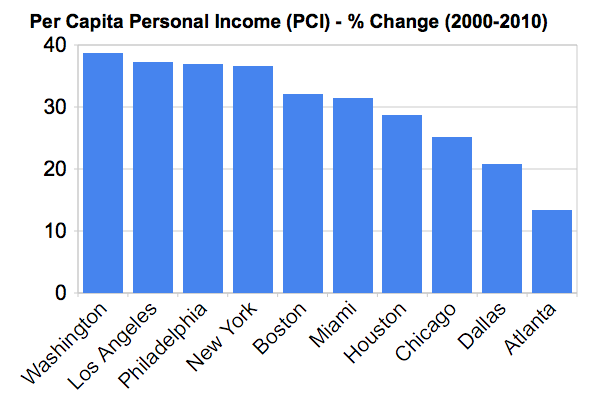
    But Chicago ranked only 8th out of 10 in PCPI growth:


    On the whole, this is a rather uninspiring collection of economic statistics for the Windy City, particularly after it did so well in the 1990s.

    Fiscal Crisis

    No discussion of Chicago’s problems in the 2000s would be complete without a review of its fiscal problems. However, as I already gave the numbers in my City Journal article, I won’t repeat them here. If anything, the problem has only gotten worse since that went to press. While Chicago may not be the worst municipality in terms of fiscal issues, Illinois is the worst state, and that will continue to be a drag until it’s addressed.

    Crime

    Among the biggest complaints about my article was that I didn’t address the crime problem in Chicago. Without a doubt, crime is a problem. Murders are up 38% or so just in 2012. The city of Chicago has a much higher murder rate than the cities of New York or Los Angeles. There has also been a national headline grabbing series of high profile attacks in affluent areas like the Gold Coast and Streeterville. The strength of the Chicago Police Department is somewhere between 500-1000 officers short of where it should be.

    I’m not the best equipped person to talk about crime, but I actually think the crime problem is overstated. Yes, it’s serious. The murder rate especially is troubling. But analyses I’ve read suggest that overall crime isn’t spiraling out of control in Chicago. Also, flash mob type attacks are happening across the country, in places ranging from Philadelphia to Portland. This isn’t a unique to Chicago situation. So I don’t want to claim that Chicago’s crime problems are uniquely bad, though they shouldn’t be minimized.

    Without a doubt the incredible collapse in crime in New York perhaps more than any other single factor fueled that city’s comeback, and it wouldn’t surprise me if it were a big factor in that city’s out performance in the 2000s. Mark Bergen cited some interesting research that suggested that for every murder in your city, 70 people move out. If Chicago had matched New York’s crime performance, it would have held steady or even gained population based on this relationship. If true, wow.

    Regardless, public safety is job #1 for any mayor, so Rahm Emanuel is rightly feeling the heat on this even if he can’t necessarily be blamed for what’s going on.

    Schools

    Others have cited Chicago’s poor public school system. Again, I’m not sure Chicago’s schools are any worse than any other big city system, and there are a number of magnet and neighborhood schools that are now attracting the children of the well-off. I’d have to see something that suggested Chicago took a turn for the worse on schools in the 2000s on a comparative basis.

    Conclusion

    There are more statistics that could be given, and if you want them, I suggest reading the very data rich OECD Territorial Review of Chicago.

    On the whole I think it’s pretty clear that there was trouble in Chicago during the 2000s – and more trouble than most large cities experienced during what was a tough decade nationally.

    Some rightly noted that I discuss the divergent performance of Chicago in the 1990s vs the 2000s, but that my structural factors that weaken Chicago were probably the same in both decades. So why the difference? I want people to know I plan to address that in a future post shortly, but next up we’ll have a look at Chicago’s present day strengths before moving on.

    Read part 1 in this series.

    Aaron M. Renn is an independent writer on urban affairs and the founder of Telestrian, a data analysis and mapping tool. He writes at The Urbanophile, where this piece originally appeared.
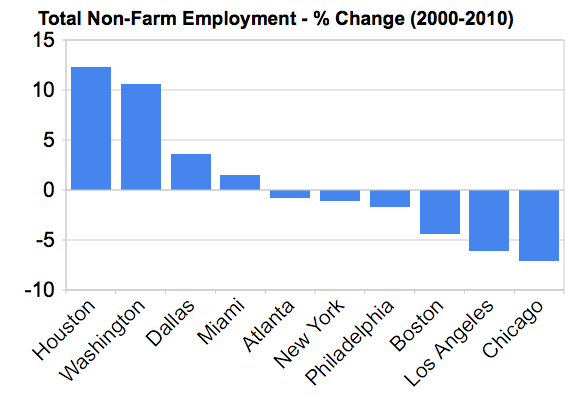
    Photo by smik67.

  • State of Chicago: The Decline and Rise

    I’ve had it in my head for over a year now to do an in-depth exploration of Chicago, a project I’ve called “State of Chicago.” This is the first a series of pieces that expand on the themes in my recent article “The Second-Rate City?

    First, I’d like to list three reasons why I wrote that piece:

    1. To bring to the attention of Chicago the very poor statistical performance of the city on basic demographic and economic measures.
    2. To write a corrective to the many national puff pieces that have been written on the city that totally overlooked its real and serious problems.
    3. To lay out some frames that I had on the underlying causes that are different from the typical explanations, in particular the excessive focus on “global city” and the “cost of clout.”

    As it turns out, Rahm Emanuel’s own economic plan and the OECD report beat me to the punch on point #1. As a lot of what I wanted to accomplish with State of Chicago was data oriented, my project is now much less ambitious than I’d originally intended since Chicago’s leaders are now, fortunately, owning up to the problems.

    The Fall of Chicago

    Today I want to start out by giving the prequel to my article: Chicago’s Rust Belt decline and subsequent comeback, particularly in the 90s. I think everybody knows that cities had a rough 70s and early 80s. It was the “Rotten Apple” era in New York, for example, a time of needle parks, mugger money, graffiti trains, a brush with bankruptcy, and much more.

    Chicago had a similar rough patch. When Richard Longworth (now of Caught in the Middle and Global Midwest fame) returned to Chicago in 1976 from many years overseas as a foreign correspondent for the Chicago Tribune, it was to a grim, decaying city that, like so many big cities in America at the time, clearly was a city that did not work.

    This was perhaps best symbolized by the city’s inept response to the Blizzard of ’79, which left the city paralyzed for days. Mayor Michael Bilandic’s blizzard response was widely credited for his subsequent re-election defeat. Old mayor Richard J. Daley’s City Hall alliance with business had preserved the Loop as a powerful, if somewhat drab, business district while so many other Midwest downtowns fell into ruin. But otherwise Chicago was a troubled, declining city covered by a veneer of boosterism.

    In 1981 Longworth wrote a damning four part, front page series for the Chicago Tribune called “A City on the Brink” drawing a powerful portrait of a city in crisis. He noted that, “Chicago has become an economic invalid. The situation may be permanent.” The Economist, in a far cry from its praise in the 2000s, described the city as having little more than a “facade of downtown prosperity.”

    The city was losing people, losing businesses, and losing jobs – even in the Loop. Manufacturing was collapsing and the middle class was fleeing, leading to neighborhood decline and eroding the city’s tax base, which in turn degraded the city services residents had come to expect and demand. The decline in services and neighborhoods drove more people way, which led to further declines, perpetuating a vicious cycle.

    University of Illinois at Chicago Professor Pierre de Vise predicted, “I see very little hope for locating economic activities here again.” And a local business executive added, “Is the city being annihilated? It’s probably inevitable.” While careful to note that Chicago was not at the point of New York City’s brush with bankruptcy nadir, Longworth noted it was headed that direction and glumly asked, “What happens when a major city becomes a backwater?”

    The city was failing on nearly every measure. I was struck by how similar Longworth’s litany of statistics were to my own. There was a big different however: back then things were way worse. Today the problems of Chicago take place against a backdrop of many areas of strength in the urban core and a secular uptrend in the fortunes of cities. Given that Chicago has come back from far more dire circumstances than it faces today, there’s reason for optimism in the present.

    Chicago Reborn

    As I noted in City Journal, during the 90s (probably starting in the late 80s), Chicago had a massive comeback. It gained people, it gained jobs, and the core reasserted itself. I moved to Chicago in 1992 when only a few select lakefront precincts were really gentrified. Though I lived in Lincoln Park, I was told not to move west of Racine, not because it was dangerous, but because it was dead. The area where I used to live near Belmont/Ashland/Lincoln was completely boarded up except for the Army-Navy surplus store. Recruiters for my company tried to sell me on the city by telling me it was now a location of the uber-hip coffee chain Starbucks. I watched vast tracts of the city transformed before my eyes. The 90s boom was real. I saw it. I felt it.

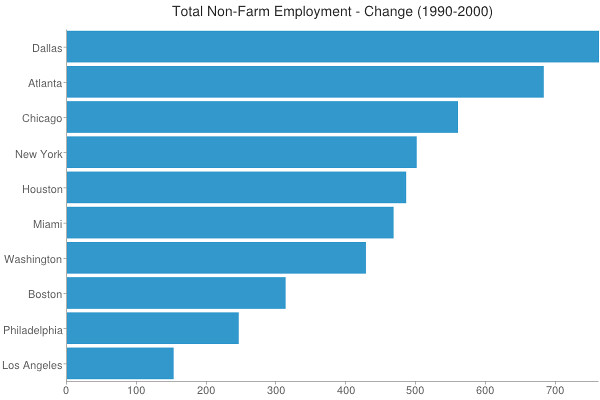
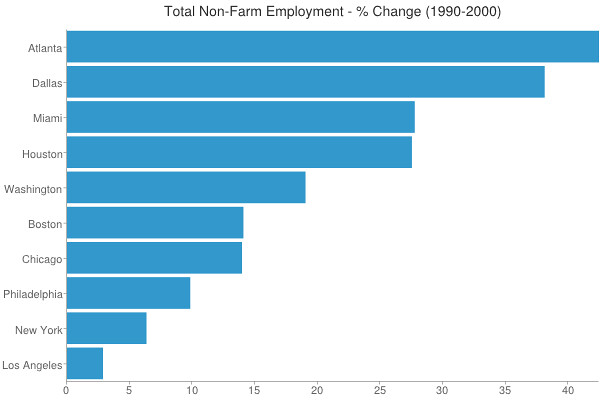
    It also showed up in the data. I don’t want to go too crazy, but I wanted to look at some economic statistics. First, I want to look at metro area job growth in the 1990s for selected cities. I’ll show the percentage gains in a moment, but here’s the raw job growth for the ten largest US metros during the 1990s. (Top ten selected based on today’s 2010 census population).


    Note: Data in thousands

    Chicago actually had the third highest total job growth. Not only did metro Chicago outgrow New York and crush LA (which got bruised by the “peace dividend”), it actually added more total jobs than Houston, everybody’s darling today. Wow. And more than currently booming Washington, DC. In short, Chicago beat out its mature tier one peers while holding its own with the emerging boomtowns. Very impressive.

    Here’s the percentage view:


    Not as impressive vs. the emerging cities, but Chicago held its own with Boston (a big beneficiary of the dotcom boom) and more than doubled up traditional peers New York and LA. I think it’s fair to label Chicago an outperformer here.

    Let’s do a quick look at unemployment rates for the big three:


    As you can see, Chicago metro had a much lower unemployment rate than NYC or LA during most of the 90s. Since unemployment rate is available at the municipal level, here’s a quick look at the big three core cities. We’ll see again that even at the municipality level, the city of Chicago had a lower unemployment rate:


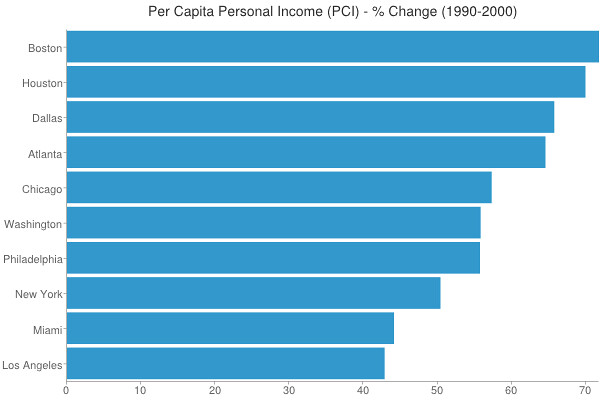
    So in terms of quantitative measures, Chicago was winning in the 90s. But it also seemed to do well qualitatively. I don’t have GDP data going back to the 90s, but I do have per capita personal income. Here’s how the top ten cities fared:


    Boston topped out, perhaps to be expected from the dotcom boom. But Chicago beat NYC and LA again, and also Washington, DC. (Interestingly, the southern boomtowns that did well on this metric in the 90s mostly got killed on it in the 2000s, Houston excepted).

    So I think it’s fair to say that compared to its large mature peers, Chicago economically was the winner (or at least near the top depending on who you put in there) during the 1990s, along with Boston. This is the type of performance Chicago is capable of delivering.

    But beyond the statistical measures, there were many qualitative improvements as well. For example, Chicago was really the early leader in quality of space. After Mayor Daley’s famous trip to Paris, he came back and encased the city in wrought iron. He also put in miles of streetscapes, with median planters, new streetlights and the like. (I happen to think the aesthetic style of these was not appropriate to Chicago, but they clearly upgraded the city in a big way). The CTA saw a brand new L line open to Midway Airport. New cultural facilities blossomed. For example, both the Chicago Symphony and the Lyric Opera undertook $100+ million building projects. And Daley even brought political stability back to the city after the turbulence Bilandic-Bryne years and the racially driven “Council Wars” of the 1980s.

    In a post-Cold War global order, Chicago also emerged as a global city. No longer just a superpower of the American interior, Chicago came to play a critical role in the global economy, through its derivatives exchanges, its professional services complex, and its status as a transport and cultural hub. Globalization became the lens through which the city sees its role in the modern economy, and with some justification. By 2010, Foreign Policy magazine ranked Chicago as the sixth most important global city in the world, for example. Chicago began to regard itself no longer as merely the “Second City,” but as a global player in its own right.

    So in the 1990s, Chicago was riding high. Little did the city know that with the dotcom collapse and the national economic trends of the 2000s, the city was about to enter a tailspin. But there was clearly a lot of real progress and change in the city and a lot for the city to feel good about and be proud of. Chicago was the big city champion of the 90s.

    I don’t want that story to get lost and people to think I’m just picking on Chicago. I’m happy to shout out its accomplishments when merited. But when things aren’t going so well, the city likewise deserves people who are willing to tell the truth.

    In the next installment, we’ll expand a bit on the troubles.

    Aaron M. Renn is an independent writer on urban affairs and the founder of Telestrian, a data analysis and mapping tool. He writes at The Urbanophile, where this piece originally appeared.
    Chicago skyline photo by BigStockPhoto.com.

  • The Collapse of Chicago Media

    When the satirical humor weekly The Onion announced it was moving its editorial staff from New York to Chicago it was considered quite a coup by boosters of the Windy City. Yet the hoopla surrounding revealed more about Chicago’s decline as a media center than any significant uptick. This includes news of a staff rebellion at the Onion in which writers attempted to scotch the move, with some ultimately deciding not to come. The strong celebration of a relatively small relocation in the grand scheme of things also shows a city looking hard for good media news where there has been so much bad recently.

    The biggest blow of the all has been the end of the Oprah Winfrey show and her departure for Los Angeles to start a new network. She was the one legitimate mega-star who came from Chicago and built an empire recognizably Chicago-based. When she left, her network, which has struggled to obtain distribution and viewers, carried a Rosie O’Donnell talk show based in Chicago that ultimately folded as well. Similarly, Playboy, another iconic Chicago media brand, also departed for LA.

    Some of this reflects national trends that have led to a greater concentration of media in New York and, to some extent, Washington. All across America, local media has struggled. The Tribune, Sun-Times, and alt-weekly Chicago Reader all went bankrupt, and while they continue to publish, they have become in many respects shadows of their former selves. New mayor Rahm Emanuel, while still engaging with local media, has frequently decided to bypass it, going directly to major national media to get the city’s story out. For example, he hosted New York Times columnist Tom Friedman, resulting in a fawning profile.

    Daley also had occasional good luck with the national media, getting glowing stories in publications like the Economist and the New Yorker. Many of these read like classic Sunday travel section pieces in their boosterism. One possible reason for that is that they are travel pieces. Chicago never had a huge number of national bureaus, and the number has shrunk in the past few years because of the difficulty in supporting a national footprint generally. For example, the Washington Post closed all of its bureaus, and the Chicago bureau was a casualty. Today most national news outlets don’t have a boots on the ground perspective of the city, and thus are open to being spun by clever locals.

    This lack of out of town and foreign media means that what coverage Chicago does get is often positive, but the flip side is that Chicago doesn’t have a built in platform for getting its message out nationally or globally. New York is America’s media center. DC, LA, and the Bay Area all have a robust out of town media presence because of the industries based there (government, entertainment, and tech respectively). They have a megaphone to the world that Chicago doesn’t. That’s perhaps one reason Emanuel made what many consider an ill-advised play for the NATO summit: it was a rare opportunity to showcase Chicago to global journalists.

    Chicago also falls short in new media. In many cities, the decline of the daily paper has been offset by a robust new media infrastructure. This includes sites like Crosscut in Seattle or MinnPost in the Twin Cities.  Major national sites like Gawker or the Huffington Post have tended to be based in traditional media center like New York or Washington. Chicago has been curiously absent here. An attempt at a non-profit online new site, the Chicago News Cooperative, failed due to financial difficulties, despite seven figures in funding from the MacArthur Foundation and a contract with the New York Times.  

    Where major platforms have arisen in Chicago, they’ve often left in order to pursue their ambitions. For example, music site Pitchfork, which started out of a music festival in Chicago, moved its editorial staff to Brooklyn. Statistical journalist Nate Silver likewise moved to New York.

    The challenge facing media and journalists in Chicago was best perhaps summed up by JC Gabel, a die hard fan of the city.  He relaunched the historic Chicagoan magazine in an effort to rebuild the sort of infrastructure the city once had. He wrote in the launch issue:

    By all accounts, it should be an exciting time to live and work in Chicago. But there is little well-paid creative work available for the hungry freelancers—the writers, artists, photographers, editors and designers—who call Chicago home. Locally, what work there is pays a pittance; nothing that could sustain the kind of long-form storytelling we were discussing.

    This might help explain the mass exodus from Chicago of creative minds of our generation throughout the last few years. Opportunities on either coast—or overseas—eventually come calling, and although they retain pride in their erstwhile Midwestern hearts, they cease to be Chicagoans by physical address.

    Stop Smiling, the magazine I co-edited and co-published for more than a decade from Chicago, ultimately couldn’t have made it without also keeping a New York office and a strong West Coast presence. By and large, a majority of stories were executed in Los Angeles or New York, and all the money we raised through ad sales came right out of the agency machines on either coast. But Chicago was always our inspiration, a place where we retired to—first to brood, then to get our work done.

    I know firsthand how difficult it is to carve out a national niche audience in a city that many still consider fly-over country, despite its rich history and inventive spirit.

    Part of the challenge for Chicago lies in the ongoing changes being wrought by the internet and globalization. These are both spreading around some activities and ever more concentrating others. Media is among those undergoing further centralization into the handful of fortress hubs, notably New York and DC. This has hit Chicago, always a second-tier media center, hard.

    But the good news is that Chicago is full of talented folks like Gabel with a passion for their city. Chicago actually does have the critical mass of talent to support a far stronger media ecosystem than it has today. And with the low barriers in the internet age, there’s no insurmountable obstacles to making that happen. But clearly anyone trying to make a go of it in media in Chicago today is swimming upstream against a fast flowing current of decline.

    Aaron M. Renn is an independent writer on urban affairs and the founder of Telestrian, a data analysis and mapping tool. His writings appear at The Urbanophile.

    Tribune tower photo by Bigstockphoto.com.

  • The OECD Reviews Chicago

    “Although still high in absolute terms, GDP and labor productivity growth rates are sluggish – both by US and international standards. The Chicago Tri-State metro-region’s contribution to national growth has slowed over the past decade and the region does not stand out as a top knowledge hub. Despite a dynamic and numerically large labor force, the region has experienced virtually no growth in the size of its prime working-age population and displays limited ability to attract and retain talent when compared to its US peers. More worrisome are the persistence of unemployment and the lack of sufficient job creation.” – OECD Territorial Review, The Chicago Tri-State Metropolitan Area

    The Organization for Economic Cooperation and Development (OECD) is an international organization that has its roots in the administration of Marshall Plan aid to rebuild Europe after World War II. The OECD was invited by the Chicagoland Chamber of Commerce* to perform a “territorial review” of Chicago’s regional economy. I believe this is the first such review the OECD has ever undertaken in the United States. The results were released a couple months ago. Unfortunately, the OECD doesn’t make its reports available for free online, but the Chicagoland Chamber graciously sent me a copy. I did a read through of this inch-thick, 332-page report and wanted to share a few observations about it. As the quote at the top might indicate, this report, like Rahm Emanuel’s economic strategy, was fairly gloomy. My points will be topical and not an integrated narrative as I did not get to undertake as thorough a review as I might like.

    Performing the Study Demonstrates the Challenge

    The review focused on the Chicago metropolitan area, though frequently included the Milwaukee metro area as well. Wisconsin and Indiana were invited to participate in the project, which was notable given the city-centric nature of most civic development initiatives in Chicago and the fact that the lion’s share of the people and economic output are in Illinois. It’s a recognition of the need to think regionally. Wisconsin did participate, but Indiana declined. Explaining why, Indiana economic development chief Mitch Roob said, “We don’t do studies, we do deals.” Indiana also made it clear that it intended to differentiate itself from Illinois to attract jobs, and that luring jobs across the border from Illinois was a core plank in their economic development strategy. (Interestingly, as I’ve documented elsewhere, Indiana has rolled over and actually allowed Kentucky to financially exploit it on the other side of the state, so the behavior is not consistent).

    Indiana Governor Mitch Daniels loves to criticize Northwest Indiana for not getting its act together. Indeed, much of that criticism is fully warranted and Daniels has spent enough time up there to get an up close and personal look at regional dysfunction. Nevertheless, NWI functions as part of the metro Chicago economy. Its success is ultimately tied to Chicagoland’s overall success, not luring jobs from a stagnated region across the border. Indiana may have a few huge gas stations and liquor stores right on the border, but you can’t build an economy on that. (From 2004-2011, Mitch Daniels term in office, Indiana has actually lost a greater percentage of its jobs than Illinois and the migration of people from Illinois to Indiana also slowed, so the “Illinoyned” strategy obviously isn’t working). Indiana should clearly have come to the table for this review.

    The fact that Indiana wouldn’t even participate in a study just goes to show how difficult regional cooperation can be. In that regard, the undertaking of the OECD review itself shows the challenge facing the region. I should note that the report authors did a good job of trying to fairly include and represent Indiana despite the state government’s lack of participation.

    Interesting Statistics

    The OECD review amassed quite a bit of interesting statistical data on Chicago and puts them in the context of other major cities in the 34 countries that comprise in the OECD. I think that by itself made the review worth doing. I might suggest other cities take a look at this to determine if such a study would be relevant to them, particularly as international comparisons can be difficult to pull off.

    This report is a goldmine of stats and there’s way too much to list here, but a few things that jumped out at me:

    • The OECD report benchmarked labor productivity, which is less commonly looked at in economic studies. Chicago’s is above average but growing more slowly than average.
    • Chicago has trailed the nation in job growth. Had Chicago simply matched the national average in job growth since 1990, the region would have 600,000 more jobs than it does today.
    • There was quite a bit of sectoral analysis of Chicago’s economy. In fact, they actually normalize the sectoral composition of Chicago’s economy when looking at job growth to see if its under performance in job growth was due to concentration in slow growing sectors – but it was not.
    • Chicago is known for having America’s second largest business district, but it ranks only fifth out of the top ten regions in America for the percentage of its jobs in the core city. Between 1960 and 1990, over 96% of new regional jobs were created outside downtown.
    • There were many other interesting statistics around labor force participation, mobility of educated labor, elderly dependency ratios, educational attainment, poverty, patents, the structure of governments, taxation, etc.

    Excess High End Talent

    According to the OECD, Chicago suffers from a skills mismatch in its workforce. This is not just true at the bottom end of the economy as might be expected, but also at the top end, where there is a surplus of highly skilled labor:

    At the high end, there is a large pool of high-skilled, highly educated workers, in principle more than sufficient to fill the jobs available at that level … at the high-skill end, data for the tri-state region points to an apparent oversupply.

    To some extent this shouldn’t be a surprise. Chicago is a desirable city for people to live in, particularly for educated workers inside its heartland catchment area. As with other big city talent magnets, the economy doesn’t always supply the right employment for all the people who want to live there. The many articles about unemployment in Portland, for example, illustrates this, and Chicago is similar. In that regard, you might see the skills surplus as a sign of local strength.

    However, the skill concentration in Chicago isn’t producing the type of high end innovation economy seen elsewhere. As the OECD notes, “Indicators suggest that the Chicago Tri-State metro-region does not rank as highly among the US knowledge hubs as one might expect, given the size of its economy and population and its concentration of world-class research universities.”

    Also, Chicago may not be as attractive a talent hub as its aggregate numbers indicate. Again per the OECD:

    To be sure, the Chicago Tri-State metro-region remains an attractive place for many migrants, but it is less attractive than many of its US metro-region peers. Moreover, if the analysis is confined to highly educated people of prime working age (25+, with at least a bachelor’s degree), then the picture is even more problematic. During 2005-09, more such people moved into the area than left it, but the net gain was relatively small compared with other large US metro-regions. Los Angeles, for example, benefited from a net gain of nearly 80,000 highly educated people in 2009, compared with 3,500 for the Chicago Tri-State metro-region.

    When you under-perform as a talent magnet and still can’t put high skilled labor to good use, that’s a definite sign of trouble. This was one thing that was eye opening for me in the study as I’d previously assumed the high end of the market was in pretty good shape and that skill mismatch problems were the result of a large under-educated population vs. open jobs requiring mid-tier skills.

    Policy Prescriptions

    The OECD’s recommendations were not nearly as strong as its assessment of the region’s conditions. This shouldn’t be surprising as it is easy to look at data and see what may be wrong, but it is not always obvious what to do about it. The recommendations fall into five broad categories:

    • Better Skills Matching
    • Improving Innovation and Entrepreneurship
    • Investments in Transportation and Logistics
    • More Green Industry Growth
    • More Effective Institutional Arrangements

    First off, including “green growth” as one of only five major chapter headings is a joke. The aggregate number of jobs identified as specifically green is small. And as I’ve noted many times, there’s no such thing as green industry. Pretty soon there will just be industry again – it will all be green. So if Chicago and the US aren’t doing well at today’s industries, why would we think they would do any better at tomorrow’s? “Green” isn’t some sort of fairy dust you can sprinkle on and work wonders with. If anything, the acceleration of transition to more green practices will only drive more manufacturing offshore, exactly as it did with light bulbs. The track record of trying to create “green jobs” almost everywhere has been poor and has failed to live up to the hype, so I can’t believe the OECD is doubling down on this snake oil.

    For the other areas, the OECD doesn’t break much new ground, though does highlight some interesting international case studies of regions getting it right. The sections more or less regurgitate the laundry list of organizations and initiatives already in place, then tag on “do more and coordinate better.” Examples include, “create region-wide capacity to match skills supply with demand” and “broaden the innovation focus [to include] non-science-and-technology-based innovation.”

    By contrast, there was little focus on what counterproductive initiatives might be trimmed. While, for example, the report notes that many of the excessive numbers of local governmental units probably should be eliminated or merged, it doesn’t really look at how many of the alphabet soup of various non-governmental civic development groups might likewise be better off euthanized. Given the unified civic leadership nexus of Chicago, this should in theory be much easier than killing off governments, which are famously resistant to elimination. It’s hard for civic sector leadership to scold state legislatures about the need to consolidate when they can’t even do it themselves. This shows that the OECD had to deal with local political reality, so it probably pulled a lot punches in the recommendations. Statements of raw flattery such as “All key public and private stakeholders are keenly aware of what needs to be done to address these issues effectively” show the extent to which the OECD wanted to avoid ruffling feathers and challenging the Chicagoland status quo, which is disappointing.

    I might also take issue with the way the problems were attributed to these structural factors without addressing at any great length many of the clear drivers of Chicago’s under-performance. For example, Chicago is the regional capital of a greater Midwest that has been struggling as a whole. It’s tough to swim upstream against that. (I’ll have more to say on other underlying factors in a subsequent analysis of my own).

    In short, this report got it half right in giving us a very good look at the current conditions, strengths, challenges, and international comparisons. Where it lagged was in fully articulating the structural landscape driving the under-performance and developing compelling strategies for turning the ship around. Still, if I were a region out there looking for a good snapshot of where I stood in the marketplace, the OECD would be on my list of people to call.

    * Disclosure: I won a competition sponsored by the Chicagoland Chamber in 2009.

    Aaron M. Renn is an independent writer on urban affairs and the founder of Telestrian, a data analysis and mapping tool. His writings appear at The Urbanophile.

    Chicago skyline photo by Bigstockphoto.com.

  • Goodbye, Chicago

    Odd as it may seem for someone known as The Urbanophile, I actually grew up in the countryside. I spent most of my childhood on a country road about four miles outside the town of Laconia, Indiana, population 50.  I always used to get confused when John Cougar sang about living in a small town, because I knew he was from Seymour, and with over 15,000 people that seemed a big town in my book.

    Today I still laugh at these urbanites who brag about their green ways like having “rain barrels” to catch reclaimed rainwater from the roof for watering their yard.  For many years that’s what I drank growing up, as we didn’t have city water supplies and had to rely on our cistern.

    After graduating high school I went to Indiana University. Then armed with my bachelors it was on to Chicago, the result of an accident: that’s where my job offer came from.  I had no strong feelings on where to live other than that I didn’t want to go back to my home town. In Chicago I ended up, like many young professionals, in the Lincoln Park neighborhood on the North Side. Though this too was pretty much an accident. I had relatives who lived there and invited me to stay with them when looking for an apartment.

    For many people from small town or suburban environments, going to college is a time of tremendous personal transformation and growth. I didn’t have that experience. For me, the great transformation came from moving to Chicago. Exiting the L in the Loop on my first day going to work, wearing a suit, surrounded by tall buildings and crowds of people, I felt like I was on the set of a movie. It was an almost surreal experience.

    Though urban life was new to me, I fell in love with it. And I was transformed by the experience. I knew nothing about culture, food, fashion, architecture, actually relating to people with different backgrounds from me, traveling, or how to get around in anything other than a car.  Beyond merely learning how to go to work every day, living in Chicago provided a non-stop stream of stimulating and educational experiences that helped me grow as a person.

    But it wasn’t just me who was being  transformed. The urban renaissance of Chicago was underway by the time I arrived in 1992, but it was very early in the process. I recall recruiters for the company I worked for bragging about how Chicago was now an outpost of that uber-hip coffee chain Starbucks. The gentrified areas were still largely confined to a narrow strip along the north Lakefront. Many of the places that later became yuppie playgrounds were then ethnic enclaves or undeveloped. Some were still close to slums.  On the outer reaches of Lincoln Park itself, streetwalkers openly plied their trade along North Ave.

    The 90s were heady a heady decade for  Chicago. The city, like select other major urban metros around the country, exploded with new growth and attracted many new migrants. Chicago experienced perhaps the largest urban condo building boom in America, transforming huge tracts of the city.  The quality on offer improved radically.  The population increased, and the city even added more jobs than Houston. It was a great time to be a Chicagoan, and I enjoyed every minute of it.

    But come the 2000s, the condo boom continued but an economic and political malaise  had clearly set in. Even new mayor Rahm Emanuel has labeled it a lost decade. As the decade ended, I had increasingly made up my mind to leave the city, now the place where I’d spend nearly as many years as my native Indiana. Early this year, I left Chicago behind.

    What made me decide to leave?  There are a few factors, some more personal than others.

    The first is that I simply had done Chicago. The Chicago experience had been transformational when I got there, but after nearly 20 years it was getting stale. It was just more of the same. It was time for new challenges.

    I was also motivated by the bleak economy. I owned a condo, an  anchor that left me at great risk of getting marooned in the city, a phenomenon recently written about by Crain’s Chicago Business. I was willing to sell near the bottom of the market to avoid the risk of getting stranded. There is no clear sense of an imminent major turnaround. There are huge unfunded liabilities at all levels of government in the region and state. The city’s economy seems to have lost a clear raison d’etre. No longer the “city of big shoulders”, it is losing out to urban areas with stronger economic identities — New York, San Francisco, Los Angeles, Washington and, even emerging cities like Houston.  So in the end I decided it was worth paying a “breakup penalty” to get out. Interestingly, no one, not even my alderman, suggested I was wrong in this.

    Lastly, I no longer saw Chicago as a good platform for my personal ambitions. The city likes to see itself as occupying a “sweet spot” as a legitimate urban oriented big city with a lower price tag and higher quality of life. Yet for me Chicago was a “sour spot” that offered neither the opportunities of say a New York, Washington, or San Francisco, but still came with a high price tag. I would rather live in a small city that’s dirt cheap where I can have more impact, or in a place like New York where the cost of living might be greater, but the opportunities are matchless.

    That is ultimately where the city will stand or fall. I’m but one example, but it’s a decision repeated with various results day after day: is this where I’ll plant my flag, seek my fortune and dreams, raise my family, or build my business?  Chicago has to be seen as a success platform for both people and businesses. The demographic and economic results of the 2000s suggest it is losing that battle for the moment, though given the 90s results, it is certainly possible to think that might change again tomorrow.

    As for me, Chicago will always hold a special place in my heart and I’ll treasure my experiences there.   But for now it’s on to new adventures.

    Aaron M. Renn is an independent writer on urban affairs and the founder of Telestrian, a data analysis and mapping tool. His writings appear at The Urbanophile.

    Chicago skyline photo by Bigstockphoto.com.

  • The Great Reordering of the Urban Hierarchy

    A delegation from Chicago is in Brussels this week to sell the city as a tourist destination in advance of the forthcoming NATO Summit. A Phil Rosenthal column explains that the city has a long way to go:

    "I don’t think most people in the U.K.have any idea where Chicago is," said Rowan Bridge, a BBC Radio producer who last year spent six months based in Washington D.C. "Most people in England think the United States consists of three cities — New York, Washington D.C., and Los Angeles — because they’re the ones that run the media, they’re the ones where the celebrities hang out, they’re the ones where the politicians are."

    Rosenthal notes that Chicago has long worried about its image, and it has never been a top global tourist destination, but a recent drop in international visitors highlights the challenge even a colossus like Chicago faces in getting its word out in a competitive global economy.

    Reading this, it once again strikes me that the old urban hierarchy is being reordered by globalization and the dramatic expansion of the US federal government, to the disadvantage of Chicago and other cities. This, I believe, helps account for its recent struggle.

    Joel Kotkin has tirelessly documented the remorseless rise of Washington, DC, rain or shine, in a manner defiant of business cycles. Washington, once a sort of commercial backwater, is now becoming much more a national capital of the type other countries have had.

    Meanwhile, back in the "spiky world," the peaks thrive while the valleys suffer. But it is the highest peaks that thrive most of all. Hence we’ve seen the emergence of a robust NYC post-9/11. It seems to have become if anything more the center of the universe, a huge financial center, media center, fashion center, cultural center, etc. – and adding to it new strength such as its emergence as America’s #2 tech startup location after Silicon Valley. New York is at an all time population high and even withing about 60,000 jobs of its all time peak employment.

    So we have New York entrenched as America’s first city, and Washington, DC increasingly its new "Second City." Los Angeles, which seems to have never quite recovered from the early 90s defense draw down, and Chicago with its 2000s malaise, seem to be the victims of DC’s rise. Another loser is Boston, which has seen its status as a financial hub decline and whose Route 128 corridor of tech, having first lost out to Silicon Valley, now appears to be losing out to NYC.

    Second tier cities in developed countries may indeed suffer as globalization proceeds. Zipf’s Law has historically governed the hierarchy of urban population (and thus proxied for overall urban importance) within particular geographies. Richard Florida and his colleagues showed that Zipf’s Law does not apply on a global basis, possibly because of the difficulty of migration between countries.

    But many other migration type barriers have declined over time, and it’s easy to conceptualize that many types of activities that once operated largely in purely domestic hierarchies now complete in global ones. If true, this would suggest that some cities, like LA, Chicago, and Boston, which ranked high in a national hierarchy might be pretty far down the list in a global one. Those cities with the greatest advantages of talent, high end specializations, and the greatest global connections would be best positioned to succeed in making the transition. We can also note the rise of new cities of importance in the BRIC counties, the Middle East, and other parts of the "developing world" that would bring new competition to traditional developed world power players, particularly for those that were already secondary centers in their own country.

    To see this playing out, contrast the differing life histories of Chicago and Hong Kong, which were effectively founded at the same time.

    I would describe this as a mix of observation and hypothesis at this point, but would love to see more formal analysis. And of course we’ll see how the trends play out. Even if true, we may not be at the end of this Great Reordering. With Washington continuing to soar, we are seeing shifts in the balance of power even with New York, such as the increasing importance of Washington as a media center. Though the inexorable mathematical logic of the budget may crimp Washington at some point, it’s certainly not impossible that some time in the future it may take its place as a London-like truly dominant national capital.

    Aaron M. Renn is an independent writer on urban affairs based in the Midwest. His writings appear at The Urbanophile.

    Photo by Doug Siefken

  • Historic Day in Corruption History: Two Governors From Same State in Jail at Same Time

    Today, history will be made. Rod Blagojevich is going to jail in Littleton, Colorado. Blagojevich will join his predecessor Governor George Ryan who’s in prison in Terre Haute, Indiana. America’s fifth largest state will now have two back-to-back Governors in federal prison at the same time. What other state in America can say that? Both Illinois Governors were convicted of major felonies. Have Illinois voters turned the corner on supporting corrupt politicians? It appears not. Recently, U.S. Attorney Patrick Fitzgerald has been busy. Long time Chicago Machine boss William Beavers was indicted on tax fraud. Tuesday, Illinois State Rep. Derrick Smith was arrested on a federal bribery charge.

    Here’s a report from WLS-TV: