Tag: China

  • Is America Now Second-Rate?

    President Donald Trump’s recent renunciation of the Paris climate change accords has spurred “the international community” to pronounce America’s sudden exit from global leadership. Now you read in the media aspirations to look instead to Europe, Canada, or even China, to dominate the world. Some American intellectuals, viewing Trump, even wish we had lost our struggle for independence.

    Yet, perhaps it’s time to unpack these claims, which turn out to be based largely on inaccurate assumptions or simply wishful thinking. In reality, these countries are hardly exemplars, as suggested by the American intellectual and pundit class, but rather are flawed places unlikely to displace America’s global leadership, even under the artless Trump.

    We’ll always have Paris, or is it Beijing?

    California Gov. Jerry Brown’s recent trip to China reflects the massive disconnect inherent in the progressive establishment worldview. The notion that the country that is the world’s largest emitter of carbon dioxide, emitting nearly twice as much as the United States, and is generating coal energy at record levels, should lead the climate jihad is so laughable as to make its critics, including Trump, seem reasonable. All this, despite the fact that the U.S., largely due to the shift from coal to natural gas, is clearly leading the world in greenhouse gas reductions.

    Paris is good for China in that it gets it off the hook for reducing its emissions until 2030, while the gullible West allows its economies to be buried by ever-cascading regulations. The accords could have cost U.S. manufacturers as many as 6.5 million industrial jobs, while China gets a basically free pass. President Xi Jinping also appeals to the increasingly popular notion among progressives that an autocracy like China is better suited to address climate change than our sometimes chaotic democratic system.

    Xi has played the gullible West with a skill that would have delighted his fellow autocrat, Joseph Stalin, who did much the same in the 1930s. (“Purges? What purges?”) Of course, Xi does not have to worry much about criticism from the media — or anywhere else. Trump may tweet insanely and seek needless fights with the media, but critics of the Chinese Communist Party end up in prison — or worse. To accuse Trump of loving dictators and then embrace Xi seems a trifle dishonest.

    Ultimately, the Paris accords are much ado about nothing. The goals will have such little impact, according to both rational skeptics like Bjorn Lomborg and true believers like NASA’s James Hanson, as to make no discernible difference in the climate catastrophe predicted by many greens. In reality, Paris is all about positioning and posturing, a game at which both Brown and Xi are far more adept than the ham-handed Trump.

    Read the entire piece at The Orange County Register.

    Joel Kotkin is executive editor of NewGeography.com. He is the Roger Hobbs Distinguished Fellow in Urban Studies at Chapman University and executive director of the Houston-based Center for Opportunity Urbanism. His newest book is The Human City: Urbanism for the rest of us. He is also author of The New Class ConflictThe City: A Global History, and The Next Hundred Million: America in 2050. He lives in Orange County, CA.

    Photo by Michael Temer via Flickr, using CC License.

  • The 37 Megacities and Largest Cities: Demographia World Urban Areas: 2017

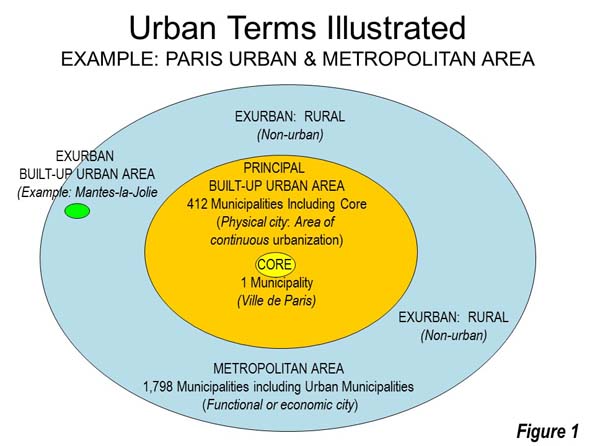
    Many of the world’s biggest cities are getting bigger still. In 2017, the number of megacities — urban areas with better than ten million people —   increased to 37 in 2017, as the Chennai urban area entered their ranks. Chennai becomes India’s fourth megacity, along with Delhi, Mumbai and Kolkota. These are among the major findings in the just released 13th annual edition of Demographia World Urban Areas, which provides population, land area and population density estimates for the 1,040 identified built-up urban areas (cities) in the world. Built-up urban areas are the physical form of the city, a definition which separates out the urban, or constructed form of the city from the rural and smaller town areas with which they form a metropolitan area or labor market (Figure 1).

    The World’s Largest Cities

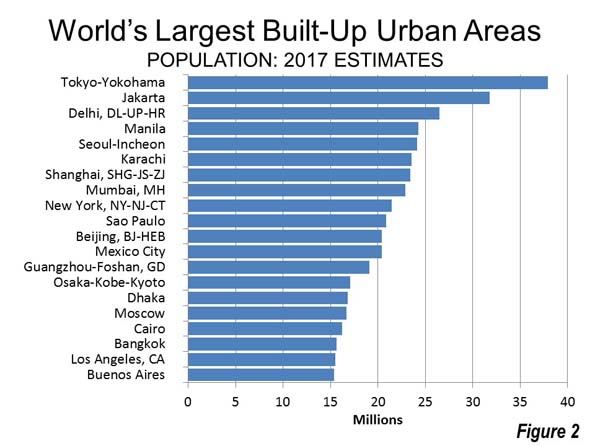
    Asia increasingly dominates the ranks of the world’s most populous cities. Tokyo-Yokohama continues to be the largest urban area in the world (Figure 2), a ranking it has held for more than six decades. It is estimated the Tokyo Yokohama house a population of 37.9 million, living in approximately 3300 square miles (8,500 square kilometers) with a population density of 11,500 per square mile (4,400 per square kilometer).

    Jakarta is the second largest urban area, with a population of 31.8 million 9,600 per square kilometer). Delhi, India’s capital held onto third position, with a population of 26.5 million. Delhi has now opened up a more than 3.5 million lead on 8th ranked Mumbai, which had been India’s largest urban area before and which some experts had considered likely to become the world’s largest city. This prediction, like a similar ones made with respect to Mexico City in the 1980s has not come to fruition and it seems unlikely that either urban area will ever be, the world’s largest.

    Manila moved up from fifth position to fourth position, passing Seoul-Incheon (Figure 3). Manila’s population is estimated at 24.3 million, in an area of 690 square miles (1,790 square kilometers) in a population density of 35,100 per square mile (13,600 per square kilometer), the highest density among the top five built-up urban areas.

    Seoul-Incheon remains the only high income city, besides Tokyo,  in the top five. Seoul-Incheon is estimated to have a population of 24.1 million and an urban population density of 22,700 per square mile (8800 per square kilometer).

    The second five includes Karachi, Shanghai, Mumbai, New York and Sao Paulo, with only New York in the high income world. Thus, seven  of the largest 10 cities in the world are now outside the high income world. New York was the largest city in the world from the 1920s until the mid-1950s. London, which was the largest city in the world from the early 19th century to the 1920s is now ranked 34th, while Beijing, which preceded London as largest ranks 11th. Among the next ten largest urban areas, only two — Osaka-Kobe-Kyoto, at 14th and Los Angeles, at 19th are in the high-income world.  Formerly rapidly growing Los Angeles seems likely to drop out of the top 20 before long.

    Dhaka’s High Density

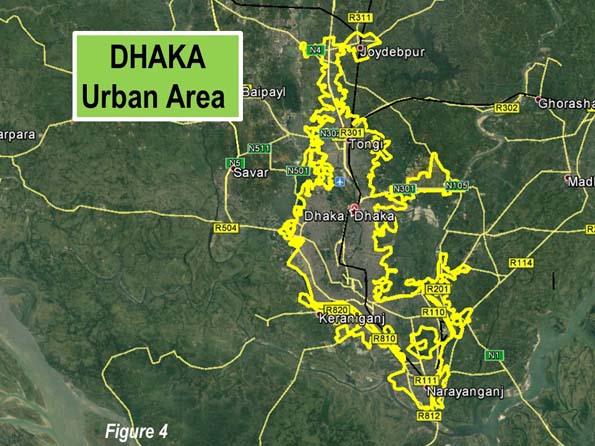
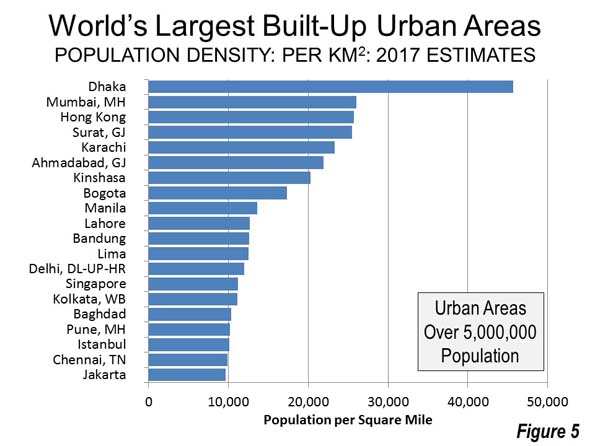
    Dhaka (Figure 4) remains far and away the highest density built-up urban area in the world (Figure 5), Dhaka has an urban density of 118,500 per square mile (45,700 per square kilometer). No other urban area exceeds 70,000 per square mile (27,000 per square kilometer). Yet, Dhaka is not dense enough for some critics, who perceive it to sprawl too much. Notably, Dhaka is about 50 percent denser than Mumbai or Hong Kong (the high income world’s densest city) and more than 30 times as dense as international densification model Portland, Oregon. Portland ranks 963rd in population density out of the 1040 built-up urban areas.

    A Half Urban World?

    In recent years, the population of the world has become majority urban for the first time. Yet, most people do not live in the largest urban areas. For example, only 15 percent of the urban population resides  in the 37 megacities. The middle of the urban population distribution is at a population of approximately 680,000. People who live in urban areas such as Shizuoka (Japan), Mangalore (India), not to be confused with Bangalore, Qitaihe (China) and Allentown (United States) are the average. The population of the urban areas that are larger have half of the urban population, while the smaller includes the other half.

    Distribution of the Population

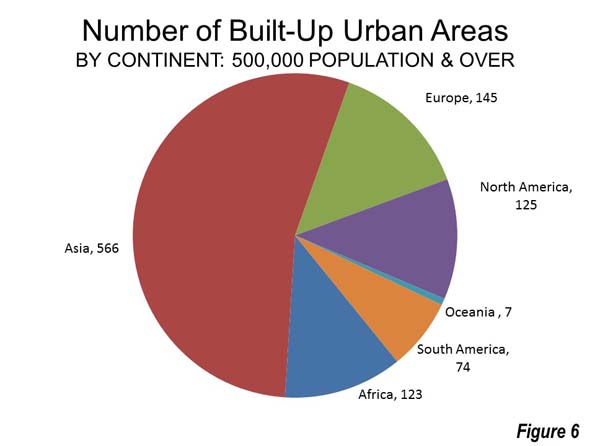
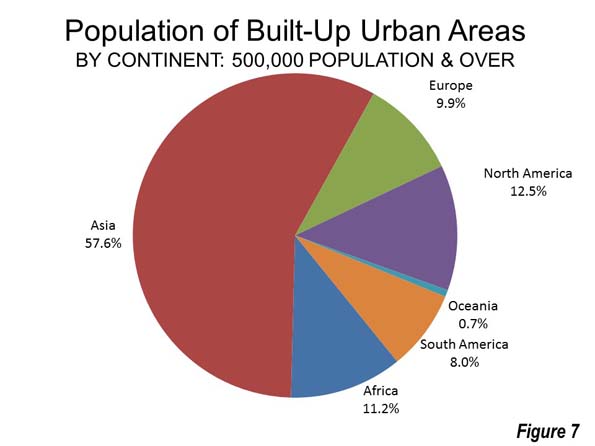
    World urbanization is dominated by Asia, which has a majority (54 percent) of the built-up urban areas with at least 500,000 population. Asia’s dominance is even greater in population, with 58 percent of the residents in urban areas of 500,000 or more. North America has the second largest share of urban area population, at 12.5 percent, followed by Africa (11.2 percent) and Europe (9.9 percent). By contrast, Europe has the second largest number of urban areas of 500,000 population or more, reflecting the generally smaller population of its cities (Figures 6 and 7).

    Concentration of Future Growth in Asia and Africa

    The latest data underscores the substantial changes that have occurred in urbanization in recent decades. In 1950, 11 of the 20 largest cities were in the high income world, according to the United Nations. On average these cities had 5 million population. Today, only five of the 20 largest cities are in the high income world and their average population is 21.5 million.

    In the decades to come, Asia  seems likely to continue its dominance, while Africa will capture an increasing share of urban population growth. By 2050, the United Nations projects that approximately 1.2 billion residents will be added to Asian urban areas, while nearly 900 million will be added to the urban areas of Africa. This would leave only about 125 million, or five percent of total urban growth for the rest of the world. Of course, projections can be wrong, but the strength of current trends make these forecasts all the more credible.

    Note: Demographia World Urban Areas uses base population figures, derived from official census and estimates data, to develop basic year population estimates within the confines of built-up urban areas. These figures are then adjusted to account for population change forecasts, principally from the United Nations or national statistics bureaus for a 2016 estimate.

    Built-up urban areas are continuously built-up development that excludes rural lands. Built-Up urban areas are the city in its physical form, as opposed to metropolitan areas, which are the city in its economic or functional form. Metropolitan areas include rural areas and secondary built-up urban areas that are outside the primary built-up urban area. These concepts are illustrated in Figure 1 (above), which uses the Paris built-up urban area (unité urbaine) and metropolitan area ("aire urbaine") as an example.

    Wendell Cox is principal of Demographia, an international public policy and demographics firm. He is a Senior Fellow of the Center for Opportunity Urbanism (US), Senior Fellow for Housing Affordability and Municipal Policy for the Frontier Centre for Public Policy (Canada), and a member of the Board of Advisors of the Center for Demographics and Policy at Chapman University (California). He is co-author of the “Demographia International Housing Affordability Survey” and author of “Demographia World Urban Areas” and “War on the Dream: How Anti-Sprawl Policy Threatens the Quality of Life.” He was appointed to three terms on the Los Angeles County Transportation Commission, where he served with the leading city and county leadership as the only non-elected member. He served as a visiting professor at the Conservatoire National des Arts et Metiers, a national university in Paris.

    Photo: Cover of Demographia World Urban Areas: 13th Annual Edition.

  • The End of the Asian Era

    For the past 40 years, the Pacific Rim has been, if you will, California’s trump card. But now, in the age of President Donald Trump and decelerating globalization, the Asian ascendency may be changing in ways that could be beneficial to our state.

    Rather than President Barack Obama’s famous “pivot to Asia,” it now might be more accurate to speak of Asians’ pivot to America. Once feared as a fierce competitor, East Asia is facing an end to its period of relentless growth, and now many interests appear to find that the United States offers a more secure, and potentially lucrative, alternative.

    This era reflects profound changes in East Asia’s prospects. They increasingly are coping with many of the demographic, social and economic challenges that have bedeviled the West since the 1970s — competition from cheaper countries, technological obsolescence, a demoralized workforce and diminishing upward mobility. The verve of the late 20th century is being supplanted by the anxieties of the early 21st.

    Demographic decline

    Forty years ago, overpopulation constituted the big issue facing East Asia. Governments from Singapore to Korea and, most importantly, China, imposed anti-natalist policies, fearing that their economic success would be overcome by a tide of new citizens. Today, East Asia confronts the world’s most stagnant demography.

    By 2030, according to the United Nations, Japan, still the world’s third-largest economy, will have more people over 80 than under 15, and, by 2050, it is expected to see its population fall by 15 percent. Many of the other Asian “tigers,” which followed Japan’s model, are saddled with a fertility rate so low that, over the next 35 years, they will join the island nation among the most elderly nations on earth.

    East Asia’s demographic crisis will hit critical mass once China, the planet’s second-largest and most dynamic large economy, feels the full impact of its super-low fertility rate. By 2050, China’s population will have a demographic look like ultraold Japan’s today — but without the higher affluence levels of its Asian neighbor to pay for all of the retirees.

    Technology and the challenge of Trumpism

    The rise of the Pacific Rim was driven, in large part, by manufacturing growth. Following the model of Japan, Asian countries grew by keeping imports out and building enormous surpluses of manufactured goods. The resulting imbalances were accepted by American administrations even when exacerbated by mercantilist policies directed against our own producers.

    The acceptance of such an arrangement ended in 2016 with the election of economic nationalist Donald Trump. But the new trade environment also includes the effective capture of the Democratic Party by elements close to Vermont’s Sen. Bernie Sanders, now America’s most popular politician. Sanders is fiercely skeptical on free trade, and his candidacy even forced Hillary Clinton, a long-time globalist, to back protectionist policies.

    Trump’s proposals to match China’s import fees and to hector companies into keeping jobs in the United States represent a huge threat to the mercantilist Asian economic model. This, at a time when new automation technology, cheaper energy and rising wage rates also are persuading Asian producers to shift production to the United States.

    Read the entire piece at The Orange County Register.

    Joel Kotkin is executive editor of NewGeography.com. He is the Roger Hobbs Distinguished Fellow in Urban Studies at Chapman University and executive director of the Houston-based Center for Opportunity Urbanism. His newest book, The Human City: Urbanism for the rest of us, was published in April by Agate. He is also author of The New Class ConflictThe City: A Global History, and The Next Hundred Million: America in 2050. He lives in Orange County, CA.

    Photo: Gage Skidmore from Peoria, AZ, United States of America (Donald Trump) [CC BY-SA 2.0], via Wikimedia Commons

  • California: The Republic of Climate

    To some progressives, California’s huge endorsement for the losing side for president reflects our state’s moral superiority. Some even embrace the notion that California should secede so that we don’t have to associate with the “deplorables” who tilted less enlightened places to President-elect Donald Trump. One can imagine our political leaders even inviting President Barack Obama, who reportedly now plans to move to our state, to serve as the California Republic’s first chief executive.

    As a standalone country, California could accelerate its ongoing emergence as what could be called “the Republic of Climate.” This would be true in two ways. Dominated by climate concerns, California’s political leaders will produce policies that discourage blue-collar growth and keep energy and housing prices high. This is ideal for the state’s wealthier, mostly white, coastal ruling classes. Yet, at the same time, the California gentry can enjoy what, for the most part, remains a temperate climate. Due to our open borders policies, they can also enjoy an inexhaustible supply of cheap service workers.

    Of course, most Californians, particularly in the interior, will not do so well. They will continue to experience a climate of declining social mobility due to rising costs, and businesses, particularly those employing blue-collar and middle-income workers, will continue to flee to more hospitable, if less idyllic, climes.

    California in the Trump era

    Barring a rush to independence, Californians now must adapt to a new regime in Washington that does not owe anything to the state, much less its policy agenda. Under the new regime, our high tax rates and ever-intensifying regulatory regime will become even more distinct from national norms.

    President Obama saw California’s regulatory program, particularly its obsession with climate change, as a role model leading the rest of the nation — and even the world. Trump’s victory turns this amicable situation on its head. California now must compete with other states, which can only salivate at the growing gap in costs.

    At the same time, foreign competitors, such as the Chinese, courted by Gov. Jerry Brown and others to follow its climate agenda, will be more than happy to take energy-dependent business off our hands. They will make gestures to impress what Vladimir Lenin labeled “useful idiots” in our ruling circles, but will continue to add coal-fired plants to power their job-sapping export industries.

    Read the entire piece at The Orange County Register.

    Joel Kotkin is executive editor of NewGeography.com. He is the Roger Hobbs Distinguished Fellow in Urban Studies at Chapman University and executive director of the Houston-based Center for Opportunity Urbanism. His newest book, The Human City: Urbanism for the rest of us, was published in April by Agate. He is also author of The New Class ConflictThe City: A Global History, and The Next Hundred Million: America in 2050. He lives in Orange County, CA.

    Photo: By User “Neon Tommy” (https://www.flickr.com/photos/neontommy/8117052872) [CC BY-SA 2.0], via Wikimedia Commons

  • Trump and the End of the World Order

    In comparison with Barack Obama, who was well regarded in the foreign media, Donald Trump does not come off as a good guy. He is also clearly redefining the country’s identity and global focus. The first American president since the 1920s to walk away from a role as global pooh-bah, Trump instead defines his job as helping the people who elected him.

    Trump’s new nationalism, spelled out in his inauguration speech, effectively rejects both the progressive globalism of the Obama years and the conservative idealism associated with George W. Bush. In the process, Trump has managed to outrage virtually the entire foreign policy establishment, including the CIA “deep state,” and more than a few foreigners as well. Everywhere in the mainstream media, here and around the world, Trump is portrayed as a destroyer of ideals, institutions and alliances bringing, in the words of the Atlantic, “the end of the American century.”

    Failure of the globalists

    Yet, as Larry Summers has pointed out, there’s a reason for the rise of “populist authoritarianism.” What he calls “global elites” have been more focused on working with their foreign counterparts than helping their own middle- and working-class populations.

    The old order is not working out all that well. The foreign policy establishments of both parties have ended up producing an America that is perhaps the weakest it has been since the end of the Vietnam debacle. George W. Bush launched a disastrous war in Iraq, which drained the country’s riches, bled its military and, in the end, left Iraq as a de facto Iranian vassal. For good measure, he pushed the expansion of trade in ways that accelerated the decline of many American industries, particularly in the Midwest, while helping boost China as our most formidable rival since the fall of the Soviet Union.

    If, as Council on Foreign Relations President Richard N. Haass has suggested, Bush did too much, Obama’s response was to do too little. By his prevarications and refusal to acknowledge the world as it is, Obama has left behind a disastrous reality. Despite engaging in several armed conflicts and increasingly lethal drone attacks, U.S. influence in the Middle East has weakened while that of Iran and Russia has soared. To be in second place to Russia — with an economy about the size of that great economic superpower, Italy — in the Middle East owed little to hacking, but much to greater skill at outmaneuvering the Obama administration’s diplomacy.

    The real challenge: China

    Despite the progressive hyperventilation about Russia, the real policy challenge lies with China, the only country that presents a serious economic and, ultimately, military threat. Despite Obama’s “pivot to Asia,” the U.S. position has demonstrably weakened there as well. China has shifted the rules of trade in its favor, built islands to gain control of the South China Sea, upgraded its military and won over old allies such as the Philippines. It is making huge inroads in Africa, and even in Latin America.

    Now Trump’s often unfocused belligerence opens the door for Chinese President Xi Jinping to posture himself as the new enlightened global hegemon. Here’s the man who heads up the world’s biggest emitter of greenhouse gases — a country committed to building more coal plants and not halting emissions growth before 2030 — preening as the enlightened son of science. A dictator who increasingly adopts an authoritarian Maoist ideology while bolstering a crony capitalist empire, Xi has convinced some progressives that he is a great advocate of free trade, something he and his country have not embraced in the real world.

    Read the entire piece at The Orange County Register.

    Joel Kotkin is executive editor of NewGeography.com. He is the Roger Hobbs Distinguished Fellow in Urban Studies at Chapman University and executive director of the Houston-based Center for Opportunity Urbanism. His newest book The Human City: Urbanism for the rest of us, was published in April by Agate. He is also author of The New Class ConflictThe City: A Global History, and The Next Hundred Million: America in 2050. He lives in Orange County, CA.

    Photo: Matt A.J., Creative Commons

  • Death Spiral Demographics: The Countries Shrinking The Fastest

    For most of recent history, the world has worried about the curse of overpopulation. But in many countries, the problem may soon be too few people, and of those, too many old ones. In 1995 only one country, Italy, had more people over 65 than under 15; today there are 30 and by 2020 that number will hit 35. Demographers estimate that global population growth will end this century.

    Rapid aging is already reshaping the politics and economies of many of the most important high-income countries. The demands of older voters are shifting the political paradigm in many places, including the United States, at least temporarily to the right. More importantly, aging populations, with fewer young workers and families, threaten weaker economic growth, as both labor and consumption begin to decline.

    We took a look at the 56 countries with populations over 20 million people, nine of which are already in demographic decline. The impact of population decline will worsen over time, particularly as the present generation now in their 50s and 60s retires, begins drawing pensions and other government support.

    Europe: Homeland of Demographic Decline

    Heading up our list of slowly dissipating large countries is the Ukraine, a country chewed at its edges by its aggressive Russian neighbor. According to U.N. projections, Ukraine’s population will fall 22% by 2050. Eastern and Southern Europe are home to several important downsizing countries including Poland (off 14% by 2050), the Russian Federation (-10.4%), Italy (-5.5%) and Spain (-2.8%). The population of the EU is expected to peak by 2050 and then gradually decline, suggesting a dim future for that body even if it holds together.

    The most important EU country, Germany, has endured demographic decline for over a generation. Germany’s population is forecast to drop 7.7% by 2050, though this projection has not been adjusted to account for the recent immigration surge. The main problem is the very low fertility rate of the EU’s superpower, which according to United Nations data was 1.4 between 2010 and 2015. It takes a fertility rate of 2.1% to replace your own population so we can expect Germany to shrink as well as get very old.

    Nor can Europe expect much help from its smaller countries. Although too small to reach our 20 million person threshold, many of Europe’s tinier “frontier” countries have abysmal fertility rates. Among the 10 smaller countries with the greatest population declines, all are in Europe, and outside Western Europe, with Bulgaria’s population expected to shrink 27% by 2050 and Romania’s 22%. Each of these have below replacement rate fertility. Things are not that much better in Western Europe, where fertility rates are also below replacement rates, but not quite so low. Long-term, the only option for Europe may be to allow more immigration, particularly from Africa and the Middle East, although this may be impossible due to growing political resistance to immigration.

    Demographic Decline: The Asian Edition

    If this were just a European disease, it would not prove such a challenge to the economic future. Europe is gradually diminishing in global importance. The big story in demographic trends is in Asia, which has driven global economic growth for the past generation. The decline of Japan’s population is perhaps best known; the great island nation, still the world’s third largest economy, is expected to see its population fall 15% by 2050, the second steepest decline after Ukraine, and get much older. By 2030, according to the United Nations, Japan will have more people over 80 than under 15.

    But the biggest hit on the world economy from the new demographics will come from China, the planet’s second largest economy, and the most dynamic.

    Until a generation ago, overpopulation threatened China’s future, as it still does some developing countries. Today the estimates of the country’s fertility rate run from 1.2 to 1.6, both well below the 2.1 replacement rate. By 2050 China’s population will shrink 2.5%, a loss of 28 million people. By then China’s population will have a demographic look similar to ultra-old Japan’s today — but without the affluence of its Asian neighbor.

    Other Asian countries have similar problems. Thailand ranks as the fifth most demographically challenged, with a projected population loss of 8%. The population of Sri Lanka, just across Adam’s Bridge from still fast-growing India, is projected to increase only 0.6%.

    Also going into a demographic stall is South Korea, another country which a generation ago worried about its expanding population. With its fertility rate well below replacement (1.3), the country will essentially stagnate over the next 35 years, and will becoming one of the most elderly nations on earth.

    Full List: The Countries Shrinking The Fastest

    Smaller Singapore is an anomaly. The city-state has a rock-bottom fertility rate of 1.2, but projects a population increase of 20% by 2050 due to its liberal and vigorously debated immigration policies.

    Economic Consequences

    Most world leaders are fixated on the unpredictable new administration in Washington in the short term, but they might do better to look at the more certain long-term impacts of diminishing populations on the world’s most important economies. Economists, including John Maynard Keynes, have connected low birth rates to economic declines. On the “devil” of overpopulation, Keynes wrote, “I only wish to warn you that the chaining up of the one devil may, if we are careless, only serve to loose another still fiercer and more intractable.”

    It is already fairly clear that lower birthrates and increased percentages of aged people have begun to slow economic growth in much of the high-income world, and can be expected to do the same in long ascendant countries such as China and South Korea. Economists estimate that China’s elderly population will increase 60% by 2020, even as the working-age population decreases by nearly 35%. This demographic decline, stems from the one-child policy as well as the higher costs and smaller homes that accompany urbanization, notes the American Enterprise Institute’s Nicholas Eberstadt. China’s annual projected GDP growth rate will likely decline from an official 7.2% in 2013 to a maximum of 6% by 2020.

    There are several reasons these demographic shifts portend economic decline. First, a lack of young labor tends to drive up wages, sparking the movement of jobs to other places. This first happened in northern Europe and Japan will increasingly occur now in Korea, Taiwan, and even China. It also lowers the rate of innovation, notes economist Gary Becker, since change tends to come from younger workers and entrepreneurs. Japan’s long economic slowdown reflects, in part, the fact that its labor force has been declining since the 1990s and will be fully a third smaller by 2035.

    The second problem has to do with the percentage of retirees compared to active working people. In the past growing societies had many more people in the workforce than retirees. But now in societies such as Japan and Germany that ratio has declined. In 1990, there were 4.7 working age Germans per over 65 person. By 2050, this number is projected to decline to 1.7. In Japan the ratios are worse, dropping more than one-half, from 5.8 in 1990 to 2.3 today and 1.4 in 2050. China, Korea and other East Asian countries, many without well-developed retirement systems, face similar challenges.

    Finally, there is the issue of consumer markets. Aging populations tend to buy less than younger ones, particularly families. One reason countries like Japan and Germany can’t reignite economic growth is their slowing consumption of goods. This challenge will become all the more greater as China, the emerging economic superpower, also slows its consumption. The future of demand, critical to developing countries, could be deeply constrained.

    What about the USA?

    To a remarkable extent, the United States has avoided these pressing demographic issues. The U.N. has the U.S. tied with Canada for the fastest projected population growth rate of any developed country: a 21% expansion by 2050. Yet this forecast could prove inaccurate.

    One threat stems from millennials who, even with an improved economy, have not started families and had children at anything close to historical rates. Today the U.S. fertility rate has dropped to 1.9 from 2.0 before the Great Recession; population growth is now lower than at any time since the Depression. This places us below replacement level for the next generation. Projections for the next decade show a stagnant, and then falling number of high school graduates, something that should concern both employers and colleges. The United States’ high projected population growth rate, like that of Singapore, is entirely dependent upon maintaining high rates of immigration.

    But even before the election of Donald Trump, who is hell-bent on cracking down on at least undocumented immigration, total immigration to the United States has been slowing. At the same time the fertility rates of some immigrant groups, notably Latinos, have been dropping rapidly and approaching those of other Americans. This is despite the fact that as many as 40% of women would like to have more children; they simply lack the adequate housing, economic wherewithal and spousal support to make it happen.

    In the coming decades, the countries that can maintain an at least somewhat reasonable population growth rate, and enough younger people, will likely do best. To a large extent, it’s too late for that in much of Europe and East Asia. For countries like the United States, Canada and Australia, with among the most liberal immigration policies and large landmasses, the prospects may be far better. However, we also need native-born youngsters to launch, get married and start creating the next generation of Americans.

    This piece originally appeared at Forbes.

    Joel Kotkin is executive editor of NewGeography.com. He is the Roger Hobbs Distinguished Fellow in Urban Studies at Chapman University and executive director of the Houston-based Center for Opportunity Urbanism. His newest book, The Human City: Urbanism for the rest of us, was published in April by Agate. He is also author of The New Class ConflictThe City: A Global History, and The Next Hundred Million: America in 2050. He lives in Orange County, CA.

    Photo: Ahmet Demirel [Public domain], via Wikimedia Commons

  • World Automotive Sales Setting New Records

    The world has come a long way since 1929, when 80 percent of the world’s car registrations were in the United States, which also manufactured 90 percent of the vehicles. Now China produces the most cars and its annual sales rank top in the world. China overtook the United States in vehicle sales during the Great Recession. But it’s not like Americans are no longer buying cars; the US broke its own record last year. In 2016, sales records were also set in nations as diverse as China, the United Kingdom, Canada, Australia and Mexico.  

    China

    China has emerged as the world’s largest automotive market. In 2016, China’s sales of passenger cars, light trucks (including sport utility vehicles, or SUVs) and commercial vehicles reached 23.9 million. This is 6.5 million more cars than were sold in the United States. This gap is likely to grow, because China’s large population offers greater opportunity for growth. The United States has about eight times as many vehicles per 1,000 population as China. The US leads in total vehicles with 260 million compared to China’s 140 million, according to OICA, the international vehicle manufacturers organization (Organisation Internationale des Constructeurs d’Automobiles), 

    From virtually the beginning of motorization more than a century ago, the United States dominated world automotive production but during  the Great Recession   China assumed sales leadership. As sales dropped precipitously in the US, Chinese sales rose 47 percent in 2009.

    Sales in 2016 were aided by temporarily lower taxes on small engine vehicles, which ended on December 31. Still, analysts expect another four to five percent growth in vehicle sales in 2017.

    As in a number of other nations with rising volumes, SUVs took an increasing share of total sales figures. SUV sales were up 44 percent, eight times the increase in passenger car sales. Now, nearly three-quarters as many SUVs as passenger cars are sold in China (Note).

    Buick was one of the international pioneers in China’s automobile market, from agreements after US President Richard Nixon’s early 1970s visit. Buicks had been favored by some government officials. and were the first American cars built in China (in a joint venture with local SAIC ). China’s Premier Zhou Enlai, who served from 1949 to 1976, owned one before World War II (Photo: Premier Zhou En Lai’s Buick, Museum in Nanjing). Today, 80 percent of the world’s Buicks are sold in China.

    In recent years the Chinese  market has become more diverse. Virtually all of the international players sell in China and there are a number of local manufacturers. Sweden’s flagship brand, Volvo, now owned by Chinese interests, who now ship a “made in China”  model to the United States (the only Chinese import).

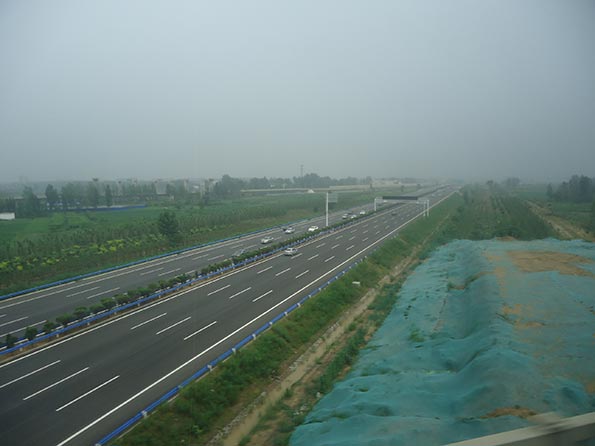
    China’s infrastructure is well prepared for its record breaking sales. China leads the world in its length of motorways (freeways or controlled access expressways), with 123,500 kilometers (76,700 miles) as of the end of 2015 (Photo: G4 Expressway between Zhengzhou, Henan and Wuhan, Hubei). This compares to the latest available US total of 104,500 (64,900 miles) in 2014.

    China’s cities are served by extensive freeway systems. In Beijing  there are five freeway ring roads and a sixth partially opened. But cars have become so popular that the high city densities have predictably created both horrific traffic. Further, despite effective emission controls, the high density of traffic contributes to the country’s severe air pollution problems . The plan for a more decentralized Beijing and environs (Jin-Jing-Ji) is aimed at least partially at reducing traffic congestion.

    Photo: Zhou En Lai’s Buick, Zhou En Lai Museum, Nanjing

    Photo: G4 Expressway between Zhengzhou, Henan and Wuhan, Hubei

    United States

    A record 17.6 million light vehicles were sold in the second largest market, the United States, which broke last year’s record of record of 17.4 million. Light duty truck sales captured nearly 60 percent of the market, with an annual increase of 7.2 percent. This included SUV’s, (and “crossovers”) with 38 percent of the market and a 7.4 percent increase. Passenger cars continued their decline by 8.1 percent, to 40 percent of the market.

    Western Europe

    The core European Union 15 nations, along with Norway and Switzerland taken together account for the third largest car market.  . There was no new record there last year but the strongest volume since 2007. Nearly 14 million light vehicles were sold, approximately six percent below the record set in 1999.

    The United Kingdom set a record, with sales of 2.6 million vehicles, up two percent from 2015. Fifteen of the seventeen nations had sales increases. Italy, Portugal and Ireland had the greatest gains, at 17.5 percent, 16.2 percent and 15.8 percent respectively. Spain also exceeded a ten percent gain (10.9 percent), while Finland gained 9.3.

    Strong gains were also posted in Sweden, Finland, Denmark and Belgium, with increases of from seven to eight percent. However, neighboring Netherlands had by far the largest drop, 14.7 percent. Large markets France (up 5.1 percent) and Germany (4.5 percent) contributed importantly to the higher Western Europe sales number. Sales were down 2 percent in Switzerland.

    A More Mobile World

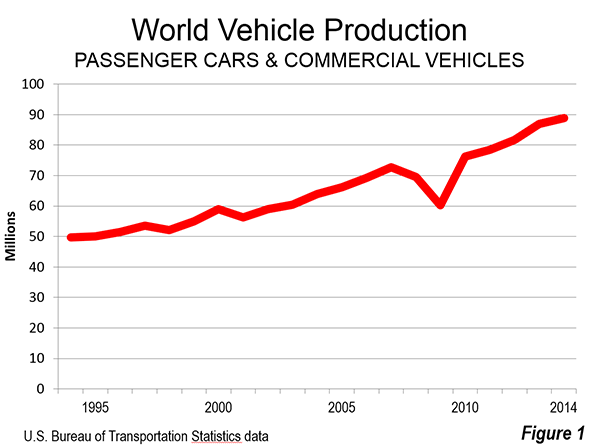
    In 2014, world vehicle sales reached 89 million (Figure 1). Between 2004 and 2014, world car sales rose at a rate of 3.3 percent annually. Even with the reverses of the Great Recession, this was a more than one-quarter increase from the 2.6 percent rate of the previous decade. If the trend of recent years continues, production will exceed 100 million by 2020.

    According to OICA, international vehicle manufacturers organization (Organisation Internationale des Constructeurs d’Automobiles), there were 1.2 billion vehicles in the world in 2014, 180 per 1,000 population.

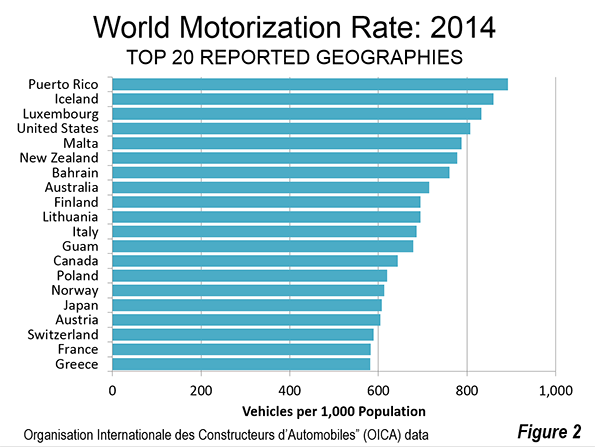
    It might be expected that the greatest motorization would have been reached in the United States, the most affluent of the larger nations. That would be partly right, but not the 50 states, rather Puerto Rico is the most intensively motorized geography in the world, with 892 vehicles per 1,000 residents, according to OICA (Puerto Rico is routinely reported separately, for cars and other data .  This is surprising, given that Puerto Rico’s median household income was only one-third of the 50 states in 2015, and less than one-half that of 50th ranked Mississippi (Figure 2).

    The United States has to settle for fourth position, following Iceland and Luxembourg. Even that may seem high, especially in view of data in The Economist’s The World in Figures, which says that the US  ranks 36th in cars per 1,000 population. But in the United States, cars aren’t even half the story. In the US, peak sales of traditional passenger cars  was reached in 1974 and sales have dropped nearly 40 percent. Consumers have been buying SUVs and pickups instead. Motorization is measured by personal vehicles, not cars. According to OICA, in 2014 86 percent of Western European vehicles were cars, compared to 47 percent in the United States, In fact, in 2016, the top three selling vehicles in the United States were pickups, led by the Ford F Series, which is also the top seller in Canada (photo: Ford F-150 Pickup), where nearly two-thirds of 2016 sales were pickups and SUVs.

    Photo: Ford F-150 (2017 model)

    World motorization continues to grow strongly. The cars are cleaner , safer and will continue to get more environmentally friendly. The mobility they have facilitated has made an important contribution to the continuing improvements in the quality of life and will continue to do so, despite efforts of governments and planners to discourage their use.

    Note: Vehicle types may not be standardized in national reporting and thus caution is required in interpreting this data.

    Wendell Cox is principal of Demographia, an international public policy and demographics firm. He is a Senior Fellow of the Center for Opportunity Urbanism (US), Senior Fellow for Housing Affordability and Municipal Policy for the Frontier Centre for Public Policy (Canada), and a member of the Board of Advisors of the Center for Demographics and Policy at Chapman University (California). He is co-author of the “Demographia International Housing Affordability Survey” and author of “Demographia World Urban Areas” and “War on the Dream: How Anti-Sprawl Policy Threatens the Quality of Life.” He was appointed to three terms on the Los Angeles County Transportation Commission, where he served with the leading city and county leadership as the only non-elected member. He served as a visiting professor at the Conservatoire National des Arts et Metiers, a national university in Paris.

    Photo: Chang’an Avenue, Beijing by Australian cowboy at the English language Wikipedia [GFDL], via Wikimedia Commons

  • The Futility of Annual Top 10 Predictions

    In every recent year, a black swan event has made top 10 lists appear quaintly naive and unimaginative. Our list is probably no better.

    This time of year, top 10 predictions are all the rage. These lists can be interesting and entertaining but how useful are they really?

    This question goes to the heart of forecasting. How futile or how useful is an attempt to forecast the economy, or technology, or world events for the next twelve months? There are three answers.

    First, not futile and somewhat useful. Projecting the trends of 2016 into 2017 is a useful exercise to identify their linear logical trajectories and end points. For example, the automation of many job functions will continue as long as robotics and artificial intelligence make progress. Or, North Korea’s ability to deliver a nuclear warhead on a long-range missile will continue to improve if unchecked.

    Second, futile and not that useful. When a desirable trend, say a decline in unemployment, is identified, policy makers will attempt to reinforce it. When an undesirable trend becomes obvious, they will work to counter it. However in both cases, the intervention can be either effective or counterproductive. It can either reinforce or roll back the trend. Human tinkering means that few trends are truly linear or logical beyond the near-term. There may be a slowdown in the spread of automation. There may be an agreement to stop North Korea’s nuclear ambitions.

    Third, neither futile nor useful but somewhat irrelevant. While forecasters are focusing their sights on the high probability of a, b and c, there are always bigger low-probability events brewing under the surface. In fact, the most important event in any given year, the one event that shakes things up and that has wide long-lasting ramifications, is usually one that few people foresaw at the beginning of that year.

         •  In 2016, Brexit and the victory of Donald Trump. A large majority of experts gave either event a low probability.

         •  In 2015, the massive refugee influx into Europe. The numbers were rising in previous years but no one saw the surge coming.

         •  In 2014, the sudden rise of ISIS after it conquered large territories in Syria and Iraq. President Obama had famously dismissed them as the JV team a few months earlier.

         •  In 2013, the Boston Marathon bombing and Edward Snowden’s revelations.

    And so on. If you look at it by decade, the most important events of the 1990s and 2000s were the collapse of the Soviet Union and the 9/11 terror attacks. Neither featured in top ten lists in any year but both had an enormous impact and repercussions that are still rippling around the world.

    So instead of a list of top 10 higher probability predictions, we should consider a list of lower probability events each of which, were it to occur, would have a very large impact on the future of politics, economics, science etc. As extensively argued by Nassim Taleb, black swan events often have a much greater impact on the future.

    Here is one attempt to compile such a list, with the caveat admission that it is only marginally better if at all than other lists and that the most important event of 2017 will likely be something else.

    Low Probability high impact events

    In no particular order:

         •  A major cyberattack that paralyzes the electric grid, payment exchanges, the stock market and/or other infrastructure. Until repaired, this would wreak havoc on daily life and the economy and would hit GDP for several quarters. It would also lead to new security measures and the attendant spending by corporations and governments.

         •  Putin removed from power. This has a low probability but it is not impossible. Referring to Putin, George Friedman recently wrote that “Russia must be led by a magician who can make small things appear large.” Through ways not always approved in the West, Putin has managed to spread Russia’s influence despite economic deterioration. But Russia has large demographic and economic challenges which could get worse after his departure.

         •  Another financial crisis starting in Europe or in emerging markets. Though regulation and oversight have increased since 2008, there was no deep overhaul of the cultural mindset at many leading financial institutions. The world is awash with credit and emerging markets are considerably weaker now than in 2008. If nothing else, moral hazard created by the bailouts means that the next crisis could be as severe as the last one, with little appetite in the public for saving the banks one more time.

         •  A joint Russia-NATO military operation against ISIS and a settlement of the Syrian war. ISIS has lost much territory in 2016 but is still effective at orchestrating terror attacks in other countries. During the campaign, Donald Trump vowed to hit them hard.

         •  A sharp economic slowdown in China. China has been a huge engine of growth for over two decades lifting its own economy and boosting commodity-based countries such as Brazil, Russia and the OPEC countries. Chinese demand also helped maintain strong demand for American and European goods at a time when growth in Western economies was sluggish or nonexistent. At the same time, China’s low-cost manufacturing and capital flows into the US lowered inflation and interest rates. A marked China slowdown could throw all of the above in reverse, lifting interest rates in the US and Europe and depressing demand for finished goods and commodities.

         •  Political turmoil in Saudi Arabia and/or Iran. Both countries have vast oil reserves and are the leading power brokers in the Middle East. Destabilization in either would have important near and long-term consequences.

         •  A coup d’état or populist revolt in an OECD country. OECD member Turkey experienced an aborted military takeover in 2016. Could it happen elsewhere? Highly improbable but not necessarily 100% out of the question, as far as black swans are concerned.

         •  The price of oil at $20 or $90 per barrel. Today oil is trading near $55 and a decline to $40 or a rise to $65 are neither here nor there in terms of their lasting impact. But a $30 to $40 rise or drop would certainly shake things up. It is not difficult to construct either scenario, improbable as it may be. For a drop, imagine China and/or the US economy weakening while production from Iran, Iraq, Libya and US shale producers surges back. For a rise, consider emerging markets recovering with a stronger India while turmoil in the Middle East threatens some production.

         •  A major terrorist attack with thousands of casualties. Unfortunately, this one will have to feature on the list every year for the foreseeable future. Though it has a low probability, its occurrence anywhere would shock and reshape the world for the several decades that follow.

         •  On the positive side, there will continue to be advances in science and medicine. Because positive developments tend to build on the previous years’ progress, they are by their nature incremental, and are therefore unlikely to generate surprise shock or awe headlines.

    These are all low probability but not zero probability events. And the impact of each would be far greater than that of any higher probability event featuring in many top 10 predictions for 2017.

    Sami Karam is the founder and editor of populyst.net and the creator of the populyst index™. populyst is about innovation, demography and society. Before populyst, he was the founder and manager of the Seven Global funds and a fund manager at leading asset managers in Boston and New York. In addition to a finance MBA from the Wharton School, he holds a Master’s in Civil Engineering from Cornell and a Bachelor of Architecture from UT Austin.

    Photo: Edvard Munch [Public domain or Public domain], via Wikimedia Commons

  • How Post-Familialism Will Shape the New Asia

    Surprisingly, the modern focal point for postfamilial urbanism comes from eastern Asia, where family traditionally exercised a powerful, even dominant influence over society. The shift toward post-familialism arose first in Japan, the region’s most economically and technologically advanced country. As early as the 1990s sociologist Muriel Jolivet unearthed a trend of growing hostility toward motherhood in her book Japan: The Childless Society? –a trend that stemmed in part from male reluctance to take responsibility for raising children.

    The trend has only accelerated since then. By 2010 a third of Japanese women entering their 30s were single, as were roughly one in five of those entering their 40s – that is roughly eight times the percentage seen in 1960 and twice that seen in 2000. By 2030, according to sociologist Mika Toyota, almost one in three Japanese males may be unmarried by age 50.

    In Japan, the direct tie between low birth rates and dense urbanization is most expressed in Tokyo, which now has a fertility rate of around one child per family, below the already depressed national average. Some of the lowest rates on earth can be seen elsewhere in eastern Asia, including those in Seoul, Singapore and Hong Kong, which are now roughly the same as the rate in Tokyo.

    As more of Asia becomes highly urbanized like Japan, this kind of ultra-low fertility will spread to other parts of the continent. Most critically, this dynamic has already spread to mainland China, or at least to its larger cities, where fertility rates have dropped well below 1.0. In 2013, Shanghai’s fertility rate of 0.7 was among the lowest ever reported – well below the “one child” mandate removed in 2015 and only one-third the rate required to simply replace the current population. Beijing and Tianjin suffer similarly dismal fertility rates.

    This pattern of low fertility, notes demographer Gavin Jones, suggests that rapid urbanization has already made the notion of the one-child policy antiquated. Now, even with fertility policies being loosened, many Chinese families are opting not to take advantage, largely due to the same reasons cited in other parts of the world: the high cost of living and high housing costs.

    Perhaps no city better reflects Asia’s emerging urban paradigm than Seoul, the densest of the high-income world’s megacities outside of Hong Kong. The Korean capital is more than 2.5 times as crowded as Tokyo, twice as dense as London and 5 times as crowded as New York. No surprise then that self-styled urban pundits love the place, as epitomized by a glowing report in Smithsonian magazine that painted Seoul as “the city of the future.” Architects, naturally, joined the chorus. In 2010 the International Council of Societies of Industrial Design named Seoul the “world design capital.”

    Ultimately, Seoul epitomizes the retro-urbanist fantasy: a city that is dense and dominating, rapidly turning the rest of the country into depopulating backwaters. Seoul has monopolized population growth in Korea, accounting for nearly 90% of total growth since 1970. Seoul also currently holds nearly 50% of the country’s population, up from 20% in 1960.

    Seoul’s development has come at the expense of not just its own hinterlands but also its own humanity. Its formerly human-scaled form of housing, known as a hanok , which was one story tall and featured an interior courtyard, has been largely replaced with tall, often repetitive towers that stretch even into the suburbs. While architects and planners celebrate this shift, they rarely consider whether this form of urbanization creates a good place for people, particularly families.

    When you consider the trends in similar cities, it’s unsurprising that Korean sociologists have noted the shift to high-density housing as being unsuitable for families with children.

    Over time the impact of these housing policies will be profound. By 2040 Korea’s population will join those of Japan and Germany as one of the world’s oldest. This will occur despite determined government efforts to encourage childbearing, efforts that may well be doomed by the government’s similar commitment to a dense, centralized urban form.

    What will happen to societies that are likely to retain extremely low rates of fertility? Japan, notes Canadian demographer Vaclav Smil, represents “an involuntary global pioneer of a new society.” Japan certainly exemplifies one way societies may evolve under diminishing birth rates.

    Projecting population and fertility rates is difficult, but the trajectory for Japan is unprecedented. The UN projects Japan’s 2100 population to be 91 million, down from 2015′s 127 million, but Japan’s own National Institute of Population & Social Security Research projects a population of 48 million, nearly 50% lower than the UN’s projection.

    Japan’s urban centralization both feeds and accelerates this trend. Rather than disperse, Japan’s population is “recentralizing.” A country with a great tradition of regional rivalries, home to an impressive archipelago of venerable cities, is becoming, in effect, a city-nation, with an increased concentration on just one massive urban agglomeration: Tokyo. This has, for the time being, allowed Tokyo to escape the worst of Japan’s demographic decline, drawing heavily on the countryside and smaller cities, both of which are losing population. From 2000 to 2013 the Tokyo metropolitan area added 2.4 million residents, while the rest of the nation declined by 2 million.

    Tokyo is now home to almost one in three Japanese. But its growth is likely to be constrained, as the last reservoir of rural and small-city residents seems certain to dry up dramatically. A projection for the core prefecture of Tokyo indicates a 50% population cut by 2100 to a number smaller than it was at the beginning of World War II; 46% of that reduced population will be over 65.

    This suggests it is time, in high-income countries at least, to shift our focus from concerns about overpopulation to a set of new and quite unique challenges presented by rapid aging and a steadily diminishing workforce. Even birth rates in developing countries are tumbling toward those of wealthy countries. As British environmental journalist Fred Pearce puts it, “the population bomb’ is being defused over the medium and long term.”

    Some, like Pearce, see the Japanese model as an exemplar of a world dominated by seniors – with very slow and even negative population growth – that will be “older, wiser, greener.” Following the adolescent ferment of the 20th century, Pearce looks forward to “the age of the old” that he claims “could be the salvation of the planet.”

    Yet, if the environmental benefits of a smaller, older and less consumptive population may be positive, there may be other negative ramifications of a rapidly aging society. For one thing, there will be increasingly fewer children to take care of elderly parents. This has led to a rising incidence of what the Japanese call kodokushi , or “lonely death,” among the aged, unmarried and childless. In Korea, Kyung-sook Shin’s highly praised bestseller, Please Look After Mom, which sold 2 million copies, focused on “filial guilt” in children who fail to look after their aging parents and hit a particular nerve in the highly competitive eastern Asian society that seems to be drifting from its familial roots.

    Additionally, an aging population will certainly diminish demand for both goods and services and likely would not promote a vibrant entrepreneurial economy.

    China will face its own version of “demographic winter,” although sometime later than Japan or the Asian Tiger states. The U.S. Census Bureau estimates that China’s population will peak in 2026 and then will age faster than any country in the world besides Japan. Its rapid urbanization, expansion of education and rising housing costs all will contribute to this trend. China’s population of children and young workers between 15 and 19 will decline 20% from 2015 to 2050, while that of the world will increase nearly 10%.

    In China the consequences of the rising number of elderly will be profound. Demographer Nicholas Eberstadt, for example, sees the prospect of a fiscal crisis caused by an aging and ultimately diminishing population. China, he notes, faces “this coming tsunami of senior citizens” with a smaller workforce, greater pension obligations and generally slower economic growth.

    It seems likely, as has occurred in Japan already, that rising costs associated with an aging population, and a dearth of new workers and consumers, will hamper wealth creation and income growth. Societies dominated by the old likely will become inherently backward-looking, seeking to preserve the existing wealth of seniors as opposed to creating new opportunities for the increasingly politically marginalized younger population.

    The shift to an aging population also creates, particularly in Asia where urbanization is most rapid, the segregation of generations, with the elderly in rural areas and the younger people in cities. Around the world, the results of this shift are likely to resemble those seen in Japan, with cities becoming home to an ever expanding part of the population, while people in the countryside are destined to grow older and ever more isolated. It is not clear how the expanding senior population, which was traditionally cared for by younger generations, will fare with fewer children to support them and in the absence of a well-developed welfare state.

    Later this century these same challenges will even be felt in many parts of the developing world. In rapidly urbanizing, relatively poor countries such as Vietnam, the fertility rate is already below replacement levels, and it is rapidly declining in other poorer countries such as Myanmar, Indonesia and even Bangladesh. In parts of Latin America, especially Brazil, fertility rates are plunging to below those seen in the United States. Brazil’s birth rate (4.3 in the late 1970s and now 1.9) has dropped not only among the professional classes but also in the countryside and among those living in the favelas. As one account reports, women in Brazil now say, “Afábrica está fechada”–the factory is closed.

    Excerpted from The Human City: Urbanism for the Rest of Us, by Joel Kotkin (B2 Books, 2016)

    This piece first appeared in Forbes.

    Joel Kotkin is executive editor of NewGeography.com. He is the Roger Hobbs Distinguished Fellow in Urban Studies at Chapman University and executive director of the Houston-based Center for Opportunity Urbanism. His newest book, The Human City: Urbanism for the rest of us, was published in April by Agate. He is also author of The New Class ConflictThe City: A Global History, and The Next Hundred Million: America in 2050. He lives in Orange County, CA.

    Photo: John Gillespie, CC License
  • A Tour of The Bund in Shanghai

    One of the great pleasures of China is a walk along the Bund promenade.

    Shanghai’s Bund is one of China’s great tourist and historic sites. Its history lessons are from two distinctively different periods. All of this can be witnessed from the raised promenade along the west bank of the Huang Pu River, which separates the old Puxi (west of the river) commercial core of Shanghai from the new, iconic business district that has grown up in Pudong (east of the river). It is clear that the promenade at the Bund is a very popular local tourist attraction as well.

    The Bund became a center of British commerce in the mid-19th century and remained a part of the Shanghai International Settlement (through a 1860s merger of the British and American concessions) until the beginning of World War II. Most of the buildings were built in the first quarter of the 20th century.

    This article will provide a quick tour of the western style buildings in Puxi, behind the promenade and a few views of Pudong (the Lujiazui business district) across the river. The tour starts at the south end of the Bund and continues approximately 1.2 kilometers (0.75 miles) to Suzhou Creek, just beyond the north end of the Bund. The western buildings are located along Zhongshan East #1 Road, facing the Huang Pu. The promenade is between the buildings and the Huang Pu, across from which is the Lujiazui business district of Pudong. Generally, the names used for the buildings are the original or pre-World War II, though the there can be conflicting names. I would be pleased to be advised of any corrections.

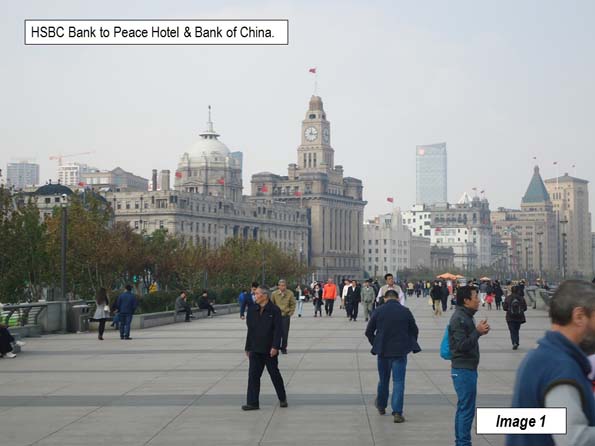
    Image 1 shows a broad sweep of the central Bund from the south to north. It includes the four most iconic buildings.

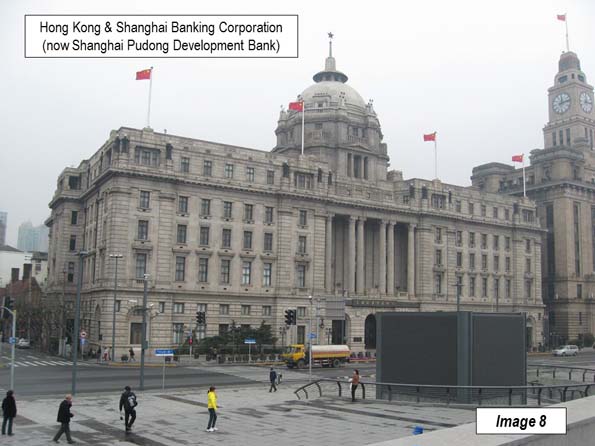
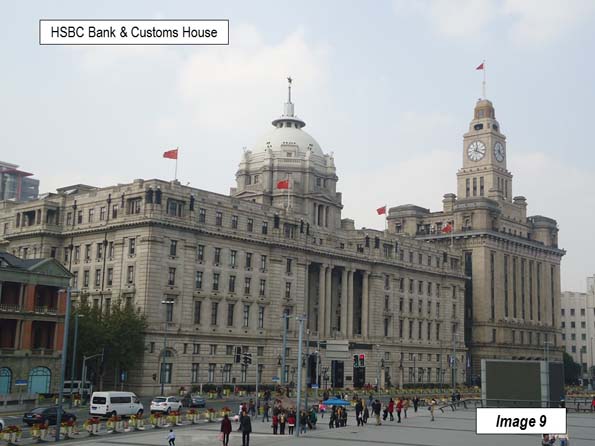
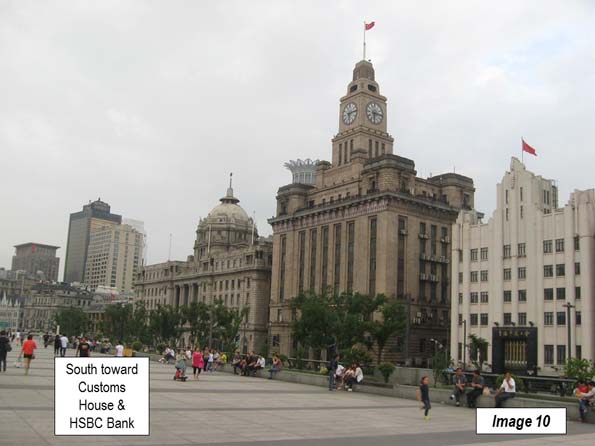
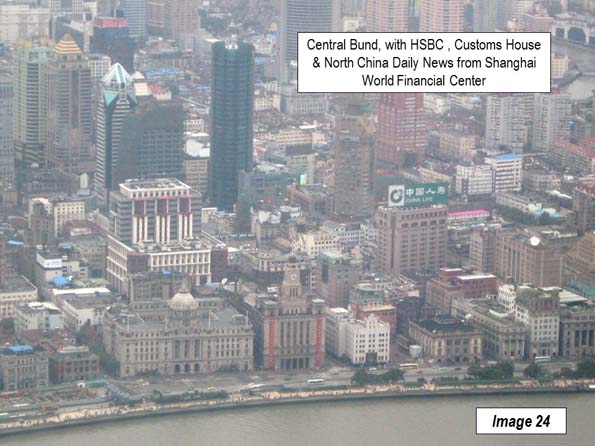
    The Hong Kong and Shanghai Banking Corporation (HSBC) Building is the large domed building near the left of the picture. It was constructed in 1923 and served as the local branch of this UK bank until 1955, six years after the establishment of the People’s Republic of China. When the bank left, it ceded title to the Shanghai People’s Government, which used the building as its headquarters for some years. It is now the Shanghai Pudong Development Bank Building.

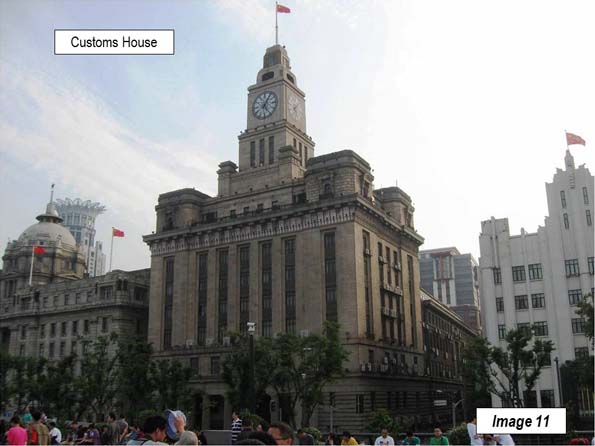
    The Customs House is just to the north of the Shanghai Pudong Development Bank Building, with the tall clock tower was opened in 1927.

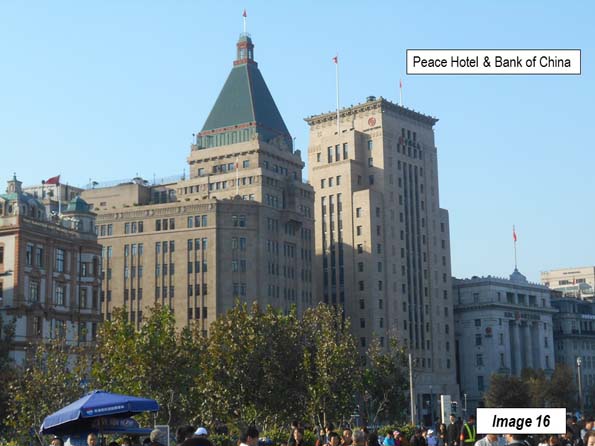
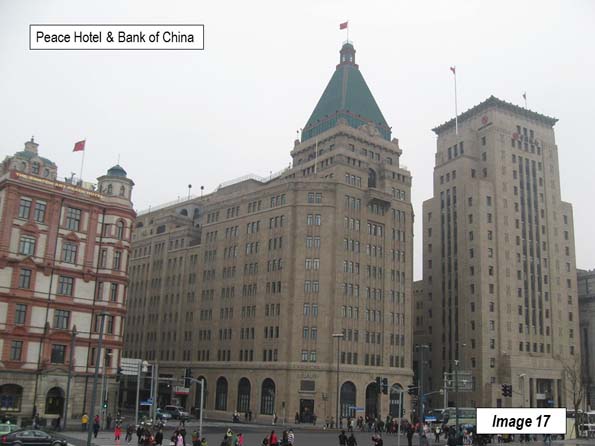
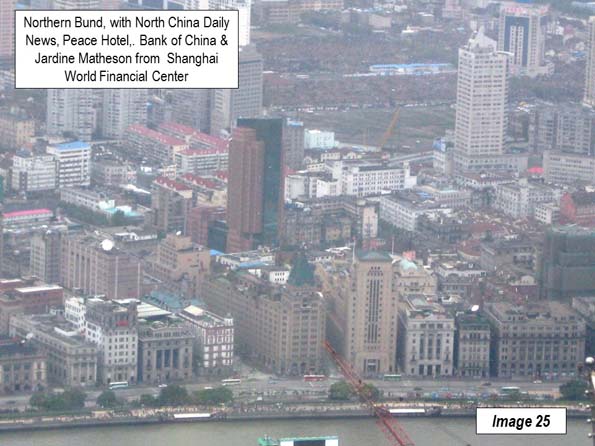
    The Peace Hotel is farther north, with the green peaked tower. It was originally the Sassoon Hotel and was the north building of the hotel complex. It is now the Fairmont Peace Hotel. Across the street, is the south building of the Peace Hotel, now called the Swatch Art Peace Hotel.

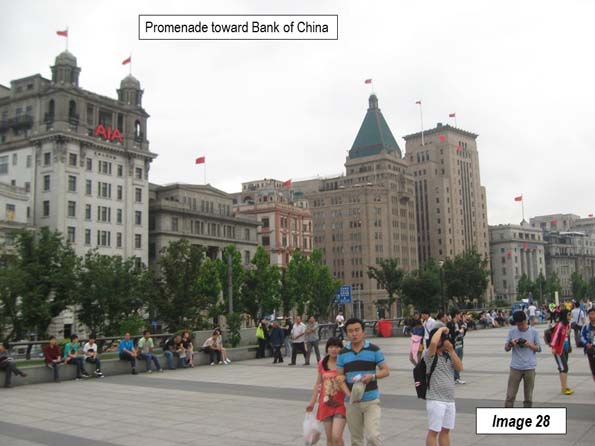
    The Bank of China Building is just to the north of the Peace Hotel. Construction began on the building in the mid-1930s and it was opened after the start of World War II, in 1942.

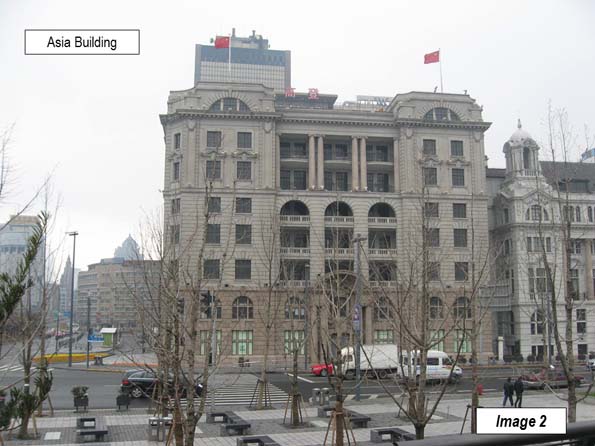
    The illustrations start at the south end of the Bund, just north of the Pudong Ferry Terminal

    Image 2: Asia Building

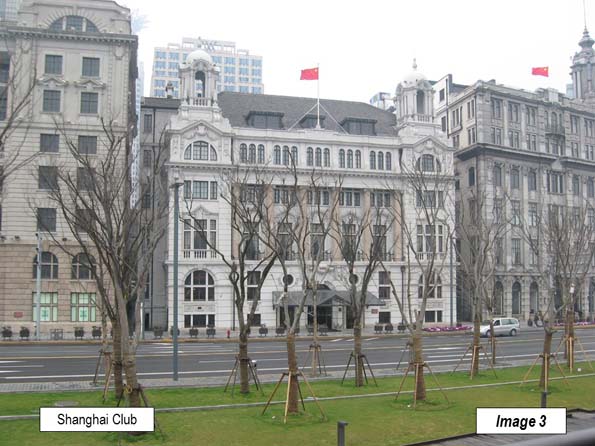
    Image 3: Shanghai Club

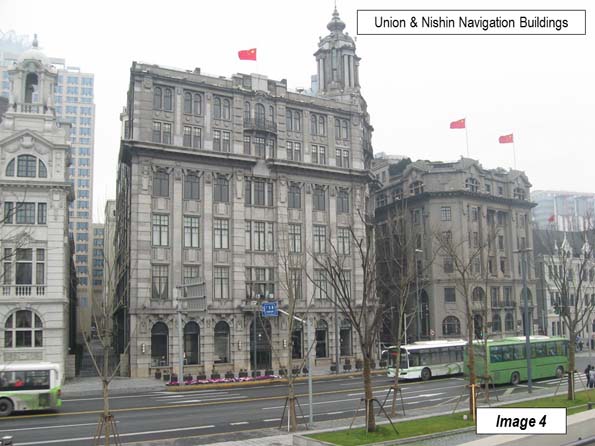
    Image 4: Union & Nish in Navigation Buildings

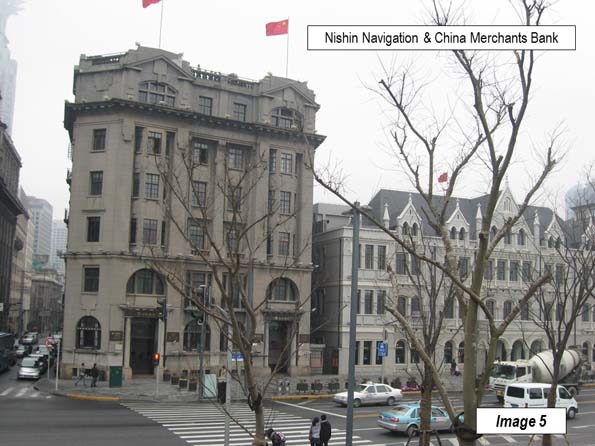
    Image 5: Nishin Navigation & China Merchants Bank Buildings

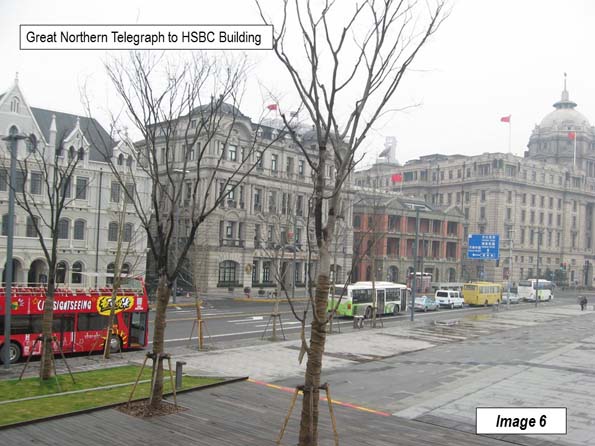
    Image 6: Great Northern Telegraph to HSBC Building

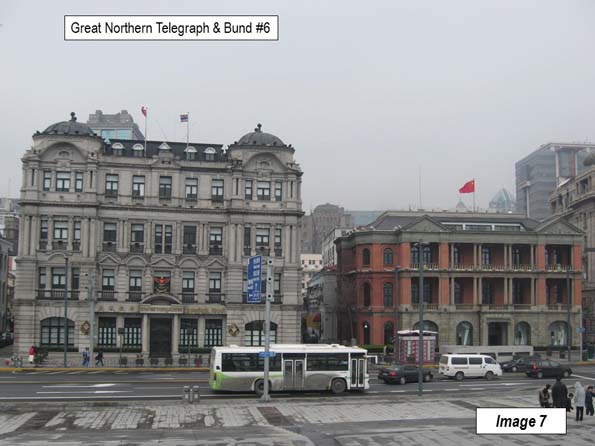
    Image 7: Great Northern Telegraph & Bund #6

    Between Bund #6 and the Hong Kong & Shanghai Bank Buildings, Fuzhou Road reaches Zhongshan Road. Fuzhou Road has been known for its bookstores, though there have been fewer in recent years.

    Image 8: Original Hong Kong & Shanghai Bank (HSBC) Building, now Shanghai Pudong Development Bank.

    Image 9: HSBC Bank & Customs House Buildings

    Image 10: Customs House and buildings to the south

    Image 11: Customs House

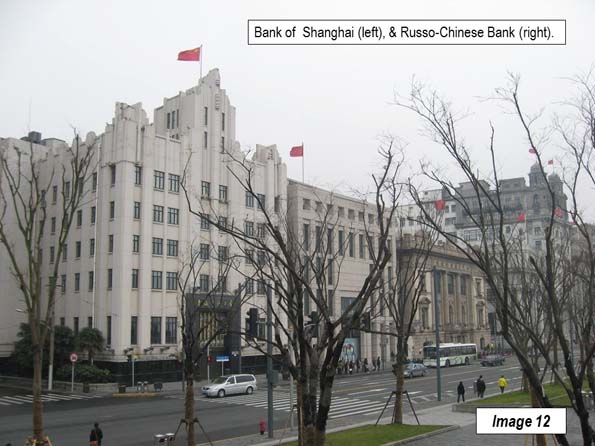
    Image 12: Bank of Shanghai & Russo-Chinese Bank

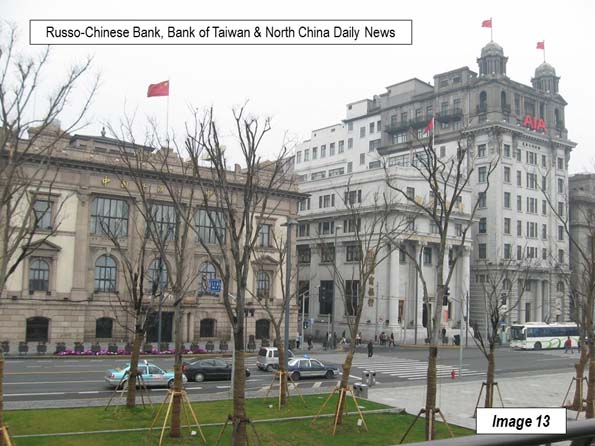
    Image 13: Russo-Chinese Bank, Bank of Taiwan (original name, Taiwan was occupied by Japan when built) and the North China Daily News buildings. The North China Daily News was the leading English newspaper of China until it closed at the beginning of World War II.

    Image 14: Bank of Taiwan, North China Daily News & Chartered Bank

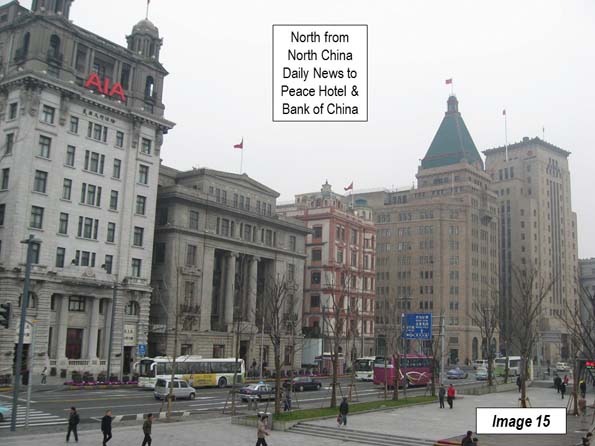
    Image 15: North China Daily News Peace Hotel South Building, Peace Hotel (North) and Bank of China buildings

    The Peace Hotel north and south buildings are across Nanjing Road opposite one another. Nanjing Road is an important shopping street, and a few more blocks inland becomes a pedestrian mall. It is also famous for offers from local students to join them in tea drinking ceremonies or at art exhibitions at which they claim to have work on display. This can be a costly experience and is not recommended.

    Image 16: Peace Hotel (North) and Bank of China

    Image 17: Peace Hotel (North) and Bank of China

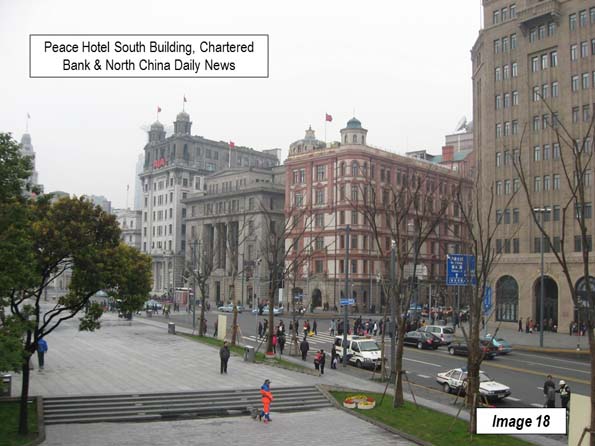
    Image 18: South from Peace Hotel (North) to North China Daily News

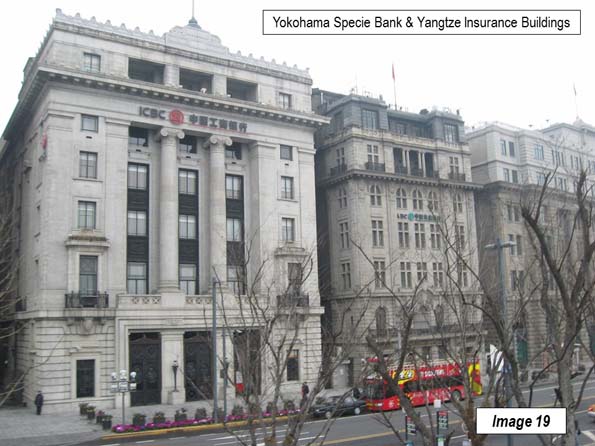
    Image 19: Yokohama Specie Bank and Yangtze Insurance buildings

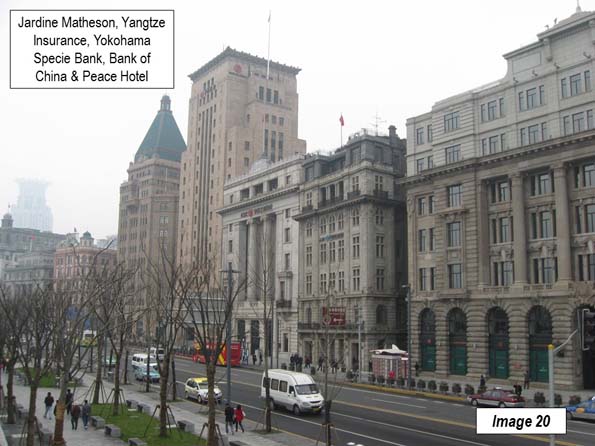
    Image 20: Jardine Matheson, Yangtze Insurance, Yokohama Specie Bank and Peace Hotel (north and south buildings). Jardine Matheson was an early trading company that got its start in Guanghou (Canton) and Hong Kong.

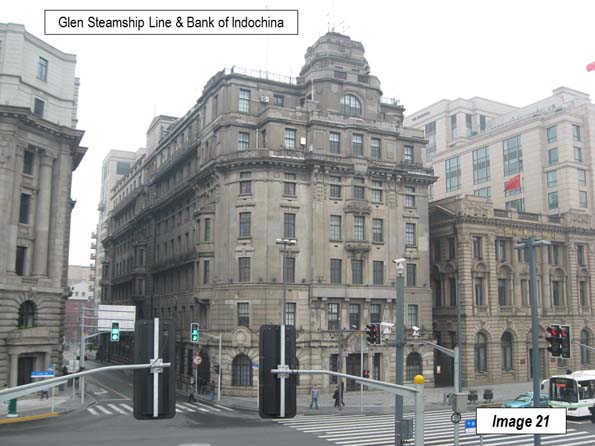
    Image 21: Glen Steamship Lines and Bank of Indochina

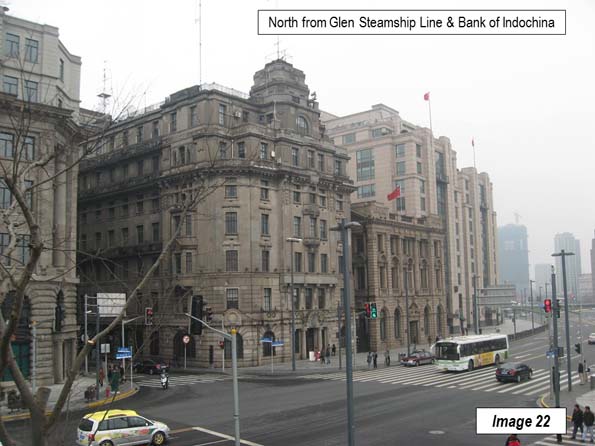
    Image 22: North end of the historic bund buildings on Zhongshan Road (Glen Steamship Lines and Bank of Indochina).

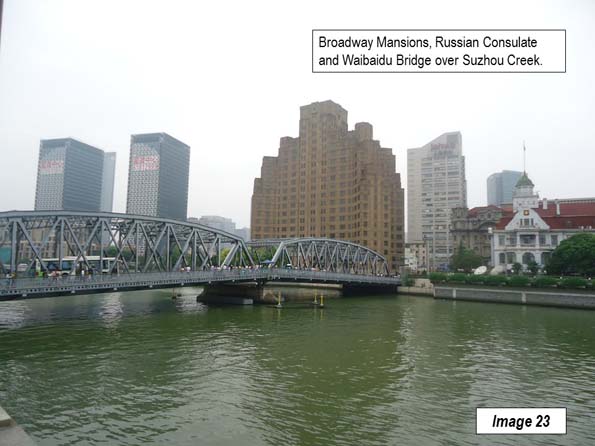
    Image 23: Waibaidu Bridge over Suzhou Creek, Broadway Mansions and Russian Consulate

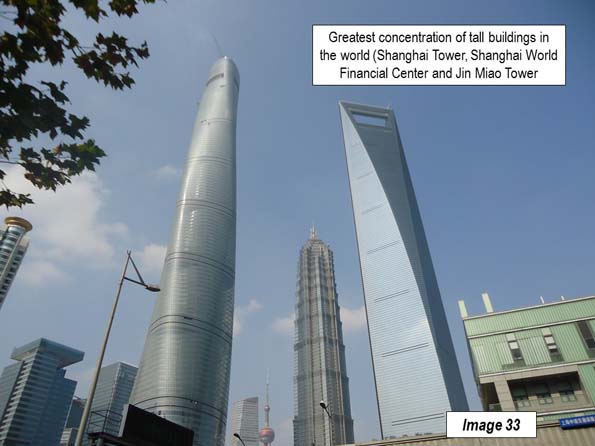
    Image 24: Central Bund, including HSBC, Customs House and North China Daily News buildings from the World Finance Centre. The Shanghai World Finance Center has an opening at the top and locals refer to it as the “bottle opener” for its resemblance (Image 33).

    Image 25: Northern Bund, including North China Daily News, Peace Hotel, Bank of China and Jardine Matheson Buildings from the Shanghai World Financial Tower.

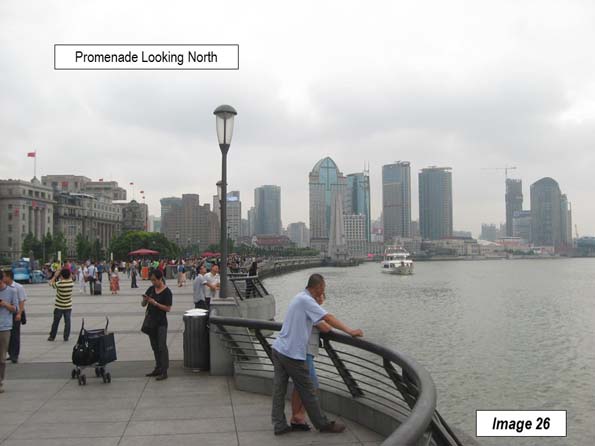
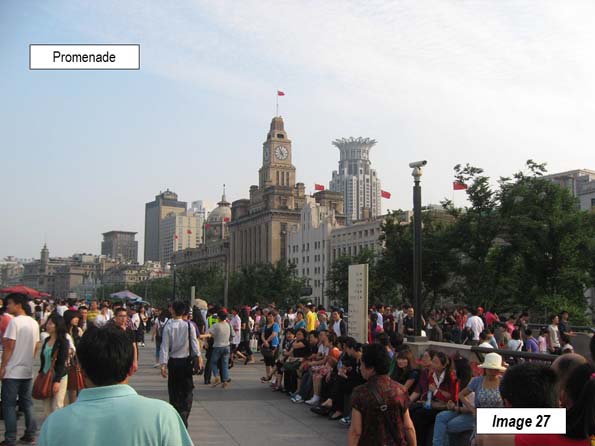
    Images 26 to 28: Promenade views

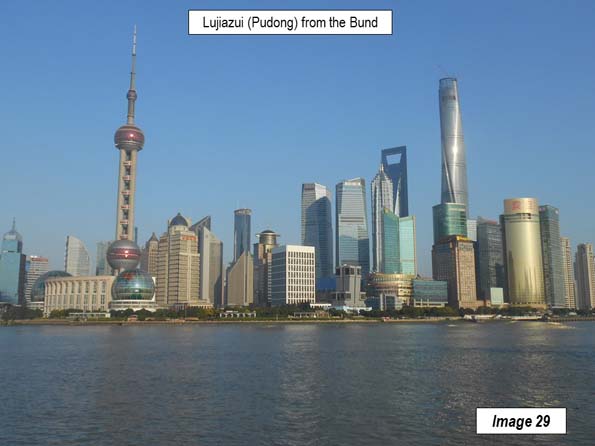
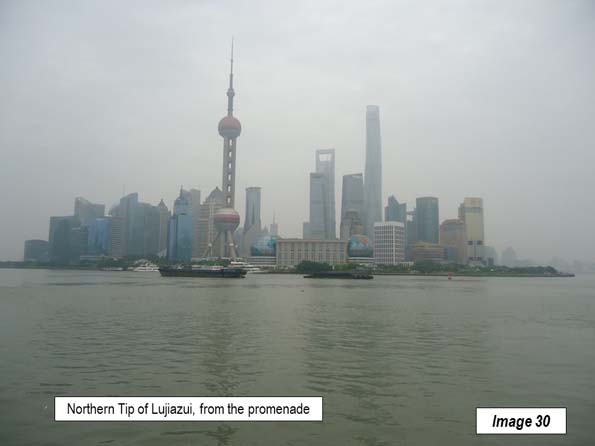
    Image 29: View of Pudong’s Lujiazui business district from the Bund promenade (across the Huang Pu). The Pearl of the Orient Tower is to the left. The tallest building, on the right, is the Shanghai Tower, second tallest building in the world (127 stories).

    Image 30: Northern tip of Lujiazui business district from the promenade

    There are a number of additional Western-style buildings that were a part of the International Settlement in Puxi. Many are on the East – West streets leading from Zhongshan Road as well as on some North – South streets, such as Sichuan Middle Road. Some buildings of the same era are located on Nanjing Road. The Park Hotel, located across the street from People’s Park was the tallest building in Asia when it was built in 1934 (Image 31), and may be the best known local hotel, along with the Peace Hotel, on the Bund.

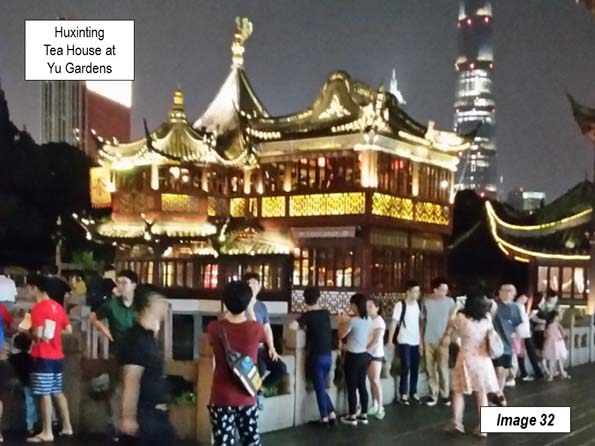
    The Bund is close to other interesting tourist areas. The Yu Garden dates to the 16th century and is the very architectural conception of China for some tourists. As Chinese as is its appearance, not much of Chinese cities looks like this. Yu Garden now hosts extensive shopping, as well as the Huxinting Teahouse (Image 32, at night).

    The Bund sightseeing tunnel provides a short rail service from East Beijing Road (across the street from the Bank of China) under the Huang Pu to Lujiazui, near the Pearl of the Orient Tower. From there overhead walkways provide access to Lujiazui skyscrapers, include the three tallest (Image 33), which are virtually across the street from one another. These include the Shanghai Tower (second tallest in the world), the Shanghai World Financial Center and the shortest, the Jin Miao Tower, which is taller than the Empire State Building in New York and nearly as tall as the Willis Tower (former Sears Tower), in Chicago, the tallest in the world for a quarter of a century.

    From here, it is a short walk to the ferry terminal for a short right to the south end of the Bund (Image 34), completing the circle tour that began with Image 2.

    Finally, the Bund promenade is also a very well designed urban space that has become one of Shanghai’s most important public meeting spaces. It is well appointed with places to sit, relax or read a book. Like Le Jardine du Luxembourg in Paris and New York’s Central Park, there are few places to better spend a Saturday afternoon.

    Photograph at Top: Central Bund (Hong Kong & Shanghai Bank and Customs House), by author

    Wendell Cox is principal of Demographia, an international public policy and demographics firm. He is a Senior Fellow of the Center for Opportunity Urbanism (US), Senior Fellow for Housing Affordability and Municipal Policy for the Frontier Centre for Public Policy (Canada), and a member of the Board of Advisors of the Center for Demographics and Policy at Chapman University (California). He is co-author of the "Demographia International Housing Affordability Survey" and author of "Demographia World Urban Areas" and "War on the Dream: How Anti-Sprawl Policy Threatens the Quality of Life." He was appointed to three terms on the Los Angeles County Transportation Commission, where he served with the leading city and county leadership as the only non-elected member. He served as a visiting professor at the Conservatoire National des Arts et Metiers, a national university in Paris.