Tag: China

  • A Tough Week for High Speed Rail

    The week ended April 16 was particularly difficult for high speed rail, as the following events illustrate.

    1. High Speed Rail Zeroed Out of US Budget: The US federal budget deal, which cut $38 billion from spending ($76 billion annualized) zeroed out the $2.5 billion 2011 budget allocation for high speed rail and $400 million of prior spending authority from President Obama’s "stimulus" program, that had provided $8 billion for high speed rail in 2009. Approximately $2 billion of that authority remains and applications total $10 billion, mostly for conventional intercity rail services, rather than genuine high speed rail service.

    2.  Missouri Legislators Block High Speed Rail: Members of the Senate Transportation Committee in Missouri refused to place high speed rail in the annual state budget. Governor Jay Nixon is seeking more than $1 billion for intercity out of the remaining $2 billion from the original Obama Administration $8 billion program. Governor Nixon indicates that he will try to get the money placed in the budget should the US Department of Transportation award a grant. Missouri joins Florida, Wisconsin and Ohio in taking actions to block funding for high speed rail projects. This reluctance is principally the result of concerns that high speed rail will incur significant cost overruns and require operating subsidies, all of which would have to be paid for by the states, which generally face serious financial difficulties.

    3. China Slows Down Trains: Safety, energy conservation and fare equity issues led the Ministry of Railways to announce a slow-down of its fastest trains to a maximum speed of 300 kilometers per hour (186 miles per hour). This could add materially to travel times, especially in the longer corridors being developed, which traverse the greatest distance of any in the world (such as Shanghai-Kunming, Shanghai-Beijing and Beijing-Hong Kong).

    4. Opposition to Britain’s HS2 Line Intensifies: Opposition continues to mount against Britain’s HS2 line from London to Manchester and Leeds. Protesters showed up at a Department of Transport event at Northampton Station intended to obtain views on the government’s plans. Lizzy Williams, chair of "Stop HS2" expressed concern that the government’s "consultation" was not objective and told only one side of the story, ignoring the difficulties (A video of Ms. Williams at an anti-HS2 convention is here). Opposition groups also plan a rally on May 8. Finally, it was reported that projected time savings on the line have been exaggerated by the government.

  • China Slowing World’s Fastest High Speed Rail

    The Wall Street Journal reports that China will slow down its world’s fastest high speed rail trains. According to the Journal, Sheng Guangzu, head of China’s Ministry of Railways, told the People’s Daily that the decision will make tickets more affordable and improve energy efficiency on the country’s high-speed railways. The maximum speed will be 300 kilometers per hour (186 miles per hour), which is also the top speed for most high speed rail trains in Japan, France, Korea and Taiwan. The United Press reported that the 300 kph service would be limited to the four north-south (Beijing to Harbin, Beijing to Shanghai, Beijing to Hong Kong and Shanghai to Shenzhen) and east-west lines (Qingdao to Taiyuan, Lanzhou to Xuzhou, Shanghai to Chengdu and Shanghai to Kunming). Both sources were unclear as to whether the new speed limit would apply to the proposed 380 kph Beijing to Shanghai line, however that line is one of the four north-south trunk routes, all of which will operate at the slower speed according to the Ministry of Railways.

    Currently, the world’s fastest high speed rail trains operate on the Guangzhou (South Station) to Wuhan route, which reaches 350 kilometers per hour on its fastest service (which stops in Changsha, the non-stop service having been cancelled), completing the run in 3:16. This lower speed could increase travel time on the route to between 3:30 and 3:45.

    The Journal cited a high-speed rail official (not Chinese) who indicated that there are safety concerns with trains running at above 320 kph. In contrast, the proposed California high speed rail line would operate at top speeds of 355 kph.

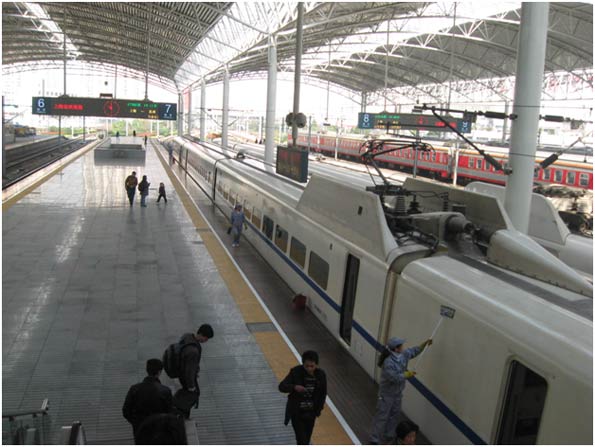
    Photo: Nanjing high speed rail train, Shanghai Station (by author)

  • China, Detroit, and Houston: How Ghost Properties Compare

    Learning about China’s property boom and its “ghost” cities has given me a whole new perspective on my four decades in the building, land development and consulting fields. During these periods our economy has had various ups and downs. In ‘up’ times, the rise in construction of new housing and growth in commercial developments has been quite obvious. What I have always had a problem understanding is why there seemed to be new housing projects and commercial projects that sprouted up during the bad times.

    Unlike this current recession — and I do believe that it is still current, despite the rhetoric that it’s over — past economic downturns were localized. As an example, I lived in Detroit in 1973 during the first gas crunch, when there were long lines to fill up. Unemployment in Detroit was a huge problem, and there was no work for a young ‘planner’ for new suburban developments, nor the prospect of anything turning around soon.

    I eventually decided to move to the south, where it was thought to be better. As I crossed into Texas, there weren’t any more gas lines. It seemed the entire State was booming. I drove through to Houston, picked up a phone book, and made a phone call to Paul Lederer Land Surveying and Engineering, which had a display ad that stuck out. Paul answered, and when I explained that I wanted to work as an apprentice to expand my knowledge into his field he hired me over the phone. I settled down, and after a year was ready to buy a home of my own.

    Detroit was still in economic hardship, with housing requiring a 20% down payment for a mortgage. At the same time, in Houston, homes were so much in demand that we had only minutes to make an offer once a home we wanted came on the market. Financing required only a 5% down payment.

    When a wealthy Detroit businessman heard that I could buy homes with only 5% down in a market that was escalating in sales and pricing I was offered a business proposition. I was asked to buy 50 homes at 5% down, and then resell them to a shell company for at least 10% more than our original purchase price. The homes would then be re-financed elsewhere with 5% down. The shell company would then default on the loans, and we would split the profits.

    In other words, if we paid an average of $30,000 each for 50 homes, we would have $1,500,000 in real estate, for which we had put $75,000 down. In theory, if I sold the homes to a shell company for $2,000,0000 with a $100,000 down payment, we would each walk away with $200,000 profit (roughly $790,000 in today’s dollars after inflation) if we defaulted on the loans. I was not interested in something that I considered fraud for a quick dollar, but it would not have been difficult to do this in real estate at that time.

    A few years later, Detroit was still in an economic downturn, and another person I knew was building large residential and commercial projects. These were new developments with hundreds of units and high-rise office towers.

    I mentioned to someone close to this developer that I was unimpressed with a venture to build at a time when there was not a market for either condominium buyers or office tenants, and curious as to why it was being pursued. A 20 story office tower would impress me if it were leased out; one sitting empty would not be so impressive.

    The answer was a lesson in economics. It was explained to me that the office tower was built for $10 million, but financed for $20 million, made possible by some inventive appraisals. Yet the bank needed only $1 million down. In other words, if the developments failed spectacularly there were still millions to be made, even if the properties went back to the banks. Ironically, Detroit in the late 1970’s and early 1980’s recovered somewhat, and the developments in question became financially viable and successful.

    I have no doubt that every industry, not just the development of land, has stories of financial shenanigans, but these are two examples of only a few that I have been exposed to during my 43 years in the development business.

    So today, whenever I see areas with aggressive construction that exceeds market potential, it makes me wonder…

    In light of this history, see what you think about development in China. Check out this 15 minute video from a major Australian broadcaster on China’s ghost cities.

    Rick Harrison is President of Rick Harrison Site Design Studio and Neighborhood Innovations, LLC. He is author of Prefurbia: Reinventing The Suburbs From Disdainable To Sustainable and creator of Performance Planning System. His websites are rhsdplanning.com and performanceplanningsystem.com.

    Photo: Expensive waterside apartments in Shekou Shenzhen by DC Master.

  • Zhengzhou Ghost City Alive!

    Zhengzhou, Henan, China (March 28, 2011): In December, London’s Daily Mail reported that the Zhengzhou New Area was China’s largest “Ghost City.” A visit to the Zhengzhou New Area indicates exactly the opposite. Chinese “Ghost Cities” are large areas of new development that are virtually unoccupied. The most famous example is Ordos, a new and reportedly empty city, built to replace an older city in Inner Mongolia.

    Zhenghou is an urban area of approximately 2.5 million population and is the capital of Henan province. The Zhengzhou New Area is located in the northeastern quadrant of Zhengzhou. It is circular in design, with two parallel roads, high-rise condominium buildings on the inner ring and commercial buildings on the outer ring. The interior of the circle includes the Henan Arts Center and a skyscraper that is under construction. A new high speed rail station is under construction to serve the new Guangzhou to Beijing line. The station is to be one of the largest in Asia.

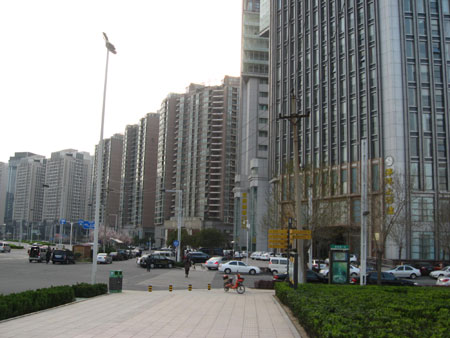
    Our visit revealed anything but a Ghost City. Granted, no-one would mistake the traffic for Beijing Third Ring Road volumes, but virtually all of the parking spaces were taken and there was traffic on the streets (Figure 1). That ultimate indicator of Chinese urbanization, the availability of frequent taxicab service was well in evidence. Two of the city’s bus rapid transit lines serve the interior circle road, again indicating a substantial threshold of non-ghost urbanization.

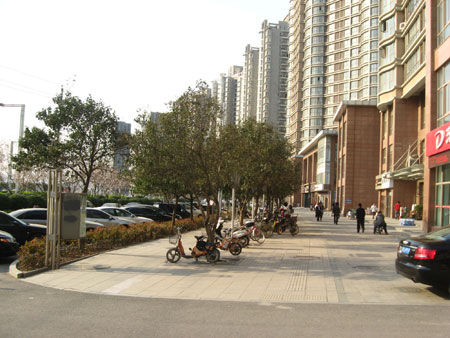
    There were people on the sidewalks, though not the numbers typical of an older, more dense section of a Chinese urban area (Figure 2). It was clear from the laundry hanging in glass enclosed patios that many of the condominiums were occupied, though it is to be expected that many would not be, given the Chinese propensity to invest in multiple residential properties (a tendency the central government seeks to curb). Many of the commercial skyscrapers were occupied, and some were still under construction. There are also shopping centers, small stores and fast food restaurants.

    Zhengzhou New Area is intended by the developers to become the new central business district for Zhengzhou. There is much more planned than this first phase. Eventually, the Zhengzhou New Area is intended to cover 105 square kilometers (41 square miles), generally further to the northeast. City maps already show the planned street pattern, not unlike 19th century maps of some US cities.

    In short, the Zhengzhou New Area is alive and not a Ghost City. It may well be that it took longer than expected for the place to come alive. But it is clear that the life of the Zhengzhou New Area began more than four months ago.

  • Are Chinese Ready to Rent?

    In 2010 “House price” ranked third on the list of the top 10 most popular phrases used by Chinese netizens. It came to no one’s surprise. In most Chinese cities housing prices have increased significantly over the past decade, with an especially sharp rise over the past three years.

    “House Price” is a term used loosely, due to the fact that the vast majority of Chinese real estate is made up of apartments or condominiums, while only a small few are town houses or fully detached homes. However, terminology aside, owning a property is the greatest life-goal for most Chinese citizens.

    It is worth mentioning that in China property ownership does not mean land ownership as it does in the West. According to Chinese law, what people are buying is similar to a land-use right, which in the case of residential property, expires after 70 years (40 years for commercial property). The countdown begins on the date that the real estate developer signs for the land, and not on the homeowner’s date of purchase.

    So why do Chinese people have such zest for real estate?

    Different from the western mentality: “Home is where your heart is” or “home is where you hang your hat;” the traditional Chinese concept is: “home is where your house is.”

    Prior to the 1980s, people still followed the custom of living with their parents after getting married. It was not uncommon to see a three-generation family living together in a single home. At that time renting was unheard of, as most apartments, if needed, were provided for free to a person or family by their employer, typically a state-owned entity.

    With China’s transformation from a strictly planned economy to a market economy, many state-owned companies became limited companies which restricted    free housing provision. However, employees were given the option of buying their current residences at a very low price, and most people did.

    Increasingly today, when a young couple gets married , both sets of parents make their utmost effort to help their children purchase a home. For many young people who do not live in their original hometown, it is  essential that they buy a property in the city where they work, as that is the easiest way for them to obtain a local hukou (urban residence permit). Without this, they cannot enjoy the same rights and social benefits as the locals. 

    People in China refer to the demand from young couples as “rigid demand,” meaning they must bear the social pressure to purchase a house before they can get married.

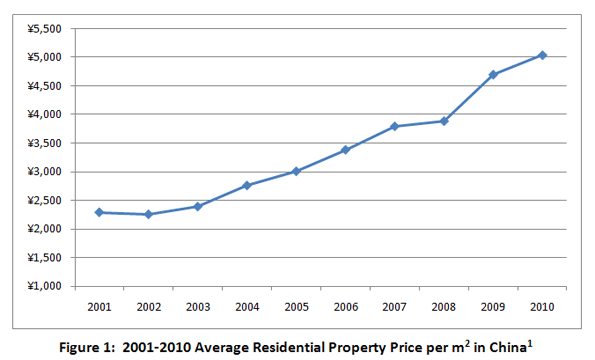
    For middle-aged Chinese, buying a house is seen as a relatively simple and secure investment, because as indicated in Figure 1, housing prices have increased steadily over the past decade.

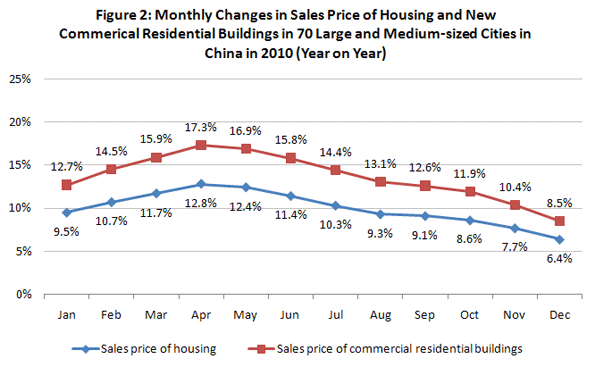
    This may now be getting out hand and the Chinese government has identified housing prices as a serious national issue. Some macro restrictive policies on home buying were issued in April 2010. Figures issued by the National Statistical Bureau, Figure 2, prove these restrictive policies did relieve somewhat the rate of house price increase.

    Immediately following the New Year, the Chinese central government announced that its top priority for 2011 would be controlling inflation. Shortly afterwards, a more stringent policy designed to limit speculation was issued on January 26th, 2011. Subsequently, each city issued its own policies based on this, with Shanghai and Chongqing, two Zhixiashi (provincial level municipalities administrated directly under the central government) taking the lead.

    Shanghai issued the following policies on February 1st, 2011.

    1. Any household purchasing a second home must provide a 60% down payment on a mortgage; and the interest rate on the mortgage will be 110% of the benchmark rate.
    2. From the publication date of this policy, households who already own one house will only be allowed to purchase one additional home.
    3. From the publication date of this policy, households who already own two or more houses will not be allowed to purchase any additional homes.
    4. Individuals selling a home less than five years since the date of purchase will be charged an additional sales tax of 5.5% of the full sales price.

    Many more cities followed in step, and announced their own sets of policies in the following weeks.

    Only one month after these policies came into effect, it is difficult to determine their effectiveness as house prices are still increasing compared with last year, although rate of change has dropped.

    The steady price has led to a renewal of interest in rented public housing. Chongqing became the first city to respond to the central government’s call with plans to build 40 million square meters  in public-rent housing units, which will provide accommodation to 1-2 million people within the next three years and to 800,000 families by 2015. In total, Chongqing will invest 120 billion RMB (18.3 billion USD) on public-rent housing construction.

    By 2012, Chongqing will also grant the urban hukou to 3 million farmers (10 million by 2020) with rural Hukou. In exchange, these farmers will give up their agricultural land, most of which will be developed into public-rent apartments.

    Who will be eligible to apply for public-rent housing?

    Chongqing’s criteria are as follows:

    1. Applicants must be over 18 years of age.
    2. Applicants must have a job which provides steady income.
    3. Monthly income must be under 2000 RMB (305 USD) for individuals and 3000 RMB (457 USD) for families. (These two numbers will fluctuate according to other economic index changes.)
    4. Families must not already have housing or have housing in which the average space per family member is lower than 13m2.

    One thing worth pointing out is that there is no hukou limit for public-rent housing applications, which means that citizens from other cities are equally qualified. All eligible applications will be placed into a lottery and public-rent apartment allocations will go to the lottery winners.

    These public-rent apartments range from 39m2 or 420 square feet (1 bedroom, 1 living room) to 53 m2 or 570 square feet (2 bedrooms, 1 living room) with the corresponding monthly rent around 390 to 530 RMB (59 to 81 USD). When you consider that the current average price of residential property per square meter in Chongqing is 5700 RMB (868 USD), that means a person could rent a 53 m2 apartment for 47.5 years before paying the equivalent cost of purchasing an apartment of the same size.

    Following suit, many other cities in China have also started to construct public-rent apartments.

    Are all the problems solved?

    Certainly this can help most lower-income citizens to find a place to live, but there are other problems. Tenants in China are not protected by laws that uphold renter’s rights as in the west. This is largely due to the fact that there are few apartment buildings owned by a single company or person. Citizens can only rent directly from home-owners with virtually no regulatory controls over the personal renting market.  Long-term leasing contracts are nearly impossible to negotiate, and landlords are able to demand large increases in rent, or even eviction at a whim. This means that renters have no stability, and usually have to face the difficulty of moving frequently.

    More buildings designed specifically for renting, and regulations protecting both tenants and home-owners are desperately needed.

    China has a long way to go when it comes to providing accommodation for its 1.3 billion citizens. Although one clear problem lies with the resources to construct the ”hardware”, this country’s development cannot continue without also upgrading its “software”: people’s way of thinking. In this case, that means convincing people to accept the idea of renting, reversing centuries of preference for ownership.

    Lisa Gu is a 26-year old Chinese national. She grew up in Yangzhou (Jiangsu) and lives and works in Nanjing (Jiangsu).

    Photo by Charles Ryan

  • A Leg Up: World’s Largest Cities No Longer Homes of Upward Mobility

    Throughout much of history, cities have served as incubators for upward mobility. A great city, wrote René Descartes in the 17th century, was “an inventory of the possible,” a place where people could lift their families out of poverty and create new futures. In his time, Amsterdam was that city, not just for ambitious Dutch peasants and artisans but for people from all over Europe. Today, many of the world’s largest cities, in both the developed and the developing world, are failing to serve this aspirational function.

    Though leading urban theorists love to celebrate the most rarified parts of the city economy—Saskia Sassen refers to “urban glamour zones” that thrive in what New York Mayor Michael Bloomberg proudly calls the “luxury city”—they tend to forget about working- and middle-class residents. Unfortunately, these urban ideas appear to be contagious, as they’re being applied to the expanding cities of Asia and other developing regions. A recent World Bank report argued that large urban concentrations—the denser, the better—are the most prodigious creators of opportunity and wealth. “To spread out economic growth,” the report claimed, is to discourage it.

    A closer look, however, suggests a more nuanced reality. Cities in the developing world are growing, but largely because they’re the only alternative to poverty and even starvation in the countryside. These cities are not only failing to provide opportunities for upward mobility; they’re producing the class inequalities found in “luxury cities” such as London and New York.

    Once rigidly egalitarian, China now has some of the world’s highest rates of income inequality. The central cores of Beijing and Shanghai employ legions of well-paid European and American architects and planners, but few concern themselves with the camps inhabited by poor, often temporary workers, who constitute roughly one-fifth of the population and live in conditions more reminiscent of a Brazilian favela than an “urban glamour zone.”

    This same stratification is also happening in India. Mumbai, one of the fastest-growing cities, is creating wealth at the top of the economic spectrum but leaving millions of others scrambling for mere subsistence. The New York–based author Suketu Mehta has described his hometown of Mumbai (formerly known as Bombay) as “an urban catastrophe,” an example of the mounting woes of rapidly expanding cities in the developing world. “Bombay is the future of urban civilization on the planet,” he wrote. “God help us.”

    A majority of Mumbai’s population now lives in slums, up from one-sixth in 1971—a statistic that reflects a lack of decent affordable housing, even for those gainfully employed. Congested, overcrowded, and polluted, Mumbai has become a difficult place to live. The life expectancy of a Mumbaikar is now seven years shorter than an average Indian’s, a remarkable statistic in a country still populated by poor villagers with little or no access to health care.

    In spite of World Bank proclamations, the most rapid urban growth in India is actually occurring in smaller, less dense cities, such as Bangalore and Ahmedabad, places with lower living costs and more business friendly governments. This mirrors a trend occurring in the United States. In the last decade, middle-income people have been moving out of our megacities. Between 2000 and 2008, according to the demographer Wendell Cox, regions of more than ten million people suffered a 10 percent rate of net domestic out-migration. (Often the only reason for population growth in these cities was immigration.) The big gainers were cities between 100,000 and 2.5 million residents: the business-friendly Texas cities Dallas, Houston, and San Antonio; Raleigh and Durham, North Carolina, which now form the fastest-growing metro area in the nation; and the heartland cities of Columbus, Indianapolis, Des Moines, Omaha, Sioux Falls, and Fargo.

    One reason for this movement has been the shift of jobs away from the coasts to lower-cost, less dense cities. The fastest growth in middle-income jobs has been concentrated in many of the places listed above: Houston, Dallas, Austin, Raleigh-Durham, and Salt Lake City. This pattern also includes high-tech, science-oriented employment. In contrast, those jobs have been stagnant or shrinking in such cities as New York, Los Angeles, San Francisco, and Chicago.

    As a result, America’s largest cities are increasingly divided into three classes: the affluent, the poor, and the nomadic class of young people who generally come to the city for a relatively brief period and then leave. New York, the aspirational city of my grandparents, now has the smallest share of middle-income families in the nation, according to a recent Brookings Institution study, with Los Angeles and San Francisco not far behind. In 1980 Manhattan, New York’s wealthiest borough, ranked 17th among U.S. counties for social inequality; by 2007 Bloomberg’s “luxury city” was first, with the top fifth earning 52 times the income of the lowest fifth, a disparity roughly comparable to that of Namibia.

    Similar patterns can be found in Europe, despite its countries’ more developed welfare states. The U.K. has witnessed a relentless centralization of urban functions in London, as once proud cities such as Manchester, Liverpool, Glasgow, and Birmingham have continued their long slide into obscurity and irrelevance. The bulk of London’s growth, however, has not taken place in the central core but in what the historian James Heartfield calls “the greater southeast.” This vast “conurbation” stretches from west of Heathrow Airport to the booming coastal city of Brighton, roughly an hour’s train ride from the“ city center.

    As the middle class has decamped, central London has become more stratified. Residents and workers there and in the West End account for some of the most concentrated wealth on the planet. At the same time, prospects for London’s middle class have weakened, with many fleeing to the suburbs or even leaving the country. (Britain remains a large exporter of educated workers to the rest of the world.) The major issue here is the high cost of housing. Even in its poorest neighborhoods, London now ranks as one of the most unaffordable places for middle-income people to buy a home.

    Still, life is much tougher for the city’s poor, many of whom live less than an hour’s walk from the wealthiest neighborhoods. Take a stroll just a mile or two from the Thames and you enter a very different London. It is here where you’ll see why the financial capital of the European Union also has the highest incidence of child poverty in Great Britain (more even than in the beleaguered North East). Thirty-six percent of children in London live in poverty, a figure that rises to more than one-half when the city’s housing costs are factored in.

    The same split has emerged in other countries considered far more open than class stratified Britain. A recent University of Toronto study found that between 1970 and 2001, the portion of middle-income neighborhoods in the city had dropped from two-thirds to one-third; poor districts had more than doubled to 40 percent. By 2020, middle-class neighborhoods could fall to less than 10 percent, with the balance made up of poor and affluent residents.

    Much the same can be seen in continental Europe, a trend greatly exacerbated by the growth of immigration. Unlike Amsterdam in Descartes’s time, Europe’s great cities are failing in their historic mission of incorporating newcomers, as German Chancellor Angela Merkel recently conceded. In Berlin, one fourth of the workforce earns less than 900 euros a month, while 36 percent of children are poor. The city once known as “Red Berlin” has emerged as “the capital of poverty and the ‘working poor’ in Germany,” Emma Bode, a left-wing journalist, wrote in 2008.

    Given these global realities, it might be time for our urban boosters to curb their enthusiasm for the “luxury city” and refocus on how to meet the aspirations of their middle- and working-class residents. If they don’t, lack of opportunity will drive more and more of this crucial aspirational class farther and farther away, mostly to smaller cities and suburbs that still offer “an inventory of the possible.”

    This piece originally appeared in Metropolis Magazine.

    Joel Kotkin is executive editor of NewGeography.com and is a distinguished presidential fellow in urban futures at Chapman University, and an adjunct fellow of the Legatum Institute in London. He is author of The City: A Global History. His newest book is The Next Hundred Million: America in 2050, released in February, 2010.

    Photo by Premshree Pillai
  • China Housing Market More Stable Than You May Think

    The sensationalist reporting of rising China tends to celebrate the country’s ascent. But there is one area where both economists and casual observers see a potential disaster: the real estate market.  Media reports of skyrocketing housing prices in first tier cities like Beijing and Shanghai and photo essays of Chinese ‘ghost cities’ inject sober skepticism into the otherwise bewildering reality of rapid growth.

    The claims about real estate, however, are as exaggerated as the breathless accounts of the country’s path towards world economic domination. It is absurd to argue that all it will take for China to fall would be a bust in the housing market. In reality, the country has too many economic fundamentals working for this one sector to wreak too much havoc.   

    Above everything, China remains a manufacturing powerhouse, providing the developed world with everything from children’s toys and athletic shoes to iPads and other electronic devices. Yes, the Great Recession did have a negative impact on China’s export business; this is why the Central Government took steps to direct massive amounts stimulus money towards infrastructure and real estate development.

    Far from being limited by exports, China is just beginning to unleash the power of its domestic consumer market. Imported goods (in reality, foreign brands, even if they are manufactured within China) are highly taxed, encouraging Chinese consumers to spend money on cheaper, local brands, thus keeping the money supply circulating through the domestic market.

    Yet this does leave China somewhat subject to real estate speculation. With   limited channels for investment, a risky domestic stock market, and little-to-no interest accrued by holding money in Chinese bank savings accounts, there is, for many individuals, nowhere else to spend their money but in the housing market.

    There are a few other forces at work here as well. Since the Chinese government still technically owns all of the land in the country, real estate developers are given the right to develop land based on a bidding process, with the rights going to the highest bidder. Auctioning of land for development typically happens at the municipal level. Once a developer is awarded the right to develop a piece of land, there is a time limit (usually no more than a few years) before it returns to the hands of the government.

    The purpose of this is two-fold: one is to manage the urban influx of new migrants and also to discourage land speculation by developers. As you can imagine, savvy developers often wait until the last minute to build a project to get the maximum profits from their projects.

    Since income taxes are low by international standards (and easily evaded through the preponderance of ‘grey money’ or hidden income) and property taxes are virtually nonexistent (up until recently at least), land auctioning is by far the largest source of income for local governments. This becomes the main way these governments fund infrastructure and public works projects.

    This same process is happening in cities across China. Why? Quite simply, the demand is there. The booming housing market is a revolution of sorts. This is really the reflection of the emergence of a true Chinese middle-class. The U.S. media, on the other hand, tends to remain focused on a massive China real estate bubble, perhaps as a projection of America’s own recent experience of real estate exuberance.

    Yet there are some major differences. For example, few Chinese purchase homes with little or no money down. Banks are not lending ‘creative mortgages’ such as ARMs to homebuyers. Government measures seek to discourage speculation.

    For instance, Chinese home buyers are limited to purchasing 2 homes and must put at least 30% down for the first home and 60% down for the second home. Investment by foreigners into the real estate market is strictly regulated in order to reduce the amount of ‘hot money’ coming into the country. Non-Chinese citizens are limited to purchase one home only and must hold onto it for 5 years before being allowed to resell it.

    Due to the massive size of China’s population, the majority of homes being purchased are flats in newly-built residential high-rise compounds. The size of these units might be a little too cozy for Americans or even Europeans, but to young Chinese homebuyers (of which most are first-time buyers), it represents an aspiration unimaginable only a few years ago.

    Take 26 year old Mei Li for example: late last year she, an administrative assistant at a construction company, and her husband, an IT professional, bought a home in the fast growing western district of Chengdu, between the 2nd and 3rd Ring Roads. The young couple put a 30% down payment on a 2-bedroom, 80 m² (860 ft²) flat on the 23rd floor of a tower that is part of a brand new residential development.

    At RMB 7,500/m², the total cost of their flat was RMB 600,000 (about $91,000 USD). As required, and with some help from their parents, Ms. Li and her husband put a down payment of 30%, or RMB 180,000, and qualified for a 30-year, 6% fixed-interest home loan from Bank of China. With a combined income ranging from about RMB 8,000-10,000 ($1,200 USD – $1,500 USD) per month, their monthly mortgage payment of RMB 2,500 ($380 USD) is easily manageable.

    Ms. Li and her husband are glad they got in when they did. Even though their new unit won’t be ready for move-in until the end of this year, they have already seen the value of their investment increase by 10%. Located adjacent to a planned stop for an underground metro line currently under construction, the value of their investment is bound to further increase due to its convenient access to public transportation. In the future, taking the subway will be just one of their transportation options as Ms. Li and her husband plan to buy their first car by the end of this year.

    Multiply Mei Li and her husband’s story by the millions and you have a better idea of what is really behind the China housing boom. To be sure, speculation certainly exists, but predominately it is middle-class aspiration that is fueling urbanization.

    In Chinese, the word for ‘family’ and ‘home’ are the same: jia (家). The family is the critical unit of Chinese culture, making ownership of a home a critical priority. For the world, middle-class home-ownership also promotes peace and stability in China, providing the basis for the evolution of a more consumer oriented, less predatory Chinese economy.

    Adam Nathaniel Mayer is an American architectural design professional currently living in China. In addition to his job designing buildings he writes the China Urban Development Blog.

  • Mega-City Semantics in China’s Pearl River Delta

    Recently an article ran in The Telegraph about China ‘creating the largest mega-city in the world with 42 million people‘. The title of the piece is a bit misleading as the government is not planning a new city per se, but rather combining a group of nearby cities into one huge ‘mega-city’. The targeted group of cities makes up the Pearl River Delta region in China’s southern Guangdong Province.

    Home to China’s famous first tier cities Guangzhou and Shenzhen, the Pearl River Delta is already one of the most populated places on earth. It is the manufacturing powerhouse of the country, thanks in large part to it being the first economically liberalized region after Reform and Opening Up. As a result of this, the Pearl River Delta has absorbed ambitious migrants from all over China for the better part of three decades.

    In addition to Guangzhou and Shenzhen, the proposal calls for integrating smaller (albeit still in the millions population-wise) cities of Donggaun, Foshan, Huizhou, Zhaoqing, Jiangmen, Zhongshan and Zhuhai into one. Upon first reading, the proposal doesn’t make much sense as the Pearl River Delta region has done an excellent job already of linking transportation and infrastructure among its different cities- so why the need to amalgamate into one city?

    Yet the intention of the integration becomes clear when Ma Xiangming, the chief planner at the Guangdong Rural and Urban Planning Institute, articulates that:

    “The idea is that when the cities are integrated, the residents can travel around freely and use the health care and other facilities in the different areas.“

    This is the key. The Chinese government still enforces the hukou household registration system for its citizens, making it difficult for people who move from one city to another to use the services offered by their new city. Restrictions for migrants to new cities are not only limited to healthcare and educational services, but to investment opportunities as well such as starting a business or purchasing a new home.

    By amalgamating the cities of the Pearl River Delta into one ‘mega-city’, this gets rid of the bureaucratic restrictions of the hukou registration. Now, the migrants who have left their native homes and settled in the Pearl River Delta can move more freely around the region. This is much more than semantics, it is a huge step forward in the liberalization of movement and opportunity for its citizens. It is unbelievable that The Guardian piece makes no mention of the significance of this development.

    UPDATE:

    Now there are reports that the story of the Pearl River Delta mega-city is false. According to an AFP report, China denies plan to create world’s biggest city.

    The error made by the original Telegraph article is most likely due to a misunderstanding by the reporters. As I mentioned above, the title was highly misleading, nothing more than a sensational headline designed to get reader attention. And the consultants quoted in the original article are city planners, professionals whose job it is to make recommendations on how to go about development, not the final decision makers who approve projects.

    The fact that the Pearl River Delta is not going to become one ‘mega-city’ doesn’t necessarily take away from the interest in integrating the region, making it a place where services are shared and the ease of mobility between its cities is increased.

  • Gifting China

    Listening to public radio, the host was interviewing a college professor as to why China has brought more innovation and progress in many areas of its growth, leaving other countries behind. In particular they mentioned high speed rail, low energy vehicles, and construction. The entire show was based solely upon how China’s universities educate differently than America, as if somehow a graduate student would suddenly posses the knowledge, experience, and drive to make major changes in transportation, science, design, and construction.

    When I hire American college students either as interns or graduates, what they have learned has little practical application as to the tasks that my business needs. Thus, we need to educate them on design (land surveying, civil engineering, planning and architecture), presentation techniques and the latest technology. What students do posses is a strong desire to make a difference in the world. I’m sure it is similar in China.

    China has made explosive progress by the process required of American companies who must comply with their restrictions to do business in their country. Let me explain:

    About 4 years ago we looked into designing neighborhoods in China. What we discovered is that an American company cannot do business directly in China. Instead of working directly, we would be required to enter into a partnership with an existing consulting firm in China. There is a problem with that requirement. If I would pursue business in China, I’d have to partner with a firm that did not have our talent, methods, or technologies we possessed. To work with an unknown firm would require us to share information that would have been exclusive to our firm, essentially training them in the strengths we took so long to accumulate. I figured that this would be a quick (and cheap) way their government could force American businesses to train their companies in our methods, and in most cases our advancements.

    Why would a company with a competitive edge want to provide privileged information to gain business? What is there to prevent that “partnering” business to break off relationships once they drain the knowledge base? Certainly they do not hire us because we have a larger workforce.

    American progress has been fostered by questioning why. Why is something being done this way? How can we make it better? This leads to innovation. Innovation was a major reason our country progressed more aggressively compared to countries that teach their students to think in only one way. China could see us as a knowledge base to farm information from our corporations wanting China’s riches.

    China seems to present an image of more progress. By forcing partnerships to do business in China we may have taught their corporations our best secrets. “We” being not just the United States, but every other country with their top designers, scientists, and technologies sharing knowledge.

    Once they have this knowledge and know-how, why would they need us? That is the foundational problem, and one reason I have not pursued work in China.

    The American way is innovation – something which I’ve seen little of in the development of our land and the building of our housing by the largest of American corporations. We should be going back to the drawing boards to accelerate American innovation and technology, and this time, not hand over this competitive edge so easily.

  • China Expressway System to Exceed US Interstates

    This should be the year that China’s intercity expressway system exceeds the length of the US interstate highway system. China’s expressways are fully grade separated, freeway standard roadways, but unlike most interstate highways, have tolls.

    The China Ministry of Transport indicates that, as of the end of 2010, China had 46,000 miles (74,000 kilometers) of expressways. Currently, the expressways of China have a total length about 1,000 miles (1,600 kilometers) less than that of the US interstate highway system. In the last year, 5,500 miles (9,000 kilometers) of new expressways were completed. If that construction rate continues, China’s expressway system would exceed the interstate system length late in the first quarter of 2011.

    By 2020, China expects to have 53,000 miles (85,000 kilometers) of expressways. This compares to the US total of approximately 57,000 miles (92,000 kilometers), including non-interstate freeways. However, the China expressway mileage does not include the expressways administered by provincial level governments, such as in Beijing (with its five expressway ring roads), the extensive system of Shanghai and the expressways of Hong Kong. No data is readily available for the lengths of these roads.

    Now it is possible to travel, uninterrupted (except for traffic jams in the vicinity of the largest urban areas), from north to south from near the Russian border, north of Harbin (in Heilongjiang or Manchuria) to near the resort island of Hainan, well south of Guangzhou, Hong Kong and the Pearl River Delta and not far from the border with Viet Nam. This is a total distance of 2,700 miles (4,400 kilometers).

    East to west travel without signals is now possible from Shanghai to near the Myanmar (Burma) border, beyond Kunming, a distance of 1,800 miles (3,000 kilometers). In the longer run, it will be possible to travel from the Russian border in Manchuria to the border of Kazakhstan in Xinjiang, a distance of 3,500 miles (5,700 kilometers).

    The expressway system is indicated in the map below. The blue the routes have been opened and the red routes are yet to be completed.