Tag: China

  • China: Two Modernizations (Decentralization and Living Away from the Job)

    American and European planners have long sought to improve the “jobs-housing” balance, seeking to place residents and jobs within walking or cycling distance. Of course, planners don’t place people anywhere. Not surprisingly, their efforts have largely failed, from the new towns of the London area, where people travel about as far to work as anywhere else, to fabled failures of Stockholm, where high rise housing close to suburban employment centers now houses migrants who tend to have far lower incomes than native Swedes.

    In the time of Mao Zedong, China had achieved perhaps the ultimate in the jobs-housing balance. Companies provided housing for their workers, who were able to walk to their jobs in the same compound. However, the economic reforms instituted by Deng Xiaoping and his successors has led to an abandonment of this model (Danwei housing) and millions of Chinese households have been lifted out of poverty into affluence. Most Chinese households do not aspire to “living on top” of the factory or office.

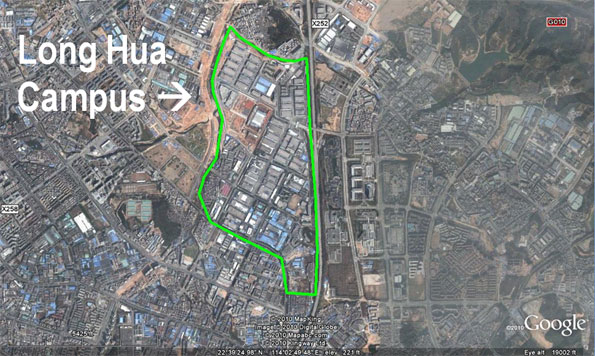
    Foxconn (Hon Hai Precision Industry), one of the world’s largest companies, is among the last to provide large amounts of housing to its workers. In its Shenzhen “Long Hua Campus,” which covers only one square mile, Foxconn employs 450,000 people (Figure). They are housed on the campus or nearby in company provided units.

    Shenzhen directly borders Hong Kong and Dongguan, which borders the Guangzhou-Foshan urban area. All together, these contiguous Pearl River Delta urban areas, along with others down the western shore to Macao have nearly 50 million people, more than live in any geographic area of the same size anywhere else in the world. These Guangdong province urban areas, along with the special economic regions of Hong Kong and Macau have become one of the world’s leading manufacturing and export areas. Shenzhen itself has been estimated to have a population of between 10 million and 15 million, depending on how the migrant workers are estimated. Shenzhen and other major manufacturing centers of China are estimated to house as many as 200 millions migrants from other parts of China (especially rural areas), coming to work in jobs that pay far higher wages than can be earned at home.

    Foxconn itself is the world’s largest manufacturer of consumer electronic technology, producing Apple’s I-Pod and I-Phone and making products for Dell, Hewlett-Packard, Sony, as well as the Nintendo, Wii entertainment systems.

    According to a report in The Wall Street Journal, Foxconn has plans to abandon its Danwei housing and move away from its “perfect” jobs-housing balance to the spatial arrangements that Chinese, Americans and Europeans routinely choose — to work where they like and live where they like.

    Foxconn has had its share of difficulties. There have been the multiple employee suicides at the Long Hua Campus. The company has faced rising costs in its Pearl River Delta operations, including higher wage costs. In its attempt to retain competitiveness, Foxconn is seriously rethinking its business model and appears likely not only get out of the housing business, but will also move many of its operations into central and western China, where costs and wages are lower. This also makes sense in relation to government policy, which seeks to develop the center and west.

    Overall, Taiwan headquartered Foxconn employs 920,000 people in China, the equivalent of the entire work force in the Portland or Kansas City metropolitan areas.

    Foxconn plans to increase its workforce in China from 920,000 to 1,300,000 and intends for many of its employees to be in new facilities in places like Chengdu (capital of Sichuan), Wuhan (capital of Hubei), Zhengzhou (capital of Henan) and Chongqing (capital of the provincial level Chongqing municipality). Foxconn’s decentralization, and the location of other new and expanded businesses in the center and west is strongly supported by China’s substantial infrastructure investment. The nation already has more than 40,000 miles of interstate equivalent highways. When all of the gaps are completed, trucks will be able to reach east coast ports from Zhengzhou or Wuhan in about days drive and little more than two days from Chongqing and Chengdu.

    At the same time, corporate executives can get to Beijing, Shanghai and the Pearl River Delta and other East Coast urban areas in 2.5 hours or less through some of the world’s most modern airports.

    Finally, the more decentralized operations will allow the migrant workers to live much closer to their homes, rather than having to travel all the way to the East Coast. This will make more frequent visits to rural villages and families possible.

    —-

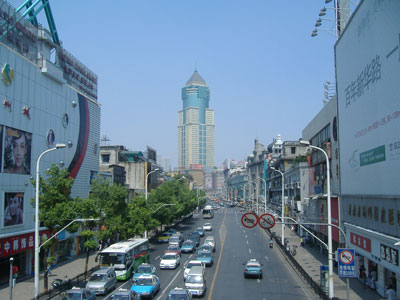
    Photo: Wuhan (photo by author)

  • What’s Behind China’s Big Traffic Jam

    The world press has been fixated on the “Beijing” traffic jam that lasted for nearly two weeks. There is a potential lesson here for the United States, which is that if traffic is allowed to far exceed roadway capacity, unprecedented traffic jams can occur.

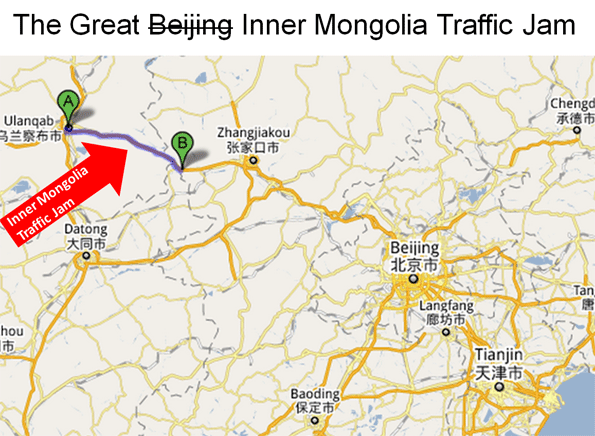
    The Inner Mongolia Traffic Jam: First we need to understand that this was not a “Beijing” traffic jam at all,or even on the outskirts of Beijing. The traffic jam came no closer to Beijing than 150 miles (250 kilometers) away, beyond the border of the city/province of Beijing, through the province of Hebei and nearly to the border of Inner Mongolia. The traffic jam then extended for more than 60 miles (100 kilometers) from near the Inner Mongolia border to Jingxi, in the region/city of Ulanqab. In reality this would be like calling a New York City traffic jam something that originated from Springfield, Massachusetts to Boston’s I-495 beltway (Figure 1).

    However, even the New York City example understates the complexity of the Chinese traffic jam. Beijing, China’s national capital, is one of the world’s largest urban areas (with a population of nearly 14 million). The city is situated at the northwestern limit of the densely populated part of China (which is called “China Proper”) that runs from Manchuria in the north to Yunnan in the south.

    Beijing’s urbanization ends at the mountains less than 30 miles from the Forbidden City, Beijing’s core. The area beyond the mountains, through which the Great Wall runs, possesses only intermittent and generally minor urbanization. The area is dominated by grassland, and some rice farming. In this environment, it is not surprising that there were few alternatives for traffic to the G-110 Expressway (freeway), just as there would be few alternatives for traveling between Casper and Cheyenne, Wyoming on Interstate 25.

    Continuing the I-25 comparison, the Inner Mongolian traffic jam more closely resembled traffic destined for Denver, with the congestion stretching from north of Cheyenne for another 60 miles, not far from the south end of the Powder River Basin, America’s largest coal producing region. This is a particularly appropriate comparison, because the type of traffic that caused the Inner Mongolian jam, coal trucks, would similarly jam I-25, were it not for the high-capacity freight rail system that moves most of the coal from the Powder River Basin to the nation’s electricity generation plants in the Midwest, East and South.

    Like Interstate 25, the G-110 Expressway is a high quality divided and grade separated four lane road. As with Wyoming’s I-25, Inner Mongolia has an old 2-lane road (National Route 110) that parallels the G-110 for much of the way. This is not a viable alternative for the truck traffic volumes that are needed to supply the megacity of Beijing with its electric power.

    Beijing’s First World Traffic: The Beijing city commission has announced that traffic flows continue to slow in Beijing. In the first half of 2010, the average speed dropped to 14 miles per hour (24 kilometers per hour). This is despite the fact that the urban area has a world class expressway system, with a fifth ring expressway (beltway) mostly completed (Note 1) and radial expressways feeding the inner areas. The surface arterial system in the inner area consists of a dense network of wide streets, providing capacity that certainly exceeds that of the city of Chicago or the four highly urbanized boroughs of New York, Manhattan, Brooklyn, the Bronx, and Queens (Note 2).

    Beijing’s inner area traffic congestion is like that of New York City. The population density is 30,000 people per square mile (the approximate density also of the four New York boroughs), too high to move the volume of traffic over a freeway and expressway system. Higher population densities are associated with greater traffic congestion, slower speeds, stop and go traffic and more intense pollution. Beijing and New York share all of these conditions.

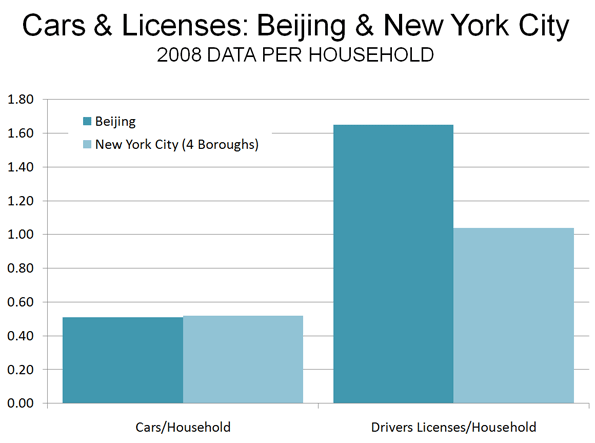
    There is a perception that the traffic situation could become substantially worse in Beijing, and that could well be the case. However, it is surprising that the Bejing (the city/province) is already well along in private vehicle ownership and use. Beijing has achieved a car ownership rate almost equal to that of New York City’s dense boroughs. In 2008, the dense boroughs of New York City had 0.52 cars per household, while Beijing had achieved a 0.51 rate. One report now places Beijing’s car ownership one third higher than in 2008, which would place Beijing’s car ownership rate 20% above that of New York City.

    By 2008, Beijing already had 1.5 times as many drivers per household as New York City’s dense boroughs (Figure 2). The difference appears to be in commercial drivers licenses, which account for nearly one-half of Beijing’s 9.4 million driver’s licenses. With the coal truck traffic and heavy truck traffic to the port of Tianjin, little more than 100 miles (160 kilometers) away, it is possible that trucks comprise a higher share of the traffic volume in Beijing than in New York City (Note 3).

    Local authorities are seeking to reduce the traffic congestion problem by building one of the world’s largest Metro (subway) systems. By the middle of the decade, nearly 350 miles (561 kilometers) should be open. Some lines will extend to outside of the fifth ring road, where much of the population growth is occurring. The Beijing Metro, like that of Mexico City, has been designed to better serve the contemporary urban area. Both are characterized by a concentration of grid routes and less by radial routes. Beijing also has ring routes. This design is especially appropriate for Beijing, which as is typical for many large Asian urban areas and unlike New York, Chicago or Hong Kong, has a decentralized core. Large office buildings in the center are more sparsely spread around a larger area, larger than these concentrated central business districts. Yet, even with this appropriate route design, the decentralization of retail and office activity necessitates time-consuming transfers that can make cars faster, even in Beijing’s traffic.

    China is also encouraging the use of electric cars, subsidizing buyers willing to switch from cars powered by fossil fuels. This will not ease traffic congestion, but it will reduce air pollution.

    At the same time, a period review of traffic conditions on the Internet will show Beijing’s worst traffic congestion to be concentrated in the high density core while in the much less dense expanding suburbs, traffic conditions are considerably better. Additionally, there is discussion of a seventh ring road and Beijing officials continue to improve their roadway network. As in US urban areas, Beijing’s continued decentralization could allow traffic to eventually be managed. Economists Peter Gordon and Harry W. Richardson have found that “suburbanization has been the dominant and successful mechanism for reducing congestion.”

    Clearing the Traffic: Meanwhile, there are reports that authorities have eased the traffic jam in Inner Mongolia. A longer term solution might be to add a couple of additional lanes in each direction. This should not be too difficult in a nation that by the end of the year will have nearly as many miles of freeway (43,000 or 70,000 kilometers) as the original US interstate system and will probably lead the world early in the next decade. This is a key to improving the competitiveness of Chinese urban areas. Sufficient roadway investment to handle growing travel demand will be just as important to maintain the competitiveness of US urban areas.

    —-

    Note 1: Beijing has six ring roads, however the first is the arterial road surrounding the Forbidden City, which is not an expressway.

    Note 2: Staten Island is excluded because its urban form is principally that of a post-war suburb, with a much lower population density.

    Note 3: This assumes comparability of data, which may not be fully reliable due to incomplete information.

    —-

    Wendell Cox is a Visiting Professor, Conservatoire National des Arts et Metiers, Paris and the author of “War on the Dream: How Anti-Sprawl Policy Threatens the Quality of Life

    Photo of Beijing Fourth Ring Road by archlife

  • The China Syndrome

    China’s ascension to the world’s second-largest economy, surpassing Japan, has led to predictions that it will inevitably snatch the No. 1 spot from the United States. Nomura Securities envisions China surpassing the U.S.’ total GDP in little more than a decade. And economist Robert Fogel predicts that by 2050 China’s economy will account for 40% of the world’s GDP, with the U.S.’ share shrinking to a measly 14%.

    Americans indeed should worry about the prospect of slipping status, but the idée fixe about China’s inevitable hegemony–like Japan’s two decades ago–could prove greatly exaggerated. Countries generally do not experience hyper-growth–the starting point for many predictions–for long. Eventually costs rise, internal pressures grow and natural limitations brake and can even throw the economy into reverse.

    Instead the U.S. has a decent chance of remaining the world’s pre-eminent economy not only over the next decade or two and even by mid-century. There are five key reasons for this contrarian conclusion.

    1. If Water is the “new oil,” China faces a thirsty future. China’s freshwater reserves are about one-fifth per capita those of the United States, notes Steve Solomon, author of Water: The Epic Struggle for Wealth, Power and Civilization. Much of that supply has become dangerously polluted; ours , for the most part, has become cleaner.

    More important, the U.S. has become more efficient in its water usage, says Solomon. China, with a far less developed economy, will face increasing demands from industrial and agricultural users as well as hundreds of millions of households that now don’t enjoy easy access to clean drinking water.

    2. China’s energy demands are soaring, but it lacks adequate domestic resources. China impresses journalists and policy-makers with grand “green” projects and heavy investment in renewables, but two-thirds of the country’s energy comes from that dirtiest of sources. China burns more coal than the U.S., Europe and Japan combined, often using very primitive technology. It has now overtaken the U.S. for the dubious honor of the most total energy use and highest greenhouse gas emissions. Since 1995 China’s dependence on foreign oil has grown from near to approaching 60%, and the country, long a coal exporter, is becoming a major importer of that unfashionable fuel.

    The U.S. meanwhile sits on largely untapped fossil fuel resources, including coal, natural gas and oil. Add Canada to the equation and North America ranks second, behind the Middle East, in energy resources. In contrast to China, America’s energy use and greenhouse emissions appear to be dropping while still enjoying enormous, still largely untapped renewable resources, particularly from wind power in the Plains and biomass.

    3. Food remains pressing problem for China. Scarce water, mass pollution and high energy costs all will limit China’s future food production. By some estimates acid rain falls on a third of all agricultural land; some climate experts predict long-term reductions in the country’s vital rice crop.

    Plagued by floods, China now will have to look to U.S. and Canada to meet demand for crucial foodstuffs, particularly corn. And the food deficit may get worse over time: As China becomes wealthier, demand for high-protein foods like beef and pork will increase. The U.S. remains the world’s most reliable supplier of many of those agricultural products.

    4. China’s rapidly aging population and shrinking workforce will slow growth, perhaps dramatically, by the next decade. Like that of the “Asian tigers” in the ’70s and ’80s, China’s rapid growth has been propelled in part by an expanding young workforce. Due to a very low birthrate, however, this trend will reverse within a decade or two. By 2050 31% of China’s population will be older than 60, compared with barely one-quarter in the U.S. There will be over 400 million elderly, with virtually no social security and few children to support them. Also worrisome: The preference for male children has skewed sex demographics dramatically, with roughly 30 million more marriageable boys than girls.

    The logical solution to this dilemma would be immigration, but China’s culture appears far too insular for such an event. Rather than a benevolent “socialist” super power China, whose population is made up over 90% Han Chinese, will bestride the world as a racially homogeneous, and communalistic “Middle Kingdom.” In contrast, the U.S., despite occasional fits of nativism, remains remarkably successful at integrating cultures from around the globe.

    5. Dictatorship thrives sometimes in a “take off” period, but often fails to compete well with more open societies during later stages of growth. Many American intellectuals and journalists celebrate China’s achievements, much as some of their predecessors admired past “successful” economic regimes in fascist Italy, Nazi Germany and the late Soviet Union. The longest lasting of the authoritarian superpowers, the Soviet state massively misallocated its resources in its unsuccessful competition with the more flexible systems of the U.S. and its allies.

    Big Brother economies experience more subtle problems. Chinese entrepreneurs , according to a survey by the Legatum Institute in London, depend far more than their more nimble and self-reliant Indian counterparts. Overweening Chinese state power also might be chasing many foreign businesses–and some developing countries– toward more congenial investment and trade partners.

    For all these problems, the Chinese emergence remains the dominant business event of our epoch. But world-wide dominion seems highly unlikely. One often overlooked factor: political problems stemming from growing inequality in this officially Marxist state. Over the past 20 years China’s income distribution pattern has shifted from the relative egalitarianism of Sweden, Japan or Germany to that of countries like Argentina and Mexico.

    The class divisions will deepen further as growth inevitably slows. Roughly one-third of 2008’s 5.6 million university graduates have been unable to find work. Things are even worse for those less skilled, rural residents and small manufacturers.

    Ironically, the Communist Party appears to further concentrate wealth and power; most of the richest people in China are linked to the party. Policies push growth, but with diminishing rewards to the masses. Over the last decade the share of GDP going to consumption dropped from 46% to less than 36%.

    Of course, a comparatively small number of skilled, with often well-connected professionals and investors flourishing, but opportunities for economic advancement may now be scarcer for most workers compared to the earlier period of China’s remarkable “liftoff” after 1980. Conditions for the working class in China remain more akin to Dickensian England than a Marxian “worker’s paradise.” China’s dismal health care system for example, ranks according to the World Health Organization, among the world’s most inequitable, 188th out of 191 nations.

    Not surprisingly, class anger has reached alarming proportions, with almost 96% of respondents, according to one recent survey, agreeing that they “resent the rich.”

    America also faces its own share of social problems but not to such an extreme degree. Many Americans resent the affluent, but also dream of becoming them. How else to explain the popularity of paeans to bourgeois vulgarity like Housewives of New Jersey?

    In the coming decades China, not the currently depressed U.S., may face greater headwinds. America’s biggest enemy will prove to be not China, but itself. The U.S. needs to move toward a pro-growth course driven by investments in our productive economy, basic infrastructure and skills-based education as well as sustainable immigration and population growth levels. If the country does these things then Americans will someday look back at their current Sinophobia as a delusion dressed up as irresistible conventional wisdom.

    This article originally appeared at Forbes.com.

    Joel Kotkin is executive editor of NewGeography.com and is a distinguished presidential fellow in urban futures at Chapman University. He is author of The City: A Global History. His newest book is The Next Hundred Million: America in 2050, released in February, 2010.

    Photo: Steve Webel

  • China’s Sliver of a Housing Bubble

    Few finance issues have received such a wide range of opinions among financial experts than the “housing bubble” in China. This is an issue of international importance because what happens in what is now the world’s 2nd largest economy affects the rest of the world.

    Differing Views: There are frequent reports of excessively high purchase prices on new housing, which when compared with measures of average household income make it appear that China has the highest house price to income ratios in history. Andy Xie, a Shanghai economist formerly with Morgan Stanley sees a huge housing bubble, which he expects to burst. Stephen Roach, chairman of Morgan Stanley Asia denies there is a bubble, claiming that there is sufficient demand from the continuing migration to the cities for the housing market to be healthy.

    I have been reluctant to weigh in on the debate, simply because there has been insufficient data available to calculate inferior housing affordability measures (such as average price to average income), much less the data that would permit Median Multiples to be calculated. (The Median Multiple is the “middle” house price divided by the “middle” household income and is optimal for measuring middle income housing affordability).

    The problems in assessing China’s housing affordability have been manifold:

    • There has been virtually no median household income data.
    • There appears to be no data available on the median house price

    This means that it is impossible to calculate the Median Multiple.

    Housing Occupancy in Urban China

    Having visited all but two of China’s 20 largest urban areas and traversed them, east to west and north to south from the countryside to the countryside (as I do in obtaining photos and impressions for my “Rental Car Tours“), however, two things are obvious.

    • New high-rise housing is being built at a furious pace in the largest urban areas.
    • Nonetheless, the volume of this new housing pales by comparison to the lower rise, older housing that was built before the present boom (which appears to have started in the 1990s). It is clear that the vast majority of people do not live in the new high rise buildings.

    Nonetheless the press has been filled with absurd reports to the effect that there are 65 million empty housing units in China. The absurdity of this now discredited number is illustrated by the following.

    (1) All of China’s urban areas with more than 500,000 population, where much of the new high rise housing has been built, have less than 300 million people. At the average household size, this means there are no more than 100 million households. In such an environment, 65 million empty units would stick out like a sore thumb. They do not.

    (3) 65 million vacant units is more houses than have been constructed since 1990.

    The New National Economic Research Institute Data: Finally, however, some clarity may be being brought to the issue. Credit Suisse sponsored groundbreaking research by National Economic Research Institute (NERI) of the China Reform Foundation in Beijing, which was led by Deputy Director Dr. Wang Xiaolu. Dr. Wang’s principal contribution is to show that household incomes are considerably higher in China than official statistics indicate. This “grey income” or “hidden income” includes bonuses paid by local governments, payments to public officials, revenues from land development and other sources of income that are not reported in official data and amounts to 90% more than reported figures (report (Analyzing Chinese Grey Income, published by Credit Suisse). In the top decile (top 90-100% of household incomes), grey income added 200% to reported incomes, while in the second decile (80%-90%), grey income more than doubled reported incomes. Buried in the NERI report is median household income data and average multiple housing affordability indicators that are the best information yet made available.

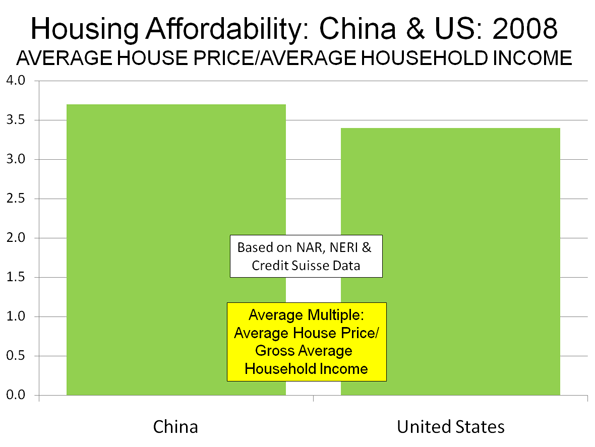
    China’s Average Multiple: Credit Suisse analyst Jinsong Du takes the NERI further to calculate housing affordability indicators that are far below the claims about the Chinese housing bubble. The average (mean) house price was 4.0 times the average disposable household income in 2008, after accounting for “grey income.” Based upon the national ratio of gross income to disposable income (from the China Yearbook), this would indicate an “average multiple” (average house price divided by gross average household income) of 3.7. This is similar to the US average multiple figure of 3.4 (Figure 1) in the same year (2008).

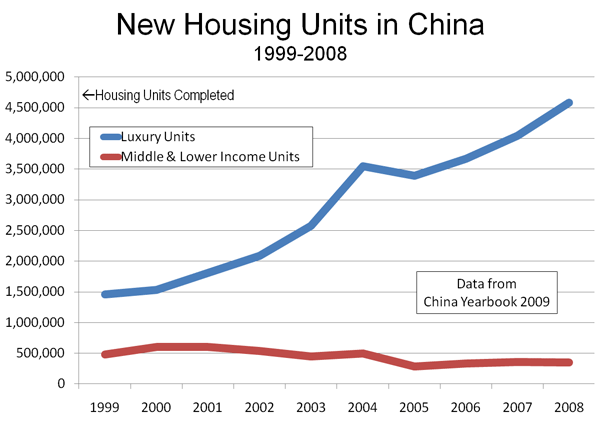
    China’s Median Multiple? This leaves the question of the Median Multiple. There is still no available median house price data. However, it is clear that the new housing is largely irrelevant to median house prices. According to data in the China Yearbook (Table 5-42), only 13% of the 31 million new houses were affordable to lower and middle income people (Figure 2). The new luxury units, with their widely touted prices, remain a minority of the houses, and, as a result, none of these can be the “middle” or median price

    In fact, the median priced house could be of a design similar to a Danwei (live-work unit) type design built before 1990. This is the type of housing that any walk or drive through a Chinese urban area will demonstrate to be dominant (and which is illustrated in the photograph above). There are huge disparities in both house prices and incomes in China. It would not be surprising for China’s Median Multiple to be similar to its average multiple, as is the case in the United States.

    Further, there is a huge difference between the US bubble and the Chinese bubble. In the United States the bubble drove up prices across all income spectrums in the impacted metropolitan areas. It burst largely because middle income households had taken on debt they could not afford. In China, the bubble may be limited to the top of the income scale, the very households that NERI finds are making two to three times as much as the official reports indicate.

    China’s Sliver of a Bubble: None of this is to suggest that house prices at the top of the market are not high. One of America’s leading housing economists, Joseph Gyourko of Wharton, along with Jing Wu and Yongheng Deng found that residential real estate auction prices rose 800% from 2003 to 2008 in Beijing (Note). Recently the government has taken action to cool the high end of the market and to encourage development of more housing for middle and lower income households. At the same time, the Gyourko research team found that new house prices had fallen relative to household incomes in Chengdu, Wuhan, Tianjin and Xi’an, all urban areas with more than 4,000,000 population.

    To accurately assess housing affordability it is necessary to have complete data. Housing affordability cannot be assessed in London using data from Belgravia, nor will Upper East Side data tell an accurate story about New York. The same is true in China. Stephen Roach said that China has a “sliver of a bubble.” That’s what the data seems to show.

    ——————

    Note: This annual rate of increase is approximately the same as was experienced in per acre government land sales in Las Vegas and Phoenix before the peak of the bubble (both urban areas are tightly ringed by “virtual” urban growth boundaries composed of government owned land).

    Wendell Cox is a Visiting Professor, Conservatoire National des Arts et Metiers, Paris and the author of “War on the Dream: How Anti-Sprawl Policy Threatens the Quality of Life

    Photograph: Median priced (?) flats in Fushun, Liaoning (photograph by the author)

  • Tribes And Trust

    Only Tribes held together by a group feeling can survive in a desert.
    –Ibn Khaldun, 14th century Arab historian

    Time to chuck into the dustbin the cosmopolitan notions so celebrated at global conferences: a world run by wise men of the United Nations, science-driven socialists or their ostensibly more pragmatic twins, global free marketers. We are leaving the age of abstractions and entering one dominated by deep-seated ethnic, religious and cultural loyalties, some with roots from centuries and millennia ago.

    The 14th century Arab historian Ibn Khaldun noted that what most holds people together is biology and shared history. These create the critical bonds of kinship and trust and a sense of common purpose that have animated every ascendant group from the days of the Greeks and Romans through the British empire, America and modern day China.

    You rarely hear such notions discussed by academics, policy wonks and politicians. The well-behaved shy away from the hoary reality that people usually put the interests of their extended family ahead of others.

    Yet the more we struggle to be true cosmopolitans, the more humanity expresses our fundamentally tribal nature. In the two decades since I wrote my book Tribes, in-group loyalties appear to have become stronger and more dominant.

    Take the Arabs, Ibn Khaldun’s own tribe, now blending ethnic nationalism and religion into a powerful, epoch-shaping mixture. Much as in the 7th or 8th centuries.

    Arab Muslim tribalism will remain a powerful force, if for no other reason than their dominance of easily accessible fossil fuel resources. You see signs of a renewed, self-conscious Arab civilization in the new mosques, shining cultural edifices, mega-hotels and office spires sprouting across Kuwait, Dubai, Qatar and Abu Dhabi.

    With Arabs, like others, intense tribal feelings can often get out of control. Racial pride and religious fervor have chased many productive cultural minorities–Armenians, Christians, Jews–from once cosmopolitan cities like Damascus, Cairo and Beirut. The Shiite Iranians have followed a similar unfortunate course. Even some in Israel feel an uncontrollable urge to exclude, as evident in a proposal to allow ultra-orthodox Haredi rabbis to determine who is–and who isn’t–a Jew.

    The power of the new tribalism is particularly evident among the Chinese. Maoism might have been a radical internationalist movement, but today’s Chinese are seeking to revive the great 15th century “middle kingdom” that led the world in industriousness and commerce, and briefly even “ruled the seas.”

    The Han are easily the world’s largest tribe with a common history, language and mythology, and they constitute over 90% of China’s billion-plus population. In contrast, India, the other great rising super power of our time, remains a patchwork of diverse ethnic, linguistic, caste and religious groupings.

    The new Middle Kingdom, as Martin Jacques warns in his influential When China Rules the World, may well prove extraordinarily ethno-centric and self-referential. The newly powerful Han may find little use for other races except as customers and suppliers of raw materials.

    Despite huge internal pressures, the Chinese are increasingly scornful of the Western business model. A good example of this change of mood: the downgrade of American and European debt by the Dagong rating agency earlier this month.

    Other tribes, meanwhile, are waning: Take the Japanese. The Japanese ascendency last century was was built upon imagination, courage and military, followed by a corporate, esprit de corps.

    Nothing speaks to tribal decline more than Japan’s shocking birth dearth. The Japanese are running out of new blood about as quickly as any nation on earth. They also seem constitutionally incapable of making the demographic shortfall with immigrants. By 2050 more than one in three Japanese will be over 60, and the workforce 40% smaller than in 2000. The same fate may await some of their Asian cousins, but Japan’s demographic time bomb will go off first.

    Europeans face similarly bleak demographic prospects. Many traditional linchpins of trust–national pride, family and religion–have weakened. Lacking some sort of “group feeling,” today’s Europeans seem unmotivated about creating a great future, as shown by their unwillingness to start businesses or create offspring.

    The trendy concept of “European” may also need to be dismissed as archaic given the mounting rift between the frugal and productive north and the anarchic south. After all, how can you speak of one Europe when the Belgians themselves remain congenitally divided between their French and Dutch speakers.

    So what other tribes, besides the Chinese, are on the upswing? Best look at the arc of rising countries across Asia–from Turkey and India to Vietnam. All appear to be entering an aggressive, expansive phase.

    The new dynamic has restored one historic aspect in the role of cities as hosts for a gathering of tribes. Singapore, for example, has evolved into a modern-day Venice: a convenient, authoritatively ordered place hosting Chinese, Malays, Indians, Vietnamese and those Westerners who want in on Asia’s action.

    Many well off Indians, Chinese and others scour the globe for the prospect of a better life–easier admission to college or the prospect of owning a large flat or even a single family house in the suburbs. This lures them to London, New York, Los Angeles, the Bay Area or Houston. Chinese yuppies still fork out big bucks to have their babies born in California.

    Tribalism has spread even to that paragon of modernism, Silicon Valley. In the end, technology often fails to trump family and cultural ties. Chinese investors push firms to set up shop with their ethnic compatriots in Taiwan, Singapore or China; the Indians for Bangalore, Chennai or Hyderabad; the Israelis for expanding Tel Aviv.

    In our informational age, of course, not all trust networks are based on ethnic DNA. The Mormons have thrived as a tribe based on theology and their remarkable culture of mutual self-help. More than half of the “Saints” now live outside of America, but still Salt Lake City serves as their own ecclesiastical Mecca.

    Even decidedly secular groups increasingly display tribal characteristics. Green activists are united by a passionate “group feeling” as powerful as that which mobilized Mohammed’s followers; just substitute “sustainable” for holy.

    Smaller tribes like investment bankers, techno-geeks or gays each share their own iconography, rites of passage, tastes in politics and culture. They cluster not only in cyberspace, but in the same neighborhoods, conferences and resorts, and increasingly intermarry.

    These secular tribes often insist they, unlike ethnic groups, are motivated by a more enlightened spirit of science, global consciousness or individual self-awareness. But don’t be taken in by such protestations. Nothing could be more tribal.

    This article originally appeared at Forbes.com.

    Joel Kotkin is executive editor of NewGeography.com and is a distinguished presidential fellow in urban futures at Chapman University. He is author of The City: A Global History. His newest book is The Next Hundred Million: America in 2050, released in February, 2010.

    Photo: TwOsE

  • Distilling China’s Development

    The economic rise of China has created two growth industries pulling in opposite directions. There’s either the school of blind praise of ‘The China Miracle’ or its opposite, apocalyptic predictions about the country’s impending implosion.

    On the surface, it appears as if the fundamentals of China’s modernization are similar to what the Western nations went through in the past, that is, a mass migration of farmers from the countryside to the urban centers to work in factories and construction sites. Taking into account the enormous scale at which this migration is happening, the country seems to be moving toward what some observers are dubbing the ‘Chinese Century’.

    Similarities aside, however, China’s development is uniquely Chinese. Whereas the U.S. was built upon the backs of immigrants from outside of its borders, China’s development owes its current success to its own huge population. China will never become a nation of external immigrants and will remain a homogenous behemoth long into the future.

    China’s current condition and its immediate future remain shrouded in a state of unsettling mystery. Having lived and worked as an architectural designer in China for nearly a year now, my own fervent curiosity has hardly been assuaged. There are a few things I’ve learned though that should be clarified regarding China’s development. Following, I will attempt to belie some common misconceptions.

    Misconception: As China continues develop, it will become more open to outside influence and the government system will reform itself to become more democratic and free.

    To the naive Western observer, China’s continued economic evolution means that the country must allow more democratic freedoms in order to remain competitive in the future. This assumption is extraordinarily dubious. China’s model is top-down, centralized planning and it has proven to be successful. To argue that it will not continue to work for China is a biased Western-projected fantasy.

    A pre-existing culture of collectivism constitutes one reason why state-driven development continues to blaze forward totally unhinged. When it comes to sensitive issues like media censorship or human rights, most Chinese citizens passively shrug their shoulders knowing full well that protesting will ultimately prove futile and self-defeating. Furthermore, most citizens are too busy hustling to make money and pull themselves up the socioeconomic ladder to be concerned with such matters.

    Perhaps the past two centuries of Chinese history will offer some clues into why the status-quo is so apathetically accepted. China’s experience of 19th and 20th Centuries consisted largely of a series of hardships: the Opium Wars to the fall of the Qing Dynasty, the subsequent Japanese Invasions and Chinese Civil War, and concluding with Mao’s Cultural Revolution. It is obvious that China is much better off now than it has been for the past 200 years.

    This might explain why China’s populace is now seizing the unique opportunity of “reform and opening” to make the best out of the current situation. It might also explain why people are reluctant to disrupt the established order. Thought about in this way, China’s current system of rule is not so much a ‘big-brother’ entity as it is an unspoken collective social contract to keep peace.

    Misconception: China’s rise to global prominence is over estimated. The looming real estate bubble in China means that economic collapse is imminent.

    Doomsday predictions about China’s collapse have become something of a growth industry. Commentators like Gordon Chang and hedge fund manager James Chanos are placing their bets on China’s demise. Many of these criticisms stem from what is speculated to be a coming crash in the real estate market.

    To the central government, constructing new buildings is much more than just providing new and modern accommodations for the populace; it stands for social stability. It doesn’t take an economist to acknowledge that city-building is an important part of economic growth. But what is often overlooked is how city-building is a key part of the modernization process, employing rural migrants and giving them opportunity to earn substantially more than they could as farmers.

    In China, real estate development is only one part of economic growth equation. Chinese leaders are well aware that the mad pace of constructing new buildings cannot last forever and already there seems to be an overabundance of supply in the residential and commercial sectors in first-tier cities like Shanghai and Beijing. Yet China is not anywhere near finished with its construction boom as 2nd, 3rd and 4th tier cities race ahead to catch up with their 1st tier counterparts.

    Looking into the future, China’s leaders are preparing to shift the economic growth to more information-based sectors. The city I live in, Chengdu, the capital of Sichuan province, has already recruited American heavy-hitters such as Cisco and Intel. Chengdu has been successful in doing this by investing in new infrastructure and developing a series of high-tech industrial zones that give foreign companies the option of lower operational costs than found in the increasingly pricey coastal cities.

    Misconception: Revaluing China’s currency will help bring manufacturing jobs back to the U.S.

    China’s economy would not be the success it is today without the foreign investment that flooded through the gates since they first opened in 1978. The number of foreign enterprises directly benefitting from the low cost of labor in China has expanded greatly since that time. China’s maintaining a low valuation of its currency, the Renminbi (RMB), has been a key factor in attracting and keeping investment from overseas businesses.

    Yet the talking heads in Washington have taken to pressuring China to revalue the RMB in order to help ‘rebalance the global economy’. Just ahead of the G20 last month, Treasury Secretary Timothy Geithner told Congress that China’s RMB peg to the U.S. dollar is an ‘impediment to sustainable global growth.’ Responding to the pressure, China announced that it would in fact let the RMB appreciate against the dollar.

    Following China’s announcement, the RMB rose a whopping .4% in value leading to what Economist Paul Krugman called the ‘Renminbi Runaround’. Krugman is correct to call out China on its currency manipulation- but it should be no surprise that what China is doing is simply looking out for its own national interests. A rapid rise in RMB value would cause some serious damage to the Chinese economy.

    American politicians know this but will continue to pressure China to raise the RMB value to score brownie points with their constituents. The reality is that both China’s economy and foreign companies using Chinese labor benefit from the low value of the RMB. For instance, companies such as Apple would not be able to sell their much coveted iPads at reasonable prices if it were not for cheap Chinese labor.

    Pressuring China too much could result in a trade war which would in fact not only hurt Chinese exporters but the American consumer as well. Politicians are also deluded into thinking that manufacturing jobs will come back to the U.S. if China’s RMB goes up. On the contrary, companies will move manufacturing operations to some other place where regulations and labor costs remain substantially lower.

    Conclusion: China’s accomplishments over the past two decades are unprecedented and fascinating. The scale at which change is happening means that complexity and uncertainty are unavoidable facts of life. Many challenges lie ahead, both for China’s domestic issues and its relationship with the rest of the world. As far as China has come, there still is a long way to go as millions still aspire to a better life.

    Adam Nathaniel Mayer is a native of California. Raised in Silicon Valley, he developed a keen interest in the importance of place within the framework of a highly globalized economy. Adam attended the University of Southern California in Los Angeles where he earned a Bachelor of Architecture degree. He currently lives in China where he works in the architecture profession. His blog can be read at http://adamnathanielmayer.blogspot.com/

    Photo by DavidM06

  • The Democrats’ Middle-Class Problem

    Class, the Industrial Revolution’s great political dividing line, is enjoying Information Age resurgence. It now threatens the political future of presidents, prime ministers and even Politburo chiefs.

    As in the Industrial Age, new technology is displacing whole groups of people — blue- and white-collar workers — as it boosts productivity and creates opportunities for others. Inequality is on the rise — from the developing world to historically egalitarian Scandinavia and Britain.

    Divisions are evident here in the United States. Throughout the 2008 presidential campaign, Barack Obama lagged in appealing to white middle- and working-class voters who supported Hillary — and former President Bill — Clinton.

    Now, these voters, according to recent polls, are increasingly alienated from the Obama administration. Reasons include slow economic growth, high unemployment among blue- and white-collar workers and a persistent credit crunch for small businesses. These factors could cause serious losses for Democrats this fall — and beyond.

    This discontent reflects long-term trends. Since 1973, for example, the rate of growth of the “typical family’s income” in the United States has slowed dramatically. For men, it has actually gone backward when adjusted for inflation.

    The past few years have been particularly rough. About two in five Americans report household incomes between $35,000 and $100,000 a year. Right now, almost three in five are deeply worried about their financial situation, according to an ABC poll from March.

    This should give Democrats an issue, theoretically. But to date, Obama and his party seem incapable of harnessing the growing middle- and working-class unrest.

    In fact, according to recent polls, these have been the voters that Democrats and the president have been losing over the past year as the economic stimulus failed to make a major dent in unemployment.

    Part of this problem lies with the party’s base, which the urban historian Fred Siegel once labeled “the coalition of the overeducated and the undereducated.” Major urban centers like New York, Chicago and San Francisco might advertise themselves as enlightened, but they have lost much of their middle class and suffer the highest levels of income inequality.

    Representatives from these areas now dominate the party and reflect their bifurcated districts. They often stress the concerns of the educated affluent on issues like climate change and gay marriage, while their economic policies focus on the public-sector workers, “green” industries and maintaining the social welfare net.

    Not surprisingly, this agenda does little for the middle-class — mostly suburban — voters.

    Sen. Scott Brown (R-Mass.), for example, won his margin of victory in largely middle- and working-class suburbs, where many voters had backed Obama in 2008, according to demographer Wendell Cox. Brown lost by almost 2-to-1 among poor voters — and also among those earning more than $85,000 a year.

    Given the danger revealed by these numbers, Democrats and other center-left parties around the world should refocus their policies on issues — such as taxes, private-sector job creation and small business — that affect such voters.

    For this growing class divide can be found globally: In China, for example, technological change and globalization have produced a new proletariat that, unlike in the past, is disinterested in warmed-over Maoist ideology.

    Perhaps nothing demonstrates this more clearly than the unrest at the Foxconn Technology Group. Workers produce cool products — for companies like Apple, Dell and Nintendo — but under such oppressive conditions that some have been driven to suicide.

    Mounting protests about Foxconn’s employment practices, and a recent rash of strikes in China’s Honda plants, reveal the disruptive potential of this class conflict.

    Even as China’s corporations and government become richer, inequality is widening. Indeed, over the past 20 years, China has shifted from an income-distribution pattern like that of Sweden or Germany to one closer to Argentina’s or Mexico’s. By 2006, China’s level of inequality was greater than that of the United States or India.

    Not surprisingly, class anger has reached alarming proportions. Almost 96 percent of respondents, according to one recent survey, agreed that they “resent the rich.”

    China’s class divides may be extreme, but similar patterns can be found almost everywhere. From India to Mexico, economic growth has led to a striking increase in the percentage of urbanites living in slum conditions.

    In 1971, for example, slum dwellers accounted for one in six Mumbaikars. Today, they are an absolute majority.

    This almost guarantees greater class conflict in the future, even as India’s economy booms.

    “The boom that is happening is giving more to the wealthy,” said R.N. Sharma of Mumbai’s Tata Institute of Social Sciences. “This is the ‘shining India’ people talk about. But the other part of it is very shocking — all the families where there is not even food security.We must ask: ‘The “shining India” is for whom?’”

    This growing inequality in the developing world is already shaping global politics. The failure of the Copenhagen climate change conference can be largely ascribed to the unwillingness of China, India, Brazil and other developing countries to sacrifice wealth creation opportunities for ecological reasons.

    Like their counterparts in New Delhi and Beijing, politicians in wealthier countries also face class conflict.

    In Britain, for example, even a massive expansion of the welfare state has done little to stop the U.K. from becoming the most unequal among the advanced European democracies.

    Alienation among white working-class voters — particularly those in the public sector or with modest small businesses — may have contributed to the Labour Party’s poor showing in the recent elections, according to Liam Byrne, the former Labour treasury secretary.

    A similar phenomenon appears in Australia. Labor Prime Minister Kevin Rudd, an icon among upper-class liberals, resigned in large part because of a precipitous decline in the polls among middle- and working-class suburban voters.

    What is not clear is whether conservative parties can abandon their often slavish devotion to big corporate interests to take advantage of these new dynamics. For years, these parties have relied on divisive social issues, like immigration, to win working- and middle-class voters. But it’s possible that a focus on profligate government spending might yet increase the right’s appeal among mid-income voters.

    As this current shift to greater inequality continues, the self-styled “popular” parties’ tendency to ignore class issues could prove disastrous.

    Unless they start addressing class issues in effective ways, they may lose not just their historical base but the political future.

    This article originally appeared in Politico.

    Joel Kotkin is executive editor of NewGeography.com and is a distinguished presidential fellow in urban futures at Chapman University. He is author of The City: A Global History. His newest book is The Next Hundred Million: America in 2050, released in Febuary, 2010.

    Official White House Photo by Pete Souza

  • Beijing on Track to Be World’s Busiest Airport

    For years, the world’s busiest airports in passenger volume have been Atlanta’s Hartfield-Jackson International and Chicago’s O’Hare. However, there are indications that this long dominance may be about to end. According to Airport Council International data for 2009, Chicago O’Hare had fallen to 4th position, following Atlanta, London-Heathrow and Beijing Capital International Airport.

    Beijing’s Capital International increased its passenger volume by 17% in 2009, while European and American airports were experiencing slight declines due to the recession. Beijing’s increase is more significant, because growth might have been expected to level off after the 2008 Olympics, which were held in Beijing. Between 2008 and 2009, Beijing rose from 8th in the world to 3rd, and from 20th place in 2004, when its volumes were approximately one-half the present level.

    Early 2010 data (first quarter) indicates that Beijing Capital International has become the second busiest airport in the world, trailing only Atlanta. Passenger volumes were up 10.5% from a year earlier. If the current rate of growth continues, Beijing should pass Atlanta in two to three years, even if the American economy improves.

    London’s 130 million annual passenger traffic was the greatest of any metropolitan area in the world in 2009 (distributed among five airports). The new Conservative-Liberal Democrat government seems determined, however, to forfeit this ranking, having banned further London airport expansions to combat what it calls “binge flying.”

    New York was second with passenger traffic of 105 million at its three major airports, while Tokyo was third at 95 million. “Binge flying” does not seem to be a concern in Japan, where Tokyo’s Haneda Airport is adding a fourth runway and will soon serve international flights again, providing competition to more distant Narita. Atlanta’s single airport handles an annual passenger volume of 88 million.

    Other airports in China are also growing. In the Pearl River Delta (the world’s largest “mega-region,” an area of adjacent urban areas), the four large airports, Hong Kong, Guangzhou and Shenzhen accommodated passenger traffic of more than 105 million in 2009. Traffic at Shanghai’s Pudong and Hongqiao grew 14% and 10% respectively.

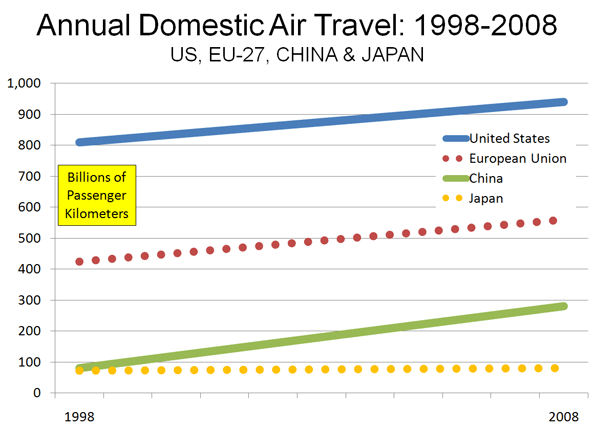
    Overall Chinese air traffic is also growing rapidly. Over the past 10 years, annual passenger volumes have risen an average of more than 25%. This compares to an average annual growth rate of 3.2% in the European Union (EU-27), 1.6% in the United States and 1.1% in Japan (Figure). The US continues to be dominant in passenger volumes, at 940 billion annual passenger kilometers, compared to 560 billion in the European Union, 280 billion in China and 80 billion in Japan (data calculated from US, Europe, China and Japan national sources).

  • Immigrant Entrepreneurs Can Turbocharge Cleveland’s Flagging Economy

    In seeking to lure a Chinese lightbulb-maker to town, Cleveland leaders revealed both a vision and a blind spot.

    Cleveland Mayor Frank Jackson and his team should be given credit for recognizing the tremendous opportunity in attracting foreign direct investment, or “FDI,” and the new jobs that it provides.

    According to a 2008 report by the U.S. Chamber of Commerce, foreign firms employed more than 5.3 million U.S. workers through their U.S. affiliates and have indirectly created millions of additional jobs. More than 30 percent of direct hires are in manufacturing. In Ohio, 600 foreign-based corporations from 28 countries are operating 1,000 facilities and employing about 180,000 people.

    One exciting new trend is the rise in the annual number of foreign investment projects in the U.S. renewable energy sector, jumping from 4 projects in 2003 to over 40 in 2008.

    In its eagerness to attract a foreign company offering energy-saving light bulbs, however, City Hall fell into traps which may have been avoided if had it tapped the cultural resources at their fingertips.

    When Mayor Jackson’s administration waded into unfamiliar waters to partner with an LED light bulb company in Ningbo, China, no one thought to talk with Chinese-American entrepreneurs and professionals living in Northeast Ohio. These individuals are eager to assist the City in helping identify appropriate partners in China, supporting the due diligence, and generally advising on a culture that dates back to 5,000 B.C. and has only opened-up in recent decades.

    As reported by Crain’s Cleveland Business, local immigrants were not viewed as a resource.

    ‘Why weren’t we informed; we could have helped you?’ asked Hong Kong-born immigration attorney Margaret Wong….

    Ms. Wong made the statement last Thursday evening, May 20, in the Red Room, a conference room attached to Cleveland Mayor Frank Jackson’s office at Cleveland City Hall. She was there with a group of local small business owners, clergy and other civic leaders invited by the mayor to a meeting to enlist their support in his effort to bring Chinese lighting manufacturer Sunpu-Opto Semiconductor Co. to the city.

    Ms. Wong was asking chief of staff Ken Silliman why the Mayor, who was not present, hadn’t sought the assistance of people such as her and the others in the room sooner in his attempt to make Cleveland the U.S. beachhead of Sunpu-Opto, a maker of energy-efficient LED lighting.

    Mr. Silliman didn’t have a ready answer.

    The answer may be that in this region immigrants are often not viewed as a valuable resource to support the region’s business development, or viewed as people with the skills to help Northeast Ohio navigate the language, cultural and market barriers abroad.

    This must change.

    Yes, it is important that the City and the region aggressively pursue FDI, not only with passion, but also with skill, networks, and on-the-ground experience.

    To make these efforts successful, however, leadership should look to leverage the foreign-market experience of our immigrant entrepreneurs and innovators, particularly in relation to China and India, where booming economies, mounting foreign currency reserves, and relationship-based business culture create unique opportunities and challenges.

    Cleveland’s immigrants, some of whom enjoy business and governmental relationships in the homeland that go back generations, are eager to be a partner in revitalizing the city and the region. They are in a unique position to help our region capture our share of the $245 billion of foreign direct investment streaming into the U.S, to ramp-up our exports to global markets where 95% of the world’s consumers live, and to attract the world’s best and brightest innovators, entrepreneurs, and professionals driving a changing economy.

    There is precedent in leveraging ethnic and global networks for local development Northeast Ohio’s Jewish community, which enjoys extensive business, family and social ties in Israel, has helped the region attract tens of Israeli companies in recent years.

    What is needed now is a bold regional plan to take this formula for success to a larger scale, particularly targeting markets such as China where the government is encouraging its businesses to expand into the United States.

    The path to this global journey, however, should begin with a few short steps at home, launching a multi-purpose International Welcome Center which will help the region build a bridge to the world.

    The Welcome Center will not only provide a much-needed platform to coordinate local resources for attracting FDI, but it will also help educate the region on why the development of a global culture is an economic necessity and on what steps we can all take to welcome and partner with international resources, such as the immigrant talent living right now in Northeast Ohio.

    This represents a bit of conundrum. How do we recruit and welcome foreign companies, their executives, and their families, if we do not fully value our existing immigrant entrepreneurs and innovators? How do we attract foreign direct investment when overseas companies are feared as job-takers?

    In responding to the dichotomy of not welcoming immigrants while trying to lure foreign companies to Cleveland, Anne O’Callaghan, founder of the Welcome Center in Philadelphia said in her City Club of Cleveland speech last year:

    Do the region’s leaders think that foreigners should just stay in the homeland but still wire you their money?

    Northeast Ohio’s immigrant community is rich in technology, entrepreneurship, global market knowledge, and new wealth.

    To make a credible push to attract foreign companies which can establish manufacturing, research, and corporate headquarters in Northeast Ohio and in-source thousands of new jobs, the region can take a bold step forward by partnering with immigrants already here and put out the “welcome mat” for those who may arrive tomorrow.

    Richard Herman is a Cleveland lawyer, Co-Chair of TiE Ohio (The International Entrepreneur), and Co-Author of Immigrant, Inc. (Wiley & Sons, 2009).

    Photo by Caveman 92223 — On the 2010 US Tour

  • China’s Urban Challenge: Balancing Sustainable Economic Growth and Soaring Property Prices

    Today, Beijing seeks to balance strong economic growth and soaring prices amidst a severe global crisis and debt turmoil in advanced economies. The challenge is colossal – to provide urban space for more than 600 million people in the coming decades.

    For months, the famous hedge fund wizard, James Chanos, has been predicting a severe Chinese property slump. As he puts it, “Dubai times 1,000 – or worse,” with the “potential to be a similar watershed event for world markets as the reversal of the U.S. subprime and housing boom.”

    The contrarian investor Chanos made his fortune on Wall Street by foreseeing the collapse of Enron and other high flying companies whose stories were “too good to be true.” He is not the only skeptic on China, but certainly one of the most prominent and articulate. And yet, China’s real estate market is very different from those of the U.S. or Dubai.

    In Dubai, the problem had to do with too much leverage. In China, consumers buying residential properties are required to put down 30 percent before taking out a mortgage. For a second home, the down payment is 50 percent, irrespective of their net worth. Home purchase is predicated on affordability.

    In the pre-crisis U.S., perverse incentives were magnified by low interest rates, sometimes minimal down payment and loans to those with poor credit histories. Excessive debt was sliced, repackaged and securitized into mortgages. Banks and ratings agencies engaged in unethical conduct. Appropriate regulatory oversight was absent.

    In the long-run, the containment of rapid price increases is vital for China’s economic growth and social cohesion. In the short-run, volatile price fluctuations are difficult to avoid in the large urban centers. These large agglomerations are evolving into “global cities”, which are driven not just by local conditions, but by global trade and investment.

    Soaring prices
    In “China bubble” predictions, Chinese property markets are typically portrayed as unitary or homogeneous. Yet, there is huge variation among cities and regions. In 2009, the urban GDP per capita was highest in Shenzhen reaching almost US$13,800 USD, whereas in Hefei it was about US$6,100.

    Until recently, the concern for the soaring prices in the property markets has been focused primarily on the high-end segment of the first-tier cities. Since the 1980s, the economic ripple effect of the successful first-tier cities – such as Shenzhen, Beijing, and Shanghai – has been spreading into new generations of Chinese cities.

    By the early 2000s, second-tier cities – from Suzhou and Shenyang to Chengdu and Chongqing – attracted significant attention with investments from global corporate giants. Third-tier cities – from Ningbo and Fuzhou to Wuxi and Harbin – have been following in the footprints, while inspiring still others, such as Kunming and Hefei.

    Yet for the most part soaring prices characterize primarily residential properties – almost exclusively the high-end segment of the most prosperous first-tier cities.

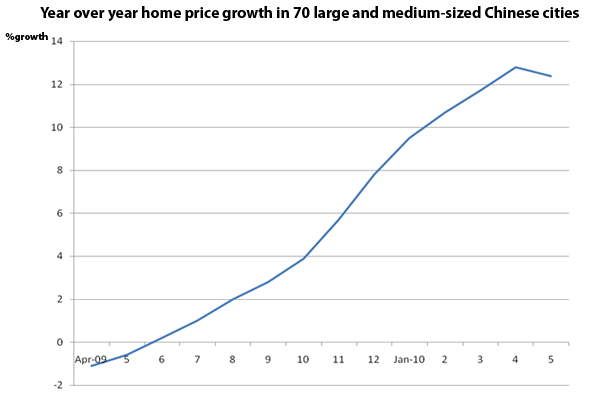
    In March, property prices in 70 Chinese cities soared by a record 11.7 percent from the previous year. In response, the government rolled out a series of measures to curb the domestic housing market amid concerns over asset bubbles.

    In early May, the People’s Bank of China raised the reserve requirement ratio for major banks by half a percentage point. Property stocks were expected to face further decline. Following Beijing and Shenzhen, the Shanghai municipal government released regulations for the property sector to curb housing speculation and soaring prices.

    Some observers worried that tightening policies may deter property developers from starting new projects and purchasing land, thereby cutting the supply and pushing up prices next year. And yet, despite these measures, housing prices rose 12.8 percent in April from a year earlier. At the same time, China’s urban fixed-asset investment increased by 26.1 percent year-on-year to $684.63 billion. The growth rate was 4.4 percentage points lower from the same period of 2009.

    As public concern over “skyrocketing housing prices” continued to simmer, the real estate tycoon Ren Zhiqiang was hit by a shoe at a forum in Dalian. The attacker was fuming over soaring housing prices.

    Last month, home prices in 70 Chinese cities rose by 12.4 percent year-on-year. The growth rate was 0.4 percentage points lower than in April, as property sales in first-tier cities (including Beijing, Shanghai and Shenzhen) contracted following the string of government measures. New home prices rose 15.1 percent year-on-year, down 0.3 percentage points from April.
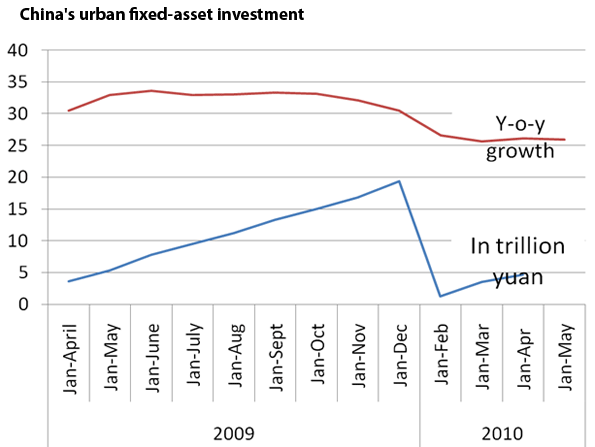
    In a bid to curb soaring prices, the government has tightened scrutiny of developers’ financing, curbed loans for third-home purchase, raised minimum mortgage rates and tightened down-payment requirements for second-home purchases.

    By early summer, new home sales in Beijing were down 70 percent. Property transactions in Shanghai slumped around 70 percent and in Shenzhen by 62 percent month-on-month in May.

    Why have prices soared so frantically and what could be done about it?

    Toward new developments and new business models
    In the West, the great urban centers – from Paris to New York City and Tokyo – evolved into great metropolises in a century or two. In China, the first-tier cities – such as Shenzhen, Beijing, and Shanghai – are morphing into global cities in barely decades.

    Understandably, the residents of the first-tier cities would like to own an apartment in their home city. However, these cities also attract the wealthy across China, prosperous investors in East Asia and multinational property companies worldwide.

    Additionally, the high price-to-rent ratios have been driven by speculation, the desire for long-term investment, and few investment instruments.

    Even buyers contribute to soaring prices. To facilitate the marriage of their son or daughter, parents are often willing to devote their savings to real estate. As the young couple and their parents put income and savings into a purchase of a single apartment, excessive prices are driven even higher.

    In addition to great demand, the soaring prices reflect supply dilemmas. Currently, residential real estate development is geared to high-end and high-margin properties, which ensure a significant cash flow for cities. In the leading cities, the direct and indirect GDP contribution by real estate can amount to some 25-35 percent of the GDP; in other cities, this contribution is relatively higher. Ironically, luxury developments support local incomes, which maintain economic growth nationwide.

    As long as high-end real estate offers high margins where affordable housing does not, regional governments, which possess the land rights, have an incentive to prioritize luxury projects.

    The government seeks to sustain real estate market development and thus to support growth critical for China’s economy. It also seeks to ensure affordable housing vital to Chinese people. As debt problems are escalating in the West, reconciling these goals – economic growth and affordable housing – poses a difficult challenge.
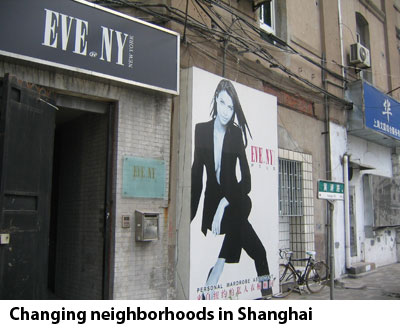
    A shift towards affordable mass-market – reportedly only 10 percent of total residential sales – is critical. In the current business model, high margins come from a very narrow high-end segment of the market. This made sense in the early days of Chinese real estate when only few wealthy people could afford a home.

    Today, far more Chinese are able and willing to acquire a home. A new era requires a new business model, which can be based on the broad middle-class segment of the market.

    Conclusion: China is not Japan déjà vu
    In China’s property markets, some argue that the risks are now so great that a decade of little or no growth, as Japan experienced in the 1990s, can no longer be dismissed. They see parallels with Japan in the late 1980s, when authorities responded to the export slump caused by the revaluation of the yen after the 1985 Plaza Accord. As Tokyo adopted a low interest rate policy to boost an expansion in domestic demand, it also created conditions for a massive economic bubble.

    Yet, contemporary China’s situation is very different. First of all, in China, there remains a large shortage of residential property that meets new living standards.

    In Japan, property price increases were more than 30 percent in the latter half of the 1990s. In China’s prosperous coastal cities, they have been around 12 percent in 2003-2009.

    In Japan, the health of the banks deteriorated rapidly with the asset bubble. In China, the share of non-performing loans declined from almost 20 percent to less than 2 percent in the 2000s.

    In Japan, the asset bubble occurred after the eclipse of the high-growth era. Instead of a potential growth rate of 3-4 percent, China, assuming stability in the international and domestic operating environment, may enjoy relatively high growth for another decade or two. In such circumstances, even rapid price fluctuations in the first-tier cities can be tolerable, even if they are not preferable.
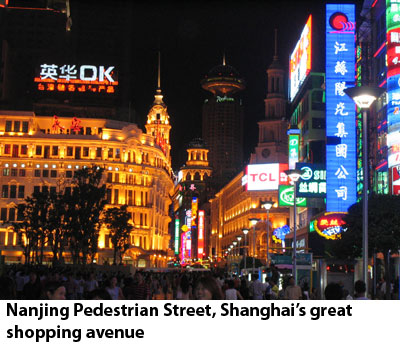
    Ultimately the difference between Japan and China is reflected by demand. Japan in the 1980s was already highly urbanized and its city population was plateauing. In China, the situation is very, very different.

    Today, there are some 360 million urban residents in China. In the next three decades, the figure is expected to grow to 970 million. What Beijing is trying to achieve is unique in history – to create urban space to more than 610 million people, within a single generation.

    In such an environment, periods of overheating will occasionally be accompanied by dramatic price increases.

    China, the urbanization rate is about 45 percent, whereas in Japan and other advanced countries it is more than 80 percent. As these nations reflect very different levels of economic development and different levels of individual prosperity, their real estate markets are different as well.

    Despite its rapid pace of expansion, China’s real estate is still at a very preliminary stage. The marketplace is so colossal that there are no precedents, no simple models.

    Yet the prospects for a robust growth remain intact. The key will be not to allow that growth to become threatened by a property bubble – while providing affordable housing for the rapidly-expanding new middle-class.

    Dr. Dan Steinbock is Research Director of International Business at India, China and America Institute (USA) and Senior Fellow at Shanghai Institutes for International Studies (China). The brief is part of the author’s ongoing project on emerging megapolises worldwide. A highly abbreviated version of the brief has been published by China Daily, China’s leading English-language daily in May.

    Photos and Illustrations: Dan Steinbock and China’s National Bureau of Statistics