Tag: China

  • Decentralized Growth and “Interstate” Highways in China

    Andrew Batston of The Wall Street Journal writes of China’s decentralization, with the growing employment in interior urban areas. Until the last decade, most of China’s spectacular urban population and employment growth had occurred on the East Coast, especially in the world’s largest megaregions of the Pearl River Delta (Hong Kong-Shenzhen-Dongguan-Guangzhou-Foshan-Jiangmin-Zhongshan-Zhuhai-Macao), the Yangtze Delta (Ningbo-Shaoxing-Hangzhou-Shanghai-Suzhou-Wuxi-Changzhou-Nangjing) and Beijing-Tianjin. Millions of migrant workers had traveled to the East Coast from the interior to take jobs paying far more than they could earn at home.

    But that has changed. Industrial production and jobs have expanded substantially in the interior, making it possible for people to take jobs closer to home, in Chongqing, Chengdu, Xian, Changsha, Wuhan, Shenyang, Taiyuan and many more urban areas. This is a fortuitous development, because the mega-regions are already sufficiently populated and could have well grown far larger if the interior development had not taken place.

    However, jobs have become more plentiful in the interior. China’s growing US interstate standard expressway (freeway) system has been an important contributor to this development. Like the US system, there are no grade crossings and all roadways have at least two lanes of traffic in each direction.

    Now, a number of interior urban areas are now within a day’s truck drive of the East Coast ports and those that are not are within two days. According to China Daily, the 65,000 kilometers (over 40,000 miles) of the national expressway system is open. This does not include extensive provincially administered systems, such as in Beijing, where four full freeway ring roads are open and a fifth is at least half complete (Beijing has six ring roads, but the first is not a freeway). Shanghai has an extensive locally administered freeway system, as do some other urban areas.

    By comparison, the US interstate system is approximately 46,000 miles (this excludes 1,000 miles of 2-lane interstate designated conventional highway in Alaska), and a total of 57,000 miles including non-interstate freeways. China is expected to displace the United States in freeway mileage by the end of the decade, when plans call for more than 60,000 miles.

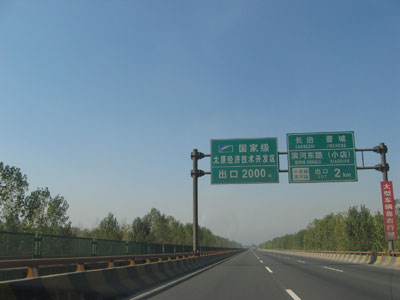
    Photograph: National Expressway Route G-040 near Taiyuan, Shanxi

  • China’s Housing Bubble: Quality Research Required

    It is extremely difficult to find reliable reporting on the intensity of the housing bubbles across China, but this article from the China Post of June 1, 2010 “Economist sees housing market bubble”, appears to be realistic.

    It states that in 2009 the average house price to average annual household income in China was 9.1 times earnings and that it rose to 11.15 during the first two months of 2010. Beijing and Shanghai are reported to have exceeded 20 times average household earnings during early 2010. These figures are from Yao Shujie, head of the School of Contemporary Chinese Studies at the University of Nottingham.

    The article noted that last week, Chinese real estate services company E House China released figures suggesting that house prices to incomes nationwide in 2009 were 8.03 times incomes, but those in Beijing, Shanghai, Hangzhou and Shenzhen were over 14 times household incomes.

    Recently, Wendell Cox of Demographia, working with the South China Post, estimated that the Median Multiple (median house price divided by median household income) for Hong Kong was 10.4 – as reported in this New Geography article Unaffordable Housing in Hong Kong. Because sufficiently reliable data is now available from Hong Kong, it will be included within the Annual Demographia International Housing Affordability Surveys going forward.

    As the Annual Demographia International Housing Affordability Surveys clearly illustrate, house prices do not exceed three times gross annual household incomes in normal markets.

    Rather remarkably, in researching and reporting on the China Housing Bubble, there has been no discussion of the land ownership differences of China and western countries.

    Freehold land is not available in China. The land is leased for a remarkably short term of 70 years. Instead of conventional ground leases in the west where ground rentals are paid, Chinese Local Governments demand an upfront payment of capitalized rental. On this basis, the land interest should be a wasting asset over the term of the lease.

    Rather remarkably – this appears not to be the case in China, where the buying public have convinced themselves (no doubt with encouragement from real estate agents and developers) that at the end of the term of the ground lease, Local Government will simply “gift” the land to home owners!

    On the sound income to house price measure, China’s housing bubble is clearly the worst in the world. When the unsatisfactory and uncertain land ownership issue is factored in as well, it is particularly concerning.

  • Racing China: The Australia Housing Bubble

    “The writing is on the wall for the Australian dream,” according to Professor Joe Flood at the Flinders University Institute for Housing, Urban and Regional Research. That was before recent predictions that Australia’s overheated housing market may be headed for even higher prices. Real estate experts have recently predicted a doubling of house prices in all five of the largest metropolitan areas over the next decade.

    Sydney, the largest metropolitan area, according to Australian Property Monitors (APM), can be expected by 2019 to experience a median house price increase to $1.124 million in 2019. This would double the 2009 figure of $569,000 (Note). Sydney is already the second most unaffordable metropolitan area in the English speaking world , according to our Demographia International Housing Affordability Survey, with a Median Multiple (median house price divided by median household income) of 9.1, trailing only Vancouver. Sydney’s higher priced housing has been blamed for stunting economic growth and job creation and appears to be a major factor in the continuing migration out of the state of New South Wales. One of Australia’s leading demographers, Bernard Salt, has projected that Sydney could fall to second largest in the nation, behind Melbourne in less than 20 years.

    Melbourne median house prices are also expected to rise above $1.1 million according to projections by property expert Michael Yardney. This would represent more than twice the $480,000 price in 2009.

    Brisbane, which has generally been less unaffordable than Sydney, would have a median house price equal to that of Sydney by 2019. This is more than double the 2009 price of $430,000.

    Perth would experience the greatest house price inflation, also rising to above $1 million, compared to the 2009 figure of $460,000.

    Adelaide would also see house prices rise to more than $1.2 million, according to APM. In 2009, the median house price in Adelaide was $370,000.

    Australia’s Race with China: Recent data indicates that prices are rising furiously toward the doubling the experts have projected. The Australian Bureau of Statistics (ABS) House Price Index indicates that prices have risen 20% over the past year. This is more than 1.5 times the 12% annual rate posted in China’s house price bubble that has its government and so many of the world’s leading economists so concerned.

    As of the 1st quarter, the greatest annual price inflation was in Melbourne, at 28%, a rate that would place it 3rd out of 70 metropolitan areas if it were in China. Prices in Sydney were up 21% from a year ago, which would also rank it 3rd out of 70 in China. At this rate, Sydney could become less affordable than Vancouver within six months and could even surpass high-priced Hong Kong. Brisbane, Adelaide and Perth all experienced price increases between 10% and 15%, and would all place in the top 20 out of 70 Chinese metropolitan areas.

    ABS indicated that the house prices increased more than in any other annual period in the 8 year history of its House Price Index. According to the Wall Street Journal’s Marketwatch, Economist Glenn Maguire of SocGen Asia Pacific in Hong Kong said “These are bubble like numbers … It’s the type of return that basically encourages speculation.” Marketwatch also predicted, on the basis of the house price trend, that the Reserve Bank of Australia (RBA) would raise interest rates, which it did a day later.

    Working for the Mortgage: Meanwhile, because variable rate mortgage loans predominate in Australia, the interest rate increase places an immediate burden on thousands of Australian households. The Housing Industry Association indicates that interest rate increases over the past six months will result in a first-home buyer mortgage payment increase of more than $300 per month.

    This is not good news for the large numbers of households already in mortgage stress, defined by the government when 35% or more of the budget goes to housing expenses. Just six months ago, a median income household purchasing the median income house in Sydney or Melbourne would have had mortgage payments that consumed 50% to 57% of their gross income. Now, the figure would be 60% to 67%. Needless to say, the median priced house is well beyond the means of the median income household. By contrast, if Melbourne and Sydney had the same housing affordability as faster growing Atlanta and Dallas-Fort Worth, the median income household would pay at least $25,000 less in annual mortgage payments for the median priced house.

    Rigging the Market: The housing affordability crisis is the direct result of excessive land use regulations that have artificially limited the supply of land, driving up house prices and fostering speculation. Before these regulations (called “urban consolidation” or “smart growth”) were adopted, housing was as affordable in Australia as in Atlanta or Dallas-Fort Worth. Median Multiples across the nation were 3.0 or below. Now the Median Multiple is between 6.7 and 9.1 in the five largest metropolitan areas. Analysts often suggest that Australia’s population growth rate is driving up prices. While Australia is growing, it grew faster over the 20 years following World War II, and still accommodated a quickly increasing home ownership share. Further, much faster population growth in Dallas-Fort Worth and Atlanta has not driven prices up. Since 2000, these two American metropolitan areas added 40% more population than the five largest Australian metropolitan regions, despite having a smaller combined population.

    This also impacts the other side of the housing equation, the ability of consumers to afford mortgages. The Urban Task Force says that Sydney’s especially onerous regulations have driven up the price of consumer goods while dampening income and employment growth. Australian Property Monitors economist Matthew Bell says that the answer to the housing affordability problem is to increase the supply of housing, a view shared by the Reserve Bank of Australia. The political reality, however, suggests that “The shortages are going to get much, much worse in Sydney” as Jason Anderson, a senior economist with BIS Shrapnel told Agence France-Presse.

    Professor Flood noted that “The country that promised limitless land, cheap housing and near universal home ownership to all comers now has the most expensive housing in the world amid very tight housing and land markets and little prospect of restoring the balance.” Flood’s research indicates a dramatic decrease in home ownership among younger households over the past 20 years.

    Alternate Futures

    Not everyone thinks that house prices can continue their stratospheric rise. US investment expert Edward Chancellor believes that the housing market is overdue for a price collapse, noting that house prices are well above historic measures. Chancellor won the George Polk award for his 2007 article Ponzi Nation, which warned of the housing collapse in the United States and the international damage that could follow. Of course, a housing collapse in Australia would have much less impact on international markets than the one that rocked the much larger US economy, but could do great damage at home.

    The good news is that house prices could be brought under control if there was a change in policy. The state government of Victoria (Melbourne is the capital) is about to significantly expand its “urban growth boundary, allowing more house construction and lower new house prices. Policies such as these could provide a preferable soft landing for the housing market. But this would require state and local governments finally to turn their backs on 20 years of devastating social engineering.


    Note: The Australian dollar is currently worth about US$0.90. The latest (2008) data indicates that Australia had a gross domestic product of $37,400 per capita (purchasing power parity), which compares to $46,500 in the United States, according to the OECD.

    Wendell Cox is a Visiting Professor, Conservatoire National des Arts et Metiers, Paris. He was born in Los Angeles and was appointed to three terms on the Los Angeles County Transportation Commission by Mayor Tom Bradley. He is the author of “War on the Dream: How Anti-Sprawl Policy Threatens the Quality of Life.

    Photograph: Detached housing conforming to plan in suburban Perth

  • Shanghai: The Rise of the Global City

    The opening of the World Expo heralds Shanghai’s coming of age, the rising economic might of China, and the financial power of Asia’s legendary metropolis.

    But that’s only part of the story. The World Expo also reflects the rise of Shanghai as a global city and the intensity of competition among emerging Chinese mega-cities.

    At the eve of the World Expo, Shanghai was buzzing with anticipation and excitement. Presented by 192 countries and 50 international organizations, the World Expo will continue for six months. It will also be the largest world exhibition ever and is expected to attract 70 million visitors from home and abroad.

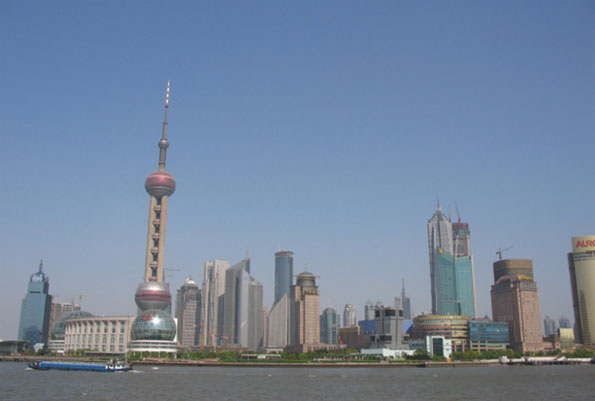
    With a population of over 20 million people, Shanghai is a hugely popular tourist destination renowned for its historical landmarks such as the Bund with its historical buildings lining the Huangpu River. In turn, Shanghai’s increasing financial power and China’s rapid economic development is reflected by the ultra-modern and ever-expanding Pudong skyline, with the Oriental Pearl Tower, the Jin Mao, and the 492-meter (1,614 ft) World Financial Center.

    For foreign sinologists, the World Expo heralds not only the resurgence of the great metropolis, but the “comeback of the city’s brash patrons.” In reality, Shanghai’s comeback started in the early 1990s, and today the resurgence of the colossal city may still be in its infancy.



    China Pavilion Preview
    Theme: Chinese Wisdom in Urban Development
    The main structure of the China Pavilion, “The Crown of the East,” has a distinctive roof, made of traditional dougong or brackets, which date back more than 2,000 years.



    Shanghai Pavilion
    Theme: New Horizons Forever
    Taking the form of Shikumen, Shanghai Pavilion seeks to blend history and modernism, the East and the West.

    In 2005, the wealthiest metropolises, as measured by their estimated GDP, were still led by the great urban centers of the leading advanced economies. By 2020 a third of these wealthy cities will be in the large emerging economies. Shanghai‘s strategic position at the mouth of the Yangtze River has made it an ideal location to assume a position in the urban paragon.

    In fact, Shanghai and the Yangtze River Delta already constitute one of the largest concentrations of adjacent metropolitan areas in the world. It is the home to some 80-90 million people with GDP (PPP) of some US$2 trillion, or about the economic size of France. However, unlike France, which is growing at the rate of 1-2 percent in 2010-2011, Shanghai enjoyed a double-digit growth in 1992-1997 and continues to grow at about 8-9 percent per year.

    Shanghai’s Resurgence

    Originally a fishing and textiles town, Shanghai grew to importance in the 19th century. The rapid development of the city began in the aftermath of the Opium War of 1840 when the Western powers forced China to open five of its coastal cities, including Shanghai, to foreign trade. The colonial powers forced the weak Qing government to sign treaties granting them the right to establish foreign concessions. In Shanghai, the part of the city proper west of the Huangpu River grew ever larger in size, whereas Pudong on the east side of the river was left untouched.

    Back in 1918, founder of the Republic of China, Dr. Sun Yat-sen put forward the idea of building a major harbor in East China with Pudong as its base. By the 1920s and the early 1930s, Shanghai was a major center of international trade and finance in the East Asian region.

    Shanghai’s Pudong and the Lujiazui Financial District
    In the late 1930s and 1940s, Shanghai was engulfed by one calamity after another. First it was battered by the currency crisis in 1935, the Sino-Japanese War starting in 1937, the onset of the Pacific War in late 1941 and, in the aftermath of World War II, the Civil War (1945-1949).

    After the declaration of the People’s Republic of China in 1949, most foreign firms moved their offices to Hong Kong, as part of an exodus of foreign investment. As Shanghai fell into a historical oblivion, Hong Kong thrived. The “Pearl of the Orient” lost its position as East Asia’s main financial center.

    During the 1950s and 1960s, Shanghai was transformed into an industrial center. It paid a crippling price in terms of taxes; until 1990, one-sixth of the central government’s revenue came from Shanghai. After China embarked on its open-door policy in the early 1980s, things began to change. After decades of neglect,there rose a resurgence of trade and investment.

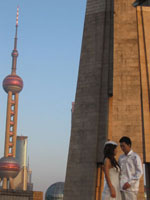
    A Wedding Couple by the People’s Heroes Memorial on the Bund
    The great transformation came in the early 1990s, when Deng Xiaoping declared that Shanghai would be “the head of the dragon” pulling the country into the future. The development of Pudong helped to restore Shanghai’s historical role for the Yangtze River Delta and, more broadly, to China.

    In a whirlwind of two decades, Shanghai increased its role in finance, banking, and as a major destination for corporate headquarters. It became a major lure to the highly educated portion of China’s workforce.

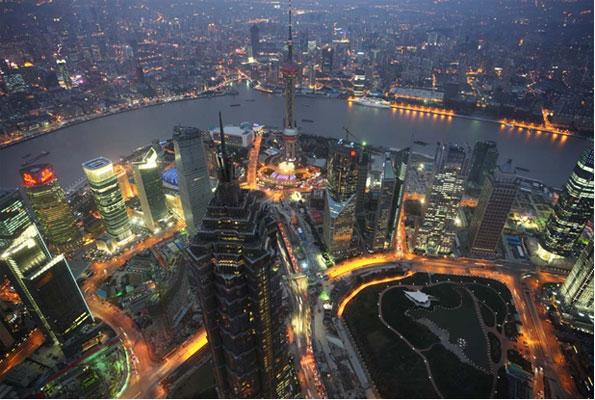
    Dusk in Pudong’s Financial District
    Tale of Two Cities

    Since the early 2000s, Shanghai and Hong Kong have increasingly been seen as rivals for the economic center of the Greater China region. Hong Kong has the advantage of a less opaque legal system, international market integration, broader economic freedom, greater banking and service expertise, lower taxes, and a fully-convertible currency. Shanghai has stronger links to both the Chinese interior and the central government, and an impressive base in manufacturing and technology.

    Since the late 1990s, Shanghai has been booming and thriving, while Hong Kong, despite its historical wealth and capabilities, has been haunted by anxiety and doubt over the future. Yet Hong Kong remains one of the world’s great financial centers. According to Financial Development 2009 by the World Economic Forum (WEF), Hong Kong ranks 5th worldwide in terms of financial sector development. Along with Tokyo and Singapore, it stands as one of the premier financial centers in Asia.

    With the recent global financial crisis, Asian cities are closing in on London and New York as leading financial centers. Although still behind Hong Kong, Shanghai has been catching up.

    The financial strength of Hong Kong has been boosted by decades of globalization. The rise of Singapore as a financial center has been also driven by determined government policies and multinational investment. Shanghai’s emergence as a future financial hub has been shaped by similar forces: years of financial reforms and multinational investment and more recently, a strong support by the central government.

    In early 2009, China’s State Council approved Shanghai’s plans to position itself into one of the world’s leading financial and shipping centers by 2020. A month later, five major trading cities – including Shanghai – got the nod from the central government to use the yuan in overseas trade settlement, which reflects China’s recent, gradualist moves to expand the use of its currency globally.

    In the long term, China will play a major role in the emerging global financial architecture. What is less certain is how this emergence will shape the roles of Shanghai and Hong Kong. Already Shanghai’s stock market is worth more than Hong Kong’s, but the city’s financial sector lacks Hong Kong’s depth and the breadth. Hong Kong has an active financial futures market, whereas Shanghai trades commodities futures. In fixed income markets, Hong Kong is far more active in global bonds than Shanghai, which is far more active in domestic currency trading.

    A big barrier: the Hong Kong dollar can be traded freely in international markets, whereas China’s RMB is not fully convertible. But over time this barrier will dissolve. Hong Kong’s regulatory system is considered independent and transparent, whereas Shanghai’s whereas Shanghai’s regulator is part of the government’s state council. In addition to the regulatory regime, there are substantial systemic differences with legal system and taxation.

    In the future, some observers expect China to have a single dominant financial center. Others believe that, due to China’s massive size, multiple centers are conceivable. In the third scenario the assumption is that, in the medium-term, Shanghai and Hong Kong will co-exist as complementary centers. But in the long-term, Shanghai will become China’s international financial center.

    Competition of Chinese Cities

    As can be seen in other parts of the world, there is increased competition among China’s cities. But since the number and scale of Chinese cities is far higher relative to their counterparts in advanced economies, the implications of Chinese urban rivalry are broader and global.

    Having suffered relative decline since the establishment of the People’s Republic of China, Shanghai’s population base increased faster relative to other cities only briefly during the massive infrastructure projects of the 1990s. Economically, Shanghai is still growing, but doing so more slowly relative to other Chinese first-tier cities such as Beijing, Shanghai, Guangzhou, Shenzhen, and in particular the emerging second-tier cities such as Chengdu, Dalian, and Shenyang. In the footprints follow the third-tier cities from Harbin to Ningbo and the fourth-tier cities from Kunming to Hefei.

    The criteria for these tiers comprise GDP per capita adjusted to purchasing power parity, level of economic development, property markets, foreign direct investment, distance to ports, and so on. As productivity levels are increasing in the more prosperous cities, the old low-margin industries are migrating to poorer regions. The process of migration predates the global crisis, but the latter has amplified it. Today, Shanghai’s growth model is predicated increasingly on innovation and high-value industries.

    Yet despite the rise of second and third tier cities, the true competition for global financial preeminence in China will boil down to a contest between Shanghai and Hong Kong. However, it may not result in a win-lose scenario. As Shanghai is evolving into China’s global financial hub, Hong Kong’s efforts to accelerate IPOs and regional innovation and the proposed merger of Hong Kong and Shenzhen could support a Nasdaq-like stock exchange in the future Pearl River Delta Metropolis.

    Meanwhile, China is giving rise to a number of megacities, which seek for specialized competitive advantages. The central government is urging and providing incentives for the wealthiest urban centers to cooperate with other cities in order to accelerate urban growth regionally. Shanghai is no exception; emulating the lessons of the Pearl River Delta, it is boosting the regional innovation system in its Yangtze River Delta.

    Shanghai’s advantage lies in its size and industrial diversity, the competitiveness of several manufacturing subsectors, and the emergence of business services. At the same time, Shanghai’s expanding technological capabilities are being nurtured by a deepening pool of human capital, increasing R&D, FDI in high-tech activities, and the openness of the city to the rest of the world. The dynamic megapolis is driven by a growing middle class, which is feeding a nascent demand for innovation. With its advanced services, large population base, and China’s largest retail sales, Shanghai is well-positioned to emerge as China’s premier business city.

    Just as New York City exemplified the strengths and aspirations of emerging America in the 20th century, Shanghai, perhaps more than any old or emerging rival, will personify the capabilities and dreams of rising Asia in the 21st century.

    Dr. Dan Steinbock is research director of international business at the India, China and America Institute (USA). He currently also serves as senior fellow at the Shanghai Institute for International Studies (SIIS), and visiting professor at the Shanghai Foreign Trade Institute. He focuses on the post-crisis integration of G-7 and BRIC economies worldwide and advises companies, governments and municipalities on issues of competitiveness and innovation. He divides his time between New York City, Shanghai and Guangzhou, and occasionally Helsinki, Finland.
  • A Carbon Added Tax, Not Cap and Trade

    Paul Krugman devoted a recent lengthy New York Times Magazine article to the promotion of a disastrous “cap and trade” regime for reducing carbon emissions. Though he doesn’t outright endorse it, he strongly suggests that the Waxman-Markey bill that passed the House would be acceptable to him. Krugman then proceeds to pooh-pooh the carbon tax idea, one that I believe has far more merit.

    Cap and trade would be a debacle for a slew of reasons. The most important is that it won’t even reduce carbon emissions. Two of the EPA’s own San Francisco attorneys dismissed the Waxman-Markey cap and trade regime as a “mirage” that would not reduce carbon because of the ability of polluters to obtain fictitious carbon offsets, among other problems.

    Even if cap and trade would require American producers to reduce carbon emissions, it would do nothing about overseas polluters. An American manufacturer could escape cap and trade simply by moving production to China. Given China’s massive coal-based electricity infrastructure and other notoriously polluting practices, carbon emissions would likely only get worse as a result, in addition to the US jobs lost.

    Krugman suggests this can be fixed with a carbon tariff, but that’s dangerously naïve. There’s no guarantee a carbon tariff would be put in place after cap and trade passed. In effect, it requires two completely separate policy mechanisms be put in place and kept synchronized over time, which seems dubious. Our trading partners would surely chafe at any carbon tariff, which would be vulnerable to challenge under international trade treaties.

    Cap and trade also has huge distortive impacts within the United States. The Brookings Institution crunched the numbers and found that cap and trade costs vary widely across the country. Compliance costs would be minimal in California and rest of the West and Northeast, while the Midwest, Mid-Atlantic, and the South get pummeled. It should come as no surprise that it is California Rep. Henry Waxman who’s pushing the bill. One can’t help but suspect these regional disparities are the real implicit goal of the bill. Indiana Gov. Mitch Daniels denounced cap and trade as “imperialism”.

    Perhaps the most diabolical part of cap and trade is in its very name. The operative word is “trade”. Who do you think will be doing the trading? Why, none other than the very people who got us into the economic mess we’re in today. Cap and trade is a gigantic giveaway to Goldman; it’s yet another instrument for speculation; it’s another way for the profiteers on Wall Street to line their pockets at our expense.

    So in a sense it’s also another way that, perhaps unintentionally, the richest sectors, the upper classes, and the financial centers like New York, Boston and San Francisco are being favored over the poor Main Street rubes who have taken it on the chin during this recession without a bailout. If you think things are bad now, just wait until CDS stands for “carbon default swap”. It’s pouring fuel on the fire of inequality between the haves and have nots.

    Cap and trade is nothing more than another tranche in the never-ending merry-go-round of bailouts for the financiers. And didn’t we learn anything from Enron’s electricity trading shenanigans? When an Iowa farmer opens up in his electric bill that’s suddenly spiked, or has to pay double to fuel his farm equipment, it’s not too much to ask that it be in the service of actual carbon reduction, not houses in the Hamptons, owned by people to whom the added cost is not material given their wealth.

    There is a better way, and that’s the Carbon Added Tax. Similar to a European-style Value Added Tax, a CAT tax would directly tax the quantity of carbon emissions added to the atmosphere in each stage of the production cycle. The tax could be set at a level that would provide certainty of price such that investments in lower carbon technologies are financially feasible right now, not decades from now.

    Also, similar to the US income tax system, the CAT would apply to the carbon emitted globally, not just in the United States. A deduction would be permitted for any bona fide carbon taxes paid in a foreign jurisdiction, up to the level of the US tax. A true-up on the carbon tax due would be paid at the point of import into the United States. That is, an importer would have to pay the CAT on products brought into the country, less any deductions for foreign carbon taxes paid, at the port of entry.

    While this global approach is a widely, and correctly, maligned feature of the US income tax code, it has important benefits from a carbon reduction perspective. First, it is location neutral. Since the tax is the same whether the carbon is emitted in China or the United States, it doesn’t encourage business to move offshore. But it also doesn’t discriminate against foreign producers. (Like any anti-carbon regime, it would raise costs in the US, affecting both domestic consumers and the competitiveness of exports).

    The CAT is also functionally equivalent to a carbon tariff, but is a unitary regime. That is, you don’t have to figure out how to bundle in or pass a separate carbon tariff as part of implementing a domestic cap and trade system. You simply pass a CAT on global carbon emissions and you are done.

    And this system allows each country to decide on its own level of carbon taxation. If countries like China want to have no tax, that’s their choice. Or, European countries could decide to have a higher tax. The complexity would come in figuring out the allowed deductions for emissions in countries that adopted other schemes like cap and trade, but this should be a readily solvable technical issue.

    There will still be divergent regional domestic impacts under a CAT. This is unavoidable in a nation where carbon emissions are unevenly distributed. But by preventing the financiers from skimming off the top, the total burden is reduced, and a CAT is a more location neutral, transparent mechanism for carbon reductions.

    A Carbon Added Tax is a far superior way to reduce carbon emissions than a cap and trade system only a Wall Street trader could love.

    Aaron M. Renn is an independent writer on urban affairs based in the Midwest. His writings appear at The Urbanophile.

    Photo by Gilbert R.

  • Contemporary China’s Mirror Image: Imperial Germany

    China has emerged as the bad boy on the global scene, pushing around executives at Rio Tinto, attacking Google, and humiliating Barack Obama at the Copenhagen Climate Talks. Speculation is growing about China’s rising power and the country’s leaders are displaying a discouraging sense of hubris. There is growing fear that the autocratic Middle Kingdom will soon dominate the world.

    These fears have parallels with another rising power of a century ago: Imperial Germany. Both emerged quickly on the global scene and did so with an enormous chip on their shoulders. Like China today, Germany was a little late coming to the industrial revolution, though its cultural contribution to European civilization and in turn to American civilization was enormous (Ralph Waldo Emerson was passionate student of Goethe). Only after its final unification and triumph over the French in the Franco-Prussian War of 1871 could Otto von Bismarck, the great 19th century pragmatist, force Germany’s sundry states into union.

    Again like China, once united and in control of its own destiny, Germany grew quickly, harboring ever more delusions about its place in the sun. In the years leading to the First World War Wilhelm I, the competent Bismarck confidant, died of cancer. This allowed vainglorious Wilhelm II to assume the mantle of the state in 1888. Prussian militarism by then was backed by a massive industrial machine operating in complete fealty to the state. Germany’s new Emperor and his clique felt that it had something to prove.

    China, once the most advanced nation on earth, similarly has a passel of historical resentments ranging from the Opium War to the complete denigration of its standing in the world. Like Germany, China has viewed itself as an advanced culture whose time had now arrived. Like Germany in the late 19th Century, it has incorporated technologies from others about as fast as it could get its hands on them.

    When Deng Zhao Ping awoke China from its Maoist/Stalinist nightmare that ripped through the country under the guise of the Cultural Revolution, they were confronted with the disintegration of communist governments around the world. Chinese leaders knew that the only way to for them to hold power was to have their economy grow. This approach parallels the economic pragmatism in late Imperial Germany under Bismarck and the Hohenzollerns, who pushed economic growth as a means of promoting social welfare while simultaneously doing all they can to consolidate power in their hands. Bismarck created the first social security system not out of a deep seated concern for the proletariat but to emasculate the socialist party.

    China by the same token has not adopted capitalism because they want to move the country towards rule of law and greater democracy but as a means of justifying their continued presence at the country’s helm. China, much like Imperial Germany, has witnessed unbelievable growth because of these centralized policies.

    On the eve of WWI, Germany was the second largest economy in the world after shooting ahead of Britain and trailing America. China just accomplished a similar feat in an even shorter time frame. China passed contemporary Germany a couple of years ago and is poised to do so with Japan in the coming year. China is cultivating a modern-style imperial prescence in Iran, Africa and Latin America in an effort to secure the natural resources that the country lacks much like Germany did. Ironically, China is doing more to raise living standards in Africa than any western aid program has been able to do.

    German industrial bosses were elites, most bore the titles of nobility. China’s bosses have been compared to the Emperor’s corrupt courtesans. The vast wealth of the Thyssen and Krupp steel dynasties can still be seen today in the massive industrial museums lining the Ruhr Valley. As in Imperial Germany, the military dominates large swaths of the economy. Germany in the late 19th and early twentieth century used its coal and iron resources to build the munitions factories that lined the despoiled Ruhr and Rhine. Holding even tighter on the reigns, China has developed an a strong state-dominated economy, forcing, for example, foreign firms to enter a joint venture with a state-owned corporation, which will quickly steal what it can of the western company’s intellectual property.

    The two governments bear disturbing similarities. Germany also had a vast bureaucracy attempting to tamp down any sedition amongst its masses. China is doing much the same. The most interesting parallel however is the rampant nationalism propagated in both Imperial Germany then and contemporary China.

    Of course, there are also some significant differences. China, for example, is much larger than Germany ever was. China is also not necessarily as instinctively expansionist . But it is extremely sensitive when it comes to Taiwan. The kerfuffle over arms sales to Taiwan last month provides more than enough evidence of this. Germany also had territories that it got very sensitive about as well. China’s attitude towards Taiwan and Tibet echoes the Kaiser’s sentiment towards occupying Strasbourg along the French border.

    Is China going to attack its neighbors and plunge the Pacific Rim into World War Three? It seems highly unlikely. China still has a lot of growing left to do. Large swaths of the peasantry are still stumbling along at poverty levels. China is also well aware of the US military’s ability to project force should it try to attack Taiwan.

    China may want to occupty Taiwan and there is none of the rhetoric among the leadership cadre about the need for Lebensraum that dominated conversations in German salons before the Great War. China’s leadership also appears far more competent than that of late Imperial Germany. But this may have to do with dumb luck. The Hohenzollerns up until Wilhelm II were all competent leaders. Could China be so unlucky as well? Could one idiot weasel his way up through the CP ranks? Who knows?

    China has serious problems with restive minorities and a growingly arrogant and repressive regime. It has industrial might, a massive resentment of western powers and a desire to get its own place in the sun. It does not have the same geographical pressures that Germany had and it is still not in any position to take on the US in the military theater and its rulers realize that. Though its economy is inflating, much of the population living below the poverty line.

    So far the technocrats over the last thirty years have been freakishly capable and have generally done a good job. The real trial of China’s claim to its place in the sun will be when a blustering fool like Kaiser Wilhelm weasels his way into the party chairmanship. Just as Germany was powerless to dispose of its ill-suited leader, China may very well be as well. If that happens, God help us all.

    Kirk Rogers resides in Bubenreuth on the outer edges of Nuremberg and teaches languages and Amercan culture at the University of Erlangen-Nuremberg’s Institut für Fremdsprachen und Auslandskunde. He has been living in Germany for about ten years now due to an inexplicable fascination with German culture.

    Photo by Artshooter

  • The Asian Urban Ascendancy

    Urbanization doubtlessly has been the most significant demographic trend in the world for at least a century and promises to become even more significant in the future. The trend began in the United States and Western Europe as people moved by the millions from the countryside to the urban areas, where employment and a better life were possible.

    World Urbanization: By 1950, approximately 30% of the world’s population lived in urban areas (that is they did not live in rural areas). The number has passed 50% in the last few years and the United Nations estimates that 60% of the population will live in urban areas by 2030. Today, China has approximately the same urban population share as did the United States 100 years ago (45%), and will reach 60% by 2030. Even with its slow population growth, China will add 270 million people to its urban areas by 2030. Only 30% of India’s population is urban, which will increase to 40% by 2030. This apparently modest increase will amount to 250 million new urban residents. Thus, combined, China and India will add about 60% more population to their urban areas than live in the United States today.

    As late as 1950, 10 of the world’s 20 largest urban areas were in the United States or Europe. Asia accounted for 6. There was only two “megacities” (urban area with a population of more than 10 million), New York and Tokyo. Over the next 50 years, Tokyo signaled the urban ascendancy of Asia, adding more than 20 million people, a larger population than lived in the second largest urban area in 2000.

    Demographia World Urban Areas: The continuing Asian urban ascendancy is illustrated in our 6th Annual Edition of Demographia World Urban Areas. This list includes all identified urban areas (Note) in the world with more than 500,000 population, and, unlike other lists estimates the urban land area and population density of each.

    Things have changed markedly since 1950. Now, 13 of the 20 largest urban areas in the world are in Asia. Only three are in the United States or Europe (New York, Los Angeles and Moscow). For the first time in at least 200 years, none of the top 5 urban areas in the world are in the United States or Europe. Now, all five of the largest urban areas in the world are in Asia. There are now 26 megacities, up from 2 in 1950. At current growth rates, there could be 39 megacities by 2030, only five of which will be in the United States or Europe (New York, Los Angeles, Moscow, Paris and Chicago)

    Tokyo remains the largest urban area (35.2 million) in the world, far larger than any other. Yet, with a slow growth rate, Tokyo is predicted to increase to only 36.0 million by 2030 and could be displaced by Jakarta.

    Jakarta is estimated to be the world’s second largest urban area, with 22.0 million people. This is a larger population than indicated on some lists, which fail to include all of the suburbs within the urban footprint. At currently projected growth rates, Jakarta could edge out Tokyo to become the largest urban area in the world by 2030, at 37.0 million. Jakarta is also unique in having adopted an official metropolitan area name, Jabotabek (taken from JAkarta, along with the large suburban municipalities of BOgor, TAngerang and BEKasi).

    Mumbai ranks third with a population of 21.3 million. Some demographers expect that Mumbai could become the largest urban area in the world eventually. The trends suggest that it will not even prevail as India’s largest urban area, falling to fifth in the world, behind Delhi. Currently projected growth rates indicate a population of 31.4 million by 2030.

    Delhi is the fourth largest urban area, with a population of 21.0 million. Like Jakarta, Delhi’s population is often under-estimated by limiting its urbanization to the National Capital Territory. However, the large, adjacent suburbs of Faridibad, Ghaziabad and Nodia add considerably to estimates. At projected growth rates, Delhi could have 32.8 million people by 2030 and be ranked as the fourth largest urban area in the world.

    Manila ranks fifth and is another urban area often characterized as having a smaller population than the reality. Various lists confine Manila to the National Capital District, which has about 11 million people. This is rather like thinking of the Toronto area as confined within the city limits of Toronto, missing half of the urban area population. In fact, the urban organism in Manila (and Toronto) extends to where the rural areas begin, and that gives Manila a population of 20.8 million. The currently projected growth rate indicates that Manila could reach 34.1 million by 2030, to rank third in the world.

    Predictions are Just Predictions: Of course projections are speculative and often do not come true. Before the 1985 earthquake, for example, many demographers expected Mexico City to become the largest urban area in the world. Since that time, Mexico City has grown, but not at the spectacular rate that was expected. In 1985, Mexico City was the third largest urban area in the world. Today Mexico City ranks 9th and could fall to 12th by 2030.

    New York, which had been the perennial leader from early in the 20th century to 1950, fell to 6th place in 2010 and looks likely to fall further, to 10th in 2030. London, which had led the world from the early 19th century until New York assumed the top position, fell from 3rd place in 1950, to 29th in 2010 and could fall to 46th by 2030.

    Urban Land Area: Housing and serving 10 million or more people takes a lot of space. The New York urban area covers the largest land area in the world, at 4,300 square miles (11,300 square kilometers), followed by Tokyo (3,400/8,700), Chicago (2,300/6,000), Los Angeles (2,200/5,800) and Boston (2,100/5,500). Another 17 urban areas cover more than 1,000 square miles or 2,500 square kilometers (such as Paris, Sao Paulo, Mexico City and Buenos Aires).

    Urban Density: Dhaka, the capital of Bangladesh, has been growing very rapidly and especially its high-density slum or shanty town population, which can reach densities as high as 2,500,000 per square mile (1,000,000 per square kilometer). Dhaka is estimated to be the densest urban area in the world, with more than 100,000 people per square mile (40,000 per square kilometer). The “historical accident” city-states of Hong Kong and Macao are in a virtual three way tie with Mumbai (65,000/25,000), followed by Surat (India) at 55,000/21,000. The highest US urban area density is in Los Angeles, at 6,400/2,500; while Western Europe’s highest urban area density is in Madrid, at 14,100/5,400.

    Of course, as the Dhaka case indicates, average densities can mask huge variations. The differences in density (density gradients) tend to be the greatest in developing world urban areas, where shantytown densities can be substantially greater than the Lower East Side of New York in 1910. However, average urban densities are the appropriate overall density measure for the urban organism, which includes everything from the core of the urban area, through the suburbs, ending at the countryside.

    Of Urbanization and Aspiration: Much has been written about the challenges of urbanization and it is clear they are accelerating. UN estimates indicate that virtually all of the population increase in the world will be in urban areas between 2010 and 2030. There is a simple reason for this. The urban areas are far better places to live, even for low income people, than rural areas. This is because urban areas have strong economies. If conditions were better outside the urban areas, then the millions who have migrated to the favelas of Rio de Janeiro and Sao Paulo would long since have returned to their roots in northeastern Brazil. Jakarta and Karachi would be emptying out. Urban areas will continue to grow strongly, because people are driven by their aspirations, which are far better served in the urban areas.


    Note: An urban area is an urban agglomeration or an urban footprint (area of continuous development). An urban area is the organism of the “city” in its spatial dimension. A metropolitan area is the organism of a city in its economic dimension and includes labor market areas that extend beyond the urban area. Census authorities in a number of nations have adopted similar definitions for urban areas (Examples are United States, Canada, United Kingdom, France, Norway, Sweden and Australia). Demographia World Urban Areas uses national census bureau data for both population and land area estimates where it is available and estimates urban land area from satellite imagery for all others, applying the international urban area criteria to the greatest possible extent.

    Photograph: Suburban Manila

    Wendell Cox is a Visiting Professor, Conservatoire National des Arts et Metiers, Paris. He was born in Los Angeles and was appointed to three terms on the Los Angeles County Transportation Commission by Mayor Tom Bradley. He is the author of “War on the Dream: How Anti-Sprawl Policy Threatens the Quality of Life.

  • What American Demographics Will Look Like in 2050

    To many observers, America’s place in the world is almost certain to erode in the decades ahead. Yet if we look beyond the short-term hardship, there are many reasons to believe that America will remain ascendant well into the middle decades of this century.

    And one important reason is people.

    From 2000 to 2050, the U.S. will add another 100 million to its population, based on census and other projections, putting the country on a growth track far faster than most other major nations in the world. And with that growth — driven by a combination of higher fertility rates and immigration — will come a host of relative economic and social benefits.

    More fertile

    Of course the percentage of childless women is rising here as elsewhere, but compared to other advanced countries, America still boasts the highest fertility rate: 50 percent higher than Russia, Germany or Japan, and well above that of China, Italy, Singapore, Korea and virtually all of eastern Europe.

    As a result, while the U.S. population is growing, Europe and Japan are seeing their populations stagnate — and are seemingly destined to eventually decline. Russia’s population could be less than a third of the U.S. by 2050, driven down by low birth and high mortality rates. Even Prime Minister Vladimir Putin has spoken of “the serious threat of turning into a decaying nation.”

    In East Asia, fertility is particularly low in highly crowded cities such as Tokyo, Shanghai, Tianjin, Beijing and Seoul. And China’s one-child policy — and a growing surplus of males over females — has set the stage for a rapidly aging population by mid-century. South Korea, meanwhile, has experienced arguably the fastest drop in fertility in world history, which perhaps explains its extraordinary, if scandal-plagued, interest in human cloning.

    Even more remarkably, America will expand its population in the midst of a global demographic slowdown. Global population growth rates of 2 percent in the 1960s have dropped to less than half that rate today, and this downward trend is likely to continue — falling to less than 0.8 percent by 2025 — largely due to an unanticipated drop in birthrates in developing countries such as Mexico and Iran. These declines are in part the result of increased urbanization, the education of women and higher property prices. The world’s population, according to some estimates, could peak as early as 2050 and begin to fall by the end of the century.

    Younger and More Vibrant

    Population growth has very different effects on wealthy and poor nations. In the developing world, a slowdown of population growth can offer at least short-term economic and environmental benefits. But in advanced countries, a rapidly aging or decreasing population does not bode well for societal or economic health, whereas a growing one offers the hope of expanding markets, new workers and entrepreneurial innovation.

    In fact, throughout history, low fertility and socioeconomic decline have been inextricably linked, creating a vicious cycle that affected such once-vibrant civilizations as ancient Rome and 17th-century Venice and that now affects contemporary Europe , Russia and Japan.

    Within the next four decades, most of the developed countries in both Europe and East Asia will become veritable old-age homes: a third or more of their populations will be older than 65, compared with only a fifth in the U.S. By 2050, roughly 30 percent of China’s population will be older than 60, according to the United Nations. The U.S. will have to cope with an aging population and lower population growth, in relative terms, but it will maintain a youthful, dynamic demographic.

    More Hopeful About the Future

    The reasons behind these diverging trends is complex. In some countries, a sense of diminished prospects, combined with a chronic lack of space, appear to be the root causes for plunging birthrates. As Italians, Germans, Japanese, Koreans and Russians have fewer offspring — one recent survey found that only half of Italian women 16 to 24 said they wanted to have children — they will have less concern for future generations.

    In contrast, in the United States roughly three-quarters of young people report they plan to have offspring. Such individual decisions suggest that America, for all its problems, is diverging from its prime competitors, placing its faith in a future that can accommodate 100 million more people.

    As author Michael Chabon recently wrote, “In having children, in engendering them, in loving them, in teaching them to love and care about the world,” parents are “betting” that life can be better for them and their progeny.

    This article originally appeared at AOLNews.com.

    Joel Kotkin is executive editor of NewGeography.com and is a distinguished presidential fellow in urban futures at Chapman University. He is author of The City: A Global History. His newest book is The Next Hundred Million: America in 2050, released in Febuary, 2010.

    Photo: victoriapeckham

  • Creating a Pearl River Delta Megapolis, The Growth Story of the 21st Century

    In Southern China, the Pearl River Delta is giving rise to an urban super-power in the first rank.

    In 2005, the wealthiest metropolises were still led by the thriving urban agglomerations of the leading advanced economies in North America, Western Europe and Japan; that is, Tokyo, New York City, Los Angeles, Chicago, Paris and London. The scale economies of these metropolises are as significant as those of many national economies. For instance, the estimated GDP of Tokyo and New York City, respectively, was not that different from the total GDP of Canada or Spain, whereas London’s estimated GDP was higher than that of Sweden or Switzerland.

    In contrast with 2005, when most of the top-100 wealthiest cities were in the G-7 economies, by 2020 a third of these wealthy cities will be in the large emerging economies. However, such rankings are based on linear extrapolations, which tend to downplay growth differences and the impact of rapid urbanization. One of such rapid-growth regions is the Pearl River Delta (PRD), or Zhusanjiao – Southern China’s low-lying area where the Pearl River flows into the South China Sea.

    This area includes Metropolitan Guangzhou, a city of 10 million, capital of the Guangdong Province, which has more than 110 million people; Shenzhen, one of the fastest-growing cities in the world; and Hong Kong, one of the most competitive cities worldwide. In this region, urban planners are joining forces to create a massive Pearl River Delta Megapolis – which includes half a dozen cities of more than 4 million people each (Guangzhou, Shenzhen, Hong Kong, Dongguan, Foshan, and Jiangmen).

    Since the economic liberalization in the late 1970s, the PRD has become one of the leading economic regions and a major manufacturing center of China. It is an ideal place for foreign investment. Hong Kong provides a world-class financial, logistics and service center, while Guangdong has first-rate electronics and manufacturing capabilities. It is these complementarities that are expected to drive the rise of the PRD region.

    Two Cities, Two Systems: Hong Kong and Shenzhen

    In 1997, Hong Kong reverted to Chinese sovereignty as a Special Administrative Region (SAR). China promised Hong Kong a 50-year autonomy; “one-country, two systems”, as Deng Xiaoping put it.

    Measured by purchasing power parity, Hong Kong’s GDP per capita today is about $42,600 (the U.S. average is $46,600). With its seven million people, it is almost as prosperous as Switzerland in terms of GDP per capita.

    This success is linked to China’s soaring economic growth, Hong Kong’s tax incentives, financial services, and its role in global trade. Despite Asia’s 1997 crisis, the technology sector slowdown, and SARS, Hong Kong’s economic engine has continued to hum. Today, the resilient city-state remains a globally important trade, shipping and the financial hub for the Greater Pearl River Delta.

    In the past, Hong Kong was the main gateway to mainland China. As the mainland has given rise to rapidly-growing and increasingly prosperous 1st tier metropolises, there are now almost 110 cities with more than 1 million people in China (by 2025 there will be more than 150 such cities in China). As a result, the role of gateway cities is becoming redundant.

    In 2008, Hong Kong International Airport handled almost 48 million people. However, since the opening of the Baiyun International Airport in Guangzhou, just one hour away from Hong Kong via a high-speed ferry, the region has been growing as an air transportation hub for the region. In 2008, it handled more than 33 million people and was the 2nd busiest airport in mainland China in terms of passenger traffic. Currently, Guangzhou is preparing for the Asian Games in late fall 2010, which will attract millions of visitors.

    Despite 30 million tourists in Hong Kong last year, the growth levels are highest in nearby Macau, China’s Las Vegas, where half of the $22 billion GDP is attributed to gaming, tourism and hospitality industries. It was shipping that initially made Hong Kong, still one of the world’s biggest container ports by output. Ever since Yangshan, a massive deepwater port off the southern coast off Pudong, opened its first phase in 2004, Shanghai’s role has risen rapidly. In 2008, the list of the world’s busiest container seaports – measured by total mass of shipping containers – was led by Singapore, followed by Shanghai, Hong Kong, Shenzhen and Guangzhou.

    Since Shenzhen was established as China’s first economic zone in 1979, the former fishing village has exploded into a prosperous city of 9 million; if, floating migrant population is included, the population base probably exceeds 14 million. Today, Shenzhen has been rated the fifth most crowded city in the world, following Mumbai, Calcutta, Karachi and Lagos – and the first in population density in China, according to Forbes magazine.

    The urban density of population in Shenzhen is 17,150 people per square kilometer, followed by Shanghai at 13,400 people. For a comparison, urban density in metropolitan Los Angeles and New York is 2,750 and 2,050 people, respectively. Unlike the U.S. cities, however, Chinese cities continue to grow – rapidly.

    Shenzhen lacks Hong Kong’s financial sophistication and global mindset. Hong Kong would like to take advantage of Shenzhen IT capabilities and manufacturing cost-efficiencies. Together, the two could evolve into the mainland’s technology hub and IPO venue.

    In 2008, Shenzhen’s GDP per capita was already $13,200 (almost approximate with Taiwan or South Korea). Combined, the total GDP of Hong Kong ($215 billion) and Shenzhen ($120 billion) would be about the same as that of Argentina or Iran.

    “Front Shop, Back Factory” Is No Longer Enough

    As the United States was swept by the global recession in late 2007, the Guangdong and Hong Kong governments intensified their high-level strategies for cooperation. The leaders of the province and the city-state see the next 20 years as a golden age in the acceleration of economic integration between the two territories, and in the creation of a world-class Pearl River Delta Megapolis.

    The proponents of the integration tend to use the term ‘metropolis.’ In fact, the PRD agglomeration would simply dwarf existing metropolises worldwide. Accordingly, the term ‘megalopolis’ may be more appropriate.

    The basic goal of this massive integration would be to enhance quality of life and status of the Greater Pearl River Delta agglomeration. Accordingly, the proponents of the GPRD seek to speed up the upgrading and restructuring of industries in the region. They hope to ensure Hong Kong’s continued prosperity and stability and increase the integrated competitiveness of the region. They also hope to develop an important engine for the development of China and the Pan-Pearl River Delta Region.

    Naturally, such objectives require substantial industrial restructuring and upgrading. In the course of 30 years of China’s reform and opening up, Hong Kong and the Pearl River Delta region jointly created an economic miracle based on the model of “Front Shop, Back Factory”. In this model, the PRD region served as the factory of the world, while Hong Kong exploited its service capabilities.

    The growth model is no longer sustainable. It has been continuously weakened. At the same time, signs of change have already become apparent in Guangzhou.

    The Pearl River Delta manufacturing industry has entered an era of restructuring, consolidation, and upgrading in three major sectors; that is, the region’s key industries, the high-tech industry and industry supporting systems. Overall, future prospects for the manufacturing industry look bright.

    Megapolis-in-Progress

    In Guangdong, Party Secretary Wang Yang has called for new thinking on Guangdong-Hong Kong economic integration, while Hong Kong’s Chief Executive Donald Tsang has stressed the need to strengthen Guangdong-Hong Kong economic cooperation. Nearly 80 percent of the residents in the two territories surveyed express confidence in accelerated cooperation between the two territories.

    Still, the plan also poses monumental problems and obstacles, including differences between Guangdong and Hong Kong in their legal, economic, public administration and social services systems. In addition to these differences, the region’s rapidly-growing urban centers have strategic objectives of their own. Competitive strains also exist between the different cities in the region.

    Yet, the incentives for agglomeration are more powerful. The development of the PRD Megapolis would spur growth in the region’s GDP, trade and investment. Some think-tanks expect the GDP of the PRD Metropolis to exceed $2.7 trillion on the basis of the current exchange rates in the next 30 years. For all practical purposes, this would mean that, by 2038, the PRD GDP would be comparable to that of the New York or London metropolitan areas. It will no longer be and up-and-comer; like Tokyo, it will stand as an urban super-power in the first rank – but more than three times bigger.

    Dr. Dan Steinbock is research director of international business at the India, China and America Institute (USA). He currently also serves as senior fellow at the Shanghai Institute for International Studies (SIIS), and visiting professor at the Shanghai Foreign Trade Institute. Dr Steinbock divides his time between New York City, Shanghai and Guangzhou, and occasionally Helsinki, Finland. His new book is Winning Across Borders: How Nokia Creates Strategic Advantage in a Fast-Changing World (Jossey-Bass/Wiley, April 2010) and his most recent policy brief is “Legacy and Globalization: Shanghai and Hong Kong as China’s Emerging Global Financial Hubs” (SIIS).

  • America on the Rise

    For much of the past decade, “declinism” – the notion that America is heading toward a deadly denouement – has largely been a philosophy of the left. But more recently, particularly in the wake of Barack Obama’s election, conservatives have begun joining the chorus, albeit singing a somewhat different variation on the same tune.

    In a recent column in The Washington Post George Will illustrates this conservative change of heart. Looking over the next few decades Will sees an aging, obsolescent America in retreat to a young and aggressive China. “America’s destiny is demographic, and therefore is inexorable and predictable,” he suggests, pointing to predictions by Nobel Prize economist Robert Fogel that China’s economy will be three times larger than that of the U.S. by 2040.

    Will may be one of America’s great columnists, but he – like his equally distinguished liberal counterpart Thomas Friedman – may be falling prey to a current fashion for sinophilia. It is a sign of the times that conservatives as well as liberals often underestimate the Middle Kingdom’s problems – in addition to America’s relative strengths.

    Rarely mentioned in such analyses is China’s own aging problem. The population of the People’s Republic will be considerably older than the U.S.’ by 2050. It also has far more boys than girls – a rather insidious problem. Among the younger generation there are already an estimated 24 million more men of marrying age than women. This is not going to end well – except perhaps for investors in prostitution and pornography.

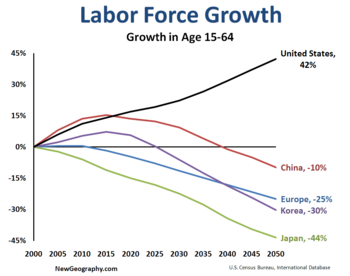
    In the longer term demographic trends actually place the U.S. in a relatively strong position. By the end of the first half of the 21st century, the American population aged 15 to 64 – essentially your economically active cohort – are projected to grow by 42%; China’s will shrink by 10%. Comparisons with other competitors are even larger, with the E.U. shrinking by 25%, Korea by 30% and Japan by a remarkable 44%.

    The Japanese experience best illustrates how wrong punditry can be. Back in the 1970s and 1980s it was commonplace for pundits – particularly on the left – to predict Japan’s ascendance into world leadership. At the time distinguished commentators like George Lodge, Lester Thurow and Robert Reich all pointed to Europe and Japan as the nations slated to beat the U.S. on the economic battlefield. “Japan is replacing America as the world’s strongest economic power,” one prominent scholar told a Joint Economic Committee of Congress in 1986. “It is in everyone’s interest that the transition goes smoothly.”

    This was not unusual or even shocking at the time. It followed a grand tradition of declinism that over the past 70 years has declared America ill-suited to compete with everyone from fascist Germany and Italy to the Soviet Union. By the mid-1950s a majority were convinced that we were losing the Cold War. In the 1980s Harvard’s John Kenneth Galbraith thought the Soviet model successful enough that the two systems would eventually “converge.”

    We all know how that convergence worked out. Even the Chinese abandoned the Stalinist economic model so admired by many American intellectuals once Mao was safely a-moldering in his grave. Outside of the European and American academe, the only strong advocates of state socialism can be found in such economic basket cases as Cuba, North Korea and Venezuela.

    So given this history, why the current rise in declinism? Certainly it’s a view many in the wider public share. Most Americans fear their children will not be able to live as well as they have. A plurality think China will be the world’s most powerful country in 20 years.

    To be sure there are some good reasons for pessimism. The huge deficits, high unemployment, our leakage of industry not only to China but other developing countries are all worrisome trends. Yet if the negative case is easier to make, it does not stand historical scrutiny.

    Let’s just go back to what we learned during the “Japan is taking over the world” phase during the 1970s and 1980s. At the time Dai Nippon’s rapid economic expansion was considered inexorable. Yet history is not a straight-line project. Most countries go through phases of expansion and decline. The factors driving success often include a well-conceived economic strategy, an expanding workforce and a sense of national élan.

    In the 1950s, 1960s and 1970s Japan – like China today – possessed all those things. Its bureaucratic state had targeted key industries like automobiles and electronics, and its large, well-educated baby boom population was hitting the workforce. There was an unmistakable sense of pride in the country’s rapid achievements after the devastation of the Second World War.

    Yet even then, as the Economist’s Bill Emmot noted in his 1989 book The Sun Also Sets, things were not so pretty once you looked a little closer. In the mid-1980s I traveled extensively in Japan and, with the help of a young Japanese-American scholar, Yoriko Kishimoto, interviewed demographers and economists who predicted Japan’s eventual decline.

    By then, the rapid drop in Japan’s birthrate and its rapid aging was already clearly predictable. But even more persuasive were hours spent with the new generation of Japanese – the equivalent of America’s Xers – who seemed alienated from the self-abnegating, work-obsessed culture of their parents. By the late 1980s it was clear that the shinjinrui (“the new race”) seemed more interested in design, culture and just having fun than their forebears. They seemed destined not to become another generation of economic samurai.

    At the time though, the very strategies so critical to Japan’s growth – particularly a focus on high-end manufacturing – proved highly susceptible to competitors from lower-cost countries: first Taiwan, Korea and Singapore, and later China, Vietnam and more recently India. Like America and Britain before it, Japan exported its unique genius abroad. Now many companies, including American ones, have narrowed the technological gap with Japan.

    Today Japan, like the E.U., lacks the youthful population needed to recover its mojo. It likely will emerge as a kind of mega-Switzerland, Sweden or Denmark – renowned for its safety and precision. Its workforce will have to be ultra-productive to finance the robots it will need to care for its vast elderly population.

    Will China follow a similar trajectory in the next few decades? Countries infrequently follow precisely the same script as another. Japan was always hemmed in by its position as a small island country with very minimal resources. Its demographic crisis will make things worse. In contrast, China, for the next few decades, certainly won’t suffer a shortage of economically productive workers

    But it could face greater problems. The kind of low-wage manufacturing strategy that has generated China’s success – as occurred with Japan – is already leading to a backlash across much of the world. China’s very girth projects a more terrifying prospect than little Japan. At some point China will either have to locate much of its industrial base closer to its customers, as Japan has done, or lose its markets.

    More important still are massive internal problems. Japan, for all its many imperfections, was and remains a stable, functioning democracy, open to the free flow of information. China is a fundamentally unstable autocracy, led from above, and one that seeks to control information – as evidenced in its conflict with Google – in an age where the free flow of information constitutes an essential part of economic progress.

    China’s social problems will be further exacerbated by a huge, largely ill-educated restive peasant class still living in poverty. Of course America too has many problems – with stunted upward mobility, the skill levels of its workforce, its fiscal situation. But the U.S., as the Japanese scholar Fuji Kamiya once noted, possesses sokojikara, a self-renewing capacity unmatched by any country.

    As we enter the next few decades of the new millennium, I would bet on a more youthful, still resource-rich and democratic America to maintain its preeminence even in a world where economic power continues to shift from its historic home in Europe to Asia.

    This article originally appeared at Forbes.com.

    Joel Kotkin is executive editor of NewGeography.com and is a distinguished presidential fellow in urban futures at Chapman University. He is author of The City: A Global History. His newest book is The Next Hundred Million: America in 2050, released in Febuary, 2010.