Tag: China

  • The Problem with Megacities

    This is the introduction to a new report from the Center for Demographics and Policy at Chapman University. The report was authored by Joel Kotkin with contributions from Wendell Cox, Ali Modarres, and Aaron M. Renn. Download the full report here (pdf).

    No phenomenon more reflects the sheer power and appeal of urbanism than the rise of megacities, which we define as an urban area with more than 10 million residents (defined as areas of continuous urban development). Until recent decades there were only three — Tokyo and New York, joined by a third, Mexico City, only in 1975. Now the megacity has become a global phenomenon that has dispersed around the planet. There were 29 such cities in 2014 and now account for roughly 13% of the world’s urban population and 7% of the world’s total population (Figure 1).

    Urban boosters such as Harvard’s Ed Glaeser suggest that megacities grow because “globalization” and “technological change have increased the returns to being smart.” 2 And to be sure, megacities such Jakarta, Kolkata (in India), Mumbai, Manila, Karachi, and Lagos — all among the top 25 most populous cities in the world — present a great opportunity for large corporate development firms who pledge to fix their problems with ultra-expensive hardware. They also provide thrilling features for journalists and a rich trove for academic researchers.

    Like Mr. Glaeser, many Western pundits find much to celebrate about the megacities mushrooming in low-income countries. To them, the growth of megacities is justified because it offers something more than unremitting rural poverty. But surely there’s a better alternative than celebrating slums, as one prominent author did recently in Foreign Policy bizarrely entitled “In Praise of Slums”3.

    As demonstrated in our new paper on global cities developed with the Civil Service College of Singapore, many of these emergent megacities in Africa and elsewhere in the developing world lack of an economic basis sufficient to substantially compete beyond their national or nearby regional markets. As a result, the rise of megacities in the developing world may be laying the foundation for an emerging crisis of urbanity, where people crowd into giant cities that lack of the economic and political infrastructure to improve their lives. At the end of this paper, we try to suggest that they may be better solutions that steer growth to smaller cities and towns, and even seek out ways to improve the life in rural villages.

    Download the full report here (pdf).

    Joel Kotkin is executive editor of NewGeography.com and Distinguished Presidential Fellow in Urban Futures at Chapman University, and a member of the editorial board of the Orange County Register. His newest book, The New Class Conflict is now available for pre-order atAmazon and Telos Press. He is author of The City: A Global History and The Next Hundred Million: America in 2050. His most recent study, The Rise of Postfamilialism, has been widely discussed and distributed internationally. He lives in Los Angeles, CA.

  • Size is not the Answer: The Changing Face of the Global City

    This is an exerpt from a new report published by Civil Service College of Singapore, authored by Joel Kotkin with contributions from Wendell Cox, Ali Modarres, and Aaron M. Renn.
    Download the full report.

    As the world urbanises and more megacities are created, some smaller, focused urban regions are becoming truly critical global hubs, unlike most larger cities, which are simply tied to their national economies. In a new ranking of global cities, CSC Senior Visiting Fellow Joel Kotkin argues that the truly global city is one that is uniquely situated to navigate the global transition to an information-based economy since the influence of industries such as media, culture or technology are the ones that will determine economic power in future. Kotkin also examines the fundamental challenge faced by cities as they achieve global status: the need to balance two identities, a global and a local one. "The world beckons, and must be accommodated, but a city must be more than a fancy theme park, or a collection of elite headquarters and expensive residential towers", he asserts.

    In this urban age, much has been written and discussed about global cities.1 Yet, as the world urbanises and with more megacities (with populations of ten million or more) created, there is a growing need to re-evaluate which are truly significant global players and which are simply large places that are more tied to their national economies than critical global hubs. Similarly, it becomes more critical to consider the unique challenges faced by cities as they achieve world-wide status.

    The term “world city” has been in use since the time of Patrick Geddes in 1915. In 1966, Peter Hall published his seminal work “The World Cities”. Hall’s world cities were all predominant cities in existing key nation-states. Later, the concept of “global cities”, based largely on concentrations of business service firms, emerged as the primary terminology describing such international centres.

    Be it “world” or “global” cities, such cities have long based their pre-eminence on things such as cultural power, housing the world’s great universities, research laboratories, financial institutions, corporate headquarters, and existence of vast empires and their extended legacy. They also disproportionately attracted the rich, and served as centres of luxury shopping, dining, and entertainment. These world cities have exercised outsized global influence in a system dominated by nation-states.2

    As a result, the discussion of global cities has focused primarily on megacities such as New York, Paris, Los Angeles, and Tokyo. This is not surprising, since the population of the world’s largest city has grown nearly six-fold since 1900 (London, in 1900, compared to Tokyo, in 2014). Smaller cities, such as Dubai, Houston, or the San Francisco Bay Area, have not been ranked as highly as they may have deserved.

    Rethinking the Urban Hierarchy

    We believe the traditional approach has underestimated the overarching importance of a region’s role in technology, media or its dominance over a key global industry.

    This new appraisal also stems from the declining power of nation-states in a globalised economy. In 1900, the capitals of empire—London, Paris, Tokyo, Berlin and St. Petersburg—were also the largest cities, the predominant centres of world trade and the exchange of ideas. The exception was non-government anomaly, New York, which has remained North America’s premier city; in contrast, at least until recently, Washington was a relatively minor city.

    Today, we are in a period like that of the Renaissance and early modern Europe, where global activity gravitates towards small, more trade-oriented cities, for example, Tyre, early Carthage, Athens, Venice, Antwerp, and Amsterdam and the cities of the Hanseatic League (each home to less than 175,000 people). These cities, for which trade was a necessity, were tiny compared not only to Constantinople (700,000 people), but also London and Paris (more than twice as the trading cities). Similarly, the early trade hubs of Asia were often not larger imperial capitals—such as Kaifeng and later Beijing in China— but smaller cities such as Cambay (India), Melaka (Malaysia) and Zaitun (now Quanzhou in China).

    We are seeing smaller, focused urban regions that are achieving more than most larger cities. Compared to many of their larger counterparts, new and dynamic global cities, such as Singapore, Dubai, Houston and the San Francisco Bay Area, have become more influential in the world economy, as measured by critical factors like technology, media, culture, diversity, transportation access and degree of economic integration in the world economy. This “archipelago of technologically high developed city regions”, notes urban geographer Paul Knox, are replacing nation-states as emerging avenues of economic power and influence.

    These new global hubs thrive not primarily due to their size, but as a result of their greater efficiencies. This can be seen in the location of foreign subsidiaries. For example, compared to Tokyo, Singapore now has more than twice as many regional headquarters; Singapore and Hong Kong also perform far better in this respect than Asia’s numerous, much larger but less affluent megacities. Global hubs are helped by their facility with English—the world’s primary language of finance, culture, and, most critically, technology. English dominates the global economic system from New York and London to Hong Kong, Singapore and Dubai. This linguistic, digital and cultural2 congruence poses concerns for major competing cities, including those Russia and mainland China.

    Download the full report.

    Joel Kotkin is executive editor of NewGeography.com and Distinguished Presidential Fellow in Urban Futures at Chapman University, and a member of the editorial board of the Orange County Register. He is author of The City: A Global History and The Next Hundred Million: America in 2050. His most recent study, The Rise of Postfamilialism, has been widely discussed and distributed internationally. He lives in Los Angeles, CA.

  • The Evolving Urban Form: Chongqing

    No city in the world is so misunderstood by analysts and the press. It is commonly asserted Chongqing is the largest city in the world. In reality it barely makes the top 50, ranking 47th.

    Cities (Shi) in China are Regions and Mostly Rural

    It is fundamentally a problem of semantics and a failure to comprehend the nuances of urban geography in China. The country is divided into provinces and their equivalents, which are in turn, divided into prefectures, most of which are "shi," "Shi" translates into English as "city." However, shi are completely different from any English conception of a city as "an inhabited place of greater size, population, or importance than or village" (per Merriam Webster).

    There approximately 300 shis and other prefectures (sub-provincial jurisdictions) in China. In contrast, there are approximately 10 times as many sub-state jurisdictions (counties) in United States, which has a land area slightly larger than that of China. China’s shi and other prefectures are thus very large. They are really more like regions in English. Virtually all shi are predominantly rural, rather than urban in their land use.

    Reporters often marvel at the many cities in China of more than 1,000,000 population. Yet many of these are nothing more than broad expanses of rural areas without large urban settlements. Take, for example, Bazhong, a "shi" of 3.3 million residents in Sichuan province. The largest urban settlement occupies just 5 square miles (13 square kilometers), roughly the same land area as Goodland, Kansas (a city of fewer than 5,000 residents). Bazhong shi’s population is spread across a virtually 100 percent rural landscape of 4,700 square miles (12,300 square kilometers).

    Chongqing in Context

    Chongqing is a shi, and is administered as a province by the national government, as also are Shanghai, Beijing and Tianjin. The province of Chongqing covers 32,000 square miles (82,500 square kilometers). This is nearly equal to the land area of Austria and more than the area of the state of Maine. No city in the world is as large as Austria.. The New York urban area comes the closest to Chongqing’s size at 4,500 square miles (11,600 square kilometers), one-seventh the land area of Chongqing.

    Not a Metropolitan Area

    Nor is it appropriate to consider the province of Chongqing as a metropolitan area (labor market). It is simply too large for that. Commuters from the Chongqing’s "Southeast Wing" would have to travel up to 5 hours, mainly on the China’s 75 mile per hour (120 kilometer per hour) freeway system to reach work in the Chongqing urban area. From the outer reaches of Chongqing’s "Northeast Wing," travel times could exceed 8 hours, again largely by 75 mile per hour freeway.

    A Largely Rural, Not Urban Province

    The province of Chongqing is predominantly rural yet The Guardian persists in telling us that "Chongqing is the fastest-growing urban centre on the planet. Its population is already bigger than that of Peru or Iraq." Not so. The 2010 Census of China placed the province of Chongqing’s population at 28.8 million, smaller than both Peru and Iraq and with fewer people than in 1990. The urban center (genuine city) of Chongqing does not reach a quarter the size of either Peru or Iraq.

    The Guardian is by no means alone. Time magazine cluelessly fawned "Virtually overnight, Chongqing has become the largest city not only in China, but in the world," Wired similarly misfired with indicating in a 2008 article that Chongqing (at 32 million population) was the "fastest-growing urban center on Earth." For all the supposed growth, not a soul was added to Chongqing province during the 2000s, as is described below.

    Not all media outlets, however, have been captured by the same fallacy as The Guardian, Time, Wired and many others. To its credit, the BBC went to considerable lengths to correct this and similar errors about the population of Chongqing. An Atlanticarticle also parsed the issue well.

    Losing Population

    In reality Chongqing lost 1.7 million people between 2000 and 2010, 5.5 percent of its population. This is significant. By contrast, the municipality of Chicago lost 6.9 percent over the same period, a loss that was considered devastating. It is not surprising that Chongqing is losing population, given its principally rural nature. Much of rural China is emptying out, as people migrate to the cities for economic opportunity (which is the very purpose of cities), just as they have done in previous decades and the last two century throughout higher income nations. Every year over the past decade, the province experienced an annual decline of 170,000, not the half-million increase reported by The Guardian. The actual urban center (not the imaginary urban center reported on by The Guardian) is gaining in population, but nothing like "half a million" per year.

    The Genuine City of Chongqing

    There is, however, a genuine city of Chongqing. Surprisingly reminiscent of Pittsburgh, Chongqing is it nestled among elongated folded mountains that are near duplicates of those near the Pennsylvania city. The city is at the confluence to two rivers, the Yangtze and the Jialing. Like the Pittsburgh’s Golden Triangle where the Allegheny and Monongahela Rivers meet, Chongqing’s has an attractive open space at Chaotianmin where the two rivers meet. Finally, as in Pittsburgh, there is an impressive, high rise central business district behind the open space. This is the best example in China of a monocentric central business district typical of many US cities (downtown Shanghai and Nanjing are similar, but more spread out).

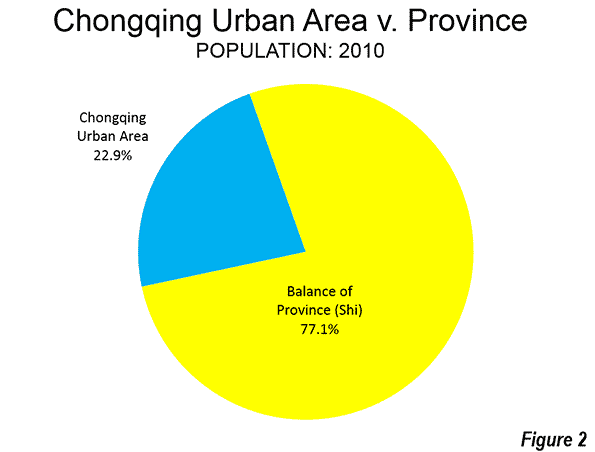
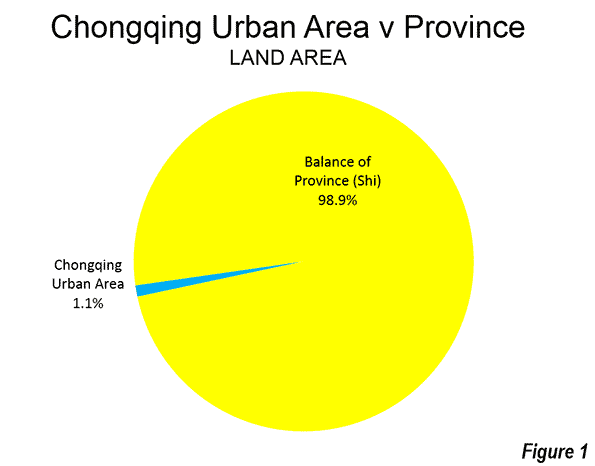
    The Chongqing urban area covers little more than 1/100th of the province’s land area (Figure 1) and contains less than one-quarter of the population (Figure 2). Yet the Chongqing urban area is still large. According to the 10th Annual Edition of Demographia Urban Areas, Chongqing has a 2014 population of 6.8 million living in a land area of 340 square miles (890 square kilometers). The urban population density is 19,600 per square mile (7,700 per square kilometer), which is about one third higher than the larger urban area average of 14,900 per square mile (5.700 per square kilometer) found across China. This is more than double the density of the Paris urban area, triple the density of the Los Angeles urban area and six times that of Portland.

    The "One Hour Economic Circle:" The Future Metropolitan Area

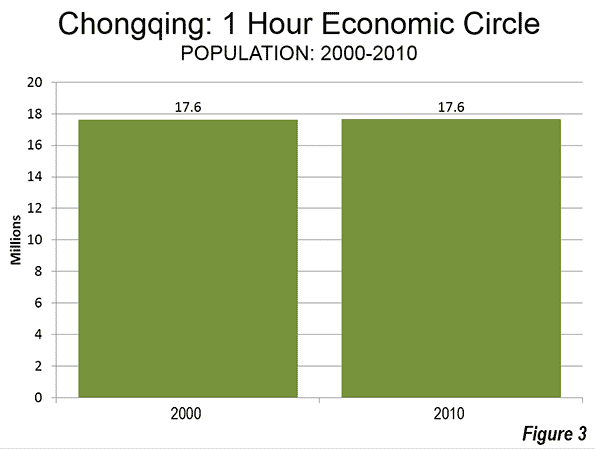
    Chongqing’s administration has a vision of a much larger city. The urban plan is concentrated on the "One Hour Economic Circle," defined as within "one hour’s driving distance." This area includes 23 of Chongqing’s 40 divisions (counties and urban districts, or qu’s), with a land area of 11,000 square miles (28,600 square kilometers), more than 1.5 times the size of the Paris metropolitan area (aire urbaine) and slightly larger than New York. The 2010 census counted a population of 17.6 million in the One Hour Economic Circle, but most of it still rural. Outside the One Hour Economic Circle, in what is called the "Northeast Wing" and the "Southeast Wing," the rural influence is even greater.

    The intent of the urban plan is to broaden the economic influence of the urban area. This would involve substantial increases in economic interchange (principally commuting) with the balance of the One Hour Economic Circle, now decidedly rural.

    Within the One Hour Economic Circle, the large rural population suggests the potential for in-situ urbanization could also contribute to economic growth as migration, as rural residents are afforded opportunities to adopt urban lifestyles (as has occurred in Quanzhou and other urban areas, especially in the province of Fuzhou).

    Population Trends 2000-2010

    The divisions (qu) that encompass the urban area are growing, even though the core is losing (Yuzhong qu). In contrast, the metropolitan area had a population of 8.0 million in 2010, up 19 percent from 2000. This is not particularly rapid growth for China. Nearly 20 metropolitan areas grew twice as fast from 2000 to 2010. Nearby Chengdu, the capital of Sichuan, grew 2.5 times as fast as Chongqing.

    Outside the metropolitan area, the One Hour Economic Circle experienced a population loss of 12 percent. As a result of this loss, the One Hour Economic Circle had only a negligible population increase of 0.1 percent between 2000 and 2010 (Figure 3).

    The Future

    At the presently projected United Nations growth rate, the Chongqing urban area would add nearly one quarter to its population by 2025. But under this pattern Chongqing will barely hold its own, but remain in the top 50 world urban areas. Yet, the city has grand plans. There are nationally and locally designated economic zones, and lower business costs encouraging commerce to move west in China. As a province and urban area directly administered by Beijing, Chongqing could be positioned for both strong population and economic growth. Yet, it remains an open question whether Chongqing will emerge as one of China’s major growth centers.

    —————-

    Note: Shi are divided into county level jurisdictions, such as qu (urban districts), counties (rural districts) and count level shi.

    ——-

    Wendell Cox is principal of Demographia, an international public policy and demographics firm. He is co-author of the “Demographia International Housing Affordability Survey” and author of “Demographia World Urban Areas” and “War on the Dream: How Anti-Sprawl Policy Threatens the Quality of Life.” He was appointed to three terms on the Los Angeles County Transportation Commission, where he served with the leading city and county leadership as the only non-elected member. He was appointed to the Amtrak Reform Council to fill the unexpired term of Governor Christine Todd Whitman and has served as a visiting professor at the Conservatoire National des Arts et Metiers, a national university in Paris.

    Photo: Downtown Chongqing (by author)

  • Beijing Gigacity to Cover Area of Cambodia or Oklahoma

    Today, there are about 30 megacities in the world, where more than 10 million residents live. The largest is Tokyo, at about 38 million. Recent announcements by the government of China could lead to the worlds’ first gigacity (for want of a better term, used here to denote a city of more than 100,000,000 population, see note). According to the Nanfang Insider, the economic integration of megacity Beijing, megacity Tianjin and eight cities (prefectures) in the province of Hebei would result in a city of 130 million. China Daily is a bit more circumspect, indicating that the Beijing supercity would have only 85 million.

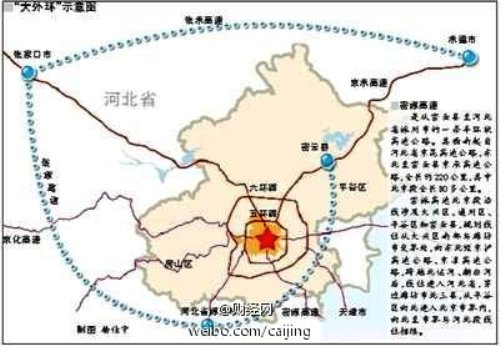
    The giga/super city would be tied together by new rapid transit lines and highways and surrounded by the 7th Ring Road, adding to the six that have already been built. The 7th Ring Road would consist of two roads, circling most of the area, and extending to a combined 850 miles (2,200 kilometers). By comparison, London’s M-25 is 117 miles long (188 kilometers), the Moscow MKAD 68 miles long (109 kilometers) and the Washington beltway is 64 miles long (103 kilometers)

    The giga or super city is not likely to really be a city, because it would be much larger than a labor market (this is why the near continuous urbanization from Boston to Washington or Tokyo to Osaka-Kobe-Kyoto is not a city). The estimated land area is 67,000 square miles (175,000 square kilometers). This is nearly as large as Cambodia or the state of Oklahoma. Providing the point to point daily commuting in such a large area is well beyond the capability of any affordable transportation system. Star Trek like teleportation could do the trick. Meanwhile, however, there is plenty to be gained from the economic integration of this large area.

    Graphic of the new 7th ring road from nanfang.com:


    Note: Technically, a gigacity would need 1 billion people (10 to the 9th power). However, megacities, with their 10 million minimum are also wrongly named. A city with a mega city would have 1,000,000 people (10 to the 6th power). Artistic license justifies the gigacity term under the circumstances. Besides, with the slowing growth of world population, it seems unlikely than any city will achieve a population of 1 trillion.

  • Bulgari to Taco Bell: Across China, Buyers Are the Target

    I work for myself, and when I travel to China on business I have the “luxury” of sleeping on trains and in hostels, and getting around during the day by bicycle. This spring I made a circuit from Beijing to Chengdu (in western China), to Wuhan (right in the middle), and to Shanghai (east coast), before heading back to Beijing. Ostensibly I was there to hunt down consumer trends.

    What I saw was:

    • Cars and smog are killing off the grace of the old cities
    • High-rise apartment towers have doomed more village markets than collectivization did
    • Much of China’s continuing economic boom is a currency sleight-of-hand, and
    • Chinese consumers are a lot less interested in Western brands than CEOs of multinationals would have us believe in their upbeat annual reports

    Herewith, notes from the lower berth on many sleepers and the saddle of whatever Giant bicycle I could rent, by which means I covered 3,134 miles in less than two weeks:

    Beijing: For grace and charm, nothing in China beats central Beijing. At night, the lights around Tiananmen Square glow like those along the grand canals of Venice. During the day, Beijing suffers from a carbon dioxide whiteout, China’s equivalent of London fog that has made the city a respiratory health disaster.

    Beijing is also at the uncomfortable crossroads of a political system struggling to accommodate dialectical materialism with emerging consumer pleasures. But the means of production are distant from Beijing power brokers, a reminder of how Marx railed against absentee landlords.

    The biggest contribution that the central bureaucracy has made to the Chinese economic miracle is to depreciate the renminbi to subsidize exports. With an exchange rate of ¥6.25 (yuan) to the US dollar, things that cost $150 in the West, such as a hotel room, are $24 in China.

    That accounts for an economic boom on the export side, but limits the demand for imported western products. If you are a Chinese worker who earns, on average, $900 a month, are you going to spend $150 on imported Air Jordans?

    The currency mismatch feeds the thriving market in Western knockoffs, but another reason for rip-off branding, I suspect, is that the idea of personal space is alien to Chinese daily life. Translated into consumer speak, that may explain why no one cares a fig about copyright laws, patents or trademarks.

    Across China: My train ride to western China lasted more than 24 hours. From my window, beyond the miasma that is Chinese air, were countless high-rise towers, many forty or fifty stories high, where rural residents have been resettled. Someday, China will be the people’s republic of tenement housing. The next revolution will begin when enough elevators are out-of-order.

    In the meantime, local shopping has become as centralized as once was the communist party. Big box stores — from Home Depot to the French supermarket Carrefour — are betting the ranch on making it alongside these brave new world housing complexes.

    The do-it-yourself corporate entities — a big fixture of malldom — have not yet figured out that Chinese women, not men, drive the Saturday afternoon purchases, and that few Chinese have SUVs to haul the stuff home.

    Chengdu: Yet another faceless city of the Asian miracle, Chengdu is clogged with late-model cars in traffic, and dotted with western boutiques and high-rise buildings.

    Cartier and Bulgari are on the best corners, but what attracts local crowds is American fast food, the ideal combination of Asian, on-the-go convenience and international branding, held together with US trans fats. Shares in YUM! Brands — the Chinese franchise owners of KFC, Pizza Hut, and Taco Bell — are up 600% since 1999.

    South of center city, I biked past the world’s largest building, the New Century Global Centre, about the size of four Astrodomes with the façade of an airport terminal. Part mall, part exhibition center, water park, university, iMax cinema, hotel, restaurant, and office complex, it’s a consumption monolith. Still, it has the feel of an enormous recycling center where government money is, so to speak, washed (maybe at the artificial beach?) into the accounts of the new class. So much for the Chinese economy prospering only as the result of long work hours.

    Wuhan: East of Chengdu, this Yangtze River city is a conglomeration of three Qing Dynasty districts into a modern juggernaut. It saw the first outbreak of the 1911 Revolution, remembered with a few Sun Yat-sen statues and museums (although he was in Hawaii when the first shots were fired).

    Crossing the Yangtze on a ferry — new China as a slow passage through the heart of darkness — the river water was the consistency of crankcase oil, and smog obscured the far shores, no doubt the byproduct of all that Appalachian coal that gets exported to China on Warren Buffet’s trains and bulk carriers.

    Doing my field research on Chinese consumerism in several superstores, including Walmart, and at Starbucks, I was fascinated at how little Western companies cater to Chinese tastes. It’s not only that there’s no Dragon Latte at Starbucks. One of the sins of branding is to add Chinese characters to Western labels, so French supermarkets in China look just like those in Paris.

    Maybe the centrally planned economy is alive and well, but it’s living in exile in places like Arkansas or Seattle? At least I didn’t hear anyone in Wuhan complaining about aisles full of junk made in China.

    Shanghai: Its new reputation is as China’s New York City, a blend of high-rise glitz and coastal sophistication. But that’s if you are in expense-account Shanghai, eating in all those revolving restaurants. I got around on long marches to metro stops and by bus and taxis— China on five traffic-jams-a-day.

    At a food services convention that I had travelled to attend, huge exposition halls were devoted to things like espresso machines and Italian gelato, the budding tastes of modern China.

    From the view at the convention hall, China looks like a treaty port of Western desires, with Mao’s capitalist road running through it. I wonder, though, if shoppers will ever make the switch from street vendors to the Great Mall.

    On the outskirts of Shanghai, a colonial-style shopping center had everything from Pizza Hut to Ben and Jerry’s ice cream. It was awash with French wines, English clothing, American cosmetics, Spanish fashions, and Swiss pharmaceuticals, but, when I was there, few customers. It felt like an ultra-upscale military PX, although the shoppers were as listless as terra cotta warriors. Build it and they will come?

    Wandering the aisles of China’s consumption centers, I came to the conclusion that Western sales representatives (with their sample bags) are the new missionaries. They’ve come to the East to preach salvation, based on new packaging for old products, but they’re as rigid in sticking to the gospels of Home Depot as they once were about peddling the Book of Mormon.

    As André Malraux wrote in 1933, as prescient about the Chinese revolution as he was about 2014 consumers, “Europeans never understand anything of China that does not resemble themselves.”

    Matthew Stevenson, a contributing editor of Harper’s Magazine, is the author of Remembering the Twentieth Century Limited, a collection of historical travel essays. His new book, Whistle-Stopping America, was recently published.

    Flickr photo, in Beijing’s Oriental Plaza shopping mall, & caption by Ming Xia, The Coca Cola Store: “China is a very receptive market to brand extension programs – Playboy clothing and Pepsi sneakers are ubiquitous in the PRC… this looks to me as if it is a test unit.”

  • China’s Ascent in World Transport

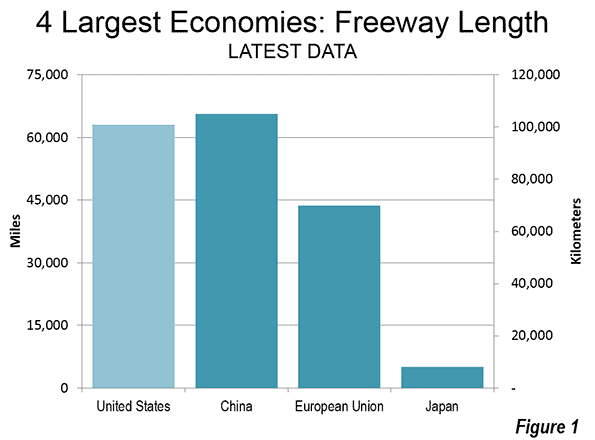
    After years of closing the gap with the United States, China built enough freeways in 2013 to amass the greatest length of freeways in the world. Between 2003 and 2013, China expanded its national expressway system, with interstate (motorway in Europe) standard roadways from 30,000 to 105,000 kilometers (18,000 to 65,000 miles). This compares to the 101,000 kilometers (63,000 miles) in the United States in 2012. China’s freeway system is also longer than that of the European Union, which was 70,000 kilometers in 2010 (43,000 miles) and Japan (8,000 kilometers or 5,000 miles) as is indicated in Figure 1 (Note 1). The ascent of China is evident across the spectrum of transport data, both passenger and freight.

    A review of transport statistics in the four largest world economies (nominal gross domestic product) shows considerable variation in both passenger and freight flows. It also reflects the rapid growth of China. Generally comparable and complete data is available for the European Union, the United States, China and Japan.

    Passenger Travel

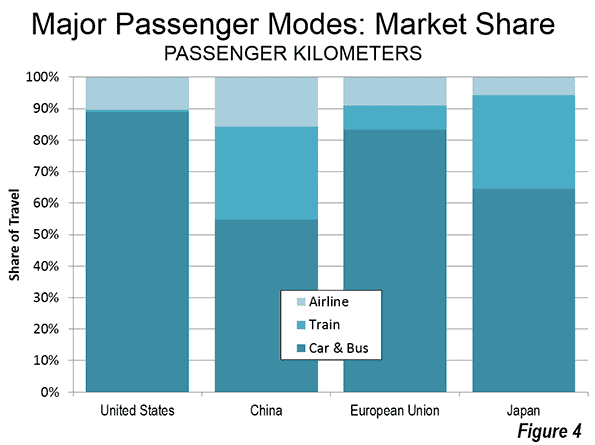
    All four of the world’s largest economies rely principally on roads for their passenger transport. The United States continues to lead in road volume (in passenger kilometers, see Note 2) by a substantial margin, followed by the European Union. In the United States, automobiles account for 83 percent of domestic passenger travel, which compares to 76 percent in the European Union and 58 percent in Japan. China’s combines automobile and bus data, which makes it impossible to obtain automobile comparisons with the other three economies.

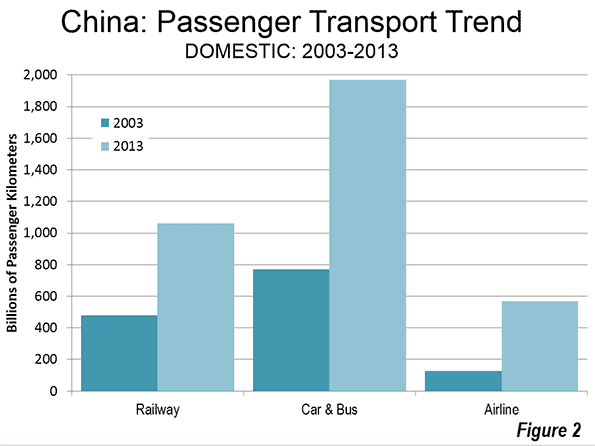
    Road travel increased more than 150 percent between 2003 and 2013 in China. Yet roads have barely held their market share as China has built new world-class airports, such as Capital City in Beijing, Baiyun in Guangzhou and many others. Over the same 10 years air travel has increased 350 percent. Meanwhile, China has built the world’s most extensive high-speed rail system and has experienced healthy rail travel growth. Yet, despite this, passenger rail’s market share has dropped from 35 percent to 29 percent over the period (Figure 2).

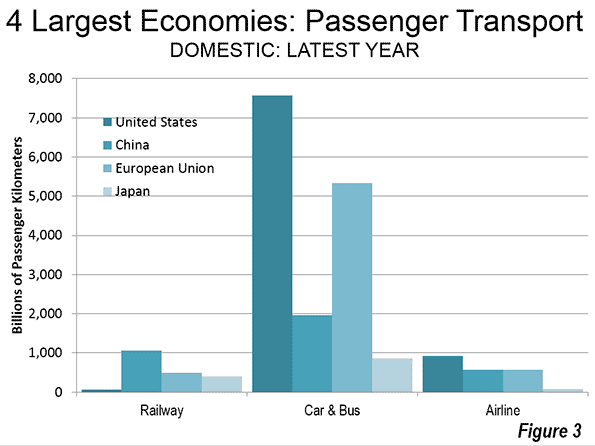
    China is dominant among the four economies in passenger rail volumes, with its 1.05 trillion annual passenger kilometers (0.65 trillion passenger miles) accounting for more than 2.5 times the rail travel in both the European Union and Japan. US rail travel is no more than 1/20th that of China (equal to the road travel volume in the state of Arkansas).

    The United States continues to lead in a domestic airline travel, with a volume approximately 60 percent greater than those of the European Union and China. China trails the European Union by only two percent and with its growth rate seems likely to assume the second position before long (Figure 3).

    Passenger travel market shares are indicated in Figure 4.

    Freight Transport

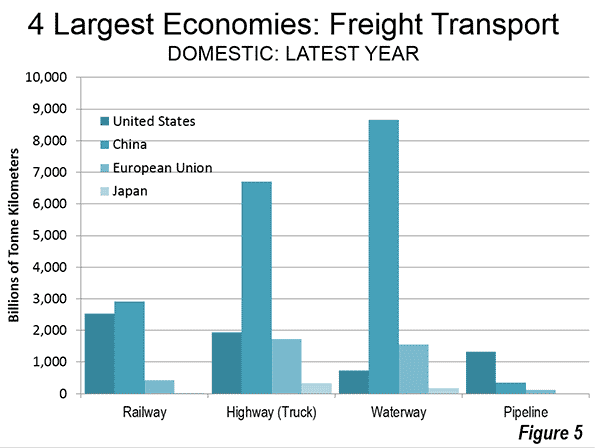
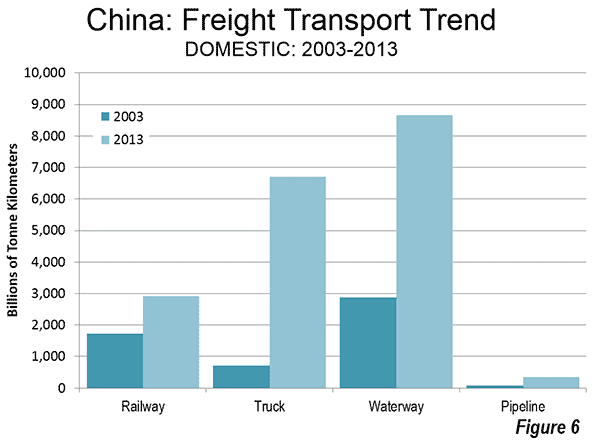
    After having led the world in rail freight volumes in recent decades, the United States has recently yielded the title to China. In 2013, China moved nearly 3 trillion tonne kilometers (Note 3) of freight by rail, compared to the US total of 2.5 trillion (2012). It may be surprising to find out that Europe, with its extensive passenger train system moves so little of its freight by rail. However, the European Union moved approximately 60 percent less of its freight by rail. However, much of the capacity of the EU’s rail system is consumed by passenger trains, leaving little for freight.  This is despite a policy commitment in the EU to substantially increase the rail freight market share relative to trucks. As a result, in Europe, the freight trains are "on the highway" (see Photo below). China has been uniquely successful among the world’s economies in developing both a world class freight rail system and a world class passenger rail system. One of China’s early objectives in developing its high speed rail program was to free space for its large freight train volumes.


    Caption: Trucks on the A7, north of Barcelona (by author)

    Among other nations, only Russia can compete with China and the United States in rail freight, having moved approximately 2.2 trillion tonne kilometers in 2012.

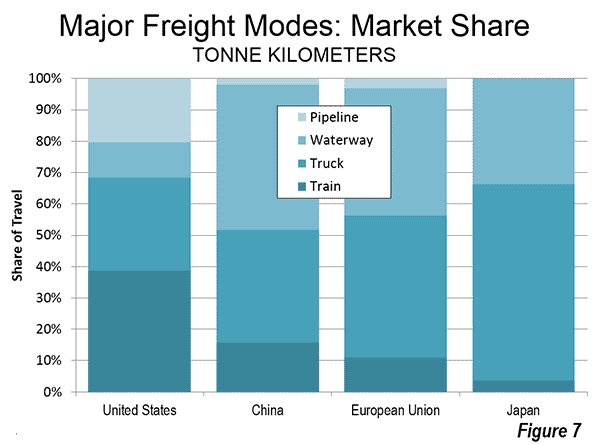
    Rail freight remains by far the most important in the United States compared to the other three largest economies. Rail freight continues to carry more tonne kilometers in the United States than trucks. The situation is much different in Europe, where trucks carried four times the volume of freight rail. Rail freight is even less significant in Japan, where trucks carry more than 15 times the volume of rail freight.

    One possibly surprising fact lies with the substantial increase in China’s truck volumes over the last decade. China now has a volume of truck traffic that is four times that of trucks in either the European Union or the United States.

    In 2003, trucks carried 60 percent less of the nation’s metric tonne mileage than freight rail. By 2013, that had been reversed with tracks carrying 130 percent more volume than freight rail.

    However China’s dominance is even greater in water borne freight, at nearly 6 times the European Union volume and more than 10 times the volume of the United States (Figure 5). Even so, China’s largest freight volumes are carried on waterways, such as the Yangtze River. Over the past 10 years waterway volumes tripled. It is even expected that there will be a significant increase in shipping on the ancient Grand Canal (Figure 6).

    Freight market shares among the major modes are shown in Figure 7.

    India

    Another of the world’s largest economies, India, also relies heavily on roads. According to the World Bank 65 percent of the freight and nearly 90 percent of passengers are carried by roads in India, though late detailed data is not available. Yet India also has the largest passenger rail usage in the world. Only China is close, and the two nations have been near equal, at least over the last decade. In 2003, China trailed India by seven percent in passenger kilometers by train. Complete Indian Railway data for 2013 is not yet available. However, if the average trip length in 2013 was the same as in 2012, China will have moved to within two percent of India’s passenger rail volume. Both nations are far above Japan and the European Union, ranked third and fourth, and almost 90 percent above Russia, which has a reputation for high passenger rail volumes.

    The Future

    With economic growth in China slowing (though still at rates that would satisfy virtually any other nation) its transport growth of the past decade seems likely to moderate. On the other hand, the other large emerging economy, India, which has substantially trailed China, could assume a Chinese trajectory. The newly elected Bharatiya Janata Party (BJP) government is committed to economic advance and infrastructure development. Market facilitating policies like those that have propelled China (see the late Noble Laureate Ronald Coase and Ning Wang, How China Became Capitalist), could lead to a similar story about India in a decade or two.

    ——

    Note 1: The latest data on international transport varies by year, even within nations (such as the United States). This analysis compares the latest data, which is 2012 (Europe and Japan), 2013 (China) and the United States (2011, with some 2009). This latest years available permit comparing the general scale of differences and, particularly in the United States, changes from the earlier data are likely to have been modest, as a result of the Great Financial Crisis and the great economic malaise that has followed. The principal data sources are the Bureau of Transportation Statistics in the United States, the National Bureau of Statistics in China and Eurostat for the European Union and Japan.

    Note 2: A passenger kilometer (or passenger mile) is the distance traveled times the number of passengers. Thus, a car going 5 kilometers with one passenger produces 5 passenger kilometers. With two passengers, there are 10 passenger kilometers.

    Note 3: A tonne kilometer is a metric tonne (2.204 pounds or 1,000 kilograms) of freight times the number of kilometers traveled. The US ton (short ton) has 2,000 pounds or 907 kilograms.

    —-

    Wendell Cox is principal of Demographia, an international public policy and demographics firm. He is co-author of the "Demographia International Housing Affordability Survey" and author of "Demographia World Urban Areas" and "War on the Dream: How Anti-Sprawl Policy Threatens the Quality of Life." He was appointed to three terms on the Los Angeles County Transportation Commission, where he served with the leading city and county leadership as the only non-elected member. He was appointed to the Amtrak Reform Council to fill the unexpired term of Governor Christine Todd Whitman and has served as a visiting professor at the Conservatoire National des Arts et Metiers, a national university in Paris.

    Photograph: Grand Canal in Suzhou (by author)

  • China Failing its Families

    China’s recent decision to reverse – at least in part – its policy limiting most couples to one child marks a watershed in thinking about demographics. Yet, this reversal of the 30-year policy may prove unavailing due to reasons – notably dense urbanization and high property prices – that work against people having more children.

    China already faces a demographic crisis unprecedented for a still-poor country. By 2050, China will have 60 million fewer people under 15 years of age, while the over-65 population grows by 190 million, approximately the population of Pakistan, the world’s sixth-most populous country. The U.S. Census Bureau estimates that China’s population will peak in 2026, and then will age faster than any country besides Japan; most of the world’s decline in children and workers ages 15-19 over the next two decades will take place in China.

    The shift in family-size policy acknowledges these looming demographic changes but may not be sufficient to address them. After all, similar problems have cropped up in other Asian countries, including such successful nations as Japan, Singapore, Taiwan and South Korea. All face tremendous fiscal crises from the prospect of a diminishing workforce insufficient to support swelling numbers of seniors. This “burden of support” crisis applies even in rich, thrifty countries like Singapore or Japan, but is potentially far more destabilizing in much poorer China.

    Perhaps the biggest force undermining both marriage and family – the core institutions of all Confucian societies – can be traced, at least in part, to changes in attitudes associated with urban life. Gavin Jones, a demographer at the National University of Singapore, estimates that up to a quarter of all East Asian women, following the example of women in Japan, will remain single by age 50, and up to a third will remain childless.

    “People’s lifestyles are more important, and their personal networks mean more than family,” notes Japanese sociologist Mika Toyota. “It’s now a choice. You can be single, self-satisfied and well. So why have kids? It’s better to go on great holidays, eat good food and have your hobbies. A family is no longer the key to the city life.”

    Urbanization threat

    Nowhere are these effects more profound, or important, as in China, where 270 million migrants, mostly from the countryside, have moved to the cities – nearly as many people as lived in the United States a decade ago. But once they arrive, many newcomers often live in poor, crowded conditions, that, along with lacking access to schooling, discourage child-rearing.

    The detrimental impact of dense urbanization on family formation is not limited to China, but is especially prevalent in East Asia, where Gavin Jones, Paulin Tay Straughan and Angelique Chan of the National University of Singapore report that “a housing and urban environment unfriendly to children” was a chief reason for women’s reluctance to have children (or more children).

    As China has urbanized, its fertility rate – the average number of births for each woman of childbearing age – has fallen to 1.55, considerably below the 2.1 “replacement rate” required to maintain the population level. But in the rest of East Asia, fertility rates are even lower. For example, Singapore’s fertility rate is 0.79, Taiwan’s is 1.11, and South Korea’s is 1.24 – even without one-child policies. Moreover, China’s fertility rate is elevated because of its higher share of rural population and can be expected to fall as rapid urbanization continues. The depressed urban fertility rates are epitomized by Beijing, at less than 1, and Shanghai, 0.70.

    Reforming the one-child policy alone won’t much change this reality. A host of pro-natalist policies in countries, including Japan and Singapore, have failed to boost birthrates. China-controlled Hong Kong, which now suffers one of the lowest fertility rates on the planet, was never subject to the one-child policy and has tried to encourage procreation, raising tax breaks to $100,000 per child. Yet these steps hardly off-set the high costs of raising childrenin this dense, bustling and expensive city. A recent Hang Seng Bank study estimates the cost of raising a child in Hong Kong at $515,000 U.S. dollars.

    Most damaging, East Asian cities have adopted an urban form almost guaranteed to suppress fertility. Most are usually dominated by skyscraping tower residential blocks and lower-rise residential buildings in which most units have no direct ground access. A 20th-floor balcony is not a substitute for a private yard to play in. Even in Western countries, where cities are usually less-dense, fertility rates are far lower in the urban cores than in the suburbs. Similarly, the birthrates in the urban core of Tokyo are well below those in the suburbs, where yards, though small by Western standards, often are available.

    Then there is the problem of affordability. Housing units in the tall residential blocks cost much more to build than ground-oriented dwellings. High costs, particularly for housing, are one reason nearly two in five Chinese, according to Weibo Sina, the country’s top social media site, feel the law change will not encourage them to consider having more children.

    Child-friendly zones?

    The Chinese government could take steps making it easier for people to have children. One would be to drive growth to less-expensive areas in the country’s vast interior. New government policy reforms have reinforced the commitment for development outside the East Coast, to the center, West and Northeast. Already, interior cities have been made more competitive for manufacturing by connection to the world’s longest interstate-type highway system, as well as the highest-volume trucking and freight rail systems.

    Spreading out development may help, but only if the form of the new housing shifts to a more family-friendly pattern. Building high-density areas, even in second-tier cities – a major source of wealth for local governments as well as developers – essentially exports Shanghai’s child-unfriendly environment to the interior. Instead, a new housing policy that stresses lower densities, more space and greater affordability is a prerequisite for encouraging new families.

    The solution could draw on some of China’s own marked policy successes. Under Deng Xiaoping, China established special economic zones, such as Shenzhen, to test liberal economic policies. Shenzhen’s reforms spread around China and have, literally, transformed the country . More recently, China embarked on a similar program to test financial liberalization, with the establishment of its first financial-services trade zone in Shanghai, and a recent announcement indicates that there will be more.

    These innovative policies could be adapted to address China’s demographic crisis. It could take the form of a few “special child-friendly zones,” established around midsize and large cities. These zones would allow for development of ground-oriented dwellings with yards and could include housing from single-family detached to multistory townhomes. New residents and existing residents could move to these dwellings, attracted by the improved environment for raising the second child.

    For its pilot program, the government could designate suburbs of Chongqing, an interior municipality directly governed from Beijing, as special child-friendly zones. Other interior cities such as Zhengzhou (Henan), Changsha (Hunan), or Xi’an (Shaanxi) could also accommodate similarly designated areas. In the West, including the United States and Northern Europe, birth rates are considerably higher – sometimes by as much as 50 percent – in the suburban periphery than in the city core.

    Some in the West may denounce this as a plan for sprawl, but these more humane, ground-oriented residences would not require substantial additional land. Well-designed neighborhoods of single-family houses on small lots and townhouses can be built at high densities. Further, these residential units are usually less-costly. In the United States, high-rise residential construction can cost more than double per square foot as ground-oriented housing.

    After initial success, child-friendly zones could be extended to other cities, just as the successful Shenzhen economic reforms gradually swept the nation. Of course, such an approach violates current Western doctrine on urban planning, which is obsessively focused on encouraging people to live in ever-higher densities. Yet these doctrines turn out to be expensive and unwise, and undermine the prospects for families. Reforming the one-child policy is a good first step, but China’s best chance to solve its demographic problem lies in developing policies that put families and children first.

    This story originally appeared at The Orange County Register.

    Joel Kotkin is executive editor of NewGeography.com and Distinguished Presidential Fellow in Urban Futures at Chapman University, and a member of the editorial board of the Orange County Register. He is author of The City: A Global History and The Next Hundred Million: America in 2050. His most recent study, The Rise of Postfamilialism, has been widely discussed and distributed internationally. He lives in Los Angeles, CA.

    Wendell Cox is a Visiting Professor, Conservatoire National des Arts et Metiers, Paris and the author of “War on the Dream: How Anti-Sprawl Policy Threatens the Quality of Life.

    Photo: Steve Webel

  • Playing Musical Chairs with World Economies

    The world’s largest economies seem engaged in something like the children’s game of “musical chairs.” For years, the United States has been the world’s largest national economy, though in recent decades the integrated economy of the European Union has challenged that claim given that the region   includes four of the ten top national economies, Germany, the United Kingdom, France and Italy. The most recent data, reflecting the deep European recession, indicates that the top position has been retaken by the United States.

    The International Monetary Fund (IMF) has released its semi-annual World Economic Outlook Database for October 2013. Information is provided for 189 country-level geographies, from 1980 to the present, with projections to 2018. Despite the economic malaise, the IMF data shows the US gross domestic product, adjusted for purchasing power parity (GDP-PPP), to be greater than that of the combined 28 member European Union (EU). This development, however, is at least partially due to accounting revisions, which are described below.

    2012 Gross Domestic Product (Purchasing Power Parity)

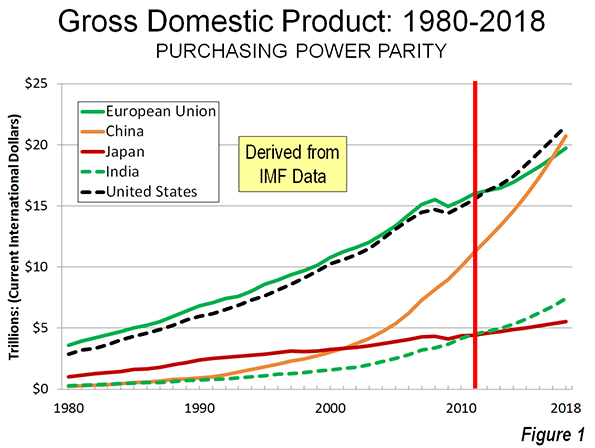
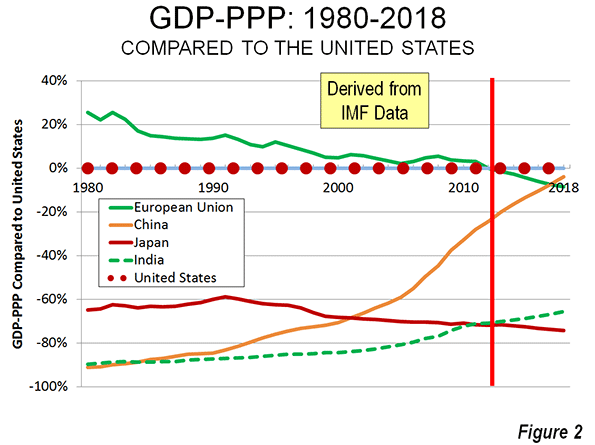
    The new data shows the United States to have a 2012 GDP-PPP of $16.245 trillion (current international dollars), two percent above the EU’s $15.933. This difference is relatively minor – the equivalent of Maryland’s GDP. In 2011, the EU led the US by a small margin, before the accounting methodology change. The IMF expects the US lead to be lengthened to approximately 10 percent by 2018. For comparison, in 1980, the same 28 EU economies had a GDP nearly one-quarter larger than that of the United States (Figures 1 and 2). However, it must be noted that in 1980, the European Union had only nine members and had an economy 8 percent smaller than that of the US.           

    China’s reduced, but still strong economic growth has propelled it to a GDP-PPP of $12.3 trillion, reaching 75 percent of the US figure. By 2018, the IMF expects China to reach 96 percent of the US GDP. If the IMF projected GDP increase rates of China and the US were to continue, China would be a larger economy than the United States by 2020. While this may be seem to be occurring sooner than expected, it is consistent with the expectation of former IMF economist Arvind Subramanian, in his book Eclipse: Living in the Shadow of China’s Economic Dominance. The scale of Chinese economic miracle that started under Deng Xiaoping can be seen by the fact that in 1980 its GDP was barely 10 percent of the US economy (See Ronald Coase and Ning Wang, How China Became Capitalist).

    India’s economy also continues to progress. Now the world’s fifth largest economy, India’s GDP-PPP is estimated at $4.7 trillion. By 2012, India’s economy had reached 29 percent of that of the United States, nearly triple the 1980 figure. IMF expects India to close the gap by another five percentage points by 2018.

    Japan has fallen to the fifth largest economy, at approximately $4.58 trillion. Japan had grown strongly after World War II, having reached 35 percent of the US economy by 1980. A number of experts, such as Harvard’s Ezra Vogel, expected that Japan would continue to close the gap with the United States. But Japan’s ascendency stopped by 1991, when it reached a size 41 percent of the US economy. In the subsequent economic slide, Japan’s economy fell to 28 percent of the US by 2012. IMF expects another two point drop by 2018.

    Gross Domestic Product per Capita (Purchasing Power Parity)

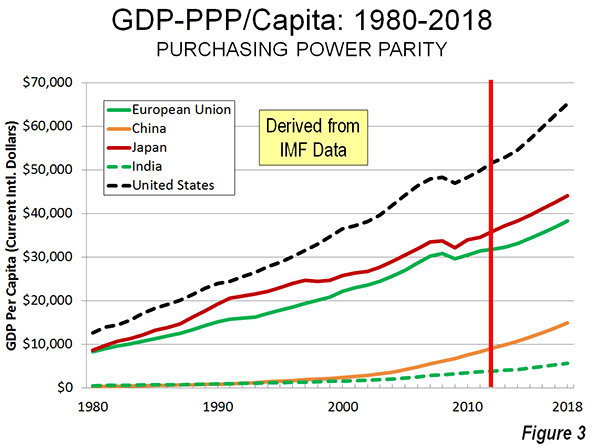
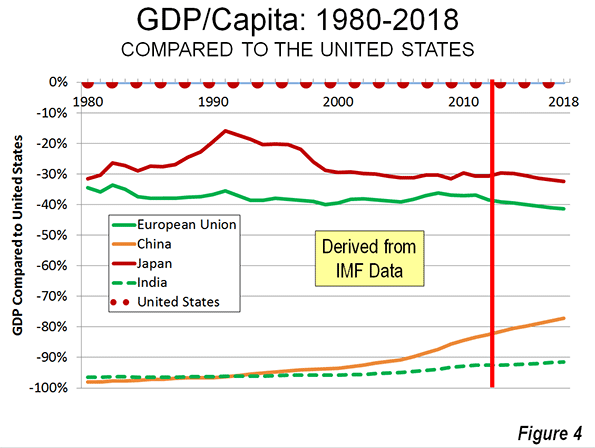
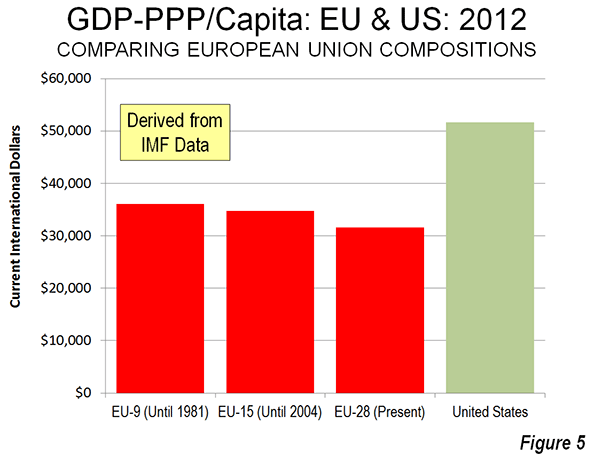
    The United States remains dominant in personal affluence among the world’s largest economies. In 2012, the US GDP-PPP per capita was $51,700. The European Union had a GDP-PPP of $31,600 in 2012, but is declining relative to the United States. In 2012, the EU GDP per capita was 61 percent of the US figure. This is down from a peak of 66 percent in 1982. IMF projects a further three percentage point loss by 2018 (Figures 3 and 4). The GDP-PPP per capita of the nations in the 9 nation European Union of 1980 was higher, at $36,100 in 2012 (Figure 5).

    Despite China’s potential for becoming the world’s leading economy by the beginning of the next decade, its huge population makes the GDP per capita much lower. In 2012 China’s GDP per capita was $9,100, about 18 percent of the US figure. This is, however, far higher than the 1980 figure of 2 percent. IMF expects China’s GDP per capita to rise to $14,900 by 2018, 23 percent of the US figure. 

    India’s GDP per capita was $3,800 in 2012, or seven percent of the US GDP per capita. India’s progress has been rapid, though   strongly overshadowed by China. India’s GDP per capita was 70 percent higher than China’s in 1980, but now China’s is now 60 percent higher. However, India has gained five percentage points on the US since 1980.

    Japan’s GDP per capita stood at 69 percent of the US figure in 2012 ($35,900), down significantly from 1991, when Japan’s GDP per capita reached 84 percent of the US level. IMF projects about a 1.5 percentage point further decline by 2018.

    Accounting Revision

    As is noted above, the accounting changes implemented by the United States have changed the world rankings and their prospects

    Data in the IMF’s last release (March 2013) placed the European Union slightly ahead of the United States in GDP-PPP. The United States is the first country to fully implement internationally agreed upon changes to national accounts (United Nations’ System of National Accounts 2008).  The IMF summarizes the revisions and its impact on the US economy as follows:

    “…expenditures on research and development activities and for the creation of entertainment, literary, and artistic originals are now treated as capital expenditures. Furthermore, the treatment of defined-benefit pension plans is switched from a cash basis to an accrual basis. The revisions increase the level of GDP by 3.4 percent and boost the personal savings rate.”

    The US Department of Commerce, Bureau of Economic Analysis indicates that Europe will convert to the new methodology in 2013 and it is to be expected that other nations will quickly follow.

    Before the accounting revision IMF data predicted that US would not pass the EU until 2015. Further, the previously lower GDP figures predicted that China would pass the United States just two years later (2017). China may have to wait to assume the top chair, but perhaps not. It all depends on how fast China converts to the new accounting and the impact of the revision on GDP figures.

    An Uncertain World

    Of course, economic projections cannot be “taken to the bank.” The world economy is volatile and uncertain and more so now that in more stable times.

    The US economy continues to sputter along with lagging growth. The European economy is doing even more poorly. Mixed signals continue to be heard from China, where astronomic growth rates are being replaced, at least for the moment, by more modest ones. President Xi Jinping says that China can create sufficient employment for its growing urban workforce with a 7.2 percent growth rate (See: “China Needs 7.2% Growth to Ensure Employment” in The Wall Street Journal) – a rate that would be the envy of each of the world’s strongest economies.

    The big high income world nations also have reason to envy India. According to the Organization for Economic Cooperation and Development (OECD), the economy of India “clocked a low growth rate of 4.4 percent” in the April to June quarter. The OECD characterized India’s immediate economic prospects as “weak,” yet India’s growth rate is far above those of the US, EU and Japan.

    The Bank of Japan (BOJ), the nation’s reserve bank, is optimistic about the nation’s new growth-seeking policies under “Abenomics” (named after Prime Minister Shinzo Abe). But the BOJ predictions of economic growth at 1.5 percent in 2014 and 2015 are favorable only in the light of Japan’s anemic recent growth.

    All of these predictions, combined with accounting changes, paint a blurred picture. This is the nature of a world economy that the IMF refers to as being stuck in “low gear.”

    Wendell Cox is a Visiting Professor, Conservatoire National des Arts et Metiers, Paris and the author of “War on the Dream: How Anti-Sprawl Policy Threatens the Quality of Life.

    —-

    Photo: Bank of China (right) and Peace Hotel, Shanghai (by author)

  • Taking Flight from Asia

    Viewed from a 50-year perspective, the rise of East Asia has been the most significant economic achievement of the past half century. But in many ways, this upward trajectory is slowing, and could even reverse. Simply put, affluence has led many Asians to question its cost, in terms of family and personal life, and is sparking a largely high-end hegira to slower-growing but, perhaps, more pleasant, locales.

    The Asian Century may have arrived, but many Asians – disproportionately entrepreneurial, well-educated and familial – are heading elsewhere. In the United States, they have surged past Hispanics as the largest source of immigrants and now account for well over a third of all newcomers. But that’s just the tip of this wave: Recent Gallup surveys reveal that tens of millions more – 40 million from the Indian subcontinent and China alone – would come if they could. This is far more than the 5 million in Mexico who would still like to move here.

    For the most part, these highly urbanized Asians are headed to places that may not be exactly pastoral, but are decidedly less-crowded places, either in the suburbs of great cities or, increasing, to sprawling low-density regions such as Houston, Dallas, Charlotte and Phoenix. In large swaths of Los Angeles County’s San Gabriel Valley, parts of the southeastern Orange County as well as the Santa Clara Valley, six cities, including tony San Marino, already are majority Asian, and many, including several in Orange County, are either there or well on the way.

    For the most part, these primarily suburban places, widely disdained by the dominant media and academic classes, appear to seem awfully nice to Asian immigrants. Nationwide over the past decade, the Asian population in suburbs grew by almost 2.8 million, or 53 percent, while their numbers expanded in core cities by 770,000, or 28 percent. In Southern California, the shift is even more pronounced: In Los Angeles and Orange counties – the nation’s largest Asian region, the suburbs added roughly five times as many Asians as did the core city. There are now roughly three Asian suburbanites for every core city dweller in our region.

    This is not just an American phenomenon. Asians, by far the fastest-growing large ethnic group in Canada, constitute a majority in many Toronto suburbs, like Markham, Brampton, Mississauga and Richmond Hill. The same pattern is seen in areas around Vancouver, such as Richmond, Greater Vancouver, Burnaby and Surrey. Asians, who, following New Zealanders, constitute a majority of newcomers in Australia, also tend to settle in suburbs, particularly newer ones.

    It’s most important to understand the reasons these people leave their homelands. Historically, people immigrate from places where there is a perceived lack of opportunity. Yet, many of the Asian countries seeing people leave – places like Singapore, Taiwan and China – have enjoyed consistently higher economic growth rates than any of the destination countries. What these immigrants increasingly understand is that, as their country’s GDP has surged, their quality of life has not and, in many ways, has deteriorated.

    These are the sometimes subtle but important things that tend to be ignored by geopoliticians and urban ideologues, attracted by the density and transit-richness of the Asian cities. “Everyday life,” observed the great French historian Fernand Braudel, “consists of the little things one hardly notices in time and space.” And, by these measurements, life in the United States, Canada or Australia is simply better than that in most Asian countries.

    In contrast, urban Asia, although rich and often colorful, has become an increasingly difficult place both for everyday life and for families. A nice salary might be satisfying, but is unlikely to be large enough to buy a house or apartment in places like Taipei or Hong Kong, where the cost of even a tiny apartment equals more than twice – adjusted for income – what would be sufficient to purchase a house in Irvine, and four times as much as an even larger residence in Houston, Dallas or Phoenix. Not surprisingly, most Asians in America feel they are living better than their parents, compared with their counterparts at home. Only 12 percent would choose to move back to their home country.

    Beyond housing, life in hyperurbanized Asia does not buy much happiness. Prosperous Singapore, for example, is one of the most pessimistic places on the planet, while ultradense South Korea has been ranked as among the least-happy nations in the Organization for Economic Cooperation and Development, ranking 32nd of 34 members. The country also suffers from among the highest suicide rates in the higher-income world.

    This reflects the often-ignored impacts of dense urbanization, including rising obesity, particularly among the young, who get less exercise and spend more time desk-bound. The air is foul, particularly in Beijing, no matter how much money you have. A healthy bank account does not exempt one from emphysema.

    Others complain about the dangers of a political system where wealth can always be confiscated by the state; no surprise, then, that a new survey shows roughly half of China’s millionaires are looking to move, primarily to the U.S. or Canada. During 2010-11, the number of Chinese applying for a U.S. investor visa, which requires a $1 million investment in the country, more than tripled, to more than 3,000. Repression of political thought and, particularly, against religion, also ranks as a major cause for leaving the homeland.

    The family – the historic centerpiece of cultures from India to Korea – may constitute the biggest victim of the hypercompetitive, ultradense Asian lifestyle. Hong Kong, Singapore and Seoul suffer among the world’s lowest fertility rates, with rates around 1. Meanwhile, Shanghai’s fertility rate has fallen to 0.7, among the lowest ever reported, well below China’s “one child” mandate and barely one-third the rate required simply to replace the current population. Due largely to crowding and high housing prices, 45 percent of couples in Hong Kong say they have given up having children.

    For those who do want to start a family, it increasingly makes sense to immigrate. This is evident in rising emigration from China’s cities, Hong Kong and Singapore, where roughly one in 10 citizens now lives abroad, often in lower-density communities in Australia, Canada and the United States.

    The nature of those immigrating is critically important. We are long past the days when the average Asian migrant is a physical laborer or a small-scale merchant. Now, the more typical newcomer is a student or a highly qualified professional. In Australia, Asians, notably from India, China and Taiwan, make up the vast majority of immigrants who qualify for entry under skills-oriented criteria.

    This pattern also can be seen in the United States. Asians now constitute a majority of workers in Silicon Valley. They also tend to concentrate in what may be best described as the country’s largely suburban nerdistans – magnets for high-tech workers – places like Plano, Texas, Bellevue, Wash., Irvine and large swaths of Santa Clara County.

    Does all this mean Asia is about to experience a precipitous decline? Not at all. But it is also increasingly clear that the dense model of development adopted on much of that continent – exacerbated by a mass movement to cities – is not, in a larger social sense, truly sustainable. Societies that become difficult for families, and exact too much stress on their residents, are destined to suffer maladies from ultrarapid aging, shrinking workforces and a host of psychological maladies.

    These strains will become more evident over time. Already, most Asian societies, from Japan and China to Singapore and Taiwan, are experiencing less growth, linked in part to financial pressures from a rapidly aging society. The economic motivations for staying in Asia will likely decline, accelerating the flight both of financial and, more importantly, human capital.

    Every society relies on the resourcefulness of its people, particularly the young. The loss of skilled individuals and, especially, families suggests we may have already witnessed the peak of the half-century-long Asian ascendency, well before the American era has even come to its oft-predicted demise.

    Joel Kotkin is executive editor of NewGeography.com and Distinguished Presidential Fellow in Urban Futures at Chapman University, and a member of the editorial board of the Orange County Register. He is author of The City: A Global History and The Next Hundred Million: America in 2050. His most recent study, The Rise of Postfamilialism, has been widely discussed and distributed internationally. He lives in Los Angeles, CA.

    This piece originally appeared at The Orange County Register.

    Singapore skyline photo by Bigstockphoto.com.
  • Shenzhen II?: The New Shanghai Financial Free Trade Zone

    Less than 35 years ago, China established its first special economic zone in Shenzhen, a prefecture (Note) bordering Hong Kong. This model is about to be expanded with the establishment of a new financially oriented free-trade zone in Shanghai, which could prove a major breakthrough in that city’s quest to become East Asia’s financial capital. The “China (Shanghai) Pilot Free Trade Zone (FTZ)” is located in eastern Pudong, the Shanghai’s suburban district (qu) that includes the huge new Pudong business district, across the river from the central business district in Puxi. 

    The potential here for rapid growth can be seen by reviewing the success of the Shenzen special economic zone (SEZ), When founded, the SEZ contained little more than a fishing village, but soon was transformed into a manufacturing and trading center, propelled by a less constrained regulatory environment. Foreign investment soared. The success of the Shenzhen model led to expansion of the zone and other special economic zones were established around the country. Shenzhen’s prosperity extended into neighboring Pearl River Delta prefectures such as Guangzhou, Dongguan, Foshan, Zhuhai and Zhongshan. Investment friendly policies were applied virtually across the nation in the years that followed. Today, for example, Apple makes many of its tablets in Chengdu, the capital of Sichuan, 1200 miles (2000 kilometers) inland via China’s larger equivalent of the US interstate highway system.

    Yet the economic advances of the special economic zones were anything but inevitable. Chinese leader Deng Xiaoping faced strong opposition from some high government officials, who were intent on limiting the scope of the Shenzhen experiment. Some even hoped to shut it down altogether (see Ezra Vogel’s Deng Xiaoping and the Transformation of China). Moreover, the economic advance of China involved, as the late Nobel Laureate Ronald Coase and Ning Wang relate in How China Became Capitalist  much more than conscious economic policy. Coase and Wang characterize the government’s light handed policies as permitting the “marginal revolutions” in individual entrepreneurship, township and village enterprises (locally owned enterprises) and private farming. These, and the special economic zones, were the driving forces in the Chinese economic miracle.

    And, as is predictable, not everyone is happy with the results of China’s transformation. There is persistent criticism of the inequality of income that has developed in China over the period. Yet, sitting on the sidelines, it is easy to second-guess the results of national economic policies, which do not always produce the intended outcomes. Suffice it to say that since 1980, China, one of the poorest nations in the world, has pursued policies, both of commission and omission, that have together lifted more people from poverty than ever before in history (See: Alleviating Poverty: A Progress Report). There is probably not a more important domestic objective for governments.

    Shanghai’s New Financially Oriented Free Trade Zone

    In the past the free trade zones focused principally on manufacturing. The new Shanghai free trade zone is the first to specialize in finance. The zone stretches along the Pacific Coast from north of Pudong International Airport, south through the large new town of Nanhui and across the Donghai Bridge to the new deep water port, which is an important component of the Port of Shanghai, now the largest in the world, and is designed to focus on finance. Initially, it will cover 11 square miles (29 square kilometers), but Hong Kong’s South China Morning Postsuggests that it might eventually be expanded to cover all of the Pudong New Area. This would expand the area to 467 square miles (1,210 square kilometers), an area nearly as large as the San Francisco-Oakland built up urban area.

    According to The Wall Street Journal “China’s government said it would turn a new free-trade zone here into a laboratory for remaking the country’s financial sector…” The Journal continues: “Financial-sector changes are at the heart of the experimentation in the zone: letting the market, rather than regulators, set interest rates and allowing firms to convert money more freely from yuan to foreign currencies and move the money overseas.”

    The Chinese based Global Times characterized the new free trade zone as an important step in China’s economic reform and the internationalization of the yuan. 

    As in the case of Shenzhen, government officials are characterizing the establishment of the new “Pilot Free Trade Zone” as an experiment. The Journal reports that the project is championed by new Premier Premier Li Keqiang, just as Shenzhen was championed by Deng Xiaoping. Should the zone be successful, it would not be surprising to see other such zones established. Perhaps, it will lead to an eventual liberalization of financial regulation across the nation, which is critical for China’s future development.

    Shanghai American Chamber of Commerce president Kenneth Jarrett responded positively to the announcement, telling China Daily: "One thing significant about the zone is its relationship to China’s economic reform agenda. Because there are a lot of talks about the need to rebalance the economy and make it more market-oriented, the FTZ (free trade zone) is a signature piece for the whole process."

    Yet, this will be far from a total free-market paradise. The government has announced a list of restrictions, including industries in which foreign investment will not be permitted and industries in which investment will be limited to joint ventures with Chinese companies.

    Chinese sources emphasize the evolutionary nature of the restrictions. According to Shanghai Daily, “The list is a temporary version for 2013 and the zone regulators will update the list every one or two years to better facilitate liberalization policies testing in the free trade zone.”

    Differing Views

    The new free trade zone move comes as analysts increasingly suggest the need to liberalize its financial sector. The Pilot FTZ could lead China’s financial sector toward greater integration into the globalized economy. This would strengthen China’s integration with the world, and could pose a major challenge to established financial centers, such as New York, London, Hong Kong and Singapore, In an editorial, The South China Morning Post (SCMP) speculates that the reforms begun with the Pilot FTZ could eventually undermine Hong Kong’s position as Asia’s financial center. The SCMP further notes that “The ultimate effect” of the Pilot FTZ “could be to help speed up economic reform nationwide. And that might be the bigger threat to Hong Kong.”

    If the skeptics are right, the restrictions and slowness of reform could limit the effectiveness of the zone and the challenge it poses to Hong Kong and other global financial capitals.  Such a view may be naïve. Other views are that reforms could lead to far more important consequences both in Asia and the World,.

    The most significant impacts could be on the United States, at least if former International Monetary Fund economist Arvind Subramanian is right. In his controversial book, Eclipse: Living in the Shadow of China’s Economic Dominance, Subramanian predicts that China will replace the United States as the world’s dominant economy by 2030 and that the yuan could replace the dollar as the principal reserve currency by that time. This could become more plausible if the financial liberalization apparently at the heart of the Pilot FTZ effort proceeds with dispatch.

    History: Repeating Itself?

    The signs from China are not completely clear. Bob Davis and Lingling Wei have just published an analytical The Wall Street Journal article that notes that President Xi Jinping has “veered left on some political issues.” Yet, indications on the economic front could be the opposite. The article focuses on Lie He, Xi Jinping’s leading economic advisor, Liu He, who Harvard’s 2001 Nobel laureate Michael Spence calls “an example of Chinese pragmatism," Spence adds that  Liu "…thinks markets are important mechanisms for getting things done efficiently," but "they’re not religion to him."

    Deng Xiaoping famously talked of crossing the river by “following the stones.” This cautious approach uses seemingly glacial policy changes that gradually initiate major change.This is how China has evolved over the past 35 years. Again, the Chinese appear to be choosing caution. This is not fast enough for some analysts, but this may also be a development that could augur many changes, not only for China, but for all its primary competitors in Asia and elsewhere.

    —–

    Note: The alternate term “prefecture” is used to denote the local jurisdictions into which all of China’s land area is divided. These go by various terms, with “municipality” or “city” used most frequently. In each case, municipalities are more akin to metropolitan areas (or even larger areas), which include the built-up urban areas and substantial expanses of surrounding rural territory.

    Photo: Pudong, Century Avenue toward the China (Shanghai) Pilot Free Trade Zone (by author)