Tag: China

  • America’s True Power In The NAFTA Century

    OK, I get it. Between George W. Bush and Barack Obama we have made complete fools of ourselves on the international stage, outmaneuvered by petty lunatics and crafty kleptocrats like Russia’sVladimir Putin. Some even claim we are witnessing “an erosion of world influence” equal to such failed states as the Soviet Union and the French Third Republic. “Has anyone noticed how diminished, how very Lilliputian, America has become?” my friend Tunku Varadajaran recently asked.

    In reality, it’s our politicians who have gotten small, not America. In our embarrassment, we tend not to notice that our rivals are also shrinking. Take the Middle East — please. Increasingly, we don’t need it because of North America’s unparalleled resources and economic vitality.

    Welcome then to the NAFTA century, in which our power is fundamentally based on developing a common economic region with our two large neighbors. Since its origins in 1994, NAFTA has emerged as the world’s largest trading bloc, linking 450 million people that produce $17 trillion in output. Foreign policy elites in both parties may focus on Europe, Asia and the Middle East, but our long-term fate lies more with Canada, Mexico and the rest of the Americas.

    Nowhere is this shift in power more obvious than in the critical energy arena, the wellspring of our deep involvement in the lunatic Middle East. Massive finds have given us a new energy lifeline in places like the Gulf coast, the Alberta tar sands, the Great Plains, the Inland West, Ohio, Pennsylvania and potentially California.

    And if Mexico successfully reforms its state-owned energy monopoly, PEMEX, the world energy — and economic — balance of power will likely shift more decisively to North America. Mexican President Pena Nieto’s plan, which would allow increased foreign investment in the energy sector, is projected by at least one analyst to boost Mexico’s oil output by 20% to 50% in the coming decades.

    Taken together, the NAFTA countries now boast larger reserves of oil, gas (and if we want it, coal) than any other part of the world. More important, given our concerns with greenhouse gases, NAFTA countries now possess, by some estimates, more clean-burning natural gas than Russia, Iran and Qatar put together. All this at a time when U.S. energy use is declining, further eroding the leverage of these troublesome countries.

    This particularly undermines the position of Putin, who has had his way with Obama but faces long-term political decline. Russia, which relies on hydrocarbons for two-thirds of its export revenues and half its budget, is being forced to cut gas prices in Europe due to a forthcoming gusher of LNG exports from the U.S. and other countries. In the end, Russia is an economic one-horse show with declining demography and a discredited political system.

    In terms of the Middle East, the NAFTA century means we can disengage, when it threatens our actual strategic interests. Afraid of a shut off of oil from the Persian Gulf? Our response should be: Make my day. Energy prices will rise, but this will hurt Europe and China more than us, and also will stimulate more jobs and economic growth in much of the country, particularly the energy belts of the Gulf Coast and the Great Plains.

    China and India have boosted energy imports as we decrease ours; China is expected to surpass the United States as the world’s largest oil importer this year. At the same time, in the EU, bans on fracking and over-reliance on unreliable, expensive “green” energy has driven up prices for both gas  and electricity.

    These high prices have not only eroded depleted consumer spending but is leading some manufacturers, including in Germany, to look at relocating production , notably to energy-rich regions of the United States. This shift in industrial production is still nascent, but is evidenced by growing U.S. manufacturing at a time when Europe and Asia, particularly China, are facing stagnation or even declines. Europe’s industry minister recently warned of “anindustrial massacre” brought on in large part by unsustainably high energy prices.

    The key beneficiaries of NAFTA’s energy surge will be energy-intensive industries such as petrochemicals — major new investments are being made in this sector along the Gulf Coast by both foreign and domestic companies. But it also can be seen in the resurgence in North American manufacturing in automobiles, steel and other key sectors. Particularly critical is Mexico’s recharged industrial boom. In 2011 roughly half of the nearly $20 billion invested in the country was for manufacturing. Increasingly companies from around the world see our southern neighbor as an ideal locale for new manufacturing plants; General Motors GM -0.96%Audi , Honda, Perelli, Alcoa and the Swedish appliance giant Electrolux have all announced major investments.

    Critically this is not so much Ross Perot’s old “sucking sound” of American jobs draining away, but about the shift in the economic balance of power away from China and East Asia. Rather than rivals, the U.S., Mexican and Canadian economies are becoming increasingly integrated, with raw materials, manufacturing goods and services traded across the borders. This integration has proceeded rapidly since NAFTA, with U.S. merchandise exports to Mexico growing from $41.6 billion in 1993 to $216.3 billion in 2012, an increase of 420%,while service exports doubled. MeanwhileU.S. imports from Mexico increased from $39.9 billion in 1993 to $277.7 billion in 2012, an increase of 596%.

    At the same time, U.S. exports to Canada increased from $100.2 billion in 1993 to $291.8 billion in 2012.

    Investment flows mirror this integration. As of 2011, the United States accounted for 44% of all foreign investment in Mexico, more than twice that of second-place Spain; Canada, ranking fourth, accounts for another 10%. Canada, which, according to a recent AT Kearney report, now ranks as the No. 4 destination for foreign direct investment, with the U.S. accounting for more than half the total in the country. Over 70% of Canada’s outbound investment goes to the U.S.

    Our human ties to these neighbors may be even more important. (Disclaimer: my wife is a native of Quebec). Mexico, for example, accounts for nearly 30% of our foreign-born population, by far the largest group. Canada, surprisingly, is the largest source of foreign-born Americans of any country outside Asia or Latin America.

    We also visit each other on a regular basis, with Canada by far the biggest sender of tourists to the U.S., more than the next nine countries combined; Mexico ranks second. The U.S., for its part, accounts for two-thirds of all visitors to Canada and the U.S. remains by far largest source of travelers to Mexico.

    These interactions reflect an intimacy Americans simply do not share with such places as the Middle East (outside Israel), Russia, and China. There’s the little matter of democracy, as well as a common sharing of a continent, with rivers, lakes and mountain ranges that often don’t respect national borders. Policy-maker may prefer to look further afield but North America is our home, Mexico and Canada our natural allies for the future. Adios, Middle East and Europe; bonjour, North America.

    This story originally appeared at Forbes.

    Joel Kotkin is executive editor of NewGeography.com and Distinguished Presidential Fellow in Urban Futures at Chapman University, and a member of the editorial board of the Orange County Register. He is author of The City: A Global History and The Next Hundred Million: America in 2050. His most recent study, The Rise of Postfamilialism, has been widely discussed and distributed internationally. He lives in Los Angeles, CA.
    NAFTA logo by AlexCovarrubias.

  • America Hanging in There Better Than Rivals

    To paraphrase the great polemicist Thomas Paine, these are times that try the souls of optimists. The country is shuffling through a very weak recovery, and public opinion remains distinctly negative, with nearly half of Americans saying China has already leapfrogged us and nearly 60 percent convinced the country is headed in the wrong direction. Belief in the political leadership of both parties stands at record lows, not surprisingly, since we are experiencing what may be remembered as the worst period of presidential leadership, under both parties, since the pre-Civil War days of Franklin Pierce and James Buchanan.

    Yet, despite the many challenges facing the United States, this country remains, by far, the best-favored part of the world, and is likely to become more so in the decade ahead. The reasons lie in the fundamentals: natural resources, technological excellence, a budding manufacturing recovery and, most important, healthier demographics. The rest of the world is not likely to cheer us on, since they now have a generally lower opinion of us than in 2009; apparently the "bounce" we got from electing our articulate, handsome, biracial Nobel laureate president is clearly, as Pew suggests, "a thing of the past."

    But as the Romans used to say, don’t let the bastards get you down. After all, it’s not like our competitors are stealing the march on us. Start with Europe. Just a few years ago, writers like Jeremy Rifkin and Steven Hill were telling us that Europe was the "model" for the world. Expand the welfare state, curtail capitalist excess, provide a comfortable partner to the rising nations of the world, and, well, enjoy a long and comfortable early retirement.

    Now, that early retirement is quickly turning into a kind of senility. Not only is Europe continuing to age – particularly along its Southern rim – but the fiscal pressures of ultrahigh unemployment, approaching 30 percent or above, among the young and the costs of maintaining a strong welfare state could create what urban analyst Aaron Renn has labeled "a demographic Lehman Brothers."

    At the same time the near-collapse of the Southern-rim countries threatens the viability of Europe’s banks, including those in Germany. Increasingly, Germany lives largely so the rest of Europe can die more quickly. Like a prototypical science-fiction villain, Germany – with fewer children than it had in 1900 – relies increasingly on the blood taken from the decaying Southern rim countries. By 2025, Germany’s economy will need 6 million additional workers, likely from such countries as Spain, Italy, Greece and Portugal, to keep its economic engine humming, according to government estimates.

    Asian anemia

    What about our prime Asian competitors? Japan has been the sick man of Asia for more than two decades. It’s now desperate enough to unleash Bernanke-like money-printing policies to supply some desperately needed economic Viagra. With a weaker currency, and more money from the Tokyo exchange, there could be a temporary recovery, but Japan’s long term prognosis is not good.

    What Japan really needs is more animal spirits – particularly the kind that produce offspring. By 2050, according to UN estimates, Japan will have 3.7 times as many people at least age 65 than 15 and younger. By then, there will be 10 percent more Japanese over 80 than under 15. Without an unlikely embrace of immigration, Japan is destined to become the nation in wheelchairs.

    China poses a more serious challenge, but the Middle Kingdom appears headed toward what one analyst calls "the end" of its amazing and profound economic miracle. Growth, once projecting Chinese global preeminence, is slowing precipitously. The country now faces a growing rank of competitors from lower-wage countries poised to take market share from the Middle Kingdom.

    China faces growing political instability at the grass-roots level, a mountain of state-issued bad debt and a festering environmental crisis, which threatens long-term food supplies and could create massive health problems. China is rapidly aging. It will have 60 million fewer people under age 15 by 2050, while gaining nearly 190 million people at least 65, approximately the population of Pakistan, the world’s fourth-most populous country.

    The so-called BRICS (Brazil, Russia, India, China and South Africa), once the darlings of the investment banking set, all are facing slowing growth and rising political instability. It doesn’t help that most are either total or partial kleptocracies, dependent on commodity exports or cheap labor. This is not a solid foundation for ascendency as newer emerging nations – Myanmar, Indonesia, Vietnam – ramp up.

    ENERGY SHIFT

    On all these accounts, North America, including our Canadian and Mexican neighbors, looks best-positioned. The first, and, arguably, most important game-changer is the energy revolution that could realign the economic stars for decades to come. The shale oil and natural gas boom, as the Economist recently noted, is as illustrative of America’s future, and genius at reinvention, "as the algorithms being generated in Silicon Valley."

    The energy boom’s best aspect, besides the emergence of relatively cleaner natural gas, is making global tyrants, such as those ruling Saudi Arabia and Russia, nervous about their future place in the world. These worries alone should send a three-word message to our leaders: Go for it.

    But North America is not, like Russia, a one-trick pony. The U.S. remains the world’s leading food producer and exporter, sending out more of such critical commodities as soybeans, corn and wheat than any other country. After decades of decline, the U.S. industrial base is growing again, and, although job growth is likely to be limited, our manufacturing sector is already the most productive in the world. With the advantages of a decent legal order, a huge domestic market and available workforce, the U.S. has remained the largest recipient of foreign investment on the planet, roughly five times that so far accumulated in China.

    Technology can be a fickle industry, but at this point of the game, it’s fair to say the U.S. is winning that race. As potentially dangerous as the tech giants may become over time, the U.S. dominance in everything from software code (Microsoft) and design (Apple), search (Google), e-retailing (Amazon), and social networking (Facebook) is nothing short of astounding. We even lead in the coffee business (Starbucks) that keeps all those nerds typing code late into the night.

    Cultural influence

    Then there’s the matter of culture. For years, Asian, Third World and European cultural warriors have plotted to knock the U.S. off its pre-eminent perch. But the European film industry is a shadow of its once-glorious efflorescence; much the same can be said about the once-splendid Japanese cinema. To be sure, Chinese films, Korean pop stars and Bollywood are rising forces, but U.S. exports more than $14 billion annually in film and television. On a global level, no one can compete with Hollywood as a packager of images and dreams – and Silicon Valley’s control of new distribution technology could further boost this advantage.

    Finally, there’s the matter of demographics. The United States, like its competitors, is aging, but not as quickly as our prime rivals. The birth rate has slowed with the recession, but it’s likely to come back toward replacement levels in the years ahead as millennials enter their thirties en masse, and immigrants continue coming to the country. America should be the only one of the top five economies with a growing workforce over the next few decades.

    So, if things are so good, why do they seem so bad? Sixteen years of lackluster leadership has not helped – a succession of two spendthrift presidents, one a too-happy warrior with a weak sense of the limits of even an imperial power, and the other, a posturing and arrogant academic oddly disconnected from the fundamental grass-roots drive that moves his country’s economy. Yet I prefer to see it in a more positive light: If we can do better than our major competitors under such leadership, how great a country is this?

    Joel Kotkin is executive editor of NewGeography.com and Distinguished Presidential Fellow in Urban Futures at Chapman University, and a member of the editorial board of the Orange County Register. He is author of The City: A Global History and The Next Hundred Million: America in 2050. His most recent study, The Rise of Postfamilialism, has been widely discussed and distributed internationally. He lives in Los Angeles, CA.
    This piece originally appeared at The Orange County Register.

    USA map image by BigStockPhoto.

  • 125 Years of Skyscrapers

    Skyscrapers have always intrigued me. Perhaps it began with selling almanacs to subscribers on my Oregon Journalpaper route in Corvallis. I have continued to purchase almanacs each year and until recently, the first thing I would do is look in the index for "Buildings, tall” in the old Pulitzer The World Almanac, the best source until the Internet.

    My 1940 edition is the first in which “Buildings, tall” appears. The world of skyscrapers has changed radically through the years. This article provides a historical perspective on the world’s tallest buildings, using information from almanacs and the Internet (See Table Below). Extensive hyperlinking is also used, principally to articles on particular buildings.

    The Rise of Commercial and Residential Buildings

    Throughout most of history, the tallest habitable buildings have been religious edifices, or mausoleums, such as the great pyramids of Egypt. But in the middle to late 19th century, taller commercial and residential buildings were erected in the United States. For four years, from 1890 to 1894, the New York World Building, itself was the tallest in the world, at 309 feet (95 meters) and 20 floors. But it was not until the turn of the 20th century that a commercial or residential building exceeded the tallest religious building, Ulm Cathedral in Germany. This was Philadelphia’s City Hall. In its wisdom, however, Philadelphia outlawed any building higher than William Penn’s head at the top of City Hall. It was not until the late 1980s that a taller building appeared in Philadelphia (One Liberty Place).

    Tallest Buildings in 1940

    Despite Chicago’s claim as birthplace of the skyscraper, by 1940, nine of the 10 tallest buildings in the world were in New York. Manhattan was so dominant that the World Almanac listed the city at the top of the list, out of alphabetical order. The five tallest buildings, the Empire State Building, the Chrysler Building, 60 Wall Tower (now 70 Pine), 40 Wall Tower (now the Trump Building) and the RCA Building (now the GE Building) all  opened in the 1930s and represent Art Deco at its zenith. The sixth tallest, the Woolworth Building, had been the world’s tallest from 1913 to 1930 and is neo-Gothic.

    Cleveland’s Terminal Tower was 7th tallest, and the tallest building in the world outside New York. Cleveland’s Union Terminal was in the building and served the legendary New York Central Railroad’spremier New York to Chicago 20th Century Limited.

    Tallest Buildings in 1962

    Things changed little by 1962. The five Art Deco skyscrapers that where the tallest in 1940 remained so in 1962. There were two newcomers to the top 10 list, both modernist monoliths, the Chase Manhattan Bank Building in lower Manhattan and the Pan Am Building (later the Met-Life Building). The Pan Am Building is despised by many New Yorkers as Parisians despise the Tour Montparnasse. This led to banning similar behemoths in the ville de Paris (most of the skyscrapers in the Paris urban area are in La Defense, a nearby suburban “edge city”). But all of the 10 tallest buildings in the world were in the United States.

    Tallest Buildings in 1981

    Just two decades later, New York’s dominance eroded. By now, The World Almanac listed New York in alphabetical order, between New Orleans and Oakland. For the first time since before 1908 when the Singer Building opened, New York was not the home of the world’s tallest building. That title had gone to Chicago’s, Sears Tower (later Willis Tower), which opened in 1974. Chicago gained even more respect with two other buildings appearing in the top 10, the Standard Oil Building (nowAon Center) and the John Hancock Center, which was the tallest mixed use (residential and commercial) building in the world. The twin towers of the former New York World Trade Center were tied for second tallest in the world.

    For the first time, a non-American skyscraper was in the top 10. Toronto’s First Canadian Place was the eighth tallest in the world. Only three of the former five New York Art Deco buildings remained in the top 10, with 40 Wall Tower and the RCA Building no longer on the list.

    Tallest Building in 2000

    By 2000,   Kuala Lumpur, which is not among the largest cities in the world, emerged with both of the tallest buildings, in the Petronas Towers. The Petronas Towers ended America’s long history of having the tallest building. These distinctive postmodern towers were just two of six Asian entries in the top 10, including another postmodern structure, the Jin Mao Tower in Shanghai’s Pudong, which is probably the world’s largest edge city.

    I recall my surprise at exiting the Guangzhou East Railway station in 1999 to see the CITIC Tower, the 7th tallest building in the world. There could have been no better indication of that nation’s modernization. The Pearl River Delta had two other of the tallest buildings, one in Shenzhen (Shun Hing Square), the special economic zone that became the economic model for the rest of China, and the second in Hong Kong (Central Plaza).

    Tallest Building in 2013

    By 2013, the world of skyscrapers had nearly completely overturned. Dubai, with a population little more than Minneapolis-St. Paul, is now home to the world’s tallest building, the Burj Khalifa. The Burj Khalifa is not just another building. Never in history has a new tallest building exceeded the height of the previous tallest building by so much. Even the long dominant Empire State Building had exceeded the Chrysler building by only 200 feet (64 meters). The Burj Khalifa was nearly 1050 feet higher (320 meters) than the then tallest building, Taipei 101, and reaches to more than 1/2 mile (0.8 kilometers) into the sky. The world’s second tallest building (the Mecca Royal Hotel Clock Tower) is also on the Arabian Peninsula.

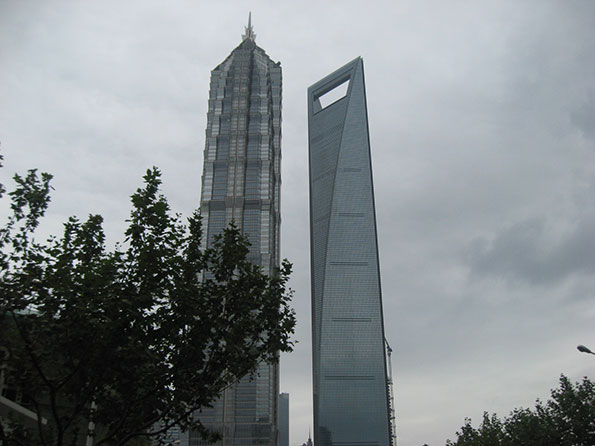
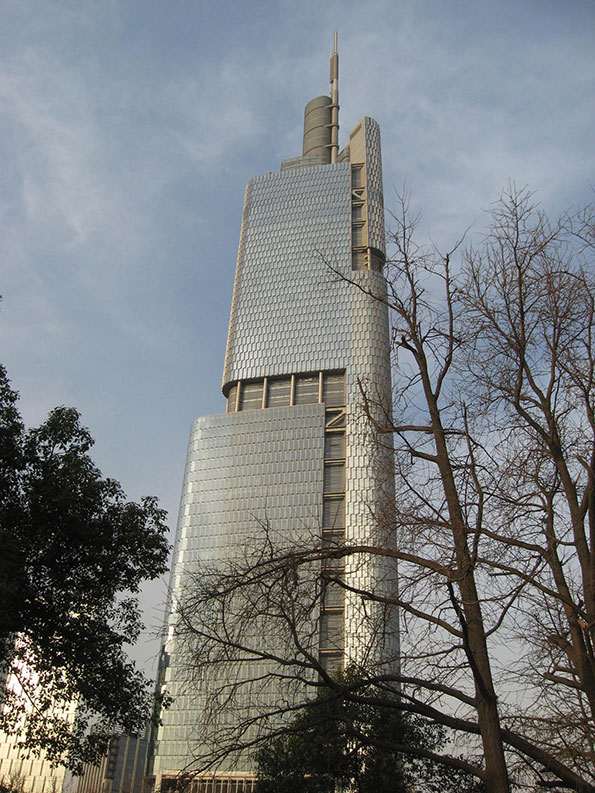
    The Shanghai World Financial Center is now the fourth tallest in the world, and when it opened had the highest habitable floor and the highest observation deck in the world. Its unusual design has earned it the nickname "bottle opener" among residents (Photo 1). Hong Kong has a new entry in the list, the International Commerce Center, across the harbor in Kowloon. Nanjing’s Greenland Financial Complex (Photo 2) ranks 8th, and Shenzhen’s Kinkey 100 ranks 10th.


    Nine of the 10 tallest buildings in the world are now in Asia. The last American entry is the Sears Tower (Willis Tower), in Chicago, which ranks 9th. Skyscraperpage.com maintains a graphic of the world’s tallest buildings (Note 1).

    Under Construction: A number of super-tall buildings (Note 2) will soon open. Earlier this month, the Shanghai Tower was “topped out.” This structure is across the street from the Jin Mao Tower and the Shanghai World Financial Center, forming by far the greatest concentration of super-tall skyscrapers in the world (Photo 1). The Ping An Finance Center in Shenzhen and the Wuhan Greenland Center in Wuhan are also under construction, and will rank, at least temporarily, second and third tallest in the world when completed. The Goldin Finance Building in Tianjin and the Lotte World Tower in Seoul will be somewhat shorter. One World Trade Center in New York will be completed before most of these, which will allow it brief entry into the top ten.

    Another entry, Sky City in Changsha (Hunan) could be on the list, slightly taller than the Burj Khalifa. This building is to be constructed in 210 days, following site preparation and work began last month. It was, however, halted by municipal officials and there are conflicting reports as to the building’s status.

    Skyscraperpage.com also maintains a graphic of the world’s tallest under-construction buildings.

    Tallest Buildings in 2020?

    None of the tallest buildings in the world are predicted to be in the United States by 2020, according to a graphic of current plans posted on the Council on Tall Buildings and Urban Habitat website. The Burj Khalifa is expected to be replaced as tallest by another Arabian Peninsula entry, the Kingdom Tower in Jeddah, which will be 0.6 miles high (3.3 kilometers). The torch has been passed to Asia.

    WORLD’S TALLEST COMPLETED BUILDINGS: 1940-2013
    1940 Building City Feet Meters Stories
    1 Empire State New York 1,250 381 102
    2 Chrysler New York 1,046 319 77
    3 60 Wall Tower (70 Pine Street) New York 950 290 66
    4 40 Wall Tower (Trump) New York 927 283 90
    5 RCA New York 850 259 70
    6 Woolworth New York 792 241 60
    7 Terminal Tower Cleveland 708 216 52
    8 Metropolitan Life New York 700 213 50
    9 500 5th Avenue New York 697 212 60
    10 20 Exchange Place New York 685 209 54
    1962 Building City Feet Meters Stories
    1 Empire State New York 1,250 381 102
    2 Chrysler New York 1,046 319 77
    3 60 Wall Tower (70 Pine Street) New York 950 290 66
    4 40 Wall Tower (Trump) New York 927 283 71
    5 RCA New York 850 259 70
    6 Pan Am (Met-Life) New York 830 253 59
    7 Chase Manhattan New York 813 248 60
    8 Woolworth New York 792 241 60
    9 20 Exchange Place New York 741 226 57
    10 Terminal Tower Cleveland 708 216 52
    1981 Building City Feet Meters Stories
    1 Sears Tower (Willis Tower) Chicago 1,454 443 110
    2 World Trade Center-North Tower New York 1,350 411 110
    2 World Trade Center-South Tower New York 1,350 411 110
    4 Empire State New York 1,250 381 102
    5 Standard Oil (Amoco) Chicago 1,136 346 80
    6 John Hancock Center Chicago 1,127 344 100
    7 Chrysler New York 1,046 319 77
    8 Texas Commerce Tower Houston 1,002 305 75
    9 First Canadian Place Toronto 952 290 72
    10 60 Wall Tower (70 Pine Street) New York 950 290 66
    2000 Building City Feet Meters Stories
    1 Petronas Tower 1 Kuala Lumpur 1,483 452 88
    1 Petronas Tower 2 Kuala Lumpur 1,483 452 88
    3 Sears Tower (Willis Tower) Chicago 1,454 443 110
    4 Jin Mao Tower Shanghai 1,381 421 88
    5 World Trade Center-North Tower New York 1,350 411 110
    5 World Trade Center-South Tower New York 1,350 411 110
    7 Citic Plaza Guangzhou 1,283 391 80
    8 Shun Hing Center Shenzhen 1,260 384 69
    9 Empire State New York 1,250 381 102
    10 Central Plaza Hong Kong 1,227 374 78
    2013 Building City Feet Meters Stories
    1 Burj Khalifa Dubai 2,717 828 163
    1 Mecca Royal Hotel Clock Tower Mecca 1,971 601 120
    3 Taipei Taipei 101 1,670 508 101
    4 Shanghai World Financial Center Shanghai 1,614 592 101
    5 International Commerce Center Hong Kong 1,588 484 118
    6 Petronas Tower 1 Kuala Lumpur 1,483 452 88
    6 Petronas Tower 2 Kuala Lumpur 1,483 452 88
    8 Greenland Financial Complex Nanjing 1,476 450 89
    9 Sears Tower (Willis Tower) Chicago 1,454 443 110
    10 Kinkey 100 Shenzhen 1,450 442 100
      Outside United States
      United States, Outside New York
      New York


    Wendell Cox is a Visiting Professor, Conservatoire National des Arts et Metiers, Paris and the author of “War on the Dream: How Anti-Sprawl Policy Threatens the Quality of Life.

    ———————

    Note 1: There are a number of sources for information on tall buildings, such as the Council on Tall Buildings and Urban Habitat, Skyscraperpage.com, Emporis.comand Wikipedia.com. Of course, my favorite will always be The World Almanac, even if the Internet provides faster access. Wikipedia also has fascinating articles on individual buildings (Wikipedia’sutility is limited to recreational research for identifying original sources, and should never be used in serious research, or God forbid, used in a footnote).

    Note 2: The Council on Tall Buildings and Urban Habitats defines a super-tall building as being over 980 feet (300 meters) high.

    ——————————

    Photo 1: Jin Mao Tower (left) and Shanghai World Financial Center (right), Shanghai. Construction began later on the recently topped out Shanghai Tower to the right of the Shanghai World Financial Center.

    Photo 2: Greenland Financial Center, Nanjing

    —————————-

    Photograph: The New York World Building (1890-1955).

  • The Evolving Urban Form: Nanjing

    Nanjing is one of China’s most historic cities. It is one of the four great ancient capitals of the nation, along with Beijing, Chang’an (Xi’an) and Luoyang. Its name means southern capital (Nan=south, Jing=capital), while the name of the current capital, Beijing means Northern capital. Nanjing was the national capital at various times, however generally for periods of no more than a few decades. Upon the establishment of the People’s Republic of China, the national capital was moved permanently to Beijing, where it had been for most of the previous five centuries.

    Nanjing is the capital of Jiangsu, which is China’s fifth most populous province. It has twice as many people as California (80 million) and a land area the size of Virginia. Nanjing is also one of the "four furnaces" of China, a title derived from its humid summers. The others include Wuhan (Hubei), Chongqing and sometimes Changsha (Hunan) or Nanchang (Jiangxi).

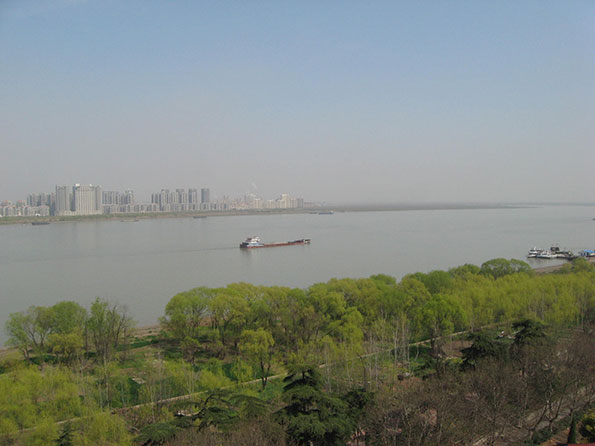
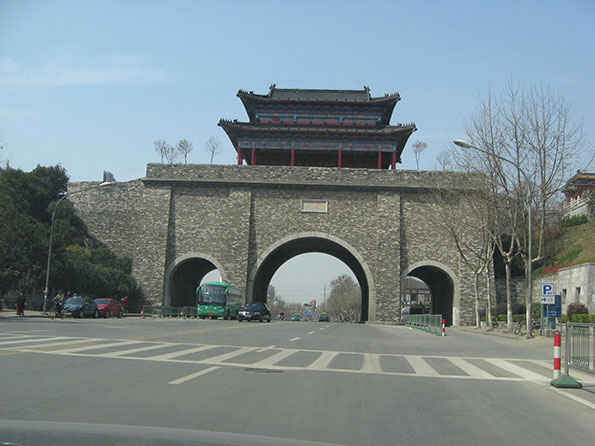
    Nanjing is reputed to have the world’s longest, though not the oldest surviving city wall, which was built in the 14th century (Photo).  The city is also the site of the second bridge ever built over the lower Yangtze River (Photo), opened in 1968 (the first was at Wuhan). The bridge carries both automobiles and trains. There are now five Yangtze River crossings in Nanjing.


    Nanjing City Wall


    Yangtze River (toward suburban Pukou qu)

    Yangtze Delta Megalopolis

    Nanjing is a big city in one of the world’s great urban mega-regions. It serves as the Western anchor of the Yangtze Delta region, a megalopolis (string of metropolitan areas) which consists of a string of sometimes adjacent urban areas, stretching through Suzhou to Shanghai and Hangzhou to Ningbo, with a population of approximately 60 million (plus additional millions in rural areas, outside the urban areas). This is at least a third more than live in the longer Washington-New York-Boston corridor, the original megalopolis.

    A trip through the Yangtze Delta corridor demonstrates only comparatively short sections that are not urbanized. One of the longest is the 10 mile (16 kilometer) section from the eastern urban fringe of Nanjing to the western fringe of Zhenjiang (location of the Pearl S. Buck Museum). Further, Nanjing’s southern fringe now meets that of Maanshan, in Anhui province (not a part of the Yangzte Delta).

    The Nanjing Urban Area

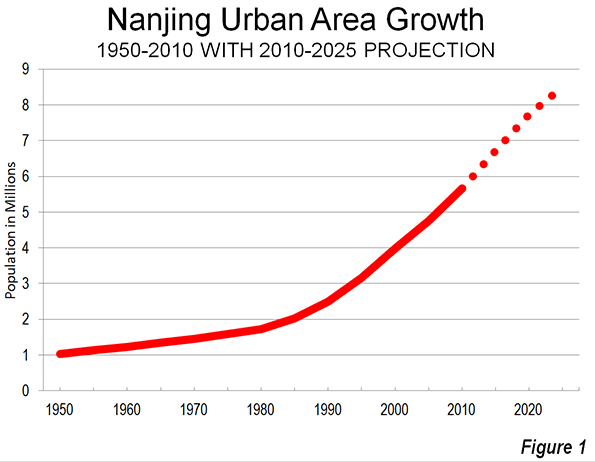
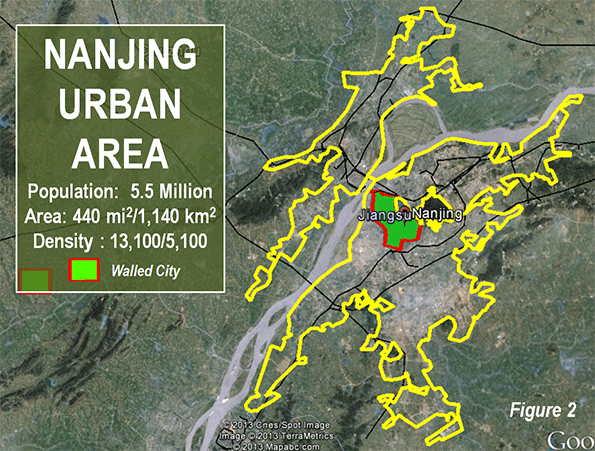
    Nanjing has grown rapidly. In 1950, the urban area population was approximately 1.0 million (see "Definition of Terms Used in the Evolving Urban Form Series"), a population some sources say was exceeded in the 15th century. The urban area has now reached 5.8 million. Nanjing is the world’s 59th largest urban area and the 13th largest in China. It is projected to have a population of more than 8 million by 2025 (Figure 1). The Nanjing urban area (Figure 2) covers approximately 440 square miles (1,140 square kilometers). This results in a population density of approximately 13,100 per square mile (5,100 per square kilometer).

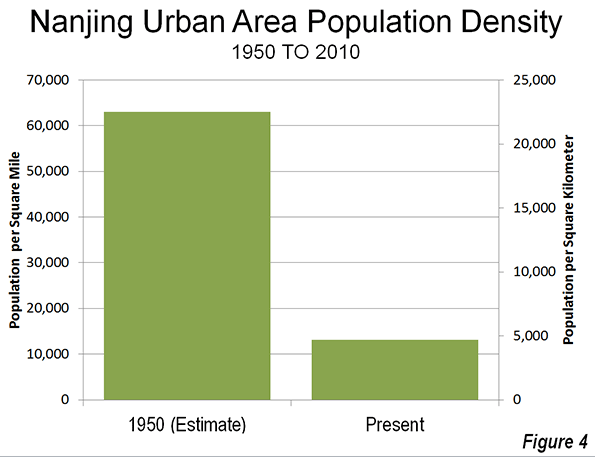
    Consistent with the general principle that cities become less dense as they get larger, Nanjing’s population density has fallen significantly over the last 60 years, even as its geographical size has more than quintupled (Figure 3). Older historic land area data is not readily available, but if it is assumed that virtually all of Nanjing’s United Nations reported 1,000,000 population in 1950 lived within the 17 square mile (44 square kilometer) periphery of the city walls, the population density would have been more than 60,000 per square mile (more than 23,000 per square kilometer). The area within the city walls is indicated by green shading in the urban area representation (Figure 2).

    By 1970, the population had increased to over 1.4 million and if this population was contained inside the city walls, the population density would have approached 90,000 per square mile (35,000 per square kilometer).Indicating a similar density, the 2010 population of the most densely populated district (Golou qu), much of which is located inside the Wall 86,000 per square mile (33,000 per square kilometer).

    The Nanjing Metropolitan Area

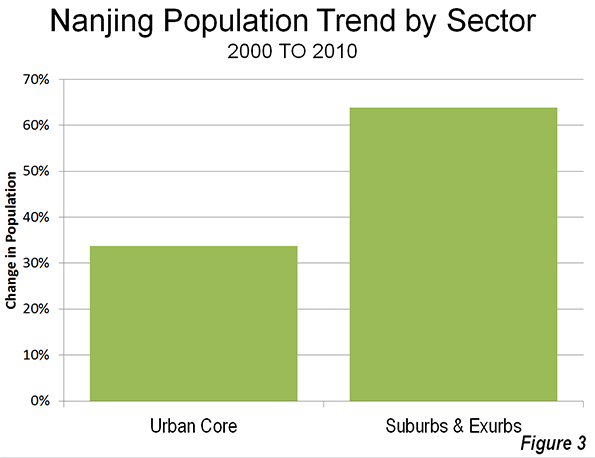
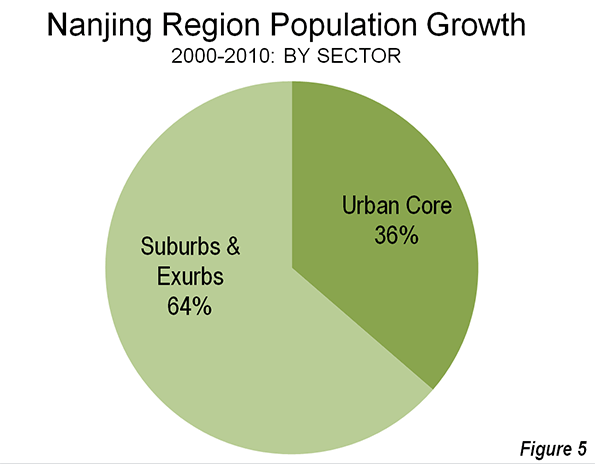
    Nanjing is a prefecture (regional municipality) with 11 districts, of which nine are in the metropolitan area (Note 1). The core of Nanjing continues to grow, from 2.5 million in 2000 to 3.4 million in 2010, an increase of 34 percent (Note 2). But in comparison, the suburban districts grew from 2.3 million to 3.8 million, an increase of 64 percent (Figure 4). For the first time, suburban Nanjing has a larger population than the urban core. The suburbs accounted for 64 percent of the metropolitan area’s growth over the past decade, compared to 36 percent in the urban core (Figure 5).

    Pukou, a suburban district across the Yangtze River from the historic location of Nanjing, was by far the fastest growing part of the metropolitan over the past decade. By 2010, the population had risen to 710,000 from 225,000 in 2000, when it was largely rural. Two metro lines are planned to connect Pukou to the rest of the urban area, which is likely to encourage further suburban development.

    The Nanjing Economy

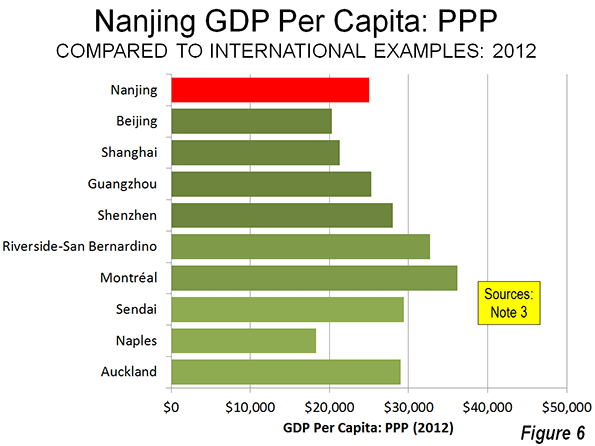
    Nanjing, like other cities in China, has been a beneficiary of China’s unprecedented poverty reduction, first launched by the economic reforms started by Deng Xiao Ping in the early 1980s. It is estimated that in 2012, Nanjing’s gross domestic product per capita (purchasing power parity adjusted) was approximately $25,000 annually. Nanjing’s GDP per capita is compared to that of other Chinese metropolitan areas and examples from the developed world in Table 6 (Note 3).

    A Strong Future

    Nanjing seems likely to continue its strong growth. This and Nanjing’s geographic location in one of the most vibrant mega-regions in the world should guarantee a continuing and strong contribution not only to the development of the Yangtze Delta megalopolis, but also to economic progress of China as a whole.

    Wendell Cox is a Visiting Professor, Conservatoire National des Arts et Metiers, Paris and the author of “War on the Dream: How Anti-Sprawl Policy Threatens the Quality of Life.

    —-

    Note 1: The districts (qu and counties) designated as urban by Nanjing prefecture (regional municipality) authorities Entire peripheral districts are designated when they begin to receive urban development. The "urban" designation in China, however, does not indicate continuous urbanization and is thus not an urban area in the internationally defined sense. The Chinese urban definition is thus similar to a metropolitan area (labor market).

    Note 2: The urban core includes the following districts (qu): Xuanwu, Biaxia, Qinhaui and Gulou.

    Note 3:  Estimated the Brookings Institution Global Metro Monitor, and other sources. See "World’s Most Affluent Metropolitan Areas: 2012" including the "Note."

    Top Photo: Zifeng Tower (all photos by author)

  • Chinese Cancel Treasure Island Investment as Brown Seeks High Speed Rail Funds

    California’s Governor Jerry Brown and an entourage of public officials and corporate executives has spent much of the last week traveling around China trying to drum up business for the state. One of his principal objectives is to entice Chinese investors to take a stake in the California high-speed rail project. From the Governor’s perspective, this makes all sense in the world.

    California’s high-speed rail program may be the current holder of the largest projected funding deficit of any infrastructure in the world, at approximately $50 billion. (That’s after shaving $30 billion off the project and losing the support of former California High Speed Rail Authority Chairman, former state Senator Quentin Kopp, who charges that the line is no longer "genuine high speed rail").

    As Governor Brown concludes his trip to the Orient, word comes from The San Francisco Chronicle that "A $1.7 billion deal with China Development Corp., the Chinese national railway and Lennar Corp. to construct 12,500 homes on the former Hunters Point Naval Shipyard in San Francisco and a string of high-rises on Treasure Island has collapsed." The project was to be built over up to three decades and would have housed 20,000 people. The deal is said to have fallen apart over not allowing the Chinese investors sufficient control and "unresolved tax issues."

    The now defunct deal may have been the largest serious Chinese investment proposal in California.

    There are important lessons for proponents of the high-speed rail system, who sometimes fantasize about China as the bailout investor of last resort. The Chinese, like the other investors who have found better things to do with their money are not likely to be swayed by the line’s excessively high cost or its modest ridership potential. Nor will the Chinese bear gifts to California.

    These issues are described in detail in the new Reason Foundation Updated Due Diligence report by Joseph Vranich and me.

  • The California-China-CO2 Connection

    Michael Peevey, President of the California Public Utilities Commission, is sincere and concerned about CO2 emissions. At a recent presentation at California State University Channel Islands, he spoke about California’s efforts to limit emissions. He mentioned green jobs, but, to his credit, he did not repeat the debunked claim that restricting CO2 emissions will be a net job creator. He also acknowledged that it doesn’t much matter what California does, if China doesn’t change its behavior. It turns out that if California were to reduce its carbon emissions to zero, in about a year and a half global CO2 would be higher anyway, just because of the growth in China’s emissions.

    Peevey talked about California’s increasingly ambitious plans for carbon reduction in the future. The goals include returning to 1990-level CO2 emmisions by 2020, and then an 80 percent reduction by 2050, regardless of population changes.

    This is going to be expensive. And the price of some of the potential technology — such as capturing atmospheric CO2 and pumping it underground — will include a lot more than the direct cost. The ultimate costs will, unfortunately, include increased global CO2 emissions.

    Some readers will remember the first time Larry Summers, the former US Treasury Secretary (under Bill Clinton) put his public career at risk because of his bluntness. In 1991, while Chief Economist at the World Bank, Summers gained international notoriety by saying in a memo, “I’ve always thought that under-populated countries in Africa are vastly under polluted.”

    That was the first of many times that lots of people demanded his head. He’s since claimed that it was sarcasm, but I don’t believe it. I believe he meant that environmental quality is a luxury good; that poor people need things like food and shelter, and they don’t much care if they trash the environment in the process. So, if pollution were localized, the poor would gain jobs and the wealthy would have an improved environment. Presumably, each would be happier.

    Of course, that sounds terrible to most people. But that’s precisely what we are doing here in California, only we’re doing it worse.

    California, by making production so very expensive, is chasing producers to places with low pollution controls. It’s worse than the situation Summers describes, because carbon dioxide emissions do not remain local. They spread throughout the atmosphere. Perversely, California is causing a global increase in CO2 emissions by its regulations limiting CO2 emissions in California.

    The problem is the result of acting on the concept of Think Globally and Act Locally (TGAL). TGAL works when pollution is local. But when air pollution is free to float around the world, you have to have a different strategy, and get the most reduction for your investment.

    And you don’t get the most for your investment in California. In terms of carbon efficiency — the ability to generate output while emitting less CO2 — California is one of the world’s most efficient economies. Each new reduction in CO2 becomes increasingly expensive. That is, reducing emissions is subject to increasing marginal costs. Reducing carbon emission in California is really expensive because we’re so carbon efficient already. Reaching the 2050 goal will be incredibly expensive. Worse, it won’t do any good.

    It’s not as if California can really afford it. Last month, I participated in the South Coast Association of Governments (SCAG) Third Annual Economic Summit. This great event provided lots of information about the economic challenges facing Southern California. For example, we learned that Los Angeles County’s economy will probably not reach its pre-recession level of jobs until at least 2018 and perhaps not until 2020.

    That’s a sobering thought.

    California State Sen. Roderick Wright, D-Los Angeles, a powerful speaker, documented California’s industrial decline, and made an emotional appeal for polices that produce jobs. The audience gave Wright a rousing ovation, something quite rare at economic conferences. The problem is that the audience was comprised of economic development people. Too bad no one else was listening. It was poorly attended by policy makers. There were only a handful of elected officials.

    California’s economy is struggling, even if many in the political class refuse to acknowledge the fact. Because of that, our investments need to be wise. The correct strategy for California is global. We need to go looking for the low hanging fruit.

    The low hanging fruit is mostly in developing countries like China, India and Brazil. We’ve tried to get them to cut their emissions at Kyoto and the like, but they refused, pointing out that they are much poorer than the West, and that we were able to develop with lower-cost polluting industries. They have a point.

    We should help them cut their carbon emissions. Reducing a ton of CO2 emissions is far cheaper in China than in California. So, let’s reduce it there.

    There are political problems with this proposal. California’s carbon regulations were sold to the people on the absurd claim that the regulations would be profitable: better than low cost, better than a free lunch.

    The bigger problem would be convincing California voters to tax themselves to clean up Chinese factories. That seems to me to be an information dissemination problem. If Californians knew the true cost of the existing program, and how little reduction in global CO2 concentrations it brings, they might logically be willing to look at other approaches. If they knew how much more effective a dollar spent on Chinese emissions was than a dollar spent on California emissions, they might seriously consider the proposal. The proposal could always be sweetened by requiring that all the work be done by California companies.

    It would be good for Californians. It would be a big step towards restoring California’s economic vigor. It would make a serious dent in global CO2 concentration. It would be less costly than our current plan.

    Let’s do it.

    Bill Watkins is a professor at California Lutheran University. and runs the Center for Economic Research and Forecasting, which can be found at clucerf.org.

    Flickr photo by doc tobin: Smog on the Great Wall.

  • China Freeways: Continuing Expansion

    Beijing’s xinhuanet.com reported on December 30 that 11,000 kilometers (7,000 miles) of new freeways (motorways) were built in 2012. This is equivalent to more than 150 percent of the freeway mileage in California.

    Based on figures reported at the end of 2011, the additional 11,000 kilometers would increase China’s national freeway system (the National Trunk Highway System) to approximately 96,000 kilometers (60,000 miles). This is approximately 20,000 kilometers (12,000 miles) longer than the US interstate highway system, as reported in 2010. As a result, China’s national freeway system is the longest in the world.

    Both China and the United States have additional freeway segments that are not a part of the national systems. In 2010, the United States had approximately 99,000 kilometers (62,000 miles) of freeways, including the interstate system. Data is not readily available for a number of urban and provincial level freeways in China that are not a part of the National Trunk Highway System.

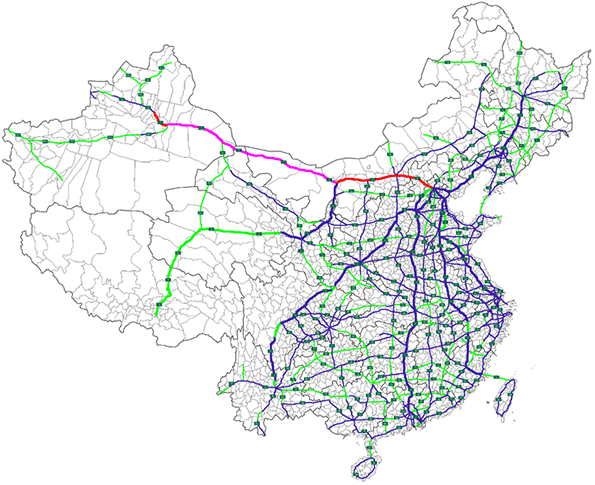
    It seems likely that the US continues to lead, though by only a small margin, in total freeway mileage. However, China is continuing to expand its system at a rapid rate. This is evident in the map below, which uses purple and green to indicate uncompleted freeways, while blue and red indicate open segments. Long stretches remain to be completed to Urumqi, the capital of Xinjiang, and beyond to the border of Kazakhstan in the Pamir Mountains, as well as two long routes to Lhasa, the capital of Tibet. A number of additional routes are also planned in the densely populated eastern third of the nation.


    Map by WikiCommons user Pafun

    Also see:
    China’s Expanding Roadways (February 2012)
    China Expressway System to Exceed US Interstates (January 2011)

  • Want to See Better US-Chinese Relations? American and Chinese Millennials Could Be Key

    While it is still fashionable for politicians in both China and the United States to prove their domestic leadership credentials by taking tough stances against their nation’s chief economic rival, the results of recent Pew surveys conducted in the two countries suggest that this type of rhetoric is a holdover from an earlier era. An examination of the beliefs among the youngest generational cohorts in each country shows a distinct lack of the ideological vitriol so common in the 1960s and 1970s. As a result, we might see a far more congenial relationship between the world’s two great powers — at least once the older generations fade away.  

    Let’s hope so, because older generations sometimes seem  more committed to discord  than accord. During the 2012 US presidential campaign both President Barack Obama and Governor Mitt Romney took full advantage of opportunities to criticize their opponent for the softness of his approach to China.  Xi Jinping, who was named the General Secretary of the Chinese Communist Party about a week after Obama was reelected and will become China’s Premier early next year, has been no less willing to rhetorically censure the United States.

    Yet the Pew research indicates that the youngest generational cohort in both the US and China holds positive attitudes toward and favors contact with the other country.   In the United States that youthful cohort is the Millennial Generation (born 1982-2003), America’s largest and most ethnically diverse and tolerant generation to date. Of the 95 million US Millennials, about four in ten are nonwhite and one in twenty is of Asian descent, with Chinese-Americans comprising the largest portion of that segment. By contrast, among U.S. seniors and Boomers, only about one in five is nonwhite and about two-percent of Asian heritage.

    Generational theorists have not definitively named the Millennials’ Chinese counterparts. Some observers, however, have called at least their urban segment “Little Emperors.” Similar to American Millennials, this generation was often reared by their own hovering “helicopter parents” in a highly protected, hyper-attentive manner that reflected the importance of these special children—the  product of China’s  “one child” policy—and the  great expectations their parents had and continue to have for their offspring. The result of this  upbringing are cohorts of civic-minded, pressured, conventional, patriotic American and Chinese young people who revere their parents, are optimistic about their nation’s future, and  open to the world.

    In China, the Pew research, conducted in March and April, 2012, contained a battery of questions probing attitudes toward the United States, its interactions with China, and its influence on Chinese society. Across all of these questions, the youngest cohort (18-29 year olds) held significantly more favorable opinions about America than older Chinese. Given that Chinese who are 50 or older include generations that established the Communist regime in 1949, fought American troops in Korea, and were part of the ideological Red Guards of the 1960s, this is not altogether surprising.   

    Overall, a majority (51%) of China’s youthful cohort held a positive view of the U.S. as compared with only 38% of older Chinese. More specifically, majorities of 18-29 year olds said they admired American technological and scientific advances (77%), American ideas about democracy (59%), U.S. music, movies, and television (56%), and agree that it is good that American ideas and customs are spreading to China (50%). Across all of these dimensions favorable attitudes toward the United States and its influence were at least 15 percentage points higher among the youngest Chinese cohort than the oldest. In only one area, the American way of doing business, did less than a majority of 18-29 year old Chinese (48%) indicate admiration of the United States; even on this dimension there was a 12-point gap between the positive opinions of younger and older Chinese respondents.

    Pew did not ask the same questions in its American surveys that it did in the Chinese study. However, it did examine many of the same dimensions permitting valid comparison of survey results in the two countries. In a November 2011 survey examining the large generation gap in U.S. politics Pew asked if it was better for the United States to build a stronger economic relationship with China or to get tough with China on economic issues. American Millennials, a generation corresponding to Chinese 18-29 year olds, overwhelmingly favored a policy focusing on building stronger trade relations with China rather than one based on toughness (69% to 24%). By contrast, a plurality of the two oldest American generations—Boomers and seniors—believed that a tougher approach instead of closer economic ties with China was best (48% to 45%). These results reflect the far greater support of Millennials than older generations for free trade agreements overall (63% to 42%).

    In its April 2012 Values survey, Pew examined the openness of Americans to “foreign,” if not specifically Chinese, influences. In one question, respondents were asked to agree or disagree with the statement: “It bothers me when I come in contact with immigrants who speak little or no English.” Only 32% of American Millennials compared to 44% of all older generations agreed. In another item Pew asked for agreement or disagreement with this statement: “the growing number of newcomers from other countries threatens traditional American customs and values.” Only four in ten Millennials (41%) as compared with a majority (53%) of Boomers and seniors agreed.

    American Millennials are a generation that seeks to resolve disputes and conflicts by searching for win-win solutions rather than absolute victories over their opponents. Recent research suggests that their Chinese counterparts share many of the same attitudes. This bodes well for relations between their two countries in coming decades. The big question for the more immediate future is whether older generations in America and China will be able and willing to set aside the attitudes based on the ideologies and policies of the past long enough for Millennials on both sides of the Pacific to forge a new, less contentious relationship.  

    Morley Winograd and Michael D. Hais are co-authors of the newly published Millennial Momentum: How a New Generation is Remaking America and Millennial Makeover: MySpace, YouTube, and the Future of American Politics and fellows of NDN and the New Policy Institute.

    Shanghai photo by Bigstock.

  • China’s Second-Tier Cities: Sichuan Rises

    Recent media attention has focused on a slowdown in China. The actual state of play in China that should be watched, though, is rather different. While residents of first and second-tier cities such as Shanghai, Beijing and Shenzhen can still be seen holding Louis Vuitton bags and iPhones, a significantly larger, yet less individually affluent, market has begun to rise within the country. It is within this terrain of lower-tier cities that China’s breakneck growth is now being demonstrated. It’s still a bit too early for these residents to be showing off designer handbags and Apple gimmickry, yet a solid and highly-sustainable growth wave is happening across China’s fourth, fifth, and sixth-tier cities in the central and western regions.

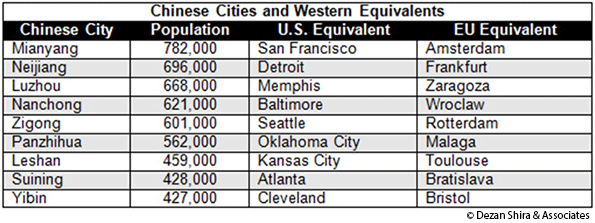
    Here are some examples, in terms of rough population equivalents:

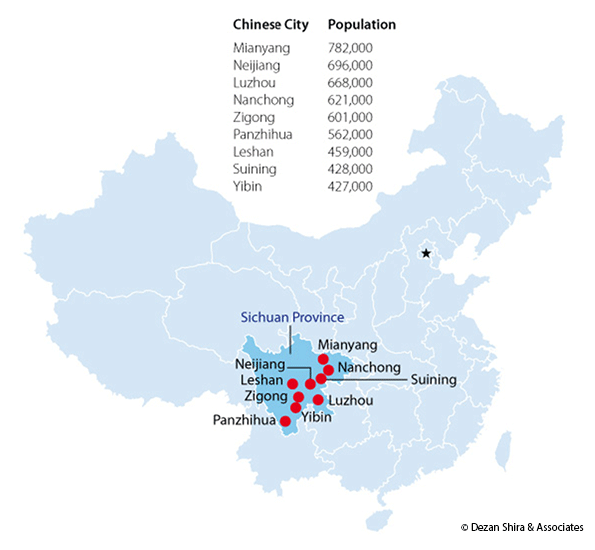
    While many readers are familiar with most of these American and European cities, hardly any know their Chinese counterparts. And all of the Chinese cities in the chart above are in just one province – Sichuan.

    When one factors in Shanxi, Henan, Hubei, Hunan, Anhui, and Jiangxi in Central China, and Gansu, Guizhou, Ningxia, Qinghai, Shaanxi, Yunnan and Xinjiang in West China, the sheer vastness of China’s own emerging markets becomes apparent. There are some 500 cities across the region with populations similar to those listed above.

    What’s happening in these lower-tier Chinese cities? The local populations are now becoming more affluent. Crucially, this is a phenomenon driven by state policy, as Beijing wishes to reduce the national East-West income gap and raise the standards of wealth across the country. It has been doing this by embarking on an aggressive policy of increasing minimum wages on a national basis, and especially so in the hinterlands. That is having the effect of increasing disposable income levels, and these consumers are now upgrading purchases from previously purely Chinese brands towards increasing levels of Western products.

    This includes the use of fast-food chains such as McDonald’s, KFC and Starbucks; massive multi-brand retailers such as Wal-Mart, Carrefour, and others that are also making inroads into these further-flung destinations. The Louis Vuitton bag may still be the preserve of China’s super wealthy in Shanghai, but in cities such as Mianyang, youths are trading up their cheap Chinese sneakers for Nikes, and looking to acquire Levis instead of the local jeans. With these consumer patterns being duplicated across the rest of China’s inland provinces, the result is little less than a revolutionary ‘upgradation’ of inland consumer power.

    The other markets in China worth keeping an eye on are those located along China’s borders. I wrote about Urumqi as a springboard for Central Asia recently. Developments elsewhere in Asia dictate that other border areas will also begin to experience significant growth, not least because of the Association of Southeast Asian Nations’ (ASEAN’s) full free trade agreement that is set to abolish tariffs between member nations by 2015.

    ASEAN includes countries that rub up alongside China’s southwest border, such as Myanmar, Vietnam and Cambodia, and adds to that countries including Laos, Malaysia, and Thailand, while to the south of China (and Guangdong Province in particular), ASEAN nations such Indonesia and the Philippines provide easy access. Why is this important? Because China has its own free trade agreement with ASEAN, and those 0 percent export tariffs among ASEAN nations are largely duplicated within China’s own agreements with the bloc.

    That means cities such as Jinghong and Luxi in Yunnan are also poised to become trade hubs. Jinghong, with a population of 520,000 is equivalent in size to Tuscon, Arizona and Sheffield in the United Kingdom, and borders Vietnam, while Luxi borders Myanmar, and with a population of 350,000 is similar in size to Tampa, Florida or Bilbao.

    Demand from the West does continue to remain sluggish, and inattentive analysts like to point to a drop in national GDP growth rates as evidence of some sort of cataclysmic event concerning development in China. That is only one, rather blinkered way of assessing the situation. Since China’s annual growth has moved briskly along at 10 percent for much of the past 15 years, a deviation from that is greeted by analytical soothsayers with cries of doom. Yet China’s 10 percent growth was never capable of being sustained, as each successive year of double-digit growth has, naturally, expanded the base to the point where it is now the world’s second-largest economy.

    China’s national GDP rates have slipped to between seven and eight percent, and it may be experiencing a “slowdown” to single-digit GDP growth when measured on a national basis. But the real story is the continued fast-paced development of wealth, disposable income, and increasing consumerism in China’s own emerging markets and the fourth, fifth and sixth-tier cities that help make up this this gigantic consumer sector. The challenge for the foreign investor will now be to reach out and go after these less glamorous locations.

    Chris Devonshire-Ellis is the founder of Dezan Shira & Associates. His clients include North American-based legal and tax firms, chambers of commerce, commercial trade institutions and universities. Following a 26-year career based in Asia, including 20 in mainland China, Chris is now based in North America and oversees client development and investment strategies for U.S. corporations looking to invest in China, India and Emerging Asia.

    Flickr photo by Ken Larmon: Downtown mall in Mianyang, Sichuan.

  • Decline Of The Asian Family: Drop In Births Threatens Economic Ascendancy

    In the last half century, East Asia emerged as the uber-performer on the global economic stage. The various countries in the region found success with substantially different systems: state-led capitalism in South Korea, Singapore and Japan; wild and wooly, competitive, entrepreneur-led growth in Taiwan and Hong Kong; and more recently, what Deng Xiaoping once described as “socialism with Chinese characteristics.”

    But these countries shared one common element: a strong Confucian family ethos. Three of Confucianism’s five key relationships are familial, led by the all-important father-son tie. In East Asia, business has often been driven by familial concerns. Hard-driving “tiger Moms” or workaholic Dads sacrificed all for the benefit of the next generation. But now that foundation is beginning to crumble, and if the trend is not reduced, the 50-year-long ascendency of the region could be threatened.

    The signs of an emerging Asian malaise can be seen in slowing economies — in Japan’s case an almost two-decade-long stagnation. South Korea and Singapore may grow this year at levels approaching that of the United States — mediocre by their historic standards. The notion of assured further progress is fading, as populations age and domestic markets seem unlikely to expand much.

    This malaise is reflect in declining birthrates, which now rival southern Europe for the world’s lowest, as demonstrated in a new report by myself and colleagues at the Singapore Civil Service College. Equally troubling, up to a quarter of all East Asian women, estimates the National University of Singapore’s Gavin Jones, will remain single by age 50, and up to a third will remain childless. Since few Asian women, unlike their North American or northern European counterparts, have children out of wedlock, the overall effect on already poor demographics could be catastrophic.

    The reasons for this decline in marriage and family are complex. Demographers such as Austria’s Wolfgang Lutz see a reinforcing pattern in which singleness becomes normative and child-rearing more difficult, and less widely supported by society. This creates, as my Singaporean colleague Anuradha Schoff puts it, “an ecosystem where childlessness is the preferred option.”

    Interviews and survey data from various East Asian countries show that part of the problem is extremely high housing costs — roughly twice or more as a percentage of income as in the United States, according to demographer Wendell Cox — and often pitiably small space. No surprise, then, that Asians coming to the United States flock to suburbs, increasingly in the more affordable parts of the country.

    The extremely competitive work environment, which now includes growing numbers of well-educated females, is having a negative impact on birth rates. In 1970, less than half of women in Japan and Korea were working, and only one-fifth in Singapore. By 2004, that number had increased to three-quarters in Japan, and roughly three in five in South Korea and Singapore, notes NUS’ Gavin Jones. As one researcher in Singapore explained, how could it be possible for her to start a family when she has to compete with other women who are not so encumbered? It made no sense to her to have children, even if the state provided her with as much as a million dollars.

    Huge time commitments at work, notes demographer Phil Longman, often work against potential parents. “As modern societies demand more and more investment in human capital,” he suggests” this demand threatens its own supply.”

    Then there are distinctly cultural issues, such as the perceived unwillingness of many East Asian men to share child-raising duties with their wives. And among parents, the much-celebrated obsession with achievement and education — also generally favored by Mandarins around the region — tends to make child-bearing seem ever more onerous and expensive. In this sense, the Confucian ethic on education undermines its paramount familialistic values.

    Japan represents the cutting edge of this lurch into what may in a decade be the general East Asian pattern. By 2010, a third of Japanese women entering their 30s were single, as were roughly one in five of those entering their 40s. That is roughly eight times the percentage in 1960, and twice as many as in 2000. By 2030, according to sociologist Mika Toyota, almost one in three Japanese males may be unmarried by age 50.

    Lacking the innovative energy of new entrants into the workplace and the economic stimulus of expanding households, Japan’s economy has become ever more stagnant and inward looking. And most Japanese view the future as far from bright; the Japanese, according to Gallup, are now among the most pessimistic people on the planet. Not too far behind them are, surprisingly, the Singaporeans.

    In Japan, the demographic clock is already ticking toward a kind of demographic doomsday. It’s been over two decades since the number of Japanese over 65 exceeded the number of those under 15, and the trajectory points to a time — by 2050 – when Japan will have 3.7 times as many people 65 and older as 15 and under, according to U.N. estimates. In 2050, the number of people over 80 will be 10% greater than the 15 and under population.

    Even Tokyo faces Japan’s emerging demographic winter. Given current trends away from family formation, Tokyo, now the world’s most populous metropolitan area, may see its population drop from its current 35 million to roughly half that in 2100. By then Japan’s overall population could fall to 48 million, according to Japan’s National Institute of Population and Social Security Research. And what will be left of the Japanese will be very urban, very old, and at some point, probably well before, bereft of savings.

    The other East Asian countries could face a similar fate, albeit a decade or two later. In Taiwan, 30% of women aged between 30 and 34 are single; only 30 years ago, just 2% of women were. In three decades, “remaining single and childless” merged from a rarity to a commonplace, and appears to be picking up momentum. In a 2011 poll of Taiwanese women under 50, a huge majority claimed they did not want children.

    For its part, Singapore has been able to keep itself going largely by importing talent from abroad. But the mass migration of newcomers, who have increased tremendously as a portion of the population, has also sparked widespread resentment among Singaporeans faced with ever greater congestion, crowding, high property prices and ever-greater competition for good jobs.

    Unlike intrinsically multicultural Singapore, Korea, Taiwan and China will struggle with the notion of tapping immigration to forestall their problems. As China progresses and urbanises, its demography increasingly mimics that of the Tigers, just as they now resemble Japan. Most of the world’s decline in children and young workers between 15 and 19 will take place in China; the People’s Republic will lose 60 million people under 15 years of age by 2050, approximately Italy’s population. It will gain nearly 190 million people 65 and over, approximately the population of Pakistan, which is the world’s fourth most populous country.

    In the longer run, these countries will have to reconsider their priorities. In order to restore a sense of a prosperous future, they must first consider what factors would encourage families and child-bearing in their societies. This may, among other things, require “tiger Moms” and workaholic Dads, as well as the bureaucracy, to change their ways. As my Japanese mentor Jiro Tokuyama used to say, East Asia will have to unlearn the secrets of its past success.

    Joel Kotkin is executive editor of NewGeography.com and is a distinguished presidential fellow in urban futures at Chapman University, and contributing editor to the City Journal in New York. He is author of The City: A Global History. His newest book is The Next Hundred Million: America in 2050, released in February, 2010.

    This piece originally appeared in Forbes.

    Happy Baby Photo by Bigstock.