Tag: China

  • The Braking Of The BRICs

    For over a decade, conventional wisdom has held that the future of the world economy rests on the rise of the so-called BRIC countries: Brazil, Russia, India, China (and, in some cases, with the addition of an ‘S’ for South Africa). A concept coined by Goldman Sachs economist Jim O’Neill, the BRICs were widely touted as the building blocks of the “post-American world.”

    Such notions are particularly popular among intellectuals like India’s Brankaj Mishra, who sees world power shifting inexorably to “ascendant nations and peoples” — i.e. the BRICs — while “America’s retrenchment is inevitable.” Yet in reality, it is increasingly clear that the BRICs upward trajectory is slowing and many long-term trends suggest that their growth rates will continue to fall in the coming decades. Like other former “America-killers” such as Europe (1960s), Japan (1970s and 1980s) and the Asian Tigers (1990s), the BRIC countries appear to be unable to sustain the steady, inevitable progress projected by enthusiasts both at home and abroad.

    One sign can be seen in the equity markets. Between 2001 and 2007, BRIC stocks soared, more than doubling in China and rising 369% in Brazil and 499% in India. Faith in the destiny of the BRICs grew even more after the world financial crisis, which these economies seemed to shrug off.

    Yet more recently the edifice appears to have begun to erode, and in some cases, could well crumble. After rising almost fourfold from 2000 until the financial crisis, the BRICs’ stock-market value is at a three-year low.

    This decline has impacted numerous key BRIC companies such as Petroleo Brasileiro SA, Brazil’s state-controlled oil company. This year it fell to the world’s 39th-largest company by market value from the 10th-biggest in July 2011. China Construction Bank Corp. dropped to 20th from 12th while Rosneft, Russia’s largest oil producer, sank to 106th from 70th. Shares of ICICI Bank Ltd., India’s second-biggest lender, have lost 17% during the past year, compared with an average gain of 9% for global peers.

    Mutual funds that invest in BRIC equities, which recorded about $70 billion of inflows in the past decade, also have posted 16 straight weeks of withdrawals, losing a net $5.3 billion, EPFR Global data show.

    This reflects serious, deep-seated problems in these economies. Brazilian consumer defaults increased to a 30-month high in May, while prices for Russia’s oil exports have dropped about 10% this year. In India, the central bank unexpectedly left interest rates unchanged last month after inflation accelerated. A gauge of Chinese manufacturing compiled by the government fell to a seven-month low in June.

    The BRICS are learning — as the Japanese did before them — the meaning of gravity. With the dollar gaining value against the Brazilian real, Brazil could slip from the world’s sixth largest economy to seventh, overtaken again by the United Kingdom.

    BRIC countries are suffering, in part, because of the slowdown in the European Union and North America. Depressed levels of spending in these export markets devastates these economies, in part because their domestic markets are not yet wealthy enough to support strong growth on their own.

    Brazil has experienced a rampant property boom in recent years, with house prices in Rio trebling since 2008, and mortgage borrowing soaring. Reduced consumer demand could help drive the country’s economic growth rate to 2.2%, a pace more familiar in developed Western economies, and less than half the rate predicted by official government economists.

    India seems to be drifting into a political crisis and remains handicapped by its deep-seated culture of corruption and favoritism. Malnutrition has increased — and is higher than in most African countries — while the political system creaks and blocks reform.

    This is one reason why credit default swaps suggest India is already a bigger investment risk than emerging markets such as Vietnam and more than double the risk of Brazil, Russia, China and South Africa. India may also lose its investment-grade credit rating as Prime Minister Manmohan Singh’s administration struggles to curb a record trade deficit, a budget shortfall that exceeded targets and fighting within the ruling coalition, Standard & Poor’s and Fitch Ratings said last month.

    In the short run, things are likely to get worse in India; S&P recently cut its forecast for growth in 2012 to 5.5% from 6.5%. Inflation running at 10% is sending investors fleeing from the rupee in favor of the dollar’s safety. Growth in industrial production fell from 9.7% in 2010 to 4.8% in 2011. The pace has slowed further in 2012.

    BRIC member Russia, as Rodney Dangerfield would have put it, is no bargain either. The crippling problem Russia faces is an economy dependent on oil for 75% of its export income. In 2008 oil was 5% of Russia’s GDP; now it’s 12.5%.

    As in India, corruption is pervasive, sparking political unrest against Vladimir Putin’s neo-czarist regime. Investment and retail has slowed down. At the same time Russia faces one of the steepest demographic declines on the planet, spurred by unusually low lifespans among males, with excessive drinking a prime contributor. Russia has lost nearly 10 million people since the collapse of the former Soviet Union. By 2050, the population could fall to as low as 126 million from 142 million in 2010. President Vladimir Putin has identified the demographic crisis as Russia’s “most urgent problem.”

    Due to its one-child policy, China, too, faces the prospect of demographic decline. The U.S. Census Bureau estimates that China’s population will peak in 2026, and will then age faster than any country in the world besides Japan. Its rapid urbanization, expansion of education, and rising housing costs all will contribute to this process. Most of the world’s decline in children and young workers between 15 and 19 will take place in China during the balance of the century.

    But China’s most pressing problems are more immediate. With exports slowing, China’s GDP growth has decelerated from 10.9% in 2010 to 9.5% in 2011. It is estimated by S&P to be 7.5% in 2012. China’s economic growth is set to slow for the ninth consecutive quarter. Schisms within the Communist Party, and growing labor and other unrest, make the Middle Kingdom somewhat less the inevitable replacement power to the U.S. that many have assumed.

    South Africa is also pressed by political and economic problems.The economy is slowing down to a very un-BRIC like 2.7% growth rate. This is well below the heady 4% plus of 2011. And, as in China and India, instability, as seen in the recent, violent work stoppage of 26,000 workers at platinum mines, could further hurt growth.

    With unemployment roughly at 25%, South Africa will hard pressed to remain an investment star in the years ahead.

    So what now? Well, we can expect financial speculators, like Goldman Sachs, to keep trolling for the next thing. Wall Street’s most influential player recently coined a new term — MIST — to cover their new favorites: Mexico, Indonesia, South Korea and Turkey. One can only imagine how long this fixation will last, given the problems these countries face with either political violence and demographic decline, and in the case of Turkey both.

    Of course, brokers hawking investments will continue to look for new places of opportunity. But as we are learning from the experience with the BRICS, not all emerging economies maintain their upward trajectory. Sometimes it might make more sense ,even given our inept political parties, to look at opportunities closer to home, where constitutional protections, a large domestic market and a diversified economy may provide better long-run prospects.

    Joel Kotkin is executive editor of NewGeography.com and is a distinguished presidential fellow in urban futures at Chapman University, and contributing editor to the City Journal in New York. He is author of The City: A Global History. His newest book is The Next Hundred Million: America in 2050, released in February, 2010.

    This piece originally appeared in Forbes.

    BRIC country map by Filipe Menegaz.
  • Livable China

    Recently, the McKinsey Global Institute published its report ‘The Most Dynamic Cities in 2025‘ in Foreign Policy, a highly respected US journal. On this list, 27 mainland Chinese cities as well as Hong Kong took top spots alongside Shanghai and Beijing, leaving many other world-renowned metropolises far behind.

    As a Chinese who has lived through China’s transformation over the past two decades, I was hardly surprised by the results of this report. What really shocked me was the doubt and controversy that this report generated in western media, especially the negativity in the heated discussions published in the very same issue of Foreign Policy.

    Among these, I was most taken aback by Mr. Isaac Stone Fish’s article ‘Unlivable Cities’. Having lived in several different Chinese cities over a 7-year period, Mr. Fish should be able to provide an objective prospective about China. Unfortunately, the takeaway from his article, in his own words is: ‘For all their economic success, China’s cities, with their lack of civil society, apocalyptic air pollution, snarling traffic, and suffocating state bureaucracy, are still terrible places to live.’

    First of all, when it comes to civilization, there are very few countries where civil society can be traced back 5000 years like China. Today’s China may be in some aspects less civilized compared with the more developed countries, but China has come a long way in creating a more civilized society in recent years. When the People’s Republic of China was founded in 1949, the illiteracy rate was more than 80% in China, but as of today, the illiteracy rate among Chinese born after 1980 is under 1%. In cities, 80% of students go on to post-secondary studies. These highly educated young Chinese will undoubtedly redefine China’s civilization. When it comes to parenting, the 80s generation, now mostly young parents, are studying how to be a parent, which would have been unheard of just a decade ago.

    The new Chinese parents are teaching their kids to use polite expressions like ‘thank-you’ and ‘sorry’, something generally neglected in the past. Pioneer cities like Shanghai and Guangzhou opened ‘Manner and Etiquette’ classes in most of their primary and high schools starting in 2006. Our education system is changing as well, gradually switching from being purely exam-oriented, to cultivating students with all around abilities. Our future generations will continue to bring China into a new era of civil society. It is ironic for Mr. Fish to call China ‘unlivable’ by describing China as having ‘lack of civil society’, yet in his own narration later he wrote: ‘Chinese cities have little crime, one can stroll safely through Beijing’s magnificent Temple of the Sun park at midnight’. How many of today’s ‘livable’ and ‘civilized’ North American cities can claim that?

    Air pollution is an issue in China, but no different than the smog that hung in the sky in Pittsburgh, London, or Los Angeles when those cities were going through their own vast development phases.   China is generating the greatest total greenhouse gas emissions in the world, but its greenhouse gas emission per capita in 2008 only ranks 78th of 214 countries in the world, while Australia ranks 11th, followed by USA (12th) and Canada (15th). China is manufacturing for the whole world, so in a sense it’s a scapegoat for countries that don’t want to or cannot make things for themselves. Yet even with that, air pollution in China never reaches the level described in Mr. Fish’s article. Take Nanjing (300 km northwest of Shanghai) as an example: in the one week Mr. Fish spent there, the only thing he saw was ‘smog the color of gargled milk’.

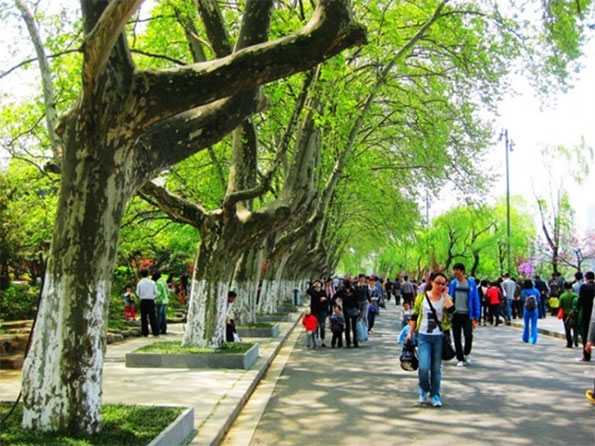
    Having lived in Nanjing for almost 10 years, I do not find Nanjing’s air quality unbearable. On the contrary, I love wondering on the streets of this ancient yet modern city, breathing the fresh air and enjoying the sweet scent given off by the Wutong Shu (Phoenix trees) erected on both sides of the streets. Every morning, citizens go outside to exercise in the mountains and parks. At night time, people take walks outside after dinner. Never would I suggest that Nanjing is an ‘unlivable’ city.


    Phoenix Trees in Nanjing

    In 2011, 14.5 million cars were sold in China. It has overtaken America as the largest automobile market. This has and will continue to cause significant traffic congestion, a worldwide issue most metropolises face today. However, China is very proactively providing solutions to this problem. In Beijing, Shanghai and Guangzhou, the local municipality limits the licenses plates issued every year in an attempt to relieve the burden caused by new traffic. Of course, China knows better than anybody that nothing will stop its citizens’ desire for car ownership as they get richer, so the only way to prevent future traffic problems is to invest in more quality highways, cleaner cars and better public transit systems.

    With China now spending approximately half a trillion dollars annually on infrastructure (9 percent of its GDP), visitors should not be surprised to see numerous highways and subways under construction in most Chinese cities. In 2010, Shanghai had the world’s most extensive subway system (429 km), followed by London (402 km) and then Beijing (372 km). By 2020, the total length of Shanghai’s subway lines will reach 877 km, more than double of New York’s current total length of subway lines. Meanwhile, China provides large subsidies to the taxi and bus industries. On top of that, with the world’s longest rail network, China’s high-speed rail system is changing the way people travel between Chinese cities. The newest bullet train from Beijing to Shanghai can bring passengers to their destination in less than five hours, while flying over the terrain at a maximum speed slightly over 300 km per hour.

    Bureaucracy has been rife in China literally for millennia, and the onset of a market economy has not changed that sad fact. Much of the criticism of China relates to censorship. Yet this is less an issue for most Chinese than for either westerners and some Chinese intellectuals. With the fast development of information science and the enormous variety of media available, people can freely choose what movie, play or art show they wish to watch, discuss anything they are interested in with their families and friends, and most importantly live the life styles they want. The ‘pervasive fear of censorship’ described by Mr. Fish literally does not exist for today’s average Chinese citizen.

    Mr. Fish also gave specific examples of ‘unlivable’ cities in China. Among them, Harbin, the capital city of Heilongjiang province, was voted the least livable metropolis mainly due to its cold winter. Personally, during my own time there, I was fascinated by Harbin’s characteristic Russian architecture, the massive and astonishingly beautiful ice sculptures, and the fun winter activities that were available. All these temperaments make Harbin an extraordinary city. I am currently studying in Canada, a country justly famous for freezing winters. Constantly hearing Canadians complain about their ‘unbearably cold’ winters makes me realize that if winter temperature is a key criteria to judge whether a city is livable or not, Winnipeg, Manitoba would probably be crowned the most unlivable city in the Western hemisphere. I can only imagine what Mr. Fish would have to say about cities like Oslo, Helsinki, Copenhagen, or Minneapolis.

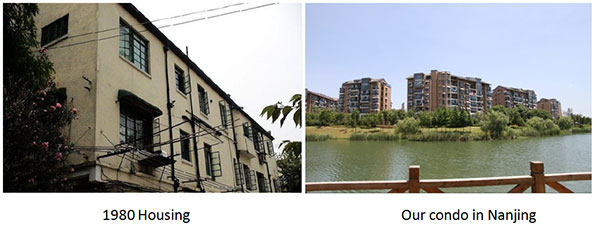
    China clearly is no paradise, yet the world should recognize how significantly the quality of life has improved over the stereotypes of the past. Growing up in 40 square meter (430 square feet) ‘Dormitory Style Housing’ (as Mr. Fish put it), with my parents and grandparents, I remember vividly how our neighbors nearly burst through our door to see our newly purchased color TV, the first they had ever seen. My happiest moment was licking a popsicle to its last frozen drop in the summer heat. Considering my parents’ combined monthly salary about 20 USD in the 1980s, this popsicle was quite a treat. Two decades later, in the same summer heat, my husband and I moved into a brand new three-bedroom condo in Nanjing, fully equipped with the most modern electronic appliances. Our condo is surrounded by a beautiful pond, a gymnasium, a supermarket and a nearby subway station. We make 3400 USD a month, eat out often and travel every year. This is not atypical for most middle-class Chinese people now. The welfare system is improving, people are less worried about getting sick, a retirement fund is in place, people now travel not only domestically but also internationally, and many send their children abroad to receive higher education. Where we are now would have been unthinkable to most people only a few decades ago.

    I’m often deeply saddened by the way in which China is so often portrayed in western media. China’s growth and development over the past few decades has been vast, and it possesses potential for a more affluent future. Westerners may refer to China as ‘unlivable’ but for me, and hundreds of millions of people like me, China today is more than simply livable, and it will continue to improve as time goes by.

    Lisa Gu is a 28 year old Chinese national who lived in Nanjing, China. She is currently studying at Wilfrid Laurier University in Waterloo, ON, Canada.

    Photo by Wikicommons user shakiestone.

  • China Personal Vehicles Now More than US

    China Web quotes the nation’s Ministry of Public Security to the effect that China’s personal vehicle fleet (automobiles and motorcycles) reached 217 million at the end of June. This would place China ahead of the United States, which had approximately 200 million personal vehicles in 2010 and led the world for perhaps for most, if not all of the last century.

    China has 114 million automobiles and 103 million motorcycles, a substantially different mix than in the more affluent United States. The US has 192 million automobiles and 8 million motorcycles.

    Motorcycles are particularly useful in China’s growing and congested cities and are the logical stepping stone for buyers who are likely to eventually own cars. Many of the motorcycles are "E-Bikes," which use a plug-in battery operated technology. These motorcycles are so fuel efficient that their greenhouse gas (GHG) emissions per passenger kilometer approximate those of a full bus.

    In 2011, China also took the lead in freeway mileage, displacing the US. The United States, with its interstate highway system had led the world in freeway mileage for at least one-half century.

  • China’s French Connection

    No two countries would appear more divergent than France and China, especially in the age of Eurozone collapse. One country represents the Asian future, while the other is the capital of the failed, if diverting, old world.

    The French recently elected a socialist president and assembly on the basis that everyone should share the country’s deficits and decline. The Chinese, meanwhile, have enough surpluses to buy out the European Union, should they wish to exchange their EU debts for an equity stake. (Maybe they will choose to have Paris shipped east in boxes?)

    To take the measure of the two economies — although I admit this survey lacks academic rigor — I recently crossed each country by rail.

    In China, I rode a succession of trains, high-speed and low, between Beijing and Hong Kong, with stops along the way in Yenan (Mao’s revolutionary capital), Xian (of Terra Cotta Warrior fame), Chongqing (Chiang Kai-shek’s wartime capital), Zhuzhou (a rail junction), Guangzhou (used to be Canton) and Shenzhen (the biggest city near Hong Kong you’ve never heard of).

    I have also recently taken a number of train trips between Geneva and Bordeaux and crossed “France profonde” through the mountainous Massif Central, or gone on more roundabout routes through Toulouse and Tours.

    My conclusions, which even I find surprising: France has a better balance between its land and cities, as well as richer farms and a more sustaining political culture, even if the presidency is a reality show.

    China, at least from a train window, seems to be devoting most of its budget surpluses to moving the population into fifty-story, high-rise apartment buildings, the dormitories of its industrial revolution.

    Like France, China has a high-speed rail network that travels on segregated tracks, allowing for speeds close to 200 miles per hour. I went from Zhuzhou to Guangzhou in about four hours, a trip that used to take overnight. The stations of the expanding high-speed Chinese network, however, are outside the downtowns of most cities, so getting to them feels like a trip to the airport.

    Unlike trips in France, most intercity trips in China take place on slow night trains, with thousands of passengers tucked into open couchette berths. On my trip south, I was usually assigned the cramped middle bunk and rode, even during the day, like “John Malkovich” on floor 7½.

    The French have largely given up on night trains. My regional train from Geneva to Bordeaux is a milk run (skim, I would say, to judge by the amenities), with beautiful views but few passengers. French high speed trains — Trains à Grande Vitesse or TVGs — do go downtown, although the French have the annoying habit of routing every trip through Paris.

    In the current economic crisis, however, funding is being bled from the rails, and many TGV cars look thread-worn. Nevertheless, the TGV remains the inspiration for the Chinese high-speed system, perhaps because many Communist leaders had warm memories of their Paris underground cells.

    Sadly, Chinese cities retain few of their French inspirations. Apart from old Beijing and some quarters of Shanghai, Xian and Guangzhou, Chinese cities are faithful to Maoist doctrine in that that they serve as worker housing and base camps for industrial output.

    I may, however, be one of the few who prefers Beijing over Paris; the biking is better and the hotels are cheaper. Nevertheless, the average Chinese city is going the way of Los Angeles and Phoenix. The streets are less forgiving to cyclists, pedestrians, and kids playing after school. The outskirts of Chinese cities are great walls of housing projects that probably can be seen from the moon.

    In France, because I often travel with a bike, during waits between trains I sometimes go for a downtown spin, which has allowed me to discover the old world charms of Orleans, Tours, Toulouse, and Blois.

    Because French cities were laid out in the eighteenth and nineteenth century and not in 2003, they have narrow streets, often unsuitable for cars, but perfect for walking, bikes and sidewalk cafés. Bordeaux, a hive of narrow streets and small, self-contained neighborhoods, is an excellent example of a car-unfriendly French city that is flourishing.

    Away from the glittering high-rise buildings in places like Dalian and Shanghai, much of train-window China remains a poor country, a succession of terraced subsistence farms, cut out of rocky hillsides and inevitably encased in a steamy fog. Elsewhere, China has the fault lines of runaway development: a population confined to worker housing, and agricultural provinces that are stripped for minerals or exports.

    By comparison, French trains are never far from verdant pastures or neatly tended vineyards. Ironically, China’s detached “people’s” government is the largest consumer of first-growth French wines.

    The wine industry is one of the few meeting points where the French and the Chinese find harmony. China is now fifth (ahead of the U.K.) in wine consumption, and at the high end nearly all of it comes from Bordeaux and Burgundy. (The low end is a concoction of bootlegged Algerian and Rhône reds.) The reason that the wines of Château Lafite Rothschild can command $2000 a bottle is because newly coined Chinese millionaires find it a must-have brand.

    Since France produces a surfeit of wines, the trade should stimulate the economies of both countries for a long time. Nevertheless, French producers live on the precipice of Chinese wine tariffs, should the Beijing government want to promote its own vineyards south of Shanghai at the exclusion of those in Pauillac.

    Which country will fare better in the coming decades: China with its Dickensian economic juggernaut, or France with its budget deficits, despite having well-fed cows and landscapes worthy of Monet?

    Just because my Geneva to Bordeaux train crosses through the contours of an Impressionist painting does not mean that France will return to its imperial glories. Nor do China’s traffic jams mean that it will dissolve into Manchu feudalism. Furthermore, to paraphrase Chou En-lai on the French revolution, it may be “too soon to tell” if Chinese communal capitalism will put an end to the party or to free enterprise.

    Ironically, France does have the surplus of a self-contained economy, even if now it is in hock to German debt markets. Similarly, China has the deficits of post-Maoism—something close to the state capitalism of fascism—including that the best that can said of its Politburo is that it keeps the high-speed trains running on time.

    Personally, I hope that both countries do well. I love that in each I can take trains, get around by bike, read about the Revolution or the Franco-Prussian war, enjoy the cities—especially Beijing and Bordeaux—and, well, drink French wines.

    Photo: The new high-speed rail station, Zhuzhou, China; from the studio of Matthew Brady.

    Matthew Stevenson, a contributing editor of Harper’s Magazine, is the author of Remembering the Twentieth Century Limited, a collection of historical travel essays. His next book is Whistle-Stopping America.
  • China and the Future of Hong Kong

    Last week Hong Kong’s new leader Leung Chun-ying was sworn into office by Chinese President Hu Jintao. The ceremony coincided with the 15th anniversary of the British handover of Hong Kong to China so there was plenty of rhetoric about ‘strengthening ties with the motherland’. Yet not far from the ceremony, tens of thousands of Hong Kong citizens marched in protest showing discontent with growing inequality and what they perceive as Beijing’s increasing assault on the territory.

    The relationship between Hong Kong and mainland China is complex. Beijing for the most part has kept its promise to uphold the ‘one country, two systems’ mandate. Officially, Hong Kong is considered a ‘Special Administrative Region’ (SAR), which means that it is treated as a separate country from an immigration standpoint and continues to circulate its own currency, the Hong Kong dollar. Hong Kong also retains an independent legal and judicial system inherited from the previous British rulers.

    Most importantly, Hong Kong has avoided the draconian media censorship common on the mainland. A free press is consistent with its reputation as a global center of banking and commerce. Hong Kong’s ease of trade and doing business frequently leads it to being named one of the world’s freest economies.

    So if Beijing continues to hold up its end of the deal, why do so many Hong Kong residents march in protest? The relationship is more nuanced than it appears on the surface. Politically, Hong Kong residents do not have the freedom to elect their leader (CY Leung was appointed by a 1,200-person electoral college made up primarily of pro-China business leaders), although democratic elections are set to commence in the next five years. Underlying this frustration is what Hong Kong residents see as an infiltration of growing mainland influence on the city.

    On the ground, Hong Kong experienced a huge increase in mainland tourists to the city since the handover. Hong Kong doesn’t have the same high tax rate on imported goods that mainland China does, so mainlanders flock to the city primarily for shopping, hunting for bargains on electronics and luxury fashion brands. It is not uncommon to see long queues of mainland tourists in front of shops of famous fashion brands like Gucci, D&G or Prada. The droves of mainland shoppers spending money in Hong Kong are great for the local economy, but many locals decry the constant flow of tourists as invading ‘locusts’.

    Yet more significant than what is happening on the ground is what is taking place high above in the sky. The phenomenon of wealthy mainlanders purchasing real estate in the city has driven   housing prices to astronomical levels, approaching the market just before the Asian Financial Crisis of 1997. For well-off Chinese mainlanders, Hong Kong real estate is seen as a safer long-term investment than China’s still somewhat risky real estate market and unpredictable stock market. A severely limited land supply coupled with the fact that a handful of powerful real estate oligarchs control the market for new development means that prices will probably stay high barring another economic crisis.

    Land-use policy is perhaps the most critical factor in determining both the future of Hong Kong and the mainland. As anyone who has been to the city can attest to, Hong Kong has some of the best infrastructure in the world, including a first-class international airport, extensive rail system and a booming seaport. Much of that infrastructure comes from the city’s land-auctioning system, which is the government’s primary source of revenue. This is also what helps keeps taxes low.

    Furthermore, unlike in the U.S., where infrastructure is traditionally financed publicly, Hong Kong’s infrastructure is increasingly built with private funds. For instance, the city’s Mass Transit Railway (MTR) Corporation, founded as a public entity, went fully private in 2000 and is traded on the Hong Kong’s stock exchange. In addition to operating and maintaining the city’s existing rail system, MTR Corporation is responsible for building new lines. What makes MTR Corporation different from most other transit authorities is that its primary earnings do not come from passenger ticket sales but from developing the land on top of and around its metro stations.

    Cheung Kong Holdings, led by Hong Kong’s richest man Li Ka-shing, is not only one of the city’s largest property developers, its business interests also include Hutchinson Port Holdings (a port operator that handles 13% of the world’s container traffic) and Hutchinson Telecommunications Limited (which builds and operates mobile phone networks). Sun Hung Kai, another powerful Hong Kong property developer also owns stakes in logistics and telecommunications businesses (although its founders, the Kwok brothers, were recently arrested on corruption charges).

    The mode of urban development in mainland Chinese cities is heavily influenced by Hong Kong. Yet instead of powerful corporations, State-Owned Enterprises (SOE), large entities owned by the government, dominate urban development related businesses. China’s land auctioning system is far from perfect, with well-documented instances of corrupt land seizures and the unfair advantages government backed SOEs have in the bidding process over private developers. But with virtually no property taxes in mainland cities, land sales remain the primary source of revenues for local governments to support infrastructure development.

    There is growing evidence that suggests China plans to alter the direction of its development model in the coming years by consolidating and privatizing its SOEs. Already, Hong Kong property developers are active in the mainland real estate market with Chinese companies eager to learn from their expertise. The cozy relationship between Hong Kong developers and mainland SOEs is a cause for concern by Hong Kong citizens, as they see their local developers as more interested in appeasing Beijing authorities than providing affordable housing for its own citizens.

    Yet this is inevitable. The city of 7 million cannot expect to forever be completely independent of a country of 1.3 billion to which it is now irrevocably attached. This is true even in spite of Hong Kong’s role as an international center of trade.

    Throughout history, Chinese culture survived through its sheer mass and cultural osmosis. When CY Leung gave his inaugural speech last week, it was in Standard Mandarin, the official language of China. Although the citizens of Hong Kong are also Chinese, their official language is Cantonese, a completely different and not mutually intelligible dialect. Leung’s move was seen as a slight to the people he was chosen to serve, yet given who he has to report to in Beijing, it made perfect sense.

    Adam Nathaniel Mayer is an architectural design professional from California. In addition to his job designing buildings he writes the China Urban Development Blog.

    Follow him on Twitter: AdamNMayer

    Hong Kong photo by BighStockphoto.com

  • The Beijing Bicycle: A Requiem

    Just because China has 500 million bikes on the road or tucked away in sheds or courtyards does not mean the two-wheeler has a bright future there, especially in its largest cities.

    Such is the growing indifference to the bike in China that no one seems to mind that the national model is manufactured in Taiwan (or under license on the mainland). With a single gear and heavy steel frame, the Giant is ideal for long rides on flat city streets. At a cost of US $180, it is the bike bargain of the world. Nevertheless, the dream for younger Chinese is a Honda scooter.

    The problem now in Beijing, Xian, and Guangzhou, if not in the country at large, is that increased prosperity is making city bike riding that much more a thing of the past. Wonderful Asian bike cities like Hanoi have already been lost to the noisy scooter and small car. Is Beijing next?

    Three years ago, Beijing was delightful by bike. Initially, I signed up with my friend George at Bicycle Kingdom to teach me the tricks of the narrow streets and the detours around Tiananmen Square. Ever since that first night of instruction, when we rolled out to the Olympic Park and down to the Temple of Heaven, I have been pedaling on my own power in Beijing and savoring every moment in the saddle.

    One reason that biking in Beijing is such a pleasure is that riders are accorded privileges lost to those sitting in traffic jams or drifting around on tour buses. During the 60th anniversary of the Chinese Revolution, a bike got me a front row seat to the spectacle.

    Beijing bikes have their own lanes, traffic lights, and rights-of-way, and a rider can easily thread his or her way anywhere. At railroad stations there are special bicycle parking lots, and even at the Forbidden City it is possible to leave your bike next to the front gate, as if you were a Mandarin.

    A few of the parks are off-limits to riders, but to my mind the only way to explore the hutongs — the historic districts of old Beijing, laid out like rabbit warrens — is on a bike, with which it is possible to roll past tea houses, food stalls, and open shops, as if in a Venetian gondola.

    Recently back in the capital, I spent a long day riding from Tiananmen Square out to Peking University, near the Summer Palace — about fifteen kilometers (a little more than nine miles) to the northwest.

    I had mapped out my route using a mixture of back streets and boulevards, and rolled away to find the Beijing grave site of the American writer Edgar Snow, whose 1937 book, Red Star Over China, was the first English-language account of Mao Tse-tung and a reportorial classic. (They met near Yenan, to which I went by train, but where there are almost no bikes.)

    To be sure, bike riding in Beijing is an acquired skill. I accept that it means weaving around buses, parked cars, delivery vans, and other obstacles. What surprised me on this long ride — about three hours in all — is how often the bikes lanes were flooded with motor scooters, cars, and a variety of motorized contraptions.

    After a while, I had my eyes attuned to the demographics of bike riders. They tended to be school kids or the elderly. From this blacktop survey, I judged that middle-aged or prosperous Beijingers have little appetite for riding. Most were moving around on scooters, the kind that have clogged many Asian cities.

    On earlier bike rides around Beijing, I found the experience sublime. This time it felt like I was riding for my life in New York City, outnumbered and outgunned by a variety of taxis, swerving motorists, and motorcyclists.

    Not only is Beijing going the way of Bangkok and other Asian cities that have been lost to gridlock, but the effects of non-riding can been seen among the Chinese themselves, more of whom are obese; undoubtedly KFC and McDonalds don’t help, either.

    Beijing is not the only Chinese city where I found biking on the wane. On my recent trip I also visited Xian, Chongqing, and Guangzhou, in search of Maoist redoubts and World War II battlefields. Chongqing (which has an excellent General Joseph Stilwell Museum and a Chou En-lai house) is built on hills, like San Francisco, so it has never been much of a bike city. Xian and Guangzhou are ideal for the bike, at least in their historic quarters. Yet each city is now overrun with cars.

    In Xian, I spent a long time just trying to find a shop that would rent me a bike. I went to several where the owners just shrugged. Finally, I borrowed a neglected bike from a hostel, but first had to take it in for repairs. No one had ridden this Giant in weeks, and the seat was set for a Lilliputian.

    You wouldn’t cycle to see the Terra Cotta warriors on a local clunker, as they are an hour by car from the city. But a bike is perfect to explore the Muslim quarter or to take in the Xian Incident Museum, which tells the story of Chiang Kai-shek’s kidnapping in 1936 and his subsequent agreement to recognize the Communist party. (Nothing focuses the mind like a kidnapping.) In Guangzhou I made it to the Sun Yat-sen Museum, but the snarling traffic scared me into a taxi.


    In Beijing and other cities, you still see bicycles loaded with garbage bags, cords of wood, furniture, dumplings, racks of clothing, and things like hundreds of fresh eggs. Some riders can comfortably bike around several family members on one frame, and it’s not unusual to see children following a parent through a busy intersection. In one alley, I biked alongside a man using his bike to move a large desk.

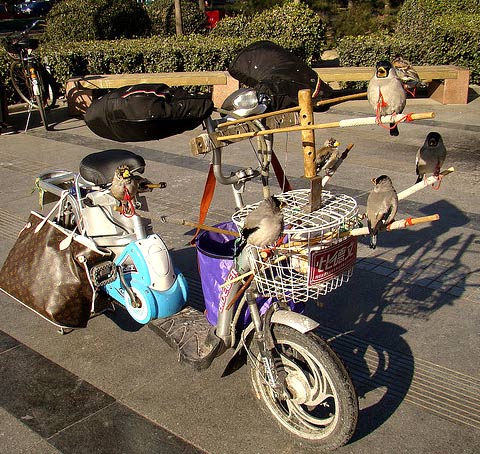
    In Beijing and Xian, I especially love the cyclists who have rigged up devices so that they can ride around with their caged birds, although one cycling raven of my acquaintance just sat on a wooden perch across the handlebars. Where will he be in five or ten years? I hate to think that Edgar Allen Poe was a writing an elegy for, among other things, the Beijing bike:

    Quoth the raven, “Nevermore.”

    Matthew Stevenson, a contributing editor of Harper’s Magazine, is the author of Remembering the Twentieth Century Limited, a collection of historical travel essays. His next book is Whistle-Stopping America.
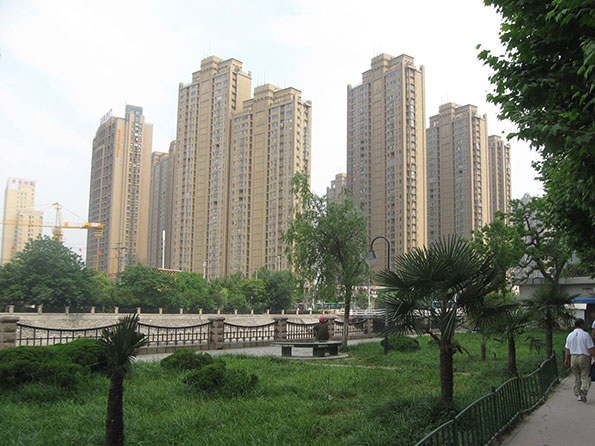
    Photo: Raven on a Bicycle, Beijing, by the author.
    Flickr Photo: Bird Scooter; birds and paraphernalia on a bike in Beijing by IstoletheTV.

  • China’s Top Growth Centers

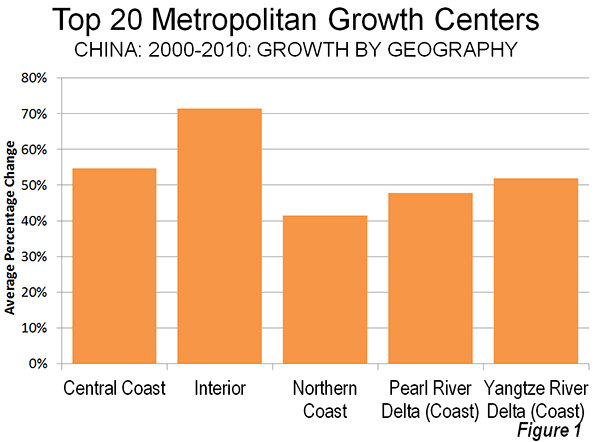
    Hefei, the capital of historically poor Anhui province emerged as China’s top growth center among major metropolitan areas over the past 10 years. Metropolitan areas from the interior, the Yangtze Delta and the central and northern coast were the fastest growing, displacing Guangdong’s Pearl River Delta, long the growth center for the country.   (Figure 1).

    China’s Trends in Context: China’s growth rate has fallen substantially and the United Nations has projected that the nation will experience population decline starting between 2030 and 2035. However, China’s urban areas have grown strongly as people have continued to move to cities for better opportunities. According to World Bank research, China’s economic progress since 1981 has lifted more people out of poverty than ever before in the world.

    Never before in history have so many people moved to urban areas in such a short period of time.

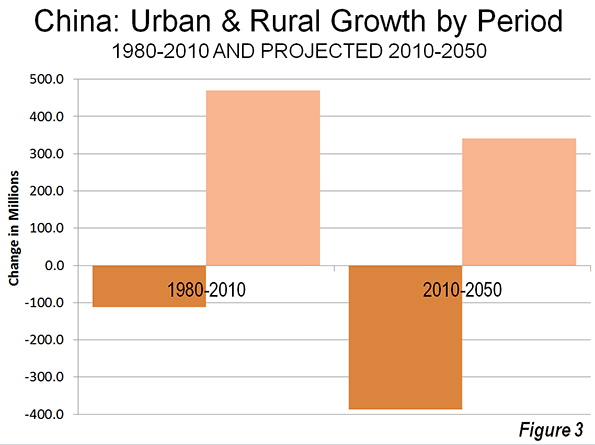
    Since the reforms began in approximately 1980, all of China’s population growth has been urban. Rural areas lost approximately 110 million people between 1980 and 2010. That is approximately equal to the population of Mexico and more than each of the nations in the world except for 11. Over the same three decades, 470 million people were added to the urban areas. That is more than 1.5 times the population of the United States.

    China’s Metropolitan Areas: This article provides an analysis of the urban districts (qu) of Chinas urban regions (routinely mislabeled "cities"). These districts are designated by regional officials as urban for urban development. Since the peripheral urban districts are principally rural, the combination of urban districts (Shi Shixiaqu)in a region are akin to a metropolitan area (labor market area).

    Among the metropolitan areas that began the decade (2000) with more than 1,000,000 inhabitants, the slowest 10 year growth rate was 36 percent. In comparison, among the 51 US metropolitan areas with more than 1,000,000 population, only three (Las Vegas, Raleigh and Austin) would have placed in China’s top 20, and not higher than 14th (Table). As in the US, the most rapid urban growth is taking place in smaller metropolitan areas with less than 5 million in 2010.  

    Top 20 Metropolitan Growth Centers in China: 2000-2010
    Rank Metropolitan Area 2000 Population 2010 Population Change % Geography
    1  Hefei, AN        1,659,000    3,352,000       1,693,000 102.0%  I 
    2  Xiamen, FJ        2,053,000     3,531,000       1,478,000 72.0%  C 
    3  Zhengzhou, HEN        2,560,000     4,254,000       1,694,000 66.2%  I 
    4  Suzhou, JS        2,473,000     4,074,000       1,601,000 64.7%  Y 
    5  Wenzhou, ZJ        1,916,000     3,040,000       1,124,000 58.7%  Y 
    6  Ningbo, ZJ        2,201,000     3,492,000       1,291,000 58.7%  Y 
    7  Urumqi, XJ        1,753,000     2,744,000          991,000 56.5%  I 
    8  Weifang, SD        1,380,000     2,044,000          664,000 48.1%  N 
    9  Shenzhen, GD        7,009,000   10,358,000       3,349,000 47.8%  P 
    10  Hangzhou, ZJ        4,243,000     6,242,000       1,999,000 47.1%  Y 
    11  Beijing, BJ      12,874,000   18,827,000       5,953,000 46.2%  N 
    12  Changsha, HUN        2,123,000     3,094,000          971,000 45.7%  I 
    13  Chengdu, SC        5,268,000     7,677,000       2,409,000 45.7%  I 
    14  Shanghai, SH      15,758,000   22,315,000       6,557,000 41.6%  Y 
    15  Hohhot, NM        1,407,000     1,981,000          574,000 40.8%  I 
    16  Nanjing, JS        5,098,000     7,166,000       2,068,000 40.6%  Y 
    17  Shijiazhuang, HEB        1,970,000     2,767,000          797,000 40.5%  N 
    18  Fuzhou, FJ        2,124,000     2,922,000          798,000 37.6%  C 
    19  Qingdao, SD        2,721,000     3,719,000          998,000 36.7%  N 
    20  Tianjin, TJ        8,146,000   11,090,000       2,944,000 36.1%  N 
     Metropolitan areas with more than 1,000,000 population in 2000.  
     Metropolitan areas consist of urban districts (qu) 
    Geographical Codes
     C   Central Coast 
     I   Interior 
     N   Northern Coast 
     P   Pearl River Delta (Coast) 
     Y   Yangtze River Delta (Coast) 
     Data from National Bureau of Statistics of China 


    The Interior: Six of the top 20 gainers were in the interior, including fastest growing Hefei. This reflects the appeal of   lower labor costs and perhaps also that rural migrants often prefer to work in regions   closer to their homes and families in agricultural regions. These six metropolitan areas had an average growth rate of 71 percent, the largest rate of any geographical grouping.

    • The capital of Anhui province, Hefei (photo), had the largest gain, at 102 percent. Hefei grew from 1.659 million to 3.352 million. Hefei is developing one of the most dispersed urban forms among China’s metropolitan area and there continues to be considerable construction. Hefei’s population growth rate was nearly one-half more than of second place Xiamen. Anhui is one province removed from the coast and Hefei is only 115 miles (185 kilometers) from the Yangtze Delta’s Nanjing.
    • The third ranked metropolitan area was Zhengzhou (photo), the capital of Henan province (also separated from the coast by one province), which experienced a 66 percent population gain.
    • Urumqi, the capital of China’s large northwestern province of Xinjiang ranked 7th with a gain of 57 percent. Urumqi is by far the most remote from the East Coast of the large gainers (2,000 miles or 3,250 kilometers from Tianjin, near Beijing).
    • Other interior fast growers were Changsha, capital of Hunan (12th, with 46 percent growth), Chengdu, the capital of Sichuan ranked 13th, with 46 percent growth and Hohhot, capital of Nei Mongol (Inner Mongolia), ranked 15th, with a growth rate of 41 percent.


    Hefei


    Zhengzhou

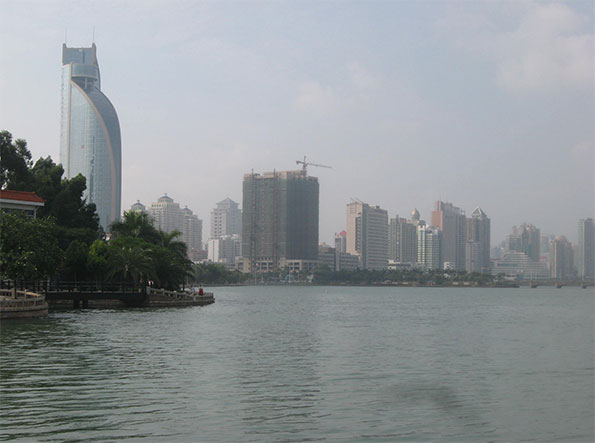
    Central Coast: Xiamen (photo), one of the first special economic zones designated after Shenzhen and placing 2nd in growth, added 72 percent to its population. This metropolitan area is centered on an island in Fujian province on China’s central coast, less than 10 miles from to Jinmen (Quemoy), an island controlled by Taiwan. Fuzhou, the capital of Fujian province was another central coastal metropolitan area among the top 20 growth centers (18th, at 38 percent). The average growth rate of these metropolitan areas on the central coast was 55 percent.


    Xiamen

    Yangtze River Delta: Like the interior, the Yangtze River (Changjiang) Delta also placed six metropolitan areas among the top 20 growth centers. The average growth rate was 52 percent. The Yangtze River Delta is a large area with a population greater than that of the Pearl River Delta, but with urban regions that are separated from one another by considerable rural territory (unlike the Pearl River Delta). The exception is the Shanghai-Suzhou-Wuxi corridor (Note), where the urbanization is continuous in limited corridors.

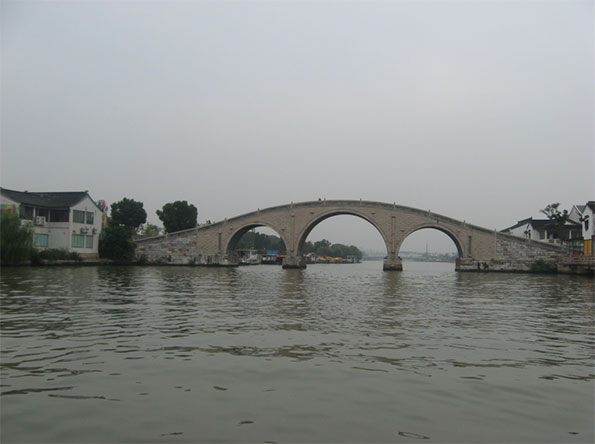
    • Suzhou (Photo), part of which (Kunshan qu) abuts Shanghai ranked as the third fastest growing metropolitan area, with a growth rate of 65 percent. Suzhou added 1.6 million people and is nearing 4.1 million. As the growth of Shanghai continues to spill westward and northward, Suzhou is likely to continue its strong growth.
    • The other three top 10 metropolitan growth areas in the Yangtze River Delta were in the province of Zhejiang, including Wenzhou at 5th, growing 59 percent (Photo), Ningbo, one of the nation’s largest ports was 6th, at 59 percent and Hangzhou, the provincial capital, which Marco Polo claimed was the largest city in the world in his Travels was 10th, at 47 percent.
    • Shanghai, the nation’s largest metropolitan area, placed 14th in growth, at 42 percent. Shanghai had the largest numeric growth, adding 6.6 million to its population, more people than live in Toronto.
    • Nanjing, the capital of Jiangsu province ranked 16th in growth, at 41 percent.


    Suzhou


    Wenzhou

    Northern Coast: Five northern coastal metropolitan areas were among the top 20 metropolitan gainers, with an average growth rate of 42 percent.

    • Weifang, in the province of Shandong ranked 8th in growth, the highest rating among metropolitan areas in the northern coastal area. Weifang added 48 percent to its population.
    • Beijing ranked 12th in growth, at a 46 percent rate. Beijing’s numeric growth was second only to Shanghai, at 6 million.
    • The other northern coastal growth centers were Shijiazhuang, the capital of Hebei (17th, at 41 percent) and 175 miles (280 kilometers), south of Beijing. Qingdao, of brewing fame ("Tsingtao" beer) ranked 19th, with a growth rate of 37 percent, while Tianjin, which is close enough to be Beijing’s port, ranked 20th, with a growth rate of 36 percent.

    Pearl River Delta: In contrast the Pearl River Delta, the home of so much urban growth over the past 30 years, placed only one metropolitan area among the top 20 growth centers, Shenzhen. Shenzhen placed 9th, with a growth rate of 48 percent. This is in stark contrast to 1990 to, when Shenzhen and adjacent Dongguan both more than doubled in population.

    Missing Giants: Chongqing was not among the top growth centers. Chongqing has been routinely mischaracterized as China’s largest metropolitan area (because of semantic confusion over the word "city"). Chongqing’s metropolitan districts grew only 22 percent and the region (a provincial equivalent) lost population. Neighborhood rival Chengdu, capital of Sichuan province from which Chongqing was separated in 1996 more than doubled its growth rate. Manchuria, China’s "Dongbei" (Northeast) also failed to place any areas among the fastest growing. Shenyang, the center of China’s Rust Belt, grew less than 10 percent, though Harbin, capital of Helonjiang grew nearly 30 percent.

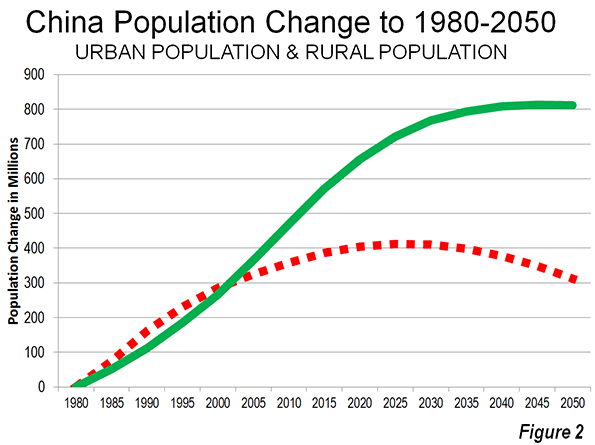
    More Growth to Come: Despite an overall population that is just peaking, urban population growth is expected to be substantial. In addition to the 470 million people that have moved to urban areas since 1980, the United Nations projects that another 340 million people will be added to the urban areas by 2045 (after which a modest decline is expected). Over the same 35 years, China’s rural population is expected to fall by 387 million (Figures 2 and 3). Where these new migrants move and how they make do will be among the most important urban stories of the next decade.


    Wendell Cox is a Visiting Professor, Conservatoire National des Arts et Metiers, Paris and the author of “War on the Dream: How Anti-Sprawl Policy Threatens the Quality of Life”.

    ——-

    Note: Includes Kunshan, part of the Suzhou metropolitan area, but a separate urban area (between the Suzhou urban area and the Shanghai urban area).

    Note: Corrected Hefei data on 6/3/2012.

    Top photo: Hefei: All photos by author.

  • The Evolving Urban Form: Shenzhen

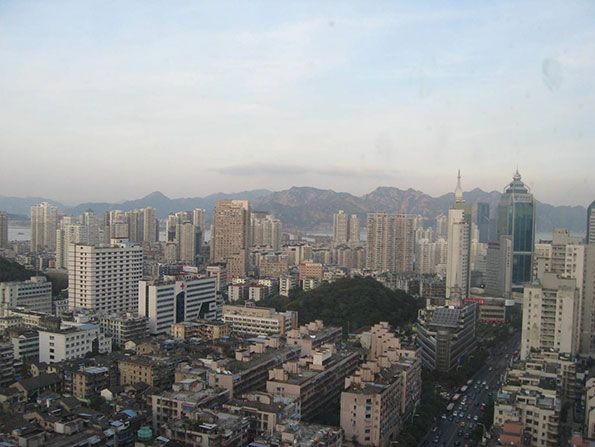
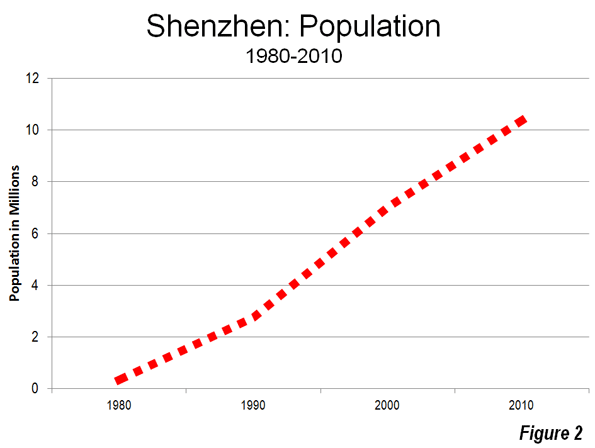
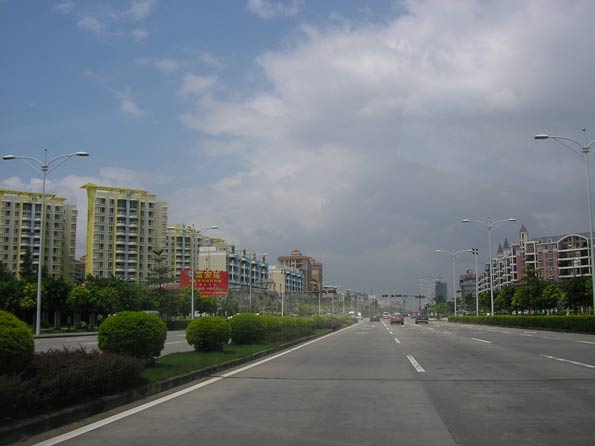
    No urban area in history has become so large so quickly than Shenzhen (Note 1). A little more than a fishing village in 1979, by the 2010 census Shenzhen registered 10.4 million inhabitants. It is easily the youngest urban area to have become one of the world’s 26 megacities (Figure 1). Most other megacities were the largest urban areas in their nations for centuries (such as London and Paris) and a few for more than a millennium (such as Istanbul and Beijing). Shenzhen’s primitiveness can be seen in this 1980 internet photo, and shows the beginnings of construction. A 2006 photograph of one of Shenzhen’s principal streets (Binhe Avenue) is above.

    Pearl River Delta Location: Shenzhen is located in Guangdong Province adjacent to Hong Kong’s northern border. Shenzhen is China’s fourth largest urban area, following Shanghai, Beijing, and Guangzou-Foshan.

    Along with Dongguan, Guanzhou, Foshan and smaller neighbors, Shenzhen forms the Pearl River Delta,   the world’s largest manufacturing center. The Pearl River Delta, along with Hong Kong and Macau, constitutes the world’s largest populated extent of urbanization, with nearly 50 million people. They live in a land area of just over 3,000 square kilometers (7,800 square kilometers. By comparison the world’s largest urban area, Tokyo-Yokohama, has a population of 37 million and covers 3,300 square miles (8,500 square kilometers). I recall from a Hong Kong to Guangzhou trip on the Canton-Kowloon Railway in 1999 that there was plenty of rural territory on the 100 mile (170 kilometers) route. Today,   development takes place along virtually the entire route (Note 2).

    The Special Economic Zone: Shenzhen was established as China’s first special economic zone by Deng Xiaoping in the period of liberalization after the death of Mao Zedong. The special economic zones allowed for alternative, generally market oriented reforms, with the end of improving economic growth. The result was economic progress far greater than anyone expected. The special economic zone program was eventually extended to several other urban areas in the nation.

    Some governmental officials preferred the previous state dominated approach, despite its greater poverty and sought to roll back the reforms. This threat reached its peak in the early 1990s, after Deng Xiaoping had retired from his government positions. In response, Deng undertook his renown "southern tour" to Shenzhen, Guangzhou and other parts of Guangdong province to promote the new economic approach and the progress that had been made. During the southern tour, Deng is reputed to have said that "to be rich is glorious." Three decades before he had said “I don’t care if it’s a white cat or a black cat. It’s a good cat as long as it catches mice." He committed to results rather than to ideology, in a sense Shenzen and its environs are the engines of non-state owned prosperity. Eventually, the publicity from Deng’s southern tour overwhelmed the opposition and China accelerated its move toward a more open economy.

    Shenzhen’s Core: Unlike the fast growing, but much smaller new urban areas of the United States (for example Phoenix, which is largely a low rise, dispersed expanse of suburbanization), Shenzhen has developed a dense central business district. Even though Shenzhen started the decade of the 1990s with little more than 1,000,000 residents, by 1996 it had the fourth tallest building in the world, the Shun Hing Tower. Only the Sears Tower in Chicago and the two World Trade Center Towers in New York were taller.

    In 2011, the Shun Hing Tower lost its local tallest building title to the Kingkey Financial Tower, at 1,449 feet (447 meters) is the 10th tallest building in the world. Now, the world’s second tallest building is under construction in Shenzhen, the Ping An International Financial Center, which is reported to reach 2,125 feet or 655 meters, with 116 floors. Only the Burj Khalifa (2,717 feet, 828 meters, 163 floors) in Dubai would be higher. Like Shanghai and Chongqing (and unlike most Chinese urban areas), Shenzhen has a highly concentrated central business district. As a result deserio.com rates Shenzhen’s skyline as 9th in the world (Note 3).

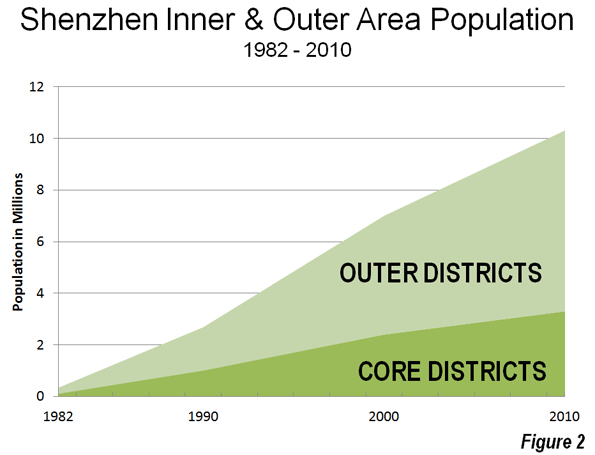
    Outer Areas Growing Faster: The three central districts (the qu of Futian, Luohu and Nanshan) grew from 2.4 million to 3.3 million population between 2000 and 2010, a rate of 38 percent. However, as is natural for a growing urban area, most of the growth was in the outer districts (Photo: Suburban Shenzhen), which grew from 4.6 million to 7.0 million, a growth rate of 52 percent. Thus, nearly three-quarters of the growth was on the periphery (Figure 2). Population growth in the earlier 1990 and 2000 period was slightly less concentrated in the outer area (68 percent). But overall  population growth has begun to slow down, with Shenzhen added 3.3 million new residents, compared to 4.3 million between 1990 and 2000.  


    Photo: Suburban Shenzhen (Longgang)

    The Urban Area: Overall, it is estimated that the Shenzhen urban area (area of continuous development) has a 2012 population of 11.9 million, with a land area of 675 square miles (1,745 square kilometers). The urban area has now crossed the border into the Huiyang district of the Huizhou region, to the east. The population density is estimated at 17,600 per square mile, or 6,800 per square kilometer,  approximately 10 percent less dense than the average urban area in China. Shenzhen is about one quarter the density of Hong Kong and double the density of Paris.

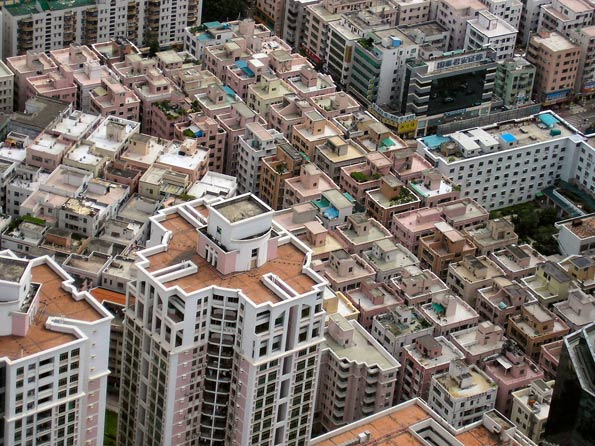
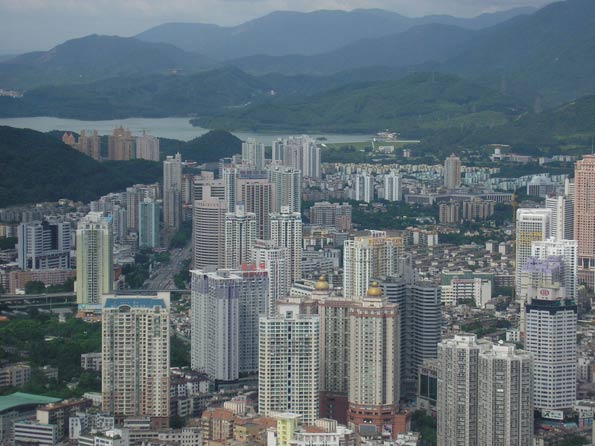
    Rich and Poor in Shenzhen: Like all urban areas, Shenzhen is a mixture of rich and poor. Shenzhen is generally considered one of the most affluent urban areas in China, yet it also has a very large low income population. Approximately one-sixth of China’s residents are considered to be temporary migrants; many work in boomtowns like Shenzhen. Seven million of these 220 million migrants live in Shenzhen,  considered the largest migrant population of any region in the nation. Migrants are attracted to Shenzhen for the same reasons people have moved to cities from early on: to get ahead. At the same time, their remittances sent back home are contributing to improved living conditions far beyond Shenzhen. It is expected that reforms to the "hukou" system of residence permits will allow many of the temporary migrants in Shenzhen and elsewhere obtain permanent residence status. Many of the migrants live in factory housing, or older, very densely packed buildings. At the same time, Shenzhen has a large number of world-class condominium buildings.


    Photo: Older Housing: Central Business District


    Photo: Newer Housing: Central Business District

    The Future of Shenzhen: Much of Shenzhen’s future will depend upon the economy of the Pearl River Delta and the extent to which migrants are able to obtain permanent residency status. There is still land enough in the region for substantial population growth. The longer term integration of the Hong Kong and Shenzhen economies could produce an even larger economic dynamo than the two that are currently separate. One thing is certain, however. Shenzhen has led China into a new economic and urban reality.

    Wendell Cox is a Visiting Professor, Conservatoire National des Arts et Metiers, Paris and the author of “War on the Dream: How Anti-Sprawl Policy Threatens the Quality of Life”.

    —–

    Note 1: Shenzhen is one of China’s regions, often called "cities," as translated from "shi."  "Shi" more resemble regions than "cities" in the non-Chinese sense, this article refers to "shi" as regions. "Shi" were formerly referred to in English as prefectures. A province is usually composed of "shis" and other "shi" level jurisdictions.

    Note 2: These combined regions are not a metropolitan area, for two reasons. First; there is little daily commuting between them and thus they are not a single labor market, which is the definition of a metropolitan area. Second, one of the regions, Hong Kong, has a border with Shenzhen that has international style customs and immigrant controls, which further precludes the two adjacent regions from being a single metropolitan area. In the longer run, greater affluence, greater mobility between the regions and relaxation of border controls could merge some or all of the now separate metropolitan areas.

    Note 3: Desiro.com, unlike some other skyline rating systems, places a premium on the density of buildings, rather than simply amalgamating building heights from throughout an urban area.

    Photo: Shenzhen:  Binhe Avenue from the Shun Hing Tower (by author)

  • World Urban Areas Population and Density: A 2012 Update

    The latest edition of Demographia World Urban Areas has just been released. The publication includes population estimates, urban land area estimates and urban densities for all nearly 850 identified urban areas in the world with a population of 500,000 or more. These urban areas account for approximately 48% of the world’s urban population. Overall, data is provided for approximately 1500 urban areas, comprising approximately 1.9 billion people, or 52% of the world’s urban population.

    Urban areas (or urban agglomerations) are areas of continuous urban development within a metropolitan area (labor market area), and are the physical form of that constitutes the essence a city. Generally, urban areas can be identified by the lights one would see from an airplane at night or in a satellite photograph. Urban areas are not metropolitan areas, which represent the economic or functional form of a city. Urban areas are a component of metropolitan areas, the other component of which is non-urban or rural territory. A metropolitan area is the combination of the urban area(s) and rural areas, which together comprise the economic region or labor market (commute shed).

    Over the last year, new census reports have become available in such nations as India, Indonesia, China, Canada, Bangladesh, the United States and South Korea. The new data has resulted in a number of ranking changes from before.

    The Megacities: In 2012, 26 urban areas qualify as megacities (Rental Car Tours for 24 of the megacities are available), with populations of greater than 10 million people (Table). As has been the case for nearly six decades, Tokyo remains the largest urban area in the world, with approximately 37 million. New York, which Tokyo displaced in 1955, has fallen to seventh largest and has the lowest population density of any megacity, at 4600 per square mile or 1800 per square kilometer (Note 2). London, which New York displaced in the 1920s never became a megacity due to the imposition of its greenbelt. Instead urbanization leapfrogged into the exurbs of southeast England, where all of the London area’s net population growth has occurred since World War II (London ranked third as late as 1960).  

    Table 1          
    LARGEST URBAN AREAS IN THE WORLD (MEGACITIES): Estimated 2012
    (Over 10,000,000 Population)          
             
    Rank Geography Urban Area Population Estimate Land Area: Square Miles Density Land Area: Km2 Density
    1 Japan Tokyo-Yokohama 37,126,000 3,300 11,300 8,547 4,300
    2 Indonesia Jakarta 26,063,000 1,075 24,200 2,784 9,400
    3 South Korea Seoul-Incheon 22,547,000 835 27,000 2,163 10,400
    4 India Delhi, DL-HR-UP 22,242,000 750 29,700 1,943 11,500
    5 Philippines Manila 21,951,000 550 39,900 1,425 15,400
    6 China Shanghai, SHG 20,860,000 1,350 15,500 3,497 6,000
    7 United States New York, NY-NJ-CT 20,464,000 4,495 4,600 11,642 1,800
    8 Brazil Sao Paulo 20,186,000 1,225 16,500 3,173 6,400
    9 Mexico Mexico City 19,463,000 790 24,600 2,046 9,500
    10 Egypt Cairo 17,816,000 660 27,000 1,709 10,400
    11 China Beijing, BJ 17,311,000 1,350 12,800 3,497 5,000
    12 Japan Osaka-Kobe-Kyoto 17,011,000 1,240 13,700 3,212 5,300
    13 India Mumbai, MAH 16,910,000 211 80,100 546 30,900
    14 China Guangzhou-Foshan, GD 16,827,000 1,225 13,700 3,173 5,300
    15 Russia Moscow 15,512,000 1,700 9,100 4,403 3,500
    16 Bangladesh Dhaka 15,414,000 134 115,000 347 44,400
    17 United States Los Angeles, CA 14,900,000 2,432 6,100 6,299 2,400
    18 India Kolkota, WB 14,374,000 465 30,900 1,204 11,900
    19 Pakistan Karachi 14,198,000 300 47,300 777 18,300
    20 Argentina Buenos Aires 13,639,000 1,020 13,400 2,642 5,200
    21 Turkey Istanbul 13,576,000 540 25,100 1,399 9,700
    22 Brazil Rio de Janeiro 12,043,000 780 15,400 2,020 6,000
    23 China Shenzhen, GD 11,885,000 675 17,600 1,748 6,800
    24 Nigeria Lagos 11,547,000 350 33,000 907 12,700
    25 France Paris 10,755,000 1,098 9,800 2,844 3,800
    26 Japan Nagoya 10,027,000 1,475 6,800 3,820 2,600


    Jakarta (Jabotabek) has emerged as the world’s second largest urban area, with a population of 26 million. This is a larger population than reported by the United Nations, since its estimates include little more than DKI Jakarta, the national capital district and beyond which urbanization stretches for a considerable distance. Continuing suburban growth in Seoul-Incheon secured that urban area a ranking of third, with approximately 22.5 million people. As was reported last year, new estimates indicate that Delhi has emerged as India’s largest urban area, with a population of 22.2 million and a growth rate that should result in its passing Seoul-Inchon in a matter of a few years. Mumbai, which like Mexico City in the 1980s has often been promoted as being destined to become the largest urban area in the world, was passed by Delhi over the past decade and has become the second largest urban area in India.

    Manila is ranked as the fifth largest urban area in the world, with 22.0 million people. In Manila, as in Jakarta, the population reported to the United Nations is far below that of the genuine urban area. The reported population is for the National Capital Region (popularly and misleadingly called "Metro Manila), which represents approximately one-half of the population of the urban area, which stretches into four additional provinces (Cavite, Laguna, Rizal and Batangas). If the population of the Washington urban area were reported in the same manner, it would be 600,000 – the population of the District of Columbia – rather than the 4.6 million indicated in the 2010 census for the entire urban area.

    Los Angeles, until recent years one of the fastest growing urban areas in the world, has dropped to 17th largest in the world and seems destined to drop out of the top 20 in the next decade or two. Fast growing Karachi, Istanbul, Lagos and others could become larger than Los Angeles. Los Angeles reached its peak ranking of 6th largest in the world from 1965 through 1980 and entered the top ten by 1950.

    Over the past decade, Paris became a megacity, reaching a population of 10.7 million. Paris has been Western Europe’s fastest growing large urban area since World War II. All of its growth since 1921 has been in the suburbs, which stretch over more than 1,000 miles (2,600 square kilometers).  This is more land area than Houston’s suburbs, but more densely populated. Since 1921, the historical core municipality (the ville de Paris) has dropped in population from 2.9 million to 2.2 million.

    By world standards, the Paris urban area has grown slowly, having fallen from being the world’s third largest in 1965 to its current ranking of 23rd. However, over the past census period, Paris added 600,000 residents, compared to less than 200,000 in the previous period, indicating a decline in out-migration and a higher natural population rate increase.

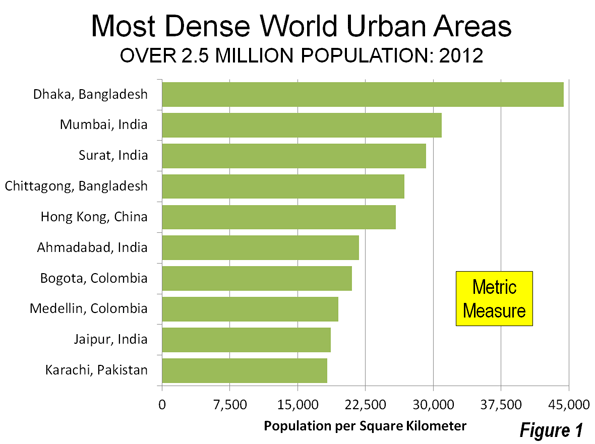
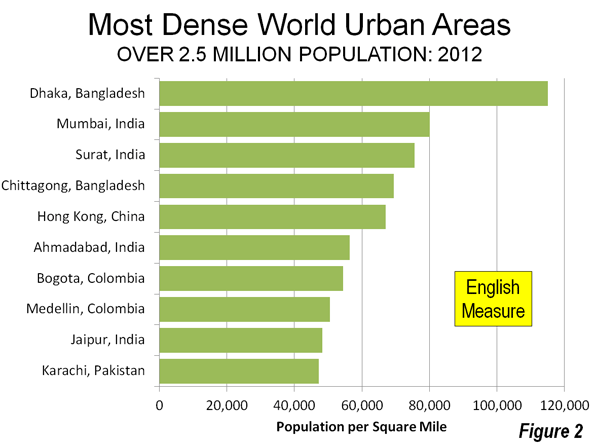
    Urban Area Densities: Dhaka, the capital of Bangladesh grew strongly between 2001 and 2011 and is by far the most densely populated urban area in the world. Dhaka’s density is estimated at 115,000 per square mile or 44,000 per square kilometer, with slum (informal dwelling) densities reported report up 4,210 per acre, or 2.7 million per square mile (1 million per square kilometer). At this density, all of the world’s 3.7 billion urban residents could be accommodated in an area approximately equal to that of the Washington (DC-MD-VA) urban area. All of Dhaka’s urban population of 15.4 million fits into a land area equal to that of the city (municipality) of Portland (population less than 600,000). Nonetheless, analysts have referred to this example of the ultimate of urban density to be "sprawling."

    Among the urban areas with more than 2.5 million population, the second-most dense is Mumbai, at 80,100 per square mile or 30,900 per square kilometer. The most dense high income world urban area is Hong Kong, at 67,000 persons per square mile or 25,900 per square kilometer. Of course, Hong Kong’s density is the result of an accident of history, which resulted in huge migration to the former British colony following World War II. Hong Kong is more than twice as dense as the second most dense high income world urban area, Busan, Korea. The smaller nearby, yet historically similar enclave of Macau (560,000) has an even higher density than Hong Kong, at 70,000 per square mile (27,000 per square kilometer).

    Seven of the densest urban areas with more than 2.5 million population are on the Asian subcontinent. These include Dhaka and Chittagong in Bangladesh, Mumbai, Ahmedabad, Surat and Jaipur in India and Karachi, in Pakistan. Colombia has two of the densest, Bogota and Medellin. Hong Kong is the only high income nation urban area among the 10 densest (Figures 1 & 2).


    The least dense urban areas with more than 2.5 million population are all in the United States. The least dense is Atlanta, with 1800 people per square mile or 700 per square kilometer. The second least dense is, perhaps surprisingly, Boston, despite its reputation for high density. Boston’s population density is 2200 per square mile or 800 per square kilometer. Also, perhaps surprisingly, Philadelphia is the least dense urban area in the world with more than 5 million population, while Chicago is the least dense urban area of more than 7.5 million. The lower density of US urban areas is illustrated by the fact that Portland, with its reputation for higher density and densification planning, would have ranked 11th least dense, if it had reached the 2.5 million threshold used in this ranking.

    Most Extensive Urban Areas: New York covers the most land area of any urban area at nearly 4500 square miles or 11,000 square kilometers. Tokyo covers 3300 square miles or 8500 kilometers. Chicago is the third most expansive urban area, at 2,600 square miles (6,900 square kilometers). Los Angeles, which has long been perceived as the most sprawling of world urban areas, ranks fifth, covering 2400 square miles or 6,300 square kilometers. Atlanta and Boston, the world’s least dense major urban areas, rank 4th and 6th, covering 2,600 and 2,100 square miles respectively (6,900 square kilometers and 5,400 square kilometers).

    The Continuing Exodus from Rural Areas: Around the world, people continue to seek the promise of better economic outcomes in urban areas. United Nations forecasts indicate that another 2.5 billion people will be added to urban areas by 2050, while rural areas (which contain all population not urban) will be reduced in population by 300 million. The world’s urban population is expected to rise from today’s nearly 53 percent to 67 percent. More than 90 percent of the urban growth is expected to be in less developed nations.

    Wendell Cox is a Visiting Professor, Conservatoire National des Arts et Metiers, Paris and the author of “War on the Dream: How Anti-Sprawl Policy Threatens the Quality of Life”.

    ——

    Note 1: Demographia World Urban Areas uses national census authority urban area population and land area data in the few nations designating urban areas on a basis generally consistent with that of the United States Census Bureau. Elsewhere, land area estimates are determined using satellite photography (Google Earth). Population estimates are also obtained from a variety of sources, such as United Nations data, where it is reflective of the urban area population (some data reported to the United Nations is for jurisdictions that are only a part of the urban area and in other cases, metropolitan area data is reported), estimates relying on a "build-up" of local authority data from national census authorities and other sources. Demographia combines some adjacent urban areas when they are contained within the same metropolitan area or consolidated area, such as in New York and Los Angeles (for a complete list see Demographia World Urban Areas). Also see: Urban Terms Defined.

    Note 2: Exceptions: In some cases, continuous urbanization does not constitute a single urban area because they are not within a single labor market (metropolitan area). This can be the case within a nation, such as in the Pearl River Delta of China, where Shenzhen, Dongguan, Zhongshan, Jiangmen, Huizhou, Zhuhai, Guangzhou-Foshan and Hong Kong, which are separate labor markets. International borders (and the Hong Kong-Shenzhen border) also define separate urban areas if free movement of labor is not permitted. Thus Detroit and Windsor or San Diego and Tijuana are separate urban areas because free movement of labor is not permitted. On the other hand, treaties permit virtual free movement of labor between the French and Belgian sides of the Lille urban area and between the Swiss and French components of the Geneva urban area.

    —-

    Photo: Recent migrants to Dhaka slum in NGO school (photo by author)

  • Understanding Chongqing and the Fall of Bo Xilai

    The demise of Bo Xilai, the former Party Secretary of Chongqing, has turned into one of the biggest political scandals in China in recent memory and now includes allegations that Bo’s wife Gu Kailai is connected to the murder of a British businessman close to Bo’s family. It is even rumored the businessman, Neil Heywood, may have had an affair with Gu.

    Yet the international espionage drama has not shed much light on the peculiar politics and evolution of Chongqing, the western Chinese city which has become its unlikely setting. As a three year resident of Chengdu, a city two hours northwest by train and a traditional economic rival, I have been fascinated by Chongqing’s unique history and political culture.

    1940-1946: China’s Wartime Capital

    In many ways, Chongqing is China’s version of the Wild West. Known for the rough and tumble nature of its locals, the city, divided by the mighty Yangtze River, has carried with it a crude reputation since the days of Chiang Kai-Shek when his Kuomintang (KMT) held the city as their capital. Even after the remainder of the KMT fled from the Mainland to Taiwan after defeat, the atmosphere of gangsterism and corruption nurtured by Chiang Kai-Shek and the KMT remained deeply imbedded.

    China might’ve taken a different path had the American forces succeeded in getting the KMT and the Communist Party to unite against the common Japanese enemy. It was in Chongqing at the KMT compound where U.S. General Joseph Stilwell arranged a meeting between Chiang-Kai Shek and Mao Zedong to try to broker the deal that ultimately failed. On an official tour of the city last year, Joel Kotkin and I had the opportunity to visit the site of the meeting- a leafy hillside compound which is now a museum and a must see for visitors to the city.

    1997: The Creation of Chongqing ‘Direct-Controlled Municipality’

    After breaking from Sichuan province 15 years ago, Chongqing direct-controlled municipality became by some measures the biggest city in the world.

    Though the specific reasons for the creation of Chongqing municipality were never officially articulated, general consensus is that the decision was to administratively abate the negative effects of Three Gorges Dam project and the resulting destruction of nearby villages. Incorporating these villages as part of Chongqing was an easy way to solve the administrative problem of transferring household registration (‘hukou’) status and mobility for the hundreds of thousands of residents who had to relocate.

    Separating Chongqing from Sichuan also had the added benefit of removing competition with the provincial capital of Chengdu. Under the administration of the Central Government, Chongqing could now move forward with unfettered development without having to deal with the demands of Chengdu. This would also provide Bo Xilai a far greater stage to promote his career ambition.

    2007 – 2012 : The Reign of Bo Xilai

    Bo landed in Chongqing in late 2007 with what some analysts saw at the time a demotion from his previous position as China’s Minister of Commerce. Prior to working for the Central Government, Bo was governor of north China’s Liaoning Province and Mayor of Dalian- the second largest city in the province.

    A port city of about 3 million people, Dalian sits on the Liaodong Peninsula that juts out into the Bohai Sea. It is here where Bo proved himself as an adept politician, serving the city as Mayor from 1992 – 2000. Bo was noted for his progressive urban planning policies, putting emphasis on modernizing the city, improving the environment, adding greenbelt corridors and preserving architectural gems from Russian and Japanese colonial periods. For his progressive urban planning policies, Bo was even awarded a UN-HABITAT “Scroll of Honour” award in 1999.

    To this day, Dalian still often ranks as one of China’s most ‘livable’ cities, a title that the city’s residents attribute to the work of Bo. Yet, if top-down urban planning initiatives were a popular success in Dalian, the same could not be said as unequivocally for Chongqing. While some applauded Bo’s efforts, others saw his overly aggressive methods as detrimental to the existing urban fabric.

    Chongqing and Dalian couldn’t be further apart in character or its stage of economic development. Whereas Dalian is a pleasant seaside town based on tourism, banking and IT, Chongqing is a rough manufacturing megalopolis, known for its craggy mountains chopping through the city and unbearably hot summers.

    Perhaps Bo thought he get away with a more strong-arm approach given Chongqing’s history of being a city on the frontier far away (both physically and psychologically) from Beijing. When he became Party Secretary of the municipality, he came in with guns blazing, initiating a bloody campaign to crack down on organized crime. He and Wang Lijun (his former right-hand man and police chief who would later try to defect to the U.S. Consulate in Chengdu) took down the previous police chief, Wen Qiang, sentencing him to death for corruption.

    Initially many locals were pleased with Bo’s very public display of taking down the gangs, but not everyone was as easily convinced. As one of my friends who is a native of the city once said to me “Bo Xilai just replaced the previous mafia with his own mafia”. If this is ultimately discovered to be the case, then it is perhaps not surprising for a city with a history of such internal struggles.

    In Chongqing, Bo also initiated similar strategies he employed in Dalian by promoting greenbelts, the development of public transportation networks (including monorails to traverse the unforgiving topography), and an ambitious affordable housing program. Yet these urban planning projects were overshadowed by Bo himself, who wanted to be seen both by the residents of Chongqing and the decision-makers in the Communist Party headquarters in Beijing as the new star in China’s political firmament.

    In addition to the organized crime crackdown, Bo also initiated the now well-documented ‘red’ campaigns, promoting the singing of Mao-era songs in public parks and converting the local television stations into 24-hour commercial free broadcasts of red propaganda. He even went so far as to establish a museum at the city’s Public Security Bureau (PSB) displaying his crackdown on crime to show off to visiting delegations.

    Somewhat unnervingly, Kotkin and I were taken to the PSB as the last stop on our visit to the city. The compound, a huge Stalinist piece of architecture, features two quarter-mile long covered colonnades extending out in front of each side of the building. We were led down the first wing by an attractive young woman shouting into a microphone, introducing us first to pictures of the ‘great leader’ Bo shaking hands with China’s top leaders, Hu Jintao and Wen Jiabao, as well as with visiting foreign officials.

    Immediately following, we were bombarded with gruesome images of Bo and Wang’s campaign to oust crime, showing the horrors committed by the gangs. Dead, mutilated bodies filled the walls, as well as photomontage of images from the execution of Wen Qiang. Inside the PSB main building, the contraband seized from Wen Qiang and his associates was on display, including every kind of narcotic you can think of, weapons including AK-47s and gigantic machetes, and millions of dollars worth of historic Chinese art pieces that were used for money laundering.

    The exhibit was meant to show the righteous power of Bo, and belittle the previous group who ruled Chongqing. Afterwards, we were invited to coffee in the opposite wing, where prominent images of Josef Stalin, Vladimir Putin, and Mao Zedong were displayed next to imaged of Bo. The experience was so bizarre that by the time we made it onto the high-speed train to Chengdu both Kotkin and I breathed a sigh of relief to make it out of the city alive.

    All of that is gone now, and Chongqing moves on without Bo. The Bo Xilai saga is a very telling narrative about where China is today. On the political side of things, Bo’s takedown is a message to Chinese citizens and the world that nothing will get in the way of the country’s urban development program, especially a rogue politician who draws too much attention to himself.

    It also means that, for commentators in the West who think that China needs to urgently reform to a more democratic system of free elections, the individuation of high-level charismatic politicians required for this kind of style of government cannot be tolerated at this stage in development. Unfortunately at this stage, popular elections run the risk of choosing someone who cultivates a personality cult.

    From the urban development standpoint (which is actually inextricably linked to the political realm, both in China and in the West), the more top-down local government policies are, the more there is the risk that those in power will abuse those powers in other ways. Finding a balance is key. Many of Bo’s initiatives both in Dalian and Chongqing have their merit in improving urban life, but the manner they were initiated, and the authoritarian, self promoting style, appear now to have been a cover for something more sinister.

    Adam Nathaniel Mayer is an American architectural design professional currently living in China. In addition to his job designing buildings he writes the China Urban Development Blog. Follow him on Twitter: AdamNMayer.

    Chongquing at Night photo by Wiki Commons user Jonipoon.