Tag: China

  • Women Ascendent: Where Females Are Rising The Fastest

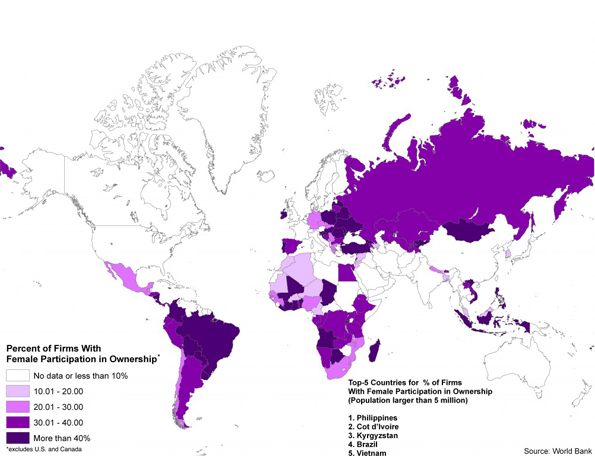
    You can find the future of the world’s women not in Scandinavia or the U.S., but among the entrepreneurs who line the streets of Mumbai, Manila and Sao Paulo. Selling everything from mangoes to home-made blouses, these women, usually considered the very bottom of their home country’s employment barrel, represent the cutting-edge of progress for women in the 21st century.

    This marks a departure from past decades, when the advancement of women was visible almost solely in the wealthiest of countries. Surveys of female achievements have consistently singled out just a sliver of the globe, but increasingly, women are making the greatest strides elsewhere — in the rapidly growing developing world.

    Women in these countries are newly empowered by remarkable gains in political representation, legal rights and, especially, education. But more important, they are rising in the 21st century’s key economic strata: as business owners.

    For our analysis of the countries where women are rising the fastest, we looked at three factors: education, politics and entrepreneurship. We studied the United Nations’ demographics on post-secondary education (current and historical) and on political participation. To assess the business environment, we examined statistics from Global Entrepreneurship Monitor on nascent entrepreneurship and the World Bank and World Economic Forum on gaps between male and female business ownership. We searched the global press, pored through research publications by financial institutions and NGOs, and visited some locations. Finally, we crunched the numbers, information and observations and came up with our own impressions.

    Our top picks for places where women were rising the fastest — as opposed to merely surfing an already advantageous position — were found largely in the developing world — particularly in Brazil, India, Vietnam and the Philippines.

    A vital benchmark of this progress is the large role that women play in business ownership in these places. In many developing countries the rate of female entrepreneurship surpasses that in the G-7 nations. Many become entrepreneurs by necessity: Often locked out of the of the best opportunities in the job market by cultural and sometimes legal barriers, women are starting businesses at rapid rates in Latin America, India, East Asia and even Africa and Central Europe.

    In contrast, female entrepreneurship rates aren’t rising in many of the most advanced countries. Despite talk of the feminization of advanced societies, the percentages of women-owned businesses are inching downward in the U.S., and they are stagnant in the E.U. To some extent, this slowdown reflects greatly expanded opportunities for a new generation of women, considerably more educated than their mothers, in both the mid-level job market and the highest corporate tiers. These changes have been accelerated by shifts in the nature of employment that favor “brains” and collaboration over traditional male advantages in “brawn” and single-minded ambition.

    The Rise of the Female Entrepreneur

    Latin America is a premiere example of the rise of female business ownership. Both Brazil and Costa Rica rank in the World Bank’s top 10 countries for female ownership participation. The region also stands out for its small gender gap in new businesses: Women are now starting businesses as often men, and sometimes succeeding. Among the top countries with the greatest equality between women and men in establishing new ventures, Global Entrepreneurship Monitor notes that many Latin American countries, especially Brazil and Peru, now have a gap that is smaller than in the U.S. or anywhere in Europe.

    The same trend is emerging in Asia. In the more tropical countries, where women are impeded by unpaid family work combined with a notoriously grim labor picture, many own marginal businesses. South Asia’s bright spot for female entrepreneurs is India, with its highly developed support structure of national-level and local organizations for women’s SMEs and early participation in micro-finance. And female entrepreneurs are thriving in Vietnam, the Philippines and Thailand as well. For example, 24% of Vietnam’s 100,000-plus incorporated enterprises are owned by women; 27% of its 3 million household businesses are also female-owned. The rate of female private business owners in China, at 11 out of 100, is also higher than the world average of 7%. Surprisingly, famously chauvinist Japan is the only country in the world where the percentage of women who own their own businesses, 13%, edges out the percentage of males who do.

    Eurasia and Central Eastern Europe have also experienced a surge in female entrepreneurial activity. As in Latin America, self-employment has often come about as a result of national tragedy and political dislocation — in this case, the economic disruption and male migration abroad that followed the fall of the Soviet Union.

    Data on women in African economies are sparse, with the positive news focused on Lesotho, ranked No. 1 and No. 2 by the World Economic forum for economic opportunity in the last two years, and, unsurprisingly, South Africa, the continent’s most developed nation, considered Africa’s best economic climate for women’s by The Economist Intelligence Unit. Ghana has also drawn attention, with a World Food Program-initiated salt start-up. Micro-financiers, development NGOs and the United Nations have assisted small-scale women entrepreneurs in African nations like Kenya in establishing micro industries such as processing soap, fruit and maize.

    Educated Women on the Front Lines

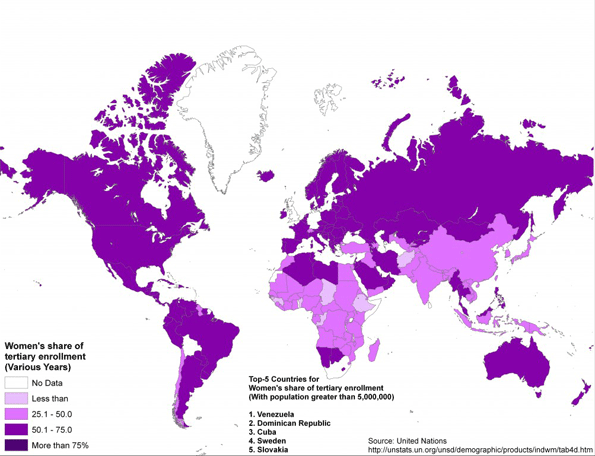
    Across the globe female gains in education have skyrocketed. In tertiary education — which includes post-high school vocational schools as well as colleges and universities — females now outnumber males in one-third of developing countries, including Brazil, Bangladesh, Honduras, Lesotho, Malaysia, Mongolia and South Africa. Worldwide, between 1970 and 2008, the number of female tertiary students expanded by 70 million, compared with 60 million for males.

    The Legal Right to Wages and Assets

    Along with economic and education gains, women in developing countries are making substantial political gains. Part of a broader movement throughout the developing world toward political empowerment, women are gaining increased access to capital and property ownership, and greater national attentiveness to issues specific to women, such as domestic violence and female health.

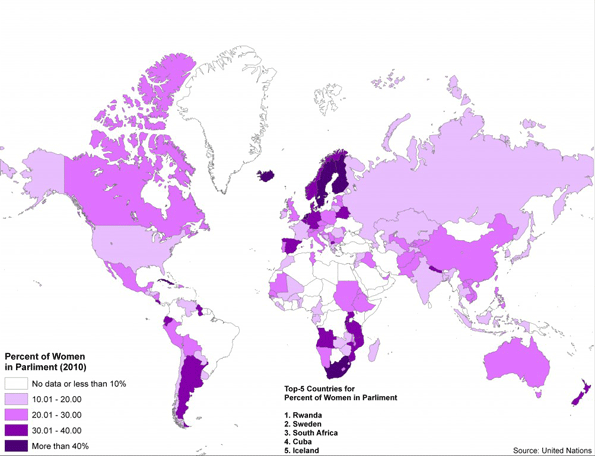
    One indication: The percentage of parliamentary seats held by women globally has risen considerably during the first decade of this century, and is now about 18%. As in entrepreneurship and education, the most dramatic gains now are not in the high-income countries but in the developing world, where sizable inroads to the very top tiers of government have also been made.

    Latin America has become the most visible emblem of rising female political power sweeping across a region. When Brazil elected Dilma Rousseff as president in 2010, it joined its neighbors Argentina, Costa Rica and, until recently, Chile in having a female head of state. Latin America, too, is a world leader for female political representation, with 30%-plus parliamentary representation in Costa Rica, Argentina, Ecuador and Bolivia.

    Yet some of the most astonishing changes in representation have taken place in Africa, where Rwanda now has the world’s highest percentage of women in parliament and cabinet seats. Each of Rwanda’s parliamentary houses comprises 50% or more women. South Africa, Angola, Mozambique, Uganda and Tanzania also boast above-average rates.

    The destiny of the global economy has shifted toward countries that once trailed behind but are now rapidly rising. In the same way, the trajectory of women’s progress — and the future of the ascendancy of women — has shifted from the developed to the developing world.

    This piece originally appeared at Forbes.com.

    Joel Kotkin is executive editor of NewGeography.com and is a distinguished presidential fellow in urban futures at Chapman University, and an adjunct fellow of the Legatum Institute in London. He is author of The City: A Global History. His newest book is The Next Hundred Million: America in 2050, released in February, 2010.

    Zina Klapper is a Los Angeles-based journalist, and Deputy Editor of newgeography.com.

    Photo by flickr user Dawn Danby

  • Overpopulation Isn’t The Problem: It’s Too Few Babies

    The world’s population recently passed the 7 billion mark, and, of course, the news was greeted with hysteria and consternation in the media. “It’s not hard to be alarmed,” intoned National Geographic. “We should all be afraid, very afraid,” warned the Guardian.

    To be sure, continued population increases, particularly in very poor countries, do threaten the world economy and environment — not to mention these countries’ own people. But overall the biggest demographic problem stems not from too many people but from too few babies.

    This is no longer just a phenomenon in advanced countries. The global “birth dearth” has spread to developing nations as well. Nearly one-third of the 59 countries with “sub-replacement” fertility rates — those under 2.1 per woman — come from the ranks of developing countries. Several large and important emerging countries, including Iran, Brazil and China, have birthrates lower than the U.S.

    In the short run this is good news. It gives these countries an opportunity to leverage their large, youthful workforce and declining percentage of children to drive economic growth. But over the next two or three decades — by 2030 in China’s case  – these economies will be forced to care for growing numbers of elderly and shrinking workforces. For the next generation of Chinese leaders, Deng Xiaoping’s rightful concern about overpopulation at the end of the Mao era will shift into a future of eldercare costs, shrinking domestic markets and labor shortages.

    This scenario is already a reality in Japan and much of the European continent, including Greece, Spain, Portugal, much of Eastern Europe, Scandinavia and Germany. Adults over the age of 65 make up more than 20% of these countries’ populations — compared with 15% in the U.S. —  and their numbers could double by 2030, according to researchers Emma Chen and Wendell Cox.

    In many of these countries, rising debt burdens and shrinking labor markets have already slowed economic growth and suppressed any hope for a major long-term turnaround. The same will happen to even the best-run European economies, just as  it has in Japan, whose decades-long growth spurt ended as its workforce began to shrink.

    By 2030 the weight of an aging population will strangle what’s left of these economies. Germany, Japan, Italy and Portugal, for example, will all have only two workers for every retiree. The U.S. will fare somewhat better, with closer to three workers per retiree. By 2030 the median age  will also be higher in China and Korea than in the U.S. This  age difference will grow substantially by 2050, according to the Stanford Center on Longevity.

    The biggest impact of aging, however, will not occur in northern Europe and Japan, where there may be enough chestnuts hidden away to keep the aged fed, but in Asia. In the next few decades, South Korea, Taiwan, Singapore, Thailand, and even Indonesia will start following Japan into the wheelchair stage of their demographic histories. These are not quite rich places like China and Brazil, which still lack the wealth and a developed welfare state to take care of the elderly Although not headed directly to European or Japanese rates of aging, these countries will experience a doubling of their Old Age Dependency Ratios; both will rise slightly above current U.S. levels by 2030.

    In China, the one-child policy could be used to explain this phenomenon, but this hardly accounts for declining birthrates and rapid aging in countries such as Iran, Mexico or Brazil. Other factors — urbanization, a secular society and upwardly mobile women — also appear to be playing an important role.

    Of course, the populations in most developing countries will still grow, but more due to longer lifetimes than a surfeit of new births.  But projections are often wrong, and their demographic trajectory may slow down more than now predicted.

    The one region expected to continue growing is Africa. Some countries, like Nigeria and Tanzania, are expected to more than double or even triple their current populations by 2050. But as Africa urbanizes and develops, it may eventually experience the same unexpected decline in fertility  we already see in Islamic Iran, multi-cultural Brazil  or throughout east Asia.

    Largely left out of the analysis may well be the next big demographic phenomenon: the rise of childlessness. We have already seen how the move in developing countries from six kids or more per household has reduced population growth. In a similarly dramatic way  the shift towards zero children, particularly in wealthier countries could have unforeseen lasting consquences. After all, with two children, or even with one kid, there’s the possibility of two or more grandchildren. With no children, it’s game over — forever.

    Of course, there have always been unmarried people and childless people; some by necessity or health reasons, others by choice. But now a growing proportion of young child-bearing age women in countries as diverse as Italy, Japan and Taiwan are claiming  no intention of having even one child. One-third of Japanese women in their 30s are unmarried, and similar trends are developing in other Asian countries.

    Life without marriage, and children, has also become the rage among a large proportion of the cognoscenti even in historically procreation-friendly America. Whether it’s because men are seen as weak, or children too problematical, traditional families could erode further in the decades ahead.

    The chidlessness phenomenon stems largely from such things as urbanization, high housing prices, intense competition over jobs and the rising prospects for women. The secularization of society — essentially embracing a self-oriented prospective — may also be a factor.

    If this trend gains momentum, we may yet witness one of the greatest demographic revolutions in human history. As larger portions of the population eschew marriage and children, today’s projections of old age dependency ratios may end up being wildly understated.  More important, the very things that have driven human society from primitive time — such as family and primary concern for children — will be shoved ever more to the sidelines. Our planet may be less crowded and frenetic, but, as in many of our child-free environments, a little bit sad and lot less vibrant.

    Our future may well prove very different from the Malthusian dystopia widely promoted in the 1960s and still widely accepted throughout the media. With fewer children and workers, and more old folks, the “population bomb” end up being more of an implosion   than an explosion.

    This piece originally appeared at Forbes.com.

    Joel Kotkin is executive editor of NewGeography.com and is a distinguished presidential fellow in urban futures at Chapman University, and an adjunct fellow of the Legatum Institute in London. He is author of The City: A Global History. His newest book is The Next Hundred Million: America in 2050, released in February, 2010.

    Photo "Nursery Cart" by flickr user Pieterjan Vandaele

  • Six Adults and One Child in China

    On a Saturday afternoon at The Bund, Xiao Ming (or “Little Ming”) clings tightly onto the hands of his paternal grandparents. His maternal grandparents walk slightly ahead, clearing a path for him in the midst of all the buzz and traffic. Retracing the imprints of their imaginary footsteps, Xiao Ming takes his first tentative steps as a three year old in town for the first time. Slightly behind him, the watchful eyes and ready hands of his own parents spur him on. 1

    Xiao Ming’s personal parade epitomises the popular quip in Shanghai and across China, that “it takes six adults to raise one child”. These six individuals form the unspoken support structure of China’s youth: While the OECD points out that 80% of students in Shanghai attend after-school tutoring, it fails to capture the “soft factors” behind Shanghai’s top rankings in the Program for International Student Assessment (PISA). Popular Chinese dramas such as <<房奴>> (House Slave) depict this in meticulous detail: Grandparents spend hours brewing “brain tonics” for their grandchildren, and parents pack austere work lunchboxes to save up for their child’s tuition fees.

    LOW FERTILITY AND THE DEMOGRAPHIC DIVIDEND

    Fifty-five years ago, China’s fertility rate was 6.1. This had fallen to 1.8 in 2010. This means that in 1955, the typical female in China would have had, on average, six children during her productive life cycle; in 2010 she would have had less than two. If Xiao Ming were born in the 1950s, he would probably have had to vie for attention and resources with at least five other siblings. Today, he has the devoted attention and care of two generations before him. Overall, the number of Chinese under 14 has declined by 6.3 percent over the last decade. (Pierson and David, 2011).

    And to be sure there are short and medium term advantages to this situation. These anecdotal observations point to demographic trends that ultimately contribute to the optimal development of a nation’s trajectory. Children may be a blessing, but in many cases too many of them overburden the working population. Indeed some describe this combination of low-fertility with a large workforce as the “demographic dividend” (RAND, 2002).

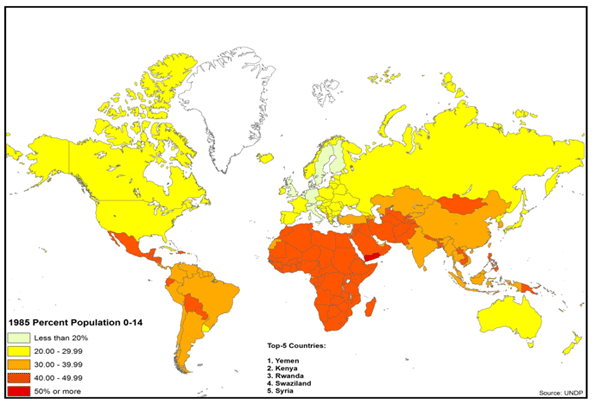
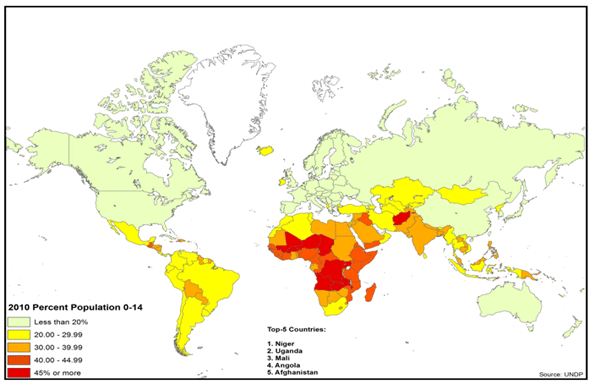
    It is of little surprise that countries with a high Youth Dependency Ratios (children under 15 per 100 persons of working age, or 15 to 64) are less stable, and turn up as hotspots on the world map (Figures 1 & 2). Liberia for instance has a 5.1 percent annual natural population increase rate, 81 children per 100 of working age, and a fertility rate of 4.7. In contrast, prosperous Denmark has a 0.3 percent annual natural population increase rate, 28 children per 100 of working age and a fertility rate of 1.9 (UNDP, 2010).

    Figure 1: Global Youth Dependency Ratio (1985)


    Figure 2: Global Youth Dependency Ratio (2010)

    As population increases outpace economic opportunities and growth, nations at risk fail to accommodate new entrants into the workforce. In addition, caring for children requires a high proportion of resources, thus depressing the rate of economic growth. (Bloom et.al., 2001).

    A low median age is thus a harbinger of impending stresses, where in extreme cases at least 50% of the population is below 20 years of age (UNDP, 2010). In comparison, the median age of the developed world averages 30 – 40 years. This forms the foundational basis of several youth bulge studies of late, explaining demographic factors behind the Arab Spring (Anderson, 2011), that was in part driven by massive increase in youth (Hvistendahl, 2011; Fuller, 2003) and the youth workforce (Kuhn and Korbel, 2011; Schwartz, 2011), much of whom are unemployed and underemployed (Bajora, 2011).

    THE FERTILITY IMPLOSION

    Yet there is a distinct disadvantage as well to ever lower birthrates. Globally population growth rates are likely to continue dropping – to less than 0.8 percent worldwide by 2025 – largely due to an unanticipated drop in birthrates in developing countries such as Mexico and Iran. These declines are in part the result of increased urbanization, the education of women, and higher property prices. Already the global fertility rate, including the developing countries, has dropped in half to an estimated 2.5 today (Longman, 2010a). Close to half the world’s population lives, notes demographer Nicholas Eberstadt, in countries with below replacement rate birth-rates. The world, he suggests, is experiencing a “fertility implosion” (Eberstadt, 2010).

    Like a population explosion, a demographic implosion has consequences. Countries that have previously engineered reductions in the fertility rates – Singapore (Yap, 2003), Hong Kong (FPAHK, 2011), Vietnam (Bennett-Jones, 2000), India (WHO, 2011) and Indonesia (Hull, 2007) – have done so to achieve more manageable economic conditions. Similar initiatives are being debated, even in the in the Philippines (Pernia et. al., 2011), where religious interpretations are being contested. China’s “one child policy” represented just a more authoritarian expression of a widespread global process. Yet this process often includes many unintended and potentially damaging consequences. However, elsewhere, virtually the same results were replicated without government policy direction, such as in Brazil (Gomey, 2011).

    Chinese “fertility implosion” is already having profound impact on marriage in China. Today researchers characterize declining fertility in China into “waves of singletons” (单身潮). While the first three, distinct “waves” or phases since 1950 are well established (王霞, 2006),it has recently been noted that the fourth (第四次单身潮) is currently in progress(陈亚亚, 2011). In the fourth and current wave, women increasingly view child-bearing and marriage as a form of entrapment and a burden that can interfere with aspirations of affluence (杨燕明  2011; 黄蓉芳 and 杨励潮, 2011).

    Not surprisingly this is most evident in the advanced urbanized parts of China, such as Shanghai, where there are already three million people over 60, or 2l percent of the population, roughly equal to the share in many advanced countries (McCartney, 2009).

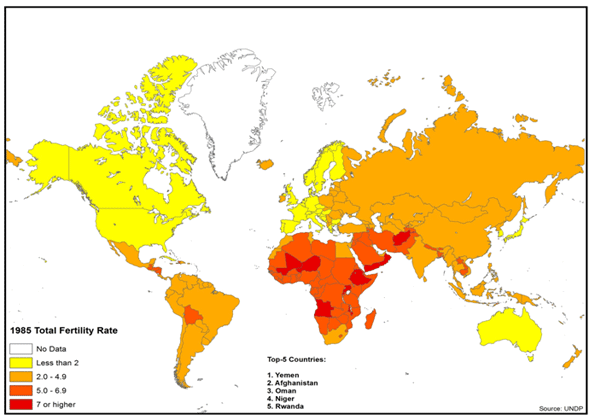
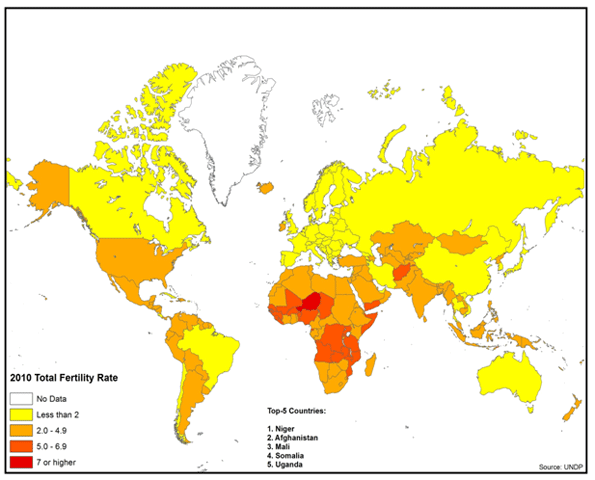
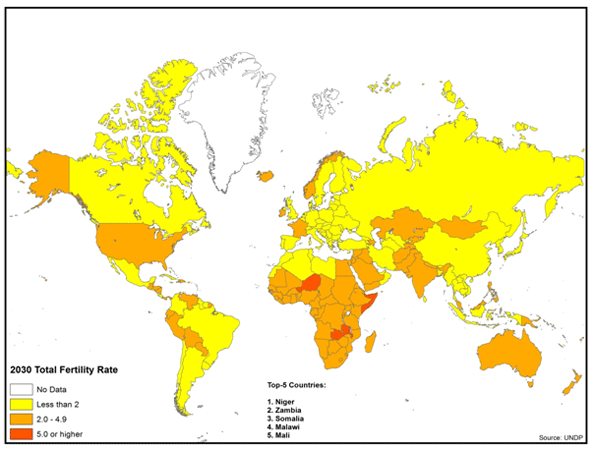
    China now has a fertility rate of 1.6, below that of Western Europe. Nor is China alone. Other middle income nations and even low income nations are experiencing significant declines in fertility rates. Brazil and Iran already have fertility rates less than that of the United States. In Bangladesh and Indonesia, fertility rates are projected to drop below replacement rates (2.1) by 2030. Around the world, increasing affluence has been associated with fewer children, as is indicated in Figures 1 – 3. The longer run implications of these less than replacement fertility rates (2.1) is smaller and much older populations (Figures 3, 4 &5).

    Figure 3: Global Total Fertility Rate (1985)

    Figure 4: Global Total Fertility Rate (2010)

    Figure 5: Global Total Fertility Rate (2030)


    GRAYING OF THE WORLD

    Here’s the big issue down the historical road: Thirty years from now, how will Xiao Ming handle six elderly parents and grandparents, all by himself? Xiao Ming’s impending dilemma is not unique to China.

    Overall what author Phil Longman calls a “gray tsunami” will be sweeping the planet, with more than half of all of population growth coming from people over 60 while only six percent will be from people under 30. The battle of the future – including in the developing world – will be, in large part, how to maintain large enough workforces required for the economic growth needed to, among other things, take care of and feed the elderly (Longman, 2011b). The National Bureau of Research (NBER) further notes that similar to child dependents, a large elderly population similarly requires a large proportion of resources, which likewise can inhibit economic growth (Bloom et. al., 2001).

    Right now the situation seems dire. Fertility rates are projected to continue their decline. Increasing life expectancy is contributing to a substantial increase in the elderly population. In many nations, the size of the elderly population will exceed that of the under 15 population for the first time.

    This could not have happened at a worse time, because the elderly have become ever more dependent on the state in many nations. Supporting a larger elderly population requires a larger work force, however it will be smaller.

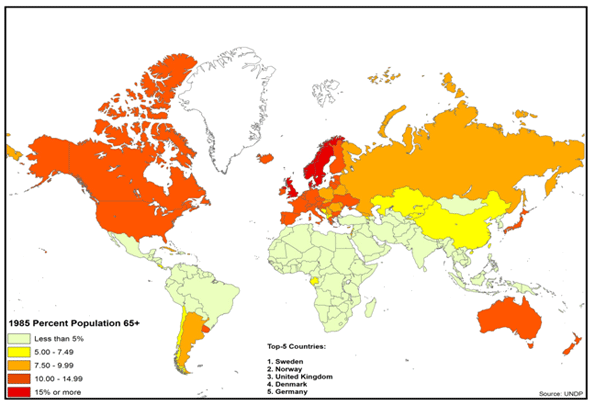
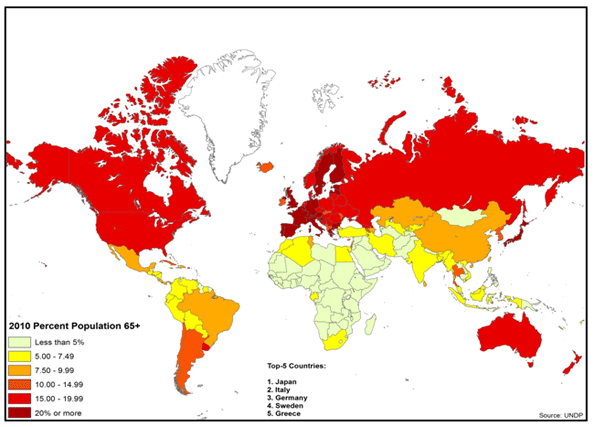
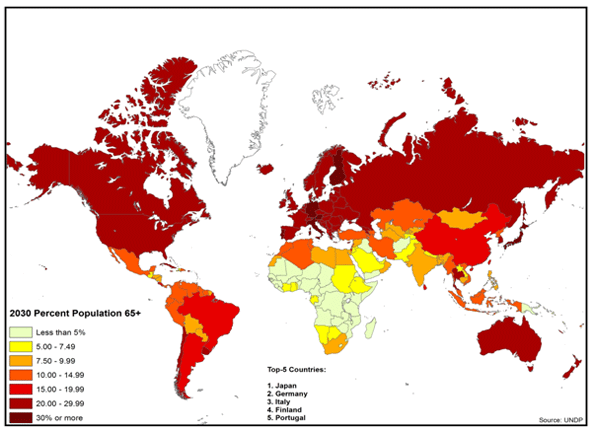
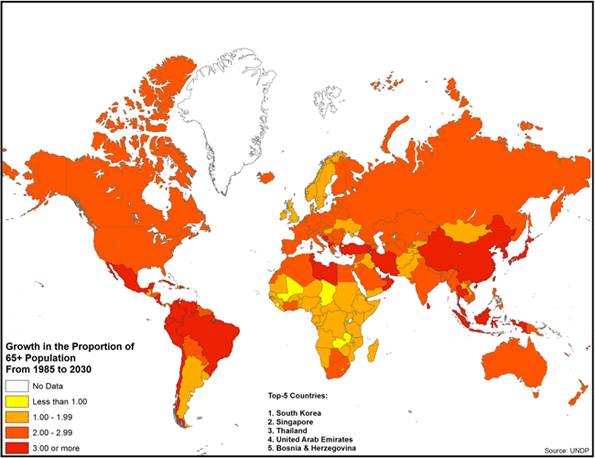
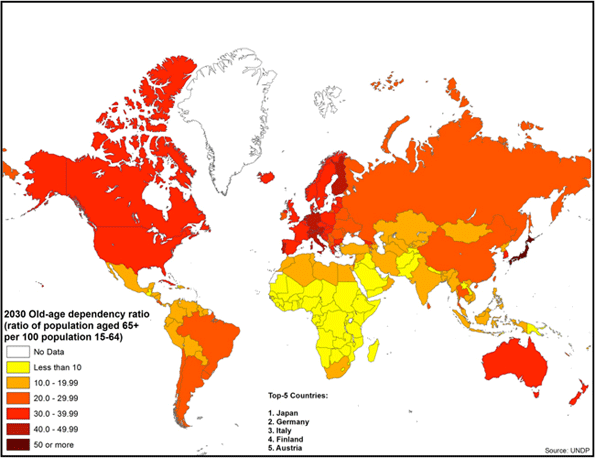
    All of this leads to a demographic future that promises to challenge the nations of the world as never before. This is illustrated by rising Old Age Dependency Ratios in Figures 6, 7 & 8.

    Figure 6: Global Old Age Dependency Ratios (1985)

    Figure 7: Global Old Age Dependency Ratios (2010)


    Figure 8: Global Old Age Dependency Ratios (2030)

    High income countries are projected to experience elderly population increases on the order of 60 percent in relation to the working age population (15 – 64) by 2030. In the United States, there are now 20 people 65 or over for every 100 of working age; little changed since 1985, when it was 18. However, by 2030 there will be 33 seniors per 100 working people. More extreme will be the fates of the world’s third and fourth largest economies. Germany’s ratio of elderly to working age individuals is already 33, compared to 21 in 1985. In 2030 this ratio will rise to an almost unimaginable 48, meaning that there will be only two working people per retiree. Japan’s situation is even worse. As recently as 1985, Japan had a relatively healthy 15 retirees for every working age person. Today this ratio is one the world’s most extreme: with 35 seniors per 100 working age people. In 2030, this ratio is expected to rise to 53.

    Things will be a bit better, at least in the next two decades, in middle income countries such as China and Brazil. But the rate of aging will be even greater than in the high income nations. Both China and Brazil will experience a doubling of their Old Age Dependency Ratios; both will rise slightly above current US levels by 2030. China is projected to rise from 11 to 23, while Brazil’s will increase from 10 to 20. Despite its theological regime, which might be seen as working against smaller families, middle-income Iran is also aging rapidly. It should see a doubling of its Old Age Dependency Ratio, but from a low 7 to a manageable 14. 

    There will be a mix of results in the lower income countries, as illustrated by the Philippines and Nigeria. In the Philippines, the fertility rate is expected to remain high by current global standards, at 2.6 in 2030, only a modest drop from the present 2.9. However, the elderly will increase 60 percent relative to the working age population (from an Old Age Dependency Ratio of 6 to 10 in 2030). Similarly, in Nigeria the fertility rate is expected to decline only slightly, from 4.8 to 4.5. Alone among the group of nations reviewed, Nigeria is expected to experience only a negligible increase in the Old Age Dependency Ratio, remaining at 6. In 1985, these nations had Old Age Dependency Ratios of between 5 to 7 (UNDP, 2010).

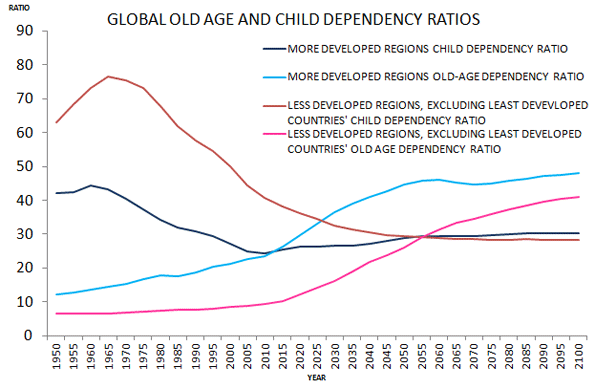
    Even if we were to discount population projections going forward (Shahani, 2011), the world is on the verge of a global demographic precipice (Figure 9) – one in which the the increase in proportion of elderly far outweighs that of the increase in proportion of children. A world which Andrew Blechman terms, “a world without children” (Blechman, 2009), and that Ted Fishman describes as one which “pits young against old, child against parent, worker against boss, company against rival, and nation against nation” (Fishman, 2009).

    Figure 9: UNDP global old age and child dependency ratios. In the developed world, child dependency will equal old-age dependency within the next 5 years. In the developing world this will happen in the next 40 years.

    FINANCING THE UNFINANCABLE?

    Where there is Virtually Universal State Support.The options available for addressing increasing old age dependency are not very attractive. Older people require considerably more in terms of overall support, particularly for health care, than younger generations (Feinberg et. al., 2011). This is a crisis particularly in demographically declining countries with well-developed social welfare nets. A recent Bank of International Settlements study found that, due to these pressures, Germany’s ratio of public debt to gross domestic product could exceed 200 percent in 2030, with annual debt service approach 10% of GDP. This would be a fiscal burden twice that of Greece today (Eberstadt and Hans, 2010).

    Where there is Less State Support: In many nations, state retirement systems often fail to cover a large share of the elderly population. While arrangements vary widely, many elderly must find their own ways to survive, such as by working longer or by relying on families. As emerging nations consider establishing or expanding social safety nets for the elderly, they need to consider the experience of the high-income world welfare states.

    Family Support: Given the stresses on public systems, it might be hoped that the elderly could be supported by their children. But this solution has been losing hold throughout the developed world. The mathematics cannot work in any of the challenged nations, at whatever income level: As the elderly population increases relative to the working population, an adult Xiao Ming is unlikely to be able, or willing, to support six parents or grandparents or even two or three.

    Reduce Benefits? The accounting answer may be simple – limit elderly benefits to what society can afford. But the politics do not work. Concentrated, organized interests, such as the elderly who receive state benefits, are likely to block any such reforms. The difficulty of dealing with today’s challenges, which are modest compared to the future, is illustrated by recent developments in Western Europe and the United States, where recipients of state aid have fought, often successfully, to retain their benefits even in the face of significant funding challenges.

    Increase the Birth Rate? A substantial increase in the birth rate in low fertility nations could help, but it would need to happen immediately. This would require broad acceptance of earlier and more frequent child-bearing women, many of whom are increasingly finding a life of affluence to be preferable to one of child-raising. Some projections show increases in the fertility rate in future years, however it could be too little-too late (UNDP HDI, 2010).

    More Migration? Increased migration from poorer countries could help richer countries finance the needs of their elderly. However, migration rates are dropping even in the United States, which is by far the world’s largest country for immigration. Although the US foreign born population grew by 10 million over the past decade, both illegal and legal immigration have been dropping. In 2008 there were over one million naturalizations; last year there were barely 600,000, a remarkable 40% drop (Ohlemacher, 2006).

    Working Longer: As life expectancy has increased in recent decades, retirement ages have changed little. For example, in the United States, since the establishment of the state retirement system, life expectancy at birth has increased 16 years, while the retirement age has increased only two years.   Generally, every additional year in life expectancy is an additional year of state support. One possible solution would be to extend retirement ages beyond the 65 years common in the high income world. Yet while life expectancy has increased, perhaps in 2030, the standard Old Age Development Ratio should be calculated using the population that is more than 75 years old instead of 65.

    More Women in the Work Force: Another factor that could assist in meeting the daunting financial challenge of supporting the elderly would be for an increase in female participation in the workplace. The extent to which such an expansion is theoretically possible varies significantly by nation, but this could be part of the solution. There is an important caveat, however. Increasing the supply of workers does not automatically create wealth. Western Europe has had intractable unemployment rates for decades and has been joined in recent years by the United States. More workers, of either sex, will require strong enough economic growth to generate sufficiently high paid employment.

    Affordable Housing:One reason for lower birthrates may be the cost of housing. Many of the countries, and regions, with the most expensive housing also tend to experience the lowest fertility – Taiwan, Singapore, Hong Kong, and much of Western Europe. Across China, for example, it is generally agreed that apartment sales prices are exceedingly high relative to incomes (Pierson, 2011). In a number of places with considerable land for new development, like the United Kingdom, Australia and some metropolitan areas of the United States and Canada, researchers have connected substantially increasing prices and housing shortages with overly-restrictive land use regulation. Any strategy that would encourage greater fertility might need to address this issue. Further, the artificially higher house prices consume discretionary income that could be better put to encouraging economic growth by increasing the demand for other goods and services.

    Economic Growth: Economic growth represents the best hope. Chinese-level GDP increases would better position to countries for demographic challenges than the Japanese or European rates of the last two decades. Clearly, economic expansion would ameliorate the pre-occupation with splitting the economic pie. It will also be important to pursue policies that minimize costs for households. If, for example, the cost of housing or food is less, more money will be available for necessary social programs (and there will be less resistance to funding them). In a sense, the difference between laggard and strong economic growth can make a huge difference. For example, economist Bret Swanson has shown that the United States could conquer its well-publicized debt burden with economic growth rates of 4 percent (Swanson, 2011).

    This Issue Must be Addressed: No one can accurately predict the future, but it is necessary to focus on the issue of aging and declining fertility. In advanced countries, if the elderly retain their state benefits and economic growth continues to be modest or even stagnant, the pressure on economies will be severe. There will be, to put it simply, less money to go around. Those who primarily fund the state – the working population – will have to pay more and could see material reductions to their standards of living. Central Bankers could yield to the temptation to print enough money to seemingly hyper-inflate away the problem, but that could lead to a lower standard of living for all.

    Overall our research suggests several possible solutions, including extending work and careers into the 70s; means tested benefits; greater incentives for having children; and measures to keep housing more affordable and family friendly wherever possible. But the ultimate issue will be maintaining economic growth.   

    The future of Xiao Ming and billions more will depend upon the result.

    Emma Chen is a Senior Strategist at the Centre for Strategic Futures, Singapore. The views expressed within this article are solely her own. Publication does not constitute an endorsement by the Centre for Strategic Futures, Singapore.

    Wendell Cox is a consultant specializing in demographics and urban issues, principal of Demographia and a visiting professor at the Conservatoire National des Arts et Metiers in Paris.

    This project was supported by the Legatum Institute. Maps designed by Ali Modarres, chairman, Geography Department, California State University, Los Angeles.


    REFERENCES

    王霞. 2006. “第三次单身潮解析 (Analysis of Youth Single Phenomenon in the Third Bachelor Trend).”中国青年研究(China Youth Study) 2006(12).

    杨燕明. 2011. “大家谈中国:第四次单身潮反映家庭婚姻危机 (Everybody Discusses China: Fourth Wave of Singles Reflects Family and Marriage Crises).” BBC News. Accessed September 19, 2011.
    http://www.bbc.co.uk/zhongwen/simp/comments_on_china/2011/07/110720_coc_marriage_byyangminyan.shtml.

    陈亚亚. 2011. “都市单身女性的生存状态考察 (Observations on the living status of urban single females).” 华人社会和谐家庭论坛暨第九届全国家庭问题学术研讨会(The Ninth National Conference on Family Issues, The Forum for Chinese Societal Harmony and Family), hosted in Guang Dong, 2011.

    黄蓉芳 and 杨励潮. 2011. “中国将迎第四次单身潮 近4%的女性因性取向单身 (China Will Meet its Fourth Wave of Singles – Nearly Four Percent of Females are Single Due to Sexual Orientation).” Xinhua, July 19.

    Anderson, Lisa. 2011. “Demystifying the Arab Spring.” Foreign Affairs May/June 2011 2-7.

    Bajoria, Jayshree. 2011. “Demographics of Arab Protests.” Council on Foreign Relations. Accessed September 19, 2011. http://www.cfr.org/egypt/demographics-arab-protests/p24096.

    Bennett-Jones, Owen. 2000. “Vietnam’s Two-Child Policy.” BBC News. Accessed September 19, 2011. http://news.bbc.co.uk/2/hi/asia-pacific/1011799.stm.

    Blechman, Andrew D. 2009. Leisureville: Adventures in a World Without Children. New York: Grove Press.

    Bloom, David E., David Canning, and Jaypee Sevilla. 2001. “Economic Growth and the Demographic Transition.” NBER Working Paper Series. Accessed September 19, 2011. http://www.nber.org/papers/w8685.pdf.

    Eberstadt, Nicholas, and Hans Groth. 2010, “Time for Demographic Stress Test.” Wall Street Journal, November 27.

    Eberstadt, Nicholas. 2010. “The Demographic Future.” Foreign Affairs 89:54-64.

    Feinberg, Lynn, Susan C. Reinhard, Ari Houser, and Rita Choula. 2011. “Valuing the Invaluable: 2011 Update – The Growing Contributions and Costs of Family Caregiving.” AARP Public Policy Institute. Accessed September 9, 2011. http://assets.aarp.org/rgcenter/ppi/ltc/i51-caregiving.pdf.

    Fishman, Ted. 2010. Shock of Gray. New York: Scribner

    Friedman, Benjamin. 2005. The Moral Consequences of Economic Growth. New York: Alfred A. Knopf.

    Fuller, Graham E. 2003. “The Youth Factor: The New Demographics of the Middle East and the Implications for U.S. Policy”. Brookings Institute. Accessed September 19, 2011.
    http://www.brookings.edu/~/media/Files/rc/papers/2003/06middleeast_fuller/fuller20030601.pdf.

    Gorney, Cynthia. 2011. “Brazil’s Girl Power.” National Geographic, September.

    Hvistendahl, M. 2011. “Young and Restless can be a Volatile Mix.” Science 333:552-4.

    Hull, Terence H, “Formative Years of Family Planning in Indonesia,” in The Global Family Planning Revolution: Three Decades of Population Policies, edited by Warren C. Robinson and John C. Warren (Washington: The World Bank, 2007), 246.

    Kuhn, Randall, and Josef Korbel. 2011. “On the Role of Human Capability in the Arab Spring.” Working paper, University of Colorado Boulder. Accessed September 19, 2011. http://www.colorado.edu/ibs/pubs/pop/pop2011-0011.pdf.

    Longman, Phillip. 2010. “Think Again: Global Aging.” Foreign Policy. Accessed September 19, 2011. http://www.foreignpolicy.com/articles/2010/10/11/think_again_global_aging.
    Longman, Phillip. 2011. “The World Will be More Crowded – With Old People.” Foreign Policy. Accessed September 19, 2011. http://www.foreignpolicy.com/articles/2011/08/15/the_world_will_be_more_crowded_with_old_people.

    McCartney, Jean. 2009. “China Steps Back from One Child Policy.” Times, July 24.

    Ohlemacher, Stephen. 2006. “3M a Year Leave Developing Countries.” Associated Press, August 17.

    Pernia, Ernesto M., Stella Alabastro-Quimbo, Maria Joy V. Abrenica, Ruperto P. Alonzo, Agustin L. Arcenas, Arsenio M. Balisacan, Dante B. Canlas, Joseph J. Capuno, Ramon L. Clarete, Rolando A. Danao, Emmanuel S. de
    Dios, Aleli dela Paz-Kraft, Benjamin E. Diokno, Emmanuel F. Esguerra, Raul V. Fabella, Maria Socorro Gochoco-Bautista, Teresa J. Ho, Dennis Claire S. Mapa, Felipe M. Medalla, Maria Nimfa F. Mendoza, Solita C. Monsod, Toby Melissa C. Monsod, Fidelina Natividad-Carlos, Cayetano W. Paderanga, Gerardo P. Sicat, Orville C. Solon, and Edita A. Tan. 2011. Discussion paper, University of the Philippines. Accessed September 19, 2011. http://www.econ.upd.edu.ph/dp/index.php/dp/article/viewFile/670/132.

    Pierson, David. 2011. “In China, Having Children is no Longer a Given.” Los Angeles Times, September 2.

    RAND Corporation. 2002. “Banking the ‘Demographic Dividend’.” Accessed September 19, 2011. http://www.rand.org/pubs/research_briefs/RB5065/index1.html.

    Shahani, Lila Ramos. 2011. “Whither the RH Bill”. BusinessWorld Online. Accessed 19 September, 2011. http://www.bworldonline.com/content.php?section=Opinion&title=Whither-the-RH-bill?&id=38459

    Schwartz, Stephanie. 2011. “Youth and the ‘Arab Spring’.” United States Institute of Peace. Accessed September 19, 2011. http://www.usip.org/publications/youth-and-the-arab-spring.

    Swanson, Bret. 2011. “The Growth Imperative.” Presentation to the National Chamber Foundation, Washington D.C., May 24. Accessed September 19, 2011. http://entropyeconomics.com/wp-content/uploads/2011/05/EE-NCF-Growth-Imperative-05.24.11-v1.9.pdf.

    The Family Planning Association of Hong Kong. 2011. “Family Planning Milestone.” Accessed September 19, 2011. http://www.famplan.org.hk/fpahk/en/template1.asp?style=template1.asp&content=about/history.asp.

    United Nations Development Programme. 2010. “International Human Development Indicators.” New York: UN Human Development Report Office. Accessed September 19, 2011. http://hdr.undp.org/en/statistics.

    U.S. Department of Homeland Security. 2010. “Table 20 – Petitions for Naturalization Filed, Persons Naturalized, and Petitions for Naturalization Denied: Fiscal Years 1907 to 2010.” Washington D.C.:  U.S. Department of Homeland Security. Accessed September 19, 2011. http://www.dhs.gov/files/statistics/publications/YrBk10Na.shtm.

    United Nations Development Programme. 2010. “International Human Development Indicators.” New York: UN Human Development Report Office. Accessed September 19, 2011. http://hdr.undp.org/en/statistics.

    United Nations Development Programme. 2010. “International Human Development Indicators.” New York: UN Human Development Report Office. Accessed September 19, 2011. http://hdr.undp.org/en/statistics.

    United Nations Development Programme. 2010. “International Human Development Indicators.” New York: UN Human Development Report Office. Accessed September 19, 2011. http://hdr.undp.org/en/statistics.

    World Health Organization Regional Office for South-East Asia. “India and Family Planning: An Overview.” Accessed September 19, 2011. http://www.searo.who.int/LinkFiles/Family_Planning_Fact_Sheets_india.pdf

    Yap, Mui Teng. 2003. “Fertility and Population Policy: The Singapore Experience.” Journal of Population and Social Security (Population) 1:643-58.

    1: Based on personal history of a co-author
  • Are We Headed For China’s Fat Years?

    Chan Koonchung’s chilling science fiction novel The Fat Years — already an underground sensation in China — will be published in the U.S. January 2012. The book, first published in Hong Kong in 2009, is partly so chilling because it reveals a scenario that is all too plausible. Set in 2013, it takes place after a second financial crisis  (euros, anyone?) that all but destroys the Anglo-American economies and ushers in “China’s golden age of ascendancy.”

    The nation that leads the world in The Fat Years is less bleakly dystopian than the Stalinist state portrayed in George Orwell’s 1984 or the biologically controlled society of Aldous Huxley’s Brave New World. Yet it is supremely authoritarian — harassing and even executing the rare dissident and putting drugs in the water supply to inflate a sense of well-being among the masses.

    This all-powerful Chinese state looks very familiar. It pursues a commercial strategy of plundering resource-rich regions around the world, often working with the most despicable of regimes such as Zimbabwe. And it harnesses and promotes information technology while maniacally censoring the Internet, rendering cyberspace just another outlet for propaganda.

    It is also increasingly self-confident. As one character — a highly placed party cadre in the story — suggests, this new Chinese model represents “the best option in the world as it really exists.”

    Many in the West already accept this notion. According to a recent Pew survey, nearly half of all Americans believe China will surpass America as the world’s leading power. The same poll found that roughly two-thirds of Britons — and many Europeans — believe similarly.

    The higher circles in Washington and New York generally view the Anglo-Saxon democracy as unable to compete with the more ordered, authoritarian Chinese model. Thrilled by what he sees as “China’s green leap forward,” New York Times columnist Thomas  Friedman proclaims the greater advantages of “one-party autocracy.” After all, Chinese autocrats can adopt “policies needed to move a society forward in the 21st century” without needing to check in with the voters. Even conservative pundit Francis Fukuyama, once a believer in the inevitable triumph of market liberalism, feels that “Anglo Saxon capitalism” has squandered its historic moment. “Democracy in America,” he notes, “has less than ever to teach China.”

    Former Obama Management and Budget chief Peter Orszag is the latest to endorse the down-with-democracy movement. Concerned with our inability to deal with our fiscal problems, climate change and rebuilding the economy, Orszag proposes shifting power from Congress to more “independent institutions” made up of unelected policymakers.  He argues that democracy can be “too much of a good thing.”  Comfortably ensconced at bailed-out Citigroup, Orszag has benefited from a financial system that increasingly resembles China’s, with its intimate ties between the state and banks. Crony capitalism, on both sides of the Pacific, it appears, has its rewards.

    Yet perhaps it is too early for the English-speaking democracies to throw in the towel.  Many who now espouse Chinese supremacy previously argued that Japan, and even Europe, was destined to dominate the world.  Yet Pax Niponica never got past the early 1990s; one former inevitable global hegemon has been downgraded to the sick man of Asia.

    Like Japan, China faces many great, if often overlooked, challenges. There’s a devastated environment, growing social unrest and rising competition from other countries, notably the Indian subcontinent. Labor force growth is slowing rapidly, and the country now has up to 30 million more marriage-age boys than girls, an all but certain spur to political unrest. Misallocation of resources by both central and local authorities threatens to create a major property bubble.

    Throughout modern history authoritarian and more centrally controlled countries have proved very good at playing “catch up” and impressing journalists. China’s Communist regime can order investment into everything from high-speed trains to green technology and massive dam construction. The results — like those previously seen in Nazi Germany and Soviet Russia — are often as physically and technologically impressive, although often cruel to both the environment and people stuck in the way.

    But once a country reaches a certain plateau of development, as Japan did in the 1990s, the nature of the competition changes; it becomes harder to target industries that are themselves in constant flux. Workers who have already achieved considerable affluence tend to be harder to bully or motivate.

    Take the battle for cyberspace. Japan’s ballyhooed bureaucracy sought to conquer this frontier through traditional channels. This allowed the internet to become a competition largely among relative young U.S. companies such as Apple, Amazon, Google and Facebook. The much-feared Japanese takeover of the computer and cultural industries back in the 1980s now has petered out into a historical footnote.

    And despite the recent, often spectacular gains of China , the primary English-speaking countries — the  U.S., U.K., Canada, Australia and New Zealand — still control a quarter of the world’s GDP, compared with 15% for the Sinosophere. Their combined per capita income is six times higher.

    Critically the U.S. and its closest cultural allies — New  Zealand, Australia and Canada —  also have enormous physical advantages. These four countries all stand among the eight largest food exporters in the world.  Recent discoveries on the energy front have made North America, particularly the Great Plains, a potentially dominant force in the global oil and gas industries. China lacks the water, and likely to resources, to match up.

    But the real edge lies with culture, particularly the English language, which has decimated all its traditional competitors — French, German and Russian — over the past two decades.  Difficult to learn, Chinese is not likely to replace English any time soon as the dominant language of culture, air travel, science and technology.

    This cultural dominion can be seen in the media as well. The U.S. and its English-speaking allies account for roughly half of all the world’s audio-visual exports. To an extent never seen before, Anglophones dominated how people think, dress and recreate.

    Arguably our biggest advantage lies in the very thing our upper echelons increasingly disdain — our messy multicultural democracy and our addiction to the rule of law. “The secret of U.S. success is neither Wall Street or Silicon Valley but its long-surviving rule of law and the system behind it,” Liu Yazhou, a Chinese two-star general, recently said. “The American system…is designed by genius and for the operation of the stupid.”

    The stunning lack of such constitutional guarantees is just one reason why many of China’s entrepreneurial elite seek to immigrate to the U.S., Canada or Australia.   Indeed, among the 20,000 Chinese with incomes over 100 million Yuan ($15 million), 27% have already emigrated and another 47% have said they were considering it, according to an April report by China Merchants Bank and U.S. consultants Bain & Co.

    To be sure, the U.S. and its allies need to change in order to compete.  Greater incentives for savings, investments and productive industries must supplant those that promote asset speculation and financial manipulation. But we can do this without importing Asia’s   hierarchical structures. Rather than trying to outdo the Politburo in developing crony capitalism we should seek to reinvigorate our diverse, grassroots economy.

    In any competitive race you do not win by emulating your rivals but by building on your intrinsic strengths.  The best way to avoid the scenario laid out in The Fat Years lies not in abandoning the very strengths that drove our historic ascendancy, but by tweaking and enhancing them so that they propel us in the coming decades.

    This piece originally appeared at Forbes.com.

    Joel Kotkin is executive editor of NewGeography.com and is a distinguished presidential fellow in urban futures at Chapman University, and an adjunct fellow of the Legatum Institute in London. He is author of The City: A Global History. His newest book is The Next Hundred Million: America in 2050, released in February, 2010.
    Shanghai photo by flickr user Sprengben

    .

  • Are 20th Century Models Relevant to 21st Century Urbanization?

    Analysis of the state of the world’s cities 2010/2011 by UN-Habitat focused on the narrowing urban divide, with 227 million people moving out of slum conditions over the preceding decade.  While acknowledging uncertainty over cause and effect, the report notes that:

    urbanization … is associated in some places with numerous, positive outcomes such as technological innovation, forms of creativity, economic progress, higher standards of living, enhanced democratic accountability and women’s empowerment. … the report calls for policy-makers and planners to understand that urbanization can be a positive force for economic development, leading to desirable social and political outcomes.

    The North Atlantic solution

    The report acknowledges the diversity of urbanisation[1], making its authors’ somewhat singular approach to managing it (more density) incongruous.  Their prescription is based on resisting urban sprawl, reflecting the experience of North America.  They also suggest that sprawl is a sign of “divided cities”, translating into

    an increase in the cost of transport, public infrastructure and of residential and commercial development. Moreover, sprawling metropolitan areas require more energy, metal, concrete and asphalt than do compact cities because homes, offices and utilities are set farther apart.

    The report denounces sprawl in suburban zones of high and middle income groups and in extensive slums on the city edge.  On the latter, they invoke issues of governance, saying it occurs because

    authorities pay little attention to slums, land, services and transport. Authorities lack the ability to predict urban growth and, as a result, fail to provide land for the urbanizing poor.

    Can one size fit all?

    It is difficult to accept prescription predisposed to a particular view. Urbanisation is not a single condition. Differences in the stage of urbanisation, vastly different physical, cultural and economic settings of “urban” settlement, and different institutional arrangements belie the idea of a universal response or that any particular form is best for all cities. 

    Apart from anything else, “western” cities [2] don’t really feature in 21st century urbanism.  Consider the figures.  In 1950 western cities accounted for 43% of the world’s urban population.  This was down to 23% in 1990 and 18% in 2010. UN projections have the figure down to 15% in 2030, accounting for between just 3% and 4% of all urban growth between now and then.

    What Size City?

    This post looks at some more numbers that help illustrate the diversity of urbanisation – the size of urban settlements. 

    According to UN figures,  8% of the world’s population lives in 53 cities housing over 5 million people; 12% in 388 cities of between 1 and 5 million; and 31% in cities of under 1 million. Any prescriptions for urban governance and urban form need to reflect quite extreme divergence between the few megacities and the many smaller settlements where the majority of urbanites live.

    The Urban Growth Trajectory

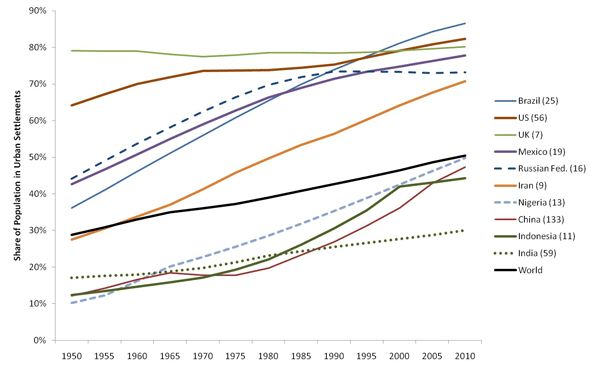
    Urbanisation experiences vary, also.  The different national experiences of the past 60 years can be illustrated using ten quite different countries (Chart 1).  By 2010, Brazil, US, UK, Mexico, and Iran were all heavily urbanised.  But the level of urbanisation changed little for the US and the UK over thelate 20th century, while it grew rapidly in the others.

    In yet another trajectory, erstwhile rapid urbanisation in Russia stalled after the mid 1980s. 


    Chart 1: Urbanisation Trends, Selected Nations, 1950-2010

    Urbanisation is accelerating in China, but has flattened off in Indonesia.  It has been increasing steadily in Nigeria and slowly but still steadily in India.

    Most people moving into smaller cities

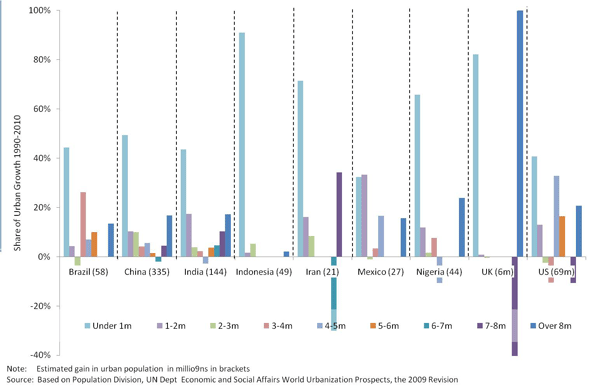
    Chart 2 shows shares of growth by city size groups over the last twenty years. (Russia is omitted because urbanisation actually declined by 5.5%.) 

    Cities of under 1 million residents dominate gains, strongly favouring developing countries.  They accounted for 90% of urban growth in Indonesia, 71% in Nigeria and 66% in Iran. 

    US experienced growth more or less across all size categories, although Chicago went from the 7m-8m to the 8m plus category, reducing down the former.

    Chart 2: Where Populations Grew – Cities by Size Category, 1990-2010

    Brazil, China, and Indonesia saw significant growth across the most size groups.  There appears to be a contrast within these countries between the centralising influence of few large cities and dispersed urbanisation in many much smaller settlements.

    (The picture for the UK reflects a gain of around 1 million people in London — to 8.6m — shifting it between categories.  Smaller cities actually accounted for 82% of the net UK gain in urban population, suggesting a duality between the growth of the capital and decentralisation through growth in smaller settlement). 

    So where are the big cities?

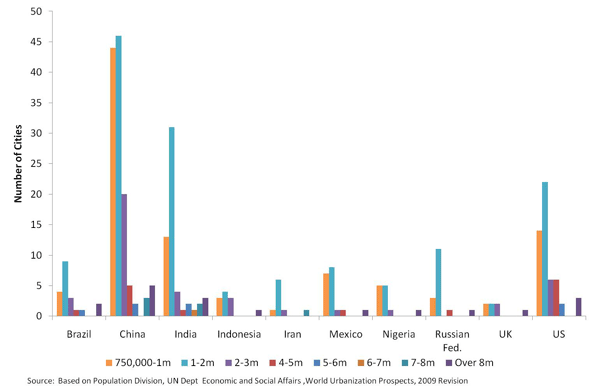
    The US has five urban agglomerations with a population of more than 5m, centred on New York, Los Angeles, Chicago, Philadelphia and Detroit (Chart 3).  Compare this with China, with twelve cities of over 5m, and five cities of more than 8 million people (Shanghai, Beijing, Chongqing, Shenzhen, and Guangzhou); or India, with eight over 5m and three over 8m (Mumbai, Kolkata, and Chennai).

    At the same time, China has 90 cities of between 750,000 and 2m, India 44 and the US 66.  Mexico has 15, Russia 14 and Brazil 13. 

    Chart 3: Number of Cities by Size Category, Ten Nations 2010

    Primacy – a mixed picture

    Single centres that dominate national populations are termed “primate”.  Their rise and fall may be symptomatic of national economic fortunes.  Excessive primacy may increase economic volatility because the contrast between a rich centre and poor periphery is politically destabilising. One centre dominating financial, human, and intellectual resources may also increase national vulnerability to structural decline.

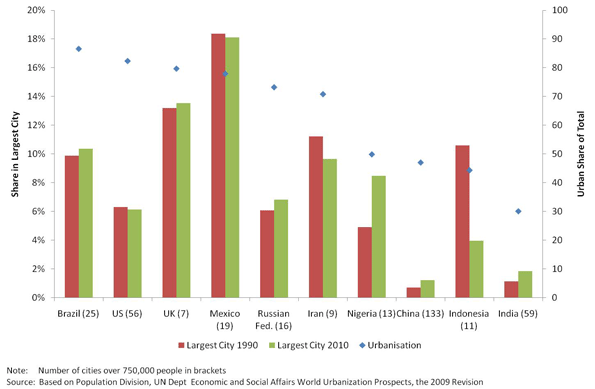
    The picture is mixed across our sample (Chart 4).  Mexico City and London stand out.  High levels of primacy are also evident in Iran and Indonesia, but have been easing, contrasting with Nigeria where it is increasing.  It is least pronounced in the countries with the largest urban populations – China and India — suggesting a strong population pull from a number of state or provincial capitals, as well as a host of much smaller cities.

    Chart 4: Population Share of Largest City, Ten Nations, 1990 and 2010

    So what does all this mean?

    The data confirms huge diversity in the sizes of cities people live in across and within nations.  It generates more questions than answers, though, the main one being whether it is relevant simply to transfer urban governance, management, or planning models from one place to another.  Apart from contrasts within and between nations, it is clear that the west is no longer the focus of urbanisation and is unlikely to hold many of the answers to today’s urban growth challenges.

    The evidence also indicates a tendency for urbanisation to take place in small, dispersed settlements rather than mega-cities.  More modest scale makes different demands on infrastructure and institutions.  It may also help manage urbanisation and ensure that benefits can be better accessed by larger numbers of people.  Small cities, sub-centres in large cities, and districts of modest scale may be better suited to adaptable and innovative planning and management than large scale, extensive cities with their more centralised, remote, and inevitably bureaucratic political and administrative systems. 

    Very large agglomerations do exist, even if they are not as dominant in the wider urban picture as their size and profiles might suggest.  The question they raise is whether they should continue to dominate national and international agenda for urban growth and management.  Dispersed urbanisation may better reflect the resources and capacities needed to support an exploding urban population in the 21st century.

    Phil McDermott is a Director of CityScope Consultants in Auckland, New Zealand, and Adjunct Professor of Regional and Urban Development at Auckland University of Technology.  He works in urban, economic and transport development throughout New Zealand and in Australia, Asia, and the Pacific.  He was formerly Head of the School of Resource and Environmental Planning at Massey University and General Manager of the Centre for Asia Pacific Aviation in Sydney. This piece originally appeared at is blog: Cities Matter.


    [1]  The lowest level of urbanisation incorporated by the UN depends on the conventions of individual nations but may refer to settlements with as few as 2,000 people.

    [2] Treated here as North America, Northern Western and Southern Europe, and Australasia

    Photo by NASA’s Marshall Space Flight Center.

  • The Evolving Urban Form: Beijing

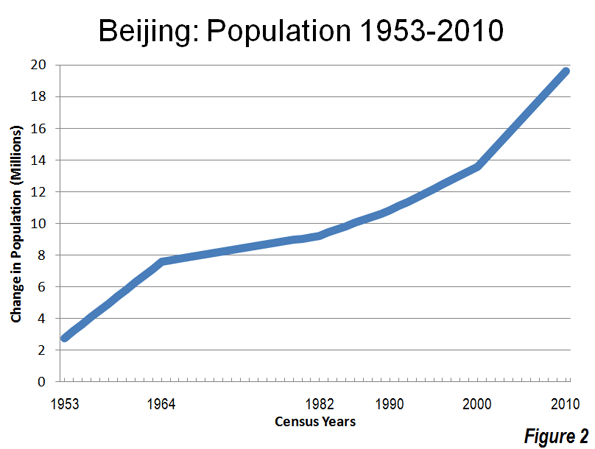
    China’s capital, Beijing, has long been one of the world’s largest urban areas. Some reports placed its population at over 1 million in 1800, which would have made Beijing the largest urban area  in the world at that time. Later in the nineteenth century, Beijing dropped below 1 million population, as London, Paris and later New York rose to prominence. As late as 1953, Beijing had a population of fewer than 3 million. Since then the city’s population has  increased more than six times (Figure 1).

    Beijing is one of China’s four "directly administered municipalities" or "provincial level municipalities," along with Shanghai, Chongqing and Tianjin (Note 1). Moreover, like Shanghai and Tianjin, Beijing is essentially a metropolitan area, composed of an urban area and exurbs approximating a labor market. This is unlike Chongqing, which has extensive rural areas and extends far beyond any plausible definition of a metropolitan area (having the land area approximately the size of Indiana or Austria).

    The Growing Beijing Urban Area: In the 1990s, Beijing added 2,700,000 people and had a population of 13.6 million in 2000. Between 2000 and 2010, Beijing population increased by more than double the previous increase, or an increase of 6 million people.

    The Expanding Beijing Urban Area: Based upon the most recent census, the next edition of Demographia World Urban Areas will estimate an urban area (urban footprint) population of 17 million, with an urban land area of 1,350 square miles (3,500 square kilometers) and an urban density of 12,600 per square mile (4,900 per square kilometer) in 2011. Beijing ranks as the world’s 12th largest urban area and is larger than any urban area in the United States or Europe with the exception of New York. As in other urban areas of China, there is considerable undeveloped land in enclaves within the suburban areas, which could develop further, raising both the population and the density.

    Falling Urban Densities: Even so, Beijing is far less dense than before. Deng and Huang at the State University of New York, Albany, place the 1949 urban land area at less than 25 square miles (63 square kilometers. Based upon its early 1950s population of less than 3,000,000, the population density of the entire urban area could have been more than 100,000 per square mile or 40,000 per square kilometer (precise urban population is not available). This is greater than the highest density major urban area today, Dhaka (Bangladesh) at 90,000 per square mile or 35,000 per square kilometer. Today’s urban Beijing may have an overall population density one-eighth that of the 1950s.

    This illustrates a reality often missed by urban analysts, who confuse population growth with increases in population density. In fact, as the Evolving Urban Form series (Note 2) indicates, dispersion is at least as important in the expansion of megacities as population growth itself. Population densities generally decline as urban areas add residents.

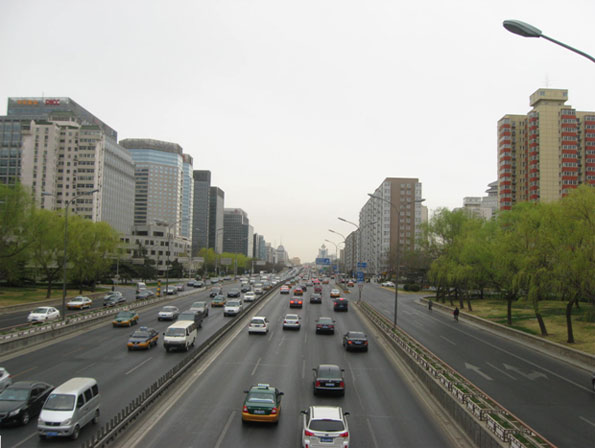
    Suburbanizing Beijing: Consistent with the international urban trends, most growth over took place outside the core (see table at bottom and Figure 2). As Beijing has suburbanized, it has added "ring roads," (beltways or loops) which except for the 1st ring road (around the Forbidden City) are freeways, often with Texas-style frontage roads (See "2nd Ring Road" photo). Now there are six ring roads and there has been some discussion of a seventh, which would extend to the adjacent Hebei province to the south. Real-time traffic conditions on the first five ring roads can be seen at the Beijing Traffic Management Bureau site (the 6th ring road is outside the map)


    2nd Ring Road with frontage roads

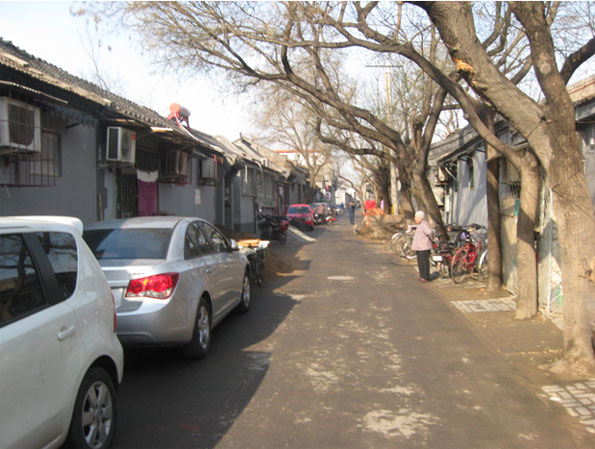
    At the same time, Beijing’s expansive suburbs do not resemble the low-density suburbanization of Phoenix, Portland, Perth or Paris. Much of the development is in high rise condominiums and a substantial part is lower quality, lower rise development that houses Beijing’s large and growing migrant population (referred to as the "floating population"), most of whom do not have Beijing resident (hukou) status. Even so, there is no shortage of detached luxury housing (called "villas") in western style developments. such as "Orange County." More recently there is increasing demand for a more modern version of the "siheyuan" (courtyard) housing makes up the renown "hutong" areas of Beijing and other Chinese cities. One website refers to the "siheyuan" as the Chinese version of the "American Dream" and a recent China Daily commentary even suggested that this type of housing should constitute the future expansion of Beijing.  However, a quick review of real estate offerings for the new siheyuans, makes it clear that they are simply unaffordable for a growing middle class that finds it difficult to afford new flats in high rises outside the 4th ring road.  

    Hutong neighborhood (Dongcheng qu)

    A map of Beijing’s districts can be seen here, with color coding that corresponds to the geographical divisions in the table.

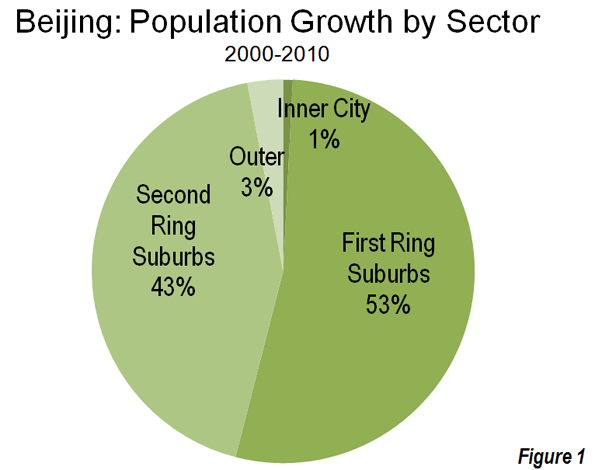
    The Inner City: During the last census period, less than one percent of the population growth has been in the inner city, which consists of the districts of Xicheng and Dongcheng, largely inside the 2nd ring road and contains the Forbidden City, Tiananmen Square, the Drum Tower (see photo below) and Bell Tower, and the Yonghegong Lama Temple (Buddhist). These districts, which contain nearly all of the remaining hutong (see photo above) residences grew only 2.2 percent. At 61,000 people per square mile (23,500 people per square kilometer), inner Beijing approaches the population density of Manhattan or the Ville de Paris.


    Toward the Drum Tower, from Jingshan Park

    Outside the Inner City: More than 99 percent of Beijing’s growth was outside the inner city. The first and second ring suburbs accounted for 96 percent of the growth, while the outer areas accounted for three percent of the growth.

    First Ring Suburbs: The four inner suburban districts of Beijing captured 52 percent of the provincial growth between 2000 and 2000. Overall, the four suburban districts added 3.2 million people, a nearly 50 percent increase in population. The population density in the inner suburbs was 19,400 per square mile in 2010 (7,500 per square kilometer). This is a higher density than the city of San Francisco. The inner suburban districts are generally located within the 5th ring road. The first ring suburbs include the district of Chaoyang, which has the largest population and where at least one-half of the population    generally lack Beijing residency (hukou). Chaoyang is also home to the new Beijing "central business district," (CBD) which is the largest concentration of high rise towers in the urban area includes  the controversial architectural icon, the CCTV Headquarters (photo at the top). The development of the CBD in the inner ring suburbs and other major commercial development are indicative of a dispersion of employment that, if permitted to continue, could ease Beijing’s legendary traffic congestion.

    Second Ring Suburbs: The outer suburban districts accounted for 44 percent of the provincial population increase between 2000 and 2000 and 2010. However, the outer suburban districts had the highest growth rate, at 72 percent, The outer suburban districts are generally located outside the 5th ring road and include considerable rural territory. The population density is 2100 per square mile (800 per square kilometer). Beijing Capital International Airport is located in this area, though it is under the jurisdiction of the inner ring district of Chaoyang. This airport is now the world’s second busiest in passenger volume, following Atlanta and having passed perennial runner-up O’Hare International in Chicago. At current growth rates Beijing Capital International could become the world’s busiest airport within five years.

    Outer Areas: The outer areas are largely rural and well outside the urban area. Nonetheless, the growth rate in the outer areas was well above the national rate and six times the rate of the inner city. The outer areas gained 186,000 people, approximately four times the inner city gain.

    Future Challenges: The floating population Beijing (and Shanghai) represented most of the population growth from 2000 to 2010. More than 7 million of Beijing’s nearly 20,000,000 population are migrant workers.   Government officials have expressed concern at the rate of population growth and have indicated an interest in severely limiting future population growth. Among Beijing’s considerable challenges is providing sufficient water for its large population. Beijing lacks the plentiful supply of water that is available to many urban areas of central and southern China (example, Shanghai, Nanjing, Wuhan and Chongqing) and the government is building a system to divert water especially from the Yangtze River. The 2020 census results could reveal a significant slowdown in growth, if these problems are not sufficiently addressed. 


    Beihei Park

    Wendell Cox is a Visiting Professor, Conservatoire National des Arts et Metiers, Paris and the author of “War on the Dream: How Anti-Sprawl Policy Threatens the Quality of Life
    ——–

    Note 1: What are translated as "cities" in China are not cities as understood in the West. A "shi" in China (translated as "city") is actually a region that may approximate a metropolitan area or labor market area in the West (with an urban core and a much larger surrounding rural territory). Some "shis" are much larger, however, such as Chongqing, which covers a land area similar to that that of Austria and nearly as large as Indiana. Chongqing and many other "cities" are far larger than any plausible metropolitan area definition.

    "Shi" may exist either at the provincial level (as in the case of Beijing, Chongqing, Shanghai and Tianjin) or it may exist within a provincial level jurisdiction, such as Nanjing in Jiangsu. Guangzhou in Guangdong or Wuhan in Hubei. Every square mile of a province (excepting the provincial level jurisdictions) is divided into shis, prefectures or comparable units, in the same way that US states are divided into county level jurisdictions or the regions of France are divided into departments. To complicate matters more, shis themselves may have county (xian) level shis within their borders, such as Cixi, a county level shi with approximately 1,000,000 people within the Ningbo shi in Zhejiang province.

    Note 2: Other megacities reviewed in this series have been: Jakarta, Los Angeles, Manila, Mexico City, Mumbai, New York ,Seoul and Shanghai .

    Photo: CCTV Headquarters in new Beijing CBD, Chaoyang district. Photo by Iamdavidtheking.

    All other photos by author.

  • Inside The Sinosphere

    Avis Tang, a cool, well-dressed software company executive, lives on the glossy frontier of China’s global expansion. From his perch amid tower blocks of Tianfu Software Park on the outskirts of the Sichuan capital of Chengdu, the 48-year-old graduate of Taiwan’s National Institute of the Arts directs a team of Chinese software engineers who are developing computer games  for his Beijing company, Perfect World Network Technology, for  the  Asian and world market.

    A glossy software office in Chengdu seems a long way from the images of centrally directed, belching factories seeking to dominate the global economy. But a close examination of the emerging Sinosphere–or Chinese sphere of influence–shows an economy that is globally dispersed, multinational and increasingly focused on the high-tech and service sectors.

    Yet if Tang came to China to work for Interserv, a Taiwan game developer, he would see that the future of his industry–including its creative side–lies not only in the coastal cities but, increasingly, in those stretching across the vast Chinese interior. “In ten years perhaps all these cities will follow the path of Shanghai,” says Tang, as technology allows businesses that once had to situate themselves in coastal megacities to expand into the interior.

    Widely considered one of the most “livable” of China’s big cities, Chengdu seems to Tang something of an incipient Silicon Valley. The area’s software revenues increased more than tenfold over the past decade, while an estimated 200,000 people are expected to be working in the city’s software industry by 2012.

    Like many of his fellow managers at the sprawling park, home to over 800 foreign-owned companies, Tang is not a citizen of China.  He’s from Taiwan and never set foot in the People’s Republic before 2001.  His wife remains in Taiwan (Tang flies there every month or two to see her).

    Chinese capitalism has relied on diaspora entrepreneurs like Tang. In this sense, the rise of China represents the triumph of a race and a culture. Indeed for most of its history China’s most important export was not silk or porcelain but people. To measure the rise of the Sinosphere, one has to consider not just China itself but what historian Lynn Pan has described as the “sons of the Yellow Emperor.”

    The Sinosphere’s roots lie with the Han expansion into southern China during the Tang dynasty (618-907). By the 12th century, the newly Sinofied southern Chinese had started moving south. There they created trade-oriented colonies like Vietnam, Burma, Malaya and the island of Java. In the 1600s Chinese settlers overcame the aboriginal inhabitants of Taiwan, creating another powerful base in the South China Sea.

    At its height, during the expeditions of the legendary eunuch Admiral Zheng Hein in the early 15th century, China’s maritime “sphere of influence” extended all the way to the Indian Ocean and beyond.

    Although ensuing Chinese regimes pulled back from expansion and all but abandoned their scattered children, the colonies, particularly in Southeast Asia, survived.  They developed business and industries suitable to their new homes, but also maintained their cultural heritage and language. After the Chinese Communist takeover of the mainland in 1949, the diaspora colonies retained their capitalist orientation. Many established trading operations and sent their children to the United States, Canada and Australia, where they enjoyed remarkable success.

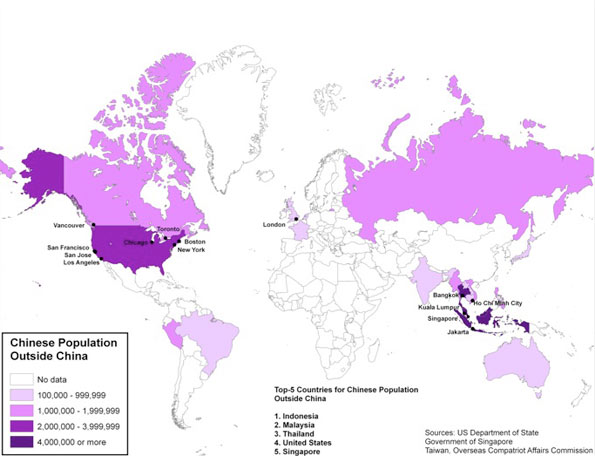
    Hong Kong, Singapore, Taipei, Rangoon, Bangkok and Jakarta can be seen as the original testing grounds for Chinese capitalism. In the past few decades North American regions such as Silicon Valley, Southern California, Toronto, Vancouver and New York-New Jersey have been added to the mix. Overall the entire overseas Chinese population has risen to nearly 40 million. Taiwan, which is de facto independent, is home to an additional 23 million, and Hong Kong and Macau, officially part of China but governed under different laws, boasts some 7.5 million.

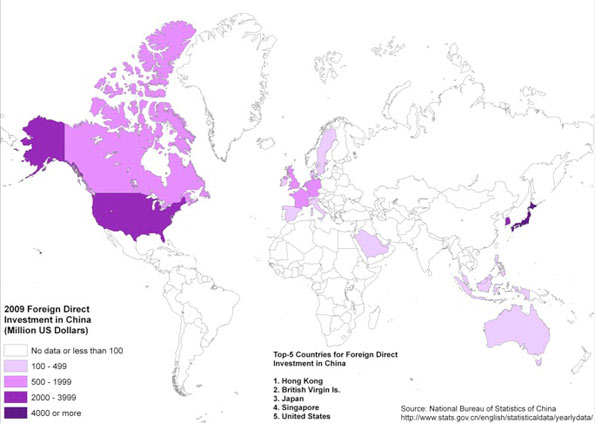
    Even today the ties between overseas Chinese and their home country remain close. The original diaspora countries—including Hong Kong–remain principal sources of investment into China. Among the ten largest sources for inbound investment to the PRC are Hong Kong, by far the largest investor, fourth-ranked Singapore and ninth-ranked Taiwan. Each brings more investments into China than such major powers as Germany, France, India and Russia. The United States, home to the largest overseas Chinese population outside Asia, ranks fifth.

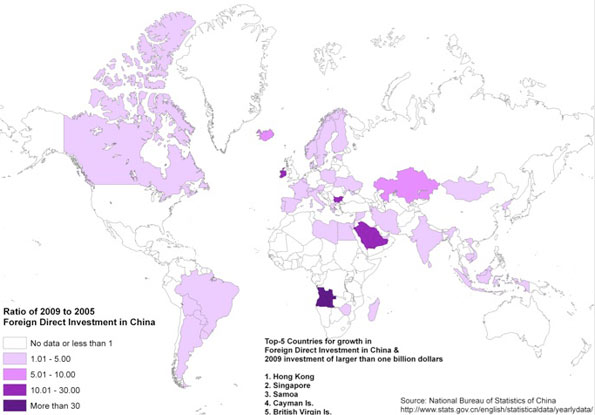
    Other investments come from places like British Virgin Islands, the Cayman Islands and Samoa, which often act as conduits for investors who do not want to be too closely monitored. This seems to include many Chinese investors, particularly in Taiwan, who may not want too much scrutiny of their outlays into the PRC. This includes even Chinese government -owned firms such as China Mobile Communication Corp., which has established an investment HUB in the far away British Virgin Islands.

    As China itself has become wealthier, financial flows from the diaspora have continued to increase. Hong Kong’s investment into China grew from $18 billion in 2005 to $45 billion four years later. Singapore’s investment surged from $2.2 billion to $4.1 billion in the same years. This has occurred while new investment from such powerhouses as the United States, Japan, Korea and Germany has stagnated or even dropped.

    The second phase of the Sinosphere has been dominated largely by industrial projects, many of them financed or helped technologically by the diaspora. Much of trade, initially, was targeted to the rich consumer markets of North America, Europe and Japan.  Between just 2007 and 2009 China’s share of world exports expanded from 7% to 9%.

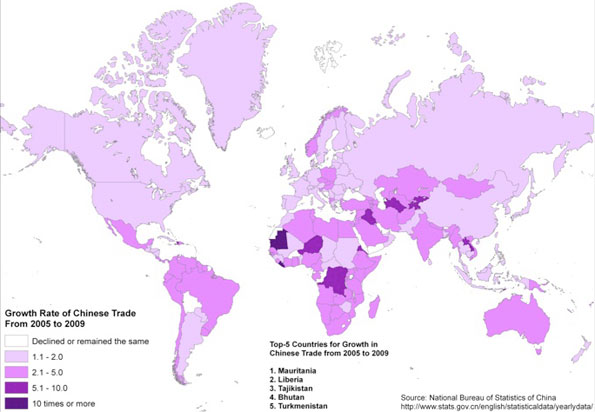
    But today the Sinosphere’s trade flow is shifting. An analysis of trade growth between 2005 and 2009 shows a significant change in focus away from advanced countries to the developing world. In the second half of the last decade, for example, trade with the United States, Japan, Germany, South Korea and the Netherlands grew by less than 50%. In contrast, commerce with key developing countries–including Afghanistan, Tajikistan, Mauretania, the Democratic Republic of the Congo, Liberia Turkmenistan, Iraq and Laos–grew ten times. Trade with large emerging economies, notably Brazil, India, Mexico and South Africa, increased five times during the same period.

    China’s thirst for resources is a big driver of this shift. Now the world’s largest car market and consumer of energy, China is in great need of oil, gas, and other natural resources. It also requires vast amounts of foodstuffs, notably corn and soybeans, for its increasingly urbanized population.

    Two of China’s new trade thrusts follow historic patterns of expansion, the first being growing investment in the Mekong Delta and Southeast Asia (Laos, Vietnam, Myanmar, Thailand, Cambodia and Malaysia). For 2010, Chinese invested $7.15 billion in energy projects alone in Myanmar. On the military side, this also includes moves by China to secure offshore islands for energy development, which is a potential source of conflict with Vietnam, the Philippines and Japan.

    The second big expansion is along the old “silk road” connecting eastern China to the energy and mineral rich “ stans” of Central Asia. This shift enhances the importance of inland Chinese cities, such as Xi’an, Chengdu and Chongqing, which are natural entrepots for central Asian trade. Perhaps even more important may prove the role of Kashgar, which was designated last year as the Special Economic Zone. Sitting on the western edge of the Xinjiang Uyghur Autonomous Zone near the border of Tajikistan, the Chinese envision Kashgar as the main rail and air link to the stans. Recent disturbances by the local Muslim majority, however, could threaten these ambitious plans.

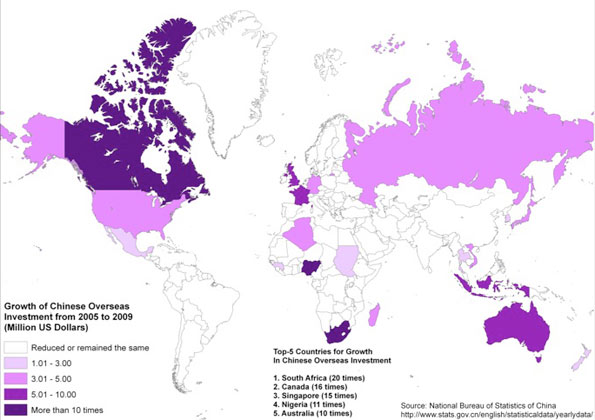
    As China’s economy and wealth has grown, it has moved from being merely a recipient of inbound investment into a major exporter of capital. China’s outbound investment is growing much faster, rising 21% in just the past year; its overseas investment overall has grown from 53.3 billion in 2005 to 224.4 billion in 2009.

    Although still the largest destination for foreign investment, the country has vaulted into the top four in terms of outbound outlays just  behind the U.S., Japan and the U.K. It is not inconceivable that China could challenge the U.S. as the world’s top foreign investor.

    The country’s investment strategy seems to be following two powerful trends.  One has to do with the acquisition of resources to feed the Chinese industrial machine and its growing consumer market. This explains the rapid growth of investment into the Middle East, South America and Africa. Four of the five fastest-growing investment areas for large scale investments–South Africa, Canada, Nigeria and Australia–are all major commodity exporters. Chinese investment in these countries has been growing from three to five times as quickly as those in the U.S. or Western Europe.

    The second, less obvious, trend relates to the idea that these countries, with generally faster growing populations, represent the most lucrative future markets for Chinese exporters.  This may be best seen in the rapid growth of Chinese government grants as well as the provision of interest-free and concessional bank loans, such as those provided by the government’s Exim bank, primarily to Chinese companies seeking to invest in developing nations, especially Africa, over the past decade. PRC financial backing for companies and projects in countries such as Angola, India, Equatorial Africa, Turkey, Egypt, the Congo and Algeria have grown over 100 times since 2005. Other key developing countries such as South Africa, Ethiopia, Somalia and Ghana all saw increases of tenfold or more.

    These developments tell us something of the future of the Sinosphere. It will be largely funded by the Chinese and their diaspora, less focused on the West and more on developing countries, including increasingly those outside the traditional stomping grounds of Chinese entrepreneurs.  The emerging Sinosphere is also likely to be somewhat less focused on manufacturing and more on services like real estate, finance and high-technology exports. This is partially due to the appeal, for manufacturers, of less expensive, more youthful countries like Bangladesh, Vietnam and Myanmar.  Wages for manufacturing workers in the Philippines, Vietnam and Indonesia are now less than half of those in China.

    These shifts are already evident by looking at recent trends in inbound investment to China, much of it from the diaspora and tax havens. Between 2005 and 2009, for example, industrial investment fell from 70% to barely 50% in 2009. The total investment in industry has remained stagnant while dollars into scientific research have grown almost five-fold. We can expect more of this as China prepares to challenge America, Japan and other advanced countries in basic research. At the same time investment into real estate has tripled, while both software and financial flows have more than doubled.

    All this explains the importance Chinese officials place on expatriates like the Taiwan-born Tang. In the 1980s and 1990s Taiwanese and Hong Kong firms spearheaded the development of China’s manufacturing prowess. Now the mainland leadership hopes that high-tech executives such as Tang will nurture and direct China’s leap into the first ranks of the global digital economy, with Perfect World’s Chengdu engineers epitomizing the future imagined by China’s aggressive regional officials. The fact that the company’s games are based largely on Chinese mythology makes the effort an even more natural fit. But Perfect World is not just looking at the Chinese or diaspora markets; it is also marketing aggressively to young gamesters in Europe and North America.

    All this can be seen as a direct challenge to the long dominant software and entertainment industries of the West, heretofore largely unchallenged by China. In a world increasingly  ’SINOFIED’  there may be huge potential for Sinosphere companies to move beyond exporting tangible goods, and increase their trade in ideas and culture to the rest of the world.

    “We are well on our way,” Tang explains from his perch in Chengdu. “China’s move into this kind of business is just beginning.”

    This research was conducted with support from the Legatum Foundation.

    This piece originally appeared at Forbes.com.

    Joel Kotkin is executive editor of NewGeography.com and is a distinguished presidential fellow in urban futures at Chapman University, an adjunct fellow of the Legatum Institute in London, and Senior Visiting Fellow at the Civil Service College in Singapore. He is author of The ity: A Global History. His newest book is The Next Hundred Million: America in 2050, released in February, 2010.
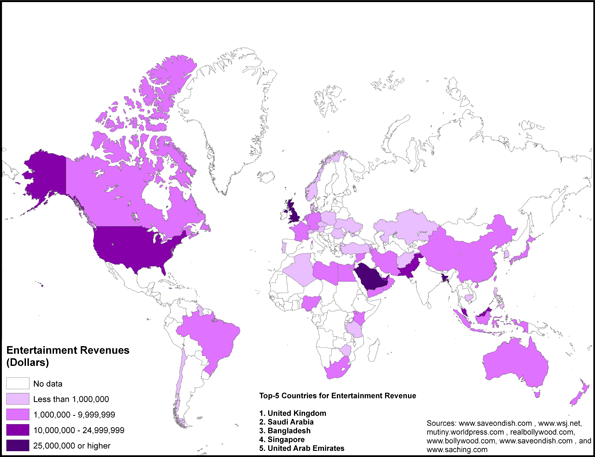
    Sim Hee Juat is currently a research associate with the Centre for Governance and Leadership at the Civil Service College of Singapore. The maps were created by Ali Modarres, Chairman of the Geography Department at California State University, Los Angeles.

    Photo by avlxyz.

  • From China’s Interior, A Step Back in Time, A Photo Essay

    In the China of the 21th century, the one where all is about reckless growth, competition and the inevitable slide down into vicious consumerism of colossal proportions, there is still a big portion of it that has not caught up with the craze and preserves its most traditional qualities almost untouched.


    Along the paved road that links the fast-growing cities of Zhangye in Gansu and Xining in Qinghai, lies the Hui village of Menyuan. It sits at about 9500ft, on the north-eastern tip of the Tibetan plateau. Stuck in time, villages like Menyuan allow us to travel back a few hundred years, where carriages pulled by donkeys are still the main mean of transport.

    The Hui are Chinese speaking Muslims and rank among the 56 recognized ethnic minorities by the Chinese Government. Hui people are descendants of the merchants of various middle-eastern origins who transited the Silk Road   between Europe and China. Some merchants stayed behind and married Han Chinese. They adopted the Chinese language but retained their Muslim faith.    Until this day, they preserve the practice of their religion untouched and their diet, dress code and daily practices follow lines prescribed by the Quran.  

    Hui people pass their tradition from generation to generation and even young teenagers seem proud about it. Most seem willing to extend it into the future generations, despite the clash of cultures and the rapid westernization of the China. 


    The Hui’s diet follows Islamic strictures. They do not eat pork and fast during Ramadan. Hui butchers keep their stores and practices as precarious – from a western perspective – as possible.  No need for refrigeration, no need for an enclosed space. Beasts are slain open-air and chopped on-demand. Carcasses hang off hooks pretty much as shiny Armani suits hang from the luxurious stores of Shanghai.


    Chinese traditional medicine and herbal treatments have been adopted by the Hui and roots are sold everywhere on the streets.

    Anything can be made into a store.  A whole family can make a store out of a simple box of metal and passively sit all day at its front door, watching life go by and of course do some business.

    In Menyuan, the atmosphere is nothing short of relaxed. People sit around the streets conversing for hours and people-watching and gossiping are every day’s main entertainment.

    Hui lifestyle, like any religious society, is a conservative one. Even though not as strict as other Muslim groups, Hui tend to segregate women on one side and men on the other. Women dress traditionally with the local cap-like chador and are usually in charge of taking care of their little kids.

    Men, on the other hand, hang out among talking and discussing local events.

    Born and raised in Buenos Aires, Argentina, Nicolas Marino is a 33 year-old architect and photographer currently based in Chengdu, China. For the last 6 years he has chosen a bicycle as means of transport to reach the most remote regions of the world where he focuses most of his documentary work. Some of his journeys include a 10.000km ride from Tehran to Shanghai and several trips around remote and rural China where he has now cycled over 8000km.

  • Report: China to Suspend High Speed Rail Development

    Railway Age reports that Premier Wen of China "has told the state media that the government will suspend approvals of new rail while it conducts safety checks to address concerns rising from the high speed train collision last month that killed 40 people."

    The Premier also indicated that high speed rail trains should operate at slower speeds "at their earlier stage of operation." Earlier this year, the Ministry of Railways slowed all trains to a maximum speed of 300 kilometers per hour (186 miles per hour) and many trains that were to operate at that speed were slowed to 250 kilometers per hour (155 miles per hour). At the time, reports indicated that the slower speeds were to lower operating costs so that fares could be reduced. Concerns had been raised about the much higher fares on the new trains and the cancellation of many conventional trains, which had much lower fares. Railway Minister In addition, Sheng Guangzu told the press that the slower operating speeds would "offer more safety."

    Photo: Suzhou to Nanjing at 300 kph (by author)

  • India Conquers the World

    From the exclusive Club Lounge on the 19th floor of Singapore’s Mandarin Oriental, Anish Lalvani gazes out at the city’s skyline, a dazzling array of glass and steel and vertical ambition. The Lalvani family has come a long way since the days when Anish’s paternal grandfather, Tirath Singh Lalvani, got his start in business by retailing medicines to King George VI’s soldiers in Karachi. Back then the city was a part of British colonial India—until independence arrived in 1947, and its inhabitants suddenly found themselves amid the bloody turmoil of the newborn Pakistan. The Lalvanis, like millions of others on both sides of the border, fled for their lives. But instead of making new homes in present-day India, the Lalvanis sought their fortunes abroad. Today the family’s Hong Kong–based Binatone Group employs some 400 people on four continents. “We couldn’t break the old boys’ network,” says Anish. “But overseas we created our own.”

    The Lalvanis’ voyage from refugees to moguls embodies a worldwide phenomenon: the growing size and sway of the Indian diaspora. The exile population now numbers some 40 million people, spread across West Africa, the Americas, and East Asia. And in many of those countries—including the United States, Britain, Canada, Singapore, and Australia—Indian immigrants and their offspring have both higher incomes and higher education levels than the general population.

    The international importance of India itself is rising to an extent unmatched since the onset of the European-dominated global economy in the 17th century. And with the country’s economy growing at roughly 8 percent a year for the past decade—more than double the rate of the United States—India’s influence can only continue to strengthen. Most economists predict that by 2025 the country will outstrip Japan to become the world’s third-largest economy.

    India is more dynamic than any other major country in demographic terms as well. Its population today is 1.21 billion, second only to China’s 1.3 billion, and thanks to the latter’s one-child policy, India’s numbers are expected to surpass those of China by the late ’20s, when India will have an estimated 1.4 billion people versus China’s 1.39 billion. Currently home to the world’s second-largest contingent of English speakers, India seems destined to step into first place, ahead of the United States, by 2020.

    But the mother country’s rise has been more than equaled by that of India’s émigrés. In fact, the diaspora remains one of India’s most important sources of foreign capital. According to the most recent available figures, workers from India in 2009 sent $49 billion in remittances to relatives back home, outpacing China by $2 billion and Mexico by $4 billion. Four percent of India’s gross domestic product comes from North American remittances alone.

    In fact, India’s business community tends to be family–centered, both at home and abroad. Chinese entrepreneurs are more than twice as likely to be financed through banks, most of them state-owned. In contrast, Indian firms and business networks tend to be essentially familial and tribal, extending in networks across the world. “Much of the Indian middle class has ties outside India,” notes researcher Vatsala Pant, formerly with the Nielsen office in Mumbai. “Our ties around the world are also family ties.”

    The importance of such familial links can be seen in the close relationship between diaspora settlement and commerce. The top five areas for Indian investment—Mauritius, the Americas, Singapore, the United Arab Emirates, and the U.K.—have large, established Indian communities and -Indian-run companies that are particularly active in electronics and software.

    Today, even the largest Indian firms, such as Tata and the Reliance Group, are controlled by groups of relatives whose power is enhanced by their wide geographic reach. “We’re very flexible about doing business,” notes Lalvani, who was raised in Britain, is a permanent resident of Hong Kong, and is married to an Indian-American. “We’re global and cosmopolitan—ethnically Indian but also tied to the U.S., U.K., and Hong Kong. They’re all things that make me who I am, and make our business work.”

    That business illustrates nicely the worldwide extent of India’s entrepreneurship. In 1958 Anish’s father, Partap Lalvani, and his uncle Gulu teamed up in London to launch Binatone as a supplier of Asian-built consumer electronics and electrical goods. Its range of products grew to include domestic appliances like kettles, toasters, and irons, and today its employees are active in otherwise neglected markets, such as the former Soviet republics of Central Asia and off-the-grid corners of Africa.

    The Indian diaspora began when Indian workers fanned out across the British Empire during the late 18th century. The exodus intensified after Britain abolished slavery in 1834, setting off a major demand for labor around the globe. Indians were sent out to become contract laborers on Malaya’s rubber plantations, or to work as indentured servants in the West Indies. Although many eventually returned home, others stayed in their new countries, and in many cases became integral parts of the national economy. Some rose to skilled positions in the colonial civil service and military, while others became businessmen, teachers, doctors, and moneylenders.

    Even after the empire’s end, émigrés kept pouring out of India to seek better lives abroad—and with them they brought brains and a willingness to work hard. In the United States, where the Indian diaspora represents less than 1 percent of the population, its members account for roughly 13 percent of the graduate students at the country’s top universities. Overall, 67 percent of people of Indian descent living in America hold at least a bachelor’s degree, compared with 28 percent of the total population. And those statistics are echoed elsewhere in the world. In Canada, people of Indian descent are twice as likely to hold graduate or professional degrees. In Britain, some 40 percent of the medical students and doctors in the National Health Service are of Indian, Pakistani, or Bangladeshi origin.

    Indians’ presence in the business realm is no less notable than in the world of higher learning. According to the latest survey by the University of Essex, the per capita income of ethnic Indians in Britain is about £15,860 (nearly $26,000), higher than that of any other ethnic group in the country and almost 10 percent above the median nation-al income. The study found that the unemployment rate among ethnic Indians is close to half the national average. In the United States, recently published data estimate average household income at $50,000, but it’s $90,000 for ethnic Indians—and a 2007 survey found that between 1995 and 2005, more companies were launched by ethnic Indians than by immigrants from Britain, China, Japan, and Taiwan combined.

    The expatriates have brought their culture with them—and that too is spreading into the general population wherever they go. Two million Brits enjoy at least one Indian meal per week, and onscreen entertainment from India has permeated the global market. Not so long ago, Bollywood movies were largely intended for domestic consumption, but foreign sales have become significant in recent years, with the large markets in the dominant diaspora countries. Today, Bollywood movies and television shows command an estimated $3 billion to $4 billion in overseas receipts, placing India’s film industry second only to Hollywood itself. In fact, India beats the rest of the world in the number of movies made and tickets sold, and industry sources estimate that as many as a third of ticket buyers in the West are non-Indians.

    Back in India, conditions remain harsh despite the country’s recent advances. The average life span in Mumbai is barely 56 years, a full quarter century less than in Britain and the United States, and poverty across the country remains at shocking levels, with four in 10 Indians living on less than $1.25 a day. Statistics like that are scarcely an incentive for members of the diaspora to return to their homeland.

    For entrepreneurs like Anish Lalvani, however, there’s a more compelling reason to remain abroad: it helps them stay in closer touch with the global marketplace. Having his home base in Hong Kong provides Lalvani with access to Chinese manufacturing and a broad talent pool. “We don’t have many Indians in our management,” he says proudly of the Binatone Group’s operations. “We get the talent from around the world.”

    As large as it may be, Binatone is far from the scale of its Chinese, American, or Japanese competitors. That means it has to keep a keen eye out for new opportunities that the bigger guys have overlooked. Building family businesses through such dogged opportunism is what has driven the expansion of Greater India. “The emerging markets are small, and it takes a lot of flexibility to get in there,” Lalvani says. “We have to go into places where the costs are low, and there are minimal chain stores, so we can get our stuff on the shelves.” But as far as Lalvani and others like him are concerned, it’s a matter of fundamental self-respect. “It’s more than just ginning up cash,” he says. “It’s about not screwing up what your father started.”

    This piece originally appeared in Newsweek.

    Joel Kotkin is executive editor of NewGeography.com and is a distinguished presidential fellow in urban futures at Chapman University, and an adjunct fellow of the Legatum Institute in London. He is author of The City: A Global History. His newest book is The Next Hundred Million: America in 2050, released in February, 2010.

    Parulekar is an engineer by training. He holds a master’s in -finance and an M.B.A.

    Research for this piece was financed by the Legatum Institute.

    Maps by Ali Modarres.

    Photo by lecercle