Tag: China

  • A Guide to China’s Rising Urban Areas

    From a Rural to Urban Dispersion in the Middle Kingdom

    China’s rise to economic prominence over the past 30 years has rested in large part to its rapid    urbanization. Prior to ‘reform and opening up’ that started in earnest during the 1970s, cities in China were viewed as pariahs by the party leadership. Millions of young urban dwellers were forced into the countryside to labor on farming communes during the Cultural Revolution. In stark contrast, today millions of rural migrants make their way to the city.

    The scale at which this is happening is unprecedented. Currently, there are 85 metropolitan areas in China with more than 1 million people, compared to 51 in the US. By 2015, urban regions will account for half of China’s population and by 2025, the urban population’s share should reach about 75%.

    To date, international attention has remained fixated on China’s largest cities of Beijing and Shanghai (and to a lesser extent, Guangzhou and Shenzhen). This is not without good reason, as Beijing and Shanghai are not only the respective government and financial centers of mainland China, but both were host to two of the most visible world events of the past decade: the 2008 Summer Olympics and the recently concluded World Expo.

    Second and Third-Tier Cities Enter Onto the World Stage

    Increasingly, however, the real trajectory of urban growth is shifting to China’s so-called ‘second-tier’ and ‘third-tier’ cities. To the outside observer, China’s lesser-known cities might seem all too similar to one another given the monotonous aesthetic of their newly constructed cityscapes. Indeed, the newfound appearance of Chinese cities is a point of contention among local urban development scholars who are concerned about the converging ‘identical faces’ of these urban areas.

    Yet to Chinese locals and foreigners who have spent some time living here, it Chinese cities are defined more by their local cuisine, dialect, history, geography, culture and climate rather than their architectural character. These often-overlooked nuances of local culture are much more essential to the identity of these cities than buildings. In the future, these distinctions may prove more effective in attracting investment and talent than flashy new construction projects.

    Here’s a short guide to these rising urban areas by region and their current identities and prospects.

    TOP 20 URBAN AREAS IN CHINA: 2010 ESTIMATES
    Rank
    Urban Area
    2010
    Area: SqMi
    Density
    Area: SqKM
    Density
    Base Year
    Base Year Pop.
    1 Shanghai, SHG 18,400,000 1,125 16,400 2,914 6,300 2010 18,400,000
    2 Shenzhen, GD 14,470,000 550 25,900 1,425 10,000 2008 14,000,000
    3 Beijing, BJ 13,955,000 1,275 10,800 3,302 4,200 2008 13,545,000
    4 Guangzhou-Foshan, GD 13,245,000 760 17,000 1,968 6,600 2007 12,600,000
    5 Dongguan, GD 10,525,000 535 19,200 1,386 7,400 2007 10,000,000
    6 Tianjin, TJ 6,675,000 500 13,100 1,295 5,000 2007 6,400,000
    7 Chongqing, CQ 5,460,000 280 19,100 725 7,400 2007 5,240,000
    8 Hangzhou, ZJ 5,305,000 250 20,600 648 8,000 2007 5,015,000
    9 Wuhan, HUB 5,260,000 275 18,700 712 7,200 2007 5,040,000
    10 Shenyang, LN 5,160,000 280 18,100 725 7,000 2007 4,950,000
    11 Chengdu, SC 4,785,000 220 21,300 570 8,200 2007 4,585,000
    12 Xi’an, SAA 3,955,000 205 18,900 531 7,300 2007 3,785,000
    13 Harbin, HL 3,615,000 235 15,100 609 5,800 2007 3,460,000
    14 Suzhou, JS 3,605,000 245 14,300 635 5,500 2007 3,400,000
    15 Nanjing, JS 3,550,000 330 10,500 855 4,100 2007 3,400,000
    16 Dalian, LN 3,255,000 270 11,800 699 4,500 2007 3,105,000
    17 Changchun, JL 3,170,000 145 21,300 376 8,200 2007 3,010,000
    18 Kunming, YN 3,070,000 130 23,100 337 8,900 2007 2,925,000
    19 Wuxi, JS 2,925,000 150 19,000 389 7,300 2007 2,760,000
    20 Taiyuan, SAX 2,900,000 120 23,600 311 9,100 2007 2,755,000
    Source: Demographia World Urban Areas: Population & Projections: 6th Edition. http://demographia.com/db-worldua.pdf


    The Interior Rises

    Chengdu (成都): It was the devastating 2008 Wenchuan Earthquake that first out Chengdu onto the international radar, but it’s the rapid expansion of its massive high tech sector that may define its long term prospects.  The aerospace industry also plays an important role in the capital city of Sichuan Province as it is the site of the development of China’s first stealth fighter, the Chengdu J-20. Despite all the new development, Chengdu remains a pleasant city, known for pandas and spicy food as well as its generally relaxed and agreeable disposition. The local government has done a good job of promoting ‘quality of life’ and relatively low cost of living to attract both investment dollars and skilled labor away from the prohibitively expensive eastern metropolises.
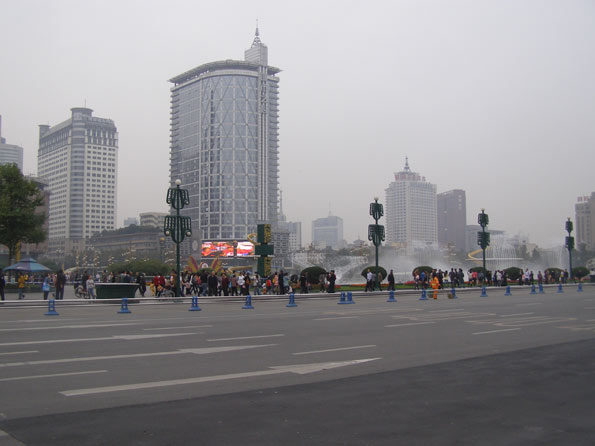
    Chongqing (重庆): Also known for spicy food, this municipality, which falls under direct control of the central government, is bisected by the Yangtze River. Its urban vista is unique, with deep gorges. It long has been known as a rough and tumble place, long plagued by organized crime. This has abated under the leadership of Communist Party Secretary Bo Xilai who has waged a war against organized crime in Chongqing since assuming office there in 2007. Though a controversial leader with a penchant for strong “red” leanings, the ambitious Bo has been applauded for cleaning up the city and implementing a large-scale public housing program.
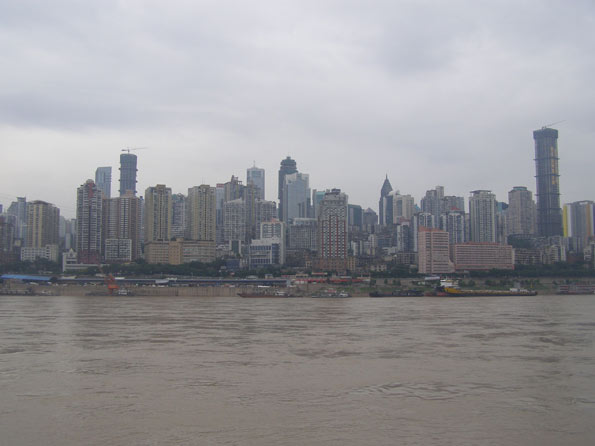
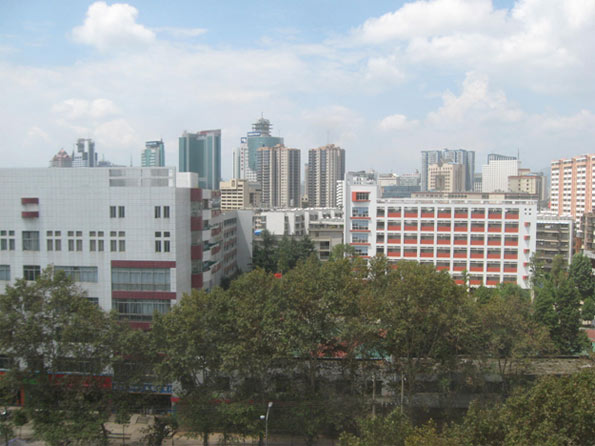
    Kunming (昆明): The city of Eternal Spring and the capital of China’s ethnically diverse southern Yunnan Province, Kunming claims the best weather in the country. As such, Kunming’s residents would rather enjoy the sunshine then spend their days indoors working in factories. The lack of industrial production doesn’t mean this city isn’t important- as Kunming has China’s 6th busiest airport and is the country’s gateway to Southeast Asia. If China goes forward with its ambitious plans to link itself with Southeast Asia via high-speed rail, Kunming could enhance its status an international transportation node.
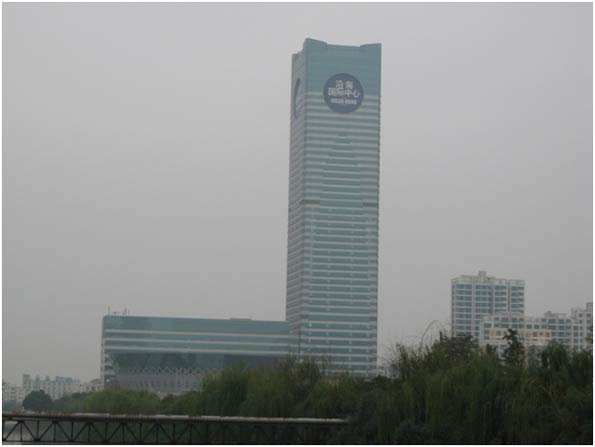
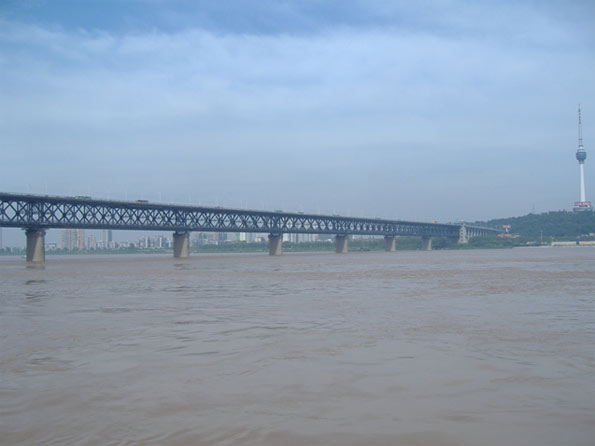
    Wuhan (武汉): Wuhan, capital of Hubei Province, is an important rail and river transport hub at China’s central crossroads. Known for its unbearably hot summers, Wuhan sits on the Yangtze River a few hundred kilometers downstream from the infamous Three Gorges Dam. The city is China’s center for the optical-electronic industry, with a focus on the production of fiber-optics. It was also recently announced that Wuhan will get China’s third tallest building, the 606 meter Greenland Center.
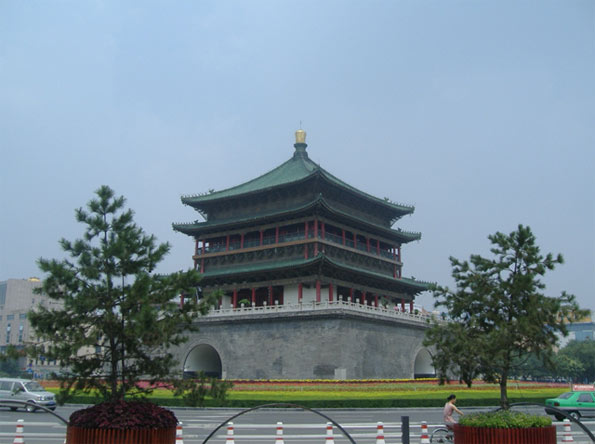
    Xi’an (西安): Once known as Chang’an (‘eternal peace’), Xi’an was the capital of multiple Chinese dynasties throughout history. It remains as one of the most popular international tourist destinations in China thanks to its world-renowned Terracotta Warriors. But today this ancient city and present day capital of Shaanxi Province is also positioning itself as a hub for the development of the software and aerospace industries. The city is also host to several reputable universities, which could help supply a strong local talent pool.
     

    Yangtze River Delta (Greater Shanghai)

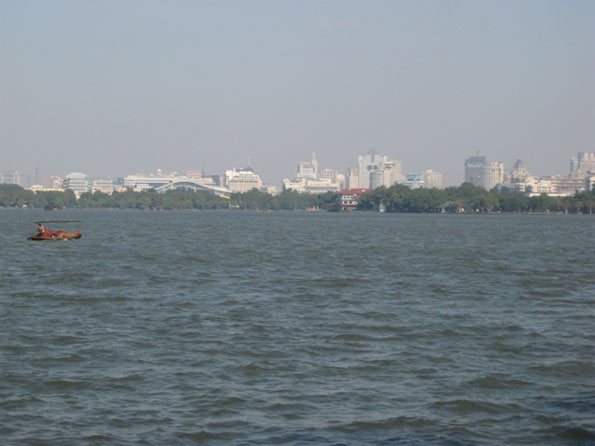
    Hangzhou (杭州): Arguably China’s most naturally beautiful large city, Hangzhou is famous for its scenic Xihu or ‘West Lake’, which just became a UNESCO Heritage Site. The capital of Zhejiang Province not only attracts tourists, but investment as well, especially in the light manufacturing and textile industries. Already somewhat of a ‘bedroom community’ for Shanghai’s wealthy, The recently inaugurated Shanghai-Hangzhou high-speed rail line, which has cut travel time down to 45 minutes between the two cities, means that Hangzhou stands to further benefit from this connection.
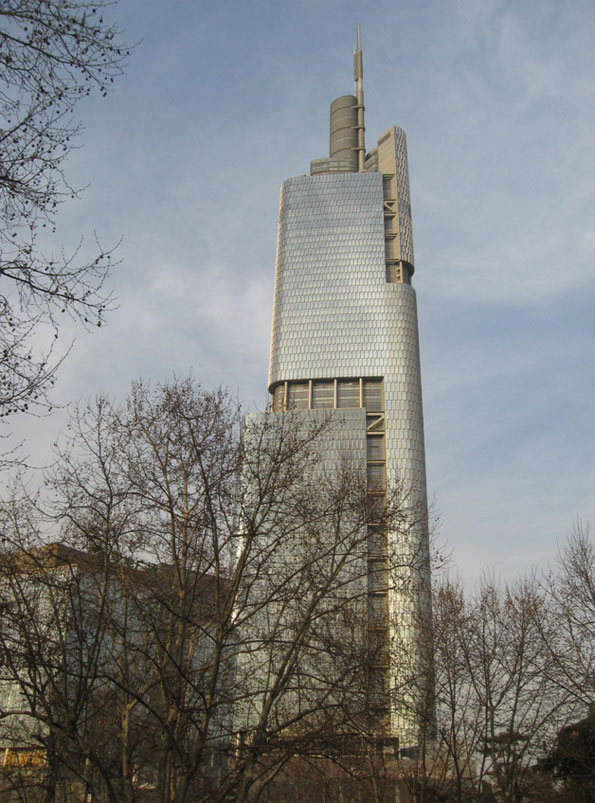
    Nanjing (南京): One of the ‘Four Great Ancient Capitals of China’, the capital of prosperous Jiangsu province is today a bustling modern metropolis. Located on the Yangtze River, Nanjing has greatly benefitted its location within the greater Yangtze River Delta Region. The city’s close proximity to Shanghai means that is has absorbed some spillover from investors looking for a lower-cost alternative. Nanjing is also home to one of China’s tallest towers, the newly opened Nanjing Greenland Tower and Asia’s largest railway station.
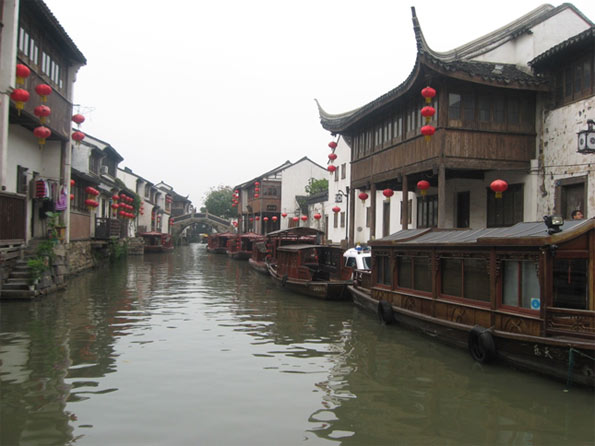
    Suzhou (苏州): Situated in Jiangsu Province en route from Shanghai and Nanjing, Suzhou is strategically located in the center of a booming region. Often referred to as the ‘Venice of the East’, the city is famous for its historic canals and classic Chinese gardens. In addition to being a popular tourist destination Suzhou is an emerging hi-tech center. The China-Singapore Suzhou Industrial Park, the largest strategic partnership between the two governments, has been established in the city.
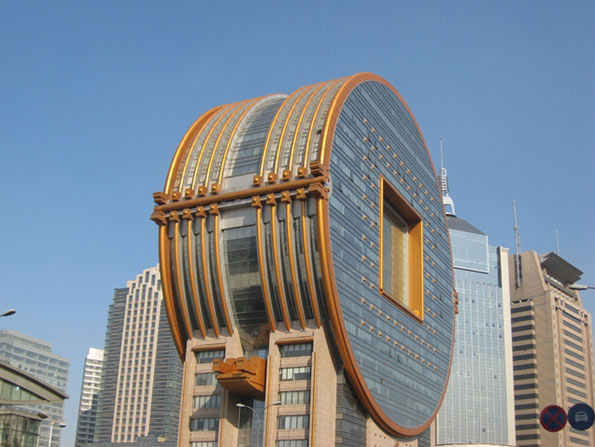
    Wuxi (无锡): Only 50 km from Suzhou, Wuxi straddles the north shores of Lake Taihu. With 3,000 years of history, Wuxi is today one of China’s most business friendly cities. Wuxi is particularly attractive to Japanese businesses, with companies like Sony, Nikon, and Konica Minolta owning manufacturing and assembling facilities in the city’s New District. The city’s relatively new airport, which opened in 2004, serves the city as well as neighboring Suzhou.


    The Industrial North: China’s Rustbelt

    Changchun (长春): Changchun was the last capital of Manchuria and the seat of Japan’s ‘Puppet Government’ during their occupation of the region during WWII. Today the capital of China’s northern Jilin Province stands as “China’s Detroit” as the country’s largest automobile producer.The Changchun Automotive Economic Trade and Development Zone is home to the country’s biggest wholesaler of used cars, automotive spare parts and tires.

    Dalian (大连): Consistently ranked as one of the ‘most livable’ of China’s big cities, Dalian sits strategically on the Liaodong Peninsula making it the principle seaport for the country’s northeast (‘DongBei’) region. Banking and IT is big here, with semiconductor giant Intel just having recently opened a $2.5 billion manufacturing facility in the city. The Dalian Commodity Exchange, highlighted by the trading of soybean contracts, is China’s largest futures exchange. Bo Xilai also left his mark on the city when he was Mayor before heading to Chongqing by initiating a campaign to add significant green space to the city.

    Harbin (哈尔滨): The capital of Heilongjiang province, Harbin is the country’s northernmost big city. Famous for its local beer and annual winter ice sculpture festival, Harbin is China’s gateway to neighboring and resource-rich Russia. Russian culture has also left its mark on the city, influencing everything from the local cuisine to the architecture. Today Harbin’s economy is focused on textiles and power equipment manufacturing.

    Shenyang (沈阳): Shenyang, the capital of Liaoning province, is the largest city in China’s northeast. Once the capital of the Manchurian Empire during the 17th Century, Shenyang is today an industrial powerhouse producing industrial equipment,  construction vehicles, power tools, and biomedical equipment. Shenyang is also a hub for agriculture and the production of foodstuffs.
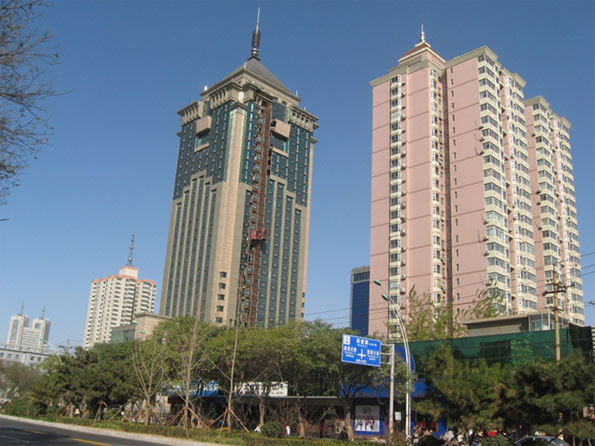
    Taiyuan (太原): The capital of coal producing Shanxi province, Taiyuan is moving up on China’s urban radar. The city serves as the administrative center for both Chinese state-owned and foreign enterprises involved in the coal mining business. The city is also home to the Taiyuan Steel and Iron Company, China’s largest producer of stainless steel. Unfortunately, due to the heavy industrial activity in the region, Taiyuan is also one of the country’s most polluted cities.
    Tianjin (天津): Long ridiculed by Beijingers, Tianjin is ambitiously positioning itself as a financial and sea logistics center for northern China. One of China’s four direct-controlled municipalities, Tianjin is less than 30 minutes from nation’s capital by high-speed train yet still has a distinct dialect and culture. The city is divided into two distinct parts: the charming historic city center, which retains colonial buildings from 19th Century foreign concessions, and the Binhai New Area, an up-and-coming Special Economic Zone next to the Bohai Sea. Tianjin is also aiming to become the center of China’s burgeoning biotech industry.


    The Outlier

    Dongguan (东莞): As the fifth largest city in China by population, Dongguan should register more prominently on the international radar. Unfortunately the most defining characteristic about this urban amalgam is its lack of character. A sprawling unplanned mass of factories in the Pearl River Delta situated between Shenzhen and Guangzhou, Dongguan is the largest city in the world without an airport. As the Pearl River Delta de-industrializes as more factories move into the lower-cost inland regions of China, Dongguan will need to reinvent itself.
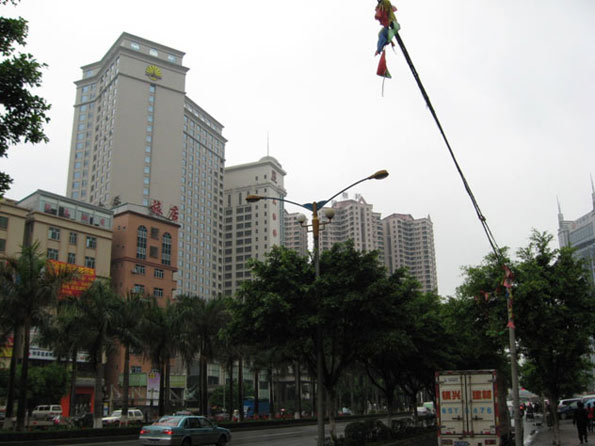
    Adam Nathaniel Mayer is an American architectural design professional currently living in China. In addition to his job designing buildings he writes the China Urban Development Blog.

    Photos: Chengdu and Chongqing photos by author. All other photos by Wendell Cox.
  • More Hyperbole on Ghost Cities in China

    The so-called Chinese "Ghost Cities" have been the subject of a number of articles in recent months. There appears to be some truth in the reports, such as in the building of a near empty new city in Inner Mongolia (Ordos). There is also a good deal of hyperbole.

    A recent article ran in the Business Insider, entitled "New Satellite Pictures of China’s Ghost Cities," which relied principally on satellite images, some quite old. Somewhat more proximate (as on-the-ground")  pictures are provided and linked in this article. They show that at least two of the Ghosts have risen from the dead (or they may never have been dead at all).

    Changsha, Hunan: Changsha is the rapidly growing capital of Hunan province, adding nearly 50 percent to its urban districts between 2000 and 2010 (even greater growth than in the US growth leaders, Las Vegas and Raleigh). The Business Insider article displays a satellite image showing huge areas of construction both to the northeast and to the west of the urban area.

    When planning a 2009 trip to China, I chose to visit Changsha because of the extensive construction shown in this very same satellite image. In my continuing satellite image research on urban areas, especially relating to  Demographia World Urban Areas, I noted that this appeared to be the most extensive construction in the nation. A number of photographs are included inour Changsha Rental Car Tour,  which were taken in September 2009.

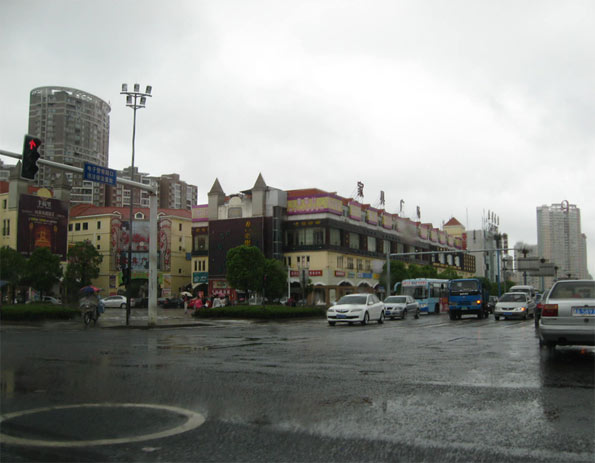
    On a rainy and quiet Sunday afternoon I took a tour of the northeast construction area and found that much of the construction had been finished. Moreover it was obvious from both the traffic and the open shopping centers and shops that this was anything but a "ghost city" (see photograph, above).

    The next day I took a similar trip to the western construction area. As in the northeast, much of the construction was complete and the communities were alive.

    Zhengzhou, Henan: Zhengzhou is also rapidly growing even faster than Changsha (over 60 percent in 10 years) and is the capital of Henan province. The article displays multiple satellite images of the Zhengzhou New Area. Because of a previous article in the Daily Mail, I took the opportunity on a recent trip to visit the Zhengzhou New Area and file a report. The Zhengzhou New Area is alive.

    The Business Insider also indicates an unfamiliarity with Chinese geography.

    Outside Jiangsu? A couple of the photographs referred to empty developments as being "outside Jiangsu," as a Westerner might describe a development as being outside Phoenix or Omaha. However Jiangsu is not an urban area or city, it is a province. Thus, to refer to a development as being outside Jiangsu is akin to referring to a development as being outside Arizona or Nebraska.

    Changsha Already Twice as Large as Los Angeles? The Business Insider also advises us that Changsha is already twice as big as Los Angeles. In fact, there are no comparable geographies between Los Angeles and Changsha that could make such a statement even close to accurate. Regrettably, many writers and much of the press make comparisons between China and other nations without the remotest idea of the meaning of the geographical terms they are using. Here are a couple of ways that Los Angeles and Changsha can be compared.

    1. Central municipality: The central municipality or core city of the Los Angeles area is the city of Los Angeles. It has a population of approximately 3.8 million people, but accounts for less than one third of the population of either the metropolitan area (functional area or labor market area) or the urban area (physical area or area of continuous development). Strictly speaking, there are no central municipalities in China, because the regions or prefectures are themselves municipalities. It is as if the city of Los Angeles comprised both Los Angeles and Orange counties. Chinese municipalities are divided into districts and if a comparison were to be made at the central municipality level, Changsha’s central district would have to be used. This would be the district (qu) of Furong, which has a population of 500,000 people, about 1/8 that of the city of Los Angeles.

    Core city comparisons are fraught with difficulties. This is illustrated by Melbourne, which had little more than 70,000 people in the last Australian census, approximately two percent of the metropolitan population. The 2010 US Census showed Melbourne, Florida to be larger.

    2. Urban Area: The one level at which they valid comparison could be made is the urban area, or the area of continuous urban development. The latest data for Los Angeles (2000) indicates an urban area population of 11.7 million people. The 2010 US Census counts for the Los Angeles area suggest that the urban area total, once released will be little higher than the 2000 figure.

    Based upon the 2010 census data, the next edition of Demographia World Urban Areas will estimate the Changsha urban area at approximately 3,000,000 people. Thus, by the urban area metric, Changsha has a population approximately one-quarter that of Los Angeles.

    It is possible that Business Insider like others, compared the population of the central city of Los Angeles (3.8 million), which is only part of the urban area to that of the Changsha municipality (7 million), which has more than double the population of the Changsha urban area and covers at least 25 times as much land area (virtually all it rural). They are not the same thing.

    —–

    Photograph: In the northwestern Changsha "ghost city:" September 2009 (by author)

  • The Evolving Urban Form: Shanghai

    According to the results of the 2010 census, Shanghai’s population was nearly 1,000,000 people more than had been projected by local authorities. The provincial level of jurisdiction grew from a population of 16.4 million in 2000 to 23.0 million in 2010. Shanghai is one of the world’s fastest growing megacities (urban regions of more than 10 million population). Shanghai’s 6.6 million population growth equals the strong growth of the Manila urban region over the same period but trails the 7.4 million growth in the Jakarta urban region. Shanghai modestly extended its lead over Beijing as China’s largest urban region, where the growth over the same period was 5.8 million.

    As is typical of urban regions around the world, Shanghai’s population gain was concentrated outside the core, in suburban and exurban areas (see table at bottom). A map of Shanghai’s districts can be seen here.

    Suburban Growth: The nine suburban districts grew 69% between 2000 and 2010. The suburban areas grew from 9.5 million in 2000 to 16.0 million in 2010, adding the equivalent of the population of greater Toronto, Dallas-Fort Worth or the Rhine-Ruhr (Essen-Dusseldorf). The suburbs dominated growth, with 99.2% of the population gain

    Sonjiang, to the west of Honquiao airport grew the most, adding nearly 150% to its population. Pudong, a huge district that extends from the new edge city development across the Huangpu River from downtown all the way to Pudong Airport on the Yangtze River added 1.9 million people and now has a population exceeding 5 million (Note).


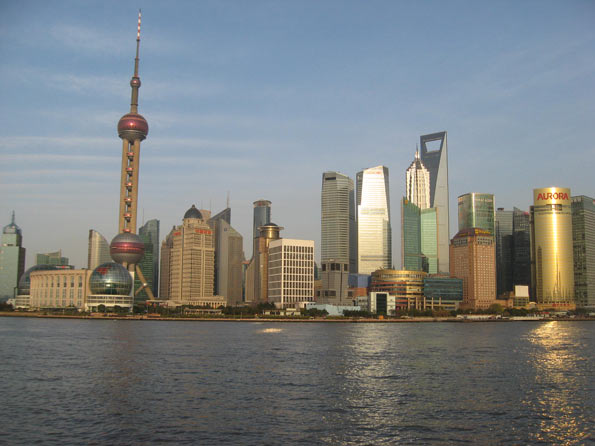
    Pudong Business District

    The Inner Core: The inner core is the all of the famous Bund, with its Western-style commercial architecture along the Huangpu River and Shanghai’s best known shopping street, Nanjing road. The three districts of the inner core all lost population. Overall, the inner core population dropped from 1.209 million to 926,000, a decline of 23%. This may seem surprising, in view of the large number of high-rise condominium buildings that have been constructed in this area. However, these buildings typically replaced higher density low rise development that was generally not up to modern standards. The inner core has a population density of 119,400 people per square mile (46,100 per square kilometer), down from 155,700 per square mile (60,100 per square kilometer) in 2000. Even so, the inner core retains a population density more than 50% above that of either Manhattan or the ville de Paris. 


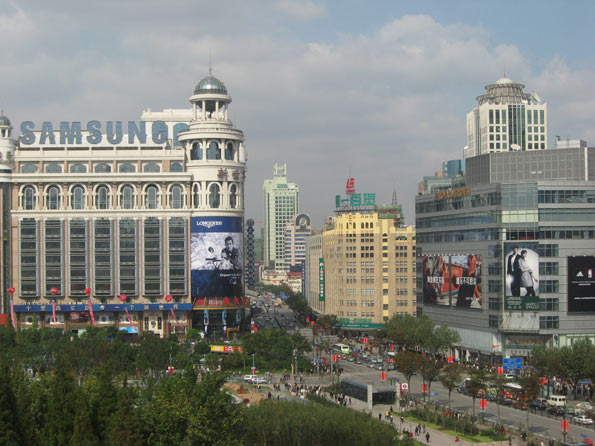
    Toward Nanjing Road

    The Outer Core: The six districts of the outer core gained 6%, increasing from 5.723 million to 6.060 million people. Two districts sustained minor losses and another three made modest gains. The district of Putuo was the exception, gaining 23%. The outer core districts had a population density of approximately 60,100 per square mile, or 23,200 per square kilometer in 2010.

    Overall, the entire core grew 0.8% and accounted for 0.8% of the growth in the jurisdiction. The population density was approximately 64,000 per square mile or 25,000 per square kilometer.

    Urban and Rural Shanghai: Overall, Shanghai covers approximately 2,445 square miles (6,333 square kilometers), a land area somewhat more than that of the Statistics Canada defined Toronto metropolitan area (2,279 square miles or 5,901square kilometers). However, Shanghai’s population is nearly four times that of the Toronto area. Even so, Shanghai’s rural population remains at approximately 3,000,000 people.

    Based upon the new census count, it is estimated that the population of the urban area is approximately 20,000,000. The suburban areas, inside the urban area but outside the core are estimated to have a population density of 10,600 per square mile or 4,100 per square kilometer, well below the density of the core. Even so, this suburban density is well above that of all but a few of the urban areas of Western Europe. The suburban areas include a number of undeveloped areas that are completely surrounded by urbanization.

    Decentralized Employment: Shanghai has also developed a decentralized employment base, despite having one of the world’s largest central business districts, with 1.25 million jobs. By comparison, Manhattan has approximately 1,750,000 jobs south of 59th Street, while Tokyo has approximately 4,000,000 jobs inside the Yamanote Loop. The central business district has approximately 15% of Shanghai’s employment.

    Shanghai’s Urban Expansion: Shanghai continues to expand in virtually every direction. It is likely that Shanghai’s urbanization will mean that of Kunshan, an urban area of nearly 1.5 million people located in the Suzhou Prefecture of Jiangsu. In addition, the urbanization is also likely to soon meet that of Taicang, another urban area in Suzhou that has a population of approximately 500,000.  At least one of Shanghai’s Metro lines is planned to be extended to Taicang.

    Shanghai’s urbanization is also poised to spill across the border into the province of Zhejiang. Development is also spreading to the east and southeast in Pudong, including Lingang, which will eventually have 1 million residents. The ocean will prevent further expansion in this direction. Lingang is the point from which a 17 mile (28 kilometer) long bridge crosses one-half of Hangzhou Bay Bridge to Shanghai’s new island port, the largest in the world.

    Shanghai exhibits the same trends that are evident in other world megacities. Like Seoul and Mexico City, the inner core population density is falling. And like Jakarta, Mumbai, Manila and most other large urban areas in the world, the overall population density is declining even as population growth continues.

    Shanghai: Population by District & County (Qu & Xian)
    2010 Census
    POPULATION            
    Sector Area: Square Kilometers  Population: 2000  Population: 2010 Population: Change 2000-2010 % Change % of Growth
    INNER CORE 20.1     1,209,000       926,000      (283,000) -23.4% -4.3%
    Huangpu Qu 4.5        575,000        430,000       (145,000) -25.2% -2.2%
    Jing’an Qu 7.6        305,000        247,000         (58,000) -19.0% -0.9%
    Luwan Qu 8.0        329,000        249,000         (80,000) -24.3% -1.2%
    OUTER CORE 261.4     5,723,000     6,060,000       337,000 5.9% 5.1%
    Changning Qu 38.3        702,000        691,000         (11,000) -1.6% -0.2%
    Hongkou Qu 23.5        861,000        852,000           (9,000) -1.0% -0.1%
    Putuo Qu 54.8     1,052,000     1,289,000        237,000 22.5% 3.6%
    Xuhui Qu 54.8     1,065,000     1,085,000          20,000 1.9% 0.3%
    Yangpu Qu 60.7     1,244,000     1,313,000          69,000 5.5% 1.0%
    Zhabei Qu 29.3        799,000        830,000          31,000 3.9% 0.5%
       
    CORE DISTRICTS 281.5 6,932,000 6,986,000 54,000 0.8% 0.8%
       
    SUBURBAN 6,051.1     9,476,000   16,031,000     6,555,000 69.2% 99.2%
    Baoshan Qu 415.3     1,228,000     1,905,000        677,000 55.1% 10.2%
    Chongming Xian 1,041.2        650,000        704,000          54,000 8.3% 0.8%
    Fengxian Qu 687.4        624,000     1,083,000        459,000 73.6% 6.9%
    Jiading Qu 458.8        753,000     1,471,000        718,000 95.4% 10.9%
    Jinshan Qu 586.1        580,000        732,000        152,000 26.2% 2.3%
    Minhang Qu 371.7     1,217,000     2,429,000     1,212,000 99.6% 18.3%
    Pudong Xin   Qu 1,210.4     3,187,000     5,044,000     1,857,000 58.3% 28.1%
    Qingpu Qu 675.5        596,000     1,081,000        485,000 81.4% 7.3%
    Songjiang Qu 604.7        641,000     1,582,000        941,000 146.8% 14.2%
       
    TOTAL 6,332.6   16,408,000   23,019,000     6,611,000 40.3% 100.0%
       
       
    POPULATION DENSITY          
       
    Sector Area: Square Kilometers  Area: Square Miles  Population/ KM2: 2000 Population/ KM2: 2010 Population/ Mile2: 2000 Population/ Mile2: 2010
    INNER CORE 20.1              7.8         60,100         46,100       155,700       119,400
    Huangpu Qu 4.5               1.7        127,800          95,600        331,000        247,600
    Jing’an Qu 7.6               2.9          40,100          32,500        103,900          84,200
    Luwan Qu 8.0               3.1          41,100          31,100        106,400          80,500
    OUTER CORE 261.4           100.9         21,900         23,200         56,700         60,100
    Changning Qu 38.3             14.8          18,300          18,000          47,400          46,600
    Hongkou Qu 23.5               9.1          36,600          36,300          94,800          94,000
    Putuo Qu 54.8             21.2          19,200          23,500          49,700          60,900
    Xuhui Qu 54.8             21.2          19,400          19,800          50,200          51,300
    Yangpu Qu 60.7             23.4          20,500          21,600          53,100          55,900
    Zhabei Qu 29.3             11.3          27,300          28,300          70,700          73,300
    CORE DISTRICTS 281.5           108.7         24,600         24,800         63,700         64,200
    SUBURBAN 6,051.1        2,336.3           1,600           2,600           4,100           6,700
    Baoshan Qu 415.3            160.3            3,000            4,600            7,800          11,900
    Chongming Xian 1,041.2            402.0              600              700            1,600            1,800
    Fengxian Qu 687.4            265.4              900            1,600            2,300            4,100
    Jiading Qu 458.8            177.1            1,600            3,200            4,100            8,300
    Jinshan Qu 586.1            226.3            1,000            1,200            2,600            3,100
    Minhang Qu 371.7            143.5            3,300            6,500            8,500          16,800
    Pudong Xin   Qu 1,210.4            467.3            2,600            4,200            6,700          10,900
    Qingpu Qu 675.5            260.8              900            1,600            2,300            4,100
    Songjiang Qu 604.7            233.5            1,100            2,600            2,800            6,700
    TOTAL 6,332.6        2,445.0           2,600           3,600           6,700           9,300


    —-

    Lead Photograph: The Bund (all photos by author)

    Note: Pudong includes the large Pudong business district, which is directly across the Huangpu River from the Bund in the central business district. However, Pudong is a relatively new development and was not a part of the urban core. Moreover, Pudong extends far to the east and southeast.

    Wendell Cox is a Visiting Professor, Conservatoire National des Arts et Metiers, Paris and the author of “War on the Dream: How Anti-Sprawl Policy Threatens the Quality of Life

  • The Other China: Life on the Streets, A Photo Essay

    We all know or have heard about the overwhelming development going on in China. Journalists enthuse and analysts throw magnificent statistics of what seems to be a miracle. Yet there is little discussion of the daily life of the common people, and their struggle. There are miracles aplenty in China, but the astounding figures only partially reflect the reality.

    Thousands of people from rural areas move to the big cities of China in search of job opportunities. Strenuous work funds an often meager existence. No social security, no benefits of any kind. Like immigrants from Europe to America’s cities in last century, they often find in the streets an answer to their needs.

    In the year 2011, in the streets of Chengdu, one of the fastest growing cities in the world, many people still have no other option than fixing their dentures under the most unimaginable poor hygiene conditions. For about 20 RMB a street dentist will fix it for you.

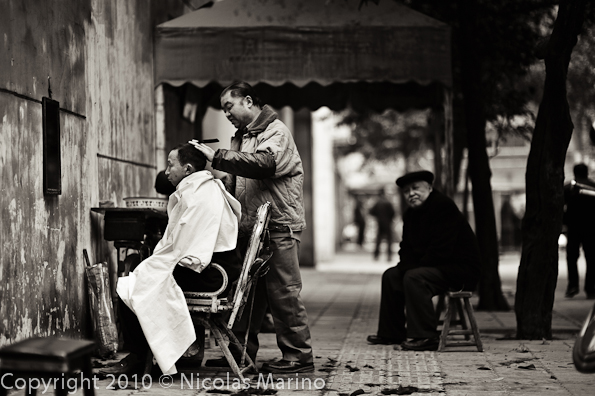
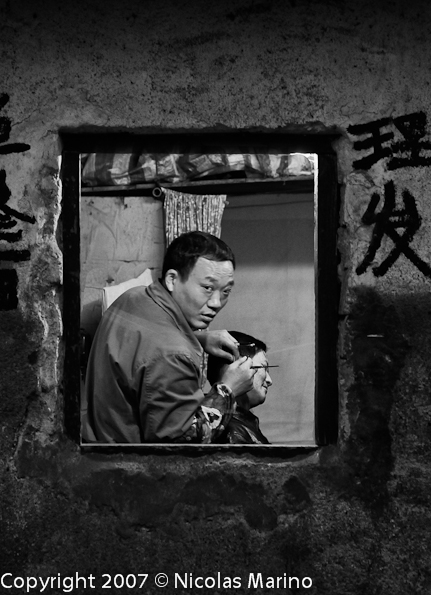
    It takes only 4RMB to get yourself a haircut, right there, on your block.


    And add 5 RMB more to the bill for a deep, though dubious, ear cleaning in one of the many neighbourhoods in Shanghai still south side of the mass production of crystal-clad skyscrapers.

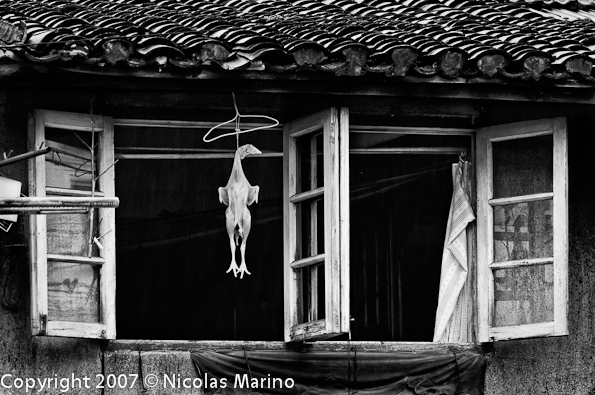
    In those neighbourhoods of all-in-one houses (all-in-one-room), the space is so reduced that the food needs to hang out of the windows. For many neighborhoods that still inconveniently survive in areas of real estate dementia and speculation of the 21st century, it may be just a matter of time until they disappear.

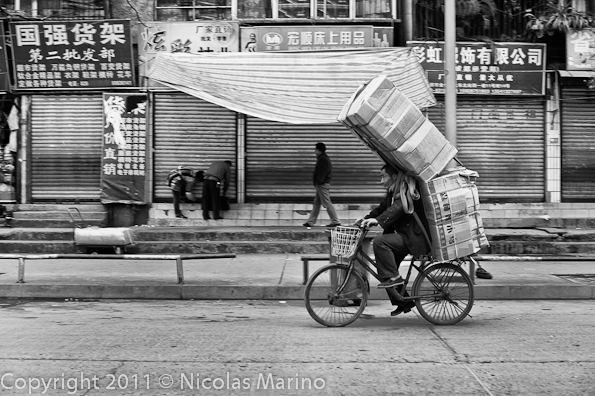
    In China, everything is cheap, and that wonderful home appliance that you just got in the shopping center at a ridiculous price even includes delivery costs. All stores include the cost in the price. There are hundreds of hands out there ready to take everything right to your door for a few coins.

    Real estate developments constantly reconfigure the skyline of Chinese cities selling wonderland views of the contaminated horizon of the Chinese skies. England New Town in Chengdu seems to offer it all, summed up in fantastic Chinglish phrase: “Leads a pious life by the city by view mountain keeping in good health.”

    And even though the children of some will go to the new IMAX around the corner, the people who build the miracle that others can enjoy go to the movies only at improvised movie theaters around the construction sites where they live.

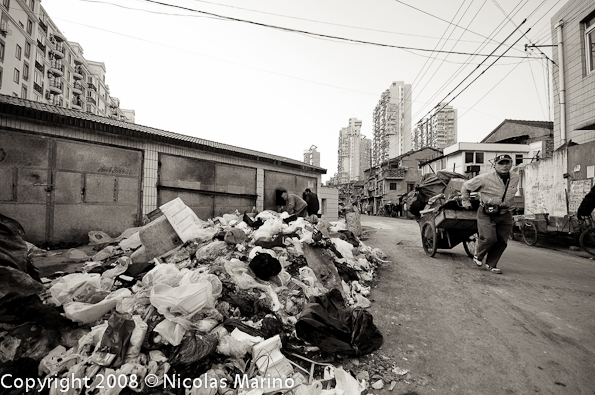
    In the meanwhile, the garbage produced by the miracle accumulates in the suburbs. There are still people ready to make the most out of it.

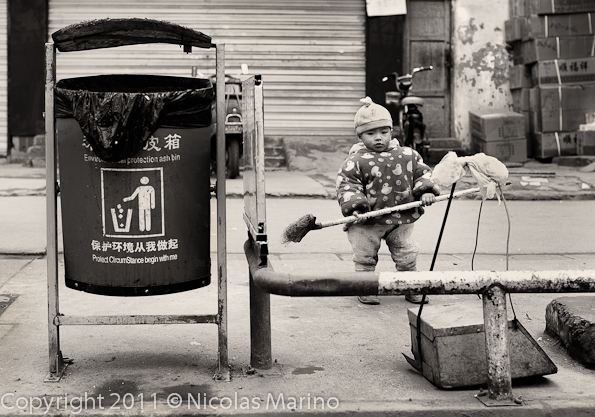
    They never get the English right, but the Chinglish we find everyday on the streets usually defines the country’s situation better than the proper English. Protect Circumstance: Begin with me. I think Ayn Rand has some followers in the People’s Republic.

    Born and raised in Buenos Aires, Argentina, Nicolas Marino is a 33 year-old architect and photographer currently based in Chengdu, China. For the last 6 years he has chosen a bicycle as means of transport to reach the most remote regions of the world where he focuses most of his documentary work. Some of his journeys include a 10.000km ride from Tehran to Shanghai and several trips around remote and rural China where he has now cycled over 8000km.

  • Asia’s New Landless Peasants?

    Landless people have long sparked instability in Asia. From the days of the Qin dynasty (3rd century B.C.), through the huge Taiping rebellion in the mid-19th century, to the successful Communist revolutions in China and Vietnam and a nearly successful insurrection in Malaysia during the mid-20th, the property-less have historically risen against those in power.

    Today as East Asia grows more affluent, landlessness is again on the rise. Although peasants in many places remain both poor and restive, the real threat is in the region’s dynamic cities, where rapid increase in housing prices threatens to push hundreds of millions outside the property-buying market.

    This boost in prices is due to the rapid economic and population growth in many Asian cities. Across China the price of housing per square meter more than doubled over the past decade, according to the National Statistical Bureau. Prices-compared-to-incomes in the diaspora hot beds of Singapore and Hong Kong are now, according to research from the consultancy group Demographia, the highest in the advanced world — at least 50% higher than New York, San Francisco, Toronto, Sydney or London.

    There are some good market-based reasons for these high prices. Most major Asian cities are thriving economically and growing far more rapidly than their Western counterparts. Over the past decade, the population of Shanghai, China’s largest city, rose 35%, or by nearly 6 million, which is more than the population of any Western European city besides London, Paris and Essen-Dusseldorf. Beijing’s population rose by 6 million in the past 10 years to nearly 20 million. And Singapore’s far more affluent population jumped 20%, a rate exceeded in the advanced world only by Atlanta, Ga., among urban areas of more than 4 million.

    The recent spike in prices, particularly in the more affluent cities, also stems from high liquidity, low interest rates and rising inflation, notes Cheong Koon Hean, CEO of Singapore’s Housing and Development Board. To these factors she adds what she calls “a herd mentality” as people rush to invest in property as a hedge against inflation.

    The traditional Chinese obsession with property ownership exacerbates these factors. As  Nanjing-based blogger and social critic Lisa Gu writes, “Owning a property is the greatest life-goal for most Chinese citizens.”

    In mainland China the rush to own is bolstered by the lack of a strong social safety net or popular trust in other investment vehicles, such as stock and bonds. ”China lacks good investment channels besides housing,” says Han Hui, senior partner in prominent Beijing real estate law firm. “People put money into real estate because they still don’t trust anything else.”

    The appeal of home-ownership in China is particularly marked since it’s more of a land-use right, which in the case of residential property, expires after 70 years (40 years for commercial property). The lease begins to run out on the date that the real estate developer signs for the land, and not on the homeowner’s date of purchase.

    Whatever its cause, this Asian form of irrational exuberance is clearly boosting inequality across the region’s cities.

    This is becoming a key issue, particularly for the younger generation.  ”House price” ranked third on the list of the top 10 most popular phrases used by Chinese netizens, says Lisa Gu. Many young Chinese, she notes, are giving up on the ideal of owning a house before marriage and starting their lives together as renters. This is widely called “getting married naked.”

    For young professionals this now might just prove a temporary annoyance, but it could evolve into something more bothersome as they age. Some might opt to avoid very expensive cities, such as Beijing or Shanghai, for up-and-coming smaller urban centers such as Chengdu, the provincial capital of agriculturally fecund Sichuan province. This city has a growing tech center but offers housing prices as much as one third those in China’s existing megacities. Although salaries are also lower, overall affordability remains much higher than in the established urban regions.

    For the many millions of poorer Chinese, including the many migrants from the countryside, the housing crunch presents a more serious issue. Most have moved to the big cities, particularly in eastern China, for better opportunities and quality of life. Virtually all the net growth in Beijing and Shanghai, according to the most recent Chinese census, came not from registered residents but among migrants — those lacking hokou status. They constitute now over one third of the population in these megacities.

    Such migrants include people of various incomes, but also a large impoverished population.  Some live in sub-standard conditions not often associated with the gleaming epicenters of Asian capitalism. Like residents of the slums of third-world cities, many are landless peasants, a group now estimated at 70 million or 80 million.

    This problem of landless peasants is likely to grow as more land is set aside for urban and industrial development. Many will face difficulty finding a decent place to live even as more affluent Chinese snatch up multiple apartments for speculative investment. This has accelerated a worsening gap between rich and poor that is of major concern to the country’s Communist rulers.

    Of course, no one suggests anything like a new peasant rebellion is in the offing. It is critical to recognize that, for all its imperfections, China’s astounding rise has lifted hundreds of millions of people out of the grip of unceasing poverty.

    But unaddressed, the property crisis could well slow east Asian capitalism’s rapid ascent. High housing prices may already be contributing to depressed birthrates — even in places where the “one child” policy does not apply, such as Singapore, Taiwan and South Korea.

    Such long-term problems are overshadowed by more immediate concerns. Fallout about cascading house prices led the Chinese central government earlier this year imposed new restrictions aimed at slowing rampant speculation — such as requiring 60% payments for second homes and restricting the purchases of additional homes.

    The interior city of Chongqing has taken even more drastic steps. The hardline government there has embraced a distinctly uncapitalist response to the housing crisis: a massive program to increase the supply of rental as well as state-owned apartments that would be available to poorer residents, including those from the countryside. This contrasts with programs in Singapore, where 80% of the population live in the public housing, but some 95% own flats purchased from current owners or the Housing Development Board.

    In China, the failure of the housing market to find places for the poor and working class could provide a rationale for expanding the state’s role in managing the economy. It certainly provides fuel for Chongqing’s active affirmation of what is seen as a revival of “red culture.”

    Beyond such ideological implications, the housing crisis could threaten both the long-term social stability and economic growth of East Asia. Unless addressed, growing dissatisfaction among a large bloc of property-less citizens has the potential to become a politically destabilizing force and a brake against market-friendly liberalization. As East Asia remains the primary driver of the world’s economic engine, this could prove bad news not only for upwardly mobile Chinese but everyone else as well.

    This piece originally appeared at Forbes.com.

    Joel Kotkin is executive editor of NewGeography.com and is a distinguished presidential fellow in urban futures at Chapman University, and an adjunct fellow of the Legatum Institute in London. He is author of The City: A Global History. His newest book is The Next Hundred Million: America in 2050, released in February, 2010.

    Photo by Colin Manuel

  • China: Urbanizing and Moving East: 2010 Census

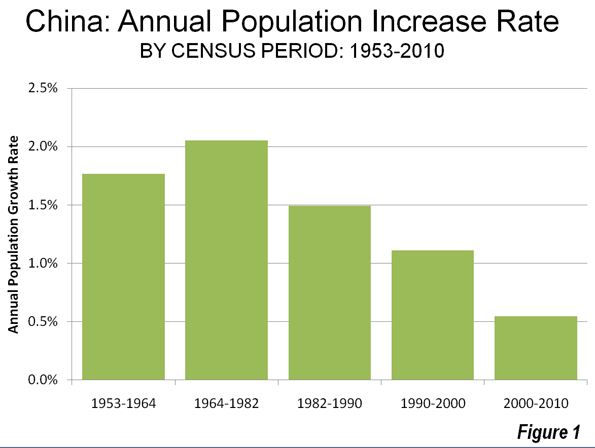
    The National Bureau of Statistics of China has just released the first results of the 2010 census. The new figures portray a radically reduced population growth rate, rapid urbanization and an unprecedented domination of population growth by the East Coast.

    Slowing Population Growth: China, the world’s most populous nation, grew rapidly until the early 1980s. The strongest growth since 1950 was in the 1964 to 1982 census period, during which the annual growth rate exceeded two percent. By the 1990 to 2000 period, the annual rate had fallen to 1.1 percent and then dropped in half to approximately 0.6 percent between 2000 and 2010 (Figure 1). The nation’s total population growth between 2000 and 2010 was approximately 75 million. In contrast, the 1964 to 1982 rate would have produced a population increase of 300 million people. Two key factors have   influenced this drop in population growth rate. The first is rapidly improving affluence, a factor routinely associated with lower birth rates around the world. The second factor is China’s one child policy, which is contributing to an aging of the population and has been associated with an increasing male to female birth ratio.

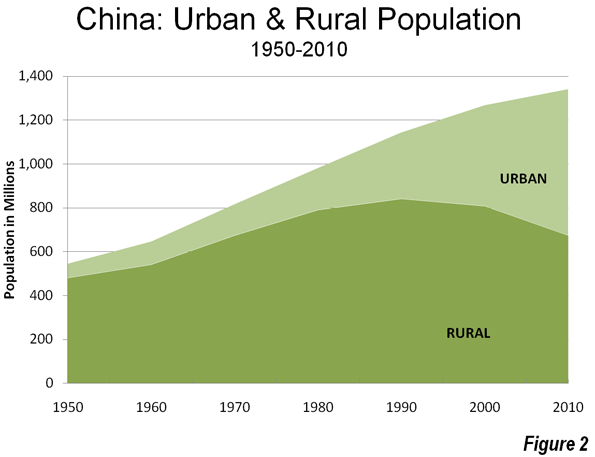
    Accelerating Urbanization: Between 2000 and 2010, China continued to urbanize at a pace and scale never seen before in world history (Figure 2).  China added approximately 205 million urban residents over 10 years, more urban residents than live in any country except for India and the United States. China’s urban population expansion was 2.5 times the estimated increase in rapidly urbanizing India. In 2010, nearly 50 percent of the population lived in urban areas, compared to 37 percent in 2000. This increase is well above expectations. The United Nations had projected an urbanization share of 47 percent, which would have converted to approximately 50 million fewer urban residents.

    A large share of the increase in urban population was from the nation’s large migrant population, which lacks registration (hukou status) at its current, generally urban place of residence. A floating population, this group rose from 120 million in 2000 to 220 million in 2010. This movement of 100 million people dwarfs the national population increase of 75 million. Previous data indicated that virtually all of Shanghai’s population growth was due to migration of (principally poorer) people from elsewhere, as has occurred elsewhere in the nation.

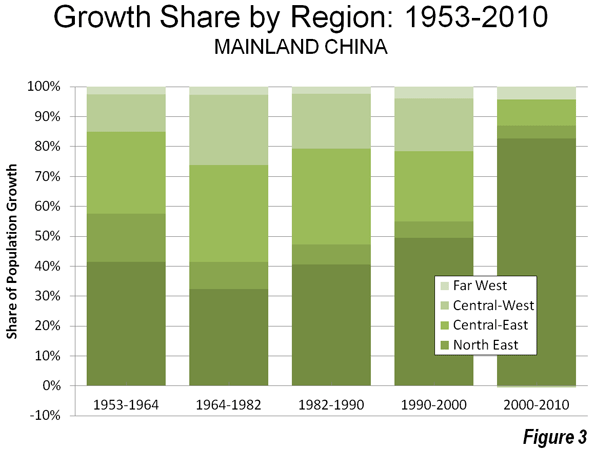
    Moving East: For the first time since 1950, one region of the nation was dominant (Figure 3), with 83 percent of growth on the already heavily urbanized East Coast. In contrast, the center (East Central and West Central regions) combined for only eight percent of the growth, which is down from 41 percent between 1990 and 2000 and 56 percent between 1964 and 1982 (Note 1) Regional and provincial level population trends are indicated in the table below (link to provincial level map).

    China Population Trends by Region & Province
    1990-2010
    1990 2000 2010 1990-2000 Change 2000-2010 Change Share of Growth: 1990-2000 Share of Growth: 2000-2010
    CHINA    1,130.49    1,262.28       1,332.77 11.7% 5.6% 100.0% 100.0%
    EAST COAST 428.61 493.84 552.20 15.2% 11.8% 49.5% 82.8%
    NORTH 165.08 182.06 200.20 10.3% 10.0% 12.9% 25.7%
      Beijing        10.82 13.82 19.61 27.7% 41.9% 2.3% 8.2%
      Hebei          61.08 67.44 71.85 10.4% 6.5% 4.8% 6.3%
      Shandong       84.39 90.79 95.79 7.6% 5.5% 4.9% 7.1%
      Tianjin        8.79 10.01 12.94 13.9% 29.3% 0.9% 4.2%
    CENTRAL 151.89 172.60 193.00 13.6% 11.8% 15.7% 28.9%
      Fujian         30.05 34.71 36.89 15.5% 6.3% 3.5% 3.1%
      Jiangsu        67.06 74.38 78.66 10.9% 5.8% 5.6% 6.1%
      Shanghai       13.34 16.74 23.02 25.5% 37.5% 2.6% 8.9%
      Zhejiang       41.45 46.77 54.43 12.8% 16.4% 4.0% 10.9%
    SOUTH 111.63 139.18 159.00 24.7% 14.2% 20.9% 28.1%
      Guangdong      62.83 86.42 104.30 37.5% 20.7% 17.9% 25.4%
      Guangxi        42.25 44.89 46.03 6.3% 2.5% 2.0% 1.6%
      Hainan         6.56 7.87 8.67 20.0% 10.2% 1.0% 1.1%
    NORTH EAST 99.33 106.55 109.52 7.3% 2.8% 5.5% 4.2%
      Heilongjiang   35.21 36.89 38.31 4.8% 3.9% 1.3% 2.0%
      Jilin          24.66 27.28 27.46 10.6% 0.7% 2.0% 0.3%
      Liaoning       39.46 42.38 43.75 7.4% 3.2% 2.2% 1.9%
    EAST CENTRAL 344.25 375.23 381.43 9.0% 1.7% 23.5% 8.8%
    NORTH 106.40 116.59 119.92 9.6% 2.9% 7.7% 4.7%
      Anhui          56.18 59.86 59.50 6.5% -0.6% 2.8% -0.5%
      Inner Mongolia 21.46 23.76 24.71 10.7% 4.0% 1.7% 1.3%
      Shanxi         28.76 32.97 35.71 14.6% 8.3% 3.2% 3.9%
    SOUTH 237.85 258.64 261.51 8.7% 1.1% 15.8% 4.1%
      Henan          85.51 92.56 94.02 8.2% 1.6% 5.3% 2.1%
      Hubei          53.97 60.28 57.24 11.7% -5.0% 4.8% -4.3%
      Hunan          60.66 64.40 65.68 6.2% 2.0% 2.8% 1.8%
      Jiangxi        37.71 41.40 44.57 9.8% 7.7% 2.8% 4.5%
    WEST CENTRAL 236.49 259.61 259.18 9.8% -0.2% 17.5% -0.6%
    NORTH 59.91 67.29 69.20 12.3% 2.8% 5.6% 2.7%
      Gansu          22.37 25.62 25.58 14.5% -0.2% 2.5% -0.1%
      Ningxia        4.66 5.62 6.30 20.7% 12.1% 0.7% 1.0%
      Shaanxi        32.88 36.05 37.33 9.6% 3.5% 2.4% 1.8%
    SOUTH 176.58 192.32 189.98 8.9% -1.2% 11.9% -3.3%
      Chongqing      28.86 30.90 28.85 7.1% -6.6% 1.5% -2.9%
      Guizhou        32.39 35.25 34.75 8.8% -1.4% 2.2% -0.7%
      Sichuan        78.36 83.29 80.42 6.3% -3.4% 3.7% -4.1%
      Yunnan         36.97 42.88 45.97 16.0% 7.2% 4.5% 4.4%
    FAR WEST 21.81 27.05 30.44 24.0% 12.5% 4.0% 4.8%
      Qinghai        4.46 5.18 5.63 16.2% 8.6% 0.5% 0.6%
      Tibet          2.20 2.62 3.00 19.3% 14.6% 0.3% 0.5%
      Xinjiang       15.16 19.25 21.81 27.0% 13.3% 3.1% 3.6%

    East Coast: The East Coast growth share of 83 percent is far higher than in previous census periods, which reached a high at 49 percent between 1990 and 2000. The share of growth was consistent within the sub-regions of the East Coast. The North, surrounding Beijing and the Yellow River (Huang He) Delta, accounted for 26 percent of the growth. The Central East Coast, with Shanghai and the Yangtze River (Changjiang) Delta at its core, captured 29 percent of the growth. The South, centering on the Pearl River Delta, and the megacities of Guangzhou, Shenzhen and Dongguan, accounted for 28 percent of the growth (Note 2).

    All of the 11 provincial level jurisdictions (Note 3) on the East Coast all except for Guangxi grew at least as fast as the nation. The fastest growth in the nation was in the three provincial level municipalities: Beijing, where the population increased 42 percent, Shanghai at 38 percent and Tianjin at 29 percent. Even so, Beijing’s population was a full two million less than some estimates, while Shanghai’s was nearly one million more than current city estimates.

    Outside the provincial level municipalities, Guangdong was the fastest growing in the nation, adding 21 percent. Guangdong became the nation’s largest provincial level jurisdiction, reaching 104 million and adding 18 million new residents. The Guangdong count was particularly surprising, roughly 7 million higher than would have been expected based upon 2009 population estimates. Zhejiang, adjacent to Shanghai grew 16 percent. Hainan, an island province carved from Guangdong in the 1980s, grew 10 percent.

    North East: The North East ("Manchuria" or "Dong Bei") accounted for only four percent of the nation’s growth, down significantly from previous census periods.  All three provinces grew at lower rates than the nation. These are traditional manufacturing areas that have not seen the sort of investment seen further south.

    East Central: The East Central provinces accounted for eight percent of the nation’s growth, down from 23 percent between 1990 and 2000. Among the seven provinces, only Shanxi and Jiangxi grew faster than the national rate. Hubei, home of Wuhan, one of the nation’s largest urban areas, experienced a loss of more five percent, the second largest population decline in the nation after Chongqing. The northern East Central jurisdictions grew at approximately one half the national rate, while the south grew at approximately one fifth the national rate.

    West Central: The seven West Central provincial level jurisdictions lost population in an amount equal to -0.6 percent of the national growth. This compares to an18 percent share of national growth between 1990 and 2000. The provincial level municipality of Chongqing experienced the largest rate of population loss in the nation at seven percent. Sichuan, from which Chongqing was carved in the 1990s, lost three percent of its population. Nonetheless, two provincial level jurisdictions in the West Central grew faster than the national rate, Ningxia and Yunnan. As in the East Central, the North grew at approximately one half the national rate. The South experienced heavy rural population losses, even as large urban areas, such as Chongqing and Chengdu experienced strong population gains.

    Far West: The jurisdictions of the Far West captured five percent of the national growth. The Far West grew the fastest among the regions, at 12.5 percent compared to 11.8 percent on the East Coast.  Each of the jurisdictions, Xinjiang, Tibet and Qinghai grew more quickly than the national rate. Nonetheless, with such a small population (30 million), the population growth in the Far West was barely one-half that of Beijing or Shanghai and little more than Tianjin.

    Provincial Losses, Urban Gains: Despite the uneven concentration of growth on the East Coast, the larger increase in (100 million) in migration from rural to urban areas led to a less uneven distribution of urban growth. The slow growth and even the population losses occurring in the interior mask huge growth in major urban areas of the same provincial level jurisdictions.

    Based upon 2009 estimates (provincial level urban data has not yet been released for 2010), the provincial level municipality of Chongqing gained 4.5 million urban residents (more than the population of Berlin), while the overall provincial level population loss was 2 million from 2000 to 2010. This illustrates one of the principal dynamic of population trends in China, as the countryside loses population to urban areas not only on the East Coast but also in the same general areas. The rural areas of Chongqing, which accounted for two-thirds of the population, lost more than 6 million residents, principally to the nearby Chongqing urban area as well as to other urban areas of the nation.

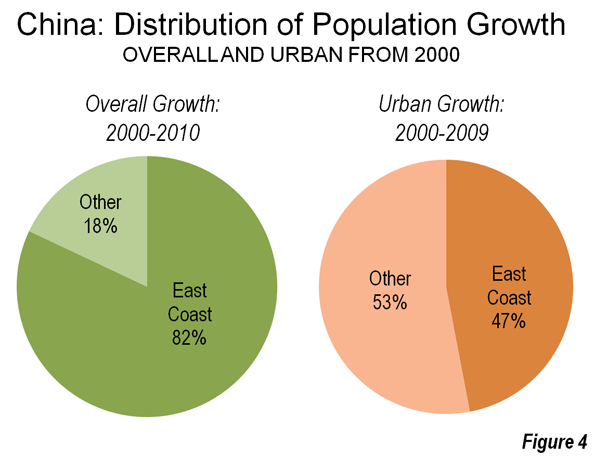
    In Sichuan, with its large and fast growing capital Chengdu, the urban population grew nearly 10 million, while  the provincial population was declining 3 million, indicating a rural loss of 13 million. Thus, while the East Coast accounted for 83 percent of the overall population growth, government estimates through 2009 indicate that only 47 percent of the urban population growth was on the East Coast (Figure 4). 

    Challenges: China faces no shortage of demographic challenges. An aging population will impose significant financial burdens on the generations to come, as is already happening in more affluent nations. The ratio of female to male births needs to be improved or social stability could be difficult to maintain in the decades ahead. The role of China’s one-child policy in these issues is now being debated and reviewed.

    The strong trend toward urbanization will continue for decades. The United Nations estimates that China will be nearly 75 percent urbanized in 2050 compared to the current 50 percent. The nation is expected to add 70 million residents, with an increase of 400 million in urban areas and a loss of 330 million in rural areas. Should these projections be reached, China’s rate of urbanization will be near the current levels in the affluent West. Even with more than one-half of urban growth now occurring outside the East Coast, there is a need to decentralize more of the growth to the emerging urban areas of the interior. This is something now widely recognized within Chinese planning and government circles.

    —–

    Photo: Wuhan (capital of Hubei) By author

    Note 1: There are various methods to categorize the regions of China. This classification is used to illustrate the differences in regional growth rates in the census periods since 1950. The provincial level municipality of Beijing is classified as East Coast because it is surrounded by provincial level jurisdictions (Hebei and Tianjin) which are coastal. Inner Mongolia, which stretches across the entire center of the nation is classified in the East Central because its population is more concentrated in that area. The regional population change between 1953 and 1964 includes an estimated allocation of population to provincial level jurisdictions into which abolished provinces (Rehe, or Jehol and Xikang) were merged during the period.

    Note 2: The Hong Kong and Macao Special Administrative Regions are also in the south, but are not included in the 2010 census data.

    Note 3: There are three types of provincial level jurisdictions in China, provinces, provincial level municipalities and autonomous regions.

    Wendell Cox is a Visiting Professor, Conservatoire National des Arts et Metiers, Paris and the author of “War on the Dream: How Anti-Sprawl Policy Threatens the Quality of Life

  • How China’s Megacities Have Avoided Problems of Other Developing Cities

    Urbanist media can’t seem to get enough of the megacity these days. Much of the commentary surrounding this topic is disconcertingly celebratory about these leviathans despite such phenomena as overcrowding, high levels of congestion and sprawling slums.

    Yet absent from most of the commentary is any mention of cities in China. This is perhaps due in large part to the lack of serious social problems in comparison to its developing city counterparts in other countries. If a megacity is defined as a city with a population of more than 10 million, then China is home to 5 megacities: Shanghai, Beijing, Shenzhen, Guangzhou and Dongguan. As the country continues to urbanize, more Chinese cities are bound to join the ranks of these megacities.

    How has China been able to avoid the pitfalls facing other developing megacities? No one is denying that Chinese cities don’t have problems including unequal income distribution, pollution and growing traffic congestion. Yet China’s megacities seem to have largely avoided social dangers such as violent crime, disease and slum proliferation that plague urban areas of other developing countries.

    How have China’s cities avoided these issues?

    1. Construction of New Housing Units

    Western media continues to bawl over the amount of new residential construction in China, calling it the ”biggest bubble ever.” I have pointed out before how this might be an overestimation of the problem and that the housing market is actually more stable than many think. One thing is clear: the ample construction of new housing units in cities across China remains the essential component leading the way in the country’s development. The ability to provide modern accommodations for millions of aspiring urban dwellers has also directly prevented the proliferation of slums and large-scale shantytowns.

    2. Development of Public Transportation

    The ability to move efficiently through an urban area is paramount to opportunity and quality of life. When one thinks of megacities such as Jakarta or Mexico City, automobile gridlock often comes to mind. Beijing might have its traffic problems as well, but China’s development of public transportation, including extensive underground subway networks, ensures citizens will have other options to move around besides motor vehicles. The more connected by different forms of a transportation a city is, the more opportunity people have to live where they want and have access to a wider geographic range of job options.

    3. Land-Use and Zoning Flexibility

    The often-overlooked reality of zoning and land-use regulations plays a much greater role in the shaping the character of megacities then it is given credit for. Mumbai’s draconian 1.33 floor-to-area ratio (FAR) throughout most of the city means that it is limited to construction of low-rise buildings,leading to the growth of overcrowded sprawling slums. Chinese cities, in contrast, allow for high FAR, promoting construction of high-rise buildings that leave room for ample green space.

    Furthermore, Chinese cities are not limited by ”urban growth boundaries” and allow development to occur on newly annexed land outside of traditional urban cores. Even traditionally ”dense” cities like Shanghai and Hong Kong allow for new development outside of their traditional centers: the Pudong New Area in Shanghai and the New Territories in Hong Kong are huge areas that are still largely underdeveloped when compared to their respective downtown areas.

    Critically, these nominally suburban or even “exurban” expansions are not mere bedroom community; they are frequently attached to areas of intense commercial, industrial and technical development. In many cities, including Chengdu, where I reside, most of the new economic growth takes place in such communities.

    4. Providing Economic Incentives with Special Trade Zones

    As China enters its third decade of rapid development, competition is heating up between its cities for domestic and foreign investment. The winners will ultimately be cities that are most business friendly and offer incentives like tax breaks to companies looking to set up operations. Many of China’s cities have gone about this by establishing special ‘economic and trade zones’, usually outside of traditional urban cores. As a matter of fact, one of new China’s most economically successful cities, Shenzhen, largely started as a ‘Special Economic Zone’ (SEZ). Special economic and trade zones that are not actual cities, but part of a larger city, thrive because they usually built on more affordable land on urban peripheries, opening up more investment for construction of state-of-the-art manufacturing and R&D facilities.

    5. Willingness to Learn from Outside Experts

    When it comes to political issues at the Central Government level, it is clear that China does not want to be told how to run its country by outside diplomats and foreign policy experts. Yet at the municipal level, Chinese government and business leaders are earnestly open to listening to experts in planning and development from outside its borders. One only needs to take a look at the countless architecture and urban planning practices from the West, Singapore and even Taiwan who currently work in China. This open exchange of ideas taking place is what allows best practices to come to fruition.

    Adam Nathaniel Mayer is an American architectural design professional currently living in China. In addition to his job designing buildings he writes the China Urban Development Blog, where a version of this piece originally appeared.

    Photo by xiquinhosilva

  • Downtown China

    In Downtown: It’s Rise and Fall, 1880-1950, Robert M Fogelson says that downtowns are a uniquely American phenomenon. He refers to downtown as the commercial cores with high building densities that form "canyons" that, in some smaller urban areas, might be only a block long to a mile or more long.  Fogelson demonstrates that downtowns in the United States are largely a creation of rail transit (subways or metros, street cars and their predecessor horse cars). American urban areas grew at the same time that this mode of transport was reached its zenith.    

    This pattern was also evident in the pre-automobile cores of large urban areas in Canada, Australia and New Zealand.

    Since then, the downtown has been losing its preeminence. As late as 1950 virtually all of the nearly 50 US urban areas with more than 250,000 people had concentrated downtown areas of varying sizes. The unifying factor was the access to this one point in the urban area by transit from most or all of the rest of the urban area.   Smaller urban areas, after transit’s golden age, never developed downtowns as well-developed as those which grew during the transit oriented urban areas of the pre-World War II era.

    China’s emerging commercial cores bear little resemblance to these older American downtowns. Generally, what might be termed as downtown in the urban areas of China is far more dispersed. The tallest buildings do not stand across narrow streets from one another. You see little of the often spectacular high-rise canyons seen in great American downtowns such as Chicago and New York or even smaller ones, such as Pittsburgh and Seattle and many others.   

    Dominant Pattern: The Dispersed Central Business District: The most pervasive form of downtown China is a larger central business district consisting of dispersed high-rise buildings superimposed on lower rise residential buildings, the latter often being five floors or less.

    Perhaps the best example is Guangzhou, capital of Guangdong (12 million population) that now engulfs adjacent Foshan. The skyscrapers of central Guangzhou, some among the tallest in the world, are spread around an area of between 10 and 15 square miles (26 to 39 square kilometers). The largest concentration is near the Guangzhou East Railway Station, where the trains of the former Kowloon – Canton Railway terminate. Even so, this concentration is more sparse than would be expected in even a smaller US Pre-World War II transit oriented downtown.   Other, smaller concentrations of tall commercial buildings or skyscrapers are virtually isolated. The Guangzhou International Finance Center, the tallest building in Guangzhou and 10th tallest in the world dominates its generally low rise surroundings, soon to be joined by an even taller 116 floor building that is under construction.

    The pattern of dispersed and large central area development is also obvious in nearby Shenzhen, Guangdong (population 15 million, see Note), which rose from being fishing village to megacity status in less than 30 years. The central core occupies at least as much space as central Guangzhou. However, unlike Guangzhou, part of the Shenzhen central area has relatively dense high-rise buildings. This eastern section has a number of very tall buildings, and of the world’s second tallest skyscraper (and China’s tallest) is now under construction in this area (the Pingan International Financial Center).

    Other Chinese urban areas with generally dispersed core commercial development include Chengdu, the capital of Sichuan (5 million), Changsha, capital of Hunan (2.5 million), Taiyuan, capital of Shanxi (3 million), Kunming, capital of Yunan (3.2 million) Guiyang, capital of Guizhou (2.3 million), Ningbo, Zhejiang (3.2 million) and Tianjin (7 million), a provincial level municipality.

    Changsha and Taiyuan are near duplicates, with the core development in a wide area extending from the main railway station over a mile westerly to north-south rivers that dissect each urban area.

    Dongguan, Guangdong (12 million, see Note), like Shenzhen became a megacity (from a rural area) in less than two decades. Dongguan is located between Guangzhou and Shenzhen, and may have the most dispersed central business district in China, with little concentration except for an "edge city" development with comparatively large distances between buildings. Dongguan is unique for being the largest urban area in the world without an international airport (Dongguan is served by the nearby Shenzhen and Guangzhou international airports).

    Dual Cores Superimposed on Dispersed Central Areas: There is also a variation on this dispersed pattern in which the core commercial area includes two unusually high concentrations of buildings.

    The best example of this is Beijing (14 million) where an older concentration of high-rise buildings is to the west of Tiananmen Square and the Forbidden City in a corridor along the Second Ring Road (one of Beijing’s five freeway rings or beltways), and a sixth is under discussion. The newer concentration is to the east, in a corridor along the Third Ring Road. This area includes the CCTV Headquarters and the tallest building in Beijing, the 74th floor China World Trade Center III, on the other side of the Third Ring Road. These concentrations along the ring roads resemble more the post-World War II corridor form of Central Avenue in Phoenix than Manhattan, Seattle or Pittsburgh.

    Shenyang, in Manchuria, capital of Liaoning (5 million) also has two cores in the midst of a less concentrated central area.  The larger and newer core is adjacent to Shenyang North Railway Station, while the smaller and older core is near Shenyang Railway Station.

    Suzhou, in Jiangsu (3.3 million) is well known for its canals, as the Venice of the Orient. Suzhou too has two comparatively concentrated cores on either side of the older smaller low rise core. The largest concentration is to the west, adjacent to the Grand Canal, built between 1,500 and 2,500 years ago to connect Hangzhou with Beijing (1,100 miles or 1,700 kilometers), The smaller concentration is to the east. Even so the pattern of dispersion is dominant. The urban area’s tallest building, the Henghe Tower (photo) is well away from any other buildings of significant height.

    In Xi’an (5 million), capital of Shaanxi (and a historic capital of China known as Chang’an), the two more concentrated areas sit along a north-south spine on either side of the historic walled city, which includes an older, even less concentrated business district.

    Wuhan, capital of Hubei (5 million) also fits the dual model, but this is partially due to the post-war amalgamation of three cities (Hankow, Wuchang and Hanyang), the first two of which have large and dispersed core areas, with some concentration.

    Hanghzou (capital of Zhejiang, 5 million) and Zhengzhou (capital of Henan, 2.3 million) exhibit a somewhat different pattern of the dual core superimposed upon the typical commercial dispersion. In Hangzhou, a new central business district is under development, well to the east of the older core area. A new central business district is also being developed, with major parts completed, on the periphery of Zhengzhou (the Zhengzhou "New Area"). This area was inaccurately characterized as China’s largest Ghost City by The Daily Mail (London).

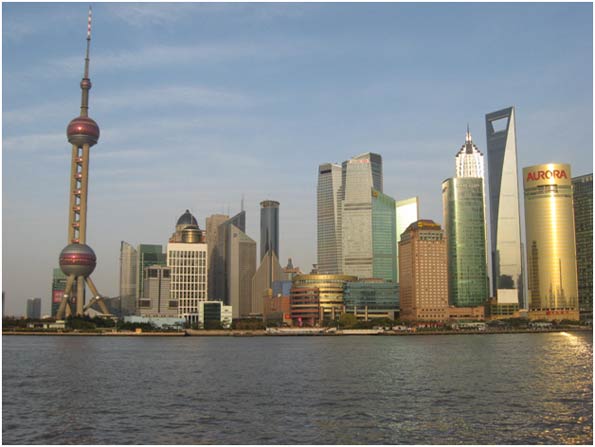
    Shanghai: Shanghai (19 million) deserves special mention. A business center since the 1920s, Shanghai boasts one of China’s more concentrated central business districts, west of the Pu River (Puxi) as well as perhaps the world’s largest edge city development, across the river in Pudong. Puxi includes the famous Bund area along the river with its classic western architecture. The central business district continues westerly and to the south to beyond the north-south elevated freeway. This district has tall buildings widely dispersed throughout. Some of Shanghai’s tallest buildings are here, though few are close to one another. Pudong includes the Pearl of the Orient Tower (either loved or hated by architectural critics), the 101 story Shanghai International Financial Center and a number of other tall and unique skyscrapers (photo). This concentration, however, is separated by large streets and plazas and does not resemble the concentrated central business districts of the United States. Soon, this area will add a 128 story building, which will be the third tallest in the world (measured in feet or meters).

    Nanjing: Nanjing, the capital of Jiangsu (4 million) has a more American looking central business district, by virtue of a number of tall buildings located close together at or near the Xinjieko intersection. Yet, Nanjing’s tallest building and seventh the tallest in the world (Nanjing Greenland Financial Center) sits well to the north of Xinjieko, while the other tallest buildings are a subway stop to the east.

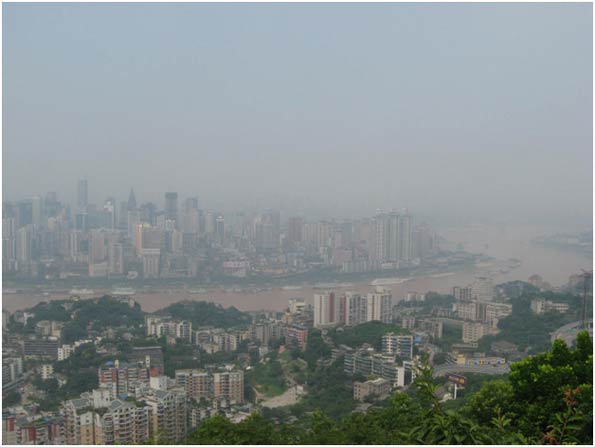
    Chongqing: Chongqing, a provincial level municipality, has an urban area population of 7 million. Chongqing breaks the mold, with a central business district that would be familiar to urbanites in the United States (photo). The core of Chongqing sits on a peninsula formed by the confluence of the Yangtze River and the Jailing River. It bears a resemblance to Pittsburgh, down to a plaza similar to the Golden Triangle. Close by and up a hill may be China’s only US style-central business district. Here, the streets are narrow, the buildings are tall, and there are canyons like those of pre-World War II Pittsburgh, Seattle or even Manhattan. Much of this anomaly is probably due to the constrained geography of the central area. At the same time, commercial development is crossing the Yangtze River and spread to formerly rural areas west, such as Daping and Shapingba . These areas are up to forty-five minutes from the core.

    None of this, of course, is surprising, since China, like America and elsewhere, is like nowhere else in the world.

    ———

    Note: The population figures shown for Shenzhen and Dongguan are based upon unofficial estimates that include the non-permanent (migrant) population. Official figures in these two prefectures generally include only permanent residents, who may represent 50 percent or less of the population.

    Wendell Cox is a Visiting Professor, Conservatoire National des Arts et Metiers, Paris and the author of “War on the Dream: How Anti-Sprawl Policy Threatens the Quality of Life

    Lead photo: Second Ring Road Corridor, Beijing (by Author)

    All photos by author.

  • Getting Married Naked

    One of my girlfriends just invited me to attend her wedding ceremony next month. In our short conversation, I learned that she and her husband have already moved into their brand new, three-bedroom condo (we barely have any detached houses, called villas, in China), purchased a new car, and will have three separate wedding ceremonies: in the groom’s hometown, the bride’s hometown, and the city where they currently live. Based on this description, you are probably picturing a couple in their late 30s who must hold high-paying respectable jobs.

    But that assumption would be wrong. They are an average young Chinese couple in their mid-20s who’ve only just graduated from university a couple of years ago.  However, what they are planning for their wedding is typical in China today.

    So how can they afford all this? Even in go-go China, many in reality can’t afford, and increasingly some are eschewing, the wedding-related expenses.

    But how did we end up in the first place with a situation where pressures force some Chinese couples to disappoint their families, their friends and maybe themselves?  Why have the wedding game become so patently insane even for the relatively affluent.

    To answer this question, we must first become familiar with some Chinese wedding traditions. Primarily when it comes to the cost of a wedding, the groom’s family is expected to provide accommodations for the couple and pay for the wedding ceremony, while the bride’s family provides what could be loosely referred to as a dowry.

    For my parents’ generation (those born between 1955 to 1965), the above mentioned wedding traditions translate into:

    • The newlyweds live with the groom’s parents after getting married. Since housing was provided by the state owned companies in the 1980s, and younger generations were expected to show their filial obedience through living with their parents, no couple would even consider having a place of their own.
    • In respect that China was still going through an extreme resource insufficiency phase in the early 1980s, my mother’s dowry only consisted of two brand new red quilts.  
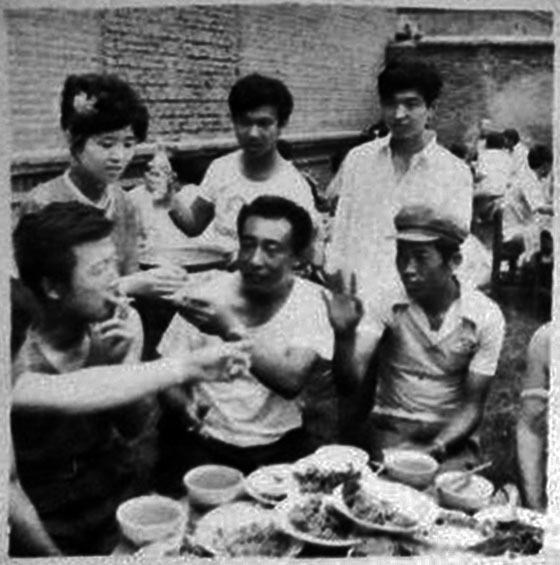
    • Wedding ceremonies usually took place in the courtyard where people lived. Good friends would come to help cook a “feast” for a relative handful of guests.


    Wedding ceremony in the 1980s


    Now, after the massive economic changes that have happened over the past two decades, these three wedding traditions tend to follow a somewhat different pattern:

    • The new couple absolutely must have their own home. In most cases the groom’s parents pay for this housing. It does not matter whether it is a three-story villa or a 40 square meter (425 square feet) bachelor apartment, whether it’s brand new or 20 years old. The key thing is that the property be ready for the new couple to move into. Depending on the family’s financial status, they either pay the full amount or at least the down payment on a mortgage, with the ownership under the new couple’s name. To pay for this, parents usually start saving as soon as their son is born.
    • The dowry given by the bride’s family is either in the form of a brand new car, a hefty deposit into the newlywed’s bank account, or payment of the cost of interior decoration for their new home (new properties in China are usually delivered as little more than a concrete shell).
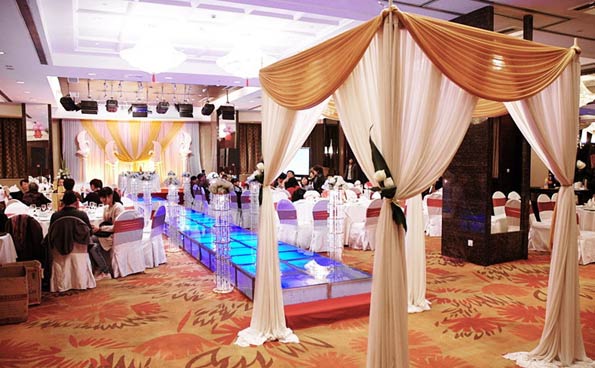
    • Wedding ceremonies are commonly held at the best hotels in town, often with about 500 guests in attendance. The guests will be seated at tables of 10, while the new couple spends most of the time standing on a stage in front.  Chinese wedding ceremonies have shifted from pure traditional Chinese style to a kind of bizarre formality. It is neither traditionally Chinese nor Western and typically includes: wedding rings, glamorous wedding pictures taken at a professional studio, multiple dresses worn by the bride, a lavishly decorated dining room and reception area in the hotel, fancy cars to transport the newlyweds and their entourage, hiring a famous host (MC), a huge feast, copious quantities of alcohol, firecrackers, and party favors that include chocolate and cigarettes.


    Modern wedding ceremony

    Don’t feel surprised if you are feeling dizzy just glancing at the list, you are not alone. Newlyweds often start preparing for their wedding ceremony several months in advance. Whether decorating their condo or taking wedding photos, or huddling with the wedding planner about the details of the ceremony, there’s pressure to get everything ready for the big day.  By the time they can go on honeymoon, most couples would rather just stay home and rest.

    The reality is, everybody knows and complains about how tiring it is to organize a wedding, yet most couples still repeat the same motions. Are they sacrificing their efforts for tradition? Not at all. They do it because weddings have become a way for people to show off their social status.

    For the newlyweds it is like a competition with their peers. For the parents however, a fancy wedding ceremony seems to have more symbolic meaning. Due to the fact that they barely had anything when they got married, and most families only have one child, this seems a chance to realize their fantasies in ways virtually impossible for them to achieve 25 years ago. It is also a perfect occasion to show their old friends what a great life they have now.

    Yet, no matter how exciting a Chinese wedding might sound, we all have to face a cold fact: there are many people in China – even among those ensconced in the middle class – who cannot afford these new wedding traditions.

    According to some unofficial calculations, in 2009 the total expenditure directly related to weddings was 600 billion CNY (92 billion USD). In 2010 the average wedding expenditure (excluding housing costs) for a Shanghai couple was 187,000 CNY (28,600 USD).

    For people who do not have the luxury of being able to afford such tremendous costs, it is not uncommon for them to borrow from their friends and relatives in order to have an “unforgettable” ceremony.

    Others see the problem from a different angle. If their daughter were to fall in love with a poor boy, some parents would not grant their permission for them to get married. At the same time, arranged marriages, blind dates and nationwide broadcast dating shows have started to pick up in popularity. The most frequently asked question for the involved parties is: do you have a house under your name?

    Still others are attempting to break free from those so called social norms and traditions, by standing up and saying no to the modern social pressure.

    A new word – “Luohun” (which directly translates as “getting married naked”) – emerged in 2008. It means that two people get married without buying a house, a car, wedding rings, having a fancy wedding ceremony or an exotic honeymoon. Instead, they spend only 9 CNY (1.4 USD) to get registered and obtain their marriage license from the state. Considering two people only get recognized in the community as a couple after their wedding ceremony in the old days, this represents a monumental shift in thinking.

    Over the past 3 years, “Luohun” has won more favour, especially with those born after 1980. According to an online survey regarding marriage trends, 60% of those polled aged 20 to 35 indicated that they can accept this new concept. It’s a matter perhaps of re-adjusting to the realities of an economy that, while growing rapidly, has also become more expensive.

    And there’s certainly some benefit in getting hitched without all the debts and encumbrances that are hard to bear for a young couple. After all, who wouldn’t want to get married naked?

    Lisa Gu is a 26-year old Chinese national. She grew up in Yangzhou (Jiangsu) and lives and works in Nanjing (Jiangsu).

    Photo by sheilaz413

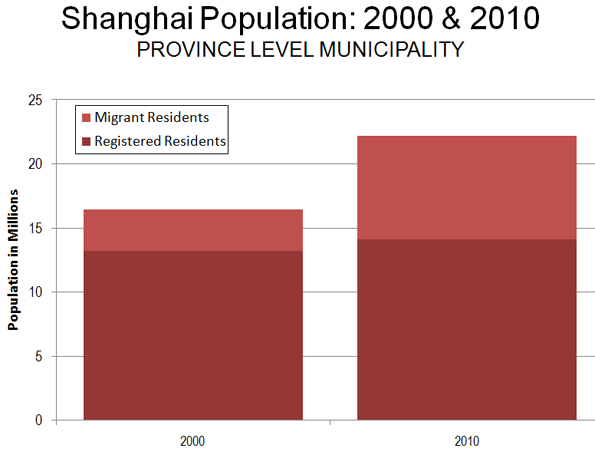
  • Shanghai: Torrid Population Growth

    The population of the provincial level municipality of Shanghai exceeded 22 million at the end of 2010, according to the Shanghai Population and Family Planning Commission. The population of 22.21 million exceeds the 2000 population of 16.41 million by 35 percent. This growth of nearly 6 million is more people than live in all but three Western European urban areas (Paris, London and Essen-Dusseldorf).

    Virtually all of the population gain was among migrant (non-permanent) residents who lack official Shanghai registration (Shanghai Hukou status). The migrant population rose from 5.9 million to 8.1 million, an increase of 153 percent (Estimates place the number of non-permanent urban residents of China as high as 200 million). There were 14.1 million permanent residents (with Shanghai Hukou status), a seven percent increase from the 2000 figure of 13.8 million (Figure).

    Non-permanent residents, who must have lived in Shanghai for six months to be counted, now account for 36.4 percent of the provincial level municipality’s population, nearly double the 19.4 share in 2000.

    Results are expected soon from the China national census, which began in November of 2010. Ding Jinhong, director of East China Normal University’s School of Social Development has suggested that the census may report a population as much as 23 million, with a non-permanent resident population of 9 million.

    It is estimated that the Shanghai urban area, which is wholly contained within the provincial level municipality, will have a mid-year 2011 population of 18.7 million, with a land area of 1,125 square miles (2,900 square kilometers). The Shanghai urban area, the 10th largest in the world, has a population density of 16,500 per square mile or 6,400 per square kilometer.

    This urban density is more than double that of Western European urban areas with more than 500,000, however it is less than one-fourth that of the Mumbai urban area. As in Mumbai, there has been substantial population dispersion from the core to suburban areas, with only 14 percent of growth in the urban core (generally inside the inner-ring expressway) between 1982 and 2000.

    The population density of the provincial municipality, which is analogous to a metropolitan area and includes considerable rural land, is much lower, at 9,100 per square mile (3,500 per square kilometer).