Tag: cities

  • Michigan’s State Legislature Needs to Cut Detroit Down to Size

    What’s often forgotten in politics and governance is municipalities are the creation of state legislatures.  A good deal of the population growth in major cities in the second half of the nineteenth century was due to annexation. One of the best examples is New York‘s amazing growth due to annexing Brooklyn. Few people are talking about it but it’s time to consider smaller political units. As Detroit struggles with failure of bankruptcy, the geographical size of the Motor city is becoming a major issue.

    Detroit’s long decline eventually put it a federal bankruptcy court. The reasons are numerous but the reality is here.  How Detroit exists from bankruptcy court is now an issue. Putting Detroit on a sound economic footing is essential to preventing another bankruptcy. The Detroit Free Press reports:

    The investment banker representing the City of Detroit had talks with billionaire real estate investor Sam Zell and investment firm the Blackstone Group about selling them the city’s vacant property — but the investors weren’t interested, the Free Press has learned.

    The revelation comes as the value of Detroit’s abandoned and blighted property — which the city considers assets in its Chapter 9 bankruptcy — is in dispute.

    Creditors argue that city-owned property is a source of significant value that is being ignored in the city’s bankruptcy restructuring blueprint, called a “plan of adjustment.” The creditors argue the approximately 22 square miles of vacant or blighted property the city owns could be sold — with the proceeds distributed to creditors and even reinvested in the city.

    But Ken Buckfire, president of the city’s investment banking adviser Miller Buckfire, testified that city-owned land “to some extent has negative value,” according to a deposition transcript obtained by the Free Press.

    One way to interpret the comment about “negative value” is where the land is located. If Michigan’s state legislature re-drew Detroit‘s geographical boundaries, investors would be more interested in the land. A new municipality, without Detroit’s corrupt and expensive politics would be a major reform. Detroit as it exists today isn’t viable for job growth and a stable population. Detroit’s local politicians and special interest groups would obviously fight any changes in geographical boundaries in Michigan’s state legislature because a declining Detroit was a way to plunder taxpayers. But Michigan taxpayers need to start asking themselves: is Detroit’s 143 square miles a viable long term enterprise?
  • Time Magazine Gets it Wrong on the Suburbs

    Time Magazine’s Sam Frizell imagines that the American Dream has changed, in an article entitled "The New American Dream is Living in a City, Not Owning a House in the Suburbs." Frizell further imagines that "Americans are abandoning their white-picket fences, two-car garages, and neighborhood cookouts in favor of a penthouse view downtown and shorter walk to work." The available population data shows no such trend.

    Frizell’s evidence is the weak showing in single family house building permits last month and a stronger showing in multi-family construction.

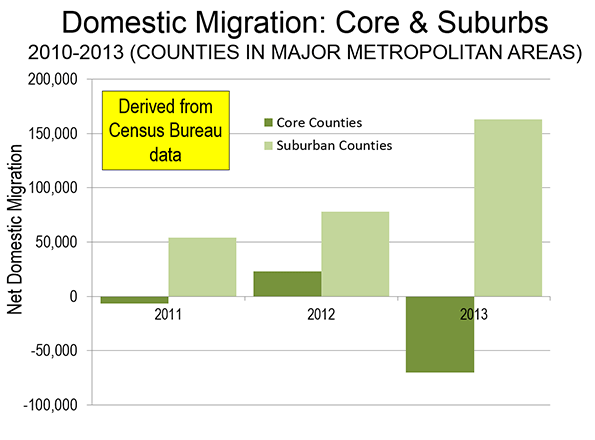
    This is just the latest in the "flocking to the city" mantra that is routinely mouthed without any actual evidence (see: Flocking Elsewhere: The Downtown Growth Story). The latest Census Bureau estimates show that net domestic migration continues to be negative in the core counties (which include the core cities) of the major metropolitan areas (those with more than 1,000,000 residents). The county level is the lowest geographical level for which data is available.

    At the same time, there is net domestic inward migration to the suburban counties. Moreover, much of the net domestic migration to metropolitan areas has been to the South and Mountain West, where core cities typically include considerable development that is suburban in nature (such as in Austin, Houston and Phoenix). As the tepid "recovery" has proceeded, net domestic migration to suburban counties has been strengthened (see: Special Report: 2013 Metropolitan Area Population Estimates), as is indicated in the Figure.

    There is no question but that core cities are doing better than before. It helps that core city crime is down and that the South Bronx doesn’t look like Berlin in 1945 anymore. For decades, many inclined toward a more urban core lifestyle were deterred by environments that were unsafe, to say the least. A principal driving force of this has been millennials in urban core areas. Yet, even this phenomenon is subject to over-hype. Two-thirds of people between the ages of 20 and 30 live in the suburbs, not the core cities, according to American Community Survey data.

    To his credit, Frizell notes that the spurt in multi-family construction is "not aspirational," citing the role of the Great Recession in making it more difficult for people to buy houses. As I pointed out in No Fundamental Shift to Transit: Not Even a Shift, 2013 is the sixth year in a row that total employment, as reported by the Bureau of Labor Statistics was below the peak year of 2007. This is an ignominious development seen only once before in the last 100 years (during the Great Depression).

    In short, urban cores are in recovery. But that does not mean (or require) that suburbs are in decline.

  • Business Insider: “Americans are Still Moving to the Suburbs”

    Andy Kiersz’s article in the Business Insider  (see Americans are Still Moving to the Suburbs) summarizes data from the US Census Bureau’s American Community Survey (ACS) to conclude that "Americans still love the suburbs, and are still moving there from big cities."

    This has long been and continues to be indicated in the data, even as major media rely on anecdotes are to suggest that large numbers of people are leaving the suburbs to "return" to the core cities (from which, by the way, most never moved). There is no doubt that the core cities are doing much better than before, and that is a good thing. Much of this is because the cities are safer than in the 1970s and 1980s. The historic urban core has been restored as an integral part of the modern urban area. However, promoting the health of core cities does not require demeaning or dismissing the suburbs, which are just as integral to modern urbanism as core cities.

    Kiersz refers to a list of the 25 largest met migration movements between counties as reported by the ACS for 2007 to 2011. In every case, the 25 largest net domestic migration movements are from more highly urban core environments to more suburban environments (domestic migration is measured only at the county level).

    The list shows that even within the nation’s largest core city, New York, people are moving to more dispersed areas. This includes net migration from Manhattan to the Bronx and Brooklyn to Queens. Then there is the suburban movement, with a stream of migrants from Queens, in the city to adjacent, suburban Nassau County. Migration from Nassau County even further out, to Suffolk County also made the top 25.

    The outward movement is not limited to New York. A net 50,000 people left the Los Angeles metropolitan area than arrived, just among the 25 largest county migration pairs. Most went to the Riverside-San Bernardino area (which depending on the definition can be called "exurban") and a large number to the Bakersfield metropolitan area. Within the metropolitan area, 10,000 moved from Los Angeles County to Orange County.

    The city (also a county) of San Francisco, which has had the strongest growth of any fully developed major US municipality that has not annexed since 1950, lost 5,000 people to nearby suburban San Mateo County.

    The top 25 also includes nearly 20,000 people moving from Chicago’s core Cook County to three suburban counties.

    It will probably be quite a long time, if ever, before the top 25 migration list has meaningful representation showing movement from suburban counties to core counties. Yet, today’s more healthy cities will do better if they genuinely tackle their remaining challenges. Most important are their education systems that send a disproportionate share of young families to the suburbs. However, from the United States to Europe, Japan, and China, the natural order is that cities (metropolitan areas with their core cities, suburbs, and exurbs) tend to disperse as they add population. That reality is again confirmed by the new data.

  • The Undead Suburban Office Market

    The restoration of central city living and working environments has been one of the more important developments in the nation’s metropolitan areas over the past two decades. Regrettably, a good story has been exaggerated out of all proportion in the print, electronic and online media.  

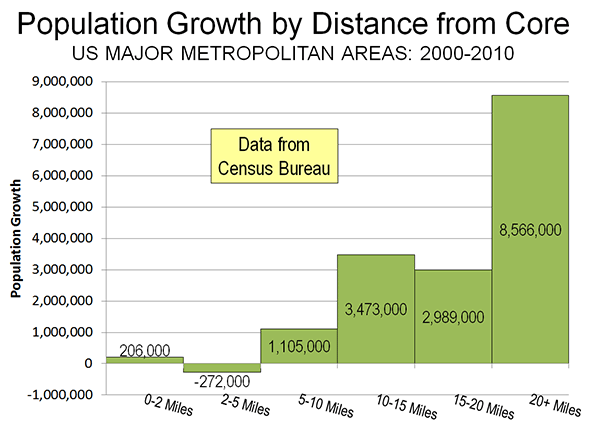
    Exaggerating Core Population Increases: The rise of population in urban cores has been important, but it has too often been used to suggest the apparent, but fallacious opposite, suburban decline. In fact, the suburbs are hardly in decline, with 93.5 percent of major metropolitan area growth outside a 10 mile radius from city hall between the 2000 and 2010 censuses (See: Flocking Elsewhere: The Downtown Growth Story).

    Exaggerating CBD Office Space Gains: Similar misinformation had been circulating about office space outside the nation’s CBDs (central business districts, or “downtowns”). Commercial real estate information company Costar’s Randyl Drummer recently described suburbia’s improving fortunes (See: Once Left for Dead, Suburban Office Making a Comeback).

    “Some analysts wrote the obituary of the suburban office campus as downsizing companies shed millions of square feet, in many cases consolidating into buildings closer to public transit in urban centers.” 

    It’s just not happening, according to Costar research:

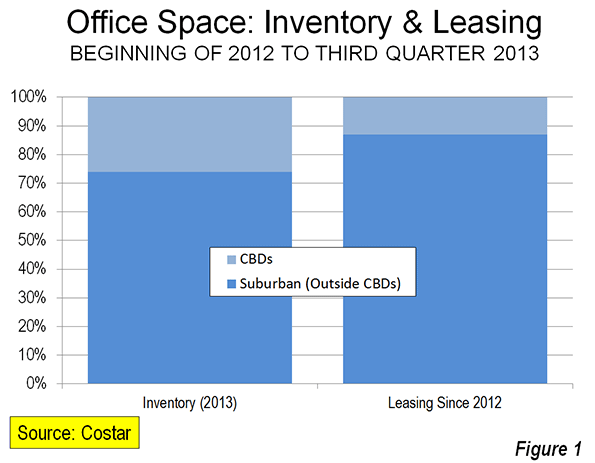
    “Overall, the suburbs have garnered more than their usual share of leasing demand over the past two years, according to an analysis by CoStar real estate economists. Since the beginning of 2012, suburban markets have accounted for a whopping 87% of office demand — which is 13% more than their ‘fair share’ based on the total market size compared with CBD office markets, according to data presented at CoStar’s recent third-quarter office review and forecast.” 

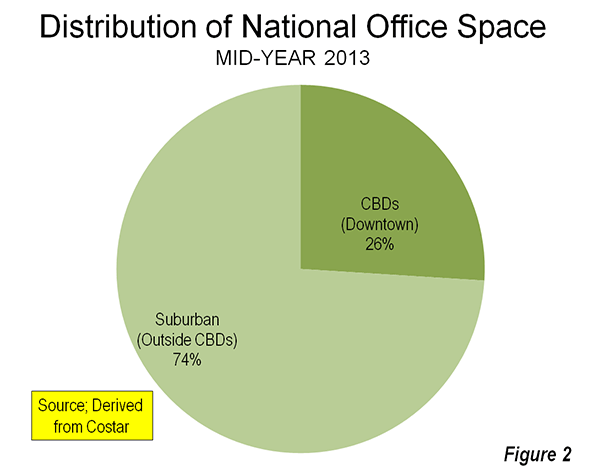
    Indeed, CBD leasing, at 13 percent of the total, is a full 50 percent below their current share of inventory (Figure 1). As of mid-2013, the suburbs accounted for nearly three quarters of the nation’s office inventory (Figure 2).

    Costar cites strong suburban development in Raleigh’s Research Triangle, and further notes that:

    A diverse set of markets that include Sacramento, San Jose, Austin, Kansas City and Charlotte have posted some of the strongest net office absorption among suburban markets.

    This is despite the glowing publicity being given to core area development, especially in places like Charlotte and Austin.

    The reality is that the monumental CBD towers dominating metropolitan skylines do not indicate downtown dominance. In fact, throughout the high income world, most metropolitan employment is outside CBDs. In the United States, typically 90 percent of employment is outside the CBDs. The suburban employment (outside the CBD) share is a bit smaller in Western Europe, Canada and Australia, but still averages approximately 80 percent or more.

    The good news is that neither suburbia nor downtown is dead.

  • Urban Core Boomer Populations Drop 1 Million 2000-2010

    This may be a surprising headline to readers of The Wall Street Journal and the Washington Post, which reported virtually the opposite result in their August 19 editions. The stories, “Hip, Urban, Middle-Aged: Baby boomers are moving into trendy urban neighborhoods, but young residents aren’t always thrilled,” by Nancy Keates in The Wall Street Journal and “With the kids gone, aging Baby Boomers opt for city life,” by Tara Barampour in the Washington Post reported on information from the real estate firm, Redfin (a link to the corrected Wall Street Journal story is below). Both stories reported virtually the same thing: that 1,000,000 baby boomers moved to within five miles of the city centers of the 50 largest cities between 2000 and 2010. Because these results appeared to be virtually the opposite of census results, I contacted both papers seeking corrections.

    When pressed for more information, Redfin.com responded with a tweet indicating that: “We don’t have a link to share or published study; Redfin did a special analysis of Census data at reporters’ requests.”

    In fact, the census data shows virtually opposite. Redfin’s method was not clear, so I queried the five mile radius within the main downtown areas of the 51 metropolitan areas with more than 1,000,000 population in 2010, shown below in this table and figure.

    Within the five mile radius of downtown, there was a net loss of 1,000,000 baby boomers, or 2 percent of the 2000 population (ages 35 to 55 in 2000). There was also a loss of 800,000 in the suburbs, or 17 percent of the 2000 population. The continuing dispersion of the nation is indicated by the fact that there was a gain of nearly 450,000 in this cohort outside the major metropolitan areas. Overall, there was a net loss of 1.3 million, principally due to deaths.

    To its credit, The Wall Street Journal issued a correction, as I would have expected. The incorrect reference to an increase of baby boomers in the urban cores was removed. To my surprise, not only did the Washington Post fail to make a correction, but they also ignored multiple requests to deal with the issue (though my emails received courteous computer generated acknowledgements).

    With the ongoing repetition of the “return to the city from the suburbs” myth, it is important to draw conclusions from the data, not from impressions.

  • Wall Street Journal Reports Reverse of Boomer Moving Trend

    An article by Nancy Keates in today’s The Wall Street Journal indicates that more than 1,000,000 baby boomers moved to within the downtowns of the 50 largest cities between 2000 and 2010. The article quoted Redfin.com as the source for the claim.

    In fact, the authoritative source for such information is the United States Census. The Journal’s claim is at significant variance with Census data.

    First of all, according to US Census Bureau data, the areas within 5 miles of the urban cores of the 51 metropolitan areas with more than 1,000,000  population lost 66,000 residents between 2000 and 2010 (See Flocking Elsewhere: The Downtown Growth Story). It is implausible for 1,000,000 boomers to have moved into areas that lost 66,000 residents (Figure).

    Secondly rather than flock to the city, as the Journal insists, baby boomers continued to disperse away from core cities between 2000 and 2010, as is indicated by data from the two censuses. The share of boomers living in core cities declined 10 percent. This is the equivalent of a reduction of 1.2 million at the 2010 population level (Note). The share of the baby boomer population rose 0.5 percent in the suburbs, the equivalent of 175,000. Outside these major metropolitan areas, the share of baby boomers rose three percent, which is the equivalent of 1,050,000. All of the net increase in boomers , then, was in the suburbs or outside the major metropolitan areas, while all of the loss was in the core cities.

    Among the 51 major metropolitan areas, only seven core cities gained baby boomers (See table at Demographia.). Among these seven, only two had larger percentage gains than the suburbs in the same metropolitan areas. One of these was Louisville, which accomplished the feat by a merger with Jefferson County. Louisville’s gain appears to have been simply the result of moving boundaries, not moving people.

    Note: The age groups used are 35 to 55 in 2000 and 45 to 65 in 2010, which approximate the baby boomers. There was a decline in the number of baby boomers between 2000 and 2010 (largely due to deaths). The figures quoted in this article allocate the same percentage loss from this reduction to the 2000 baby boomer population for each core city and metropolitan area (the national rate).

  • Will Obamacare Bail Out Cities?

    When Rahm Emanuel was Barack Obama’s Chief of Staff, little did he know he’d be helping craft a law that would help him as the future Mayor of Chicago. Many American cities failed to put away enough money for current and former government workers.  Rahm Emanuel and powerful Democratic Party interest groups would like the federal government to bailout their pensioners. While the unions are less shy about looting federal taxpayers, Emanuel is working hard getting federal help.

    Emanuel needs to cut costs immediately to prevent more downgrades from the bond rating agencies.  One of Emanuel’s creative financial techniques involves the use of Obamacare as way of pushing some financial costs from the city of Chicago budget onto the federal government.  Many retired workers don’t like or want Obamacare.  The Chicago Sun Times reports :

    Chicago’s 30,000 retired city employees are trying to stop Mayor Rahm Emanuel from saving $108.7 million — by phasing out the city’s 55 percent subsidy for retiree health care and foisting Obamacare on them.

    One week after an unprecedented, triple-drop in Chicago’s bond rating, retirees have filed a class-action lawsuit against the city and its four employee pension funds that threatens to make the financial crisis even worse.

    The suit argues that the Illinois Constitution guarantees that municipal pension membership benefits are an “enforceable contractual relationship which may not be diminished or impaired.”

    Chicago’s retired workers aren’t the only individuals unhappy with Obamacare.  IRS workers don’t want Obamacare but likely will find they can’t keep their current health insurance.  All of this is providing massive strains on the Blue Model coalition of government workers and the Democratic Party.  In Chicago, at least retired government workers can know who to blame for their change in health insurance if they lose their lawsuit. Mayor Rahm Emanuel not only was instrumental in getting Obamacare passed but now he’s dumping Obamacare on thousands of workers as Chicago’s Chief Executive.

  • MoneySense Top 10 Best Places to Live in Canada in 2013

    Here we go again! Another ranking of the “best” places to live. I wonder how many of those there are.  They just pop up on your computer screen like unwanted ads. Perhaps there are so many “best” cities rankings that at some point most cities end up winning or being in the top 10. Mayors and chambers of commerce know it, just like car companies. If you don’t win the top prize you will simply pick a category and exploit it to death to sell your product. It could be safety, trunk size, fuel efficiency, resale value. In the case of cities, it can be average house price, commuting time, unemployment rate, safety and the pièce de resistance, the vaguest criteria of all, the one that makes rankings such subjective tool: amenities.

    What does it mean for MoneySense to be the best? A look at the methodology shows that the criteria are quite typical of most rankings: crime, amenities, commuting, heath, housing etc.  Also, the number of points given to each criterion varies from one to another and are totally based on the mood of those who design the ranking. If you think that dry weather is important then you will give it more points. If you dislike bike paths you give it less point. If professional sport teams seem unimportant, you simply don’t use it as a criterion.

    One big mistake that those guys do is to mess up distinctions between metropolitan areas and suburbs. Too often, they only include the boundaries of municipalities and break up larger cities into pieces even though they are really parts of greater metropolitan areas.  For example, The Greater Toronto Area (GTA) has close to 6 million residents. The Municipality (or City) of Toronto has about 2.5 million people. Mississauga, a populous suburb of the GTA, but has its own place  in the very same ranking. How can this be? This is major flaw, a very common one.

    So let’s take look at the ranking. We indicate when a city was part of a Census Metropolitan area):

    1. Calgary, Alberta
    2. St. Albert, Alberta ( a suburb of the Census Metropolitan Area of Edmonton)
    3. Burlington, Ontario (a suburb of the Census Metropolitan Are of Toronto)
    4. Strathcona County, Alberta ( a suburb of the Census Metropolitan Area of Edmonton)
    5. Oakville, Ontario (a suburb of the Census Metropolitan Are of Toronto)
    6. Ottawa, Ontario (Since all suburbs of Ottawa has been amalgamated it couldn’t be broken down like Edmonton or Toronto)
    7. Saanich, British Columbia ( a suburb of the Census Metropolitan Area of Victoria)
    8. Lacombe, Alberta ( a suburb of the Census Metropolitan Area of Edmonton)
    9. Lethbridge, Alberta
    10. Newmarket, Ontario (a suburb of the Census Metropolitan Are of Toronto)

    It would be hard to end up with a more flawed ranking. There is a mix of small cities (Lethbridge), the mid-size city of Ottawa, with suburbs that have been amalgamated into one unified City of Ottawa, without taking account that the Census Metropolitan Area includes the City of Gatineau, across the Ottawa River, in the Province of Québec. It is simply impossible to judge a suburb or a city that is part of a metropolitan area and ignore the fact that its amenities, transportation system, jobs, highways etc. are all linked. How would Mississauga’s economy perform if it wasn’t of Toronto, or its airport, (located in Mississauga!)? How would Ottawa do if they didn’t have its pool Gatineau and its pool of 75,000 civil servants living in its more affordable houses, commuting by across the Ottawa River by one of its 5 bridges?

    I am not pro-gentrification nor a big fan of downtown living, at least not until my kids will live at home. I myself live in an Ontario suburb of Ottawa, while commuting by train to Montreal a few times a month. However, I am fully aware that my suburb would not exist if not for downtown Ottawa. When 75% of the labour force living in my suburb commutes to downtown Ottawa each day to go to work, if the city had not been amalgamated in 2000, I would have laughed at any ranking that would have considered my suburb as a stand- alone city.

    Please guys, you do not rank cities like you rank sports teams.

  • Nerdwallet.com Mixes Apples and Oranges on “Worst Cities for Drivers”

    The website nerdwallet.com mixes apples and oranges in producing a list of the 10 worst "cities" for car drivers in the United States. The ratings hardly matter, since the nerdwallet.com score is based on a mixture of urban area and municipality data.

    The Apples: Nerdrwallet.com uses the Texas Transportation Institute traveled the may delay measures for urban areas. These are areas of continuous urban development that always include far more population than is in the central city or municipality. There is no data for the traffic congestion measures at the central city level. These traffic congestion scores are nerdwallet.com’s "apples."

    The Oranges: The oranges of the population densities for the core municipalities. For example, the density shown for New York is that of the city, at 27,000 per square mile. The urban area has a density of approximately 5000 per square mile.

    The Comparison: The net effect is that nerdwallet.com uses the city of New York, with its 8 million people in approximately 300 square miles to the New York urban area with approximately 18 million people in 3,400 square miles. These are not the same things and any score derived from the mixing of these two definitions is inherently invalid.

    This is one of all too many examples of comparisons that are made in the press between "cities," with editors and fact checkers taking insufficient care to ensure that they are using comparable data.

  • Applying the Urbanophile’s Beliefs About Cities to Houston

    Last month The Urbanophile posted his statement of beliefs about cities, and a lot of them resonated with me about Houston.  Here are some favorite excerpts along with my own thoughts.

    * Great cities, like great wines, have to express their terroir. There is no one-size-fits-all model of urban success. Our cities are as diverse as their citizenry. To succeed, they need to express their own essential and unique character.  

     This is why you always have to be skeptical when somebody says something like "For Houston to be world class we have to do X like city Y."  I believe that especially applies to heavy rail commuter transit in our decentralized, car-based city, but it also applies to recent questions like "Why can’t Houston have downtown retail like Chicago’s Magnificent Mile or New York’s Fifth Avenue?"  Because we’re not like them, and we already have our pedestrian-oriented upscale shopping district: it’s called The Galleria, one of the largest malls in the country, and with plenty of parking and climate control to boot!

    * Don’t try to beat other cities at their game. Instead, make them beat you at yours. Cities are unique – yours included. Instead of fretting about measuring up to the planet’s elite metropoli or trying to emulate them, cities should figure out their unique strengths that other places can’t match.

    Hear, hear! To quote an old post of mine: "Houston starts the 21st-century with a set of amenities 99% of the planet’s cities would kill for: a vibrant core with several hundred thousand jobs; a profitable and growing set of major industry clusters (Energy, the Texas Medical Center, the Port); the second-most Fortune 500 headquarters in the country (26); top-notch museums, festivals, theater, arts and cultural organizations; major league sports and stadiums; a revitalized downtown; astonishing affordability (especially housing); a culture of openness, friendliness, opportunity, and charity (reinforced by Katrina); global diversity; a young and growing population; progressiveness; entrepreneurial energy and optimism; efficient and business-friendly local government; regional unity; a smorgasbord of tasty and inexpensive international restaurants; and tremendous mobility infrastructure (including the freeway and transit networks, railroads, the port, and a set of truly world-class hub airports)."

    * It says something powerful about a city when people vote with their feet to move there, to plant their flag, to seek their fortune. There is no more telling statistic about a place than in-migration. It’s important to know if people are moving into or out of a city–and why.

    The most ignored statistic of the creative class city boosters, because their idols – NYC, Boston, Chicago, SF, LA – fail horribly on it.

    * Moreover, new blood isn’t just nice to have, it’s essential. In an ever-more globalized, rapidly changing, competitive world, a city’s best interests are not served by being populated with people who’ve never lived anywhere else.

     Points for our global diversity.

    * But it isn’t just about the best and brightest, either. Attracting the educated is important, but cities are also where the poor come to become middle class, where immigrants come to build a better future for themselves and their families. Their needs must be taken up, too–and equally.

    Hallelujah for Opportunity Urbanism (and more here).

    * A great city needs great suburbs. To pull our cities up, there’s no need to tear our suburbs down. To be successful in the modern era, its important for every part of a metropolitan region to thrive and bring its “A game”. 

    * “Building on assets” is a trap. The only reason we have any man-made assets in the first place is that previous generations of leaders didn’t follow that strategy. Only building on assets is a strategy about defending the past, not embracing the future. It is the spending down of our urban inheritance. Yes, leverage assets, but also add totally new things to the pot for future generations.

    Absolutely.

    * We need to look forward, not backward. There is no more corrosive force than nostalgia. We should know where we’ve come from and what we stand for. But we can’t become imprisoned by a yearning for an imagined past that never really was.

    * We need to embrace a 21st century vision of urbanism. Urbanism – Yes, but trying to copy Greenwich Village 1950 is not the answer. To find it, we must boldly re-imagine the possibilities of what a city can be and bravely identify what works today-and what doesn’t.

    Yep – time to rethink Jane Jacobs.

    * We don’t know where this ride is taking us. We’re at a pivotal time in America’s urban history. So much is changing, and more change is yet to come. For our own sake, we should not assume that we’ve arrived where we’re headed, or that we have the answers. If there’s one thing we should take away from the urban planning failures of the past, it is a strong dose of humility.

    "Planning for utopia" doesn’t work.  Cities need the freedom to evolve organically.

    This piece first appeared at Houston Strategies.