Tag: cities

  • Mobility on the Decline

    Faced with an economic downturn and a bursting real estate bubble, Americans look to be staying put in greater numbers. According to Ball State demographer Michael Hicks, interviewed in an article examining the trend in the San Francisco Chronicle, “Property values have dropped so much, people can’t pick up and move the way they used to.”

    In April, the Census Bureau reported that in 2008, the “national mover rate,” declined to 11.9 percent, down from 13.2 percent in 2007. This marks the “lowest rate since the bureau began tracking these data in 1948.” As William Frey, a demographer at the Brookings Institute, puts it, “the most footloose nation in the world is now staying put.”

    According to Frey, the middle of the decade was marked by a “mobility bubble,” spurred on “by easy credit and superheated housing growth in newer parts of the Sun Belt and exurbs throughout the country”. As the recession took hold through 2008, migration to suburbs and exurbs fell “flat in a hurry,” showing “just how rapidly changing housing market conditions can affect population shifts.”

    While, as Frey suggests, people may be moving into suburbs and exurbs at a slower rate, central cities within metro areas continue to lose population. The Census Bureau reports that during 2008 “principal cities within metropolitan areas experienced a net loss of 2 million movers, while the suburbs had a net gain of 2.2 million movers.” While the downturn in migration may help central cities hold onto some of their population, Frey contends that “it remains to be seen whether the migration-fueled engines of the early 2000s—especially the Sun Belt and outer metropolitan suburbs—will regain their former status.”
  • City & Suburban Trends: Sometimes it Helps to Look at the Data

    Jonathan Weber writes that “Most demographic and market indicators suggest that growth and development across the country are moving away from the suburban and exurban fringe and toward center-cities and close-in suburbs,” in an article for MSNBC entitled Demographic trends now favor downtown: Growth across the country moves away from suburban and exurban fringe.

    One might wonder what country Weber is writing about. In the United States, growth and development continues to be concentrated in suburban and exurban areas. Moreover, strong domestic migration continues away from the center cities and close-in suburbs, as evidenced by the fact that between 2000 and 2008, 4.6 million domestic migrants left the core counties of the metropolitan areas over 1,000,000 population, while 2.0 million moved into the suburban counties.

    The case is apparently furthered by the obligatory reference and photograph of The Model, Portland, Oregon. However, even in Portland, the suburbs are doing far better than the core. Since 2000, the suburbs have gained 106,000 domestic migrants, while the core county (Multnomah) has lost 4,000 domestic migrants. The IRS micro-data further indicates that the core continues to lose net domestic migration to the suburban counties.

    It appears that the only trend indicating that the suburbs are losing out to central cities is the exponential increase in articles blindly parroting “death of the suburbs” dogma.

  • Moving Away from the City: The Reality Missed by the Fairfax County Survey

    Political “spin” descended to a new low today with the publication of survey results purporting to suggest that suburban residents and workers are pining for city life. The Washington Business Journal dutifully reported that Today’s suburban workers and residents miss the amenities of cities. The survey sponsor, the Fairfax County (Virginia) Economic Development Authority noted that “almost half of workers who work in the suburbs, say they want more public transportation, more housing options, greater access to useable green space or a better variety of job opportunities – typical features of cities.”

    All of this may sound impressive until you realize that no one urban “amenity” was mentioned by more than 25 percent of respondents. That means, for example, that 77 percent of responding suburban residents did not consider “access to convenient public transportation” important enough to mention, while 23 percent did.

    According to the Economic Development Authority, the survey indicates that 52 percent of residents “say they would move to a community that offered more of these” urban amenities.

    The survey got the moving part right, but missed by a mile on where they are moving. From 2000 to 2008, more than 100,000 domestic migrants left Fairfax County, 11 percent of its 2000 population. But they didn’t move to the city (Washington) or to more urban Alexandria or Arlington, because all of these lost domestic migrants as well. Indeed, the only counties in the Washington, DC area that gained domestic migrants are further from the city than Fairfax County.

  • Mapping Urban Income Dispersion

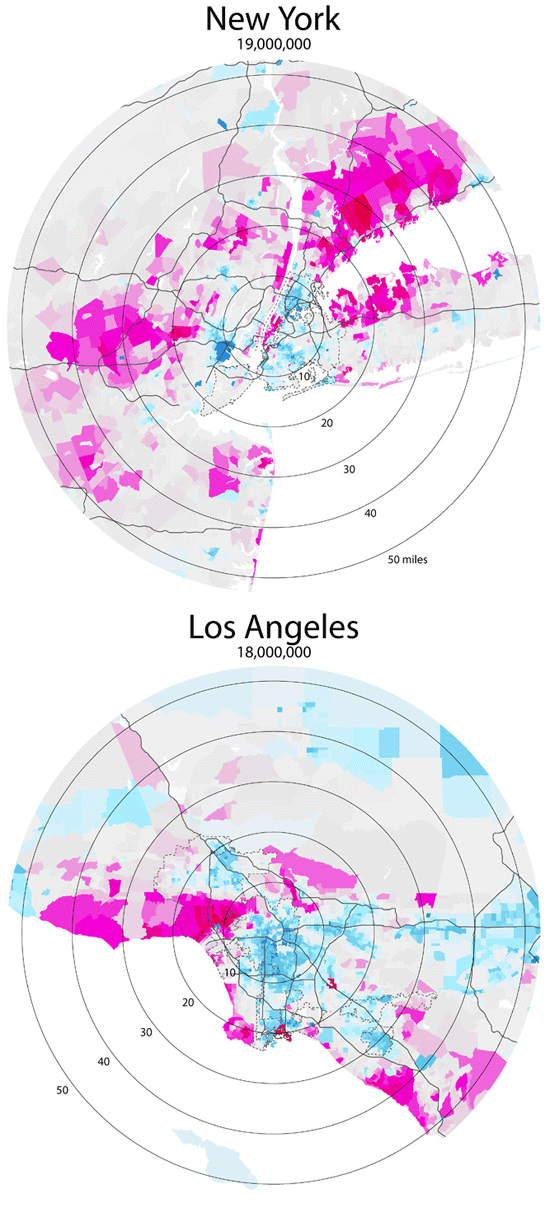
    Here’s some cool maps from radicalcartography.net looking at income dispersion in the country’s 25 largest metropolitan areas by population. From the page:

    These maps show the distribution of income (per capita) around the 25 largest metropolitan areas in the US (all those with population greater than 2,000,000). The goal was to test the “donut” hypothesis — the idea that a city will create concentric rings of wealth and poverty, with the rich both in the suburbs and in the “revitalized” downtown, and the poor stuck in between.

    This does seem to have some validity in older cities like Boston, New York, Philadelphia, or Chicago, but in newer cities it is not the case. Instead of donuts, one finds “wedges” of wealth occupying a continuous pie-slice from the center to the periphery.

    Just from visual inspection, it also seems that poverty donuts all tend to have about a five-mile radius, regardless of the size of the city. Perhaps this is the practical limit for commuting without a car?

    All maps are at the same scale, and all use the same color values for income.

  • GHG Emissions by Type of Geography

    The suburbs, generally a haven for luxury SUVs, regimented lawn sprinkling, and keep-up-with-the-Jones purchases, are not often considered the front-runner in environmentally friendly living.

    However, the Australian Conservation Foundation’s 2007 Consumption Atlas published controversial research that suggested that “dense inner-city zones unleash more greenhouse emissions than car-loving fringe suburbs.” Suddenly, car use is not the prime factor in measuring efficient living, nor can incomes tell the whole story. ()

    While it has been generally accepted that high human consumption is worse for the planet than lower consumption, the study’s main controversy is the fact that the ACF gave the problem a specific geography.

    The quote:

    Rural and regional areas tend to have noticeably lower levels of consumption . . . Higher incomes in the inner cities are associated with higher levels of consumption across the board.

    The ACF has not only pointed their finger at their main supporters (inner-city professionals) but have also invited comments from a variety of sources. The Australian study questions the data used in the past to measure where the worst violators are located.

    American consultant Wendell Cox—long an advocate of suburban development—found that the data suggested that “lower GHG emissions were associated with long distance from the (urban) core, detached housing, more automobile use and lower population density.”

    A team from Queensland’s Griffith University Urban Research Program drew an altogether different conclusion that put simply is, “correlation does not establish causality.”

    GHG emissions are a function of overall consumption and consumption based on low-density housing “doesn’t figure prominently in the composition of aggregate consumption.”

    Urban sprawl cannot be used as an argument or attempt to point fingers at the Hummer drivers. Lowering greenhouse gas emissions will require a commitment by city dwellers and suburbanites alike if we are to alter our future carbon footprint.

    While the study itself has prompted much discussion and debate, if the object is to cut down on greenhouse gas emissions, singling out suburbia might not be the first order of business. Spurious data and indeterminate causality make for an argument destined to fail for the lack of a supportable conclusion – unless we wish to overturn logic entirely, which some seem determined to do in furtherance of their long-held anti-suburban agenda.

  • NGVideo: East St. Louis (Part II)

    The second part in the series on East St. Louis gives views of downtown today, shows how its history can be seen in the city, and explains why the city could still be a good place for new development.

    Part I discusses the origins and development of East St. Louis as an industrial city.

    Part III will explore ideas put forward for (re)development of the city, including cultural tourism based on the city’s African American heritage and use of vacant land for farming to create a local food source for the St. Louis metropolitan area.

    Michael R. Allen is the Assistant Director at Landmarks Association of St. Louis. He edits the blog Ecology of Absence, “a voice for historic preservation and a chronicle of architectural change in St. Louis, Missouri and its region”.

    Alex Lotz is an undergraduate film student in his final year at Chapman University.

  • NGVideo: East St. Louis (Part I)

    The first in a series of videos about the economic, political, and cultural history and future of East St. Louis, Illinois.

    Part II gives views of downtown today, shows how its history can be seen in the city, and explains why the city could still be a good place for new development.

    Michael R. Allen is the Assistant Director at Landmarks Association of St. Louis. He edits the blog Ecology of Absence, “a voice for historic preservation and a chronicle of architectural change in St. Louis, Missouri and its region”.

    Alex Lotz is an undergraduate film student in his final year at Chapman University.

  • A (New) Place to Call Home

    A recent survey by Pew Research finds that nearly half of Americans (46%) “would rather live in a different type of community from the one they’re living in now,” with those living in cities expressing the highest desire to live elsewhere.

    Even though many Americans say they are interested in giving somewhere new a try, most of us seem to think that our current communities aren’t so bad. According to Pew, over 80% of respondents rated their current community as excellent, very good, or good. The survey also reports that “ideal community type” was not dominated by any one class of place, with 30% preferring small towns, 25% suburbs, 23% cities, and 21% rural areas.

    Pew also asked those surveyed about their interest in living in specific big cities. Denver came out on top, with 43% of respondents stating that they would be interested in living in its metro area. Other western cities also fared quite well, with seven of the top ten “popular” cities being located in the west. The remainder of the top ten was made up of southern cities. Cities in the north and east lagged behind in popularity, with the rustbelt cities of Detroit and Cleveland registering the lowest popularity. (8% and 10%)

  • New Census Data on Cities

    US Census released the latest population data on cities this week. Looking at the top 15 largest US cities, only Sunbelt cities of Phoenix, San Antonio, Houston, and Jacksonville are ahead of the national rate since 2000. Interestingly, the cities of San Francisco and San Jose are making a recent comeback after losses early this decade, although San Francisco is still trailing its year 2000 mark.

    Tory Gattis explains the situation in Houston, where the population of the city has exploded since 2005.

    The fastest growing larger city overall since 2000 is Raleigh, followed by a pile of places in warm climates, two in the Denver metro, along with plains cities of Omaha and Oklahoma City.

    Many California cities fill out the smaller cities list, along with two from the Chicago metro and Olathe and Sioux Falls on the plains.