Tag: Cleveland

  • Changing the Narrative in Cleveland

    Cleveland, like many Rust Belt cities, has both an image and a self-image problem. Its residents have simultaneously had passion and loyalty for the city, while also being filled with shame about it and relentlessly negative and fatalistic about its future. Again, this is something that is the case for any number of places.

    This is a problem because the economy runs on expectations. Why do you start a business doing X? Because you expect to make a profit at it. Why move to city Y? Because you expect the job you have there will be a good fit or you otherwise expect that you are going to find personal satisfaction there.

    If we expect the economy to do poorly, we tighten our belts and help create the weakened demand conditions that bring that economy about. If we have positive expectations about the future we behave differently.

    Any number of cities seemed to be created from nothing much out of sheer boosterism, a sort of fake it till you make it approach that generated expectations that ultimately became a self-fulfilling prophecy. Houston may be a good example of this.

    So in a sense the real future of a place depends on people’s expectations about it in the future. That’s not to say that any expectation can simply be willed into being. Just because you expect to win the Super Bowl doesn’t mean it will happen. But positive expectations play a critical role in creating positive realities.

    Expectations are simply beliefs about the future, and thus can be shaped by sales and marketing techniques. This is part of what the city branding business is all about.

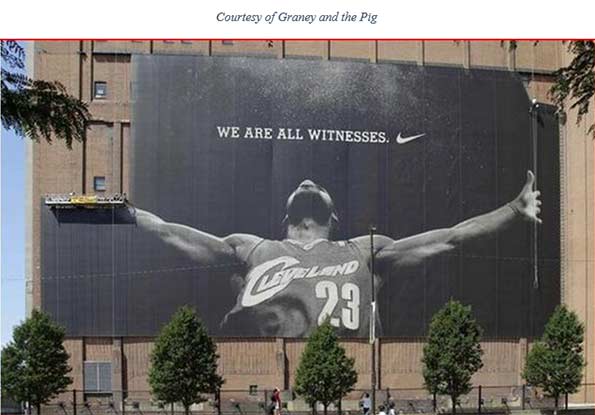
    Traditionally, marketing folks in Midwest cities have struggled to definite a positive aspirational identity and sell it to the world. Cleveland falls into this category. But a recent article in Cleveland Magazine talks about how the narrative and expectations about the city have changed in light of recent developments such as the return of LeBron James and the resulting NBA championship.

    “It got to the point where we began to believe the negative side of our image, to the point where we ourselves began to reinforce that,” says Mayor Frank Jackson. “When we did that, it became true, not only what the world thought we were, but also what we thought we were.”

    Research by Destination Cleveland showed that in 2012, only 34 percent of locals would recommend Cleveland to friends and family. Consider that for a second. Only five years ago, 66 percent of Clevelanders were so down on their town they couldn’t even bear the agony of putting in a good word with their college pals or Uncle Al. Other similar cities would usually have positive numbers in the mid-60s.

    Well, we’ve got a problem, thought David Gilbert, Destination Cleveland president and CEO.

    Five years later, amid an avalanche of good news, our chests swell with civic pride. LeBron came back. We won an NBA championship and made it to the World Series in the same year. We hosted a major political convention. The renovated Public Square opened. The lakefront is blossoming. Health care technologies and professional services are opening a connection to the globalized economy. We are, proportionately speaking, drawing more than our fair share of millennials to the region.

    The article goes on to describe the various ways in which Clevelanders are much more optimistic about the future of their city than they were in the past. That’s great news and a sign of shifting internal expectations.

    It’s hard to convince the world your city is great if you don’t even believe it yourself. I myself have had the experience in other cities of having people berating their own town and wondering why people who had moved there had done such a darned fool thing. Changing the internal narrative really helps set the stage for changing the external one.

    The article rightly highlights the risk facing Cleveland and other cities in the region. Namely that this expectations turnaround has been based on events like the NBA win, the GOP convention, etc. Previous Cleveland renaissances flamed out when those externals changed.

    The challenge for Cleveland is to create something durable that carries them through the difficult challenge of long term change and dealing with some of the challenges they face. But for now the fact that the spirits of residents have been lifted – and not without cause – and that there have been some events that generated positive national press is good news for this long-struggling city. It’s right and proper to celebrate it.

    This piece first appeared on Urbanophile.

    Aaron M. Renn is a senior fellow at the Manhattan Institute, a contributing editor of City Journal, and an economic development columnist for Governing magazine. He focuses on ways to help America’s cities thrive in an ever more complex, competitive, globalized, and diverse twenty-first century. During Renn’s 15-year career in management and technology consulting, he was a partner at Accenture and held several technology strategy roles and directed multimillion-dollar global technology implementations. He has contributed to The Guardian, Forbes.com, and numerous other publications. Renn holds a B.S. from Indiana University, where he coauthored an early social-networking platform in 1991.

    Photo by Aeroplanepics0112 (Own work) [CC BY-SA 3.0], via Wikimedia Commons

  • Cleveland Renaissance Fair

    So much talk of the Cleveland comeback with our downtown building boom and Republican National Convention-fueled makeover makes it difficult not to think about our mid-1990s civic renaissance. In 1995, The New York Times headline proclaimed ” ‘Mistake by the Lake’ Wakes Up, Roaring” as downtown’s stadiums and lakefront development created a “new face and new style of a city that for a long time had little panache.”

    But it wasn’t just the media who became enchanted with our freshly minted charms — even the scholars were feeling it. The academics, however, had a Lake Erie-sized caveat. There was a divide in the region’s comeback, noted the authors of the 1997 study “The Rise and Fall and Rise of Cleveland,” with areas separated by characteristics of “capital investment and disinvestment, industrialization and deindustrialization, suburbanization and ghettoization, white flight and a black underclass, the growth of services, and a [high-skill and low-skill] dual economy.”

    Prophetic then, those words serve as a warning now. The paradox of Cleveland’s comeback, if not an urban American comeback, is that the more a city returns, the greater the number who get left behind.

    Rob English splits his time between Baltimore and Cleveland. He has been doing so for nearly three years.

    A former Army infantryman, he serves as supervising organizer for the Greater Cleveland Congregations, a network of local faith and community-based organizations working for social justice. His experience in Baltimore since 1997 gives him a different perspective on his work in Cleveland today. “You have to meet people where they’re at, listen to them, and find ways to act in their mutual interest,” he says.

    English marched with the Cleveland group in late May after the Michael Brelo trial verdict to demand comprehensive criminal justice reform. As the demonstrators from about 40 religious congregations walked arm-in-arm along downtown streets to City Hall and the Justice Center, it was peaceful — unlike what happened in Baltimore a month earlier. There, the death of 25-year-old Freddie Gray in police custody prompted violent social unrest.

    “Baltimore is about seven to 10 years ahead of Cleveland,” says English.

    Odd as it sounds, what English means is that Baltimore’s economic resurgence has been longer in the making — and that may be a good thing for Cleveland.

    Baltimore’s signature project, the cleanup and rehabilitation of Baltimore’s Inner Harbor with its world-class aquarium and science center, began in the 1980s. Oriole Park at Camden Yards, an architectural model for Progressive Field, opened in 1992.

    With the beautification came a change in the city’s demographics. Today, nearly 27 percent of Baltimore residents have college degrees, compared to 16 percent in Cleveland. Baltimore’s median income ($41,385) is $15,000 higher than here. Cleveland’s poverty rate sits at 35 percent, 12 percentage points more than Baltimore.

    But the benefits in Charm City are not evenly distributed. White city residents earn nearly double that of black city residents. Baltimore also had the ninth worst wage disparity between high- and low-income workers in the nation, according to the Martin Prosperity Institute. So, while the physical redevelopment is apparent in the eyes of all Baltimoreans, the effect is uneven in their temperaments.

    English, 46, recalls a talk he had with an African-American woman from East Baltimore several years back. She could see the Inner Harbor off in the distance from her neighborhood.

    “Let me tell you about my anger,” she told him. “Every morning when I wake up and take the kids to the bus stop, every morning I look down and see the harbor, and every morning I get angrier.”

    Her experience is more than an isolated one, says English. In Baltimore, people saw aspects of the city improve year after year. Yet so many weren’t a part of it. Eventually tensions built, and the Freddie Gray incident ignited it.

    “Now, Cleveland is beginning a renaissance,” English says. “But there is room to come together so you’re not two cities.”

    ——–

    Thomas P.M. Barnett’s book The Pentagon’s New Map is more than a decade old. But its message is no less relevant.

    “Disconnectedness defines danger,” he argues.

    For the expert geostrategist, the world is split between two types of geographies: the Core, where “globalization is thick with network connectivity, financial transactions, liberal media flows, and collective security,” and the Gap, or areas disconnected from globalization and defined by poverty, low education rates and “the chronic conflicts that incubate the next generation” of instability.

    “We ignore the Gap’s existence at our own peril,” concludes Barnett.

    It is a useful model in understanding what’s occurring in Northeast Ohio.

    Consider that, according to a Brookings Institution study, Cleveland and Seattle led the nation with the biggest percentage increases in high-income households from 2012 to 2013. Yet, research from Rutgers University revealed Cleveland also has one of the largest increases in neighborhoods with concentrated poverty since 2000.

    This division is further evident when mapping the concentration of Northeast Ohio residents with college degrees. Higher educated areas are centered in downtown, Ohio City, Tremont, Detroit Shoreway and AsiaTown, which have each seen double-digit percentage increases in residents with college degrees since 2000, as well as along the lakeshore, near University Circle and in various suburban and exurban clusters. Meanwhile less educated areas are grouped in the city of Cleveland outside the urban core and in the rural exurbs.

    Simply, areas of Cleveland that are revitalizing are part of the globalizing Core. The isolate neighborhoods, or those experiencing higher levels of violence and poverty, comprise the Gap.

    In fact, for a number of quality of life indicators, outcomes in various East Side neighborhoods are below that of developing nations. A recent PolitiFact article showed that infant mortality rates were worse in select East Cleveland neighborhoods than in North Korea, Uzbekistan, Zimbabwe and the Gaza Strip.

    According to data by Case Western Reserve University, homicide rates for sections of the city are similarly comparable. In 2010, homicide rates in Ward 1, comprising parts of the southeast side, and Ward 9, which entails Glenville, are similar to Guatemala and El Salvador.

    What’s happening here is not unlike cities such as Chicago, Baltimore, Miami and Brooklyn, New York, where the spatial patterns of having and not having mean poverty gets pushed together, not alleviated. When cities evolve as separate and unequal, they create a deepening sense of alienation and marginalization.

    “The economic and social frustration could be expressed in more recourse to violence,” says Mark Joseph, director of the National Initiative on Mixed-Income Communities at Case Western Reserve University.

    Revitalizing neighborhoods have more “eyes on the street,” says Joseph, who examined the effect in the Second City while at the University of Chicago. And more vigilant policing can “push gangs into more constrained areas of the city and into more conflict with each other.”

    In the first nine months of 2015, for example, there was a 40 percent increase in gun homicides compared to 2014.

    “As we are seeing in our city, innocent bystanders suffer the consequences as well as those directly targeted,” Joseph says.

    In a span of a month, a 5-year-old, a 3-year-old and a 5-month-old were all victims of drive by shootings from gang violence that has boiled over in various East Side neighborhoods.

    After the youngest, Aavielle Wakefield, was killed, Cleveland police chief Calvin Williams stood at the crime scene on East 143rd Street in Cleveland’s Mount Pleasant neighborhood. It was night. The street was lit by the television crews. With Mayor Frank Jackson by his side, the chief demurred about the senseless tit for tat, the need to catch the perpetrators.

    Suddenly, his face went from firm to fragile. “To the family … it’s tough … it’s tough,” he said in tears. “This should not be happening to our city. And we got to do something about it.”

    ——–

    “I have looked into the eyes of children soldiers overseas,” says English, who served a platoon leader stationed in Somalia. “I see the same look in Cleveland and Baltimore. That is what decades of disinvestment has created in our urban areas. It’s got to stop.”

    Click to Enlarge

    English was in Baltimore in April when the riots erupted about 20 miles away from the harbor. The city was on needles. English and a few co-workers received alerts about young people near Mondawmin Mall turning violent.

    The message was to go where the rioting was occurring, with the intent to stem the unrest.

    When English arrived, a CVS was being looted and burned. As a community organizer, English attempted to do what organizers do: connect to the disconnected. But he wasn’t succeeding.

    “I looked at the young people in the eyes,” he recalls. “I lost my soul. I couldn’t connect with them.”

    Anthony Body, a 29-year-old Glenville resident and member of the Cleveland Community Police Commission, sees similarities here.

    “There is a sense of hopelessness,” he says.

    Isolation fuels the cycle of disenfranchisement. Without exposure to positive outcomes, there can only be so much progress. Body says due to the lack of role models in his neighborhood people were influenced by the lifestyle of rappers, drug dealers and the garbage man.

    “There is nothing wrong with being a garbage man,” he says. “But in order to choose Option B, you had to be exposed to Option B.”

    The realities of his neighborhood have taken a personal toll. Body has lost at least one family member or friend to violence every year since 2006.

    “All the trauma. The trauma of no job, the trauma of violence — the lack of family or social support — the schools,” he says, “it all drags on you when you try to better your life, so that when difficulty hits, you just go back to what you know.”

    No doubt, the persistence of violence is not just a Cleveland problem, but a national one. Homicides are up sharply in Washington, D.C., Milwaukee, St. Louis and Baltimore.

    On a mid-October trip to Ohio, FBI director James B. Comey wondered aloud: After years of declining violent crime in cities, why the uptick? “I’m not here announcing any big initiative or program,” Comey said, “but we have a lot of smart people who we brought on board after 9/11 who may be able to help look at the issue differently.”

    Cheap heroin from Mexico and the turf battles to supply what has become a nationwide heroin epidemic was one likely scenario, he offered.

    “What we’re in the midst of is a drug war,” says Hough resident and writer Mansfield Frazier, who likens today’s violence to the St. Valentine’s Day Massacre that left seven men dead in Prohibition-era Chicago.

    For Khrystalynn Shefton, a housing development manager at the Famicos Foundation — a community development corporation in Glenville and Hough — this drug war is not just an urban problem, but an everyone problem. It’s limiting the potential for struggling neighborhoods to appreciate.

    Shefton tells the story of a friend who lives off Rockefeller Park in a beautifully renovated home in Glenville. On a recent Sunday, she was enjoying tea in her sunroom. “A guy pulls up, straps up and does heroin in front of her house,” Shefton says. When he was done, the man left down Martin Luther King Jr. Boulevard to head toward Interstate 90 and back to the suburbs.

    “The pain for me in this renaissance is that as a city we have not figured out that ‘I am my brother’s keeper,’ ” she says. “It’s all connected — the ills in the suburbs and the city.”

    The roots of urban violence run deeper than the existence of a drug war. In September, the Cincinnati Enquirer investigated the Queen City’s rise in gun violence. What Cincinnati was witnessing ran counter to conventional wisdom that crime goes up in bad economic times and down in good times, offered Mayor John Cranley.

    “This is the best economy we’ve had since the Great Recession and yet crime is up,” Cranley explained. “So it’s more likely to be linked to social and cultural than economic reasons.”

    Of course, one could argue that the violence is linked to social and cultural issues stemming from economic reasons. Simply, the economy has changed rapidly since so many worked in the plants. Good economic times have been divorced from so many people, if not a generation of so many people.

    The Georgetown Public Policy Institute found that four out of the five jobs lost since the Great Recession required a high school degree or less. “The shift in the workforce from less-educated to more-educated has been a slow and steady process,” notes the authors.

    In the early 20th century, Cleveland was a magnet for European immigrants, Puerto Ricans and African-Americans because industry needed labor to produce economic growth. Manufacturing built our middle class. It enabled people to move up.

    In 1990, for example, more than 50 percent of Cuyahoga County’s African-American residents lived in heavily segregated East Side city neighborhoods, while today that number is down to 30 percent.

    That said, large-scale launchpad industries for formerly blue-collar communities are now nonexistent. Cleveland lost its old magnetism. But the children and grandchildren of the city’s factory-floored forefathers remain.

    And they are idle. Thirty-eight percent of Cleveland’s males are not in the labor force. In black majority neighborhoods such as Union Miles, Central and Glenville, those numbers approach 50 percent.

    When English first began canvassing Rust Belt cities, the Texas native was amazed at the number of black men standing on the corners. In Baltimore, he got to know many of them.

    “We have always been on the corners,” English recalls one of them telling him. “The difference then is that we had lunch pails, and we were waiting for a ride to the steel mills.”

    While English has been making that point for years, corporate and civic leadership in Baltimore are just now coming around to it, he says. “The unrest in Baltimore and the day-to-day violence in Cleveland — it’s a jobs issue.”

    Body, a good neighbor ambassador supervisor with the Northeast Ohio Sewer District, echoes the sentiment. “People where I live just want opportunity,” he says. “They want to work. Every generation up to recently had [opportunities to work] handed down, somewhere in between it stopped being handed down.”

    Body, who earned a business degree from Malone University while on a football scholarship, considers himself blessed. His parents and higher education taught him critical-thinking skills. He became better prepared for today’s economy. He found his place — and Glenville is a part of it.

    “I’m still playing the dozens and breaking bread with my community,” he says. “I’m trying to express to folks there is another way.”

    But too many of them can’t see it, he says. “The feeling in most folks is disappointment for not being able to join with it.”

    ——–

    There is an understanding in geopolitics that everything local is global. What you see happening on the corner is tied together, whether that’s a vacant house and a skeletal factory or a condo development and state-of-the-art medical research facility.

    It is correlated to Cleveland’s relationship with and relevance in the world. One set of aesthetics are birthed by severing from our economic past, and the other birthed from ties to our economic future.

    In between these aesthetics are people.

    Yes, a younger, more educated generation has found aspiration in Cleveland’s core. Yet to think Cleveland can come back by deepening the pattern of isolation versus prosperity is to ignore a basic tenant of modernization: With evolution comes progress — not just economically, but humanly.

    Cleveland’s rebirth is in its infancy. The city is still alive in the shadows of all it has lost, making it possible for a consciousness to be reborn right.

    Part of this entails learning from the lessons of Baltimore. There, like in Cleveland, the city’s economic transformation is largely spearheaded by the education and medical sectors centered around Johns Hopkins University and Johns Hopkins Hospital in East Baltimore.

    Recently, in the face of Baltimore’s social unrest, the two institutions joined in an initiative called HopkinsLocal. The point is simple: Tackle social and health issues in Baltimore by engaging the city’s poorest residents and preparing the unprepared. By 2018, they plan to fill 40 percent of targeted positions by hiring from within the city’s most distressed communities. In all, it is one of the more robust buy local anchor institution policies in the nation.

    Locally, programs to do something similar with anchor institutions have been developed, particularly the Evergreen Cooperatives. The worker-owned co-ops based in Cleveland’s East Side are contracted out to sell local goods and services to global institutions such as the Cleveland Clinic. While innovative, the efforts need scaling. Discussions are happening in Cleveland to do just that.

    For English, the urgency couldn’t have come too soon.

    “It’s a generational moment,” he says. “In the future, people will look back to now and ask, ‘How did we respond?’ “

    This piece first appeared in Cleveland Magazine.

    Richey Piiparinen is a Senior Research Associate who leads the Center for Population Dynamics at the Levin College of Urban Affairs at Cleveland State University. His work focuses on regional economic development and urban revitalization.

  • America’s Shrinking Cities Are Gaining Brains

    If there’s one thing that’s a nearly universal anxiety among cities, it’s brain drain, or the loss of educated residents to other places. I’ve written about this many times over the years, critiquing the way it is normally conceived.

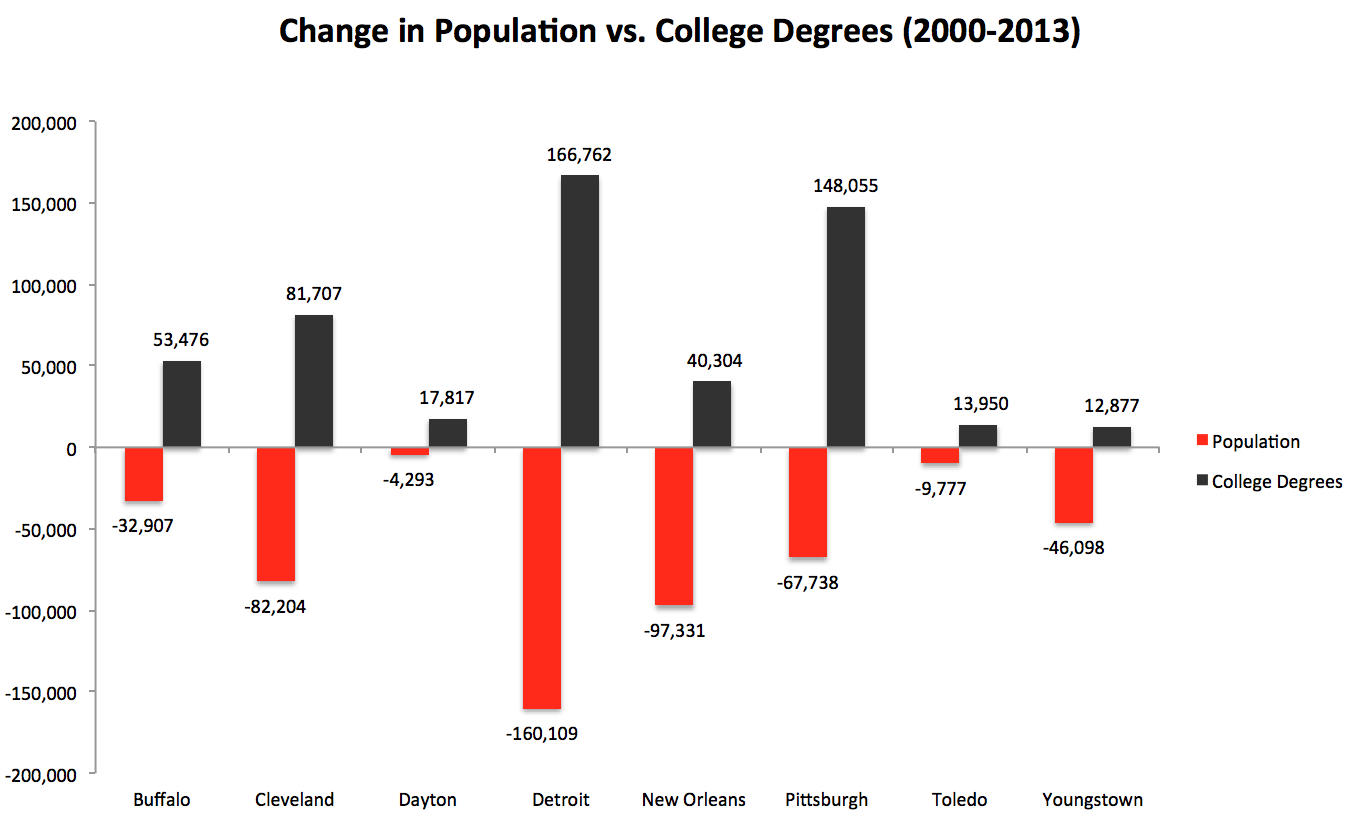
    Since brain drain seems to be a major concern in shrinking cities, I decided to take a look at the facts around brains in those places. Looking at the 28 metro areas among the 100 largest that had objective measures of shrinkage – in population and/or jobs – between 2000 and 2013, I looked what what happened to their educational attainment levels.

    My results were published in my Manhattan Institute study “Brain Gain in America’s Shrinking Cities.” As the title implies, my key findings were:

    • Every major metro area in the country that has been losing population and/or jobs is actually gaining people with college degrees at double digit rates.
    • As a whole the shrinking city group is holding its own with the country in terms of educational attainment rates, and in many cases outperforming it.
    • Even among younger adults, most shrinking cities are adding more of them with degrees, increasing their educated population share, and even catching up with the rest of the country in their college degree attainment levels.

    The following chart of metro area population change vs. degree change for select cities should drive the point home.

    Click through to read the whole thing.

    In short, for most places, it looks like the battle against brain drain has actually been won. As people there can attest, thanks to many improvements public and private over the years, they are now viable places to live for higher end talent in a way they weren’t say 20 years ago. This means the attention and resources that have been devoted to this issue can now be put to more present day tasks such as repairing civic finances, rebuilding core public services, and creating more economic opportunity for those without degrees.

    More commentary later perhaps, but for now please check out the report and share widely.

    Aaron M. Renn is a senior fellow at the Manhattan Institute and a Contributing Editor at City Journal. He writes at The Urbanophile.

  • The New, Improved? Rust Belt

    There is no longer a Rust Belt. It melted into air. The decline of manufacturing, the vacancy of the immense, industrial structures that once defined the productive capacities and vibrant lives of so many pockmarked towns, the dwindling of social capital—all the prognosticators writing the obituaries for these dead geographies were right.

    How long were rust belt cities going to be able to, as author Robert Putnam would phrase it, “bowl alone?” It turns out not very long.

    Rust Belt cities don’t exist because the narrative surrounding them over the past few years has slowly changed. No longer are they identified as places of decay; now the story is that they’re places of opportunity and renewal. This conviction is emerging against the backdrop of a general sort of reintroduction of the American city as a great, good place; a crucible of talent, energy, youth and creativity. (As if that hasn’t always been the case.)

    Now, for every Detroit horror story, there’s a shiny Shinola. Buffalo is a nascent hipster haven.

    Levon Helm has risen from the dead and is singing, “Look out, Cleveland, some craft brew is comin’ through…”

    With its well-defined physical landscapes and deep cultural histories, the Rust Belt aesthetic has long been subject to the same forces that have turned places like Williamsburg, Brooklyn and Chicago’s Wicker Park into moneyed enclaves of those seeking a repurposed past for modern means. As the global city shatters into a million pieces, Rust Belt cities are poised to piggyback on their own organic growth, becoming ever more attractive with their lower barriers to achieve a sense of urban authenticity.

    Yet, as pockets of Rust Belt cities are successfully redeveloped, is there reason for concern that they may be losing some of what sets them apart?

    In Chicago, where the Rust Belt exists under the glittering shadow of its Global City sheen, the steady march of hipsterdom through Wicker Park and Logan Square is nearly complete. On the Far South Side of the city, on the fallow 700-acre grounds of the former US Steel South Works mill, a massive, master-planned mixed-use development is envisioned and (very) slowly taking shape.

    In the Corktown section of Detroit, the long-abandoned and derelict Michigan Central Station has morphed into an asset for a bevy of bars, shops and nightlife stops, which have deservedly garnered travel nods from Martha Stewart. Working through the Bedrock Financial-led-revitalizing downtown and past the hip enclave of Midtown, a new steward is currently cleaning up the infamous Packard Motor Plant and entertaining plans of perhaps an “autonomous community.”

    In Pittsburgh, a city always a little ahead into the future, Lawrenceville has been dubbed one of the “top 26 most hipster neighborhoods in the world” by Business Insider magazine, while in the South Side neighborhood, the old J&L Steel mill on the banks of the Monongahela River is currently home to SouthSide Works, a “shop/dine/play/live” mixed-use lifestyle center of offices, residences, movie theaters and outlets of H&M, American Eagle and The Cheesecake Factory.

    These movements through the cityscape may seem disconnected, but they represent a waning of the cultural affect that is specific to a sense of place and defines it. Whether it is a sort of hipster-variation-on-a-theme or a top-down, master planned repurposing of formerly industrial sites, there is an emerging urban typology that is seen and felt in cities everywhere. In this way, these commoditized developments echo their suburban forbearers in standardizing a formula for successful sameness.

    When the French anthropologist Marc Auge coined the term ‘non–place’ to describe the interstitial spaces in which so much of modern life unfolds, he focused in on the transitory nodes of transit and commerce such as airports, highways, and supermarkets to describe a condition wherein the individual “becomes no more than what he does or experiences in the role of passenger, customer, or driver”— namely, a consumer. Many critical urban theorists have adopted Auge’s theory to describe the monotony, placelessness, and anywhere-ness of sprawling suburbs.

    One could argue, though, that as cities proper increasingly mirror one another in their (re)development, Auge’s theory now threatens to apply itself to the fabric of cities themselves. It begs the question of whether there are perhaps other ways to engage and activate ‘non-place’ into meaningful, active space.

    Managing needed investment while maintaining distinctiveness — which is, of course, what makes any city worth its while to begin with — is a delicate dance. Like everywhere else, the Rust Belt is inspiration for a form of American magic realism, wrestles with this.

    Cities change. To assume the city hasn’t always been a speculative spectacle is ludicrous, as silly as it is to perpetuate dead geographies onto the living. But the refashioning of Rust Belt cities’ physical and cultural landscapes should at least give us pause to wonder if we’re losing realism and magic in manufacturing a sense of place.

    Ben Schulman is the Communications Director for the American Institute of Architects Chicago (AIA Chicago) and the co-creator of the Contraphonic Sound Series, a project that documents cities through sound.Follow @skyscrapinknees (https://twitter.com/skyscrapinknees)

    Flickr photo by Russ: Detroit Bike City Shinola

  • The Rustbelt Roars Back From the Dead

    Urban America is often portrayed as a tale of two kinds of places, those that “have it” and those who do not. For the most part, the cities of the Midwest—with the exception of Chicago and Minneapolis—have been consigned to the second, and inferior, class. Cleveland, Buffalo, Detroit or a host of smaller cities are rarely assessed, except as objects of pity whose only hope is to find a way, through new urbanist alchemy, to mimic the urban patterns of “superstar cities” like New York, San Francisco, Boston, or Portland.

    Yet in reality, the rustbelt could well be on the verge of a major resurgence, one that should be welcomed not only locally but by the rest of the country. Two factors drive this change. One is the steady revival of America as a productive manufacturing country, driven in large part by new technology, rising wages abroad (notably in China), and the development of low-cost, abundant domestic energy, much of it now produced in states such as Ohio and in the western reaches of Pennsylvania.

    The second, and perhaps more surprising, is the wealth of human capital already existent in the region. After decades of decline, this is now expanding as younger educated workers move to the area in part to escape the soaring cost of living, high taxes, and regulations that now weigh so heavily on the super-star cities. In fact, more educated workers now leave Manhattan and Brooklyn for places like Cuyahoga County and Erie County, where Cleveland and Buffalo are located, than the other way around.

    The Psychological Undermining of the Rustbelt

    When attention is paid to the industrial Midwest, it often takes the form of an anthropological curiosity as to how “the other half” lives. “I’ll tell you the relationship between New York and Cleveland,” said Joyce Brabner, wife of the underground comic book legend Harvey Pekar, to a New York City radio host. Brabner talked about the “MTV people” coming to Cleveland to get pictures of Pekar emptying the garbage and going bowling. But they didn’t bowl, Brabner quipped. They went to the library. “So, that’s it,” she continued. “We’re just basically these little pulsating jugular veins waiting for you guys to leech off some of our nice, homey, backwards Cleveland stuff.”

    Urban economists, particularly those on the self-satisfied coasts, tend to envision utter hopelessness for the region. “Can Buffalo Ever Come Back?” reads the headline of a City Journal article by Harvard economist Ed Glaeser. He answers in the subtitle: “Probably not—and government should stop bribing people to stay there.” Glaeser cites Buffalo’s low levels of human capital and low housing costs as reasons to federally jump ship.

    Berkeley-based economist Enrico Moretti is also bearish on the future of the region. Moretti believes that the winners in the knowledge economy, such as Silicon Valley, Boston, and Seattle, will be winning more, and the losers—he cites Cleveland and Detroit—will be winning less. In a recent interview, Moretti hints at the prospect of federal incentives tied to unemployment benefits to motivate people to leave the Rust Belt for high-tech hot spots. “If you are a waiter, you can make twice as much in Austin relative to Flint,” remarked Moretti. Of course what’s missing from this equation is that the median rent in San Francisco is much more than double that of Flint, without considering the higher cost of energy and far higher taxes.

    Often, when national experts imbue hopelessness into the region, rustbelt leaders, no strangers to desperation, often take the bait. Perhaps nothing so illustrates the long-term acceptance of second-class status than the widespread adoption of the creative class model of urban development championed by Richard Florida. This approach—which holds up places like San Francisco and New York as exemplars par excellence—maintains that the key to growth is to develop a hip, cool scene that will attract educated, entrepreneurial people to a city.

    For instance, in a recent interview about how to turn around Detroit, Florida says, “If you want to rebuild a neighborhood, you’re a lot better off starting with stuff people eat and drink.” In other words, cities should develop the microbrewery district, the artisanal culinary scene, etc. to attract the talent; and once the talent clusters, broad economic development will follow.

    This approach was adopted in the ’90s by such politicians as former Michigan governor Jennifer Granholm, who famously proclaimed that the key to turning around rustbelt cities like Detroit lay in becoming “cool” by cultivating the “creative class” and subsidizing the arts. But as the American Prospect has noted, many down-at-the-heels burgs like Cleveland, Toledo, Hartford , Rochester, and Elmira, New York have tried but largely failed to reinvent themselves as hipster-oriented. “You can put mag wheels on a Gremlin,” commented one long time Michigan observer, “but that doesn’t make it a Mustang.”

    The Resurgence of the rustbelt as a productive region

    The rustbelt revival relies not on mimicry but on embracing the regional culture that values production of things over simply their mere consumption. Cities like San Francisco, Portland and Seattle may have started with industrial roots, but their recent success has been tied to such factors as attractive geographies and, to Midwest sensibilities at least, mild climates. These regions have been enriched for decades by the migration of people from the rustbelt—Microsoft’s former President Steve Ballmer (suburban Detroit), venture capitalist John Doerr (St. Louis), and Intel co-founder Robert Noyce (Iowa) are just a few examples.

    The cities of the heartland came into existence, first and foremost, as economic entities. Detroit, for example, grew first from timber and farming, and later autos; its location at the confluence of the Detroit River and the Great Lakes assured that its products could be exported around the nation and the world. Cleveland grew, and thrived, due to its location near such natural resources as oil (which explains Standard Oil’s founding in that city), as well as its strategic lakefront location. Pittsburgh also grew largely due to the nearby availability of cheap energy as well as the confluence of three rivers that made it an ideal place for the evolution of the steel industry.

    Today many in the economics and urban planning professions consider such factors close to irrelevant. With the certainty of old Marxists predicting the inevitable end of capitalism, the clerisy today denies that industry can ever revive. “Construction and manufacturing jobs are not coming back,” intoned Slate, suggesting not much of a future for a wide swath of the country, and millions of Americans.

    Yet a funny thing has happened on the way to oblivion: the rustbelt’s industrial base is reviving. Cheap and abundant natural gas is luring investment from manufacturers from Europe and Asia, who must otherwise depend on often unsecured and more expensive sources of energy. The current energy and industrial boom, according to Siemens President Joe Kaeser, “is a once-in-a-lifetime moment.”

    Indeed, since 2010, jobs have expanded in energy, manufacturing, logistics and, with the return of the housing market in some areas, construction. Although much of the expansion has taken place in the sunbelt, notably Texas, the rustbelt economy has also been a prime beneficiary. Of the top ten states for new plants in 2010, five were in the rustbelt—led by second place (after Texas) Ohio, Pennsylvania, Michigan, Illinois, and Indiana.

     Most impressively, there has been a revival of job growth in these areas. Between 2009 and 2013, rustbelt cities and states dominated the country’s industrial revival. At the top of the list is Michigan, which gained 88,000 industrial jobs, a performance even greater than that of Texas, which came in second. The next three leading beneficiaries are all rustbelt states: Indiana, Ohio, and Wisconsin.

    For much of the past half century, the rustbelt states suffered high levels of unemployment. But today Ohio, Indiana, Minnesota and Wisconsin have considerably lower rates of unemployment than the national average, and considerably less than California, Georgia, Nevada, New Jersey, and New York.

    Human Capital: A critical advantage for the new rustbelt

    Critically, despite generations of out-migration, the region has retained a strong base of skilled, technical workers. The Great Lakes states, for example, boast the largest concentration of engineering jobs (more than 318,000) of any major region. This is 70,000 more than northeast or the west coast. In terms of engineers per capita, both Dayton and Detroit rank among the top 12 regions in the country; they have many more, per capita, than Boston, San Francisco, New York, Los Angeles, and Chicago.

    The rustbelt’s technological strengths differ considerably those of the two leading engineer cities, San Jose/Silicon Valley and Houston. In the Silicon Valley engineers tend to be focused on the high profile digital economy, while those in Houston are generally engaged with oil and gas. In contrast, the rustbelt’s workforce is more involved in the world of production, of practical engineering. Their work conforms closest to French sociologist Marcel Mauss’s description of technology as “a traditional action made effective.”

    The revival of industry makes such engineering talent critical to regional success. It also provides a critical opportunity to expand the ranks of the middle class. The University of Washington’s Richard Morrill has found that areas with large concentrations of manufacturing—including largely non-union southern plants—and other higher-wage blue collar jobs have significantly lower levels of income inequality than areas that rely primarily on service, finance, and tech industries.

    This could create tremendous opportunity for a broad swath of the rustbelt population. There is already, notes a recent Boston Consulting Group (BCG) study, a shortfall of some 100,000 skilled manufacturing positions in the U.S. By 2020, according to BCG and the Bureau of Labor Statistics, the nation could face a shortfall of around 875,000 machinists, welders, industrial-machinery operators, and other highly skilled manufacturing professionals.

     So rather than focus on the “hip cool,” the rustbelt’s new generation, particulary the majority without Bas, needs to become reacquainted with the skills—so often deemed unfashionable and dead-end—that built the region.

    Equally critical has been the growth among younger educated workers in the region. From 2000 to 2012, the Buffalo metro area rose to seventh in the nation in the number of 25- to 34-year-olds with a college degree, a percentage gain of 34 percent. Greater Pittsburgh ranked tenth. Over the last three years, the Cleveland metro has risen to third in the nation in the percentage gain of young adults with a college degree, behind only Nashville and Orlando. Cleveland’s gain of 15,500 college-educated young adults was greater than Silicon Valley’s and seven times that of Portland.

    These young folks aren’t just arriving, but they are also employed. According to the Center for Population Dynamics at Cleveland State University, Pittsburgh and Cleveland are third and eighth in the nation respectively in the percentage of 25- to 34-year olds in the workforce with an advanced or professional degree, ahead of such high-tech hot spots as Seattle, Austin, and San Diego, and well ahead of Portland, which ranks twenty-third. One explanation for this shift lies in job prospects. For example, one recent highly-disseminated report by the Portland-based Value of Jobs Coalition found that Portland’s “brain gain” was more akin to “brain waste.” The region’s educated labor force—which the report found was oversaturated with liberal arts majors—works fewer hours and gets paid less than the national metropolitan average.

    The Comeback is not just coming, it’s already here

    What’s driving the sudden improvement in the rustbelt? Some of it has to do with the region’s legacy. Various industrialists long ago financed the universities and hospitals that pepper the region, and it is these centers of knowledge production that are driving the highly-skilled workforce demand. For example, Carnegie Mellon’s robotics and computer engineering programs are creating a two-way pipeline between Pittsburgh and Silicon Valley. Both Google and Apple are broadening their physical footprint in the Steel City, in part because of the cost advantages the rustbelt offers relative to either coast. In Cleveland, the health care service and technology industry is clustering at a fast pace, particularly along the city’s health-tech corridor. According to Jeff Epstein, director of Cleveland Health-Tech Corridor, the city has raised more than $1 billion in venture capital over the last 12 years. The city’s biotech start-ups have increased by 133 percent, to 700, over the same time period. Global firms are taking notice. “The city has become quite a hub for the healthcare industry,” said Eric Spiegel, CEO of Siemen’s USA, on a recent visit to Cleveland. “We think there’s a good talent base here. It’s a good location for a lot of our businesses.” Bowling and taking out the garbage this isn’t.

    Another major factor lies with costs. Housing prices in most rustbelt cities, adjusted for incomes, are one-third those of the Bay Area and at most one-half those seen in the Los Angeles, New York, or Boston areas. This can be seen not just in distant exurbs or suburbs, but in prime inner-city neighborhoods. Whatever dreams millennials have are likely to center around affordable single-family housing, as they begin to marry and start families. The rustbelt offers this younger generation the kind of choices, and middle class standards, that are increasingly unattainable in the superstar cities.

    These changes are beginning to be seen in hard economic numbers. The region is already experiencing some of the nation’s largest per capita income gains. From 2009 to 2012, Cleveland’s metro income, when adjusted for inflation and cost of living, increased from $44,109 to $47,631—the fifth biggest increase in the nation, behind Silicon Valley, Houston, Oklahoma City, and Nashville. Buffalo ranked tenth in the nation, while Detroit and Pittsburgh ranked twelth and thirteenth, respectively. Conversely, Portland’s metro area ranked thirty-eighth in income gains, going from $39,414 to $40,706, one spot ahead of New York, whose per capita income nudged up by only $1,200.

    Economic development, then, is not simply about adding a cornucopia of talent or cool, then shaking and stirring it like a drink. According to Buffalo native and rustbelt economic expert Sean Safford, a director at the internationally-acclaimed Parisian Sciences Po, creative classification efforts distract from the kind of basic investments that really matter. What is important, Safford found, is investing in infrastructure that will drive the evolution of the rustbelt’s knowledge networks, particularly around the anchor institutions such as industrial research labs, universities, and hospitals that can help produce products for the global market.

    Cleveland, for one, is figuring this out. Along the city’s health-tech corridor, investment is not spent sprinkling the tech corridor with art galleries and microbreweries, but rather with the world’s first commercial 100 gigabit fiber network. Cleveland increasingly knows its bread is buttered by health care expertise, and it is making the requisite infrastructure investments to further the growth of its health care industry.

    Sure, Cleveland has got a microbrew scene as well, just like Portland. But a pricey pint requires a solid paycheck, which means Cleveland has microbreweries whose products are consumed by people who know microbes, and how to fashion steel, or develop new energy resources. Those tasty brews are consumed by producers. As long as that causality stays clear—not only for Cleveland, but for other rustbelt metro areas as well—then the region’s future could be far brighter than most experts suggest. Before long, those who can only envision the rustbelt as a landscape of garbage cans and bowling pins may find that they are the people who are stuck in the past.

    This piece originally appeared in Forbes.

    Joel Kotkin is executive editor of NewGeography.com and Distinguished Presidential Fellow in Urban Futures at Chapman University, and a member of the editorial board of the Orange County Register. His newest book, The New Class Conflict is now available at Amazon and Telos Press. He is author of The City: A Global History and The Next Hundred Million: America in 2050. His most recent study, The Rise of Postfamilialism, has been widely discussed and distributed internationally. He lives in Los Angeles, CA.

    Richey Piiparinen is a Clevelander, writer, and Senior Research Associate heading the Center for Population Dynamics at Cleveland State University.

  • Brain Drain Hysteria Breeds Bad Policy

    Desperate times call for desperate measures. The Rust Belt, a region familiar to the air of anxiety, knows this all too well, particularly the “desperate measures” part.

    A case in point: During the 1990’s, Pittsburgh, like many of its Rust Belt peers, was in the midst of a fit of brain drain hysteria. Strategic policy was needed. So the powers that be thought of a marketing campaign meant to saturate the minds of the educated “young and the restless” who were thinking about exiting the Steel City. Pittsburgh demographer and economist Chris Briem, in a 2000 op-ed in the Post-Gazette, picks it up from here:

    “The focus on retaining vs. attracting workers is pervasive in local policies. One marketing character thought of by the Pittsburgh Regional Alliance, whose mission is to promote Pittsburgh, was the genial "Border Guard Bob." The image was of an older, uniformed sentinel on Pittsburgh’s borders keeping our citizens, in particular the younger workers, from leaving the region. This is the same logic that inspired the East Germans to build a wall around Berlin and is likely to have as much success in the long-run.”

    Luckily for Pittsburgh, Border Guard Bob never materialized. Policy-wise, building walls is terrible form in the age of information. Still, the aura of desperation remained in the region, despite its illogicality. For instance, in his 2002 piece called “Young people are not leaving Pittsburgh”, Briem crunched the numbers to find the region’s brain drain wasn’t. Yet he found it hard “to convince Pittsburghers that the outmigration of youth is not the problem it once was,” blaming “a persistence of memory” stemming from the regional exodus in the 1980’s.  

    As a demographer and economic thinker in Cleveland, I can sympathize with Briem. Cleveland, too, is prone to bouts of brain drain hysteria. A recent report highlighted in the New York Times called “The Young and Restless and the Nation’s Cities” was enough set off a flare-up. The report found that between 2000 and 2012, Greater Cleveland added less than 800 25- to 34-year-olds with a college degree—an increase of 1%. The metro ranked second last out of 51 metros, behind only Detroit.

    Obviously, those numbers are not good. That said, from a methodological standpoint, the study has its limitations. Specifically, the analysis cuts through four economic eras: 2000, the end of a prolonged expansionary period; 2005 to 2007, the middle of a jobless economic recovery; 2008 to 2010, the throes of a deep global recession; and 2011 to 2012, a period of economic recovery.

    Why does this matter? Migration patterns are affected by quite different economic circumstances nationally. This is especially true for the 25- to 34-year-old cohort, who are the most mobile, if not fickle, group.

    For example, Greater Cleveland’s lack of a young adult brain gain from 2000 to 2012 resulted from a substantial decrease of nearly 16,000 25- to 34-year-olds with a 4-year college degree from 2000 to 2006. The 2001 recession and subsequent jobless recovery hit Cleveland hard. However, my research at the Center for Population Dynamics at Cleveland State University showed that Greater Cleveland recouped the losses from earlier in the decade, gaining approximately 17,000 25- to 34-year-olds with a 4-year degree from 2006 to 2012—an increase of 23%.

    Moreover, the Census recently released data for 2013, which allows a comparison of the nation’s top big-city metros for 2011 to 2013: the current era of economic recovery. Put simply, what large metros have the momentum? Has there been a shift in where the “young and the restless” are attempting to settle down?

    The results are surprising. Cleveland ranks 3rd in the nation, with a 19.85% increase in the number of young adults with a college degree, behind the Sun Belt metros Nashville and Orlando. And no, this percentage “pop” for the region is not simply due to the fact that Cleveland had a really small base of young college graduates. In fact, the region’s 3-year gain of 15,557 ranks Cleveland 15th in total gains, despite being the 29th largest metro in the nation. To put this in perspective, Greater Cleveland had a larger total growth than Chicago, and nearly seven times the gain of Portland: the nation’s poster child for where the “young and restless” go to “live, work, play”.

    Table 1: 25-to-34-year-olds with at least a Bachelor’s degree, Change, 2011 to 2013
    Metro Area 2011 2013 % Change 2011 to 2013 Total Change 2011 to 2013
    Nashville-Davidson–Murfreesboro–Franklin, TN 82,588 103,239 25.01% 20,652
    Orlando-Kissimmee-Sanford, FL 83,706 101,066 20.74% 17,361
    Cleveland-Elyria, OH 78,392 93,949 19.85% 15,557
    Riverside-San Bernardino-Ontario, CA 97,804 116,767 19.39% 18,963
    Jacksonville, FL 47,792 56,256 17.71% 8,464
    Austin-Round Rock, TX 119,482 138,240 15.70% 18,758
    Seattle-Tacoma-Bellevue, WA 208,647 240,267 15.15% 31,620
    Sacramento–Roseville–Arden-Arcade, CA 77,075 87,435 13.44% 10,360
    Salt Lake City, UT 55,036 62,124 12.88% 7,088
    Pittsburgh, PA 117,402 131,770 12.24% 14,368
    Philadelphia-Camden-Wilmington, PA-NJ-DE-MD 306,271 341,220 11.41% 34,948
    Columbus, OH 106,144 118,224 11.38% 12,080
    Houston-The Woodlands-Sugar Land, TX 266,289 295,230 10.87% 28,941
    Buffalo-Cheektowaga-Niagara Falls, NY 52,231 57,727 10.52% 5,496
    Dallas-Fort Worth-Arlington, TX 296,927 327,330 10.24% 30,403
    New Orleans-Metairie, LA 54,104 59,616 10.19% 5,512
    San Jose-Sunnyvale-Santa Clara, CA 135,306 148,978 10.10% 13,672
    Detroit-Warren-Dearborn, MI 154,542 170,122 10.08% 15,580
    San Francisco-Oakland-Hayward, CA 320,585 350,490 9.33% 29,904
    Baltimore-Columbia-Towson, MD 150,003 163,941 9.29% 13,938
    New York-Newark-Jersey City, NY-NJ-PA 1,216,127 1,327,778 9.18% 111,651
    Los Angeles-Long Beach-Anaheim, CA 631,960 688,057 8.88% 56,098
    St. Louis, MO-IL 134,267 145,978 8.72% 11,710
    Oklahoma City, OK 58,027 63,084 8.71% 5,057
    San Antonio-New Braunfels, TX 85,240 92,524 8.55% 7,284
    Hartford-West Hartford-East Hartford, CT 59,780 64,784 8.37% 5,004
    Denver-Aurora-Lakewood, CO 163,026 176,237 8.10% 13,211
    Milwaukee-Waukesha-West Allis, WI 79,404 85,793 8.05% 6,390
    Louisville/Jefferson County, KY-IN 50,790 54,849 7.99% 4,060
    Virginia Beach-Norfolk-Newport News, VA-NC 67,664 72,888 7.72% 5,224
    Tampa-St. Petersburg-Clearwater, FL 99,316 106,504 7.24% 7,187
    San Diego-Carlsbad, CA 167,735 179,850 7.22% 12,114
    Birmingham-Hoover, AL 47,340 50,675 7.04% 3,335
    Kansas City, MO-KS 102,284 109,455 7.01% 7,171
    Rochester, NY 48,844 52,212 6.90% 3,368
    Boston-Cambridge-Newton, MA-NH 348,490 371,303 6.55% 22,813
    Phoenix-Mesa-Scottsdale, AZ 163,995 174,694 6.52% 10,699
    Providence-Warwick, RI-MA 64,205 68,349 6.45% 4,144
    Raleigh, NC 76,164 80,447 5.62% 4,283
    Indianapolis-Carmel-Anderson, IN 91,083 95,827 5.21% 4,744
    Las Vegas-Henderson-Paradise, NV 59,998 63,058 5.10% 3,060
    Cincinnati, OH-KY-IN 95,084 99,225 4.36% 4,142
    Minneapolis-St. Paul-Bloomington, MN-WI 214,755 223,640 4.14% 8,885
    Washington-Arlington-Alexandria, DC-VA-MD-WV 460,693 477,706 3.69% 17,013
    Chicago-Naperville-Elgin, IL-IN-WI 558,464 572,324 2.48% 13,860
    Atlanta-Sandy Springs-Roswell, GA 272,907 279,232 2.32% 6,325
    Portland-Vancouver-Hillsboro, OR-WA 119,490 121,794 1.93% 2,304
    Miami-Fort Lauderdale-West Palm Beach, FL 221,294 224,388 1.40% 3,094
    Richmond, VA 59,907 59,289 -1.03% -618
    Memphis, TN-MS-AR 52,911 49,412 -6.61% -3,499
    Source: ACS 1-Year, 2011, 2013 Note: Charlotte was removed from the analysis due to substantial geographic changes in the MSA designation from 2011 to 2013. Created by the Center for Population Dynamics at Cleveland State Univeristy, October, 2014. 


    What gives?

    Part of the answer may be economic. For example, my colleagues Joel Kotkin and Aaron Renn recently analyzed the growth in per capita GDP from 2010 to 2013 for Forbes in a piece entitled “The cities that are benefiting the most from the economic recovery”. Cleveland ranked 15th in the nation, with a 6% increase. In terms of income, the metro is 5th in the nation in the total per capita income increase from 2010 to 2012, behind Houston, San Jose, Oklahoma, and San Francisco.

    In understanding Cleveland’s nascent young adult brain gain, the broader economic performance is important. Healthier economies make metros “stickier” for those here and more of a magnet for those who aren’t. And while there also is the element of “Rust Belt Chic”, or the lure of so-called “authentic” places that counter the “Brooklynization” of American cities, Cleveland as a destination, or a “consumer city”, will always take a back seat to Cleveland as a “producer city”, which is a metro of good jobs, good schools, and affordable housing. The producer city focuses on the creation of value, not simply the consumption of things. This is not to say amenities, such as a good culinary and microbrew scene, are not important, it only says that if the talent you attract has nothing to produce or nowhere to live, well, all play and no work makes Jack a dull boy.

    Talent attraction, then, is only part of the formula in Cleveland’s ongoing and difficult economic restructuring. Talent production is also needed, for both natives and newcomers, regardless of the age group. But emphasizing the latter entails knowing the score on the former. Brain drain hysteria breeds desperation.

    And desperate times call for desperate measures—and bad policy.

    This piece first appeared at Crains Cleveland.

    Richey Piiparinen is a Clevelander, writer, and Senior Research Associate heading the Center for Population Dynamics at Cleveland State University.

  • A Newer Geography of Jobs: Where Workers with Advanced Degrees Are Concentrating the Fastest

    This is a new report brief from the Center for Population Dynamics at Cleveland State University, download the pdf version here. The report was authored by Richey Piiparinen, Jim Russell, and Charlie Post.

    In 1963, nearly 75% of America’s top 50 companies owned and extracted natural resources1. By 2013, only 20% of top firms were natural resource-based. Today, knowledge-focused industries such as IBM comprise over 50% of America’s top 50 firms. Translation: talent is the new oil.

    But not every region has reservoirs of human capital. Historically, knowledge economies have gathered in select top-tier metros, termed “Islands of Innovation”2. Think Boston and San Francisco. There are numerous reasons for this, including access to select research institutions, as well as the productivity effects that arise when a cluster economy is formed3.

    For scholars such as economist Enrico Moretti, this “Great Divergence”4 between “the best” and “the rest” will continue. “More than traditional industries,” writes Moretti in his book The New Geography of Jobs, “the knowledge economy has an inherent tendency toward geographical agglomeration.”

    But is this trend inevitable? Will the divergence remain? One line of thought is that the cost of living in top-tier metros will inevitably lead to “capital equalization”5—loosely defined as the “convergence” between regions in job and income growth. Capital equalization was a key factor in the decline of the Rust Belt. Here, manufacturing jobs became automated or moved down South or overseas to cut labor costs. One could argue that capital equalization will re-map the geographies of the knowledge economy in a similar manner.

    “The prediction of this view is the convergence of American communities,” writes Moretti. “Low-cost areas will attract more and more of the new, high-paying jobs. Cities that have been lagging behind-the Clevelands, the Topekas, and the Mobiles-will grow much faster. Bogged down by their high costs, San Francisco, New York, Seattle, and similar cities will decline.” That said, Moretti does not believe convergence is taking shape. “[T]he data don’t support this view,” Moretti continues. “In fact, the opposite has been happening.”

    But there is data that do support this view, and it begins to sketch a newer geography of jobs that is enabling an increasing concentration of highly-skilled workers in America’s second-tier cities. AOL Co- Founder Steve Case has dubbed this convergence back into Middle America “the Rise of the Rest”6.

    Where are America’s Highest-Skilled Jobs Clustering?

    The most common measure of human capital is educational attainment, or the percent of a population  with a college degree. Not all human capital is equal. Generally speaking, the higher the degree conferred, the more productive the worker, and this is reflected in pay. For example, the national median income by education level is as follows: $27,350 for a high school graduate, $50,050 for a person with a 4-year degree, and $65,565 for a person with an advanced degree7. The fact that those with a graduate or professional degree are paid highest is indicative of their productive capacity in the knowledge economy.

    Specifically, a region’s highest-educated workers are likely to be job creators, not just job consumers. This primarily comes about two ways: (1) through direct job creation, such as a research doctor starting a biotech spin-off firm; and (2) through indirect job creation, particularly relating to the “downstream” effect a high- paying job has on the local service economy. Put simply, more income, more spending, equals more jobs.

    What metros are experiencing the fastest growth in its concentrationof workers with advanced or professional degrees? To answer this, the analysis used data from the Current Population Survey (CPS) to compare the educational attainment rates of the nation’s largest laborforcesfrom 2005 to 2013. Of particular concern was the percentage of people in a regional labor force with an advanced or professional degree, and whether or not top-tier metros gained higher- skilled workers at a faster rate than second-tier metros. Here, the rate was calculated as the percent point change between a region’s 2013 educational attainment rate and its 2005 educational attainment rate for workers with an advanced degree.

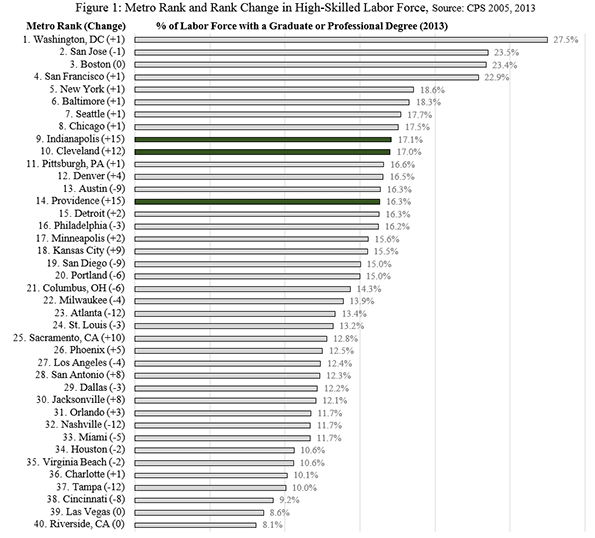
    Table 1 shows the results. In line with the Great Divergence, Washington, D.C. and San Francisco are experiencing the 1st and 4th fastest rates of change in the employment of high- skilled workers, respectively. However, three of the top five fastest-growth metros are second tier: Providence, Indianapolis, and Cleveland— each with over a 5% percent point change. While these metros cannot match the top-tier metros in the number of advanced degree jobs gained— e.g., Cleveland gained nearly 44,000 grad-level jobs compared to 157,000 for San Francisco— the data nonetheless speak to a number of second-tier metros converging, or “moving up”, into the knowledge economy hierarchy.

    Table 1 Percentage of Workers with Advanced Degree, 2005 Percentage of Workers with Advanced Degree, 2013 Percent Point Change
    Source: CPS 2005, 2013
     
    Washington, DC 21.58% 27.48% 5.90%
    Providence 10.71% 16.30% 5.59%
    Indianapolis 11.63% 17.08% 5.45%
    San Francisco 17.49% 22.88% 5.39%
    Cleveland 11.68% 17.00% 5.32%
    Kansas City 10.88% 15.49% 4.61%
    Jacksonville 7.54% 12.07% 4.52%
    San Antonio 8.52% 12.32% 3.80%
    Denver 12.75% 16.54% 3.78%
    Sacramento, CA 9.07% 12.78% 3.72%
    Detroit 12.66% 16.26% 3.60%
    Minneapolis 12.30% 15.55% 3.25%
    Riverside, CA 5.08% 8.09% 3.01%
    Pittsburgh, PA 13.66% 16.57% 2.91%
    Chicago 14.70% 17.55% 2.84%
    Philadelphia 13.52% 16.22% 2.70%
    Charlotte 7.62% 10.14% 2.52%
    Orlando 9.28% 11.73% 2.45%
    Boston 21.03% 23.41% 2.37%
    Seattle 15.34% 17.71% 2.36%
    Phoenix 10.19% 12.50% 2.31%
    Milwaukee 12.32% 13.87% 1.55%
    Las Vegas 7.08% 8.56% 1.48%
    Portland 13.52% 14.98% 1.46%
    New York 17.14% 18.56% 1.42%
    Columbus, OH 12.95% 14.35% 1.40%
    St. Louis 11.91% 13.20% 1.29%
    Dallas 10.89% 12.16% 1.28%
    Baltimore 17.12% 18.28% 1.17%
    Virginia Beach 9.62% 10.57% 0.96%
    Houston 9.65% 10.60% 0.95%
    Miami 10.83% 11.68% 0.85%
    San Diego 14.27% 15.03% 0.75%
    Los Angeles 11.65% 12.38% 0.73%
    San Jose 23.33% 23.52% 0.20%
    Nashville 12.02% 11.70% -0.32%
    Atlanta 14.08% 13.36% -0.72%
    Cincinnati 10.23% 9.22% -1.01%
    Tampa 11.30% 10.05% -1.25%
    Austin 17.92% 16.35% -1.57%


    To further illustrate this point, rankings were calculated to show the metros with the highest concentration of advanced-degreed workers in the labor force for 2005 and 2013. Change rankings were then calculated to determine just how far converging metros like Cleveland and Indianapolis were rising in the knowledge economy hierarchy. Figure 1 displays the results. Notice the top of the rankings are comprised of traditional top-tier metros. Also, the change in these metro rankings from 2005 showed no variance (ranging from -1 to +1), indicating little “wiggle room” in the top echelon from 2005 to 2013. The exception, here, was Austin, which dropped 9 spots to 13th. Moreover, two metros—Indianapolis and Cleveland—moved up from the middle of the pack to rank 9th and 10th, respectively. Providence also made a large leap: from 29th in 2005 to 14th in 2013. These figures indicate there is a notable economic restructuring occurring in Indianapolis, Cleveland, and Providence that is perhaps forming a next generation of innovation nodes.

    Now, in the case of Cleveland, do the results mean the gritty Rust Belt metro is experiencing robust job growth? Not exactly. From 2005 to 2013, 78% of the nearly 54,782 jobs added for college graduates in Greater Cleveland were for those with advanced degrees—meaning job growth for people with only a bachelor’s degree was sluggish at best. What’s more, job losses for Greater Clevelanders without college degrees was substantial: a decline over 83,000 jobs from 2005 to 2013. In other words, while the region’s highest-skilled workforce is converging into the ranks of the national elite, the effect has yet to be found “downstream” in direct or indirect job creation.

    This is not unexpected. Specifically, economic restructuring, particularly for manufacturing-based regions, is a process, and a working theory for the Center for Population Dynamics is that a concentration of advanced-degree workers is an important leading indicator to more widespread growth8. As this line of inquiry evolves, an eventual step is to set up a policy framework so that the region’s growing concentration of high-skilled workers can be strategically catalyzed to lead to broader economic opportunities, rather than missed opportunities. The Center for Population Dynamics is currently constructing a working policy paper that will help drive this effort.

    This is a new report brief from the Center for Population Dynamics at Cleveland State University, download the pdf version here. The report was authored by Richey Piiparinen, Jim Russell, and Charlie Post.

    2 Hilpert, Ulrich. Archipelago Europe: islands of innovation: synthesis report. FAST, Commission of the European Communities, 1992.

    3 Porter, Michael E. "Location, competition, and economic development: Local clusters in a global economy." Economic development quarterly 14.1 (2000): 15-34.

    4 Moretti, Enrico. The new geography of jobs. Houghton Mifflin Harcourt, 2012.

    7 Source: American Community Survey 1-Year Estimates, 2013

    8 See: http://engagedscholarship.csuohio.edu/urban_facpub/1177/

  • Ranking America’s Top Young Labor Forces: A Rust Belt Rising?

    This is a new report brief from the Center for Population Dynamics at Cleveland State University, download the pdf version here. The report was authored by Richey Piiparinen, Charlie Post, and Jim Russell

    Greater Cleveland ranks 8th nationally in the percentage of 25- to 34-year-olds in the labor force with a graduate or professional degree, ahead of such “brain hubs” as Chicago, Seattle, and Austin. The analysis speculates as to whether or not this is a leading indicator to broader economic growth. Comparisons are made with Boston and Pittsburgh—two metros further along in the economic restructuring process.

    Ranking America’s Young Adult Labor Forces

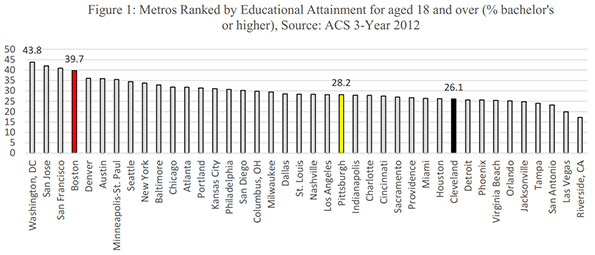
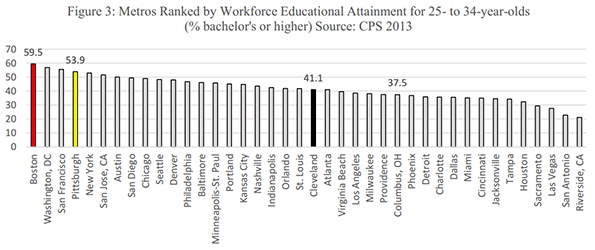
    A region’s economic prospects are tied to its levels of human capital. The most common proxy for human capital is the educational attainment rate, or the percent of a population that has completed a bachelor’s degree or higher. Figure 1 shows the nation’s largest 40 metros ranked by the percent of residents 18 and over who have completed at least a bachelor’s degree. The Rust Belt metros of Pittsburgh and Cleveland rank 23rd and 31st, respectively.

    But there are issues with measuring educational attainment this way. Metros such as Cleveland and Pittsburgh have larger aging populations due to their settlement histories, and this significantly affects regional educational attainment rates. Why does this matter? Notes Pittsburgh economist Chris Briem1: “I argue all the time that such a metric says little about how well we are doing in recent decades at either educating the population, or on how we are doing at both attracting and retaining folks with higher education.”

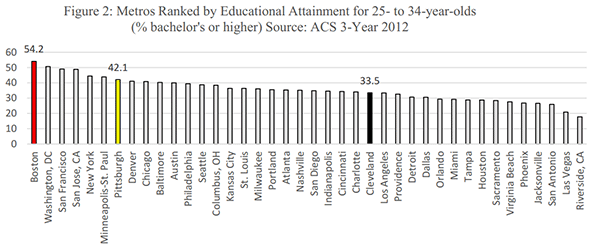
    A better way to analyze human capital is through age cohort. Measuring the educational attainment of a region’s 25- to 34-year-olds is a leading indicator when it comes to understanding where a region’s economy is headed. Figure 2 shows the educational attainment rates for the 25- to 34-year-old age cohort. Greater Pittsburgh ranks 7th, moving up 16 spots. Greater Cleveland moves up 6 spots to rank 25th.

    An additional method of examining a region’s skill level is to look at the educational attainment within the labor force, as opposed to population. The rationale for doing so is simple. Regions with proportionally large student populations, like Columbus, Ohio, can have exaggerated talent pools, at least in terms of economic productivity. That is, a college student may live in a region to consume knowledge but not necessarily be employed to produce output.

    To calculate educational attainment in the labor force, data were analyzed for the 25- to 34-year-old cohort from 2013 Current Population Survey2. Figure 3 details the results of this analysis. Pittsburgh ranks 4th, whereas Greater Cleveland moves up to rank 21st. Conversely, Columbus, Ohio drops 13 spots to rank 27th, perhaps suggesting that the region’s large college enrollment isn’t effectively translating into the regional labor market.

    A final analysis examines the percentage of a region’s young adult labor force that is highly skilled, or those with a graduate or professional degree. Slicing the labor force data this way is important in that a region’s highest-skilled workers are drivers of economic growth. Specifically, a metro’s top talent—think engineers, scientists, and doctors—are key agents of knowledge production and transference3, which— when translated into the marketplace—mean new firms and the evolution of existing firms. Those metros that have a high concentration of highly-skilled young adult workers have a head start in the race toward the “next” new economy.

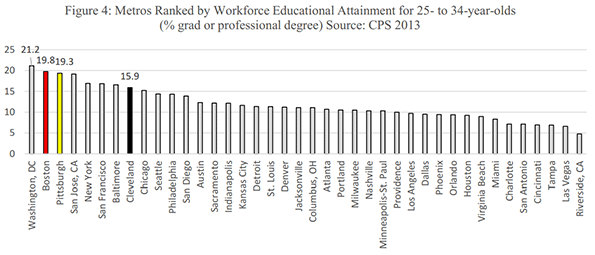
    Figure 4 ranks the metros by the percentage of 25- to 34-year-olds in the labor force with a graduate or professional degree. Pittsburgh ranks 3rd nationally, whereas Greater Cleveland moves up 13 spots to rank 8th, ahead of Chicago, Seattle, and Austin. The implications of these findings are discussed below.

    A Rust Belt Rising?

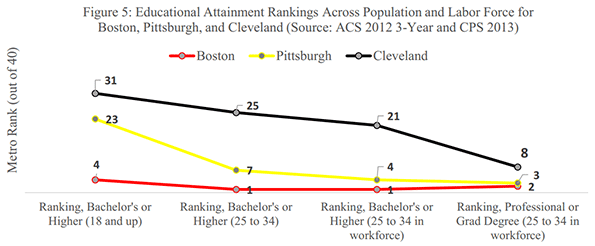
    Economic restructuring from a labor- to a knowledge-based economy is no easy endeavor. Perhaps no other metro has made this transformation as successfully as Boston. What has driven the region’s evolution from a “dying factory town to a thriving information city”4 has been its gains in human capital. As shown in Figure 5, Boston ranks as an elite metro when it comes to educational attainment rates in both its population and labor force.

    What metro is the “next Boston”? Pittsburgh is a likely candidate. The “Steel City” region is increasingly marrying its legacies of manufacturing and knowledge production, with the evolution of new industries and products to show for it5. Enabling Pittsburgh’s ascent is a highly-skilled young adult workforce that’s rivaling Boston in terms of concentration of human capital (See Figure 5 below).

    here does that leave Cleveland? While the region is far from being the “next Boston”, one can make the case it is trending to be the “next Pittsburgh”. Specifically, a line of emerging thought—and one that will be developed by the Center for Population Dynamics in the coming months in two working papers—is that Cleveland’s 8th-placed ranking in its concentration of young workers with an advanced degree is a harbinger of broader economic growth. While this supposition is exactly that, there are several mechanisms by which this can occur.

    First, it is important to note that there is an industry demand for workers with advanced degrees in Greater Cleveland, else its 8th-place ranking wouldn’t occur. Termed a “magnet city”6, Cleveland’s knowledge economy is forming world-class clusters of expertise that are attracting top talent in key industry sectors, particularly life sciences and advanced manufacturing. In other words, if you want to act, you go to Hollywood. If you want to practice cardiac care or make medical devices you come to Cleveland. The next step for the region is to scale up its emerging economies so that the amassing of knowledge and investment becomes multiplied into the creation of a “thicker, stickier” regional economy.

    Part of this scaling up process relates to the effect that Cleveland’s concentration of highly-skilled workers can have on the local economic ecosystem. To wit, those with advanced degrees are most likely to migrate across state or international lines7. For instance, 29% of newly-arriving immigrants into Cleveland’s Cuyahoga County had a graduate or professional degree8. This means Cleveland’s burgeoning new economy demand is commonly fueled from outside the market. Why does this matter? For a historically insular region like Cleveland, this out-of-the-market knowledge migration brings a deepening of a region’s idea bank, as well as increasing global connectivity. The ability of a region to cross-pollinate ideas and get connected with global markets is crucial in the creation of new firms and emerging industries9.

    Now, what does, for example, a new biotech firm in Cleveland’s Health Tech Corridor mean for the local mechanic, bartender, lawyer, or accountant? A lot actually. Specifically, economist Enrico Moretti found that for every high-skilled job created, an additional 5 jobs are created in the professional or service sector10. What’s more, the job creation goes beyond the local services and taps into semi-skilled professions in emerging industries. For example, a recent Brookings study found that the Cleveland metro ranked 20th out of the nation’s largest 100 metros in the number of workers without bachelor’s degrees employed in pre-baccalaureate health care occupations11.

    Summary

    Perhaps Cleveland is the next Pittsburgh, and Pittsburgh the next Boston. Clarifying this entails analyzing how human capital development and economic restructuring takes place. Simply, is Cleveland’s talent profile today similar to Pittsburgh’s a decade ago, and to Boston’s twenty years prior? Moreover, what policies have been proven effective in translating knowledge production to regional economic growth?

    The Center for Population Dynamics is in the process of answering these questions. The information intends to help Cleveland speed up how quickly tomorrow gets here.

    This is a new report brief from the Center for Population Dynamics at Cleveland State University, download the pdf version here.

    Creative Commons photo “Cleveland Skyline from the Flats” by Flickr.com user Erik Drost.

    ———–

    2 The Current Population Survey (CPS) is a monthly survey of households conducted by the Bureau of Census for the Bureau of Labor Statistics. The monthly workforce educational attainment rate estimates were aggregated for a 2013 annual estimate.

    3 Waters, R. and Smith, H. 2013. High-technology local economies: Geographical mobility of the highly-skilled. In
    Networking Regionalised Innovative Labour Markets; Eds. Hilpert, U and Smith. H. Routledge: New York.
  • Cleveland, LeBron, and the Evolution of Collective Shame

    “Shame is fear of humiliation at one’s inferior status in the estimation of others.”—Lao Tzu.

    Sitting with fellow Clevelanders at a since-demolished bar, July 7th, 2010, LeBron James, local boy, uttered the words that hurt: “I am taking my talents to South Beach”. It was a shot heard around the world, but felt sharply inside the Rust Belt city’s heart.

    “He had before invoked all the connotations of home, only to leave it,” wrote Cleveland sports columnist Bill Livingston the next day, in a piece entitled “By rejecting his hometown team, LeBron James earns his slot on the [Art] Modell list of shame”. Livingston upbraided LeBron for scheduling a cable event to “exploit this city’s suffering”. His words were intent on shaming LeBron for leaving, yet in doing so reared Cleveland’s collective shame for having again been left.

    Collective shame is an underappreciated subject. But it, like other collective emotions—think fear and pride—run our societies as noted by the great sociologist Emile Durkheim.

    For decades, Cleveland has been held together by a solidarity in loss, especially the collective shame that came with it. Unlike guilt, which is about what one did, shame is an affront on the self, or what one is.
    And what was blue-collar Cleveland without a wealth of blue-collar jobs? It was a city of losses—be it of income, population, and a way of life.

    Walk down many Cleveland streets and you can see how this loss has played out in disinvestment. Often, the effect on the viewer is the same: status was here, but no longer. The constant reminders of loss give shame currency. Cleveland is not alone here. Cities the world over are afflicted with the hangovers of history. From the “Geography of Melancholy” in the American Reader, the author writes:

    Nearly every historic city has its brand of melancholy indelibly associated with it—each variety linked to the scars the city bears. Lisbon has its saudade: a feeling of aimless loss tied to the city’s legacy of vanishing seafarers, explorers shipwrecked in search of Western horizons. Istanbul has huzun: a religiously-tinged brand of melancholy rooted in the city’s nostalgia for its glorious past.

    Instead of seafarers, Cleveland had steelworkers, and others who’ve had their working-class status stripped. Yet while the loss was personal, it was the result of macro forces, leaving many feeling powerless and alone. This aloneness was tied up in the feeling of shared suffering. “The very fact that shame is an isolating experience,” notes the author of “Shame and the Social Bond”, “also means that if one can find ways of sharing and communicating it this communication can bring about particular closeness with other persons.”

    There are many ways collective emotions are shared. Much of the vessels are informal. Think oral tradition and rumors. Fashion is another channel, like a city’s t-shirts. In fact perhaps nothing says implicit understanding between natives like city mottos emblazoned chest level. Cleveland’s most famous t-shirt said simply: “Cleveland—you’ve got to be tough”. It was made in 1977, in the heyday of the city’s decline. You had to be tough in the face of a post-industrial headwind. Today, iterations remain on this “the world is against us” mentality. “Defend Cleveland” and “Cleveland VS Everybody” t-shirts are worn liberally. Another favorite that tips more toward shame than to a defensiveness against judgment says: “Cleveland Low Life”—a play on “Miller High Life”.

    Is all this productive? No doubt, collective shame, according to scholars, can strengthen the bonds between members of a group which, in turn, can lead to a process of self-exploration and restoration of a social identity. Or it can be chronic. Cleveland is well-known for its self-flagellation. It’s especially obvious to folks who aren’t native Clevelanders.

    “I have, in fact, never lived in a place whose proud residents so consistently and gleefully disrespect their hometown as Cleveland,’ notes legendary Jeopardy champ Arthur Cho in his recent Daily Beast piece “Cleveland Comes Crawling Back to LeBron: The Masochism of Rust Belt Chic”. Cho, a Cleveland newcomer, goes on to write that though he hates to “engage in victim-blaming”, the reason “everyone dogs on Cleveland is that we ask for it”. Why? Cho concludes: “If we weren’t suffering, we wouldn’t be Cleveland anymore.”

    But this Cleveland mindset does little for opening the region up to new ideas. Just as the messages become defensive, so do the policies and politics. Nativist culture reigns. Nepotism and patronage become the grease that runs the status quo. And so the communal shrouding effectively disables the possibility of possibility. Hence, the region’s struggles in its economic restructuring in the era of global connectivity.

    In that sense, Cleveland’s collective shame can be a source of bad policies which ensure the collective shame. But why would a city want to do that, albeit implicitly, subconsciously?

    “Economic struggle can be a cultural unifier in a community that people tacitly want to hold onto in order to preserve civic cohesion,” writes urban theorist Aaron Renn in Governing. Beyond that, those with power can lose it with community change. Continues Renn:

    …[I]t isn’t hard to figure out that even in cities and states with serious problems, many people inside the system are benefiting from the status quo.

    They have political power, an inside track on government contracts, a nice gig at a civic organization or nonprofit, and so on. All of these people, who are disproportionately in the power broker class of most places, potentially stand to lose if economic decline is reversed. That’s not to say they are evil, but they all have an interest to protect.

    Does this mean Cleveland is doomed? Hardly. The region is experiencing a brain gain. It has incredible assets—namely, its educational, hospital, and cultural institutions—that have been dragging it along toward a point of turning the page. But more is needed. Specifically, more perspective—a perspective that the city’s inferiority complex isn’t about what others think of Cleveland, but about what Clevelanders are compelled to think about themselves.

    Which brings us back to LeBron. Soon after his announcement that he was leaving, The Onion wrote a satirical piece called “Despite Repeated Attempts To Tear It Down, Massive LeBron James Mural Keeps Reappearing”. In it, the iconic “We are All Witnesses” banner keeps hauntingly resurfacing. At one point in the piece, city workers removed it panel by panel, “only to find an identical mural hanging directly behind it”. The article ends, “As of press time, nobody outside the Cleveland area had seen the mural once since it was originally taken down…”

    The takeaway, then: When suffering has become your identity, you have clearly suffered long enough.

    Cleveland’s path to progress means letting go of that which has stubbornly remained. There’s hope that the change is coming, largely due to the presence of the new generation. 

    In many ways LeBron is an embodiment of the next generation of Cleveland and the Rust Belt. His return epitomizes possibility. No, I am not talking about championships here, nor the collective Prozac-effects that a parade down E. 9th St. would have on the region’s psyche. Instead it is about perspective.

    The day LeBron announced his decision he was leaving Cleveland, he was in Akron. According to an ESPN piece, he knew the decision would hurt people, and that nothing would ever be the same for him. “Somehow he got through the final day of his annual basketball camp in Akron without confessing,” the authors write. “By the time [former teammate] Damon Jones drove him to the airport, where he would fly to Connecticut and reveal his infamous decision to the world, there was a lump in his throat.”

    LeBron, like all sons and daughters of the Rust Belt, is a product of collective shame, and so his self-battle with leaving is no surprise. But sometimes leaving is the answer. No person should ever self-sacrifice out of a loyalty to place. And sometimes coming home is the next answer. If only because intermittent personal aspiration will often take a backseat to that evolutionary and endearingly human need to belong.

    The secret sauce, here, is the perspective gained in the journey. And then bringing it back to a community that could use more than its fair share.

    Richey Piiparinen is a Clevelander, writer, and Senior Research Associate heading the Center for Population Dynamics at Cleveland State University.

    Lead photo courtesy of Michael Lapidakis.

  • Confessions of a Rust Belt Orphan

    How I Learned to Stop Worrying and Love Northeast Ohio

    Go to sleep, Captain Future, in your lair of art deco
    You were our pioneer of progress, but tomorrow’s been postponed
    Go to sleep, Captain Future, let corrosion close your eyes
    If the board should vote to restore hope, we’ll pass along the lie

    -The Secret Sound of the NSA, Captain Future

    As near as I can tell, the term “Rust Belt” originated sometime in the mid-1980s. That sounds about right.

    I originated slightly earlier, in 1972, at St. Thomas Hospital in Akron, Ohio, Rubber Capital of the World. My very earliest memory is of a day, sometime in the Summer of 1975, that my parents, my baby brother, and I went on a camping trip to Lake Milton, just west of Youngstown. I was three years old. To this day, I have no idea why, of all of the things that I could remember, but don’t, I happen to remember this one. But it is a good place to start.
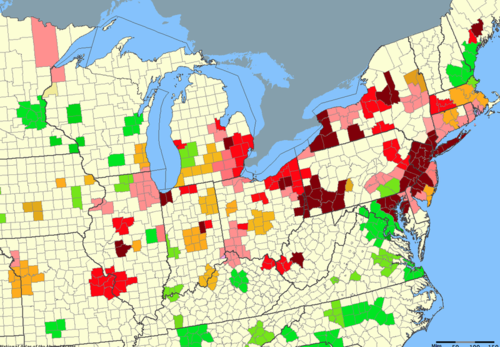
    image
    Image Source: Wikipedia: Change in total number of manufacturing jobs in metropolitan areas, 1954-2002. Dark red is very bad. Akron is dark red.

    The memory is so vivid that I can still remember looking at the green overhead freeway signs along the West Expressway in Akron. Some of the signs were in kilometers, as well as in miles back then, due to an ill-fated attempt to convert Americans to the Metric system in the 1970s. I remember the overpoweringly pungent smell of rubber wafting from the smokestacks of B.F. Goodrich and Firestone. I recall asking my mother about it, and her explaining that those were the factories where the tires, and the rubber, and the chemicals were made. They were made by hard-working, good people – people like my Uncle Jim – but more on that, later.

    When I was a little bit older, I would learn that this was the smell of good jobs; of hard, dangerous work; and of the way of life that built the modern version of this quirky and gritty town. It was the smell that tripled Akron’s population between 1910 and 1920, transforming it from a sleepy former canal-town to the 32nd largest city in America. It is a smell laced with melancholy, ambivalence, and nostalgia – for it was the smell of an era that was quickly coming to an end (although I was far too young to be aware of this fact at the time). It was sometimes the smell of tragedy.

    We stopped by my grandparents’ house, in Firestone Park, on the way to the campground. I can still remember my grandmother giving me a box of Barnum’s Animals crackers for the road. She was always kind and generous like that.

    Who were my grandparents? My grandparents were Akron. It’s as simple as that. Their story was Akron’s story. My grandfather was born in 1916, in Barnesboro, a small coal-mining town in Western Pennsylvania, somewhere between Johnstown, DuBois, and nowhere. His father, a coal miner, had emigrated there from Hungary nine years earlier. My grandmother was born in Barberton, in 1920. Barberton was reportedly the most-industrialized city in the United States, per-capita, at some point around that time.

    They were both factory workers for their entire working lives (I don’t think they called jobs like that “careers” back then). My grandfather worked at the Firestone Tire & Rubber Company. My grandmother worked at Saalfield Publishing, a factory that was one of the largest producers of children’s books, games, and puzzles in the world. Today, both of the plants where they worked form part of a gutted, derelict, post-apocalyptic moonscape in South Akron, located between that same West Expressway and perdition. The City of Akron has plans for revitalizing this former industrial area. It needs to happen, but there are ghosts there…

    My name is Ozymandias, King of Kings, 
    Look on my works, ye Mighty, and despair!
    Nothing beside remains. Round the decay 
    Of that colossal wreck, boundless and bare 
    The lone and level sands stretch far away.

    -Percy Bysshe Shelley, Ozymandias

    My grandparents’ house exemplified what it was to live in working-class Akron in the late 1970s and early 1980s. My stream-of-consciousness memories of that house include: lots of cigarettes and ashtrays; Hee-HawThe Joker’s Wild; fresh tomatoes and peppers; Fred & Lamont Sanford; Archie & Edith Bunker; Herb Score and Indians baseball on the radio on the front porch; hand-knitted afghans; UHF/VHF; 3, 5, 8, and 43; cold cans of Coca-Cola and Pabst Blue Ribbon (back when the pop-tops still came off of the can); the Ohio Lottery; chicken and galuskas (dumplings); a garage floor that you could eat off of; a meticulously maintained 14-year-old Chrysler with 29,000 miles on it; a refrigerator in the dining room because the kitchen was too small; catching fireflies in jars; and all being right with the world.

    I always associate the familiar comfort of that tiny two-bedroom bungalow with the omnipresence of cigarette smoke and television. I remember sitting there on May 18, 1980. It was my eighth birthday. We were sitting in front of the TV, watching coverage of the Mount St. Helens eruption in Washington State. I remember talking about the fact that it was going to be the year 2000 (the Future!) in just twenty years. It was an odd conversation for an eight year old to be having with adults (planning for the future already, and for a life without friends, apparently). I remember thinking about the fact that I would be 28 years old then, and how inconceivably distant it all seemed. Things seem so permanent when you’re eight, and time moves ever-so-slowly.

    More often than not, when we visited my grandparents, my Uncle Jim and Aunt Helen would be there. Uncle Jim was born in 1936, in West Virginia. His family, too, had come to Akron to find work that was better-paying, steadier, and (relatively) less dangerous than the work in the coal mines. Uncle Jim was a rubber worker, first at Mohawk Rubber and then later at B.F. Goodrich. Uncle Jim also cut hair over at the most-appropriately named West Virginia Barbershop, on South Arlington Street in East Akron. He was one of the best, most decent, kindest people that I have ever known.

    I remember asking my mother once why Uncle Jim never washed his hands. She scolded me, explaining that he did wash his hands, but that because he built tires, his hands were stained with carbon-black, which wouldn’t come out no matter how hard you scrubbed. I learned later, that it would take about six months for that stuff to leach out of your pores, once you quit working.

    Uncle Jim died in 1983, killed in an industrial accident on the job at B.F. Goodrich. He was only 47. The plant would close for good about a year later.

    It was an unthinkably tragic event, at a singularly traumatic time for Akron. It was the end of an era.

    Times Change

    My friend Della Rucker recently wrote a great post entitled The Elder Children of the Rust Belt over at her blog, Wise Economy. It dredged up all of these old memories, and it got me thinking about childhood, about this place that I love, and about the experience of growing up just as an economic era (perhaps the most prosperous and anomalous one in modern history) was coming to an end.

    That is what the late 1970s and early 1980s was: the end of one thing, and the beginning of a (still yet-to-be-determined) something else. I didn’t know it at the time, but that’s because I was just a kid.

    In retrospect it was obvious: the decay; the deterioration, the decomposition, the slow-at-first, and then faster-than-you-can-see-it unwinding of an industrial machine that had been wound-up far, far, too-tight. The machine runs until it breaks down; then it is replaced with a new and more efficient one – a perfectly ironic metaphor for an industrial society that killed the goose that laid the golden egg. It was a machine made up of unions, and management, and capitalized sunk costs, and supply chains, and commodity prices, and globalization. Except it wasn’t really a machine at all. It was really just people. And people aren’t machines. When they are treated as such, and then discarded as obsolete, there are consequences.

    You could hear it in the music: from the decadent, desperately-seeking-something (escape) pulse of Disco, to the (first) nihilistic and (then) fatalistic sound of Punk and Post-Punk. It’s not an accident that a band called Devo came from Akron, Ohio. De-evolution: the idea that instead of evolving, mankind has actually regressed, as evidenced by the dysfunction and herd mentality of American society. It sounded a lot like Akron in the late 1970s. It still sounds a little bit like the Rust Belt today.

    As an adult, looking back at the experience of growing up at that time, you realize how much it colors your thinking and outlook on life. It’s all the more poignant when you realize that the “end-of-an-era” is never really an “end” as such, but is really a transition to something else. But to what exactly?

    The end of that era, which was marked by strikes, layoffs, and unemployment, was followed by its echoes and repercussions: economic dislocation, outmigration, poverty, and abandonment; as well as the more intangible psychological detritus – the pains from the phantom limb long after the amputation; the vertiginous sensation of watching someone (or something) die.

    And it came to me then 
    That every plan 
    Is a tiny prayer to Father Time

    As I stared at my shoes
    In the ICU
    That reeked of piss and 409

    It sung like a violent wind
    That our memories depend
    On a faulty camera in our minds

    ‘Cause there’s no comfort in the waiting room
    Just nervous paces bracing for bad news

    Love is watching someone die…

    -Death Cab For Cutie, What Sarah Said

    But it is both our tragedy and our glory that life goes on.

    Della raised a lot of these issues in her post: our generation’s ambivalent relationship with the American Dream (like Della, I feel the same unpleasant taste of rust in my mouth whenever I write or utter that phrase); our distrust of organizations and institutions; and our realization that you have to keep going, fight, and survive, in spite of it all. She talked about how we came of age at a time of loss:

    not loss like a massive destruction, but a loss like something insidious, deep, pervasive.

    It is so true, and it is so misunderstood. One of the people commenting on her blog post said, essentially, that it is dangerous to romanticize about a “golden age”; that all generations struggle; and that life is hard.

    Yes, those things are all true. But they are largely irrelevant to the topic at hand.

    There is a very large middle ground between a “golden age” and an “existential struggle”. The time and place about which we are both writing (the late 1970s through the present, in the Rust Belt) is neither. But it is undoubtedly a time of extreme transition. It is a great economic unraveling, and we are collectively and individually still trying to figure out how to navigate through it, survive it, and ultimately build something better out of it.

    History is cyclical. Regardless of how enamored Americans, in general, may be with the idea, it is not linear. It is neither a long, slow march toward utopia, nor toward oblivion. When I look at history, I see times of relative (and it’s all relative, this side of paradise) peace, prosperity, and stability; and other times of relative strife, economic upheaval, uncertainty, and instability. We really did move from one of those times to the other, beginning in the 1970s, and continuing through the present.

    The point that is easy to miss when uttering phrases like “life is hard for every generation” is that none of this discussion about the Rust Belt – where it’s been, where it is going – has anything to do with a “golden age”. But it has everything to do with the fact that this time of transition was an era (like all eras) that meant a lot (good and bad) to the people that lived through it. It helped make them who they are today, and it helped make where they live what it is today.

    For those that were kids at the time that the great unraveling began (people like me, and people like Della) it is partially about the narrative that we were socialized to believe in at a very young age, and how that narrative went up in a puff of smoke. In 1977, I could smell rubber in the air, and many of my family members and friends’ parents worked in rubber factories. In 1982, the last passenger tire was built in Akron. By 1984, 90% of those jobs were gone, many of those people had moved out of town, and the whole thing was already a fading memory. Just as when a person dies, many people reacted with a mixture of silence, embarrassment, and denial.

    As a kid, especially, you construct your identity based upon the place in which you live. The whole identity that I had built, even as a small child, as a proud Akronite: This is the RUBBER CAPITAL OF THE WORLD; this is where we make lots and lots of Useful Things for people all over the world; this is where Real Americans Do Real Work; this is where people from Europe, the South, and Appalachia come to make a Better Life for themselves; well, that all got yanked away. I couldn’t believe any of those things anymore, because they were no longer true, and I knew it. I could see it with my own two eyes. Maybe some of them were never true to begin with, but kids can’t live a lie the way that adults can. When the place that you thought you lived in turns out not to be the place that you actually live, it can be jarring and disorienting. It can even be heartbreaking.

    We’re the middle children of history, man. No purpose or place. We have no Great War. No Great Depression. Our great war is a spiritual war. Our great depression is our lives.

    Tyler Durden, Fight Club

    I’m fond of the above quote. I was even fonder of it when I was 28 years old. Time, and the realization that life is short, and that you ultimately have to participate and do something with it besides analyze it as an outside observer, has lessened its power considerably. It remains the quintessential Generation X quote, from the quintessential Generation X movie. It certainly fits in quite well with all of this. But, then again, maybe it shouldn’t.

    I use the phrase “Rust Belt Orphan” in the title of this post, because that is what the experience of coming of age at the time of the great economic unraveling feels like at the gut-level. But it’s a dangerous and unproductive combination, when coupled with the whole Gen-X thing.

    In many ways, the Rust Belt is the “Generation X” of regions – the place that just doesn’t seem to fit in; the place that most people would just as soon forget about; the place that would, in fact, just as soon forget about itself; the place that, if it does dare to acknowledge its own existence or needs, barely notices the surprised frowns of displeasure and disdain from those on the outside, because they have already been subsumed by the place’s own self-doubt and self-loathing.

    A fake chinese rubber plant
    In the fake plastic earth
    That she bought from a rubber man
    In a town full of rubber plans
    To get rid of itself

    -Radiohead, Fake Plastic Trees

    The whole Gen-X misfit wandering-in-the-Rust Belt-wilderness meme is a palpably prevalent, but seldom acknowledged part of our regional culture. It is probably just as well. It’s so easy for the whole smoldering heap of negativity to degenerate into a viscous morass of alienation and anomie. Little good can come from going any further down that dead-end road.

    Whither the Future?

    The Greek word for “return” is nostosAlgos means “suffering.” So nostalgia is the suffering caused by an unappeased yearning to return.
    – 
    Milan Kundera, Ignorance

    So where does this all leave us?

    First, as a region, I think we have to get serious about making our peace with the past and moving on. We have begun to do this in Akron, and, if the stories and anecdotal evidence are to be believed, we are probably ahead of the region as a whole.

    But what does “making our peace” and “moving on” really mean? In many ways, I think that our region has been going through a collective period of mourning for the better part of four decades. Nostalgia and angst regarding the things that have been lost (some of our identity, prosperity, and national prominence) is all part of the grieving process. The best way out is always through.

    But we should grieve, not so we can wallow in the experience and refuse to move on, but so we can gain a better understanding of who we are and where we come from. Coming to grips with and acknowledging those things, ultimately enables us to help make these places that we love better.

    We Americans are generally not all that good at, or comfortable with, mourning or grief. There’s a very American idea that grieving is synonymous with “moving on” and (even worse) that “moving on” is synonymous with “getting over it”.

    We’re very comfortable with that neat and tidy straight, upwardly-trending line toward the future (and a more prosperous, progressive, and enlightened future it will always be, world without end, Amen.)

    We’re not so comfortable with that messy and confusing historical cycle of boom-and-bust, of evolution and de-evolution, of creation and destruction and reinvention. But that’s the world as we actually experience it, and it’s the one that we must live in. It is far from perfect. I wish that I had another one to offer you. But there isn’t one on this side of the Great Beyond. For all of its trials and tribulations, the world that we inhabit has one inestimable advantage: it is unambiguously real.

    “Moving on” means refusing to become paralyzed by the past; living up to our present responsibilities; and striving every day to become the type of people that are better able to help others. But “moving on” doesn’t mean that we forget about the past, that we pretend that we didn’t experience what we did, or that we create an alternate reality to avoid playing the hand that we’ve actually been dealt.

    Second, I don’t think we can, or should, “get over” the Rust Belt. The very phrase “get over it” traffics in denial, wishful thinking, and the estrangement of one’s self from one’s roots. Countless attempts to “get over” the Rust Belt have resulted in the innumerable short-sighted, “get rich quick” economic development projects, and public-private pyramid-schemes that many of us have come to find so distasteful, ineffective, and expensive.

    We don’t have to be (and can’t be, even if we want to) something that we are not. But we do have to be the best place that we can be. This might mean that we are a smaller, relatively less-prominent place. But it also means that we can be a much better-connected, more cohesive, coherent, and equitable place. The only people that can stop us from becoming that place are we ourselves.

    For a place that has been burned so badly by the vicissitudes of the global economy, Big Business, and Big Industry, we always seem to be so quick to put our faith in the Next Big Project, the Next Big Organization, and the Next Big Thing. I’m not sure whether this is the cause of our current economic malaise, or the effect, or both. Whatever it is, we need to stop doing it.

    Does this mean that we should never do or dream anything big? No. Absolutely not. But it does mean that we should be prudent and wise, and that we should tend to prefer our economic development and public investment to be hyper-nimble, hyper-scalable, hyper-neighborhood-focused, and ultra-diverse. Fetishizing Daniel Burnham’s famous “Make no little plans…” quote has done us much harm. Sometimes “little plans” are exactly what we need, because they often involve fundamentals, are easier to pull-off, and more readily establish trust, inspire hope, and build relationships.

    Those of us that came of age during the great economic unraveling and (still painful) transition from the Great American Manufacturing Belt to the Rust Belt might just be in a better position to understand our challenges, and to find the creative solutions required to meet them head-on. Those of us that stuck it out and still live here, know where we came from. We’re under no illusions about who we are or where we live. I think Della Rucker was on to something when she listed what we can bring to the table:

    • Determination
    • Long-game focus
    • Understanding the depth of the pit and the long way left to climb out of it
    • Resourcefulness
    • Ability to salvage
    • Expectation that there are no easy answers
    • Disinclination to believe that everything will be all right if only we do this One Big Thing

    When I look at this list, I see pragmatism, resilience, self-knowledge, survival skills, and leadership. It all rings true.

    He wanted to care, and he could not care. For he had gone away and he could never go back any more. The gates were closed, the sun was gone down, and there was no beauty but the gray beauty of steel that withstands all time. Even the grief he could have borne was left behind in the country of illusion, of youth, of the richness of life, where his winter dreams had flourished.

    “Long ago,” he said, “long ago, there was something in me, but now that thing is gone. Now that thing is gone, that thing is gone. I cannot cry. I cannot care. That thing will come back no more.”

    -F. Scott Fitzgerald, Winter Dreams

    So, let’s have our final elegy for the Rust Belt. Then, let’s get to work.

    This post originally appeared in Jason Segedy’s Notes From the Underground on November 2, 2013.

    Segedy is the Director of the Akron Metropolitan Area Transportation Study, the Metropolitan Planning Organization serving Akron, Ohio.  As a native of Akron, and as an urban planner, he has a strong interest in the future of places throughout the Great Lakes region, and in the people that inhabit them.