Tag: Cleveland

  • The Ugly City Beautiful: A Policy Analysis

    When it comes to the future, Detroit and San Francisco act as poles in the continuum of American consciousness. Detroit is dead and will continue dying. San Francisco is the region sipping heartily from the fountain of youth. Such trajectories, according to experts, will go on indefinitely.

    Harvard economist Ed Glaeser has a grim outlook for the Rust Belt. “[P]eople and firms are leaving Buffalo for the Sunbelt because the Sunbelt is a warmer, more pleasant, and more productive area to live,” he writes in City Journal.

    Glaeser echoes this sentiment in a recent interview with International Business Times, saying “[s]mart people want to be around other smart people”, and the Rust Belt has a long slog ahead given that “post-industrial city migration is dominated by people moving to warmer climes”.

    But is this true? Is there a “brain drain” from the Rust Belt to the Sun Belt and Coasts? In a word: no. But Rust Belt leaders have bought this narrative hook line and sinker, and the subsequent hand-wringing has led to wasteful public investment.

    “Michigan’s cities must retain and attract more people, including young knowledge workers, to its cities by making them attractive, vibrant, and diverse places,” reads a 2003 memo from the National Governor’s Association about Michigan’s “Cool Cities” campaign.

    But the campaign struggled. “Government can’t mandate cool,” reflected Karen Gagnon, the former Cool Cities director. “As soon as government says something is cool, it’s not.”

    What’s worse, “cooling you city” with talent attraction expenditures can exacerbate economic disparities on the ground. Cities, like Chicago, are increasingly becoming bifurcated cities based on faulty assumptions that “trickle down urbanism” works. That said, the challenge of the day—for not only Rust Belt cities, but all cities—is not “brain drain”, but “brain waste”. Those cities who can best rebuild middle class communities tied to emerging markets will be the future of investment, like they were in the past.

    Through Rust-Colored Glasses

    When a people fall from grace, the sentiment of decline tends to stick. The Rust Belt’s demise is cemented. Meanwhile, the future is elsewhere. Like toward the sun. For instance, from 2000 to 2010, the Sun Belt metros of Houston, Dallas, Atlanta, Riverside, Las Vegas, Miami, Orlando, and Phoenix experienced the largest population growth. The biggest losers? It’s a “who’s who” of Rust Belt metros, led by Detroit, Cleveland, Pittsburgh, and Buffalo.

    America is a country governed by growth: big cars, big belt buckles, big houses, and big populations. Shrinkage is weakness. It is a sign of place failure. The problem here is that population growth is an ineffective, broad-brush measure when trying to understand regional underlying dynamics. A new study by Jessie Poon and Wei Yin in the journal Geography Compass called “Human Capital: A Comparison of Rustbelt and Sunbelt Cities” details exactly that.

    In it, the authors compare human capital levels between the Sunbelt metros in California (including San Francisco and L.A.), Nevada, New Mexico, and Arizona with Rust Belt metros in Michigan, Ohio, Indiana, Pennsylvania, and upstate New York. When it comes to share of population with a college degree, the authors find that the Rust Belt is experiencing a brain gain equal to their Sun Belt peers from 1980 to 2010. Poon and Wei also found that skill ratios of immigrants is higher in the Rust Belt than Sunbelt. The authors note that despite population decline, the Rust Belt continues “to be important sites of human capital accumulation”.

    The study coincides with recent work out of the Center for Population Dynamics that shows Greater Cleveland’s number of 25- to 34-year olds with a bachelor’s or higher increased by 23% from 2006 to 2012, as well as Pittsburgh economist Chris Briem’s work that shows the metros of Pittsburgh, Detroit, and Cleveland rank 1st,, 6th, 7th in the country respectively when it comes to the number of young adults in the labor force with a graduate or professional degree.

    Beyond human capital, the Rust Belt continues to produce and export wealth at a massive pace. The “Chi-Pitts” mega-region, which mirrors the Rust Belt boundaries with the addition of Minneapolis, generates $2.3 billion in economic output, second only to the “Bos-Wash” mega-region that makes up the Northeast Corridor.

    Also, using IRS migration data from the 2009-2010 period, a team of researchers led by Michal Migurski showed that Los Angeles County, New York County, and Cook County sent the most people and money to the rest of the United States. Detroit’s Wayne County was fourth. Cleveland’s Cuyahoga County was 9th, one spot ahead of San Francisco County. Speaking to Esquire, which published the work in a visual called “Where Does the Money Go”, Migurski explains the findings:

    "We realized that if you look at the biggest ‘losers,’ essentially what you’re looking at are the biggest cities in the U.S.," Migurski says. One of those losers: New York County, which lost $1,306,548,000 and 15,100 people. "But does that actually mean New York is a big loser?" Migurski asks. "One of our ideas was that, you’re not a loser if you’re losing money. You’re an exporter." The sort of exporter, he says, that boosts the rest of the U.S. economy. Traditional Sun Belt retirement areas comprise the gainers; areas like South Florida and Southern California in particular, create what Migurski calls "money sinks."

    Still, the notion of “loser” for Wayne and Cuyahoga County sticks, despite evidence to the contrary. But why? Why the constant “poor post-industrial people” sentiment, if not a low-grade captivation that comes with “ruin porn” rubbernecking?

    Well, if an ideal exists—you know, the experts beckon: be the “new” city, the “hot” city, the “creative” city—then a study in contrasts is necessary. The Rust Belt, with its connotations of smoke stacks and demographic decline, fits the bill.

    “[Richard] Florida suggests that Rustbelt cities’ high concentration of less creative blue-collar workers also produces unhappy residents,”Poon and Wei conclude in their Rust Belt/Sun Belt study. “We suggest that such a doom and gloom picture of urban and regional development for the uncool industrial Rustbelt needs to be tempered with a trend of brain gain that is growing across cities in the region.”

    But for this tempering to happen a clearer understanding of the importance of accumulating human capital needs to be ascertained. More exactly: Is it to put your city to work, or to “live-work-play”?

    Build it and they will…what?

    In his 1921 work Economy and Society, social scientist Max Weber details a city’s raison d’etre. Cities can be producer cities, wherein importance is derived from industries that demand national and international trade. Think Detroit and cars. Additionally, cities are consumer cities, in which growth is tied to how much is spent consuming goods and services in the local economy. Think eating, drinking, and buying houses.

    The cities that are the most economically robust have wealth generated from global production, which in turn enables local consumption. San Francisco’s tech economy drives it real estate market and artisanal toast scene. That is, if the question was “What came first, the farm-to-table chicken or the egghead?” The answer is “the egghead”, hands down.

    But this logic—i.e., in order to go to a restaurant, you need a job, and your job prospects are tied to the viability of your region’s global industries—is often turned on its head in economic development. Here, the goal is growth, no matter the rhyme or reason.

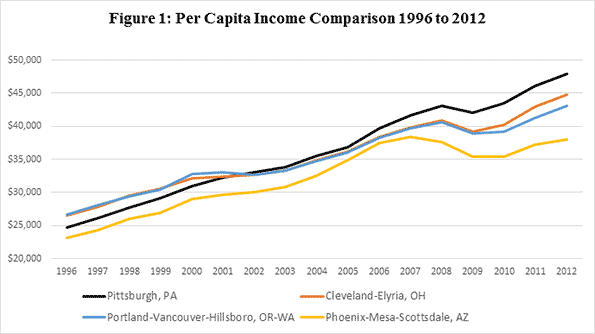
    “Like in many Sun Belt cities,” writes a Seattle Times columnist and Sun Belt expat, “Phoenix’s economic plan devolved into merely adding people, no matter the enormous long-term costs”. The columnist goes on to note that while the population has boomed, the city lags on most measures, such as per capita income (see Figure 1 below).
    Moreover, the Phoenixes of the world exist partly because of retired Baby Boomers and the disposable income that comes with it. The Sun Belt feeds off the legacy of production in the Northeast and Midwest. Other cities, like Portland, are fed by a not dissimilar dynamic. But it’s not the retired who come, rather the pre-retired.
    “The Portland metro area’s young college-educated white men are slackers when it comes to logging hours on the job,” lead’s a piece in the Oregonian about a study conducted last year, “and that’s one reason people here collectively earn $2.8 billion less a year than the national average.” Figure 1 demonstrates Portland’s sluggish income gains compared to Rust Belt peers Pittsburgh and Cleveland.

    Similarly, in a paper circulated by the Federal Reserve Bank of Atlanta, the author analyzed the top 86 “brain gain” metros in the nation to determine whether or not a region’s increase in human capital was paying off in terms of per capita income, labor force participation, poverty rate, and unemployment. The author found Portland was one of twelve metros that experienced zero economic outcomes. Pittsburgh scored 4 for 4. The authors suggest that talent attraction and retention—when untethered to production capacity—“may be largely inefficient, a kind of traditional economic development ‘buffalo hunting’”.

    Portland is perhaps America’s consummate lifestyle city. No doubt, the city has experienced a significant brain gain over the last decade. Portland is a talent attraction model. But it is not a talent producing or refining model. Rather, Portland is producing a scene that is run by the consumption of the scene’s aesthetic. Writes one young worker who left:

    “I can’t stay too long because I know if I stayed a day too long in Portland, I’d suddenly be happy to embrace the slow pace of the city and stop working… I’d end up getting sleeping real late every day, drink some coffee, maybe write some poetry on my porch (or not), and then find a part time job selling cigars like I had in college.”

    The lesson is that accumulating talent is not enough. There has to be something for the talent to do, or a context that fosters “doing”. It is also a warning for cities investing in the lifestyle game. Spending on creative class amenities ensures nothing. Creating a field of dreams won’t pay the bills. But it will run up the tab.

    The Ugly City Beautiful

    In 1998, the Chicago Sun-Times ran a piece called “Building the City Beautiful”. “The mayor of the city of Chicago, Richard M. Daley, is a big admirer of Martha Stewart,” it begins, before describing Daley’s plans to begin the "Martha Stewart-izing" of Chicago. The article goes on to quote a University of Illinois at Chicago professor who said Chicago is turning from a producer city to a consumer city. "The producer city was the industrial city — the smoke and the noise and the industrial jobs,” noted the professor. “The consumer city is the city of Starbucks, boutiques and so forth.”

    The professor was only partly right. By the 1990s, Chicago was indeed becoming brainier. But its emerging knowledge economy was an outgrowth of its “big shouldered” manufacturing base. Columbia University professor Saskia Sassen recently noted that pundits overlook this when examining the city’s transformation, with the bias being that “Chicago had to overcome its agro-industrial past, [and] that its economic history put it at a disadvantage”. Notes Sassen:

    [I]n my research I found that its past was not a disadvantage. In fact, it was one key source of its competitive advantage. The particular specialized corporate services that had to be developed to handle the needs of its agro-industrial regional economy gave Chicago a key component of its current specialized advantage in the global economy.

    Similar economic transformations from legacy cost to legacy asset are found throughout the whole of the Rust Belt. Pittsburgh, for instance, no longer provides the muscle for steel making, but it does act as the “brain center” for the world’s steel frame. How this came about is detailed in the article “Pittsburgh’s evolving steel legacy and the steel technology cluster”.

    With the arrival of the new economy also came “new economy” tastes. Sassen noted that when she arrived in to study in Chicago in the 90s she was greeted by “old lofts transformed into beautiful restaurants catering to a whole new type of high-income worker—hip, excited, alive.”

    In other words, local consumption patterns began setting up around the emergent worker demand. Going was the Italian Beef and arriving was pickled beets. This demand also impacted housing, with the attraction to urban living setting the stage for gentrification. This, in a nutshell, is the dynamic driving the transformation of urban neighborhoods nationwide: a new economy demands new workers which in turn demand a new kind of lifestyle. The problem, though, is that leaders have the causality backward, or that creating a new lifestyle will incur new worker supply and then poof: new industries. But as we see with Portland, it is not that easy. The industrial DNA and social history of your city matters more than the cosmetics atop the topography.

    Still, from a policy and strategy standpoint, it is easier just to make your city “cool”. And that’s exactly what Chicago has been doing at a significant pace. In a recent piece entitled “Well-healed in the Windy City”, author Aaron Renn details Mayor Rahm Emanuel’s policy of using tax-increment financing (TIF) to create geographic “winners” and “losers” across Chicagoland. “The true purpose of Chicago’s TIF districts—which now take in about $500 million per year,” writes Renn, “appears to be tending to high-end residents, businesses, and tourists, while insulating them from the poorer segments of the city.”

    The strategy was spelled out explicitly by Mayor Emanuel during a recent ribbon cutting for a bike path in Chicago’s Loop. Said Emanuel: “I expect not only to take all of their [Seattle and Portland’s] bikers but I also want all the jobs that come with this, all the economic growth that comes with this, all the opportunities of the future that come with this.”

    Notwithstanding the faulty logic in the strategy—e.g., if Portland lacks the jobs for its residents, how can it supply jobs for Chicagoans—the real problem is the costs associated with such bifurcated investment. In West and South Chicago, the byproducts of the City Beautiful approach are downright ugly. But they are not unexpected. They are the long-documented economic and social effects of concentrated poverty and segregation. Continues Renn:

    Safety levels in Chicago can no longer be plotted on a single bell-shaped curve for the entire city. Today, that curve is split into two—one distribution for the wealthy neighborhoods and one for the poor ones. A lack of resources is part of the problem: the police department is understaffed… While the city budget is tight, failing to increase police strength during a murder epidemic is a profound statement of civic priorities.

    Urban priorities flow from a perception of what is at stake. For long, the push for human capital accumulation has pitted city versus city amidst the backdrop of an urban popularity contest in which the “winner” is assured nothing outside of popularity. But victory in the vanity game is fleeting. The young and the restless are exactly that, and many people who come to New York or San Francisco, or for that matter Portland, leave as they get older and seek out affordable places to raise a family. What remains on the ground is the reality of brain waste. Without the prioritization of equitable, integrated middle-class neighborhoods a city’s progress will be always be disparate, if not illusory. Talent attraction is but part of a redevelopment process. So is talent refinement for those arriving and talent production for those in place. After all, neighborhoods are factories of human capital. Building people, not places, is what a successful city is all about.

    But to know this is to “know thyself”. The Rust Belt has been dying for some time now, so say the experts. The region has absorbed the projections, and given that desperate times call for desperate measures investment has been wasted. “[Creative class theory] is bad because it distracts from what’s important,” says Sean Stafford, author of Why the Garden Club Couldn’t Save Youngstown.

    Regaining focus entails removing the rust-colored glasses. Rust Belt leaders will see there are assets to work with, not to mention feel the freedom that comes with no longer being a study in contrast for those touting a future that really isn’t.

    Richey Piiparinen is Senior Research Associate at the Center for Population Dynamics at the Maxine Goodman Levin College of Urban Affairs at Cleveland State University. The Center for Population Dynamics at Cleveland State University’s Maxine Goodman Levin College of Urban Affairs aims to help partner organizations competitively position the region for economic and community development. It will do so through the lens of migration, applied demography, and culture.

    Lead photo courtesy of bctz Cleveland
  • Population Growth as the Cure for the Incredible Shrinking City?

    The 1957 sci-fi classic The Incredible Shrinking Man reads like a Rust Belt city script. In it, the lead actor is afflicted with the anti-natural: shrinkage in a world of growth. The rest becomes existential. From the movie review blog “Twenty Four Frames”:

    He hates being a scientific experiment and a spectacle for the media. He is no longer the everyday 1950′s image of the middle class, white picket fenced American man. Instead, he now fights for survival in his own house where everyday objects are now the enemy to his existence. Finally, he must face the biggest question of all. If he continues to shrink, will he eventually even exist?

    Such is the mood behind revitalization efforts in shrinking city America, particularly the Rust Belt. There, population decline has been occurring for decades. It still occurs. The Cleveland metro lost nearly 83,000 people from 2000 to 2012. The Pittsburgh metro lost over 67,000. This is in contrast to the region’s “greenfield economies”—defined as “the set of conditions that flow from building on new territory or exploiting new markets vs. the redevelopment of old places”. For example, the geographically-expanding Columbus metro added 260,000 people from 2000 to 2012. The top feeder region into Columbus was Greater Cleveland.

    The dynamics behind these demographic patterns are fairly intuitive. Population gains and losses are a factor of a region’s employment picture. Cleveland Fed economist Joel Elvery explains:

    Urban economists like to divide a regional economy into two sectors: tradable and nontradable. The tradable sector produces goods and services that are sold outside of the region; the nontradable sector produces goods and services for use in the region…If the industries that make up the tradable sector are growing nationally, then the region will most likely grow. If the tradable sector is struggling, eventually the region will also struggle.

    In the case of Cleveland, one of the region’s main tradable sectors is manufacturing. That said, technological advances in manufacturing means it takes less people to make a product. In the 1950s an auto worker made on average seven cars per year. A worker can make 28 today. The effect of the increased productivity is a loss of jobs. The effect of job loss is a declining population.

    Put a fork in the Rust Belt, right?

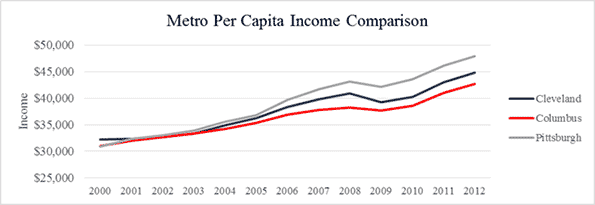
    Not exactly. Figure 1 shows the metro per capita income for Cleveland, Pittsburgh, and Columbus. The metros’ incomes were even around 2003, but then Pittsburgh and Cleveland began diverging from Columbus around 2005. Of importance here is that Pittsburgh and Cleveland have had higher per capita income growth than Columbus despite their declining population. This goes against the grain of traditional urban development thinking in which growth is god.

    Figure 1: Source, US Bureau of Economic Analysis via Telestrian

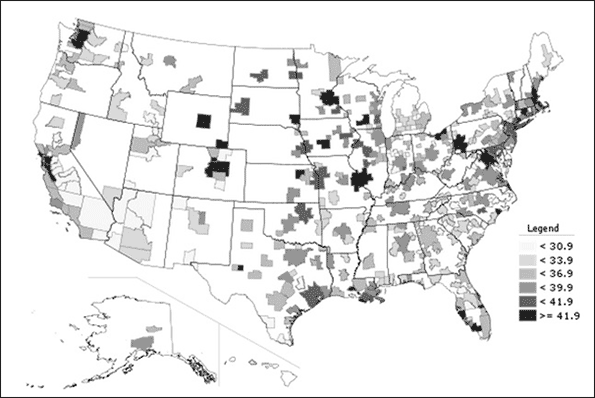
    Looking at real per capita income at purchasing power parity (PPP), or income adjusted for inflation and how far a dollar goes in a given metro, the trends hold. The map below shows the real per capita income (PPP) for all metros for the United States. Notice Greater Cleveland and Greater Pittsburgh stand out, with values at or above $42,000 a year. In fact, in ranking the nation’s largest metros (over 1 million people), the highest real per capita metros were Hartford, Boston, and San Francisco, followed by Pittsburgh 6th and Cleveland 11th. Not bad for “dying” metros. Columbus clocked in at 28th, while peer Rust Belt metro Detroit was 44th out of 51.

    Map: Map of real per capita personal income adjusted for inflation (in 2005 chained dollars) and regional purchasing power. In thousands of dollars (2011). Source, U.S. Bureau of Economic Analysis via Telestrian.

    Why is greater per capita income growth happening in the Rust Belt compared to Columbus? We have to keep in mind that a rising per capita income is not necessarily associated with a robust economy, particularly for regions that have flat or declining populations. Specifically, a metro, such as Cleveland, can gain in per capita income simply due to a significant out-migration of low- and middle-income workers. Such a scenario could prove problematic if the area’s total personal income is decreasing across time, because then the overall economy is contracting.

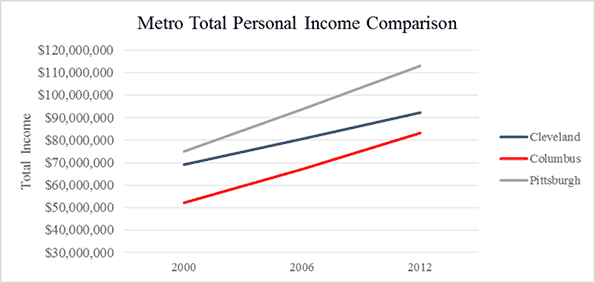
    But this is not the case. Figure 2 shows the total personal income for the three metros from 2000 to 2012. Both Cleveland’s and Pittsburgh’s total personal income levels increase despite declining populations. This effect has been called “growth without growth” by the Brookings Institution, and it occurs when a workforce is becoming more educated and productive at the same time overall population declines.

    Figure 2: Source, US Bureau of Economic Analysis

    This is what is happening in the Cleveland metro. Data from a new study I co-authored with Jim Russell out of the Center for Population Dynamics at Cleveland State University showed that from 2000 to 2012, Greater Cleveland gained over 63,000 educated residents, while simultaneously losing nearly 74,000 residents without a college degree. Over two-thirds of this brain gain occurred between 2006 and 2012. The fastest growing cohort was for college-educated Greater Clevelanders 65 and plus—a 30% increase. The number of Greater Clevelanders with a college degree aged 25 to 34 increased by 23%. Conversely, the vast majority of the out-migration was made by people aged 35 to 44 without a 4-year degree.

    This population dynamic is partly the result of Cleveland’s restructuring from a labor- into a knowledge-based economy. Specifically, growing tradable industries, like STEM and health care employment—which have driven job growth in Cleveland—are able to attract and retain skilled residents, whereas slower-growth industries are “pushing” less skilled workers elsewhere. Many of these non-degreed workers find a better return on investment in areas that are gaining in population, particularly if they are employed in the local consumer economy. Think laborers and much of the service class. This notion is supported by the fact that from 2000 to 2011, the average income of a person that moved from Greater Cleveland to Greater Columbus was $38,000 a year. Such a re-positioning of less-educated workers partly explains that while the Columbus metro is gaining on Greater Cleveland in total income, it is not the case with per capita income. Notes the Cleveland Fed: “Per capita income growth [in Columbus] is under increasing pressure to continue rising as population growth exceeds income growth”.

    So yes, Cleveland shrinks. But it is not about brain drain, but about rational choice theory. And while population loss is troubling for any city, it is in many respects a necessary demographic result as a region like Greater Cleveland transitions from brawn- to brain-intensive work.

    Think of this as a “one step at a time” approach to the existential plight that is the incredible shrinking city—meaning Cleveland’s migration needs are currently about quality, not quantity. This is because economic growth is not likely to be achieved through an increase in local consumption. Local jobs are created from emerging tradable industries, not vice versa—five service jobs are made for every new high-skill job in fact. And emerging industries are created via human capital, not consumer demand.

    “Consumer demand does not necessarily translate into increased employment,” writes John Papola in Forbes. “That’s because ‘consumers’ don’t employ people. Businesses do.”

    So where does Cleveland go from here?

    It needs to look to Pittsburgh. The sister Rust Belt city has had a human capital formation that has been nothing short of astonishing. University of Pittsburgh economist Chris Briem calculated that the metro ranked fifth in the nation when it came to the percentage of young adult workers with a bachelor’s degree, behind only Boston, San Francisco, D.C., and Austin. What’s more, Greater Pittsburgh ranked first for the highest concentration of young adult workers with a graduate or professional degree.

    “Change in the Pittsburgh economy is reflected in many ways,” writes Briem, “but probably no more profoundly than in the educational attainment of its workforce”.

    Greater Cleveland doesn’t perform too shabbily either, ranking 17th in the nation in the number of young adult workers with a bachelor’s degree, and 7th in the nation for young workers with a graduate or professional degree, ahead of knowledge hub darlings Seattle and Austin.

    In other words, Cleveland’s got something to build on: the quality of its young adult workforce. So instead of dumping money on brain drain boondoggles, or expending significant public expenditure on things like hotels and casinos that intend to drive economic growth from consumption on up, the region needs to pull out all the stops on growing a critical mass of talent. Because, as my colleague Jim Russell puts it, “talent is the new oil”.

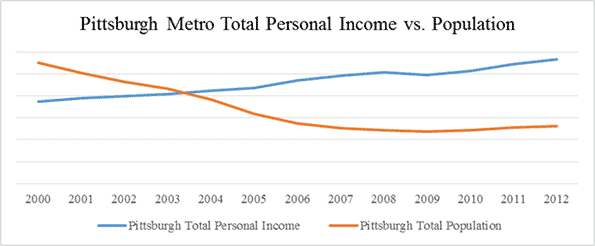
    Eventually, once the region’s new economy sectors are revved up, then job growth for both skilled and less skilled work will increase, making the region amenable to population gain. This is the case in Pittsburgh, where population loss has recently turned into a slight gain after decades of decline (See Figure 3).

    Figure 3: Source, American Community Survey, Bureau of Economic Analysis

    But until that growth happens the Rust Belt will be stubbornly mired in its existential crisis. Shrinking, struggling, and wishing on silver bullets and outdoor chandeliers. But maybe there is room for measured hope. More exactly, we shrink therefore we are?

    "I was continuing to shrink, to become… what? The infinitesimal? What was I? Still a human being?,” wonders the incredible shrinking man in the film’s closing monologue. “Or was I the man of the future?”

    Well, considering what the cost of living is doing to the coasts, maybe the notion of Pittsburgh as the city of the future isn’t so farfetched. The Clevelands of the world would be wise to wager so, and then model accordingly.

    Richey Piiparinen is a Senior Research Associate who leads the Center for Population Dynamics at the Levin College of Urban Affairs at Cleveland State University. His work focuses on regional economic development and urban revitalization.

    Top image: Courtesy of Universal Pictures

  • Fracking, Youngstown and The Right to the City

    What happens when the Chamber of Commerce, labor leaders, and government officials, most of whom live outside the city, are pitted against a small yet influential group of community and university activists? That’s what’s going on right now in a debate over a ballot initiative that would prevent gas extraction by hydraulic fracturing — fracking — in Youngstown, Ohio. The proposed ordinance, Community Bill of Rights (CBR), is modeled on similar anti-drilling legislation in other Ohio communities that would largely block drilling, as well as shale gas extraction and injection wells, especially in urban areas.

    This is the third attempt during the last two years to pass such legislation in Youngstown, and the vote has become closer each time. In the most recent try, 45 per cent supported the ordinance and 55 per cent opposed it. Supporters hope to shift the balance this time.

    The underlying legal issue is whether local community restrictions can preempt Ohio’s legal framework for gas and oil drilling. Ohio is a home rule state where municipalities have authority “to exercise all powers of local self-government and to adopt and enforce within their limits such local police, sanitary and other similar regulations, as are not in conflict with general laws”. As proponents of the Youngstown ordinance point out, there is no exception in the Constitution for the oil and gas industry.

    The Constitution would seem to give Youngstown the right to regulate fracking on the local level, but in 2004, the Ohio legislature passed a bill HB 278 explicitly denying that right. The bill was largely written by the oil and gas industry, which recruited support for it by flooding both Republicans and Democrats with campaign contributions, according to former Ohio Attorney General Marc Dann. This happened before the industry expanded drilling in the Marcellus and Utica Shale regions of Eastern Ohio, suggesting that the industry knew it would encounter local resistance.

    Resistance to fracking reflects concerns about the well-documented relationship between fracking and earthquakes, both nationally and in Youngstown, and related health concerns. But what makes the Youngstown fight so remarkable is the setting: a community with a long history of economic struggle.

    Youngstown has been the poster child for deindustrialization and disinvestment since 1977. The city has lost over 30 per cent of its population in the last quarter century, and it has demolished over 3000 properties in the last five years. The average sale price for a home is $21,327. Other challenges include a median household income of $24,880 and a 36 per cent poverty rate. It’s also home to several prisons; one of every 20 residents is a prisoner. Alan Mallach, an urbanist and senior fellow of the National Housing Institute, notes that economic development efforts have not sufficiently addressed these problems, pointing out that “… factories or warehouses that the city has attracted usually move to the nearby suburbs, and four out of five jobs in the city are filled by people who commute from out of town.”

    Those opposing the Community Bill of Rights capitalize on these difficulties. They have spent large sums to set up phone banks in black urban churches, promoting the idea that fracking will create jobs. Yet there is very little evidence that African Americans have benefited from the fracking industry, except as precarious laborers.

    Many of those who are pushing for fracking don’t live in the city, and won’t have to live with its problems. These include Chamber members, labor unionists (especially the skilled trades), and city government employees who are exempted from local city residency requirements – a policy that contributed to the flight of middle-class white residents and the hollowing out of the city.

    The difference between the influence of these non-residents and the less well-financed voices of those who live in the city has not been lost on Community Bill of Rights supporters. CBR leaders Ray and Susie Beiersdorfer, city residents and Youngstown State University geologists, recognize that the blitz of advertising by the oil and natural gas industry, promising future jobs, appeals to the largely working-class, mostly black residents who are most affected by the city’s high levels of poverty and unemployment. But as a group of YSU academics noted in a letter to a Youngstown newspaper, “The same can be said for the manufacturing of cigarettes, alcohol, drones, high-range missiles, and nuclear warheads.”

    Youngstown, of course, is especially susceptible to the promise of jobs, even at the expense of the environment and health, and that has led some on the political left to either stay out of the fight or to oppose the CBR. Younger, environmentally-conscious city residents, including proponents of urban farming and sustainability, support the CBR. Other community groups think that the ban is too localized, and want to work on statewide fights. They argue that, because of the 2004 legislation, the local CBR is unenforceable and largely symbolic. Many local Democratic Party leaders also are visibly and vocally opposing the CBR. Democratic voters see their local leadership standing arm and arm with the many of same people who have attempted to undermine unionism and voting rights in Ohio.

    The proponents of the ban have been particularly troubled by the role of the city’s largest institution, Youngstown State University, and the resources it has accepted from the oil and gas industry. The impact of the university’s support of fracking has been powerful. YSU has downsized or abolished Humanities and Arts programs, while expanding its STEM (science, tech, engineering and math) college and trumpeting its training programs for promised oil and gas industry jobs that have yet to materialize in any significant degree. Some educators, like Deborah Mower, have argued that this should not be the role of the University: “Instead of merely responding to the industry need and ignoring the problems of fracking that have plagued the industry for decades, the university could create an epicenter for redressing their problems…. Perhaps lost in this discussion is the nature of education.”

    CBR proponents agree with that sentiment, but they might also point out that what is really at stake is, as the organizers of an upcoming international conference phrase it, the “right to the city” versus the influence of non-residents (disclosure: I’ll be speaking in May on so-called “smart shrinkage” at The Right to the City in an Era of Austerity (1973-2014) .

    The oil and gas industry has spent over $100,000 to defeat the CBR, and proponents have been sued to keep it off the ballot. Meanwhile, the Beiersdofers and other CBR organizers increasingly believe that public health, science and the ballot box are being overpowered by money. But they won’t let that happen in Youngstown without a fight.

    John Russo is a visiting research fellow at the Metropolitan Institute of Virginia Tech, and former co-director of the Center for Working-Class Studies / professor (emeritus) in the Williamson College of Business Administration at Youngstown State University. He is a board member of the Mahoning Valley Organizing Collaborative (MVOC) (Youngstown-Warren), and the co-author, with Sherry Linkon, of Steeltown U.S.A.: Work and Memory in Youngstown.

    Flickr photo by Don O’Brien, Red, White and Blue: In Ohio, 100-barrel tanks used to contain crude oil from gas wells.

  • From Balkanized Cleveland to Global Cleveland: A Theory of Change for Legacy Cities

    Legacy cities have legacy costs, including disinvestment from the inner city, as well as regional economic decline. The spiral has been ongoing for decades. The new white paper by consultants Richey Piiparinen and Jim Russell entitled “From Balkanized Cleveland to Global Cleveland”, funded by the Cleveland-based neighborhood non-profit Ohio City Inc., examines the systemic reasons behind legacy city decline, all the while charting a path to possible solutions.

    Shrinking city theorists say the problem with the legacy city is that people leave. But urban powerhouses such as New York lose more people in a day than the Clevelands of the world do in a month. The real problem with legacy cities is an absence of newcomers, as it is this lack of “demographic dynamism”, or “churn,” which has inhibited economic evolution.

    To arrest economic decline, cities commonly undertake a patchwork of strategies. These include retention strategies that supposedly “plug” the brain drain; attraction strategies that emphasize placemaking, residential density, and urban amenities; or “big ticket” developments such as convention centers and casinos. The authors take another stance, theorizing that migration is the key to economic development. Cities that lack churn need churn. Without it, legacy cities can act as echo chambers of patronage and provincial thinking.

    But churn in itself is not enough. Often, the importance of inmigrants equates to filling condos or restaurant booths. Take the case of Ohio City, an inner city neighborhood bordering Cleveland’s central business district. The neighborhood, home to the iconic West Side Market, has made strides in its recovery. Investment is coming in. Condos are being built. Restaurants are opening. But this is not enough.

    In fact the mistake cities make when it comes to reinvestment is to settle with the low-hanging fruit of gentrification. Here, the neighborhood is seen as a center of consumption, with trickle-down effects from increased commerce said to reach low-income residents living in gentrifying, or potentially gentrifying, neighborhoods. This does not happen.

    This does not mean the reinvestment going on in neighborhoods such as Ohio City is unwelcome. It is only to say something else is needed. Ohio City needs to be made into a neighborhood that produces, not simply one that consumes.

    One way to do this is to ensure that the diversity of race, class, and businesses that currently exist in the neighborhood continue in the face of increasing market demand. For instance, Ohio City is 36% Black, 20% Hispanic, and 54% White. The neighborhood’s race and class mixing has increased over the last decade. Ensuring such heterogeneity can remain in the face of market demand is the challenge of the day. To date, no city has systematically ensured a process of policies that prioritizes the long-term benefits of integrated communities over the short-term benefits of consumer-driven gentrification.

    The benefits include increased economic mobility for individuals who grow up in integrated neighborhoods. For instance, a new study called “The Equality of Opportunity Project” found that Cleveland ranked 45th out of 50 metro areas in terms of upward mobility. A child in Cleveland raised in the bottom fifth of an income class only has a five percent chance of rising to the top fifth in her lifetime. The study, however, concludes that “upward mobility tended to be higher in metropolitan areas where poor families were more dispersed among mixed-income neighborhoods”.

    Cleveland is at a threshold. The re-investment is coming, and the importance of this infill as a means to arrest its economic and demographic decline cannot be overstated. Yet this will only occur if re-investment is leveraged so as to develop real economic growth. In other words, simply developing “creative class” enclaves in the likes of Ohio City and Tremont will do nothing to transition Cleveland from a segregated, siloed city with high rates of poverty into a globalized, integrated city comprised of neighborhoods that produce human capacity.

    Where people live informs them no less than where they work or go to school. Neighborhoods are factories of human capital. Equitable, integrated environments maximize potential. America needs to go past the gentrification model of revitalization. The cities that still have a fighting chance, like Cleveland, should lead.

    Read the white paper here.

  • To Rebuild, the Midwest Must Face Its Real and Severe Problems

    Despite well-publicized problems that earned it the nickname of the “Rust Belt”, on paper the Midwest possesses some formidable strengths. These include the largest concentration of engineers in America, world class educational institutions, a plethora of headquarters of global champions ranging from Proctor and Gamble to Caterpillar to the Chicago Mercantile Exchange, the world’s greatest reserves of fresh water, and an expanding immigrant population.

    Yet with limited exceptions, these have been around for a while, but haven’t produced much growth across the region. Instead, outside of an archipelago of successful outliers (mostly select parts of major metros or college towns), the region has seen its population, job, and income growth badly trail the nation.  During the 2000s US population grew by 9.7%, the Midwest* 3.8%. For jobs, the US lost 1.5% but the Midwest 7.8%.

    Reversing this requires not just leveraging strengths and building on assets, but facing the very real and severe structural challenges that plague the region. However, most of the strategies out there remain outside the region’s essential DNA:

    • Economic clusters like high tech startups or water industries are in effect attempts to build new success enclaves outside the system.
    • Rebuilding downtowns into urban playgrounds for the upscale often takes place against a backdrop of vacant lots, abandoned structures, and depopulation – in other words, empty space.
    • The Rust Belt Chic movement suggests that many of the problems are actually the solution.  But while there are intriguing and important elements to this, it bypasses core issues.

    These are all good as far as they go, but they require little broad-based reform (as opposed to district or enclave based solutions) to structural problems and thus are limited in what they can achieve.

    What are these structural problems? Among the key ones are:

    1. Racism. The modern history of Midwest cities is enmeshed in the history of race relations, particularly between black and white. Places like Chicago and Milwaukee remain among the absolutely most segregated in America. Race riots have been defining feature of cities ranging from Detroit to Cincinnati (which had a race-influenced riot as recently as 2001). In all of these places, a large population of black residents live in segregated neighborhoods plagued with problems ranging from poor schools to low quality housing to a lack of jobs.  Significant social distress has resulted. 

    There are signs the Great Migration that brought blacks north in search of factory work is reversing, with black residents actually seeing more welcoming environments and better economic opportunities in Southern metro areas like Atlanta, Houston, and Charlotte. As well, historically it’s been the more ambitious who leave, not such a good thing for the people and places left behind.

    2. Corruption.  Midwest cities ranging from Chicago to Detroit to Cleveland are famous as cesspools of corruption and cronyism. Systems like Chicago’s “aldermanic privilege” tradition that gives city council members almost dictatorial control over their districts produce environments of almost required tacit corruption even if no laws are violated. In other cities, it’s well known that your approvals will go much faster if you hire the right wired-up subcontractors, lawyers, or lobbyists. While this type of environment exists at some level everywhere, it’s very bad in many Midwest cities and badly degrades an already challenged business climate.

    3. Closed Societies. Contrary to the assertions of Robert Putnam and Bowling Alone, a lot of Midwest places suffer from an excess of social capital. As Sean Safford noted in Why the Garden Club Couldn’t Save Youngstown, excessively dense social networks can create a hermetically sealed environment into which new ideas can’t penetrate or get a hearing.  There are many reports of newcomers to Midwest cities saying that they have difficult making friends and penetrating the social networks in places as diverse as Minneapolis and Cleveland. In Cincinnati and St. Louis expect that the first question you’ll be asked is “Where did you go to high school?” which tells you everything you need to know about those cities.  Immigration has ticked up in recent years, but overall the Midwest has done a poor job of attracting outsiders.

    4. Two-Tier Environment and Resulting Paralysis.  Despite the plethora of high end companies, educated workers, and top quality universities, the Midwest economy was traditionally based on moderately skilled labor in agriculture and industry. This forged a work force that places too low value on education and which can even be suspicious of people with too much of it. Today’s agriculture and manufacturing concerns, at least the ones with jobs that pay more than subsistence wages, require much higher levels of skills and education than in the past. What’s more, with the global macro-economy favorable to larger cities and talent based industries, larger metros have comparatively done well while most smaller towns have struggled. As a result, their quality of life and services have so badly degraded they are no longer attractive to “discretionary residents” (those with the means and opportunity to leave), which perpetuates a downward spiral as the educated flock to bigger cities. That’s why manufacturers complain they can’t find workers with skills, even if those skills are just passing and drug test and showing up to work everyday. This produces massive inequities, resentment, and policy confusion. What’s more, realistically many very poorly performing communities may never recover.

    Beyond these core issues, many places have aging infrastructure, massive blight issues, a regulatory environment not suited to the 21st century, and severe fiscal problems. All of these are extremely difficult problems to resolve, but that does not mean they don’t need to be faced, and overcome.

    Unsurprisingly, the Midwest has not been a particularly competitive region.  There will continue to be bright spots ranging Des Moines to Madison to the greater Chicago Loop to the fracking fields of western Pennsylvania, but until the region faces up to its problems don’t expect a major turnaround anytime soon.

    Aaron M. Renn is an independent writer on urban affairs and the founder of Telestrian, a data analysis and mapping tool. He writes at The Urbanophile.

  • The Unrise of the Creative Working Class

    Scarcity leads to creativity out of necessity. That’s the pop culture meme at least. Think “starving artist,” or the survivors in Survivor. The thinking has penetrated the business culture as well. For example, in the shadow of the 2008 recession, Google founder Sergey Brin, in a letter to his shareholders, writes: “I am optimistic about the future, because I believe scarcity breeds clarity: it focuses minds, forcing people to think creatively and rise to the challenge.”

    But a recent book, Scarcity: Why Having Too Little Means So Much, by Ivy League psychologists Sendhil Mullainathan and Eldar Shafir, states otherwise. Through years of investigative research, the authors found that people operating from a bandwidth of scarcity don’t have the luxury of preemptive thought. Rather, being in survivor mode saps a person’s cognitive reserve.

    “Think about being hungry,” says Shafir in a piece in Pacific Standard. “If you’re hungry, that’s what you think about. You don’t have to strain for years—the minute you’re hungry, that’s where your mind goes.” The mental preoccupation extends to unpaid utility bills, debt, or, more generally, anything that’s life-pressing, he adds. The effect drains resources from a person’s “proactive memory”.

    Think of the absence of scarcity, then, as the freedom to think, visualize, and create. The results of Mullainathan and Shafir’s findings have implications for cities. Specifically, it’s widely theorized that cities must innovate to survive, and it is a city’s creative reservoir—which is dependent on the size of its educated workforce—that will nurture innovation. This is how  a city of soot can evolve into a city of software, not unlike what has occurred in Pittsburgh.

    But what about  Rust Belt cities struggling with high rates of poverty? Over 36 percent of Detroit’s 700,000 plus are below the poverty line. In Cleveland, the poverty rate is 33 percent of nearly 400,000. The national poverty rate is 14 percent.  This is a ridiculous amount of brain capacity consumed by unforgiving reality.  No wonder Detroit inches to get a leg up. The feral dogs, abandoned houses, and creditors looking for money have eaten up the capability to envision. Hence, the collective exasperation, and the bankruptcy death spiral.

    What will save the Clevelands and Detroits? The most prescribed cure is to find a way to attract more educated people. This has led cities across the country to compete for the vaunted “creative class” professional demographic. To urban theorist Richard Florida, to get creative types a city must have “[an] indigenous street-level culture – a teeming blend of cafes, sidewalk musicians, and small galleries and bistros, where it is hard to draw the line between participant and observer or between creativity and its creators.”

    According to Florida, a city needs to know it is on stage,and compete for the attention of a select demographic. In theatre parlance, this is called “capturing the audience experience.”  In urban place-making parlance it is called  “principles of persuasion” that emphasize novelty, contrast, surprise, color, etc.

    Robin_Williams_779552

    In other words, cities must become the collective embodiment of Robin Williams.

    Then, once you get your audience, you just watch them go,  says Florida, as creativity is “a social process.”  Creativity is bred by “the presence of other creative people.”  The scarcity of creativity in a poor city hypothetically gets filled up by the big-bang spontaneity of two creative types talking, neurologically egged on, no doubt, by a festival performer on stilts in a clown suit sauntering before them.

    If this strategy sounds like an overly simplified way to change what ails Detroit and Cleveland, it’s because it is. In fact Florida himself acknowledged this, stating in Atlantic Cities that, “On close inspection, talent clustering provides little in the way of trickle-down benefits [to the poor].”  In fact, because housing costs rise, it  makes the lives of lower- and middle-income people worse.

    But cities keep revitalizing this way because it is a feel-good prescription that is politically palatable. Who hates art, carnivals, drinking, and eating?  Displays of abundance provide the incentive to look the other way. Writes Thomas Sewell, “The first lesson of economics is scarcity: There is never enough of anything to satisfy all those who want it. The first lesson of politics is to disregard the first lesson of economics”.

    Where does that leave the millions operating on the wrong side of scarcity? Florida’s answer is for cities to somehow convince corporate America to pay their service workers more. While admirable, I doubt Daniel Schwartz, CEO of Burger King, is listening.

    Another option would be refocusing the lens through which modern urban revitalization is viewed. The default setting is to compete for scarcity of the educated elite. Instead, we should alleviate the scarcity from the struggling.  But flipping this script requires cities to give up on the idea that there is some audience that will save them. It is a city’s people who ultimately ruin or save themselves.

    In the meantime, the urban play continues. Cleveland is directing $4 million dollars of its casino windfall profits into the creation of an outdoor chandelier  that will hang at an intersection outside of Playhouse Square, the city’s theater district. The design, evoked by chandeliers inside the Playhouse itself, is intended to blur the line between drama and reality, and will “add glittery outdoor glamour to a district that tends at times to look gray and lifeless,”  according to architecture critic Steven Litt–all the while making the intersection “feel like a giant theater lobby”.

    But the script on Cleveland’s streets is one of hardship, not glittery glamour. Here’s hoping the outdoor chandelier illuminates that scarcity to those walking beneath it.

    This piece was originally published in Belt Magazine.

    Richey Piiparinen is a writer and policy researcher based in Cleveland. He is co-editor of Rust Belt Chic: The Cleveland Anthology. Read more from him at his blog and at Rust Belt Chic.

    Lead photo by David Shvartsman.

  • The Promise and the Peril of Rust Belt Chic

    What do you do when you’re a post-industrial city fallen on hard times? There’s a sort of default answer in the marketplace that I’ll call for want of a better term the “Standard Model.” The Standard Model more or less tells cities to try to be more like Portland. That is, focus on things like local food, bicycles, public transit, the arts, New Urbanist type real estate development, upscale shopping, microbreweries, coffee shops, etc., etc. The idea seems to be that the Rust Belt city model is a failure and should be chucked in favor of something better. In this model the publicly subsidized real estate project is the preferred economic development strategy. We’ve seen city after city work to create downtown and near-downtown “Green Zones” resembling miniature Chicagos. While these have generated excitement and even attracted some residents (upwards of 4,000 in Cleveland and 3,000 in St. Louis, though these are the high end), they have not fundamentally changed the civic trajectory other than in the largest Tier One type cities. And they likely never will. People who want Standard Model urbanism can find superior versions in many cities that generally boast more robust economies to boot.

    Enter Rust Belt Chic. This approach in theory solves two of the issues plaguing Standard Model urbanism, authenticity and uniqueness. I haven’t seen a crisp definition of what Rust Belt Chic actually is according to its boosters, but Pete Saunders summed up some of the salient points. The three key elements I see, which build upon each other:

    1. Do the Fail. Giving up on the idea of the factories coming back or large scale re-population.

    2. Reject Growth as a Success Marker. This actually aligns it somewhat with the standard model. Traditional signs of civic success such as population and job growth are rejected in favor of items like per capita income, brain gain, etc.

    3. Brashly Embrace the “Rust” in Rust Belt. This extends Do the Fail to actually embrace the civic characteristics failure produced, as well as various quirky legacies of the industrial past such as Pittsburgh potties.

    The best part of Rust Belt Chic is that it understands that you have to be who you are, not who you aren’t. Someone once described a brand as “a promise delivered.” When cities decide that what they are is of no worth or that it can’t succeed in the marketplace, the temptation can then be to try to pretend like they are Portland or some such. Almost invariably in such cases cities end up building towards a false promise they can never deliver. That’s not to say any of the elements of Standard Model urbanism are bad in an of themselves. The problem is that they are basically “best practices” types of things. Just as no company can succeed as nothing but an agglomeration of best practices, no city can either.

    The tendency in Rust Belt cities has been to try to downplay their authentic characteristics in order to try to portray themselves as hip and with it. As I’ve noted before, the one thing most clearly associated with Indianapolis is the Indianapolis 500, yet auto racing plays a fairly small role in how the city tries to sell itself these days.

    Rust Belt Chic is a first attempt at a region deciding no longer to be a passive importer of ideas about what cities should be, but instead trying to chart a path that is rooted in a unique, local history, culture, geography, etc. To the extent that it steers cities away from a purely “me too” strategy towards creating something that has a unique market positioning that’s real to the place and has at least some competitive advantage in the marketplace, Rust Belt Chic is a big win.

    However, as currently constituted, Rust Belt Chic would appear to be limited. In effect, it is really a marketing and to some extent a talent attraction program. Looking at the ironically appropriated trappings of the working man that characterize so much of hipsterdom, Rust Belt Chic says “Hey, we’ve got the real thing.” So rather than drinking PBR ironically, you drink I.C. Light with a more subtle degree of irony (i.e., by pretending that you’re actually drinking it authentically). The term “chic” itself is suggestive of fashion, and thus of artifice.

    What Rust Belt Chic does not do is address any of the core problems of the cities in question, ranging from fiscal crises to corruption to poor business climates to segregation, to say nothing of safe streets, better schools, etc. Maybe that isn’t its aim. But if not, then it would appear to be only one small component of an overall civic strategy, and not an alternative to the Standard Model in its own right. The theory of change it embodies would appear to be that authenticity of place and culture will attract people looking for the real, thus restarting the demographic engine through more population dynamism and ultimately that will percolate into the economy. That’s fine as far as it goes, but it’s insufficient.

    The elevation of authenticity also poses the danger of imprisoning the community in a straitjacket from the past. With “do the fail” and the embrace of decline as part of the culture, Rust Belt Chic deftly side steps some of the worst dangers of the corrosive force of nostalgia. However, the problem with authenticity is that is has to be, well, authentic. And the way that’s normally accomplished is by encasing something in amber, stunting its evolution.

    What Rust Belt Chic needs to be able to do is inform real, substantive change, and to not only unearth the authentic civic character, but updates it for 21st century realities.

    A city I think has done this quite well is Nashville. It would have been tempting for them to see their country music legacy as déclassé, and try to basically pitch themselves as the Portland of the South or some such. Instead, while they have embraced a number of Standard Model approaches – as I said, there’s nothing per se wrong with them – they kept country music as core to their identity. But it isn’t yesterday’s country music or culture. People in Nashville today aren’t sitting around watching Hee Haw reruns. Country music today is as much Hollywood as Hank Williams.

    That’s not to say Nashville disparages its past. Far from it. The old classic country performers are still honored, and their music still respected and listened to. And they see today’s country as linked across time to that of previous generations. So there’s evolution, but with continuity. They very much value their traditions. But they haven’t become imprisoned by them. Also, Nashville happens to have a stellar business climate, far less corruption than your average Rust Belt city, an openness to outsiders, an increasingly diverse population base, and an aggressiveness towards growth missing in most of the Rust Belt. That’s not to say Nashville’s perfect, but they’ve done a pretty good job of updating their authentic culture while backing it up with an actual product that’s functional demographically and economically.

    If Rust Belt Chic wants to reach its potential, it has to be able to do more than unearth and embrace the authentic culture of a place – though that’s important – it needs to be able to inform cultural evolution and also the very real changes in the product (such as Atlanta’s striving to shuck itself of the stigma of racism in the South by becoming the “city too busy to hate” and in the process becoming America’s premier city for blacks) needed to make these cities competitive again.

    Aaron M. Renn is an independent writer on urban affairs and the founder of Telestrian, a data analysis and mapping tool. He writes at The Urbanophile, where this piece originally appeared.

  • Rust Belt Chic And The Keys To Reviving The Great Lakes

    Over four decades, the Great Lakes states have been the sad sack of American geography. This perception has been reinforced by Detroit’s bankruptcy filing and the descent of Chicago, the region’s poster child for gentrification, toward insolvency.

    Yet despite these problems, the Great Lakes’ future may be far brighter than many think. But this can only be accomplished by doubling down on the essential DNA of the region: engineering, manufacturing, logistics, a reasonable cost of living and bountiful natural resources. This approach builds off what some local urbanists, notably Jim Russell, have dubbed “rust belt chic.”

    With a population of 58 million, the Lakes region boasts a $2.6 trillion economy equal to that of France and far larger than the West Coast’s. (We define the region geographically as comprising the western ends of New York and Pennsylvania, northeastern Minnesota, and Ohio, Indiana, Illinois, Michigan and Wisconsin.) Despite the growth in auto manufacturing in the South, the Great Lakes region still accounts for the vast majority of jobs in the resurgent industry, now operating at record levels of capacity.

    Since 2007, Michigan, Indiana, Ohio and Wisconsin have ranked among the top five states for growth in industrial jobs, adding a half million new manufacturing jobs since 2009.

    To build on this progress the region needs to focus on its human assets. This starts with by far the nation’s largest concentration of engineers, some 318,000, which stems from the oft unappreciated fact that manufacturing employs the majority of scientists and engineers in the nation. It also accounts for almost 70% of corporate research and development. This includes disciplines such as mechanical engineering, which according to a recent EMSI study, has enjoyed steady job and income growth over the past 20 years.

    Another critical asset is the concentration of skilled trades, the workers most sought after by employers, according to a recent Manpower survey. To keep this advantage, the area needs to focus on educating its workforce — particularly in neglected inner city neighborhoods — with skill training for jobs that actually exist and are expected to grow. This is already occurring in some states, such as Ohio.

    To be sure, traditional manufacturing jobs, particularly for the unskilled and semi-skilled, likely will never come back in large numbers. But the earnings level for skilled workers will remain well above the national average, and may increase even further as shortages develop.

    Some dismiss such blue-collar strengths as a critical weakness. They suggest that area residents might decamp for places like Silicon Valley where they can find livelihoods cutting hair and providing other personal services for the digerati.

    Of course, no sane Great Lakes leader would endorse this approach in public, but many, instead of embracing “rustbelt chic” prefer to recreate a faux version of America’s left coast. This obsession goes back at least a decade, reaching its most risible level during the time of former Michigan Gov. Jennifer Granholm. Her strategy focused on turning its cities — including Detroit — into “cool” burgs.

    This clearly did little to turn around either already beleaguered state or cities; “cool” did not save Detroit from bankruptcy. Indeed cool represents just one variation in a myriad of Rust Belt elixirs, including casinos, convention centers, “and creative class oriented arts districts. Virtually all the strategies being adopted in Detroit have already been applied in Cleveland, including by the same entrepreneur, Quicken Loans Chairman Dan Gilbert, with very little tangible economic benefit.

    Yet despite this history, Detroit — the poster child of public malfeasance — once again is pinning its hopes on luring the “creative class” to Motor City. It starts with the usual stab at subsidizing housing, office and retail around the central core. This is being jump-started by taking Quicken Loans jobs already in the area’s suburbs, meaning little net regional advantage.

    Even more absurd, Michigan taxpayers are being asked to pony up to as much as $440 million for a new stadium in Detroit for the Red Wings hockey team. In contrast to this beneficence, many remaining established, older smaller neighborhood businesses — many of them deeply entrenched in the Rust Belt economy — get stuck with ever higher tax bills and reduced levels of public service.

    To be sure, this approach can succeed in building hipster cordon sanitaire — a miniaturized but utterly derivative urban district — that can be shown to investors and visiting, and usually core-centric, journalists. It also can enrich speculators and those politicians who service them, but represents a marginally effective means of reviving the city, much less the regional, economy.

    Instead of chasing hipsters , Cleveland urban strategist Richey Piiparinen suggests cities such as his rebuild their economies from the ground up, tapping the strong industrial skills, work ethic and resilient culture deeply embedded in the region. Large factories may not return en masse to Cleveland, Detroit or Chicago, but a strong industrial economy and a culture embracing hard work could stir growth in service-related fields as well.

    Geography and location provide other opportunities . The area’s natural resources — the Great Lakes contain one-fifth of the world’s supply of fresh water — constitute a profound competitive advantage against drought stricken economies in the Inland West, the southern Great Plains and parts of the Southeast. Water is an essential element in many industrial processes, including fracking, a serious issue in parts of the Rust Belt. Miles of attractive coastline could be used to lure not only factories, but high-tech businesses, tourists and educated professionals who can choose their location.

    The Great Lakes also are a natural conduit for the $250 billion trade with Canada, with its vast resource-based economy and growing population . Instead of funding better bars, art galleries and sports venues, or hoping to attract tourists and conventioneers to traipse to Cleveland in December, what the region really needs, noted a recent Brookings report, is better infrastructure, such as bridges, ports, freight rail and roads.

    Critical too are the region’s strong engineering schools. Of the nation’s top 10, four — Carnegie Mellon, Purdue, the University of Michigan, and the University of Illinois at Champagne-Urbana — are located in the Rust Belt. The Great Lakes may not be home to the Ivy League, but it remains the nursery of practical applied intelligence.

    Emerging demographic trends could also play a positive role. The millennial generation will soon be approaching the age when they wish to start businesses, get married, have children and buy homes. A good target would be those seeking a single-family home and a reasonable cost of living; both are increasingly difficult to attain in much of the Northeast and coastal California where the cost of housing, even adjusted to income, can be easily two to three times higher.

    Indeed, despite decades of demographic stagnation, the region already boasts higher percentages of people under 15 than the Northwest, the Northeast (including New York) and has about the same percentage of kids as the rapidly growing Southeast. For a new generation, the Great Lakes could emerge as a destination, not a place to avoid.

    This requires the region becoming more attractive to newcomers, whether from abroad or within the country. As urban analyst Aaron Renn suggests, the Great Lakes has to become more culturally open to outsiders and immigrants. Cities such as Cleveland, Chicago, and Detroit were once magnets for immigrants from Europe and people coming from America’s rural hinterlands, notably the south.

    Restoring appeal to outsiders does not mean denying the region’s proud past, and throwing away its historic assets, but instead focusing on its core values. For many reasons — geography, weather, history — the region cannot remake itself into California, the Pacific Northwest or the Northeast Corridor. Instead the Great Lakes can best restore its legacy as an aspirational region by focusing on the very real things that constitute its historic DNA.

    Joel Kotkin is executive editor of NewGeography.com and Distinguished Presidential Fellow in Urban Futures at Chapman University, and a member of the editorial board of the Orange County Register. He is author of The City: A Global History and The Next Hundred Million: America in 2050. His most recent study, The Rise of Postfamilialism, has been widely discussed and distributed internationally. He lives in Los Angeles, CA.

    This piece originally appeared at Forbes.

    Great Lakes map by BigStock.

  • Is the “Rust Belt” a Dirty Word?

    Many people hate the term “Rust Belt”. They dislike the aesthetics of the Rust Belt. For others, the term is less loaded, but rather a moniker denoting who we are. Consider me in the latter camp. But I often cross paths with those who loathe the term, or more exactly any notion of there being a Rust Belt culture.

    For instance, I recently ran into a top official for the City of Cleveland. We shook hands, discussed backgrounds, before the individual put a name to a book I co-edited called Rust Belt Chic: A Cleveland Anthology, which is a collection of stories detailing what it means to be a Clevelander, a Rust Belter. The official let on she didn’t care for the term “Rust Belt”, and in fact found the idea of celebrating a Rust Belt culture backwards and distasteful. I told the official there was a new generation taking ownership of having grown up in a post-industrial reality, and that make no apologies for it. The official insinuated those people are not in positions of power, so what does it matter. I responded in ten years many will be, and so it matters a lot.

    Anyway, the conversation stayed with me for a few weeks, if only because it was a living, breathing example of what needs to go in Cleveland, if not the whole of the Rust Belt; namely, shame and false pride. Both characteristics go together. Said philosopher Lao Tzu:

    Pride attaches undue importance to the superiority of one’s status in the eyes of others; And shame is fear of humiliation at one’s inferior status in the estimation of others. When one sets his heart on being highly esteemed, and achieves such rating, then he is automatically involved in fear of losing his status.

    Shame. It’s pretty thick in these parts, and it’s linked to the region’s nickname, “The Rust Belt”. After all, rust connotes disuse, or of being left behind. Yet we are only shameful because the region did have status. We were a proud region once, as our forefathers and foremothers built this country. They protected this country. They enabled the defeat of Hitler. No hyperbole on that last part.

    Specifically, before being the “Rust Belt” the region was the “Arsenal of Democracy”, which was a term coined by Detroiter Bill Knudsen in his conversation with a weary and worried President Roosevelt on the eve of WWII. At the time of the talk, May 28th, 1940, America had the 18th largest army in the world, and so what FDR needed from Knudsen was reassurance Detroit’s industrial infrastructure could produce weapons at a pace unimaginable. Knudsen replied Detroit’s manufacturing might could transform into the country’s “Arsenal of Democracy”, with term eventually gaining traction in an FDR fireside chat dated December 29, 1940. In it, the President states:

    We must be the great arsenal of democracy. For us this is an emergency as serious as war itself. We must apply ourselves to our task with the same resolution, the same sense of urgency, the same spirit of patriotism and sacrifice as we would show were we at war.

    Obviously, the area succeeded, with Pittsburgh having produced one-fifth of the Allied forces steel from 1940 to 1945 alone.


    Courtesy of Seeking Michigan

    Needless to say, the region has had a lot to be proud of. But then macroeconomic forces took hold. Things globalized, and thus the way we lived and the things we did became obsolete. Shit happened. Shit is still happening. Yet part of the reason this is so is because we cannot let go. Being proud turned into stubborn pride, particularly for the region’s leadership who is hanging on to the illusion that yesterday will happen as long as we adhere to the same thought processes and power structures that held tow during the region’s heyday. But then yesterday doesn’t happen. Year after year it doesn’t happen. The pride becomes desperation. The pride becomes false. Said William Blake:

    Shame is pride’s cloak.

    And so with the collective shame comes collective temptation and desperation. Casinos will save the cities. Convention centers will save the cities. If only the cities will beautify enough. If only we had an outdoor chandelier. Or a suburban-type downtown mall. Or a tech district. Or a critical mass of microbreweries and boutiques. Or whatever anyone else doing. Anyone else, but us.

    Meanwhile, such city transformations erode the region’s true competitive advantage, which is who we are, and the various potentials inherent in our ability to persevere, i.e., our “learned resilience”. Writes Erie, PA native and economic development blogger Jim Russell:

    What I mean is seeing opportunity hiding in a community struggling with survival. There’s just something about Youngstown that stirs passion in me. I’m not gawking at ruin porn or glossing over everything that is wrong. I love Rust Belt cities. I love Rust Belt culture. I’m proud to be from the Rust Belt. That’s what Rust Belt Chic now means to me. It’s personal. It’s who I am. For Pittsburgh, I could sense the tide turning. I see the same transformation taking place in other Rust Belt cities. A pejorative, Rust Belt-ness is an asset. It’s a starting point for moving forward, not a finish line or a civic booster campaign.

    There is indeed a growing movement of Rust Belt pride taking hold. Yet it is not a false pride, rather a pride that’s derived from an acceptance of having become rust. Such can be immeasurable for the psychogeography of the region. After all, says William James,

    Acceptance of what has happened is the first step to overcoming the consequences of any misfortune.

    Richey Piiparinen is a writer and policy researcher based in Cleveland. He is co-editor of Rust Belt Chic: The Cleveland Anthology. Read more from him at his blog and at Rust Belt Chic.

  • Visions of the Rust Belt Future (Part 2)

    There are interesting developments being played out in the Rust Belt. Some cities, like Detroit, seem to be embarking whole hog down the creative class path. Others, like Pittsburgh, have their own thing going on, a thing loosely delineated as the “Rust Belt Chic” model of economic development, with no modest amount of success. How a given Rust Belt city reinvests will have a large say in its future.

    Part 1 of this series examined the nascent creative classification of Detroit. Part 2 analyzes whether or not there is a new way forward for post-industrial cities, using the lessons from Pittsburgh and Cleveland as a guide.

    Rust Belt Chic

    Rust Belt Chic is the opposite of Creative Class Chic. The latter [is] the globalization of hip and cool. Wondering how Pittsburgh can be more like Austin is an absurd enterprise and, ultimately, counterproductive. I want to visit the Cleveland of Harvey Pekar, not the Miami of LeBron James. I can find King James World just about anywhere. Give me more Rust Belt Chic.—Jim Russell, Talent Geographer and economic development blogger at Pacific Standard.

    ***

    Pittsburgh has been referred to as “hell with the lid taken off”. It’s not a compliment, with the moniker originating from an 1868 travelogue written in The Atlantic Monthly. But the reference is a misquote. From the piece:

    On the evening of this dark day, we were conducted to the edge of the abyss, and looked over the iron railing upon the most striking spectacle we ever beheld … It is an unprofitable business, view-hunting; but if any one would enjoy a spectacle as striking as Niagara, he may do so by simply walking up a long hill to Cliff Street in Pittsburg, and looking over into — hell with the lid taken off.”

    As stated, the context of the piece has been lost to the narrative of the Rust Belt malaise, with one Pittsburgh local writing: “It was practically a love letter to the city, yet that damned ‘hell with the lid taken off’ line is all that survives”.

    This Rust Belt notion of “hell with the lid taken off”, “Shittsburgh”, and Cleveland as the “Mistake by the Lake” flows from a certain reality, as the post-industrial transition hasn’t exactly been a sun-bathing. But the lore is also partly contrived, since it’s derived from a stubborn stereotyping of the Rust Belt as a backwater you go to die. Such rigid yet malleable beliefs are “mesofacts”, or cognitions which—while not necessarily reflecting reality—nonetheless influence reality, particularly the act of migration. Writes Samuel Arbesman, the founder of the term:

    [I]magine you are considering relocating to another city. Not recognizing the slow change in the economic fortunes of various metropolitan areas, you immediately dismiss certain cities. For example, Pittsburgh, a city in the core of the historic Rust Belt of the United States, was for a long time considered to be something of a city to avoid.

    Mesofacts are an issue for Rust Belt cities. But the  resultant civic booster pandering comes off as desperation, with the image makeover usually but a process to “hip” your city into something, anything else. In fact there has been ample shame in being Rust Belt. Shame for having been post-industrialized. Abandoned. Idled from what the culture is known for: hard work. The collective sense has affected how the future is plotted.  Buffalo, St. Louis, Dayton yearn to be Las Vegas, Miami, Portland, New York. In fact, as we speak, Cleveland is planning a “transformational” vibrancy effort that entails hanging a Rodeo Drive-like outdoor chandelier in its theatre district. It will hang not a mile away from a neighborhood, Central, with a 70% poverty rate. Such dissonance-ensuing efforts kills recovery efforts. Said Jean de la Fontaine:

    “Everyone has his faults which he continually repeats: neither fear nor shame can cure them”.

    The alternative is for a city to know itself,  to chart its own way. Let others copycat their way to oblivion, or to become, according urbanist Aaron Renn, some “sort of mini-Brooklyn instead of who they really are at heart”. But this isn’t easy. It requires a collective and sustained effort, and a conceptual frame that can guide the process. This, then, is the central driving tenant of Rust Belt Chic economic development. It is not a process of “kumbaya-ing”, but a strategy sourced through that basic wisdom of the ages: “Know Thyself”.


    Courtesy of Red, White, and Blueprints

    Below details the experiences of Pittsburgh and Cleveland using the Rust Belt Chic lens, particularly showing how an awareness of its legacy costs and legacy opportunities can be used to build emerging economies and evolving societies.

    The New Economy: Neither Extraction nor Retention

    A reality for the Rust Belt is that people left. Cleveland’s population declined by one-third in the 1970s. Pittsburgh’s exodus occurred in the 1980s. In fact, the whole of the region exported people, with states like California historically benefiting. Commonly, domestic outmigration has been viewed akin to leprosy, with angst-ridden brain drain initiatives haranguing people to stay put. This is a prime example of a mesofact-driven policy that does more harm than good. Rather, understanding how to leverage the fact your citizens are everywhere would be wise in an economy where connection matters more than place. This is the view in international economic development. Rust Belt cities should get wise. How Sweden thinks:

    Swedish Foreign Affairs Minister Carl Bildt believes it’s essential to embrace globalization. “I want to have more of the world in Sweden and more of Sweden in the world,” he told me. Sweden isn’t afraid of brain drain, he said. Instead, “we encourage our young people to study abroad and to work abroad.” Many return, but even those who don’t help to connect Sweden to what Mr. Bildt calls “the global flow of ideas.”

    This “global flow of ideas” is not just talk. It has legs. Writes leading Rust Belt Chic thinker, and colleague, Jim Russell: “Moving from one place to another is an economic stimulus. People leaving Cleveland promotes growth.”

    Courtesy of the Census.

    Courtesy of the Census.

    How does this work exactly?

    Think of an act of migration as a lying down of fiber optics, with each trip thickening the network between two points in space. Often, cluster relationships begin forming. Take Los Angles and Pittsburgh. For years, the best talent would be poached at Carnegie Mellon. On the surface, this meant Pittsburgh would grow the talent and California, though an employer such as Disney Labs, would reap the rewards.

    Brain drain, right? Thus, spend money to herd the nerds, and make your talent inert for the sake of a Census count. Or, as Russell writes: “Pittsburgh is dying. Time to pony up the jingle and get Richard Florida to save the day.”

    Well, as Ernest George Ravenstein wrote in “The Laws of Migration, 1885”, “Each main current of migration produces a compensating counter-current”, and this is exactly what happened between Pittsburgh and Los Angeles. For instance, as the cost of attracting talent into “spiky locales” started becoming prohibitive, alternatives were sought. For Disney Labs, one was locating an R&D center near Carnegie Mellon, with the decision influenced by the networks formed through by Pittsburgh’s “brain drain”. Count Google and Apple as two others bellying up in the Rust Belt backwater. As is Schell Games, an educational gaming company with a founder born in Jersey, educated in Pittsburgh, and refined in Los Angeles. Located in the South Side neighborhood of Pittsburgh, the company totaled a quarter of a billion dollars in sales in 2011. A similar process is being played out in Cleveland between Case Western, University Hospitals, and Philips Technology in the field of medical imaging. These are just some of the  relational opportunities across the whole of the Rust Belt.

    Digging further, there is something else going on here, particularly as it relates to the Rust Belt’s legacy asset of growing talent. To wit, other regions, like Portland, attract talent, but their educational ecosystems are less developed. The Rust Belt educates. It mines talent. Exports talent. For instance, according to the Chronicle of Higher Education, the top 10 states for out-of-state freshman enrollment reside in the Midwest (Pennsylvania is 1, Ohio is 7).

    Why does this matter? Because much like the industrial epoch before it, the innovation economy—to buy a term from Economist Enrico Moretti—is converging; that is, it is becoming less “spiky” and looking for leverage. Thus, the “rise of the rest”. From the Harvard Business Review:

    It goes without saying that no matter how much talent a company might have, there are many more talented people working outside its boundaries. Yet all too many companies focus solely on acquiring talent, on bringing talent inside the firm. Why not access talent wherever it resides?

    The overall lesson here is this: Rust Belt cities need to get over lamenting the Chicken Little-like strategy that is plugging the brain drain. Let your people go. Let them grow. Concentrate on the network.  The trend of jobs constricting its supply line to talent is likely to grow. Welcome to the “talent economy”.

    “Cool” Exhaustion

    Venture capitalist Brad Feld recently said, “The cities that have the most movement in and out of them are the most vibrant”. The statement speaks to the reality that Pittsburgh et al. won’t shrink their way to growth, as in-migration is needed. On that score, there’s some indication of Rust Belt demographic inflows, indicating changes of a mesofact shift.

    For example, people are returning to Pittsburgh, with a positive net migration for the past five years. In fact, U-Haul’s latest annual survey marks Pittsburgh as the top growth city in the U.S. There’s some movement back to Cleveland as well. My past research for the Urban Institute showed a net inflow of 25- to 34-year olds in the city’s downtown, as well as its surrounding inner-core neighborhoods. Other Cleveland neighborhoods and inner-ring suburbs are seeing a net inflow of young adults as well. Also, migration patterns from 2005 to 2010 flowed net positive to Cleveland’s Cuyahoga County from the “spiky” counties of Chicago’s Cook County and Brooklyn’s King County.

    Will the trend grow? Here, it’s necessary to infer why it is occurring, so as to emphasize the inherent competitive advantages Rust Belt cities have to offer.

    Part of the psychogeographic attraction that Cleveland and Pittsburgh have is the fact they are not Portland, Brooklyn, or any other variety of venerable hot spots engaging in an  arms race of mod. Industrial cities maintain distinct cultures comprised of unique histories that are manifested by both elegant and unpolished bones. In short, the Rust Belt is real places, with real people. Wrote a New York City cyclist and author on his recent trip entitled “It’s Monday, I’m Back, And Cleveland!”:

    Portlanders ride around on bespoke bicycles wearing artisanal fanny packs and eating kimchi quesadillas out of food trucks.  Clevelanders watch “The Deer Hunter” and eat rabbit and tubular meats while basking in the warm glow of their leg lamps…

    …Cleveland has its own unique take on the whole “artisanal” phenomenon.  For example, in Brooklyn people open stores where they only sell olive oil or mayonnaise, or where some Oberlin graduate will give you an old-timey shave with a straight razor and a leather strop for $75.  In Cleveland, this guy sits outside his shop making bats.


    Courtesy of Bike Snob NYC

    Rust Belt cities, then, got their own thing going on, something at variance with the universal creative class typology said to attract “young and the restless”. To engage in copycatting would be a tragedy for Cleveland and Pittsburgh to adopt—like re-branding a flower by eroding its scent.

    Joi Ito, the head of MIT’s Media Lab, agrees, saying city making is not about heavy-handed creative class endeavors, but about backing off, letting things emerge. But again, this requires city self-awareness, which, according to Ito, “has to do with the character of the city, the character of the people, the character of the mayor”. In other words, the answers for a city are inside of it. Not inside the idea of outside programming.

    And by being self-aware, Cleveland and Pittsburgh could position themselves as places for the “cool exhausted”, or places about community, affordability, and family. Places that contain good single-family housing stock. Places with coffee shops, taverns, and backyards. Places not prone to the dichotomy of micro-apartments v. McMansions but rather rest in a middle-grounding sweet spot that is projected to be attractive to the next generation of homebuyers. Says a newcomer to Pittsburgh from Brooklyn:

    Moving to Lawrenceville was one of the smartest things we’ve done.  It’s a visually, historically, and socially stimulating neighborhood with a stronger sense of community than I’ve experienced anywhere else.

    No doubt,  in-migration of all types is needed—i.e., Pittsburgh’s and Cleveland’s foreign-born rates are at historic lows— but the low-hanging fruit is Rust Belt refugees, or “boomerangers”, many Global City graduates. Russell, who has been examining the phenomenon for years, sees this variant of return migration as a potential game-changer for historically declining Rust Belt cities, particularly because it represents a counter flow to the donut hole-patterning of urban decline. “This is happening, and it’s on a scale much larger than expected,” Russell says. “We are busy catching up to a trend. The Rust Belt Chic migration is a particular form of return migration: Rust Belt suburb-to Big City-to grandpa’s neighborhood”.

    Economically speaking, such migrants pack a wallop, as the act of migration is primarily an entrepreneurial act. Such is illustrated in a recent New York Times piece called “Replanting the Rust Belt”. In it, they profile Cleveland chef Jonathan Sawyer who moved back home from New York to raise his family. Yet he was also determined “to help the city transcend its Rust Belt reputation”. Once there, Sawyer “foraged for people”, eventually setting up a local food ecosystem that “connects mushroom farms, bean gardens, Italian bakeries, Amish dairies, noodle makers, butchers and the basement and backyard of his own house”.

    Migrants like Sawyer are economic change agents. Pittsburgh and Cleveland need to scale them up, and then do everything they can to eliminate barriers so they can forage properly.

    Bowling with Strangers

    As the middle class re-enters and gentrifies inner city Rust Belt neighborhoods, consequences will arise. Still, desperate city leaders are happy with any trade-offs, as is evidenced by Detroit’s economic development czar George Jackson recent declaration that: “I’m sorry, but, I mean, bring it on [gentrification]. We can’t just be a poor city and prosper.”

    Such conceptions are common in government, institutionalized even. Notes Neil Smith:

    Gentrification became a systematic attempt to remake the central city, to take it back from the working class, from minorities, from homeless people, from immigrants…What began as a seemingly quaint rediscovery of the drama and edginess of the new urban “frontier” became in the 1990s broad-based market driven policy.

    It is widely understood gentrification does little to eliminate the systemic problems facing not only the Rust Belt, but most communities: that of segregation and inequality. There needs to be a prioritizing of the underlying neighborhood dynamics that offer both hope and challenges for a path forward. To that end, given the rapidity of demographic and housing change in the industrial Midwest—i.e., it’s “brokenness”—consider the Rust Belt as good a living “lab” as any.

    For instance, certain demographic shifts in various Rust Belt cities are going against longstanding patterns, particularly the organic evolution of mixed neighborhoods. The integration is coming from several angles, which is largely due to the “benefits” of a depressed housing market. For instance, in Ohio City, one of Cleveland’s gentrifying neighborhoods, the percentage of black residents increased from 24% of the population to 34% from 1990 to 2010, whereas the percentage of whites declined 58% to 50%. Given that Ohio City is one of the areas seeing an inflow of 25- to 34-year old residents, there appears to be  a meet-up of lower-to-middle-income black families that have migrated from the East Side of Cleveland with younger suburban and exurban whites. The same demographic patterns are occurring in other Cleveland neighborhoods such as Edgewater, Old Brooklyn, and Kamm’s Corners, as well numerous suburbs, suggesting a “shake-up” of social capital paradigms that have kept Cleveland not only geographically segregated, but psycho-sociologically segregated.

    “Social capital”, you say?

    Yes. Most often social capital is talked about in good terms only, a la Putnam’s seminal book Bowling Alone But as illustrated in the paper “Why the Garden Club Couldn’t Save Youngstown”, too much social capital kills. For example, too much trust in others like you can parallel not enough trust in others unlike you, leading  to immobility, insularity, and stagnation of ideas.  What is needed in Cleveland and Pittsburgh is less social capital, or more movement, more outsiders, and more crossing of such psychogeographic divides as the Cuyahoga River, which has served to divide the  city of Cleveland between the East and West Sides. These “shake-ups” that are occurring fosters the heterogeneity necessary to reverse Cleveland’s declining, patriarchal course.


    “My Hometown”. Courtesy of Plain Dealer

    But simple diversification of neighborhoods won’t do the trick. For instance, a white teen may go to a diverse high school but it doesn’t mean she will have black friends. This filtering along entrenched historical fault lines happens in neighborhoods as well. The scene in D.C.:

    Both groups [whites and blacks] feel entitled and resent the other’s sense of entitlement. Over time the neighborhood’s revitalization engineers a rigid caste system eerily reminiscent of pre-1965 America. You see it in bars, churches, restaurants and bookstores. You see it in the buildings people live in and where people do their shopping. In fact, other than public space, little is shared in the neighborhood. Not resources. Not opportunities. Not the kind of social capital that is vital for social mobility. Not even words.

    What is partly occurring here relates to a controversial finding of Putnam’s, or that diversity can decrease social capital—perhaps too much. “People living in ethnically diverse settings appear to ‘hunker down’”, writes Putnam, or “to pull in like a turtle”.

    Why?

    Part of the reason is that neighborhood diversity can equate to living “by” each other and not “with” each other. As such, neighborhood integration is still raw in the American zeitgeist, with heterogeneity, according to Putnam, engendering mistrust and too little social capital. A next step is needed. Here, community leaders should heed lessons from the concept of creative destruction. From the article “The Downside of Diversity”:

    If…diversity, at least in the short run, is a liability for social connectedness, a parallel line of emerging research suggests it can be a big asset when it comes to driving productivity and innovation…

    … In other words, those in more diverse communities may do more bowling alone, but the creative tensions unleashed by those differences in the workplace may vault those same places to the cutting edge of the economy and of creative culture.

    This, then, represents a key opportunity for Cleveland and Pittsburgh to reconstitute a new American neighborhood model by harnessing the potential inherent in its integrating neighborhoods. This opportunity is perhaps greater in Rust Belt communities given—as of yet—the absence of housing market pressure that tends to filter people along similar demographic lines. The mission is simple: how can cities foster mobility without a complete sacrifice of trust? This entails thinking about social capital in a new way: neither a presence nor absence of it, but a continuum of social capital with insularity based on comfortability on one end, and insularity based on mistrust on the other. The sweet spot of social capital is somewhere in the middle, which entails not bowling with your buddies or bowling alone, but bowling with strangers—until they no longer aren’t.

    Why is this so important?

    Where people live informs them no less than where they go to school. Neighborhoods are factories of human capital. America needs to go past the gentrification model of revitalization. The cities that still have a fighting chance, like in the Rust Belt, should lead.

    Richey Piiparinen is a writer and policy researcher based in Cleveland. He is co-editor of Rust Belt Chic: The Cleveland Anthology. Read more from him at his blog and at Rust Belt Chic.

    Lead photo courtesy of Spicy Biscotti.