Tag: Cleveland

  • Rust Belt: Can Micro-Suburbs Stay Independent?

    The Ohio suburb of East Cleveland abuts the core city to its west and north, and in terms of physical appearance the boundary between the two is indistinct. A century ago, the City of Cleveland unsuccessfully attempted to annex East Cleveland on two occasions. These days, Cleveland is unlikely to perceive its eastern neighbor as much of a catch. East Cleveland fell on hard times during the deindustrialization that took place throughout the Cuyahoga Valley: since 1970, it has lost more than half of its population. Nearly 40% of the 2010 population falls below the poverty level.

    East Cleveland’s residents and depressed real estate do not contribute a tax base by which the city can provide fundamental services. In this way, it’s no different than numerous exceedingly small towns and micro suburbs scattered nationwide. Can it — and other places like it — survive? And, if so, how?

    East Cleveland’s ‘solution’ is to shift the burden to motorists by tackling them with hefty speeding tickets. The 2.5-mile stretch of Euclid Avenue that passes through town is one of the city’s few revenue-raisers; a sidewalk sign promises camera monitoring and $90 speeding tickets.

    East Cleveland is a “Community of Strict Enforcement” that may not have high road fatalities, but the city’s socioeconomics give it few other options to generate the revenue it needs. The placard on the sidewalk (seen above) undoubtedly owes its existence to the debacle that a few years back brought about the demise of another Ohio town, New Rome.

    New Rome, outside Columbus, was a tiny village of only about nine city blocks (approximately twelve acres) that, even at its peak, no more than 150 people called home; the 2000 Census estimated its population at 60. It would probably have gone completely ignored if it weren’t for a four-block stretch of U.S. 40 (West Broad Street in Columbus) that fell within the town’s corporate limits. Within New Rome’s 1000-foot segment of highway, the speed limit dropped from 45 mph to 35. The New Rome Police Department had every right to issue $90 citations to motorists going 42 mph within this speed trap — and it did. The village of a dozen ramshackle houses, three apartment buildings, and a handful of small businesses earned nearly all its revenue from traffic tickets. With no other real public agencies, the money paid for the police force (which at times had as many as 14 employees, one quarter of the then-population) and the village council.

    A few neighbors eventually grew so frustrated that they launched the website New Rome Sucks. And after a series of corruption revelations, the town attracted the attention of the Franklin County Prosecutor and Ohio Attorney General Jim Petro, who determined that, after decades of incompetent management, New Rome should be abolished. Eventually, Petro convinced the Ohio General Assembly to pass a law allowing the state to seek dissolution of a village under 150 people if the State Auditor found that it provided few public services and demonstrated a pattern of wrongdoing. In 2004, the Village of New Rome was irrevocably absorbed into Prairie Township of Franklin County, Ohio.

    In most municipalities, good governance is a selling point. However, New Rome’s malfeasance was unequivocally a reflection of the will of its constituents. They got the racket that a majority of them apparently wanted. And eventually the village forfeited its very existence.

    While a New Rome could realistically emerge anywhere in the country, it is worth questioning whether the municipal incorporation structure in Ohio — and other states — particularly abets the process. Tiny municipalities exist everywhere. But they seem particularly prevalent in the industrial heartland. Cleveland’s Cuyahoga County has 57 incorporated municipalities; Columbus’ Franklin County has 25; Cincinnati’s Hamilton County has 38. Most states to Ohio’s northeast are almost completely incorporated: William Penn mandated this characteristic in his original charter for Pennsylvania. New Jersey is 99% incorporated. It is not uncommon to find boroughs as small as New Rome in both of these states; the Philadelphia suburb of Millbourne, for example, measures only .07 square miles.

    Conversely, southern states are more likely to opt for either expanses of unincorporated urbanized land (which characterizes the vast New Orleans suburb of Metairie) or mega-municipalities, such as the “town” of Gilbert outside Phoenix, with a population over 200,000.

    The majority of shrinking cities — and towns, villages, boroughs, and townships — now are clustered in the Northeast and the Midwest. “Home Rule” provisions in the Ohio state constitution, and similar legislation elsewhere in these regions, coupled with a small population, allow for a disproportionate amount of self-actualization… for better or worse. Cleveland’s most prosperous micro-suburbs have wielded it effectively to stem the erosion of their tax base.

    Does this broad-brush distinction between North and South yield any conclusions? At the very least, Rust Belt states must carefully weigh the benefits of entitling tiny populations to remain as independent towns. Otherwise, the only way many communities in a metropolitan mosaic will ever paint themselves out of the red is through surreptitious speed traps.

    Eric McAfee is an itinerant urban planner/emergency manager who fuses his cross county (and trans-national) travels and love of contemporary landscapes into his blog, American Dirt, where a different version of this article appeared.

    Photo in East Cleveland by the author.
  • The Cleveland Miracle That Should Never Have Been

    “[T]he most obvious, ubiquitous, important realities are often the ones that are the hardest to see and talk about.” Writer David Foster Wallace
    The story of the three Cleveland women kidnapped over 10 years ago and recently found alive in a house on the city’s Near West Side has captivated the national imagination. There is the miracle aspect from the fact that such situations rarely end this way. There is the hero aspect that is Charles Ramsey, the raw dog, uber-Cleveland man that tells it like it is (e.g., “Bro, I knew something was wrong when a little, pretty white girl ran into a black man’s arms.”) But that is not what this essay is about. Rather, it is about our failure as a city, particularly a failure of priority.

    On Monday, May 6th, the feeling in the air as one of the girls-turned-women emerged into her freedom was torn. There was elation at the miracle that the supposed dead were alive, yet there was also a collective unease that comes with the reality that Cleveland can be a violent city, and that there was a need for a miracle in the first place.

    Worse, the fact that the decades-long captivity occurred in the shadows of Cleveland’s revitalization success story, Ohio City—the city’s artisan district and home of the West Side Market—well, let’s just say it was enough to give many in this city pause. Including myself.

    Specifically, the week’s events left me acutely aware that Cleveland is still comprised of remnants of a post-industrial community. For it is a city still reeling. Still struggling. Still failing the most vulnerable. And it is a city still culpable, if only through fostering a continued failure in leadership that refuses to build the city the right way.

    Yes, like many cities, there are pockets of reinvestment, such as the gentrifying neighborhoods of Detroit Shoreway, Downtown, University Circle, Ohio City, and Tremont. And reinvestment in inner-city neighborhoods is needed, as concentrated poverty and segregation is no path forward. But Cleveland is not going to consume and play its way out of this. Re-treading the entertainment district into whatever urban revitalization fad appears to be going on in any given decade will only lead to what we always got: a perpetual state of “revitalization”. What will work is a real reconstitution of Cleveland’s neighborhoods; that is, a reconstitution of people, and not simply of place. To that end, think of the city as a net. No amount of investment will stick until we rethread our community fabric, which involves growing the people that comprise a community in the first place.

    Maslow's Hierarchy of Needs.svg

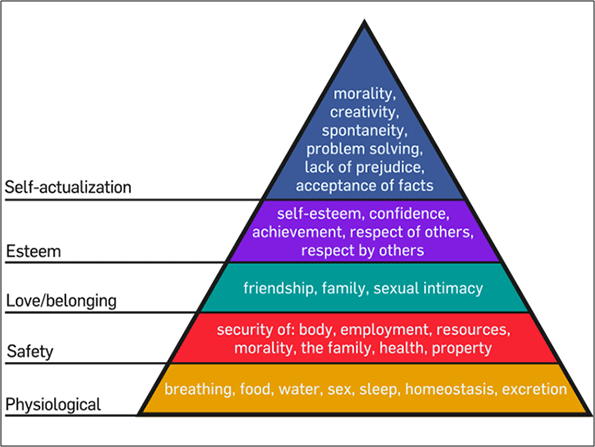
    How does a city do this? Well, the first step is to not get too cute, and to do the obvious realities right.. No amount of beautification projects will save a post-industrial city. A city needs to focus on the basics, as you develop a city like you grow a child. Here, the psychologist Albert Maslow’s hierarchy of needs can help.

    To wit, city leaders must prioritize physiological needs: eradicate food deserts, curb environmental threats, etc. Then, focus on safety. Not just manning safety force slots, but making sure those protecting us respect their duty. There are big questions about this in Cleveland. Also, shelter. Real local housing policies are needed, as are innovative educational and workforce development strategies. If you want to get creative, you can even leverage and strategize various needs together, like utilizing a glut of vacant storefronts into small business/entrepreneurial initiatives. Next, encourage social and cultural attachment so the benefits of community capital can be had. Don’t worry. If persons can breathe, eat, work, feel safe, and go home, they are likely to do this on their own. In fact that is the beauty of a hierarchy approach, as investment at the bottom turns into a self-fulfilling process up top. And then the icing on the cake: actualizing individuals, perhaps through fostering creative capital programs. That said, creatively classifying a city is doing it backwards if you haven’t built your city from the foundation up. Said Maslow: “A first-rate soup is more creative than a second-rate painting.”

    And while this makes intuitive sense to regular Clevelanders, it is confusing for the local leaders, if only through the advice of revitalization experts. For instance, in an article addressing concerns over whether or not Detroit’s investment should go to a bike path initiative, the author references an expert as to why the answer is “yes”:

    As Peter Kageyama argues in his book For the Love of Cities, “In the city making ‘hierarchy of needs’ we see most communities focused on bottom-line, core issues of making cities functional and safe. There still are many communities that struggle to even deliver functional and safe but that is not the problem. The problem is when communities only focus on the functional and safe and never raise their aspirations.”…Ultimately, places that do not engage us emotionally do not feel worth caring about.

    Clicking on the link above to Kageyama’s page, the expert details his thoughts and his audience:

    I focus primarily on American cities though the ideas are relevant to any place. I pay particular attention to some of our most challenged places such as Detroit, Cleveland and New Orleans as they have become hot beds of social innovation as government and the “official” city-makers have struggled to reconcile shrinking budgets and diminished capabilities. Into this vacuum has flowed a new breed of city-maker – usually young, independent, unofficial, creative, rule breaking and entrepreneurial. These are the new “frontiersmen” and “frontierswomen” who are rebuilding these cities from the ground up.

    There are a few problems here. First, while attachment to place is important, the logic is a bit flawed. A person insecure in various aspects of livability, like food and shelter, is not going to have their concerns addressed via an emotional connection to a given place. I am not saying developing place is bad. I am only saying such an approach is akin investing in nice drapes as your house is on fire. Put the fire out. Protect your people. Grow your people. After all, according to economic developer Jim Russell, people develop, not places.

    Second, local leaders are elected for a reason. To lead. And to serve and protect. “Frontiersmen” or Frontierswomen” are not going to protect the preyed upon—notwithstanding Charles Ramsey, though I doubt that is what Kageyama had in mind.

    No doubt, the events in Cleveland have shaken the city—yet another tear in an already torn city. And while the local and national news media is branding the escape of three women and one child as the “Miracle in Cleveland”, it wasn’t. At least not for us. We failed these young women. We failed the women before them. I hope this serves as our wake-up call. We will not play our way out of this. And if we continue to try, there will always be shame in the shadows of our revitalization.

    Richey Piiparinen is a writer and policy researcher based in Cleveland. He is co-editor of Rust Belt Chic: The Cleveland Anthology. Read more from him at his blog and at Rust Belt Chic.

    Top photo Courtesy of WOIO/AP

  • Why Inmigration Really Matters, Particularly to the Rust Belt

    Cleveland Mayor Frank Jackson’s recent comment about immigration has drawn some local ire. At his annual remarks on the state of the city, the Mayor—in response to a question of how Cleveland can end its population decline by attracting immigrants—stated: “I believe in taking care of your own”.

    To be fair, the Mayor contextualized the statement by inferring that the best attraction strategy is to build a city that works for those who reside in it. In some respects I agree. In fact America attracts immigrants not because of “attraction strategies”, but because it offers the prospects of a better quality of life. So, if a city can nail that down, well, that is a hell of a pull.

    The problem, though, is that historically inward-facing legacy cities such as Cleveland have had a hard time moving the needle toward progress because fresh blood is lacking, and so a “taking care of your own” strategy often devolves into policies that simply further fossilize the status quo.

    Why?

    Because such cities—with low rates of inmigration, and a long lineage of social capital that can tip to the side of insularity and territorial encampment—have too much inertia, which is defined as “the resistance of an object to change its state of motion or rest”.

    Inertia is real, not simply in physics, but in organizational behavior, such as city politics and policy. And the more historical it is, the thicker the status quo, and thus the harder it is for a city to change—meaning the future, or the momentum of the city, can be like a train chugging to constant stops of stagnation unless a “force outside the system…act[s] upon the system for a long enough period of time to have any effect on changing the momentum.”

    Enter the importance of outsiders, be they immigrants, returning expats, or just new people from other parts of the country. Without them cities get stuck. People see the same things, talk the same things over. Bullshit territorial divides like East- versus West-side of the Cuyahoga River reign, effectively cutting a city’s “brain” in half. Business is business as usual, then. Hence the post-industrial-sixty-year decline.

    Writes Aaron Renn over at Urbanophile:

    I previously noted how it generally takes a critical mass of outsiders, enough to create a constituency for change in its own right, to drive real disruptive change in a community. These are the people who aren’t invested in the status quo. Absent that, getting reform that works will be a difficult challenge.

    Echoes migration expert and blogger Jim Russell:

    Without migration, there are no cities. An urban landscape is more than a draw for talent. Metros thrive on churn, both the influx and egress of people…

    … The very act of moving, particularly to the top tier of global cities, is entrepreneurial. You are surrounded by risk-takers and innovation. The competition is fierce. The cream of the crop is seeking any edge, looking for any opening.

    I am learning about the power of migration first hand. You see, I am a lifelong Clevelander, a West Sider, one well-versed in the how things are customarily done around here, and what thoughts and words are commonly produced if only through a Rust Belt inertia that can be cloaked in “tradition”. My partner, Andiara Lima, is a relative newcomer from Vale do Aço, or the “Steel Valley” of Brazil. Before I met her I was ignorant to the presence of the Brazilian community in Cleveland. Now, I no longer am, and the experience provides me with on-the-ground lessons as to the importance of migration in evolving the Rust Belt “way”.

    brazil house party


    For instance, individually speaking, my panorama is being broadened, with the dominant cultural connotations of Cleveland defined primarily by whiteness or blackness taking a needed hit. For instance, I was at a Brazilian-hosted house party not long back, and it was like nothing I ever experienced. The dining room was cleared, bodies moved, sweat poured, people screamed and shook ass. A band was set up to play bossa nova along a window seat. And it was happening all in the neighborhood of my childhood, but way beyond my childhood. Rather a feeling of something forward.  Not just past. Not identity politics, but a freshness needed so that crusty legacy and power can be dampened if only to bust identity politics up.

    No doubt, these identity politics hurt the region’s ability to welcome and catalyze emerging groups. For instance, I am reminded of a recent Facebook comment on a local politician’s page that discussed a community forum about how Cuyahoga County government reform would affect race relations. The commenter notes:

    The whole panel was black or white people. The Asians and Latinos were in the back of the room wondering “what about us?”

    “What about us?”

    It’s a good question, and one local leaders shouldn’t underestimate given the region’s need for fresh blood. And we aren’t just talking bodies, but talent, as migrants are “economic ass-kickers”, particularly due the fact that migration is in itself an act of entrepreneurialism.

    For instance, my partner Andiara studies the Brazilian trade market for a local investment company. Her informational network into the country, both professionally and informally, is deep. For me, she is a link between two Rust Belt worlds, shattering my sense of restrictive locality for a borderless view that gets me thinking about how to position Cleveland not just regionally, but globally.

    For Cleveland, she is a reserve for local industry that should be both cultivated and tapped, especially since—as the US Ambassador to Brazil recently said at Cleveland’s Union Club—“Brazil is an economic and democratic power the United States needs as a partner”.


    And there is Luca Mondaca and Moises Borges, both acclaimed Brazilian musicians who are plugging (into) and broadening (out) Cleveland’s musical legacy. Yet there is frustration, particularly for Luca, as she feels isolated, untapped, and sometimes lost in the culture of a city that—while desperate for freshness—has difficulty getting beyond the inertia that comes with being comfortably stale. And while I am hopeful that the city is in fact becoming more welcoming—and that the opportunity afforded by the region’s affordability and legacy assets can further open the inmigrant sluicegates—passive optimism is not an option.

    Neither is parochial playmaking.

    In fact, Andiara Lima, Luca Mondaca, and Moises Borges are Cleveland’s “own”. But without that recognition, they may not be for very much longer.

    Richey Piiparinen is a writer and policy researcher based in Cleveland. He is co-editor of Rust Belt Chic: The Cleveland Anthology. Read more from him at his blog and at Rust Belt Chic.

  • Should California Governor Jerry Brown Take a Victory Lap?

    "Memento Mori" – "Remember your mortality" – was whispered into the ears of Roman generals as they celebrated their great military triumphs. Someone should be whispering something similar in the ear of Gov. Jerry Brown, who has been quick to celebrate his tax and budget "triumph" and to denounce as "declinists" those who threaten to rain on the gubernatorial parade.

    Brown speaks about California’s "rendezvous with destiny" and the state’s "special destiny… more vibrant and more stunning in its boldness." His pitch certainly has persuaded much of the mainstream media to add their horns to the triumph.

    Yet right now, despite its many blessings, our state remains more on a collision course with mediocrity – at best– than with any such manifest destiny. California may not be a "death-spiral state" as some conservatives suggest, but Brown’s triumphs – the Proposition 30 tax increases, the marginalization of the GOP as well as his Democratic rivals – have been more political than substantial and have done little to address the state’s major long-term challenges.

    Let’s check this out. Unemployment remains the third-highest among the states; we still have one-third of the nation’s welfare recipients; the highest poverty rate in the country, with one in five of California’s diminishing ranks of children living in poverty, including more than a third of children in Fresno. Our education system, with new dollars or not, continues to fail young people and our economy.

    Critically, the three key elements typically invoked to promote the comeback meme – budget relief, the genius of Silicon Valley alchemists and "green" jobs – are themselves suspect. Even Brown, who suggested that we could create 500,000 jobs from his climate change agenda, isn’t speaking much about it. In California, and across the nation, "green jobs" have failed to materialize enough to offset the higher costs imposed on the rest of the economy, the high public subsidies and parade of failed ventures associated with these policies.

    Yet, Brown is so dogmatically loyal to this agenda that he remains committed to massive regulation of the economy, which is slowing growth. And he shows – despite his occasional bouts of fiscal sanity – no signs of backing away from his financially troubled bullet-train fantasy.

    If green economics are failing, can Silicon Valley bail out the state? Reporters anxious to celebrate our deep-blue state’s comeback almost always genuflect to the tech industry. They rarely bother to look at the fact that, even with considerable growth in the tech sector over the past two years, the valley has not even recovered the job levels of a decade ago.

    More troubling still, Silicon Valley is becoming less an exemplar of capitalism than the beneficiary of an insider game that relies on access to capital and contacts more than on innovation. It is also becoming increasingly dependent on government largesse: No one bet more on subsidized "green" companies than the venture-capital elite. Prospects are also dimming for social media, the valley’s latest signature industry. User interest in Facebook is slipping, notes Pew, and the industry now sees its next great opportunity, of all socially worthless things, in online gambling.

    Even under the best of circumstances, Silicon Valley is neither robust enough nor predisposed to help solve the state’s long-term fiscal challenges. In fact, the high-tech darlings of the progressives, such as Google and Apple, are turning out to be as adept in not paying taxes as are Mitt Romney or General Electric. For its part, Facebook now appears to have paid no income taxes at all last year.

    In fact, the only thing bailing out California is not growing tech firms, but the enormous legacy of wealth, including inherited wealth, that has built up in our state over the past 30 years. California is still rich in rich people, whose stock and real estate holdings are gaining value. As long as Uncle Ben’s printing press hands out free money, California could collect enough in state income taxes to perhaps balance its annual budget for a spell.

    None of this places, to say the least, California on a firm footing. So at the risk of engendering some gubernatorial ire, here’s my memento mori suggestions for restoring California’s promise. This starts with the assumption that the elements of a true revival exist and that, if Brown would shed some of his dogma, he may end up deserving his current plaudits.

    Get real on the budget.Asset bubbles may rescue the state from annual budget woes, but the state’s long-term prospects remain cloudy, due largely to mounting government employee pension costs. Attempts to revise the game for new employees are not sufficient to scale the state’s mounting "wall of debt"; Californians per capita now owe almost five times as much to Wall Street as residents of our chief rival, Texas. Analyst Joe Matthews suggests we need more drastic fixes, such as cutting off retirees’ health benefits after they reach Medicare age.

    Redirect the climate-change jihad. California can keep leading in conservation but needs to adopt a more pragmatic people-friendly approach, such as by encouraging telecommuting and energy-saving technologies. In contrast, the current high-density housing diktats and ultra-expensive "green" energy will force up prices for housing and electricity rates way out of proportion to national norms. This damages the middle and working class even if it won’t impinge on the lifestyles of Brown’s rich and famous friends.

    Focus on basic industry. Tech and entertainment can never drive enough jobs or wealth to support this huge state. But California is blessed with the country’s richest soil and huge fossil-fuel reserves. These could bring in new revenue to the state and create new jobs for a broad number of Californians, particularly in the hard-pressed interior. Particularly critical is the state of the water system, which once again faces large cutbacks because of pressure from environmentalists. Brown has spoken in favor of a peripheral canal; solving the water problem may leave him with a greater legacy than the dodgy bullet train.

    Reform the education system. More money alone won’t save the schools, but may be used only to prop up the pensions of teachers and administrators. Some kind of radical reform – perhaps school choice, vouchers, mass use of charters – must be the price of any increase in money to education. Brown has made some reformist noises with the University of California, but he remains tethered to the teachers unions on K-12 schools.

    Invest in economically needed infrastructure. Besides the peripheral canal, Brown should look at expanding the state’s energy supply by permitting the construction of low-polluting, economically efficient gas-fired power plants. Rather than waste money on a "train to nowhere," he should be looking at fixing roads, bridges, ports – the sinews of a modern economy – and improving existing inter-city trains (and buses), particularly in high-volume corridors in the Bay Area/Sacramento and across Southern California.

    Prioritize blue-collar opportunities. California’s greatest challenges lie with a widening class divide. Bolstering manufacturing, which is in a secular decline here, and restarting construction could create new opportunities for blue-collar workers. Port expansion would create lots of jobs in everything from warehousing to assembly and business services. This can be meshed with revitalized training programs for the skilled trades. In simple terms: California needs more skilled machinists, electricians and irrigation technicians and likely fewer marginally employable ethnic-studies or humanities grads from second- and third-tier schools.

    One can understand why our governor, at age 74, wants to enjoy his triumph. But to deserve the laurel wreath, he first needs to make the major changes that can bring this greatest of states back to its historic potential.

    Joel Kotkin is executive editor of NewGeography.com and a distinguished presidential fellow in urban futures at Chapman University, and a member of the editorial board of the Orange County Register. He is author of The City: A Global History and The Next Hundred Million: America in 2050. His most recent study, The Rise of Postfamilialism, has been widely discussed and distributed internationally. He lives in Los Angeles, CA.

    This piece originally appeared in the Orange County Register.

    Jerry Brown photo by Bigstock.

  • Gentrification and its Discontents: Cleveland Needs to Go Beyond Being Creatively Classed

    “Indeed, we have the know-how, but we do not have the know-why, nor the know-what-for”—Erich Fromm, social psychologist.

    The question of how you “become” as a city has been weighing on me lately. Is it enough to get people back into the emptiness? Is it enough to pretty the derelict? I mean, is the trajectory of Cleveland’s success simply a collection of micro-everythings, start-ups, and occupancy rates? That is, is Cleveland’s reward simply the benefit of being creatively classed?

    I hope not. It won’t work. Here is why.

    The problem with most city revitalization these days relates to its playbook: there are the investors who have the capital, and then the political power from which finance flows. Here, money not only talks, it builds, with investors’ wishes transcribed in how a city looks, feels, and functions. That said, the main interest of the investors is to make money, and so people are seen as consumers as opposed to citizens. Consumers that fill up real estate space. Consumers that salivate over tastes. Consumers of art and design, with the attraction to beauty meant to establish a “vibrancy for profit” mindset as opposed to experiencing beauty for the value of beauty’s sake. Come to think of it, the creative class is really just the consumer class, just like the rest of us. Yet they are anointed in status by city makers because they are thought to have more spending power than their working- and service-class counterparts.

    “Follow the creative community, and property values will rise,” states one recent article in a real estate publication. “You have given real estate developers the playbook”, echoes Albert Ratner, head of Cleveland-based Forest City, on his reading of “The Rise of the Creative Class”. The motivations, as such, are quite blatant.

    Now, why is this a problem?

    Because developers have extraordinary amounts of pull in directing where finances goes (this is particularly true in Cleveland), which means investment can get skewed to a select demographic. As such, the gap between the haves and have not’s grows and the geographic disparities begin to cement social inequities into the city’s fabric. Cracks then show: drug use, murders, alienation and disenfranchisement, growing pockets of continued disinvestment, and it won’t stop because research has consistently shown that inequity is an endless source of social ills. The only thing left to do is to compartmentalize our shadows, with “bad” kept in places away from the spots of our “hope”. This is not unique to Cleveland or to this era. It is just the way things have been, which leads me to wonder if Cleveland’s recent comeback is just a carousel in which progress is simply rearranging the broken deckchairs.

    But while the future is uncertain, failure need not be inevitable. Yet what can be done in Cleveland and other Rust Belt cities to ensure we don’t waste our opportunity? Unfortunately, little outside of a radical shift in how cities think about themselves, particularly as it relates to the notion of “revitalization”.

    This is where the concept of “Rust Belt Chic” comes in, which—when it is boiled down—is really just a process of collectively “knowing thyself” (an in depth description of Rust Belt Chic economic development will be delineated in a subsequent post). Specifically, by becoming aware of who we are as “Cleveland” we know who we are not, or more exactly: what we don’t need to be. This is important as it relieves the temptation of Cleveland trying to copy some other city’s so-called success which, in the end, is counterproductive, as such efforts—like the historic Columbia Building demolition for a Vegas-style “look”—ultimately eliminates those things like history and architecture which ties us together.

    columbia building

    The historic Columbia Building being demolished. Courtesy of the Cleveland Kid.

    This is all to say that Cleveland need not be “brochured” for the so-called creative class. That is simply objectifying your city as a product as opposed to a people, which is crude, and such posturing and posing is hardly Cleveland, besides.

    Instead, a hammering down of who we are in our process of becoming is needed. We are Clevelanders. We care and fight for this city, endlessly. We swear, shake hands, bleed, heal, work, fight, and pray—all in an environment molded more so by the reality of Mickey Rourke than the donning of Ashton Kutcher. And so while repopulating the core is needed, we also must engage in building the productive capacity of people as opposed to simply relying on a capacity to spend. Specifically, squeezing out price per sq. feet at the expense of community fabric is not true economic growth. It is mountains turned to coal.

    I cannot emphasize enough how important community development is to Cleveland’s future. For as creative classification goes main stream, more and more cities will begin looking and feeling the same, and more and more cities will be turned to products to be gobbled up by those with stars in their eyes. But this kind of thing is not for everyone, or even for most. It is for a slice, a finicky slice. And so I gather creative classification will go the way of the fad, like all styles do. Some cities will be stuck left to look at the cartoon tattoos that dot their body, while the people left longing will decompress to find something a little more real.

    Then—if we do it right—people will turn to Cleveland not because we faked the place as attractive, but because Cleveland made an effort to turn to its people.

    This post originally appeared at Cool Cleveland.

    Richey Piiparinen is a writer and policy researcher based in Cleveland. He is co-editor of Rust Belt Chic: The Cleveland Anthology. Read more from him at his blog and at Rust Belt Chic.

    Lead photo: Don’t call him creative classed. A Cleveland artist, Mac, and his rooster, Morty.

  • That Sucking Sound You Hear…Solutions to America’s Housing Crisis Are Needed

    There is a crisis in America that’s not being attended to. It is the housing crisis, and its tentacles reach deep into the decline of the American middle class. Particularly, the interlocking dynamics of foreclosure, abandonment, and blight are draining the net worth of millions of Americans. The solutions to date have been piecemeal and ineffective. One possible initiative on the radar—which will be explained further below—entails a federal investment in the strategic demolishing of thousands of “zombie properties” that are eroding equity and quality of life.

    This erosion is real. Writes Howie Kahn of his recent tour with a City of Detroit demolition crew:

    Old roofs half-collapse under the weight of snow, forcing the walls to bulge outward. Moisture eats away the insides. Mold spoils the walls, softens the floors. In the summer, the sun bakes it all to a high stink and turns it crisp as tinder. Nature takes over. Trees sprout through the dormers. Animals get comfortable. We see this everywhere we go…So many innocent onetime starter homes, built on credit and striving, now in foreclosure. The holding company writes it off as a loss. And unless some crusading neighborhood association acts as a sentry, no one’s watching the house anymore. In essence, it belongs to nobody—or to everybody. Because once a house becomes worthless and unwanted…it’s everybody’s problem. Everybody’s crime scene.

    As both a policy researcher and a Clevelander, I know these realities first hand. The city was home to over 40,000 vacant housing units in 2010, or nearly 20% of its stock. Several of these units were across a street from me, the result of a foreclosure on a rental investment purchased during housing inflation heights. Tenants were kicked out around 2009. The place sat empty, but I soon noticed people constantly disappearing into the back of the building. Drug activity I thought. Then one day I found a pile of hypodermic needles on my front lawn while cutting the grass. I have a child. The very real effect of blight acted as a drain on my property value, not to mention my quality of life.

    And while I stayed in the City of Cleveland, many don’t. Cleveland lost 17% of its population from 2000 to 2010. The population decline (which is a long-term trend)—combined with the subprime mortgage crisis—created for unprecedented amounts of oversupply. Often, with both banks and homeowners walking away, the vacant structure devolves into blight until it becomes “a disamentiy effect”, which in plain-speak simply means living near something nobody would want to, with the unappealing prospect monetized in the devaluation of the house’s market value.

    This disamentiy effect has been quantified. For instance, my colleague Nigel Griswold found that in Flint, MI each abandoned structure within 500 ft. reduced a home’s sales price by 2.27%. A study by Thomas Fitzpatrick of the Federal Reserve Bank of Cleveland showed an additional property within 500 ft. that is either delinquent or vacant reduces prices by 1.3%. In low-poverty areas the effect is greater: 4.6%.

    Of course the larger problem is the broader economic effect, as depreciation goes beyond a lower return on investment and gets at household net worth. Specifically, according to the Census Bureau, household net worth declined 20% from 2005 to 2010 (40% since 2007). Of this decline, 76% was attributed to a loss of home equity. Minorities were hardest hit, with average Black household equity falling from $70,000 to $50,000 and average Hispanic household equity falling $90,000 to $40,000.

    Such declines in net worth have swelled the number of Americans stuck in precarious economic conditions. A recent report called “Living on the Edge: Financial Insecurity and Policies to Rebuild Prosperity in America” found that nearly half of Americans are “liquid asset poor”, meaning “they lack the savings to cover basic expenses for three months if unemployment, a medical emergency or other crisis leads to a loss of stable income.”

    Vacant house in Detroit. Courtesy of Streetsblog

    Such economic figures are alarming, and they call for intensive solutions aimed at reconstituting the American middle class, if only to achieve a broader economic recovery outside of the investor class. One such solution could entail a large-scale strategic demolition of “zombie properties” in America’s hardest hit areas, such as the Rust Belt.

    Why demolition?

    It is simple, really: by removing the disamentiy effect you are giving the value of the surrounding houses a chance, and there is initial empirical proof that this does in fact occur. Specifically, in his examination of Flint, MI, Griswold found that Genesee County’s demolition investment was paying off, with $3.5 million of demolition activity producing $112 million in improved surrounding property values. Not a bad ROI, and it’s a return that positively affects homeowners, investors, and government alike.

    The question remains: why isn’t there a concerted effort to once and for all excise the hundreds of thousands “zombie properties” that are draining value from the American economy?

    The reasons are varied, but one in particular relates to a lack of empirical proof that demolition has a definitive monetary impact. One current study, spearheaded by Jim Rokakis of the Thriving Communities Institute, aims to fill the gap. The study, headed by Nigel Griswold, myself, and the Center on Urban Poverty and Community Development at Case Western Reserve University, was partly conceived out of a September 2012 interagency meeting on Residential Property Vacancy, Abandonment and Demolition in which—after hearing pleas from a largely Midwestern contingent—officials from Federal Treasury issued a challenge: show through robust empirical means that demolition (1) retains value on nearby properties, and (2) decreases the likelihood of future foreclosures. If the results prove definitive, Treasury suggested they could make a federal strategic demolition initiative a reality.

    Vacant houses in Buffalo. Courtesy of the NY Times.

    Of course the operative word here is “strategic”, as bulldozing for the sake of bulldozing does not a solution to a crisis make. As such, the intent of this research is also to help those on the ground ascertain where an investment in demolitions could pay off most. For example, there are properties—particularly architecturally-rich properties with high intrinsic value—that should be preserved and shuttled down another path. As well, there are areas in cities in which population decline is shifting ever so slightly. The area I had lived was one of them. And the house that was once vacant across from me has been renovated and is now home to a number of tenants. Thus, the authors of the study are cognizant of the contextualization that exists in various hardest hit cities, and so recommendations will be matched with an understanding as such.

    That said, the study is currently ongoing, and while the results are as yet unclear—and in fact may not be robust enough to convince D.C. to act—the effect of “zombie properties” on the financial and mental well-being of regular Americans is anything but uncertain.

    As a Clevelander, I know this all too well.

    Richey Piiparinen is a writer and policy researcher based in Cleveland. He is co-editor of Rust Belt Chic: The Cleveland Anthology. Read more from him at his blog and at Rust Belt Chic.

    Vacant Cleveland house photo by Flickr user edkohler.

  • “Livability” vs. Livability: The Pitfalls of Willy Wonka Urbanism

    livability: (livable) fit or suitable to live in or with; “livable conditions”.

    “Livability” has been a buzz word in city development for some time, and for good reason, as who doesn’t want livability, outside the zombie cohort? Things get hairy, though, when “livability”—as an economic development strategy—gets unpacked, because questions arise: “Livability” for whom? “Livability” at what cost?

    Making a city “livable” these days largely means appealing to a select group of folks so as to form “an attractive economic place”. This notion of “livability” really came on in the late 1980’s, and was done under the presumption that certain cities offered higher quality of life, read: better lifestyles. For instance, in 1989 geographer David Harvey wrote that cities need to “keep ahead of the game [by] engendering leap-frogging innovations in life-styles, cultural forms, products, and service mixes…if they are to survive.” This was a radical departure from previous societal efforts to make quality of life a priority (think: pollution remediation) in that “life” was swapped out for “lifestyle”.

    You could argue, then, that the original sin of “livability”-driven economic development begins right there. Namely, the emphasis will not be on the people of a city, but on potential consumers, particularly high-valued consumers with means, subsequently referred to as the “creative class”. As for creative class wants? They are, according to Richard Florida, “[an] indigenous street-level culture – a teeming blend of cafes, sidewalk musicians, and small galleries and bistros…” In this sense, the idea of “livability” gets precariously slimmed out.

    Nonetheless, this thinking has penetrated mainstream economic development, with cities attempting to one-up each other in their want to attract a slice of the “livability” electorate. The consequences have become predictable: more comfort for some, less comfort for most.

    ***

    Perhaps the city most famous for livability-driven economic development is Portland. It is America’s amenity apex, and a recent study showed it attracts the young by the boatload due to a certain leisure-lifestyle it affords.

    For example, from a recent article entitled “(P)retirement’s new frontier”, the author interviews a 36-year old who is “underemployed on purpose”, as well as a couple who quit their jobs in Austin, sold their car, and have backyard chickens, yet now feel “much richer”. Such folks are referred to by economist Joe Cortright as “lifestyle entrepreneurs”. Part of this entrepreneurial output, touched on in the article, is a website called Badass that rates Portland neighborhoods for amenities like pinball machines, food carts, and access to bike lanes. At times the article reads like Portland was dreamed up by Willy Wonka.

    Here, I half kid. From a description of the movie Charlie and the Chocolate Factory, notice the parallel themes: the Peter Pan motif, an escape from an unsatisfactory reality, and the promise of limitless sensory and savory experiences:

    The Chocolate Room is designed to look like an outdoor landscape complete with trees, flowers and a waterfall, but Wonka has made the entire scene out of candy and chocolate. Charlie and the other children see some doll-sized human beings in the Chocolate Room, and Wonka explains they are Oompa-Loompas whom he saved from the dangerous country of Loompaland. The Oompa-Loompas agreed to work for Wonka and live in his factory in exchange for a safe home and an endless supply of their favorite food, cacao beans.


    Courtesy of Knotworkshop

    Swap out the over-educated and underemployed for the Oompa-Loompas, chocolate for lifestyle amenities, and the Chocolate Room for the concept of “Portland-as-place”, and you got yourself a sequel. But there are problems with such city building: it’s too often defined by the ephemera, or that “transitory matter not intended to be retained or preserved”. And while the ephemera aren’t building blocks to economic growth—but instead represent America’s tendency to fix hard structural deficits with the airy promises of the pleasure principle—they are nonetheless a main cog in the modern day city-making machine. From an article entitled “Placemaking Revolution: the powerful role of ephemera and the arts in our cities”:

    Coletta addressed the question of how ephemeral events can have lasting impacts in cities. “I think you can do temporality with regularity. Some temporary events are so powerful that they stay in the memory for a long time, and spark the imagination.

    But I would argue that now more than ever we need less fantasy in city building than we do reality—as reality can’t keep being handed off to folks who are unable to consume their way to imagining existence as anything but decidedly not livable.

    ***

    “Livability” backlashes are becoming increasingly common across the country. For instance, a piece in Crain’s Chicago questions whether Chicago’s catering to the global creative class is worth the debt it is incurring, and whether the split between the amenity-rich rich neighborhoods and the amenity-poor poor neighborhoods is worth the investment, particularly given the record levels of violence that is tearing parts of the city to pieces. And while Mayor Emanuel’s bike-pathing of the City moves forward because “he wants all of [Seattle’s] bikers”, libraries are closing, red light cameras are ubiquitous, taxes are rising, and the city has a police manpower shortage of 1,000 that can’t be plugged because there’s no money. In fact things are so desperate that the City recently turned to Twitter to fight crime.


    Stop-The-Violence Campaign in Chicago. Courtesy of Metropolis Coffee

    In New York, the President of NYU is under a vote of no confidence for his plans to extend the creative classification of the campus into Greenwich Village. And while this has been ongoing—for instance, one commenter in the bookWhile We Were Sleeping: NYU and the Destruction of New York” states “There are days when I feel like I’m stranded in some upscale mall in Pasadena”—the recent city-sanctioned plan to bulldoze and “mix use” a residential neighborhood for “livability” purposes in order to “attract ambitious students and faculty to sustain the region’s economic base and quality of life” has pushed faculty and the community over the edge.

    Perhaps not coincidentally, the plan—and fight for it—comes at a time with Richard Florida joining NYU as a Global Research Professor, with the President commenting on the unison this way:

    There is a certain symmetry here: Richard Florida is joining NYU…at a moment when the University has begun responding to the forces that give rise to his most trenchant insights.

    Even in Portland, the “livability” backlash is present. A September 2012 article entitled “Portland’s livability conflicts: Contradictions of affluence and affliction” states:

    With its tree-lined streets, bike paths and transit options, Portland is beautiful and very safe. But behind that facade, Portland is also a city of contradictions.

    These contradictions, according to the author, involve the discordance brewing between the poverty and “alarmingly large number of hypodermic needle” situation on one hand, and the topographical layering of that “everything is fine” sheen that remains intact for many coming to seek it.

    Others in the community are questioning the theory of livability-driven economic development in its own right. For instance, in a piece entitled “The Portland Question: Livability or Job Growth?”, the author notes the growing worries in the region as to the path Portland is on:

    Last year, Portland’s own catalyst for economic change, the Portland Development Commission, warned that the city’s traditional focus on livability projects such as streetcars and housing had not delivered the job growth needed to stay competitive. That’s a strong statement considering that livability has become what largely defines Portland’s character.

    ***

    Taken together, perhaps it’s time for city leaders and citizens alike to take stock in how cities are being made, and for whom the making is focused. In fact maybe it’s time to drop the “livability” gimmicks that define Willy Wonka urbanism–or to squeeze “the style” out of “lifestyle” so as to expose the highest priority, the highest necessity: which is life.

    So, you wanna make your city “hot”? Then cook the irons of affordable housing, mobility, education, and solid jobs.

    Or, you know: livability.


    Richey Piiparinen is a writer and policy researcher based in Cleveland. He is co-editor of Rust Belt Chic: The Cleveland Anthology. Read more from him at his blog and at Rust Belt Chic.

    Kauffman Performing Arts Center photo by Bigstock.

  • Born Into Ruin: How the Young are Changing Cleveland

    It’s true. I am not happy all the time living in Cleveland. But I don’t want to be happy all the time. That’s unnatural. Said Nietzsche:

    “Sometimes, struggles are exactly what we need in our life. If we were to go through our life without any obstacles, we would be crippled. We would not be as strong as what we could have been.”

    Cleveland is a struggle. But that is how I know it. That is how many Clevelanders in their 20’s to 40’s know it. We didn’t know the city of Mr. Jingeling and Bob Hope—the city of a near million—the “Best Location in Nation”. No, we knew Cleveland on its knees. We knew Cleveland praying. But being born into post-industry is a good first lesson. Life is an obstacle. Cleveland prepares you.

    For what?

    Bullshit, or at least the proclivity of it.

    Aspirations abound now. If you were only creative enough, rich enough, worldly and knowledgeable enough, then: you can become something, a star—evolved from your basic beginnings. Fine. But it’s this ambition-before-all-else mindset that has also extended our eyes from our feet, or our aspirations from our selves, and so for long the country has left its principles behind to build castles in the air with no foundation. Consequently, our culture—our sense of being from somewhere, of bleeding the aesthetic of someplace—has taken a hit. It’s no surprise, then, that our castles keep falling down into a pile of broken promises that never seem to be able to feed, clothe, or employ us properly.

    To hell with it. Time to be proud in the gift of being grounded. It is the only way up.

    Grounded. It’s how we are grown here in the Rust Belt. For you see it everywhere: the reality of things. You see it in the cracked sidewalks, and in the seriousness on the faces of the people all around you. You see it in the empty brownfields behind chain link fences. Yet there is a comfort in the Rust Belt aesthetic, one tied to the fact there’s little pretentiously precious. From the bodies we are built with to the handshakes we make to the food we eat to the buildings we see, shit is heavy here. And it’s a ritual you learn simply by living on Rust Belt ground.

    I am watching this unfold first hand with my 2-year old daughter. You see, I have a place near the rail ties, and each time the train rides through my girl runs to the window to see the power of the “choo choo”. I watch her with a smile as she watches with awe as the force of the box cars enter our bodies through the vibrations coming up from the ground. She is becoming Rust Belt, I think. I do this every time this happens.

    But this groundedness, this Rust Belt-ness, it’s not a settling or a lack of aspiration, but rather—for Clevelanders populating the city that never knew its heights— a chance to look around and see nothing but work to do, and an opportunity to do it. There are a lot of fresh eyes around. The city psychology is changing. And I think this may save Cleveland, because people are no longer waiting for Cleveland to save us.

    This is happening all across the Rust Belt. For instance, Detroit native Bill Morris recently wrote about his trip back to Motown to “see that Detroiters had stopped waiting for salvation from above – a new auto factory, a new government program, a new housing development – because they were too busy saving themselves down at street level.”

    Morris goes on to interview Jack Kushigan, a Detroiter who grew up working in the family’s machine shop before moving to San Francisco and then back. He writes of Kushigan:

    I met him in the woodworking shop he’d set up in a church basement on the city’s hard-hit East Side, where he was teaching neighborhood people how to make furniture out of wood harvested from abandoned buildings, a virtually limitless source of raw materials. “Detroit for years, during its decline, has been hoping for a Messiah,” Kushigian told me. “Detroit has finally given up on that. A lot of people in Detroit have a fire burning inside them that I don’t see anywhere else. My feeling is that the Messiah is us.”

    I feel the same thing is happening in Cleveland. The work the young people are doing. The fact they are entering the broken dreams of past generations with no illusions, little skeletons, but with a determination that comes with being grounded. And it is this kind of collective turn-the-page energy that will end the endless recent history of our decline.

    Call it the benefit of struggle, or of not having your castles yet crumble because you’d been born into the ruin.

    This piece originally appeared on Cool Cleveland.

    Richey Piiparinen is a writer and policy researcher based in Cleveland. He is co-editor of Rust Belt Chic: The Cleveland Anthology. Read more from him at his blog and at Rust Belt Chic.

  • No Reservations Cleveland

    There is a new video out marketing Cleveland and a new slogan: “Downtown Cleveland: It’s here”. Now, I struggle with critiquing it. One the one hand, I get its energy and optimism: the energy in Downtown is palpable, real—there is a bit of a youth movement to the core—and hence the compilation of images, sounds, and narratives that are trying to capitalize and communicate what is going down.

    On the other hand, I see it as another missed opportunity. The message reads blasé. Tastes like a spoon of new car smell. In fact it could be about anywhere—Nashville, Cincinnati, Tampa, etc.; that is, instead of exposing what Cleveland really is and what’s unique about it, it’s distinctiveness as an attraction is buried in amenity-driven microphone-ing that screams we have sports teams and a casino and restaurants and the yet-spoiled exuberance of the young. But when you think about Cleveland—I mean honestly think about Cleveland: about its guts and soul and heart and people—is this the kind of stuff that comes to mind?

    Of course not. So why do it?

    Firstly, it speaks to a larger method of city revitalization that has been running America for some time. Here, the creative classification method entails imposing a rather homogenous, universal cool over a given city topography. Glitz, glamor, glass condos, and sports heroes. Bike paths and food trucks. Millennium Park Jr.’s. Etc. But with this whitewashing comes the chipping away at Cleveland’s Rust Belt soul. And it is this soul, mind you, that is a real attraction. After all, what is so hot about going everywhere when you can go somewhere?

    And yes: Cleveland is a somewhere and has a something. This thing is part cultural, part aesthetic, part historical, and part a consequence of having to go on in the face of adversity. It is part wit, part ironic, part self-deprecating, but also part stand your ground in the defense of where you came from. And it’s all real, not ephemeral: our distinctiveness arising less from donning another city’s success than stripping naked and showing our nuts and bolts. Our warts. Our knuckles and heart.

    Secondly, and this speaks to the marketing machine in general, but outfits that produce messaging at this level just cannot get beyond the culture of the boardroom from which the message emerges. Corporatism repels risk. And this not only relates to branding professionals but also to the customers seeking the brand. It’s like everyone knows their audience and their audience is everyone. It’s all about that one type we want, they say, and we want thousands of them. It is a safe strategy, riskless. But Cleveland doesn’t need safe. Playing it conservative has just kept us secure in our knowledge that we are always revitalizing. Instead, step outside, show your face to the world, as branding is and always has been about differentiation. But to do that you need to be aware and secure in knowing what makes you different.

    It is alright. People will like you. And if they don’t, so be it. The coolest will. Said Anthony Bourdain in his “No Reservations: Cleveland” trip:

    I think that troubled cities often tragically misinterpret what’s coolest about themselves. They scramble for cure-alls, something that will “attract business”, always one convention center, one pedestrian mall or restaurant district away from revival. They miss their biggest, best and probably most marketable asset: their unique and slightly off-center character. Few people go to New Orleans because it’s a “normal” city — or a “perfect” or “safe” one. They go because it’s crazy, borderline dysfunctional, permissive, shabby, alcoholic and bat shit crazy — and because it looks like nowhere else. Cleveland is one of my favorite cities. I don’t arrive there with a smile on my face every time because of the Cleveland Philharmonic.

    A friend recently commented to me that authenticity and grit can’t be marketed. Well, check this new video out from Memphis. They got it. I get a feel for who they are. And it makes me want to check the city out.

    Richey Piiparinen is a writer and policy researcher based in Cleveland. He is co-editor of Rust Belt Chic: The Cleveland Anthology. Read more from him at his blog and at Rust Belt Chic, where this piece originally appeared.

    Cleveland nuts photo by Flickr user The Cleveland Kid.

  • Faking It: The Happy Messaging of Placemaking

    Picasso said “Art is a lie that tells the truth”. Nowadays, there’s less truth to that, as the creative process is increasingly about prettying up and papering over what’s broke.

    More on that shortly, but first, about the breakage: it’s legitimate. Said Nobel laureate Joseph E. Stiglitz in a recent NY Times piece that plain-talks our economic conditions: “Increasing inequality means a weaker economy, which means increasing inequality, which means a weaker economy.”

    That assessment—from a very smart man studying the problem—isn’t good. But in the American feel-good milieu you wouldn’t know it: “We’re coming out if it.” “Tomorrow is forever.” “Start-ups will save the U.S.” Etc. And while tone deaf, this kind of brushing off of problems isn’t new, but part of what social critic Barbara Ehrenreich refers to as America’s “cult of cheerfulness”, and it’s a “cult” that has spawned a longstanding and growing American feel-good industry.

    Recently, researcher Jeff Faux—in his book The Servant Economy: Where America’s Elite is Sending the Middle Class—says the feel-good industry has disarmed social urgency and unrest with “cheerful denial”, particularly as it relates to declining standards of living. Faux writes:

    [T]he positive-thinking industry has gone from publishing self-improvement books and training sales people to smile even when they don’t feel like it to loosely constructed system of social engineering that distracts and discourages Americans from dealing with what is happening to their society.

    This form of social control is wide and far-reaching, ranging from the smiley face Wal-Mart logo to motivational seminars for laid off workers that spoon feed a “can do” attitude like it’s castor oil, regardless if it is the context that really “can’t.” Increasingly, cheerful denial has become the purview of artists and designers; that is, instead of using aesthetics to tear down—like did Picasso, Duchamp, and Matta-Clark—we use aesthetics to prop up.

    Enter placemaking, or that medium of developing “place” in our cities through shared efforts of artists and designers alike.

    Placemaking does a lot of good. Parks, festivals, and various urban design interventions can create for a myriad of positive attributes related to happiness, worth, and reinvestment. But placemaking in its pervasive search for vibrancy can often come off as Pollyannaish, or yet another means at happy messaging. At its worst, placemaking not only distracts from pressing concerns if only to provide a place to collectively clap, but—when done in exceedingly high rent spots continuously immune to economic downturns—can also serve to reinforce the bubble mentality of the elite.

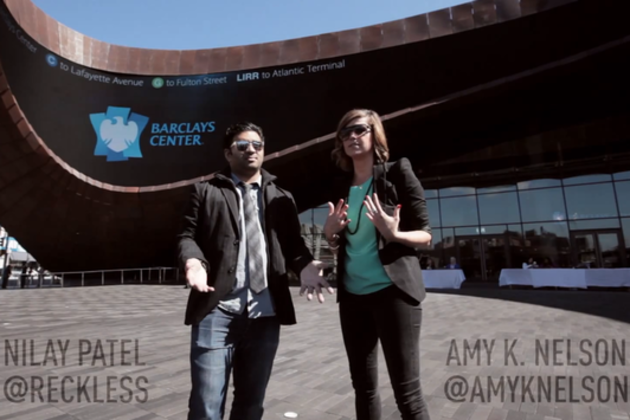
    One needs to go no further than America’s cultural capital, New York City, to see this operating. For instance, in a recent article called the “How Rust Became the New Urban Luxury Item”, the author talks about how the aesthetic of rust is being remade from a reality into a motif. The new billion-dollar Barclays Center was made rusty on purpose, and a new section of the High Line—the park made from an abandoned rail line—will most certainly retain its wear, with its decay polished if need be.


    Courtesy of Techcat

    Why is this occurring? The author writes:

    [R]ust has become fashionable. It’s a sign of street cred, kind of like the pre-fab holes in a pair of $500 designer jeans…

    …The kind of rust you find on the Barclays Center and in the refurbished High Line park is a luxury item. In places like Cleveland and Detroit and the parts of New York without corporate sponsorship, rust is still just rust.

    There is a lot of truth there: rust is still just rust in places that have come to exist in post-industrialization, but for others: rust is luxury, rust is christened from the landscape of one’s hard times up to the decor of the powerful’s play areas.

    On one hand, there is nothing new here. Beautification efforts to attend to social ills is a longstanding method of inflicting good feelings over hard realities. There was the City Beautiful Movement, the Urban Renewal Movement, etc. But what’s rarer is the fact that the aesthetics of disinvestment—in this case rust, and its “hard time” connotations—are being brought in to “dirty” the pretty up. In other words, by “street cred-ing” spaces for the elite, design is used to legitimize the extravagant via images of the honest-to-god consequences of the all-too every day.

    The problem of course is that it elevates how things look and feel in places like the Rust Belt into a luxury status. But in reality, the Rust Belt has been anything but. And while rust is a genuine and pulsating aesthetic in post-industrial America, it is more so akin to the look of a scar: or a character-molding image of resilience that’s now part of the culture’s flesh, and as such can come off as lame when it’s fabricated to make the appearance of something look “harder” than what is.


    Courtesy of Vagabondish

    Of course this adopting of the Rust Belt aesthetic is but part of a cultural authenticity movement that has been going on for some time. People are tiring of the flighty, ephemeral, and the rootless. People want reminders of where America came from and the fight it has in it. But designing for authenticity, according to scholar Jeanne Liedtka, is not only foolhardy—“the authentic emerges; it is not summoned…”—but yet another indication that America is spending more energy on faking it then fixing it.

    Richey Piiparinen is a writer and policy researcher based in Cleveland. He is co-editor of Rust Belt Chic: The Cleveland Anthology. This piece originally appeared at his blog.

    Happy smiley photo by Bigstock.