Tag: Cleveland

  • Flocking Elsewhere: The Downtown Growth Story

    The United States Census Bureau has released a report (Patterns of Metropolitan and Micropolitan Population Change: 2000 to 2010.) on metropolitan area growth between 2000 and 2010. The Census Bureau’s the news release highlighted population growth in downtown areas, which it defines as within two miles of the city hall of the largest municipality in each metropolitan area. Predictably, media sources that interpret any improvement in core city fortunes as evidence of people returning to the cities (from which they never came), referred to people "flocking" back to the "city" (See here and here, for example).

    Downtown Population Trends: Make no mistake about it, the central cores of the nation’s largest cities are doing better than at any time in recent history. Much of the credit has to go to successful efforts to make crime infested urban cores suitable for habitation, which started with the strong law enforcement policies of former New York Mayor Rudy Giuliani.

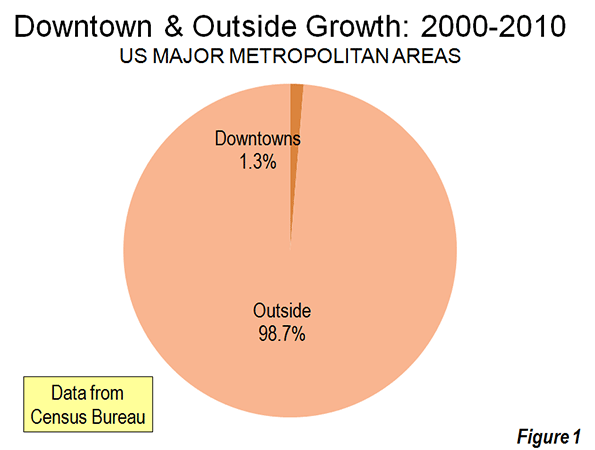
    However, to characterize the trend since 2000 as reflective of any "flocking" to the cities is to exaggerate the trend of downtown improvement beyond recognition. Among the 51 major metropolitan areas (those with more than 1 million population), nearly 99 percent of all population growth between 2000 and 2010 was outside the downtown areas (Figure 1).
    There was population growth in 33 downtown areas out of the 51 major metropolitan areas. As is typical for core urban measures, nearly 80 percent of this population growth was concentrated in the six most vibrant downtown areas, New York, Chicago, Philadelphia, Washington, Boston and San Francisco.

    If the next six fastest-growing downtown areas are added to the list (Dallas-Fort Worth, Houston, Los Angeles, Portland, San Diego and Seattle), downtown growth exceeds the national total of 205,000 people, because the other 39 downtown areas had a net population loss. Overall, the average downtown area in the major metropolitan areas grew by 4000 people between 2000 and 2010. That may be a lot of people for a college lacrosse game, but not for a city. While in some cases these increases were substantial in percentage terms, the population base was generally small, which was the result of huge population losses in previous decades as well as the conversion of old disused office buildings, warehouses and factories into residential units.

    Trends in the Larger Urban Cores: The downtown population gains, however, were not sufficient to stem the continuing decline in urban core populations. Among the 51 major metropolitan areas, the aggregate data indicates a loss of population within six miles of city hall. In essence, the oasis of modest downtown growth was more than negated by losses surrounding the downtown areas. Virtually all the population growth in the major metropolitan areas lay outside the six mile radius core, as areas within the historical urban core, including downtown, lost 0.4 percent.

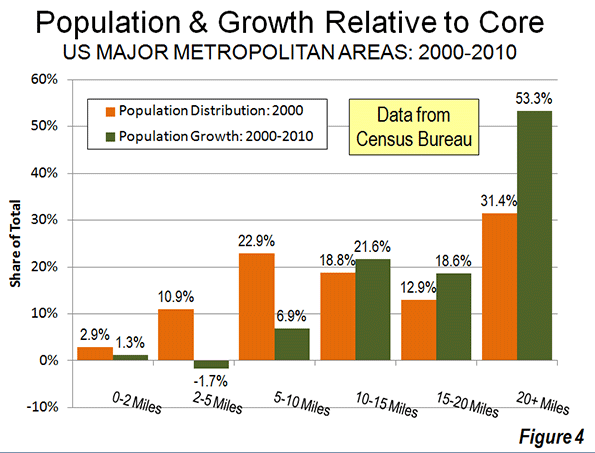
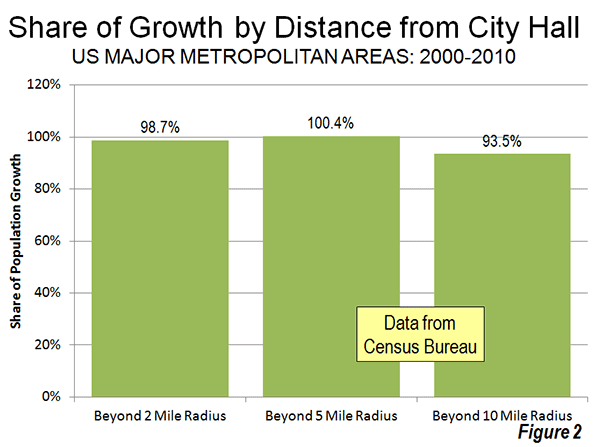
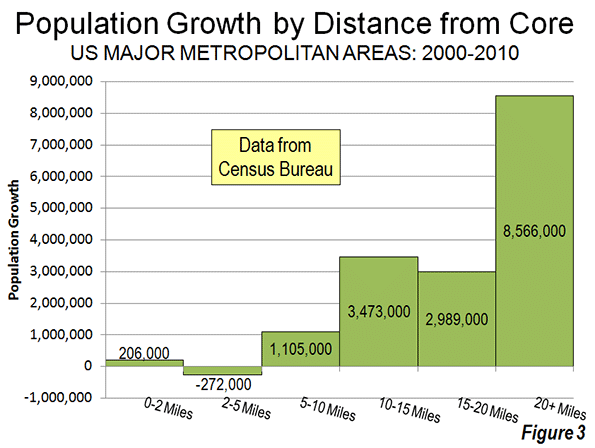
    Even when the radius is expanded to 10 miles, the overwhelming majority of growth remains outside. Approximately 94 percent of the aggregate population growth of the major metropolitan areas occurred more than 10 miles from downtown (Figure 2). Figure 3 shows that more than one-half of the growth occurred 20 miles and further from city hall. Further, the population growth beyond 10 miles (10-15 mile radius, 15-20 miles radius and 20 mile and greater radius) from the core exceeded the (2000) share of population, showing the continuing dispersal of American metropolitan areas (Figure 4).
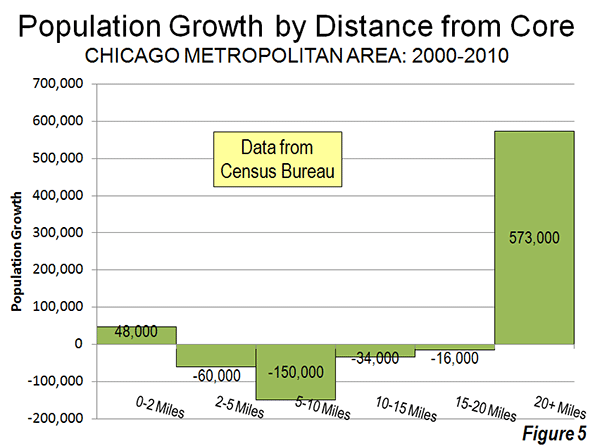
    Chicago: The Champion? The Census Bureau press release highlights the fact that downtown Chicago experienced the largest gain in the nation. Downtown Chicago accounted for 13 percent of the metropolitan area’s growth with an impressive 48,000 new residents. However, while downtown Chicago was prospering, people were flocking away from the rest of the city. Within a five mile radius of the Loop, there was a net population loss of 12,000 and a net loss of more than 200,000 within 20 miles (Figure 5). Only within the 36th mile radius from city hall is there a net population gain.
    Cleveland: Comeback City and Always Will Be? In view of Cleveland’s demographic decline (down from 915,000 in 1950 to 397,000 in 2010), any progress in downtown Cleveland is welcome. But despite the frequently recurring reports, downtown Cleveland’s population growth was barely 3,000. Despite this gain, the loss within a 6 mile radius was 70,000 and 125,000 within a 12 mile radius. Beyond the 12- mile radius, there was a population increase of nearly 55,000, which insufficient to avoid a metropolitan area population loss.

    Other Metropolitan Areas: A total of 30 major metropolitan areas suffered core population losses, despite the fact that many had downtown population increases.

    • Five major metropolitan areas suffered overall population losses (Buffalo, Cleveland, Detroit, Pittsburgh and Katrina ravaged New Orleans).
    • St. Louis, with a core city that holds the modern international record for population loss (from 857,000 in 1950 to 319,000 in 2010), experienced a population decline within a 27 mile radius of city hall. Approximately 150 percent of the growth in the St. Louis metropolitan area was outside the 27 mile radius. Even so, there was an increase of nearly 6,000 in the population of downtown St. Louis.
    • There were population losses all the way out to a considerable distance from city halls in Memphis (16 mile radius), Cincinnati (15 mile radius) and Birmingham (14 mile radius). The three corresponding downtown areas also lost population.
    • Despite having one of the strongest downtown population increases (12,000), population declined within a 10 mile radius of the Dallas city hall. This contrasts with nearby Houston, which also experienced a strong downtown increase (10,000) but no losses at any radius of the urban core.
    • Milwaukee experienced a small downtown population increase (2,000), but had a population loss within an11 mile radius.

    The other 21 major metropolitan areas experienced population gains throughout. Even so, most of the growth (77 percent) was outside the 10 mile radius. San Jose had the most concentrated growth, with only 24 percent outside a 10 miles radius from city hall. All of the other metropolitan areas had 60 percent or more of their growth outside a 10 mile radius from city hall.

    As we have observed before, 2000 to 2010 was, unlike the 1970s and other decades, more friendly to the nation’s core cities, although less so than the previous decade. Due to the repurposing of old offices and other structures, sometimes aided by subsidies, small downtown slivers may have done better than at any time since before World War II. But the data is clear. Suburban growth was stronger in the 2000s than in the 1990s. The one percent flocked to downtown and the 99 percent flocked to outside downtown.

    Population Loss Radius: Major Metropolitan Areas
    Miles from City Hall of Historical Core Municipality*
    Major Metropolitan Areas (Over 1,000,000 Population Share of Metropolitan Growth Population Loss Radius (Miles)
    "Outside Downtown" (2- Mile Radius) Outside 5-Mile Radius Outside 10-Mile Radius
    MAJOR METROPOLITAN AREAS: TOTAL 98.7% 100.4% 93.5% 6
    Atlanta, GA 99.6% 101.1% 99.9% 9
    Austin, TX 98.1% 96.7% 81.9% 0
    Baltimore, MD 106.5% 118.7% 99.5% 9
    Birmingham, AL 104.2% 132.5% 124.9% 14
    Boston, MA-NH 90.8% 76.9% 67.3% 0
    Buffalo, NY Entire Metropolitan Area Loss
    Charlotte, NC-SC 99.1% 97.4% 75.0% 3
    Chicago, IL-IN-WI 86.7% 103.3% 144.6% 35
    Cincinnati, OH-KY-IN 105.1% 126.8% 135.2% 15
    Cleveland, OH Entire Metropolitan Area Loss
    Columbus, OH 100.5% 104.3% 86.9% 7
    Dallas-Fort Worth, TX 99.0% 101.0% 100.7% 10
    Denver, CO 98.0% 100.3% 89.8% 5
    Detroit,  MI Entire Metropolitan Area Loss
    Hartford, CT 99.2% 92.7% 67.2% 0
    Houston, TX 99.2% 99.5% 98.0% 0
    Indianapolis. IN 102.1% 112.1% 89.6% 8
    Jacksonville, FL 100.2% 106.3% 85.3% 8
    Kansas City, MO-KS 99.5% 109.0% 113.3% 12
    Las Vegas, NV 101.4% 98.0% 63.6% 4
    Los Angeles, CA 97.3% 102.2% 97.6% 8
    Louisville, KY-IN 102.5% 108.5% 90.9% 8
    Memphis, TN-MS-AR 101.2% 118.5% 143.5% 16
    Miami, FL 99.4% 93.0% 91.3% 0
    Milwaukee,WI 95.9% 109.0% 107.5% 11
    Minneapolis-St. Paul, MN-WI 97.4% 99.2% 100.1% 7
    Nashville, TN 100.0% 101.4% 92.4% 7
    New Orleans. LA Entire Metropolitan Area Loss
    New York, NY-NJ-PA 93.5% 81.7% 68.9% 0
    Oklahoma City, OK 100.1% 96.8% 83.5% 2
    Orlando, FL 99.7% 99.4% 84.2% 0
    Philadelphia, PA-NJ-DE-MD 92.6% 98.8% 96.3% 7
    Phoenix, AZ 100.7% 101.8% 93.6% 6
    Pittsburgh, PA Entire Metropolitan Area Loss
    Portland, OR-WA 95.0% 91.5% 62.7% 0
    Providence, RI-MA 96.2% 91.7% 70.1% 0
    Raleigh, NC 99.6% 93.0% 67.7% 0
    Richmond, VA 95.7% 91.7% 70.2% 0
    Riverside-San Bernardino, CA 99.5% 97.2% 85.8% 0
    Rochester, NY 146.9% 149.3% 82.5% 9
    Sacramento, CA 99.9% 94.4% 79.5% 0
    Salt Lake City, UT 98.9% 95.1% 84.1% 0
    San Antonio, TX 101.1% 102.5% 86.7% 7
    San Diego, CA 96.3% 94.1% 90.1% 0
    San Francisco-Oakland, CA 90.7% 87.6% 82.2% 0
    San Jose, CA 95.1% 79.1% 24.3% 0
    Seattle, WA 96.5% 91.9% 81.4% 0
    St. Louis,, MO-IL 94.8% 119.7% 148.9% 27
    Tampa-St. Petersburg, FL 98.6% 97.8% 83.7% 0
    Virginia Beach-Norfolk, VA-NC 93.1% 90.1% 82.3% 0
    Washington, DC-VA-MD-WV 97.5% 94.5% 87.9% 0
    Calculated from Census Bureau data
    *Except in Virginia Beach-Norfolk, Where Virginia Beach is used


    ——-

    Notes:

    Population Weighted Density: In its report, the Census Bureau uses "population-weighted density," rather than average population density to compare metropolitan areas. The Census Bureau justified this use as follows:

    "Overall densities of CBSAs can be heavily affected by the size of the geographic units for which they are calculated. Metropolitan and micropolitan statistical areas are delimited using counties as their basic building blocks, and counties vary greatly across the country in terms of their geographic size. With this in mind, one way of measuring actual residential density is to examine the ratio of population to land area at the scale of the census tract, which—of all the geographic units for which decennial census data are tabulated—is typi­cally the closest in scale to urban and subur­ban neighborhoods".

    The Census Bureau rightly points out the problem with comparing metropolitan area density. However, it is a problem of the federal government’s making, by virtue of using metropolitan area building blocks (counties) that are sometimes too large for designation of genuine metropolitan areas. These difficulties have been overcome by the national census authorities in Japan in Canada, for example, where smaller building blocks are used (such as municipalities or local government authorities).

    Further, the Census Bureau already has a means for measuring population density at the census tract level, which is "the closest in scale to urban and suburban neighborhoods." This is the urban area.

    "Population-weighted density" is an interesting concept that can provide an impression of the density that is perceived by the average resident of the metropolitan area. Unfortunately, in its report, the Census Bureau is less than precise with its terminology and repeatedly fails to modify the term density with the important "population-weighted" qualification. This could lead to considerable misunderstanding.

    The Census Bureau did not provide average population densities based for the mileage radii. Because of large bodies of water (such as Lake Michigan in Chicago can reduce land areas, it was not possible to estimate population densities by radius.

    Census Bureau Revision of Incorrect Report: We notified the Census Bureau of errors in its press release and report on September 27. The problems included substitution of San Francisco population data for Salt Lake City as well as metropolitan population in the supporting spreadsheet file. On September 28, the Census Bureau issued a revised press release and report to rectify the errors. Later the erroneous spreadsheet was withdrawn and had not been re-posted as of October 1. We have made corrections to the spreadsheet for this analysis.

    Note: Larger "Downtown" Populations in Smaller Metropolitan Areas: Because of the broad 2-mile radius measure used by the Census Bureau, most of the population increase characterized as relating to downtown occurred outside the major metropolitan areas. This is simply because in smaller metropolitan areas, such an area (12.6 square miles) will necessarily contain a larger share of the metropolitan area. Further, many smaller metropolitan areas are virtually all suburban and had experienced little or no core population losses over the decades that have been so devastating to many large core municipalities. On average, 2.7 percent of the population of major metropolitan areas was within a two-mile radius of city hall in 2010. By comparison, in smaller metropolitan areas, approximately 12.7 percent of the population was within a two mile radius.

    Photograph: Chicago Suburbs: (where nearly all the growth occurred), by author

  • The Creative Destruction of Creative Class-ification

    Bits and pieces of ideal cities have been incorporated into real ones; traffic projects and housing schemes are habitually introduced by their sponsors as at least preliminary steps to paradise. The ideal city gives us the authority to castigate the real one; while the sore itch of real cities goads us into creating ideal ones. Jonathan Raban, from Soft City

    There’s a spot in Cleveland that is becoming what many had hoped for: a bit vibrant, a bit hip, with breweries, local retail, and farm-to-table restaurants turning that hard rawness of a disinvested Rust Belt city strip into a thing less raw.

    Actually, the current mix of grit and slight refinement works well on Cleveland’s W. 25th St in Ohio City. Characters abound. The racial and class mixing feels both natural and unforced. Place authenticity is there, aided no doubt by the presence of the 100-year old West Side Market anchoring what is an emerging neighborhood identity of an area where one can get a bite or sip of Cleveland amidst its architectural integrity. And the distinctive Cleveland-ness of it all is becoming ever more attractive, especially to those looking for something beyond that sea of cities sanitizing their urban terroir.

    West Side Market at night. Courtesy of the Plain Dealer

    I just wonder if the inevitable will happen.

    The inevitable, of course, is called “success”. Often, in the creative class-ification of the urban environment, “success” commonly proceeds this way: an area seeps in its own disability to achieve “highest and best use”—yet it’s cheap, intriguing even, particularly due to “the creative allure of urban grit”. Artists and bohemians make a home and create. A scene unfolds, thus laying the sluice gates toward beautification. Food and coffee places soon come to fill need. Retail locates near the foot traffic. Investment begets investment until all the dead buildings are freshly coated. The professional creative class eventually brings in the rear, effectively dictating a claim of “highest and best use”. Market studies by developers get corporate chains interested. Homogeneity ensues via the unforgiving force that is the economy of space, with income, race, and viewpoint converging into a slice of the urban electorate. This convergence is often presumed to result in the explosion of ideas via agglomeration of knowledge. But suppose it simply results in the deadening of insight via an agglomeration of group think.

    Take the case of Portland. It is a creative class darling, with the young and educated demographic inmigrating rapidly over the past decade. Proponents of the creative class suggest it is Portland’s place-based amenities—its density, its array of bike paths and coffee shops, its craft brews and locavore scene—that is attractive to the psychology of the mobile and modish. Let’s suppose this is true. No suppositions are necessary, however, when inferring what the decade-long demographic shift has done to the diversity of the city’s inner core.

    From an article entitled “In Portland’s heart, 2010 Census shows diversity dwindling”, the author writes:

    “Portland, already the whitest major city in the country, has become whiter at its core even as surrounding areas have grown more diverse…The city core didn’t become whiter simply because lots of white residents moved in…Nearly 10,000 people of color, mostly African Americans, also moved out…As a result, the part of Portland famous for its livability — for charming shops and easy transit, walkable streets and abundant bike paths — increasingly belongs to affluent whites.”

    Of course the irony here is that diversity and tolerance is said to attract a subgroup of forward-looking folks who then congregate using the grease of spatial economics to force said tolerance and diversity out. Given that diversity and tolerance have been argued to be key engines to idea production and subsequent economic growth, perhaps it’s no surprise Portland has not grown economically, regardless of the strained narrative stating otherwise.

    Diversity of people are not the only victims to creative class-ification, so is diversity of place. From a recent Atlantic Cities article, the former owner of the popular Mama’s Bar in the East Village talked about his taxes skyrocketing 380% as the reason he had to close. Later, the owner wonders about the cost of NYC’s decision to world-class the hell out of its urban intricacy and ambiguity:

    I think the thing that makes this city unique is it does have different neighborhoods that are specific and unique unto themselves. They have their own personality. What has happened — and I don’t want to blame the mayor, because it’s the evolution of the city — but things have become so expensive here…the only way businesses can survive in these neighborhoods is if they’re banks or corporate chains. These neighborhoods are being whittled down into carbon copies of each other.


    Mama’s Bar, now closed. Courtesy of community54.com

    Echoing this sentiment, the New York Times just ran an op-ed from the blogger at Vanishing New York about how the place-making standard bearer the High Line has created for a stretch of people lined like cattle amidst a neighborhood increasingly delineated into a pasture of consumption, not a hive of innovation. The author writes:

    [T]he idea was enticing: a public park above the hubbub, a contemplative space where nature softens the city’s abrasiveness…

    …My skepticism took root during my first visit. The designers had scrubbed the graffiti and tamed the wildflowers. Guards admonished me when my foot moved too close to a weed…

    …The neighborhood has since been completely remade. Old buildings fell and mountain ranges of glassy towers with names like High Line 519 and HL23 started to swell…

    Since the op-eds running, the blogger, Jeremiah Moss, has been derided as regressive, an obstructionist, with one commentator on his blog accusing Moss of being “a lazy critic” who is “not interested in either exploring the nature of our changing urban environment or discussing the merits of the [High Line’s] design”. But these critics miss Moss’s point, or that place-making is not simply about beauty, but so too the motive behind beautification. Often, that means economic gain, and often: that means at any cost. From a post in Art Info:

    The High Line — being such an alluring work of design — became, quite literally, a lure to attract groups powerful enough to steamroll socioeconomic diversity and reconstruct the neighborhood into a more glamorous version of New York.

    This was not how it was supposed to go. In a piece in Parks and Recreation, the author describes creative class theorist Richard Florida’s exemplifying of the High Line as an example of “communities transforming old industrial-age infrastructure into unusual and magnetic parks”. Florida explains many cities are figuring out that place has worth, and are prioritizing accordingly:

    The good news is that some cities have come to understand that great parks can rally citizens and hold communities together…and the most far-seeing mayors realize that.

    What is less discussed is how publicly-subsidized parks and other place-based jewels can be used as a hammer to polish out the vicinity around them; that is, how parks can be co-opted to break communities apart.

    Don’t get me wrong. I think place-making has its place. But its Frankenstein effects can’t be ignored. As—again—there is a contradiction at play in creative class theory; namely, that the preconditions of success: diversity, density, and tolerance, can create for a “success” that eats diversity and tolerance, particularly in those “special sauce” dense spots like East Village and downtown Portland that are harmonized to be vessels for new knowledge and thus new economies. In fact it can be argued that such outcomes deaden the long-term growth of cities in that traditional geographic and cultural hearts are being sold for the “gimme now” gains of taxation on objects from coffee to condos. And really: there is nothing much cool or creative about that. Rather, it’s selling your city to the highest bidder. It is mountains turned to coal.

    East Village Condo. Courtesy of http://cityofstrangers.net/

    Looking back, maybe this was all to be expected. Layering a cellophane of universal cool over the topography of distinct places to attract a slice of the urban electorate—many of which have no clue about the genius loci of each place—well, what would one expect?

    Still, there are lessons to be had here. Lessons for cities. Here’s hoping that those so-called failed and dead cities like Cleveland can resist getting their spots of raw locality from being entirely scrubbed out. In fact, in a world of inauthenticity it will be cities of realness that provide for environments fostering a stimulation of thought. It will be these cities collecting the hemorrhaging of thinkers and doers that can no longer stand the plasticity derived from the mold of “highest and best use”. It will be these cities providing for the creative destruction of creative class urbanity.

    Richey Piiparinen is a writer and policy researcher based in Cleveland. He is co-editor of Rust Belt Chic: The Cleveland Anthology. This piece originally appeared at his blog.

    Downtown Cleveland photo by Bigstock.

  • Anorexic Vampires and the Pittsburgh Potty: The Story of Rust Belt Chic

    “Rust Belt Chic is the opposite of Creative Class Chic. The latter [is] the globalization of hip and cool. Wondering how Pittsburgh can be more like Austin is an absurd enterprise and, ultimately, counterproductive. I want to visit the Cleveland of Harvey Pekar, not the Miami of LeBron James. I can find King James World just about anywhere. Give me more Rust Belt Chic.” Jim Russell, blogger at Burgh Diaspora

    National interest in a Rust Belt “revival” has blossomed. There are the spreads in Details, Atlantic Cities, and Salon, as well as an NPR Morning Edition feature. And so many Rust Belters are beginning to strut a little, albeit cautiously–kind of like a guy with newly-minted renown who’s constantly poking around for the “kick me” sign, if only because he has a history of being kicked.

    There’s a term for this interest: “Rust Belt Chic”. But the term isn’t new, nor is the coastal attention on so-called “flyover” country. Which means “Rust Belt Chic” is a term with history–loaded even–as it arose out of irony, yet it has evolved in connotation if only because the heyday of Creative Class Chic is giving way to an authenticity movement that is flowing into the likes of the industrial heartland.

    About that historical context. Here’s Joyce Brabner, wife of Cleveland writer Harvey Pekar, being interviewed in 1992, and introducing the world to the term:

    I’ll tell you the relationship between New York and Cleveland. We are the people that all those anorexic vampires with their little black miniskirts and their black leather jackets come to with their video cameras to document Rust Belt chic. MTV people knocking on our door, asking to get pictures of Harvey emptying the garbage, asking if they can shoot footage of us going bowling. But we don’t go bowling, we go to the library, but they don’t want to shoot that. So, that’s it. We’re just basically these little pulsating jugular veins waiting for you guys to leech off some of our nice, homey, backwards Cleveland stuff.

    Now to understand Brabner’s resentment we step back again to 1989. Pekar–who is perhaps Cleveland’s essence condensed into a breathing human–had been going on Letterman. Apparently the execs found Pekar interesting, and so they’d book him periodically, with Pekar–a file clerk at the VA–given the opportunity to promote his comic book American Splendor. Well, after long, the relationship soured. Pekar felt exploited by NYC’s life of the party, with his trust of being an invited guest giving way to the realization he was just the jester. So, in what would be his last appearance, he called Letterman a “shill for GE” on live TV. Letterman fumed. Cracked jokes about Harvey’s “Mickey Mouse magazine” to a roaring crowd before apologizing to Cleveland for…well…being us.


    Think of this incident between two individuals–or more exactly, between two realities: the famed and fameless, the make-up’d and cosmetically starved, the prosperous and struggled–as a microcosm for regional relations, with the Rust Belt left to linger in a lack of illusions for decades.

    But when you have a constant pound of reality bearing down on a people, the culture tends to mold around what’s real. Said Coco Chanel:

    “Hard times arouse an instinctive desire for authenticity”.

    And if you can say one thing about the Rust Belt–it’s that it’s authentic. Not just about resiliency in the face of hardship, but in style and drink, and the way words are said and handshakes made. In the way our cities look, and the feeling the looks of our cities give off. It’s akin to an absence of fear in knowing you aren’t getting ahead of yourself. Consider the Rust Belt the ground in the idea of the American Dream.


    2012-06-29-toledo_rust_harticle_intro.jpg

    Photo credit: Sean Posey

    Of course this is all pretty uncool. I mean, pierogi and spaetzle sustain you but don’t exactly get you off. Meanwhile, over the past two decades American cities began their creative class crusade to be the next cool spot, complete with standard cool spot amenities: clubs, galleries, bike paths, etc. Specifically, Richard Florida, an expert on urbanism, built an empire advising cities that if they want creative types they must in fact get ahead of themselves, as the young are mobile and modish and are always looking for the next crest of cool.

    These “Young and the Restless”–so they’re dubbed–are thus seeking and hunting, but also: apparently anxious. And this bit of pop psychology was recently illustrated beautifully in the piece “The Fall of the Creative Class” by Frank Bures:

    I know now that this was Florida’s true genius: He took our anxiety about place and turned it into a product. He found a way to capitalize on our nagging sense that there is always somewhere out there more creative, more fun, more diverse, more gay, and just plain better than the one where we happen to be.

    After long–and with billions invested not in infrastructure, but in the ephemerality of our urbanity–chunks of America had the solidity of air. Places without roots. People without place. We became a country getting ahead of itself until we popped like a blowfish into pieces. Suddenly, we were all Rust Belters, and living on grounded reality.

    Then somewhere along the way Rust Belt Chic turned from irony into actuality, and the Rust Belt from a pejorative into a badge of honor. Next thing you know banjo bingo and DJ Polka are happening, and suburban young are haunting the neighborhoods their parents grew up in then left. Next thing you know there are insights about cultural peculiarities, particularly those things once shunned as evidence of the Rust Belt’s uncouthness, but that were–after all–the things that rooted a history into a people into a place.

    Take the Pittsburgh Potty. For recent generations it was about the shame of having a toilet with no walls becoming the pride of having a toilet with no walls. From Pittsburgh Magazine:

    We purchased a house with a stray potty, and we’ve given that potty a warm home. But we simply pretended as if the stray potty didn’t exist, and we certainly didn’t make eye contact with the potty when we walked past it to do laundry.

    The Pittsburgh Potty is basically a toilet in the middle of many Pittsburgh basements. No walls and no stalls. It existed so steel workers can get clean and use the bathroom without dragging soot through ma’s linoleum.


    2012-06-29-PghPotty.JPG

    Photo credit: Brookline Connection

    Authentic: yes. Cool? A toilet?

    Only in the partly backward Rust Belt of Harvey Pekar and friends. From the twitter feed of @douglasderda who asked “What is a Pittsburgh Potty?” Some responses follow:

    “I told my wife I wanted to put ours back in, but she refused. I threatened to use the stationary tubs.”

    “In my house, that would be known as my husband’s bathroom.”

    “It’s a huge selling feature for PGH natives. I’m not kidding. We weren’t so lucky in our SS home.”

    “We’re high class people. Our Pittsburgh Potty has a bidet. Well, it’s a hose mounted on the bottom, but still ….”

    Eventually, this satisfaction found in re-rooting back into our own Rust Belt history has become the fuel of wisdom for even Coastal elites. Here’s David Brooks recently talking about the lessons of Bruce Springsteen’s global intrigue being nested in the locality that defines Rust Belt Chic:

    If your identity is formed by hard boundaries, if you come from a specific place…you are going to have more depth and definition than you are if you grew up in the far-flung networks of pluralism and eclecticism, surfing from one spot to the next, sampling one style then the next, your identity formed by soft boundaries, or none at all.

    Brooks continues:

    The whole experience makes me want to pull aside politicians and business leaders and maybe everyone else and offer some pious advice: Don’t try to be everyman…Go deeper into your own tradition. Call more upon the geography of your own past. Be distinct and credible. People will come.

    And some are coming, albeit slowly, unevenly. But more importantly, as a region we are once again becoming–but nothing other than ourselves.

    Authenticity, reality: this was and always will be the base from which we wrestle our dreams back down to solid ground.

    American splendor, indeed.

    This is an excerpt from the forthcoming book Rust Belt Chic: A Cleveland Anthology. It first appeared at RustBeltChic.com.

  • Right in the Middle: The Midwest’s Growth Lessons for America

    The Midwest’s troubles are well-known. The decline of manufacturing has resulted in job losses and dying industrial towns. The best and brightest have fled the flatlands for more exciting, sunnier, mountainous, or coastal places where the real action is. Even Peyton Manning has left the heartland for the Rockies.

    This narrative is so deeply embedded both in and outside of the Midwest that many people overlook the ways in which parts of the region are bouncing back. The Midwest’s story is important because it serves in significant ways as a regional microcosm of how growth and opportunity should look in America today.

    In a recent study we look at trends that upend the conventional wisdom about the Midwest. We find that it is neither doomed to a slow and dirty demise like an old house on an eroding slope, nor forced to reinvent itself Dubai-style in order to compete with Silicon Valley or Manhattan. The Midwest’s future is rooted very much in its past—but with some important updates.

    What do we mean? For starters, this means capitalizing on Americans’ desire to reside where the cost of living and doing business is favorable. As the last Census showed, Americans move in droves to regions where the cost of living is low, businesses face fewer obstacles, and workers have choices. As Wendell Cox and Joel Kotkin have shown, this goes for 25- to 35-year-olds as well as 55- to 65-year-olds. People want options and a good quality of life at a price they can afford.

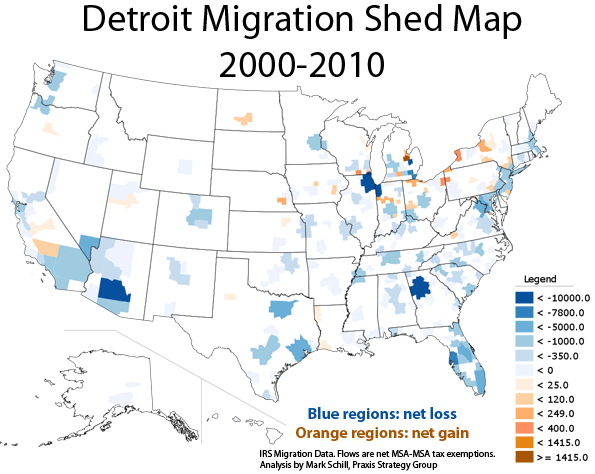
    In the Midwest, these trends have favored placed like Columbus, Ohio, and Indianapolis, Indiana. When people hear “Midwest,” they are more likely to think of this kind of picture:

    The blue areas show destinations to which people from Detroit have moved between 2000 and 2010. The brown shades are the areas from which Detroit has drawn people. Given Detroit’s well-publicized decline, all the blue should be no surprise.

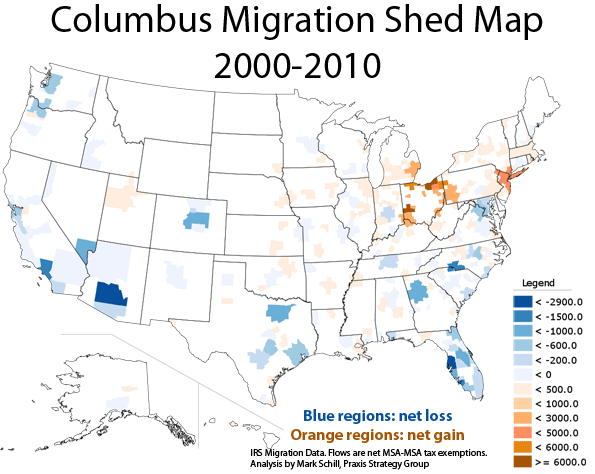
    But a respectable portion of the Midwest looks like this:

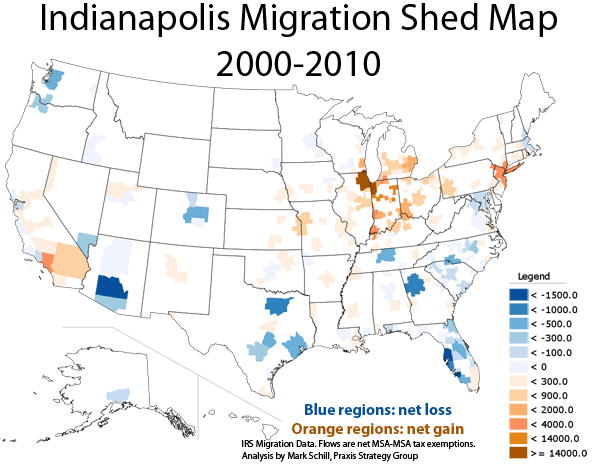
    And this:

    Like most parts of America, Columbus and Indianapolis have seen a net outmigration southward to Florida and Texas. No surprise there. But note how both cities are stealing population from Chicago, Detroit, New York, and even southern California and Miami in Indianapolis’s case. The maps also show how intense interstate competition within the Midwest is right now.

    One important measure of the cost of living is housing affordability, which is typically set at 3.0 as a measure of median housing price divided by median income. Compared to San Francisco at 7.2, New York at 6.1, Los Angeles at 5.9, and Miami at 4.7, Columbus stands at 2.8 and Indianapolis at 2.4. Charlotte, which has been an exemplary Sun Belt growth magnet for a while, stands at 3.9, a slight click above the Chicago area’s 3.8.

    Affordability and overall quality of life as measured by schools and greater disposable income matter a lot—even to technology entrepreneurs. Some Midwestern areas are outpacing coastal areas on this front. In a recent Forbes ranking of tech growth in the nation’s largest 51 metro areas, the Midwest had three cities within the top 15, with Columbus in third position, followed by Indianapolis and St. Louis.

    But it would be wrong for tech boosters to think the Midwest’s future rests in harnessing the power of this sector alone. Rather, it’s a combination of brains and brawn that signify the Midwest’s core strength. When we look at Midwestern areas that have experienced above-average growth in bachelor’s degrees, there are important overlaps with areas experiencing above-average growth in manufacturing, too.

    In the corridor from Madison to Milwaukee, or the outlying areas around Chicago, or the Indianapolis metro area, or even in the Quad Cities on the Iowa-Illinois border, we see higher educational attainment and manufacturing growth occurring together. Cedar Rapids, Iowa, had the highest GDP growth from 2000 to 2010 of any metro area in the Midwest. A new corridor has grown up between Cedar Rapids and Iowa City, home to the University of Iowa; it takes advantage of the region’s historical manufacturing capacity and blends it with new technology. Peoria, Illinois, is second to Cedar Rapids in GDP growth. Peoria is home to 200 manufacturing firms, and it is also a Midwestern leader in college degree attainment.

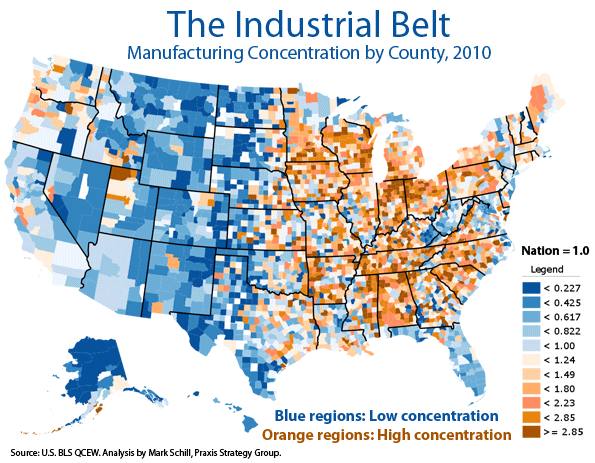
    Manufacturing continues to be part of the regional DNA in the Midwest. Trying to move away from it would be a fool’s errand, as this picture shows:

    The concentration of manufacturing in middle America is a real asset, especially when combined with higher levels of educational attainment, as we have seen. The Midwest is still home to much of the nation’s skilled labor force. And contrary to the declinist narrative mentioned at the outset, the region has added 50,000 “heavy metal” manufacturing jobs since 2009.

    The challenge for the region, actually, will perhaps be filling manufacturing jobs rather than creating them. A recent Deloitte survey found that 83 percent of manufacturers nationwide suffered a moderate or severe shortage of skilled production workers. The Midwest is poised to establish what we call a “new industrial paradigm,” characterized by a blend of heavy manufacturing, new technology, a more highly educated industrial labor base, and lighter labor restrictions (Indiana just became a right-to-work state, and the much-publicized debates in Wisconsin and Ohio over labor laws have only served to draw more attention to the need for reform, whatever the near-term effects). When you add to all of this the new energy sources discovered in some parts of the Midwest—such as new finds in Utica shale in Ohio—a new industrial paradigm in the region could end up being a large source of new wealth creation in the coming generation.

    So why might the Midwest be something of a microcosm for how growth and opportunity look in America as a whole, given its idiosyncratic reliance on manufacturing not shared by other regions? The main reason is that middle America is a clear picture of how much the basics matter: Cost of living, job quality, schools, and opportunities to develop the right skills for the best jobs. The areas within the Midwest that have gotten the basics right are poaching people and companies from the areas that haven’t. Any economic development strategy that ignores the basics in favor of a more stylized theory of growth will usually run off the rails before too long. Americans, at the end of the day, want the places they live to get the basics right so they themselves can build their lives, start their businesses, and raise their children as they wish.

    This piece originally appeared at The American.

    This peice was adapted from a recent report: "Clues from the Past: The Midwest as an Aspirational Region." Download the full pdf version of the report, including charts and maps about the Great Lakes Region.

    Joel Kotkin is executive editor of NewGeography.com and is a distinguished presidential fellow in urban futures at Chapman University, and contributing editor to the City Journal in New York. He is author of The City: A Global History. His newest book is The Next Hundred Million: America in 2050, released in February, 2010.

    Mark Schill is Vice President of Research at Praxis Strategy Group, an economic development and research firm working with communities and states to improve their economies.

    Ryan Streeter is Distinguished Fellow for Economic and Fiscal Policy at the Sagamore Institute. You can follow his work at RyanStreeter.com and Sagamoreinstitute.org.

    Great Lakes Freighter photo by BigStockPhoto.com.

  • Clues from the Past: The Midwest as an Aspirational Region

    This piece is an except from a new report on the Great Lakes Region for the Sagamore Institue. Download the pdf version for the full report including charts and maps on the region.

    The American Great Lakes region has long been a region defined by the forces of production, both agricultural and industrial. From the 1840s on, the region forged a legacy of productive power, easily surpassing the old northeast as the primary center of American industrial and agricultural might.

    The Rise of the Great Lakes

    Natural forces shaped the region, from its waterways and mineral resources, which made it ideal for industrial development. The lakes themselves are the largest sources of freshwater on the planet; the five lakes together are twice the size of England. This “fresh water Mediterranean” provided an essential pathway for transport between the various regions of the Great Lakes, as well as a connection to the northeast and, through the Saint Lawrence and the Erie Canal, to New York and the Atlantic.

    But more than anything, it has been the people of the Great Lakes that proved its greatest resource. In the early 19th Century, the region’s development was paced by migrants from New England, who brought with them their values of thrift, hard work and a passion for education and self-improvement. Later others, notably Germans and Scandinavians, injected a similar culture of self-improvement to the area.

    Like New England, the Great Lakes, noted author John Gunther, was possessed with a “gadget mind” that sparked the innovations that gave America command of the industrial revolution. Much of the brawn for this came from the poorer parts of Europe — Russia, Italy, and most particularly Poland, which led one observer to call Chicago “a mushroom and a suburb of Warsaw.” By 1920 one third of third of the population of Chicago, Cleveland and Detroit was foreign born.

    Initially based largely on agricultural exports, by 1860 the region had blossomed into an urbanized industrial powerhouse. “All over the Middle West,” wrote historians Charles and Mary Beard, “crossroads hamlets grew into trading towns, villages spread into cities, cities became railway and industrial centers.” The area’s rapid growth sparked great optimism; in 1841 journalist and land speculator predicted that by 1940 Cincinnati would be the largest city in North America and by 2000 “the greatest city in the world.” Cleveland, Cincinnati, Toledo, Milwaukee and most of all Chicago stood at the center of a “web of steel” that marked the region as the world’s preeminent industrial center. It also sparked other innovations, from the auto assembly line and the high-rise building to the mail order catalog.

    This growth cascaded in the early years of the last century. It became the nation’s primary growth engine. Between 1900 and 1920 Chicago added a million people while Cleveland doubled its population and Detroit, epicenter of the emerging “automobile revolution”, grew three fold. In everything from architecture and city planning to literature, the Great Lakes stood at the national, even global, cutting edge.

    A Half Century of Decline

    By the 1970s, the Great Lakes region, including Ontario, accounted for two-thirds of the North America’s automobile production, 70 percent of pig iron and three quarters of its steel. Yet by that time, this close tie to industry was seen not as an advantage but as a curse, driving the region towards precipitous decline.

    By then America was widely seen as entering a “post-industrial era,” and the Great Lakes, the former bastion of the manufacturing economy, seemed the odd region out. Defined as the “foundry” in Joel Garreau’s Nine Nations of North America, it was the only one he identified as in decline. He described the region’s inner cities as “North America’s Gulag Archipelago.”

    Once a magnet for newcomers, the region now took a back seat as a place that attracted domestic or foreign migrants.10 With the exception of Chicago, the Lakes region have continues to lag both in domestic migration and foreign immigrants. Newcomers were reinventing places like Los Angeles, Houston, Miami and New York, but relatively few were coming to Cleveland, Detroit or Cincinnati.

    The Great Lakes cities, also with the sometimes exception of Chicago, also found themselves increasingly regarded as cultural backwaters. Occasional stories of restoration and renaissance made the rounds in the media, but the trend was to greater obsolescence, to becoming permanently “a cultural colony” of the coasts. “To a Californian or a New Yorker,” noted Indiana-based historian Jon Teaford, “Cleveland, Detroit, Indianapolis and Saint Louis were down-at-the-heel, doughty matrons, sporting last year’s cultural fashions.”

    Until recently there has been ample reason to believe this decline would continue. Only nine of the Midwest’s 40 largest metropolitan areas have a higher per capita GDP than the national average. This reflected a deep seated loss of jobs paced by industrial decline but not made up for by gains in other fields.

    During this period the region not only lost many of its industrial jobs but, more pointedly, failed to replace them with the technology and service jobs that grew rapidly elsewhere. As a result, the region’s percentage of the national workforce dropped steadily over the past half century. In 1966, the Great Lakes region possessed one in four jobs in the country; by 2010 that percentage had fallen to less than one in five.

    As a response to the perception of industry-led decline, some Great Lakes leaders sought out other sources of employment and growth. In Detroit, for example, much emphasis was placed on casino development. Michigan’s former Governor Jennifer Granholm, sought to reverse decline by targeting the so-called “creative class” by turning its hard-hit towns into “cool cities.” Across the region, others focused on convention centers, arts attractions such as museums and other entertainment venues as the way to improve their sagging fortunes.

    Seeds of Resurgence
    None of these efforts – although much heralded throughout the 1980s and 1990s – did much to reverse the region’s decline. Notes Jim Russell, author of the widely read Burgh Diaspora website:

    Should Akron start putting more money in skateparks or global warming?

    There are huge problems in spending money in order to attract the geographically fickle. Fads fade and the mobile – largely people under 30 – will move again…Tying up the urban budget with projects aimed at retaining the creative class has its own perils. There is little, if any, evidence indicating that this policy will decrease the geographic mobility of the well-educated. Many cities stuffed with cultural amenities also sport high rates of out-migration. Furthermore, tastes change. “Best places to live” lists change quite a bit from one year to the next.

    Instead, the region’s current rebound is occurring in surprising fashion. The real lure of the Great Lakes lies in its own fundamental advantages: lower housing prices, business climate and perhaps, more importantly, a nascent industrial rebound.

    This can be seen, most importantly, in employment numbers. Starting in the last few years, the area’s share of jobs has remained steady. The highest unemployment rates in the country are no longer concentrated in the Great Lakes region, but in states such as California and Nevada. In many Great Lakes states, unemployment rates have been dropping more rapidly than the national average.

    Critically this resurgence has not resulted in a shift away from industrial growth. Instead, we are witnessing the early stages of what could be a profound increase in both the economic heft and job creation tied to the industrial sector. But the Great Lakes rebound is not merely a cyclical, one dimensional rise; it also includes growth in a host of other sectors, including in the information area and, perhaps even more remarkably, in energy, particularly shale gas.

    At the same time the rise in non-industrial jobs also should testify to the growing attractiveness of the region, particularly for young families. After decades of mass outmigration, the region has begun to achieve a more favorable balance with the rest of country. Outmigration rates for states in the region are at or below national levels.

    Migration in the Midwest, as Russell and others have pointed out, should be regarded more from the vantage point of recruitment, not retention. By promoting its affordability and improving economy, the region could improve its trailing inmigration rates. As people vote with their feet for the region, they are laying down the foundation for the area’s resurgence in the coming decades.

    The Rise of New Growth Nodes

    The Great Lakes demographic and economic turnaround does not mean that growth has occurred in the pattern of the early 20th Century. Instead we see the emergence of a new set of leadership cities. If Akron, Detroit, Cleveland and Chicago paced the region’s early 20th century ascendency, the new “winners” appear to include affordable, attractive cities, many of whom are home to major universities, state capitals and key research institutions.

    These areas have done well in attracting many people from the less successful metropolitan areas of the region. Columbus, for example, evidenced strong growth from the rest of Ohio and other parts of the Midwest, notably Michigan and Illinois. But perhaps more importantly, the area enjoys strong in-migration from those parts of country — notably the Northeast and California — that have traditionally dominated knowledge-intensive industries.

    A similar pattern can be seen in Indianapolis. In recent years, as urban analyst Aaron Renn notes, the Indiana capital has enjoyed “a profile closer to the Sun Belt than the Rust Belt.” It grew its population at a rate 50 percent greater than the national average, and also had strong net inmigration, with almost 65,000 net people deciding to pack up and move to the Indiana capital.

    Already a center of regional culture and services, the area has succeeded as well in attracting new migrants not only from big Midwestern cities such as Chicago, but also from the two coasts.

    By way of contrast, Chicago’s migration patterns look much different than those in Columbus and Indianapolis. Many other regions around the country benefited from people leaving the Windy City than Chicago gained from them. Chicago’s biggest gains have come from other, more troubled Great Lakes regions, while Indianapolis, for instance, has taken advantage of Chicagoans looking for more opportunity elsewhere.

    Behind this shift in migration from the coasts lie many factors, such as taxes and regulations.
    But perhaps most important may be the region’s greater affordability. Even after the bubble, for example, many key eastern and west coast regions suffer a ratio housing prices to annual incomes of five, six or even seven to one. For the most part, virtually all parts of the Great Lakes have ratios of three or less.

    Over time, this could prove a critical advantage to the Great Lakes. As the current millennial generation – the largest generation in American history – enters their 30s, it is likely that they will seek out places where they can afford to buy a home and enjoy a middle class quality of life. The Great Lakes will be one place that can offer that opportunity.

    Key to recovery: Both Brain and Brawn

    The future of the Great Lakes region lies neither in simply the “information” economy nor in the brute force of manufacturing. Instead it is as a result of a combination both of the industrial sector and the high-value service sectors that feed into it.

    Critically, the region boasts many areas where the information and service economies are particularly strong. Of the nine Midwestern metropolitan areas with per capita GDP growth above the national average, four are capital cities and six are home to major universities. Given governmental involvement in two of the fastest-growing sectors of the economy, health care and education, it is no surprise that seats of government and large state-funded research universities – which also double as the hotbeds of medical services – are growing ahead of other regions with a more traditional, and perhaps outdated, economic base.

    Indeed, some Midwestern areas are outperforming the coastal economies even in the realm of high-tech. In a recent ranking by Forbes magazine of best areas for tech growth among the nation’s 51 largest metropolitan areas, the region boasted three of the top fifteen areas, led by #3 Columbus, followed by Indianapolis and St. Louis.

    However, it would be inaccurate to portray the Midwest as depending purely on a service or information economy. Producing things for sale and export is still alive and well, and the Midwestern regions that have blended their traditional capacity for manufacturing with newer fast-growing sectors of the economy.

    Cedar Rapids, Iowa enjoyed the highest rate of GDP growth from 2001-2010 of any metropolitan area in the Midwest. Between Cedar Rapids and Iowa City, home to the University of Iowa, a new high-tech corridor has grown up that takes advantage of the area’s historical manufacturing capacity and the new technology driven through the university.

    Terre Haute, Indiana, fifth on the list of GDP leaders, reflects even more completely the blending of the “old” Midwest with the emerging one. Manufacturing has held steady as a share of the local economy at about 15.5 percent since 1991, but health and education have jumped from 14 to 17 percent, while wholesale services and agriculture have dropped. Terre Haute is home to Indiana State University and Rose-Hulman Institute of Technology, a regional leader in engineering, science, and mathematics education.

    Peoria, Illinois is second behind Cedar Rapids in GDP growth the past ten years. It is home to more than 200 manufacturing firms, two of the world’s largest earth-moving equipment makers, and coal fields. Peoria is also a leader in college degree attainment in the Great Lakes. While its absolute attainment levels are still low, its college educated population is growing faster than nearly every community in the Midwest. Peoria is one example of how brains + brawn, and not just brains, is the key to Midwestern growth going forward.

    Consider what we might call the dynamic of the Badgers and the Wolverines. In Wisconsin, home of the Badgers, there exists an east-west corridor between Madison, home to the state university and state capital, and Milwaukee, the state’s historical center of industry and commerce. In Michigan, home of the Wolverines, an east-west corridor stretches between Ann Arbor, home to the University of Michigan, and Detroit, the state’s historical center of industry and commerce.

    In Figure 14 we see that both Ann Arbor and Madison have high levels of bachelor degrees compared to the national average. But Madison is leading the Midwest in bachelor degree growth while Ann Arbor rate remains fairly static. Meanwhile, even though Detroit surprises with a fairly high rate of bachelor degree growth, Milwaukee stays in front of the national average in both growth and absolute numbers of college-educated workers.

    Some might say that the Badgers are beating the Wolverines in the knowledge-intensive sectors of the economy, but that the lead manufacturing is up for grabs. But the truth is that the Wisconsin corridor also enjoys positive marks in manufacturing.

    Milwaukee, for example, leads Detroit in the growth of manufacturing jobs. And Madison is emerging as a manufacturing center while Ann Arbor lags far behind. The knowledge economy and the old-time manufacturing economy can work happily together, in the case of Madison Milwaukee, or so far less so in the case of Ann Arbor-Detroit.

    The New Industrial Paradigm

    Despite the attempts to write it off as a spent force, manufacturing will remain a key driver of Midwestern and national growth. Despite the many job losses that impacted this sector over the past generation, American manufacturing remains remarkably resilient, with a global market share similar to that of the 1970s.

    More recently, however, American industrial base has begun to expand and begin to gain on its competitors. This places the Great Lakes in an advantageous position. American manufacturing after a decade of decline has outpaced the overall recovery over the two years, in part due to soaring exports. In 2011 American manufacturing continued to expand even as Germany, Japan and Brazil all weakened in this vital sector.

    Many factors are driving this change. One is a tie to the growing domestic energy industry, which has already sparked growth in the shale areas of eastern Ohio and other parts of the Great Lakes region. The United States together now boast the largest natural gas reserves in the world. In Ohio alone, new finds in the Utica shale could be worth as much as $500 billion; one energy executive called it “the biggest thing to hit Ohio since the plow.”

    The boom in natural gas has already sparked a considerable industrial rebound including the building of a new $650 million steel plant for gas pipes in the Youngstown area.18 Karen Wright, whose Ariel Corporation sells compressors used in gas plants, has added more than 300 positions over the past two years. “There’s a huge amount of drilling throughout the Midwest,” Wright says. “This is a game changer.”

    It also leads to the prospect that as coal-fired plants become more expensive to operate due to concerns over greenhouse gas emissions, the region will have a new, cleaner and potentially less expensive power source.

    Another critical factor has been the rise of wage rates in both Europe and East Asia. Increasingly, American-based manufacturing is in a favored position as a lower cost producer. Concerns over “knock offs” and lack of patent protection in China may also be sparking a “back to USA” trend, something particularly favorable to the Great Lakes region.

    Yet the new industrial base will not resemble old one. We are seeing both an industrial renaissance in the country and one that is heavily concentrated in the Great Lakes region. But it is a resurgence that is as much brain as brawn; an industry increasingly dependent not just on hard work, but skilled labor.

    This pattern cuts across industry lines. Indeed even as the share of the workforce employed in manufacturing has dropped from 20 percent to roughly half that, high skilled jobs in industry have soared 37 percent. Even after years of declining employment, manufacturers in heavy industry, such as automobiles, are running short on skilled workers. Industry expert David Cole predicts there could be demand for 100,000 new workers by 2013. Overall, 83 percent of all manufacturers, according to Deloitte Touche, suffer a moderate or severe shortage of skilled production workers.

    This remains a fundamental strength of the region. Much of the skilled labor base in the nation remains in the Midwest. The region is also home to four of the highest ranked, according to US News, industrial engineering schools in the nation: the University of Michigan at Ann Arbor, Northwestern, the University of Wisconsin at Madison and Purdue.

    Equally important for the region will be replacing the large cadre of skilled workers, many of whom are entering the late 50s and early 60s. “We have a very skilled workforce, but they are getting older,” says Ariel Wright, who employs 1,200 people at three Ohio factories. “I don’t know where we are going to find replacements.”

    For now the very culture of production – often seen as a liability in the past – could prove a key to the Great Lakes’ future resurgence. These advantages are already redounding to the region. Indeed a recent Forbes survey of “heavy metal” industries – that is those involved heavy industry, metals, vehicles and complex machinery – found the region in surprisingly good shape.

    The Milwaukee area, for example, ranked number 2 among the 50 metropolitan areas on the list, while Detroit clocked in with a respectable 6 placed finish. Cincinnati, Kansas City and Cleveland all ranked well within the top 20. In all, the 40 Great Lakes metropolitan areas added 50,000 heavy metal industry jobs since 2009.

    Looking Forward

    For the first time in a generation, the Great Lakes are experiencing demographic and economic trends in their favor. Yet in everything from migration to industrial growth, the region can expect to face strong competition from other areas, most notably Texas, the Southeast, the Great Plains and the Intermountain West for new jobs and production.

    To meet this challenge, and truly take advantage of improved conditions, the region must develop a strategy that is suited to its particular advantages. There is no need to try to compete with Manhattan on urban chic, with Silicon Valley in high-tech startups or with Hollywood in entertainment – as some growth theorists would likely recommend.

    The Great Lakes needs to focus primarily on those very values of production and community that sparked its original ascendance. Once these are identified and strengthened, the region can once again not only rebound, but define its own space in the national and global economy.

    Perhaps the first priority has to do with education. The Great Lakes has an enormous edge in terms of first-class engineering schools, and needs to become more focused on these programs and those associated with them, including the information sciences. It needs to supplement this focus on the top echelon with a greater effort — as we can now see in Ohio — in training more of the skilled workforce desperately needed for the region’s resurgent manufacturers.

    By 2018, 63 percent of the nation’s jobs will require some type of post-high school training credential. Increasingly successful education programs have to focus on aligning with jobs available within a state or region. This can only occur with explicit cooperation between education, government, and the business community.

    Likewise, business collaboration with universities can boost the amount and the impact of industry R&D investments that fosters innovation. University-based research and technology development can yield fast-growing, high-technology firms that create higher-paying middle skill and professional, scientific and technical jobs.

    The second priority lies in developing critical infrastructure to keep the region’s economy humming. This includes a greater emphasis on developing energy resources, rebuilding and modernizing the freight rail, waterways and ports, as well as highways that connect the Great Lakes to the rest of the country and the world.

    In the modern economy, creating economic advantage also includes paying attention to specialized infrastructure such as university and lab facilities, technology and training centers, multi-modal shipping and logistics facilities, and research parks. These infrasystems – integrated fusions of facilities, technology and advanced socio-technical capabilities – can drive innovation, particularly for future higher-value industries and higher-paying jobs. The full range of today’s infrastructure assets is shown in the figure below.

    Third, and perhaps most important, the region needs to maintain the housing affordability and other quality of life attributes critical to attracting both immigrants and domestic migrants. As Millennials enter their 30s in large numbers over the next decade, the region needs to improve its public schools, parks and other amenities to attract them.

    Ultimately, this represents a distinctly common-sense means to overcome a legacy of failure and create a new paradigm of success for the region. The Great Lakes, rather than trying to arrest its decline by completely running away from its past, can now recover the great sense of potential so evident in its heroic history.

    Download the full pdf version of the report, including charts and maps about the Great Lakes Region. The report was authored for the Sagamore Institute with support from the Lynde and Harry Bradley Foundation.

    Joel Kotkin is executive editor of NewGeography.com and is a distinguished presidential fellow in urban futures at Chapman University, and contributing editor to the City Journal in New York. He is author of The City: A Global History. His newest book is The Next Hundred Million: America in 2050, released in February, 2010.

    Mark Schill is Vice President of Research at Praxis Strategy Group, an economic development and research firm working with communities and states to improve their economies.

    Ryan Streeter is Distinguished Fellow for Economic and Fiscal Policy at the Sagamore Institute. You can follow his work at RyanStreeter.com and Sagamoreinstitute.org.

    Photo courtesy of BigStockPhoto.com.

  • The Shifting Geography of Black America

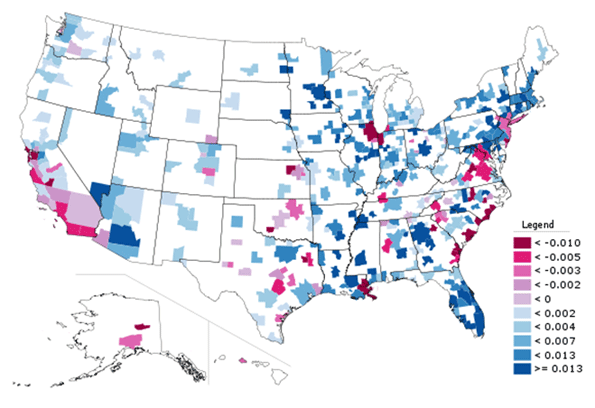
    Black population changes in various cities have been one of the few pieces of the latest Census to receive significant media coverage.  The New York Times, for example, noted that many blacks have returned to the South nationally and particularly from New York City.  The overall narrative has been one of a “reverse Great Migration.”  But while many northern cities did see anemic growth or even losses in black population, and many southern cities saw their black population surge, the real story actually extends well beyond the notion of a monolithic return to the South.

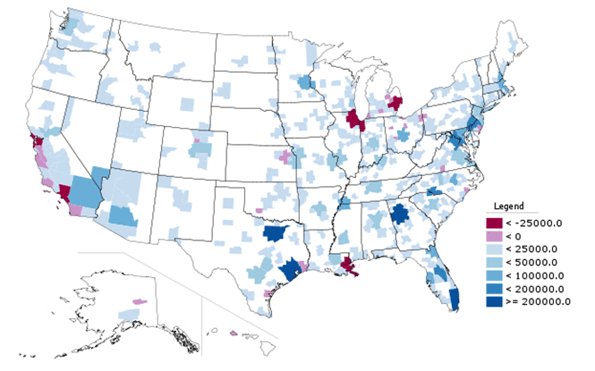
    The map below, showing total growth in Black Only population from 2000 to 2010, indeed shows that northern and west coast cities had low or even negative growth while various southern cities boomed.


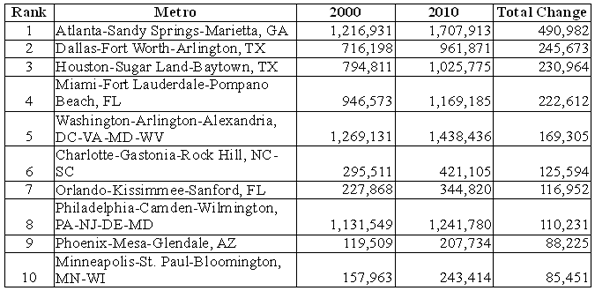
    Here is a list of the top ten metro areas (among those with more than a million total people) for black population growth:


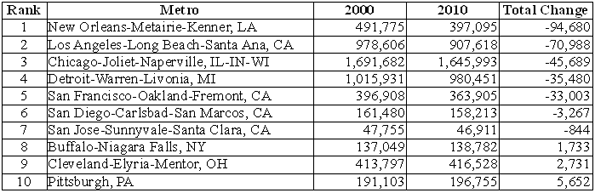
    And here are the bottom ten (among those with more than one million people):


    Of course, looking at total population numbers can mislead. Some cities grew slowly or lost people as a whole while others boomed. With Houston, Dallas, and Atlanta all adding over a million people each, it’s no surprise these regions added lots of blacks. Working and middle class African-Americans likely shared many of the same motivations to move to these cities – such as lower housing prices – as Americans of other ethnicities. In that light, a look at change in black population share (the percentage of the population that is black) provides additional perspective:


    Here we see not a single-minded return to the South, but a complex mixture of shrinking and growing regions in various parts of the country.  This includes some surprising places, like Minneapolis-St. Paul, which was one of the top ten metros in the country for total black population growth, and also saw its black population share grow strongly.  Now the Twin Cities, along with Columbus, Ohio, another strong performer, are two of the top destination for African immigrants from Somalia and elsewhere, which doubtless accounts for part of that strong growth. But anecdotal reports indicate that they are also benefitting from Chicago’s expanding black diaspora, along with places like Indianapolis and various Downstate metros.

    Atlanta, well known as America’s premier metro area for blacks, continued to dominate the charts. Not only far and away the leader in adding raw numbers of blacks, the African-American share also grew share strongly too. Charlotte is also clearly emerging as another key black population hub, ranking #6 in America for total black population growth, which is impressive for a smaller city, and adding nearly two percentage points in black population share.  It grew its black population much faster than other fast growing small cities like Raleigh or Nashville, and added share at more than three times as fast.

    By contrast, Houston, which grew total black population significantly, had a much lower share gain. Austin, one of America’s fastest growing metros, added only 28,000 blacks and actually lost black population share. And Washington, DC, despite being a traditional black population and cultural hub, also lost black population share regionally as gentrification in the District resulted in its loss of its black majority for the first time in decades, according to the Brookings Institution. 

    So even among rapidly growing metro areas in the South, the appeal to black population is selective, favoring places like Atlanta, Charlotte, Florida cities, and even slower growing cities along the length of the Mississippi River like Memphis.  Even some cities in the North are retaining their allure to blacks as well. Less favored or even out of favor are metros like DC, Dallas, and Houston as well as cities such as Charleston and Savannah along the southeast coast.

    Slow or negative black population growth is particularly concentrated in traditional tier one “global cities”, as well as those facing economic or other hardship like Detroit, Cleveland, and immediate post-Katrina New Orleans.

    The latter may be understandable – whites have been leaving these regions as well – but the former is quite troubling.  The global city model, focused on high end and creative services, is supposedly the bright and shining savior of American urbanism. Indeed, it’s hard to find a city that doesn’t have some aspect of that as a core plank in its civic strategy. Yet the cities that have been most focused at promoting this notion – such as New York, San Francisco, and Chicago – are generally those  disproportionately driving blacks away. The reasons for this aren’t clear, but the high and increasing cost of living in those places seems like one logical explanation.

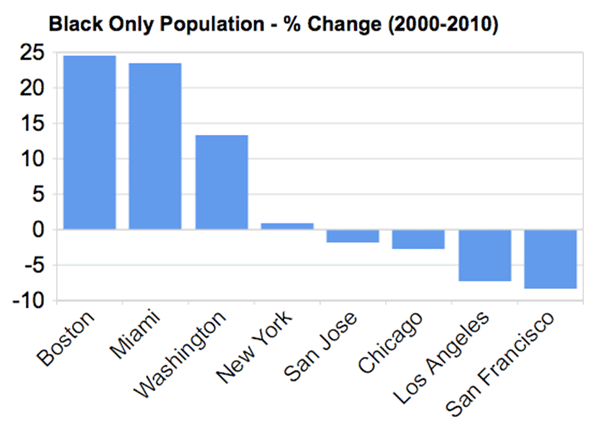
    Here’s a more detailed look at the percentage growth in Black Only population in some tier one global type metros:


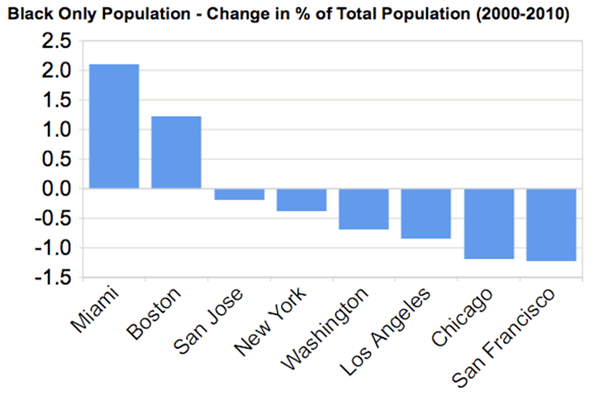
    New York barely broke even on black population, while Chicago, LA, and the Bay Area all actually lost black residents, a stunning reversal from their past as black magnets. However, Boston, not a traditional black population hub, grew its black population strongly on a percentage basis, as did Miami and DC, though as noted before, the share change in DC was negative.  Here is that metric for the same metros:


    With the notable exceptions of Boston and Miami – and Philadelphia, seldom ranked highly as a global city but still a traditional large northern metropolis – most global city regions appear to be increasingly inhospitable to Blacks.  Thus their model of success, whatever its appeal to some, at a basic level simply lacks inclusiveness. This shows its clear limits as an overall model for America’s urban centers as a whole.

    Aaron M. Renn is an independent writer on urban affairs based in the Midwest. His writings appear at The Urbanophile. Data analysis, maps, and charts in this piece were prepared with Telestrian.

  • The Next Boom Towns In The U.S.

    What cities are best positioned to grow and prosper in the coming decade?

    To determine the next boom towns in the U.S., with the help of Mark Schill at the Praxis Strategy Group, we took the 52 largest metro areas in the country (those with populations exceeding 1 million) and ranked them based on various data indicating past, present and future vitality.

    We started with job growth, not only looking at performance over the past decade but also focusing on growth in the past two years, to account for the possible long-term effects of the Great Recession. That accounted for roughly one-third of the score.  The other two-thirds were made up of a a broad range of demographic factors, all weighted equally. These included rates of family formation (percentage growth in children 5-17), growth in educated migration, population growth and, finally, a broad measurement of attractiveness to immigrants — as places to settle, make money and start businesses.

    We focused on these demographic factors because college-educated migrants (who also tend to be under 30), new families and immigrants will be critical in shaping the future.  Areas that are rapidly losing young families and low rates of migration among educated migrants are the American equivalents of rapidly aging countries like Japan; those with more sprightly demographics are akin to up and coming countries such as Vietnam.

    Many of our top performers are not surprising. No. 1 Austin, Texas, and No. 2 Raleigh, N.C., have it all demographically: high rates of immigration and migration of educated workers and healthy increases in population and number of children. They are also economic superstars, with job-creation records among the best in the nation.

    Perhaps less expected is the No. 3 ranking for Nashville, Tenn. The country music capital, with its low housing prices and pro-business environment, has experienced rapid growth in educated migrants, where it ranks an impressive fourth in terms of percentage growth. New ethnic groups, such as Latinos and Asians, have doubled in size over the past decade.

    Two advantages Nashville and other rising Southern cities like No. 8 Charlotte, N.C., possess are a mild climate and smaller scale. Even with population growth, they do not suffer the persistent transportation bottlenecks that strangle the older growth hubs. At the same time, these cities are building the infrastructure — roads, cultural institutions and airports — critical to future growth. Charlotte’s bustling airport may never be as big as Atlanta’s Hartsfield, but it serves both major national and international routes.

    Of course, Texas metropolitan areas feature prominently on our list of future boom towns, including No. 4 San Antonio, No. 5 Houston and No. 7 Dallas, which over the past years boasted the biggest jump in new jobs, over 83,000. Aided by relatively low housing prices and buoyant economies, these Lone Star cities have become major hubs for jobs and families.

    And there’s more growth to come. With its strategically located airport, Dallas is emerging as the ideal place for corporate relocations. And Houston, with its burgeoning port and dominance of the world energy business, seems destined to become ever more influential in the coming decade. Both cities have emerged as major immigrant hubs, attracting on newcomers at a rate far higher than old immigrant hubs like Chicago, Boston and Seattle.

    The three other regions in our top 10 represent radically different kinds of places. The Washington, D.C., area (No. 6) sprawls from the District of Columbia through parts of Virginia, Maryland and West Virginia. Its great competitive advantage lies in proximity to the federal government, which has helped it enjoy an almost shockingly   ”good recession,” with continuing job growth, including in high-wage science- and technology-related fields, and an improving real estate market.

    Our other two top ten, No. 9 Phoenix, Ariz., and No. 10 Orlando, Fla., have not done well in the recession, but both still have more jobs now than in 2000. Their demographics remain surprisingly robust. Despite some anti-immigrant agitation by local politicians, immigrants still seem to be flocking to both of these states. Known better s as retirement havens, their ranks of children and families have surged over the past decade. Warm weather, pro-business environments and, most critically, a large supply of affordable housing should allow these regions to grow, if not in the overheated fashion of the past, at rates both steadier and more sustainable.

    Sadly, several of the nation’s premier economic regions sit toward the bottom of the list, notably former boom town Los Angeles (No. 47). Los Angeles’ once huge and vibrant industrial sector has shrunk rapidly, in large part the consequence of ever-tightening regulatory burdens. Its once magnetic appeal to educated migrants faded and families are fleeing from persistently high housing prices, poor educational choices and weak employment opportunities. Los Angeles lost over 180,000 children 5 to 17, the largest such drop in the nation.

    Many of L.A.’s traditional rivals — such as Chicago (with which is tied at No. 47), New York City (No. 35) and San Francisco (No. 42) — also did poorly on our prospective list.  To be sure,  they will continue to reap the benefits of existing resources — financial institutions, universities and the presence of leading companies — but their future prospects will be limited by their generally sluggish job creation and aging demographics.

    Of course, even the most exhaustive research cannot fully predict the future. A significant downsizing of the federal government, for example, would slow the D.C. region’s growth. A big fall in energy prices, or tough restrictions of carbon emissions, could hit the Texas cities, particularly Houston, hard. If housing prices stabilize in the Northeast or West Coast, less people will flock to places like Phoenix, Orlando or even Indianapolis (No.11) , Salt Lake City (No. 12) and Columbus (No. 13). One or more of our now lower ranked locales, like Los Angeles, San Francisco and New York, might also decide to reform in order to become more attractive to small businesses and middle class families.

    What is clear is that well-established patterns of job creation and vital demographics will drive future regional growth, not only in the next year, but over the coming decade.  People create economies and they tend to vote with their feet when they choose to locate their families as well as their businesses.  This will prove   more decisive in shaping future growth   than the hip imagery and big city-oriented PR flackery that dominate media coverage of America’s changing regions.

    Cities of the Future Rankings
    Rank Metropolitan Area
    1 Austin, TX
    2 Raleigh, NC
    3 Nashville, TN
    4 San Antonio, TX
    5 Houston, TX
    6 Washington, DC-VA-MD-WV
    7 Dallas-Fort Worth, TX
    8 Charlotte, NC-SC
    8 Phoenix, AZ
    10 Orlando, FL
    11 Indianapolis, IN
    12 Salt Lake City, UT
    13 Columbus, OH
    14 Jacksonville, FL
    15 Atlanta, GA
    16 Las Vegas, NV
    16 Riverside, CA
    18 Portland, OR-WA
    19 Denver, CO
    20 Oklahoma City, OK
    21 Baltimore, MD
    22 Louisville, KY-IN
    22 Richmond, VA
    24 Seattle, WA
    25 Kansas City, MO-KS
    26 San Diego, CA
    27 Miami, FL
    28 Tampa, FL
    29 Sacramento, CA
    30 Birmingham, AL
    31 New Orleans, LA
    32 Philadelphia, PA-NJ-DE-MD
    33 Minneapolis, MN-WI
    34 St. Louis, MO-IL
    35 Cincinnati, OH-KY-IN
    35 New York, NY-NJ-PA
    37 Boston, MA-NH
    38 Memphis, TN-MS-AR
    39 Pittsburgh, PA
    40 Virginia Beach, VA-NC
    41 Rochester, NY
    42 Buffalo, NY
    42 San Francisco, CA
    44 Hartford, CT
    45 Milwaukee, WI
    45 San Jose, CA
    47 Chicago, IL-IN-WI
    47 Los Angeles, CA
    49 Providence, RI-MA
    50 Detroit, MI
    51 Cleveland, OH

    This piece originally appeared at Forbes.com.

    Joel Kotkin is executive editor of NewGeography.com and is a distinguished presidential fellow in urban futures at Chapman University, and an adjunct fellow of the Legatum Institute in London. He is author of The City: A Global History. His newest book is The Next Hundred Million: America in 2050, released in February, 2010.

    Photo by Exothermic Photography

  • Enterprising States: Hard choices now, hard work ahead: State Strategies to Renew Growth and Create Jobs

    This is an excerpt from "Enterprising States: Creating Jobs, Economic Development, and Prosperity in Challenging Times" authored by Praxis Strategy Group and Joel Kotkin. The entire report is available at the National Chamber Foundation website, including highlights of top performing states and profiles of each state’s economic development efforts.

    Read the full report.

    Read part one in this series.

    America has the world’s largest economy, the world’s leading universities, the most robust entrepreneurial culture and many of its biggest companies—yet many see this as a diminishing advantage.31 Stagnation, many predict, will extend into the foreseeable future because the economy’s low-hanging fruit has disappeared and so the pace of innovation has slowed; by this argument we are now on a “technological plateau” that will make further growth challenging.32 The United States remains a leader in global innovation, but better-funded, higher-performing hubs of innovation are emerging among determined competitors, notably China.

    In contrast, we believe America’s prospects for competing with other countries are better than commonly assumed, and we are convinced that our strategy for the future is unlikely to be found elsewhere. Unlike our major competitors, we enjoy a huge base of natural resources—such as food and energy—which are likely to become ever more in demand as countries like China and India grow their economies. Most important of all, the United States, particularly in contrast with Europe and East Asia, enjoys relatively youthful demographics, promising an expanding workforce, new consumers and a new flood of entrepreneurs.

    Yet our demographics and resources require intelligent policies that fit our particular situations. As a young country, we will have to find employment for an additional 20 million Americans in this decade. Slow growth, which could be accommodated in rapidly aging Japan or Germany, is not an option for the United States. We will also need to harness all forms of energy, from renewables to fossil fuels. Today, half of our trade deficit consists of energy, and yet we have the oil and gas resources to supply the vast majority of our needs. As we invest in renewables for the long run, the country needs to use the resources that are readily available in order to reduce the deficit and spark job growth.

    Our ability to compete, particularly on the state level, could be compromised by an inability to address our budgetary challenges. According to the Center on Budget and Policy Priorities, states are struggling with budget shortfalls for fiscal 2012 that add up to $112 billion. The most recent Fiscal Survey of the States anticipates considerably more financial stress in the states as the substantial funding made available by the American Recovery and Reinvestment Act of 2009 will no longer be available.

    Most states have already taken actions to streamline and downsize government to meet the new economic realities. This has proven to be challenging given the increased demand for state services during the national recession. Surely, more redesign, streamlining and reform is on the way. To recoup lost revenue, states have taken such actions as eliminating tax exemptions, broadening the tax base, and in some cases increasing rates as well as raising a number of fees. Low tax rates by themselves are not a silver bullet for growth, but it has become clear that outdated state tax systems can undercut economic vitality.

    States are the fulcrum of change in key areas of education, infrastructure, energy, innovation and skills training—something that was confirmed on many fronts in the first Enterprising States study. States and localities are far better positioned than the federal government to foster strategic investment, regulations, taxes and incentives that encourage private sector prosperity. In large part, this is because they are more responsive to local conditions.

    Equally important, a diversified portfolio of opportunity agendas implemented by the individual states will go a long way toward renewing growth and prosperity in the national economy.

    New Era of Leadership by the States?

    As the 2010 Enterprising States study was being completed, the states were implementing sweeping changes to deal with a growing number of challenges. Since then twenty-nine new governors have started their terms. Governors of every state, along with their legislative counterparts, are taking steps to grow their states’ economies, create jobs and compete globally. They want to help businesses prosper, to produce an educated and skilled workforce, and to provide other essential services and infrastructure that foster the entrepreneurship and innovation that will lead to greater productivity and competitiveness.

    The dramatic shortage of job opportunities has driven up the unemployment rate, pushed a large number of workers into part-time jobs, increased underemployment problems, and reduced the number of people who were expected to be active participants in the labor force. There is universal agreement that we need policies and programs that create jobs now, alongside investments to lay the foundations for long-term economic growth. “To keep the American dream of widely shared prosperity alive,” one commentator has argued, “we need to choose entrepreneurship and competition over the vested interests of the status quo.”

    Restoring confidence in the economy by creating a meaningful and compelling plan for moving forward is a top priority for elected officials as well as leaders from business, education, and labor groups throughout the country.

    There is also a stark recognition among the states that solving their fiscal problems is directly connected to creating an economic climate that will foster job creation. Any state with a budget tilting towards insolvency is in a weak position to make and maintain investments in its workforce and economic infrastructure. A state’s fiscal health also has immediate consequences by affecting its credit rating and, thereby, the cost of borrowing money. Unfunded pension obligations, viewed historically as soft debt, are now being considered together with the total value of state bonds to come up with a credit rating.

    Many governors and state legislatures are attempting to strike a balance between budget cuts that could hold back the recovery by putting more people out of work, and spending cuts and government reforms that would create a more business-friendly environment, leading to greater business confidence, private-sector investment and job creation. How this balance is achieved depends on each state’s unique set of circumstances and available assets. Moreover, at their core, these debates reflect the fundamental tensions between the two major visions of American progress, namely: creating equality of condition by boosting wages, improving working conditions, and guaranteeing basic services, and creating equality of opportunity, by creating the conditions whereby individuals can elevate themselves through industry, perseverance, talent, and righteous behavior.

    As noted in The Economist, private capital is mobile and it goes where government works. So while political considerations and ideological rationalizations certainly do influence the mix of austerity measures and public investments, the real opportunity today is for states to redesign government for the 21st century. That means cutting programs that do not spur economic growth and shifting resources, where possible, to those existing or planned programs that will.

    While spending cuts will help control deficient budgets, so will increased revenue brought by economic growth. As states enact budget austerity measures, what job creation initiatives are surviving or receiving increased investment? What are the new priorities for job creation? How are states balancing cuts with critical job-creating initiatives that will stimulate innovation, build infrastructure, provide skills training, and unleash the dynamism of small business?

    Job-Centric States Are Redesigning Government and Investing in Opportunity

    Determining where to cut and where to invest40 is the central challenge of the day. States must carry out short-term strategies to jump-start and/or sustain an as-of-yet lackluster recovery, and cut costs to make state government more efficient and to avoid financial calamity. Simultaneously, though, they must craft and invest in innovations and structural solutions that will foster long-term economic growth while reining in taxes and regulations that stifle job creation.

    In most states, revenues remain stubbornly down from where they were before the recession, and job growth is proving to be more elusive than in most previous recoveries. The strategies now being planned or undertaken by each state are based on their unique sets of interests, resources and capabilities, aligned with the opportunities that they see on the horizon and believe are conceivably within their grasp. Yet all states “will likely need a new network of market-oriented, private-sector-leveraging, performance-driven institutions”41 to restore and revitalize their economies.

    The 2011 Enterprising States study highlights state-driven initiatives to 1) redesign government, including measures to deal with excessive debt levels that inhibit economic growth and job creation, and 2) forward-looking, enterprise-friendly initiatives whose primary goal is to create the conditions for job creation and future prosperity.

    The policy initiatives and programmatic efforts are related to the five policy areas that were included in the original Enterprising States report.

    • Entrepreneurship and Innovation
    • Exports, International Trade and Foreign Direct Investment
    • Workforce Development and Training
    • Infrastructure
    • Taxes and Regulation

What’s different in 2011 and for the foreseeable future is that for many states the imperative for change is real. The choice is simple. To remain a job-creating, fiscally robust economy, states will either change on their own or change will continue to be forced upon them.

Investing In Opportunity

States are taking a hard look at making investments in and implementing initiatives to create and sustain high-growth, higher-wage, 21st century industries.States play a key role in the higher education landscape, so there is considerable support for and investment in programs that educate the future talent pool and foster collaboration between business, education and government on science and technology, technology transfer and entrepreneurial programs. As states evaluate their return on investment, performance-based funding has become a best practice for aligning colleges and universities as partners in workforce preparation and sources of opportunity, growth, and competitive advantage.

High-growth start-ups are the best generators of new jobs, accounting for nearly all net job creation in America in the last twenty-plus years. They are also the firms most likely to raise productivity, a basis for economic growth. They also create jobs that did not previously exist, and solve problems in a way that makes a difference in people’s lives.

States have stepped up their efforts to help companies scale up and grow in order to capture growing domestic and international markets. A number of states have established or expanded seed and growth-stage financing funds. Some have implemented economic gardening programs deliberately designed to focus on expanding existing second-stage companies that have viable growth opportunities. Several states have undertaken initiatives to fix deficiencies in the market that inhibit private-sector investment and entrepreneurial activity. Tax credits for angel investors and state-backed venture capital funds are just two examples.

Companies with a global reach that bring together multiple technologies or complex expertise—such as advanced manufacturing, investment banking, construction and engineering, and natural resources—are likely to drive the nation’s global competitiveness in the next few years, along with more focused technology companies that are part of complex virtual networks.44 For that reason, several states are implementing, and having considerable success with, programs to help companies expand into global markets by assisting in the development of a customized international growth plan. And, some states have made significant headway using focused and purposeful strategies to attract foreign direct investment.

Public-private partnerships and privatization initiatives for economic development and the provision of infrastructure are proliferating throughout the states. Building funds and bonding programs that involve private-sector investors are now widely used to construct specialized facilities for research, demonstration, and technology transfer in key economic sectors. Building on the lessons of the past, states have become considerably more adept at avoiding what Robert Fogel has called “hothouse capitalism,” in which government assumes much of the risk while private contractors and financiers take the profit.

While unemployment remains high, many currently available jobs go unfilled. America faces a shortfall of almost two million technical and analytical workers in the coming years, a situation that stands to thwart economic growth.45 Painfully cognizant of this dilemma, many states are establishing workforce training and development programs that address structural unemployment problems and the mismatch between available jobs and the skills of the existing workforce. The goal is to align training and academic programs with in-demand regional occupations, and to add greater flexibility to workforce training programs that have left some re-trainable individuals slipping through the cracks.

Forward-looking states are modernizing their education and workforce training initiatives by developing people-focused approaches that help and train workers in navigating their careers, provide assistance for entrepreneurs, make lifelong learning loans, and offer wage insurance plans. The goal is to empower people to find better jobs and/or to create new ones. Plainly, making America more globally competitive is vital, but the increasingly obvious gap in our economic discussions is an agenda for making Americans more personally competitive. In this view, forging a new economics for the Individual Age will require rethinking our economy from the bottom up in order to realize future growth and prosperity.

Finally, because energy issues, both current and future, have become such critical factors in business and for economic growth, states are getting serious about policies, initiatives and investments to provide clean, secure, safe and affordable energy tailored to regional, state and local resources. These include renewable energy standards, investments in research, development and commercialization of energy technologies and processes, and the establishment of new financing authorities to build the infrastructure that will extract and transport energy to the places where it will fuel new growth.

Redesigning Government

The fiscal situation of many states has caused them to reconsider the level of services they are providing and, certainly, the way that they deliver them. According to the Government Accountability Office, “Because most state and local governments are required to balance their operating budgets, the declining fiscal conditions shown in our simulations suggest the fiscal pressures the sector faces and foreshadow the extent to which these governments will need to make substantial policy changes to avoid growing fiscal imbalances.”

In The Price of Government: Getting the Results We Need in an Age of Permanent Fiscal Crisis, David Osborne and Peter Hutchinson contend that Industrial Age government is just not up to the tasks and challenges at hand. Centralized bureaucracies, hierarchical management, rules and regulations, standardized services, command-and-control methods, and public monopolies are simply not aligned to Information Age realities. Today, government must be restructured and prepared for rapid change, global competition, the pervasive use of information technologies, and a public that expects quality and has lots of choices.

The keys, according to Osborne and Hutchinson, are to 1) get rid of low-value spending, 2) move money into higher-value, more cost-effective strategies and programs and 3) motivate all managers to find better, cheaper ways to deliver results. In sum, government needs to provide incentives, expect accountability, and allow the freedom to innovate.48
Government redesign efforts that are now underway or in the planning stages often follow the simple guidelines outlined above. Yet various approaches are now being used by state governments, including:

  • Consolidation, reorganization, or elimination of agencies, boards and commissions.
  • Regionalization of governance to decentralize decision-making and to customize and align service delivery with local circumstances.
  • Streamlining and modernizing bureaucratic processes to increase productivity and improve service delivery, often by deploying services online.
  • Experimenting with charter agencies that commit to producing measurable benefits and to saving money—either by reducing expenditures or increasing revenues—in exchange for greater authority and flexibility.

Steps to curb spending and reform taxation in the states have varied widely. States with the most serious fiscal problems are laying off workers, imposing hiring freezes, reducing spending for education and health care and ending or curtailing social services. Aid to local governments has been cut. For many states, current obligations for public pension funds and health insurance costs are unaffordable and future obligations represent a
looming financial disaster. Cuts, concessions and larger contributions from employees are now a necessary part of balancing the state’s checkbook.

Taxes and tax policies vary considerably among the states. To make up for lost revenues, most states have taken such actions as eliminating tax exemptions, broadening tax bases, and in some cases increasing rates as well as raising a number of fees. States have enacted increases in all of the major taxes they levy, including personal income taxes, general sales taxes, business taxes, and excise taxes. However, many states did reduce business taxes with new credits or expanded existing credits to encourage investment and growth in targeted industries.
Uncertainty, above all, is the antagonist of growth, investment, and job creation. States that cannot rid themselves of onerous DURT49 (delays, uncertainty, regulations and taxes) are in peril of putting the heaviest burdens on new and small businesses and on entrepreneurs, the real job creators in a growing economy. In a tight economy these considerations become more stringent for entrepreneurs and companies that are making economic decisions simply because the levels of uncertainty and the stakes are so much higher. Eliminating employment regulations and time-consuming processes that place unreasonable burdens on business can have a significant impact on job creation.

Moreover, the competitive identity of a state today relies increasingly on the degree to which the actions of the private, public and civic sectors are aligned with and corroborate the identity claimed or brand promise. A story must be backed up by actions: to simply proclaim an enterprise-friendly environment is no longer adequate.
States that are doing it right today are responsive and are taking a cooperative, supportive approach to dealing with new and existing companies. Their attitude and operating systems are customer-centric and their emphasis is on streamlining processes for obtaining permits, licenses, and titles.

Many state governments across the country are adopting a fast-track approach to achieving a better balance between the requirements of regulation and the need for new jobs and industry, so that that results have a higher priority than rules. This is the mindset that must guide the interface between government and business.
operating budgets, the declining fiscal conditions shown in our simulations suggest the fiscal pressures the sector faces and foreshadow the extent to which these governments will need to make substantial policy changes to avoid growing fiscal imbalances.”

In The Price of Government: Getting the Results We Need in an Age of Permanent Fiscal Crisis, David Osborne and Peter Hutchinson contend that Industrial Age government is just not up to the tasks and challenges at hand. Centralized bureaucracies, hierarchical management, rules and regulations, standardized services, command-and-control methods, and public monopolies are simply not aligned to Information Age realities. Today, government must be restructured and prepared for rapid change, global competition, the pervasive use of information technologies, and a public that expects quality and has lots of choices.

The keys, according to Osborne and Hutchinson, are to 1) get rid of low-value spending, 2) move money into higher-value, more cost-effective strategies and programs and 3) motivate all managers to find better, cheaper ways to deliver results. In sum, government needs to provide incentives, expect accountability, and allow the freedom to innovate.48

Government redesign efforts that are now underway or in the planning stages often follow the simple guidelines outlined above. Yet various approaches are now being used by state governments, including:

  • Consolidation, reorganization, or elimination of • agencies, boards and commissions.
  • Regionalization of governance to decentralize • decision-making and to customize and align service delivery with local circumstances.
  • Streamlining and modernizing bureaucratic processes • to increase productivity and improve service delivery, often by deploying services online.
  • Experimenting with charter agencies that commit • to producing measurable benefits and to saving money—either by reducing expenditures or increasing revenues—in exchange for greater authority and flexibility.

Steps to curb spending and reform taxation in the states have varied widely. States with the most serious fiscal problems are laying off workers, imposing hiring freezes, reducing spending for education and health care and ending or curtailing social services. Aid to local governments has been cut. For many states, current obligations for public pension funds and health insurance costs are unaffordable and future obligations represent a
looming financial disaster. Cuts, concessions and larger contributions from employees are now a necessary part of balancing the state’s checkbook.

Taxes and tax policies vary considerably among the states. To make up for lost revenues, most states have taken such actions as eliminating tax exemptions, broadening tax bases, and in some cases increasing rates as well as raising a number of fees. States have enacted increases in all of the major taxes they levy, including personal income taxes, general sales taxes, business taxes, and excise taxes. However, many states did reduce business taxes with new credits or expanded existing credits to encourage investment and growth in targeted industries.
Uncertainty, above all, is the antagonist of growth, investment, and job creation. States that cannot rid themselves of onerous DUR (delays, uncertainty, regulations and taxes) are in peril of putting the heaviest burdens on new and small businesses and on entrepreneurs, the real job creators in a growing economy. In a tight economy these considerations become more stringent for entrepreneurs and companies that are making economic decisions simply because the levels of uncertainty and the stakes are so much higher. Eliminating employment regulations and time-consuming processes that place unreasonable burdens on business can have a significant impact on job creation.

Moreover, the competitive identity of a state today relies increasingly on the degree to which the actions of the private, public and civic sectors are aligned with and corroborate the identity

States that are doing it right today are responsive and are taking a cooperative, supportive approach to dealing with new and existing companies. Their attitude and operating systems are customer-centric and their emphasis is on streamlining processes for obtaining permits, licenses, and titles.

Many state governments across the country are adopting a fast-track approach to achieving a better balance between the requirements of regulation and the need for new jobs and industry, so that that results have a higher priority than rules. This is the mindset that must guide the interface between government and business.

Read the full report, including highlights of top performing states and profiles of job creation efforts in all 50 states.

Praxis Strategy Group is an economic research, analysis, and strategic planning firm. Joel Kotkin is executive editor of NewGeography.com and author of The Next Hundred Million: America in 2050

  • Cleveland: Huge Core Loss Overwhelms Suburban Gain

    The Cleveland metropolitan area population fell from 2,148,000 in 2000 to 2.077,000 in 2010, according to the just released 2010 census figures. All of the loss was attributable to the city of Cleveland. However, population growth in the suburbs was small.

    The 2010 census data indicates that the city of Cleveland lost 16.9 percent of its population between 2000 and 2010, the largest loss yet reported by a historical core municipality (excluding Hurricane Katrina ravaged New Orleans). Cleveland dropped from 477,000 in 2000 to 397,000 in 2010. The city of Cleveland reached its population peak of 914,000 in 1950 and has since fallen 57 percent.

    The suburbs added 10,000 residents, for a growth rate of 0.6 percent. This small gain was insufficient to offset the loss of 80,000 residents in the city of Cleveland and the metropolitan area suffered a population loss of 3.3 percent.

    The core county of Cuyahoga (which includes the city of Cleveland) declined 114,000 residents, for a loss of 8.2 percent. All of the four suburban counties gained, with by far the largest gain (14 percent) in Medina County.

  • Regional Exchange Rates: The Cost of Living in US Metropolitan Areas

    International travelers and expatriates have long known that currency exchange rates are not reliable indicators of purchasing power. For example, a traveler to France or Germany will notice that the dollar equivalent in Euros cannot buy as much as at home. Conversely, the traveler to China will note that the dollar equivalent in Yuan will buy more.

    Economists have attempted to solve this problem by developing "purchasing power parities," which are used to estimate currency conversion rates that equalize values based upon prices (Note 1). This helps establish the real value of money in a particular place.

    When people move from one region of the United States to another they can encounter a similar phenomenon. For example, a dollar is not worth as much in San Jose as it is in St. Louis. Research by the US Department of Commerce Bureau of Economic Analysis (BEA), for example, found that in 2006 a dollar purchased roughly 35 cents less in San Jose than in St. Louis. BEA researchers estimated "regional price parities" for states and the District of Columbia and for all of the nation’s metropolitan areas (Note 2). Regional price parities can be thought of as the equivalent of regional (state or metropolitan area) exchange rates. This research was covered in previous newgeography.com articles by Eamon Moynihan and this author.

    This article uses Department of Labor, Bureau of Labor Statistics metropolitan area consumer price indexes to estimate the 2009 cost of living and per capita personal income adjusted for the cost of living.

    Cost of Living: At the regional level (See Census Region Map, Figure 1), there are substantial differences in the cost of living (Figure 2). The lowest cost of living is in the Midwest, at 4.8 percent below the nation. The South has the second lowest cost of living at 3.9 percent above the national level. The West is the most expensive area, 13.5 percent above the national cost-of-living, while the Northeast’s cost-of-living stands 11.3 percent above the national rate.

    The cost of living in the South may seem higher than expected. But if the higher cost metropolitan areas of Washington, Baltimore and Miami are excluded, the cost of living in the South falls to 1.5 percent below the national rate. If the California metropolitan areas are excluded from the West, the cost of living still remains 4.0 percent above the national rate.

    Per Capita Income: The highest unadjusted per capita incomes are in the Northeast, followed by the West, the South and the Midwest. Yet when metropolitan area exchange rates are taken into consideration, the order changes significantly. The Northeast remains the most affluent, and the Midwest moves from last place to second place. The South is in third place, the same as its income rating, while the West falls from second place to fourth place (Figure 3).

    Cost of Living: Variations in the cost of living, which is reflected by the metropolitan area exchange rates, remains similar in 2009 to the 2006 rankings.

    The Top Ten: The lowest costs of living were in (Table 1):

    1. St. Louis, where $0.891 purchased $1.00 in value at the national average.
    2. Kansas City, where $0.903 purchased $1.00 in value at the national average.
    3. Cleveland, where $0.921 purchased $1.00 in value at the national average.
    4. Pittsburgh, where $0.941 purchased $1.00 in value at the national average.
    5. Cincinnati, where $0.944 purchased $1.00 in value at the national average.

    Rounding out the most affordable 10 are two metropolitan areas in the South (Atlanta and Dallas-Fort Worth), two in the Midwest (Detroit and Milwaukee) and one in the West (Denver). No Northeastern metropolitan area was ranked in the top 10.

    Table 1
    Estimated Cost of Living: 2009
    Metropolitan Areas over 1,000,000 with Local CPIs
    Rank Metropolitan Area
    Metropolitan Exchange Rate: to Purchase $1.00 at National Average
    Compared to Lowest Cost of Living
    1
    St. Louis, MO-IL
    $0.891
    0%
    2
    Kansas City, MO-KS
    $0.903
    1%
    3
    Cleveland, OH
    $0.921
    3%
    4
    Pittsburgh. PA
    $0.941
    6%
    5
    Cincinnati, OH-KY-IN
    $0.944
    6%
    6
    Atlanta. GA
    $0.958
    8%
    7
    Detroit. MI
    $0.959
    8%
    8
    Milwaukee. WI
    $0.959
    8%
    9
    Dallas-Fort Worth, TX
    $0.976
    10%
    10
    Denver, CO
    $0.996
    12%
    11
    Minneapolis-St. Paul, MN-WI
    $1.000
    12%
    12
    Houston, TX
    $1.000
    12%
    13
    Tampa-St. Petersburg, FL
    $1.006
    13%
    14
    Phoenix, AZ
    $1.011
    14%
    15
    Portland, OR-WA
    $1.034
    16%
    16
    Chicago, IL-IN-WI
    $1.041
    17%
    17
    Philadelphia, PA-NJ-DE-MD
    $1.054
    18%
    18
    Baltimore, MD
    $1.068
    20%
    19
    Riverside-San Bernardino, CA
    $1.078
    21%
    20
    Miami-West Palm Beach, FL
    $1.085
    22%
    21
    Seattle, WA
    $1.120
    26%
    22
    San Diego, CA
    $1.151
    29%
    23
    Boston, MA
    $1.175
    32%
    24
    Washington, DC-VA-MD-WV
    $1.181
    33%
    25
    Los Angeles, CA
    $1.222
    37%
    26
    San Francisco-Oakland, CA
    $1.258
    41%
    27
    New York, NY-NJ-PA
    $1.281
    44%
    28
    San Jose, CA
    $1.343
    51%
    Estimated from BEA 2006 data, adjusted by local Consumer Price Index for 2006-2009


    The Bottom Ten: The most expensive metropolitan areas were:

    28. San Jose, where $1.343 purchased $1.00 in value at the national average.
    27. New York, where $1.281 purchased $1.00 in value at the national average.
    26. San Francisco, where $1.268 purchased $1.00 in value at the national average.
    25. Los Angeles, where $1.222 purchased $1.00 in value at the national average.
    24. Washington, where $1.181 purchased $1.00 in value at the national average.

    The bottom ten also included three metropolitan areas in the West (Riverside-San Bernardino, San Diego and Seattle), one in the Northeast (Boston) and one in the South (Miami). There were no Midwestern metropolitan areas in the bottom 10.

    Per Capita Income: Per capita income in 2009 was then adjusted for the cost of living.

    Top Ten:Washington has the highest per capita income, adjusted for the cost of living, at $47,800. San Francisco placed second at $47,500. Denver ranked third at $46,200, while the cost-of-living adjusted income in Minneapolis-St. Paul was $45,800 and $45,700 in Boston. The top 10 also included two Midwestern metropolitan areas (St. Louis and Kansas City), two from the Northeast (Baltimore and Pittsburgh) and one from the West (Seattle).

    Bottom Ten: The least affluent metropolitan area was Riverside-San Bernardino, with a per capita income of $27,800. Phoenix was second least affluent at $33,900 while Los Angeles was third least affluent at $35,000. The fourth least affluent metropolitan area was Tampa-St. Petersburg at $36,600 and the fifth least affluent metropolitan area was Portland at $37,400. The bottom 10 also included two metropolitan areas from the South (Atlanta and Miami), two from the Midwest (Cincinnati and Detroit) and one from the West (San Diego).

    The cost of living adjusted income data includes surprises. New York, commonly considered a particularly affluent metropolitan area, ranked 17th in cost-of-living adjusted income, and below such seemingly unlikely metropolitan areas as Pittsburgh, Kansas City, Cleveland, St. Louis and Milwaukee. These metropolitan areas also ranked above San Jose, which ranked first in unadjusted income in 2000, but now ranks 16th in cost of living adjusted income (Table 2).

    Table 2
    Personal Income Per Capita Adjusted for  the Cost of Liviing
    Metropolitan Areas over 1,000,000 with Local CPIs
    Rank (Cost of Living Adjusted)
    Rank (Unadjusted Income)
    Metropolitan Area
    Per Capita Income 2009: Adjusted for Cost of Living
    Per Capita Income 2009: Unadjusted
    1
    2
    Washington, DC-VA-MD-WV
    $47,780
    $56,442
    2
    1
    San Francisco-Oakland, CA
    $47,462
    $59,696
    3
    8
    Denver, CO
    $46,172
    $45,982
    4
    9
    Minneapolis-St. Paul, MN-WI
    $45,772
    $45,750
    5
    4
    Boston, MA
    $45,707
    $53,713
    6
    18
    St. Louis, MO-IL
    $45,288
    $40,342
    7
    7
    Baltimore, MD
    $44,908
    $47,962
    8
    15
    Pittsburgh. PA
    $44,848
    $42,216
    9
    19
    Kansas City, MO-KS
    $43,862
    $39,619
    10
    6
    Seattle, WA
    $43,730
    $48,976
    11
    13
    Houston, TX
    $43,581
    $43,568
    12
    16
    Milwaukee. WI
    $43,477
    $41,696
    13
    11
    Philadelphia, PA-NJ-DE-MD
    $43,247
    $45,565
    14
    21
    Cleveland, OH
    $42,734
    $39,348
    15
    12
    Chicago, IL-IN-WI
    $41,990
    $43,727
    16
    3
    San Jose, CA
    $41,255
    $55,404
    17
    5
    New York, NY-NJ-PA
    $40,893
    $52,375
    18
    20
    Dallas-Fort Worth, TX
    $40,494
    $39,514
    19
    23
    Cincinnati, OH-KY-IN
    $40,437
    $38,168
    20
    10
    San Diego, CA
    $39,647
    $45,630
    21
    24
    Detroit. MI
    $39,147
    $37,541
    22
    17
    Miami-West Palm Beach, FL
    $38,124
    $41,352
    23
    26
    Atlanta. GA
    $38,081
    $36,482
    24
    22
    Portland, OR-WA
    $37,446
    $38,728
    25
    25
    Tampa-St. Petersburg, FL
    $36,561
    $36,780
    26
    14
    Los Angeles, CA
    $35,045
    $42,818
    27
    27
    Phoenix, AZ
    $33,897
    $34,282
    28
    28
    Riverside-San Bernardino, CA
    $27,767
    $29,930
    Estimated from BEA 2009 income data and 2006 regional price parity data, adjusted by local Consumer Price Index for 2006-2009


    Some expensive metropolitan areas such as Washington, San Francisco and Boston ranked at or near the top, but their cost-of-living adjusted incomes were considerably less than the unadjusted incomes. On average, it took $1.20 to purchase $1.00 of value at national rates in these three metropolitan areas. Washington’s unadjusted per capita income was 40 percent ($16,100) higher than that of St. Louis, however when the cost of living is factored in, Washington’s advantage drops to 6 percent ($2,500).

    Caveats: The analysis above does not consider cost-of-living differentials within metropolitan areas. For example, data from the ACCRA cost of living index indicates generally higher prices in the cores of the largest metropolitan areas, such as New York (especially Manhattan), Chicago and San Francisco. Further, these data make no adjustment for relative levels of taxation. A cost of living analysis using disposable income would produce different results, dropping higher taxed metropolitan areas to lower rankings and raising lower taxed metropolitan areas higher.

    Cost of Living Differences: Will They Continue? The spread in cost-of-living between metropolitan areas have been driven wider over the last decade by the relative escalation of house prices in some metropolitan areas in the West, Florida and the Northeast. Whether these shifts in cost of living will be reflected in migration patterns will be one of the things to look for in the new Census.

    ———

    Note 1: Purchasing power parity data is published by the World Bank, the International Monetary Fund (IMF) and the Organization for Economic Cooperation and Development (OECD).

    Note 2: The BEA research applied regional price parity factors only to employee compensation and excluded other income. It is possible that, had the analysis been expanded to these other forms of income, the differences in cost of living would have been greater.

    Photo: Rosslyn, VA business district, Washington (by author)

    Wendell Cox is a Visiting Professor, Conservatoire National des Arts et Metiers, Paris and the author of “War on the Dream: How Anti-Sprawl Policy Threatens the Quality of Life