Tag: commercial real estate

  • The Undead Suburban Office Market

    The restoration of central city living and working environments has been one of the more important developments in the nation’s metropolitan areas over the past two decades. Regrettably, a good story has been exaggerated out of all proportion in the print, electronic and online media.  

    Exaggerating Core Population Increases: The rise of population in urban cores has been important, but it has too often been used to suggest the apparent, but fallacious opposite, suburban decline. In fact, the suburbs are hardly in decline, with 93.5 percent of major metropolitan area growth outside a 10 mile radius from city hall between the 2000 and 2010 censuses (See: Flocking Elsewhere: The Downtown Growth Story).

    Exaggerating CBD Office Space Gains: Similar misinformation had been circulating about office space outside the nation’s CBDs (central business districts, or “downtowns”). Commercial real estate information company Costar’s Randyl Drummer recently described suburbia’s improving fortunes (See: Once Left for Dead, Suburban Office Making a Comeback).

    “Some analysts wrote the obituary of the suburban office campus as downsizing companies shed millions of square feet, in many cases consolidating into buildings closer to public transit in urban centers.” 

    It’s just not happening, according to Costar research:

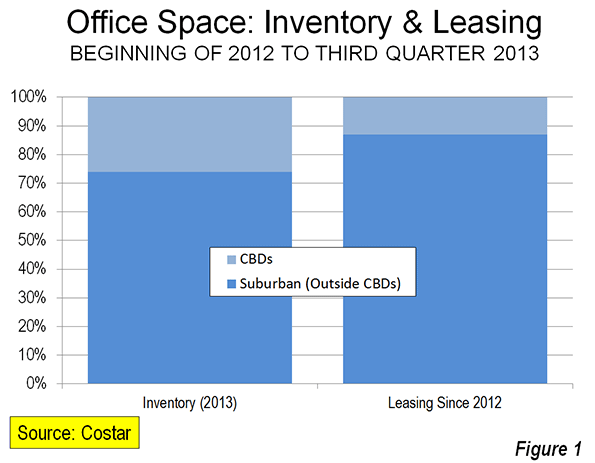
    “Overall, the suburbs have garnered more than their usual share of leasing demand over the past two years, according to an analysis by CoStar real estate economists. Since the beginning of 2012, suburban markets have accounted for a whopping 87% of office demand — which is 13% more than their ‘fair share’ based on the total market size compared with CBD office markets, according to data presented at CoStar’s recent third-quarter office review and forecast.” 

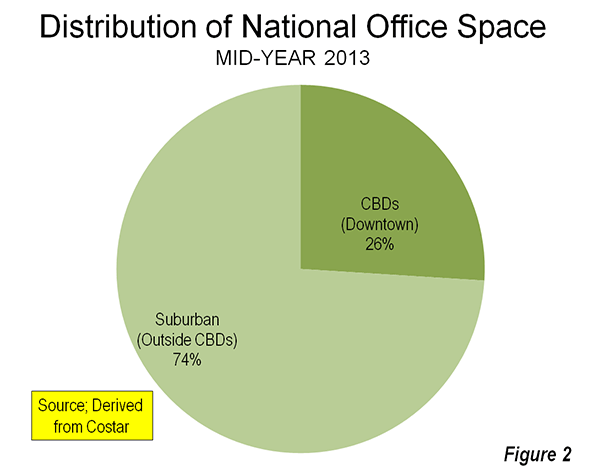
    Indeed, CBD leasing, at 13 percent of the total, is a full 50 percent below their current share of inventory (Figure 1). As of mid-2013, the suburbs accounted for nearly three quarters of the nation’s office inventory (Figure 2).
    Costar cites strong suburban development in Raleigh’s Research Triangle, and further notes that:

    A diverse set of markets that include Sacramento, San Jose, Austin, Kansas City and Charlotte have posted some of the strongest net office absorption among suburban markets.

    This is despite the glowing publicity being given to core area development, especially in places like Charlotte and Austin.

    The reality is that the monumental CBD towers dominating metropolitan skylines do not indicate downtown dominance. In fact, throughout the high income world, most metropolitan employment is outside CBDs. In the United States, typically 90 percent of employment is outside the CBDs. The suburban employment (outside the CBD) share is a bit smaller in Western Europe, Canada and Australia, but still averages approximately 80 percent or more.

    The good news is that neither suburbia nor downtown is dead.

  • Commercial Real Estate Bust of 2010

    Coming soon to a market near you: a bust in commercial real estate that will make the subprime mortgage crisis look like a picnic. The other shoe drops in 2010.

    Federal Deposit Insurance Corporation Chairman Sheila Bair told a Senate committee on October 14 that commercial real estate loan losses between now and the end of 2010 pose the most significant risk to U.S. financial institutions. Although you can’t read it online, on October 7, 2009 Wall Street Journal reporters Lingling Wei and Maurice Tamman (Eastern edition, pg. C.1, Fed Frets About Commercial Real Estate) reported on a presentation prepared by an Atlanta Fed real-estate expert who is worried “about the banking industry’s commercial real-estate exposure.”

    Since July, the Federal Reserve has been pumping billions of dollars into commercial-mortgage-backed securities (CMBS, same things as the residential-MBS I’ve written about before in this space, only for shopping malls instead of houses). To accomplish this, the Fed uses the Term Asset-Backed Securities Loan Facility or TALF program. It is one of several alphabet-soup programs the Fed is using to pass a couple of trillion dollars to the stock market through private corporations (not just regulated banking institutions). For example, between March and July 2009, Harley-Davidson Inc. and other non-banks raised $65 billion in sales of bonds backed by everything from motorcycle loans to credit card debt. The Fed made $35 billion in TALF loans to investors buying those securities, which sparked a market rally. That market rally, however, is not in the commercial real estate market – it’s in the securities market. Since its inception, TALF has put between $2 billion and $11 billion per month into the securities market.

    TALF lends money to anyone willing to buy CMBS (or student loans, car loans, etc.). The Fed reasons that, as long as banks can move loans off their books by repackaging and selling them as bonds, they will make more loans. So they justify giving money to non-banks to buy the bonds because the money will go to the banks. Get it?

    Unfortunately, as vacancy rates rise, banks are increasingly reluctant to make new commercial real estate loans. This is obviously the case since Office of Thrift Supervision deputy director Timothy Ward told Congress this week that they will be issuing guidelines on doing loan workouts. A loan work out is what industry experts call “extend and pretend” – extend the terms and pretend like they are paying you. CRE loans, furthermore, are shorter in duration than home mortgages – typically 5 years instead of 30 years. That means a lot of loans will be coming due before the economy picks up enough to fill all those offices with rent-paying businesses. The value of commercial mortgages at least 60 days behind on payments jumped sevenfold in September – to $22.4 billion – or almost 4 percent of all commercial mortgages repackaged and sold as bonds. That’s about the same as the 90 day past-due rate seen for all residential mortgages (including those not sold off by the banks) in the first quarter of 2009.

    As of October 14, 2009, the TALF balance is $43.2 billion and growing. From what we are hearing now, it may not be enough.