Tag: condos

  • Canada’s Central Bank Issues Warning on Toronto Condominium Market

    For a few years, concern has been expressed about house price increases in Canada, which have been disproportionate compared to household incomes.

    In this regard, the latest, semi-annual Bank of Canada Financial System Review points to the overbuilt multi-unit market, especially the Toronto condominium market, as having the potential to inflict serious harm on the economy (see A Toronto Condo Bubble?), including “reduced household net worth.” In its report, Canada’s central bank said:

    “…the total number of housing units under construction remains significantly above its historical average relative to the population. This development is almost entirely attributable to multiple-unit dwellings (which include condominium units). In the Toronto condominium market, the number of unsold high-rise units in the pre-construction and under-construction stages has remained near the high levels observed since early 2012. If the investor component of demand has boosted construction in the condominium market beyond demographic requirements, this market may be more susceptible to shifts in buyer sentiment. Furthermore, if the upcoming supply of units is not absorbed by demand as they are completed over the next 12 to 30 months, the supply-demand discrepancy would become more apparent, increasing the risk of an abrupt correction in prices and residential construction activity.

    Any correction in condominium prices could spread to other segments of the housing market as buyers and sellers adjust their expectations. Such a correction would reduce household net worth, confidence and consumption spending, with negative spillovers to income and employment. These adverse effects would weaken the credit quality of banks’ loan portfolios and could lead to tighter lending conditions for households and businesses. This chain of events could then feed back into the housing market, causing the drop in house prices to overshoot.

    (Emphasis by author)

    Canadian analysts have long been concerned about the potential for its rising house prices to collapse, as occurred in the overheated US markets. Just as the housing bust in California, Florida, Arizona and Nevada threw the US economy and that of the world into the worst economic decline since the Great Depression, a housing price bust could inflict serious damage to the Canadian economy, which has performed strongly in recent years.

    In the United States, the housing bust led to a nearly 20 percent reduction in household net worth, while recent reports show that the loss has been recovered. However, this recovery has been anything but equal. Many households who suffered losses, such as in investments intended to finance retirement, have not seen their wealth restored.

    There is plenty about housing market distortion for Canada to be concerned about.
  • A Toronto Condo Bubble?

    Toronto has experienced a virtual explosion in high rise condominium construction in recent years, especially in the downtown area. According to Bloomberg, Toronto has the largest number of high-rise condominium towers under construction in the world.

    However concerns are being expressed that the market may be saturated and that a housing bubble is developing. The Toronto Starreports that new condominium sales declined 55 percent in the first quarter of 2013, compared to last year.

    At the same time, a huge number of new condominium units is under construction in Toronto. According to The Star, 57,000 units were being built during the first quarter. The first quarter build rate is reported as the largest rate ever. For their part, builders have scaled back plans for new towers

    Who is Buying?

    In an article entitled, “Toronto Condo Investors Under Water,” the Toronto Condo Bubble|Toronto Housing Bubble website (subtitled Largest Housing Bubble Except for Vancouver of Course) asked:  “… if condo living is the way of the future, then why is it that the majority of people who buy condos never actually live in them?”

    The question was in the context of a report by Scotiabank that between 45% and 60% of Toronto condominium purchasers were investors, rather than people who actually intended to live in the housing.

    Single Family Housing in Toronto: The Holy Grail

    At the same time, The Star points to indicators that the single family housing market retains considerable strength. Part of the reason is that this most desired type of housing is made far more difficult to build as a result of provincial land-use policies (urban containment, including the Toronto "greenbelt").According to The Star, "That’s made detached homes, in particular, the coveted Holy Grail of housing."

    Despite the explosion in condominium units, Statistics Canada data indicates that 71 percent of net new occupied housing in the Toronto metropolitan area was detached between 2006 and 2011.

    These market dynamics, rising detached house prices relative to incomes and heightened speculation are predictable outcomes of urban containment (land rationing) policies.

  • Seeking Community in Vancouver’s High Rise Ghost Towns

    The Province in Vancouver reports (in "15% of downtown Vancouver condos sit empty, turning areas into ghost towns: Study") that "much of the downtown core is starting to look like B.C.’s ghost towns — with apartments languishing empty, businesses closing down and residents not feeling the sense of community they bought into." The study, by University of British Columbia (UBC) planning professor Andy Yan, indicates that the problem is most pronounced outside the long-established high-rise district of the West End. He notes that in Coal Harbour, well located adjacent to the downtown area along Burrard Inlet, approximately 25% of the condominium units are unoccupied.

    UBC economics professor Tour Somerville suggests that the number may even be higher, at 65% vacant, including both unsold units and units that have been purchased but not occupied by their owners. Vancouver has had an unusual amount of investment from mainland China, especially as that nation has substantially limited the purchase of condominium units for investment purposes.

    Reporter Mike Reptis of The Province notes the difficulties for businesses in the area, indicating that "it’s a problem to local small business owners and residents — especially in Coal Harbour — who have bought into the neighbourhood expecting more of a community, and more business."

    A long time convenience store manager complained that “foot traffic has slowed" and "local people can’t afford (to live here)," concluding that "small grocery stores are closing up" and "A lot of small companies are closing up.”

  • Miami Condo Price Implosion Continues

    The National Association of Realtors has just published its quarterly median house prices and the trend continues downward in Miami. At the end of the third quarter, the median condominium price had dropped to $82,900 in Miami, about the same as the list price for a BMW-7 sedan. This places condominium prices at 77 percent below the 2007 second quarter median of $367,000.

    While Miami has experienced perhaps the most substantial condominium bust in the nation, other metropolitan areas, such as Atlanta, Seattle, Los Angeles, San Diego, Chicago and Portland (Oregon) have seen huge decreases and a spate of spate of distress auctions and conversion of units to rentals.

    A recent article in The Wall Street Journal noted that condominiums have experienced an even greater market decline than detached housing. The over-building of condominiums may have been spurred by rose predictions from urban planners about the demand for central city housing being far greater than the supply. For example, the developer of City Center Las Vegas indicated that they built too many condominium units, at least in part in response to information received an urban planning symposium.

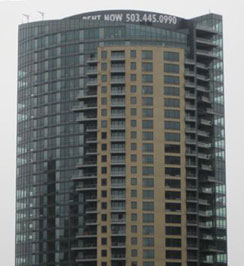
    Photograph: Condominium Conversion to Rentals in Portland (by author).

  • Near-New Seattle Residential High-Rise Faces Demolition

    Seattle’s tony Belltown condo neighborhood hardly needs more bad news. Like many other similar areas in central city cores, the supply of new high rise condominiums has far outstripped the demand. Over the past year, the downtown area condominium market has experienced a median price decline of 35%. Units in at least three downtown buildings have been auctioned off at prices from 30% to 50% below the latest, already discounted prices.

    Yet things have gotten even worse. A 25 story apartment building, only 9 years old, will be demolished due to substandard construction. Owners of the McGuire Apartments (photo on web here), Carpenters Union Local 131 and the Multi-Employer Property Trust issued a letter recently announced saying that “Since the necessary repairs are impractical, the decision … is to dismantle the building.” The letter also indicated that tenants would be assisted in finding new housing.

    A local blogger (Hideous Belltown) has provided a more than one-year long chronicle of the building, since scaffolding was erected, and concluding with two “death-watch” entries.

    The Seattle tower may be the newest and tallest building to ever be demolished, especially in the United States.