Tag: Dallas

  • Migration: Geographies In Conflict

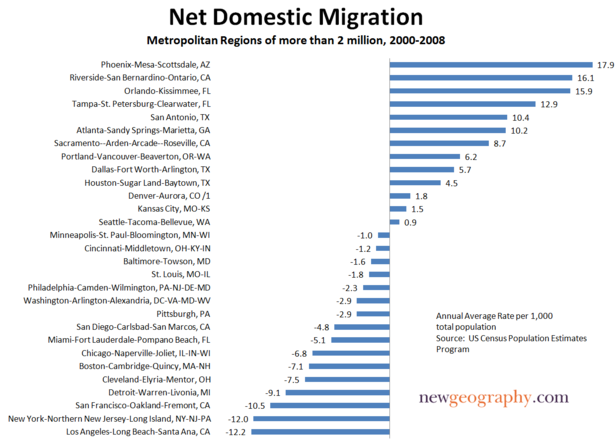
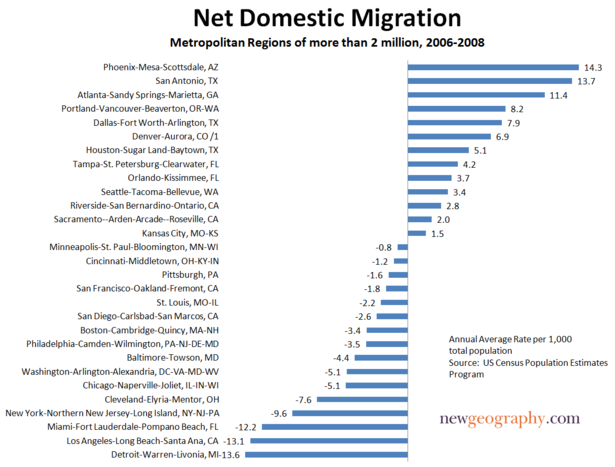
    It’s an interesting puzzle. The “cool cities”, the ones that are supposedly doing the best, the ones with the hottest downtowns, the biggest buzz, leading-edge new companies, smart shops, swank restaurants and hip hotels – the ones that are supposed to be magnets for talent – are often among those with the highest levels of net domestic outmigration. New York City, Los Angeles, San Francisco, Boston, Miami and Chicago – all were big losers in the 2000s. Seattle, Denver, and Minneapolis more or less broke even. Portland is the only proverbially cool city with a regional population over two million that gained any significant number of migrants.

    Those who find this an occasion for a schadenfreude moment attribute it to tax and regulatory climates. Clearly, things like cost of doing business are clearly very important. And indeed this is often under-rated by cool city proponents. And other things equal, people do prefer low tax jurisdictions. Still, is this the only answer, or is there another explanation? Could it be that rather than high costs driving migration, both costs and migration are being driven by other underlying factors?

    Perhaps the root problem is structural change in the economy in the age of globalization. As business became more globalized and more virtualized, this created demand for new types of financial products and producer services – notably in the law, accounting, consultancy, and marketing areas – to help businesses service and control their far flung networks. Unlike many activities, financial and producer services are subject to clustering economics, and have ended up concentrated in a relatively small number of cities around the world.

    These so-called “global cities” serve as control nodes for various global networks and key production sites for these services, along with other specialized niches they long had. In effect, more distributed economic activities requires increasing centralization of select functions, particularly the most highly value-added functions. Yet these activities are not set in stone; for example, areas that were once centers for global business, like Cleveland or Detroit, are fading; others like Houston and Dallas are rising.

    Yet unlike the Texas cities, which retain a strong middle-class and middle-echelon economy, many of the more elite, established urban centers – for example New York and London – increasingly create parallel economies and labor markets in those cities. These cities now generally contain two kinds of people and firms: those who are part of the global city functions and those who are not. Those who are engaged in global city functions operate in a world of very high value-added activities; specialized, niche skill markets; and rising demand conditions. Those skills are not readily acquired outside of global cities. Often, they are sub-specialized to particular places as different global cities specialize in different niches.

    In many cases, these functions have not yet migrated to India or China or often even another global city. This tends to inflate salaries significantly for these specialized, niche skill jobs.

    On the other hand, many people who once thrived in these cities have not benefited from these economic forces. They often are in occupations where labor arbitrage is feasible, and their jobs can either be off-shored, or readily transferred to lower cost locales in the US. This includes manufacturing work, but also important but less specialized white collar occupations like basic accounting, loan officers, corporate IT, and HR. In short, the routine side of the traditional monolithic corporate headquarters and services firm.

    In effect, in these global cities, two economic geographies share the same physical geography – and those economic geographies are in conflict. One set requires catering to high skill, highly paid workers and firms where cost is a secondary concern. The other involves occupations and industries where cost is very much a concern. The occupants of these two geographies have very different public policy priorities. Which of them will win out?

    In a global city, particularly a mature and expensive one, the elite geography wins. It is generating the most money, and with money comes power and influence. Additionally, the high wage workers in these industries are simply able to pay more for real estate and other items. Their mere paychecks are driving up costs in the city they live in. They are re-ordering the city in their own high income image, aided and abetted by a speculative financial fueled housing bubble.

    The prestige of these industries burnishes the civic brand, making them attractive to civic boosters. What’s more, leaders in global cities feel that these are their businesses of their future. For them the attractiveness of concentrating in areas where you think you can create a “wide moat” advantage makes sense.

    This is why cities like Portland, Minneapolis, Denver, and Seattle haven’t fared nearly so badly – they aren’t really full metal global cities and thus, while not always cheap, have remained relatively affordable versus places like San Francisco and New York.

    At the same time it is not easy for these more expensive cities to adopt a low tax, low cost approach. For many reasons, places like San Francisco, New York, and London will never, no matter what they do, be able to match Atlanta, Houston, or Dallas, or even Chicago in a war on costs. That would be a suicide mission. Their logical strategy is to follow the law of comparative advantage, and specialize where you have the best competitive position in the market, and that’s global city functions.

    Many other cities have followed this strategy, but with differing success. Fearing to end up like the next Michigan and Detroit pair, many states and cities have invested heavily to build up urban amenities to cater to the global city firms and their workers: transit systems, showplace public buildings, art and culture events, bike lanes, and beautification. Cost fell by the wayside as a concern, as did investments in priorities of the traditional middle class.

    This explains why, for example, not only have taxes gone up, but things like schools and other basic services have declined so badly in places like California. Traditional primary and secondary education is not important to industries where California is betting its future. Silicon Valley, Hollywood, and biotech draw their workers from the best and brightest of the world. They source globally, not locally. Their labor force is largely educated elsewhere. Basic education and investments in poorer neighborhoods has no ROI for those industries. With the decline of high tech manufacturing in Silicon Valley, even previously critical institutions such as community colleges are no longer as needed.

    The same goes for growth and sprawl. They are playing a game of quality over quantity. They specialize in elite urban areas and elite suburbs or exurbs. For example, San Francisco also has Marin, Palo Alto and Los Altos Hills. New York has, in addition to Manhattan, Greenwich and northern Westchester. The only thing they need size for is sheer scale in certain urban functions, and they already have it. Growth is unnecessary for them and only brings problems.

    It also explains the highly pro-immigration stance of these cities, as a large service class is needed for globalization’s new aristocrats. Immigrants are needed as low cost labor in the burgeoning restaurant and hotel business. In America’s global cities immigrant housekeepers, landscapers, and nannies are common. They may not dress like His Lordship’s butler, but that doesn’t make them any less servants.

    Lastly, it explains why we have seen the same polarizing class pattern so consistently despite broad geographic and socio-political differences between places like Los Angeles, Boston, and Chicago, to say nothing of overseas locales like London. A common global phenomenon probably has a common underlying cause.

    The traditional middle class, feeling the squeeze, is simply moving to where its own kind is king and its own priorities are catered to. In a battle of conflicting economic geographies, the one with higher value added wins, displacing others in what Jane Jacobs termed the “self-destruction of diversity”. First, an attractive environment draws diverse uses, then one becomes economically dominant and, through superior purchasing power, displaces other uses over time. The story ends when that dominant economic activity exhausts itself – the true danger facing global cities, though fortunately they are generally not dependent on just one small niche. It’s basic comparative advantage.

    If you are just an average middle class guy, why live in one of those global cities anyway? Unless you have roots there that you value, take advantage of something you can’t get anywhere else such as by having a passion for world class opera, or are one of globalization’s courtiers – a hanger on like a high end chef, artist, or indie rocker, perhaps – why put up with the high cost and hassles? It makes no sense. You’re better off living in suburban Cincinnati than suburban Chicago.

    And frankly, the folks on the global city side prefer it if you leave anyway. Immigrants are unlikely to start trouble, but a middle class facing an economic squeeze and threat to its way of life might raise a ruckus. That won’t happen if enough of them move to Dallas and rob the rest of critical mass and resulting political clout.

    Many of those leaving are college educated, especially, when they get older, get married, and start having families. A relatively large number of these people could be replaced by a smaller number of elite bankers, biotech PhDs, and celebrity chefs. In that case, both “narratives” could hold simultaneously. One type of talent moves in, while a greater number of a different kind moves out. As with trade generally, this could even be viewed as a win-win in some regard.

    Again, it is easy to blame the costs and public policy. Clearly there is room for improvement in governance such as reigning in out of control civil service pay and pensions in places like California and New York. But what is more pernicious is the rising income gap in America, and the likely outcomes it drives when a city acquires a small elite economic class with incomes that far outstrip the average, and lacks strong economic linkages to the rest of the city other than for personal services. It sets in motion economic logic that undermines the traditional middle class, which then starts leaving, exacerbating the gap.

    For years we worried that a large, stable middle class with a permanent, largely minority underclass constituted an unjust order. As it turns out, the alternatives are sometimes worse. Ultimately some American cities have come to take on the cast of their third world brethren, a perhaps somewhat less extreme version of Mexico City or São Paulo, where vast wealth and glitter exist side by side with the favelas.

    This explains why America’s global cities often feel more kinship with their international peers than with many of the places in their own country. The global cities, which now enjoy something of a political ascendency, are also sundering the American commonwealth. Taking steps to prevent a further widening of the income gap may be the only way to save these cities’ middle class – and maintain the solidarity of the country.

    Aaron M. Renn is an independent writer on urban affairs based in the Midwest. His writings appear at The Urbanophile.
  • Numbers Don’t Support Migration Exodus to “Cool Cities”

    For the past decade a large coterie of pundits, prognosticators and their media camp followers have insisted that growth in America would be concentrated in places hip and cool, largely the bluish regions of the country.

    Since the onset of the recession, which has hit many once-thriving Sun Belt hot spots, this chorus has grown bolder. The Wall Street Journal, for example, recently identified the “Next Youth-Magnet Cities” as drawn from the old “hip and cool” collection of yore: Seattle, Portland, Washington, New York and Austin, Texas.

    It’s not just the young who will flock to the blue meccas, but money and business as well, according to the narrative. The future, the Atlantic assured its readers, did not belong to the rubes in the suburbs or Sun Belt, but to high-density, high-end places like New York, San Francisco and Boston.

    This narrative, which has not changed much over the past decade, is misleading and largely misstated. Net migration, both before and after the Great Recession, according to analysis by the Praxis Strategy Group, has continued to be strongest to the predominately red states of the South and Intermountain West.

    This seems true even for those seeking high-end jobs. Between 2006 and 2008, the metropolitan areas that enjoyed the fastest percentage shift toward educated and professional workers and industries included nominally “unhip” places like Indianapolis, Charlotte, N.C., Memphis, Tenn., Salt Lake City, Jacksonville, Fla., Tampa, Fla., and Kansas City, Mo.

    The overall migration numbers are even more revealing. As was the case for much of the past decade, the biggest gainers continue to include cities such as San Antonio, Dallas and Houston. Rather than being oases for migrants, some oft-cited magnets such as New York, Boston, Los Angeles and Chicago have all suffered considerable loss of population to other regions over the past year.

    Much the same pattern emerges when you look at longer-term state demographic patterns. A recent survey by the Empire Center for New York State Policy found that the biggest net losers in terms of per capita outmigration between 2000 and 2008 were, with the exception of Louisiana, all blue state bastions. New York residents lead in terms of rate of exodus, closely followed by the District of Columbia, Michigan, Pennsylvania, Massachusetts and California.

    An even greater shock to the sensibilities of the insular, Manhattan-centric media, the report found that most of the movement from the Empire State was not from the much-dissed suburbia, but from that hip and cool paragon, New York City. This can not be ascribed as a loss of the unwanted: According to the report, those leaving the city had 13% higher incomes than those coming in.

    How can this be, when everyone who’s smart and hip is headed to the Big Apple? This question was addressed in a report by the center-left, New York-based Center for an Urban Future. True, considerable numbers of young, educated people come to New York, but it turns out that many of them leave for the suburbs or other states as they reach their peak earning years.

    Indeed, it’s astonishing given the many clear improvements in New York that more residents left the five boroughs for other locales in 2006, the peak of the last boom, than in 1993, when the city was in demonstrably worse shape. In 2006, the city had a net loss of 153,828 residents through domestic out-migration, compared to a decline of 141,047 in 1993, with every borough except Brooklyn experiencing a higher number of out-migrants in 2006.

    Of course, blue state boosters can point out that the exodus has slowed with the recession, as opportunities have dried up elsewhere. True, the flood of migration has slowed across the nation. Yet it has only slowed, not dried up. When the economy revives, it’s likely to start flowing heavily again.

    More important, the key group leaving New York and other so-called “youth-magnets” comprises the middle class, particularly families, critical to any long-term urban revival. This year’s Census shows that the number of single households in New York has reached record levels; in Manhattan, more than half of all households are singles. And the Urban Future report’s analysis found that even well-heeled Manhattanites with children tend to leave once they reach the age of 5 or above.

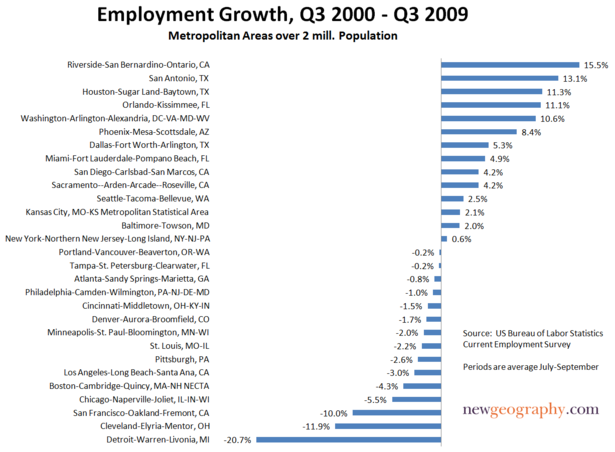
    The key factor here may well be economic opportunity. Virtually all the supposedly top-ranked cities cited in this media narrative have suffered below-average job growth throughout the decade. Some, like Portland and New York, have added almost no new jobs; others like San Francisco, Boston and Chicago have actually lost positions over the past decade.

    In contrast, even after the current doldrums, San Antonio, Orlando, Houston, Dallas and Phoenix all boast at least 5% more jobs now than a decade ago. Among the large-narrative magnet regions only one–government-bloated greater Washington–has enjoyed strong employment growth.

    The impact of job growth on the middle class has been profound. New York City, for example, has the smallest share of middle-income families in the nation, according to a recent Brookings Institution study; its proportion of middle-income neighborhoods was smaller than that of any metropolitan area except Los Angeles.The same pattern has also emerged in what has become widely touted as America’s “model city”–President Obama’s adopted hometown of Chicago.

    The likely reasons behind these troubling trends are things rarely discussed in “the narrative”–concerns like high costs, taxes and regulations making it tough on industries that employ the middle class. One clear culprit: out of control state spending. State spending in New York is second per capita in the nation (anomalous Alaska is first); California stands fourth and New Jersey seventh. Illinois is down the list but coming up fast. Over the past decade, while its population grew by only 7%, Illinois’ spending grew by an inflation-adjusted 39%.

    The problem here is more than just too-large government; it lies in how states spend their money. Massive public spending increases over the past decade in California, New Jersey, Illinois and New York have gone overwhelmingly into the pockets and pensions of public employees. It certainly has not flowed into such basic infrastructure as roads, bridges and ports that are needed to keep key industries competitive.

    The American Association of State Highway Transportation, for example, ranked New York 43rd in the country and New Jersey dead last in terms of quality of roads. Some 46% of the Garden State’s roads were rated in poor condition, compared with the national average of 13%, even as the state’s spending reached new highs. The typical New Jersey driver spends almost $600 a year in auto repairs necessitated by the poor conditions of the roads.

    In contrast, states in the South and parts of the Plains tend to pour their public resources into productive uses. Cities like Mobile, Ala., Houston, Charleston, S.C., and Savannah, Ga., have been investing in port facilities to take advantage of the planned widening of the Panama Canal. The primary goal is to take business away from the increasingly expensive, overregulated and under-invested ports of the Northeast and West Coast. Similarly, places like Kansas City and the Dakotas are looking to boost their basic rail and road networks to support export-heavy industries.

    Even in the face of the Obama administration’s strongly urban-centric, blue state-oriented economic policy, these generally less than hip places appear poised to grow as the economy recovers. Virtually all the top 10 economies that have withstood the recession come from outside the “youth-magnet” field: San Antonio; Oklahoma City; Little Rock, Ark.; Dallas, Baton Rouge, La.; Tulsa, Okla., Omaha, Neb.; Houston and El Paso, Texas. The one exception to this rule, Austin, also benefits from being located in solvent, generally low-tax Texas.

    This continued erosion of jobs and the middle class from the blue states and cities is not inevitable. Many of these places enjoy enormous assets in terms of universities, strategic location, concentrations of talented workers and entrenched high-wage industries. But short of a massive and continuing bailout from Washington, the only way to reverse their decline will be a thorough reformation of their governmental structure and policies. No narrative, no matter how well spun, can make up for that reality.

    This article originally appeared at Forbes.com.

    Joel Kotkin is executive editor of NewGeography.com and is a distinguished presidential fellow in urban futures at Chapman University. He is author of The City: A Global History. His next book, The Next Hundred Million: America in 2050, will be published by Penguin Press early next year.

  • The White City

    Among the media, academia and within planning circles, there’s a generally standing answer to the question of what cities are the best, the most progressive and best role models for small and mid-sized cities. The standard list includes Portland, Seattle, Austin, Minneapolis, and Denver. In particular, Portland is held up as a paradigm, with its urban growth boundary, extensive transit system, excellent cycling culture, and a pro-density policy. These cities are frequently contrasted with those of the Rust Belt and South, which are found wanting, often even by locals, as “cool” urban places.

    But look closely at these exemplars and a curious fact emerges. If you take away the dominant Tier One cities like New York, Chicago and Los Angeles you will find that the “progressive” cities aren’t red or blue, but another color entirely: white.

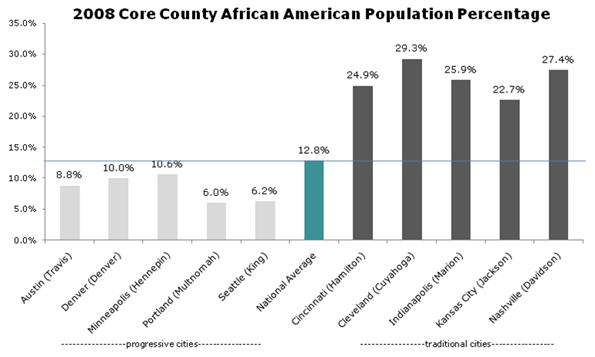
    In fact, not one of these “progressive” cities even reaches the national average for African American percentage population in its core county. Perhaps not progressiveness but whiteness is the defining characteristic of the group.

    The progressive paragon of Portland is the whitest on the list, with an African American population less than half the national average. It is America’s ultimate White City. The contrast with other, supposedly less advanced cities is stark.

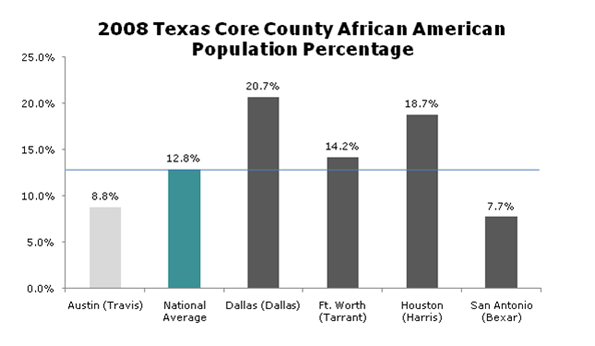
    It is not just a regional thing, either. Even look just within the state of Texas, where Austin is held up as a bastion of right thinking urbanism next to sprawlvilles like Dallas-Ft. Worth and Houston.

    Again, we see that Austin is far whiter than either Dallas-Ft. Worth or Houston.

    This raises troubling questions about these cities. Why is it that progressivism in smaller metros is so often associated with low numbers of African Americans? Can you have a progressive city properly so-called with only a disproportionate handful of African Americans in it? In addition, why has no one called these cities on it?

    As the college educated flock to these progressive El Dorados, many factors are cited as reasons: transit systems, density, bike lanes, walkable communities, robust art and cultural scenes. But another way to look at it is simply as White Flight writ large. Why move to the suburbs of your stodgy Midwest city to escape African Americans and get criticized for it when you can move to Portland and actually be praised as progressive, urban and hip? Many of the policies of Portland are not that dissimilar from those of upscale suburbs in their effects. Urban growth boundaries and other mechanisms raise land prices and render housing less affordable exactly the same as large lot zoning and building codes that mandate brick and other expensive materials do. They both contribute to reducing housing affordability for historically disadvantaged communities. Just like the most exclusive suburbs.

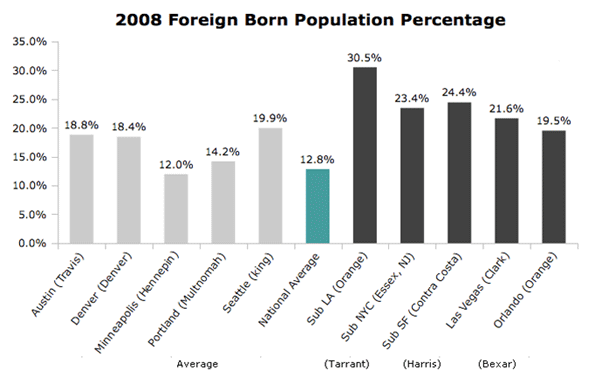
    This lack of racial diversity helps explain why urban boosters focus increasingly on international immigration as a diversity measure. Minneapolis, Portland and Austin do have more foreign born than African Americans, and do better than Rust Belt cities on that metric, but that’s a low hurdle to jump. They lack the diversity of a Miami, Houston, Los Angeles or a host of other unheralded towns from the Texas border to Las Vegas and Orlando. They even have far fewer foreign born residents than many suburban counties of America’s major cities.

    The relative lack of diversity in places like Portland raises some tough questions the perennially PC urban boosters might not want to answer. For example, how can a city define itself as diverse or progressive while lacking in African Americans, the traditional sine qua non of diversity, and often in immigrants as well?

    Imagine a large corporation with a workforce whose African American percentage far lagged its industry peers, sans any apparent concern, and without a credible action plan to remediate it. Would such a corporation be viewed as a progressive firm and employer? The answer is obvious. Yet the same situation in major cities yields a different answer. Curious.

    In fact, lack of ethnic diversity may have much to do with what allows these places to be “progressive”. It’s easy to have Scandinavian policies if you have Scandinavian demographics. Minneapolis-St. Paul, of course, is notable in its Scandinavian heritage; Seattle and Portland received much of their initial migrants from the northern tier of America, which has always been heavily Germanic and Scandinavian.

    In comparison to the great cities of the Rust Belt, the Northeast, California and Texas, these cities have relatively homogenous populations. Lack of diversity in culture makes it far easier to implement “progressive” policies that cater to populations with similar values; much the same can be seen in such celebrated urban model cultures in the Netherlands and Scandinavia. Their relative wealth also leads to a natural adoption of the default strategy of the upscale suburb: the nicest stuff for the people with the most money. It is much more difficult when you have more racially and economically diverse populations with different needs, interests, and desires to reconcile.

    In contrast, the starker part of racial history in America has been one of the defining elements of the history of the cities of the Northeast, Midwest, and South. Slavery and Jim Crow led to the Great Migration to the industrial North, which broke the old ethnic machine urban consensus there. Civil rights struggles, fair housing, affirmative action, school integration and busing, riots, red lining, block busting, public housing, the emergence of black political leaders – especially mayors – prompted white flight and the associated disinvestment, leading to the decline of urban schools and neighborhoods.

    There’s a long, depressing history here.

    In Texas, California, and south Florida a somewhat similar, if less stark, pattern has occurred with largely Latino immigration. This can be seen in the evolution of Miami, Los Angeles, and increasingly Houston, San Antonio and Dallas. Just like African-Americans, Latino immigrants also are disproportionately poor and often have different site priorities and sensibilities than upscale whites.

    This may explain why most of the smaller cities of the Midwest and South have not proven amenable to replicating the policies of Portland. Most Midwest advocates of, for example, rail transit, have tried to simply transplant the Portland solution to their city without thinking about the local context in terms of system goals and design, and how to sell it. Civic leaders in city after city duly make their pilgrimage to Denver or Portland to check out shiny new transit systems, but the resulting videos of smiling yuppies and happy hipsters are not likely to impress anyone over at the local NAACP or in the barrios.

    We are seeing this script played out in Cincinnati presently, where an odd coalition of African Americans and anti-tax Republicans has formed to try to stop a streetcar system. Streetcar advocates imported Portland’s solution and arguments to Cincinnati without thinking hard enough to make the case for how it would benefit the whole community.

    That’s not to let these other cities off the hook. Most of them have let their urban cores decay. Almost without exception, they have done nothing to engage with their African American populations. If people really believe what they say about diversity being a source of strength, why not act like it? I believe that cities that start taking their African American and other minority communities seriously, seeing them as a pillar of civic growth, will reap big dividends and distinguish themselves in the marketplace.

    This trail has been blazed not by the “progressive” paragons but by places like Atlanta, Dallas and Houston. Atlanta, long known as one of America’s premier African American cities, has boomed to become the capital of the New South. It should come as no surprise that good for African Americans has meant good for whites too. Similarly, Houston took in tens of thousands of mostly poor and overwhelmingly African American refugees from Hurricane Katrina. Houston, a booming metro and emerging world city, rolled out the welcome mat for them – and for Latinos, Asians and other newcomers. They see these people as possessing talent worth having.

    This history and resulting political dynamic could not be more different from what happened in Portland and its “progressive” brethren. These cities have never been black, and may never be predominately Latino. Perhaps they cannot be blamed for this but they certainly should not be self-congratulatory about it or feel superior about the urban policies a lack of diversity has enabled.

    Aaron M. Renn is an independent writer on urban affairs based in the Midwest. His writings appear at The Urbanophile.
  • Eros Triumphs…At Least in Some Places, Mapping Natural Population Increases

    As with other advanced capitalist societies, the US population is aging. About 30 percent of US counties experienced natural decrease – more deaths than births – in the 2000-2007 period.

    Nevertheless, the most exceptional feature of the United States remains its unusually high level of natural increase, and significant degree of population growth. This is often attributed to the high level of immigration, especially from Mexico, illegal as well as legal, and their high fertility. This process is indeed critical, even though most of the migration is in fact legal, and the share from Mexico is not as high as commonly perceived. Also most of the Hispanic population in the United States is native, not immigrant.

    Perhaps a more important feature of US society contributing to a smaller decline in fertility than in most other advanced countries is the extraordinary cultural traditionalism of perhaps half the American population. This is reflected in the so-called “culture wars”: a more educated modernism, pejoratively dubbed as “secular humanist,” versus a more traditional, religion-observing “moral majority.”

    Conservatives campaign against abortion and even contraception, and maintain an amazingly high level of religiosity and skepticism of science, creating a climate favorable to a level of fertility above replacement levels (2.1 per female). The super pro-child Mormon Church alone claims millions of members, and evangelical groups boast even more. This creates a fascinating, future-influencing tension between a younger-growing, more educated population choosing lower fertility on average, and a more traditional population more successful at reproducing themselves!

    Natural increase, then, can be expected in the following kinds of areas. One is heavily Hispanic areas. Those with more recent immigrant stock have higher fertility, but above replacement fertility seems to persist for several generations. Another lies in Native American Indian areas. The explanation here is controversial, but there is perhaps a sense of the need for more children as a reaction to a perceived threat of loss of identity.

    For areas with more vibrant economic growth, attracting and maintaining young workers constitute another focal point for natural increase. These are overwhelmingly urban, even metropolitan. Note that these areas may not have above replacement fertility, but will have natural increase, simply because of the younger age structure of the population.

    Other strong candidates for natural increase include military base areas, because of the prevalence of young families. Likewise Mormon areas, and fundamentalist religion areas, at least where there remain sufficiently young populations.

    Seventy percent of counties had natural increase, differing from counties with natural decrease by higher immigration, much higher levels of urban population, a much younger population, and far higher levels of racial and ethnic minorities, especially Hispanics.

    A little more than half (1193) of counties with natural increase had net domestic out-migration – more people leaving than moving into the county, and of these the majority (702) lost population, while in the other 492 natural increase was greater than the out-migration loss, resulting in population gains. Out migration counties differ from in-migration counties ONLY because of the markedly higher ethnic and racial minority shares, obviously reflecting much weaker economic performances. The population losing counties had especially high African American population shares and were more rural.

    The net in-migration counties (1093) are usefully separated into those in which natural increase exceeded the net in-migration (only 272 counties) and those in which net in-migration was dominant (821). The former had slightly higher minority shares, and were somewhat more urban.

    Geography of Natural Increase

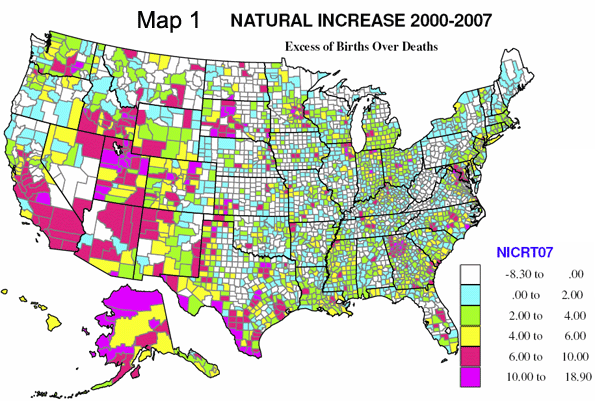
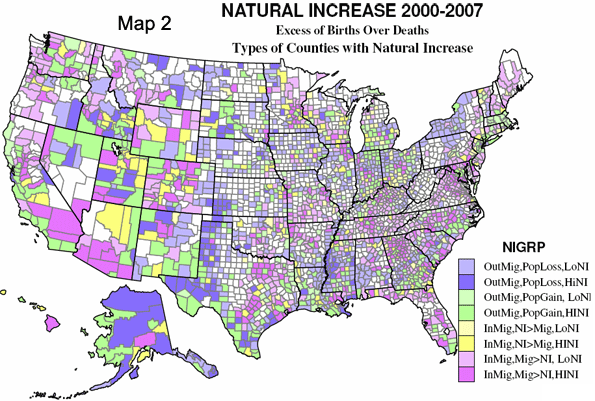
    Figure 1 maps natural increase by five levels, with cooler colors having a small natural increase (here in the simple sense of the excess of births over deaths as a share of the base population), and warm colors indicated high levels of natural increase. Rates of over 10 percent are really startlingly high.

    Natural increase prevails over much of the country, with the exception of much of the Great Plains, from Texas to Canada, and northern Appalachia. High levels of natural increase, over 6 percent (orange and magenta on Map 1) occur in five kinds of areas that are really highly predictable.

    • First, areas of high Hispanic population, mainly from Texas to southern and central California, but also in parts of eastern Washington and southwestern Kansas.
    • Second, Native American Indian reservation areas, most obviously in Alaska, New Mexico, South Dakota, Arizona but also Montana and North Dakota.
    • Third, the Mormon “culture belt,” spreading from the “Zion” of Utah to Idaho, Nevada and Wyoming.
    • Fourth, rapidly growing suburban and exurban counties, most notably around Houston, Dallas, San Antonio, Austin, Atlanta, Washington DC, Chicago, Minneapolis, Charlotte and Denver, and
    • fifth, in counties with military bases, for example, in North Carolina, Georgia, Kansas, Oklahoma and several other states.

    Above average natural increase, from 4 to 6 percent, is typical of many modestly growing metropolitan areas, both central and suburban and exurban counties, and in a scattering of rural-small town counties, especially in the west (western Colorado is notable). Low natural increase, under 2 percent, is very widespread across both urban and rural areas, and is often indicative of slow-growing economies with out-migration (please see Map 2), and in areas moderately attractive to older migrants, thus depressing births, but not enough to cause natural decrease.

    Map 2 sorts counties according to in or out migration, population gain or loss, and the role of natural increase versus net in-migration. Four basic types are mapped, but then divided into high or low natural increase. Rapidly growing counties with net in-migration even greater than high natural increase (dark pink) are especially typical of suburban and exurban counties of large metropolises, and of fast-growing smaller metropolitan areas. Lower natural increase is more common for rural and small town amenity areas, as well as far exurban counties. Natural increase greater than in-migration (yellow) is not very common, and tends to occur in rural-small town counties, including several counties with high Mormon shares. Counties with out-migration but enough natural increase to permit overall population growth (green) are common in three kinds of areas. First are large central metropolitan counties – such as those containing Los Angeles, Houston, Dallas, and Miami – with high non-Hispanic white out-migration, but high Hispanic in-migration. The second type are border region counties with high Mexican in-migration, and the third are Native American Indian areas. Those counties experiencing population loss (purple) are much more like counties with natural decrease: dominantly rural or declining rust belt metropolitan areas.

    Finally, what areas have the highest rates of natural increase? These see increases of 16 to 19 percent from the base population. They are Wade-Hampton, Alaska (west of Bethel); Webb, Texas (Laredo); Utah (Provo); Hidalgo, Texas (McAllen); Loudoun, Virginia (Leesburg, northwest of Washington DC); Starr, Texas (Rio Grande City); and Madison, Idaho (Rexburg). Three are Hispanic, two Mormon, one Alaska native, and one fast growing suburban.

    Natural increase has remained higher than forecast 40 years ago due to far higher immigration, above replacement fertility even among the affluent and educated, and high teenage pregnancy in connection with constraints on abortion – i.e., America’s very high religious traditionalism. The unknowns ahead include the rate of future immigration, whether 2nd and 3rd generation Hispanics will reduce fertility markedly and whether education and modernism will reduce the power of tradition.

    See Richard’s similar piece on natural decreases in US population.

    Richard Morrill is Professor Emeritus of Geography and Environmental Studies, University of Washington. His research interests include: political geography (voting behavior, redistricting, local governance), population/demography/settlement/migration, urban geography and planning, urban transportation (i.e., old fashioned generalist)

  • New Feudalism: Does Home Ownership Have a Future?

    In mid August, as we were beginning to feel a pulse in the nation’s housing market, an academician and housing expert from the University of Pennsylvania named Thomas J. Sugrue wrote an article in the Wall Street Journal proposing that, for many people, the new American Dream should be renting.

    Sugrue is writing a book on the history of real estate in America, a tome I cannot wait to read because it will apparently illustrate how epic events in our nation’s history have shaped and molded our real estate market, hence our lives. He quotes builder William Levitt, considered the father of affordable suburban mass housing, saying “no man who owns his own house and lot can be a Communist.”

    That was said during the Cold War and McCarthy era: Levitt was marketing his wares, playing off the public’s fears like any good salesman. And for many politicians – from Herbert Hoover to Bill Clinton and George W. Bush – expanding ownership of homes remained critical to the nation’s identity.
    But is all this changing? The Obama Administration seems at best ambivalent about homeownership. It seems determined to put more resources into rental housing while promulgating policies that may coerce Americans out of the suburban single family homes and back into dense, multifamily urban housing.

    This would mark a major change in what we usually consider the American dream. Enabling home ownership is like crack cocaine for politicians: the impetus for the Great Recession of 2008 may well have been formed on the day President Bill Clinton launched National Homeownership Day in 1995. And I remember sitting terrified in front of the television post 9/11 when President George W. Bush reassured us that America was strong and would recover. Our housing market is strong, he said, a theme that would echo throughout his presidency. Seeing two by fours go up and mortar flying gave Americans a sense of calm, of rebuilding.

    The attacks of 9/11 almost brought down our economy. The housing market helped prop it up.

    Most of us still love our homes. Sugrue quotes a Pew survey that faintly echoes the national health care debate: nine out of ten homeowners view their homes as a comfort in their lives. He seems to argue we should change everything for ten percent. To be sure, as he suggests, for some home ownership has become a source of panic and despair: 53,000 people packing a Save the Dream fair at Atlanta’s World Congress Center. Georgia’s housing market has been hit hard – 338,411 homes went into foreclosure in May and June, 2009.

    But it’s not just Georgia. Since the second quarter of 2006, housing values across the nation have plummeted to values roughly equivalent to post 9/11. We are not immune even here in Texas, with one of the nation’s strongest large state economies: our prices are soft, down anywhere from five to 20%, and buyers want deals. Go north to Little Elm; you might think you are in Atlanta. Homes may not be selling for thirty cents on the dollar as they are in Phoenix, but a house in the trophy community of University Park listed for $999,000 recently, sold in the mid $800s. The owner of a Preston Hollow mansion not too far from George W. Bush turned down a $38 million dollar offer two years ago, insulted. He recently sold his nine-plus acre property for $28 million.

    And just one week ago I spoke with an Allen, Texas home builder who told me that current tough love lending standards were keeping a lot of people out of the jumbo market – that is, halting them from buying million dollar homes. When you have to put down 30%, he said, that’s $300,000 on a million dollar home. If homes are not appreciating, he said, smart people say, why do we want to tie up that much money in our homestead?

    Yet we have been here before. Half of all U.S. mortgages were in default during The Great Depression, although it’s true far fewer people owned homes. This is when Herbert Hoover and Franklin Roosevelt created government programs to help save homeowners from foreclosure. I remember my grandmother telling me how Mr. Roosevelt saved her home in 1932 – she voted Democratic in every election because of it until the day she died in 1966. In 1938, Fannie Mae was created to buy mortgages on the secondary market, an effort to stimulate credit.

    After World War II, when the government made home loans accessible for thousands of GIs returning from the wars, home ownership rates climbed like the staircases in a suburban colonial. Now more than two-thirds of Americans own their homes.

    The government’s role in shaping this industry has been pretty explicit. Government programs gave us those first FHA loans that got many of us on the housing track, out to the suburbs, allowing people to leave more congested, and often dangerous, inner cities. Government is the hand that keeps the mortgage industry in motion, like a giant conveyor belt of money. But the hand might be pushing us where we shouldn’t go.

    This is certainly true for many in the communities traditionally underserved in the housing market. The government tried to fix this through creation of the Department of Housing and Urban Development, and by pushing Fannie Mae to underwrite loans to “riskier” buyers. The result: in 2006, Sugrue writes, almost 53% of blacks and more than 47% of Hispanics got sub-prime mortgages.

    Those were the loans that were packaged to spread the risk, and sold off as securities. Very lucrative for banks, who always make out like bandits either way, our federal government stood in the background as a silent backer. An appraiser I interviewed recently told me that Fannie Mae will now be ordering appraisals on loans before they buy them.

    You mean, I said, they weren’t doing this before?

    Then there’s the former sub-prime mortgage lender, now turned real estate agent. You, I scolded, how could you approve a school teacher for a loan on a $400,000 house? Shame on you. Well, he told me, if I would have denied her the loan, she could have come back at me for discrimination, or she would have just gone to someone else. So I made the loan and took my commission.

    Yet for all this, I am bullish on home ownership. I think it gives homeowners a sense of security, a blanket of protection that may or may not be a mirage. Economists, who see the world in a “cash nexus”, do not understand this; planners, believing they know a better way, don’t realize that a rental apartment in a dense development does not usually provide our peaceful havens from the cruel world like a single family home or a townhouse that we have a stake in.

    Homeownership may be precarious, but it does provide a greater sense of permanency for families and communities. Home ownership also stimulates the economy. Consumers never buy as much as they do the first few days in a new home – countless trips to Lowes, Home Depot, Bed, Bath & Beyond, the Container Store. A tenant or landlord may buy for their place, but perhaps never with the care and fervor that comes with homeownership. Apartments are built with, at the most, 30 year life spans. I’ve seen enough Section 8 housing to tell you – you don’t want to live in them at the end of their life-cycle. Apartments are considered temporary, places for people who are in transition or not really sure they are going to stay, one reason why they drive higher crime rates.

    Homes are more permanent. Children thrive with structure and feel more secure coming home to a familiar place day after day. Children who live in homes score higher on standardized tests. They may eventually move from one home to another, but will always come back to it and show a friend – that is the house where I grew up.

    Home ownership also forges financial security. Mortgages are like forced savings accounts. Pay your mortgage and in 30 years you’ll have an asset that could cushion your retirement. Either you will own your home outright, or you will have equity to supplement your income when you sell and downsize. The problems came when we started using our homes as slot machines or banks. Home equity lines of credit were illegal in Texas until 1997 as a consumer protection, and the banking industry led the charge to loosen that law with a constitutional amendment. In Texas, the total of all mortgage debt on your home (including HELOCs) is limited to 80% of the home’s fair market value, among other stipulations.

    What we need now is not to move against homeownership but return to more basic fundamentals that seemed to work just fine for 50-plus years. The cost of a house should reflect more of people’s ability to pay. But do we want to be a nation of renters? My bet is no.

    Candace Evans is the Editor of DallasDirt, a Dallas-based real estate blog for D Magazine Media Partners.

  • Tracking Business Services: Best And Worst Cities For High-Paying Jobs

    Media coverage of America’s best jobs usually focuses on blue-collar sectors, like manufacturing, or elite ones, such as finance or technology. But if you’re seeking high-wage employment, your best bet lies in the massive “business and professional services” sector.

    This unsung division of the economy is basically a mirror of any and all productive industry. It includes everything from human resources and administration to technical and scientific positions, as well as accounting, legal and architectural firms.

    Overall there are roughly 17 million professional and business services jobs, 4 million more than manufacturing. This makes it twice as big as the finance sector and five times the size of the much-ballyhooed tech sector. While its average salary – roughly $55,000 a year – is somewhat lower than in those other elite sectors, its wages are still higher than those in all the other large sectors, like health. The sector’s $1 trillion in total pay per year accounts for nearly 20% of all wages paid in the nation; finance and tech together only account for $812 billion.

    More than that, the business and professional services sector has encompassed the fastest-growing part of the high-wage economy. Employment in lower-wage sectors like education has also grown quickly. But employment in other sectors that pay their employees well, such as technology, has remained stagnant; jobs in some, such as manufacturing, have fallen sharply. Critically, the business services sector – particularly at the better-paying end – seems to have weathered the current recession better than these other high-wage sectors.

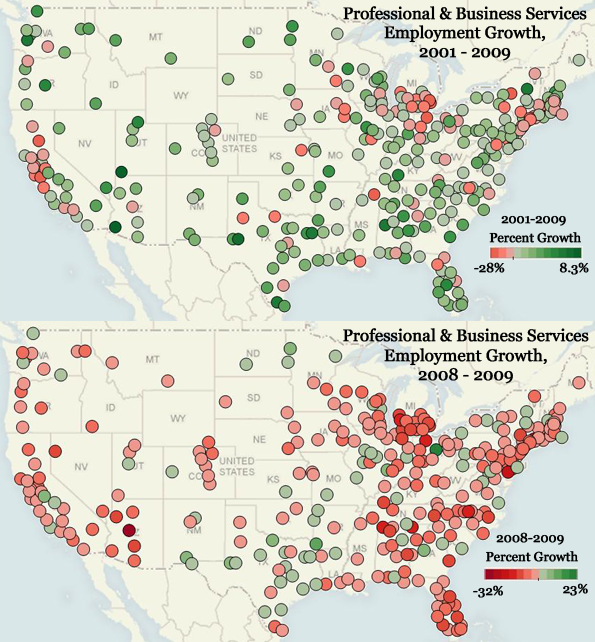
    The crucial question remains: In what regions is this critical economic cog booming? In a new analysis with my colleagues at the Praxis Strategy Group, we examined Bureau of Labor Statistics employment data for this sector, keeping an eye on trends over both the last year and the last decade. Some of the metropolitan areas that boasted short-term growth in this sector also maintained steady employment success over the long-term, which suggests that these particular cities have sturdy economies that aren’t as prone to intense boom-bust cycles.

    At the top of our list of best places is greater Washington, D.C., and its surrounding suburbs in Virginia and Maryland. Government jobs may drive that economy, but it is the lawyers, consultants and technical services firms who harvest the richest benefits. As New York University public policy professor Mitchell Moss observes, Washington has emerged as the “real winner” in the recession – not just for public-sector workers but private-sector ones too.

    Fastest Growing Professional and Business Services Sectors
    Area Name Jobs in Sector 2009
    (thousands)
    Sector Share of Jobs 2009
    (percent of total)
    Growth 2008 – 2009
    (percent growth)
    Cumulative Growth 2001 – 2009
    (percent growth)
    2001-2009 Job Change (thousands) 2008-2009 Job Change (thousands)
    Northern Virginia, VA 355.2 27.2% 1.5% 22.4% 65.0 5.2
    Washington-Arlington-Alexandria, DC-VA-MD-WV 558.7 23.0% 0.9% 22.8% 103.6 5.1
    Austin-Round Rock, TX 112.4 14.4% 3.3% 18.7% 17.7 3.6
    Houston-Sugar Land-Baytown, TX 382.3 14.7% 0.9% 19.2% 61.5 3.2
    Virginia Beach-Norfolk-Newport News, VA-NC 106.6 14.0% 2.8% 8.0% 7.9 2.9
    Bethesda-Frederick-Rockville, MD 125.7 21.9% 2.1% 9.0% 10.4 2.6
    Wichita, KS 31.5 10.1% 3.5% 16.4% 4.4 1.1
    Chattanooga, TN-GA 25.9 10.6% 4.3% 11.8% 2.7 1.1
    Peoria, IL 23.0 12.1% 4.5% 43.2% 6.9 1.0
    Rochester, NY 61.8 11.9% 1.5% 1.9% 1.1 0.9
    Augusta-Richmond County, GA-SC 31.0 14.5% 3.0% 7.5% 2.2 0.9
    Mansfield, OH 5.1 9.1% 19.4% 4.1% 0.2 0.8
    Kennewick-Pasco-Richland, WA 20.8 22.2% 4.2% 20.2% 3.5 0.8
    St. Louis, MO-IL 195.4 14.6% 0.4% 3.9% 7.4 0.8
    Fayetteville-Springdale-Rogers, AR-MO 33.5 16.2% 2.2% 34.2% 8.5 0.7
    Macon, GA 12.1 11.9% 5.5% 31.2% 2.9 0.6
    Pittsburgh, PA 158.9 13.9% 0.4% 14.5% 20.1 0.6
    Fresno, CA 30.7 10.3% 1.9% 23.3% 5.8 0.6
    Provo-Orem, UT 23.3 12.4% 2.5% 16.7% 3.3 0.6
    Charleston-North Charleston-Summerville, SC 42.2 14.3% 1.3% 31.1% 10.0 0.5

    Over the past year, parts of northern Virginia – ground zero for the so-called “beltway bandits” who work in industries the government depends on to do its job – have enjoyed the fastest growth in business and professional services, adding over 5,200 jobs despite the current downturn.

    Other areas around the nation’s capital have also seen strong growth. The Washington D.C.-Arlington-Alexandria area, for example, came in second on our list, gaining nearly 5,100 positions, while No. 6 the Bethesda-Frederick-Rockville, Md., metro area added 2,600. In addition, yet another Virginia area – No. 5-ranked Virginia Beach-Norfolk-Newport News, a center for military-related industries – gained nearly 2,900 jobs in this sector.

    It’s far too early to thank the free-spending ways of Barack Obama’s administration for all this growth. As anyone can tell you, the Bush White House and its Republican Congress were not exactly models of fiscal restraint. Plus, Washington and Northern Virginia have seen growth in their business services sectors over the last several years, in the period stretching from 2001 to 2009. Together those two metros added over 165,000 new jobs in this critical, high-wage sector.

    Of course, you don’t have to head to Washington to find a high-paying job – although you might not be able to escape unpleasant summer weather. The other major group of business-services hot spots includes Austin, Texas, at No. 3, and Houston, at No. 4. These Lone Star local economies have continued to thrive not only during the current recession but also over the last decade.

    The others winners include farther-afield locales in Kansas, Tennessee, Illinois and New York. These areas could be gaining both from companies seeking to lower costs and from the new capabilities for remote work due to the Internet. Even though they didn’t make our list, a host of smaller communities – like Mansfield, Ohio; Provo, Utah; and Charleston, S.C. – also enjoyed significant growth in the business services sector over the past year.

    So if these are the places where this segment of the economy is growing and high-paying jobs are easier to come by, where is the opposite true? The worst cities on our list span three archetypes: Rust Belt basket cases, Sunbelt flame-outs and expensive big cities. Perhaps the toughest losses were in Michigan: Detroit and the Warren-Troy metro area suffered big setbacks both in the last year and over the last decade.

    Fastest Declining Professional and Business Services Sectors
    Area Name Jobs in Sector 2009
    (thousands)
    Sector Share of Jobs 2009
    (percent of total)
    Growth 2008 – 2009
    (percent growth)
    Cumulative Growth 2001 – 2009
    (percent growth)
    2001-2009 Job Change (thousands) 2008-2009 Job Change (thousands)
    Phoenix-Mesa-Scottsdale, AZ 289.2 16.0% -10.8% 7.9% 21.2 -35.1
    Warren-Troy-Farmington Hills, MI 202.5 18.5% -12.0% -21.2% -54.4 -27.7
    Chicago-Naperville-Joliet, IL 633.6 16.8% -4.1% -2.9% -19.0 -27.0
    Los Angeles-Long Beach-Glendale, CA 574.7 14.3% -4.2% -3.4% -20.4 -25.2
    Atlanta-Sandy Springs-Marietta, GA 390.3 16.4% -5.9% -1.3% -5.1 -24.4
    Orlando-Kissimmee, FL 170.9 16.2% -8.5% 7.7% 12.3 -16.0
    Santa Ana-Anaheim-Irvine, CA 261.9 18.0% -4.7% 4.0% 10.2 -12.8
    Minneapolis-St. Paul-Bloomington, MN-WI 253.4 14.4% -4.6% -4.6% -12.2 -12.3
    Edison-New Brunswick, NJ 164.5 16.3% -6.7% -2.6% -4.4 -11.9
    Detroit-Livonia-Dearborn, MI 108.9 14.7% -9.5% -20.9% -28.8 -11.4
    Indianapolis-Carmel, IN 120.3 13.4% -8.3% 13.6% 14.4 -10.8
    Riverside-San Bernardino-Ontario, CA 133.7 11.2% -6.5% 36.0% 35.4 -9.2
    Tampa-St. Petersburg-Clearwater, FL 223.2 18.5% -3.7% 12.3% 24.5 -8.6
    New York City, NY 595.7 15.8% -1.4% -0.8% -5.1 -8.4
    Newark-Union, NJ-PA 163.5 16.0% -4.7% -0.5% -0.8 -8.0
    Bergen-Hudson-Passaic, NJ 130.6 14.6% -5.8% -9.1% -13.0 -8.0
    Milwaukee-Waukesha-West Allis, WI 107.6 12.9% -6.6% -1.7% -1.8 -7.6
    Miami-Miami Beach-Kendall, FL 139.1 13.4% -4.7% 2.2% 3.0 -6.8
    Oakland-Fremont-Hayward, CA 158.0 15.6% -4.0% -7.1% -12.2 -6.7
    Las Vegas-Paradise, NV 108.2 12.1% -5.8% 38.1% 29.9 -6.6
    Boston-Cambridge-Quincy, MA 308.8 18.2% -2.0% -6.8% -22.5 -6.4
    Sacramento–Arden-Arcade–Roseville, CA 106.1 12.3% -5.6% -1.8% -1.9 -6.3
    Cleveland-Elyria-Mentor, OH 137.8 13.3% -4.3% -5.2% -7.6 -6.1
    Denver-Aurora-Broomfield, CO 207.0 16.9% -2.9% 4.0% 8.0 -6.1

    Consistent job losses in business services in these areas – some 54,000 in the Troy area since 2001 – reveal the clear connection between employment in business services and in the region’s fundamental auto industry. It turns out that elite services often prove dependent on basic industry. When industrial plants shut down, it’s not just blue-collar workers and company executives that suffer; as a result, these firms will use fewer lawyers, accountants, architects and technical consultants.

    A similar picture emerges in cities like Phoenix, which lost about 35,000 business-services jobs in just one year. This loss stems from the collapse of the housing bubble, which powered the rest of the regional economy. The same meltdown caused smaller but still significant reversals in one-time boomtowns like Orlando, Fla., Atlanta and Southern California’s Santa Ana region, which encompasses Orange County, where business service employment dropped by double-digit rates over the past year.

    Yet these same areas should see some recovery, perhaps more so than the traditional auto manufacturing-focused towns. Phoenix, Orlando and other Sun Belt locations – including a host of other areas in Florida – all saw increasing employment in business services over the past decade. If the economy comes back, along with a stabilization of the residential real estate market, business-services job growth will likely begin to take off again. After all, the fundamental reasons for the success of these areas, such as warm weather, lower costs and the need to serve a growing population, have not fundamentally changed.

    Perhaps most perplexing is the fate of some of the other places on our worst cities list, particularly the biggest metropolitan areas. The professional and business services sector is widely considered ideal for large, cosmopolitan centers, since lots of industries require support. But Chicago experienced a huge chunk of job losses – almost 25% – in this sector during the last year. Other big cities, including Los Angeles, Minneapolis and New York, also suffered.

    This is not a new phenomenon. These and other big cities, like Boston and San Jose, San Francisco and Oakland in California, have been shedding these types of jobs since 2001. These losses, however, have been concentrated at the lower-wage end of the business service pyramid, in areas like human resources and administration. These are the positions that companies can fill more easily and cheaply using the Internet or by hiring in less expensive outposts.

    That’s why Washington and its environs, which has seen across-the-board business growth, remain the great exception. Many business-services jobs outside the beltway appear to be becoming more nomadic, based in places where firms face lower costs and where workers can afford to live well on middle-income salaries. Even the long-term resiliency of higher-wage employment like law and accounting in traditional business hubs like New York could be at risk over time, with some jobs shifting to less expensive locales or even overseas.

    The changing nature of business services presents a boon to some communities and a challenge to others as they seek to survive and thrive in spite of the current recession. How some cities manage to grow this segment of their economies may well presage which parts of the country will thrive best during the years of recovery – and beyond.

    This article originally appeared at Forbes.

    Joel Kotkin is executive editor of NewGeography.com and is a presidential fellow in urban futures at Chapman University. He is author of The City: A Global History. His next book, The Next Hundred Million: America in 2050, will be published by Penguin early next year.

  • Special Report: Infill in US Urban Areas

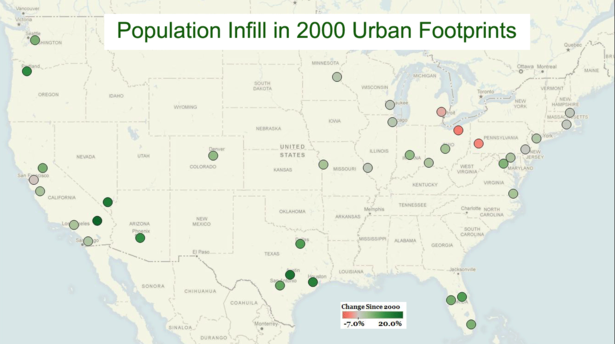
    One of the favored strategies of current urban planning is “infill” development. This is development that occurs within the existing urban footprint, as opposed that taking place on the fringe of the urban footprint (suburbanization). For the first time, the United States Bureau of the Census is producing data that readily reveals infill, as measured by population growth, in the nation’s urban areas.

    2000 Urban Footprint Populations

    The new 2007 estimates relate to urban areas or urban footprints as defined in 2000 and are produced by the American Community Survey program of the Bureau of the Census. Urban areas are the continuous urbanization that one would observe as the lights of a “city” on a clear night from an airplane. It is the extent of development from one side of the urban form to the other. Further, urban areas are not metropolitan areas, which are always larger and are defined by work trip travel patterns. Metropolitan areas always include adjacent rural areas, while urban areas never do.

    The Process of Infill

    Although embraced with often religious passion within the urban planning community, infill is neither good nor bad in terms of social or environmental impact. Infill always increases population densities and that means more traffic. If road capacity is increased sufficiently, traffic congestion can be kept at previous levels. If on the other hand, nothing is done, traffic congestion is likely to increase along with population. This means slower traffic and more stop and go operations, which inevitably increases the intensity of air pollution with the potential to cancel out any reductions in greenhouse gas emissions (GHG) that might occur if average car trip lengths decline. Similar difficulties can occur with respect to other infrastructure systems, such as sewer and water. Expanding roads, sewer and water systems in already developed areas can be far more expensive than new systems on greenfield sites. Regrettably, boosters of infill routinely ignore these issues.

    But infill has been going on for years, along with suburbanization, both in the United States and in other first world nations. This is indicated by the general densification trend that occurred in US urban areas between 1990 and 2000 and the longer term densification trends that occurred in a number of southwestern urban areas, such as Los Angeles, San Jose, Riverside-San Bernardino, Phoenix, Dallas-Fort Worth and Las Vegas. All these traditionally “sprawling” areas have, in fact, been densifying since 1960 or before. Since 2000, 33 of the nation’s 37 urban areas with a population exceeding 1,000,000 population experienced population infill to their 2000 urban footprints.

    Infill in Traditionally Regulated Markets (More Responsive Markets)

    Infill is a natural consequence of the traditional post-World War II land use regulation, which tends towards accommodating both demographic growth and market forces. This has been replaced by more prescriptive (often called “smart growth”) land use regulation in some urban areas. Under traditional regulation, suburban development followed a “leap frog” process, moving ever further out. This is roundly condemned in today’s planning literature and among leading academics and policy makers.

    Leap frog development occurs where urban development skips over empty land and creates a less continuous urban fabric. Land is developed based upon the interplay between sellers and buyers. Due to fewer planning restrictions, no seller can be sure that their land will be purchased since there is always plenty of land that buyers can otherwise purchase. This keeps land prices down. In the more responsive markets, it is typical for land and site infrastructure costs to be 20 percent of the total price land and house price.

    Infill occurs as land that has been “leaped” over is subsequently purchased for development. Again, because buyers have plenty of choices, prices of the infill land remains low, so that land and infrastructure costs remain relatively affordable in relationship to the overall new house purchase price.

    The result is an urban area that is generally continuous, though with a transitional “ragged edge.” The ragged edge enabled the broad expansion of home ownership that occurred in the decades following World War II by keeping house prices low.

    Infill in More Prescriptive Markets (Smart Growth)

    The infill process is quite dramatically different in more prescriptive markets. Infill might be mandated as a percentage of total development or by severely limiting the development allowed to occur closer to the urban fringe. Sellers of land on which development is permitted have disproportionate power to charge higher prices because the planning regime seriously limits the availability of alternative sites for buyers. This, of course, flows through to house prices. The share of land and site infrastructure can rise to two-thirds of the house and land cost. The urban area may have a “clearer” edge, but at a significant loss in housing affordability.

    Infill Trends in the 2000s

    The new infill estimates indicate that American urban areas continue to densify. Between 2000 and 2007, the 33 of the 37 urban areas of more than 1,000,000 population experienced densification in their 2000 urban footprints. The average population infill increase was 5.6 percent (See Table the following table).

    Population Infill in 2000 Urban Footprints
    2000-2007
      Population Change: 2000 Urban Footprint Population Density of 2000 Urban Footprint in 2007  
    Urban Area 2000 Census 2007 Estimate Change % Rank Rank
    Riverside–San Bernardino, CA       1,506,816      1,800,117     293,301 19.5% 1         4,110 8
    Atlanta, GA       3,499,840      4,118,485     618,645 17.7% 2         2,100 36
    Austin, TX         901,920      1,051,962     150,042 16.6% 3         3,308 17
    Las Vegas, NV       1,314,357      1,518,835     204,478 15.6% 4         5,311 5
    Houston, TX       3,822,509      4,370,475     547,966 14.3% 5         3,377 16
    Portland, OR–WA       1,583,138      1,779,705     196,567 12.4% 6         3,755 12
    Phoenix, AZ       2,907,049      3,254,634     347,585 12.0% 7         4,078 9
    Dallas–Fort Worth, TX       4,145,659      4,549,281     403,622 9.7% 8         3,236 18
    Orlando, FL       1,157,431      1,267,976     110,545 9.6% 9         2,799 24
    San Antonio, TX       1,327,554      1,440,794     113,240 8.5% 10         3,540 14
    Tampa–St. Petersburg, FL       2,062,339      2,209,067     146,728 7.1% 11         2,754 25
    Sacramento, CA       1,393,498      1,488,647       95,149 6.8% 12         4,034 10
    Seattle, WA       2,712,205      2,896,844     184,639 6.8% 13         3,040 21
    Miami, FL       4,919,036      5,243,679     324,643 6.6% 14         4,703 6
    Washington, DC–VA–MD       3,933,920      4,174,187     240,267 6.1% 15         3,611 13
    Denver, CO       1,984,887      2,087,803     102,916 5.2% 16         4,192 7
    Indianapolis, IN       1,218,919      1,278,687       59,768 4.9% 17         2,316 34
    Columbus, OH       1,133,193      1,175,132       41,939 3.7% 18         2,960 22
    Kansas City, MO–KS       1,361,744      1,408,900       47,156 3.5% 19         2,413 31
    Virginia Beach, VA       1,394,439      1,442,494       48,055 3.4% 20         2,742 26
    San Jose, CA       1,538,312      1,588,544       50,232 3.3% 21         6,110 2
    Los Angeles, CA     11,789,487    12,171,625     382,138 3.2% 22         7,302 1
    Cincinnati, OH–KY–IN       1,503,262      1,546,730       43,468 2.9% 23         2,305 35
    Baltimore, MD       2,076,354      2,133,371       57,017 2.7% 24         3,128 19
    San Diego, CA       2,674,436      2,747,620       73,184 2.7% 25         3,514 15
    New York, NY–NJ–CT     17,799,861    18,223,567     423,706 2.4% 26         5,440 4
    Minneapolis–St. Paul, MN       2,388,593      2,438,359       49,766 2.1% 27         2,727 27
    Chicago, IL–IN       8,307,904      8,467,804     159,900 1.9% 28         3,992 11
    St. Louis, MO–IL       2,077,662      2,103,040       25,378 1.2% 29         2,540 30
    Milwaukee, WI       1,308,913      1,324,365       15,452 1.2% 30         2,719 28
    Boston, MA–NH–RI       4,032,484      4,077,659       45,175 1.1% 31         2,350 33
    Providence, RI–MA       1,174,548      1,183,622        9,074 0.8% 32         2,353 32
    Philadelphia, PA–NJ–DE–MD       5,149,079      5,178,918       29,839 0.6% 33         2,880 23
    San Francisco, CA       3,228,605      3,214,137      (14,468) -0.4% 34         6,099 3
    Detroit, MI       3,903,377      3,831,575      (71,802) -1.8% 35         3,041 20
    Pittsburgh, PA       1,753,136      1,687,509      (65,627) -3.7% 36         1,981 37
    Cleveland, OH       1,786,647      1,705,917      (80,730) -4.5% 37         2,641 29
    Total  116,773,113  122,182,066  5,408,953 5.6%
    Data from US Bureau of the Census

    Riverside-San Bernardino, long castigated as a “sprawl” market, had the largest population infill, at 19.5 percent. Atlanta ranked number two, at 17.7 percent. This is a real surprise, since Atlanta was the least dense major urban area in the world in 2000, ranked second in 2000s infill. As a result, it is likely that Pittsburgh- often held up as a model of urban regeneration – is now the world’s least dense major urban area. On the other hand, if Atlanta’s infill rate continues, its 2000 urban footprint will be more dense than that of Boston by 2015.

    Austin ranked third, adding 16.6 percent population to its 2000 urban footprint. Las Vegas ranked fourth, with a 15.6 percent increase in its 2000 urban footprint. The density of Las Vegas is increasing so rapidly that by the 2010 census its 2000 urban footprint will be more dense than the 2000 New York urban footprint, should the current rates continue.

    Perhaps most surprising of all is that Houston ranked fifth, added 14.3 percent to its 2000 urban footprint. This may surprise those who have denounced Houston’s largely deregulated regulatory environment, both in the city and in unincorporated county areas in the suburbs. Yet overall Houston’s infill exceeded that of smart growth model Portland. The Rose City stood at sixth, adding 12.4 percent to its 2000 urban footprint.

    Perhaps equally surprising, Portland remains less dense than average for a western urban area. Its 2000 urban footprint density trailing Los Angeles, San Jose, San Francisco, Las Vegas, Denver, Riverside-San Bernardino, Phoenix and Sacramento, while leading only San Diego and Seattle.

    The top ten were rounded out by Phoenix (7th), Dallas-Fort Worth (8th), Orlando (9th) and San Antonio (10th). It is worth noting that like Houston, the unincorporated suburbs of Austin, Dallas-Fort Worth and San Antonio have largely deregulated land use regulation, yet these urban areas ranked high in infill.

    Interestingly some of the greatest infill growth also took place in the fastest growing, traditionally “sprawling” cities. Atlanta also had the largest numeric increase in the population of its 2000 urban footprint, at more than 600,000. Houston was a close second, at nearly 550,000.

    In contrast, population losses since 2000 in the urban footprints of Cleveland, Pittsburgh, Detroit and San Francisco, means these urban areas experienced no population infill. San Francisco’s loss enabled San Jose to move into second position nationally after Los Angeles in the population density of its 2000 urban footprint.

    How the Core Cities Fared

    The core cities (municipalities) attracted, on average, their population share. Approximately 30 percent of the infill growth occurred inside the core cities. Even this figure may be a bit high, due to the impacts of annexation

    All of the infill in Philadelphia, Baltimore, Chicago, Providence and Minneapolis-St. Paul occurred outside the core cities. The city of Portland attracted barely 10 percent of its urban area infill, despite highly publicized (and subsidized) infill projects such as the Pearl District. Core cities attracted the largest share of infill growth in such diverse cities as San Antonio, San Jose, Columbus, Phoenix and New York.

    Note: Additional information available at http://www.demographia.com/db-uzafoot2007.pdf

    Wendell Cox is a Visiting Professor, Conservatoire National des Arts et Metiers, Paris. He was born in Los Angeles and was appointed to three terms on the Los Angeles County Transportation Commission by Mayor Tom Bradley. He is the author of “War on the Dream: How Anti-Sprawl Policy Threatens the Quality of Life.

  • America’s Four Great Growth Waves and the World Cities They Produced

    There have been four great growth waves in American history. In each case, there was an attractive new frontier, which not only drew migrating waves of people seeking new opportunity, but also developed large new bases of industry, wealth, and power. These waves have also created top-tier world cities in their wake. The first three of these waves were:

    1. The Boston, New York, Philadelphia, Baltimore, Washington DC corridor was America’s original land of opportunity, industry, wealth, and power. New York was the big winner, and DC and Boston still do quite well.
    2. The rise of the agricultural and industrial Midwest, including Chicago, Detroit, Pittsburgh, Cleveland, and St. Louis. The fall here has been a hard one as manufacturing moved abroad, but Chicago still stands as a world-class city produced during the region’s heyday.
    3. The great westward migration, mostly focused on California, but with ancillary growth in adjacent and west coast states. This migration started well before World War 2, but really took off after the war, and produced two top-tier mega-metros – Los Angeles and the San Francisco Bay Area – and several successful second-tiers like Seattle, San Diego, Las Vegas, and Phoenix.

    These waves are not clearly distinct, but overlap each other. As one region matures and starts to level off, the next region starts its growth wave. And that’s the situation now as California shows clear signs of having peaked: gigantic tech and housing crashes plus economic and domestic outmigration as tax, cost-of-living, housing, and regulatory burdens rise and a dysfunctional government teeters towards financial collapse.

    The fourth wave is increasingly clear and follows the same California model of a single focus mega-state and an ancillary region: Texas and the new South.

    Just as California had its pre-war growth surge, Texas had its first real growth waves with the 20th-century post-Spindletop oil boom. California had the dust bowl migration of the 30s, and Texas the oil boom migration of the 70s. But the real super-surge has become clearer in the new century as California hands off the baton to Texas. This growth wave really covers much of the South, but Texas is the 800lb gorilla vs. states like Georgia and North Carolina, just as California dominates over Washington, Nevada, and Arizona. Texas even looms over Florida, which certainly has experienced incredible population growth to become the fourth-largest state, but has had considerably less success with building industry, wealth, and power. Florida’s wealth – like that of Arizona – comes in part from people who built wealth elsewhere but moved or bought a second home there. Neither place is home to many Fortune 500 headquarters, an area where Texas has excelled.

    California had its agriculture and oil barons before WW2, but the real story there was the post-war rise of the entertainment, defense, aerospace, biotech, trade and technology industries. In a similar way, Texas’ oil tycoons are just the tip of the coming surge of wealth and power in industries such as technology, health care, biotech, defense, trade, transportation, aerospace, finance, telecom, and alternative energy in addition to traditional oil and gas (in fact, Texas is the #1 wind power state).

    The great cities emerging from this new wave are Atlanta, Dallas-Ft.Worth, and Houston. They dominate the census growth stats (Houston story), and all indications are that Houston will pass Philadelphia in the 2010 census to join Dallas-Ft.Worth in the top 5 metros along with New York, Los Angeles, and Chicago. DFW and Houston are even approaching the combined San Francisco Bay Area population of 6.1 million, and Texas passed California and New York for the #1 ranking in the Fortune 500 HQ rankings last year.

    Want more evidence? Check out this impressive video on the DFW-Austin-San Antonio-Houston Texas Triangle with an overwhelming list of statistics that make the case. In the video, they refer to the region as the 18m-strong “Texaplex” – a play on the “Metroplex” nickname for Dallas-Ft. Worth. You can also see their Texaplex informational brochure here (pdf).

    When you look at it in this historical context, it’s clear Texas and the new South will be the focal point of America’s growth for at least the next few decades. History also says at least one, and possibly more, truly top-tier world cities will emerge from this wave – and it could be argued that some have already. It’s easy to get caught up in the day-to-day hubub and crisis-of-the-moment, but take a minute to stand back and see the big picture. Those living in or moving to Texas and the new South are part of a great historical wave that’s just starting to really take off, the same as being in Chicago at the turn of the 19th-century or in California after WW2. Pretty cool, eh?

    Tory Gattis is a Social Systems Architect, consultant and entrepreneur with a genuine love of his hometown Houston and its people. He covers a wide range of Houston topics at Houston Strategies – including transportation, transit, quality-of-life, city identity, and development and land-use regulations – and have published numerous Houston Chronicle op-eds on these topics.

  • Where are the Best Cities for Job Growth?

    Over the past five years, Michael Shires, associate professor in public policy at Pepperdine University, and I have been compiling a list of the best places to do business. The list, based on job growth in regions across the U.S. over the long, middle and short term, has changed over the years–but the employment landscape has never looked like this.

    In past iterations, we saw many fast-growing economies–some adding jobs at annual rates of 3% to 5%. Meanwhile, some grew more slowly, and others actually lost jobs. This year, however, you can barely find a fast-growing economy anywhere in this vast, diverse country. In 2008, 2% growth made a city a veritable boom town, and anything approaching 1% growth is, oddly, better than merely respectable.

    So this year perhaps we should call the rankings not the “best” places for jobs, but the “least worst.” But the least worst economies in America today largely mirror those that topped the list last year, even if these regions have recently experienced less growth than in prior years. Our No.1-ranked big city, Austin, for example, enjoyed growth of 1% in 2008–less than a third of its average since 2003.

    The study is based on job growth in 333 regions–called Metropolitan Statistical Areas by the Bureau of Labor Statistics, which provided the data–across the U.S. Our analysis looked not only at job growth in the last year but also at how employment figures have changed since 1996. This is because we are wary of overemphasizing recent data and strive to give a more complete picture of the potential a region has for job-seekers. (For the complete methodology, click here.)

    The top of the complete ranking–which, for ease, we have broken down into the two smaller lists, of the best big and small cities for jobs–is dominated by one state: Texas. The Lone Star State may have lost a powerful advocate in Washington, but it’s home to a remarkable eight of the top 20 cities on our list–including No. 1-ranked Odessa, a small city in the state’s northwestern region. Further, the top five large metropolitan areas for job growth–Austin, Houston, San Antonio, Ft. Worth and Dallas–are all in Texas’ “urban triangle.”

    The reasons for the state’s relative success are varied. A healthy energy industry is certainly one cause. Many Texas high-fliers, including Odessa, Longview, Dallas and Houston, are home to energy companies that employ hordes of people–and usually at fairly high salaries for both blue- and white-collar workers. In some places, these spurts represent a huge reversal from the late 1990s. Take Odessa’s remarkable 5.5% job growth in 2008, which followed a period of growth well under 1% from 1998 to 2002.

    Of course, not all the nation’s energy jobs are located in Texas, even if the state does play host to most of our major oil companies. The surge in energy prices in 2007 also boosted the performance of several other top-ranked locales such as Grand Junction, Colo., Houma-Bayou Cane-Thibodoux, La., Tulsa, Okla., Lafayette, La., and Bismarck, N.D.

    Looking at the energy sector’s hotbeds, however, doesn’t tell the whole story. Another major factor behind a city’s job offerings is how severely it experienced the housing crisis. There’s a “zone of sanity” across the middle of the country, including Kansas City, Mo., that largely avoided the real estate bubble and the subsequent foreclosure crisis.

    Still other factors correlating with job growth–as evidenced by Shires‘ and my current and past studies–are lower costs and taxes. For example, the area around Kennewick, Wash., is far less expensive than coastal communities in that same state, and residents and businesses there also enjoy cheap hydroelectric power. Compared with high-tech centers in California and the Northeast, such as San José and Boston, places like Austin offer both tax and housing-cost bargains, as do Fargo, N.D. and Durham-Chapel Hill, N.C.

    College towns also did well on our list, particularly those in states that are both less expensive and outside the Great Lakes. Although universities–and their endowments–are feeling the recession’s pinch, they continue to attract students. In fact, colleges saw a bumper crop of applicants this year, as members of the huge millennial generation, encompassing those born after 1983, reach that stage of life. More recently, college towns have emerged as incubators for new companies and as attractive places for retirees.

    Specifically, the college town winners include not only well-known places like Austin and Chapel Hill, but also less-hyped places like Athens, Ga., home of the University of Georgia; College Station, Texas, where 48,000-student Texas A&M University is located; Morgantown, W.Va., site of the University of West Virginia; and Fargo, the hub of North Dakota State University.

    Democratic states are glaringly absent from the top of the list. You don’t get to a traditionally blue state–in a departure from past years, Obama won North Carolina–until you get to Olympia, Wash., and Seattle, which ranked No. 6 among the large cities.

    But political changes afoot could affect the trajectory of many of our fast-growing communities–and not always in positive ways. It’s possible that the Obama administration’s new energy policies, which may discourage domestic fossil fuel production,could put a considerable damper on the still-robust parts of Texas and elsewhere where coal, oil and natural gas industries are still cornerstones of economic success.

    By contrast, the wind- and solar-power industries seem to be, as of now, relatively small job generators, and with energy prices low, endeavors in these areas are sustainable only with massive subsidies from Washington. But still, if these sectors grow in size and profitability, other locales that have not typically been seen as energy hubs over the past few decades may benefit–notably parts of California, although Texas and the Great Plains also seem positioned to profit from these developments.

    Another critical concern for some communities is the potential for major cutbacks on big-ticket defense spending. This would be of particular interest to communities in places like Texas, Oklahoma and Georgia where new aircraft are currently assembled. Over the years, blue states like California have seen their defense industry shrivel as the once-potent Texas Congressional delegation and the two Bushes tilted toward Lone Star State contractors.

    These days it’s big-city mayors and big blue-state governors who are looking for financial support from Obama. Northeast boosters are convinced more money on mass transit, inter-city rail lines and scientific research will rev up their economies. Boston–No. 16 on the list of large cities and a leading medical and scientific research center–could be a beneficiary of the new federal spending.

    The most obvious winner from the recent power shift should be Washington, D.C. The Obama-led stimulus, including the massive Treasury bailout, has transformed the town from merely the political capital into the de facto center of regular capital as well. Watch for D.C. and its environs to move up our list over the next year or two. Already the area boasts one of the few strong apartment markets among the big metropolitan areas in the country, which will only improve as job-seekers flock to the new Rome.

    Yet Washington is an anomaly, because most of the places that stand to benefit from this unforgiving economy are ones that are affordable and therefore friendly to business, reinforcing a key trend of the last decade. It also helps regions to have ties to core industries like energy and agriculture, a sector that has remained relatively strong and will strengthen again when global demand for food increases.

    Some areas have attracted new residents readily and continue to do so, albeit at a somewhat slower pace. Over time this migration could be good news for a handful of metropolitan areas like Salt Lake City, which ranks seventh among the big cities for job growth, and Raleigh-Cary, N.C., which was No. 1 among large cities last year and No. 8 this year. Over the last few years, these places have consistently appeared at the top of our rankings and are emerging as preferred sites for cutting-edge technology and manufacturing firms.

    Below these winners are a cluster of other promising places that have already managed to withstand the current downturn in decent shape and seem certain to rebound along with the overall economy. These include the largely suburban area around Kansas City, Kan., perennial high-flyer Coeur d’Alene, Idaho, and Greeley, Colo.–in part due to their ability to attract workers and businesses from bigger metropolitan centers nearby–as well as Huntsville, Ala., which has a strong concentration of workers in the government and high-tech sectors.

    In the end, most of the cities at the top of the lists–whether they are small, medium or large–have shown they have what it takes to survive in tough times. Less-stressed local governments will be able to construct needed infrastructure and attract new investors so that job growth can rise to the levels of past years. If better days are in the offing, these areas seem best positioned to be the next drivers of the economic expansion this nation sorely needs.

    This article originally appeared at Forbes.

    Joel Kotkin is executive editor of NewGeography.com and is a presidential fellow in urban futures at Chapman University. He is author of The City: A Global History and is finishing a book on the American future.

  • Are Farms the Suburban Future?

    More than fifty years ago, Frances Montgomery and Philip O’Bryan Williams bought a 500-acre stretch of prairie north of Dallas as a horse farm. It was designed to be a place for their children to run wild on weekends, ride horses, a family escape light years from the Frette-linen, Viking-kitchen and fully staffed second and third home palaces enjoyed by today’s junior high net worth set. The main residence was a recycled World War II barracks; the one bathroom was the only luxury.

    In those days Dallas was an upstart city just taking control of the Trinity River that flooded neighborhoods to the south, one reason why everyone moved north. As the post World War II building boom spread the population further north, the Montgomery family knew it would only be a matter of time before the family farm was surrounded by development, if not swallowed.

    Yet now what is left of places like Montgomery Farms could become a major testing ground in the future of suburban development. In the urban development world, there are two camps, says Williams’ son, Philip Jr., a former CPA who spends his days nurturing the changes that have come to his family’s land. If development had to come, Williams sought intellectual control and the lightest load. One group wants to re-populate the cities with higher density condos and more urban living – the Congress of New Urbanism (CNU). The other camp looks towards the Conservation Subdivision Development (CSD), integrating farming and urbanism to add vitality to a community. A recent New Urban News story quoted Miami architect Andres Duany as saying that agriculture is looming large for new urbanism:

    “Agriculture,” he said, “is the new golf.”

    In fact, studies show that property viewing or abutting agricultural lands is as valuable as those overlooking the golf-course, maybe more so if residents can grow fresh, pesticide-free foods and reduce long-distance trucking. (Fresh cow’s milk, children feeding baby goats not on field trips but recess.) Organic farms, says Missouri developer Greg Whittaker, could also be a revenue-generating business with sales of bedding plants, pumpkins and Christmas trees. Unless, of course, you live in Connecticut, where state Representative Rosa DeLauro wants to make growing your own food against the law and punishable by a fine of up to $1,000,000.

    At Montgomery Farm, CNU and CSD have met in the middle, says Williams, blending agriculture with sub urbanism – with an added artistic touch.

    As Philip, his sister, and the Montgomery farm team were masterminding their agricultural suburban development, they laid out firm ground rules. Art and conservation would trump development profits. Builders would not erect cookie cutter, “they-all-look-alike” homes or McMansions. The city was to put a road through the farm from Highway 75, slicing one of the more heavily wooded cross-sections of the acreage. A road is not a road in the Williams’ world. Seeking a highway that would be as unique as the lifestyle they were offering, the team gathered a group of Connemara Conservancy artists who, along with civil engineers, sponsored a road design contest in 1996.

    “It was a road with no intersections, which meant no idling cars and pollution,” says Williams. Signage was kept to a minimum and international Dark Sky requirements reduced light pollution. This was a farm, where you wanted to find stars at night, not spotlights. Berms were added along the side to mask the homes and muffle noise, and the street was curved, not a straight-arrow shot with stoplights. The City of Allen provided a variance and footed thirty percent of the cost for Bethany Road.

    What’s wrong with suburbia, asks Williams? Driving. Look at the new Honda Minivans: every seat has a TV, 3 plugs for a microwave, more than one giant cup-holder and even eating trays. It’s as if automakers were trying to put a kitchen and laundry room in the car – why not get a Winnebago? Montgomery Farm was designed for walking and biking: the 52 acre mixed-use Watters Creek development – a creek really runs through it – is within walking distance of the home developments. Kids can walk to school, and everyone can walk to the subway station that can whisk them to the heart of downtown Dallas.

    Further up Highway 75, the Southern Land Company is building a development some Texans might consider sac-religious. Southern aims to bypass 25 years of traditional suburbia and build the way communities were designed and built one hundred years ago: porch and street-centered neighborhood, not just sprawl. Streets are old-fashioned boulevards lined with huge trees sporting medians and open spaces.

    About the time developers were drooling to slice and dice Montgomery Farm’s Allen terrain, Tim Downey, founder and CEO of Southern, had a vision in Chattanooga, Tennessee. In 1988 he saw that few developers were looking into the future and considering lifestyle and design components, the way residents might be faring ten years after the developers finished their job. Entire neighborhoods were cropping up without conscious design, architectural or horticultural input. Production building was everywhere, it seemed, a mass of rooflines that all looked the same.

    “If we are going to design and build neighborhoods, let’s look at what they did 100 years ago,” says Jim Cheney, Vice President of Communications, Southern Land Company. “Not what they did 25 years ago.”

    In 1996, Southern flew its architecture department from Franklin, Tennessee to one of Dallas’s old, historic neighborhoods with cameras and notebooks, challenged them to find the most charming and enduring architectural styles and re-create them for Tucker Hill, an 800-acre master-planned community about 20 miles north of those homes. The architects were told to design the way their grandparents might have lived, not re-create McMansions.

    They banned repeated elevations and offered expensive landscape packages with each home. And if builders didn’t want to spend $10,000 on trees, they could build elsewhere. It was almost a foreign process to both builders and buyers. Southern had developed three Tennessee communities before Westhaven, outside Nashville, and the Texas property called Tucker Hill.

    “People just have this mindset,” says Cheney. “6000 square feet, large back-yards so I can hide – not be a part of the neighborhood.”

    But if half the Nashville population thought Downey was insane for Westhaven, Tucker Hill was an even gutsier move to pull off in ranch-mentality Texas. Southern puts a tremendous emphasis on the front of the home and its relation to the street. No front-loading garages; backyards are small and made up for by numerous parks and water features designed to get people out and together – think Hank Hill shooting the breeze with his buddies by the lake, not over the barbecue.

    The concept is similar to the Park Cities, home of Southern Methodist University and one of the most solid communities in the country. Property values in Highland Park and University Park have held strong – even risen – through repeated recessions, thanks in part to the community’s strong school system, low crime, walkability, and perception as a family community with numerous parks and fountains.

    For those who find the lots too small, the houses too congested, Southern’s projects may not be a good fit. But for those who truly want to commune, it’s home. In Nashville, the Westhaven community was barely a year old but 700 people turned out for a block party. The diverse age mix ranges from young families to empty-nest baby boomers to retirees who want to live near their children, but not under the same roof.

    Retirees in the suburbs? Urbanites may cringe, but many Baby Boomers grew up in the suburbs and, when given a choice, do not want to live in the gritty city, says Cheney. Now they can enjoy the ‘burbs and live green. Developers such as Phillip Williams and Tim Downey are offering innovative lifestyles that may help re-define suburban development as living light on the land.

    “America’s land is less than six percent developed,” says Philip Williams. “We are developing without regard for what we left behind, constructing 40 year life homes from trees that take 80 years to grow.”

    Almost like a financial world living on credit, and we’ve now seen where that has led us. But perhaps we can also change our suburbs, and our lives, for the better.

    Candace Evans is the Editor of DallasDirt, a Dallas-based real estate blog for D Magazine Media Partners.